TYPES OF SERVICE

       Johann Kelly T. Almelor
       BSHRM – 1B
What is food service?
There are some basic principles in food and beverage service that a
waiter must know:

•    When food is served by the waiter at the table from a platter
onto a guest plate, the service is done from the left.
•    When food is pre-plated the service to the guest is usually
done from the right, though modern convention permits service
from the left also.
•    All beverages are served from the right.
•    Soups are served from the right unless it is poured by a waiter
from a large tureen into a soup cup in which case it is done from
the left of              the guest.
•    Ladies are always served first and the remaining guests
clockwise.       Soiled plates should always be cleared from the table
from the right.
•    Empty crockery and fresh cutlery are always served from the
right. Never reach across a Customer. Hence, when a guest is
HISTORY OF THE ATOM

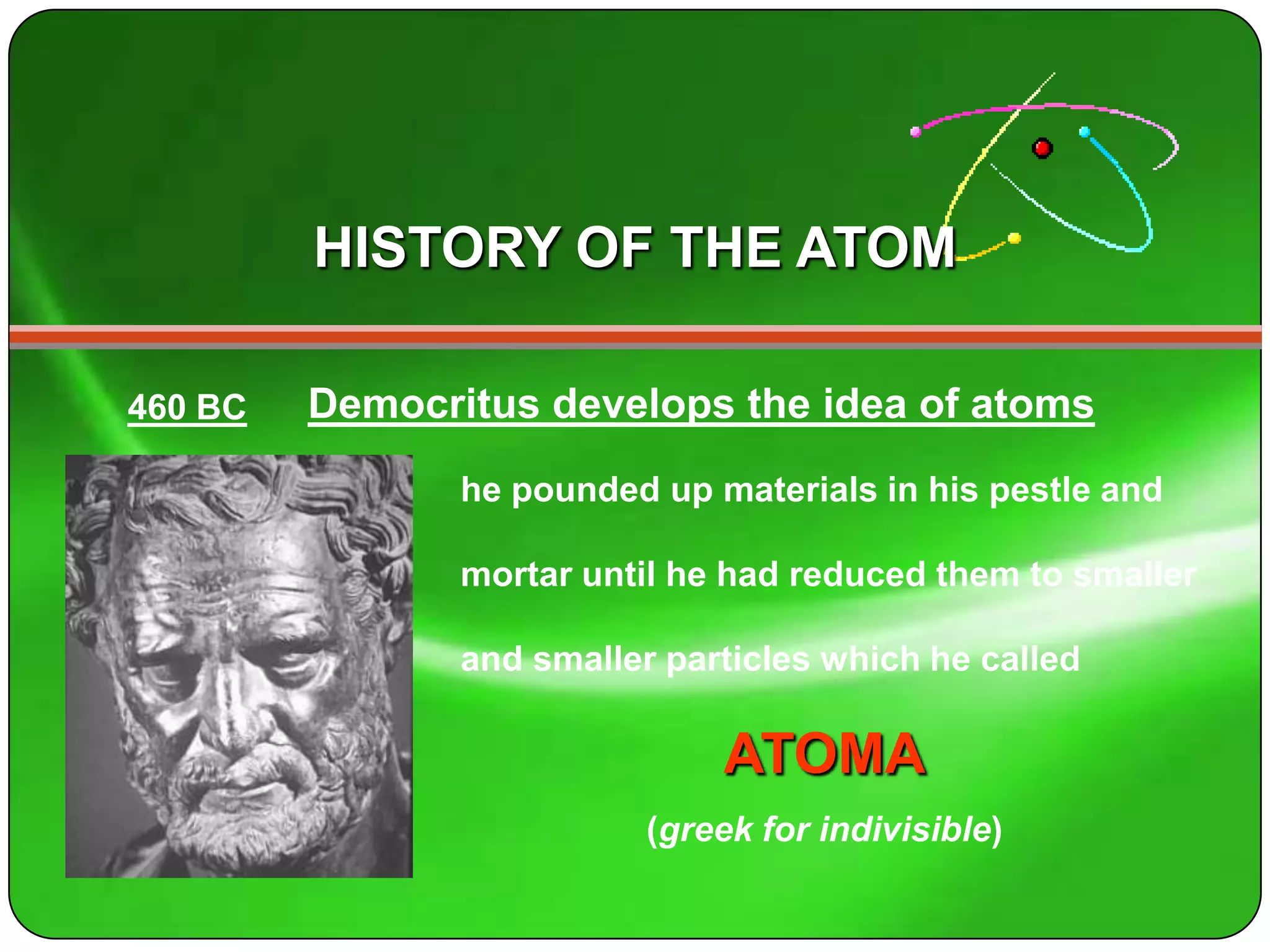
460 BC   Democritus develops the idea of atoms
                he pounded up materials in his pestle and

                mortar until he had reduced them to smaller

                and smaller particles which he called

                               ATOMA
                           (greek for indivisible)
HISTORY OF THE ATOM

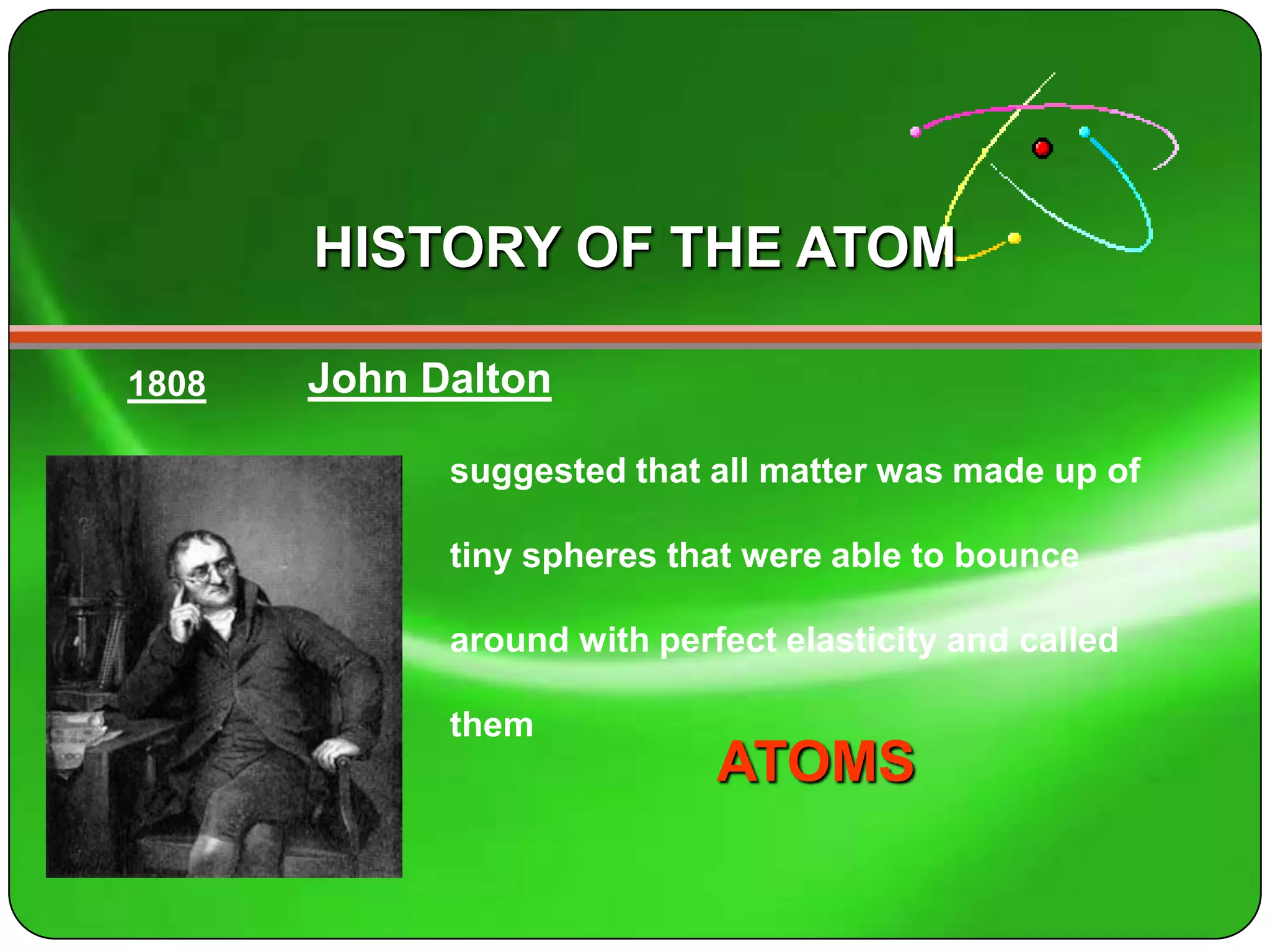
1808   John Dalton

             suggested that all matter was made up of

             tiny spheres that were able to bounce

             around with perfect elasticity and called

             them
                             ATOMS
HISTORY OF THE ATOM

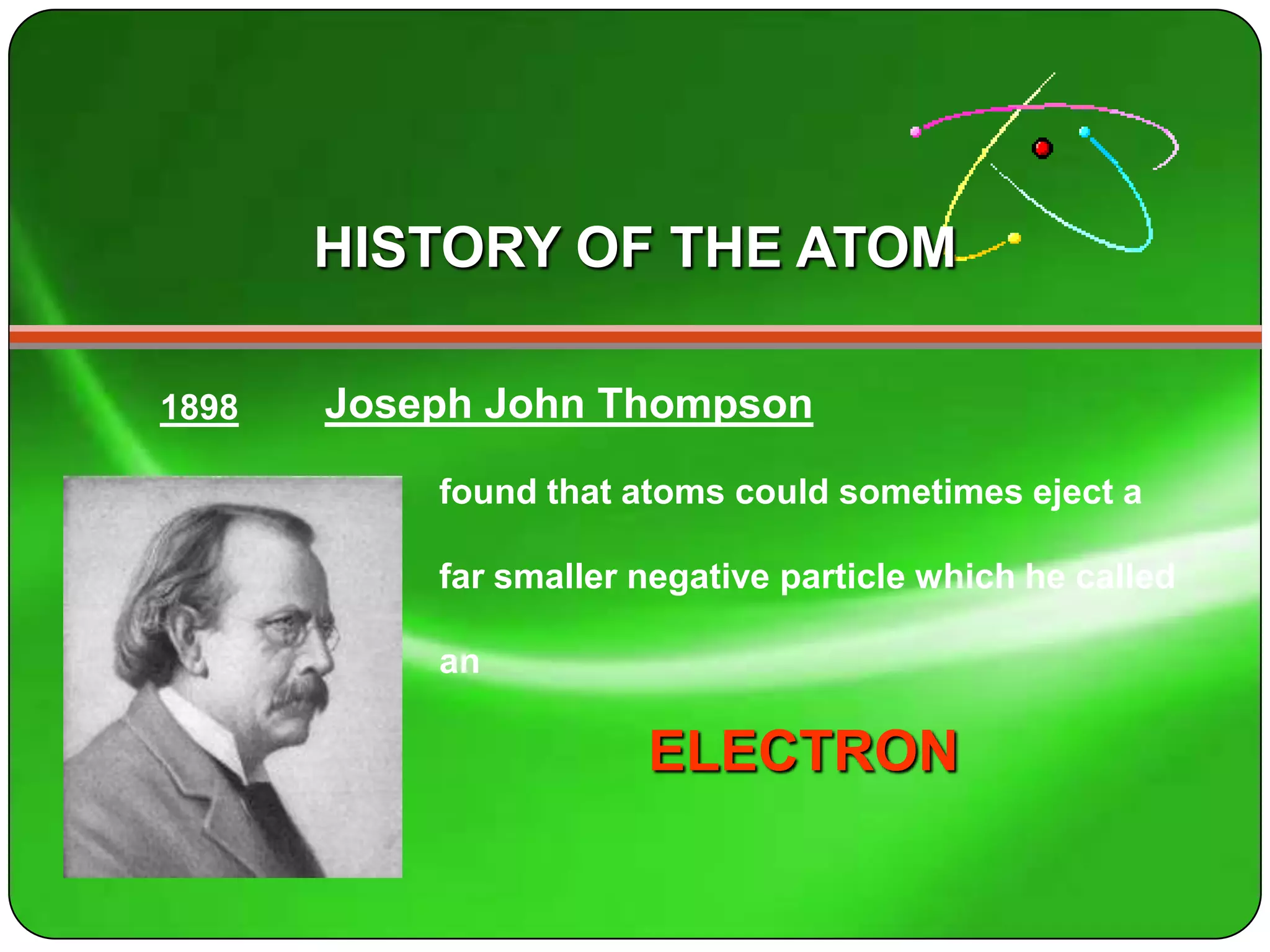
1898   Joseph John Thompson

           found that atoms could sometimes eject a

           far smaller negative particle which he called

           an

                       ELECTRON
HISTORY OF THE ATOM
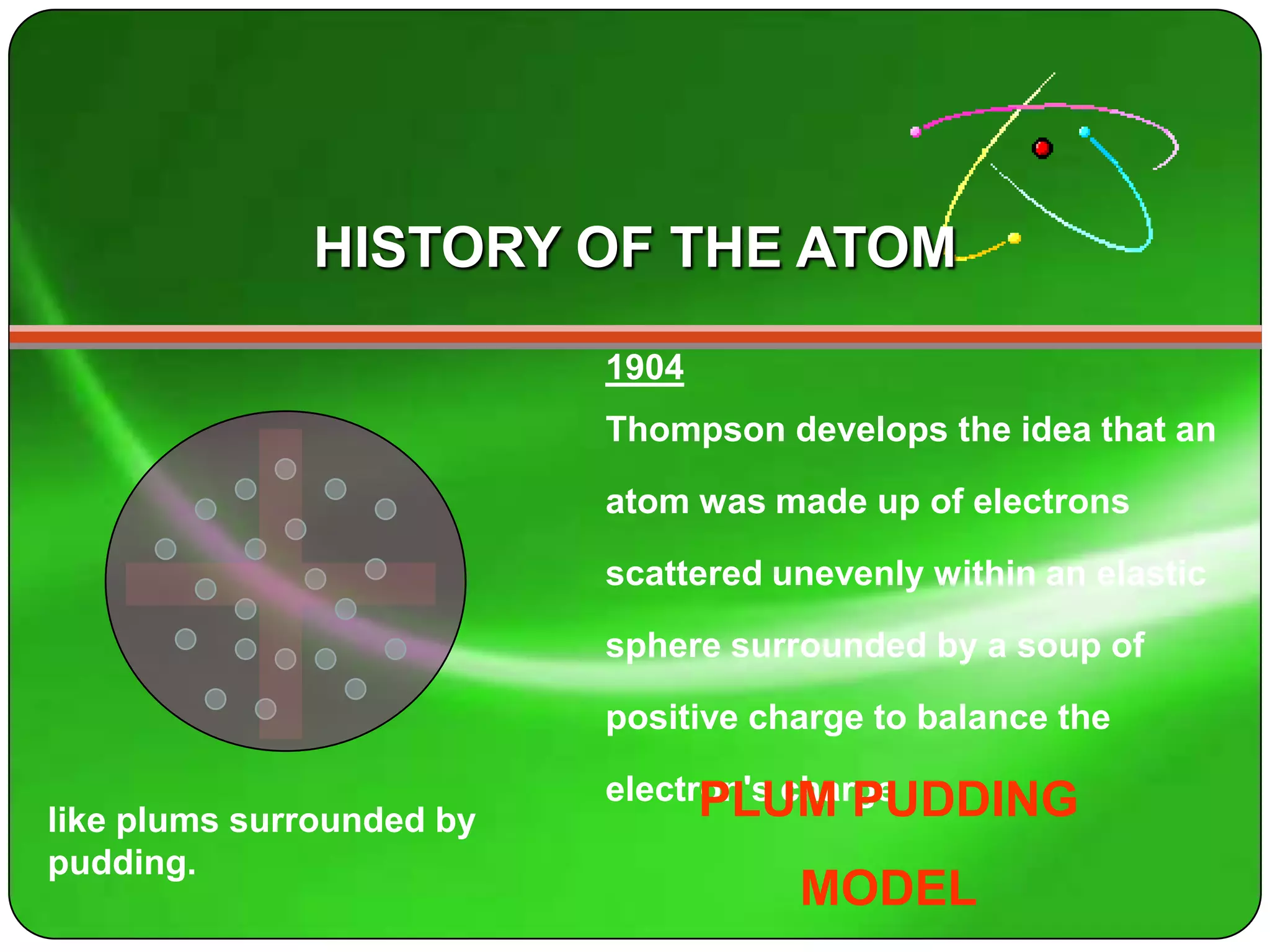
                           1904
                           Thompson develops the idea that an

                           atom was made up of electrons

                           scattered unevenly within an elastic

                           sphere surrounded by a soup of

                           positive charge to balance the

                           electron's charge
                                 PLUM PUDDING
like plums surrounded by
pudding.
                                      MODEL
HISTORY OF THE ATOM

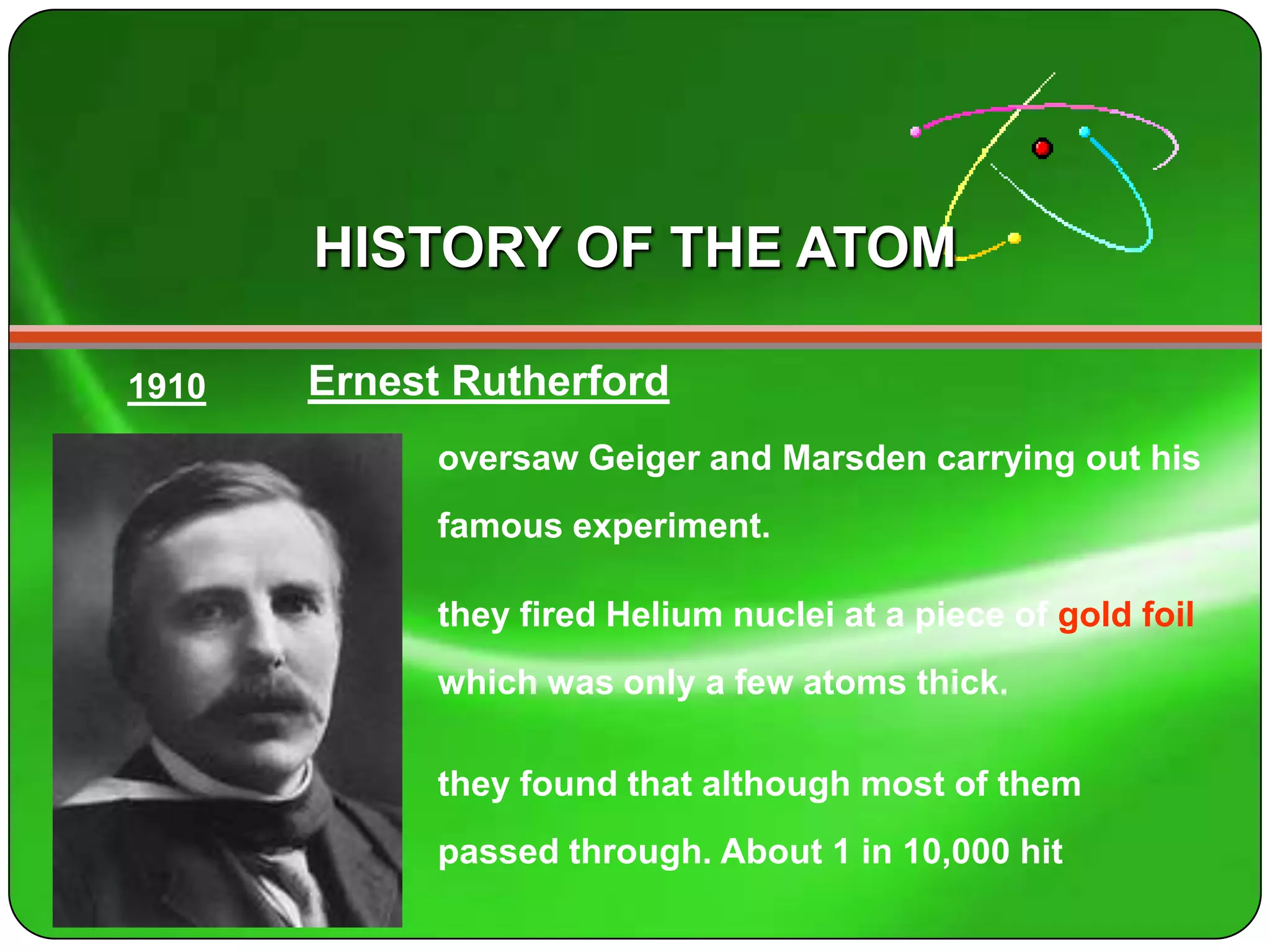
1910   Ernest Rutherford
             oversaw Geiger and Marsden carrying out his
             famous experiment.

             they fired Helium nuclei at a piece of gold foil
             which was only a few atoms thick.

             they found that although most of them
             passed through. About 1 in 10,000 hit
HISTORY OF THE ATOM

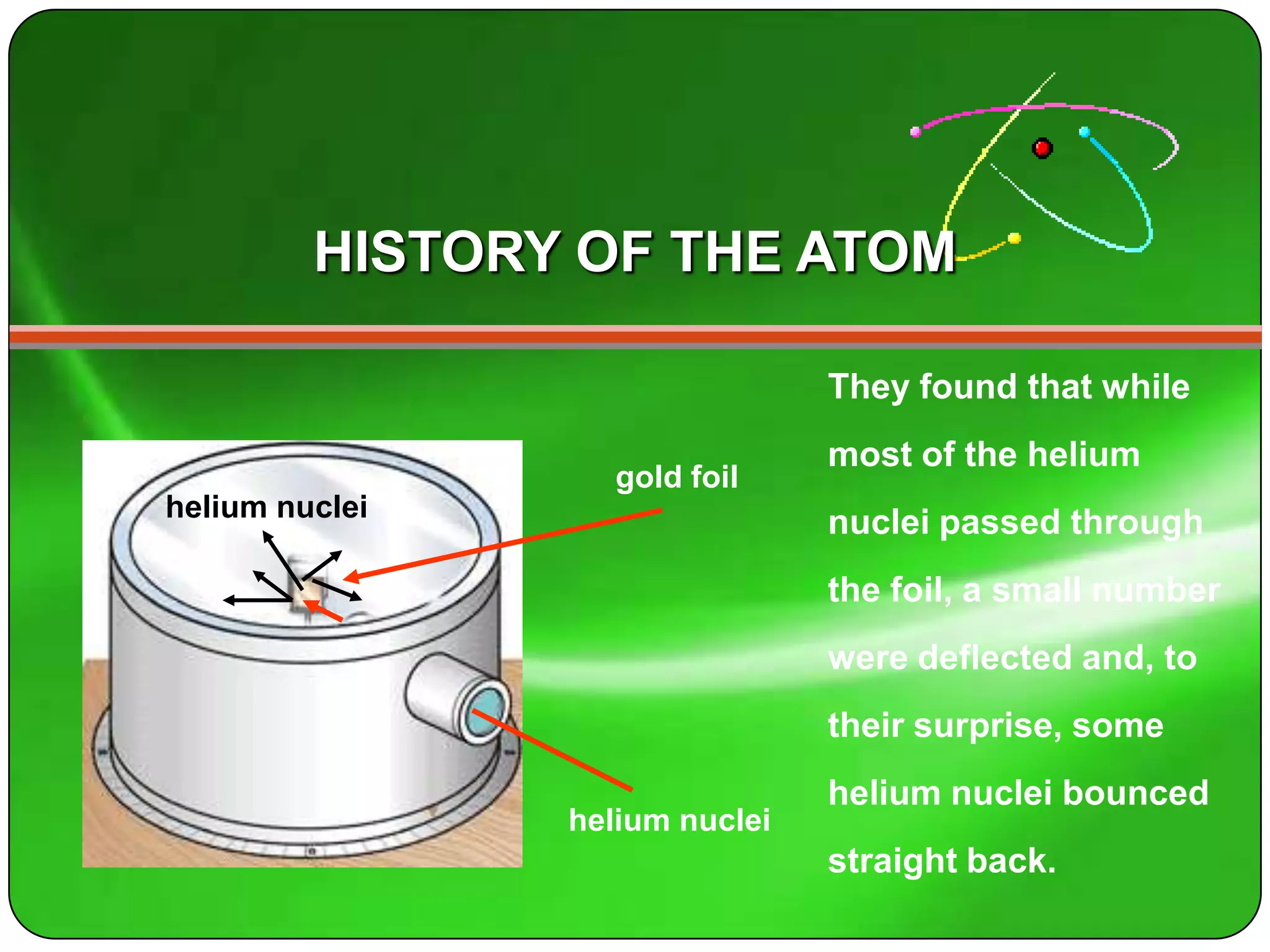
                                They found that while
                                most of the helium
                   gold foil
helium nuclei
                                nuclei passed through
                                the foil, a small number
                                were deflected and, to
                                their surprise, some
                                helium nuclei bounced
                helium nuclei
                                straight back.
HISTORY OF THE ATOM

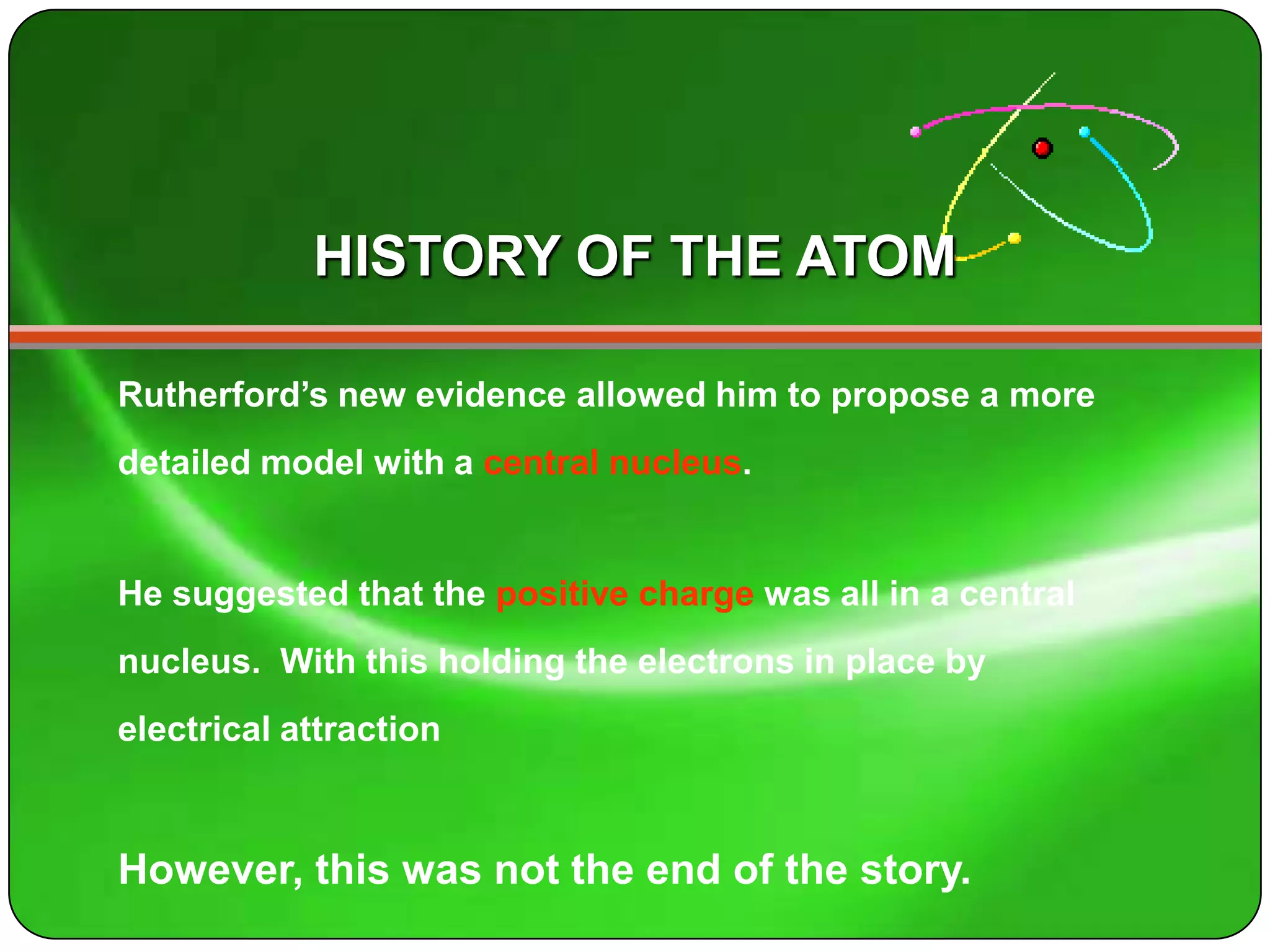
Rutherford’s new evidence allowed him to propose a more
detailed model with a central nucleus.


He suggested that the positive charge was all in a central
nucleus. With this holding the electrons in place by
electrical attraction


However, this was not the end of the story.
HISTORY OF THE ATOM

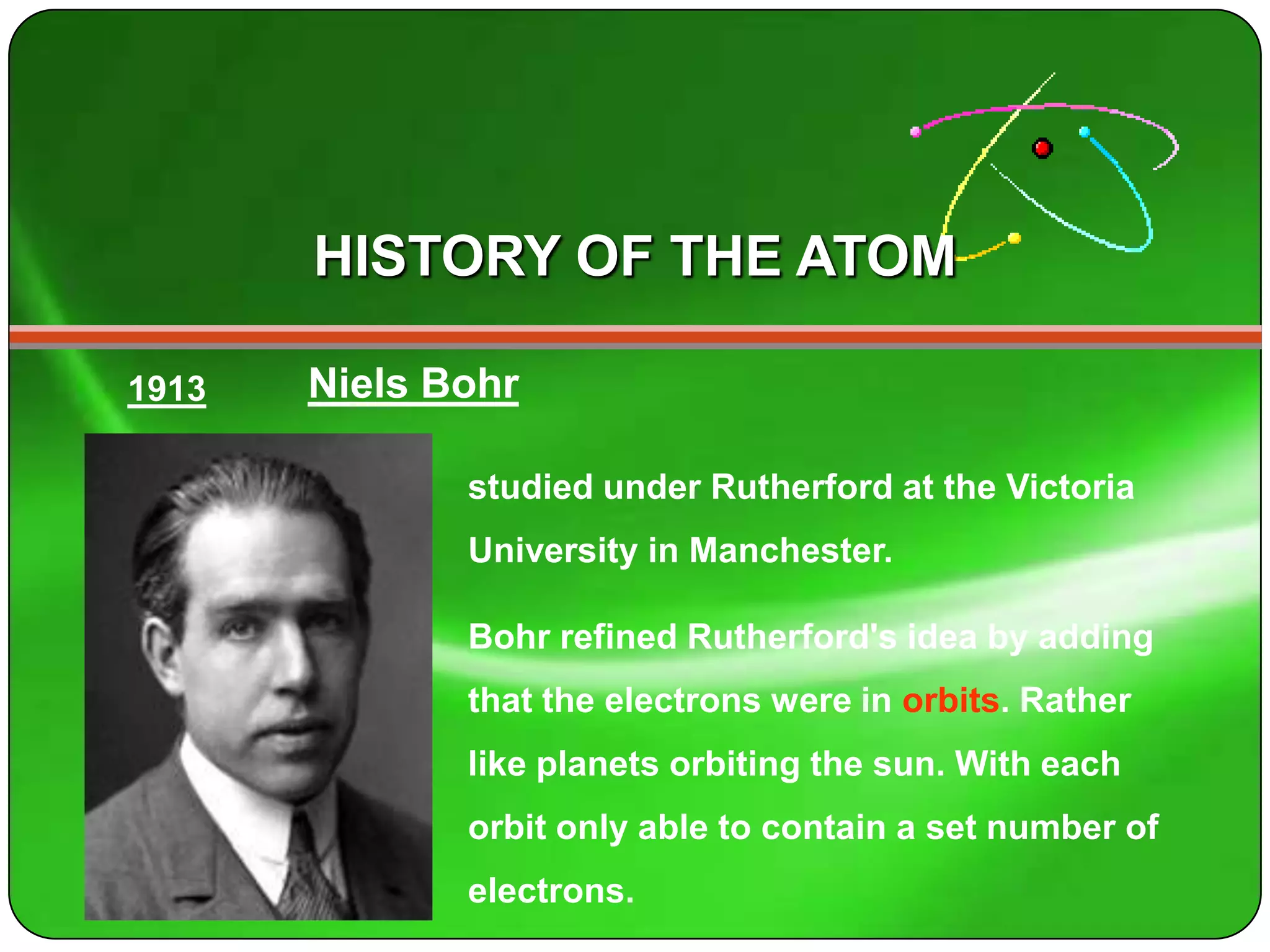
1913   Niels Bohr

              studied under Rutherford at the Victoria
              University in Manchester.

              Bohr refined Rutherford's idea by adding
              that the electrons were in orbits. Rather
              like planets orbiting the sun. With each
              orbit only able to contain a set number of
              electrons.
Atomic Structure
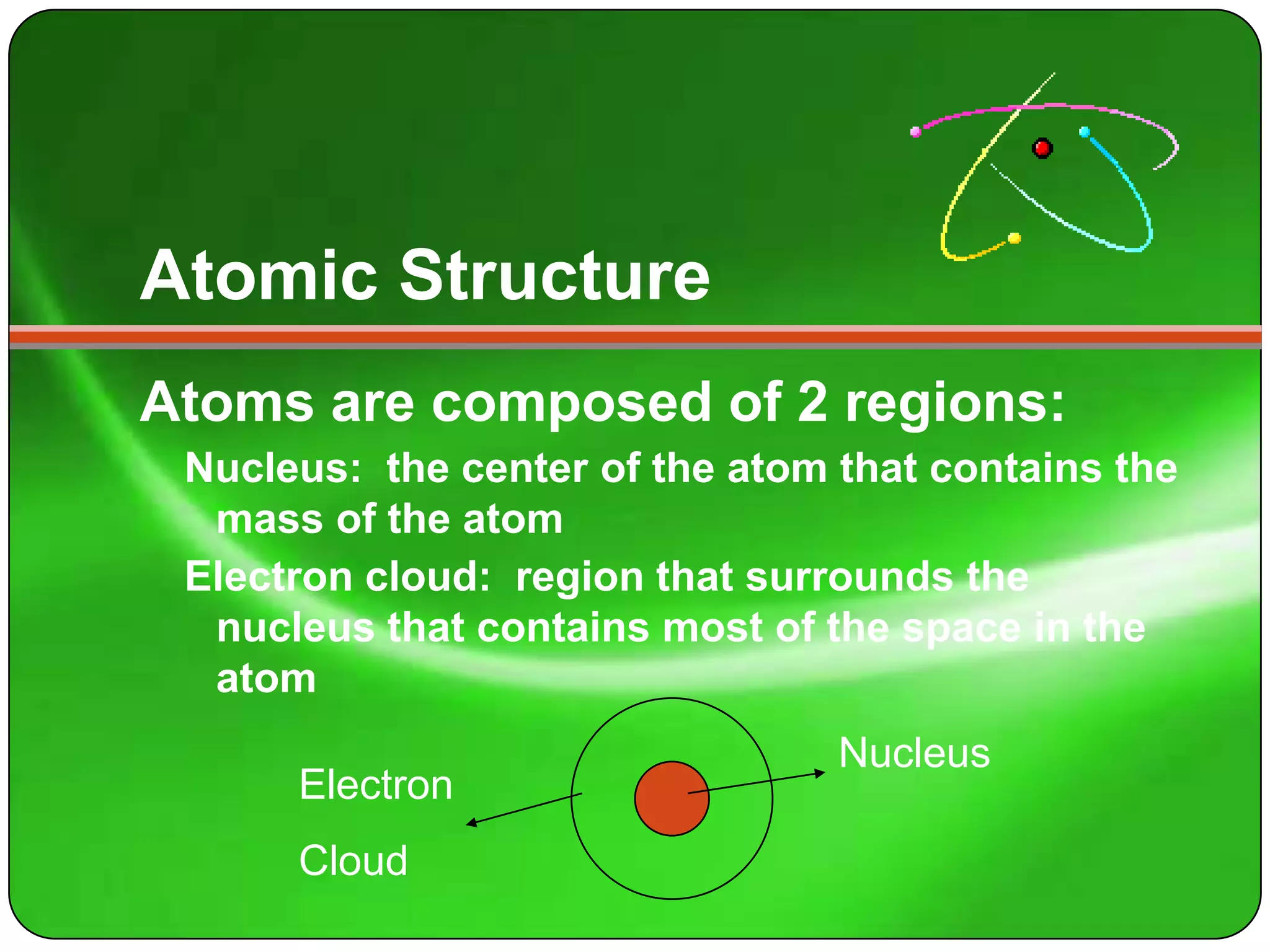
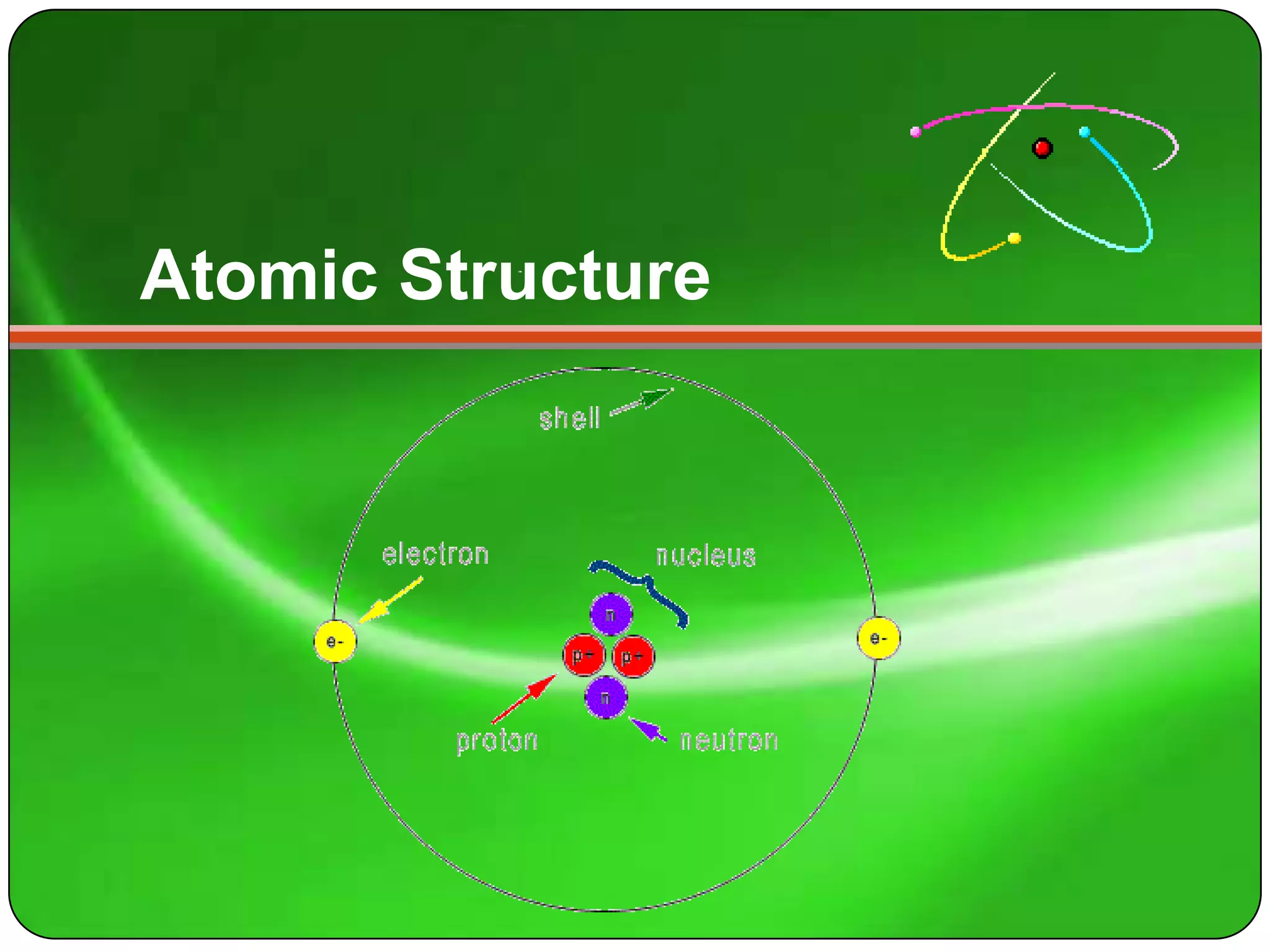
Atoms are composed of 2 regions:
 Nucleus: the center of the atom that contains the
  mass of the atom
 Electron cloud: region that surrounds the
  nucleus that contains most of the space in the
  atom
                                 Nucleus
      Electron
      Cloud
Atomic Structure
Atomic Structure
Atomic Structure
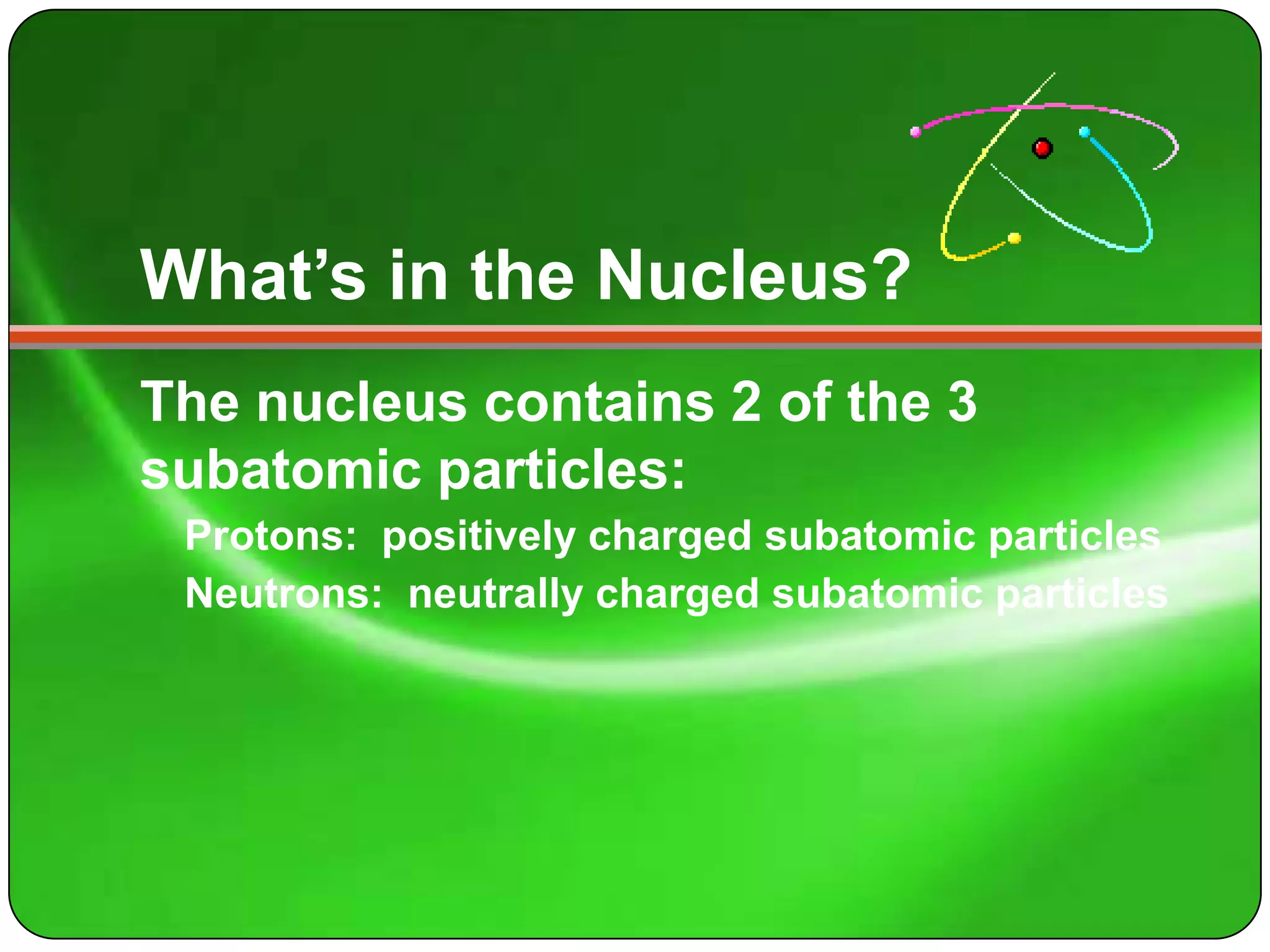
What’s in the Nucleus?
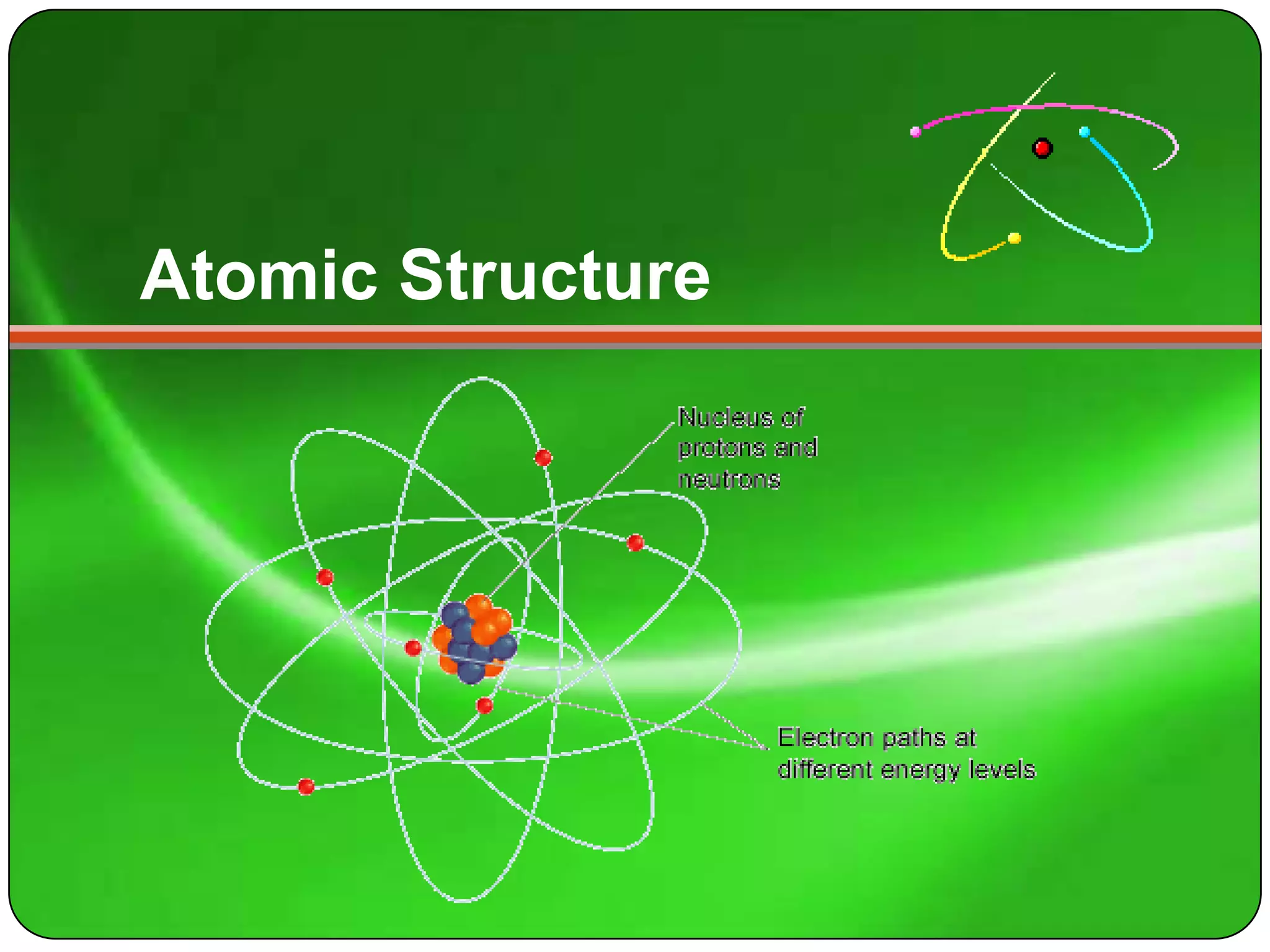
The nucleus contains 2 of the 3
subatomic particles:
 Protons: positively charged subatomic particles
 Neutrons: neutrally charged subatomic particles
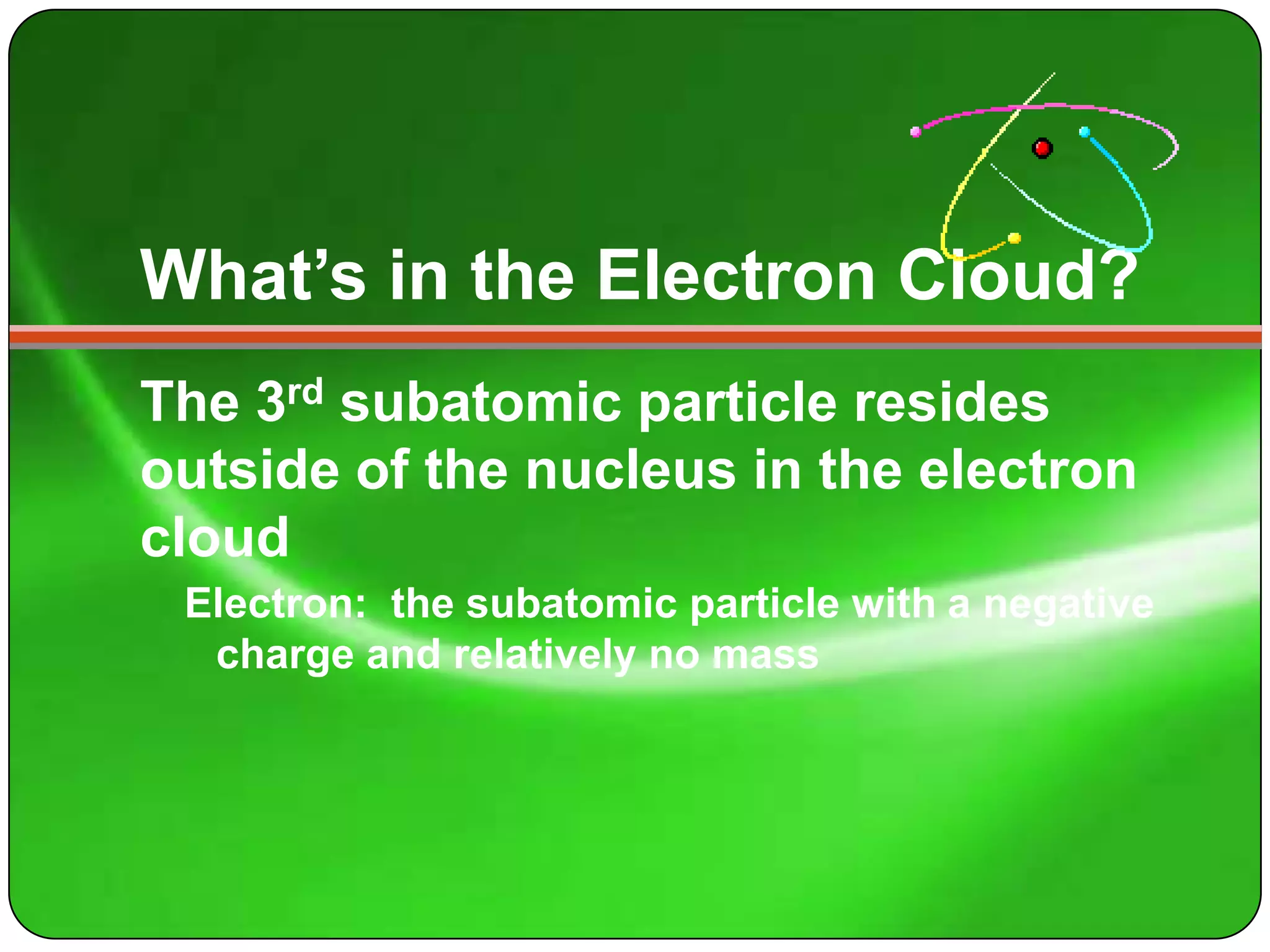
What’s in the Electron Cloud?
The 3rd subatomic particle resides
outside of the nucleus in the electron
cloud
 Electron: the subatomic particle with a negative
  charge and relatively no mass
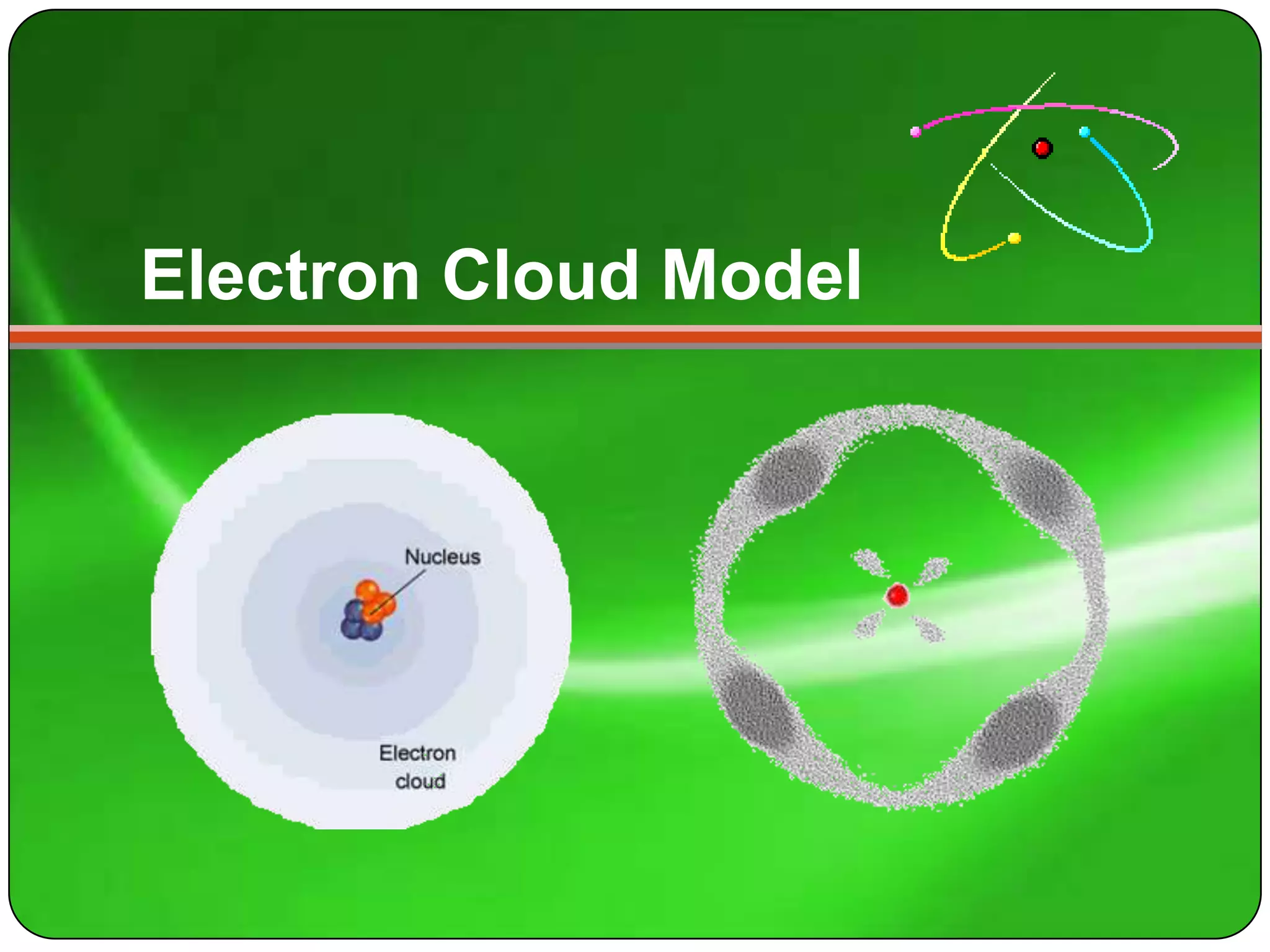
Electron Cloud Model
How do the subatomic particles
balance each other?
In an atom:
 The protons = the electrons
  If 20 protons are present in an atom then 20
     electrons are there to balance the overall
     charge of the atom—atoms are neutral
 The neutrons have no charge; therefore
  they do not have to equal the number of
  protons or electrons
How do we know the number of
subatomic particles in an atom?
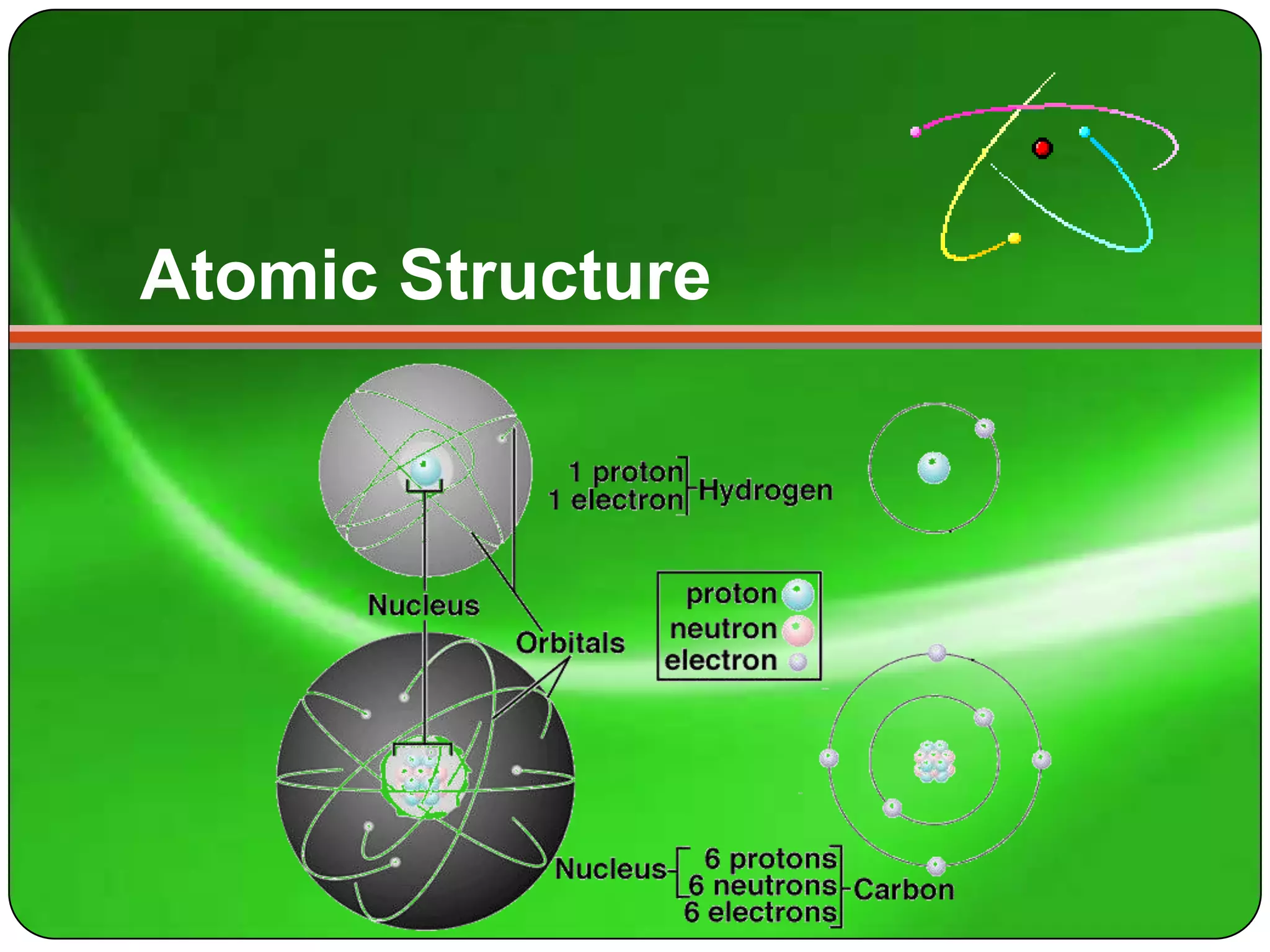
Atomic number: this number indicates
the number of protons in an atom
 Ex: Hydrogen’s atomic number is 1
   So hydrogen has 1 proton
 Ex: Carbon’s atomic number is 6
   So carbon has 6 protons
**The number of protons identifies the
atom.
   Ex. 2 protons = He, 29 protons = Cu
How do we know the number of
subatomic particles in an atom?
Mass number: the number of protons
and neutrons in the nucleus
 Ex: hydrogen can have a mass of 3.
  Since it has 1 proton it must have 2
  neutrons

  # of neutrons = mass # - atomic #
Determining the number of
protons and neutrons
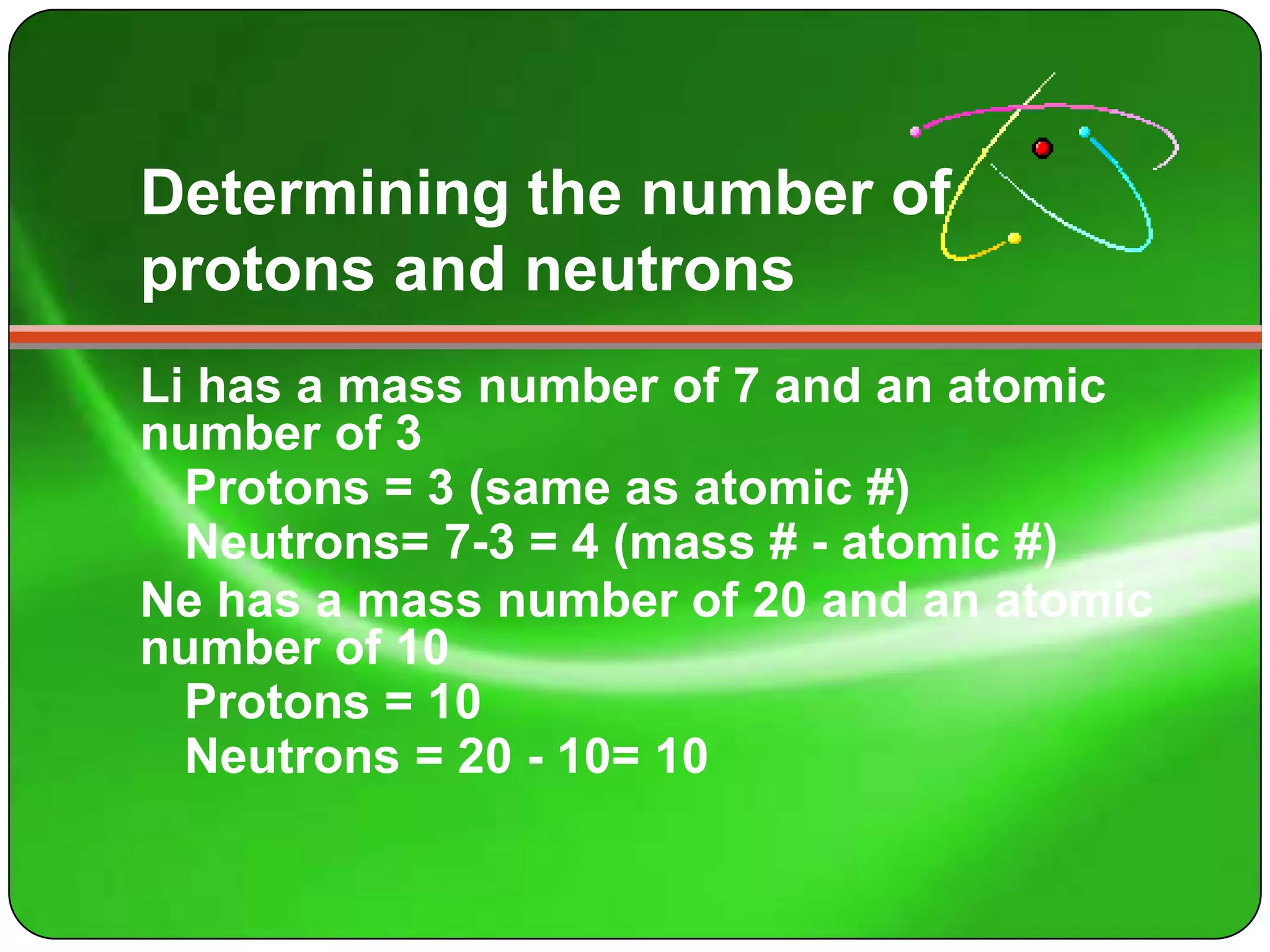
Li has a mass number of 7 and an atomic
number of 3
  Protons = 3 (same as atomic #)
  Neutrons= 7-3 = 4 (mass # - atomic #)
Ne has a mass number of 20 and an atomic
number of 10
  Protons = 10
  Neutrons = 20 - 10= 10
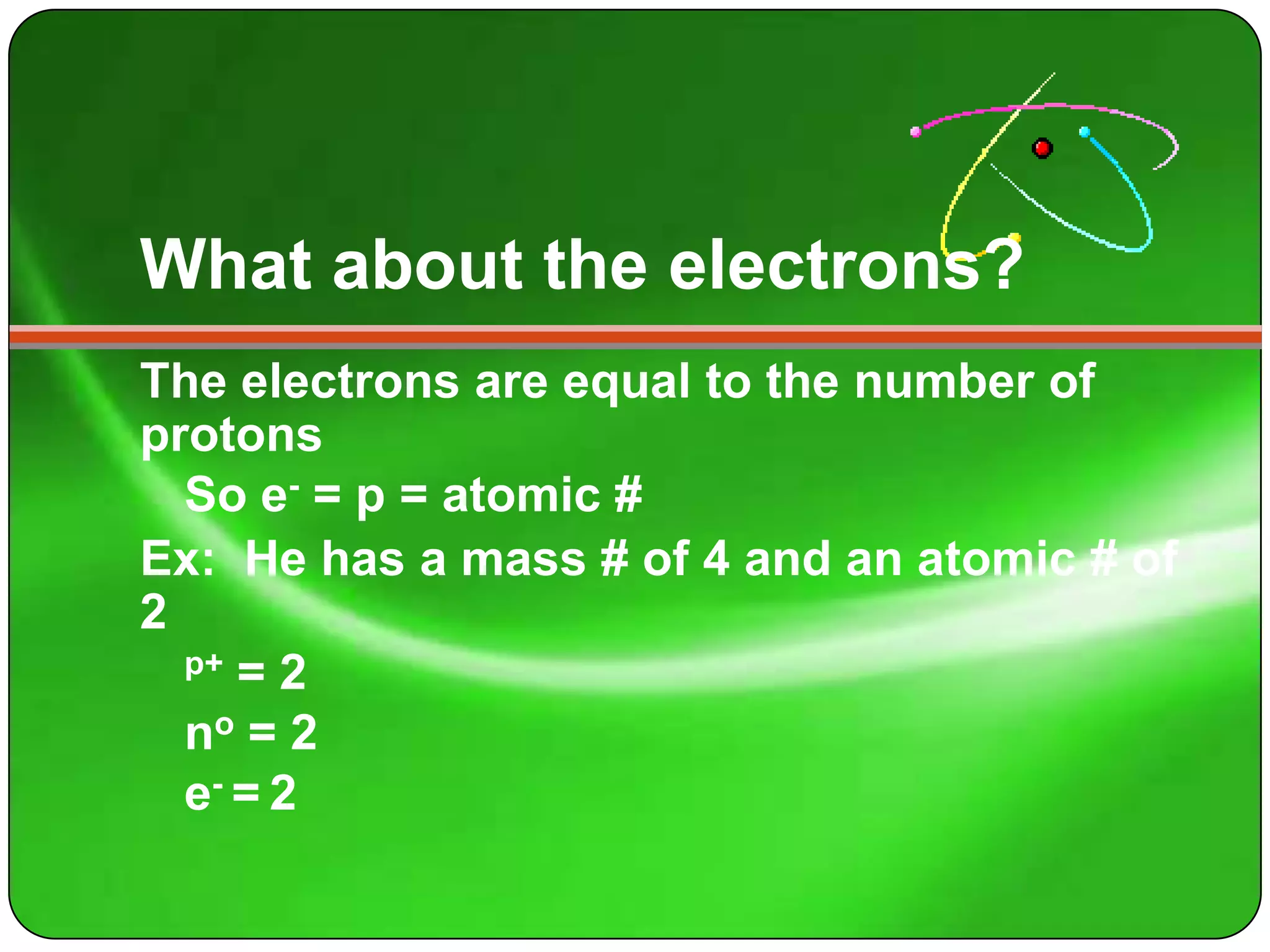
What about the electrons?
The electrons are equal to the number of
protons
  So e- = p = atomic #
Ex: He has a mass # of 4 and an atomic # of
2
  p+ = 2

  no = 2
  e- = 2
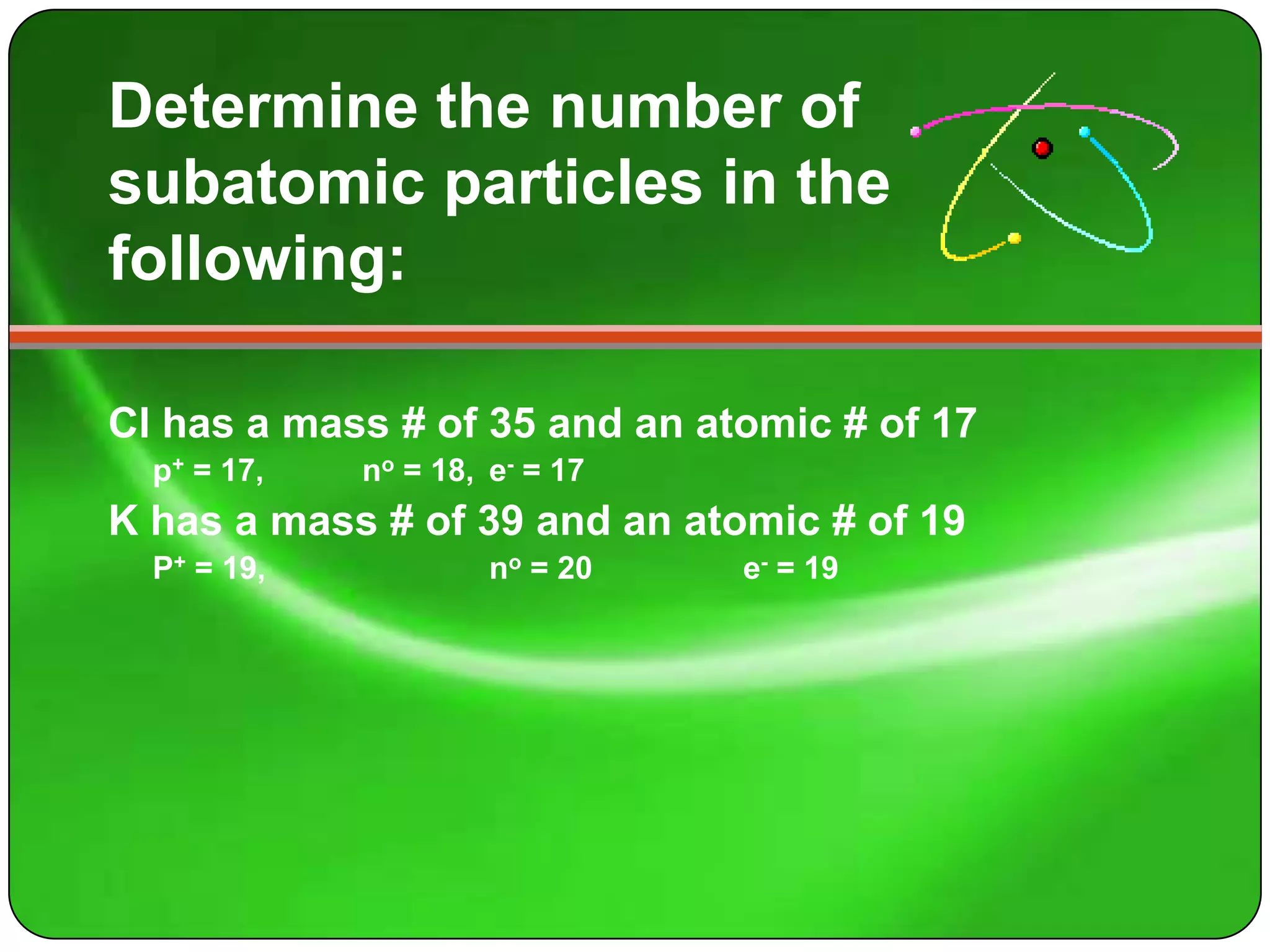
Determine the number of
subatomic particles in the
following:

Cl has a mass # of 35 and an atomic # of 17
  p+ = 17,   no = 18, e- = 17
K has a mass # of 39 and an atomic # of 19
  P+ = 19,            no = 20   e- = 19
How exactly are the particles
arranged?
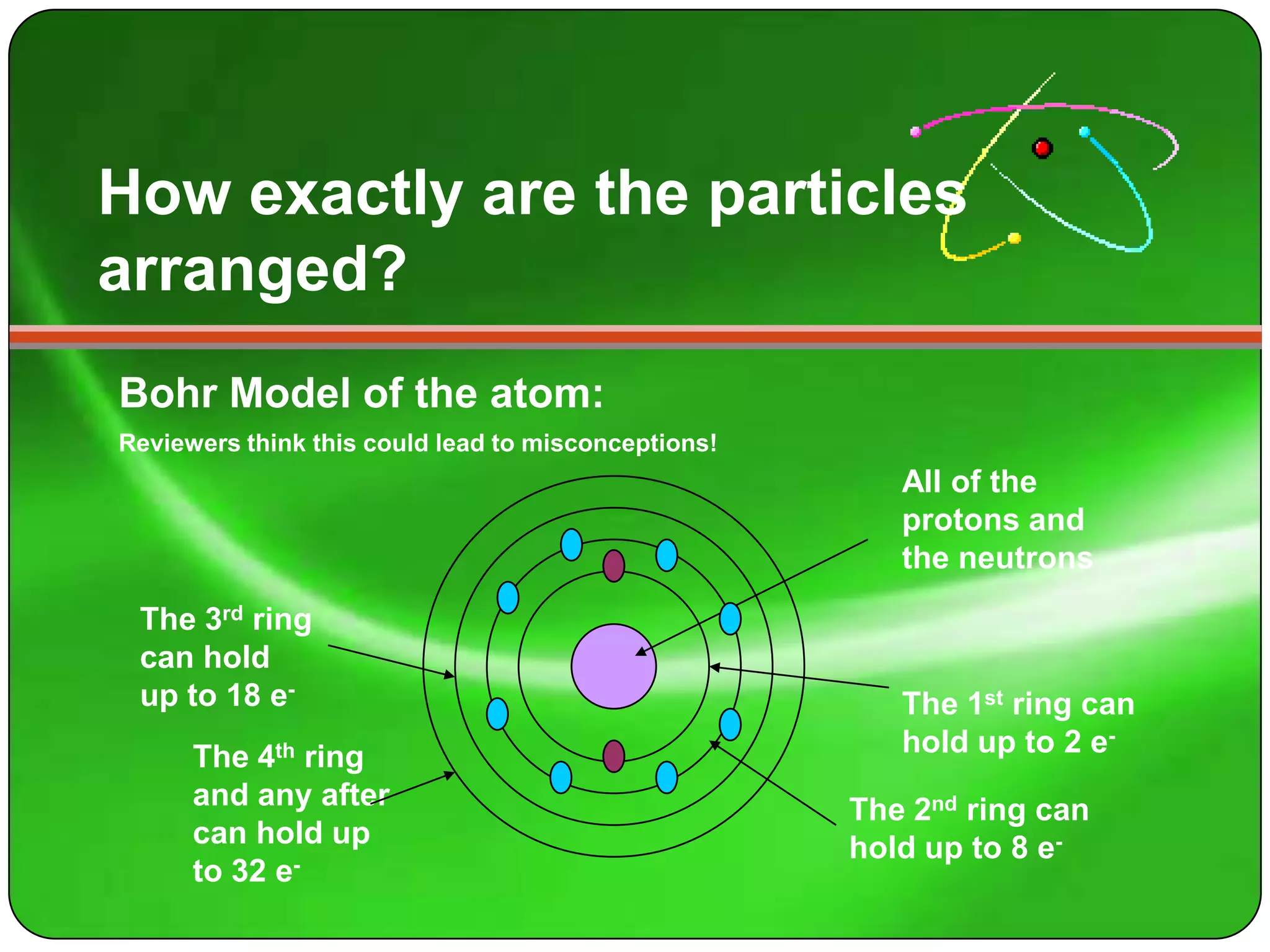
Bohr Model of the atom:
Reviewers think this could lead to misconceptions!
                                                        All of the
                                                        protons and
                                                        the neutrons
 The 3rd ring
 can hold
 up to 18 e-                                            The 1st ring can
      The 4th ring                                      hold up to 2 e-
      and any after                                  The 2nd ring can
      can hold up                                    hold up to 8 e-
      to 32 e-
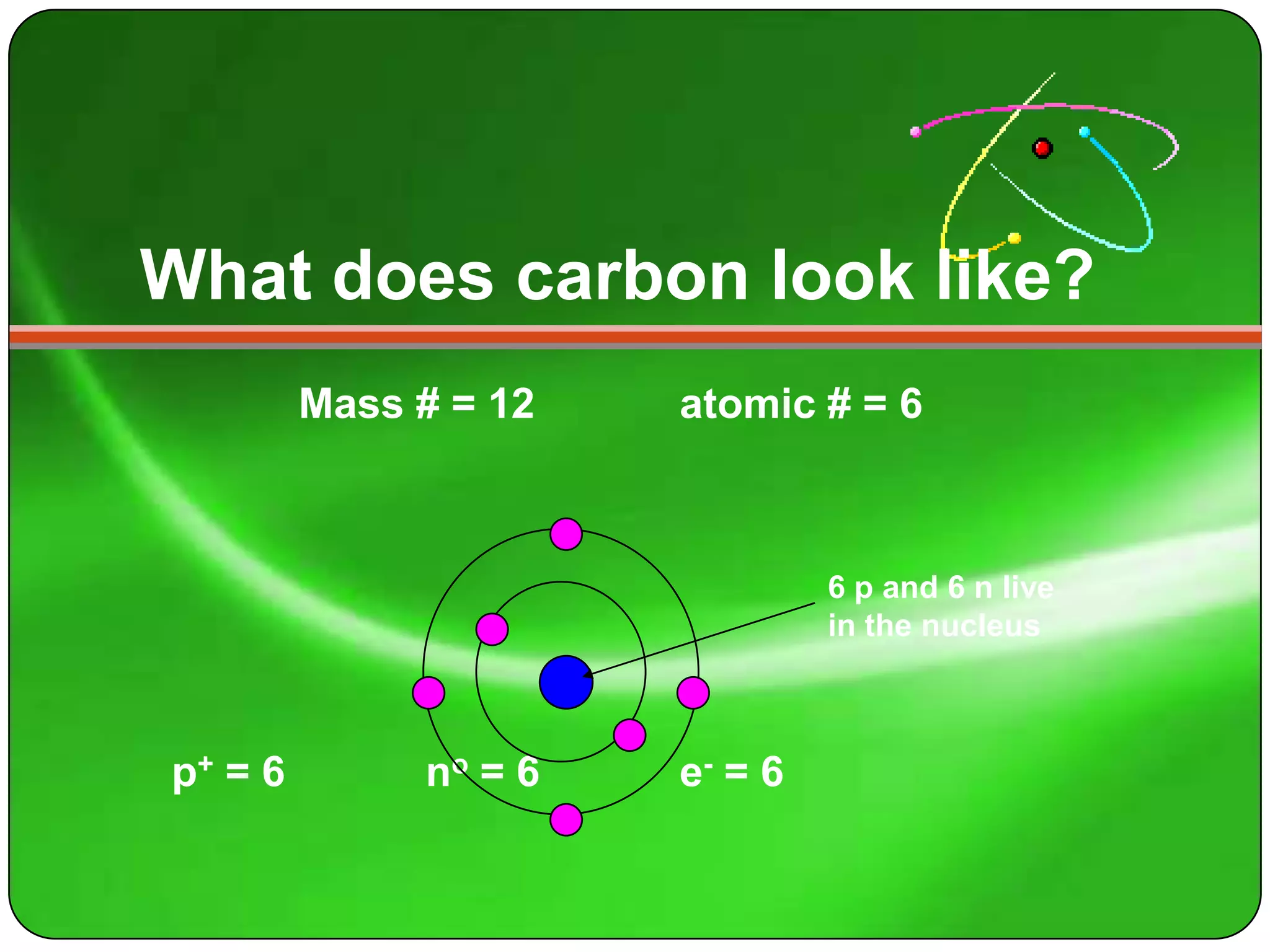
What does carbon look like?
         Mass # = 12   atomic # = 6


                                6 p and 6 n live
                                in the nucleus


p+ = 6        no = 6   e- = 6

Structure of atom

  • 1.
    TYPES OF SERVICE Johann Kelly T. Almelor BSHRM – 1B
  • 2.
    What is foodservice? There are some basic principles in food and beverage service that a waiter must know: • When food is served by the waiter at the table from a platter onto a guest plate, the service is done from the left. • When food is pre-plated the service to the guest is usually done from the right, though modern convention permits service from the left also. • All beverages are served from the right. • Soups are served from the right unless it is poured by a waiter from a large tureen into a soup cup in which case it is done from the left of the guest. • Ladies are always served first and the remaining guests clockwise. Soiled plates should always be cleared from the table from the right. • Empty crockery and fresh cutlery are always served from the right. Never reach across a Customer. Hence, when a guest is
  • 3.
    HISTORY OF THEATOM 460 BC Democritus develops the idea of atoms he pounded up materials in his pestle and mortar until he had reduced them to smaller and smaller particles which he called ATOMA (greek for indivisible)
  • 4.
    HISTORY OF THEATOM 1808 John Dalton suggested that all matter was made up of tiny spheres that were able to bounce around with perfect elasticity and called them ATOMS
  • 5.
    HISTORY OF THEATOM 1898 Joseph John Thompson found that atoms could sometimes eject a far smaller negative particle which he called an ELECTRON
  • 6.
    HISTORY OF THEATOM 1904 Thompson develops the idea that an atom was made up of electrons scattered unevenly within an elastic sphere surrounded by a soup of positive charge to balance the electron's charge PLUM PUDDING like plums surrounded by pudding. MODEL
  • 7.
    HISTORY OF THEATOM 1910 Ernest Rutherford oversaw Geiger and Marsden carrying out his famous experiment. they fired Helium nuclei at a piece of gold foil which was only a few atoms thick. they found that although most of them passed through. About 1 in 10,000 hit
  • 8.
    HISTORY OF THEATOM They found that while most of the helium gold foil helium nuclei nuclei passed through the foil, a small number were deflected and, to their surprise, some helium nuclei bounced helium nuclei straight back.
  • 9.
    HISTORY OF THEATOM Rutherford’s new evidence allowed him to propose a more detailed model with a central nucleus. He suggested that the positive charge was all in a central nucleus. With this holding the electrons in place by electrical attraction However, this was not the end of the story.
  • 10.
    HISTORY OF THEATOM 1913 Niels Bohr studied under Rutherford at the Victoria University in Manchester. Bohr refined Rutherford's idea by adding that the electrons were in orbits. Rather like planets orbiting the sun. With each orbit only able to contain a set number of electrons.
  • 11.
    Atomic Structure Atoms arecomposed of 2 regions: Nucleus: the center of the atom that contains the mass of the atom Electron cloud: region that surrounds the nucleus that contains most of the space in the atom Nucleus Electron Cloud
  • 12.
  • 13.
  • 14.
  • 15.
    What’s in theNucleus? The nucleus contains 2 of the 3 subatomic particles: Protons: positively charged subatomic particles Neutrons: neutrally charged subatomic particles
  • 16.
    What’s in theElectron Cloud? The 3rd subatomic particle resides outside of the nucleus in the electron cloud Electron: the subatomic particle with a negative charge and relatively no mass
  • 17.
  • 18.
    How do thesubatomic particles balance each other? In an atom: The protons = the electrons If 20 protons are present in an atom then 20 electrons are there to balance the overall charge of the atom—atoms are neutral The neutrons have no charge; therefore they do not have to equal the number of protons or electrons
  • 19.
    How do weknow the number of subatomic particles in an atom? Atomic number: this number indicates the number of protons in an atom Ex: Hydrogen’s atomic number is 1 So hydrogen has 1 proton Ex: Carbon’s atomic number is 6 So carbon has 6 protons **The number of protons identifies the atom. Ex. 2 protons = He, 29 protons = Cu
  • 20.
    How do weknow the number of subatomic particles in an atom? Mass number: the number of protons and neutrons in the nucleus Ex: hydrogen can have a mass of 3. Since it has 1 proton it must have 2 neutrons # of neutrons = mass # - atomic #
  • 21.
    Determining the numberof protons and neutrons Li has a mass number of 7 and an atomic number of 3 Protons = 3 (same as atomic #) Neutrons= 7-3 = 4 (mass # - atomic #) Ne has a mass number of 20 and an atomic number of 10 Protons = 10 Neutrons = 20 - 10= 10
  • 22.
    What about theelectrons? The electrons are equal to the number of protons So e- = p = atomic # Ex: He has a mass # of 4 and an atomic # of 2 p+ = 2 no = 2 e- = 2
  • 23.
    Determine the numberof subatomic particles in the following: Cl has a mass # of 35 and an atomic # of 17 p+ = 17, no = 18, e- = 17 K has a mass # of 39 and an atomic # of 19 P+ = 19, no = 20 e- = 19
  • 24.
    How exactly arethe particles arranged? Bohr Model of the atom: Reviewers think this could lead to misconceptions! All of the protons and the neutrons The 3rd ring can hold up to 18 e- The 1st ring can The 4th ring hold up to 2 e- and any after The 2nd ring can can hold up hold up to 8 e- to 32 e-
  • 25.
    What does carbonlook like? Mass # = 12 atomic # = 6 6 p and 6 n live in the nucleus p+ = 6 no = 6 e- = 6