


SHOAIB AHMED SIDDIQUI & MUHAMMAD TAUQEER
• Differential warming of the earth causes pressure differences in the
atmosphere, which generate winds
• As winds move across the surface of open bodies of water, they transfer some
of their energy to the water and create waves
• Waves travel vast distances across oceans at great speed. The longer and
stronger the wind blows over the sea surface, the higher, longer, faster and
more powerful the wave is.
Where does wave energy originate?
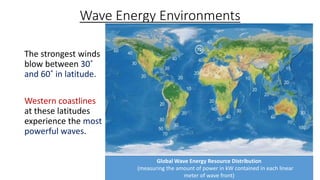
Wave Energy Environments
The strongest winds
blow between 30˚
and 60˚ in latitude.
Western coastlines
at these latitudes
experience the most
powerful waves.
Global Wave Energy Resource Distribution
(measuring the amount of power in kW contained in each linear
meter of wave front)
Wave Power: history
A bit of history…
– First concepts 200 years ago, but viable schemes only in the 1970’
– Increased interest for RE, and specifically for wage energy, after the energy
crisis in 1973, but insufficient money allocated to bring projects to maturity
– 80’ because of oil price fall, wave energy funding reduced significantly
– 90’ growing awareness of the potential of generating energy from waves
Wave Energy
• The Electric Power Research Institute (EPRI) estimates that the annual
average incident wave energy off of the U.S. coastline amounts to
2100 terawatt hours per year. (A terawatt equals a trillion watts.)
• Extracting 20% of that total energy at 50% conversion efficiency
would generate as much electricity as conventional hydropower
currently provides – 7% of total U.S. electricity consumption, or 210
terawatt hours per year.
The world's fossil fuels are dwindling whilst the
amounts of CO2 in the atmosphere is increasing. What
we need is an energy source that doesn't pollute,
doesn't increase CO2 levels and is renewable. That's
why we have wave power
How do we extract
wave energy?
In order to extract this energy, wave energy conversion devices must
create a system of reacting forces, in which two or more bodies move
relative to each other, while at least one body interacts with the
waves.
There are many ways that such a system could be configured.
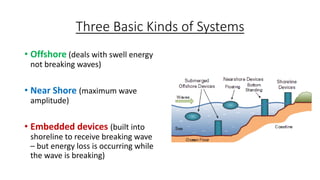
Three Basic Kinds of Systems
• Offshore (deals with swell energy
not breaking waves)
• Near Shore (maximum wave
amplitude)
• Embedded devices (built into
shoreline to receive breaking wave
– but energy loss is occurring while
the wave is breaking)
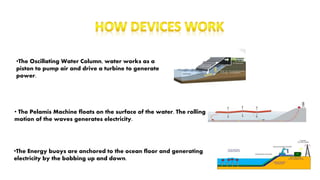
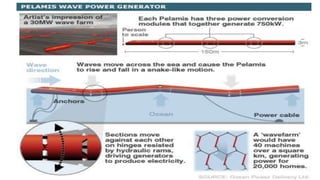
• The Pelamis Machine floats on the surface of the water. The rolling
motion of the waves generates electricity.
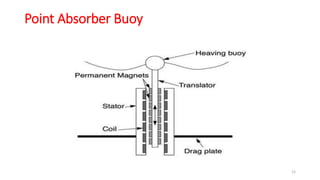
•The Energy buoys are anchored to the ocean floor and generating
electricity by the bobbing up and down.
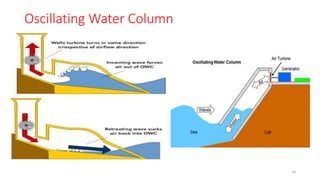
•The Oscillating Water Column, water works as a
piston to pump air and drive a turbine to generate
power.
Oscillating Water Column
10
Point Absorber Buoy
12
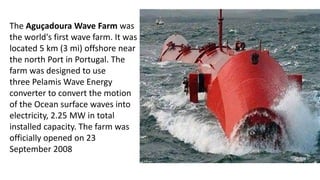
The Aguçadoura Wave Farm was
the world's first wave farm. It was
located 5 km (3 mi) offshore near
the north Port in Portugal. The
farm was designed to use
three Pelamis Wave Energy
converter to convert the motion
of the Ocean surface waves into
electricity, 2.25 MW in total
installed capacity. The farm was
officially opened on 23
September 2008
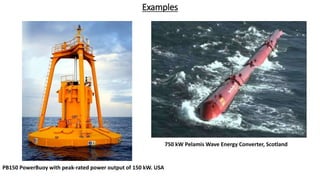
Examples
PB150 PowerBuoy with peak-rated power output of 150 kW. USA
750 kW Pelamis Wave Energy Converter, Scotland
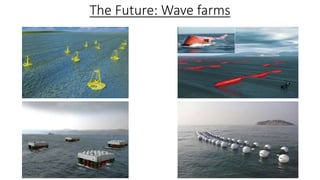
The Future: Wave farms
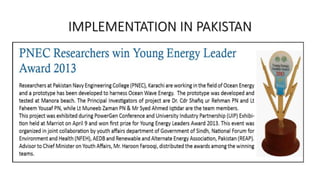
IMPLEMENTATION IN PAKISTAN
Electricity shortfall reaches 5500 MW in Pakistan
• Load shedding duration has increased as
difference in the supply and demand of
power hit 5,500 MW a mid ongoing intense
heatwave in most parts of the country.
• Currently, electricity generation is 15,500
MW against the demand of 21,000 MW.
Benefits of Wave Energy
• Available 24/7 on 365 days - therefore power produced from them is
much steadier and more predictable – waves can be accurately predicted
48 hours in advance and therefore forecast energy output (BUT
irregularity in wave ampitude, and direction)
• Good data on waves from wave monitoring bouys
• Wave energy contains 1000 times the kinetic energy of wind (can produce
the same amount of power in less space)
• Wave power does not produce greenhouse gases.
• The energy is free - no fuel needed, no waste produced.
CONCLUSION
• Ocean waves are both clean and
renewable sources of energy
with a tremendous worldwide
potential of generating
electricity.
• If fully exploited, about 40% of
the world’s power demand could
be supplied by this resource –
equivalent to as much as 800
nuclear power plants.
At the University of Edinburgh, Prof. Salter developed what is known
today as Salter’s Duck. Salter’s Duck looked like very large boxes that
were attached to the ocean floor. As the waves moved them back and
forth, the mechanical energy became electrical energy, which drove a
generator. Salter’s Duck was able to capture 90 percent of the wave
motion and 90 percent of that could be turned into electrical energy,
which is very impressive. In addition, at the time the Duck was
completed, the cost of the electricity was the same as nuclear power
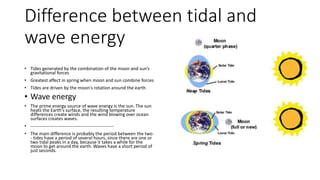
Difference between tidal and
wave energy
• Tides generated by the combination of the moon and sun’s
gravitational forces
• Greatest affect in spring when moon and sun combine forces
• Tides are driven by the moon's rotation around the earth
• Wave energy
• The prime energy source of wave energy is the sun. The sun
heats the Earth's surface, the resulting temperature
differences create winds and the wind blowing over ocean
surfaces creates waves.
• ------------------------------------------------------
• The main difference is probably the period between the two
- tides have a period of several hours, since there are one or
two tidal peaks in a day, because it takes a while for the
moon to get around the earth. Waves have a short period of
just seconds.
There were a series of energy crises between 1967 and
1979 caused by problems in the Middle East but the most
significant started in 1973 when Arab oil producers
imposed an embargo.
The decision to boycott America and punish the west in
response to support for Israel in the Yom Kippur war against
Egypt led the price of crude to rise from $3 per barrel to
$12 by 1974.
The price of petrol rocketed, making all transport more
expensive. There was even talk in Britain of rationing using
coupons left over from the second world war.
• the best wave generator technology in place in the United Kingdom is
producing energy at an average projected/assessed cost of 7.5 cents
kWh

Power generation through waves

  • 1.
    SHOAIB AHMED SIDDIQUI& MUHAMMAD TAUQEER
  • 2.
    • Differential warmingof the earth causes pressure differences in the atmosphere, which generate winds • As winds move across the surface of open bodies of water, they transfer some of their energy to the water and create waves • Waves travel vast distances across oceans at great speed. The longer and stronger the wind blows over the sea surface, the higher, longer, faster and more powerful the wave is. Where does wave energy originate?
  • 3.
    Wave Energy Environments Thestrongest winds blow between 30˚ and 60˚ in latitude. Western coastlines at these latitudes experience the most powerful waves. Global Wave Energy Resource Distribution (measuring the amount of power in kW contained in each linear meter of wave front)
  • 4.
    Wave Power: history Abit of history… – First concepts 200 years ago, but viable schemes only in the 1970’ – Increased interest for RE, and specifically for wage energy, after the energy crisis in 1973, but insufficient money allocated to bring projects to maturity – 80’ because of oil price fall, wave energy funding reduced significantly – 90’ growing awareness of the potential of generating energy from waves
  • 5.
    Wave Energy • TheElectric Power Research Institute (EPRI) estimates that the annual average incident wave energy off of the U.S. coastline amounts to 2100 terawatt hours per year. (A terawatt equals a trillion watts.) • Extracting 20% of that total energy at 50% conversion efficiency would generate as much electricity as conventional hydropower currently provides – 7% of total U.S. electricity consumption, or 210 terawatt hours per year.
  • 6.
    The world's fossilfuels are dwindling whilst the amounts of CO2 in the atmosphere is increasing. What we need is an energy source that doesn't pollute, doesn't increase CO2 levels and is renewable. That's why we have wave power
  • 7.
    How do weextract wave energy? In order to extract this energy, wave energy conversion devices must create a system of reacting forces, in which two or more bodies move relative to each other, while at least one body interacts with the waves. There are many ways that such a system could be configured.
  • 8.
    Three Basic Kindsof Systems • Offshore (deals with swell energy not breaking waves) • Near Shore (maximum wave amplitude) • Embedded devices (built into shoreline to receive breaking wave – but energy loss is occurring while the wave is breaking)
  • 9.
    • The PelamisMachine floats on the surface of the water. The rolling motion of the waves generates electricity. •The Energy buoys are anchored to the ocean floor and generating electricity by the bobbing up and down. •The Oscillating Water Column, water works as a piston to pump air and drive a turbine to generate power.
  • 10.
  • 12.
  • 13.
    The Aguçadoura WaveFarm was the world's first wave farm. It was located 5 km (3 mi) offshore near the north Port in Portugal. The farm was designed to use three Pelamis Wave Energy converter to convert the motion of the Ocean surface waves into electricity, 2.25 MW in total installed capacity. The farm was officially opened on 23 September 2008
  • 14.
    Examples PB150 PowerBuoy withpeak-rated power output of 150 kW. USA 750 kW Pelamis Wave Energy Converter, Scotland
  • 15.
  • 16.
  • 18.
    Electricity shortfall reaches5500 MW in Pakistan • Load shedding duration has increased as difference in the supply and demand of power hit 5,500 MW a mid ongoing intense heatwave in most parts of the country. • Currently, electricity generation is 15,500 MW against the demand of 21,000 MW.
  • 19.
    Benefits of WaveEnergy • Available 24/7 on 365 days - therefore power produced from them is much steadier and more predictable – waves can be accurately predicted 48 hours in advance and therefore forecast energy output (BUT irregularity in wave ampitude, and direction) • Good data on waves from wave monitoring bouys • Wave energy contains 1000 times the kinetic energy of wind (can produce the same amount of power in less space) • Wave power does not produce greenhouse gases. • The energy is free - no fuel needed, no waste produced.
  • 20.
    CONCLUSION • Ocean wavesare both clean and renewable sources of energy with a tremendous worldwide potential of generating electricity. • If fully exploited, about 40% of the world’s power demand could be supplied by this resource – equivalent to as much as 800 nuclear power plants.
  • 23.
    At the Universityof Edinburgh, Prof. Salter developed what is known today as Salter’s Duck. Salter’s Duck looked like very large boxes that were attached to the ocean floor. As the waves moved them back and forth, the mechanical energy became electrical energy, which drove a generator. Salter’s Duck was able to capture 90 percent of the wave motion and 90 percent of that could be turned into electrical energy, which is very impressive. In addition, at the time the Duck was completed, the cost of the electricity was the same as nuclear power
  • 24.
    Difference between tidaland wave energy • Tides generated by the combination of the moon and sun’s gravitational forces • Greatest affect in spring when moon and sun combine forces • Tides are driven by the moon's rotation around the earth • Wave energy • The prime energy source of wave energy is the sun. The sun heats the Earth's surface, the resulting temperature differences create winds and the wind blowing over ocean surfaces creates waves. • ------------------------------------------------------ • The main difference is probably the period between the two - tides have a period of several hours, since there are one or two tidal peaks in a day, because it takes a while for the moon to get around the earth. Waves have a short period of just seconds.
  • 25.
    There were aseries of energy crises between 1967 and 1979 caused by problems in the Middle East but the most significant started in 1973 when Arab oil producers imposed an embargo. The decision to boycott America and punish the west in response to support for Israel in the Yom Kippur war against Egypt led the price of crude to rise from $3 per barrel to $12 by 1974. The price of petrol rocketed, making all transport more expensive. There was even talk in Britain of rationing using coupons left over from the second world war.
  • 27.
    • the bestwave generator technology in place in the United Kingdom is producing energy at an average projected/assessed cost of 7.5 cents kWh