Discussion Points
Biography
Rationalization
Bureaucracy
Authority
Social Action
Sociology of Religion
Impacts
Criticism
Conclusion
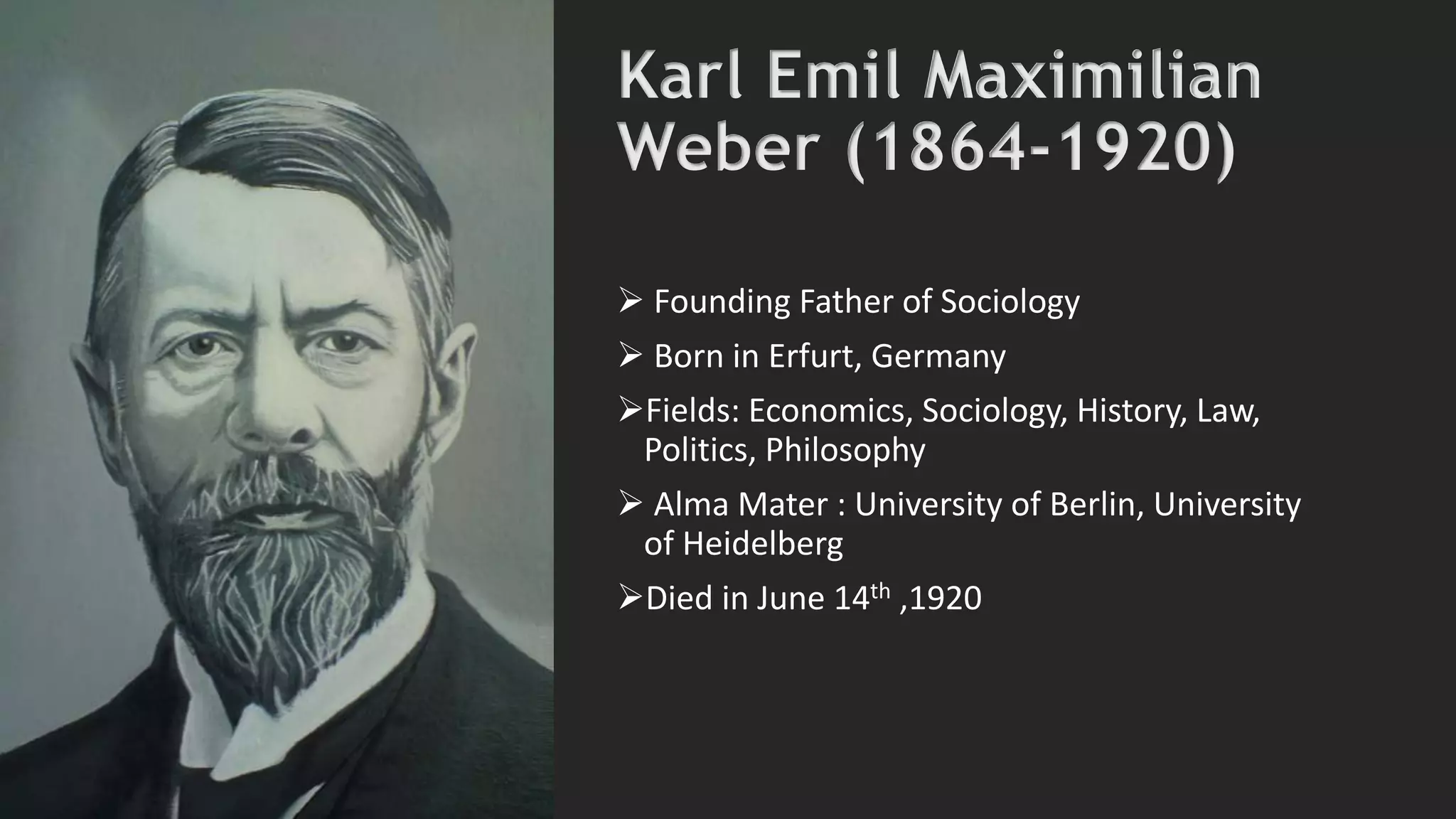
Karl Emil Maximilian
Weber (1864-1920)
 Founding Father of Sociology
 Born in Erfurt, Germany
Fields: Economics, Sociology, History, Law,
Politics, Philosophy
 Alma Mater : University of Berlin, University
of Heidelberg
Died in June 14th ,1920
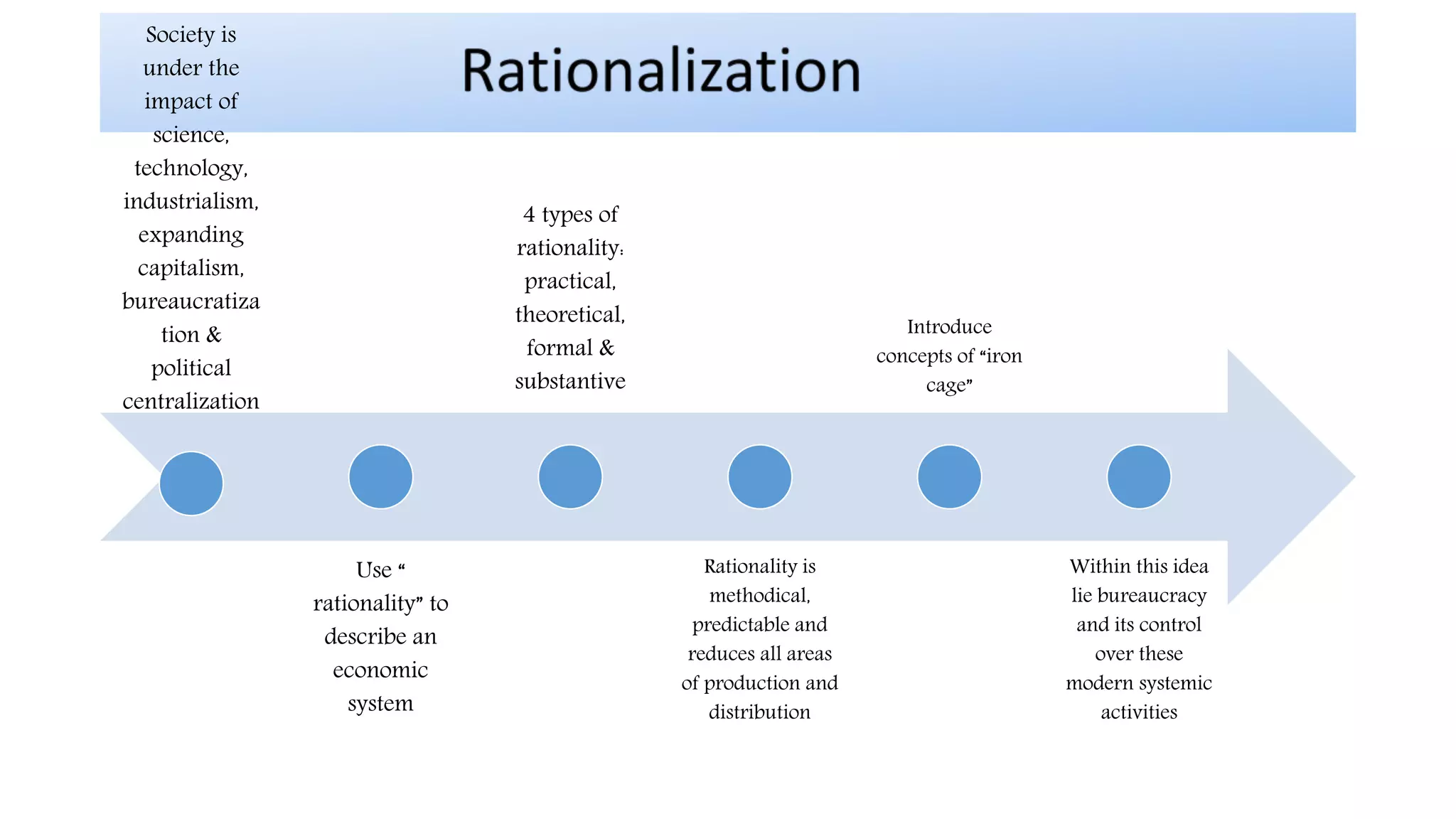
Society is
under the
impact of
science,
technology,
industrialism,
expanding
capitalism,
bureaucratiza
tion &
political
centralization
Use “
rationality” to
describe an
economic
system
4 types of
rationality:
practical,
theoretical,
formal &
substantive
Rationality is
methodical,
predictable and
reduces all areas
of production and
distribution
Introduce
concepts of “iron
cage”
Within this idea
lie bureaucracy
and its control
over these
modern systemic
activities
Bureaucracy
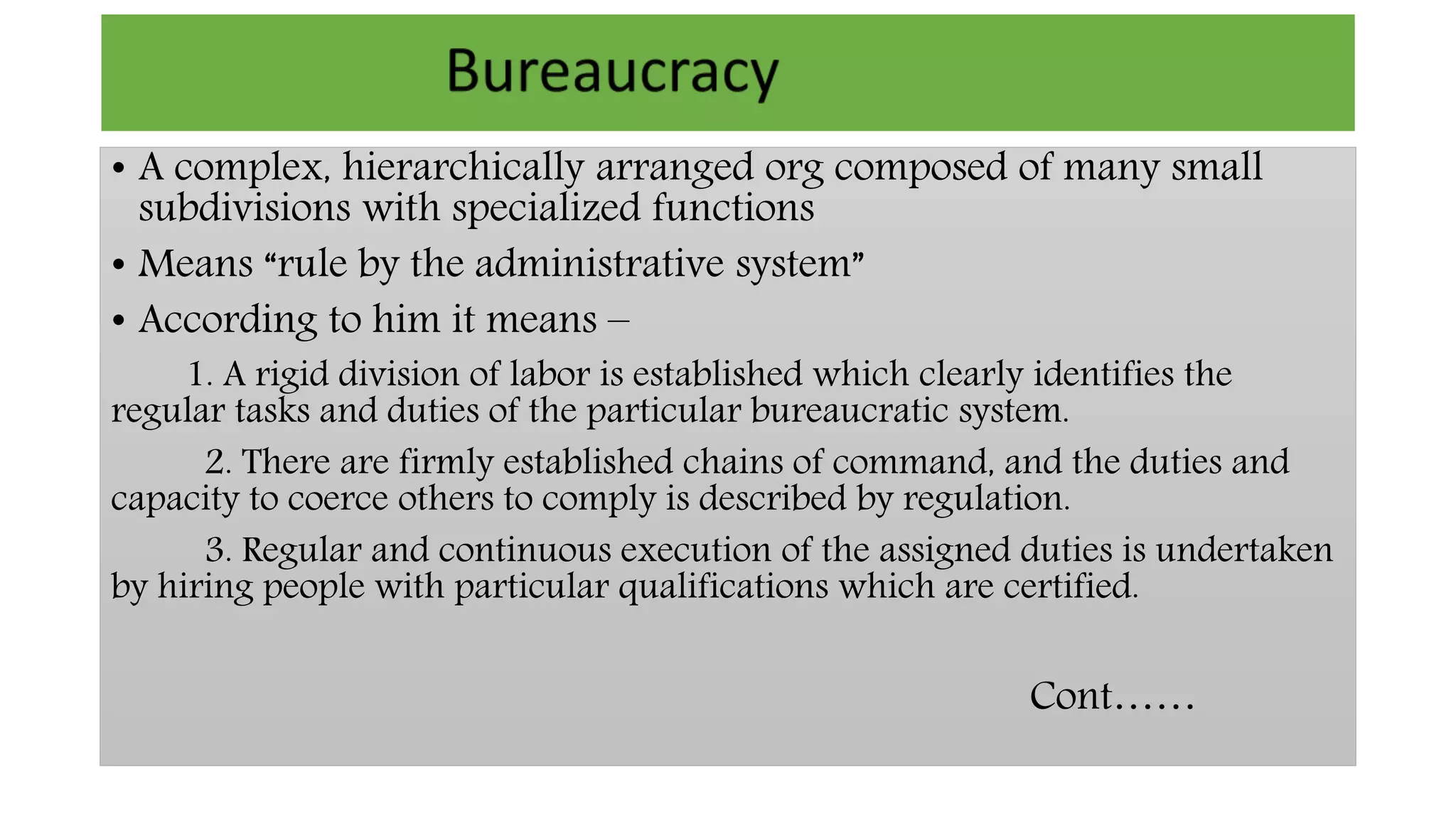
• A complex, hierarchically arranged org composed of many small
subdivisions with specialized functions
• Means “rule by the administrative system”
• According to him it means –
1. A rigid division of labor is established which clearly identifies the
regular tasks and duties of the particular bureaucratic system.
2. There are firmly established chains of command, and the duties and
capacity to coerce others to comply is described by regulation.
3. Regular and continuous execution of the assigned duties is undertaken
by hiring people with particular qualifications which are certified.
Cont……
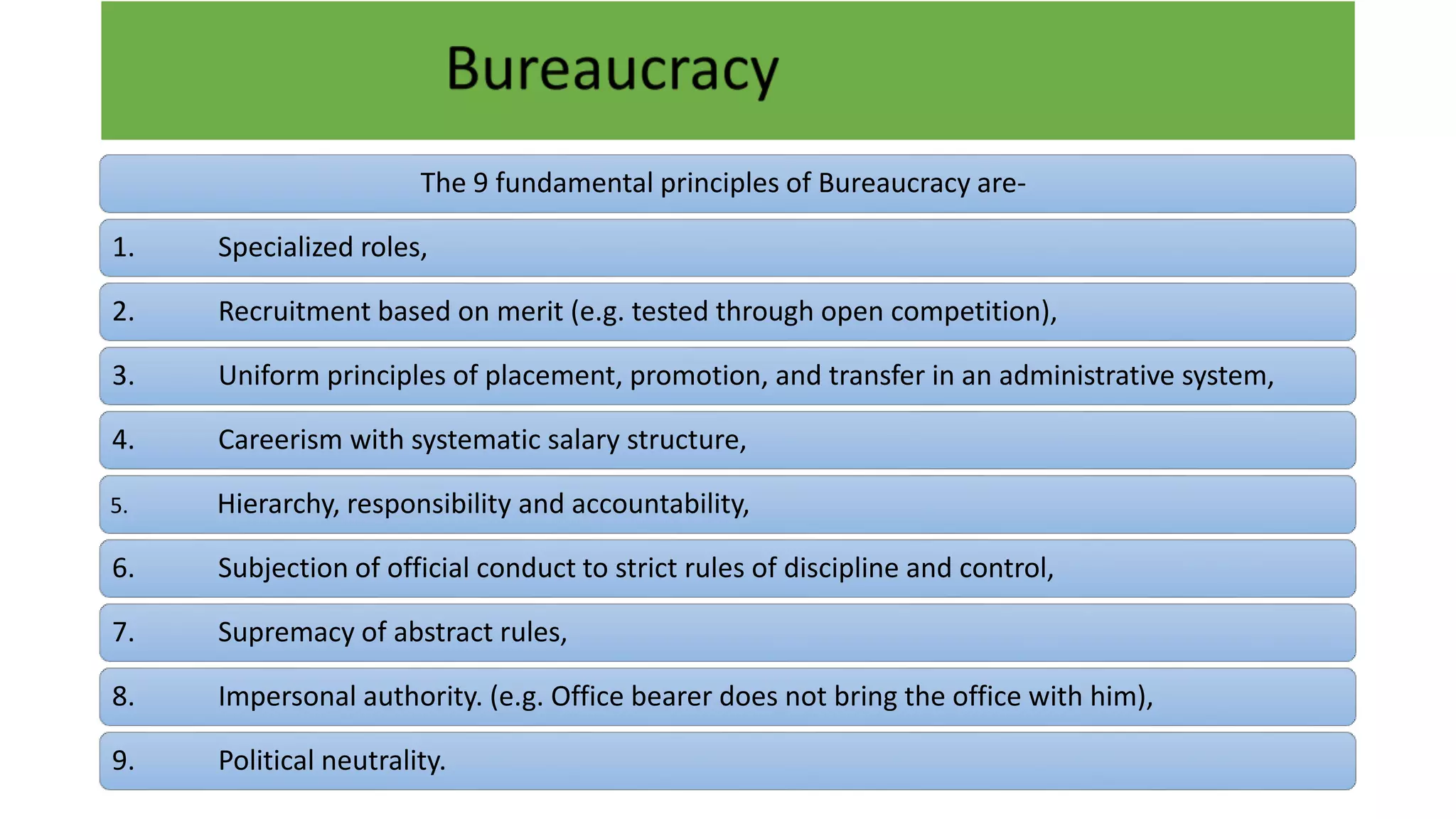
The 9 fundamental principles of Bureaucracy are-
1. Specialized roles,
2. Recruitment based on merit (e.g. tested through open competition),
3. Uniform principles of placement, promotion, and transfer in an administrative system,
4. Careerism with systematic salary structure,
5. Hierarchy, responsibility and accountability,
6. Subjection of official conduct to strict rules of discipline and control,
7. Supremacy of abstract rules,
8. Impersonal authority. (e.g. Office bearer does not bring the office with him),
9. Political neutrality.
Authority
Authority/Domination: Probability that
commands will be obeyed
“Without exception every sphere of
social action is profoundly influenced by
structures of domination
Domination (authority) is always only
one side of command-obedience
relationship
Authority
There are 3 main types
of legitimacy, based on:
Rational grounds -
resting on the belief in
the legality of enacted
rules and the right of
those elevated to
authority under such
rules to issue
commands (i.e. legal
authority).
Traditional grounds -
Resting on an
established belief in
the sanctity of old
traditions
Charismatic grounds -
resting on devotion to
the exceptional
sanctity, heroism or
exemplary character
of an individual
person.
Social Action
In sociology,
social action, also
recognized as
"Weberian social
action" refers to
an act which
takes into
account the
actions and
reactions of
individuals (or
'agents').
Rendering to Max
Weber, "an Action
is 'social' if the
acting individual
takes account of
the behavior of
others and is
thereby oriented
in its course".
Social action is
concerned with
toward others.
These can be
past, present, or
future, known or
unknown.
Not every kind of
action is social
action. Overt
action is non-
social if it is
oriented solely to
the behavior of
inanimate
objects. I.e.
religious activity
is not social if is
simply for
individual
contemplation or
prayer.
Not all contact is social
(like a collision of two
cyclists) if it is merely a
natural accident. But
the discussion that
follows would be.
4. Social action is not
identical to similar
actions across many
people or every action
influenced by other
people. I.e. putting up
umbrellas is not social
action. Neither is simple
imitation of others, if it is
entirely reactive. In all
these cases, the
borderline is quite
indefinite.
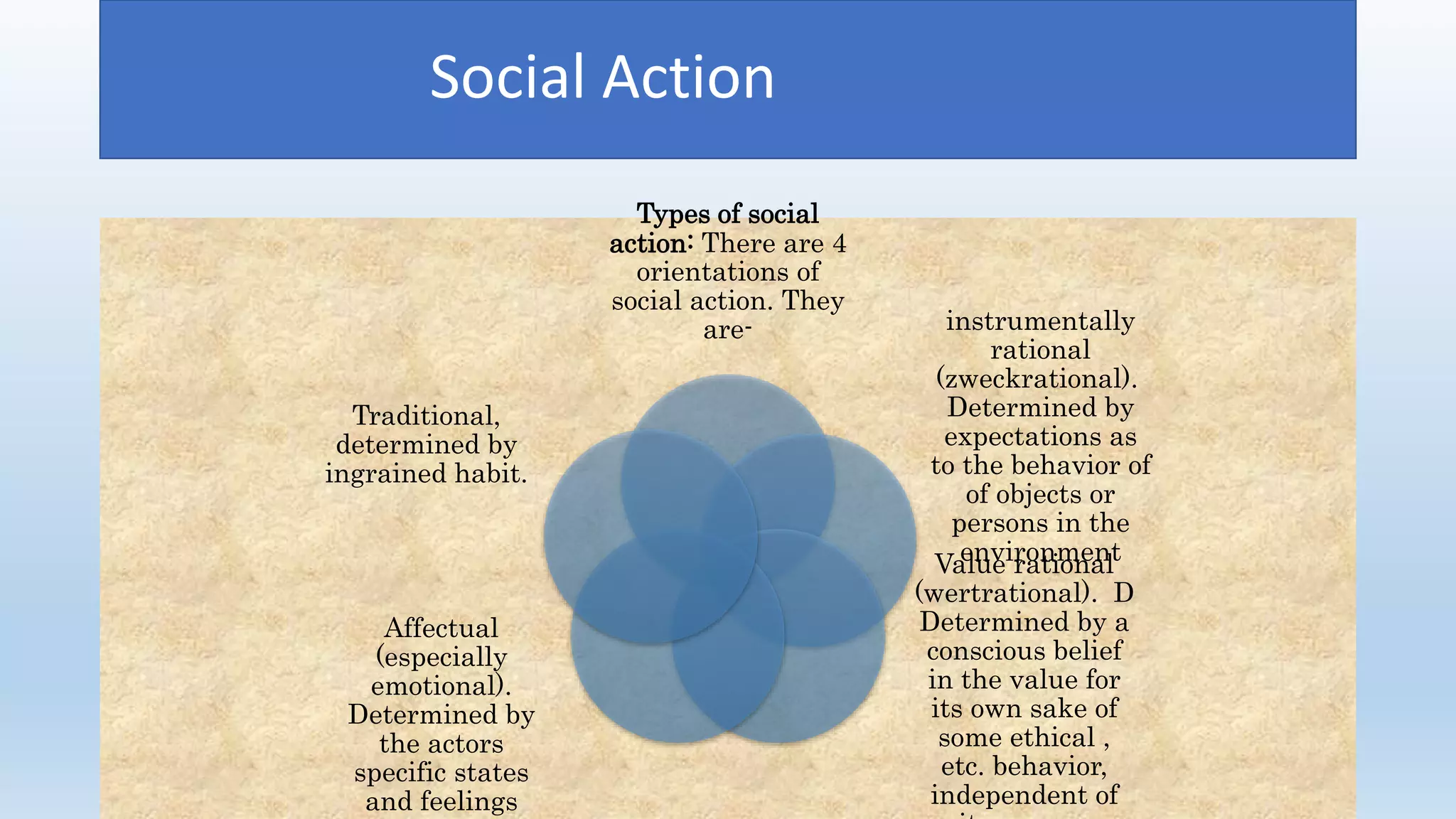
Social Action
Types of social
action: There are 4
orientations of
social action. They
are- instrumentally
rational
(zweckrational).
Determined by
expectations as
to the behavior of
of objects or
persons in the
environmentValue rational
(wertrational). D
Determined by a
conscious belief
in the value for
its own sake of
some ethical ,
etc. behavior,
independent of
Affectual
(especially
emotional).
Determined by
the actors
specific states
and feelings
Traditional,
determined by
ingrained habit.
Social ActionSocial Action
Discussed it in his book “The Protestants Ethic and the Spirit of Capitalism (1904-
1905)
He analyzed Confucianism, Taoism, Hinduism & Buddhism there
Looked into the effect of religious ideas on economic activities
Considered religion as a basis for social stratification
Weber believed Religion was one of the main pillars of Society
Calvinist ideas had a major impact on social advancement & economic
innovation in the west
Focused on the beliefs of magic that he referred to as the “disenchantment of the
world”
Sociology of Religion
His concepts have
had enormous
impact on
sociological theory
today
His
methodological
works provides a
framework for
research and
instruction
Substantive
explorations in
religion,
economics, history
& politics give a
unique insight into
the origins of the
modern world and
its evolution
Articulated the
idea that the world
is becoming
increasingly
dominated by
norms & values of
Impacts of Weber’s work
Most importantly, Weber
studied the relationship
between religious ideas
and the effect they have
on the economic system
He researched how the
West developed a rational
religious system
(Calvinism) that played a
key role in the rise of
rational economic system
Through the influence his
concepts and ideas have
had across many parts of
the world, Weberian
theory is very significant
today.
Impacts of Weber’s work
Criticism
There was a controversy about the impact of religious beliefs on the economic
actions of mankind
Many sociologist believes he lacks a critical theory and his theories can not be
used to point out opportunities for constructive change
For Bureaucracy and formal rationality, two types of rationalization, were
developed because of their efficiency, calculability and control of achieving goal
but as rationalization develops, the original goal is often forgotten and tasks are
often accomplished for pure pleasure
He is criticized for his theory of social action because it falls between two
meanings and people become confused about how to implement the concept in
everyday life
One hand, it could mean a subjective intuition because this would not be
scientific
On the other hand, the sociologist couldn’t just proclaim the “Objective” meaning
of the social phenomenon
Criticism
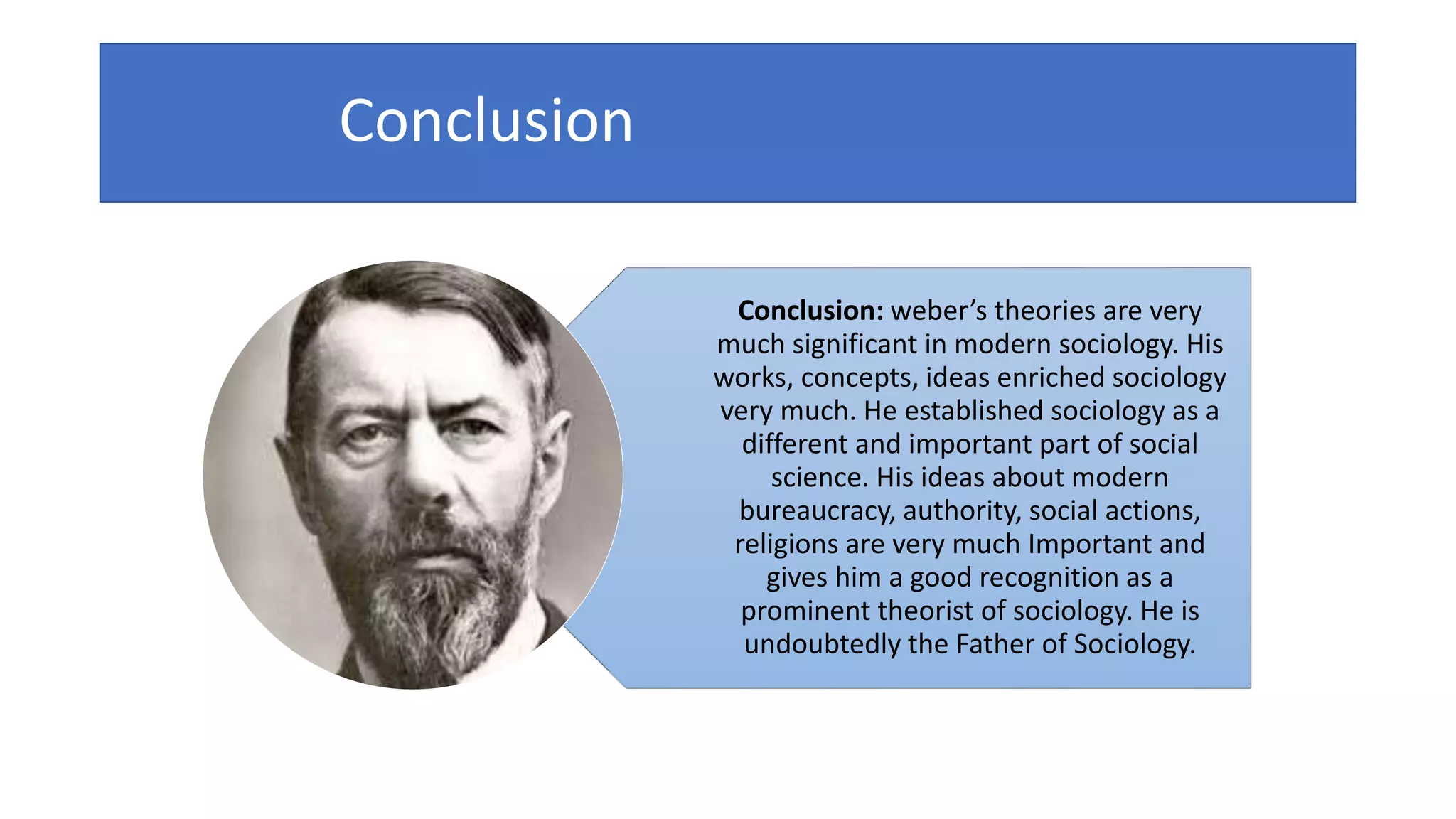
Conclusion
Conclusion: weber’s theories are very
much significant in modern sociology. His
works, concepts, ideas enriched sociology
very much. He established sociology as a
different and important part of social
science. His ideas about modern
bureaucracy, authority, social actions,
religions are very much Important and
gives him a good recognition as a
prominent theorist of sociology. He is
undoubtedly the Father of Sociology.
Sociology of Max Weber

Sociology of Max Weber

  • 2.
  • 3.
    Karl Emil Maximilian Weber(1864-1920)  Founding Father of Sociology  Born in Erfurt, Germany Fields: Economics, Sociology, History, Law, Politics, Philosophy  Alma Mater : University of Berlin, University of Heidelberg Died in June 14th ,1920
  • 4.
    Society is under the impactof science, technology, industrialism, expanding capitalism, bureaucratiza tion & political centralization Use “ rationality” to describe an economic system 4 types of rationality: practical, theoretical, formal & substantive Rationality is methodical, predictable and reduces all areas of production and distribution Introduce concepts of “iron cage” Within this idea lie bureaucracy and its control over these modern systemic activities
  • 6.
    Bureaucracy • A complex,hierarchically arranged org composed of many small subdivisions with specialized functions • Means “rule by the administrative system” • According to him it means – 1. A rigid division of labor is established which clearly identifies the regular tasks and duties of the particular bureaucratic system. 2. There are firmly established chains of command, and the duties and capacity to coerce others to comply is described by regulation. 3. Regular and continuous execution of the assigned duties is undertaken by hiring people with particular qualifications which are certified. Cont……
  • 7.
    The 9 fundamentalprinciples of Bureaucracy are- 1. Specialized roles, 2. Recruitment based on merit (e.g. tested through open competition), 3. Uniform principles of placement, promotion, and transfer in an administrative system, 4. Careerism with systematic salary structure, 5. Hierarchy, responsibility and accountability, 6. Subjection of official conduct to strict rules of discipline and control, 7. Supremacy of abstract rules, 8. Impersonal authority. (e.g. Office bearer does not bring the office with him), 9. Political neutrality.
  • 8.
    Authority Authority/Domination: Probability that commandswill be obeyed “Without exception every sphere of social action is profoundly influenced by structures of domination Domination (authority) is always only one side of command-obedience relationship
  • 9.
    Authority There are 3main types of legitimacy, based on: Rational grounds - resting on the belief in the legality of enacted rules and the right of those elevated to authority under such rules to issue commands (i.e. legal authority). Traditional grounds - Resting on an established belief in the sanctity of old traditions Charismatic grounds - resting on devotion to the exceptional sanctity, heroism or exemplary character of an individual person.
  • 10.
    Social Action In sociology, socialaction, also recognized as "Weberian social action" refers to an act which takes into account the actions and reactions of individuals (or 'agents'). Rendering to Max Weber, "an Action is 'social' if the acting individual takes account of the behavior of others and is thereby oriented in its course". Social action is concerned with toward others. These can be past, present, or future, known or unknown. Not every kind of action is social action. Overt action is non- social if it is oriented solely to the behavior of inanimate objects. I.e. religious activity is not social if is simply for individual contemplation or prayer.
  • 11.
    Not all contactis social (like a collision of two cyclists) if it is merely a natural accident. But the discussion that follows would be. 4. Social action is not identical to similar actions across many people or every action influenced by other people. I.e. putting up umbrellas is not social action. Neither is simple imitation of others, if it is entirely reactive. In all these cases, the borderline is quite indefinite. Social Action
  • 12.
    Types of social action:There are 4 orientations of social action. They are- instrumentally rational (zweckrational). Determined by expectations as to the behavior of of objects or persons in the environmentValue rational (wertrational). D Determined by a conscious belief in the value for its own sake of some ethical , etc. behavior, independent of Affectual (especially emotional). Determined by the actors specific states and feelings Traditional, determined by ingrained habit. Social ActionSocial Action
  • 13.
    Discussed it inhis book “The Protestants Ethic and the Spirit of Capitalism (1904- 1905) He analyzed Confucianism, Taoism, Hinduism & Buddhism there Looked into the effect of religious ideas on economic activities Considered religion as a basis for social stratification Weber believed Religion was one of the main pillars of Society Calvinist ideas had a major impact on social advancement & economic innovation in the west Focused on the beliefs of magic that he referred to as the “disenchantment of the world” Sociology of Religion
  • 14.
    His concepts have hadenormous impact on sociological theory today His methodological works provides a framework for research and instruction Substantive explorations in religion, economics, history & politics give a unique insight into the origins of the modern world and its evolution Articulated the idea that the world is becoming increasingly dominated by norms & values of Impacts of Weber’s work
  • 15.
    Most importantly, Weber studiedthe relationship between religious ideas and the effect they have on the economic system He researched how the West developed a rational religious system (Calvinism) that played a key role in the rise of rational economic system Through the influence his concepts and ideas have had across many parts of the world, Weberian theory is very significant today. Impacts of Weber’s work
  • 16.
    Criticism There was acontroversy about the impact of religious beliefs on the economic actions of mankind Many sociologist believes he lacks a critical theory and his theories can not be used to point out opportunities for constructive change For Bureaucracy and formal rationality, two types of rationalization, were developed because of their efficiency, calculability and control of achieving goal but as rationalization develops, the original goal is often forgotten and tasks are often accomplished for pure pleasure
  • 17.
    He is criticizedfor his theory of social action because it falls between two meanings and people become confused about how to implement the concept in everyday life One hand, it could mean a subjective intuition because this would not be scientific On the other hand, the sociologist couldn’t just proclaim the “Objective” meaning of the social phenomenon Criticism
  • 18.
    Conclusion Conclusion: weber’s theoriesare very much significant in modern sociology. His works, concepts, ideas enriched sociology very much. He established sociology as a different and important part of social science. His ideas about modern bureaucracy, authority, social actions, religions are very much Important and gives him a good recognition as a prominent theorist of sociology. He is undoubtedly the Father of Sociology.