2013

WHOLE SCHOOL CHANGE
PROJECT

GOCERLER PRIMARY SCHOOL IMPROVEMENT PLAN 2012- 2016
This report is a school improvement plan prepared for GOCERLER PRIMARY SCHOOL
in Kepez/ Antalya. The plan is designed through the collaboration between the school and
the Middle East Technical University Societal Change Center (METU SCC). The project
is funded by TUBITAK and this report is published as an example of school improvement
plan. Hence justifications for each step or part are provided to some extent in case other
schools wish to initiate school change through adapting this plan. However one must be
careful that the plan is not applicable to every situation. Before using this report, it is
highly advised to review the plan in terms of its applicability to the specific school’s
context and student achievement since the physical (resources, policies, structures,
schedules) and people factors (attitudes, beliefs, and relationships) are different in each
school;that is why same formulations do not apply to every context.
1
∞WHOLE SCHOOL CHANGE PROJECT∞

Contextual Background and Rationale
Kepez Göçerler Primary School is located in Kepez on the north side of the center of Antalya. Even though
it is not far away from the center (almost ten kilometers away), it is located in an area which has
traditionally been squatted by the ones who immigrate from the nearby cities and the southeast part of
Turkey. The families mostly belong to low and low- middle classes and are occupied with insecure/ part
time jobs or jobs with minimum wages. Although recently there have been rural transformation projects
started to be implemented in the area, the school is still experiencing the difficulties of traditionally
associated SES problems.
The school has got four classes for each grade (4+4: A,B,C,D). Therefore a two tier pattern of schooling is
provided. As for the school environment, it seems to be safe and the area allocated for students to play
during breaks is big enough. However, there is no security staff. School population is more than school’s
capacity. It has 32 classes available and in each classroom there are almost 15 students per class- quite
effective. There are thirty-seven teachers and one headmaster and two assistant headmasters working at
the school. There are enough and appropriate technical services at school (language class, science class,
computer lab etc.)
In the recent years, school has been facing with decreasing achievement level in SBS and student
enrollment rates (even though the community population is in a huge increase). In the previous years,
school headmasters tried to start some initiatives however those were only quick fixes and did not result
in the desired outcomes. Therefore, to implement a more consistent and sustainable changes at the
school, the headmasters have contacted METU SCC and both collaboratively have set up a project to be
funded by TUBITAK (1) to improve the school’s image in the community, and (2) to develop a
collaboration project with a well-known university to motivate the staff and community, (3) to tackle the
low interest of families in their children’s schoolwork. Therefore improving student learning and
organizational capacity (which respectively increases student learning through building school capacity
for sustained change) are placed at the forefront of the agenda of the project so to cover these three
problems. Plus, as suggested by Hopkins (2001), these two together are essential since without capacity
building changes in classroom practices / student learning will not be school- wide and sustained into the
medium term.
The project takes four years/ eight terms and first term is taken up with the planning process, and the
following seven terms are followed by implementation and monitoring process as advised by EIC (2000).
At the end of the each term, a summative evaluation process will take up to determine the success of
2
∞WHOLE SCHOOL CHANGE PROJECT∞

whole process. As an ongoing basis, formative evaluation is done to prove where the plan is heading
towards. Now, this report is published at the completion of the first term of the plan, and is still being
implemented.
The planning process has started with a team of initial change agents which has been set up through the
collaboration of the METU SCC and the headmasters. The team is composed of three experts from METU
SCC, all headmasters along with eight teachers (from each grade) who are into professional learning or
development practices the most among all. The team leader is the headmaster in the school and the
monitoring team is the METU SCC team.

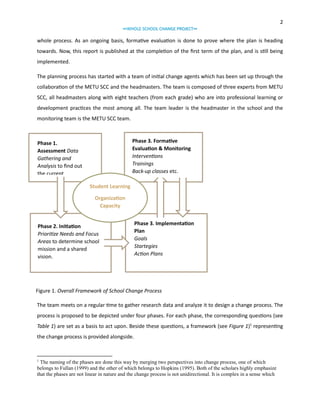
Phase 1.
Assessment Data
Gathering and
Analysis to find out
the current
strengths and areas
of needs

Phase 3. Formative
Evaluation & Monitoring
Interventions
Trainings
Back-up classes etc.
Student Learning
Organization
Capacity

Phase 2. Initiation
Prioritize Needs and Focus
Areas to determine school
mission and a shared
vision.

Phase 3. Implementation
Plan
Goals
Startegies
Action Plans

Figure 1. Overall Framework of School Change Process
The team meets on a regular time to gather research data and analyze it to design a change process. The
process is proposed to be depicted under four phases. For each phase, the corresponding questions (see
Table 1) are set as a basis to act upon. Beside these questions, a framework (see Figure 1)1 representing
the change process is provided alongside.

1

The naming of the phases are done this way by merging two perspectives into change process, one of which
belongs to Fullan (1999) and the other of which belongs to Hopkins (1995). Both of the scholars highly emphasize
that the phases are not linear in nature and the change process is not unidirectional. It is complex in a sense which
3
∞WHOLE SCHOOL CHANGE PROJECT∞

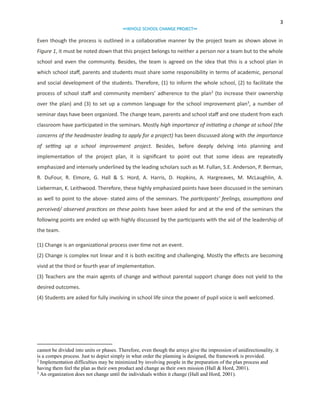
Even though the process is outlined in a collaborative manner by the project team as shown above in
Figure 1, it must be noted down that this project belongs to neither a person nor a team but to the whole
school and even the community. Besides, the team is agreed on the idea that this is a school plan in
which school staff, parents and students must share some responsibility in terms of academic, personal
and social development of the students. Therefore, (1) to inform the whole school, (2) to facilitate the
process of school staff and community members’ adherence to the plan2 (to increase their ownership
over the plan) and (3) to set up a common language for the school improvement plan3, a number of
seminar days have been organized. The change team, parents and school staff and one student from each
classroom have participated in the seminars. Mostly high importance of initiating a change at school (the
concerns of the headmaster leading to apply for a project) has been discussed along with the importance
of setting up a school improvement project. Besides, before deeply delving into planning and
implementation of the project plan, it is significant to point out that some ideas are repeatedly
emphasized and intensely underlined by the leading scholars such as M. Fullan, S.E. Anderson, P. Berman,
R. DuFour, R. Elmore, G. Hall & S. Hord, A. Harris, D. Hopkins, A. Hargreaves, M. McLaughlin, A.
Lieberman, K. Leithwood. Therefore, these highly emphasized points have been discussed in the seminars
as well to point to the above- stated aims of the seminars. The participants’ feelings, assumptions and
perceived/ observed practices on these points have been asked for and at the end of the seminars the
following points are ended up with highly discussed by the participants with the aid of the leadership of
the team.
(1) Change is an organizational process over time not an event.
(2) Change is complex not linear and it is both exciting and challenging. Mostly the effects are becoming
vivid at the third or fourth year of implementation.
(3) Teachers are the main agents of change and without parental support change does not yield to the
desired outcomes.
(4) Students are asked for fully involving in school life since the power of pupil voice is well welcomed.

cannot be divided into units or phases. Therefore, even though the arrays give the impression of unidirectionality, it
is a compex process. Just to depict simply in what order the planning is designed, the framework is provided.
2
Implementation difficulties may be minimized by involving people in the preparation of the plan process and
having them feel the plan as their own product and change as their own mission (Hall & Hord, 2001).
3
An organization does not change until the individuals within it change (Hall and Hord, 2001).
4
∞WHOLE SCHOOL CHANGE PROJECT∞

Phase 1: Assessment
The assessment process is done on the basis of two foreground points of the project agenda: (1) student
learning and (2) organizational capacity. For each, a number of questions are outlined and a number of
data gathering tools are used. Even though the questions are allocated between two of them, they are
not mutually exclusive, but rather wholly integrated and related main issues.
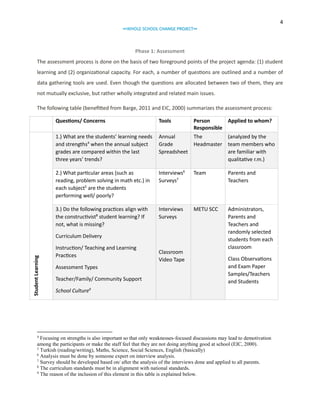
The following table (benefitted from Barge, 2011 and EIC, 2000) summarizes the assessment process:
Questions/ Concerns

Tools

1.) What are the students’ learning needs
and strengths4 when the annual subject
grades are compared within the last
three years’ trends?

Annual
The
Grade
Headmaster
Spreadsheet

(analyzed by the
team members who
are familiar with
qualitative r.m.)

2.) What particular areas (such as
reading, problem solving in math etc.) in
each subject5 are the students
performing well/ poorly?

Interviews6
Surveys7

Team

Parents and
Teachers

3.) Do the following practices align with
the constructivist8 student learning? If
not, what is missing?

Interviews
Surveys

METU SCC

Administrators,
Parents and
Teachers and
randomly selected
students from each
classroom

Student Learning

Curriculum Delivery

4

Instruction/ Teaching and Learning
Practices
Assessment Types
Teacher/Family/ Community Support

Classroom
Video Tape

Person
Applied to whom?
Responsible

Class Observations
and Exam Paper
Samples/Teachers
and Students

School Culture9

Focusing on strengths is also important so that only weaknesses-focused discussions may lead to demotivation
among the participants or make the staff feel that they are not doing anything good at school (EIC, 2000).
5
Turkish (reading/writing), Maths, Science, Social Sciences, English (basically)
6
Analysis must be done by someone expert on interview analysis.
7
Survey should be developed based on/ after the analysis of the interviews done and applied to all parents.
8
The curriculum standards must be in alignment with national standards.
9
The reason of the inclusion of this element in this table is explained below.
5
∞WHOLE SCHOOL CHANGE PROJECT∞

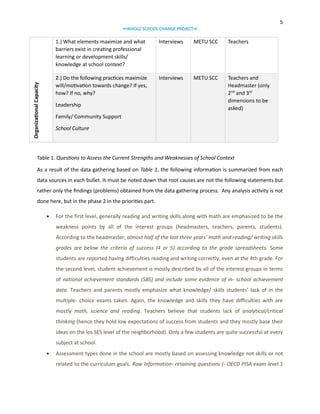
Interviews

METU SCC

Teachers

2.) Do the following practices maximize
will/motivation towards change? If yes,
how? If no, why?

Organizational Capacity

1.) What elements maximize and what
barriers exist in creating professional
learning or development skills/
knowledge at school context?

Interviews

METU SCC

Teachers and
Headmaster (only
2nd and 3rd
dimensions to be
asked)

Leadership
Family/ Community Support
School Culture

Table 1. Questions to Assess the Current Strengths and Weaknesses of School Context
As a result of the data gathering based on Table 1, the following information is summarized from each
data sources in each bullet. It must be noted down that root causes are not the following statements but
rather only the findings (problems) obtained from the data gathering process. Any analysis activity is not
done here, but in the phase 2 in the priorities part.
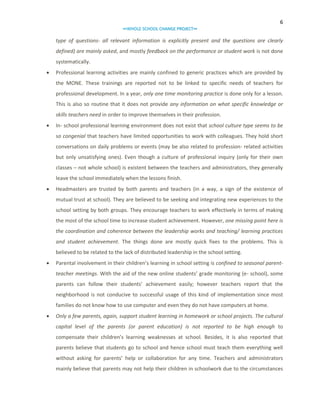


For the first level, generally reading and writing skills along with math are emphasized to be the
weakness points by all of the interest groups (headmasters, teachers, parents, students).
According to the headmaster, almost half of the last three years’ math and reading/ writing skills
grades are below the criteria of success (4 or 5) according to the grade spreadsheets. Some
students are reported having difficulties reading and writing correctly, even at the 4th grade. For
the second level, student achievement is mostly described by all of the interest groups in terms
of national achievement standards (SBS) and include some evidence of in- school achievement
data. Teachers and parents mostly emphasize what knowledge/ skills students’ lack of in the
multiple- choice exams taken. Again, the knowledge and skills they have difficulties with are
mostly math, science and reading. Teachers believe that students lack of analytical/critical
thinking (hence they hold low expectations of success from students and they mostly base their
ideas on the los SES level of the neighborhood). Only a few students are quite successful at every
subject at school.



Assessment types done in the school are mostly based on assessing knowledge not skills or not
related to the curriculum goals. Raw Information- retaining questions (- OECD PISA exam level 1
6
∞WHOLE SCHOOL CHANGE PROJECT∞

type of questions- all relevant information is explicitly present and the questions are clearly
defined) are mainly asked, and mostly feedback on the performance or student work is not done
systematically.


Professional learning activities are mainly confined to generic practices which are provided by
the MONE. These trainings are reported not to be linked to specific needs of teachers for
professional development. In a year, only one time monitoring practice is done only for a lesson.
This is also so routine that it does not provide any information on what specific knowledge or
skills teachers need in order to improve themselves in their profession.



In- school professional learning environment does not exist that school culture type seems to be
so congenial that teachers have limited opportunities to work with colleagues. They hold short
conversations on daily problems or events (may be also related to profession- related activities
but only unsatisfying ones). Even though a culture of professional inquiry (only for their own
classes – not whole school) is existent between the teachers and administrators, they generally
leave the school immediately when the lessons finish.



Headmasters are trusted by both parents and teachers (in a way, a sign of the existence of
mutual trust at school). They are believed to be seeking and integrating new experiences to the
school setting by both groups. They encourage teachers to work effectively in terms of making
the most of the school time to increase student achievement. However, one missing point here is
the coordination and coherence between the leadership works and teaching/ learning practices
and student achievement. The things done are mostly quick fixes to the problems. This is
believed to be related to the lack of distributed leadership in the school setting.



Parental involvement in their children’s learning in school setting is confined to seasonal parentteacher meetings. With the aid of the new online students’ grade monitoring (e- school), some
parents can follow their students’ achievement easily; however teachers report that the
neighborhood is not conducive to successful usage of this kind of implementation since most
families do not know how to use computer and even they do not have computers at home.



Only a few parents, again, support student learning in homework or school projects. The cultural
capital level of the parents (or parent education) is not reported to be high enough to
compensate their children’s learning weaknesses at school. Besides, it is also reported that
parents believe that students go to school and hence school must teach them everything well
without asking for parents’ help or collaboration for any time. Teachers and administrators
mainly believe that parents may not help their children in schoolwork due to the circumstances
7
∞WHOLE SCHOOL CHANGE PROJECT∞

they cannot control such as their lack of knowledge on particular schoolwork; however they
support more frequent communication between school and home.
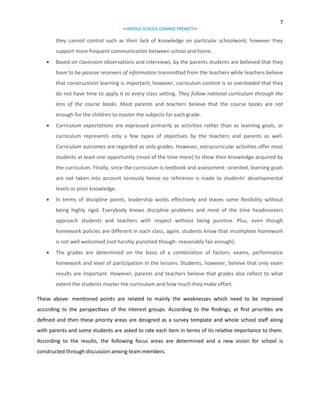


Based on classroom observations and interviews, by the parents students are believed that they
have to be passive receivers of information transmitted from the teachers while teachers believe
that constructivist learning is important; however, curriculum content is so overloaded that they
do not have time to apply it to every class setting. They follow national curriculum through the
lens of the course books. Most parents and teachers believe that the course books are not
enough for the children to master the subjects for each grade.



Curriculum expectations are expressed primarily as activities rather than as learning goals, or
curriculum represents only a few types of objectives by the teachers and parents as well.
Curriculum outcomes are regarded as only grades. However, extracurricular activities offer most
students at least one opportunity (most of the time more) to show their knowledge acquired by
the curriculum. Finally, since the curriculum is textbook and assessment- oriented, learning goals
are not taken into account seriously hence no reference is made to students’ developmental
levels or prior knowledge.



In terms of discipline points, leadership works effectively and leaves some flexibility without
being highly rigid. Everybody knows discipline problems and most of the time headmasters
approach students and teachers with respect without being punitive. Plus, even though
homework policies are different in each class, again, students know that incomplete homework
is not well welcomed (not harshly punished though- reasonably fair enough).



The grades are determined on the basis of a combination of factors: exams, performance
homework and level of participation in the lessons. Students, however, believe that only exam
results are important. However, parents and teachers believe that grades also reflect to what
extent the students master the curriculum and how much they make effort.

These above- mentioned points are related to mainly the weaknesses which need to be improved
according to the perspectives of the interest groups. According to the findings, at first priorities are
defined and then these priority areas are designed as a survey template and whole school staff along
with parents and some students are asked to rate each item in terms of its relative importance to them.
According to the results, the following focus areas are determined and a new vision for school is
constructed through discussion among team members.
8
∞WHOLE SCHOOL CHANGE PROJECT∞

Phase 2: Initiation
First of all, school vision is determined as follows:
“We will establish clear learning goals, measure performance accordingly and
increase opportunities by increasing school capacity for all and each one of
our students. Everybody can learn and achieve.”
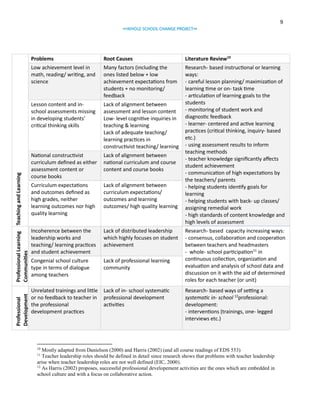
Then, priorities for the plan are determined as shown in Figure 2 after the responses to the survey by all
interest groups are analyzed by the team. Each priority is linked to other priority area that they should be
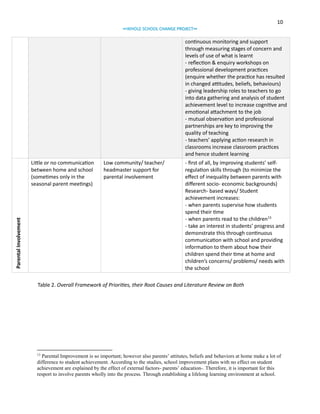
viewed as separate from each other. Plus, by delving into the analysis of the findings/ problems provided
above, root causes (related to the outlined priorities shown below in Figure 2), and what sound literature
review proposes for these problems are provided in Table 2. This process accelerates the phase of
determining goals, strategies and action plans in this project. Of course, all of what literature review
suggests are not included in the plan since school culture/ context determines the choices behind action
plans.

School Culture
Teaching and Learning
Curriculum Alignment

Student Learning
Organizational
Capacity

Professional Development

Parental Involvement/ Support

Figure 2. Overall Framework of Priorities and Focus
Areas

Professional Learning
Communities
(distributed leadership)
9
∞WHOLE SCHOOL CHANGE PROJECT∞

Literature Review10

Many factors (including the
ones listed below + low
achievement expectations from
students + no monitoring/
feedback

Lesson content and inschool assessments missing
in developing students’
critical thinking skills

Professional
Development

Root Causes

Low achievement level in
math, reading/ writing, and
science

Professional Learning Teaching and Learning
Communities

Problems

Lack of alignment between
assessment and lesson content
Low- level cognitive inquiries in
teaching & learning
Lack of adequate teaching/
learning practices in
constructivist teaching/ learning

National constructivist
curriculum defined as either
assessment content or
course books

Lack of alignment between
national curriculum and course
content and course books

Curriculum expectations
and outcomes defined as
high grades, neither
learning outcomes nor high
quality learning

Lack of alignment between
curriculum expectations/
outcomes and learning
outcomes/ high quality learning

Research- based instructional or learning
ways:
- careful lesson planning/ maximization of
learning time or on- task time
- articulation of learning goals to the
students
- monitoring of student work and
diagnostic feedback
- learner- centered and active learning
practices (critical thinking, inquiry- based
etc.)
- using assessment results to inform
teaching methods
- teacher knowledge significantly affects
student achievement
- communication of high expectations by
the teachers/ parents
- helping students identify goals for
learning
- helping students with back- up classes/
assigning remedial work
- high standards of content knowledge and
high levels of assessment

Incoherence between the
leadership works and
teaching/ learning practices
and student achievement

Lack of distributed leadership
which highly focuses on student
achievement

Congenial school culture
type in terms of dialogue
among teachers

Lack of professional learning
community

Unrelated trainings and little
or no feedback to teacher in
the professional
development practices

Lack of in- school systematic
professional development
activities

10

Research- based capacity increasing ways:
- consensus, collaboration and cooperation
between teachers and headmasters
- whole- school participation11 in
continuous collection, organization and
evaluation and analysis of school data and
discussion on it with the aid of determined
roles for each teacher (or unit)
Research- based ways of setting a
systematic in- school 12professional:
development:
- interventions (trainings, one- legged
interviews etc.)

Mostly adapted from Danielson (2000) and Harris (2002) (and all course readings of EDS 553)
Teacher leadership roles should be defined in detail since research shows that problems with teacher leadership
arise when teacher leadership roles are not well defined (EIC, 2000).
12
As Harris (2002) proposes, successful professional developement activities are the ones which are embedded in
school culture and with a focus on collaborative action.
11
10
∞WHOLE SCHOOL CHANGE PROJECT∞

continuous monitoring and support
through measuring stages of concern and
levels of use of what is learnt
- reflection & enquiry workshops on
professional development practices
(enquire whether the practice has resulted
in changed attitudes, beliefs, behaviours)
- giving leadership roles to teachers to go
into data gathering and analysis of student
achievement level to increase cognitive and
emotional attachment to the job
- mutual observation and professional
partnerships are key to improving the
quality of teaching
- teachers’ applying action research in
classrooms increase classroom practices
and hence student learning

Parental Involvement

Little or no communication
between home and school
(sometimes only in the
seasonal parent meetings)

Low community/ teacher/
headmaster support for
parental involvement

- first of all, by improving students’ selfregulation skills through (to minimize the
effect of inequality between parents with
different socio- economic backgrounds)
Research- based ways/ Student
achievement increases:
- when parents supervise how students
spend their time
- when parents read to the children13
- take an interest in students’ progress and
demonstrate this through continuous
communication with school and providing
information to them about how their
children spend their time at home and
children’s concerns/ problems/ needs with
the school

Table 2. Overall Framework of Priorities, their Root Causes and Literature Review on Both

Parental Improvement is so important; however also parents’ attitutes, beliefs and behaviors at home make a lot of
difference to student achievement. According to the studies, school improvement plans with no effect on student
achievement are explained by the effect of external factors- parents’ education-. Therefore, it is important for this
resport to involve parents wholly into the process. Through establishing a lifelong learning environment at school.
13
11
∞WHOLE SCHOOL CHANGE PROJECT∞

Phase 3: Implementation
At this phase, three questions (as extracted from Mooney & Mausbach, 2008) are taken into
consideration.
“1. What goals do we need to take us where we are going?
2. What strategies will we need to get there?
3. What action steps will help us get the work done?” (p. 81)
Priorities are determined and root causes of these priorities are explained along with research- based
ways of increasing student achievement and organizational capacity. As explained just at the beginning of
this report, organizational capacity building is also for the sake of increasing student achievement even
though the main aim behind is to build the capacity for sustained change. Therefore, all priority areas
first serve as ways of increasing student learning. Plus, all priority areas are linked to each other since for
a goal it is not possible to just focus on an area in developing strategies or action plans.
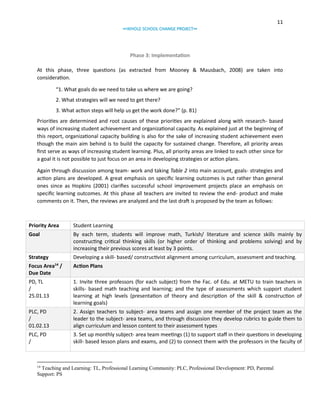
Again through discussion among team- work and taking Table 2 into main account, goals- strategies and
action plans are developed. A great emphasis on specific learning outcomes is put rather than general
ones since as Hopkins (2001) clarifies successful school improvement projects place an emphasis on
specific learning outcomes. At this phase all teachers are invited to review the end- product and make
comments on it. Then, the reviews are analyzed and the last draft is proposed by the team as follows:

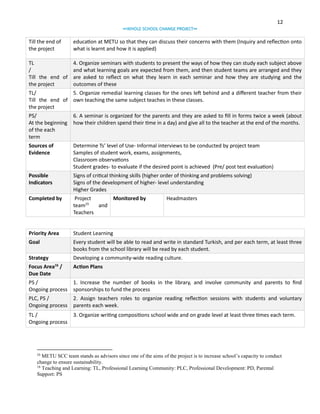
Priority Area

Student Learning

Goal

By each term, students will improve math, Turkish/ literature and science skills mainly by
constructing critical thinking skills (or higher order of thinking and problems solving) and by
increasing their previous scores at least by 3 points.

Strategy

Developing a skill- based/ constructivist alignment among curriculum, assessment and teaching.

Focus Area14 /
Due Date

Action Plans

PD, TL
/
25.01.13

1. Invite three professors (for each subject) from the Fac. of Edu. at METU to train teachers in
skills- based math teaching and learning; and the type of assessments which support student
learning at high levels (presentation of theory and description of the skill & construction of
learning goals)

PLC, PD
/
01.02.13

2. Assign teachers to subject- area teams and assign one member of the project team as the
leader to the subject- area teams, and through discussion they develop rubrics to guide them to
align curriculum and lesson content to their assessment types

PLC, PD
/

3. Set up monthly subject- area team meetings (1) to support staff in their questions in developing
skill- based lesson plans and exams, and (2) to connect them with the professors in the faculty of

14

Teaching and Learning: TL, Professional Learning Community: PLC, Professional Development: PD, Parental
Support: PS
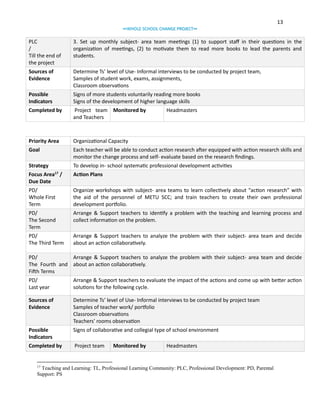
12
∞WHOLE SCHOOL CHANGE PROJECT∞

Till the end of
the project

education at METU so that they can discuss their concerns with them (Inquiry and reflection onto
what is learnt and how it is applied)

TL
4. Organize seminars with students to present the ways of how they can study each subject above
/
and what learning goals are expected from them, and then student teams are arranged and they
Till the end of are asked to reflect on what they learn in each seminar and how they are studying and the
the project
outcomes of these
TL/
5. Organize remedial learning classes for the ones left behind and a different teacher from their
Till the end of own teaching the same subject teaches in these classes.
the project
PS/
At the beginning
of the each
term

6. A seminar is organized for the parents and they are asked to fill in forms twice a week (about
how their children spend their time in a day) and give all to the teacher at the end of the months.

Sources of
Evidence

Determine Ts’ level of Use- Informal interviews to be conducted by project team
Samples of student work, exams, assignments,
Classroom observations
Student grades- to evaluate if the desired point is achieved (Pre/ post test evaluation)

Possible
Indicators

Signs of critical thinking skills (higher order of thinking and problems solving)
Signs of the development of higher- level understanding
Higher Grades

Completed by

Project
Monitored by
15
team
and
Teachers

Priority Area

Student Learning

Goal

Every student will be able to read and write in standard Turkish, and per each term, at least three
books from the school library will be read by each student.

Strategy

Headmasters

Developing a community-wide reading culture.
16

Focus Area /
Due Date

Action Plans

PS /
Ongoing process

1. Increase the number of books in the library, and involve community and parents to find
sponsorships to fund the process

PLC, PS /
Ongoing process

2. Assign teachers roles to organize reading reflection sessions with students and voluntary
parents each week.

TL /
Ongoing process

3. Organize writing compositions school wide and on grade level at least three times each term.

15

METU SCC team stands as advisors since one of the aims of the project is to increase school’s capacity to conduct
change to ensure sustainability.
16
Teaching and Learning: TL, Professional Learning Community: PLC, Professional Development: PD, Parental
Support: PS
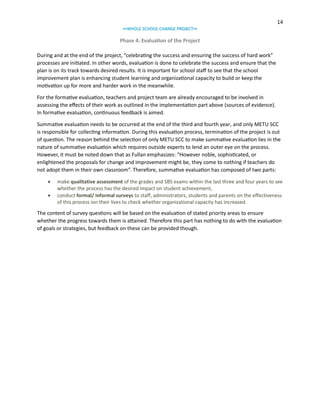
13
∞WHOLE SCHOOL CHANGE PROJECT∞

PLC
/
Till the end of
the project

3. Set up monthly subject- area team meetings (1) to support staff in their questions in the
organization of meetings, (2) to motivate them to read more books to lead the parents and
students.

Sources of
Evidence

Determine Ts’ level of Use- Informal interviews to be conducted by project team,
Samples of student work, exams, assignments,
Classroom observations

Possible
Indicators

Signs of more students voluntarily reading more books
Signs of the development of higher language skills

Completed by

Project team Monitored by
and Teachers

Priority Area

Organizational Capacity

Goal

Each teacher will be able to conduct action research after equipped with action research skills and
monitor the change process and self- evaluate based on the research findings.

Strategy

Headmasters

To develop in- school systematic professional development activities
17

Focus Area /
Due Date

Action Plans

PD/
Whole First
Term

Organize workshops with subject- area teams to learn collectively about “action research” with
the aid of the personnel of METU SCC; and train teachers to create their own professional
development portfolio.

PD/
The Second
Term

Arrange & Support teachers to identify a problem with the teaching and learning process and
collect information on the problem.

PD/
The Third Term

Arrange & Support teachers to analyze the problem with their subject- area team and decide
about an action collaboratively.

PD/
Arrange & Support teachers to analyze the problem with their subject- area team and decide
The Fourth and about an action collaboratively.
Fifth Terms
PD/
Last year

Arrange & Support teachers to evaluate the impact of the actions and come up with better action
solutions for the following cycle.

Sources of
Evidence

Determine Ts’ level of Use- Informal interviews to be conducted by project team
Samples of teacher work/ portfolio
Classroom observations
Teachers’ rooms observation

Possible
Indicators

Signs of collaborative and collegial type of school environment

Completed by

Project team

17

Monitored by

Headmasters

Teaching and Learning: TL, Professional Learning Community: PLC, Professional Development: PD, Parental
Support: PS
14
∞WHOLE SCHOOL CHANGE PROJECT∞

Phase 4: Evaluation of the Project
During and at the end of the project, “celebrating the success and ensuring the success of hard work”
processes are initiated. In other words, evaluation is done to celebrate the success and ensure that the
plan is on its track towards desired results. It is important for school staff to see that the school
improvement plan is enhancing student learning and organizational capacity to build or keep the
motivation up for more and harder work in the meanwhile.
For the formative evaluation, teachers and project team are already encouraged to be involved in
assessing the effects of their work as outlined in the implementation part above (sources of evidence).
In formative evaluation, continuous feedback is aimed.
Summative evaluation needs to be occurred at the end of the third and fourth year, and only METU SCC
is responsible for collecting information. During this evaluation process, termination of the project is out
of question. The reason behind the selection of only METU SCC to make summative evaluation lies in the
nature of summative evaluation which requires outside experts to lend an outer eye on the process.
However, it must be noted down that as Fullan emphasizes: “However noble, sophisticated, or
enlightened the proposals for change and improvement might be, they come to nothing if teachers do
not adopt them in their own classroom”. Therefore, summative evaluation has composed of two parts:



make qualitative assessment of the grades and SBS exams within the last three and four years to see
whether the process has the desired impact on student achievement,
conduct formal/ informal surveys to staff, administrators, students and parents on the effectiveness
of this process ion their lives to check whether organizational capacity has increased.

The content of survey questions will be based on the evaluation of stated priority areas to ensure
whether the progress towards them is attained. Therefore this part has nothing to do with the evaluation
of goals or strategies, but feedback on these can be provided though.
15
∞WHOLE SCHOOL CHANGE PROJECT∞

References
Danielson, C. (2002). Enhancing student achievement: A framework for school improvement. Virginia:
ASCD.
Education Improvement Commission. (2000). School improvement planning: A handbook for principals,
teachers and school councils. Toronto.
Hall, G.E. & Hord, S.M. (2001). Implementing change: Patterns, principles and potholes. Boston: Alyn
and Bacon.
Harris, A. (2002). School improvement: What is in it for schools? London: Routledge.
Hopkins, D. (1995). Development planning for school improvement. London: Cassell.
Hopkins, D. (2001). School improvement for real. London: Routledge.
Fullan, M. (1999). Change forces: The sequel. London: Routledge.
Fullan, M. (2007). The new meaning of educational change (4th ed.). New York: Teachers College.
Mooney, N. J. & Mausbach, A. T. (2008). Align the design: A blueprint for school improvement. Virginia:
ASCD.
Reeves, D. B. (2006). The learning leader: How to focus school improvement for better results. Virginia:
ASCD.
Zmuda, A. , Kuklis, R. & Kline, E. (2004). Transforming schools: Creating a culture of continuous
improvement. Virginia: ASCD.

Sample School Improvement Plan

  • 1.
    2013 WHOLE SCHOOL CHANGE PROJECT GOCERLERPRIMARY SCHOOL IMPROVEMENT PLAN 2012- 2016 This report is a school improvement plan prepared for GOCERLER PRIMARY SCHOOL in Kepez/ Antalya. The plan is designed through the collaboration between the school and the Middle East Technical University Societal Change Center (METU SCC). The project is funded by TUBITAK and this report is published as an example of school improvement plan. Hence justifications for each step or part are provided to some extent in case other schools wish to initiate school change through adapting this plan. However one must be careful that the plan is not applicable to every situation. Before using this report, it is highly advised to review the plan in terms of its applicability to the specific school’s context and student achievement since the physical (resources, policies, structures, schedules) and people factors (attitudes, beliefs, and relationships) are different in each school;that is why same formulations do not apply to every context.
  • 2.
    1 ∞WHOLE SCHOOL CHANGEPROJECT∞ Contextual Background and Rationale Kepez Göçerler Primary School is located in Kepez on the north side of the center of Antalya. Even though it is not far away from the center (almost ten kilometers away), it is located in an area which has traditionally been squatted by the ones who immigrate from the nearby cities and the southeast part of Turkey. The families mostly belong to low and low- middle classes and are occupied with insecure/ part time jobs or jobs with minimum wages. Although recently there have been rural transformation projects started to be implemented in the area, the school is still experiencing the difficulties of traditionally associated SES problems. The school has got four classes for each grade (4+4: A,B,C,D). Therefore a two tier pattern of schooling is provided. As for the school environment, it seems to be safe and the area allocated for students to play during breaks is big enough. However, there is no security staff. School population is more than school’s capacity. It has 32 classes available and in each classroom there are almost 15 students per class- quite effective. There are thirty-seven teachers and one headmaster and two assistant headmasters working at the school. There are enough and appropriate technical services at school (language class, science class, computer lab etc.) In the recent years, school has been facing with decreasing achievement level in SBS and student enrollment rates (even though the community population is in a huge increase). In the previous years, school headmasters tried to start some initiatives however those were only quick fixes and did not result in the desired outcomes. Therefore, to implement a more consistent and sustainable changes at the school, the headmasters have contacted METU SCC and both collaboratively have set up a project to be funded by TUBITAK (1) to improve the school’s image in the community, and (2) to develop a collaboration project with a well-known university to motivate the staff and community, (3) to tackle the low interest of families in their children’s schoolwork. Therefore improving student learning and organizational capacity (which respectively increases student learning through building school capacity for sustained change) are placed at the forefront of the agenda of the project so to cover these three problems. Plus, as suggested by Hopkins (2001), these two together are essential since without capacity building changes in classroom practices / student learning will not be school- wide and sustained into the medium term. The project takes four years/ eight terms and first term is taken up with the planning process, and the following seven terms are followed by implementation and monitoring process as advised by EIC (2000). At the end of the each term, a summative evaluation process will take up to determine the success of
  • 3.
    2 ∞WHOLE SCHOOL CHANGEPROJECT∞ whole process. As an ongoing basis, formative evaluation is done to prove where the plan is heading towards. Now, this report is published at the completion of the first term of the plan, and is still being implemented. The planning process has started with a team of initial change agents which has been set up through the collaboration of the METU SCC and the headmasters. The team is composed of three experts from METU SCC, all headmasters along with eight teachers (from each grade) who are into professional learning or development practices the most among all. The team leader is the headmaster in the school and the monitoring team is the METU SCC team. Phase 1. Assessment Data Gathering and Analysis to find out the current strengths and areas of needs Phase 3. Formative Evaluation & Monitoring Interventions Trainings Back-up classes etc. Student Learning Organization Capacity Phase 2. Initiation Prioritize Needs and Focus Areas to determine school mission and a shared vision. Phase 3. Implementation Plan Goals Startegies Action Plans Figure 1. Overall Framework of School Change Process The team meets on a regular time to gather research data and analyze it to design a change process. The process is proposed to be depicted under four phases. For each phase, the corresponding questions (see Table 1) are set as a basis to act upon. Beside these questions, a framework (see Figure 1)1 representing the change process is provided alongside. 1 The naming of the phases are done this way by merging two perspectives into change process, one of which belongs to Fullan (1999) and the other of which belongs to Hopkins (1995). Both of the scholars highly emphasize that the phases are not linear in nature and the change process is not unidirectional. It is complex in a sense which
  • 4.
    3 ∞WHOLE SCHOOL CHANGEPROJECT∞ Even though the process is outlined in a collaborative manner by the project team as shown above in Figure 1, it must be noted down that this project belongs to neither a person nor a team but to the whole school and even the community. Besides, the team is agreed on the idea that this is a school plan in which school staff, parents and students must share some responsibility in terms of academic, personal and social development of the students. Therefore, (1) to inform the whole school, (2) to facilitate the process of school staff and community members’ adherence to the plan2 (to increase their ownership over the plan) and (3) to set up a common language for the school improvement plan3, a number of seminar days have been organized. The change team, parents and school staff and one student from each classroom have participated in the seminars. Mostly high importance of initiating a change at school (the concerns of the headmaster leading to apply for a project) has been discussed along with the importance of setting up a school improvement project. Besides, before deeply delving into planning and implementation of the project plan, it is significant to point out that some ideas are repeatedly emphasized and intensely underlined by the leading scholars such as M. Fullan, S.E. Anderson, P. Berman, R. DuFour, R. Elmore, G. Hall & S. Hord, A. Harris, D. Hopkins, A. Hargreaves, M. McLaughlin, A. Lieberman, K. Leithwood. Therefore, these highly emphasized points have been discussed in the seminars as well to point to the above- stated aims of the seminars. The participants’ feelings, assumptions and perceived/ observed practices on these points have been asked for and at the end of the seminars the following points are ended up with highly discussed by the participants with the aid of the leadership of the team. (1) Change is an organizational process over time not an event. (2) Change is complex not linear and it is both exciting and challenging. Mostly the effects are becoming vivid at the third or fourth year of implementation. (3) Teachers are the main agents of change and without parental support change does not yield to the desired outcomes. (4) Students are asked for fully involving in school life since the power of pupil voice is well welcomed. cannot be divided into units or phases. Therefore, even though the arrays give the impression of unidirectionality, it is a compex process. Just to depict simply in what order the planning is designed, the framework is provided. 2 Implementation difficulties may be minimized by involving people in the preparation of the plan process and having them feel the plan as their own product and change as their own mission (Hall & Hord, 2001). 3 An organization does not change until the individuals within it change (Hall and Hord, 2001).
  • 5.
    4 ∞WHOLE SCHOOL CHANGEPROJECT∞ Phase 1: Assessment The assessment process is done on the basis of two foreground points of the project agenda: (1) student learning and (2) organizational capacity. For each, a number of questions are outlined and a number of data gathering tools are used. Even though the questions are allocated between two of them, they are not mutually exclusive, but rather wholly integrated and related main issues. The following table (benefitted from Barge, 2011 and EIC, 2000) summarizes the assessment process: Questions/ Concerns Tools 1.) What are the students’ learning needs and strengths4 when the annual subject grades are compared within the last three years’ trends? Annual The Grade Headmaster Spreadsheet (analyzed by the team members who are familiar with qualitative r.m.) 2.) What particular areas (such as reading, problem solving in math etc.) in each subject5 are the students performing well/ poorly? Interviews6 Surveys7 Team Parents and Teachers 3.) Do the following practices align with the constructivist8 student learning? If not, what is missing? Interviews Surveys METU SCC Administrators, Parents and Teachers and randomly selected students from each classroom Student Learning Curriculum Delivery 4 Instruction/ Teaching and Learning Practices Assessment Types Teacher/Family/ Community Support Classroom Video Tape Person Applied to whom? Responsible Class Observations and Exam Paper Samples/Teachers and Students School Culture9 Focusing on strengths is also important so that only weaknesses-focused discussions may lead to demotivation among the participants or make the staff feel that they are not doing anything good at school (EIC, 2000). 5 Turkish (reading/writing), Maths, Science, Social Sciences, English (basically) 6 Analysis must be done by someone expert on interview analysis. 7 Survey should be developed based on/ after the analysis of the interviews done and applied to all parents. 8 The curriculum standards must be in alignment with national standards. 9 The reason of the inclusion of this element in this table is explained below.
  • 6.
    5 ∞WHOLE SCHOOL CHANGEPROJECT∞ Interviews METU SCC Teachers 2.) Do the following practices maximize will/motivation towards change? If yes, how? If no, why? Organizational Capacity 1.) What elements maximize and what barriers exist in creating professional learning or development skills/ knowledge at school context? Interviews METU SCC Teachers and Headmaster (only 2nd and 3rd dimensions to be asked) Leadership Family/ Community Support School Culture Table 1. Questions to Assess the Current Strengths and Weaknesses of School Context As a result of the data gathering based on Table 1, the following information is summarized from each data sources in each bullet. It must be noted down that root causes are not the following statements but rather only the findings (problems) obtained from the data gathering process. Any analysis activity is not done here, but in the phase 2 in the priorities part.  For the first level, generally reading and writing skills along with math are emphasized to be the weakness points by all of the interest groups (headmasters, teachers, parents, students). According to the headmaster, almost half of the last three years’ math and reading/ writing skills grades are below the criteria of success (4 or 5) according to the grade spreadsheets. Some students are reported having difficulties reading and writing correctly, even at the 4th grade. For the second level, student achievement is mostly described by all of the interest groups in terms of national achievement standards (SBS) and include some evidence of in- school achievement data. Teachers and parents mostly emphasize what knowledge/ skills students’ lack of in the multiple- choice exams taken. Again, the knowledge and skills they have difficulties with are mostly math, science and reading. Teachers believe that students lack of analytical/critical thinking (hence they hold low expectations of success from students and they mostly base their ideas on the los SES level of the neighborhood). Only a few students are quite successful at every subject at school.  Assessment types done in the school are mostly based on assessing knowledge not skills or not related to the curriculum goals. Raw Information- retaining questions (- OECD PISA exam level 1
  • 7.
    6 ∞WHOLE SCHOOL CHANGEPROJECT∞ type of questions- all relevant information is explicitly present and the questions are clearly defined) are mainly asked, and mostly feedback on the performance or student work is not done systematically.  Professional learning activities are mainly confined to generic practices which are provided by the MONE. These trainings are reported not to be linked to specific needs of teachers for professional development. In a year, only one time monitoring practice is done only for a lesson. This is also so routine that it does not provide any information on what specific knowledge or skills teachers need in order to improve themselves in their profession.  In- school professional learning environment does not exist that school culture type seems to be so congenial that teachers have limited opportunities to work with colleagues. They hold short conversations on daily problems or events (may be also related to profession- related activities but only unsatisfying ones). Even though a culture of professional inquiry (only for their own classes – not whole school) is existent between the teachers and administrators, they generally leave the school immediately when the lessons finish.  Headmasters are trusted by both parents and teachers (in a way, a sign of the existence of mutual trust at school). They are believed to be seeking and integrating new experiences to the school setting by both groups. They encourage teachers to work effectively in terms of making the most of the school time to increase student achievement. However, one missing point here is the coordination and coherence between the leadership works and teaching/ learning practices and student achievement. The things done are mostly quick fixes to the problems. This is believed to be related to the lack of distributed leadership in the school setting.  Parental involvement in their children’s learning in school setting is confined to seasonal parentteacher meetings. With the aid of the new online students’ grade monitoring (e- school), some parents can follow their students’ achievement easily; however teachers report that the neighborhood is not conducive to successful usage of this kind of implementation since most families do not know how to use computer and even they do not have computers at home.  Only a few parents, again, support student learning in homework or school projects. The cultural capital level of the parents (or parent education) is not reported to be high enough to compensate their children’s learning weaknesses at school. Besides, it is also reported that parents believe that students go to school and hence school must teach them everything well without asking for parents’ help or collaboration for any time. Teachers and administrators mainly believe that parents may not help their children in schoolwork due to the circumstances
  • 8.
    7 ∞WHOLE SCHOOL CHANGEPROJECT∞ they cannot control such as their lack of knowledge on particular schoolwork; however they support more frequent communication between school and home.  Based on classroom observations and interviews, by the parents students are believed that they have to be passive receivers of information transmitted from the teachers while teachers believe that constructivist learning is important; however, curriculum content is so overloaded that they do not have time to apply it to every class setting. They follow national curriculum through the lens of the course books. Most parents and teachers believe that the course books are not enough for the children to master the subjects for each grade.  Curriculum expectations are expressed primarily as activities rather than as learning goals, or curriculum represents only a few types of objectives by the teachers and parents as well. Curriculum outcomes are regarded as only grades. However, extracurricular activities offer most students at least one opportunity (most of the time more) to show their knowledge acquired by the curriculum. Finally, since the curriculum is textbook and assessment- oriented, learning goals are not taken into account seriously hence no reference is made to students’ developmental levels or prior knowledge.  In terms of discipline points, leadership works effectively and leaves some flexibility without being highly rigid. Everybody knows discipline problems and most of the time headmasters approach students and teachers with respect without being punitive. Plus, even though homework policies are different in each class, again, students know that incomplete homework is not well welcomed (not harshly punished though- reasonably fair enough).  The grades are determined on the basis of a combination of factors: exams, performance homework and level of participation in the lessons. Students, however, believe that only exam results are important. However, parents and teachers believe that grades also reflect to what extent the students master the curriculum and how much they make effort. These above- mentioned points are related to mainly the weaknesses which need to be improved according to the perspectives of the interest groups. According to the findings, at first priorities are defined and then these priority areas are designed as a survey template and whole school staff along with parents and some students are asked to rate each item in terms of its relative importance to them. According to the results, the following focus areas are determined and a new vision for school is constructed through discussion among team members.
  • 9.
    8 ∞WHOLE SCHOOL CHANGEPROJECT∞ Phase 2: Initiation First of all, school vision is determined as follows: “We will establish clear learning goals, measure performance accordingly and increase opportunities by increasing school capacity for all and each one of our students. Everybody can learn and achieve.” Then, priorities for the plan are determined as shown in Figure 2 after the responses to the survey by all interest groups are analyzed by the team. Each priority is linked to other priority area that they should be viewed as separate from each other. Plus, by delving into the analysis of the findings/ problems provided above, root causes (related to the outlined priorities shown below in Figure 2), and what sound literature review proposes for these problems are provided in Table 2. This process accelerates the phase of determining goals, strategies and action plans in this project. Of course, all of what literature review suggests are not included in the plan since school culture/ context determines the choices behind action plans. School Culture Teaching and Learning Curriculum Alignment Student Learning Organizational Capacity Professional Development Parental Involvement/ Support Figure 2. Overall Framework of Priorities and Focus Areas Professional Learning Communities (distributed leadership)
  • 10.
    9 ∞WHOLE SCHOOL CHANGEPROJECT∞ Literature Review10 Many factors (including the ones listed below + low achievement expectations from students + no monitoring/ feedback Lesson content and inschool assessments missing in developing students’ critical thinking skills Professional Development Root Causes Low achievement level in math, reading/ writing, and science Professional Learning Teaching and Learning Communities Problems Lack of alignment between assessment and lesson content Low- level cognitive inquiries in teaching & learning Lack of adequate teaching/ learning practices in constructivist teaching/ learning National constructivist curriculum defined as either assessment content or course books Lack of alignment between national curriculum and course content and course books Curriculum expectations and outcomes defined as high grades, neither learning outcomes nor high quality learning Lack of alignment between curriculum expectations/ outcomes and learning outcomes/ high quality learning Research- based instructional or learning ways: - careful lesson planning/ maximization of learning time or on- task time - articulation of learning goals to the students - monitoring of student work and diagnostic feedback - learner- centered and active learning practices (critical thinking, inquiry- based etc.) - using assessment results to inform teaching methods - teacher knowledge significantly affects student achievement - communication of high expectations by the teachers/ parents - helping students identify goals for learning - helping students with back- up classes/ assigning remedial work - high standards of content knowledge and high levels of assessment Incoherence between the leadership works and teaching/ learning practices and student achievement Lack of distributed leadership which highly focuses on student achievement Congenial school culture type in terms of dialogue among teachers Lack of professional learning community Unrelated trainings and little or no feedback to teacher in the professional development practices Lack of in- school systematic professional development activities 10 Research- based capacity increasing ways: - consensus, collaboration and cooperation between teachers and headmasters - whole- school participation11 in continuous collection, organization and evaluation and analysis of school data and discussion on it with the aid of determined roles for each teacher (or unit) Research- based ways of setting a systematic in- school 12professional: development: - interventions (trainings, one- legged interviews etc.) Mostly adapted from Danielson (2000) and Harris (2002) (and all course readings of EDS 553) Teacher leadership roles should be defined in detail since research shows that problems with teacher leadership arise when teacher leadership roles are not well defined (EIC, 2000). 12 As Harris (2002) proposes, successful professional developement activities are the ones which are embedded in school culture and with a focus on collaborative action. 11
  • 11.
    10 ∞WHOLE SCHOOL CHANGEPROJECT∞ continuous monitoring and support through measuring stages of concern and levels of use of what is learnt - reflection & enquiry workshops on professional development practices (enquire whether the practice has resulted in changed attitudes, beliefs, behaviours) - giving leadership roles to teachers to go into data gathering and analysis of student achievement level to increase cognitive and emotional attachment to the job - mutual observation and professional partnerships are key to improving the quality of teaching - teachers’ applying action research in classrooms increase classroom practices and hence student learning Parental Involvement Little or no communication between home and school (sometimes only in the seasonal parent meetings) Low community/ teacher/ headmaster support for parental involvement - first of all, by improving students’ selfregulation skills through (to minimize the effect of inequality between parents with different socio- economic backgrounds) Research- based ways/ Student achievement increases: - when parents supervise how students spend their time - when parents read to the children13 - take an interest in students’ progress and demonstrate this through continuous communication with school and providing information to them about how their children spend their time at home and children’s concerns/ problems/ needs with the school Table 2. Overall Framework of Priorities, their Root Causes and Literature Review on Both Parental Improvement is so important; however also parents’ attitutes, beliefs and behaviors at home make a lot of difference to student achievement. According to the studies, school improvement plans with no effect on student achievement are explained by the effect of external factors- parents’ education-. Therefore, it is important for this resport to involve parents wholly into the process. Through establishing a lifelong learning environment at school. 13
  • 12.
    11 ∞WHOLE SCHOOL CHANGEPROJECT∞ Phase 3: Implementation At this phase, three questions (as extracted from Mooney & Mausbach, 2008) are taken into consideration. “1. What goals do we need to take us where we are going? 2. What strategies will we need to get there? 3. What action steps will help us get the work done?” (p. 81) Priorities are determined and root causes of these priorities are explained along with research- based ways of increasing student achievement and organizational capacity. As explained just at the beginning of this report, organizational capacity building is also for the sake of increasing student achievement even though the main aim behind is to build the capacity for sustained change. Therefore, all priority areas first serve as ways of increasing student learning. Plus, all priority areas are linked to each other since for a goal it is not possible to just focus on an area in developing strategies or action plans. Again through discussion among team- work and taking Table 2 into main account, goals- strategies and action plans are developed. A great emphasis on specific learning outcomes is put rather than general ones since as Hopkins (2001) clarifies successful school improvement projects place an emphasis on specific learning outcomes. At this phase all teachers are invited to review the end- product and make comments on it. Then, the reviews are analyzed and the last draft is proposed by the team as follows: Priority Area Student Learning Goal By each term, students will improve math, Turkish/ literature and science skills mainly by constructing critical thinking skills (or higher order of thinking and problems solving) and by increasing their previous scores at least by 3 points. Strategy Developing a skill- based/ constructivist alignment among curriculum, assessment and teaching. Focus Area14 / Due Date Action Plans PD, TL / 25.01.13 1. Invite three professors (for each subject) from the Fac. of Edu. at METU to train teachers in skills- based math teaching and learning; and the type of assessments which support student learning at high levels (presentation of theory and description of the skill & construction of learning goals) PLC, PD / 01.02.13 2. Assign teachers to subject- area teams and assign one member of the project team as the leader to the subject- area teams, and through discussion they develop rubrics to guide them to align curriculum and lesson content to their assessment types PLC, PD / 3. Set up monthly subject- area team meetings (1) to support staff in their questions in developing skill- based lesson plans and exams, and (2) to connect them with the professors in the faculty of 14 Teaching and Learning: TL, Professional Learning Community: PLC, Professional Development: PD, Parental Support: PS
  • 13.
    12 ∞WHOLE SCHOOL CHANGEPROJECT∞ Till the end of the project education at METU so that they can discuss their concerns with them (Inquiry and reflection onto what is learnt and how it is applied) TL 4. Organize seminars with students to present the ways of how they can study each subject above / and what learning goals are expected from them, and then student teams are arranged and they Till the end of are asked to reflect on what they learn in each seminar and how they are studying and the the project outcomes of these TL/ 5. Organize remedial learning classes for the ones left behind and a different teacher from their Till the end of own teaching the same subject teaches in these classes. the project PS/ At the beginning of the each term 6. A seminar is organized for the parents and they are asked to fill in forms twice a week (about how their children spend their time in a day) and give all to the teacher at the end of the months. Sources of Evidence Determine Ts’ level of Use- Informal interviews to be conducted by project team Samples of student work, exams, assignments, Classroom observations Student grades- to evaluate if the desired point is achieved (Pre/ post test evaluation) Possible Indicators Signs of critical thinking skills (higher order of thinking and problems solving) Signs of the development of higher- level understanding Higher Grades Completed by Project Monitored by 15 team and Teachers Priority Area Student Learning Goal Every student will be able to read and write in standard Turkish, and per each term, at least three books from the school library will be read by each student. Strategy Headmasters Developing a community-wide reading culture. 16 Focus Area / Due Date Action Plans PS / Ongoing process 1. Increase the number of books in the library, and involve community and parents to find sponsorships to fund the process PLC, PS / Ongoing process 2. Assign teachers roles to organize reading reflection sessions with students and voluntary parents each week. TL / Ongoing process 3. Organize writing compositions school wide and on grade level at least three times each term. 15 METU SCC team stands as advisors since one of the aims of the project is to increase school’s capacity to conduct change to ensure sustainability. 16 Teaching and Learning: TL, Professional Learning Community: PLC, Professional Development: PD, Parental Support: PS
  • 14.
    13 ∞WHOLE SCHOOL CHANGEPROJECT∞ PLC / Till the end of the project 3. Set up monthly subject- area team meetings (1) to support staff in their questions in the organization of meetings, (2) to motivate them to read more books to lead the parents and students. Sources of Evidence Determine Ts’ level of Use- Informal interviews to be conducted by project team, Samples of student work, exams, assignments, Classroom observations Possible Indicators Signs of more students voluntarily reading more books Signs of the development of higher language skills Completed by Project team Monitored by and Teachers Priority Area Organizational Capacity Goal Each teacher will be able to conduct action research after equipped with action research skills and monitor the change process and self- evaluate based on the research findings. Strategy Headmasters To develop in- school systematic professional development activities 17 Focus Area / Due Date Action Plans PD/ Whole First Term Organize workshops with subject- area teams to learn collectively about “action research” with the aid of the personnel of METU SCC; and train teachers to create their own professional development portfolio. PD/ The Second Term Arrange & Support teachers to identify a problem with the teaching and learning process and collect information on the problem. PD/ The Third Term Arrange & Support teachers to analyze the problem with their subject- area team and decide about an action collaboratively. PD/ Arrange & Support teachers to analyze the problem with their subject- area team and decide The Fourth and about an action collaboratively. Fifth Terms PD/ Last year Arrange & Support teachers to evaluate the impact of the actions and come up with better action solutions for the following cycle. Sources of Evidence Determine Ts’ level of Use- Informal interviews to be conducted by project team Samples of teacher work/ portfolio Classroom observations Teachers’ rooms observation Possible Indicators Signs of collaborative and collegial type of school environment Completed by Project team 17 Monitored by Headmasters Teaching and Learning: TL, Professional Learning Community: PLC, Professional Development: PD, Parental Support: PS
  • 15.
    14 ∞WHOLE SCHOOL CHANGEPROJECT∞ Phase 4: Evaluation of the Project During and at the end of the project, “celebrating the success and ensuring the success of hard work” processes are initiated. In other words, evaluation is done to celebrate the success and ensure that the plan is on its track towards desired results. It is important for school staff to see that the school improvement plan is enhancing student learning and organizational capacity to build or keep the motivation up for more and harder work in the meanwhile. For the formative evaluation, teachers and project team are already encouraged to be involved in assessing the effects of their work as outlined in the implementation part above (sources of evidence). In formative evaluation, continuous feedback is aimed. Summative evaluation needs to be occurred at the end of the third and fourth year, and only METU SCC is responsible for collecting information. During this evaluation process, termination of the project is out of question. The reason behind the selection of only METU SCC to make summative evaluation lies in the nature of summative evaluation which requires outside experts to lend an outer eye on the process. However, it must be noted down that as Fullan emphasizes: “However noble, sophisticated, or enlightened the proposals for change and improvement might be, they come to nothing if teachers do not adopt them in their own classroom”. Therefore, summative evaluation has composed of two parts:   make qualitative assessment of the grades and SBS exams within the last three and four years to see whether the process has the desired impact on student achievement, conduct formal/ informal surveys to staff, administrators, students and parents on the effectiveness of this process ion their lives to check whether organizational capacity has increased. The content of survey questions will be based on the evaluation of stated priority areas to ensure whether the progress towards them is attained. Therefore this part has nothing to do with the evaluation of goals or strategies, but feedback on these can be provided though.
  • 16.
    15 ∞WHOLE SCHOOL CHANGEPROJECT∞ References Danielson, C. (2002). Enhancing student achievement: A framework for school improvement. Virginia: ASCD. Education Improvement Commission. (2000). School improvement planning: A handbook for principals, teachers and school councils. Toronto. Hall, G.E. & Hord, S.M. (2001). Implementing change: Patterns, principles and potholes. Boston: Alyn and Bacon. Harris, A. (2002). School improvement: What is in it for schools? London: Routledge. Hopkins, D. (1995). Development planning for school improvement. London: Cassell. Hopkins, D. (2001). School improvement for real. London: Routledge. Fullan, M. (1999). Change forces: The sequel. London: Routledge. Fullan, M. (2007). The new meaning of educational change (4th ed.). New York: Teachers College. Mooney, N. J. & Mausbach, A. T. (2008). Align the design: A blueprint for school improvement. Virginia: ASCD. Reeves, D. B. (2006). The learning leader: How to focus school improvement for better results. Virginia: ASCD. Zmuda, A. , Kuklis, R. & Kline, E. (2004). Transforming schools: Creating a culture of continuous improvement. Virginia: ASCD.