
MICHEL FOUCAULT
Critical Studiesin Education and Culture Series
Postmodern Philosophical Critique and the Pursuit of Knowledge in Higher
Education
Roger P.Mourad, J K
Naming the Multiple: Poststructuralism and Education
Michael Peters, editor
Literacy in the Library: Negotiating the Spaces Between Order and Desire
Mark Dvessman
Thinking Again: Education After Postmodernism
Nigel Blake, Paul Smeyers, Richard Smith, and Paul Standish
Racial Categorization of Multiracial Children i n Schools
Jane Ayers Chiong
bellhooks’EngagedPedagogy:Education for Critical Consciousness
Namulundah Florence
Wittgenstein: Philosophy, Postmodernism,Pedagogy
Michael Peters and JamesMarshall
Policy, Pedagogy, and Social Inequality: Community College Student Realities in
Post-IndustrialAmerica
Penelope E.Herideen
Psychoanalysis and Pedagogy
Stephen Appel, editor
The Rhetoric of Diversity and the Traditions of American Literary Study: Critical
Multiculturalism in English
Lesliee Antonette
Becoming and Unbecoming White: Owning and Disowning a Racial Identity
Christine Clark and James O’Donnell
Critical Pedagogy: An Introduction, 2nd Edition
Barry Kanpol
MICHEL FOUCAULT
Materialism and Education
Mark Olssen
Critical Studies in Education and Culture Series
Edited by Henry A. Giroux
J
BERGIN & GARVEY
Westport,Connecticut London
Library of CongressCataloging-in-PublicationData
Olssen, Mark.
Michel Foucault :materialism and education /Mark Olssen.
p.cm.-(Criticalstudiesineducationandcultureseries,
ISSN1064-8615)
Includes bibliographical references and index.
ISBN 0-89789-587-8 (alk. paper)
1.Foucault,Michel-Contributionsineducation.2.Education
Philosophy.3.Historicalmaterialism. 1. Title. 11. Series.
LB880.F6820471999
370'.1"dc2198-49933
British Library Cataloguing in Publication Data is available.
Copyright 0 1999 by Mark Olssen
A l l rights reserved. No portion of this book m a y be
reproduced, by any process or technique, without
the express written consent of the publisher.
Library of Congress Catalog Card Number: 9 8 4 9 9 3 3
1SBN:O-89789-587-8
ISSN:1064-8615
First published in 1999
Bergin & Garvey, 88 Post Road West, Westport, CT 06881
An imprint of Greenwood Publishing Group, Inc.
wvw.greenwood.com
Printed in the United States of America
The paper used in this book complies with the
Permanent Paper Standard issued by the National
Information Standards Organization (239.48-1984).
l 0 9 8 7 6 5 4 3 2
Copyright Acknowledgments
The author and publisher are gratehl for permission to reproducc portions
of the following copyrighted material:
Balibar, E. (1992). Foucault and Marx: The question of nominalism. In
T.J.Armstrong (Ed.), Michel Foucault: Philosopher. New York and London:
Harvester/Wheatsheaf.
Foucault, M. (1972). The Archaeology of Knowledge (trans. A. Sheridan)
London: Tavistock.
Foucault, M. (1991b). Remarks on Marx: Conversations with Duccio
Trombadori (trans. R.J.Goldstein & J.Cascaito). New York: Semiotext(c).
Contents
Series Foreword by Hewy A. Giroux
Preface
1.
I.
2.
3.
11.
4.
5.
6.
7.
111.
8.
9.
10.
11.
Introduction
The Modified Realism of Michel Foucault
Foucault’s Methods
Power and the Self
ConsideringFoucault as Historical Materialist
Foucault’s Different Faces
Foucault and Marxism
Relativism
Foucault and Gramsci: Is There a Basis for Convergence?
Foucault and the Tasks of Education
Foucault and Critical Theory
Educating the Self
Foucault’s Influence in Educational Research
Postscript: Autonomy, History, Materialism
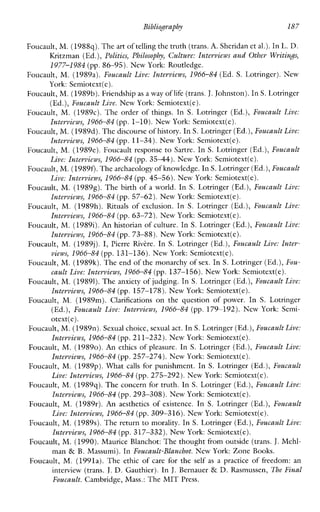
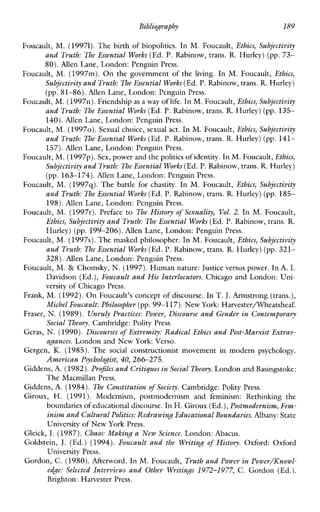
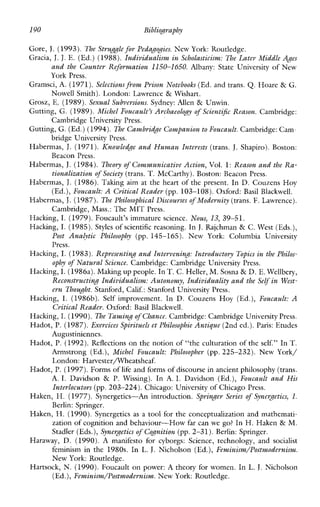
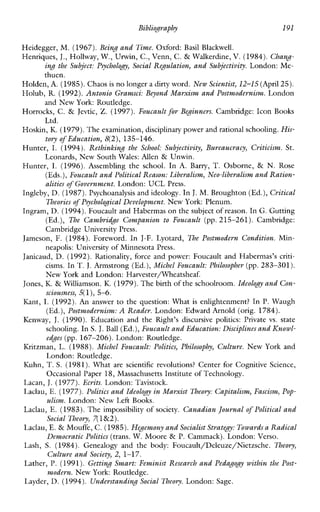
Bibliography
Index
vii
xi
1
7
9
19
37
39
49
71
89
111
113
139
159
171
179
197
This Page Intentionally Left Blank
Series Foreword
Educational reform has fallen upon hard times. The traditional assumption
thatschooling is fundamentallytied to the imperatives of citizenship de-
signed to educate studentsto exercise civic leadership and public service has
been eroded. The schools are now the key institution for producing profes-
sional, technically trained, credentialized workers for whom the demands of
citizenship are subordinated to the vicissitudes of the marketplace and the
commercialpublicsphere.Giventhecurrentcorporateandrightwing as-
sault on publicandhighereducation,coupledwiththeemergenceofa
moral and political climate that has shifted to a new Social Darwinism, the
issues whichframedthedemocraticmeaning,purpose,and use to which
education mightaspire have been displaced by more vocational and narrowly
ideological considerations.
The war waged against the possibilities of an education wedded to the
precepts of areal democracy is not merely ideological. Againstthe backdrop
of reduced funding for public schooling, thecall for privatization, vouchers,
culturaluniformity, andchoice,there are theoftenignoredlarger social
realities of material power and oppression. On the national level, there has
beena vast resurgenceofracism.This is evidentinthepassingofanti-
immigration laws such as Proposition 187 in California, the dismantling of
the welfare state, the demonization of black youth that is taking place in
the popular media, and the remarkable attention provided by the media to
forms of race talk that argue for the intellectual inferiority of blacks or dis-
miss calls for racial justice as simply a holdover from the “morally bankrupt”
legacy of the 1960s.
Poverty is on the rise among children in the United States, with 20 per-
cent of all children under the age of eighteen living below the poverty line.
VZZZ
...
Series Foreword
Unemployment is growingatanalarmingrateforpooryouthofcolor,
especially in the urban centers. Whileblack youth are policed and disciplined
in and out of the nation’s schools, conservative and liberal educators define
educationthroughthe ethically limpdiscoursesofprivatization,national
standards, and global competitiveness.
Manywritersin the critical education tradition have attempted to chal-
lenge the right wing fundamentalism behind educational and social reform
in both the United States and abroad while simultaneously providingethical
signposts for a public discourse about education and democracy thatis both
propheticandtransformative.Eschewingtraditionalcategories, a diverse
number of critical theorists and educators have successfully exposed the po-
litical and ethical implications of the cynicism and despair that has become
endemic to the discourse of schooling and civic life. In itsplace, such ed-
ucators strive to provide a languageof hope thatinextricably linksthe strug-
gle over schoolingto understanding and transforming our presentsocial and
cultural dangers.
At the risk of overgeneralizing, both cultural studies theorists andcritical
educators have emphasized the importance of understanding theory as the
grounded basis for“interveningintocontextsandpower ...in order to
enable peopleto act morestrategically in ways that may change their context
for the better.”’ Moreover, theorists in both fields have argued for the pri-
macy of the political by calling for and struggling to produce critical public
spaces, regardless of how fleeting they may be, in which “popular cultural
resistance is explored as a form of political resistance.”2 Such writers have
analyzed the challenges that teachers will have to face in redefining a new
mission for education, one that is linked to honoring the experiences, con-
cerns, and diverse histories and languages that give expression to the mul-
tiple narratives that engage and challenge the legacy of democracy.
Equallysignificant is the insight of recent critical educational work that
connects thepolitics of difference with concrete strategies for addressing the
crucial relationshpsbetweenschoolingandtheeconomy,andcitizenship
and thepolitics of meaning in communities of multicultural,multiracial, and
multilingual schools.
Critical %%diesin Education and Culture attempts to address and dem-
onstrate how scholars working in thefields of cultural studies and thecritical
pedagogy might join together in a radical project and practice informed by
theoretically rigorous discourses thataffirm the critical but refuse the cynical,
and establish hope as central to a critical pedagogical and politicalpractice
but eschew a romantic utopianism. Central to such a project is the issue of
how pedagogy might provide cultural studies theorists and educators with
an opportunity to engage pedagogical practices that are not only transdis-
ciplinary, transgressive, and oppositional, butalso connected toa wider pro-
ject designed to furtherracial, economic, andpolitical dem~cracy.~By tahng
seriously the relations between culture and power, we further the possibili-
ties of resistance, struggle, and change.
SeriesForeword ix
Critical Studies in Education and Culture is committed to publishing
work that opens a narrative space thataffirms the contextual and thespecific
whilesimultaneouslyrecognizingthe ways inwhichsuch spaces are shot
through with issues of power. Theseries attempts to continue an important
legacy of theoretical work in cultural studies in which related debates on
pedagogy are understood and addressed within the larger context of social
responsibility, civic courage,andthereconstructionofdemocraticpublic
life. We must keep in mind Raymond Williams’s insight that the “deepest
impulse (informing cultural politics) is the desire to make learning part of
the process of social change it~elf.”~Education as a culturalpedagogical
practice takes place across multiplesites, which include not only schools and
universities but also the mass media,popularculture,andotherpublic
spheres, and signals how within diverse contexts, education makes us both
subjects of and subject to relations of power.
This series challenges the current return to the primacy of market values
and simultaneous retreat from politics so evident in the recent work of ed-
ucationaltheorists,legislators,and policy analysts. Professionalrelegitima-
tion in a troubled time seems to be the order of the day as anincreasing
number of academics both refuse to recognize public and higher education
as critical publicspheresand offer little or no resistance to theongoing
vocationalization of schooling, the continuing evisceration of the intellectual
labor force, and the current assaults on the working poor, the elderly, and
women and ~hildren.~
Emphasizing the centrality of politics, culture, and power,Critical Studies
in Education and Culturewill deal with pedagogical issues that contribute
in imaginative and transformativeways to our understanding of howcritical
knowledge, democratic values, and social practicescanprovidea basis for
teachers, students, and other cultural workers to redefinetheirrole as en-
gaged and public intellectuals. Each volume will attempt to rethink the re-
lationship between language and experience, pedagogy and human agency,
and ethics and social responsibility as part of a larger project for engaging
and deepening the prospects of democratic schooling in a multiracial and
multicultural society. Critical Studies in Education and Culturetakes on the
responsibility of witnessing and addressing the most pressing problems of
publicschoolingand civic life, andengagesculture as a crucial site and
strategic force for productive social change.
Henry A. Giroux
NOTES
1. Lawrence Grossberg, “Toward a Genealogy of the State of Cultural Studies,”
in Cary Nelson and Dilip Parameshwar Gaonkar, eds., Disciplinariq and Dissent in
Cultural Studies(New York: Routledge, 1996), 143.
X Series Foreword
2. David Bailey and Stuart Hall,“The Vertigo of Displacemcnt,”Ten 8 (2:3)
(1992),19.
3. My notion of transdisciplinarycomesfrom Mas’ud ZavarzadehandDonald
Morton, “Theory, Pedagogy, Politics:The Crisis ofthe ‘Subject’ inthe Humanities,”
in Mas’ud Zavarzadeh and Donald Morton, eds., TheoryPedagogy Politics: Textsfor
Change (Urbana: University of IllinoisPress, 1992), 10. Atissuehereis neither
ignoring the boundaries of discipline-basedknowledge nor simplyfusingdifferent
disciplines, but creating theoretical paradigms, questions, and knowledgethat cannot
be taken up within the policed boundaries of the existing disciplines.
4. Raymond Williams, “Adult Education and Social Change,” in What I Came to
Say (London: Hutchinson-Radus, 1989), 158.
5. The term “professionallegitimation”comesfrom a personalcorrespondence
with Professor Jeff Williamsof East Carolina University.
Preface
I started writing on Michel Foucault in 1984 while on study leave in Lon-
don. I hadreadFoucault’searlierworks during the latter 1980s and had
been reading The History o f Sexuality, Volumes 2 and 3 and rereading The
Archaeology of Knowledge during the first fewweeks of my study leave. I
had also become convinced thatto read Foucault as part of a general “post-
modernist”tradition of thought in the same broad arena as Derridaand
Lyotard was a mistake. As I re-read The A~chaeolo~yo f Knowledge and his
later works I increasingly took the view that his oeuvre as a whole revealed
anoverallconsistency thatcouldbelocatedwithinabroadlymaterialist
perspective that could be represented as areconfiguration of the base-su-
perstructure relation, a reconfiguration that altered and rejected certain dis-
tinctivefeatures andfundamentalaxiomsofMarxismbutnevertheless
constituteda viablehistoricalmaterialistform of analysis. I also became
convinced that such a perspective had been understated in accountsof Fou-
cault. His modifications in relation to Marxism and his oppositions in rela-
tion to Hegelianismenabledanewresolution of the linkage between
metaphysical holism and terror, a linkage which had preoccupied both West-
ern liberal and continental traditions of thoughtalike. In addition,it enabled
a radically different understanding of the processes of education from the
dominant technicist and individualist conceptions whichprevail in ourtimes.
Yet, in that Foucault shared certainaffinities with Marxism it is not possible
to see him as a Marxist, for he rejected much of the substantive approach
of Marxism as well as the broad conception of history in which that per-
spectivewas wrapped. In that his work can be better understood in terms
of a particular relation to Marxism, however, his overall approach draws on
Nietzsche, Heidegger, and Greco-Roman and classical Greek thought, and
xii Preface
can also be understood in termsof its relation and oppositionto Kantianism.
As a thinker who dared to challenge manyof the dominant intellectual con-
ceptions since the Greeks,his writings have radical implications for our con-
temporaryunderstandingsofwhatitmeans to behuman,forour
understandings of ethical action, and for our understandingof the types of
futuresthatit is possible to create.Havingwritten a number of articles
suggestingthatFoucaultadvocated his own distinctive form of historical
materialism, in 1997 I was encouraged to develop them into a book-length
work, which now appears in this work.
As with all such enterprises, various people have assisted in reading this
manuscript or earlier drafts of chapters related to this manuscript. To these
ends I would like tothank JamesMarshallandMichaelPetersfortheir
assistance and encouragement with this project, and John Morss for reading
over themanuscript. I would also like tothank mypartner,JudithMc-
Farlane,forherpatienceandencouragement,andChristineGardenerfor
typing and preparing the manuscript.
Introduction
Jiirgen Habermas commented afterMichelFoucault’sdeathin 1984 that
“within the circle of the philosophers of my generation who diagnose our
times,Foucaulthasmost lastingly influencedthe Zeitgeist” (Habermas,
1986: 107). Given thatHabermas was formany years oneof Foucault’s
staunchest critics, this was tribute indeed. Foucault was not only to become
France’s most prominent post-war philosopher but, as David Macey (1993:
xi) has observed, “he ...successfully crossed the great divide that separates
the purely academic world from the broader cultural sphere.” In order to
answer the questions “what is it he has done?” and L1what significance does
what he has done have for an understanding of education?”, it is necessary
first to position Foucault in relation to the dominant intellectual currents of
his time.
At one level of abstraction, Foucault’s main achievement and goal was to
counterpose the philosophy of the concept to the philosophy of conscious-
ness. In thishereactedagainstthedominanceofSartreanexistentialism
instancing a dividing line that ran between a philosophy of experience, of
meaning, of the subject, and of consciousness on the one hand, and an anti-
humanist philosophy of concepts and structures on the other. On the one
side stood Sartre and Merleau-Ponty. On the other stood Cavaillis,Bach-
elard, Koyrk, Canguilhem, and Althusser (Macey, 1993: 33).
In a different sense, and within this context, Foucault can be viewed as a
sociologistofknowledge,andatthesametime as anhistorianand as a
philosopher.SuchrepresentationsseemplausiblegivenFoucault’s self-
chosen title of the Chair he occupied at the Coll2ge de France as the “Pro-
fessor of the History of Systems of Thought.” His central works comprise
studies of the emergence of phenomena, events, and processes that have
2 Michel Foucault
come to be seen as taken-for-granted within the history of European culture.
Among his earlierworks one was concerned with the history of madness
during theClassical age, and another with the birthof a discourse ofclinical
medicine during the late eighteenth century. In the 1960s he wrote on the
human sciences and the nature of knowledge. In the 1970s he presented a
history of the prison and of new modes ofdiscipline as they occurred inthe
nineteenth century. Later in the 1970s he wrote on the history of sexuality
to oppose the idea that sexuality reveals some “deep truth” about the self
and to expose the fallacy of theview that the humansciences are concerned
with uncovering rather than constructing the objects of their domain. In an
important sense Foucault’s work seeks to uncover not the development of
rationality, but theways new forms of control and power are legitimated by
complex discourses that stake a claim to rationality and that are embedded
in diverse institutional sites.
Foucault’slastingcontribution isas anhistorianandaphilosopherof
science, though not of the sort who can be neatly labeled in terms of dis-
ciplinary home, but rathera scholar who defies neat intellectual classification
and who rejects the institutional basis of disciplinaryaffiliation. Although
his works can be consideredhistories by virtue of their objects and temporal
reference, the objectives and conceptual and theoretical resources are drawn
fromphilosophy.According to ClareO’Farrell (1989: 3), a stronger case
can be made to consider Foucault’s writings as philosophies rather than as
histories. There is, she says, a “constancyofphilosophicalquest”which
underpins the historical shifts in emphasis and reinterpretations he makes of
his work. While I would agree with O’Farrell on this point, I would argue
further that the mix of historical and theoretical concerns means they are
not straightforwardly philosophicaltreatises either. If his work has a coher-
ence, the best designation, in my view, isas a sociologist of knowledge in
the traditions of Marx, Durkheim, and Mannheim. The sociology of knowl-
edgeseeks to relatepatternsofthought to social situationsandthereby
reveal how knowledgeis a product ofsocial structures andsocial interaction.
Foucault’sapproach fits such a designation as revealedin the illumination
as to how the human sciences as forms of power-knowledge have been im-
plicated with social structures, and in the repeated effort on Foucault’s part
to expose the individualist, and especially bio-medicalrootsofmodern
knowledge as expressions of power-knowledge.
To present an account of Foucault’s life can only be undertaken against
the background that Foucault’s own attitude to texts on or about the self
mirrored Nietzsche’s (1983: 97) distaste for “all the learned dust of biog-
raphy.” There is an important sense, however, in which each of Foucault’s
books must be seen as part of his biography and related to changes within
his life. In their important book Michel Foucault: Beyond Structuralism and
Hermeneutics (1982),Dreyfus and Rabinow distinguish four stages in Fou-
Intvoduction 3
cault’s intellectualdevelopment-aHeideggerianstage;anarchaeological,
quasi-structuralist stage; a genealogical, Nietzschean stage characterized by
ageneralretreatfromMarxismandlanguagephilosophy;and finally, an
ethical stage marked by a new concern with Greek and Stoic thought and
the development of a new ethics of the self.
AfterenteringtheEcoleNormaleSupt-rieure as a nurwalien in1946,
Foucault’s intellectual and personal life was shaped in the shadow of Marx-
ismand hisclosefriendshipwithLouisAlthusserwhichdevelopedinthe
1940s. Although Foucault joined the Parti Communiste Franqais (PCF) in
1950, under the undoubted influence of Althusser, Foucault’s commitment
to Marxism extended little beyond the general conviction that material ec-
onomic conditions were an important influence on social and political life.
Disillusioned by the nature of inter-party communist politics,his commit-
ment was to beshort-lived,however.Foucault left the PCF in 1953 and
embarked on a period of political quietism that lasted until the mid-1960s.
From then on there was a renewed interest in politics-this time of a non-
communist sort-brought into focus by the events of May-June 1968,and
his growing friendship withGilles Deleuze, the “prime mover”of the Nietz-
schean renaissance in France. From 1968 through the next decade, Foucault
started to work collaboratively with Deleuzeon a number of projects.These
included joint authorship of the “Introduction” toPierre IUossowski’s 1967
translation of Nietzsche’s Frohliche Wissenschaft, being interviewed together
during 1972, and Foucault’s writing of the “Preface” to the 1977 English
translation of Anti-Oedipus. Politically from this time Foucault became ac-
tivein prison reform and in active representation of other subjugated and
marginalized groups within French society.
Foucault’s writings can also be traced in relation to the varied character-
izations he offers of his own work over the course of time. As Paul Patton
notes, in his earlierworks, written in the 1960s, Foucault represented his
project as concerned to define“the limits and exclusionswhichmake up
our cultural unconscious” (1987: 227). Later, in the 1970s, he defined his
central concernas being related to theissue of power, although he conceded
thatin his earlierworks-Madness and Civilizatiun and The Birth (8the
Clinic-he had scarcely used the term (Foucault, 1980b: 115). By the late
1970s, Foucault offered yet another representation of his work, defining his
centralinterest as concernedwiththe historical originsof “subjectifica-
tion”-“the process by which, in our culture, human beings are made into
subjects” (Patton, 1987: 227). Atvarioustimes throughout the course of
his life, Foucault represented his oeuvre as a long-term project of discovering
the elements of the “western will to truth.” Just before his death in 1984,
in what is perhaps an attempt to bring these different characterizations to-
gether,hedefendedanintellectualethicof“permanentrevolutionin
thought” (1987: 227).NotwithstandingthedifferentaccountsFoucault
4 Michcl Foucault
offered at different times, however, within the broad tradition of the soci-
ology of knowledge, Foucault’s work, I will argue, can be seen to have a
more deeply structured coherence.
In terms of the major influences on his work, his intellectual and philo-
sophicalprecursors, so to speak, it has beencommonplace to repeat Fou-
cault’s ownacknowledgmentsof his substantialdebtstoNietzscheand
Heidegger. As he states, “for me, Heidegger has always been the essential
philosopher. ...My entirephilosophicaldevelopment was determined by
my reading of Heidegger” (Foucault, 1985b: 8).
Concerning Nietzsche, he says, “I amsimplyNietzschean,and I try to
see, on a number of points, and to the extent that it is possible, with the
aid ofNietzsche’stexts ...whatcanbedoneinthisorthatdomain”
(1985b: 9).
But, as Hubert Dreyfus tells us, “it was through Heidegger that Foucault
came to appreciate Nietzsche” (1992: 80-81 ). In Foucault’swords,“it is
possible that if I had not read Heidegger,I would not have read Nietzsche.
I had tried to read Nietzsche in thefifties but Nietzsche alone did not appeal
to me-whereas Nietzsche and Heidegger, thatwas a philosophical shock!”
(Foucault, 1985b: 9).
One of the central themes which Foucault shared with Heidegger and
Nietzsche, as well as with French writers like Althusser, was their challenge
to the Cartesian and Kantian conceptions of the subject, propounding in-
stead the view that our own selves may be the greatest illusion of our time.
This “theoretical anti-humanism’’ stands in contrast to the phenomenolog-
ical conception that Foucault rejected.H e rejects a view of the subject stand-
ing prior to history orsociety, maintaining that the events and categories of
ourworldmustbeanalyzedinrelation to historical bodiesofdiscourse
“tacitly governed by anonymous rules” (Rajchman, 1985: 44).
To seeFoucault as Heideggerian, or as Nietzschean,however, is to ex-
aggerate. Notwithstanding his own views on this matter, and not wishing
to underrate his debt to Nietzsche, he is not simply Nietzschean, or simply
Heideggerian. Other key influences on his work include French structural-
ism, as well as the more mainstream French philosophy of science, including
notablessuch as Koyrt, Cavaillks, Bachelard,Canguilhem,andAlthusser.
These thinkers had each in their own way sought to challenge the concep-
tion of history as a universal, objective, and progressive unfolding of events
governed by a conception of a unified model of science taken on from the
Enlightenment,andsoughttoreplaceitwithanattempt to discoveran
irredeemable plurality of forces and objects of knowledge, characterized, as
Rajchman says, “by anonymous tacit procedures, [each] succeeding one an-
otherthrough breaksandensuingruptures-adiscontinuoushistory”
(1985: 53).
Yet anotherinfluenceonFoucaultcamefromthe Annales schoolcon-
ception of “new history” identified with the journalAnnales, which opposed
Intyoduction 5
“‘battle-treaty’narrative”conceptionsofhistory(Rajchman,1985: 53),
replacing it with broadsocial history. In the introduction toThe Archaeology
of ICnowledge (1972: 3-11), Foucault acknowledges the importance of the
Annales histories, drawing specifically on Braudel’s concepts of “serial his-
tory” as well as the notion of longue durte whereby events were seen not
as discrete atoms, but rather as intelligible onlywithina“series”or “CO-
herent succession” characterized by repetition over a long period and util-
izedconceptuallyforthemeasurementofdataoneconomicagricultural
phenomena (such as price fluctuations) (see Dean, 1994: 3 7 4 2 ) .
Finally, Foucault was influenced by Marxism. Although he took the view
that “Marxist thought is irredeemably confined by an episteme that is com-
ing to an end” (Sheridan, 1980: 73), he could also agree, albeit in a some-
what different sense, to an interviewer’s suggestion that “Marx was at work
in [his] own methodology” (Foucault, 1988a: 46). As these two instances
might suggest, Foucault’s relationshipto Marxism was not straightforward.
Although for the most part he was critical of Marxism, a great deal of what
he wrote can be seen as a response to Marxism. As Balibar has noted, “the
whole of Foucault’s work can be seen in terms of a genuine struggle with
Marxand ...thiscan be viewed as one of the driving forces of his pro-
ductiveness” (1992:39).The maincriticisms ofMarxismweredirected
againstthemethodologicalmodelsandphilosophicalconceptions it em-
braced, especially its attachment to various forms of Hegelianism, as well as
its undue emphasis on economic determinants and forms of power.As Fou-
cault states, “to put it very simply, psychiatric internment, the mental nor-
malizationof individuals, andpenalinstitutions have nodoubta fairly
limited importance if one is only looking for their economic significance”
(1980b: 116).
InthatFoucaultdepartsfromMarxism, his ownapproachnevertheless
constitutes a form of consistent materialism that has theoretical implications
for the analysis of social and educational systems. In seeking to demonstrate
such an approach as a correct reading of Foucault,linguistic readings of his
work such as that of Christopher Norris (1993) which represent himas part
of the linguistic turn in French philosophy, where “thereis nothing beyond
[the] prison-house of language” and where “language (or representation)
henceforth defines the very limits of thought’’ (1993: 30), will be dispelled
in the process of being corrected. Rather, Foucault will be represented, as
Habermas has suggested, “not merelyas a historicist,” but at thesame time
as a “nominalist, materialist and empiricist” (1987: 257).
Because the distinctiveness of Foucault’sapproachcanbestbeseenin
contrast to other major philosophical systems and thinkers, this study directs
considerable attention to examining Foucault’s relationship to Marxism, as
well as to Kant,Gramsci,Habermas,andtheGreeks. By so locating Fou-
cault, it is possible, I will argue, to expose the distinctive characterof his
philosophicalcontribution.Inrelation to education, there is inFoucault’s
6 Michel Foucault
approach a double emphasis that constitutes an ordering principle for this
work. Ontheonehand,attention is directed to discursivepractices that
perform an educative role in the constitution of subjects and of human forms
of existence. On the other hand, forms of education areconstitutedand
utilized for the purposes of collective ethical self-creation, a theme Foucault
emphasized in his latter works.
This work is divided into three sections. Part I provides an introduction
to Foucault as a distinctively materialist thinker, focusing on the distinctive-
ness of his methods of research (Chapter 2) as well as his theoretical con-
ception of power and of the historical constitution of the subject (Chapter
Part I1 considersFoucault as anhistoricalmaterialist.Thissectionseeks
to bridge the divide between linguistic receptions of Foucault and historical
materialism by pointing to Foucault’s developing interest after 1968 in the
relationship between discursive and extra-discursive dimensions of reality. In
this context it will be argued that Foucault’s analysis of the doublerelation
between power and knowledge differs radically from the self-referential tex-
tuality of Derrida and his followers (Chapter 4). Chapter 5 goes on to ex-
aminethecentraldifferencesbetweenFoucault’sversionofhistorical
materialism and Marxistversions, noting the central rejection of the He-
gelian conception of a closed “totality” and the developing suggestion of
what may be represented as a form of post-structuralist Marxism. Although
many authors havecriticizedFoucault’sproject on the grounds of episte-
mological and moral relativism, it is argued in Chapter 6 that relativism is
not an insuperable problem for Foucault and that there are various ways to
resolve the problem of self-referentiality in his work. Although Foucault’s
notions of materialism are anti-Marxist in their rejection of modes of pro-
duction, dialectical method,andideologycritique,suchanassessment
should not obscure deficiencies in Foucault’s account relating to power and
structure orto the nominalistic form ofanalysis adopted. As a consequence,
the sources, substances, anddispersal of power are not concretely related to
institutionalpractices.Chapter 7 explores the issue as to whether the ad-
dition to Foucault’s approach of insights from Gramsci can serve as a cor-
rective to some of these deficiencies.
Part I11 exploresvariousthemesrelatingFoucault’swork to education.
Chapter 8 outlinesFoucault’s critical epistemology and his relationship to
Kant, seelung to elucidate Foucault’s conception of knowledge in relation
to politicalaction and utopian proposals. In Chapter 9 his latteremphasis
on ethical self-creation is represented as a distinctively educational form of
activity, embodying a form of thin communitarianism that takes us back to
theGreekpolis.Chapter 10 assesses someofthemoreinterestingrecent
utilizationsofFoucaultineducationalresearch.Chapter 11 concludes by
focusing on Foucault’sdistinctiveresolution ofstructureandagencyand
determinism and free will.
3).
The Modified Realism
of Michel Foucault
This Page Intentionally Left Blank
Chapter 2
Foucault’s Methods
Methodologically, Foucault’s works utilize two approaches: that of archae-
olo~y,concernedwithdescribingthe historical presuppositionsofagiven
system of thought, and that of JenealoJy, concerned with tracing the his-
torical processes of descent and enzeryence by which a given thought system
or process comes into being and is subsequently transformed.
Foucault’s method of archaeology constitutes a way of analyzing the su-
perstructural dimension of language statements constitutive of discourse. A
discourse is defined in terms of statements(tnoncts), of “things said.” State-
mentsareevents of certainkmdswhichareatoncetied to anhistorical
context and capable of repetition. Statements are not equivalent to propo-
sitionsorsentences,or“speech acts,” neither are theyphonemes,mor-
phemes, or syntagms. Rather, as Foucault (1972: 115) states,
In examining the statement what we have discovered is afunction that has a bearing
on groups of signs, which is identified neither with grammatical “acceptability” nor
with logical correctness, and which requires ifit is to operate: a referential (whichis
not exactly a fact, a state of things, or even an object, but a principle of differentia-
tion); a subject (not the speaking consciousness, not the author of theformulation,
but a position that may befilled in certainconditions byvariousindividuals); an
associated jield (which is not the real context of the formulation, the situation in
which it was articulated, but a domain of coexistence for other statements); a ma-
teriality (which isnot only the substance or support of thearticulation, but a status,
rules of transcription, possibilities of use and re-use).(emphasisadded)’
Foucault is interestedinseriousstatementscomprisingthatsub-set of
formal knowledge statements, which contain truth claims and which belong
10 Michel Foucault
to a singlesystem offormation. A “discursiveformation”comprisesthe
“regularity” that obtains between “objects, typesof statement, concepts, or
thematic choices” (Foucault, 1972: 38). It is “thegeneralenunciative sys-
tem that governs a group of verbal performances” (116).
Archaeological analysis is centrally concerned with uncovering the rules
offormation of discourses, or discursivesystems. In a technical sense, it
proceeds at the level of statements (Lnoncts)searching for rules that explain
the appearance of phenomena under study. It examines the forms of regu-
larity, that is, the discursive conditions, which order the structure of a form
of discourse and which determine how such orders come into being. It is
not an analysis ofthatwhich is claimed to betrueinknowledgebutan
analysis of “truth games.” Discourse is thus analyzed in terms of the op-
eration of rules that bring it into being. Archaeology attempts to account
forthe way discoursesare ordered. As Foucaultstates,“myobject is not
languagebutthearchive,that is to say theaccumulatedexistenceof dis-
course. Archaeology, suchas I intend it,is h n neither to geology(asanalysis
ofthesub-soil),nor to genealogy (as descriptionsofbeginningsand se-
quences); it’s the analysis of discourse in its modality of archive” (1989a:
25). As such, archaeology focuses attention on thelink between perception
and action and on why at different periods specialists in knowledge perceive
objects differently. The core of archaeology is thus an attempt to establish
the discursive practicesand rules of formation of discourses through ashng,
“how is it that oneparticular statement appeared rather than another” (Fou-
cault, 1972: 27).As Manfred Frank says, “As such, he is more interested in
the condtions whichmake it possible for the structures to arise than in the
structures themselves ...for Foucault the foundation of the constitution of
an order is never a subject, but yet another order: in the last instance this
would be the order of the discourse with itsregard diju codt(already coded
look)”(1992: 107).
In The Order of Things, for example, Foucault seeks to uncover the reg-
ularities that accounted for the emergence of the sciences in the nineteenth
century by comparing forms of thought across different historical periods
(Renaissance, Classical, andModern).Archaeologyhereconstitutes a
method for examining the historicity of science by describing rules that un-
dergird ways of looking at the world. These rulesareregularities that de-
termine the systems of possibility as to what is considered as true and false,
and they determine what counts as grounds for assent or dissent, as well as
what arguments and data arerelevantandlegitimate.These“structuresof
thought” are termed episteunes. An “episteme” refers to“thetotalsetof
relations that unite, at a given period, the discursive practices. ...The ep-
isteme is not a form of knowledge ...or type of rationality which, crossing
the boundaries of the most varied sciences, manifests the sovereign unity of
a subject, a spirit, or a period; it is thetotalityofrelationsthatcanbe
Foucault’r Methods l1
discovered for a given period, between the sciences when one analyses them
at the level of discursive regularities” (Foucault, 1972: 191).
Robert Machado (1992: 14) characterizes an episteme as defined by two
features. The first is its depth; an episteme relates to the nature of “deep”
knowledge (savoir) and to the specific orderorconfigurationthatsuch
knowledgeassumesinagivenperiod.This is to say thatanepisteme is
governed by aprincipleprior to and independent of the ordering of dis-
course such as science,which is constituted of “surface” knowledge (con-
naissance). Thesecond is itsgeneralglobalnature. In anyculture, at a
particular point in time, there is only one episteme which defines the corn
ditions ofpossibility of all theoretical knowledge (see Foucault, 1970:179).
Archaeology is an historicalanalysis of this theoretical knowledge attempting
to trace links between the different domains of “life, work, and language,”
revealing relationships that are not readily apparent. In doing so, it seeks to
expose the “historical a priori” of the episteme as it manifests itself in the
body of discourses under study.In this sense, Foucault insists that epistemes
are not transcendental in the Kantiansense, neither are they origins orfoun-
dations. Rather, they are a practiceto be encountered; thatis, they are time-
bound and factual.
Archaeology signals Foucault’s affinity to themainstreamtraditionof
French philosophy as embodied in Bachelard, Koyrt,Cavaillks, Canguilhem,
and Althusser, who sought to study science in terms of its place in history.
Its proper object of analysis in Foucault’s work is the historical constitution
of the human sciences. It aims to trace, in the manner familiar to French
philosophy,sharpbutnotcompletediscontinuitiesbetweensystemsof
thought. Hence, archaeology seeks to chart ruptures/changes between dis-
cursive systems. An archaeological mutation makes a new age possible, that
is, the structures of discourse suddenly change at certain crucial junctures
in a sudden radical discursive restructuring.
For example, in The Birth of the Clinic, Foucaultutilizesarchaeological
methods to extend his study of the humansciences to the study of medicine
as ascience. In seeking to trace theconditions of possibility ofmodern
medicaldiscourse,Foucaultidentifiesa“mutation”inWesternmedical
thought at the end of the eighteenth century. It is a mutation in medical
perception and knowledge from a classificatory medicine, or “medicine of
species,” based on pathological anatomy, to a “medicine of symptoms” and
eventually, a “medicine of tissues,” or “anatomo-clinical medicine” (Smart,
1985: 29). Essentially it involves a reconceptualization of the medical gaze
froma classification of casesbased on “types” to a classification o f cases
solely in relation to individuals. As Smart (27) maintains, for Foucault med-
icine is “the first scientific discourse concerning the individual.” It is with
medical discourse that the individual is constituted as an “object of positive
knowledge.”
12 Machel Foucault
Insofar as archaeology’s object of studyis discourse, its methods are con-
ceptual and it aims to search for explanations at a deeper level than those
provided by science. Archaeology utilizes theoretical knowledge (savoir)in
order to analyze science. As Machado states, “in short, archaeologyanalyses
the similarities and differences between different forms of theoretical knowl-
edge (savoirs),establishingbetweenthem a ‘uniquenetworkofnecessary
relationships’ ”(1992: 15).It examines science in its historical context, tak-
ing as itsstartingpointthe historical constitutionof scientific concepts,
detailing the types of progress that characterize them, the means by which
truth is produced,andthe criteria of rationality thatthey establish (Ma-
chado, (1992: 15).
Archaeologyhas several affinities to structuralism.Themain similarities
reside in representing discourse as a rule-governed system, as autonomous,
and in focusing on both discourse and the speaker as constructed objects,
thelattereffectedthroughthede-centeringthesubject.What saves Fou-
cault,ultimately,fromlapsingintostructuralism is theutilizationofNie-
tzsche’s methodofgenealogy(describedbelow,)whichenableshimto
situate discourse and the locus of its transformation in the contextof history.
Crucially, too, archaeology asserts the priority of theoretical knowledge
(theoria)over science for the purposes of analysis and evaluation. It is be-
cause Foucault believes in the superiority of theoretical knowledge that he
subordinates science to it. Thecentrality of theoretical knowledge (theoria),
as a form of critical interrogation, wasdisplacedwiththeScientificRevo-
lutionofthesixteenthandseventeenthcenturies,anditcontinuedto be
dismissed by Ibnt at the end of the eighteenth century. Until the end of
the eighteenth century, the principle that being can always be represented
directly was the central characteristic of the episteme, which Foucault calls
the “reign of representation.” Although Kant challenged the postulate ofa
directly represented order (which he attributed to a mistake made by Plato),
replacing it withan analytic that reflected on limits, heneverthelesssafe-
guarded the continued dominance of the “objectivist” tradition based on
mathematization, thus ensuring the retreat oftheoriaas a form of knowledge
to a position outside the “space of representation” (Foucault, 1970:212-
213).
In establishing archaeology, Foucault is thus reinstating theoria prior to
science. Unlikescience,archaeologydoes notcontainassumptionsabout
evolution or progress, and it displaces science for providing the authority
for knowledge of the past in relation toissues such as progress or truth. Yet,
in doing so, it does not invalidate the legitimacy or truth of science either.
GENEALOGY
Genealogical analysis aims to explain the existence and transformation of
elements of theoretical knowledge (savoir)by situating them within power
Foucault’s Methods 13
structuresand by tracingtheirdescentandemergenceinthecontextof
history. As such,it traces an essential,historically constituted tie between
powerandknowledge,anditprovidesacausalexplanationforchangein
discursiveformations andepistemes.Because it is more historical,ithelps
Foucaultavoidsuccumbing to thetemptationsofstructuralism. Yet, like
archaeology, it avoids referenceto a philosophical conception of the subject,
radicalizing Nietzsche and Heidegger’s opposition to the post-Cartesian and
Kantianconceptions.Likearchaeology, too, it is limited and justified as a
method in terms of the fruitfulness of its specific applications.
Genealogy thus asserts the historical constitution of our most prized cer-
tainties about ourselves and the world in its attempts to de-naturalize ex-
planationsfortheexistenceofphenomena. It analyzesdiscourseinits
relation to social structures and has an explicit focus on power and on bod-
ies. It is interested in institutionalanalysis and technologies of power aiming
to isolate the mechanisms by which power operates. Through its focus on
power, also, genealogy aimsto document how culture attemptsto normalize
individuals through increasinglyrationalizedmeans,byconstitutingnor-
mality,turningthemintomeaningfulsubjectsanddocileobjects.Power
relations are therefore pivotal. Genealogy thusshifts the model for historical
understandingfromMarxistscienceandideology,orfromhermeneutical
texts and their interpretation,to a Nietzschean-inspiredanalysis of strategies
and tactics in history.
ForFoucault (1977b: 142), then, as forNeitzsche,genealogyopposes
itself to the search for origins (Ursprund)or essences. To search for origins
is to attempt to capture theexact essence of things, which Foucault sees as
reinstating Platonicessentialism. Such a search assumes the existence of “im-
mobile forms that precede the external world of accident and succession.’’
Such a search, says Foucault, assumes the existence of a
primordial truth fully adequate to its nature, and it necessitatesthe removal of every
mask to ultimately disclose an original identity. However, if the genealogist refuses
to extend hisfaithinmetaphysics,ifhelistens to history, he fmds that there is
“something altogether different” behind things: not a timeless and essential secret,
butthe secret that theyhave no essence orthat their essencewasfabricatedin a
piecemeal fashion from alien forms. (142)
In addition, genealogicalanalysis does not take history atits word but rather
shows that concepts suchas liberty, for example,far from being fundamental
to human nature, or at the root of human attachment to being and truth,
are rather the invention of the ruling classes (142).
Rather than trace origins (Ursprund),genealogy traces the processesof
descent and evvcerdence. Foucault defines descent (herlzunft)as pertaining to
practices as a series of events: “TO follow the complex course of descent is
to maintainpassingevents in their proper dispersion; it is to identify the
14 Michel Foucault
accidents, theminute deviations-orconversely, thecomplete reversals-
the errors, the false appraisals, and the faulty calculations that gave birth to
those things that continueto exist and have value for us” (Foucault, 1977b:
146).
Unlike the continuities traced by those historians who search for origins,
genealogy traces the jolts and surprises of history in terms of the effects of
power on the body. Following Nietzsche’s nominalism, Foucault’s geneal-
ogies of the subject constitute an investigation into how wehave been fash-
ioned as ethical subjects. Hence, genealogy attaches itself to the body, that
“inscribed surface of events ...and a volume in perpetual disintegration”
(1977b: 148).It reveals how history “inscribes itself in the nervous system,
in temperament, in the digestive apparatus ...in faulty respiration, in im-
proper diets, in the debilitated and prostrate bodyof those whose ancestors
commited errors” (147).
In contrast to descent, emergence (Entstehun.)traces “the movement of
arising” (148).“Emergence is thus the entry of forces; it is their eruption,
the leapfromwings to centerstage,eachinitsyouthfulstrength” (149-
150).
Genealogy has a central role in tracing the patterns of descent and emer-
gence of discursivesystems. CitingNietzschefrom The Dawn andfrom
Human, All Too Human, Foucault argues that the forces operating in his-
tory that constitute the historical process are not controlled by destiny or
by regulative mechanisms, but respond to “haphazard conflicts,” and they
“always appear through the singular randomness of events” (1977b: 154-
155).
In terms of its approach to history, genealogy signals Foucault’s affinities
to the“newhistory”ofthe Annales schoolandtherejectionoflinear,
humanist histories that embodied hermeneutical methods in ascertaining the
meaning of documents, and subscribed to conceptions of linearity and suc-
cession. Such approaches treat history as a narrative of events in chronolog-
ical order, assume a feigned neutrality generated more from adherence to a
particular style than to worked-out methodological rules, and represent the
present as emerging unproblematically from the historical record, recount-
ingthe facts as puredescriptioninanassumedphenomenologicalunion
between the historian and the past.
In Nietzsche, GenealoJy, Histovy, Foucault (1977b) invokes the second of
Nietzsche’s Untimely Meditations (Nietzsche,1983:57-123)inorder to
record his debt to Nietzscheconcerningtheformsofhistoryherejects.
Nietzsche identifies three uses of history which are problematic: the mon-
umental, devotedto a veneration of great events, great men, and great deeds
(Foucault, 1977b:69-72); the antiquarian, dedicated to preservation of the
past as a continuity of identity in tradition (72-75); and the critical, dedi-
cated to judgment on and condemnation of parts of the past in the name
of the present (74-75). Itis to these three conceptions that Foucault argues
Foucault’s Methods 15
the historical sense of Nietzsche’s genealogy is opposed. Following closely
in Nietzsche’s footsteps, Foucault summarizes his own approach to reason
and history as a “critical inquiry into the history of rationality,” “a rational
critique ofrationality,” and “a contingent history of history” (1983a: 201).
Drawing on concepts elaborated by Nietzsche, Mitchell Dean summarizes
Foucault’s histories as “effective” and “critical”:
If archaeology displacesthe delirium of interpretationwith an analysisof the positivity
of discourse, then genealogy displaces both the search for ultimate foundationsand
its opposite, nihilism, with a form of patient criticism and problematisation located
in the present. Foucault’s critical history forsakesthe critique of the past in terms of
the truth of the present but not thecritical use of history of reason to diagnose the
practical issues, necessities, and limits of the present. Let us call history “effective”
to the extent that it upsets the colonisation of historical knowledge by the schemas
of a transcendental and synthetic philosophy of history, and “critical” inproportion
to itscapacity to engagein the tireless interrogation of what isheld to begiven,
necessary, natural, or neutral. (1994:20)
Foucault’sgenealogicalhistoriesthuschallengethepresuppositionsof
pasthistories, thetendencytowardtotalizingabstraction,towardclosure,
toward universalist assumptions regarding the human identity or the nature
of existence. His approachalso rejects the transcendental turn in philosophy
and asserts the radical contingency of discourses in their historical context.
Further insights into Foucault’s methods are revealed in his lecture notes
at the Colkge de France, as published in the four volumes of Dits et tcrits
(1994a).Inthesevolumes,Foucault reveals theimportanceof analytic
method and the philosophy of language in relation to the analysis of dis-
course. In one essay, “La philosophie analytique de la politique” (1994c),
initiallydelivered in 1978 inJapan,Foucault spells out the superiority of
analytical methods as used in Anglo-American philosophy compared to cl-
alectical methodology. What characterizesanalytic methods is a concern not
with the “deep structures’’ of language, or the “being” of language but
with the “everyday use” made of language in different types of discourse.
By extension,Foucaultarguesthatphilosophycan similarlyanalyze what
occurs in “everyday relations of power” and in all those other relations that
“traverse the social body.” Just as language can be seento underlie thought,
so there is a similar grammarunderlying social relationsandrelationsof
power. Hence, Foucault argues for what he calls an “analytico-political phi-
losophy.” Similarly, rather than seeing language as revealingsomeeternal
buried truth that “deceives or reveals,”themetaphoricalmethodforun-
derstandingthatFoucault utilizes is thatofagame:“Language, it is
played.” It is thus a “strategic” metaphor, as well as a linguistic metaphor,
thatFoucault utilizes to developa critical approach to societyfreedfrom
the theory of Marxism: “Relations of power,also, they are played; itis these
16 Michel Foucault
games of power (jeux de pouvoir)that one must study in terms of tactics
and strategy, in terms of order and of chance, in terms of stakes and objec-
tives” (Foucault, 1994c, Vol. 3: 541-542).
Foucault’sdependenceonstructural linguistics is also central to under-
standing the nature of his analysis. Traditionally, the rationality of analytic
reason, he says, has been concerned with causality. In structural linguistics,
however, the concernis not withcausality, but in revealing multiple relations
which, in his 1969 article “Linguistique et sciences sociales,” Foucault calls
“logical relations” (see Foucault, 1994b, Vol. 1: 824). While it is possible
to formalize one’s treatment of the analysis of relations, it is, says Foucault,
thediscoveryofthe“presenceof a logic that is not the logicofcausal
determinism that is currentlyattheheartofphilosophicalandtheoretical
debates” (824).
Foucault’sreliance onthemodelofstructural linguisticsprovides him
with a method that avoids both methodological individualism and entrap-
ment by a concern with causalism. Structural linguistics is concerned with
“the systematic sets of relations among elements” (Davidson, 1997: 8),and
it functions for Foucault as a model that enables him to study social reality
as a logical structure, or a set of logical relations revealing relations that are
not transparent to consciousness. The methods of structural linguistics also
enableFoucault to analyzechange.Forjust as linguistics undertakessyw
chronic analysis seeking to trace thenecessaryconditionsforanelement
withinthestructureoflanguagetoundergochange,a similar synchronic
analysis applied to social life asks thequestion,inorderfor a change to
occur, what other changes must also take place in the overall texture of the
social configuration? (See Foucault, 1994b, Vol. 1: 827.) Hence, Foucault
seeks to identify logical relations where none had previously been thought
to exist or where previously one had searched for causal relations. This form
of analysis becomes for Foucault a method of analyzing previously invisible
determinations (see Davidson, 1997: 1-20).
Themethodologicalstrategiescommon to botharchaeologyandgene-
alogywerealsodevelopedinresponse to Marxism,which is characterized
by a specific, narrow conception of causality (un causalisme primaire) and
a dialectical logic that has little in common with the logical relations that
interest Foucault. Thus he maintains: “what oneis trying to recover in Marx
is something that is neither the determinist ascription of causality, nor the
logic of a Hegelian type, but alogical analysis of reality” (Foucault, 1994b,
Vol. 1: 824-825; cited in Davidson, 1997: IO).
Arnold Davidson (1997),in a review of Dits et h i t s to which my own
analysis is indebted, points out thatit is through such methodological strat-
egies that Foucault proceeds to advance a non-reductive, holist analysis of
sociallife. According to Davidson,“thiskind of analysis is characterised,
first, by anti-atomism, by the idea that we should not analyse single or in-
dividual elements in isolation but that one must look at the systematic re-
FoacaaLt’s Methods 17
lationsamongelements;second,it is characterisedby the ideathatthe
relations between elements are coherent and transformable, that is, that the
elements form a structure” (11).Thus, in his dissertation on theknowledge
of heredity as a system of thought, submitted as part of his application for
his positionat the Collkge deFrance,Foucaultseeks to describe the
changes, transformations, and conditions of possibility that made genetics
possible, that constituted it as a science based on a series of discourses con-
cerningbreeding,just as in The Order of Thingshe had done for natural
history and biology. What factors led to the emergence of these fields as
sciences? Whatelementschanged to makesuchdevelopmentspossible?
What made them possible as systems of thought? Thus Foucault seeks to
describe the relations among elementsas structures that change as the com-
ponent elements change. That is, heendeavors to establish the systematic
sets of relations and transformations that enable different forms of knowl-
edge to emerge.
NOTE
1. Unless indicated, all emphases in quotations in this book belong to the original
author being cited.
This Page Intentionally Left Blank
Cbaptev 3
Power and the Self
For Foucault, at least inDiscipline and Punish and The Histovy of Sexuality,
Volume 1, the relationshipbetweendiscursivesystems of knowledgeand
power and domination becomes critical. Unlike Marxists, hesees no oneset
of factors as directing human destiny. Rather, he represents power in terms
of a multiplicit?, offorce relations throughout the entire social formation.
Foucault’s central critique of traditional approaches to power is against the
“juridico-discursive” model of power which underpins not just Marxist the-
ories but liberal theories of power as well. The three features of this model
of power are (Sawich, 1991: 20-21 ):
that powerispossessed (e.g., by the state, classes, individuals);
that powerflowsfromacentralizedsource,from top to bottom; and
that power isprimarilyrepressivein its exercise.
In contrast, Foucault’s alternative conception maintains
that poweriscxcrcised rather than possessed;
that power is productive, aswellasrepressive; and
that powerarises from the bottom up.
Foucault’sargumentvis-i-visMarxism is thatinmodern capitalist states
power is not significantly determined by economicforces.Furthermore,
other institutional sectors, suchas psychiatric institutions, schools, and pris-
ons, are increasingly essential to the operations of social power and in the
20 Michel Foucault
constitutions of subjectivities: roles that have been minimized by Marxists.
Thus, in relation to Marxism, Foucault asks a series of questions:
What means are available to us today if we seek to conduct a non-economicanalysis
of power?Very few, I believe. We have in the first place the assertion that power is
neither given, nor exchanged, nor recovered, but rather exercised, and that it only
existsinaction.Again,wehave at our disposal another assertion to the effect that
power is not primarily the maintenance and reproduction of economicrelations, but
isabovealla relation of force. The questions to be posed would then be these:if
power is exercised,what sort of exercise does it involve?In what does it consist? What
is itsmechanism? (Foucault, 1980f: 89)
In The History of Sexuality,Volume 1,Foucault repeats his view concern-
ing the general nature and exercise of power: “Power ...is exercised from
innumerable points in the interplay of non-egalitarian and mobile relations.
...Powercomesfrombelow;that is, there is no binaryand all-
encompassingoppositionbetween rulers andruledattheroot of power
relations” (197th:94).Foucault’s rejection of the view that “power is what
represses” is also directed against Marxists. As he states it in Discipline and
Punish: “We must cease once and for all to describe the effects of power in
negativeterms;it ‘excludes’, it ‘represses’, it ‘censors’, it ‘abstracts’, it
‘masks’, it ‘conceals’. In fact, power produces, it producesreality; it produces
domains of objects and rituals of truth. The individual and the knowledge
that may be gained of him belong to this production” (1977a: 194). Fou-
cault also rejects the metaphors ofwar, struggle, orconflict to explain power.
His rejection of the “juridical” conception of powerentails the rejection of
thoseconceptionsderivedfromphilosophersoftheeighteenthcentury
which saw power as an “original right that is given up in the establishment
of sovereignty, andthecontract”(1980691).Foucault rejects boththe
juridical conception,whichhecharacterizes as a “contract-oppression”
schema,andthe“war-repressionschema,”which sees powerinterms of
struggleandsubmission,inpreference toanapproachthatexaminesthe
mechanisms(i.e.,the“how”)ofpower(1977a: 92). As heputsit,in a
lecture given in 1976 “my general project over the past fewyears has been,
in essence, to reverse the modes ofanalysis followed by the entire discourse
of right from the time of the Middle Ages” (19806 95).In his view, this
juridical theory of power as sovereigntyhashadfour roles to play: as a
mechanism that waseffective under feudalism; as an instrument and justi-
fication for establishing large-scale administrative monarchies; as a theory of
sovereignty utilized to reinforce royal power; and as justification for a model
of parliamentary democracy (see Foucault, 19806 103).
Central to this juridical theory of sovereignty is a concern to explain how
power descends from the topto the lower orders of society. When Foucault
talks of power, on the other hand, he talks about manifold forms of dom-
Power and the Self 21
inationthatcanbeexercisedwithin society: “notthedominationofthe
king in his central position ...but that of his subjects in their mutual re-
lations ...[ofl the multiple forms of subjugation that havea place and func-
tion within the social organism” (19806 96).
In his Two Lectures onPower (19806 96-102),hesummarizes several
methodologicalimperativesconcerningthestudyofpower.First, analysis
should not concern itself with the regulated and legitimate forms of power
in central locations, but rather with power at the extremities, at the points
where it becomescapillary, that is, regional and local forms and institutions.
Second, analysis should not concern power at the level of conscious in-
tention or decision-that is, not consider power from the internal point of
view but rather at thelevel of real practices, at thelevel of those continuous
and uninterrupted processes which subject our bodies, govern our gestures,
and dictate our behaviors (see 1980f:97).
Third, power is not to be taken as one individual’s domination over oth-
ers, or one group orclass over others. That is, it is not a case of those who
possess it and those who don’t. Power must be analyzed as somethng that
circulates or that functions “in the form of a chain ...through a net-like
organisation” (19806 98).
Fourth,powermustnotbeanalyzed as adescending analysis, in a de-
ductive manner, starting from the center and aimed at discovering to what
extent it permeates its base. Rather, one must conduct anascending.analysis
of power starting from its infinitesimal mechanisms each of which has its
own history, its own trajectory, its own technologies andtactics (19806 99).
The descending analysis is again that of the Marxist whowill say that the
bourgeoisie has been the dominant class since the sixteenth or seventeenth
century. Rather than deducing the general phenomenon of power from the
domination of the bourgeois class, one needs to investigate historically, be-
ginning from the lowestlevel, how mechanisms of power have been able to
function: “we need to identify the agents responsible ...and not be content
to lump them under the formula of a generalised bourgeoisie”(19806 101).
In short, says Foucault, we should direct our researches on power not to-
ward the juridical edifice of sovereignty, or the State apparatus, or the ide-
ologies that accompany them but toward the material operations of power,
and specific aspectsof domination and subjectionas they operate in localized
systems and apparatuses.
While power may result in dominance, subjection, or violence, it is not
primarily a form of domination.As Foucault puts it (1978a:93), “one needs
to be nominalistic, no doubt: power is not an institution, and not a struc-
ture; neither is it a certain strength we are endowed with; it is the name
that we are endowed with; it is the name that one attributes to a complex
strategical situation in a particular society.”
As a strategy, the problem is to know how power works in specific loca-
tions. Hence, in place of a concept of power as an entity or as a juridical
22 Michel Foucault
conception which represents power as the emanation of sovereignty, Fou-
caultestablishesananalytic of power which makes explicit itspurely rela-
tional character and which locates the basis of these relations in a “hostile
engagement of forces ...Nietzsche’shypothesis”(Foucault, 1997: xv).
Powerinthisconception,whileco-extensivewiththe social body, is not
necessarily directed by a subject. While there is a push, no one is pushing:
Power relations are both intentional and non-subjective . . .there is no power that is
exercised without aseries of aims and objectives. But this does not mean that it
results from the choice or decision of an individual subject. ...It is often the case
that no oneis there to have invented them, and whocan be said to have formulated
them: an implicit characteristic of the great anonymous, almost unspoken strategies
whichcoordinate the loquacioustacticswhose“inventors” or decisionmakersare
often without hypocrisy. (Foucault, 1978a:94-95)
The abandonment of the juridicalmodelofpower is thus replaced by a
concrete analysis of power. The juridical model, which sees the individual
subject as endowed with natural rights, primitive powers of antagonism, and
proclivities forwar,has the consequence that social relations are also seen
as examples of warfare, ultimately dependent on an essentialist foundation.
Between 1976 and1980,Foucaultsought to strengthenhis views on
power,distinguishing more precisely betweenthe strategic conception of
power and the states rf domination that people ordinarily call power:
It seems to me we must distinguish between power relationsunderstood as strategic
games between liberties-in which some try to control the conduct of others, who
in turn try to avoidallowingtheir conduct to becontrolled or try to control the
conduct of others-and states of domination that peopleordinarilycall“power”.
And between the two, between games of power and states of domination, you have
technologies of government-understood, of course, in avery broad sense. (Cited
in Foucault, 1997:xvii)
POWER-KNOWLEDGE
In The Order of Thi-yzgs,discourseswere seen to express the historical a
priori of an episteme. Later, while they continued to express this, Foucault
began to chart the manifold ways that they were related to social structure.
It is the fact thatknowledgesystemsareinextricablyrelated to issues of
power, that there are always sociological implications to the production of
knowledge, and that knowledge systems themselves constitute technologies
of power, that Foucault is referring to in the concept ofpower-knowledge, a
concept he uses in his genealogical writings to theorize the interconnections
betweenpowerandknowledge. One of his purposesinthisregard is to
focus on discourses that claim to be advancing under the banner of legiti-
matesciencebutthat have remainedintimatelyconnected to themicro-
Power and the Self 23
physicsofpower.Becausethedifferentsciencesinteractwith social
structures in differentways, Foucault believes itis necessary to examine each
specific discursive formation separatelyso that one can evaluate its claims to
adequatelydescribe reality, as well as assess the particular ways inwhich
interactionswith social structureandwithpowertakeplace(Dreyfus &
Rabinow, 1982: ch. 2).
Although any quest for knowledge may produce expertise and technical
competence, it is never simply neutral or disinterested. Rather, it isalways
affected by, and warped by, other factors within the social domain. In this
sense,Foucaultargues,theEnlightenmentdiscoursesofthehuman sci-
ences-medicine,psychiatry,biology,genetics,psychology-tooktheir
shapenotsimplyfromtheaccumulatedknowledgethattheirresearchers
hadproduced,butfromaninterrelationwith a series ofotherelements
within the historical field. To show how human populations became objects
ofpositiveknowledgeand to explorethebio-medicalrootsofmodern
knowledge as anexpression ofpower-knowledgebecameFoucault’sprin-
cipal theoretical interest.
The links between power and knowledge increasingly occupied Foucault’s
attention when he sought to explain the rationale for his empirical studies
on the sciences as discursive structures of disciplined knowledge. It was the
human sciences, what Ian Haclung(1979)calls “immature” sciences, rather
than the naturalsciences, that occupied most of Foucault’s attention. In his
early work, The Order of Things, Foucault hardly mentions the concept of
powerandonlyoccasionally refers to social structure.Yet,it is herethat
Foucault gives his most thorough and systematiccritique of the contem-
porary human sciences. In this work he argues for a radical reconstruction
of the way we understand the disciplines, and he suggests a new theory of
knowledge,whichheexpoundsmoresystematicallyin The Archaeology of
Knowledge, andelaboratesintermsoftheinteractionswiththenon-
discursivepractices of social structureinworks like Discipline and Punish
and The History of Sexuality, Volume 1, as well as in interviews which he
gave with increasing regularity in the later years of his life.
In methodological terms, the central key to understanding the disciplines
as discursive formations isas structures (1)that manifest definite rules and
regularities; (2) wherethese rules and regularitiesare compatiblewiththe
episteme of the age in the sense of establishing limits and exclusions, and
are affected by the practical constraints of institutional power and control
within the social structure; (3) that determine and limit the “conditions of
possibility,” that is, what it is possible and legitimate to say or write, what
counts as reason,argument,orevidence; (4) that are autonomous in the
sensethatthey do not integrally representbeing; (5) that are anonymous
in the sense that they are not linked to or embodied in individual subjects
but are themselves, ontologically, part of a discursive regularity; (6) that go
through transformations and experience radical discontinuities at particular
24 Michel Foucault
periods which are sharp but not complete; and (7)that constitute forms of
powerthatshapesubjectsand assist inregulating social life throughthe
process of normalization.
The link betweenpowerandthe disciplines is built on the relationof
power and truth. In Foucault’s words, “there can be no possible exerciseof
powerwithout a certaineconomyofdiscoursesoftruthwhichoperates
through and on thebasis of this association” (1980f:93). Hence, truth for
Foucault is ultimately political in nature and is predicated on knowledge of
powerstrategiesoperativein a givensociety at a particulartime. In this
sense, power promotes truth just as it does falsity. In this regard truth has
not set humans free but hasinstitutedsubjection since, as Foucault says,
“the man described for us, whom we are invited to free, is already himself
the effect of a subjection much more profound than himself” (1977a: 30).
In focusing on the “dubious” or “immature” sciences, Foucault brings
into question the possible success of the unity of science program. In his
early book Maladie Mentale et Personalid, first published in 1954,’ he ar-
gues the basic thesis that whereas organic medicine is a genuine science of
the body, there cannot be a similar science of human beings. Although, as
is now well-known, he opposed republication of this work, owing to the
form of anthropological humanism and materialism advanced, there was no
major alteration of his views concerning thesciences. As he states in chapter
1 of the revised edition of that work,
My aim ...is to show that mental pathology requires methods of analysis different
from those of organic pathology and that it is only byanartifice of language that
the same meaning can be attributed to “illnesses of the body” and “illnesses of the
mind”. A unitary pathology using the same methodsand concepts in thepsycholog-
ical and physiological domains is now purely mythical, evenif the unity of body and
mind is in the order of reality. (Foucault, 1987b: 10)
Here Foucault argues that while a theoretical, scientific approach had been
achieved in organic medicine, a parallel approach in psychiatry had not suc-
ceeded. Hence:
Psychology has never been ableto offer psychiatry what physiology gaveto medicine:
a tool of analysis that, in delimiting the disorder, makes it possible to envisage the
functional relationship of this damageto the personality as a whole. ...In psychiatry,
on the other hand, the notion of personality makes any distinction between normal
and pathological singularly difficult. ...[In medicine] the notion of organic totality
accentuates the individualityof the sick subject; it makes it possible to isolate him in
his morbid originality and to determine the particular character of his pathological
reactions. In mental pathology, the reality of the patient does not permitsuchan
abstraction and each morbid individuality must beunderstood through thepractices
of the environmentwith regard to him. ...The dialecticof the relations of the indi-
Power and the Self 25
vidual to his environment does not operate in the same way in pathological physi-
ology and in pathological psychology. (Foucault, 1987b: 10-13)
ThusFoucaultdoesnot vieweveryscience as equallyproblematic.His
cynicism is reserved for the human sciences, and especially those whose ob-
jectof analysis is the “figure of man.” Yet, as Dreyfus points out, citing
Foucault (198Sc: 3), this does not make Foucault an opponent of scientific
realism:
Despite his interest inthe historical background and social consequencesof all truth-
claims,Foucaultremained throughout hislife a scientificrealist in the tradition of
his teacher,Georges Canguilhem. In an appreciationof the workof Canguilhem,
Foucault wrote in 1985: “in the history of science one cannot take truth as given,
but neither can one do without a relation to the truth and to the opposition of the
true and the false. It is thisreference to the order of the true and the falsewhich
gives to that history its specificity and its importance.” (Dreyfus, 1987b:x-xi)
Although, as Dreyfuspointsout,Foucaultowes a majordebttoCan-
guilhem, as do writers like Bourdieu, Castels, Passeron, Althusser, and Lacan
(seeFoucault, 19801),it should be appreciated that in many respects this
debt extends through Canguilhem (andalso independently of him) back to
Bachelard. As Gutting (1989: ch. 1)points out, his recognition of the his-
toricity of scientific conceptions, as well as the notion of discontinuity, that
is, of epistemological ruptures and mutations,by which the history of science
is understoodintermsofbreaks,owesamajordebttoBachelard.Like
Bachelard, too, Foucault rejects a sharptheory/observationdistinction of
the sort advanced by naive realisms. He shares Bachelard’s emphasis on the
need to treat questions of scientific rationality in regional terms, eschewing
global theories;to expose the contingent nature of that which imposesitself
in the present as necessary; and to seek to expose the “deep structures” of
knowledge, which has affinities, as Gutting notes, to Bachelard’s conception
of a “psychoanalysis of knowledge” (1989: 53).
AlthoughBachelard’sinfluencemustnot be underemphasizedor dis-
counted, the direct debt to Canguilhem, especially to treatment of the his-
toryofscience as ahistoryofitsconcepts, is ofcentralimportance.In
addition, Foucault frequently sides with Canguilhem against Bachelard on
specific issues; notably, he emphasizes with Canguilhem the ways in which
continuities can persist over epistemological breaks. Although Canguilhem
rejects the idea of science as emergence in the process of a linear unfolding,
he has a more nuanced understandmg of theprocessthandidBachelard,
tracing the discontinuities internal to the history ofscience: its ruptures and
mutations, wrong turnings, obstacles, unanticipated advances, that charac-
terizetheprocess differently foreachandevery scientific domain. Hence,
rather than seeing error as progressivelyeliminated by the“naturalforces
26 Michel Foucault
of truth which emerge little by little from the shadows” (Foucault, 19801:
56),Canguilhem sees the historical link that different moments of a science
have with each other as “constituted by ...successive recastings, reforma-
tions, bringing to light of new foundations, changes inscale, transitions to
new types of objects” (19801: 56).
With regard to the relations between the physical and the social sciences,
Dreyfusnotesthatevenin Discipline and Punish, a later work,Foucault
represents the physical and human sciences in much the same way as he did
in his early work in the 1950s. Thus,while natural sciences like physics and
organicchemistry are seen as matureand as havingdetachedthemselves
from the power processes in which they originated, the human sciences have
been largely unsuited to their subject matters and have remained implicated
with the microphysics of power. Although in his works in the 1980s Fou-
cault doesn’t write about the physical sciences, “it seems reasonable to sup-
pose,” as Dreyfusputsit,“thatFoucaultretainedthe view statedinthis
first book [Maludie Mentale et PersonalitL] thatthenaturalscienceshave
been able to arrive at relative autonomy because they have found a level of
analysis that authorizesvalid abstractions correspondingto the causal powers
in the physical world” (Dreyfus, 1987b: xi).
Central to Foucault’s explanationis his view that human phenomena such
as personality can only be understood in relation to historical and cultural
domainsandthushumanbeingscannotbestudiedinthe same way that
physical phenomena can be. In order to understand “the historical dimen-
sion of the human psyche” (Foucault, 1987b:31),it is not possible to study
it as a series of “isolablefunctionalcomponents”(Dreyfus, 1987: xii).
Whereas the “natural sciences can be right about the functional components
of physical and organic nature ...there is no human nature for the human
sciences to be right about” (Dreyfus, 1987: xii). Hence the “dubious sci-
ences” that focus on the “figureofman”mustperpetuallystrugglewith
the fact that man’s self as well as his consciousness are opaque and foreign
to him in spite of the fact that he is the source of all meaning.
Foucault’s method thus owes nothing to the methods of the natural sci-
ences. Rather, his attempt to explain the human subject, or any other cul-
tural phenomenon, isby endeavoring to see as much as possible the whole
panorama-synchronically and diachronically-by understanding sets of el-
ements as totalities whose elements cannot be dissociated but rather must
be articulated through the ensemble of discursive and non-discursive prac-
tices which brings something into the interplay of truth and falsehood con-
stituting it into an object of thought. Psychiatry and psychology are, then,
for Foucault “pseudo-sciences,” whereas disciplines such as natural history
are “sciences at the prehistoric stage” (1972:178).These disciplines, which
constitute “groups of statements that borrow their organization from sci-
entific models,” constitute the privileged object of archaeological analysis,
he tellsus in The Archaeology of Knowledge. Hencearchaeologydescribes
Power and the Self 27
and analyzes disciplines that are “not really sciences ...which tend to co-
herenceanddemonstrativity,whichareaccepted,institutionalized,trans-
mitted and sometimes taught as sciences” (178).
In tracing the emergence of discourses of knowledge, including the sci-
ences, Foucault distinguishes several distinct levels of eemerpmceof a discur-
sive formation. Thefirst level he mentions is the thveshold of positivity, which
refers to the point at which a discursivepracticeachievesindividuality and
autonomy, the moment whena single systemof the formation of statements
is put into operation (1972: 186).A thveshold of episteemolodization pertains
to the point when, in the operation of a discursive formation, a group of
statements is articulated andclaims to validate (even if unsuccessfully) norms
of verification andcoherence,andwhenit exercisesa dominant function
overknowledge(186-187). A threshold of scientificity is crossedwhen a
discursive system obeys formal criteria and when its statements comply with
the laws and rulesfor theconstructionofpropositionsand so on (1972:
187).And a threshold of fovemalization is passed when a scientific discourse
is able, in turn, to define and proscribe axioms necessary to it, the elements
that it uses, thepropositionalstructuresthatarelegitimateto it, and the
transformations that it accepts (187).
The chronology of the emergence of these levels is neither regular nor
homogeneous; hence itis not possible to divide the history of human knowl-
edge neatly into differentstages.Moreover, not all discursive formations
pass through all thesedifferentthresholds, so thereare no “naturalstages
...ofmaturation.” Yet, it is the“distribution i n time of thesedifferent
thresholds,theirsuccession,theirpossiblecoincidence (or lack of it), the
way in which they may govern one another, or become implicated withone
another, the conditions in which, in turn, they are established”(1972: 187)
that constitutes Foucault’s theoretical description of his own endeavor. By
recognizing that discursive practices have their own levels, thresholds, rup-
tures, and the like, he avoids chronological description or the imputation of
a single linear process of emergence in which all the complexities are “re-
duced to the monotonous act of an endlessly repeated foundation” (1972:
188).
Hence, central to Foucault’s analytic endeavor is the task of tracing the
emergenceofvarious discursive formations acrossdifferentthresholds,
showing how concepts develop, are purified and accredited scientific status,
how a region of experience is accorded scientific status or constituted as a
scientific domain, as well as tracing how science emerges froma pre-scientific
domain or level. Foucault sees mathematics as the onlyscienceforwhich
one can neither distinguish these different thresholds or shifts, as “the only
discursive practice to have crossed at one and the same time the thresholds
of positivity, epistemologization, scientificity, and formalization,” although
he concedes that the ability to analyze it thus is partly because its establish-
ment is so “littleaccessible to analysis” (1972: 188).
28 Michel Foucault
In a more general sense Foucault asks the question, “in accordance with
what order and what processes is the emergence of a region of scientificity
in a given discursive formation accomplished?’’ (1972: 184), and he traces
the processes by which science becomes localized in a field of knowledge at
a particular juncture. Here the field of knowledge refers to a more general
discursive context made up of elements that are “indispensable to the con-
stitution of a science, although theyare not necessarily destined to give rise
to one” (182).
Whatmadeitpossibleforpsychiatry to appearepistemologizedatthe
beginningofthenineteenthcenturywith Pinel, Heinroth,andEsquirol
“was a whole set of relations between hospitalization, internment, the con-
ditions and procedures of socialexclusion,the rules of jurisprudence, the
norms of industrial labour and bourgeois morality, in short a whole group
of relations that characterized for this discursive practice the formation of
itsstatements’’ (1972: 179). Yet, says Foucault,thediscursiveformation
whose existence was mapped by the psychiatric discipline was not coexten-
sive with it, but rather went beyond its boundaries. Moreover, if one goes
back in time and tries to discover what, in the seventeenth and eighteenth
centuries, preceded the establishment of psychiatry, one realizes that there
was no such prior discipline, but, despite this, a discursive practice, with its
own regularity and consistency did operate. Such a discursive practice was
present in medicine and could also be found in “administrative regulations,
in literary or philosophical texts, in casuistics, in the theories or projects of
obligatory labour or assistance to the poor” (1972: 179).
Althoughonecananalyzepsychatryinitsepistemologicalstructure,or
in terms of the framework of the political institutions in which it operates,
or in terms of its ethical implications as regards either the patient or doctor
or both, Foucault’s objective has not been concerned with such goals; but
rather to seek to show
how the formation of psychiatryas a science, the limitation of itsfield,and the
definition of its object implicated a political structure and a moralpractice:in the
twofold sense that they were presupposed by the progressive organisation of psychi-
atry as a science and that they were also changed by this development.Psychiatry as
we know it couldn’t have existedwithout a whole interplayof politicalstructuresand
without a set of ethical attitudes; but inversely, the establishment of madness as a
domain of knowledgechanged the political practices and the ethical attitudes that
concerned it. It was a matter of determining the role of politics and ethics in the
establishment of madness as a particular domain of scientific knowledge, and also of
analysing the effects of the latter on politicaland ethical practices.(1984g: 386-387)
BIO-POWERAND GOVERNMENTALITY
At the end of The History of Sexuality, Volume 1,Foucault proposes that
power in modern society increasingly takes the form of bio-power. By “bio-
Power and the Self 29
power” he means the “macro-social” functions of “power-knowledge” in
the regulation and investigation of populations. It is in this sense that FOLI-
cault has identified certain knowledge and attendant practices as crucial to
constructing and normalizing modern society. In addition, certain institu-
tions-prisons, mental hospitals, schools, sciences, and the like-have func-
tioned as apparatusesthat have beeninstrumentalinconstructingthe
modern conception of the subject and the very idea of whatit means to be
normal.They arevehicles by whichthepopulation is organizedand by
which productivity and order in modern welfare capitalist states are made
possible. Bio-power emerged, says Foucault, in the seventeenth century as
a coherent and powerful technology, and itrefers to the increasing ordering
and regulation of all realms of society by the State under the guise of im-
proving the welfare of individuals-not as individuals as such, but rather as
subjects of a population. For Foucault, the aim of bio-power is norvnaliza-
tzon. It aims to regulate individuals through increasingly rationalized means,
utilizing technologies such as statistics and political arithmetic. The systems
of knowledge and the institutional sectorsto which they have given rise in
turnbegan to constitutesystemsofadministrativecontrolthatreplaced
harsher forms of control from previous times. In this sense, says Foucault,
modern statesdo notrely on force, but on formsof knowledge that regulate
populations by describing, defining, and delivering the forms of normality
and educability (Foucault, 1980b).
Increasingly, the State became the ultimate agent in the exercise of bio-
power, and as it did it constituted new forms of political rationality orgov-
ernvnentality. Foucault first used the concept of governmentality in 1978in
a paper published in English in 1979 (see Foucault, 1979a), and he devel-
oped the concept further in lectures given at the Colltge de France between
1976 and 1984. Thetheoreticalrationalefortheconcept was to counter
the criticisms of Marxists and liberals that his treatment of power as expli-
cated in works such as Discipline and Punish and The History of Sexuality,
Volume 1 dealt only with the “micro-physics” in terms of which subjects
appeared deterministically prefigured by techniques that fashion individuals
to leaddocileandpractical lives ina way that obliterates all possibility of
resistance andautonomy.Governmentalitythus refers to the globalcoor-
dination of power at the level of the State as opposed to the micro-physics
of power. It refers ,to discourses concerned with the “arts of government’’
by which the Statepolitically coordinates power toeffect particular construc-
tions of the subject. As Foucault puts it:
The art of government ...is essentially concerned with ...how to introduce econ-
omy, that is the correct manner of managing individuals, goods and wealth within
the family ...how to introduce this meticulous attention of the fathertowardshis
family, into the management of the state. (Foucault, 1979a: 10)
30 Michel Foucault
In his lectures on the arts of government, Foucault insists on the impor-
tance ofa series of discourses that appeared in Europe from the late sixteenth
century onwards and that provided forms of rationalization for new admin-
istrative techniques. State reasoninitially distinguished government by State
from government by the head of a family, a nobleman, ora sovereign prince.
Then a science of policing emerged (Polizeiwissenschaft) related to the aim
of completely controlling social life and seeking to adjust the happiness of
individuals to the happiness of the State. Through a complex series of po-
litical, economic, and epistemological changes, and especially the Church’s
decline in unity and influence, classical liberalism represented a new emer-
gentformofgovernmentalitythatconstitutedforFoucault a political-
epistemologicalrevolution. What hesuggests is that a genealogyofthe
modernStatesuggestedtwomodalitiesofpower,whichcan be distin-
guished in terms of the directions in relation to which power is exercised.
First are totalizing forms of power, whichare aimed at increasing the power
of the State at the level ofpopulations,andthatcharacterizethe Polizei-
wissenschaft of the ancien regime. This reason of State is based on a unity
of knowing and governing as embodied in the conception of the Stateas a
Leviathan where all that was happening in society could be maintained by
the State.
Second are individualizing forms of power, applied to subjects of State
power to which it recognizes a special responsibility, and which characterize
emergent liberal regimes. This conception questioned the unity of knowing
and governing and maintained that therationality of the State could notbe
calculative and regulative of the totality, but instead sought to situate po-
litical reason within an unstable politico-epistemological matrix. Hence lib-
eralism represented a new reason of state, and a new individualizing form
ofpowerthataimed to createsubjectsofcertain hnds. It was bothan
alternative conception o fhow things were to be and a critique of what had
gone before(Marshall,1996a;Burchell, 1996; Rose, 1996).
In developing notions of bio-power concerned with populations as aggre-
gates and ofgovernmentalityconcerned withpolitical rule and management,
Foucault alsocame to arguefor a conceptionofontologicalfreedomof
individuals through a conception of the strategic reversibility of power rela-
tions in terms ofwhichindividualsubjects, though constituted by power-
knowledgc, can utilize the techniques of power in achieving their own ends.
Such a notion ultimately makes Foucault an optimist about the possibilities
of emancipation and the ability ofpeople to direct the course of human
events, for it is through such a conception of power, together with his in-
sistence onthecontingentnature of life, thatFoucaultunderscoresthe
transformable character of the cultural formation (see Foucault, 1991a).
Power and the Self 31
THE HISTORICAL CONSTITUTION OF THE SELF
Foucault utilizes the concepts concerned with the problematic of power
to provideanovelandnowinfluentialperspective on the construction of
the self. Essentially, what he advocates is a social constructionist account of
the self. What this involves, as Deborah Cook states, is that:
the subject is ...not pregiven,just assex and the body or man are not “already
there” waiting to be discovered.When Foucault speaks of theformation of the sub-
ject, he means quite literally that the subject does not existasa determinate form
with specific qualities before the practices that make up the rapport a soi in different
historical periods bring it into being. (Cook, 1987:218-219)
For Foucault, the subject is constituted not in language, as Lacan would
have it, but through many different types of practices. Some of these indi-
vidualizing practices are discursive(author function); others are institutional.
In this view he stood sharplyopposed to thephenomenologyofSartre,
opposing any conception of the subject that is prior to and constitutive of
history. Hence, life’s events must be analyzed not as a consequence of the
volition of subjects but in terms of historical bodies of anonymous, rule-
governeddiscourse. In this,Foucault is much closer to Heidegger’santi-
humanistunderstanding of thesubjectandfreedomthan to Sartre’s
conception of the individual as the embodiment of freedom of the will.
For Foucault, the process through which subjects and their identities are
formed is deeply ingrained in the culture and,as Racevslus maintains,is “one
that is immanentinthedominantepistemologicalmodeofthemodern
period in particular” (1991: 23) In considering the problems of theorizing
identity formationas a function of history and language, Racevskis identifies
what he calls the major paradox of Foucault’s work, for:
Identity is what is naturally given and is therefore considered as a possession, yet it
is also that which possessesthe individual. If,on the onehand, identity isconstituted
by a personal experience and an individual history, it is also and inevitably aproduct
ofthe otherness of cultural,social, and linguisticdeterminants. As thc individual
rcconstructs and reflects upon an imaginary identity, he/she cultivates an illusion of
conscious control that only serves to occlude the aleatory and contingent nature of
this imaginary essence. Thus, in a sense, identity is our metaphysical refuge, it is the
gap between our history and History, between our self-consciousand purposeful use
of language and the Logos that makes our speech possible. We reside in this gap by
covering it up withanexplanatory system that reconciles our self-imagewith our
being, a system that has also the virtue of placing other humans within the context
of a fundamental nature, a teleological design, or a scientific paradigm. (1991:21)
In order to examine the notion of identity, Foucault, through archaeology
and genealogy, challengeswhat is traditionally considered as given and what-
32 Michel Foucault
ever is deemednormal.Thischallengingofthetraditionalconceptionof
identity in modernism, introduced and emphasized from Hobbes onwards,
is part of a massive indoctrination to which individuals have been subjected.
This, as Racevshs (1991: 27) notes, Foucaultapplies to himself, as evident
in his statements such as “I have been bottle-fed with knowledge.” Identity
constitution is derived when through culture and education the dominant
epistemological matrixis internalized. Hence, an identityis linked closely to
notions ofessence and being, says Racevskis, and it can be considered to be
“a product of the epistemological configuration that gave rise to the figure
of‘man’atthebeginningofthenineteenthcentury”(22).Identityfor-
mation, like other aspects of subjectivity, is therefore inextricably enmeshed
in political strategies and is involved with the power-knowledge effects ap-
plied by discourse.
ForFoucault,the self is constituted discursively andinstitutionally by
power-knowledgeorganizedin disciplinaryblocks. Thereare two main
mechanisms: technologies of domination and technologies of self:Technologies
of domination act on the body from the outside via classification and ob-
jectification. These involve the human sciences, whichdeveloped after the
start of the nineteenth century and which ensure the provision of “expert”
and “authoritative” knowledge, and an assortment of “dividing practices”
whichobjectify thesubject,providing classifications forsubjectpositions
(mad, normal, intelligent, unintelligent, high jlyer, slow developer, etc.). In
educationtheseoperatethrough a wholerangeoftechniques,including
examinationsandotherformsofassessment,streaming practices, and the
like. “Technologies of the self,”Foucault’slaterinterest, are operated by
individuals themselves who have the agency to utilize strategies of power to
manageand affect theirconstitution as subjects through a recognition of
the possible “subject positions” available, and throughresistance, to change
history (Foucault, 1982a: 208).
In The History of Sexuality, Volume 1, Foucault outlines hs suspicion of
doctrines of liberation thatrely on a conception of a “deepself,” which can
be uncovered through some privileged form of science. Rather, sexual dis-
coursescreatesubjectsfromwithout as an effect ofcertainregimesof
“power-knowledge.” It is throughtechniques originally derivingfrom
Christian pastoral power (such as the “confession”), and seeing its modern
formonthe psychoanalyst’scouch, says Foucault,thatknowledgeof an
“inner self’ is claimed. As such, The History of Sexuality, Volume 1 consti-
tutes a genealogy of the forms by which Europeans have recognized them-
selves as subjects of desire. Although Foucault maintains the constructionist
nature of discursive systems, based on a thesis, as Marshall (1996a, 1996b)
hasnoted, on theperformativefunctionoflanguage,thisshouldnot be
seen as amounting to anaive form of linguistic idealism whereby itis claimed
that nothing exists outside of discourse, or that everything about ourselves
is constructed by discourse.Foucault’sphilosophicalnominalismensures
Power and the Self 33
that his constructionist claimsvary depending on the object ofhis analytical
focus. While in relation to explaining the constitution of the self Foucault
maintains a strong constructionistthesis, in relation to the physical sciences
he is much more cautious, and in relation to the physical world he is not a
constructionist atall. These facts give his constructionism a “dynamic” qual-
ity (Olssen, 1995).
In relation to thehistory of philosophical conceptions, Foucault’s view of
the self is premised on a rejection of the Cartesian and Kantian conceptions
ofsubject-centeredreason.In this, he followsNietzschewho rejects the
Cartesian Cogito as afoundationconstitutiveofautonomousreasoned
thought. Nietzsche questioned the “strangeness” of Descartes’ indubitable
beliefs-that “thinking exists” (Nietzsche, 1968: 4 8 3 4 8 4 ) . As Lashex-
plains:
This .. .Nietzsche remarksis a “strong belief,” at best “questionable,” hardly “in-
dubitable.” This shaky assumptionis followed by the non-sequitur that the“I” exists.
Even ifthinkingwas indubitable,the argument forthe “I” would depend onanother
assumption-that there must be a “substance” which thinks, which itself, observes
Nietzsche, is dependent on a beliefin“substance” ...Nietzschemayhave,with
justification, addedthat there is no necessity that such a substance be the “I”. (Lash,
1984: 12)
Foucault alsorejects theKantianconceptionof a constitutivesubject,
accepting Heidegger’s (1967) critique of that notion. For Kant rational in-
dividuals impose their categorical constructions on the world; that is, they
constitutetheworldimposingcategoriesonsensedatathrougha priori
faculties. For Foucault the categories werehistorically contingent rather than
universal, andfollowingHeidegger,heclaimedthatKantattributed too
much agency to the individual subject, thus neglecting to affordsufficient
significance to the context of “backgroundbeliefs”-the discourse for Fou-
cault-constitutive of experience.
Kant, says Foucault,placedmenatthecenterof scientific knowledge
through locating the levels of knowledge, as well as the basis of rationality,
in pure a priori faculties of human reason which were independent of em-
pirical evidence. This “centering of man,” Foucault states in The Order of
Things (1970: 340-341), is Kant’s “Copernican revolution’’ which induced
an “anthropological sleep” into the modern systems of knowledge directing
attention to the issue: what is man? (see Simons, 1995: 13).
While in Discipline and Punish and The History of Sexuality, Volume 1,
Foucault’s emphasiswas on the production of theself by others and through
the human sciences, in his later works he became interested in how “a hu-
manbeingturnshim-orherselfinto a subject”(Foucault,1982a:208).
Hence, whle in Madness and Civilisation the problem was how madmen
were controlled by outside forces, by The History of Sexuality, Volume 1the
34 Michel Foucault
problem had become how one controls oneself through a variety of inner
mental techniques and with the aid of those who are expertsinrevealing
the truth about oneself.
During the 1980s Foucault became increasingly interested in anaesthetics
of self, resurrecting the Greek notion “to take care of oneself.” Although
the self is still seen as the outcome ofdiscourses of the humansciences and
oftheinstitutionalpracticesof political control,Foucaultarguedforan
ethics of “caring for oneself’ as a means of practicing freedom. He came
to see the self, though constituted by power, as developing a new dimension
of subjectivity which derived from power and knowledge but whichwas not
dependent on them. Hence, although createdby power in history, through
interactionwithothersand by thenecessityof reflection, a rapport U soi
developswhichconstitutesaninteriorandcreatesitsownunique aspect,
(seeDeleuze,1988:100-101)
Suggested here is that caring for oneself involved a notion of increasing
maturity through processes such as problematization and reflection which
could prevent one from being dominatedby others or by aspects ofoneself.
In resurrecting the principle of “caring for oneself,” Foucault is reversing
the priority of Western culture as underpinned by the Delphic maxim “to
know thyself’ which supplanted the original Greek notion based on care.
Originallyin theGreco-Romanworld, says Foucault,thecareofthe self
throughimproving,surpassing,andmasteringoneself was themannerin
whichindividuallibertyconsidereditself as ethical,and was basic to and
prior to knowing oneself (Marshall, 1996a, 1996b).
FOUCAULT AND FEMINISM
Much of thesignificance of Foucault for an understanding ofsubjectivity
can be seen in connection with the extensive feminist appropriation of his
work. Diamond and Quinby (1988)note four convergences between fem-
inism and Foucault. First, both recognize the body as the site of power, that
is, as thelocusofdominationthroughwhich subjectivity is constituted.
Second,bothpointto local andintermediateoperationsofpowerrather
than focusing exclusively on the State or on the mode of production. Third,
both highlight the crucial roleofdiscourseinitscapacity to produce and
sustain hegemonic power. And fourth, bothcriticize Western humanism for
having privilegedthe experience of Western masculineelites as they proclaim
universals about truth. In this sense, both attempt to dismantle“existing
but hithertofore unrecognised modes of domination’’ (1988: x).
Renate Holub also recognizes Foucault’s significance for feminism:
[Mlany feministtheorists have found much inspiration in the conceptualsophisti-
cation and methods of analysis of Foucault’s work. In particular, hs analysisof the
operations of power, such as his critical studiesof theinstitutions ofmedicine, prisons
Power and the Self 35
andscience,which have identified the body as the site of power through which
docilityand submission are accomplished. . . .Moreover, Foucault’s emphasis on the
hnctional partiality of discourses and language inthe production of domination and
in the marginalization and silencingof counter-discourses has also been animportant
source of insight for feministtheory. Language, the symbolic sphere,the tools of our
intercommunicative practices are indeed implicated in the production and reproduc-
tion of hegemonic domination. Furthermore, Foucault has called into question the
legitimacy of ways of telling history, metanarratives which tella linear story instead
of a discontinuous one, and metanarratives which insist on telling the story from a
western point of view, on telling the true story of how and why it all happened. ...
Indeed, objectivity and rationality itself were dismantledby Foucault as constructions
designed to securehegemony.Theseare but a fewFoucauldianpositionswhich
feminists could easily [sic] incorporate into their theoreticalwork. (Holub, 1992:
200-201)
In relation to the issue of subjectivity, Foucault has influenced feminists
such as Judith Butler (1990), Jam Sawiclu (1991, 1995), and Susan Bordo
(1988)in their rejection of identity-based politics rooted in the notion of
anhistorical,pre-discursive “I.” For Foucault “identities” are “self repre-
sentations”or“fixations”that are neither fixed nor stable. The subject is
not a “thing” outside of culture, and there is no pure “state of nature” to
ground history either. The subjectis not a substantive entity atall but rather
a process of signification with an open system of discursivepossibilities. The
self is a regulated but not determined set of practices and possibilities.
This has led to moves within feminism to represent identity as politicized
in the process of construction. The choice of experiences that constitute the
self always have political effects for identity stands in a discursive relation to
otherdiscursiveelements.Thusidentity isalways a boundednotion.In
Butler’s (1990)sense of “parodic repetition” or Haraway’s (1990) senseof
“thecyborg”formsof repetitivesignificationdefy andexceeddominant
cultural injunctions. Such examples might include the“lipstick lesbian” and
“theeffeminateman.”Suchaninjunctionthatestablishedidentities are
cultural means that their stability and coherence can be challenged prefig-
uring the establishment of other identities.
W h a t has caused many feminists to turn away from Foucault, however, is
that he sees, to cite NancyHartsock (1990), “noheadquarterswhichset
the direction” (Holub, 1992: 201); that is, he sees no structural source to
power and thus is unable, finally, to answer the question “Who is it that
has power?” It may be that a thinker like Gramsci is a corrective here, for
while he, like Foucault, sees power relations as ubiquitous, “equally ubiq-
uitous,” as Holub expressesit, &‘areunequalrelationsofpower”(1992:
200). For GramscimorethanFoucault,powerrelations arehierarchically
structured and relatedto a source. This is a connection I will explore further
in Chapter 7.
36 Michel Foucault
NOTE
1. Republishedin 1962 as Maladie Mentale et Psychologie (Paris:PressesUniver-
sitaires de France). This was the revised edition with a differentsecond part and
conclusion. Translated by Alan Sheridan as Mental Illness and Pqchology(NewYork:
Harper and Row, 1976). Itis this later, radically revisededition which is used in the
1987 University of California Press edition, fromwhichall quotations used in this
work are taken.
Considering Foucault
as Historical Materialist
This Page Intentionally Left Blank
Chapter 4
Foucault’s Different Faces
In his book Tropics of Discoume (1978),Hayden White the points out that
Foucault treats all phenomena as linguistic phenomena (White, 1978: 230).
Such an interpretation appeared consistent with the way Foucault treated
the subjects of madness and reason inhis earlier studies, and was a common
explanation of his workingeneralduringthe 1960s and 1970s. Suchan
interpretation was consistent with the emphasis givento language by writers
such as Saussure, Lacan, and Barthes, and there was a tendency during the
1970s to see Foucault as another language theorist within the French tra-
dition of social theory. Yet according to Mark Poster (1984), Dreyfus and
Rabinow (1983), Barry Smart (1985), and Michdle Barrett (1988), while
in his earlier archaeological investigations Foucault held that the deep struc-
tures of human life and culture were explicable in relation to the structures
of language, after 1968 he reorientated and reclassified hisideas, substan-
tially altering the direction of his work. As Poster states, “after 1968 [the]
structuralist concern with language and its autonomy that was paramount
in The Order of Things. ..gave way to an ill-defined but suggestive category
of discourse/practice in which the reciprocal interplay of reason and action
was presumed. ...This subtle yet ill-defined senseof the interplay of truth
andpower,theoryand practice,became thecentralthemeofFoucault’s
investigations” (1984: 9).
Whether this change in Foucault’s views was as sudden as Poster suggests
is controversial.Marshall (1990) andDonelly (1982) see a moregradual
transition, with genealogy building on and extending archaeology. Accord-
ing to Michael Mahon (1992), it is highly debatable whether change took
place at allin fact. Although Foucaultmay not have referredto thepractices
40 Michel Foucault
andinstitutionsof the real worldinanyobvioussense,a careful reading
reveals otherwise. As Mahon puts it,
There is more than a littledifficulty . ..inreading Histoire de la Folie, Foucault’s
archaeology of madness’s silenceor Naissance de la clinique: Une archiologie du regard
nzidical and stillargue that Foucault in his early archaeological writingsis simplycon-
cerned withautonomousdiscourse, independent of technologies ofpower, social prac-
tices andinstitutions.As Foucault insists withan interviewer, “there is only interest in
describing this autonomousstratum of discourse to the measure in whichone can put
it in relation withother strata, of practices, of institutions,of social and political rela-
tions, etc. It is this relation whichhas always haunted me.” (1992: 102-103)
Or again, as Mahon quotes Foucault,
The archaeology of the human sciences has to be established through studying the
mechanisms of power which have invested human bodies, acts and forms of behav-
iour. ...Archaeology examinesthe “archive”, “that specific discursive configuration
which permits a discourse to arise, to exist and to function within the framework of
social relations and practices, within modes of institutionalized application and cul-
tural usage.” (Cited in Mahon, 1992: 103)
Dreyfus and Rabinow (1983) argue at great length that over time Fou-
cault changed hisemphasis,attempting to adoptamore realist position.
TheymaintainthatFoucault’scontinued dissatisfaction withtheachieve-
ments of TheArchaeology of ICnowledge led him to shift emphasis from ar-
chaeology to Nietzsche’s concept of genealogy as a dominant method. The
idea of genealogy, claim Dreyfus and Rabinow, places a much greater em-
phasis on practices and social institutions and on the relations between dis-
cursive and extra-discursive dimensions of reality.
MichPle Barrett (1988)offers a similar thesis. According to Barrett, in his
earlier works Foucault elaborated a view of the “production of ‘things’ by
‘words,’ ”and she claims that Foucault as archaeologist was phenomeno-
logically andepistemologicallydetachedfromthediscursiveformations
studied (Barrett, 1988: 130). It is onlyFoucault’slaterworks-Discipline
and Punish and The History of Sexualitpwhere “practice is favoured over
theory” and where “discourse is understood as a way of organisingprac-
tices” (1988: 134). The shift from archaeology to genealogy means essen-
tially that Foucault no longer regards himself as detached from the social
practices he studies. Indicative of the transition, says Barrett, is the fact that
Foucault “discovered the concept of power” (135). She cites Foucault to
support her case:
When I think back now, I ask what else it was that I was talking about in Madness
and Civilization or The Birth of the Clinic but power. Yet I am perfectly aware that
I scarcely even used the word and never had such a field of analysis at my disposal.
(cited in Barrett: 135)
Foucault’s Dijfevent Faces 41
Barry Smart(1985: 4748) depictsa similarshift inFoucault’swork,
seeing the methodological approach ofThe Archaeology of Knowledge as sig-
nificantly altered by Foucault’s shift to genealogy. Although this
represented a changeofemphasis and the developmentof new concepts ...such
shifts and transformations as are evident do not signify a rigidchangeof“break”
between earlier and later writings, rather a re-ordering of analytic priorities from a
structuralist-influenced preoccupation with discourse to a greater and more explicit
consideration of institutions.
My own view also stresses the continuity between Foucault’s earlier and
later periods of writing. Although Foucault’s lateranalysis adopts new meth-
odsandstrategies,andexploresnewproblems,there is no repudiation of
the central theoretical insights of The Archaeology of Knowledge. There are
shifts of emphasis as well in the problems of interest, and he becomes more
manifestly materialist in the sense that he elaborates a theory of power, but
there is no disqualification of his insights in The Archaeology. Moreover, The
Archaeology canplausiblyberead in a fundamentally materialist way. This
view also accords with Foucault’s own view that too much had been made
of asupposedcontrastbetweenhisearlierandhislaterwritings: “I have
said nothing different from what I was already saying” (cited in Racevskis,
When he wrote The Archaeology, Foucault’s primary object of investiga-
tion was the ontological nature of the discursive: how discourses arise; how
they achieve their unity; how they define their objects. Hence, in the first
chapters of The Archaeology he investigates how discourses such as psychi-
atry,grammar,economics,andmedicineconstitutetheirhistoricalform:
“on what kind of unity they could be based.” He discovers that what ac-
counts for the process of the formationof discourse is a “group of rules that
are immanent in a practice, and define it in itsspecificity” (Foucault, 1972:
46). Hence, Foucault maintains thata discourse is not constituted according
to the nature of the objects it subsumes in its gaze, that is, according to its
referents.Thus,forexample,he claims that “in thenineteenthcentury,
psychiatricdiscourse is characterized not byprivilegedobjects, but by the
way in which it forms objects that are in fact highly dispersed” (1972: 44).
While making this claim, he does not discard the existence of the referent,
nordoesheontologicallysubordinateit to the discursive. In addition, he
“has no wish ...to excludeanyeffort to uncoverandfreethese‘predis-
cursive’ experiences from the tyranny of the text” (1972: 47). That, how-
ever, is not the aim of his analyses in The Archaeology of Knowledge. Rather,
his aim, he states, is to
1991: 28-29).
dispense with “things”. To “depresentify” them....To substitute for the enigmatic
treasure of “things” anterior to discourse, the regularformationofobjects that
emerge only in discourse. To define these objects without reference to the pound,
42 Michel Foucault
the foundation ofthing, but by relating them to the body of rules that enable them
to form as objects of a discourse and thusconstitute the conditionsof their historical
appearance. (Foucault, 1972:4748)
Here Foucault is asserting the ontological autonomy of the discursive, a
claim whicheven as he moved to a moreobviously realist position in his
laterworks he was never to give up. He is pointing to the immediate ine-
radicable existence of the discursive through which life is made intelligible
and which is always an obstacle to detecting anything beyond it. Thus our
engagement with the world isalways mediated by discourse that is consti-
tuted by “relations” as they “are established between institutions, economic
and socialprocesses,behaviouralpatterns,systemsofnorms,techniques,
types of classification, modes of characterization [which] ...enables it to
appear ...to defineitsdifference,itsirreducibility, andevenperhapsits
heterogeneity” (1972: 45). This “complex group of relations that function
as a rule” constitutes the “system of formation” of discourse (74). In an-
alyzingdiscourse, says Foucault,“one sees thelooseningoftheembrace
...of words and things, and the emergence of a group of rules proper to
discursive practice. These rules define not the dumbexistence of reality, nor
the canonical use of vocabulary, but the ordering of objects” (49). At the
sametime,Foucault stresses the materiali@oftheformativeprocessesof
discourse, noting that central to the theoretical choices and forms of exclu-
sion that constitute them is an “authority ...characterized ...by the func-
tion thatthediscourse ...mustcarryout in a field of non-discursive
practices” (Foucault, 1972: 68).
Thus General Grammar played a role in pedagogic practice; in a much more obvious
and much more important way, the Analysis of Wealth played a role not only in the
political and economic decisions of governments,but in the scarcely conceptualized,
scarccly theoretized, daily practice of emergent capitalism, and inthe social and po-
litical struggles that characterized the Classical period. (1972: 68)
Foucault again reinforces the importance of the extra-discursive later in
The Archaeolog?: whereheclaimsthat“archaeology also reveals relations
betweendiscursiveandnon-discursivedomains”(Foucault, 1972:162).
Thus, tahng theexample of classical medicine, he compares archaeologyas
a form of analysis to Marxism:
A causalanalysis ...would try to discover to what extent political changes, or eco-
nomic processes, could determine the consciousness of scientists-the horizon and
direction of their interest, their system of values, their way of perceiving things, the
style of their rationality. ...Archaeologysituatesitsanalysis at another level. ...It
wishes to show not how political practice has determined the meaning and form of
medical discourse, but how and in what form it takes part in its conditions of emer-
gence, insertion and functioning. (1972: 163; emphasis added)
Foucault’sDiffeerentFaces 43
The unavoidability of discursive mediation is not changed in Foucault’s
post-1968period, yet inhis works ofthe 1970s-Discipline and Punishand
The History of Sexualitv, Volume l-practice becomes increasingly empha-
sized as that which exists independent of interpretation andas separate from
discourse.Thisincreasingrecognitionofmaterialpractice correlates with
Foucault’s shift in method from archaeology to genealogy. In focusing on
archaeology, Foucault emphasizes the structure of thediscursive, whereas in
focusing on genealogy he gives greater weight to practices and institutions.
Whereas archaeological investigations are directed to an analysis of the un-
conscious rules offormationwhichregulatetheemergenceofdiscourse,
genealogical analysis focuses on the specific nature of the relations between
discourseandpractice,andthematerialconditionsofemergenceofthe
human sciences and of discursive systems of knowledge. Genealogical anal-
ysis is essentially a method of tracing the processes of descent and emergence
in the search for antecedents.As a form of critical historical method, itseeks
to identify links between the discursive and the extra-discursive, that is, be-
tween discourses and particular technologies of power located within social
practices. In the shift fromarchaeology to genealogy,themajoremphasis
of the latter constitutes an expressed commitment to realism, to a form of
historicalmaterialism, and as Smartputsit,“achangeinFoucault’svalue
relationship to his subjectmatter”fromthe “relative detachment’’ofar-
chaeology to a “commitment to critique”characteristic of genealogy(1985:
48).
Whatmustbestressed,however, is thatwhilethere is a clearshift in
Foucault’s thought, and while that shift may express Foucault’s dissatisfac-
tion with his earlier works, the later methods should not be seenas exclud-
ing the earlier ones. Minson (1985: 115)argues that a full understanding
of Foucault’s later genealogiesrequires an understanding of archaeology. For
Arnold Davidson (1986:227), too, archaeologyis quite consistent and com-
patible with genealogy and is in fact required to give genealogy its full ex-
pression. As Davidson states bluntly: “genealogy does not so much displace
archaeology as widen the kind of analysis to be pursued. It is a question, as
Foucault put it in his last writings, of different axes whose ‘relative impor-
tance ...is not always the same for all formsofexperience’ ”(Davidson,
1986:227).
Rabinow also sees Foucault’slaterworks as consistentwith hisearlier
ones: they simply extend the form of the analysis. He points out that Fou-
cault continues to use the most important of the concepts and theoretical
ideas of The Archaeology of Knowledge in his later works. In Rabinow’s view:
Foucault has been consistentlymaterialist. In asking, “HOWdoes discoursefunc-
tion?,” his aim has been to isolate techniquesof power exactly in those places where
this kind of analysis is rarelydone. But to achieve this, he at first overemphasizedthe
inner articulations and seemingly self-enclosed nature of social scientific discourses.
44 Michel Foucault
AlthoughFoucaulthaspreserved the majority of his“archaeological”systematiza-
tions of the formation of concepts, objects, subjects, and strategies of discourse in
the humansciences,hehasnowexplicitlywidenedhisanalysis to showhowthese
disciplineshave played an effective part in a historical field that includes other types
of nondiscursive practice. (1984: 10)
What also occurs between theearlier and the later works,as Thomas Flynn
(1991a) has noted, is a shift from a spatial to a temporal motif in Foucault’s
work. That the different approaches are complementary, however, is estab-
lished by Foucaulthimselfwhen, after thepublicationof Discipline and
Punish, he seeks to redefine themethodofarchaeologyingenealogical
terms:
The archaeology of the human sciences has to be established through studying the
mechanisms of power which have invested human bodies, acts and forms of behav-
iour. Andthisinvestigationenablesus to rediscover one of the conditions of the
emergence of the humansciences: the great nineteenth-century effort in discipline
andnormalisation. (Foucault, 1980d: 61)
In his later works, Foucault introduced the concept of problematization
as yet another theoretical device to supplement archaeology and genealogy.
To studyhistoryintermsofproblematizationinvolvesthechoiceofthe
material as a function of the givens of the problem and a focusingof analysis
on elements capable of being resolved, together with the establishment of
relations that permit a solution.
Characteristically, Foucault says that the concept of problematization has
linked all his works since Madness and Civilization. In that work, it was a
question of determining how and why at a particular moment madness was
problematized via a certain institutional practice and a certain cognitive ap-
paratus. Similarly, Discipline and Punish dealt with changes in the proble-
matizationofrelationsbetweenpersonalpracticesandinstitutionsatthe
end of the seventeenth century, while the question addressed inThe History
of Sexuality, Volumes 1 and 2, is how sexuality was problematized.
FOUCAULT AND THELATER
POST-STRUCTURALISTS
There seems little doubt that Foucault’s form of analysis and methodo-
logical orientationchanged to somedegree,althoughthere is some
contention as to whetherthechange was suddenorgradual.There also
appears to be a consensus that Foucault’s analysis is compatible with a form
of historicalmaterialist analysis. It is, as Callinicos (1988: 68) has put it,
summarizing Edward Said, “a worldly poststructuralism,” a poststructural-
ism that articulates both “the said and the unsaid,’’ the “discursive and the
non-discursive.” By referring to it in this way, it can be distinguished from
Foucault’s Diffeevent Faces 45
the linguistic idealism of later versions of post-structuralism, especially the
forms of textualism identified with writers such as Derrida, Lacan, and Ly-
otard.Barrett alsomakesthisdistinctionbetween two forms of post-
structuralism.WhereasFoucault’snotionof discursivity is related to
context,” the textualism of Derrida and the later post-structuralists is es-
sentially “self-referential.” As Foucault says, “thequestionposed by lan-
guage analysis ...is always: according to what ruleshas a particular
statement been made, and consequently according to whatrules could other
similar statements be made? The descriptionof the events of discourse poses
a quite different question: how is it that one particular statement appeared
rather than another?’ (1972: 27; emphasis added).
One consequence of Foucault’s more materialist position is that his own
account is renderedincompatiblewiththeSaussurean view oflanguage
where signification is represented as anterior to, and independent from, the
world.Foucaultdoesnotprioritizethe signifier inthe classic Saussurean
sense, either in the sense of bracketing the referent or abandoning it. Hence
he avoidspositing a worldinwhich, as forSaussure andthelaterpost-
structuralists, there are only words, not things.’
For Derrida and the later post-structuralists, post-structuralism prioritizes
the linguistic, places literature at the center of analysis, and treats all forms
of discourse, including science, as literary genres. In addition, it is a form
of anti-realism in that it privileges discourse over the world and denies the
possibility ofeverescaping the discursiveandeverknowing reality inde-
pendent of discourse. For Derrida, there is no escape from discourse. A l l is
text. As he famously put it, “I1 n’y a pas de hors-texte”-there is nothing
outside the text (Derrida, 1976: 158).
The difference between textualism and Foucault’s theoretical perspective
is brought home forcefully in his definition of the dispositiJ or apparatus,
which constitutes thesocial body as a “thoroughly heterogeneous ensemble
consistingofdiscourses,institutions,architecturalforms,regulatorydeci-
sions, laws, administrativemeasures,scientificstatements,philosophical,
moral and philanthropic propositions-in short the said as much as the un-
said” (Foucault, 19801: 194).While not disclaiming the importance of lan-
guage, t h s statement entails a rejection of giving language priority. Rather,
says Foucault, “I believe one’s point of reference should notbe to the great
model of language ...and signs but to that of war and battle. This history
which bears and determines us has the form of a war rather than that of a
language: relations of power, not relations of meaning” (Foucault, 1980b:
114).
For Foucault, the concept of power-lznowledge is thusapragmaticcon-
ceptualization. It is not a denial of the importance of practice or reality in
relation to discourse, or a denial of the importance of discourse in relation
to practice. Rather, says Foucault, “there is no power relation without the
correlative constitution of a field of knowledge, nor at the same time any
‘L
46 Michel Foucault
knowledge that does not presuppose and constitute at the same time power
relations” (Foucault, 1977a: 27).
The difference between Foucault and Derrida could not be more marked.
ForDerrida,language is prioritized over the world in a sense reminiscent
of Levi-Strauss, Lacan, and Lyotard. Although each discourse produces its
owntruth,the actualmeaningofthistruth is held to beuncertain,an
uncertainty based on Derrida’s conceptions of textual dispersal and deferral
of meaning where meanings are never made clear because the constituent
termscanneverbepinneddown(Derrida, 1976, 1981; Lacan, 1977; Ly-
otard, 1984).Moving beyond Saussure and Levi-Strauss, Derrida denies any
systematicity to language at all, or any possibility of reference to a real world.
In his critique of the “metaphysics of presence,” for example, he critiques
the doctrine that reality is directly given to the subject. Language, for Der-
rida, is “an infinite play of signifiers” where linguistic meaning “consists of
the play of signifiers proliferating into infinity,” and any attempt to halt the
endless play and invoke a concept of reference to the real world must, says
Derrida, involve postulationsof a “transcendentalsignified”wherebythe
world is somehow assumed to be present to consciousness without any dis-
cursive mediation (Derrida, 1976: 148-153). Hence the idea that our dis-
courses of science or knowledge provide a veridical insight into the nature
of the world or of an independent reality is just a myth.
For Derrida, because we cannot secure the meaning of words in relation
to their vefevent, we canneverassume we are describing reality, andthe
assumptionsentailedinthe“metaphysicsofpresence,”thattheworld is
available to be understood through our discursive knowledge systems, must
remain assumptions. The belief that the world has independent ontological
status is the myth which for Derrida propels empiricism, positivism, ration-
alism, and historical materialism. Because it maintainsthat consciousness has
direct access to reality with no requirementof discursive mediation,dis-
course cannot get in the way of apprehending reality. Derrida (1976: 143)
introduces the concept of diffLvance to emphasize that it is impossible to
escape from the “metaphysics of presence.” As Callinicos defines it, diffkr-
ance combines the meanings of two words-“to differ” and “to defer.” It
affirms a presence always deferred into the future or past but nevertheless
constantly invoked (Callinicos, 1988: 75).
NOTE
1. In The Oydcr of Things Foucault presentsanhistoricalmaterialism of signifi-
cation.From the stoics to the seventeenthcentury, he says (1970: 42), the system
of signs in the Westernworldhadbeen a ternary one, for it was recognized as
containing the significant, the signified,and the ‘Lconjuncture.”From the seven-
teenth century, the arrangement of signswas to become binary, sinceit was defined,
with Port-Royal, as the connection of a significantto a signified. From here, signi-
Foucault’s Diffeerent Faces 47
fication was reflected in the form of representation (p. 44). Foucault also comments
that “Saussure, rediscovering the project of a general semiology, should have given
the sign a definition that could seem “psychologistic” (the linking of a concept and
an image): this isbecause he was infactrediscovering the classical condition for
conceiving of the binary nature of the sign” (67).
This Page Intentionally Left Blank
Cbaptev 5
Foucault and Marxism
If Foucault’s worldly post-structuralism can be seen, as Poster, and Dreyfus
and Rabinow suggest, as a form of historical materialist analysis, the impor-
tant question is howdoesFoucault’sformof historicalmaterialismdiffer
from that of Marx?
In the Marxistconceptionof historicalmaterialism,discourse is repre-
sented as part of the superstructure that is split from material practice (the
economic base) and subordinated to it. In the same way, the mental oper-
ations of consciousness are represented as derivative from the material base
of society. The most famous expression of Marx’s conception is from the
Preface of A Contribution to The Cyitique of Political Economy.
In the social production which men carry on they enter into definite relations that
are indispensable and independent of their will; these relations of production corre-
spond to a definite stage of developmentof their material powersof production. The
sum total of these relations of production constitutes the economic structure of so-
ciety-thereal foundation, on whichriselegal and politicalsuperstructuresand to
which correspond definite forms of social consciousness.The mode of production in
materiallifedetermines the generalcharacter of the social,politicalandspiritual
processes of life. It is not the consciousness of men that determines their existence,
but, on thecontrary, their social existence determines their consciousness. Ata certain
stage of their development, the materialforces of production insocietycomein
conflictwith the existing relationsof production, or-what is but a legal expression
for the same thing-with the property relations within which they had been at work
before. From forms of development of the forces of production these relationsturn
into their fetters. Then comes a period of social revolution. With the change of the
economic foundation the entire immense superstructureis more or less rapidly trans-
formed. In considering such transformations the distinction should alwaysbemade
50 MichelFoucault
between the material transformation ofthe economic conditionsof productionwhich
canbe determinedwith the precisionofnaturalscience,and the legal,political,
religious, aesthetic,or philosophic-in short ideological forms in which men become
conscious of this conflict and fight itout. ...No social order ever disappears before
all the productiveforces,forwhich there is room in it, have beendeveloped;and
new higher relations of production never appear beforethe conditions of their exis-
tence have matured in the womb of the old society. Therefore, mankindalways takes
up only such problems as it can solve; since, looking at the matter more closely,we
will always find that the problem itself arises only whenthe material conditions nec-
essary for its solution alreadyexist or are at least in the process of formation. (Marx,
1904: 11-12)
That Marx’s formulation led to charges of economic determinism is evi-
dent from the politicaldebates of his own day. Joseph Bloch had leveled
such a charge, and in replyingto Bloch’s accusations in1890 Engels sought
to defend Marx’s conception:
According to the materialist conception of history, the ultimately determining ele-
ment in historyis the production and reproduction of real life. Morethan this neither
Marx nor I haveever asserted. Hence if somebodytwiststhis into saying that the
economic element is the only determining one, he transforms that proposition into
a meaningless, abstract,senseless phrase. The economic situationis the basis, but the
variouselementsof the superstructure:politicalformsof the class struggleandits
results, to wit: constitutions establishedby the victoriousclass aftera successful battle,
etc., juridicalforms,and then even the reflexes of all theseactualstrugglesin the
brains ofthe participants, political, juristic, philosophical theories, religiousviews and
their further development into systems of dogmas, also exercise their influenceupon
the course of the historical struggles and in many cases preponderate in determining
their form. There is an interaction ofall these elementsin which, amid allthe endless
host of accidents ...the economic movement finally asserts itself as necessary. (En-
gels, 1978: 760-761)
In the twentieth century one of the central issues addressed by Western
Marxists has been an attempted resolution and reconceptualization of the
relation between the economic base and the cultural superstructure of so-
ciety. In the classical Marxist model, both the character of a society’s culture
and institutions and the direction set for its future development are deter-
mined by the nature of theeconomicbase,whichcanbedefined as the
mode of production ata certain stage of development (Williams, 1980: 33).
The simplest nature of this relation, as Williams tells us, was one of “the
reflection, the imitation, or the reproduction of the reality of the base in
the superstructure in a more or less direct way” (1980: 33)-that is, a re-
lation in which the economic base and specifically the forces of production
constituted the ultimatecause to which thesocial, legal, and political frame-
work of the society can be traced back.
In the attempt to reformulate Marxism in the twentieth century, the ec-
FoucaultandMamisur, 51
onomic determinist conception is challenged by those who see Marxism as
granting rather more independence or autonomy to the superstructures of
society. Hence a dialectical notion of the relation was stressed, suggesting a
relation of reciprocal influence. It was argued that, although the base con-
ditions and affects the superstructure, it is in turn conditioned and affected
by it. In all cases, however, in order to remain as Marxists,theultimate
priority of the economic base as the causal determinant of the social char-
acter of a society was safeguarded by maintaining that the economic factor
is “determininginthe last instance.”Hence,it was maintainedthatthe
superstructure had only a “relative autonomy,” and the theory of “relative
autonomy,” as a short-hand designation of the base-superstructure relation,
became a central concept of twentieth-century Marxism.
Therewere, of course,otherattemptedformulationsoftheprocess of
determination and of the relations or modeof interaction between economic
and cultural phenomena in a society. Some of these formulations sought to
replace, or go beyond, the topographical metaphor of base and superstruc-
ture with its suggestion of a definite dichotomous spatial relationship and
to conceptualize the issue of determination in altogether different ways. In
his ownsummaryofthe qualifications andamendmentsintroduced by
twentieth-century Marxists, usually claiming to clarify Marx’s true and orig-
inal intentions, Williams points out that:
The first kind of qualification had to do with delays intime, with complications,and
with certain indirect or relatively distant relationships. . ..The second stage was re-
lated but more fundamental, in that the process of thc relationship itself was more
substantially looked at. This was the kind of reconsideration which gaverise to thc
modern notion of “mediation”, in which something more than simple reflcction or
rcproduction-indeed something radicallydifferentfrom either reflection or repro-
duction-actively occurs. In the later twcntieth century there is the notion of “ho-
mologous structures”, where there may be no direct or easily apparent similarity,and
certainly nothing likc reflectionor reproduction, between the superstructural proccss
and the reality of the base, but in whichthereis an essentialhomology or corre-
spondence of structures,whichcanbediscovered byanalysis. This is not the same
notion as “mediation”, but itis the same lcindof amendmentin that therelationship
between the base andthe superstructure is not supposed to bedirect, nor simply
operationallysubject to lags and complications and indirectnesses, butthat of its
nature it is not direct reproduction. (1980: 32-33)
In his own attempted reformulations, Williams argues that
We have to revalue “determination” towards the setting of limits and thc exertion
of pressure, and away from a predicted, prefigured and controlled content.We havc
to revalue “superstructure” towards a related range of culturalpractices, and away
fromareflectcd, reproduced or specifically dependent content. And,crucially,we
have to revalue “the basc” away fromthe notion of a fixedeconomicor technological
52 Michel Foucault
abstraction, andtowards the specific activities of men in real social and economic
relationships, containing hndamental contradictionsand variations and therefore d-
ways in a state of dynamic process.(1980: 34)
Notions of “totality” (associated with Lukics), or of “hegemony” (as-
sociated with Gramsci),or ofsociety as a “complex whole” (associated with
Althusser), constitute attempts to move beyond simple dichotomous models
of base and superstructure. In Althusser’s conception, the social structure,
represented as a “complex whole structured in dominance” is characterized
by a series of levels of practices, including the level of science or theoretical
practice, the level ofideological practice, the level of politicalprac-
tice, and the level of economic practice. Althusser argues for theprimacy of
practice “byshowingthat all the levels of socialexistenceare the sites
of distinct practices” (Althusser, 1970: 58) and claims that Marx’s achieve-
ment was tofound “a historico-dialecticalmaterialism of praxis: that is
...a theory of the different specific Levels of human practice” (Althusser,
1969: 169).
The determination of events and processes was theorized using the con-
cept of overdetermination, a concept that Althusser borrowed from Freud.
It indicatesaprocess ofthe complex and multiplecausation of events
whereby a causal contribution is made byall of the levels, the relative im-
portance of any level inanyparticular instancevaryingaccording to time
and place. Theorized in this way, Althusser argues that the non-economic
practices have a specific effectivity,which means that they are determining as
well as determined,just as economicpracticesaredetermining aswell as
determined. It also means that every aspect or part contributes in its own
right to determining the characterof the overall whole of which it is a part,
as well as being shaped by it in turn. In the same way, rather than charac-
terizing contradictions as singularly concerned with the economic forces and
relations of production, there is in Althusser’s conception a multiplicity of
contradictions occurring at all levels of the social formation. In this sense,
determination is never simple,but rather complex and multiple. Again, how-
ever, inorder to retain hislink to Marxismand to differentiate his own
theory of social structure from non-Marxist theories of systems functional-
ism, Althusser argues that economic practice is fundamental and is “deter-
mining in the last instance.” Although the economy is “determining in the
last instance,” itis not always the dominant structure. The apparent paradox
is explained because the economy determines which of the other elements
will be dominant. That is, it determines for the non-economic levels their
respective degrees of autonomy or dependence in relationto each other and
to itself, and thus the different degrees of effect that each will have. It can
determine itself as dominant or non-dominant at any particular time. At a
particular juncture one element may displace another to assume the domi-
nant role. In addition, different elements can be dominant in different so-
Foucault and Marxism 53
cieties or at different times. Hence, this is what Althusser intends when he
refers to the social formation as a structure in dominance.
Foucault rejectsMarxist modelsofadeterminingeconomic base and a
determined superstructure as well as refinementsbased on conceptions of
totality by Marx’s twentieth-century successors. Like Althusser, he retains a
conceptof practice, however. Also like Althusser,heutilizesamodelof
complex and multiple causation and determination within the social struc-
ture, although the specific elements and mechanisms of such processes, as
elaborated by Foucault, differ in important respects.
After 1968, says Poster, Foucault attempted to come to grips with Marxist
scholarship,andwhile thepositionsheadoptedinsome cases resembled
thoseofWesternMarxists,generallyhewentbeyondthosepositions to-
wards a new formulation ofcritical theory. Although Foucaultrejects Marx-
ism as a specific theory of the mode of production, as a critique of political
economy, or as a dialectical method, he advances a criticalview of domi-
nation which,like historical materialism, takesall social practicesas transitory
and all intellectualformations as indissociablyconnectedwithpowerand
social relations (Poster, 1984: 3 9 4 0 ) . Poster explains what he sees as Fou-
cault’s greater relevance than Marxism in terms of a shift from nineteenth-
and early twentieth-centuryformsofcapitalismbased onthe“modeof
production” to newformsoflatertwentieth-centurycapitalismbasedon
the“modeofinformation.”Thesechangeswereassociated, says Poster,
with changes in the nature of the economy, an increase in the service and
white-collar sectors, the increasing development of information technology,
and developments in electronic communications, together with new possi-
bilities that these developments generate for a decentralization of political
power.AlthoughMarxism’sfocus on labor and the central causal priority
of the economy may have had heuristic value in the age of ascendant capi-
talism, in an era of “information capitalism” historical materialism finds its
premise in power thatis the effect of “discourse/practice.” Thus, according
to Poster, “the couplet discourse/practice ...enables [Foucault] to search
for the close connection between manifestations of reason and patterns of
domination. ...Foucault can study the way in which discourse is not in-
nocent, but shaped by practice-withoutprivileginganyform of practice
.. .such as class struggle. He can also study how discourse in turn shapes
practice without privileginganyformofdiscourse”(Poster, 1984: 12).’
Foucault thus rejects Marx’s conception of historical materialism as a mech-
anism by which discourse is split from material (non-discursive) practice and
by which the former is then subordinated to the latter. By representing the
mental operations of consciousness as derivative from the material base of
society, Marx, for Foucault, remainsfirmly fixed withina traditional Enlight-
enment problematic (Poster, 1984: 16-18).
In Foucault’s materialism, explaining the relations between dscursive for-
mations and non-discursive domains (institutions,political events, economic
54 Michel Foucault
practices, and processes) is recognized as the ultimate objective, at least from
the time of The Avchaeology of Ihowledge. For archaeology, in comparison
to Marxism,however, “The vapprochewents are notintended to uncover
greatculturalcontinuities,nor to isolatemechanisms of causality ...nor
does it seek to rediscover what is expressed in them ...it tries to determine
howthe rules offormationthatgovern it ...maybelinked to non-
discursive systems:it seeks to define specific forms of articulation” (Foucault,
1972: 162).Unlike Marxists, he sees no one set of factors as directing hu-
man destiny. Rather, the forms of articulation and determinationmay differ
in relation to the relative importance of different non-discursive (material)
factors in terms of both place and time. In the shift from a purely archae-
ological to agenealogical modeofenquiry,Foucault’sconcernwiththe
relation between discursive and non-discursive domainsis given a more his-
torical anddynamicformulation,although, as arguedabove,theconcern
withsynchronic analysis is notabandoned.Throughout, however, Fou-
cault’s centralaim is to provide a version of critical theoryinwhichthe
economic base is not the totalizing center of the social formation, whereby
Hegel’s evolutionary model of history is replaced by Nietzsche’s concept of
genealogy, and wherecauses and connections to an imputed center or foun-
dation are rejected in favor of exposing the contingency and transitory na-
tureofexisting social practices. In Poster’sview,thispresents us witha
crucial decision. IncomparingFoucaultandAlthusser,hemaintainsthat
“the theoretical choice offeredby these two theorists is dramatic and urgent.
In myviewFoucault’sposition in the present context is more valuable as
aninterpretivestrategy. ...Foucault’spositionopensup critical theory
morethan Althusser’s both to thechanging social formationand to the
social locations where contestation actually occurs” (Poster, 1984: 3 9 4 0 ) .
The essential point for Foucault is that he recognizes two levels of the
real-the discursive and the extra-discursive. While he goes to great pain to
insist that the material world has ontological status, he also insists that we
grant a certain autonomy to discourse. Where he differs fromMarxism as
well as fromempiricism, as Barry Smart points out, is that whereas those
perspectives assume the possibility of an immediately pre-given correspon-
dence between discourse and the world, Foucault, thoughnot denying such
a possibility, problematizesit(Smart,1983: 94). Such a “non-
correspondence” is described “asa routine feature of positive significance
requiring analysis in each particular instance” (94).Or, as Gordon has put
it,“ourworlddoesnotfollow a programme,but we live in a world of
programmes, that is to say in a world traversed by the effects of discourses
whose object ...is the rendering rationalisable, transparent and program-
mable of the real” (Gordon, 1980, cited in Smart, 1983: 94).Margolis also
supports the view that Foucault’sapproach is consistentwithmaterialist
analysis, at least on the criterion of realism. Foucault, says Margolis:
Foucault and Mayxism 55
does not dismiss de re necessities of this or that episteme; theyare rightly recognised
there as the necessities they are. But they are also not enshrined as universal, change-
less structures of any kind(regardingworld or reason). (Rather)we are always invited
to “test” for the ‘‘limits’’ that we may go beyond. That’s to say: the invariancesof
any proposed transcendental limitsof reason may be tested by exploring whetherwe
can alter such a model of coherence convincingly, in a way that rests on historical
change.(Margolis, 1993:204)
For Foucault, then, historical materialism means that in any era or period
the specific causal relations, as well as the priority of this or that structure,
must be investigated anew. There are no universal, causally efficacious laws
or mechanisms throughout history, just as there are no simple material cat-
egories (e.g.class) that can explain everything. In addition, Foucault rejects
classical forms of materialism that reject (or neglect) narrative structure, lan-
guage, or interpretation. What Marx effected with classical historical mate-
rialism was a “double manoeuvre,” as Poster calls it, which splits discourse
from practice and subordinates the formerto the latter. In effect,it excludes
mental operations and language from the domain of historical research, and
privileges matter over ideas. While he thus recognizes thereality of the extra-
discursive, Foucault actively opposes“thematerialistmind-setthat sees
value onlyinthemute,greyworld of the pre-discursive andtreatswith
disregard the productive creationsof discourse” (Barrett, 1988: 131).Since
he does not allow for knowledge of a world independently of discourse,
then forms of materialism claiming that knowledge is simply a reflection of
material processes without remainder are rendered problematic and incom-
patible with Foucault’s position. At another level in relation to contempo-
rary conceptionsofhistoricalmaterialism,there is abasic compatibility,
however. This is the sense which holds that the objects of discourse arereal
structuresthemselves,independentofdiscourse,ontologicallyirreducible,
andsometimesoutofsynchronizationwiththeforms of their discursive
representation.
While having a generally historicized viewof the nature and development
of knowledge, Foucault rejects the possibility of any absolute or transcen-
dental conception of truth “outsideof history” as well as of any conception
of “objective” or “necessary” interests that could provide a necessary “ar-
chimedean point” to ground either knowledge, morality, or politics. Read
in this way, historical materialismis about thesystematic character of society
and how it might change. It is about the processes of changeinternal to
social systems. It holds that societies are to varying extents integrated sys-
tematically throughtheirmaterialpracticesand discursive coherences, and
break down and change as the component elements of the system change.
56 Michel Foucault
CONSTRUCTIONISM
Attributing greater autonomy to the discursive,Foucault’s approach af-
fords a greater role to the constructionist dimension of knowledge. This is
to say that under certain circumstances, and varying according to time and
place, discourses may be instrumental in constructing the objects of which
they speak. Foucault believed thisto be the case with regard to the objective
referents of psychiatric knowledge, and inhis earlier works, as stated above,
he tended to overgeneralize the view. In his later writings, however, while
the constructionist theme is retained, it is qualified considerably in relation
to the issue of realism. This gives Foucault’sconstructionism a dynamic
quality (Hacking, 1986; Olssen, 1995). It is a constructionismthat,while
recognizing the generative potential of discourse in relation to the world,
also recognizesthevariationsthatmight exist inrelation to differentdo-
mains of inquiry and different forms of knowledge. It also recognizes the
existence of real-world structures andpractices and thelimits and boundaries
within which discursive constructions are possible, and yet perceives the ex-
istenceofnumerouskindsofknowledgeclaimthat are “not demarcated
prior to the discourse but [come] into existence only contemporaneous with
the discursive formation that made it possible to talk about them” (Rouse,
1994:93).
The constructionist claims are stronger in relation to the socialsciences
than to the natural sciences. When Foucault compares medicine to psychi-
atry, for instance, he states that “medicine ...has a much more solidsci-
entific armature ...but it toois profoundly enmeshed in social structures.”
Thenaturalsciencessuch as theoreticalphysicsororganicchemistry also
have “solid scientific armatures.” Although they are affected by the power
relations in the largersociety, Foucault recognizes that therelations between
social structure and the discipline can be difficult to untangle. With respect
to forms of knowledge like psychiatry,however,Foucaultmaintainsthat
“the question ...[is] much easier to resolve, since the epistemological pro-
fileis alowoneandpsychiatricpractice is linkedwith a wholerangeof
institutions, economic requirements and political issues of social regulation”
(Foucault, 1980b: 109-110).
In relation to disciplines like psychiatry,Foucaultmaintainsstrongcon-
structionist claims. Disciplines like psychiatry can, in Foucauldian terms, be
represented as discourses which, rising inthe nineteenth andearly twentieth
centuries, defined new ways of relating to theworld, new means of admin-
istrative control, new ways of defining and tallung about people. They pro-
ducednewboxes toputpeoplein,new labels, newcategoriesand
classifications that became inscribed in the practices of daily life and in the
organizationalandinstitutionalstructuresof society. Inaddition, as new
developments in technology produced new ways of addressing social prob-
lems, new patterns of normalization and new bases forsocial authority were
Foucault and Marxism 57
established. The very emergence of the knowledge discipline, says Foucault,
became implicated in producing the conceptions of normality they claimed
to uncover. Hence, the human sciencesformulate ways of organizing the
world and in doing so position people in relationto the categorizations and
classifications theyconstruct.Foucaultconsidersthehumansciences“the
dubious sciences” (Foucault, 1980b: 109)which, although contributinglit-
tle knowledge about human beings, have attained massive importance and
power in society, a fact that itself needs to be explained. In his conception
they have become complex strategic constructs and forms of domination.
Withrelation totheconstitutionof subjectivity, Foucaultadvancesa
strong constructionist program that can be distinguished from the “weak”
constructionist program of labeling theories and “social problem” perspec-
tives. In his strong claimsas they relateto thesubject, Foucault takes objects
like the body and focuses on how conceptions ofsubjectivity are created or
invented in history: “We should try to discover how it is that subjects are
gradually,progressively, really and materially constituted through a multi-
plicity of organisms,forces, energies, materials, desires, thoughts etc.” (Fou-
cault,1980f: 97).
None ofFoucault’s constructionist claims cancelsout ornullifies his right
to be called a materialist, however, for although discourse has a constructive
potential,itsgrammar is determinedinturn by neighboring practices.
Hence, as Foucault’s long-time friend Paul Veyne says, Foucault’s method
seeks to understandthediscursiveonly as the“objectivizationsofdeter-
mined practices,” determinations that themselves must be brought to light
(1997: 159).Veynelabels this approach as “rarefaction,” which explicates
how Foucault sees discursivesystems as constituted by historicalpractices
“just as pear trees produce pears and apple trees bear apples” (1997: 160).
Micro-analysis reveals, however, that the heterogeneity of practices does not
trace a vector we can call progress,” nor is it pushed or directed by forces
such as “reason, desire or consciousness” (167).As Veyne makes clear, for
Foucault, the truth of history resides ultimately in practices, not discourses.
Hence “it is a ‘wholly material universe’ made up ofprediscursive referents
that remain faceless potentialities;inthisuniversepracticesthat arenever
the sameengender,atvaryingpoints,objectivizationsthat areneverthe
same, ever-changing faces. Each practice depends on all the others and on
theirtransformations.Everything is historical, andeverythingdepends on
everything else” (171).
Foucault’sconstructionism is thus similar to whatIanHacking (1986)
calls “dynamicnominalism,”whichexpressesthe thesis thatthe basis of
classification varies and may derive its justification from both the occurring
phenomena and the particular ways of grouping and classifying phenomena
in different societies. For Foucault, then, although the idea of social con-
struction refers to material, historical constitution, it also attests to the view
that certain phenomena are constructed in the realm of the discursive. In
< c
58 Michel Foucault
addition,Foucaultrecognizesthatdifferentformsofcategorization are
based on different forms of kindhood. Some categories (“the Devil”) may
exist because of a moral or religious discourse; others (“Intelligence Quo-
tients”) may exist because of an historically constituted discipline of knowl-
edge (Individual Difference Psychology); yet others (“tigers”) would exist
as kinds with physical extension and an historically evolved form. While the
latter would exist independent of the category naming it, this is not obvi-
ously the case withregard to theDevilortoIntelligenceQuotients,and
there is a very real sense in which these latter objectsdepend onthe discursive
formation that names them. Hence, the constructionist thesis applies differ-
ently to different forms of kmdhood. Yet, even to tigers, or any other phe-
nomenonwithphysicalextension,it is not clear thatthere is nota
constructionistdimensioninthatsuchphenomenacanbe classified and
grouped differently. Gender constitutes a good example, for, whileit is now
widelyrecognizedthatgender characteristicsare not inevitableeffectsof
physical sexual characteristics, they are not unrelated to them.
Hence, with reference to Foucault, although there is a sense in which his
work utilizes a constructionist dimension,it is not clear that he can be termed
a social constructionist if by this term we mean, as is often intended (Craib,
1997; Burr,1995),aformofanti-realismordiscursiveidealismwhereby
objectsintheworld are positedintheprocessofnamingthem.2This is
clearly the case for some types of objects, but it is not for others. Although
Foucaultgrantsadegreeofautonomytodiscourseandtherelationsof
signification are not direct, theyare nevertheless set inplay by the constraints
of a wholly material universe.
In relation to Marxism, although discursive systemsare related to material
practices, the extent to which they reflect or depend on such material prac-
tices varies fromtimetotimeandfromsociety to society.While in both
The Order of Thingsand The Archaeology of Knowledge discourse is bracketed
off from the social practices and institutions in which it is embedded, thus
creating the sense of a linguistic or discursive idealism, it is in fact the case,
as Rabinow points out, that Foucault “never intended to isolate discourse
from the social practices that surround it. Rather, he was experimenting to
see how much autonomy could legitimately be claimed for discursive for-
mations. His aim, then as now, was to avoid analyses of discourse (or ide-
ology) as reflections, no matter howsophisticatedly mediated, of something
supposedly ‘deeper’ and more ‘real’ ”(Rabinow, 1984: 10).
AGAINST TOTALITY
The central element of Foucault’s critique of Marxism relates to the no-
tion of totalization. Essentially, for Foucault, Marxism was not just a deter-
ministic but a deductivistic approach. That is, it directs attention not justto
the primacy of the economy but it seeks to explain the parts of a culture as
Foucault and Mayxism 59
explicable anddecodablepartsofthewholetotalityorsystem.Marxism,
claims Foucault, seeks to ascertain “the principle that binds the whole, the
codethatunlocksthesystem,andtheelementsthatcanbeexplained by
deduction”(Thompson, 1986: 106). This was theapproachofHegel, as
well as Marx,whichseeks to analyzehistory and society in terms of “to-
tality,” where the parts are an “expression” of thewhole-hence the notion
of an “expressive totality.” In this respect, Foucault draws a distinction be-
tween “total history” and “general history.” The central differences are:
The project of totalhistoryis one that seeks to reconstitute the overallform of a
civilization, the principle-material or spiritual-ofasociety, the significance com-
mon to all the phenomena of a period, the law that accounts for their cohesion. ...
A total description draws all phenomenaaround a single centre-a principle, a meam
ing, aspirit,aworld-view, an overall shape ...it is supposed that between all the
events of a well-defined spatio-temporal area, between all the phenomena of which
traceshavebeen found, it must bepossible to establishasystem of homogeneous
relations: a network of causality that makes it possible to derive each of them, rela-
tions of analogy that show how they symbolize one another, or howthey all express
one and the samecentral core; it isalsosupposed that one and the sameform of
historicity operates upon economicstructures, social institutionsandcustoms ...and
subjects them all to the same typeof transformation; lastly,it is supposed that history
itselfmaybe articulated into great units-stages or phases-which contain within
themselvestheirownprinciple of cohesion. ...[Gleneral history, on the contrary,
would deploy the space of dispersion ...it speaks of series, divisions, limits, differ-
ences of level, shifts, chronological specificities, particular forms of rehandling, pos-
sible types of relation. . . .The problem .. .which defines the task of general history
is to determine what form of relationmaybelegitimatelydescribedbetweenthese
differentseries.(Foucault, 1972:9-10)
Whereas total history seeks to explain all phenomena in relationto a single
center,generalhistoryemploysthespaceofdispersion.ForFoucault,the
explanatory quest is not to search for the organizing principle of a cultural
formation-whether the “economy,” or the “human subject,” or the “pro-
letariat.” Rather, Foucault is interested in advancing a polymorphous corn
ception of determination in order to reveal the “play of dependencies” in
the social and historical process. As he puts it in an article written in 1968
and translated and printed in English in 1978, “I would like to substitute
this whole play of dependencies for the uniform, simple notionof assigning
a causality; and by suspendingtheindefinitelyextended privilege ofthe
cause, in orderto render apparent the polymorphous cluster ofcorrelations”
(Foucault, 1978b: 13).
For Foucault the play of dependencies had three aspects: first, the intra-
discursive, whichconcernsrelationsbetweenobjects,operations,andcon-
ceptswithinthe discursive formation;second,the intey-discuvsive, which
concernsrelationsbetweendifferent discursive formations;and,third,the
60 Michel Foucault
extra-discursive, which concerns the relations between a discourse and the
whole play of economic, political, and social practices. Rather than seek to
find the articulating principle of a cultural complex, Foucaultwas interested
in discerning how cultural formations were made to appear “rational” and
“unified,” how particular discourses came to be formed, and what rules lay
behnd the processofformation. In doing so, he sought to produce ac-
counts of how discursive formations like nineteenth-century psychopathol-
ogycame to beformed,howitconstitutedits scientificlegitimacy and
shaped the thinking of a particular period. Thus, in the case of nineteenth-
centurypsychiatryandpsychopathology,Foucaultshows howtheterm
madness came to beapplied to certaintypesofbehavior,andhow,inits
very designation by whatitwasn’t,ithelped establish our conceptions of
“the rational” and “the sane.”
In all of these studies, however, Foucault resists the temptation to try to
explain the development of particular discursive formationsas a result of any
singlecause or principle. In opposition to the themes of totalizing history
with its notions of “the progress of reason” and “the spirit of a century”
Foucault substitutes what he calls a differentiated analysis:
Nothing, you see, is more foreign to me than the quest for a sovereign, unique and
constraining form. I do not seek to detect, starting fromdiversesigns, the unitary
spirit of an epoch, the general form of its consciousness: something like a Weltan-
schauung. Nor have Idescribed either the emergence and eclipseof formal structure
which might reign for a timeoverall the manifestations of thought: I have not
written the historyof a syncopatedtranscendental. Nor, finally,have I described
thoughts or century-old sensitivities comingto life, stuttering, struggling and dying
out like great phantoms-ghosts playing out their shadow theatre against the back-
drop of history. I have studied, one after another, ensemblesofdiscourse; I have
characterised them; I have definedthe play of rules, oftransformations, ofthresholds,
of remanences. I haveestablishedand I havedescribed their clusters of relations.
Whenever I have deemed it necessary I have allowedthe systems to proliferate. (Fou-
cault, 1978b: 10)
It is theattempt to “individualize”discourses that definesFoucault’s
methodological imperative: specifying their systematic andspecific character;
searching for the rules of formation for all ofitsconcepts,methods,and
theoretical postulates; examining the conditions of its transformation which
are effective, at a precise time, for its operations, concepts, and theories to
be formed, or discarded, or modified; and ascertaining its specific existence
in relation to other types of discourse (Foucault, 1978b: 8-10).
In seeking to characterize the nature ofhis “pluralism” and how itaffects
the analysis of discourse, Foucault explains how he “substitute[s] the anal-
ysis of different types of transformation for the abstract, general, and mo-
notonousformof‘change’inwhichone so willinglythinksintermsof
succession”(Foucault,1978b: 11).In this,heseeks to definewiththe
Foucault and Marxism 61
greatest care the transformations that have constituted the change, replacing
the general theme of becoming (“generalform,abstractelement,primary
cause, and universal effect”) by the analysis of the transformations in their
specificity, an examination of “the diversity of systems and the play of dis-
continuities into the history of discourses” (1978b: 15).This involves, says
Foucault, within a given discursive formation(1)detecting the changes that
affect the operations, objects, theoretical choices, and so on; (2) detecting
the changes that affect thediscursiveformationsthemselves(e.g.,changes
in the boundaries that define the field); (3) detecting the changes that si-
multaneously affect several discursive formations (e.g., reversal of the hier-
archy of importance,as happened, for instance, in theClassical period when
the analysis of language lost the “directing role” that it hadin the first years
of the nineteenth centuryto biology, which in turn led to the development
ofnewconceptssuch as “organism,”“function,”and“organization,”
whichinturnaffectedothersciences). All ofthesetypesofchanges, says
Foucault, characterize changes in individual discourses and affect modifica-
tions in the episteme itself: its “redistributions,” that is, “the different trans-
formationswhichit is possible to describeconcerning ...statesof
discourse”(Foucault,1978b: 11-12).
In oppositionto totalizing models, Foucaultsees his own analysis as more
limited: to searching for the empirical historical grounds for discursive con-
sistency or coherence; to recognizing in discourse its empirical worldlyfea-
tures-“the work of the author, and why not?-his juvenilia or his mature
work ...the patterns of a linguistic or rhetorical model (a genre, a style)”;
andacknowledgingthat all thetransformatoryoperations arecarried out
“prior to discourse and outside of it” (1978b: 17).
In his later studies, Foucault asserts the “pluralist” nature of his project
through his use of concepts like “eventalization”; he observes that specific
events (iveninzentssinguliers) cannot be integrated or decoded simply as an
application of a uniform and universal regularity. In this non-unified sense,
the analytic of discourse effects a non-unified perspective. A s Foucault ex-
plains it:
It hasled to the individualization of different series, which are juxtaposed to one
another, follow one another,overlap and intersect, without one being able to reduce
them to a linearschema. Thus, inplace of the continuous chronology of reason,
whichwasinvariablytracedback to someinaccessibleorigin, there haveappeared
scalesthat are sometimes very brief, distinct fromone another, irveducible to a single
law, scales that bear a type of historypeculiar to each one, andwhich cannot be
reduced to the generalmodel of a consciousness that acquires,progresses, and re-
members. (Foucault, 1972: 8; emphasis added)
The notionof “eventalization” itself contains a number of elements.First
it treats all objects of knowledge as historical events. Second, it refers to a
“pluralization of causes”:
62 Michel Foucault
Causal multiplication consists in analysing an event according to the multiple proc-
esses that constitute it. ...“[E]ventalization”thusworks by constructing around
the singularevent analysed as process a “polygon” or rather a “polyhedron”of
intelligibility,the number of whose faces is not given in advancc and can neverprop-
erlybe taken as finite. One has to proceed by progressive,necessarilyincomplete
saturation. And one has to bear in mind that the firther one decomposes the proc-
esses under analysis, the more one is enabled, and indeed obliged to construct their
external relations of intelligibility.(Foucault, 1987a: 104-105)
In addition, says Foucault,eventalizationrefers to the rediscovery of the
“connections,encounters,supports, blockages, plays of forces,strategies,
and so on that at a given moment establish what subsequently comes to
count as being self-evident, universal and necessary.” Finally, it constitutes
a “breach of self evidence”; that is, “it means making visible a singularity
at places where there is a temptation to invoke historical constants, an im-
mediateanthropologicaltrait,oranobviousnessthatimposesitselfuni-
formly on all.” In this sense, the theoretical function of eventalizationseeks
to breach the self-evidence of historical phenomena; “to show that things
‘weren’t as necessary as all that’; it wasn’t a matter of course that mad people
came to be regardedas mentally ill; it wasn’t self-evident that the only things
to be done to a criminal was to lock him up, it wasn’t self-evident that the
causes of illness were to be sought through the individual examination of
bodies; andso on” (Foucault, 1987a: 104).Eventalization thus opposes the
evidence on which knowledge sequences and practices rest.
Alongside the concept of singular eventsis that of exteriority. What Fou-
caultmeans by “exteriority” is thateachindividualelement is irreducible
“to the unified discursive principle, or to an internal core of meaningto be
found in the discourse.” As Frank defines it:
What the ruleofexteriorityofdiscoursemeans, then, is: “not movingfrom the
discourse towards its internal, hidden core, towards the heart of the thought or the
meaning, which is manifest in it”. So the procedure of the analytic of discourse is
externalbecauseit wishes to leave the series ( s h e )ofsingleevents,mutuallyirre-
ducible (in terms of a deductive or teleological principle), justas they are “external”
to any totalizing general concept. (1992: 108)
In that events and instances are individualized, “individualized” means here,
as Frank states it, “not predictable from the point ofview of their structure,
and contingent with respect to the way they happen to be” (1992: 110).
What is important to Foucault in this instanceis the avoidance of subsuming
the singleelementalevent or statement as an echo or a reflection of the
discursive formation. Again this is but another aspect of hisopposition to
the determined notion ofcausality embodied in the Hegelian conception of
an “expressive totality” and, by derivation, also embodied in the notion of
a primary causal necessity (un causalisme primaire),which hesees as central
Foucaultand Marxism 63
to Marxism. What concerns Foucault is the “uniqueness” and “unpredict-
ability” of the singular historical instance, an issue that he describes in The
Archaeology of Knowledge (1972) as a “central theme”(114).What heseeks
to do is introduce conceptions of indeterminacy, irvegulavity,openness, and
complexity as integral to his conception of the historicalprocess. In The
Avchaeology of Ihowledge thistakestheformofestablishingthespatio-
temporal coordinates that ensure the novel aspect of the “statement” (tn-
onct): “The enunciation is an unrepeatable event; it has situated and dated
uniquenessthat is irreducible. Yet thisuniquenessallowsofanumberof
constants-grammatical,semantic, logical-by which one can, by neutral-
izing the moment of enunciation and the coordinates that individualize it,
recognise the general form” (Foucault, 1972: 101).Or again, “every state-
mentbelongstoa certainregularity-thatconsequently none canbere-
garded as pure creation, as the marvellous disorder of genius. But we have
also seen that no statement can be regarded as inactive, and be valid as the
scarcely real shadow or transfer of the initial statement. The whole enunci-
ative field is both regular and alerted: it never sleeps” (146-147).
In termsofthesociologicalimplicationsoftheprincipleoftotality as
utilized by Marxism,Balibarnotesthatitconveys“theideathat,inthe
social ...‘whole,’the ‘parts’ orthe ‘cells’ are necessarily siv~.ilarto the
whole itself” (1992: 44).Foucault’s objection to this principle on a practical
level, that is, in terms of its implications for actual historical and social re-
search, can be seen in regard to any number of institutional sectors. Balibar
gives the example of the family which Foucault analyzes in The History of
Sexuality, Volume 1.While typically Marxists had considered the family re-
ductively as the consumption-hub of bourgeoissociety(i.e., as purelyre-
productiveof capitalist class relations),forFoucault,the family hasmore
positive functions. As Balibar points out:
Foucault stresses the strategic role of thefamily (its moralisation and its medicalisa-
tion) in the apparatus of the regulation of populations which forms one of the es-
sentialpowers of the “bourgeois”State;also it is important for him to show that
the family is simultaneously the locus of institutional perversion ...the hysterisation
of thewomen’s body ...the space which is the opposite to psychiatric space. ..the
central concern in thecompetition between holders of professional knowledgeabout
m a n ...the means of socialising reproductive activity and, in particular, the locus of
the juridical“recoding” of bodilytechniques in general into forms of alliance or
kinship. . ..It is for all thesereasons that the family cannot beconsidered as the
reduced image of the global society. (1992:44)
Hence, the family does not reproduce society and the society does not im-
itatethe family. As Balibarstates,it is “not a monad pars totalis of‘the
society’ ”(1992: 44), and its strategic importancelies not inits resemblance
but in thespecificnature of its difference. Foucault’s criticismsof the Marxist
64 Michcl Foucault
use of the concept of power is also related to totalism in that the power of
dominant groups is seen in Marxism to echo through “successiveamplifi-
cations ...through the whole social body” (see Foucault, 197th: 121; Bal-
ibar, 1992: 44).
In a more philosophical vein, Foucault opposes totality in order to rein-
troduce the category of chance back into the historical process. It is against
the kinds of chance that had been excluded by the Age of Reason. Against
the dominant Enlightenment norm of “determined necessity” he counter-
poses“pureirregularity”(Hacking, 1990: 10). As Hacking explains, “it
harked back, in part, to something ancient or vestigial. It also looked into
the future, to new and often darker visions of the person. ...Its most pas-
sionate spokesman was Nietzsche” (Hacking, 1990: 10).
Foucault’srejection of Marxist and Enlightenment conceptions of cau-
sality explicitly reflects his Nietzschean heritage and his belief that Marxism
hadoutliveditsusefulness(Sheridan,1980: 70; Barrett, 1988: 130). Fol-
lowing Nietzsche, and basedon his condemnation of the postulatesof iden-
tity,Foucaultcounterposesthe“logic of identity,”whichcharacterizes
modernist forms of thought, including Marxism, to the “logicof difference”
which characterizes his. On the epistemological difference between the two,
the feminist writer Elizabeth Grosz writes: “identity, in which A = A, is the
most basic axiom in Aristotelian logic; it underlies our received notions of
personal identity as well as the foundations of western ontology and epis-
temology. In opposing a logic of identity, a logic of Being, and in advocat-
ing a ‘logic’ of dlfference or becoming, Nietzsche initiated a major critical
trajectory in contemporary theory” (1989: ix).
In linguistics, Saussure uses a philosophy of differenceto explain the com-
plexity and hnctioning of language and representation.He claims that “lan-
guage itself undermines and problematises the very identities it establishes.
A sign is self identical (A= A), but it is also always something else, some-
thing more, another sign, dependent on a whole network of signs” (Grosz,
1989:ix).
The ontological objection to identity underpins the post-structuralist re-
jection of totalityand establishes diffeerence as a centralpost-structuralist
principle. What difference entails in this context is that an object’s essential
identity is not fixed within it butis established by its relations or connections
tootherobjects.Thedifferencethatanobjecthaswithotherobjectsin
terms of the overall matrix of relations establishes the contrasts that count
in establishing its identity. In this process, however, there is no final reso-
lution or settlement as to what an object finally is since any attempted con-
clusion as toan object’sidentityintroducesfurtherchangesandnew
differencesinitsmatrixofrelations tootherobjects.Thisoppositionto
totality,which rejects the ideathat a n objecthasany essential identity or
unity, maintains that any apparent unity exists only through an object’s re-
Foucault and Marxism 65
lations to otherobjects.These relationsare constitutiveofamultiplicity
revealing that any unity or essential identity is only an illusion. Hence it is
argued that an analytic of difference consistently applied reveals the falsity
of any supposed unity or totality.
At a political level, the post-structuralist claims that the search for totality
or unity results in totalitarianism. Thisis because the search for unity entails
a limitation of discourse within a predefined range of possibilities, a range
defined by the supposed real nature of the totality to be discovered. Such
assumptions thus prevent freedom of expression in that the very attemptto
achieveunityin thelightof a predefinedtotalityforces a reductionand
delimitation of the differences that exist to a single theoretical idea or sup-
posed material state of the real. For the post-structuralist this implies total-
itarianisminthatthought is directedalonga single channelwhere
differences and oppositional elements are suppressed.
It was in terms of the philosophy of difference and the debt to Nietzsche
that Foucault enunciates a theory of discursive formations andrejects Marx-
ist and Hegelian conceptions of history. Although Foucault’s work can be
broadly located within a tradition of thought beginning with Hegel, it is
the rejection of the Hegelian dialectic, with its beliefs in progress, Enlight-
enment, and optimism concerning human ability to understand reality, that
characterizesFoucault’sNietzschean method.WhereasMarxists like Al-
thusser adopted a structuralist program of seelung to explain the whole by
understanding the interrelations between its component parts, for Foucault
the totality always eluded analysis or understanding in terms of “necessity,”
and hence the ability to predict any future course of events, but rather was
characterized by incompleteness,indetcesminacy,complexity, and chance. As
Foucault says, “though it is true that these discontinuous discursive series
each have within certain limits, their regularity, it is undoubtedly no longer
possible to establish links of mechanical causality, or of ideal necessity be-
tween the elements which constitute them.We must accept the introduction
of alea (chance) as acategoryintheproductionofevents”(Foucault,
1981a: 69).
In relation to this conception it can be observed that Foucault’s model is
analogous to Roy Bhaskar’s thesis concerning“opensystems”andcausal
complexity.ForBhaskar (1978), “open systems”areinevitablycharacter-
ized by amultiplicityofgenerative(causal)mechanisms. As a result, the
achevement ofscientific closure, in the senseof deduction orpredictability,
is impossible.AlthoughFoucaultwouldconcurwithBhaskar on this,he
does not appear to share Bhaskar’s faithinthe possibility ofascienceof
genuinely universal generative mechanisms. While Foucault doesn’t explic-
itly deny the existence of universalregularities or mechanisms (see Foucault,
1984a:48), he avoids the use of universal categories ofanalysis, or thesearch
foruniversaltruths or regularities in the world. In thissense,itcould be
66 Michel Foucault
conjectured that Foucault advances a more radical thesis than Bhaskar as to
the openness of social systems and of the limitations of science entailed as
a consequence of such.
Foucault’s project thus marks a break with Marxism’s central postulates;
yet as Balibar (1992: 56) observes, there is a partial usage of Marxist tenets
as well.Like Marx, Foucault asks questions of the same order, concerning
philosophy and philosophy of history, and concerning the nature of histor-
ical investigations. Moreover, both writers can be represented as “historical
materialists.” As Balibar notes:
Inasmuch as it is true that theshzft in philosophy as practisedby Marx and by Fou-
cault involves, in a nutshell, the need which has existed for a century to move from
aphilosophy of history to aphilosophy in history, it isnecessary, in the rigorous
form of a seriesof dilemmas (eitherMarx, or Foucault), that themain linesof tension
of atheoreticalfield should become apparent and, eventually,definable.Thisfield
must, in some form, already exist, and it must already have been traversed and par-
ticularised. Nonetheless it must remain to a large extent to be discoveredand defined
cartographically. Perhaps it could be referred to as the field of “historical material-
ism.” ...Central to this . ..is the concept of “social relations” or, contradiction as
a structure internal to power relations. This is what sustains the Marxian notion of
historicalmaterialism. This then is what, more and moreexplicitly,Foucault ques-
tions. At the (provisional) point of his evolution on this question ...he developed
ideas which it would not be wrong to refer to by the name of “historical material-
ism,” but in awaywhichis opposed, in each of the ways in which it is meant, to
Marx: materiality is seen not as the materiality of “socialrelations” but as the
materiality of the apparatus and practice of power, inasmuch as it affects bodies; his-
toyicity isseen not as the historicity of contradiction (whether this be viewed as an
instance of the totalisation of differentforms of struggle or as an instance of the
interiorisation of theirnecessity) butin terms of the historicity of the cvenc the
improbable outcome of various strategies of repression and of multiple and partially
uncontrollable forms of subjugation. (Balibar, 1992: 54-55)
A KIND OF NOMINALISM
As part of his general opposition to Marxism, Foucault draws on nomi-
nalism as a means of preventing materialism “from turning back into meta-
physics”(Balibar, 1992: 56). In thisway, heavoids the reification and
idealization of particularconceptsandtheoreticalterms as entities or ab-
stractions that are claimed to havesolid transhistorical existence. The doc-
trine of nominalism, although it does not deny the existenceof the material
world,deniesthat it is sortedin anyparticularwayinanytranshistorical
sense. Thus, it disputes the existence of “natural categories” (kinds). While
if taken to an extreme and applied to the objects of the physical world it
becomes absurd, appliedto thesocial and historical world it becomes a thesis
about theunreality of abstractions and collective representations (e.g.,social
FoucaultandMamism 67
class) applied in a similar way in different historical periods. It thus assists
as a general philosophical strategy in prioritizing the uniqueness of historical
events over the universality of historical laws and categorizations. Nominal-
ism concerns the great question started by Plato about the nature of gen-
eralizations and definitions andis based on a distrust of essences and natures.
Foucault’s appropriation of nominalism must be distinguished as regards
theclaimsconcerning realism.Realism, as I am using this term, stands in
opposition to idealism. Idealism, as Haclung tells us, is a thesis about exis-
tence. “In its extreme form it says that all that exists is mental, a production
of the human spirit.” Nominalism, on the other hand, though seen as the
opposite of realism “prior to Kant,” does not in fact deny the real existence
of matter, or of its ontological privileging in relation to mind. As Hacking
says:
Nominalism is about classification. It says that only our modes o f thinlung make us
sort grass from straw,flesh from foliage. The world does not have to be sorted that
way; itdoesnotcome wrappedup in “natural kinds”. In contrast the Aristotelian
realist (theanti-nominalist) says thattheworldjustcomesincertain kinds ...the
nominalistdoes not deny thatthere is real stuff,existingindependent o f mind. He
deniesonlythat it is naturally and intrinsically sorted inanyparticularway. (1983,
108)
Although Foucault explicitly calls upon nominalism, it is arguable as to
whether the concept hasa stable enough meaning in the history ofits usage
to warrant claims concerningaffinities between nominalism and anti-realism.
As Haclung notes, the two doctrines-nominalism and realism-are “logi-
cally distinct.” Certainly, too, Foucault is not an “old-fashioned nominalist
...[who sees] systemsof classification as products of the human mind,”
for he theorizes intellectual production in relation to historically elaborated
discourses rather than in terms of the human subject. In addition, whereas
the “old-fashionednominalist” saw the human mind as unalterable,Fou-
cault sees discursive systems as transformable (Hacking, 1983: 110).
In this sense, Foucault’sform of nominalismis more akm to T. S. Kuhn’s,
whose work Hacking classifies as “revolutionary nominalism.” Hachng ex-
plains this notion with respect to Kuhn’s views on scientific revolutions:
[It] producesanew way of addressing some aspect of nature. It provides models,
conjectured laws, classes of entities, causal powers which did not enter into thepred-
ecessor science. In a completely uncontroversial sense we may now live in a different
worldfromthenineteenthcenturyage of steam-a world in which aeroplanesare
everywhere and railways are going bankrupt. More philosophically ...it is a different
world,inthat it is categorized in new ways, thought o f as filledwith new potenti-
alities, new causes, new effects. But this novelty is not the production o fnew entities
inthemind. It is theimposition of anew system o f categoriesuponphenomena,
68 Michel Foucault
including newly created phenomena. That iswhy I callitakind of nominalism.
(1983: 109).
Hacking clarifies the concept further by citing Kuhn (1981: 25):
What characterizes revolutions is,thus, change in several of thetaxonomic categories
prerequisite to scientific descriptions and generalizations. That change, furthermore,
is an adjustment not only of criteria relevant to categorization, but also of the way
in which given objects and situations are distributed among preexisting categories.
Sincesuchredistribution alwaysinvolves more thanone category and since those
categoriesareinterdefined,this sort of alteration isnecessarilyholistic. (Hacking,
1983: 109)
AnycomparisonbetweenKuhnandFoucaultmust be qualified inthat
whileKuhnwroteinrelation to the physicalsciencesin The Structure of
Scientijc Revolutions, Foucault’scentralinterest is in the human sciences,
the“immaturesciences,” as Hacking(1979) calls them,whichFoucault
depicts as “groups of statements that borrow their organization from sci-
entific models” (1972: 178). Yet, on the issue of nominalism,Foucault’s
brand, like Kuhn’s, is able to theorize the possibility of revolutionary change
and yet not deny the ontological existence of the material world. Hence,
Foucault would hold that given certain changes in the structure of society,
or of our schemes of discursive representation, certain (but not necessarily
all) of our classifications systems and categorizations could change. One of
Foucault’s central theses concerning science is that while we may think we
are categorizing the world in terms of fixed, immovable, natural categories,
such classificatory schemes are morecontingentthan we think.Whilehe
sees important differences between the physical and the human sciences in
their claims to adequately represent the world, in both cases the schemas of
our classifications must themselves be seenas historical episodes. In addition,
there is no final way to classify or represent the world that we can be certain
of. Like Kant he sees no means of escaping conceptualism. Unlike Kant, he
sees no way of salvaging objectivism,but accepts the implicationsof a radical
historicism. His empirical studies are attempts to describe the ways that our
schemes of reality change.
NOTES
1. Poster makes a telling point here, but his language is mistaken. The distinction
is not between discourse/practice, as Foucault refers frequentlyto discursive practices
(seeFoucault, 1972: 162; 19978: 12).The distinctionPoster intends isbetween
discursive practices and pre-discursive or non-discursive practices, and as this is true
to Foucault’susage of theseconcepts, it is the way I willberepresenting the dis-
tinction in the remainder of this book.
2. One difficulty associated with “social constructionism” as a theory is that there
Foucault and Marxism 69
areseveralvariations. It canbetraced through SymbolicInteractionismandcan
include ethnomethodology, “postmodern”andvarious“post-structuralist” ap-
proaches. It is also a term used to include approaches in psychology suchas Kenneth
Gergen’s (1985).Burr (1995)tracesthe rootsof contemporary constructionism back
to Mead’sSymbolicInteractionism (althoughthe “I,” inrepresenting thenon-
socialized sourceof creativity and originality,is not compatible with modern versions
of constructionism). Burr (cited inCraib, 1997: 4) lists four factors as essentialto
constructionism: (1)a critical stance towardtaken-for-grantedknowledge, (2)a belief
in the cultural and historical specificity of knowledge, (3) a belief that knowledge is
sustained bysocialprocesses, and (4) a belief that knowledgeandsocialaction go
together. However, as Ian Craib points out, such a definition“wouldappropriate
the whole of sociology to social constructionis~n,”andBurr’sdefinitionleaves
enough out to make it not worthwhile fromthe point of view of this analysis anyway.
Craibdefines it as including two aspects: (1)anti-essentialism-essentialismis the
view that sees “the person as having some definableand discoverablenature,whether
given by biology or by environment” and (2)anti-realism. “Social constructionism,”
says Craib, implies that (a)there is something constructed, (b)something doing the
construction, but “there is no rawmaterial out of which the finished product is
formed” (1997: 4). In this sense, Foucault is not a social constructionist, although
he is an anti-essentialist. He is not an anti-realist, however. Whilehe denies a direct
perception of reality, he allows an indirect relationto reality, and hedoes not see the
world as an element of discursive practice.For Foucault, our relation to the world is
mediated through discourse. In that “social constructionism” typically represents an
anti-realist thesis,it is not accurate to apply the tag to Foucault. All that can be said
is that heexemplifiessome constructionist themes (e.g., heisskeptical of founda-
tionalist warrants forthe sciences; he replaces foundationalist philosophiesof science
with a predominantlysocial and historical account oftheoreticaladvances.Unlike
many so-called social constructionists (Gergen, Mead, Vygotsky,Schutz, Berger and
Luckman), Foucault places less weight on cognitive dimensions such as “subjectiv-
ity,” “consciousness,” or “mental processes.” Unlike others, he does not deny on-
tological status to the world or to thought. None of this makes it useful to call him
a “social constructionist.” however.
This Page Intentionally Left Blank
Chapter 6
Relativism
In The Philosophical Discourses of Modernity (1987), Jiirgen Habermas ac-
cuses Foucault of three forms of skepticism which derive, he tells us, from
his dependence on Nietzsche. These forms of skepticism all relate to Fou-
cault’s theory of power, which he sees Foucault as developing“fromthe
late1960s” (1987: 241)andwhichgeneratea“systematicambiguity”
(1987: 270) in relation to (1)presentism, (2) relativism, and (3) arbitrary
partisanship (1987: 276).
By presentiswz Habermasmeans “a historiography ...hermeneutically
stuck in its own starting position” (1987:276), which entails a methodo-
logical opposition to something Foucault can’t himself eliminate: that is, a
tendencyto filter the past throughthe lensofthepresent. As a radical
historicist, Foucaulthas no standpoint (such as an origin) from which as-
sessments can be established, and, in the absence of any objective standard,
he has no option but to fall back on a subjective standard. In other words,
he “can only explain the technologies of power andpractices of domination
by comparing them with one another. ...In doing so, one inevitably con-
nects the viewpoints under which the comparisonis proposed with his own
hermeneutic point of departure” (1987: 277).
By relativism Habermas means “an analysis ...that can understand itself
only as a context-dependent practicalexercise” (1987: 276). Whereas pre-
sentism refers to the order of signification, relativism concerns the order of
truth.Inthisregard, says Habermas,Foucault’shistoricism is inevitably
caught in its own trap of being able to follow practices that are caught in
the endless play of power. This producesa “self-referentiality” which cannot
beescaped. “Not only are truth claimsconfined to thediscourseswithin
which they arise; they exhaust their entire significancein the functional con-
72 Michel Foucault
tribution they make to the self-maintenance of a given totality of discourse
...this basic assumption of the theory of power is self-referential; if it is
correct, it must destroy the foundations of research inspired by it as well”
(1987: 279).
As Habermasadmits,Foucault gives answersofsortsclaimingthatthe
superiority of genealogical enquiry will establishits preeminence above all
the other human sciences inits own performance, linkedas it is in its positive
moments to the disqualified, “subjugated”knowledges“beneaththere-
quired level of cognition orscientificity” in which there slumbers “ahistorical
knowledge of struggles” (Habermas, 1987: 279-280). Yet genealogical his-
toriography falls short of escaping self-referentiality, claims Habermas. The
validityclaims of subjugated knowledges count no more and no less than
those of the dominant discourses of power that they attack, for “they, too,
are nothing else than the effects of power they unleash” (281).
Arbitrary partisanship refers to “a criticism thatcannotaccountforits
[own] normative foundations” (276). As such, it is a form of “cryptonor-
mativism” of the sort Foucault attacks in the human sciences and which he
claims inhis own work not to manifest. Foucault’s “grounding of a second-
order value freedom is already by no means value free,” says Habermas. In
addition, it is not clear why we should undertake analysis in the first place:
“Why should we muster any resistance atall-against this all-pervasive power
circulating in the bloodstream of the body of modern society, insteadof
just adapting ourselves to it ...why fight at all?” (Habermas, 1987:284).
Habermas attributes these errors to Foucault’s theory of power present
in his work all along butintensified after his turn to Nietzsche from the late
1960s. In this, Habermas attributesto Foucault a particular reading of Nie-
tzsche where the will to knowledge is seen as but one aspect of the will to
power. Dominique Janicaud (1992: 292) explainsthat“behindapparently
universal truth claimsarehiddenthesubjectiveclaims to powerofvalue
judgements.” Hence, for Habermas, says Janicaud, “the will to power be-
comes ...the truth of the claim to truth.” It is, indeed, “a continuation of
the confrontation between Socrates and Callicles ...the rationalist affirms
the universal validity of his judgements; the Nietzschean unmasks this latter
as a form of the will to power.” Hence, Habermas reads Nietzsche as of-
fering an “anti-rational, anti-universal thesisin favour of a subjective impo-
sition of strength” (292), and he sees Foucault as following in this mode
where power and reason are inextricably linked.
Hilary Putnam’s objections are similar to Habermas’s, although the cen-
tral error identified is that of “relativism.” Noting that while Hegel taught
us to see all our ideas, forms of rationality, images of knowledge, and so on
as historically conditioned, he also posited an objective notion of rationality
which we (or Absolute Mind) were coming to possess, “Thinkers who ac-
cept the first Hegelian idea, that our conceptions of rationality are all his-
torically conditionedwhilerejectingtheideaofanend (or evenan ideal
limit) to the process, tend to become historical or cultural relativists” (Put-
Relativism 73
nam, 1983: 287-288). Andrelativism, says Putnam, is “self-defeating,” “in-
coherent,”and“self-contradictory”(288).Arguments similar to thisone
havebeenoffered by CharlesTaylor (1986), MichaelWalzer (1986), and
Christopher Norris (1993). According to Norris, Foucaultoffers “no secure
vantage point,” no “sky hook,” inRorty’ssense, on which to base either
arguments or judgments. Thus, there is “no standard of right reading, no
ethical criterion, no critical court of appeal. ...few writers have done more
to undermine the claims of authorial intent, to dislodge the knowing and
willingsubjectfromitserstwhileprivilegedstatusand to promulgatean
‘ethics’ of reading indifferentto issues of interpretative truth or falsehood”
(Norris, 1993: 50).
JosephMargolis (1993) presentsaninterestingdefenseofFoucault
againstthekindofchargesmade by Habermas, Putnam, and Norris. Ac-
cordingto Margolis,Foucault’shistoricism is neither“self-refuting”nor
“self-referential,” andchargesfromKantianorAnglo-Americanphilo-
sophical quarters based on assumptions and perspectives that Foucault does
not accept are hardly satisfactory. Neither Habermas nor Putnam, says Mar-
golis, are prepared to consider thatany form of relativism could be coherent.
Althoughsomeversionsofhistoricism(e.g.,Ranke’s) do entail self-
referentialparadoxes,Foucault’sversion is free fromsuchinconsistencies
“either cross-culturally or diachronically”(Margolis, 1993: 197). What is
centrally at stake, says Margolis, is the meaning of objectivity under histor-
icist conditions. For Foucault, thereis no “fixed origin” or no“secure exit”
from history in terms of which Habermas’s, Putnam’s, or Norris’s charges
could be addressed. And since when did rationality dictate that we have to
posit some objective “archimedean point” in terms of which all of history
can be grounded?ForFoucault,“genealogy ...rejects themetahistorical
deployment ofideal significations and indefinite teleologies.It opposes itself
to the search for origins” (Foucault, 1977b: 140). Thus Foucault opposes
the notions of constants, orbins, rules o f enquiry, absolutes, continuities, or
the like. Opposing any attempt to apply objective methods of the study of
man (as intended by Kant or Marx, for instance), rather it is the constitution
of man whose history Foucault seeks to trace. On this, he is in fact explicit:
Criticism is no longer going to be practised in the search for formal structures with
universal value, but rather as a historical investigation into the events that have led
us to constitute ourselves andto recognize ourselvesas subjectsofwhat we are doing,
thinking, saying. In this sense this criticism is not transcendental,and its goal is not
that of making a metaphysicspossible: it is genealogical in its designandarchaeo-
logical in its method. (Foucault, 1984a: 46, cited in Margolis, 1993:203)
In short, says Margolis, the objections raised by Habermas and Putnam
are notquestionsFoucault can addresswithinthescopeof his analysis.
Although both Habermas and Putnam hndamentally believe that “the ho-
74 MichelFoucault
rizon of the understanding of meaning ...is not prior to, but subordinate
to thequestionoftruth,”andaccuseFoucaultfornotupholdingthis
maxim, the realissue, says Margolis, is that “it is not that the horizon of
the understanding of meaning is ‘prior’ or ‘subordinate’ to truth but that
meaning and truth (reference and identity) are conceptually inseparable, on
aparwithoneanother-andtakentogether, are (now)(withFoucault)
being irresistibly historicized. There’s the lesson stretching from Hegel to
Foucault’’(Margolis, 1993: 203).
For Foucault, then, historical materialism means that in any era or period
the specific causal relations, as well as the priority of this or that structure,
must be investigated anew. There are no universal, causally efficacious laws
or mechanisms throughout history, just as there are no simple material cat-
egories (e.g.,class) thatcanexplaineverything.WhatFoucault stresses is
thattheactof justification, andthenorms weappeal to, willalways be
internal to thepractices we are criticizing. Our judgments will involve com-
parativehistorical and social evaluations not on the basis of transhistorical
universals but in terms of “local” comparisons.
As anhistoricist,Foucault’s method is a combination of critical analysis
and rigorous empirical research: an attempt both to describe history and to
penetrate its “innercore”whiledenyingtheexistenceof historicallaws.
While“necessity”operates,almostinRanke’ssense, as thatwhichhas al-
ready been formed and cannotbe overturned, Foucault denies the existence
of historical laws,of a constant human nature, or anyclaims to transhistorical
values. The notion oftransience is thus central to Foucault’s historicism. A l l
discursive forms are part of the process of history, and there is no founda-
tional sense in terms of which claims to knowledge can be grounded. On
this point, then, Foucault could agree with Marx’s statement in Volume 1
of Capital that “every historically developed social form is in fluid move-
ment, and therefore takes into account its transient nature no less than its
momentary existence” (Marx, 19 17: 29).
If weare to make any progress in discussing Foucault and the problem
of historical relativism, it is important to distinguish types ofrelativism. Roy
Bhaskar (1986) has distinguished two types: (1)epistemic relativism which
holds that all beliefs are socially constructed so that knowledge is transient
and that neither truth values norcriteria or rationality exist outside historical
time, and (2)judgmental relativism,which claims that all beliefs are equally
valid in the sense that there are no rational grounds for preferring one to
the other. Itis “epistemic relativism” that Foucaultasserts, and “judgmental
relativism”thathe is sometimes charged with. “Judgmental relativism” is
usually associated with the Incommensurability Thesis.We accept Ian Hack-
ing’s point that incommensurability is not a problem; that “as a matter of
brute fact all human languages are fairly easily partially translatable” (1985:
157-159).Inaddition, weaccept Bhaskar’s (1986:72-76)pointthat if
theories are completely incommensurable, then they are not incommensu-
Relativism 75
rable, for they do not relate to the same domain of analysis. If on the other
handthey offer competingexplanationsofanobject,thenthere is some
common basis for their independent assessment.
“Epistemic relativism” presents potential problems for Foucault relating
to (1)the thesis thatthere are no facts independent of interpretation, or
real-world structures independent of discursive mediation,(2) theclaim that
different periods of Western thought have been ruled by radically different
epistemes, (3)the claimthat all knowledge is essentially “power-
knowledge”and is tied to non-discursive social structures,and (4) claims
relating tothe explicitlylocal andregionalnatureofFoucault’s analysis
which pertain also to the issue of the universality of knowledge.
TheproblemsforFoucault-andunquestionablythere are remaining
problems with such a thoroughly historicized version of historical materi-
alism-relate not to ontology but to epistemology. They are issues relating
to the question of howwe know the truth. Is there any discourse whichhas,
or can have,a privileged access to thereal? For if reason and knowledge are
historicized, but “the real” and “truth” are not, then the conditions under
which we can ever gain any secure knowledge are rendered problematic. It
needs to be resolved, as Margolis concludes, if Foucault’s “Hegelian project
is ever to seriouslyadvance”(Margolis, 1993:203).Although I am not
claiming to have resolved theissue, once and forall, a number of resolutions
have been attempted, which can be discussed briefly in the following sec-
tions.
HISTORICAL NECESSITY: CONGRUENCEBETWEEN
DISCOURSE AND PRACTICE, AND DISCOURSE
AND DISCOURSE
There are no absolute ways that Foucault can be saved from the problems
associated with skepticism that confront him, and,in this sense, most of the
suggestions made later in this chapter are pragmatic attempts if not to re-
solvethe issues, at least to moderatethem.Foucaulthimself,in The Ar-
chaeology of Ihowledge, admits he is “avoiding the ground upon which [his
studies]couldfindsupport”(1972:205). Also, as Janicaud(1992:29)
points out, the source of most of what Habermas says is Foucault himself
who made various admissions and criticisms of his own work in the Intro-
duction to TheHistory of Sexuality, Volume 2. In addition, Foucault fully
understands the complications and consequences ofhis rejection of the Kan-
tian trunscendentul subject as a condition for the possibility of any knowl-
edge. As he says to Giulio Pretic in an interview published first in 1972 in
I1 Bimestrcin:
When I say that I strive to avoid it, I don’t mean that I am sure of succeeding. My
procedure at this moment is of a regressive sort, I would say: I try to assume a greater
76 Mithel Foucault
and greater detachment in order to define the historical conditions and transforma-
tions of our knowledge. I try to historicize to the utmost in order to leaveas little
space as possible to the transcendental. I cannot exclude the possibility that one day
I willhave to confront an irreducible rcszdium whichwillbe,infact, the transcen-
dental. (Foucault, 1989c: 79)
Althoughtheassurednessgiventoknowledge by Kant is replaced by
doubt and uncertainty given the absence of transcendental foundations, it
is not true, as Christopher Norris (1993: 86) says, that all judgments are
equallyarbitrary or that no evaluationscanbemade.Whatitdoesmean,
however, is that thebasis for such judgmentsis more practical and concrete,
and,admittedly, less certain.This,however, was a centralcorrectionthat
Foucault seeksto introduce inhis critique of the Enlightenment.As Dreyfus
and Rabinow maintain:
The archaeological step back that Foucault takesin order to see the strangeness of
our society’s practices does not mean that he considers these practices meaningless.
Since we share cultural practices withothers, and since these practices have madeus
what we are, wehave,perforce,somecommon footing from which to proceed, to
understand, to act. Butthat foothold is no longer one which is universal,guaranteed,
verified, or grounded. (1986: 115)
It is not, then, that nothing counts as validcriteria. Just as Kant’s con-
ception of “practical reason” involvesa form of thinking “whose autonomy
consists in its reflective distance from matters of phenomenal self-evidence
or straightforwardempiricaltruth,butwhichnonethelesscannotbecon-
ceived ...as existing in a separate realm” (Norris, 1993: SS), so Foucault’s
conceptionof“practical critical interrogation” cannot be and should not
be divorced from the interests of,to use Norris’s phrase, “veridical warrant.”
Such a warrant would include both correspondence with the facts as well as
coherence with “mature” discursive systems, or rules of cognitive enquiry.
Writers like M o r a (1990),Haclung (1985), and Flynn (1994)suggest a
sense ofobjectivity as being. in accord with historical necessity, necessity being
recognized in that Foucault recognizes the existence of “de re” structures
and practices. In this sense, what could be suggested is anhistoricist con-
ceptionof rationality and objectivity operatinginrelationtovaluesthat
“correspond to” the“movementofhistory.”IanHacking(1985) offers
such a suggested resolution when he asks how discursive formations relate
to the real world, and whether they survive or die depending on their use-
fulness to particularsocietiesatparticulartimes.Thisdoesn’tnecessarily
license a conception of history in the sense that whatever has survived must
have done so becauseit is usefulandthereforebetter,foritmaynotbe
useful tomorrow, or it may have already outlived its functional importance
and thus constitute a residual and disappearing category. What Haclung is
Relativism 77
suggesting,rather, is thatdiscourses arein aconstantprocess of testing
themselves in terms of practicein history and, further, that thefact that real-
world structures and practicesare always discursively mediated does not nec-
essarily thereforesuggest relativism. As Hackingstates,“ithastaken
millennia to evolvesystemsofreasoning. ...Some of our once favoured
styles of reasoning have turned out to be dead ends and othersare probably
ontheirway.However,new styles ofreasoning will continue to evolve”
(1985:150).
Looked at in this way, the historicity of our styles of reasoning in no way
makes them less objective or less rational.Rationalityandobjectivityare
related to context. Discursive systemshave histories. Some work better than
others, are more useful, or continue “todeliver the goods.” While the truth
claimsassociatedwithanyparticulardiscoursemaybeinternal to the for-
malized structure, this does not mean that human beings cannot also exer-
cise rational judgment related to their being in the world. Hackingbelieves
this when he says “there are good and bad reasons for propositions about
nature. They are not relative to anything. They do not depend on context”
(1985: 151).Thus, Hacking sees two sorts of knowledge claim: one where
claimsarerelative to a “styleofreasoning”(ordiscourse)andanother,
involving more trivial types of knowledge, where they are not. In this sense
he sees a common stock of non-relativized observational truths that serve
to anchor communication.
Gramsci makes a similar distinction whenhe distinguishes between “good
sense” and “folklore” as being the two elements of “common sense.” By
such a distinction, Gramsci attempted to resolve the impasseofrelativism
in the context of historicist and anti-foundational conceptions of the emer-
genceanddevelopment of knowledge.ForGramsci,goodsense was the
criterion of evaluation generatedby experience, whereas folklorewas knowl-
edgehandeddownfromgenerationtogenerationsimplyonthe basis of
custom or trahtion. The taskofeducatorswasto instill good Sense and
eradicate folklore.
THE PERVASIVENESS OF INTERPRETATION
ForFoucault,thereareno“simplygivenfacts”orsenseimpressions.
Similar to Bachelard,Canguilhem,andKant,Foucaultbelievedthat facts
always have to be interpreted. In Donald Davidson’s (1985) sense, Foucault
invokes a dualism of “scheme and reality.” The idea of uninterpreted ex-
perience or of experience uncontaminated by interpretation is just another
“dogma of empiricism.” However, this does not entail the relativistic po-
sition that thereare no genuinely objectivefacts. Rather, like Kant, Foucault
adopts the view that explanation in terms of a categorical scheme is a con-
dition of objectivity. It is through archaeological/genealogical analysis that
the successive layers oftheworldcanbeuncovered.LikeBachelardand
78 MichelFoucault
Canguilhem, Foucault came to reject the hermeneutic position that there is
nothingbutinterpretation,that all description is interpretation,inNie-
tzsche’s sense, “all the way down,” in preference to a method designed to
describediscursive formations as objectivestructuresquiteapartfromthe
meanings that subjects may give them.
The charge that relativism arises due to the pervasiveness of interpretation
has led some to accuse Foucault of Nietzschean perspectivism-that there
is no reality but onlydifferingperspectives that areinfinite.Gary Gutting
notesthatsomecommentators haveviewedFoucault’s essay “Nietzsche,
Freud,Marx”(Foucault,1986b) as offeringsucha perspectival position.
Yet, as Gutting observes, correctly in my view, Foucaultis merely describing
Nietzsche’s own position here in the context ofhis general thesis as to how
structures of significationvaryindifferenthistoricalperiods. In his own
words Foucault made it clear in Birth ( f t h e Clinic and The Archaeology of
Knowledge thatarchaeologyrejectshermeneutics or interpretivismforar-
chaeology seeks to describe objective structures independent of any inter-
pretationorperspective.Thiswould also squarewitharchaeology’sclose
affinity to semiology when Foucault points out in thelast paragraph of “Nie-
tzsche, Freud, Marx” that “hermeneutics and semiology are two fierce en-
emies since semiology denies the infinity of interpretations, believing in the
absoluteexistence of signs”(Foucault,1986b: 5). This essay showsthat
Foucault is offering an historical materialism of signification consistent with
his general position in The Order of Things where he describes (1970: 42)
the differences in systems of signification between the age of resemblance
and the age of representation.
WhileFoucaultmaintainsthat historically generatedinterpretivistcate-
gories are essential to the production of knowledge, and that in this sense
there are no uninterpreted facts or data, this does not gainsay the existence
offacts or data or truths. Only “getting at them”is seen to be problematic.
Foucault can also be charged with relativism on a particular reading of his
thesis concerning the insularity of epistewes. Although epistewes constitute a
structural basis for the generation and meaning of discursive systems, Fou-
cault does not represent them as being completely insulated or separate and
it is not acceptable to accuse Foucault of relativism on the basis that state-
ments made under one episteme are incomprehensible or meaningless from
the point of view of another. On this issue Foucault follows Canguilhem.
In The Oydev of Things and The Archaeol(gy of Knowledge, as Gutting points
out, he does not denyall continuity in changes between epistemes, acknowl-
edging “transitional” modalities of expression, as well as “transitional the-
ories,”whichenable a “bridge”betweenoneepistemeandanother. In
addition, as Gutting also notes, the notion of “discontinuity” that operates
between one episteme and another does not necessarily preclude a concep-
tion of social progress (1989: 275).
Relativism 79
Foucault believes that constraintson discourse operate inseveral ways and
thattheyallowforthegradual“excavation”ofthereal. One is thatthe
existence of discoursesarises from events in history, thatis, from “practices”
that enable statementsto be assessed as true or false, as valid or invalid, and
as authoritative. This provides a check on the autonomyof discourse within
limits.Foucault’sconceptof practice refers to “a pre-conceptual,anony-
mous, socially-sanctioned body of rules that govern one’s manner of per-
ceiving, judging, imagining and acting” (Flynn, 1989: 135).Pre-discursive
practices are linked (enchainment) to discourses. Such a practice thus forms
the intelligible background for actions by its twofold character as both ju-
dicative and veridicative. On the one hand, pre-discursive practices establish
and imply norms, controls, and exclusions. On the other hand, they render
true/false discourse possible. Thus the practice of legal punishment, for ex-
ample, entails an interplay between a code that regulates ways of acting-
how to disciplineaninmate-and the production of true discourse which
legitimates these ways of acting (Flynn, 1989: 134-147).While such prac-
tices thus act as constraints on discourse, they are unable to totally explain
the discursive context of explanation andbelief, which is to say, with Duhem
andQuine,that practicesunderdeterminethediscursivecontextoftheir
explanation.
In this sense, Foucault’s critical social scienceis characterized by the same
sense of indeterminacy as other forms of social science. Because the idea of
practice is historicized, Kant’s finite and grounded concept of objectivity is
overturned, as Hegel’sGeist is eliminated. As a consequence,reasonsand
explanations for events and occurrences are relative to an overall context or
period, discourse, or episteme. The whole point of Foucault’s analysis is to
reveal the contextualization andradical contingency of our most prized cer-
tainties.One key problemforFoucault is how to derivestandardsof as-
sessment,comparison,andevaluation,without falling headlongintoan
ahistorical and essentialist epistemology.Therecanbenoassurednessin
terms of foundations. A l l that provides security or assuredness of belief is
not anytimelessconception of truth but a simple correspondence between
discourse and practice, and a coherence between discourse and other (more
mature)discursivesystems.Althoughtheseprocessesprovide a check on
discursivemeaningwithin anyparticularhistoricalcontext,theyarequite
compatiblewith a coalescenceof truth and ideology, which is to say that
Foucault believes that the attainment of truth within limits is compatible
with a strongideological bias. In thissense, thecriterionof validity and
assessment of the adequacy of statements depends on, or is relative to, the
circumstances of users, and the rules of agreement and criteria of truth are
internal to a discursive system and a givensociety. Explanations accept the
burden of a pragmatic and normativecriteria of adequacy. Explanation stops
at the point where questioning by the relevantlocalconsensusceasesand
80 MichelFoucault
there is no sense attachedto the idea thatsome standards or beliefs are truly
rational as distinct from merely being accepted as such within a given his-
torical period, except on pragmatic grounds.
POWER AND KNOWLEDGE
Perhaps the most common accusation of relativism is that Foucault sees
knowledge as originating from non-discursive social structures. Much of the
basis for those who criticize Foucault for being a relativist in this sense of
linking knowledge to power derives from a particular Nietzschean reading
of Foucault as seeing the “will to truth” as but an aspect of the “will to
power.”This is oneofHabermas’scentralcriticisms, as statedabove. A
number of possible responses can be made to Habermas in order to defend
Foucault here. One is to defend Nietzsche against such a view. A second is
to establish that Foucault, though influenced by Nietzsche, cannot be sad-
dled with the deficiencies of Nietzsche’s approach. A third is to represent
Foucault’s own approachto power-knowledge in a W-aythat resolves the issue
of relativism.
In relation to the first, Janicaud (1992) denies that Nietzsche’s thought
can be reduced to such an anti-rationalist thesis. What is more, he says,
it would be easily refuted: not only becausea subject’s willto power couldbe denied
from one instant to another by another subject in the most arbitrary way, but also
because it contradictsitself;for by denying truth (ingeneral terms) it affirms (in
general terms) non-truth,which boils down to affirming the truth of this non-truth
called the will to power. The Nietzschean (just like Callicles) is caught in the trap of
an implicit truth judgement which cannot subtend its own negation:“I affirm (Iput
forward as truth) that there is no truth.” (292-293)
Janicaud then proceeds to defend such a reading of Nietzsche:
In Nietzsche the questioning of rationality canby no means be reduced to a naive
dispute on the surface level betweenthe intrinsic and formal validity oftruth judge-
ments. Nietzsche never contested either the coherence or the interest of the logical,
mathematical or scientific corpus. Rather, he affirmed the eminent disciplinary value
of the spirit ofanalysis and observation andthe critical value ofthe exercise of reason
in sciences.It is well known that he dedicatedHumain trop humain to Voltaire, that
he admired the EncyclopCdistes and that he made plans to pursue scientific studies
inParis.Evenifthisleaningtowardspositivitygrewlessmarked during the latter
years of his lucidity, it would be an untenable misinterpretationto reduce Nietzsche’s
thought to a challenge to rationality madeby life or to the destruction of objectivity
by the pathos of subjectivity.(1992: 293)
In relation to the second argument there are some grounds for minimizing
Foucault’s dependence on Nietzsche. While Foucaultwas influenced by Nie-
Relativism 81
tzsche to a marked extent in the 1970s, Foucault himself has cautioned us
not to exaggerate the extent to which he follows in Nietzsche’s footsteps.
As he said to Gbard Raulet, “I do notbelieve there is a single Nietzschean-
ism. There are no grounds forbelieving that there is a true Nietzscheanism,
or that oursis any truer than others.” Foucault then proceeds to admit that
he “found in Nietzsche ...ameansofdisplacing[himself] in terms of a
philosophical horizon dominated by phenomenology and Marxism” (Fou-
cault, 1988a: 31). Although he admits he took Nietzsche seriously and that
his debt is largely to the texts Nietzsche wrote around the 1880s where the
question of truth and the history of truth were central tohis work, Foucault
downplays his dependenceonNietzsche,denyingforhimself, as forDe-
leuze,thatthere is any “deafeningreference” (32). When confronted by
Raulet that “Nietzsche makes no fundamental distinction between will to
knowledgeand will to power,”Foucaultresponds by indicatingthathe
thinks“there is a perceptibledisplacementinNietzsche’s texts between
those which are broadly preoccupied with the questionof the will to knowl-
edge and those which are preoccupied with the will to power,” but adds “I
do not want to get into this argument for the very simple reason that it is
years since I have read Nietzsche” (33).
The point of exploring these commentsis to indicate that Nietzsche can-
not be seenas determining the outcomeof Foucault’s approach in any over-
all sense. This constitutes important background in orderto understand the
third point, that Foucault does not see power and knowledgeas inextricably
tiedinany final or absolute sense. Although he does see power asalways
associated with knowledge, a plausible case can be made to suggest that he
is not trying to situate all knowledge as a mere product, that is, as reducible
to power.Rather,thenatureoftherelation is onewheretherespective
effects of power-knowledge can be “separated out,” a conception that would
seem to be implied when Foucault speaks of “untangling” the interrelations
betweenmedicineand social structure, or physics, organic chemistry, psy-
chiatry, and so on, and social structure (Foucault, 1980b: 109;19848:386-
387). Hence,althoughconstituted by power-knowledge relations, it is
possible to establish an authority, in some cases to “wrench free” from the
immediacies of the historical present. Gutting makes a similar point when
he notes that “even though Foucault sees bodies of knowledge as originat-
ing from non-discursive practices of social control, he also allows that some
disciplineshave beenable to freethemselves effectively from this connec-
tion”(1989:275; emphasis added). As Gutting says, Foucault gives this
explanation in relation to his account of the emergence of the physical sci-
ences,which he saw as arising from the methods of judicial investigation
employed by the Inquisition. “In becoming a technique for the empirical
sciences, the investigation has detached itself from the inquisitorial proce-
dureinwhichit was historically rooted”(Foucault, 1977a: 226,citedin
Gutting, 1989: 276).
82 Michel Foucault
Thus a particular conception of objectivity is present in Foucault’s work
with regard to the judgments he makes about the epistemological status in
relation to the discourses of the sciences.While constituted in relation to
power-knowledge, Foucaultsuggeststhatthesciences are not inexorably
bound by the same distorting effects in all times andplaces, but can establish
relative degrees of freedom at various stages of their development. Foucault
clearly makes this type of judgment in his comparisons between the physical
and socialsciencesinterms of the “solidness”oftheir“epistemological
armatures”(Foucault,1980b: 109).Theappropriateepistemologicalcon-
ceptions in this regard are those of “degrees of detachment,” “developing
maturity,” or “having stood the test of time.” Such might be the basis, for
example, for comparing the authoritativeness of “mathematics” compared
to “craniometry,” or as Foucault does, of comparing “theoretical physics”
to “psychiatry” (109).This,then, offers some basis forestablishing the
authoritativeness of particular discourses.
Part of what is involved in the notion of power-knowledge is that knowl-
edge is inevitably dependent on context.Yet this does not necessarily entail
a skeptical position. While contextualism entails that knowledge occurs only
against a background and further, that all knowledge is conditioned by that
background, it is not necessary to see these forms of entailment as vicious,
for several reasons. First, the fact that shared practices and beliefs evolve in
a contextdoesnotmean that the linksare so strongthatsomeformof
distance cannot, with effort, be obtained. Second, the context dependence
of knowledge, though transient in terms of its production, does not mean
that truth is merely contingent. What is revealed may be contingent. Then,
again, it may not be. Historicism entailsclaims about knowing the world,
not about the world itself. Third, the fact thatknowledge is conditioned
doesnotmeanthatwhat is revealeddoesnothaveobjectivestatus.The
context, in this sense, is a constraint, but not a limitation, in a way similar
to language. Just as language is a constraining condltionon communication,
it is not a fixed limiton ourcapacity to communicate. Languageuse presents
a series of flexible constraints rather than fixed limits on interpretation and
understanding. A fitting example of this point is provided by Gutting (1989:
276) when he notes that the existence of an essential connection between
power and knowledge may not necessarily impair the validity of the disci-
pline. In one of his last interviews, as Gutting reports, Foucault claims that
even“mathematics is linked,in a certain way, and withowt impairing its
validity, to gamesandinstitutionsofpower”(276;emphasisadded).
Fourth, Foucault’s critical orientation is itself based on norms of correctness,
coherence,andcorrespondence.Hence,contextual historical knowledge
may produce revisable publicly warranted knowledge. The fact that science
is a socialpracticethattakesplacewithinabroader social and historical
context does not therefore necessarily mean that knowledgelacks objectivity
or representational status.
Relativism 83
This conception, which is of course crucial to resolving the paradox of
relativism in Foucault’s work, also finds textual support in his writings and
interviews. In What Is Enl&htenment?(1984a: 48), while commenting on
the nature of critical method, Foucault asks, “How can the growth of ca-
pabilities be disconnected from the intensification of power relations?”, in
order to answer the question that hiscritical historicist method means “that
no work can be done except in disorder and contingency”(47).In addition,
inresponse to a question byFranGois Ewald in 1984, Foucaultconfronts
the criticism directly, showing a certain degree of irritation:
If I had said, or wanted to say, that knowledge was power I would have said it, and
havingsaid it, I would no longer have anything to say, since in identifying them I
would have had no reason to try to show their different relationshps. I directed my
attention specificallyto see how certain forms of power which were of thcsame type
could give place to forms of knowledge extremely different in their object and struc-
ture. Let’s take the problem of thehospital’s structure:it yielded to a psychiatric type
of inclosure to which corresponded the formation of a psychiatric knowledge whose
epistemological structurecould remain rather special.But in anothcr book, The Birth
of the Clinic, I tried to show how thissamehospital structure haddeveloped an
anatomic-pathologicalknowledgewhich was the foundation of a medicine with a
completely different scientific fecundity.Thus onehas structures ofpower, twoneigh-
bouring institutional forms-psychiatric inclosure, medical hospitalization-to which
different forms of knowledge are linked, between which one can establish rclation-
ships, conditional connections,but not of cause and effect, nor a fortioriof identity.
Those who say that forme knowledge is the mask of power don’t seem to have the
capacity to understand. There’s hardly any point in responding to them. (Foucault,
1989q: 304-305)
Or, again, as he explained to Gtrard Kaulet, “when I read-and I know it
has beenattributed to me-thethesis,‘knowledge is power’, or ‘power is
knowledge’, I begin to laugh, since studying their relation is preciselymy
problem. If they were identical, I would not have to study them. ...The
very fact that I pose the question of their relation proves clearly that I do
not identifi them” (1988a: 43).
UNIVERSALITY
Are there any universal truths? Theissue of universality is also more prob-
lematic in Foucault than has often been thought by those who charge Fou-
cault with naive nihilism or relativism. It is frequently claimed that Foucault
advocates “local and regional” forms of analysis and denies the possibility
of universal truth.There areseveralinstances inhisinterviewswherehe
explicitly claims that he is not denying thepossibility of universal structures,
however. In The Foucault Reader,for instance, Foucault speaks of possible
“universalisingtendencies”at theroot of Western civilization--“the ac-
84 Micbel Foucault
quisition of capabilities and the struggle for freedom”-as, in his opinion,
“permanent elements” (1984a:4748).Again, in the Prefaceto The History
of Sexuality, Volume 2, Foucault says that “singularforms of experience
may very well harbour universal structures;they may well not be independ-
ent from the concrete determinations of socialexistence ...this thought
has a historicity which is proper to it. That it should have this historicity
does not mean that it is deprived of all universulform, but instead that the
putting into play of these universal forms is itself historical” (1984e: 335;
emphasis added).
We must also consider that in some interviews (with Gtrard Raulet, for
instance) Foucault seems to echo genuine incredulity of the interpretations
of his work which see him as representing reason or science as coming to
anend,or as representing a breakbetweenmodernism/postmodernism
(1988a: 35). What he asserts, however, is the not altogether unsupportable
claim thatknowledge isalways related to social context,that social life is
conditioned by the structures inherited from the past, and thatall phenom-
enamust be understoodintheir historical circumstances.Thismakesthe
achievement of certain knowledge an even moredifficult affair than has been
presumed in the dominant Anglo-American empiricist traditions.
THE AUTONOMY OF THE CONCEPTUAL
Todd May makes a parallel attempt to resolve the relativistic implication
of Foucault’sthesisindistinguishing theconceptualstatusofFoucault’s
propositions from theirhistorical and social contingency. According to May,
“that conceptual thought can recognise its own rootedness in history, so-
ciety, and politics does not imply any reduction to the latter.” In this sense,
May seeks to argue for the non-reducibilityand autonomy of the conceptual.
Hence, while the conceptual may be “inconceivable outside a socially and
politically situated normative framework is not to claim that the conceptual
just is the social and political forces of such a framework” (1995: 46).Such
a situation would only arise, says May, if Foucault’s analysis committed him
to a denial of the mental: which it does not.
This contention is supported by Foucault’smanycomments on the au-
tonomy and separatedness of thought: “Thought is freedom in relation to
what one does, the motion by which one detaches oneself from it, estab-
lishes it as an objectand reflects on it as a problem” (19848: 388). Or:
“We must free ourselves fromthe sacrilization of thesocial as the onlyreality
and stop regarding as superfluous something so essential in human life and
in human relationsas thought. Thoughtexists independently of systems and
structures of discourse. It is something that is often hidden, but which al-
ways animateseverydaybehaviour”(19881: 155). Or: “When thought in-
tervenes, it doesn’tassume a uniqueformthat is thedirect result or the
necessaryexpression ofthese difficulties;it is an original or specific re-
Relativism 85
sponse-often taking many forms, sometimes even contradictory in its dif-
ferent aspects” (1984a: 388-389). Hence, judgment isalways autonomous
and freelywilled, always underdetermined by circumstances, and thought
becomes possible in that the thinker can “step back from [a certain] way of
actingorreacting, to presentit to oneself as anobjectofthoughtand
question it as to its meanings, its conditions, and its goals” (388).Thought
is free to the extent that itpermitsaproblematizationofthegroundsof
taken-for-grantedattitudesand beliefs (Norris, 1993: 91), and“thework
ofphilosophicalandhistoricalreflection is put back into the field of the
work of thought only on conditions that oneclearly graspsproblematization
not as an arrangement of representations but as a work of thought” (1984:
390, cited in Norris, 1993: 91).
THE TURN TO SUBJECTIVITY
The issue of relativism ina specifically moralsense is frequentlyraised
against Foucault, and while Foucault may not present us with formally stated
and explicit criteria to support one form of moral conduct over another, it
is not evident that the basis of such a justification could not be elaborated,
especially, as we will see, in relation to Foucault’s theoretical articulation of
the relations between self and others. Ethical work, for Foucault,is the work
that one performs in order to attempt to transform one’sself into an ethical
subject of one’s own behavior. Such work of self upon self involves “prac-
tices offreedom,”whichinvolveschallengingnormalizedconceptionsof
behavior. It is in this sense that the theme of “care of theself’ as an ethical
action involved a relationship to both self and others (see chapter9).In the
Greek and Roman worlds, individual andcivic liberty considered themselves
as ethical,andfromPlato to Descartesthethemeofthecareofthe self
permeates all ethical thought.
Some writers, notablyArnoldDavidson (1986) and Gilles Deleuze
(1988),believe that Foucault’s ‘‘turn to subjectivity” constitutes a new and,
in Davidson’s sense, “primary domain of analysis,” and that Foucault’s no-
tion of rapport a soi offers a new line of defense against nihilism and rela-
tivism.Even Christopher Norris believes it constitutes “an escape route of
kinds” (1993: 30).
In his final period, in the 1980s, Foucault turned to the issue of subjec-
tivity as an attempt to confront the arbitrariness of historicity. During this
period he argues for an aestheticview of the personas moral agent in which
“care of oneself’ through “inner dalogue” is seen as a “way out” of the
absence of moral or epistemological grounds and in theface of thepolitical
domination of discursive construction of self. This process requires the de-
velopment of an ethics of the self (Foucault, 1989a).
The emphasis on the “turn to subjectivity”that is central to Deleuze’s
reading of Foucault sees the self, although constituted by power, as being
86 Michel Foucault
able to forge a new dimension which can be distinguished from both rela-
tions of knowledge and of power. For Deleuze, Foucault’s idea is “that of
a dimension of subjectivity derived from power and knowledge without be-
ingdependentonthem”(Deleuze,1988:101).Thesubjectcomesinto
being when the forces that constitute power fold back on themselves, thus
creatingtheconditionsforself-mastery. As Deleuze says, “it is as if the
relations of the outside foldedback to create a doubling, allow a relationto
oneself to emerge, and constitute an inside which is hollowed out and de-
velops its own unique dimension ...[tlhis is the Greek version of the snag
andthedoubling: a differentiation that leads to afolding, a reflection”
The way of freeing oneself from the effects of powev-knowledge counter-
poses itself to the fact thatpowerinsinuates itself intheconstitution of
rational self-identity. Whileit is still impossible in any absolutesense to know
rationally one’s true humanity independent ofpower’s distorting effects, the
possibility of maturity is constituted through acts of self-creation in a way
reminiscent of Sartre’s conception of “free choice,” constrained by others
andtheworld.WhetherthisNietzscheantheme of lifeas aworkofart
satisfies therequirementsofanadequatejustificationofmoralactionfor
Foucault is perhaps more problematic. While notions of pragmatics and ma-
turity may suffice in relation to truth, many may be dissatisfied with Fou-
cault’s unwillingness or inability to providea firm ground on whichhe
standsfromwhichhecandefendonemoralviewpointagainstanother.
Hence, Dreyfus and Rabinow (1982: 264) state that Foucault “owes us a
criterion of what makes one kind of danger more dangerous than another.”
Yet Foucault, in his own writing and interviews,implicitly advocates a theory
of the good,albeit one that opposes totalization and supports pluralism, and
that enables self-creation in a democratic context where others can act sim-
ilarly as well as challenge dominant structures. What he wants to avoid is
promoting atheoryofthegood as asubstantiveidealwhichpromotesa
universal ethic and is totalizing and oppressive. Thus, when fully extended,
if we were to ascertain the conditionsof possibility for self-creation as every-
one’sright, it is not clear that Foucault’sapproachwould notcontain a
moral and political standpoint.
Even so, ourjudgments will always involve comparativehistoricaland
social judgments, and there are no transhistorical universals to ground our
critiques and to guide change. Such judgments maywellappeal to demo-
craticdiscourses that are immanent in the historical struggles of existence
and that have engraved their memory upon us. Such a possibility would not
lack contingency, but, at the same time, it would not lack value because of
that. Hence, it would seem that the justifications and norms we appeal to
willalways be internal to the practices we are criticizing. Hence the consti-
tution of rights in history does not derive from a hypothetical thought proc-
ess or a conceptual archimedean point outside of experiences but from an
(100).
Relativism 87
actual dialogical situation in which agents communicate with each other in
terms of “situated knowledges,” as Haraway (1990) calls them, located in
historically evolving conceptions of justice negotiated in complex struggles
and debates. Perhaps the fact that Foucault never debated the issue of rel-
ativism but frequently avoided the grounds on which he could find support
mayhaveledhim to supportRorty’sclaimthat“theritualinvocationof
the‘need to avoidrelativism’ is mostcomprehensible as anexpressionof
the need to preserve certain habits of contemporary European life” (Fou-
cault 1972: 205).
Yet while Foucault may well agree with this, he does not himself think it
“useless to revolt” or to “protest” or take a stand. As he says in his article
“Is It Useless to Revolt?”:
It is through revolt that subjectivity(not that of great men but that of whomever)
introduces itself into history and gives it the breath of life. A delinquent puts his life
into the balanceagainstabsurd punishments; a madman can no longer accept con-
finement and the forfeiture of his rights;a people rehses theregime which oppresses
it. This does not make the rebelin the firstcase innocent, nor does it cure in the
second, and it does not assure the third rebel of the promised tomorrow. Onedoes
not have to beinsolidaritywith them. One does not have to maintain that these
confusedvoicessound better than the others andexpress the ultimate truth. For
there to be a sense in listening to them and in searching for what they want to say,
it is sufficientthat they exist and that they have against them so much which is set
up to silence them. A question of morality? Perhaps.A question of reality? Certainly.
A l l the disenchantments of history amount to nothing; it is due to such voices that
the time of men does not have the form of an evolution, but precisely that of a
history. (Foucault, 1981e: 8)
Finally, Foucault also gives a moralpriority to differenceandpluralism.
Thus Taylor’s criticism that Foucault relinquishes anycritical power that his
historical analysis might have, because there is for him “no order of human
life, or way weare, or human nature, that one canappeal to in order to
judge or evaluate between ways of life” (1986: 93), displays a peculiar cri-
terial finality that Foucault would wish to be without. Many possible styles
of existence have value, and there are many ways of assessing them, but all
depend for their validity on supports and guides whichare not as grounded
as some, like Taylor, might believe exist, or hope for.
This Page Intentionally Left Blank
Foucault and Gramsci:
Is There a Basis for Convergence?
It is commonplacetodayforauthorstociteFoucaultononepageand
Gramsci on the next without mention of thefact that the work of these two
authors belong to fundamentally different theoretical traditions. This chap-
ter examines whether a synthesis between their different projects is possible.
The convergence thesiswasinitially proposed by Chantal Mouffe in 1979
when she suggested that substantial elements of Foucault’s work are com-
patible with much of Gramsci’s and that particular aspects ofGramsci’s work
converge with Foucault’s (Mouffe, 1979: 201). Since then various attempts
have been made to link the two thinkers in a common frame of reference
(Laclau & Mouffe, 1985; Smart, 1986; Kenway, 1990; Cocks, 1989). This
chapter considers the feasibility of such a convergence by comparing Fou-
caultandGramsciinrespect to theirdifferent views on social structure,
materialism, the role of intellectuals, history, collective politics, power, and
the State. In addition to thisdirectcomparison,consideration is given to
morerecenttwentieth-centuryattemptsto linkMarxismandpost-
structuralism, with specific attention to the writings of Laclau and Mouffe,
and to possible objections to such a convergence. The chapter concludesby
arguingthat a Foucault-Gramsciconvergence gives rise to a theoretically
worthwhile but specifically non-Marxist form of historical materialism.
Jane Kenway (1990) is among the researchers who have sought to utilize
FoucaultandGramsciin a commonframeofreference.Shearguesthat
considering Foucault in reference to Gramsci permits a more useful analysis
than considering Foucaultby himself. For this reason, Kenway contends that
Foucault is usefully complemented by a “post-structuralist reading of Gram-
sci”(Kenway, 1990: 172). In fact, forKenway, a Gramscianreadingof
Foucault helpsfree Foucault from the libertarian and right-wing implications
90 Michel Foucault
thatsomehavedepictedin his work(Benton, 1984; Giddens,1982,ch.
15).In addition, to see such compatabilities between Foucault and a neo-
Marxist,while it may appear incongruous to those who have emphasized
the incompatibility and difference between Foucault and Marxism, need not
be considered an attempt to synthesize the two projects either in terms of
“Foucault/Gramsci”or,morebroadly, “modernism/postmodernism.”
Rather,forKenway,thepurpose is more limited and is aimed at demon-
strating the more pragmatic advantages of “combining their different foci
for the analysis of the incident under scrutiny” (Kenway, 1990: 202). Ken-
way’s concern to treat both Gramsci and Foucault as complementary is par-
alleled by the similarefforts ofSmart (1986), Mercer (1980), andCocks
(1989).
Anotherattempt to integrateFoucaultandGramscihasbeenmade by
thefeministphilosopherJoanCocks(1989). Like Kenway, Cocksargues
that the ability to utilize both writers’ insights in a common perspective has
significant value in that bothoffer more by way of sociological insight when
combined than each does individually. Her theoretical justification for such
an enterprise is more elaborate than Kenway’s, however. As she puts it,
There are [between Gramsci and Foucault] certain striking thematic repetitions, cer-
tainsimilaranalyticalobsessions-certainways, too, inwhich their arguments and
insights are reciprocally illuminating. What isflawed in each argument alone, more-
over, isimprovedby the selective combination of the arguments together. For in
some cases there is too great a faith in subjectiveagency,in others too greatan
emphasis on objective determination. Some defend an overly centrist strategy of re-
sistance, others an overly localist one. In certain arguments we find a naive esteem
for a final harmony in social relations, and in others, a hypertrophied sensitivity to
the possibilitiesof repression in any collective way of life. (Cocks, 1989:26)
Inotherwords,theadvantageofcombiningFoucaultandGramsciin a
common frame of reference derives from the fact that each moderates the
weaknesses oftheother. Foucault’sfocus onthe molecularand onthe
micro-physics of power supplements and enriches the Gramscian focus on
structures in an analysis that enables a theorization of both the sources and
structural basis of power in institutions as well as its consequences and cap-
illary effects.Foucault’ssupplementationofMarxismthusenableshim to
correct and neutralize some of that perspective’s well-documenteddeficien-
cies. According to Nancy Fraser,
Foucault rules out the crude marxist critiquesof ideology and an overemphasisupon
the state andeconomy,andinsteadrulesin “the politics of everydaylife”. For if
powercirculateseverywhere,even at the mostmundanelevels, then anyeffort to
transform the regime must make an effort to address these everyday practices. Here
we can seethat while breaking withthe totalising theory of marxism Foucault retains
the link with a critical theory of society. Foucault unpacksthe presupposition of grand
Foucault and Gyanzsci 91
theorising and addresses the plurality of forces, practices and regimes of power that
exist within society.As such he subjectsthe micro politics of everyday lifeto scrutiny,
often seeming to dissolvemacroconcerns into ananalytic concentration of micro
practices. (Fraser, 1989:26)
The consequences of retaining Gramscian insights in relation to Foucault
are also of value. Gramsci’s theorization of power is much more materially
grounded thanFoucault’s in that it maps the topography and articulates the
structural sources of power. Thesignificance of utilizing Gramscian insights
is increasedwhenoneconsidersthatFoucault’sconceptionofpowerhas
been frequently criticized from a sociological point ofview. As Derek Layder
points out, for instance:
As Foucault doesnot define power, his analysis of dominationlacks definition; it has
no particular shape, no boundaries, no topography.As such it tends to flow or leak
into everything else. Such a diffuse or amorphous notion of power makes it partic-
ularly difficult to understand its spheres of influence and the intensity of its eEects.
. . .Foucault’s notion of power .. .pays little attention to the structural conditions
under which power effects are produced in people. (Layder, 1994: 109)
For Nancy Fraser, “Foucault ...adopts a concept of power that permits
him no condemnation of any objectionablefeatures of modern societies”
(1989:33).In a related way, Charles Taylor criticizes Foucault’s conception
of power as a gross oversimplification: “Foucault’s opposition between the
oldmodelofpowerbased on sovereignty/obedience,andthenewone
based on domination/subjugation leaves out everything in Western history
which has been animated bycivic humanism or analogous movements. ...
Without this in one’s conceptual armoury Western history and societies be-
come incomprehensible” (Taylor, 1986: 83).’
In addition to the issue of power, Gramscian insights are also worthy of
being retained in relation to the conceptualization of practices of the ma-
terial or non-discursive level of reality.WhileFoucaultacknowledgesthe
existence of real-world necessities, theyremain relatively undifferentiated
within his general theory.As a consequence, the contexts of, and distinctions
within, the material realm remain unspecified. Important in Gramsci is the
distinction between power as fovce or domination (dominio)and power as
consent (consenso),and between thestate and civil society.I n addition, Gram-
sci theorizes the relations between structure and qency, between individual
agents and their contributions and historical collective movements in a way
that Foucault fails to do. To be able to understand the way in which social
contexts (structures, institutions) mold social activity linking individuals to
group processes and to otherformsof collective expressionexplainswhy
notions such as resistance and theprocesses of oppositional politicsare more
theoretically intelligible in Gramsci than in Foucault. In short, Gramsci en-
92 Michel Foucault
ables us to understand how the social circumstances in which action takes
placemake certain things possible, and how creativity, agency, andcon-
straint are related through social activity.
Gramsci also enables a moderation of Foucault’s radcal historical nomi-
nalism. The doctrine of nominalism asserts a thesis about the unreality of
abstractions and collective representations, and involves a prioritizing of in-
dividuality and uniqueness of historical events over the universality of his-
torical laws. While Foucault is a holist,there is a sensein which the
sociological form of nominalism that he adopts results inan atomistic view
of society and a consistent sociological singularism. Foucault’sproject, as
Thomas Flynn (1989, 1994) has observed, can be seen as expressing the
strong nominalist tendency of thelater Middle Ages, which regards individ-
ual elements as the only real existences andthere being no reality at all in
universal essences. Thus, although it needs careful qualification, there is
some point to Flynn’s view that “what Foucault callshis ‘nominalism’ is a
form of methodological individualism. It treats such abstractions as ‘man’
and ‘power’ as reducible for the purposes of explanation to the individuals
that comprise them. This is the context of his claim, for example, that
‘power does not exist’, that there are only individual instances of domina-
tion, manipulation, edification, control and the like” (Flynn, 1994: 39).
Flynn also notes that Foucault’snominalist claims are highly challengeable
and that Foucault fails to defend such a perspective (Flynn, 1994: 44).Sup-
plementing Foucault with Gramsci effectively moderates the nature of this
nominalism from the radical version of the doctrine where only individual
things exist and there are no universal regularities or entities to a milder
version of the doctrine in which universality is considered to be at least as
important as individuality in the makeup of the universe and its description
(Gracia, 1988: 7-8). For many sociologists, on this issue alone, mixing
Gramsci and Foucault has major beneficial sociological effects.
POST-STRUCTURALISMAND MARXISM
One of the major obstacles to such a convergence, and at the same time
one of the major potential contributions of Foucault to Gramscianism, re-
lates to theconcept of social structure as embodied in the concepts of to-
tulity and diffeerence.
Since Foucault’s post-structuralist conception of difference ensures the
openness of thesocial structure, in a sociological sense it overlays a pluralist
model onto the structure of classical Marxist theory, and elevates difference
as an ontological principle that replaces orat least balances unity as the
central principle of social explanation.
Some commentators believe that Gramsci, under the influence of Croce
and Hegel, overemphasizes the degree of consensus necessary for social re-
FoucaultandGramsci 93
production. Adamson, for instance, refers to Gramsci’s “unitarism” in the
following manner:
As in the German Idealisttradition, Gramscitended philosophicallytoward aunitarist
rather than a pluralistposition; he seemed to believe in a kind of anthropological
impetus immanent in history which supports political movements and forms of po-
litical organization tending toward uniformityandagainstdiversity.WhileKant’s
politicsledhim in the same direction, heshiedawayin Perpetual Peace from the
ideaof a world state becausehefeareditstyrannicaltendencies. Though Gramsci
did not speakexplicitly of a world state. ...Given the influencc of Hegel on him,
one suspects that the culturally integrated totality that he foresaw would have been
complexly mediated. Yet his failure to be fully explicit about the character of these
mediations, coupled with other indications such as his treatment of language (e.g.,
the need to educate people away from regional dialects), casts doubt on this suspi-
cion, especially whenit is brought intoconjunction with the politicsof the “modern
prince.” (1980: 240-241)
Adamson goes on to argue thatGramsci’s “ontological suppositions show
a clearawareness of the importance of ‘individuality’ for human freedom
...at odds with any static image of totalitarian control from above”(1980:
241). BecauseinterpretationsofGramscisuch as thosegiven by Hughes
(1961: 101),Lichtheim (1961: 369), or Bates (1976: 116, 124-129) depict
the strategy of hegemony as inevitably producing a culturally integrated to-
tality tending toward totalitarianism, however, Foucault’s post-structuralist
conceptionofdifferencecan be seen as providinganimportantformof
insurance against the possibility of such interpretations, thus ensuring the
“openness” of the social system.
Notwithstanding the value of Foucault’s correctionas an insurance against
thosewhowouldinterpretGramsci as aHegelian,itshould also be ac-
knowledged that many writers wouldseek to defendGramsci on this matter.
A plausible case can be made to defendtheclaimthatalthoughGramsci
was interestedinexplaining unification, it was forhimanempirical issue
and not an a priori metaphysical premise. In that he was interested in uni-
fication, it was the unificationof Italy. In that heseeks hegemonic relations
as forms of common agreement, he considers both theorkin of such agree-
ments and who benefitsfrom them. His concept of hegemonyrefers to a set
of ideaswhich,ratherthanadvance a metaphysicalrepresentationofthe
dominant ideological matrix, are dominant as a consequence of a particular
structure of power. Such a view is supported by Adamson, who notes:
By stressing the integration of all the economic, political, or cultural expressions of
a particular society,the concepts of hegemony and historic bloc suggested not how
some of these spheres are reflccted inothers but rather how they are partial totalities
of potentially equal significance which are knit together or drift apart in accordance
with the political actions that people carry out in concrete historical circumstances.
...The possibility of an alternative hegemony seemsto presuppose a social order in
which the existing hegemonicapparatusis not so powerful and pervasive asto disrupt
all organized, collectivechallenges and yetwhichissufficiently dependcnt on that
hegemonic apparatus for its stability so that an alternative hegemony would pose a
serious threat. (Adamson, 1980: 179)
Hence, Adamson argues:
Certainly it was not [Gramsci’s] intention to argue that asociety’scultureisvery
often, if ever, the perfect, totalized expression of its hegemonic apparatus. His asser-
tion was that states seek to diffusea hegemonic outlook as best they can, and that
majorworks of art and literature are therefore likely to reflect and perhaps also to
influence and shape this hegemony. (Adamson, 1980:244)
Gramsci realized that hegemonic situations differ in intensity and degree
of variation depending on thedynamics of historical development. On this
view the potential for social disintegration is ever present, and conflict lurks
justbelow the surface. This possibility wouldseemtobesupported by
Gramsci’s rejectionofLukics’sconception of “the point of view of the
totality,” through which history progressively realizes the point of view of
the proletariat in a process of “unfolding,” as a form of idealism (Gramsci,
1961: 448). Such a view is supported by Adamson who notes that “while
Lukics’s anthropological dialectic implied a sense of historical closure. ...
Gramsci’s pragmatalogical dialectic seemed to deny the necessity of an his-
torical movementtowardtotality.”Atthesametime,Adamsonseemsto
reluctantly concede that Gramsci at times “drifted toward a teleology of the
proletariat as history’s culmination,”thusreinstatingclosure,makingop-
erationalizingtheconceptofhegemony, as ananalytic guidetograsping
the politics of cultural life, difficult. (Adamson, 1980: 138). Ifindeedre-
ductionism is a tendency by which slippage occurs unwittingly, then Fou-
cault’s correction, through the applicationof difference, marks a n important
contribution.
WhileMarxismhas always refused to make the theme of differenceits
organizing principle, it has always found a place for difference in relation to
unity. What the post-structuralist correction involves, then, is altering the
ontologicalweightings of “unity”and“difference”withinthecontextof
the theory as a whole. As Milton Fisk observes, “the materialist interpreta-
tion of history is certainly in the tradition of the theme of difference-in-
unity, for it attempts to organise the different aspects of a society around
its economy considered as a unity. ...Post Marxists of the poststructuralist
sort claim that privileging gets us into difficulty since it is inherently reduc-
tionist of differences” (Fisk, 1993: 326).
SIMILARITIES AND DIFFERENCES
The attempt at convergence does not founder in relationto epistemology,
for Gramsci, like Foucault, was critical of materialists who assume a direct
Foucault and Gramsci 95
correspondence with reality unmediated by culture or language. In this re-
spect, Gramsci shares Lukacs’s mathematization ofany distinction between
“thoughtandbeing” as a “false and rigid duality” (LukLcs, 1971: 204),
and he refers to the positing of material realities as entities that could be
apprehended independently of discourse,orseensimply as a reflection of
materialprocesses withoutremainder, as “religiousresidues”(citedfrom
Bhaskar, 1991: 165).
The originality ofGramsci’sform of materialism,anditscompatibility
withFoucault’sapproach,stemsinlargepartfrom the breakitproduced
with mechanistic models of base and superstructure. For Gramsci, forms of
Marxism that overemphasize the economic base of society neglect the di-
versity of the constitution of civil society and its autonomy from the eco-
nomic.InattackingBukharin’s (1969) view of historicalmaterialism,
typically seen as thesuccessor toSecondInternationalMarxism,Gramsci
was stating his opposition toclassicalversions of historical materialism.“The
claim, presented as an essential postulate of historical materialism, that every
fluctuation of politics and ideology can be presented and expounded as an
immediate expression of the structure, mustbe contested in theory as prim-
itiveinfantilism”(Gramsci, 1971: 407).
Whereaspolitical and cultural hegemony was always ‘‘based on the de-
cisive functionoftheleadinggroupinthedecisivenucleusofeconomic
activity” (Gramsci, 1971: 161),it was also distinct from it. Again,as Gram-
sci explains:
Politics becomes permanent action and gives birth to permanent organisations pre-
cisely in so faras it identifiesitself with economics.But it isalso distinctfrom it,
which is why one may speak separatelyof economics and politics, and speakof “po-
litical passion”as of an immediate impulseto action whichis born on the“permanent
and organic”terrainofeconomiclife but whichtranscends it, bringing into play
emotions andaspirationsinwhoseincandescentatmosphereevencalculations in-
volving individual human life itself obey differentlaws from those of individual profit,
etc. (Gramsci, 1971: 139-140)
In his criticisms of Bukharin, Gramsci maintained that it is impossible to
predictanydeterminateoutcomesbecauseoutcomesdepend onhuman
conditions that are not themselvesdetermined by their antecedent condi-
tions. In oppositionto Bukharin, historyis governed by laws only in a highly
restricted sense. Hence, Gramsci (1971: 412) says, “it is not a question of
discovering a metaphysical law of ‘determinism’, or even of establishing a
‘general law’ of causality.” History in this model is represented as infinite
variety and multiplicity with continuous creation of unique patterns. “It is
a question,” says Gramsci,“ofbringing outhowin historical evolution
relatively permanent forces are constituted which operate witha certain reg-
ularity andautomatism”(412).WhereasBukharin’ssearchforuniformity
96 Michel Foucault
and objective laws constituted a form of vulgar evolutionism, for Gramsci
historical materialism was a set of concepts comprising tools for analysis, a
guide to examining social situations rather than a predetermined ontology
or methodology of the social order.
Gramsci’s opposition to economism was central to his concentration on
the autonomy of the cultural sphere, and on elements of culture suchas the
nation and ethnic identity which he saw as independent from economics.
In addition, thestress on the role of education, on the constitution of iden-
titiesin civil society, as well as on the role of intellectuals,was part of a
constructionistdimensiontaken as muchfromCroceandMachiavelli as
from Marx bywhich Gramsci emphasized the constitutive nature of human
consciousness. The autonomy of thediscursive is recognized also in relation
to the universality of the philosophical dimension of reasoning. As Gramsci
maintains:
It must first be shown that all men are “philosophers.” ...This philosophy is con-
tainedin: 1: languageitself,which is a totality of determined notions of concepts
and not just of wordsgrammaticallydevoid of content; 2: “commonsense” and
“good sense”; 3: popular religion and, therefore, also in theentire system of beliefs,
superstitions, opinions, ways of seeingthings and of acting, whicharccollectively
bundled together under the name of “folklore.” (Gramsci, 1971: 323)
BecauseGramscisawordinarylanguage as containing philosophical no-
tionsthataffectedperceptionsandactions,heregardedthelimitationsof
using so-called ordinary languageas a solution to philosophical problems in
the manner of modernlinguistic philosophy. Like Foucault, the importance
Gramsciplaced on language was on itsrole as a carrier of political and
philosophical presuppositions. He wassensitive to the way language could
be “atthesametime a living thingand a museum of fossils of life and
civilization” (Gramsci, 1971: 450). Languages are hegemonicinstruments
that can reinforce thevalues of common sense and potentially transmit new
ones.
In that Gramsci believed that the intellectual poverty of orthodox Marx-
ism could be resolved through “infusions of idealism” (Femia, 1987: 95),
within the Communist Party,especially during the pre-prisonyears, Gramsci
was frequently berated for “idealism” (see Davidson, 1977: 89).After 1919,
as Femia notes, Gramsci’s “wrestling match with Croce” resulted in a more
critical and materialist approach,taking a seriousinterestinthematerial
conditions that prevented men from directing theirlives in accordance with
their ideals. (Femia, 1987: 95).While Gramsci remained committed to cer-
tain Crocean ideas and themes,his central reactionwas that, justas Bukharin
had ignored culture, Croce ignored structure (Femia,1987:98”see Gram-
sci, 1971:216-217). In hiscriticisms of Croce, Gramsci insists that ideas
must be studied in relation to the social patterns in which they are embed-
Foucaultand Gravnsci 97
ded. Hence political activity, he says, must be “grounded in factual reality”
(40). Similarly, in his analysis of “objective”and“subjective”factorsin
change, Gramsci depicts the formeras independent of humanwill (180).In
addition, he believed that producing change through a purely educational
movement without regard to objective circumstances was an “anarchist fal-
lacy” (149).History must not be seen as Croce did, as the history of con-
cepts, but rather as a history of acting and thinlung men. It is the notion
that activity andthought are always related to a contextthatultimately
enables Gramsci to avoid idealism. He cautions against attributingtoo much
causal weightto the material as against the ideational ordiscursive, however.
He was never impressed by the radicalizing potential of economic crises. At
best they could only “create a terrain more favourable to the dissemination
of certain modes of thought” (184). Gramsciadvancessimilararguments
againstidealist interpretationsof his workin The Pyison Notebooks inthe
sections “Science and the Instruments of Science” ( 4 5 7 4 5 8 ) and in “The
So-called Question of the External World”(440448).According to Femia
(1987: 106), while Gramsci’s terminology is influenced by idealism, a close
inspection indicates that he is not denying the existence of nature prior to
the human spirit, but only the relevance of intelligibility of such a natural
order.Hence,althoughGramscifrequentlymakesconstructioniststate-
ments such as “we know reality only in relation to man” (Gramsci, 1971:
143),this is quite different, says Femia (1987: 116),from Croce’s view that
nature is a creation ofhuman activity orthat valuesand beliefs are the
primary determinants of sociallife. “If Gramsci is anidealist,” says Femia
(113), “it is only in the attenuated sense that since Kant, we are all ideal-
ists.”
Gramsci and Foucault also share similar views on therole of intellectuals.
Gramsci’s writings on intellectuals and on political education signal his pro-
found distance from all forms of voluntarism or idealism. To be politically
effective,leadership must be ovpznic to the group whose interests it artic-
ulates. As Gramsci says:
A human mass does not “distinguish”itself,does notbecome independent inits
own right without, in the widest sense, organising itself; and there is no organisation
without intellectuals, that is, without organisers and leaders, in other words, without
the theoretical aspect of the theory-practice nexus being distinguished concretely by
theexistence of a group of people“specialized”inconceptualandphilosophical
elaboration of ideas.(Gramsci, 1971: 334)
AlthoughGramsci sees “organic” intellectuals as articulatingthegoals
andaspirationsofsubalterngroupsagainst the “crystallising”functionof
“traditional” intellectuals, so Foucault champions the “specific” intellectual
as someone who represents the claims of “local, marginalised, and disqual-
ified knowledges” against the global theories of systematizing thought of
98 MichelFoucault
the “universal intellectuals” who seek to “uphold reason.” For Foucault, a
“specific intellectual” is someone
working, not in the modality of the “universal,” the “exemplary,” the “just-and-
true-for-all,” but within specific sectors, at the precise points where their own con-
ditions of life or worksituationthem (housing, the hospital, the asylum, the
laboratory, the university, family and sexual relations). (Foucault, 1980b:126)
For Foucault, like Gramsci, intellectuals have an important role as organ-
izers of culture and disseminators of truth. Every society has its dominant
and effective “regimeoftruth,” as well as its“general politics of truth”
around which the nature and form of truthis contested. Thedisqualification
of local and regional forms of knowledgeis achieved in Foucault’s thought
through “the existence of a particular politico-economic regime of the pro-
duction of truth” (Smart, 1985: 68). In this sense, his task is not to purify
science or truth by critiquing its ideological element but, as Smart says, “of
detaching the power of truth fromits forms of hegemony,social, economic,
and cultural, within which it operates’’ (Smart, 1985: 68).
In linking intellectuals and masses, Gramsci is also linking individuals to
collectiveprocesses ofchangein society. The processes by whichgroups,
organizations, and alliances form is synthetic rather than determined by the
mode of production or by metaphysical criteria, or by the historical level of
development in general.On several occasions in-ThePrison Notebooks Gram-
sci discusses the processes by which individuals link together and by which
relations between individual andcollective are formed (Gramsci, 1971:186-
191).When the distance between individuals and group aspirations or be-
tween intellectuals and masses narrows, groups coalesce into what Gramsci
calls an “intellectual/moral bloc” or an “historic bloc.” A political party is
one example of an “historic bloc.” It is (or may be) a hegemonic force in
the making. This sociological analysis as to how groups form and disperse,
which is at the basis of the theory of hegemony,is broadly compatible with
the view of social relations in the work of Foucault.
One other important similarity between Gramsci and Foucault relates to
their view of history. They are both “absolute historicists,” which is to say
that“the rationality oftheoreticalorphilosophicalsystems is manifested
solelyin relation to the historical processes of which theyare a part” (Femia,
1987: 245).While this means that truth values are not determined by cor-
respondence to some fixed standard, to an“objective” reality beyond the
reach of human volition, it does not mean that the truth of ideas or prop-
ositionscontainedin any theoryorphilosophycannotbetestedagainst
practice, or corroborated in relation to their coherence to other “mature”
discursivesystems. For Gramsci,rationalconceptions are thosetheoretical
formulationsthatcometo prevailhistorically,partly as aconsequenceof
arrangements of power, partly through a handing downof custom and tra-
Foucault and Gravnsci 99
dition, partly because they meet human needs and aspirations, and, hence,
as a consequence of all of these, form the “common sense” of an epoch.
Similarly, Foucault’s approach attempts to describe history while denying
the existence of historicallaws, of a constanthumannature,ofsubject-
centered reason, or ofany absolute or transhistoricalvalues. Building on the
epistemological work of Bachelard and Canguilhem, Foucault is interested
in explaining the discontinuities, breaks, and ruptures that signal fundamen-
tal changes in discursive systems. He is also interested in the interrelations
and entanglements between discursive formations and the various political,
economic, social, andideological practices thatformthe social structure.
Foucault approachesideas and values not in terms of absolute norms of truth
and good but as the expressions of a specific age, culture, or people. If such
values,ideas orknowledge systemsare functionsof historical conditions,
thenthey may changewithchangesinthoseconditions,and 110 possible
evaluation of their value or truth in general is possible.
Gramsci has similar problems in relation to the issue of relativism in that,
like Foucault, he identifies history with philosophy.Similar to Foucault, too,
Gramsci sees thesubject as socially and historically constructed.Human
nature is but “the totality ofhistorically determined social relations” (Gram-
sci, 1971:133).Inaddition, as Gramscistates: “Onecannot ...have a
critical and coherent conception of the world, without having a conscious-
ness of its historicity ...[without] ...‘knowing thyself‘ as a product of the
historicalprocess to date which has deposited in you an infinity of traces,
without leaving an inventory” (Gramsci, 1971: 324).
Boththinkers also emphasize theindependentand creativerole ofthe
human will within the historicalprocess. Both are in this sense “optimists
ofthe will.” ForFoucault, likeGramsci, one of the centraltasks of the
intellectual is educational in that it is orientated toward the possibilities for
change. In this regard, Foucault clearlysawhimself as an educator. As he
explains in an interview:
My role ...is to showpeople that theyaremuchfreer than they feel, that people
accept as truth, asevidence,some themes whichhavebeenbuilt up at a certain
moment during history,and that thisso-calledevidencecanbecriticisedand de-
stroyed. To change something in the minds of people-that is the role of the intel-
lectual. (Martin, Gutman, & Hutton, 1988: 10)
Foucault’s ethic of freedomlies not in “self discovery,” or “authenticity”
in the Sartrean sense but, as Rajchman (1985: 38) describesit,“in a con-
stant attempt at self disengagement and self invention.” This was indeed
Foucault’s own ethic as writer and intellectual. It was the theoretical idea
of testing limits (Simon, 1995: 13) which Foucault pursued both in intel-
lectual work and at a practical level.
Gramscialsoplacesastrongemphasis on the possibility of freedom. In
100 Michel Foucault
thissense,for both thinkers, men are not determined, although they may
be entrapped. Individuals operate within structurally determined limits, but
they perform a creative and potentially autonomous role. However, such a
role must be understood in relationto collective political actionand in terms
of the structural and institutional scope for self-creation. Hence, what Femia
says for Gramsci applies equallyto Foucault: “Men in history...are striving
to realize their full potentialities, and this effortis a struggle to escape from
being the plaything of forces that seem at once mysterious and irresistible;
that is, to attainmasteryovertheseforces, to subjugatethem”(Femia,
1987: 119).
Gramscialsosees change as an essentialfunctionofintellectuals.For
Gramsci,however,“counter-hegemony”linksindividuals to thecultural-
historical process in a way Foucault doesn’t do. For Gramsci, the result of
counter-hegemony is a “higher” life achieved through collective political
action. To this end, his concepts of ‘Lwar of movement” (total revolution),
“war ofposition”(limitedstrategicadvance), “passive revolution’’(grad-
ualistincursion/advance), or “caesarism” (unexpectedpoliticalinterven-
tion)markGramsci as a majorstrategistofchangein a way inwhich
Foucault is only left wanting.
Duccio Trombadori, in his interviews with Foucault in 1978, asked Fou-
cault about the inability to conceptualize change in a way that transcends
localistic issues and links the individual to groups and collective politics:
One of the observations that could be made of the way in which you confront the
theme of poweris this: the extreme fragmentation or “localization” ofthe questions
ends up impeding the transition from a dimension that we might even call “corpo-
rate” to a vision ofthe totality within whichthe particular problemis inserted. (Fou-
cault, 1991b: 150)
Foucault gives a long answer in which he says:
Yes, the problems that I posearealwaysconcernedwith local and particular issues
...how could one do otherwise?(150-151 )
To this response Trombadori raises an objection:
Perhaps I didn’texplainmyself. I do not dispute the need to raiselocalproblems,
evenin a radicalway,if it is necessary.Moreover, I am sensitive to whatyou say
about intellectual work. Nevertheless, it seems to me that that way of confronting
problems by particularizing them ends up inhibiting the possibility of their coordi-
nation in relation to other problems in the general understanding (vision) of a de-
terminate historical and political situation. (l52)
Foucault responds:
Foucault and Grarnsci l01
Localizingproblems is indispensablefortheoreticalandpoliticalreasons.But that
doesn’t mean that they are not, however, general problems. M e r all, what is more
general in a society than the way in which it defines the relation to madness. (152)
But Trombadori is still not satisfied.
When I spoke of a general understanding (vision),Iwas referring essentially to the
political immersion of a problem and to the necessity of its articulation in a wider
action or program that at the same time is linked to certain historico-political con-
ditions. (153)
To this Foucault responds:
The generality that I try to make apparent is not of the sametypeas others. And
when I amblamed for localizingproblems,confusion is createdbetween the local
character ofmy analyses and an idea of generality similarto the oneusually discussed
by historians,sociologists,economistsetc. I don’tadvanceproblems that areless
general than those usually proposed by political partiesor by certain great theoretical
systems.
Somewhat frustrated, Trombadori endeavorsto restate the problem:
What you say is perfectly acceptable. But you seem to confirm a certain closure, or
unwillingness to open your discourse clearly onto the level of the “political.” (154)
He continues to elaborate in an effort to clarify:
For every local problem one alwaysfaces the need to find solutions-even if provi-
sional and temporaryones-in political terms. From thisarises the need to shift one’s
way of seeing things froma particular analysis to the examination of real possibilities,
within whicha process of changeand transformation can advance.It is in this balance
between the local situation and the general picture that the “political” function is at
stake. (156-157)
To which Foucault says:
I would respond in this way:for reasons that essentially pertainto my political choice,
in the widestsense of theterm, I absolutelywill not play the part of one who
prescribes solutions. I hold that the role of the intellectual today is not that ofes-
tablishing laws or proposing solutions or prophesying, since by doing that one can
only contribute to the functioning of a determinate situation of power that to my
mind must be criticized. (157)
Trombadoriremains unsatisfied, however,and asks Foucaultwhether“in
the long run,” by evading in some way the “political dimension,” his pro-
posal “risks representing a kind of ‘distraction,’ considering the contingent
102 Michel Foucault
andcomplexstakesinquestionthat areplacedinsocietybuthavetheir
immediate reflection on the level of institutions and parties” (164).
Foucault developed the concept ofgovernvnentality in the late 1970s and
early 1980s in response to criticisms that his conception of power was too
localistic and regional and didn’t take the formation of national and inter-
national hegemonies into account.H e developed the concept of thestrateJic
reversibility of power relations at the same time, in an effort to explain how
individualsexert agency, drawing onthe very discursivesystems through
which they have been constructed, his ability to explain the subtle and com-
plex relations between individuals, groups, and objectivehistorical processes
and movements,as well as the dynamics as to how change insocial structures
is effected. Yet Foucault is not as “tightly” theorized as is Gramsci. Foucault
may also wellhavehad less interestindoing so. To someextent,while
Gramsci focused on political change, Foucault became more interested, es-
pecially toward the end of his life, in the development and care of the self.
Yet although this signals a difference, Gramsci’s theories of change are not
incompatiblewithFoucault’sconception of the discursiveconstructionof
individuals and of the relationship between individuals andsocial structures.
This is to say, in effect, that Gramsci’s theoreticalinsights can still be utilized
within a more pluralist approach. Such a shift can alsoaccommodate changes
in the use of language as they reflect the different social ontologies between
the thinkers. Hence Gramsci’s use of language in the singular, reflecting as
it does his more unitarist approach, resulting in the use of singular terms
like “cultural and moral leadership,” “cultural hegemony,” and so on, can
easily be adjusted to echo Foucault’s mode of expression, where he speaks
in the plural of “hegemonies,” “knowledges,” “regimes of truth” and so
on. In short,while there are differences, they are not incompatibilities. They
are in fact complementarities, and to “correct” Gramsci with Foucault by
altering the ontological weight between “difference” and %nity” is both
to “denationalize”Gramsci(i.e., to make his theoreticalconceptsand
themes less concerned with or tied to the underlying dimension of unifi-
cation at a national level), and therefore, also, to reconceptualize his theo-
retical project within a new pluralist framework, a framework much more
relevant to the dispersal of power from national to international contexts in
late twentieth-century capitalist contexts.
POWER, HEGEMONY, AND THESTATE
Althoughthedimensionsdiscussedabovecanbeseen as compatibilities
between the two thinkers, the precondition for, consequence of, and ulti-
mate cost of making the convergence thesis work is effectedonly on the
basis thatGramsci“vacate[s]thetheoreticalproblematic of Marxism”
(Smart, 1983: 41). Henceonlyon the basis of a trunsforvned theoretical
FoucaultandGramsci 103
content does Foucault usethe concept of hegemonyas he does, for example,
in The History of Sexuality. As Balibar notes,
Foucault .. .uses the notion of hegemony. ..in a way which makes it possible to get
away from the “great binary division” (VS, p. 127)in which the necessity for a final
crisis and collisionis always ideally contained. The “social hegemonies” (VS,p. 122),
or the “hegemoniceffects”whichmake up the “great dominations” (VS, p. 124)
and constitute the “focalpoints of resistance” on the basis of which a network of
institutions and disciplinary practices spreads throughout the whole of society (VS,
p. 169)have to be conceived ofnot as given in advancebut as resultsor as resultants;
“terminal forms,” which are at the same time differential or relational forms.In the
sameway,revolutionshave to beconceived of as “strategiccodings of points of
resistance” (VS,p. 127)-in other words, as the effects of contingent integration,
not predetermined. (Balibar, 1992: 51)’
In thata Foucauldian reading of Gramscisignals a shift awayfrom classical
Marxism, readings of Gramsci that do not portray himas primarily or solely
within the Marxist tradition, suchas those provided by Maurice Finocchiaro
(1988), Benedetto Fontana (1993), or Walter Adamson (1980), also help
make such an approach possible. These writers, while acknowledging Gram-
xi’s interest and attachment to Marxism, emphasize the eclecticism of his
work,drawing as itdoeson writerssuch as CroceandMachiavelli. As
Adamson notes, “most of the assumptions in Gramsci’s ‘autonomous sci-
ence’of politics wererootedin Machiavelli’s outlook”(1980: 204). Of
particular note are the distinctions between fortuna and virtzi (attesting to
thedistinctionbetween“objectivemateriality”andthe creativeaspect of
“will”), and between “leaders” and “led.” In addition, as Adamson points
out:
Machiavellihadbeen among the first political theorists to basehis political calcula-
tions on the “effective reality” of the social and economic world. He had conceived
that world not statically but dynamically, as a “relation of forces incontinuous mo-
tion” which could beshaped into a “newequilibrium” by a creativepoliticalwill.
And he had the great virtue of having written about politics “neither in the form of
a cold utopia nor as learned theorizing, but rather as a creation of concrete fantasy
which acts on a dispersed and shattered people to arouse and organize its collective
will.” For all of these reasons Machiavelli wasan inspiration to Gramsci. (Adamson,
1980: 204)
Another effect of mixing Gramsci with Foucault is that we are forced to
alter our idea of the structure ofsocial conflict. Foucault doesn’t see power
as structuredorbinarybetweendominators/dominatedor as exclusively
repressive. Rather, as noted above, politics and power constitutea dimension
present in all fields of human activity. As well as being repressive, power is
also productive,and, far frombeingcontainedinthestateorrepressive
104 Michel Foucault
apparatuses, power is exercised at all levels of society. Because he does not
insist onthedominanceofeconomicconsiderations,Foucault is able to
consider power in relation to diverse domains, for example, the structures
of enlightenment, knowledge,sexuality, rationality, medicine, discipline, and
punishment.
According to Barry Smart(1986),it is in relationto the concepts of power
andhegemonythatthe essential complementarityand utility ofthe two
approaches is justified. Although Foucault’s work has revealed the complex
multipleprocessesfromwhichthestrategicconstitutionoftheformsof
hegemony may emerge, Gramsci’s formulations contributeto and constitute
a theory of the formation and of the attempted social cohesion of groups
and classes in the widersocial structure in response to external environmen-
tal conditions. In terms of this new combined perspective, then, attempts
to constitute hegemony work not simply through practices of coercion, or
simply through practicesofconsent,but also byway ofother practices,
techniques, and methods that infiltrate minds and bodies as well as cultural
valuesandbehaviors as apparentlynaturallyoccurringproperties.Both
GramsciandFoucaultshare a dual analytic focus on forms of knowledge
and relations of power through which the human subject has been objec-
tified andconstitutedandonthetechniquesofthe self andrelated dis-
courses in terms of which human beings are made into subjects. Both focus
on a concern with forms of government to which human beings are sub-
jected, disciplined, modified, and reconstructed. Through such a common
perspective, the dangers of interpreting hegemonyas a form of socialization
(fromabove) are averted.Rather,nowit is represented as constituted
through practicesinconcrete historical settings(frombelow).WhatFou-
cault adds to Gramsci, apart from a more open conception of social struc-
ture, then, is an understanding of how variouscomplexsocialtechniques
and methods central to the construction of identities, values, and political
settlements are constitutedandhowtheyoperate.Foucault offers a more
developed set of concepts through which the micro-physics of the consti-
tution of hegemonyis understood in terms of the exercise of multiple proc-
esses (techniques, strategies) of power and its effects. This is precisely what
Gramsci on his own account was unable to do. In addition, Foucault man-
ages to shift the focus away from the problematic of ideology, and in doing
so heprovidesadditionalstrength to argumentsagainsteconomicdeter-
minisminMarxisttheory.Rather,nowwithFoucault’scontributionthe
issue becomes a consideration of the general relations between power and
knowledge.
As well as consideringthedynamicsofthecomplexprocessesthrough
which hegemonic formsare constituted, theoverall achievements of the new
synthesisaresignificant.Foucault’sfocus on power as both repressiveand
productive parallels Gramsci’s distinction between power as exercised by the
repressive state apparatuses on the one hand and power exercised through
Foucault and Gramsci 105
the mobilization of consent on the other. In addition, Foucault’s description
of the complex processes of governmentalization, which involve the emer-
gence and development of new technologies of power on individuals and
populations, accounts for the constructionof different forms ofsocial beliefs
and values, and hence furthers our understanding of hegemony. It is also
possible to utilize the concepts of both thinkers in a combined perspective.
Thus anexplanationofhownewforms of powershape andgovernthe
individual involves supplementing, in Barry Smart’s words:
the “State”/“civilsociety”dichotomy ...by an analyticfocus upon the ‘govern-
mentalization’ of power relations, that is the development of individualizing tech-
niques and practices which are reducible neither to force nor to consent, techniques
and practices whichhave transformed political conflict and struggle through thecon-
stitution of new forms of social cohesion. (Smart, 1986: 162)
In other words, Gramsci’s distinctions between the State andcivil society,
and between forcc and consent, are now augmented by the concept ofgov-
ernvnentality, which describes State power over populations and has the ef-
fect of more adequately theorizing power relations at both the micro and
macro levels of social structure. While the State is not all-encompassing, in
the sense of eradicating the sphere of civil society altogether (as it did for
Althusser with his conception of Repressive State Apparatuses and Ideolog-
ical State Apparatuses), it is still permitted a very real presence. This would
appear to be in accord with Foucault’s statement of his own intention, as
expressed in an interview in the late 1970s:
I don’t want to say that theState isn’t important; what I want to say is that relations
of power,andhence the analysis that mustbemade of them, necessarilyextend
beyond the limits of the State. ...The State is superstructural in relation to a whole
series of power networks that invest the body, sexuality, the family, kinship, knowl-
edge, technology and so forth. (Foucault, 1980b: 122)
Smart expresses a similar idea:
Analytically Foucault’s work pries open the problem of hegemony in so faras it de-
centres the question of the state, introduces a non-reductionist conception of power,
and displaces the concept of ideology, through whichGramsci sought to theorise
questions of “intellectual and moral leadership” central to the achievement of he-
gemony, withanalyses of the relations of “truth” and “power” through which “men
govern(themselvesand others).” (Smart, 1986: 162)
Bothauthors believe thatpowerfunctions as dominationonlyinsofar as
those who are dominated consent to it. Without consent there can be no
domination, and in this sense, as Holub (1992)points out, both see power
as ubiquitous, and both also share a view of the production of consent as
106 Michel Foucault
occurring within the systems and subsystemsof everyday social relations and
practices.
CONTEMPORARY FORMS OF
POST-STRUCTURALIST MARXISM
In the twentieth century, various forms of post-Marxist scholarship have
sought to integrate Gramsci with various forms of post-structuralism. Laclau
and Mouffe’s attempt to make the convergence thesis work is premised on
their rejection of mechanistic versions of materialism and hence is the key
to understanding their post-structuralist version of Marxism. The notionof
“historic bloc,” which “cross-cuts” traditional conceptions of base and su-
perstructure, enables Gramscito transcend economistic versionsof Marxism
and of the centrality of class, they argue. Because they fail to distinguish
between the materialism of Foucault and the textualism of the later post-
structuralists,however,their attemptendslinkingGramsci to thepost-
structuralists rather than the materialists, with consequent enormous costs
in terms of analysis and explanation. As Laclau and Mouffe explain in their
book Hegemony and Socialist Strategy,
Our analysis rejects the distinction between discursive and non-discursive practices.
It affirms ...that every object is constituted as an object of discourse, insofaras no
object is given outside every discursive condition ofemergence. ...The fact that
every object is constituted as an object of discourse has nothing to do with whether
there is a world external to thought, or with the realism/idealism opposition. An
earthquake or the falling of a brick is an event that certainly exists, in the sense that
it occurs hereand now, independently of my will. But whethertheirspecificity as
objects is constructedin terms of “natural phenomena” or “expressions ofthe wrath
of God,” depends upon the structuring of a discursive field. What is denied is not
that suchobjects exist externally to thought, but the sathes different assestion that
they could constitute themselves as objects outside any discussive conditionof emergence.
(Laclau & Mouffe, 1985: 107-108)
The conception of society also changes in Laclau and Mouffe’s form of
post-Marxism in their attempt to incorporate difference as opposed to the
Hegelian conception of totality as the backbone to a renewed conception
of social structure. The initial argument for sucha case was put forward by
Laclau and Mouffe in their article “The Impossibility of Society” (1983).
Here they say, “The incomplete character of every totality necessarily leads
us to abandon, as a terrain of analysis, the premise of ‘society’ as a sutured
and self-defined totality. Society is not a valid object of discourse. There is
no singleunderlyingprinciple fixing-and henceconstituting-thewhole
social field of differences” (Laclau & Mouffe, 1983: 111).
Laclau andMouffe use theconceptof sutwe to makesuchapost-
structuralist conception of social structure possible andto escape the notion
Foucault and Gramxi I07
of a social structure characterized by an underlying principle that fixes and
hence constitutes the whole field of differences. Meaning in English, liter-
ally, “to stitch”(Barrett,1988: 66), theconceptforLaclauandMouffe
represents the teension between “totalization” and “difference.” As Michtle
Barrett explains, in seeking to clarify Laclau and Mouffe’s position,
A “suture” marks the absence of former identity, as whena cut flesh heals but leaves
a scar marking difference, Laclau and Mouffe present us with a body politic whose
skin is permanentlysplit open, necessitating ceaseless duty in the emergencyroom
for the surgeons of hegemony whose fate it is to try and close, temporarily and with
difficulty, the gaps. (Thispatient never makesit to the recovery ward.) (Barrett,1988:
66i
Hence, for Laclau and Mouffe, “Hegemonic practices are suturing in so far
as their field of operation is determined by the openness of the social, by
the ultimately unfixed character of every signifier. This original lack is pre-
cisely what the hegemonic practices try to fill in” (Laclau & Mouffe, 1985,
n.1).
In their attempts to forgea“convergence,”LaclauandMouffe see he-
gemony as discursively constituted in the same way that all social relations
derive their social character from their discursive constitution. In this sense,
connections among individuals and groups have to be constructed, articu-
lated, and maintained. Within the textualist parameters of their resolution
of the problem, however, the discursiveis rendered as co-extensive with the
social, and all social relations as being constituted in and through discourse.
As subjects are social, so they too are constituted in and through discourse.
Man is a discursively constructed “subject-position.” The benefits of this,
they claim, is that dimensions like “class” and “the mode of production”
are not privileged. Rather than the nature of social life existing as “always
already classed,” class is now “constituted” rather than “pre-given” in the
same way as race and gender are constituted from the elements alreadypres-
ent in the “national-popular” culture. Rather than class subjectivities being
determined by the subject’s positionintherelationsofproduction,with
equivalent political andideologicaldispositions, class identities are formed
as the outcome of political contestation as groups compete to create class
alignments from the raw material in the discursivefield. In this model, then,
theconvergence is forged by opposingtheunity of the social order,op-
posing the idea of theclass belongingness of subjects andpractices, opposing
the idea of a correspondence between the various levels or regions of the
social system, opposing the idea of asingle principle of explanationor causal
model for all events, asserting the heterogeneity ofsocial relations, affirming
the synthetic nature of the constitution of groups, and recognizing the twin
levels of discursive and extra-discursive as well as the variability ofcausal
relations and principles of explanation. What they actually do, however, in
108 Michel Foucault
achieving all this, is privilege the discursiveover the extra-discursive, thus
lapsing into a form of linguisticidealism that is more in keeping with the
textualism of Derrida rather than the more subtle materialist reading of dis-
couvse/pmctice to be found in Foucault. In the end, the practices of thereal
materialworlddropoutoftheir analysis altogether.Thus, as IanCraib
states:
In the work of Laclau and Mouffe (1985)...we are presented with a permanently
open notion of articulation, of subjectivity sliding from meaning to meaning. The
problem then becomes that ofsuggesting how there can be sufficient “fixity” to be
able to say anything coherent at all. If any such point is suggested, it can be decon-
structed immediately,leaving us on a constant and eventuallymeaninglessslide of
meaning. (Craib, 1977: 10)
CONCLUSION
Even if we can accept the positive implications that the post-structuralist
conceptofdifferencehasforanunderstandingoftheopennessof social
systems, it is still the case, as Fisk (1993) has observed, that difference and
totality have to be kept in balance, or that the ontological principle of dif-
ference cannot plausiblyexplainsocialrelations on itsown (Fisk, 1993:
324).This is whyin classical philosophythethemeofotherness,which
underpinsdifference, wasalways pairedwiththatofunity or identity. To
try to make one’s philosophical orientation work solely on the grounds of
difference neglects equally strong arguments for unity. For to try to define
objects solely in terms of differences neglects equally compelling reasons for
consideringthem as objectsofcertain kinds. Similarly, if, as thepost-
structuralist insists, it is not possible to achieve a final synthesis, this doesn’t
mean, nor should it entail, that all unities or identities simply collapse into
differences or that social life is simply a process of endless, vicious regress.
In short, as Fisk (325) argues, unless the theory of difference is to result in
incoherence,theremustbeaminimalkindofunity.This is perhapsthe
major reason for adding Gramsci to Foucault.
There will of course be those who are not satisfied. The Marxistwriter
Norman Geras (1990) objects to anypossiblemarriagebetweenFoucault
and Gramsci on the grounds thatFoucault’s use of concepts such as hegem-
ony orcapitalism generates fundamental incompatibilities between divergent
world views, something along the lines of a paradigm conflict.Geras does
not believe that the concepts can be transformed in the process of conver-
gence but sees any possible “meeting”as a “head-on collision.” The central
axis of the conflict is “totality”and“difference,”orbetween“necessity”
and “indeterminism.” To use concepts such as capitalism or hegemony cre-
ates inconsistencies, in Geras’s view, because the concepts come from (and
Foucault and Gramsci 109
therebyimply)atheoreticthatrunscounter to the ideaofdifference as
popularly theorized. Rather than invoke the open and non-structured nature
of the social, it is apparent that, in Geras’s view, these concepts stand in for
a banished reality that postmodernists incorporate on each page as needed
(Geras, 1990: 109). In addition, by their (essential) nature, they imply clo-
suredetermined by and intelligible to one foundation or origin. In other
words, says Geras, these concepts can only make sense in relationto a struc-
tured society where itis possible to fix the meaning of any event. In hegem-
onytheory,forexample, anydiscourse is constituted,heclaims, by
definition, as an attempt “to dominate the field of discursivity,” “to arrest
the flow of difference,” that is, “to construct a centre” (Geras, 1990: 67).
In spite of the surface plausibility of Geras’s arguments, they only con-
stitute a handicap to a convergence if one expects the outcome to be some
form of classical Marxism. This is clearly not the case for Foucault; nor is it
forLaclauandMouffe, who go to considerablelengths to separate them-
selves fromtheMarxistcamp-hencetheuseoftheterm post-Marxism.
What is altered beyond recognition is the form and structure of these con-
cepts as utilized by Foucault withinhis post-structuralist perspective.In Fou-
cault’susage, hegemonynowsimplybecomesanotherstructuralconcept
that expresses the relations of power within a discursivefield. The shift from
unitarist to pluralist ontology also enablesa parallelshift atthe level of
language,fromsingular to plural formsofexpression.While onedoesn’t
want to strike too discordant a note, the outcomeis perhaps closerto Weber
than toMarx. What itfacilitates at a pragmaticlevel is the availability of two
well-workedconcepts-hegemonyanddiscourse-whichcan now be util-
ized as analytic and explanatory tools in conventional sociological work.
Rather than conceptualize social relations as totalities, they are now con-
stituted as relations of aggregates, of institutions, forms of organizations,
series,practices, andagentsinanew pluralistmix.While Foucault recog-
nizes no pre-givencenter or structure, he searches in each age, following
Nietzsche’sexample,withadherence to almost positivistprinciples of his-
torical analysis, for the regulating mechanisms by which closure is directed.
Hegemony is anattempttoproducesuchaclosure.Inthe final analysis,
however, such attemptsare never successful,which is to say that hegemonies
are always incomplete, always contested, brealung down, needing to be re-
made and rewon. The consequence of reading Gramsciafter Foucault is that
t h s incompleteness becomes of central importance and receives greater em-
phasis. The consequence of retaining Gramscian insights, however, is that
Foucault’s nominalist individualismis moderated by a conception that allows
for the theorization of structures, for an understanding of how groups, or-
ganizations, andalliances form and cohere, and for an understanding of how
partandwholecohere as organized collectiveexpression.Gramsci’s non-
reductionist problematicof hegemony and conception of power allows that,
110 Michcl Foucault
far frombeinglocalizedinthe repressive stateapparatuses,power is exer-
cised at all levels of society. As such, power is therefore consistent with the
strategic conception of power in the work of Foucault.
In the final analysis, Gramsci and Foucault present a more powerful per-
spective on social structuretakentogetherthaneachdoesonhisown. It
produces what can be seenas a new form of historical materialism. Although
it is not specifically a Marxist conception in that it is not a theory of the
economic base of society, or a critique of political economy or of the tra-
ditional Marxist dialectical method, it still provides for a general theory of
dominationwhich,consistentwithhistoricalmaterialism, takes all social,
economic,and political practices as transitoryand all intellectual and dis-
cursive formations as inseparablyconnected to power and social relations.
Given fundamentalshifts in the structure ofcapitalism-in terms of a general
post-Fordist diversification of economicstructures,intermsofincreased
globalization,orintermsof a shiftfroma“mode of production” to a
“mode of information” (Poster, 1984)”such a conception of historical ma-
terialism must be viewed as having considerable analytic and theoretical im-
portance.
NOTES
1. Other writers who similarly criticize Foucault’s concept of power along similar
lincs for subvertingthe possibility of a social and political criticism include Benhabib
(1989: 369-370), Walzer (1986: 64), White (1991: 18), and Wolin (1988: 186,
2. VS represents “La Volontt de Savoir,” the subtitle of The Histoyy of Sexuality
193-194).
in the French edition.
Pavt 111
Foucault and the
Tasks of Education
This Page Intentionally Left Blank
Foucault and Critical Theory
A critique is not a matter of saying that things are not right as they are.
It is a matter of pointing out onwhat kinds of assumptions, what kinds
of familiar, unchallenged, unconsidered modes ofthought, the practices
that we accept rest. ...Criticism is a matter of flushingout that thought
andtrying to change it: to show that thingsare not as self-evidentas
one believed, to see that what is accepted as self-evidentwill no longer
be accepted as such. Practisingcriticism is a matterofmakingfacile
gesturesdifficult. (Foucault, 19881: 154-155)
Critique, for Foucault, aims at identifying and exposing the unrecognized
forms of power in people’s lives, to expose and move beyond the forms in
which we are entrapped in relationto the diverse ways that weact and think.
In thissense,critiqueaims to freeusfrom the historically transitory con-
straints of contemporary consciousnessas realized in and throughdiscursive
practices. Such constraints impose limitations thathave become so intimately
a part of theway people experience theirlives that theyno longer experience
these systems as limitations but embrace them as the very structure of nor-
mal and natural human behavior. Within these limits, seenas both the limits
of reason and the limits of nature, freedomis subordinated to reason which
is subordinated to nature, and it is againstsuchareduction of reason to
nature that Foucault struggles. His commitmentis to a form of “permanent
criticism’’ which must be seen as linked to his broader program of freedom
of thought.It is thefreedomtothinkdifferentlyfromwhatwealready
know.Thoughtand life achieverealization throughanattitudeof“per-
manent criticism’’ whose aim is not an objective of absolute emancipation
114 Michel Foucault
or absolute enlightenment, but rather limited and partial operations on the
world as well as acts ofaesthetic self-creation framedwithin a critical on-
tology of ourselves and supported by an ethics and aesthetics of existence.
FOUCAULT, KANT,AND THEENLIGHTENMENT
Foucault sees in Kant’s essay “What Is Enlightenment?”(1784)the origin
of a critical ontology of the present. In Foucault’s view, Kant founded the
two great critical traditionsbetweenwhichmodernphilosophyhasbeen
divided. On the one hand, IGntlaid down and founded thatcritical tradition
of philosophy that defines the conditions under which a true knowledge is
possible, of which a whole area of modern philosophy since the nineteenth
centuryhasbeenpresentedanddeveloped on that basis as an analytic of
truth. On the other hand, he initiated a mode of critical interrogation that
is immanent in the movement of the Enlightenment and that directs our
attention to the present and asks, “What is the contemporary field of pos-
sible experience?” It is in this latter emphasis, starting with Hegel and lead-
ingthroughNietzsche,Weber,andtheFrankfurtSchool, that Foucault
locates his own work.
Foucault summarizes IGnt’s definition of the concept of Enlightenment
as a measure of man’s “release fromhis self-incurred tutelage” (Kant, 1992:
90). KantdefinesEnlightenment, says Foucault,“inan entirelynegative
way, as an A u g a n ~ ,an ‘exit’ or ‘way out’ ...he is looking for a difference:
whatdifferencedoestodayintroducewithrespect to yesterday?” (1984a:
34). In this, Foucault discovers Kant as “anarcher,” as Habermas (1986:
105) has put it, “whoaims his arrow at the heart of the most actual features
of the present and so opens the discourse of modernity.” As Foucault puts
it:
The question that seems to me to appear for the first time in this text by Kant is the
question of the present, the question of what is happening now. ...And what is this
“now” within which all of us find ourselves...it seems to me that with this texton
the Auflzlarung we see philosophy ...problematizing its own discursive contempo-
raneity: a contemporaneitythat it questions as an event. (Foucault, 1988q: 87-88)
In considering the Enlightenment, what also must be taken into account,
says Foucault (1988q: 89), is that “the Aufllgrung calls itself Aufllhwz,.
It is certainly a very singular cultural process that became aware ofitself by
naming itself. By situating itself in relation to its past and its future, and by
designating the operations that it must carry out within its own present.”
Thus, as Foucault(1984a: 34) summarizes it, Kantindicatesin his essay
that the “way out” that characterizes the Enlightenment is a process that
releases us from the status of our own immaturity, an immaturity in which
Foucault and Critical Theovy 115
weacceptsomeone else’s authorityto lead us in areas wheretheuseof
reason is called for.
Kantlinks the processof release fromimmaturitytomanhimself. He
notes that “man himself is responsible for his immature status ...that he
is able to escape from it only by a change that he himself will bring about
in himself.” Hence Kant’s motto for the Enlightenment: aude sapeve (dare
to know) (1984a: 35).
The Enlightenment for I(ant, says Foucault, is therefore both a collective
pvocess and an act of pevsunal courafle (35). As integral to the conditions for
escapefromimmaturity,Kant seeks to distinguishtherealmofobedience
and reason. Hence one must obey as a condition of being able to reason
freely. (Ihnt gives theexampleofpayingone’staxeswhilebeing free to
reason about the system of taxation in operation.) Thus central to the En-
lightenment in Kant’s view is the public use of reason which “must be free
...[for] it alone can bring about enlightenment among men” (Kant, 1992:
92). Toresolve the issue as to how thepublic use of free reason can coexist
with obedience to thelaw, Kant proposeshis famous contract with Frederick
11. This, as Foucault puts it, “might be called the contract of rational des-
potism with free reason: the public and free use of autonomous reason will
be the best guarantee of obedience,on condition, however, that thepolitical
principle that must be obeyed itself be in conformity with universal reason”
(Foucault, 1984a: 37).
There is a connection, in Foucault’sview, between the brief article “What
Is Enlightenment?” and Kant’s three Critiques,’ for Kant describes the En-
lightenment as the moment when humanity is going to put its own reason
to use, without subjecting itself to any authority. It is precisely at this mo-
ment, however, that the critique is necessary since, as Foucault (1984a: 37-
38) states, “its role is that of defining the conditions under which the use
of reason is legitimate. ...The critique is, in a sense, the handbook of rea-
son that has grown up in Enlightenment; and, conversely, the Enlighten-
ment is theageofthecritique.”Thus, Kant’s short essay onthe
Enlightenment constitutes “a reflection ...on the contemporary status of
his own enterprise.” It is in this sense, as Foucault maintains, that “this little
text is located ...at thecrossroadsof criticalreflection and reflection on
history” (38).
modernity. As he puts it,
Foucault takes Kant’s text as the point of emergence of the question of
the question of modernity had been posed in classical culture according to an axis
with two poles, antiquity and modernity; it had been formulated either in terms of
an authority to be accepted or rejected ...or else i n the form ...of acomparative
evaluation:are the Ancientssuperior to the Moderns? areweliving in aperiod of
decadence? and so forth. There now appearsanewway of posing the question of
modernity, no longer within a longitudinal relationship to the Ancients, but rather
116 Michcl Foucault
in what one might call a “sagital” relation to one’s own present-ness.Discourse has
to take account of its own present-ness, in order to find its own place,to pronounce
its meaning, andto specifythe mode of action whichit is capableof exercising within
this present. What ismy present?What is the meaning of this present?And whata m
I doing when I speak of this present?Such is, it seems to me, the substance of this
new interrogation on modernity. (Foucault, 1986c:90)
Hence, for Foucault, Kant’s essay introduces a new type of question into
the field of philosophical reflection, one that sees philosophy “problematiz-
ing its own discursive present-ness” within the context of history. (1986~:
89). It is this historical contextualization that was Kant’s reason for under-
taking his work at theparticular time, in the first place. In fact, the question
he was addressing was one putto him and otherAuflzlarer by the Berlinische
Munatsschrift. Fifteen years later, Kant posed a similar question in response
to the French Revolution. In hisarticle “The Conflict of the Faculties,”2
Kant considers the questionas to the nature of the French Revolution. What
he was searching for was a “sign” of progress of the human race. In order
to judge progress, reasoned Kant, rather than seek to follow the threads of
a “teleological fabric which would make progress possible’’ Kant thought it
necessary “to isolate and identify in history an event that will serve as a sign
for progress’’ (92).
[Tlhe event that will be able to allow us to decide whether there is progress will be
a sign: rememorativum, demonstrativunz, prognosticurn. It must be a sign that shows
that it hasalreadybeenlike that (the rememorative sign), a sign that shows that
thingsarealsotakingplacenow (the demonstrative), and a sign that shows that it
willalwayshappenlike that (the prognostic sign). In this waywe canbesure that
the cause that makes progress possible hasnot just acted at a particular moment, but
that it guarantees a general tendency of mankind as a whole to move in a direction
of progress. (Foucault, 1988q: 91)
Is there such a sign? Kant answered that the French Revolution has such
signifying value, although itis not the revolutionas an event that constitutes
the sign but rather “the way the Revolution operates as spectacle, the way
it is generally received by spectators who did not take part in it but watch
it, witness it and, for better or worse, allow themselves to be swept along
by it” (1988:92). It doesn’t even matter whether the Revolution succeeds
or fails. What constitutes thesign of progress is the fact, as Kant expresses it,
that the Revolution is surrounded by “a wishful participation that borders
closely on enthusiasm” (cited in Foucault, 1986c: 93).
Hence, for Kant, the enthusiasm for the Revolution“is the sign ofa moral
disposition of humanity” (Foucault, 1986c: 93); it completes and continues
the process of the Enlightenment, that event that denotes the long journey
fromhumanity’simmaturity to maturity. In Foucault’sview, Kant’s two
questions-“What Is Enlightenment?” and “What IsRevolution?”-are the
Foucault and Critical Theory 117
two forms in which he poses the question ofhis own present. They are also
the two questions “which have continued to haunt if not all modern phi-
losophy since the nineteenth century, at least a great part of it.” For Kant,
says Foucault, the Enlightenment constitutes both a “singular event inau-
gurating European modernity and as a permanent process manifesting itself
in the history of reason” (95).
Foucault is less convinced than Kant that the Enlightenment is a long,
slow, uphill pilgrimage based on the directing capacities of reason or that
theRevolutionconstitutes a signofprogress.ForFoucault,ratherthan
being a period or eventbased on conviction and certainty in man’s new-
found,maturedependenceonreason,theEnlightenment signifies uncer-
tainty and the need for caution. Similarly, the Revolution is not an event
marked by the passage of enthusiasm whichserves as a sure sign of progress,
but an event that is an ambiguous occurrence and always potentially dan-
gerous: “liable to succeed or miscarry, or to succeed at unacceptable cost”
(1986~:92). Hence, whileFoucaultrespects Kant’s argument,he finds it
flawed on several grounds: “many things in our experience convince us that
the historical event of the Enlightenment did not make us mature adults,
and we have not reached that stage yet” (1984a: 49-50). The Revolution
that Kant took to be a sign of progress, although “born of rationalism ...
one is entitled toask what partis played in the effects of despotism in which
that hope lost itself” (Foucault, 19801: 54).
Foucault also rejects the notion that reason has a universal form, and he
sees Kant as trying to safeguard reason’s role in response to the collapse of
metaphysics.Foucault’sapproach to historyandreason will not be taken
seriously by anyonewhoagreeswithKantthat“maturity”involves a rec-
ognition of the ‘‘limits’’ beyond which reason cannot go. Yet, as Ian Hack-
ing (1986b: 238) points out, “Foucaultwas a remarkably able Kantian.” In
The Order of 7hinJs,he describes Kant’s work as characterized by an “an-
alytic of finitude” (1970: 313-318). This involves the claim that man, for
Kant, exists at the center of the universe as a finite being who can reason
within limits that he cannot go beyond. Such a notion generates insoluble
contradictions for the human sciences because it is based on incompatible
conceptions of what man, hishistory, and mind are (312-313). Foucault
traces the play of these contradictions as they have emerged alongside the
empirical human sciences. Hence on the one hand our knowledge must be
limited, as man knows himself as a finite being, as an objective of nature;
on the other hand that finitude which establishes the limits of human un-
derstanding is claimed to betheconditionthatmakesknowledgeof this
finitude possible (314-315). Thus thepossibility of knowledgeis established
on limits to reason that deny it (317-318).
Kant’s philosophicalthesisconcerningthe limits ofreason wasinitially
presented as an answer to Hume’s skepticism in which certainty in knowl-
edge is undermined.While Hume thought that there was nointegrating
118 Michel Foucault
principle underpinning human identity, Kant held that there was: that there
is a “condition of possibility” which constitutes the unity of the individual
subject; that conscious experience is not just a matter of “associative link-
age” and cannot be reduced to transient states, impressions, desires, and so
on. In Kant’s view, knowledge is limited by a priori categories that human
beingsuse to makesenseoftheworld.Thesecategoriesandconcepts by
which human beings structure experience, and which concern such dimen-
sions as space and time, make the world intelligible, but onlyinalimited
sense.Theypermitknowledgeofthe“phenomenalworld,”that is, the
world “for us”; but they do not give us knowledgeof“thingsinthem-
selves.” Hence,there are definite limits beyondwhichknowledgeofthe
world cannot be obtained and of which it is pointless to ask if weare to
avoid speculative errors. Becauseour minds impose or construct a structure,
it is useless to ask whattheworld is like in itself unmediated by human
perception.
Kant gives a much more complex account of thelimits imposed on reason
which prevent it from going beyond what is given in experience. Through
hisdivision ofknowledgeintothreespheres-science,morality,and aes-
thetics-Kantimposesadditionallimits on the human faculties, foreach
sphere of knowledgeis associated and restricted to its own type of reasoning.
Hence it is illegitimate to use forms of reasoning appropriate for one par-
ticular sphere(e.g.,science)whenarbitratingclaimsinoneoftheothers
(e.g., in terms of morality or of aesthetics).
Kant’s argument is transcendentalinthesensethattheexistenceofa
priori categories are deduced to constitute the consciousness of the human
subject as that which organizes perception andare seen as timeless and self-
evident universal structures. For Foucault, the unresolved tension of Kant’s
philosophicalproject is that he fails to appreciate the contingent and his-
torically contextualized character of all truth-claims, that is, to advocate a
notionofcritiquewhichclaimstotranscend specific historical conditions
through the exerciseofcognitivefaculties (of understanding, reason, and
judgment)deducedapriori as timelessstructures. In thissense,Foucault
rejects Kant’s claims to have established the universal grounds for the con-
ditions of possibility of human knowledge, and Kant’s claims for transcen-
dentalreason arereplacedforFoucault by aprincipleofpermanent
contingency. By extension,Foucaultdisputes Kant’s claim to haveestab-
lished a secure foundation by which to differentiate various types of knowl-
edge claims, relatingto science, practical reason, or aesthetics. The objective
is to switchfromaconception of critiquewhich is transcendentally
grounded to a conception of critique which conceives it as practical and as
historicallyspecific. Hence, as to Kant’s famousquestions“Whatcan I
know,”“Whatought I to do?”and ‘‘Whatmay I hopefor?,”Foucault
would, as James Bernauer expresses it, “de-nature” and “historicize” them:
Foucault and CriticalTheory 119
Not “What can I know?,” butrather, “How havemy questionsbeen produced?
How has the path of my knowing been determined?” Not “What ought I to do?,”
but rather, “How have I been situated to experiencethe real?How have exclusions
operatedindelineating the realmofobligationfor me?” Not “What may I hope
for?,” but rather,“Whatare the strugglesinwhich I am engaged? How have the
parameters for my aspirations been defined?” (1991b: 46)
Underpinning Kant’s transcendentalism is an anthropological conception
ofthesubject.FoucaultopposesIGntianhumanisminthesame way he
opposed Hegelianism and Phenomenology and their philosophy of the sub-
ject.Althoughinfluenced by Nietzsche’s anti-humanism in the sense that
Foucault sees no “doer” behind the deed and no subject as such, there is
a certainobvioussense, as Norris(1993: 80) pointsout,thatFoucault’s
conception of the subject marks a retreat from Kant back to Hume in that
Foucault recognizes no “unity,” “essence,” or integral identity to the sub-
ject.s Foucault’s critique of humanismis consistent throughout his work but
receives its earliest systematic treatment in The Order of Thing-S.As he ex-
pressed it later, anthropological humanism takes various forms and can be
seen in Christianity, Marxism, Existentialism, Phenomenology, even Nazism
and Stalinism, says Foucault. In addition:
Humanism is ...a theme, or rather, a set of themes that have reappeared on several
occasions over time, in European societies; these themes, always tiedto value judge-
ments, haveobviouslyvariedgreatlyintheir content, as well as in the values they
have preserved. ...Fromthis we must not conclude that everything that hasever
been linked with humanism is to be rejected, but that the humanistic thematic isin
itself too supple, too diverse, too inconsistent to serve as an axis for rcflection. And
it is a fact that, at leastsince the seventeenth century, what is called humanism has
always been obliged to lean on certain conceptions of man borrowed from religion,
science, or politics. Humanism serves to color and to justify the conceptions of man
to which it is, after all, obliged to take recourse. (1984a:44)
Humanism, in fact, constitutes a condition of possibility of the Enlight-
enment episteme. It focuses on the study of man and places the subject at
the center of life. Hence Kantianism sees man as a transcendental arbiter of
reason and as both the subject and object of knowledge, leading in Fou-
cault’s view to the fundamental incompatibilities in the conception of what
man is and in the nature of modernist knowledge that he analyzed in The
Order of Thing-S(1970: 316-322). For Foucault, man cannot be seen as a
foundation or origin or conditionof possibility of discourse. Kant’s attempt
to do so was part of his search for an original foundation “that would make
rationality the telos of mankind, and link the whole history of thought to
the preservation of this rationality” (Foucault, 1972: 13).
ForFoucault,then, because theEnlightenmenthasnotevacuatedthe
120 Michel Foucault
problems and dangers of earlier periods in history, thebasis of critique must
be as a formofpermanentinterrogativethinking:“Thethreadthat may
connect us with the Enlightenment is not faithfdness to doctrinal elements,
but rather the permanent reactivation of an attitude-that is, of a philo-
sophical ethos that could be described as a permanent critique of our his-
torical era” (Foucault, 1984a: 42).
In that the Enlightenment emphasizes a “permanent critique,” it empha-
sizes a form of philosophical interrogation that “simultaneously problema-
tizes man’s relation to the present, man’s historical mode of being, and the
constitution of the self as an autonomous subject,” says Foucault (1984a:
42). Critique, then, is defined as “ethos” which has both a negative and a
positive heuristic. In terms of its negative heuristic, Foucault identifies the
need to refuse what he calls “the ‘blackmail’ of the Enlightenment” (42).
This refers to the pressure to be either “for or against the Enlightenment,”
to “accept the Enlightenment and remain with the tradition of its ration-
alism ...or [to] criticise the Enlightenment and then try to escape from its
principles of rationality” (43). Rather:
We must try to proceed with the analysis of ourselves as beings who are historically
determined,to a certain extent, by the Enlightenment. Suchananalysisimplies a
series of historical inquiriesthat are as precise as possible; and these inquiries willnot
be orientated retrospectively toward the “essential kernel of rationality” that can be
found in the Enlightenmentand that would have to be preserved in any event; they
will be orientated toward the “contemporary limits ofthe necessary,” that is, toward
what is not or is no longer indispensable for the constitution of ourselves as auton-
omous subjects. (43)
For Foucault, the Enlightenment comprises a set of events and complex
historical processes located at a certain point in the development of Euro-
pean societies, and the philosophical ethos of critique may be characterized
as a limit-atcitude, but in a different sense from that suggested by Kant:
Criticism indeed consists of analyzing and reflecting upon limits. But if the Kantian
question was that of knowing what limits knowledge hasto renounce transgressing,
it seems to me that the critical question today has to be turned back into a positive
one: in what is given to us as universal, necessary, obligatory, what placeis occupied
by whatever is singular, contingent, and the product ofarbitrary constraints?The
point, in brief, is to transform the critique conducted in the form of necessary limi-
tation into a practical critique that takes the form of a possible transgression.(Fou-
cault, 1984a:45)
Foucault thus transforms Ihnt’s dissertation on Enlightenment into a form
of “historico-philosophicalcritique.” Rather than accepting preestablished
limits to reason based on Kant’s transcendental analysis, the theoretical task
becomes that of testing the limits which establish to what extent we can
FoucaultandCritical Theory 121
move beyond them. In addition,says Foucault, this historico-critical attitude
must be an experimental one. It must reject “radical and global” forms of
analysis, as “we know from experience,” he says, “that the claim to escape
from the system of contemporary reality so as to produce the overall pro-
grams of another society, of another way of thinking, another culture, an-
other vision of the world, has led onlyto the return of the most dangerous
traditions.”ThusFoucaultanalyzes “specific transformations,”which are
experimental, practical, and local (1984a: 46). But this does not mean that
nothing can be done “except in disorder and contingency” (48).Neither
is it to say thatits qualitiesare thoseofan“obtuse,naive,orprimitive
empiricism”(Foucault,1980f: 81).We will return to the specificpractical
injunctions of Foucault’s conception after briefly considering his location in
relation to other major forms of intellectual thought.
FOUCAULT, HABERMAS, AND THE QUESTION
OF MODERNITY
Foucault’s conception of critique does not appealto standards in the past,
in the future, or in reason, yetit seeks to expose unrecognized operation of
power in social practices. In this respect, Foucault’s conception of critique
differs from that of Marxism, the Frankfurt School, or Habermas. Foucault’s
aim is not the realization of a rationalsociety, but more pragmatically, to
reveal “the contemporary limits of the necessary.” His critique, in that it is
not Kantian,alsodoes not sharethe faith of a futureutopiaofthesort
advocated by Marxistsor by the leading writers ofthe Frankfurt School such
as Adorno,Horkheimer,orHabermas. As Rajchman says, citingGeuss
(1981),Foucault sees the model of an “inverted Enlightenment” as defin-
itive of thevery idea of the model ofcritical theory that has been developed
withinMarxism, and most especially by the Frankfurt School (1985: 80).
Suchmodelspresuppose,inFoucault’sview,therevelationofsomecon-
cealed emancipatory truth about our “real” natures, just as much as they
do about the real natureand limits to reason. It is theabsenceofsome
implicit or explicit ultimate measure or standard by which truth is assessed
that explains why Foucault terms his own form of critical interrogation as
“practical.” In this sense, its most immediate and central concernis to sound
a warning on the dangers of power, and this becomes the main function of
philosophy. As Foucault states, “on the criticalside ...philosophy is pre-
cisely the challenging of all phenomena of domination at whateverlevel or
whateverformtheypresentthemselves-political,economic, sexual, insti-
tutional, and so on” (1991a: 20).
For Habermas, critical theory has both Hegelian and Ihntian moments
in that it attempts to realize an idealhistorical state as well as to maintain
universal claims fortruth and moral reasoning. In addition, Habermas’s crit-
ical theory shares the Kantian theme of the unity of knowledge underpinned
122 Michel Foucault
by a conceptionofanthropologicalinterests.InHabermas’sconception
there are three “interests” of humanity which correspond to the different
relevant interests of inquiry. The first “interest” corresponds to the natural
sciences, yields instrumental “means-ends” knowledge, and is based on an
interest in explaining; the second corresponds to the humansciences, yields
interpretiveknowledge,and is based on an interest in understanding; and
the third corresponds to critical knowledge and is based on an interest in
emancipation or in becoming mature. For Habermas, knowledge acquired
through these interests is rational to the extent that it is not corrupted by
domination or oppression, whichis to say that communication is rational to
the extent that it is unconstrained by force. Hence Habermas promotes a
transhistorical and cross-cultural conception of rationality whichlocatesit
neitherinthesubjectnortheworld,butratherinthenatureof uncon-
strained communication,as resolved through arJumentution or deliberation.
Presupposed in every speech act, says Habermas, is the possibility of sepa-
ratingthe“strategic”fromthe“communicative” uses oflanguage, a cir-
cumstance that makes it possible to assess the validity of perspectives based
on the force of the better arJument alone (see Habermas, 1971, 1984).
Foucault sees Habermas’s conception of critique as an idealist conception
that traces the process of the Enlightenment as the story of its movement
toward itsideal realizationorend-state.This is theHegelianthemethat
links Habermas’s idea of critique to therealization of history’s ultimate goal
and that sees history as the self-realization of humanity. Healso rejects Ha-
bermas’s assumptions concerning the nature of knowledge based in the dif-
ferent interests of the human race, which grounds for Habermas, following
KantandFichte,themajor divisions inthesciencesofinquiry.This,in
Foucault’s view, isto ground one’s formof critique in ananalytic framework
of anthropological interests that underpin both the Hegelian and ICantian
moments. Hence, Foucault attempts to purge both the humanist and the
idealist aims of critiqueas they occur in Habermas’s project, replacing them,
followingNietzsche,with a modelofhistory as a continuousandnever-
ending process of changing practices.
FoucaultthusopposesHabermasintermsof his Hegelianismand his
Ihntianism: he rejects his conception of history, his conception of anthro-
pologicalinterests, his conception of reason, as well as his “utopianism”
whichtogether give rise to Habermas’snotionof a rationality premised,
according to Jameson, on the idea of a “noisefree, transparent, fully com-
municational society” (1984:vii) where “so-called validity claims immanent
in ordinaryconversationcanbe discursively redeemed at the level of dis-
course” (Peters, 1996:40). With regard to this issue, Foucault states,
[In Habermas’s work] there isalways something whichcauses me a problem. It is
when he assignsavery important place to relations of communication and also a
function that I wouldcall “utopian.” Thethoughtthat there could be a state of
Foucault and Critical Theory 123
communication which would be such that the games of truth could circulate freely,
without obstacles, without constraint, and without coercive effects, seems to me to
be Utopia. It is beingblind to the fact that relations of power are not something
bad in themselves, from which one must free oneself. I don’t believe there canbe a
societywithout relations of power....The problem is not of tryingto dissolve them
in the utopiaof a perfectlytransparentcommunication, but to giveone’sself the
rules of law,the techniques of management, and also the ethics,the ethos,the practice
of self, which would allow these games of power to beplayedwith a minimum of
domination. (Foucault, 1991a: 18)
For Foucault, “strategic” action, conceived broadly as politically or ideo-
logically distorted dialogue, necessarily supervenes on “communicative” ac-
tion. It is always the question of maintaining the correct balance of power
relations in the present rather than seeking to exclude all forms of power
from the world in the search for a different order of society. Hence Foucault
rejects theidea,whichhe sees inHabermas,Marxism,andtheFrankfurt
School, of conceiving history as a single rational trajectory along which hu-
manity fulfills its essential nature. For Foucault, power is more ubiquitous,
diffuse, andcorporeal; it infiltrates the fine texturesof social existence as
well as self-identity, and hence it is impossible to know one’s true humanity
apart from power’s distorting effects (Foucault, 1980f: 96, 101).
For his part, Habermas labels Foucault as a “young conservative,” similar
to the ‘young conservatives’ of the Weimar Republic. This accusation goes
to the heart of the difference between himself and Foucault: their relations
to the issue of “modernity.” Habermas designates himself as a defender of
the “project of modernity” which aims to preserve the emancipatory im-
pulse of the Enlightenment, against the anti-modern sentiments of a lineof
French post-structuralist thinkers “running from Bataille to Derrida by way
of Foucault” (cited in Foucault, 1988a: 34). Hence, for Habermas, Foucault
is a “post-modernist” who manifests an opposition to modernity which he
defines, as did Weber, as a movement thatprivileges the tradition of reason.
“Post-modernity,” then, as Raulet summarizes it in his interview with Fou-
cault (1988a: 35), is “the crumbling away or the break-up of reason.”
When confronted with this “accusation” by interviewer Raulet in 1983,
Foucault professes “not to be up-to-date on the issue of post-modernity”
and “not to understand what kind of problemis common to the people we
call post-modernorpost-structuralist”(Foucault,1988a: 33-34). Once
Raulet links it to the “break up of reason,’’ Foucault dissents completely.
That is not my problem .., I am not prepared to identify reason entirely with the
totality of rational forms which have come to dominate-atanygiven moment, in
our own era and evenvery recently-in types of knowledge, forms of technique and
modalities of government or domination....For me, no given form of rationalityis
actually reason. So I do not see how wecan say that the forms of rationality which
havebeen dominant ...are in the process of collapsing and disappearing. ...I can
124 Michel Foucault
see multiple transformations,but I cannot see why we should call this transformation
a collapse of reason ...there is no sense at all in the proposition that reason is a
long narrative which is now finished, and that another narrative is under way. (Fou-
cault, 1988a: 35)
Foucault goes on to cautionagainstseeingthepresent as a “presentof
rupture, or a high point, or of completion, or of a returning down” and
maintains that while there are “forms of rationality,” there is no “unique
line of reason.” Again he complains of “blackmail” against the possibility
of a critical enquiry into the history of rationality (“either you accept ra-
tionality or you fall prey to the irrational”), and dissents even when told of
Habermas’s praise for his recognition of the “moment when reason bifur-
cated” (into instrumental and moral reason) when Kant asked the question
“What Is Enlightenment?” (27). Foucaultadmits thiswas an“important
event”butdenies it was a “uniquephenomenon”:ratherthan a single
division, there has been an “abundance of branchings, ramifications, breaks,
and ruptures” (28). Each time a type of rationality asserts itself, it does so,
as Raulet expresses the point, by “a kmd of cut-out-by exclusion, or by
self-demarcation, drawing a boundary between self and other” (29).Hence,
if modernity means anything for Foucault, itis probably best represented in
the form of an answeras given by Dreyfus and Rabinow: “modernity is not
a specific historical event, but a historical conjuncture which has happened
several times in our history, albeit with different form and content: for ex-
ample,thebreakdownofthetraditional virtues inAthensatthetimeof
Socrates and Aristophanes, the decline of the Hellenistic world, the end of
metaphysics at the time of Kant” (1986: 117).
NIETZSCHE, FREUD,MARX,AND HEIDEGGER
In his article “Nietzsche, Freud, Marx” (1986b), Foucault speaks of the
historicity of techniquesofculturalinterpretationbasedin the works of
Nietzsche, Freud, and Marx that introduceda new critical frameof reference
which provided thepossibility of moving beyond the Renaissance search for
“resemblances” toward a new hermeneutic. In this grid of intelligibility a
new mode of interpretation, one that“always reflects back on itself,” where
“we are perpetually sent back in a perpetual play of mirrors” was initiated
(1986b: 2). Here Foucault questions whether Nietzsche, Freud, and Marx
have not in some way multipliedthesignsintheWesternworld.Rather
thangivingnewmeaning to thingsthathadnomeaning,“theyhavein
reality changed the nature of the sign and modified the fashion in which
the sign can in general be interpreted,” modifying the “space of distribution
in which signs can be signs” (2).With these three thinkers, says Foucault,
“interpretationhasbecomean infinitetask” (3). Whileinthesixteenth
century the epistemic principle of “resemblance” underpinned and limited
Foucault and Critical Theory 125
the interpretive function, Foucault points out that with Nietzsche, Freud,
and Marx what was introduced was a conceptual framework built on “ir-
reduciblegapingandopenness.”This is not because,forFoucault,inter-
pretation is “withoutborders” (3) but becauseinterpretationwith
Nietzsche, Freud, and Marx is preoccupied solely with “already present in-
terpretation,which it mustoverthrow,upset,shatter,withtheblowofa
hammer”:
One sees this already in Marx, who interprets not the history of relations of produc-
tion,but arelationalreadyofferingitself as an interpretation, since it appearsas
nature. Likewise, Freud interprets not signs but interpretations. ...In thesame man-
ner,Nietzscheseizesinterpretations that havealreadyseizedeach other. For Nie-
tzsche there is no original signified. Words themselves arenothing but interpretations
., .and ultimatelytheysignifponlybecausetheyareessentially nothing but inter-
prctations. (1986b:4)
Here Foucault is explaining historical shifts in discursive systems of inter-
pretation which proceed according to differentprinciples. Nietzsche, Freud,
and Marx introduced a “suspicious” form of interpretation that questioned
already accepted interpretations trading under the title of “truth,” such as
those embodied in the conception of an Enlightenment. In all three think-
ers, signs are revealed as “masks.” “Thus money functions in the way that
one sees it defined in The C y i t i p e of Political Economy and above all in the
first volumeof Capital. ThussymptomshnctioninFreud.AndinNie-
tzsche,words, justice,binaryclassifications of Good and Evil, andconse-
quently signs,aremasks” (4). Foucaultexplainsthatone effect ofthese
“suspicious” forms of interpretation is to be “thrown back on the interpre-
tor, on‘psychology’ in Nietzsche’s sense.” Anotheris that the interpretation
cannot fail to be turned back on itself.
In his ownformofmaterialism,which rejects the “suspiciousstance,”
Foucault eclecticallyutilizes Nietzsche.AlthoughheadmitshetookNie-
tzsche c‘seriously,’’ especially the works that Nietzsche wrote around 1880,
just as he claims for Deleuze, there is no “deafening reference to Nietzsche
...nor any attempt to wave the Nietzschean flag for rhetorical or political
ends”(1986b: 4). WhatFoucaulttakesfromNietzsche is his anti-
humanism, his conception of historyas constituted through complexity and
chance, and a conception of difference which represents life as a haphazard,
endlessstruggle,wheretheessenceofthings lies in their relation to each
other, based on a truncated dialectic (without synthesis) of opposing forces
ofpower.FoucaultsharesNietzsche’sconceptionwherebythenatureof
things varies depending on the position they occupy within the changing
hierarchy of domination and subordination. In this view the will to power
is not that of anindividual or subject butis universally applicableto human
society and therelations of force of which itis constituted. Hence Foucault,
like Nietzsche, abandons the Platonic quest for unity and puts in its place
126 Michel Foucault
a pluralism of the essence of things, a critique of existing values, a commit-
menttonomadicstructure,andarepresentationof life as aesthetic self-
creation.Nietzsche’sapproach to truth also recognizesitsconstructionist
dimension, in the sense that knowledgeis seen as “invented’’ in a sense that
attimes goes well beyondFoucault’sappropriations. In Beyond Good and
Evil (1966: 17-19), Nietzsche turns Kant’s questions around and asks why
knowledge is necessary. Only, he decides, for the preservation of life. What
matters is not the truth but what we believe to betrue.Humanshave a
“will to truth’’ (and are as happy with true as with false judgments) which
also is a “will to power,” that is, a will to affirm life (11-12). The idea that
knowledge is hscovered is replaced by the view that itis invented. Nietzsche
sees scientific andmoralknowledge as possibly wrong yetlife-affirming;
hence he affirms a philosophy “beyond good andevil” (12).Although Fou-
cault was influenced by Nietzsche’s writings regarding truth, power, and the
subject, as Foucault admitted to Gtrard Raulet (1988a: 31), it is a mistake
to overstate his dependence on Nietzsche. Foucault certainly did not share
Nietzsche’s disdain of collective political resistanceon behalf of the margin-
alized and the downtrodden; nor did he share Nietzsche’s ethical elitism as
entailed in the celebration in the interests and struggles of the Ubernzensch;
nor did he share the irrationalist view that one finds inNietzscheanun-
constrained constructionism, that the constraints of the world do not mat-
ter, that one can invent whatever one likes, and so on. Yet Nietzsche was
alsouseful toFoucault,for as already noted(Chapter 6) it was through
thinkers like Nietzsche that Foucaultwas able to distance himself from Phe-
nomenology and Marxism. By distancing himself from Phenomenology it
meanthecouldavoidthephilosophyofthesubject,whileinrelationto
Marxism it meanthecouldavoidthetheoreticalandmethodologicalen-
trapmentsofMarxistformsofcritique, aswellas ofthegeneralMarxist
vision of history and society.
In thisregard,Foucault’sversionof critical theory rejects both Marxist
concepts like ideology and Freudo-Marxist concepts like repression. His ob-
jections to the concept of ideology are succinctly stated in his essay Truth
and Power:
The notionof ideology appearsto me to be difficultto make use of, for three reasons.
The firstis that, like it or not, it always standsinvirtual opposition to something
else which is supposed to count as truth. Now I believe that the problem does not
consist in drawingthe line between that in a discourse whichfalls under thecategory
ofscientificity or truth, and that whichcomes under some other category, but in
seeing historically how effectsof truth are produced within discourses which inthem-
selves areneither true nor false. The second drawback isthat theconcept of ideology
refers, I thinknecessarily, to something in the order of a subject. Third, ideology
stands in a secondary position relativeto something which functions as its infrastruc-
ture, as its material economic determinant, etc. For these three reasons, I think that
this is a notion that cannot be used without circumspection. (1980b: 118)
FoucaultandCritical Theory 127
Hence, to expose an ideology is to expose our “true” interests and at the
sametime to liberate the alienated subject. One of Foucault’s central ob-
jections to such a concept is that power operates on bodies in much more
subtleandconcrete ways thanmerelythroughthesocializationintoirra-
tional beliefs. To see power as simply accompanied by ideological produc-
tion is to overgeneralize.ForFoucault,itmustbeseen, as heputsit, as
“both much more and much less than ideology” (1980f: 102). It relates to
the production of specific effective instruments for the formation and ac-
cumulationofknowledge: specific methodsofobservation; specific tech-
niques of registration;specific procedures for investigation and research; and
apparatuses of control (102).
On similar grounds tohis rejection of ideology within Marxism, Foucault
rejects the use of the concept by Habermas based on a Kantian model that
counterpoises the “irrational” to a n ideal of rational agreement among au-
tonomous rational agents. In place of such a view which distinguishes ide-
ology from science or truth, Foucault substitutes his theoretical notion of
“discursivepractice”based on a minute and detailed analysis ofpractices
thatmake particular formsof historicalpracticepossible. Theconceptof
discursive practice doesnot dissolve truth butrejects the distinction between
ideology and truth or ideology andscience. As our identities and our bodies
are constructed through such discursive practices, the partitioning of truth
from falsehood is problematic-much more difficult in Foucault’s view than
hashithertobeenpreviouslythought,andsomethingthat is never finally
assured. In addition, discursive practices are always complex articulations of
the true, but in a particular historical juncture and dependent on that junc-
ture. Hence Foucault analyzes how discursive practices constitute normsthat
provide a perspectivewithin a particularnormativecontextofpossible
thought and action which become legitimized as “true” expressions.
A discursive practice is not in this sense ideological but the complex ar-
ticulationofelementswithinan historically generatedcomplexstructure.
Such a structure is always changing, is relatively autonomous, is not directed
by a single personorgroup,andhasunforeseenandunintendedconse-
quences. What Foucault analyzes is the emergence of norms that guide ac-
tion and conduct as a consequence of a multitude of practices. Rather than
seek to reveal some deep truth in the melange ofhistorical practices, which
could give sense to a concept of ideology, he seeks to account through a
microscopic materialism for the emergence of our present truths.
Although Foucault therefore has major reservations aboutuse of the con-
ceptofideology,thesereservationsapply largely to its specific usewithin
Marxisttheory,foremploymentoftheconcept suffers fromthegeneral
problems of the theory. Outside of Marxist theory Foucault sometimes uses
the concept himself, and in The Archaeology of ICnowledJe, in the section
titled“Knowledge (suvoir) and Ideology” (1972: 184-186), hearticulates
a legitimate theoretical useof the concept, arguing that(a)ideological prac-
128 Michel Fowcault
tice must be seenas one practice among others; (b) ideologyis not exclusive
of scientificity, that is, because something is ideological does not mean that
the totality of its statements are undermined by error, contradiction, lacu-
nae, or defect; and (c)by correcting itself, by rectifying its errors,a discourse
does not necessarily undo its relations with ideology (186).“To tackle the
ideologicalfunction of a science”, he says, “musttakeintoaccountthe
analysis of the discursive formationthat gave rise to it and the group of
objects, concepts, and theoretical choices that it hadto develop and system-
atize” (186).By so doing, one must show “how thediscursive practice that
gave rise to such a positivity functioned amongst other practices that might
have been of a discursive, but also of a political or economic, order” (86).
In this sense, some discursivesystemsare“entirely penetrated with ideol-
ogy” (178), “political economy” being a case in point. InFoucault’s words,
“broadly speaking, and setting aside all mediation and specificity, it can be
said that political economy has a role in capitalist society, that it serves the
interests of the bourgeois class, that it was made by and for that class, and
that it bears the mark of its origins even in its concepts and logical arch-
tecture” (185).
Foucault also opposes the concept of repression as used by Freud and by
Freudo-Marxists, and heviews the concept as even more insidious than that
of ideology (Foucault, 1980b: 117).As he states in his interview with Ste-
phen Riggins,however,“it is not aquestionofdenyingtheexistenceof
repression. It’s one of showing that repression isalways a part of a much
morecomplexpoliticalstrategyregarding sexuality” (Foucault, 1988j: 9).
As he expressed elsewhere (Foucault, 1980b: 117), just as behind the con-
cept of ideology there is a nostalgia for a quasi-transparent form of l<nowl-
edge, free from all error and illusion, so behind the concept of repression
lies a longing for a form of power innocent of all coercion, discipline, and
normalization. Not only does it deny the productive dimensions of power,
but also it presupposes an essentialist conception of the subject as having a
vital being “held down,” prevented from self-realization.
In The Histmy of Sexuality, Volume 1,Foucault specifically objects to the
followingtheses as developed by Freudo-MarxismandWilhelmReichin
particular:
That sexuality in the nineteenth century was repressed as part of a broader strategy
of theexploitationand oppression of the workforce. Here repression meant that
sexuality was “rejected,”“refimd,”“blocked,”“concealed,” “masked,” “con-
fined,” “placed within a binary system of licit and illicit,” and “prohibited” except
in certain restricted contexts.
That sexual liberation is tied to and consequent upon political, social, andeconomic
liberation.
That the body has a natural vital energy that is thwarted by bourgeois social insti-
tutions such as the family, the state, and the economy.
Foucault andCritical Theory 129
That sexualitywas censored or talk of sexualitywas prevented by the policingfunc-
tions of social, education,economic, or political institutions (1978a: 83-85).
In Foucault’s view, “things are not merely repressed. There is about sex-
uality a lot ofdefective regulations in which the negativeeffects of inhibition
are counterbalancedby the positive effects of stimulation. Theway in which
sexuality in the nineteenth century was both repressed but also put in light,
underlined,analyzedthroughtechniques like psychology and psychiatry,
shows very well that it was not simply a question of repression” (1988j:9).
What Foucault seeks to do by challenging the concept of repression, like
that of ideology, is question the clarity and effectiveness of a certain form
of left-wing thinking.H e specifically directs a number of arguments against
the Freudo-Marxists. First, he opposes their biologism/essentialism regard-
ing their conception of the subject; second, he challenges the historical ac-
curacy of therepression thesis, claiming that to the extent thatsexuality was
censored from the late eighteenth century, it also received constant atten-
tion; third, it depends ona purely negative, juridical notion of power com-
mon to both Marxism and psychoanalysisbased onthe idea of
“subjugation-obedience”(Foucault, 197th: 85)and correlativewiththe
notion of “alienation”; and fourth, heclaims that sucha notion presupposes
the principle of an expressive totality whereby the partssimply “express” or
“reflect” the whole.
Foucault’sopposition to theconceptofrepression as employed by the
Freudo-Marxists is based on an opposition to both Marxism and Freudian-
ism. It is accurate to say that Foucault had much less respect for Freud and
psychoanalysis than he did for Marxism. His generalview of psychoanalysis,
as Millernotes, is taintedwith“sarcasm” (1992: 58). He regardsit,ar-
chaeologically, as “something dead, or about to die” (59). He initially crit-
icizeditinhis 1954 book Maludie Mentule et Personalith (see Foucault,
1987b), and it receives further extended treatment in The Oyder of Things.
Foucault sees its originsas belonging to a structure whose historical emer-
gence is contemporary with the human sciences. The concept of man that
it depends on emerges only at the end of the eighteenth century and in the
first years of the nineteenth. It is essentially Cartesian man, the man of the
human sciences, a “man” unthinkable during theClassical period. From the
perspective of psychoanalysis, this model of the mind, as “ideas” or “im-
ages” that represent the outside world,may correspond with varying degrees
of adequacy to what is actually out in the world (see Foucault, 1987b:31).
In addition to its philosophical conception of the subject, Foucault op-
poses psychoanalysis for its approach to science, by which it seeks to explain
the forces underlying the human personality, in terms of the causal models
of theNutumissenschaften. In this model, sexual desireis explained in terms
of natural laws.
130 Michel Foucault
In The Order of Things psychoanalysis also experiences the paradox of the
“empirical-transcendental doublet” of which Kantis identified as the prime
mover. Kant accepted the finitude of human reason as the basis for man’s
positive powers. As Foucault asserts, “to make the limits of knowledge pro-
vide a foundationforthe possibility ofknowing”(1970: 317) creates a
paradox. Hence man functions as both the source of meaning and a mean-
ingless object, a paradox that posits a finite system of representations as the
basis of all knowledge about man. Psychoanalysis is doubly mistaken, for it
seeks to understand the unconscious through the conscious. Any science of
psychology must deal with this paradox that man’s self and mental life are
opaque and foreignto him, while at thesame time they constitute the source
of all meaning: man is both the subject and object of knowledge. As Fou-
cault says, “psychoanalysis stands as close as possible, in fact, to that critical
function which as we have seen, exists within all human sciences. In setting
itself the task of making the discourse of the unconscious speak through
consciousness,psychoanalysis is advancinginthedirectionofthatfunda-
mentalregioninwhichtherelationsofrepresentationandfinitudecome
into play” (1970: 374). Hence,as Dreyfus maintains, “Freud’sview of ther-
apy as the interminable task of searching out and bringingto light the self s
concealed motivations is the culmination of that structure of thesciences of
man that demands that one think the unthought. ..the unthought must
be ...accessible to thought” (1987: xvii).
Rather than explainsexuality as a function of natural laws, as a natural
urgelocateddeepwithintheorganism,Foucault sees it as an apparatus
(dispotif) explainable throughpowermechanismsandcomprisinginstitu-
tions, forms of behavior, discursive and nondiscursive practices. Hence the
concept of sexuality that Freud depends on is historically bourgeois, arising
from the middle of the eighteenth century. Yet an “archaeology” of psy-
choanalysis shows that the history of the apparatus of sexuality cannot rep-
resent sexual desire as an organic function operating in terms of naturallaws,
for it presupposes a false unity. Foucault proposes that “the notion of ‘sex’
madeitpossible to grouptogether,inan artificial unity,anatomicalele-
ments, biological functions, conducts, sensations, and pleasures, and it en-
abledone to makeuse ofthisfictitiousunity as a causalprinciple,an
omnipresent meaning, a secret to be discovered everywhere” (1978a: 154).
As well as criticizing Freud and Man, andappropriating from Nietzsche,
Foucault adopts aspects from the writings of Heidegger, an influence that
until the work of Machery (1986) and Dreyfus (1987, 1992) has been un-
derstated, despite the obvious difference that Foucault was anhistorianin
the sense that Heidegger certainly was not.
Dreyfus (1987:xv) points out that when Foucault wroteMaladie Mentale
et l’ersonaliti in the early 1950s (first published 1954), Foucault’s approach
represented an eclectic mix of existential phenomenology of the early Hei-
degger and writerslike Binswanger, as well as the classical version of Marxist
Foucault andCritical Theory 131
materialism which he adopted in order to combatCartesian Representation-
ism and psychological viewpoints that sought to develop scientific accounts
of the human mind based on the methods of the natural sciences.
Central to the existential phenomenology of the early Heidegger was a
representation of mentallife in terms of “intentionality” which presupposed
a “context” in terms of which objectsin the world made sense and through
which Foucault could provide a descriptive rather than a scientific account
of human pathology. This context in turn presupposed an “ontology,” a
backgroundunderstandingof Being, includingpresuppositions,things,
tools,language,institutions,sharedunderstandings,andotherpeople,
whichdetermineswhat is deemed possible or impossible,whatcounts as
important or unimportant, or what eventsare meaningful or unmeaningful.
A culture’s understanding ofBeing creates what Heidegger calls a “clear-
ing” (Lichtung)in which objects take meaning for individuals and through
which possibilities and options are opened up, made possible, or closed off,
or blocked.The“clearing”determineswhatit is possible to thinkand
achieve, say or do.
As Dreyfus observes, Foucault’s approach to explaining mental illness in
his early publication was also based on a classical materialist account of psy-
chological pathology as located in objective material life contradictions. In
this, he “simply reverses the classical story. ...In Foucault’s account, social
contradictionscausealienation,alienationcausesdefenses,defensescause
brainmalfunction,andbrainmalfunctioncausesabnormalbehaviour”
(Dreyfus, 1987:xxvi). In Foucault’s words, he sought to show “how each
morbid individuality must be understood through the practices of the en-
vironment” (1987b: 12).
One can see why Foucault (1984e: 334) claimed tobe “unsatisfied” with
this early work and why he opposed its republication in 1962; for he came
to reject the anthropological assumptions of existential phenomenology as
well as the specific form of thematerialist view of history. These committed
him, as Dreyfusclaims,citingPaulRicoeur, to a“hermeneuticsof suspi-
cion” by which the presentis understood to be a “cover-up of truth”(class
struggle,libido,anxiety)which,whenunmasked, will resultinliberation
(Dreyfus,1987: xxviii).
Influenced by the late Heidegger, who came to reject the view of a con-
stant, ahistorical, universal truth, Foucault ultimately modified the exact na-
ture of his materialism. H e rejected the “hermeneutics of suspicion” which
led him to progressively distance himself from the themes of the early Hei-
degger and Marx andreject the understanding of the experienceof madness
as anunchanging, ahistorical construct,or as aconstantunderlyingstate
waiting to be revealed. What he came to reject, in more general terms, was
the idea that there existed some general ahistorical structure of experience
which could be liberated by simply changing social circumstances. What he
replaced it with was a more nuanced materialism that saw the structures of
132 Michel Foucault
experiences, andhuman beings as well, as constituted through historical
practices.
O n this model, then, there is no universal truth of the human condition
to be discovered.FollowingNietzscheand thelaterHeidegger,Foucault
forges a nominalist reduction of the ontological dimensions of personality,
illness, and all forms of experience, which means that theyhave no essential
core apart from the practices that give them meaning. Thus historical con-
stitution becomes the key to the understanding of experience, society, and
self. Althoughit is possible to adducevarious“costs”and“benefits” by
consideringexperienceswithin theconfigurationof life experience as a
whole, there is no fundamental truth to be revealed, and noideal state needs
be achieved.The best for peopleis immanent in their presentlife conditions.
Human beings must work with what they have.
Foucault believed that the critical task becomes to understand discursive
historicalpractices that constitute andthereforedefineformsofhistorical
experience such as madness, or sexuality, or discipline, or punishment, and
to understandhowculturesimposelimits,exclusions,andrestrictionson
the scope of human possibility.
Madness and Civilization,which Foucault wrote in the early 1960s, con-
tainsresonancesofthe early Heidegger,whichcan be evidencedin the
continued appeal to concepts such as strangeness, fear, anxiety, or silence.
By the time of The Birth of the Clinic and The Order of Things, however,
Foucault had rejected hermeneutics as anapproachthatwould reveal the
deep truth underpinning ordinary experience, including the claim that mad-
ness has been silenced and must be liberated. As Dreyfus says, Foucault has
changed from “digging out the ahistorical structure of Dasein to interpret-
ing the historical constitution of western man” (1987: xxxiv).
Foucault shared with the later Heidegger the themes that experience is
constitutedinhistory,thathistory is a strategywithout a consciously di-
recting subject, and that the driving forces of historyhave to do with power
and control. In relation to this later theme, Foucault’s conception of nor-
malizationcan be regarded as similar to Heidegger’s view inseeingthe
expansion of the processes of rational control over human subjects through
the “total mobilization” of technology to all aspects of life. For Foucault,
the expansion of normalizing power through science and technology pro-
gressively incorporateseachand every anomaly,andthroughthehuman
sciences, such as psychiatry,psychology, and statistics,enablesknowledge
of individuals to be assumed under a type and to be classified by locating
individuals and the population in relation to thesameepistemicandcon-
ceptual space. Hence normalization eradicates the possibility or desirability
of difference. It functions in terms of educational technologies such as the
normalcurve,whichwas first used in the educationalandpsychological
sciences by Francis Galton in the second half of the nineteenth century to
classify intelligence, to situatetheindividualwithinanepistemic field or
FoucaultandCvitical Theory 133
framework, without reducing the individual to the typical. Hence, as FOLI-
cault states, normalizing judgment produced “a whole range of degrees of
normalityindicatingmembershipofahomogeneous social body but also
playing a part in classification, hierarchization, and the distribution of rank.
In this sense, the power of normalization imposes homogeneity, but it in-
dividualizes by making it possible to measure gaps, to determine levels, to
fix specialities, and to renderthedifferencesuseful by fitting them one to
another” (1977a: 184).
Foucault, like Heidegger, sees the modern age as being marked by a ten-
dency toward the total ordering ofall beings through disciplinary bio-power,
which distorts the social order and our relationsto other beings. Hence, for
Foucault, like Heidegger, the continued trend toward total mobilization of
Westernsocietyposes our greatest danger, for while previous “clearings”
have been incomplete, leaving spaces of ungovernability, in the present ep-
ochhumanbeingsarebeingsubjected to greaterandgreater surveillance
and control.
THE PRACTICE OF CRITICISM
What criticism represents for Foucault, in a concrete and practical sense,
is anautonomous,non-centralizedkindoftheoreticalproduction,whose
validity is notdependentonthe approval ofthe establishedregimes of
thought. In thissense,criticisminvolves the role of the “specificintellec-
tual” and is linked to the insurrection of subjugated knowledges. By sub-
jugated knowledges, Foucault means the historical contents of knowledges
that have been disqualified as inadequate to their task or insufficiently elab-
orated-naive knowledgesthataredefined as operating low down on the
hierarchy offormalknowledgebelowanacceptable level of cognition or
scientificity. It is through the reemergence of these low-ranking subordinate
knowledges that criticism performs its task (see Foucault, 1980f).
In that the task of criticism is not linked to the objective ofabsolute
emancipation, the commitment is part of a broader program of freedom of
the thinker which involves an ascetical moment of the transgression ofself.
In this sense, critique for Foucault has two components-work on oneself
andresponse to one’stime. On thispointNorrismisrepresentsFoucault
when he claims that Foucault “turns to aesthetics as an analogue, or a sub-
stituteforthemisguidedlaborsofepistemological or ethico-politicalcri-
tique”(1993: 80). Foucault sees critique as both“ontheworld”
(cognitively, ethically, politically) and “on oneself.” As we will see in the
nextchapter,Foucaultdevelopednewformsofrelating to the self, most
clearly expressed in the context of revolt and thepossibility which Bernauer
claims“witnesses the capacity foranecstatictranscendence of anyhistory
which asserts its necessity” (1991: 70). As a modern example of work on
oneself, Foucault points to Baudelaire whose “consciousness of modernity
134 Machel Foucault
is widelyrecognised as one of the most acute in the nineteenth century”
(Foucault, 1984a: 39).Baudelaire defines modernityas “the will to ‘heroize’
the present.” Modern man is the man who tries to invent himself through
an ascetic elaboration of self which can only be produced, says Baudelaire,
in art. The Enlightenment, says Foucault, emphasizes “a type of philosoph-
ical interrogation ...thatsimultaneouslyproblematizesman’srelation to
the present, man’s historical mode of being, and the constitution of theself
as an autonomous subject” (Foucault, 1984a: 42).
Central to the task of critique is its relationship to the transforwzation of
real-world structures. “Criticism,”Foucaultobserves, “is absolutely indis-
pensable for any transformation” (Foucault, 198%: 155),“a transformation
that remains within the same mode of thought,a transformation thatis only
a way of adjusting the same thought more closely to the reality of things
can merely be a superficial transformation ...as soon as one can no longer
think things as one formerly thought them, transformation becomes both
very urgent, very difficult, andquitepossible” (155). So criticism is inte-
grally related to transformation and change, which, Foucault states, can only
be carried out in a free atmosphere. This gives a programmatic role for the
“specific intellectual” and for “thought.” Since he works specifically in the
realm of thought, his role is to see how far the liberation of thought can
make these transformations urgent enough for people to want to carry them
out:
Out of theseconflicts,theseconfrontations,anewpowerrelation must emerge,
whose first, temporary expression will be a reform. If at the base there has not been
the work of thought upon itself and if, in fact,modes of thought, that is to say
modes of action, have not been altered, whatever the project for reform, we h o w
that it will be swamped, digested by modes of behaviour and institutions that will
always be the same. (156)
Thought, then, is a crucial factor in the process ofcriticism. Thought exists
independently of systems and structures of discourse. It is something that
is often hidden but thatalways animates everyday behavior (Foucault, 198%:
154-155). A critique is not a questionof criticizing things as notbeing
right as they are. Rather, says Foucault, “it is a matter of pointing out on
what kinds of assumptions, what hnds of familiar, unchallenged, unconsid-
ered modes of thought the practices that we accept rest ...Criticism is a
matter of flushing out that thought and trying to change it: to show that
things are not as self-evident as one believed, to see that what is accepted
as self-evident will no longer be accepted as such (154-155).
Thought is also the context for therealization of freedom. Foucault’s anti-
humanist conception of freedom echoes Heidegger’s rather than Sartre’s in
that rather than seeing freedom as a naturalright, or fundamentalchoice
relating to a conception of our fundamental being, Foucault sees it as re-
lating to thepossibilities generated through “clearing away” the illusions of
Foucault and Critical Theoyv 135
the age and becoming conscious of the historical and social mainsprings of
our actions. Rajchman calls it “the freeing or ‘clearing’ of the possibilities
of an age” (1985: 4445).
Freedom is also permitted a space in relation to Foucault’s conception of
change, says Rajchman. In thearchaeological scheme of things, change while
non-deliberate is not caused or necessitatedby internal contradictions or by
externalforces on theirown.Thus a space is providedfor a newtypeof
freedominwhich“newsystemsof possibility opened-up,or ‘cleared’ ”
For a longperiod, says Foucault,the“left”intellectualspokeand was
acknowledged in the capacity of truth and justice,as the “spokesman of the
universal ...the consciousness/conscience of us all” (1980b: 126). This
role is that of a “faded Marxism,” and it is diminishing. Intellectuals have
increasinglybecomeused to workingin“specific” sitessince theSecond
WorldWar(127).Ratherthanbeing a generalist, a writer, a “universal
consciousness,” his or her specific activity increasinglyserves as the basis for
politicization,andshe or hedevelops“lateralconnectionsacrossdifferent
forms of knowledge and from one focus of politicization to another. Mag-
istrates and psychiatrists, doctors and social workers, laboratory technicians
andsociologistshavebecomeable to participate,bothwithintheirown
fields andthroughmutualexchangeandsupport,in a globalprocess of
politicization of intellectuals” (126). Foucault identifies Robert Oppenhei-
mer as marking the point of transitionbetweentheuniversaland specific
intellectual. “It’s because he had a direct and localised relation to scientific
knowledge and institutions that the atomic scientist couldmake his inter-
vention. ...And for the first time ...the intellectual was hounded by po-
litical powers, nolongeronaccountofthe generaldiscoursewhich he
conducted, but because of the knowledge at his disposal: it w a s at this level
that he constituted a political threat” (128).
IfOppenheimersymbolically typifies this newemergentfigureatone
level, Foucault indicates that his precursors can be seen in the debates be-
tweenDarwinandthepost-Darwinianevolutionistsandtheirstormyde-
bates with the socialists on the topics related to evolution (crime, psychiatry,
eugenics)andinthepoliticizationofeventsaroundbiologyand physics.
Todaythe specific intellectual is a productof newly emerging“technic-
scientific structures” and faces “the danger of remaining at thelevel of con-
junctura1struggles,pressingdemandsrestricted to particularsectors.”
Hence, says Foucault, there exists “the risk of being unabletodevelop these
struggles for lack of a global strategy or outside support; the risk, too, of
not being followed, or only by very limited groups” (1980b: 130).
It would be a dangerous error to discount the specific intellectual politi-
cally in relation to his local form of power, either on the grounds that heis
simply a specialist or that his interests do not concern themasses, or to see
him or heras merely a servant ofcapital or the State. For itis the intellectual
(45).
136 Michel Foucault
as the occupier of a “specific position,” rather than as the “bearer of uni-
versal values,’’ that most directly links to the apparatus of truth and enables
the intellectual to engage in struggle, not simply in relation to professional
or sectoral interests, butat the “general level of the regime of truth”(132).
There isa battle“for truth,” or at least “around truth”-itbeing understood ...
that by truth I do not mean “the ensemble of truths which are to be discovered and
accepted,” but rather “the ensemble of rulesaccording to which the true and the
falseare separated and specificeffects of the power attached to the true,” it being
understood also that it’s not a matter of a battle “on behalf” of the truth, butof a
battle about the status of truth and the economic and political role it plays. (132)
For Foucault, then, historico-critical investigations constitute an historical
ontology that aims to study specific interconnections in terms of knuwLe&e,
power, and ethics, and that bears on the issue of truth. Such an historical
ontology of ourselves has to answer an open series of questions and make
an indefinite number of enquiries. They are practical in the sense that they
derive their starting point in terms of problematizations in relationto actual,
concrete,humanexistence.Althoughsuchinvestigationsare “specific” in
the sense that they always bear upon “a material, an epoch, a body of de-
termined practices, and discourses” (1984a: 49), they are also “general” in
the sense that such problems are relevant to Western societies and include
such issues as the relations between sanity and insanity,sickness and health.
Finally, says Foucault, “what is at stake is this: how can the growth of ca-
pabilitiesbedisconnectedfrom the intensification ofpowerrelations?”
(148).This may ultimately be seen as the intended purpose or goal of cri-
tique.
LikeMarx, through the arm of critique, Foucault wants to change our
world, not simply our idea of it. As an intellectual, he was opposed to the
Enlightenment emphasis on unity and normality, and the lack of toleration
for diversity as evidencedin thetechnocratic ways ourcultures deal with
sickness,insanity, crime,and sexuality. Thehomogenizingandtotalizing
forms of culture work in and through the apparatuses of education in con-
junction with the Enlightenment project based on thesciences of Man.Yet
the modern ethos, the lucid and heroicability to face up to the crises of the
present, is not what Foucault calls maturity. Maturity consists not only of
theheroicattitudebutwhatFoucault calls anironicstancetoward one’s
present situation. Maturity as ironic, says Dreyfus and Rabinow, entails “an
abandonment of traditional seriousnesswhile preserving active engagement
intheconcernsofthepresent. It seeks to avoidpreservingsome special
status for truth which grounds serious involvement, and also to avoid the
frivolity which arises when one abandons all seriousness to chance on the
grave of god, or logos,orphallocentrism,etc.” (1986: 117). Hencethe
ironic stance involves utilizing those practices that offer the possibility of a
Foucault and Critical Theorv 137
new way of acting. This concern with ascetic self-creation became a central
theme of Foucault’s later writings, and itis to this subject that weshall now
turn.
NOTES
1. The Critique of Pure Reason, The Critique of Practical Rcason, The Critique
of Judgement.
2. The Conflict ofthe Faculties is a collection ofthree dissertationson therelations
between the different facultiesthat make up the university. The second dissertation
concerns the conflict between Law and Philosophy and asks the question “Is there
such a thing as constant progrcss for mankind?” In seeking an answer to this ques-
tion, Ihnt raised the issue of the French Rcvolution.
3. This “rctreat,” whilesuggestiveof a similarity, cannot bepushed too far,for
it could not involve a return to Cartesianism, as Foucault and the post-structuralists
would reject such a position.
4. Foucault’sdissatisfactionremained in spiteof the fact thatthe1962 cdition
was revised to rcpresent thc changes talung place in his thought.
This Page Intentionally Left Blank
Chapter 9
Educating the Self
So it is not enough to say that the subject is constituted in a symbolic
system. Itis not just inthe play of symbolsthat thesubject is constituted.
It is constituted in real practices-historically analyzable practices. There
is a technology of the constitution of the self which cuts across symbolic
systemswhileusing them. (Foucault, 1997d: 277)
Such is the basis of Foucault’s materialism of the self. Although the self is
constituted by practices, it is always possible to make something out of what
it has been made into,once it learns how to pull the strings. This is the
basis of ethical work. Ethical work, says Foucault, is the work one performs
in the attempt to transformoneself into an ethical subject of one’sown
behavior, the means by which we change ourselves in order to become eth-
ical subjects. Such a history of ethics is a history of ascetics. In his interview
“On the Genealogy of Ethics,” Foucault explainsthat there is “another side
to these moral prescriptions which most of the time is not isolated as such
but is, I think, very important: the kind of relationship you ought to have
with yourself, rapport a soi, which I call ethics, and which determines how
the individual is supposed to constitute himself as a moral subject of his own
actions” (1983d: 237-238). The question of how to conceptualize ethics
and how to write its history led Foucault to a study of ancient cultures in
the tradition of historians of ancient thought such as Paul Veyne, Georges
Dumitzil, Pierre Hadot, and Jean-Pierre Vernant (Davidson, 1994: 64).
Foucault’s concern with ethics in the last two volumes of The History of
Sexuality, constituted a reconceptualization and reorientation of his original
project on sex in The History of Sexuality, Volume 1 (Davidson, 1994: 64).
140 Michel Foucault
Now, sex would be conceptualized in relation to ethics, and ethics was to
become, in his latter works,specifically the framework for interpreting Greek
and Roman problematizations ofsex. Ethics, as such, was a part of morality,
but, rather than focus exclusively on codesofmoralbehavior,itconcen-
trated on theself‘s relationship to the self, for the way we relate to ourselves
contributes to the way that we construct ourselves and form our identities
as well as the ways we lead our lives and govern our conduct.
In thisnewfoundconcernwithethicalaction,there is on the surfacea
shiftinrelation to Foucault’sinterest away fromknowledge as acoercive
practice of subjectionto being a practiceof the self-formation of the subject.
Yet this positingof a moreactive, volitional subject doesnot involve a radical
break with his earlier work, nor is it inconsistent with it (Foucault, 1991a:
11; 1989q: 296). In Madness and Civilization, Foucault states that it was
a matter of knowing how one “governed” “the mad” (1989q: 296);in his
last two works, it was a matter of how one “governs” oneself. In addition,
he says:
if now I am interested ...in the way in which the subject constitutes himself in an
active fashion, by the practices of theself, these practices are nevertheless not some-
thing that the individualinvents by himself.Theyarepatterns that he finds i n his
culture and whichare proposed, suggested and imposed on himbyhis culture, his
society and hissocial group. (Foucault, 1991a: 11)
ETHICS, SELF-CREATION, AND THE CARE
OF THE SELF
In Volumes 2 and 3 of The Histoyy of Sexuali(y, Foucault became con-
cerned with a set of practices that were very important in classical and late
antiquity. These practices, heexplains, had to do with what the Greekscalled
epimeleia heautou and in Latin cum.sui-theprinciple thatoneneeds to
attend to one’s self or takecare of one’s self, whichreferred to forms of
practice of the self. This phenomenon had been important since Greek and
Roman times,even though it had hardly been studied. In the civilizations
of Greece and Rome, these practices of self played a much greater impor-
tance than they did later on when such practices of theself were taken over
by institutions of religion, psychiatry, and a pedagogical kind (see Foucault,
1986a: 45).
In providing historical examples of the “care for the self,” Foucault pres-
ents the example of Socrates. In the Apolo~y,Socrates presents himself to
his judges as the teacher of self-concern. Socrates accosts strangers and be-
rates themforbeingconcernedwithwealth,reputation,andhonors,but
notwiththeirsouls.Socrateschallengesthem to “careforthemselves.”
Christian asceticism, like ancient philosophy, also takes the care of the self
seriously and “makes the obligation to know one’s self one of the elements
Educating the Self 141
of this essential care” (Foucault, 1997b: 94).Foucault gives the example of
Gregory of Nyssa, who applies the notion of epivczeleia heautou to the im-
pulses to “renounce marriage, detach one’sself from the flesh, and through
the virginity of one’s heart and body regain the immortality from which one
had fallen” (94).
In both of these later volumes of The History of Sexuality Foucault was
inspired by the work of Pierre Hadot (1987, 1997). As Davidson puts it,
“In order fully to understand Foucault’s motivations andhis object of study
onemust take intoaccountthe way inwhichHadot’swork onancient
spiritual exercises helped to form the entire project. ...If asis now widely
recognised the work of Georges Canguilhemis indispensable to understand-
ing the early Foucault, the work of Pierre Hadotis crucial to understanding
his last writings” (1997: 200-201).
What Hadot did was to open up dimensions of ancient philosophy typi-
cally overlooked and forgotten. Foucault, being a keen reader of Hadot’s
work, sought to reinstate philosophy as “a mode of life, as an act of living,
as a way of being” (Davidson,1997:195) by seeking to isolate philosophical
and spiritual exercises that lead to the philosophical way of life. Hadot had
argued that suchexercises were eclipsed bythe reductionof philosophy from
a way of life to anabstracttheoretical activity lockedwithina discipline.
Similarly, Foucault argues that “codes of behaviour became emphasised at
the expense of forms of subjectivation” (201). In both The Use of Pleasuve
and The Care of the Self Foucault borrows Hadot’s notion of spiritual ex-
ercises, directing his attention to the history of ethics as a history of askisis
or practices of self, focusing attention on classical Greece as well as Helle-
nistic and Roman philosophy as places where these elements of askzsis were
most emphasized, strongest, and most dynamic (201).
Hadot acknowledges in turn a debt to Pierre Courcelle’s work on Hel-
lenistic literature,’ which explored themes such as “self knowledge, histor-
ically following them “across the years ...as they evolved in the western
tradition” (Hadot, 1997: 206). An important concept was that of philoso-
phia, which as a form of life required spiritual exercises aimed at realizing a
transformation of one’s vision of the world. Suchexercises, involvedlearning
how to live the philosophical life (Hadot, 1987: 196). Thelesson of ancient
philosophy, Hadot says, consisted in “an invitation for a man to transform
himself. Philosophy is conversion, transformation of the way of being and
the way of living, the quest for wisdom” (Hadot,1987:227). Starting with
Ancient Greece and traversing the Hellenistic and Roman cultures, Hadot
considersthephilosophicalorientationsofthedifferentschools-the Pla-
tonists,theAristoteleans,theEpicureans,theStoics,theAcademicians-
and notes how each school has its fundamental approachto life and regimen
of exercises.
According to Arnold Davidson, “the idea of philosophy as a way of life
...is one of the most forceful and provocative directionsof Foucault’s later
I42 Michcl Foucault
thought” (1994: 70-1). To emphasize philosophy as a “way of life” must
be seen as distinct from everyday life, for, as Hadot has written with respect
to the ancients, the idea of a“way of life” “implies a rupture with what the
skeptics called bios, that is daily life” (cited in Davidson, 1994: 70). “It was
this experience of philosophyas a way of life, and notsimply as a theoretical
doctrine,thatbroughtSocratesintodeadlyconflictwiththeauthorities”
(71). For Foucault, “philosophywas a spiritual exercise, an exercise of one-
self in which one submitted to modifications and tests, underwent changes,
in order to learn to think differently” (71).
In considering various sorts of ethical action in ancient cultures, Foucault
surveys different senses of the care of the self related to the work one does
on oneself: as a philosophical style of life; as a form of spiritual “conversion
to self” (epistvopht? eisheautou); as a preparation for death(melett!thanatou);
as directedtowards self-sufficiency (autavkeia);and as a practice of truth
telling(pavvhLsia).Ethical action was always undertaken in the context of
real-life existence,however, andpertains to practical activity exercised on
the world. In this sense, ethics concerns the power we exercise in relation
to what power does to us and to the forms of subjection we experience, in
order to constitute ourselves as the subjects of knowledge. Foucault refers
to these self-formative practices as “ascetical” practices; he interprets ascet-
ical in a broader sense than that used by Weber, not as L‘abnegation,’’but
as an “exercise of self upon self by which one triesto work out,to transform
one’s self and to attain a certain mode of being” (Foucault, 1991a: 2). In
thissense,ethics is about“techniquesofself-improvement,” to use Ian
Hacking’s (1986)phrase. Foucault lists among thevarious aspects of ethical
practice:ethicalsubstance, the aspect ofour behaviorrelevantforethical
judgment; the mode of subjectivation, or what is used in order to internalize
theseconcerns;various self-foovmin. techniques,used to get ethics to work
(self-denial,asceticism, etc.);and teleolqgy, referring to the kind ofbeing
which we aspire to be as moral beings (1985a: 26-27; 1997d: 262-265).
By ethics, Foucault refers not to morality in the narrow sense of the term,
but rather to customs and pvactices-what IGnt meant by Sitten (Haclung,
1986:239). Hence, ethicsis not intendedin the Kantian sense, as pertaining
to something “utterly internal, the private duty of reason” (Haclung: 239)
but more in the sense of Ancient Greece where ethics was concerned with
the good life.
The Greeks ...considered this freedom as a problem and the freedom of the indi-
vidual as an cthical problem. But ethical in the sense that Greeks could understand.
Ethos wasthe deportmentand the way to behavc. It was the subject’s mode of being
and a certain manner of acting visible to others. One’s ethos wasseenbyhisdress,
by his bearing, by his gait, by the poise with whichhe reacts to events,etc. Forthem
that is the complete exprcssion of liberty. (Foucault, 1991a: 6)
Educating the Self 143
In this regard, Hacking says that Foucault reverses Kant.Ibnt had held that
we constructour ethical position by recourse to reason. As Hackingob-
serves, “buttheinnovation is not reason butconstruction” (1986: 239).
Inotherwords,Kanttaughtusthatwemakethemorallaw,andthat is
what makes us moral. Foucault incorporates this “constructionist” dimen-
sion into his historicism, meaning that “morality leads away from the letter
of the law of Kant, but curiously preserves Kant’s spirit” (1986: 239). As
Haclung concludes, “those who criticise Foucault for not giving us a place
to stand might start their critique with Kant” (1986: 239).
Closely related to the Greek view of ethics, ethical action demands styli-
zation which is an aesthetics of existence. In this sense, ethical self-creation
of one’s life as a work of art extends Nietzsche’s concept that life has value
as anaestheticachievementandthatonemust give style to one’s life by
integrating thediffuse nature of oneself intoa coherent whole. The question
of style was crucial in ancient experience: stylization of one’s relationship to
oneself, style of conduct, and stylization of one’s relationship to others. In
the Greco-Roman empire of the second and third centuries, stylewas re-
garded as a moral code (Foucault, 1989s: 319). Accordingto Davidson, this
theme of aesthetics as involving a style of existence is another of Foucault’s
central ideas inhis later writings’ (1994:70-71). “Styles of existence”refers
to how one lives a life philosophically. The problem of ethicsis in choosing
a style of life. As Paul Veyne notes, “style does not mean distinction here;
the word is to be taken in the sense of the Greeks, for whom artist was first
of all an artisan and a work of art was first of all a work” (Davidson, 1994:
67). One of Foucault’s concerns was in the style of life of the homosexual
community by which he sought to “advance ...a homosexual as&s that
would make us work on ourselves and invent, I do notsay discover, a man-
ner of being that is still improbable” (Foucault, 1989b: 206, cited in Da-
vidson, 1994:72). Hence, as Davidson points out, the homosexual style of
life involvesnewformsoffriendshipand yields “a cultureandan ethics
aimed at the creation of a homo-sexual mode of life” (1994: 72).
Ethical action presupposes a certain political and social structure with re-
spect to liberty. According to Foucault, “liberty is the ontological condition
of ethics. But ethics is the deliberate form assumed by liberty” (1991a: 4).
For liberty or civic freedom to exist, there must be a certain level of liber-
ation conceived as the absence of domination. Inthis, Foucault disputes the
view “more or less derived from Hegel” in terms of which “the liberty of
the individual would haveno importance when faced with the noble totality
of the city” (5).The concern for liberty as expressed in ancient societies-
in not being a slave, for instance-was a basic, constant issue during eight
centuries of ancient culture.We have there an entire ethics that turned about
the careofthe self, premised on liberty,andthat gave ancientethics its
distinctive form (5). Thusthe subject’sactivity is intrinsically mediated
144 Michel Foucault
through power which coexists with freedom in that relationships of power
are changeablerelationsthatcanmodifythemselves.Butwherestatesof
domination result in relations of power beingfixed “in such a way that they
are perpetually asymmetrical [then the] margin of liberty is extremely lim-
ited” (12). Foucault gives the example of the traditional conjugal relation
in the eighteenth and nineteenth centuries: “we cannot say that there was
only male power; the woman herself could do a lot of things: be unfaithful
to him,extractmoneyfromhim,refusehim sexually. She was, however,
subject to a state of domination, in the measure where all that was finally
no more than a certain number of tricks which never brought about a re-
versal of the situation” (12).Such states of domination entail relations of
powerwhich“insteadofbeing variable and allowingdifferentpartners a
strategy which alters them, find themselvesfirmly set and congealed. When
an individualor social group managesto block the field of relations of power
...to prevent all reversibility of movement ...we are facing what can be
called a state of domination” (3). In such a situation, liberty is “extremely
confined or limited,”andinthis sense a certaindegreeofliberation is a
precondition for liberty, which in turn is a precondition for the ethical prac-
tices of theself. Such ethical practices ofself on self involve choices that are
essentially moral choices, says Foucault (3).
Just as ethical work presupposes liberty, it also is intrinsically political. As
Foucault explains, “itis political inthe measure that non-slavery with respect
to others is a condition: a slave has no ethics. Liberty is itself political. And
then it has a political model, in the measure where being free means not
being a slave to one’s self and to one’s appetites, which supposes that one
establishes over one’sself a certain relation of domination, of mastery, which
wascalledarche-power, authority” (1991a: 6).
Practices of the self are political also in that they constitute relations of
power,theyare ways ofcontrollingandlimiting. As suchthey raise the
problem of the abuse of power, when one imposeson others “one’s whims,
one’s appetites, one’s desires.”
There WC see the image of the tyrant or simplyof the powerful and wealthyman
who takesadvantage of hispowerandhiswealth to misuse others, to impose on
them undue power. But one sees-at least that is what the Greek philosopherssay-
that this man is in reality a slave to his appetites. And the good ruler is precisely the
one who exercises his power correctly,i.e., by exercising at the same time his power
on himself. And it is the power over self which will regulate the power over others
...if you care for yourself correctly,i.e., if you know ontologically what you are. ..
then vou cannot abuse your power over others. (Foucault, 1991a: 8)
The care of theself thus positsa politically active subject, involving practices
of the self whichincludegovernance as well as theproblemsofpractical
politics.Theseinturn involvemanagerialimperatives,includingdecision
EducatinH the Selj‘ 145
making, the interpretation and application of rules, gambits, risks, knowing
when to act and when to hold back, or being able if necessary to attack or
defend. These skills required autarkeia (self-sufficiency) which pertained in
the ancient schools to a form of internal freedom “located in the faculty of
judgement, not in some psychologically thick form of introspection” (Da-
vidson, 1994: 76-77).
Hence the care of the self does not just refer to “attention to oneself’
in the narrow sense; noris it concernedsolely with the avoidance of mistakes
and dangers; nor does it designate primarily an attitude toward one’sself or
a form of awareness of self. Rather, it designates a “regulated occupation,
a work with its methods and objectives’’ (Foucault, 1986a: 50; 1997b: 95).
This work is by its very nature political, for it contains integral to it notions
concerning the management of self and others. This is evident, says Fou-
cault, in the meaning of the word epinzeleia and its various uses. Xenophon
employs the wordto designate the work of a master of the household who
supervisesitsfarming, and it is a word also used to pay ritual homage to
the dead and to the gods. In addition, Dio of Prusa uses it to refer to the
activity of the sovereign who looks after his people and leads the city-state.
Also, in the comparison of Plato’s Alcibiades with texts from the first and
second centuries, Foucault points out that the care of the self is related to
politics, pedagogy, and self-knowledge (1986a: 50; 1997b: 95).
CARE OF THESELF/KNOWLEDGE OF THESELF
ForFoucault,“careofthe self’ precedes“knowingthe self.” Inthe
cultures of Antiquity, philosophy revolved about the self, and knowledge of
the world came afterward and as support for the care of the self (Foucault,
1986a: 14).Thus theAncients’ concern for care of theself can be actualized
against the modernist concern for truth. Philosophy reversed the priority of
caring for self over the Delphic principle of knowing the self ( ~ ~ 6 t hseau-
tou). In Greek and Roman texts, the injunction of having to know oneself
was always associated with the other principle of the care of the self, and it
was thatneedtocareforoneselfthatbroughttheDelphicmaximinto
operation (Foucault, 1997e: 226). Foucault maintains that it is implicit in
all Greek and Roman cultures and has been explicit since Plato’s Alcibiades.
Thus concern with care of the self was present in the Socratic dialogues, in
Xenophon, in Hippocrates, and in the Neoplatonist tradition from Albinus
on. One had to occupyoneselfwithoneselfbeforetheDelphicprinciple
couldbebroughtintoaction.Hence,“therewas a subordinationofthe
second principle to the former” (Foucault, 1997e: 226).
Foucault gives several examples (228-230). The first philosophical elab-
oration of the concern with taking care of oneself Foucault finds in Plato’s
Alcibiades l, where “taking care of oneself is its first principle” (229-230).
In 127d of the Alcibiades wefind the firstappearanceof the phrase epi-
146 Michel Foucault
meleisthai sautou, which expresses “something more serious than the simple
fact of paying attention to oneself’ (1997e: 230). Socrates shows the am-
bitious young man that it is quite presumptuous of him to want to take
charge of the city, or even manage his affairs, unless he has first learned to
take care of himself (1986a: 44). In the Apology it is as a master of the art
of care of the self that Socrates presents himselfto his judges (44).Care of
the self thus involves various things: talung pains with one’s holdings and
one’s health. It isalways a realactivity and not simply an attitude (1997e:
230). It is usedinreference to a farmer tending hisfields,his cattle,and
his house, or to the occupation of the ruler in taking care of the city and
citizens. In addition, it is also used as a medical term to signify the fact of
caring (1986a: 50, 1997e: 230).
In Alcibiades 1, concern for the self, says Foucault, is related to defective
pedagogy-one that concerns political ambition at a particular moment. In
the remainder of the text, Plato explores two questions-first, what is the
nature of the self of which one has to take care? and, second, what is the
nature of that care? The answer to thefirst question is that the self is not a
substance but a form of activity. The answer to the second is that to take
care of oneselfconsists of knowingoneself. In this Plato gave priority to the
Delphicmaxim“knowyourself,”whicheventuallyabsorbedtheprinciple
of caring for the self (Foucault, 1997c: 231).
While the privileged position of “know yourself’ is characteristic of all
Platonists, later in the Hellenistic and Greco-Roman periods thisis reversed:
the accent was not on knowing yourself but on caring for yourself. Hence
“in the Hellenistic and imperial periods, the Socratic notion of ‘the care of
the self became a common universal philosophical theme” (231), accepted
as a primary orientation by Epicurus and his followers, by the Cynics, and
by Stoics such as Seneca, Rufus, and Galen (232).
AlthoughwithDescartes,“it is striking to findthat in the Mkditations
there is exactly this same spiritual care to accede to a mode of being where
doubt would not be allowedandwhere finally wewouldknow,” it is in
fact withDescartesthatthis“modeofbeing is entirely determined by
knowledge,andit is as access to a knowingsubject ...thatphilosophy
would define itself’ (1991a: 14).
Until the sixteenth century truth hada price: “no access to truth without
ascesis.” Furthermore “in western culture up to the sixteenth century, as-
ceticism and access to truth are always more or less obscurely linked” (Fou-
cault, 1997d: 279):
Evenif it is true that Greekphilosophyfoundedrationality, it always held that a
subject could not have access to the truth if he did not first operate upon himself a
certainwork that wouldmakehimsusceptible to knowing the truth-aworkof
purification, conversion of the soul by contemplation of the soul itself. ...But the
extraordinary thing in Descartes’ texts is that he succeeded in substituting a subject
Ed~catinHthe Self 147
as founder of practices of knowledge for a subject constituted through practices of
the self. (278-279)
With Descartes, then, thelink between care of theself and knowing theself
is broken:
Evidenceis substituted for ascesis atthe point where the relationship to the self
intersects the relationship to others and thcworld. The relationship to selfno longer
needs to be ascetic to get into relation to the truth. It suffices that the relationship
to the selfreveals to me the obvious truth of what I see forme to apprehend the
truth definitively. Thus, I can beimmoral and know the truth. ...WithDescartes
direct evidence is enough. (279)
TRANSFORMATIONS
Compared to Greek life inPlato’s time,intheHellenisticandGreco-
Roman periods, the specific form of caring for the self differed in the sense
that it was no longer exclusivelya preparation for political life. Rather, in
the latter periods it became a way of life and a universal principle based on
the idea that one must leave politics in order to take care of oneself. Such
developments were related to broader material changes in politics and cul-
ture associated with the decline of the city-states as autonomous entities, a
decline thatstartedaroundthethirdcentury B.C. Thisinturnled to a
change in the role of the citizenry whichsaw a movement of a “retreat into
the self’ and a growing individualism that accorded increasing importance
to the privateaspects of existence, to the values of personal conduct, and
to the interest that people focused on themselves (1986a: 4 1 4 2 ) . Individ-
ualism, in this sense, refers (1)to a particular attitude, characterized by the
“absolute value attributed to the individualinhissingularity and by the
degree of independence conceded to himvis-i-vis the group to which he
belongsandtheinstitutions to whichhe is answerable” (42); (2) to the
“positive valuation of private life, that refers to the importance granted to
familyrelationships, to forms of domestic activity andtothedomain of
patriarchal interests” (42); as well as (3) to the intensity of the relations to
self. Thus in Roman times:
Whereas formerly ethics implied a closeconnection betwcen power over onesclfand
power over others, and therefore had to refer to an aesthetics of life that accorded
with one’s status, the new rules of the political game made it more difficultto define
the relations between what one was, what one could do, and what one was expected
to accomplish. The formation of oneself as thc ethical subject of one’s own actions
became more problematic. (84)
The new rules of the political game were ushered in because of the rise
of centralized imperialism under the Empire. One must approach the issue
148 Michel Foucault
of explaining the changes that occurred in terms of the “organisation of a
complexspace”:imperialsocietywas “more flexible,” “more differenti-
ated,” “less rigidly hierarchized”than was Atheniansociety(Foucault,
1986a:82). As aconsequence,newformsofthe political gameemerge
whichamounttoformsofprivatizedretreat(85).There is a “return to
oneself’ in Hellenistic and Roman thought which is in part an alternative
to the civic activity and politicalresponsibilities ofAthenian society, and
whichweremarked by certain“withdrawalbehaviors”andproblematized
politicalbehavior in certain crucial ways (86). The importance of starting
with the self as a basis for political rule becomes emphasized. Hence, Fou-
cault cites Plutarch, who stresses that before they can be involved in public
life it is necessarythattheindividualmust“retreatwithinhimself’;that
beforehecanbeinvolvedinpoliticalrule he must “set his soul straight”
and“properly establishhis own ethos” (91-92).Thus,intheHellenistic
period and at the beginning of the Empire, the three types of authority-
over self, household, and others-became modified, and a growth of public
constraintsandprohibitions saw an individualisticwithdrawal into private
life (96). Hence, there is a crisis of the subject (96). Self-knowledge now
becomes just one aspect of care of the self, and a medical model was sub-
stituted for Plato’s pedagogical model, that is, the care of the self becomes
permanent medical care. The goal of the care of the self becomes the goal
ofthecompleteachievementof life. Thedominantformofpedagogical
relation also shifted away from the importance placed on dialectic as dia-
logue to a master-studentrelationshipbased not on question and answer
but onsilent listening. Truthwas no longer “within one”as it was for Plato,
but i n the lodoi, the teachings of the masters. The dominant practices of the
self became to subjectivate these teachings, to assimilate, acquire, and trans-
form these teachings into “a permanent principle of action” (1997e: 232).
Techniquesofthe self can be foundin all culturesindifferentforms
(Foucault, 1997d: 277). Justas Hellenistic and Roman culture differed from
Atheniansocietyincertain respects, so too therewerechangeswiththe
emergenceofChristianexperience.InChristianculture,strictobligations
of truth, dogma, and canon imposeda set of rules of behavior for a certain
transformationofthe self. Christianexperienceimpliedanobligation to
obey rules as each person had an obligation to know who he was, to know
what was happeninginsideofhim, to acknowledge faults, to recognize
temptations, and so on. There was also an obligation to disclose the self as
was made obvious through the development of different forms of discov-
ering and deciphering the truth about themselves, suchas exomolodi%iswhich
constituted an obligation to recognize oneself as a sinner and penitent, an
obligation that “rubs out the sin and yet reveals the sinner” (1997e: 244);
through exagoreusis, a form of “self-examination ...reminiscent of the ver-
balizing exercises in relation to the teacher-master of the pagan philosoph-
ical schools” (245)andincorporatingtheChristian spiritualprinciples of
Educating the Self 149
obedience and spirituality; and later in terms of the sacrament of penance
and the confession of sins (243). Christian obedience constituted a “new
technologyoftheself”that was moreconcernedwith“innerhidden
thought” related to “inner impurity” than with action, and that represented
a renunciation of self and a surrender of autonomy.
From the eighteenth century to the present, these techniques of Christian
obedience have been “reinserted in a different context by the so-called hu-
man sciences in order to use them without renunciation of the self but to
constitute, positively, a new self’ (Foucault, 1997e: 249). This constitutes
adecisivebreak (249). WhileDescartessymbolizesthisbreak,thereare
complex material causes. At a particular time, the “care of the self’ became
suspect, says Foucault. Caring for theself gradually became transformedinto
self-love, a formofegoism or individualinterest,ratherthanlinked, as it
was in antiquity, to the care for others, involving necessary sacrifice of the
self. This was partly due to developments within Christian experience, which
involved new individualizing forms of power.
With Christianity, there occurred a slow, gradual shift in relation to the moralities o f
Antiquity, which wereessentially a practice,a style of liberty. O f course, there had
also been certain norms of behaviour that governed each individual’s behaviour. But
the will to be a moralsubjectandthesearchfor an ethics of existencewere, in
Antiquity, mainlyan attempt to affirm one’s libertyand to give to one’s own life a
certainform in which onecould recogniseoneself,berecognised by others,and
which even posterity might take as an example. This elaboration of one’s own life as
a personal work of art, even if it obeyed certain collective canons, was at the centre,
it seems to me, of moral experience, of the will to morality in Antiquity, whereas in
Christianity, with the religion o f the text, the idea of the will of God, the principle
o f obedience, morality took on increasingly the form o f a code o f rules. ...From
Antiquity to Christianity, wepass from a morality that was essentially the search for
a personal ethics to amorality as obedience to a system of rules (Foucault, 1988n:
49)
Foucault was interested in antiquity, not because he admired thelives of the
Ancients,butwiththeideaofmorality as obedience to a code of rules
disappearing, the idea of moralityas the search for anaesthetics of existence
becomes more urgent. Although Foucault did not judge it desirable to re-
instate Greek ethics (1989s: 319), he considered the element of ethical ac-
tion involved in the work of self on self to be capable of taking on some
contemporary significance. In this sense, as an interviewer suggestedto him,
his return to the Greeks can be seen as “shakmg up the ground on which
we think and live” (1989s: 319).
SELF AND OTHERS
The onset of modernityalso involved forms of power in relationnot only
to religion but to philosophy, economics, politics, and culture. If at the start
150 MichelFoucault
of this period there was an uncoupling of the imperative to “care for the
self’ from its twin to “know the self,” with the latter imperative gradually
eclipsing the former, the social effects of this process in undermining com-
munity and in promoting individualizing forms of power were also impor-
tant for Foucault.
From Descartes to Husserl, the imperative to “know thyself’ increasinglypredomi-
nated over that to “take care of thyself’. As the “care of the self’ had traditionally
passed through or entailed relationships with others, this disproportionate weighting
of knowledge has contributed to the “universal unbrotherliness” that caused Weber
so muchpain and which he lacked the tools to do more than decry. For Foucault
the equation of philosophical askesis with renunciation of family, solidarity, and care
for one’s self and for others-as the price for knowledge-was one of our biggest
wrong turnings. (Rabinow, 1997:xxv)
Although Kant reintroduced ethics as an applied form of procedural ra-
tionality after Descartes had cut ethics and reasonloose, Kant’s solution did
not reintegrate knowledge of the self with the care of the self. Rather, it
demanded a universal subject that nonetheless necessitated an ethicalatti-
tude whereby we recognize ourselvesas universal subjects by conformingto
universal rules (Foucault, 1997d: 279-280).
In the premodern period, care of theself implied the care for others, and
thus the care of the self was always ethical in itself. As Foucault states in
relation to the Greeks, “For the Greeks it is not because it is care for others
that it is ethical. Care for the self is ethical in itself, but it implies complex
relations with others, in the measure where this ethics of freedom is also a
way of caring for others” (1991a: 7).
The relation of self for others was evident among the Greeks in relation
to the responsibilities of governance in the home, of the city, or in inter-
individualrelationshipswhetherformal or based on friendship, or in edu-
cationalrelationshipsbased onthe“teachingsofamaster ...aguide,a
counsellor, a friend-someone who will tell youthetruth”(Foucault,
1991a: 7). Thus, “the problem of relationshipswithothers is present all
alonginthisdevelopmentofcarefor self’ (7). As Horrocksand Jevtic
explain,“thecommitmentofself. ..neededagreaterunderstandingof
how to balance ‘withdrawal’ and ‘commitment’ in order to find the purpose
of man’s existence in and out of the home” (1997: 157).
In one of his interviews, Foucault states his central interest in The History
of Sexuality, Volume 3 as being “how an experience is formed where the
relationship to self and to others is linked” (19898: 296). Care of the self,
then, isalways atthe sametimeconcernedwithcareforothers.Ethical
practice in this senseis communal, and “ethos implies a relation with others
to the extent that care for self renders one competent to occupy a place in
the city, in the community ...whether it be to exercise a magistracy or to
Educatingthe Self’ 151
have friendly relationships” (Foucault, 1991a: 7). Foucault notes how this
indeed was the ethical imperative of Socrates. In Greek society, “One who
cared for himself correctly found himself by that very fact, in a measure to
behavecorrectlyinrelationship to othersandforothers.A city inwhich
everyone would be correctly concerned for self would be a city that would
be doingwell, and it would find therein the ethical principle of its stability.”
There is a temporal and logical order, however: “One must not have the
care for others precede the care for self. The carefor the self takesmoral
precedenceinthemeasurethattherelationship to self takesontological
precedence” (7).
PRACTICES OF THE SELF
Practices of the self (askisis)refer to “a set of practices by which one can
acquire, assimilate, and transform truths into a permanent principle of ac-
tion”(1997e: 235). The practices ofcaringforoneself involve self-
knowledge (the Socratic-Platonic aspect), knowledge of rules of conduct or
of principles that are truths,andvariousself-forming activities. Together
these form a total orientation to life (235). Hence epimeleia heautou is not
just a principle but a constant practice: “We may say that in all of ancient
philosophy the care of the self was considered as both a duty and a tech-
nique,a basic obligationandasetof carefully worked-outprocedures”
(Foucault, 1997b: 95). Among thevarious techniques highlighted by Fou-
cault as reasonably constant across history are the following:
1. Onemuststudyphilosophy.Socrates advisesAlcibiades to take
advantage of his youthto look after himself and embark on a study of phi-
losophy.
2. The care of the self must be constant and exercised throughout one’s
whole life (1986a: 49; 1997b: 96).
3. Attending to one’s self is a “form of living” (1997b: 96). Alcibiades
realized that he must attend to himself if he hoped to attend to others.
4. The common goal of these practices of self canbecharacterized by
the principle of “conversion to one’s self.” This goal involves a turning-in
upon oneself (epistrophe eis heautou) (1986a: 64). For Alcibiadesthis is to
occur through the impulse by which the soul turns to itself and by which
one’sgaze is drawn “aloft”-toward the divine element (1997b: 96). For
Seneca, Plutarch, and Epictetus the conversion is accomplished by “setting
intoone-self’and by “taking up residenceinoneself.” Inaddition,in a
conversion to oneself one establishes various relationsto oneself-to control
oneself, to enjoy oneself (96). Theconversion of self is the final goal of all
the practices of self. It impliesashift of attention whereby the self gains
access to the self, resulting in pleasure (1986a: 66).
5. Pedapogy: In the Alcibiades, the deficiencies of education meant that
one must take care of it oneself, to provide a formation (Foucault, 1997b:
152 Micbel Foucault
96).This includes (a) a critical function, relating to un-learning, gettingrid
of bad habits, or moderating the lessons of teachers and parents; (b) strug-
gle-practices of the self involve“permanentbattle”and“theindividual
must be giventheweaponsandthecouragethat will enable him to fight
all hislife” (97).Foucault draws on metaphors of the athletic contest and
of warfare, the latter of which suggests that “the mind must be deployed
like an army that the enemy isalways liable to attack” (97); (c) a curative
and therapeutic function, which aims to cure the diseases of the soul, which
conceivesofphilosophy andmedicine as a “singledomain” (mia chora)
(97), and which links medicine and education, in the model of Epictetus,
as an iatreion or “dispensary for the soul.”
6. A teacher: Universally, Greek writing and the writings of the first and
second centuries emphasized the importance of a teacher or director. Thus,
“it was a generally accepted principle that one could not attend to oneself
without the help of another” (97). The role of teacher could, however,take
variousforms:strictlyeducationalorganizations(e.g.,Epictetus’sschool);
privatecounselors, especially in Rome but also in family relations(Seneca
writes a consolation to his mother on the occasion of his exile); relations of
protection(thesameSeneca looks after thecareerandeducationofthe
youngSerenus); relations offriendship(SenecaandLucilius);and so on
(98).In Hellenistic and Roman times, too, there was a right to appeal for
guidance and counselingto another. Galen, for instance, advises anyone who
wants to take proper care of himselfto seek the aid of another (1986a: 53).
7. Askisis: Thisterm refers to a setofexercisesthatenableus to keep
control in the face of events that may take place; that enable us not to be
overwhelmed or “thrown” by events or by emotions within us. The Greeks
characterize two poles of theseexercises or practices as malet2 andgymnasia.
MalctZ refers to meditation (meditatio)suggestive of a preparation by im-
provisation of thinking over arguments, by conducting exercises in imagi-
nation,forthe Stoics, praemeditatio malovum, oran ethicalimaginary
exercise. Gymnasia is at the opposite pole andrefers to “training” in a real-
life situation rather than an imaginary experience in thought. It can involve
sexualabstinence,physicalprivation,andother rituals of purification. Be-
tween maleti and gymnasia lie a whole series of intermediate possibilities
8. Logoi: In order to keep control of ourselves, we need access to certain
“discourses” understood as true discourses (logoi),or what Lucretius calls
veridicta dicta, which enable us to facereality and protect ourselves when
an unforeseen event occurs (99).The “nature” of these logoi was dsputed,
a dispute that had to do with the need for theoretical knowledge (theoria).
The Epicureans emphasized knowledge of the “principles that govern the
world,” whereas the Stoics emphasized dogmata (theoretical principles re-
lated to practical prescriptions), and others stressedconcrete rulesof behavior
(99-100).3 A furtherquestion, says Foucault (loo),concernshowthese
(1997b: 98-99).
EducatinH the Self 153
Logoi exist within us, whether by memory (Plutarch), or what the Greeks
mean by py.okhciron ekbcin, or what Seneca and Plutarch suggest is the ab-
sorption ofa truth so thoroughly that it becomes part ofoneself-“an abid-
ing, always-active, inner principle of action” internalized “through a more
and more thorough appropriation” (101).
Such internalized true discourses, says Foucault (loo),are not merely a
simple memory that can berecalled. Foucault draws on various metaphorical
indications that characterize such true discourses. Plutarch compares them
to a medicalmetaphor (pharvnakon) whichprovides us withprotection
against all the vicissitudes of existence. Marcus Aurelius compares them to
an instrument kit that a surgeon uses. Plutarch refers to the metaphor of
“friendship” which is “always at hand” and “the surest and best of which
are those whose useful presence in adversity lends assistance to us” (100).
9. Medicine: The careofthe self has a closecorrelationwithmedical
thought and practice all the way back to Ancient Greek culture. By Greco-
Roman times, this correlation was so strong that Plutarch was able to say,
at the beginning of Advice about ICccping Well, that philosophy and medi-
cine are concerned with “a single field” (vnia chOra) (Foucault, 1986x54).
Both drew on a shared set of notions whose central element is the concept
of pathos.
It applies to the passions as well as to physical illness, to the distress of the body and
to the involuntary movement of thesoul; and in both cases alike, it refers to a state
of passivity, which for the body takes the form of a disorder that upsets the balance
of its humours or its qualities and which for the soul takes the form of a movement
capable of carrying it away in spite of itself. (54)
Hence Foucault says that the improvement, the perfecting of the soul that
one seeks in philosophy, the paidcia that philosophy is supposed to ensure,
increasingly assumes a medical coloration (55).
10. Education: There is also a strongrelationbetweencareofthe self
and education of the self from Ancient Greece through to Greco-Roman
times. In this sense, educating oneself and caring for oneself are intercon-
nected activities,especially those aspects of the care of the self forwhich
one seeks a teacher, making them forms of adult education-of Erwachse-
nerzichung (50).Educating the self also assumes a certain involvement with
the medical cultivation of the self (5 5). Thus Epictetussees his school as a
“dispensary to the soul” and the philosopher’s school as a “physician’s con-
sulting room” (iatreion)(55). The “crossover point” where agitation and
troublesconcernbothbodyand soul appears to havebeenexpressed
through a particular and intense form of attention to the body (56).
11. Methods of appropriation: Foucaultstatesthat a series oftechnical
questions crop up, 1997b: 100) concerning the methods of appropriation.
Here he stresses (a)progressive exercises of memorization, and the impor-
154 Michel Foucault
tanceof(b)listening,(c)writing,and(d)habitual self-reflection. In The
History of Sexuality, Volume3,he also considers (e) testingprocedures,
comprisingvarious practical tests,such as abstinence (1986a: 58), and (Q
exercises in self-examination in order to scrutinize the self (1986a: 61-62).
With reference to the various exercises of self-examination, these include
the evaluation of one’s progress, self-scrutinization,as well as the “necessary
labor of thought upon itself to form a steady screening of representations,
examining them, monitoring them, sorting them out” (63). “More than an
exercise done at regular intervals, it is a constant attitude that one must take
toward oneself.” Hence, in the Apology, Socrates says that “an unexamined
life (anexetastof bios) is notworth living” (63), whileEpictetus uses the
metaphor of the “night watchman” and the “money changer” to speak of
the control of thought, advancing theview that “we must notaccept mental
representations unsubjected to examination” (63).
With reference to “listening,” Foucault compares Socrates, who questions
people, trying to get them to say what they know, to the Stoics and Epi-
cureans, who stress silence and listening by the disciple. Thus Plutarch or
Philo of Alexandria develop a set of rules for proper listening covering such
subjects as thephysicalposture to take,howtodirectone’sattention, as
wellas the way to retain what has been said (1997b: 101).
Withreference to writing, Foucault includes the cultivation of personal
writing,takingnotes,conductingconversations, reflecting on whatone
hears or does, as well as keeping notebooks (what the Greeks call hupom-
nimata). He notes the importance of written notation as an indispensable
elementinthe ascetic life intheculturesofantiquityandlater.Writing
about oneself performs a number of functions:
It palliates the dangers of solitude; it offers what one has done or thought to a
possible gaze; the fact of obliging oneself to write plays the role of a companion by
giving rise to the fear of disapproval and to shame ...what others are to the ascetic
in a community, the notebook is to the recluse ...the constraint that the presence
of others exerts in the domain of conduct, writing will exert i n the domain of inner
impulses of the soul. (Foucault, 1997c: 207-208)
Drawing from characters such as Seneca, Plutarch, and Marcus Aurelius,
sees Foucault self-writing as playing a role very close to that of confession
to the priest. Self-writing playeda role in the cultivation of the self prior to
Christianity,serving to enforce“itsclose link with companionship, its ap-
plication to the impulses of thought, its role as a truth test” (208). Self-
writingrequiresexercise (ashisis). So theartof living (tehhni tou biou)
requires an ashisis that must be understood as a training of the self by the
self.
Comparedto practicessuch as abstinence,memorization, self-
examination,meditation, silence, andlistening to others,writingcame
rather late, but it came toplay a considerable role.“By means of this nightly
EducatinH the Self 155
description an important step is taken towards the description of the self”
(Foucault, 1997d: 275). Writing came into vogue in Plato’s time for per-
sonal and administrative use (272) and permitted a politics of the self: “the
ancients carried on this politics of themselves with these notebooks just as
governmentsandthosewhomanageenterprisesadministered by keeping
registers” (272).Foucault points out that the texts from the imperial epoch
of Greco-Roman culture also placed a good deal of emphasis on writing as
evidenced by Seneca and Epictetus. For Epictetus, though offering an ex-
clusively oral teaching, writing was nonetheless emphasized as a “personal
exercise.” For Epictetus, Foucault observes ( 1 9 9 7 ~ :208-209), writing ap-
pears regularly associated with “meditation, with that exercise of thought
on itself that reactivates what it knows, calls to mind a principle, a rule, an
example, reflects on them, assimilates them,andinthismannerprepares
itself to face reality” (209).
Foucault believed that writing is associated with thou& in two different
ways:
One takes the formof a linear“series”: it goesfrommeditation to the activityof
writing and from theretopnmazein,that is, to training and trial ina real situation-
a labor of thought, a labor through writing, a labor in reality. The otheris circular:
the meditationprecedes the noteswhichenable the rereadingwhichin turn re-
initiates the meditation. In any case, whatever the cycle of exercise in which it takes
place, writing constitutes an essential stage in the process to which the whole ashisis
leads: namely,the fashioning of accepted discourses, recognisedas true, into rational
principles of action. A s an element of self-training, writing has,to use an expression
that one finds in Plutarch,a n ethopoictic function: it is a n agent ofthe transformation
of truth into ethos.
Keeping notebooks (hupomnimatu)is also importantas a n aid to memory:
Their use as books of life, as guides for conduct, seems to have become a common
thing for a whole cultivated public. One wrote down quotes in them, extracts from
books,examplesandactions that one hadwitnessed or read about, reflections or
meanings that one had heard or that had come to mind. They constituted a material
record of things read, heard, or thought, thus offering them up as a kind of accu-
mulated treasure for subsequent rereading and meditation. They also formed a raw
material for the drafting of more systematic treatises, in which one presented argu-
ments and means for struggling against some weakness (such as anger, envy, gossip,
flattery) or for overcoming some deficient circumstance (a grief, an exile, ruin, dis-
grace). (1997c:209-210)
These huppomnimutu should not be seen simply as a memory support or as
“private” but serve as supports to friendship, advice, public documents, and
for “truth production.” Hence, the aim of hupomnimata is “to make one’s
recollection of the fragmentary logos, transmitted through teaching, listen-
ing, or reading, a means of establishing a relationship of oneself with one-
156 Michel Foucault
self” (211).Writing prevents stultitia which exclusive attention to reading
produces (212). Stultitiais mental agitation or distraction involving constant
and frequent change of opinion and weakness in the face of events because
the mindis prevented from providing a fixed point foritself in the possession
of an acquired truth. Hence writing was seen as necessary for the soul, and
hence hupomnZmata must be a regular and deliberate practice.
12. Parrhksia: In his last lecturesatthe Colltge de France, in his inter-
pretationsofvariousworks byPlato: FoucaultarguesthatSocratic par-
rhksia,the practice of truth telling,is a specifically ethical practice. Parrhkssia
hastheobjective of incitingeachperson to be concerned with their own
self; thus itwas a moral virtue as opposed to a political virtue (Flynn, 1991:
102).Inthis sense,“truthtellinginvolvesthepresence of another. ...
What was expected in the case of telling the truth about oneself was that
the other likewise be a truth teller, not a flatterer or coward (this was the
condition of the parrhesiastic‘contract’establishedbetweenthe two par-
ties)” (Flynn: 103). Foucault distinguishes differentbasic modalities of truth
tellingrelating totheprophet,the sage, theteacher-technician,andthe
parrhesiast. Each is concerned with a different form of truth-as destiny, as
being, as techn?, and as ethos (103-104). Socrates could play each of these
roles, but he was depicted by Plato primarily as a parrhesiastic, says Flynn.
Although each of the four modes of spealung the truth has maintained a
different degree of dominance and importance in different societies at dif-
ferent historicaltimes, intheWesternphilosophicaltraditiontruthtelling
has primarily concerned being and ethos (104).
CONCLUSION
FoucaultwinsRichardRorty’s (1991) approvalwhenhespeaksof aes-
thetic self-invention; yet Rorty misinterprets Foucault, downplaying the po-
litical and radical implications of his work and understating the Aristotelian
sense of community that Foucault directs our attention to. Rorty presents
a “private-aestheticist” reading of Foucault, which is a reading “in the tra-
dition of liberal irony we havecome to associate with Rorty” (Norris, (1993:
46).
WhetherFoucault’sscholarshipinregard to theAncients is attimesin
accurate, as Pierre Hadot (1992) questions, is an issue that is not disputed
here. According to Hadot, Foucault makes several errors in his interpreta-
tion and assessment of ancient culture. Hadot notes “some inexactitude”
(226) in Foucault’s presentation of the ethic of the Greco-Roman world as
an “ethic of pleasure,” specifically Foucault’s failure to distinguish pleasure
(voluptus)from joy (Oaudium) in the works of Seneca; his lack of emphasis
on the themes of divinization, the pursuit of wisdom, and “belonging to
the Whole of the human community,to the cosmic Whole” (227);his lack
of attention to the Epicureans; his interpretation of the function of hupovtz-
nemata as inclining thesoul toward meditation of the past, rather,as Hadot
Educating the Self 157
(228) claims, to promote pleasure in the meditation of the present moment.
As Hadot puts it:
It is not, then, asFoucault thought ...by writingandreadingdisparate thoughts
that the individual forges his spiritual identity. First, as we have seen, these thoughts
are not disparate, but chosen for their coherence. Secondly-and most importandy-
the point was not to forge a spiritualidentity by writing but to freeoneselffrom
one’s individuality, to raiseoneself to universality. It is thereforeinaccurate to talk
of “writing about the self ’;not only is it not oneself that one is writing about, but
also the writing does not constitute the self: as in other spiritual exercises,it changes
the level of the self; it universalizes it. (Hadot, 1992: 229)
Hadot accuses Foucault of representing a “new form of dandyism” and
of advancing a conception of theself that was “too purely aesthetic” (230).
Yet,atthesametime,Hadot(226)appreciateswhyFoucault mayhave
glossed over some aspects. His return to an examination of ancient cultures
was not simply a n historical studybut“wasmeant also to offer contem-
porary man a model of life” (226). Hadot concedes that because Foucault
saw themes such as universalization as problematic and divinization as too
individualistic, he may well have parenthesized them as laclung importance
withintheproblematizationof self related to the presentconjunctureof
forces within which he wrote. As Foucault states to Gilles Barbadette, “the
search for styles of existence as different as possible from each other appears
to me to be one of the points around which contemporary research could
be initiated in particular groups in the past” (1989s: 330).
Foucault’s treatment of ethics is, then, an “education of the self’ based
on a conception of ethos which he derives from an examination of ancient
cultures: a culturationof life stagesthroughpracticesofaesthetic self-
fashioning which allow the individuala measure of autonomy in the context
of a broader community. In this Foucault reexamines the uses of pleasure
in the Greek and Greco-Romanworks in order to promote an “art ofliving”
(tekhne tou b i o ~ ) . ~
Whether Foucault’s vision is “too purely aesthetic,” as Hadot claims, is
disputable in that the aesthetic form of the Enlightenment must be seen as
supplementing the critical form, as hasbeendealtwith earlier, which was
also essential in Foucault’s conception. The aesthetic form is established on
the basis of surpassing Enlightenment claims in order to create new forms
of autonomy and new types of society. For Foucault aesthetic self-creation
is an alternative to Kantianpracticalreason-infact to all ofmodernist
ethics-because it assists us in viewing ethical life as a form of self-creation
rather than as a form of self-knowledge.
NOTES
1. Les lettresgreques en Occident de Macrobe a Cassiodore (Paris: E. de Boccard,
1943).
158 Michel Foucault
2. Foucault acknowledges a debt inhisuse of style to Peter Brown, The Making
of Late Antiguity (Boston: HarvardUniversityPress, 1978). SeeFoucault (1989s:
320).
3. Foucault cites Seneca,Lettres a Lucilius(trans. H. Noblot),Paris: BellesLettres,
1945-1964, vol. 4, pp. 27-50; Ad Lucilium Epistulae Morales (trans. R.M. Gun-
mere), Cambridge, Mass.: Harvard University Press, 1962,vol. 2, pp. 395449.
4. The Apology, Crito, and Phaedo.
5. Foucaultwasattracted to both ClassicalGreek and especiallyGreco-Roman
antiquity. One of the main Greek sources of influence on Foucault’s ethics are the
Stoics, although as PaulVeyne puts it,
clearly no onewill accuse him of aspiring to renew the Stoic ethicsof the Greeks ...the solution
to a contemporary problem will never be found in a problem raised in another era, which is
not the same except through a false resemblance. ...From one age to another problems are
not similar, any more than is nature or reason; the eternal return is also an eternal departure
(he had been fond of thisexpressionofChar’s);onlysuccessivevalorizationsexist.(citedin
Davidson, 1997:226)
In spite ofVeyne’s comment, there are parallels between Foucault’s approach and
that of the Stoics, especiallywith regard to the issue of freedom and the resolution
of determinismandfreewill. There are,forinstance,parallelsbetweenFoucault’s
treatment of the issue with the general approach of writers such as Chrysippus (see
related comment in Chapter 11,note 2). The problem of determinism and free will
only became acute in the post-Aristotelian period in Stoic philosophy as the earlier
pre-Socratics, suchas Leucippus and Democritus, showed no awareness ofthe prob-
lem. In addition, Epicurus’s attempted resolution was so unsatisfactory thatit
providesfewinsights, but likeliberalism in the modern era, comprises an assertion
of freewill while ignoring the sheer weight ofthe evidence ofman’s dependenceon
causalfactorsand of his constitution by them. Relatedly, the Stoicconceptionsof
the “continuum” and of the “interdependence of things” are much more in accord
with Foucault’s materialismthan is the approach of the Epicureans. Aristotletoo had
a notion of “continuum,” although it was a more passive conception than that of
the Stoics, which represented the whole cosmos as constituted of parts in dynamic
interplay. Attributing exclusiveaffinitybetweenFoucaultandspecificschools of
thought is problematic due to his general eclecticism, however,as he is also at times
influenced by Aristotle, and there also appear affinities or parallels to various of the
pre-Socratics such as Anaximander and Anaxagoras. While any attempts to be more
specific on Foucault’srelation to the Greekswouldrequire further study, one im-
portant common thread whichanimates Foucault, like that whichanimated Can-
guilhem, is the postulation of anactive,intelligent life force,residing not inan
ontology ofreason (Plato, Descartes) or in a transcendentalsubject(ICant) or in a
psychological subject, but inherent in matter. The a priorisis not in other words on
the aside of the subject, but on the side of the material world and immanent in it.
Hence, life is meaning inscribed in matter. It is not formal, but material.
Chapter l 0
Foucault’s Influence in
Educational Research
Foucault has had a major impact on the socialsciences and a smaller,yet
growing, impact on educational studm. In1989 James Marshall could note
that “educationalists had littleto say on the subject” (1989:98).In review-
ing the works influenced directly by Foucault, Marshall refers to studies by
JonesandWilliamson (1979), Hoskin (1979), as well as the criticalpsy-
chology of Henriques, Hollway, Urwin, Venn, and Walkerdine (1984). In
the few years afterMarshallmadethisobservation,thesituationbegan to
alter.Publications by Cherryholmes (1988), Ellesworth(1989),McLaren
and Hammer (1989),Walkerdine (1989),Davies (1989), Marshall (1989,
1990), Ball (1990), Miller (1990), Pagano (1990),Aronowitz and Giroux
(1991), Britzman (1991),Lather (1991),McLaren (1991), Giroux (1991),
and Olssen (1993), to name just some, established a veritable explosion of
worksinfluenced by Foucault or by post-structuralism generally. Indeed,
since 1991 the influenceofFoucaultandpost-structuralism on education
has continued to grow, affecting almost every area of study, although Mar-
shall’s observation that “it is far from clear that the theoretical radicalness
of the work has been grasped” (1989: 98) would still seem to be relevant.
Inaddition,notwithstandinganincreasingvolumeofliterature,inmany
placesFoucault’sideasare still marginalizedwithinthemainstream dis-
courses of educational scholarship.
Many of the works that appeared in the late 1980s and early 1990s re-
lating Foucault to education simply sought to explain the relevance of Fou-
cault’s distinctive orientation to education, or of post-structuralism generally
(e.g.,Cherryholmes, 1988, or Marshall, 1989). Others sought some sort of
integration or synthesis between post-structuralism and critical theory (Gi-
roux, 1990; Aronowitz & Giroux, 1991; Lather, 1991; Ellesworth, 1989),
160 MichelFoucault
proposingpost-structuralism as a theoryofemancipationtowardamore
equitable society. The appeal of Foucault,as of other post-structuralist writ-
ers, was thatheproblematizedthemeta-narrativesoftheEnlightenment
and advocated the possibility of treating all knowledge and forms of peda-
gogy as contingent, specific, local, and historical (Aronowitz & Giroux, 1991:
81). It also permittedthe realization of historically constitutedformsof
knowledge and pedagogy as “regimes of truth” (Gore, 1993:Ch. 6) with-
out resorting to “top-heavy” critical meta-narratives such as Marxism.
Of relevance to educational psychology, the study by Henriques, Hollwap,
Urwin, Venn, and Walkerdine(1984)explored theway in which psychology
is involvedinparticularconstructionsoftheindividualand society.After
mapping the effects of nineteenth-century individualism on psychology, the
authors seek to demonstrate, utilizing Foucault and other post-structuralist
thinkers, theway educational psychologies suchas those of Piaget contribute
to the normalization and surveillance of children. Much of the problem, it
is argued, stems from the ontological conception of the individual, which
results from a certain model of individual and society relations that domi-
natedtheVictoriancontextout of whichpsychologydeveloped.Sucha
model of the person warps both psychology’s development and its opera-
tions. In order to correct the individualist bias of Western psychology, the
authors seek to explore the applicability of various sociological theories in
theirattemptfindamoreappropriatemodelof“individual-society” rela-
tions as a basis forthe discipline. RejectingMarxisttheories as being too
“totalistic,” focusing on structures of the economy as mechanically deter-
miningindividualsresponses and actions in a rigid way reflecting class in-
terests, the authors utilize Foucault and other post-structuralists in orderto
represent individuals as constituted by dispotifs of discourse/practices with
multiple sites of origin.
Also with respect to educational psychology, some of my own work (Ols-
sen, 1993),utilizes Foucauldian theory in orderto throw light on the origins
of educational psychology by tracing it as a particular discourse to its emer-
gence in the nineteenth century. My aim was to trace the way that educa-
tionalpsychology, like psychologyingeneral,containeddeepwithinthe
“hard core” of its scientific research program the political ideology of sev-
enteenth to nineteenth-century individualism. This ideology of individual-
ism derived from three sources: (1)from political and economic liberalisms,
emerging in the seventeenth century;(2)from the epistemological emphasis
on methodological individualism, emerging in the sixteenth and seventeenth
centuries;and (3) fromthesciencesofbiologyandevolution as they de-
velopedinthe late eighteenthandnineteenthcenturies.Ineachofthese
three areas, specific proposals(politicalobligation, scientific method) con-
founded various senses or forms ofindwidualism-descriptive, moral, polit-
ical-asserting what in essencewas a metaphysic of individ%alismagainst the
more social and communitarian metaphysic of the ancien regime. The im-
Foucault’sInfluenceinEducationalResearch 161
plication ofthis was to fashion a conception of the individualas “proprietor
of his own person and capacities,” a conception that privileges nature over
nurture, and that Foucault contendsis fallacious in terms of both ontology
and psychology. Yet without this conception of the “possessive individual”
(Macpherson, 1962: 263), sciences like mentaltestingandindividualdif-
ference psychology would never have gotten off the ground or become in-
stitutionalized as powerfulformsoftechnicalcontrolwithinWestern
education systems during the twentieth century.
Sciences like mental testing and educational psychology defined newways
of relating to the world, new means of administrative control, new ways of
defining and talking about people-in short, new means of normalization
and surveillance by which order and discipline in modern Western nations
is made effective. Throughthesenew sciences,individual humansubjects
wererepresentedinbiologically essentialist terms,and societieswere de-
picted as “reflecting” or“adaptingto”the real naturesoftheircitizens.
The doctrine of ontological individualism in which the human subject was
represented as “pre-social,” because of its dominance in European culture
at theendofthenineteenthcentury,madepossibletheemergenceof a
discipline such as educational psychology. Such an individualism has in turn
hadmajorconsequencesforitsdevelopment as anempiricalscience. Put
another way, the emergence of educational psychologies in the second half
of the nineteenth century reflected the cultural and political postulatesof
Benthamite individualism and was something of a contradiction to the tide
of collectivist thinking which became ascendant in the final decades of the
nineteenthcentury.Theculturalindividualismthatgave rise to policies of
social amelioration based on self-help and individual enterprisewas a central
consequence of the Enlightenment prioritizing of the individualas the foun-
dation stone of political and civic obligation. Rather than see individuals as
perfectible only in the context of a society, as had been maintained by lead-
ing thinkers from the time of ancient Greece to the seventeenth century,
with the Enlightenment faith in subject-centered reason came theview that
we can understand individuals only by perfecting individuals. Similarly, the
view that we can understand individuals only by understanding the form of
society in which they live was replaced by the contention that we can un-
derstand society only through an understanding of its individual members.
As I also pointed out (Olssen, 1993), although a Foucauldian approach
to psychology might well support a “limited program,” as Wundt originally
proposed, confining psychology to neuroscience, the study of “higher men-
tal faculties” would be left to history and sociology. As I stated:
Consistent with developing lines of thought in Germany, Wundt viewed the scope
of humanexperimentalpsychology as distinctlylimited.Believing that mindwas a
social phenomenon, he agreedwith his contemporary,the sociologist Durkheim,that
the socialwas not reducible to the individualand thatthe best way to study the
162 Michel Foucault
concepts of consciousness was through the study of what Durkheim called “social
facts”-myths,traditionsandcustoms. (Olssen, 1993: 157)
InthenineteenthcenturybothMarxandDurkheimtookthe view that
society is independent toindividuals and that theindividual mind is socially
and historically constructed.Againstthosetheoristswhoarguedthatthe
individual is “pre-social” or biologically constituted, Marx argued that the
individual is always already social: that is, the individual is a social being
from the first. As he summed it up in the preface to A Contribution to the
Critique of Political Economy, “it is not the consciousness of men that de-
termines their existence, but theirsocial existence that determines their con-
sciousness”(Marx,1968: 21). Thedualpositionwithrespecttothe
ontologicalprivileging of individual or society is clearly expressedinthis
quotation.
Durkheim also claimed the importance of society over the individual, ar-
guing that no study of the individual can give us an understanding of so-
ciety. In his Rules of Sociological Method (1933), he argued that, although
society is made up of individuals, it is different and distinct from the com-
ponent parts. If we think of language, or marriage, or of the various legal
or moral codes in the world, then it becomes clear, argued Durkheim, that
by studying the individual personwe could never come to an understanding
of such institutions.Yet without studying these structural features ofsociety,
we cannot understand the individual either.By the term “social,” Durkheim
meant those “general” or “collective” dimensions of reality as they are ex-
pressedinpatterns orstructures.Certainideasorvaluesystems,such as
Christian thought, can be found throughout society and persist for a long
period of time. In many cases they are more enduring than the individual
members of thesociety. They were there before the individualwas born and
will be there after he or she is dead. When the individual comes into the
world, reality in the form of language, belief systems, schooling, and so on
is already constituted. It is not an immutable natural state of affairs but is
historically constructed and is different in different societies. Durkeim main-
tained, that even an act as intimately personal as suicide was a social rather
than a psychological phenomenon. Inhis study onsuicide, Durkheim argues
andpresentsevidenceforthehypothesisthatthecauseofsuicide is the
degree of social and moral integration of the society: it was not something
that could be explained by loohng at individuals.
The ontological priority of the individualwas reinforced by a broad spec-
trum of social and political theory and is closely tied to social, economic,
and political changes from the sixteenth century onward. The Reformation
and the attendant Protestant religion gave rise to a new spirit of individu-
alism wherebyeachindividualcouldcommunicate directly with God and
was solely responsible for his (or even her) salvation. With the expansion of
empire, the growth of science, and the Enlightenment belief in progress,
Foucault’sInfluenceinEducationalReseavch 163
the idea that the individual was master of his fate was further encouraged.
This was partly inspired by the successful methods of the physical sciences
whichemployedmathematical laws andmeasurementquantification,and
baseditself on ametaphysic of atomism, reducing complex physical phe-
nomenatotheir smallest component particles.Believing thatthe social
world could be studied in the sameway was to generally endorse the search
for the truth of life in the individual.
Classical liberalindividualismencompassed all aspectsof life. In The
Wealth of Nations, published in 1776,Adam Smith soughtto explain laissez-
faire capitalismas a consequence of the natural competition of the individual
in much the same way, withrespect to basic postulates, that Darwin later
sought to explain the processes of natural selection at work in the origins
and evolution of species. In political philosophy, John Stuart Mill was to
frame a political conception of liberty to safeguard political freedom within
a laissez-faire approach to capitalism. Others, such as Jeremy Bentham and
HerbertSpencer,weretolegitimize“non-intervention,”“individuallib-
erty,” and “unregulated competition” as being part of the natural orderof
thinJs, reinforcing what was an ascendant view of society as a consequence
of solely individual initiatives.
C. B.Macphersonhasdescribedthestrainofthought inhis book Be
Political Theory of Possessive Individualism (1962)and shows how, through
a variety of thinkers from Thomas Hobbes to John Locke English political
and social thought in the seventeenth century is characterized by the idea
of possessive individualism.Thisidea, says Macpherson, became axiomatic
to liberal democraticthoughtandto scientific movements.Duringthe
eighteenth and nineteenth centuries it became an underlying and unifying
assumption. Its “possessive’’ quality is found in the condition of the indi-
vidual as essentially the proprietor of his (or presumably her) own person
or capacities, owing nothing to society for them. Thus for theorists such as
Thomas Hobbes, John Locke, Adam Smith, Herbert Spencer, Jeremy Ben-
tham,JohnStuart Mill, andFrancisGalton,theindividual“pre-figures”
society, and society will be happy and secure to the extent that individuals
are happyandsecure.Notonlydoestheindividualown his or her own
capacities, but,more crucially, each is morallyand legallyresponsiblefor
himself or herself. Freedomfromdependenceonothers meansfreedom
from relations with others except those relations entered into voluntarily out
of self-interest. Human societyis simply a seriesof market relations between
self-interested subjects. For Adam Smith itis guided by an “invisible hand.”
For John Locke societyis a “joint stock company” of which individualsare
shareholders.
Paradoxically, while the impact of individualismwas dominant in relation
to thesocial, political, educational, andscientific ideasof the late nineteenth,
early twentieth century, this periodactually marked a major extension of the
State’s authority over every aspect of the individual’slife and to every corner
164 Michel Foucault
of society. The problems of urbanization, populationincreases, immigration,
war, and a majorconcernwitheugenics(MacKenzie, 1979) gave rise to
more regulation and control, leading to the State’s encouragement of var-
ious forms of social research (see Abrams, 1968).
Notwithstanding this paradox, the impact ofclassical liberal individualism
on psychology was secure. It can be summed up with reference to several
features.Psychology took the individual as a unitaryrational actorand as
the primary object of investigation. It was a science of the sin8le case ab-
stracted from culture. In that social factors were important at all, they were
simply seen as contaminating influences.
Biologism w a s one form of individualism and was central to the psychol-
ogies of individual differences and Freudianism.In indvidualdifference psy-
chology, almost no social influences were acknowledged at all, the genetic
structure of the individual being seen as determining behavior and capacity
in all important respects.
In Freud’stheories,althoughenvironmentalfactorscould act to affect
development, the derivation and nature of development was determined by
biologically shaped drives. The role of societywas to serve to repress and
constrain, and ultimately channel, these drives into socially useful activities.
Freud’s implicit theory of social structure was premised on the idea of con-
flict andaggressionbetween individuals. In thissensehehad a view of
society similar to that held by Thomas Hobbes: a zero-sum model of com-
petition and mutually excluding trade-offs between individuals motivatedby
chaotic psychic energies (Ingleby, 1987).
Cognitive developmental psychologies accorded biology a less direct role
but still conceptualized the individual as a unitary rational actor, seeing be-
haviors, attitudes, emotions, language, and dispositions and so on as things
in the individual and part of the individual’scognitivemakeup.Develop-
ment was seen as a consequence of inner mechanisms and capacities were
viewed as individual and as logically distinct from social processes. Without
a social perspective, cognitive psychology distorted the notion of develop-
ment, reducing it to a series of cognitive rules.
Behaviorism was another form of individualism. Although the behaviorists
rejected biology, stressing the environmental determinationof behavior, the
approach was still in accord with the dictates of methodological andliberal
individualism. It was, infact, the psychology of thesingle case par excellence.
The focus wasstill on the individual as logically distinct from culture (In-
gleby, 1987).Although individualdispositionscould be modified by the
environment,thenature of dispositionsremainslocatedfirmlyinsidethe
child’s immediate environment and this, as Ingleby puts it, “occludes social
structure as effectively as thehereditarians”(Ingleby, 1987: 299).There
was no recognition of structural orcollective aspects of culture or societyas
impacting on individuals’ lives at all.
In thissense,from a Foucauldianperspective,psychology is inadequate
Foucault’sInfluenceinEducationalResearch 165
for thetask of explaining thesocial nature of development, forit is premised
on a fallacy in ontology constituted in modernism in terms of an episteme
that excluded the possibility that an individual subject could be understood
in terms of theexternality of the structures of thesocial world. For Foucault,
psychologicalsciencecan be seen as a discursiveformationthatproduced
new categories andclassificatory systems which became inscribed inthe prac-
tices and organizational structures of daily life. In addition, it invented new
concepts-intelligence, behavioral problem, reinforcement schedule, hyper-
activity, ego control, the unconscious, stages of development, child-centered
pedagogy, means analysis, scaling, normal development, slow development,
and so on-whichbecame inFoucauldiantermsdeeplyimplicated in
producingthe very reality thattheyclaimed to discover. Hencethe dis-
course of psychology formulatesa way of organizing the world, and in doing
so itpositionspeopleinrelation tothecategoriesand classifications it
constructs.
In recent years therehavebeen a numberofmoresubstantialanalyses
utilizing Foucauldian approaches to educational issues. In a number of pa-
pers and books spanning several years, James Marshall (1989, 1990, 1995,
1996a,1996b) haspresented a Foucauldian analysis of liberal education
principlesfocusing on (1)personal autonomy, (2) notions of identity, (3)
the adequacy of the liberal concept of authority, and (4) the idea of the
improvement or progress of human beings through education or insociety.
Maintaining the Foucauldian thesis that the autos or self has been con-
structed politically by power-knowledge,Marshallcritiquesthe view that
education is involved in the pursuit of personal autonomy or that rational
autonomy is the aim of education. For Foucault, says Marshall, the pursuit
of personal autonomy in such Enlightenment terms is a social construction
and is destined to fail because it masks the fact that any such persons have
been constituted by political acts. As Marshall puts it, “the notion of a self
able to deliberate upon and accept laws so as to act autonomously as op-
posed to following laws heteronomously is a fiction,furnisheduponthe
western world post-Kant as the basis for moral action but, for Foucault in
the cause of governmentality” (1996a: 113). Rather, for Foucault,says Mar-
shall, ourconception of ourselves as “freeagents” is an illusion, andhe
argues that liberal educators like P. H. Hirst, R. F. Dearden, and R. S. Pe-
ters, who advocate personal autonomy as a fundamental aim of education,
do not understand how modern power, through the technologies of dom-
ination and of the self,has produced individuals who are governable. For
Marshall, the very concepts that we use to construct our identities are such
as to make independence and autonomyillusory. Hence education via gov-
ernmentality affects the production of a new form of subject-those who
believe they are free.Suchaneducationsimplyintroduces a new form of
social controland socialization andnewandmoreinsidiousformsofin-
doctrination wherea belief in our own authorship bindsus to the conditions
166 Michel Foucault
of our own production and constitutesa n identity that makesus governable.
Inthat “selves” do emerge,it isas “pathologised”intocertaintypesof
human beings who are discursively constructed.
The human sciences have been pivotal here as technologies of the self in
theconstruction of humansubjects as autonomous. The human sciences
have produced knowledge about man during the period of the Enlighten-
ment. This, says Marshall, entails a “messy involvement”:
Man enters the scene as both speaking subject and as an object that is spoken about.
As speakingsubject,Manrepresents the very conditions ofpossibility of content
knowledge about theobject man. Foucault argues that Man as subject in the human
sciences has a continuous messyinvolvementinknowledge about the object Man.
Or, to put it another way, whereas the very conditions for the possibilities of knowl-
edge should be separate from the contents of knowledge, or that there should be a
dividing line between the transcendental and the empirical, Foucaultbelieves that in
the human sciences they are not and carmot be so divided. (1996a: 120)
In a related sense, utilizing Foucault’s concept of governmentality, Mar-
shall (1995, 1996a, 1996b)andPetersand Marshall (1996) examinethe
neo-liberalnotion of the autonomouschooser as embodying a particular
conception of human nature,as a model of the security of the state, and as
a particularmodelof surveillance andcontrol.Focusing on the massive
changes in politicalpolicies regarding education, as well as other social serv-
ices, which have taken place in New Zealand since 1987, Marshall develops
a Foucauldian analysis of the reformsintermsofnotionssuch as choice,
quality, freedom, and autonomy.In a way similarto his analysis of autonomy
as a liberal educational goal, what is presupposed in the notion of the au-
tonomous chooser, says Marshall, is that the notionof autonomy needed to
make choices, and the notionof needs and interests entailedas a result, have
not been manipulated or imposed in some way upon the chooser but are
the subject’s own. A Foucauldian critique rejects such a possibility.
Further work on Foucault and education has been carried out inAustralia
by Ian Hunter (1994, 1996),who stresses the distinctiveness of Foucault’s
approach to the school as an apparatus for the social determination of sub-
jectivity. ForFoucault, says Hunter, historical phenomena areseen to
emerge not as realizations ofunderlyingprinciples or developmental laws
but as contingent assemblages put together under “blind” historical circum-
stances.Foucaultwould not be concerned with education in reproducing
labor power or ideology,says Hunter (1996:47), but rather with theeffects
of the school through a variety of technologies of domination concerned
with thedisciplinary organization of the school:special architectures; devices
for organizing space and time; body techniques; practices ofsurveillance and
supervision; pedagogical relationships; procedures of administration and ex-
amination.Foucaultthusforces us to considerthatit is noteducational
Foucault’sInfluenceinEducationalResearch 167
principles but school premises and modes of organization thatare important
for understanding the constitution of subjectivity. And rather than repre-
senting the school as an agency of the economy or of the Repressive State
Apparatuses, for Foucault it is a form of disciplinary and bureaucratic gov-
ernance. It initially arose, says Hunter (149), from the pastoral disciplines
whereby the production ofa self-monitoring and self-regulating subjectwas
made into a central disciplinary objective.
In the eighteenth century, says Hunter, the happiness of citizens and the
highestgoodoftheStatewereinseparable,premisedonfreedomwithin
limits,assured property, and flourishing industry. (see Hunter, 1996: 155-
156). WithKant the highestgood became moral enlightenment, considered
as a break from the “self-incurred tutelage” of medieval European society
andacommitmentto “self-realization,”relying on the individual’s own
faculties of conscienceandconsciousness characteristic of the Enlighten-
ment. For Kant the State should embody this rational and self-determining
moral law. This begs the question of exactly how the State could fulfill the
conditions of individual reason. As Hunter points out, Kant was happy to
acknowledge Frederick the Greatas the democratic embodiment of the peo-
ple, thusdefendinginthe final analysis an“armybackedenlightenment”
(156).
Notwithstanding such a paradox, Kant remainedthe champion of an eth-
ical individualism and universalism which asserted the supremacy of the in-
dividualconscience as expressedinthecategoricalimperative.Thismeant
in the final analysis that civic or governmental interests do not have a moral
authority equivalent to the inner moral sense. This “make[s] it impossible
forhimtoreachapositive historical understanding of theseparation of
governmentalandintellectual-spiritual (oeistlich) spheres”(Hunter,1996:
157),resultingina split betweenthe “civic” andthe“moral”person.
Hence, whileforKanttheStatemustencouragethecreationofrational
capacities in its citizens, Kantian philosophy also contains “two incompatible
views: a de facto acknowledgementthatrationalconduct is an effect of
the State’spacificationandtrainingofthepopulation;andanunblinking
faithofanintellectual elite thatsuchconduct arises from intellectual
self-reflection alone” (157).Herein lies theparadoxbetween liberal and
Marxistviewpoints:“For the liberal paradoxofacommunityofrational
individuals that uses schooling to form itself, and the Marxiandialectic of
‘learning (human development) and choosing (human freedom)’,are latter-
dayvariantsoftheKantian circle.Like Kant’s, these views areincapable
of reflecting onthe schoolsystem as oneofthearational, disciplinary
means through which states beganto form populations capable ofcivic con-
duct” (157).
Foucault’sproject,likethoseofSchiller, Hegel, andMarxbeforehim,
has been to challenge Kant’s presumption of the “morally ultimate character
of self-reflective personhood” (Hunter: 157), seeking instead to historicize
168 Michel Foucault
Kant by tyingthedevelopmentofthepersontothatof society. In this
Foucault rejects boththe KantianandtheHegelian-Marxist view ofthe
formationofthesubject.Thesubject is neither “self-reflective” nor“in-
corporable” to historyor class. Rather, says Hunter,Foucaultfocuses on
the specific spiritual practices and disciplines through which individuals be-
come “ethically self-concerned” and seek to compose themselves as subjects
of their own conduct (158).Thus for Foucault the “reflective subject” is
understood as a particular practice of the person deriving from the spiritual
disciplines of the Greco-Roman and Christian cultures of the West-stoic
self-testing; Christian interrogation of the flesh; the Catholic confessional;
Protestant self-examination; sexualausterity; fasting-these are all inventions
for taking an interest in ourselves as subjects of our own conduct.
Hunter says that from Foucault’s viewpoint it is necessary to give up the
idea that the subject might freely choose its own form “through a rational
inspection of moral principlesor competing versions of the goodlife.” Free-
dom is possible with regard to individual action only after conduct has un-
dergonemoralproblematization,butindividualscannot freely choosethe
form in which they will undergo problematization. Rather, individuals will
be subject to dominantmodesoftheculture.HunterdrawsonWeber’s
(1930) account of the rise of the Protestant ethic in the sixteenth and sev-
enteenth centuries in order to provide a Foucauldian description of the ex-
ercise of spiritual trainingofthepopulation.Fundamental to this
development was the transfer of power of ethical determination from the
priesthood to the population. Such a transfer involved the systematic use of
devices for mass spiritual problematization. Hunter notes in particular the
doctrine of predestination which he claims destroyed the certitude of sal-
vation and encouraged the transmission of particular formsof ethical labor-
practices of self-watchfulness, self control, special forms of devotional read-
ing and writing-through which the faithful reassured themselves of their
own ethical standing: “The resultwas aprofounddisseminationandindi-
vidualization of Christianspirituality as ordinary members of flock were in-
ducted into apractice of ethical life that made them ‘personally’ responsible
for their own salvation” (159).
It is against this background that Hunter seeks to explain the rise of the
first popularschoolsystemsinEurope by the churches as instruments for
the intensification and dissemination of Christianspiritual discipline and pas-
toral guidance beginning in the continental States of Europe in the sixteenth
and seventeenth centuries and reaching its height under eighteenth-century
pietism and puritanism. Schooling then was a specifically religious effort by
theReformedChurches to ChristianizetheEuropeanpeasantries, as a
method of “injecting religion into daily life” (159). Theobject of pastoral
pedagogy was not to produce “docile workers” or social automatons, and
it cannot be understood as religious brainwashing, as Marxist historians are
wont to do. Rather, it was to form the capacities required for individuals to
Foucault’sInfluenceinEducationalResearch 169
comport themselves as self-reflective and self-governing persons. What crit-
ical historians fail to understand, and what Foucault corrects, says Hunter
(160), is that the capacities of the self-reflective person emerge only after
individualshavebeeninitiated intotheartsofself-concernand self-
regulation. Foucault enables us to understand then the construction of“self-
reflective personhood,” not inKantianterms, but as “the construction of
that specialpedagogicalmilieuinwhichsuchpersonhood is formed as a
disciplined comportment” (161).The school’s function was to transmit the
disciplines of ethical self-concern and ethical labor into the daily life of the
laity.
It was, says Hunter, Christian pedagogy’s existence as a discipline, rather
than as an ideology, that allowed it to slip its theological moorings and to
reappear in the form of secular moral education.It effectively could become
“humanist” pedagogy which utilizes the practices of ethical labor adopted
and adapted from its Christian prototype. But for all that the self-reflective,
self-regulating students that it forms are no less the product of an uncon-
ditional initiation into the discursive disciplines of conscience.
Based on such an analysis, Hunter suggests that a Foucauldian approach
reinstatesWeberagainstMarx.Stateschooling,ratherthanbeingrepre-
sented as an expression of the interests and capacities of class politics, must
be seen instead as the outcome of technical faculties of administration and
as a vehicle for transmitting of pastoral pedagogy. It was through Christian
pastoralism thattheschooldisseminatedthecomportmentofthe self-
reflective person, via a pedagogy of moral subjectification. Through a piece-
meal series of exchanges between the State and the Christian pastorate, the
school-throughitsarchitecture,pedagogy,andadministration-became
employed as an instrument of social governance of citizens and the spiritual
disciplining of souls.
Foucauldian approaches to educationprovide a distinctive view of history
and historical method which marks a radical departure and rejection from
both Liberal and Marxist accounts of the emergence and functions of mass
schooling in the Western world. Against Marxist and traditional critical ac-
counts Foucault opposesall forms of materialist reductionism or explanation
in terms of economic factors. Rather, his own approach stresses the multi-
plicity of material causes. Against Liberals he displaces the ontological pri-
orityplaced on the individual as theauthorsoftheirown selves andthe
moral individualism that such an approach entails. Criticisms of Foucault’s
approach focus on themoral and epistemological relativism ofhis approach;
on his approach to power,and by extension, on the consequences of the
philosophical nominalism that underpins his analysis.
This Page Intentionally Left Blank
Cbuptev 11
Postscript:
Autonomy, History, Materialism
Christopher Norris takes issue with Foucault. While recognizing that Fou-
cault is giving the subject a degree of autonomy, Norris finds it “hard to
comprehendhowthesubject(inFoucault)could achieveany degreeof
autonomy, given the extent to which, on Foucault’s own submission, this
freedom is necessarily shaped or constrained by existing structures of regu-
lative control” (1993: 32). Norris thus fails to see how Foucault can envis-
age “a realm of ethicalvalues-of-choice,responsibility, and self
determination,” noting that “therestill seems little room within this spartan
regime for any notion of the ‘subject’ beyond what is produced by a clash
of opposing values systems or an arena of endlessly contending discourses
devoid of effective moral agency and choice” (33). For Norris, Foucault’s
subject is nothing much more than “a place-filler ...a recipient of moral
directives ...a localized point of intersection ...and a product of various
contending forces’’ (34). Because in his later works Foucault speaks of eth-
ical self-creation and autonomy, Norris accuses him of being inconsistent.
Whatemerges [in the finaldecades]is not so mucha radical re-thinking of these
issues as a shift in rhetorical strategy, one that allows [Foucault] to place more em-
phasis on the active, self-shaping, volitional aspectsof human conduct and thought,
but which signally fails to explain how such impulses could ever take rise, given the
selfs inescapable subjection to a range of preexistingdisciplinary codes and imper-
atives that between them determine the very shape and limits of its “freedom.” (34-
35)
Norris sees Foucault’s post-structuralism as premised on the argument that
subjectivity is a mere effect of varioussignifyingsystems or orders of dis-
cursive representation. And the doubt extends, he says, to Foucault’s later
172 MichclFoucault
writings in that Foucault continued to respect structuralist concepts evenas
he“insisted”that we “rethink”thequestionofthesubject.Norristhus
sees thepressureexerted by thestructuralistparadigm as fatal inthatit
“generates strictly insolubleantimoniesintherealmof ethical thought”
Such criticisms, though commonly directed at Foucault, miss their mark,
inNorris’scase,bya fairly widemargin.Foucaultdoesn’tsee subjectivity
entirely intermsofdiscursiveformationsand, as I havearguedin earlier
chapters, one of Foucault’s central themes is against such a reductionism.
Although he sees history and discourses as prior to and constitutive of the
individual subject, the subject cannot be reduced to such discursive factors.
As he says in The Archaeolog?, of Ihowledge:
(35).
If I suspended all reference to the speakingsubject, it was not to discoverlawsof
construction or forms that could be applied inthe same way by all speaking subjects,
nor was it to givevoice to the greatuniversaldiscourse that is common to allmen
at a particular period. On the contrary, myaimwas to showwhat the differences
consistedof,how it was possibleformen,within the samediscursivepractice, to
speak of different objects, to have contrary opinions ...in short, I want not to ex-
clude the problemof the subject, but to definepositionsandfunctions that the
subject could occupy in the diversity of discourse. (1972: 200)
It must also be reasserted that Foucault never changed his orientation, as
he himself insisted to be the case: “I have said nothing different from what
I was already saying” (Racevskis, 1991:28-29). He had in fact always been
concerned about explaining the autonomy of the subject in the context of
its embeddedness in social structures. With relation tothought,for instance,
Foucault explains it as an original creative response in relation to social de-
terminants:
For a domain of action, a behaviour, to enter the field of thought, itis necessary to
have made it lose its familiarity,or tohave provoked a certain number of difficulties
around it. Theseelementsresultfromsocial, economic, or politicalprocesses.But
here their only roleis that of castigation. They can exist and performtheir action for
a very long time, before there is effective problematization by thought. And when
thought intervenes, it doesn’t assume a unique form that is the direct result or the
necessary expression of these difficulties; at is an orig-inal 01specificresponse-often
taking many forms, sometimes even contradictory in its different aspects-tothese
difficulties, which are defined for it by a situation or a context and which hold true
as a possible question. (19848: 388-389) (emphasis added)
Thought, then, arises as a unique event from a context of rules. Hence, it
is always the case that “to a single set of &fficulties, several responses can
be made. ...But what has to be understood is what makes them simulta-
neouslypossible: it is the point in which their simultaneity is rooted; it is
Postscript: Autonomy,History,Materialism 173
the soil that can flourish them all in their diversity and sometimes in spite
of their contradictions” (Foucault 19848: 389).
Thomas Flynn claims that a “lingering uneasiness remains. ...As Sartre
reminded the Marxist ‘economists’, Flaubert may be a petit bourgeois, but
not all petit bourgeois are Flauberts” (1991b: 114). Yet Flynn finally gives
Foucault the benefit of the doubt:
Foucault was facing an issue that many have regarded the Achilles’ heel of Marxism
and Structuralism alike:the moral implicationsof their theories of history and society.
Do they lead to a sterile amoralism, rendering inconsistent any viable moral theory?
Foucault’s Nietzschean sympathies made him hostile to moral norms as commonly
conceived. But the increasing importance given the moral subject in his later work
aswellas the interrelation of power and truth in its self-constitution suggests Fou-
cault’s account might leave room for moral creativity ina way that eluded both Marx
and the structuralists. (114)
Foucault can be defended more emphatically in terms of preserving the
autonomy and creativity of the subject, both individually and as a group.
WhatFoucault essentiallyadvances is a theory of holism-particularismin
terms of which, because novelty and complexity in history areessential char-
acteristics, there will only ever be one Flaubert, although Flaubert will also
share certain characteristics with other petit bourgeois individuals, as well as
with the individuals of other social classes.’
Foucault makes his position clear in his interview with Noam Chomsky
(Foucault & Chomsky, 1997) where he indicates that he does not dispute
the existence of “extrinsic mental schematism” and that he didn’t dispute
the Chomskian-type answers to the “so-called what questions: whywe pos-
sess language-not just how language functions, but what’s the reason for
our having language” (114).Apart from “one ortwo little historical points”
which he wants to dispute, Foucault claims to be in essential accordwith
Chomsky. This accord especially applies, he says, to the recognition of“free
creation within a system of rules.”
One canonly,interms of language or of knowledge, produce something new by
putting intoplay a certain number of rules. ...Thus we can roughly saythat linguists
before Mr Chomsky mainly insisted on the rules of construction of statements and
less on the innovation represented by every new statement. ...And in the history of
science or in the history of thought, we place more emphasis on individual creation,
and we had kept aside and left in the shadows these communal general rules, which
obscurely manifest themselves through every scientific discovery, every scientific in-
vention, and even every philosophical innovation. (Foucault & Chomsky 1997:119-
120)
In this sense, Foucault explains the autonomy andoriginality of the subject
in the same way, using the same arguments as he explains the autonomy of
174
statements (inonct5). In the interview with Chomsky, Foucault agrees that
“rules and freedom are not opposed to each other.” In fact, the point he
is at pains to stress in the interview with Chomsky is that within any system
of rules, in the long run “whatis strilung is the proliferation of possibilities
by divergencies” (121-122). As he says:
[Clreativity ispossiblein putting into play a system of rules; it is not a mixture of
order and freedom. Where ...I don’t completely agree with Mr Chomsky is when
he places the principle of these regularities, in a way, in the interior of the mind or
of human nature. If it is a matter of whether these rules are effectively put to work
by the human mind, allright; allright, too, if it is a question of whether the historian
and the linguistcanthink it intheir turn; it isall rightalso to say that theserules
should allow us to realisewhatissaid or thought by theseindividuals.But to say
that these regularities are connected, as conditions of existence,to the human mind
or its nature, isdifficult forme to accept; it seems to me that one must, before
reaching that point . . .replace it in the field of other human practices, such as eco-
nomics, technology, politics, sociology, which can serve them as conditions of for-
mation, of models, of place, or apparition, etc. I would like to know whether one
cannot discover the system of regularity, of constraint, whichmakes science possible,
somewhcrcelse,evenoutside the human mind, insocialforms,in the relations of
production, in the class struggle, etc. (123)
Although Chomsky is interested in the “intrinsic capabilities of mind,”
Foucault is interested in explaining how infinite possibilities of application
arise from a limited number of rules that constitute the social conditions of
existence. In this sense a parallel exists between Foucault’s model of holism-
particularism or system/originality and non-linear theories of determination
or causality which are being used in both the physical as well as the social
sciencesandwhichshowhow infinitepossibilities andrandomnon-
predictableoccurrencesmaybederivedfromasetofdetermined rules or
laws2
In sociologicalterms,thereareparallels as well betweenFoucaultand
Weber in terms of the fundamental form of materialism relating to the con-
ceptionof social and historical change.WhileFoucaultwouldagreewith
bothWeberandMarxthatcapitalism is anhistorically specific economic
form and not due toany ubiquitous humandrive, h e would side with Weber
againstformsofdeterministicMarxisminrelation to themethodological
underpinning to the theory of how history changes. With Weber,he would
concur that historical eventsandoutcomes,ratherthanbeingdetermined
by anysingle factorsuch as the economy, instead follow a logic of unin-
tended consequences, and on this basisas well cannot be predicted in terms
of their future development. Thisissue concerning differentviews of history,
and the different forms of materialismimplied,wascentral to the dispute
among sociologists between Weberian and classical Marxist accounts of his-
torical development(seeRay, 1987: 97-125). Foucault’scontribution,
Postscript: Autonomy, History, Materialism 175
then, has been to incorporate a pluralistsocial ontology into an historicist
frame of reference, while preserving the radical impetus of historical mate-
rialism as both anoppositional politics and as arigorousformof critical
analysis.
As a stimulus to research Foucault helps us understand the intricate re-
lations between modernism, humanism, liberalism, and Western science as
structural forms that occluded difference and remained intolerant to groups
caught in underprivileged positions who lacked power. Foucault draws our
attention to the underside of modernity and Enlightenment rationality, of
ourfaithinscienceandinthehuman will to changeand to master. He
points to thedarkersideofthe liberal Enlightenment-toHiroshima,
Auschwitz, Chernobyl-to any number of impending crises linked to eco-
logical breakdown, or to crises of health and disease, or to the politics of
exclusion and violence,or to thefailures of liberalism with respectto people
of color, to women, or to those living in the Third World. The failures of
liberal humanism arealso evidentinrelation to newdevelopmentswithin
mass culture relatingto the invention, manufacture, and spread of new forms
of technology. While on the one hand thismayhave resulted in a partial
uprising of some previously marginalized groups-now empowered by the
new portable forms of technology and new sources of information, some-
times even temporarily resulting in spaces of ungovernability-and created
a clash of multiple perspectives from which the worldis viewed, on the other
handitleads to increasingsurveillanceandnormalization as those groups
who exercise real power effectively seek to extend their control through the
insidious mobilization of market strategies and ever-tighter systems of in-
stitutional control.
The revolt against liberalism and humanism is for Foucault an opposition
to all forms of marginalization and subjugation.It is through such discourses
by which citizens are taught and forced to submit to power regimes pres-
entlyin place. To oppose them is not possiblesimplyat the level of the
economy or at the level of the State, for power operates in the present era
most effectively at the social and cultural levels aswellas through systems
of disciplined knowledge. In this sense, in order for political opposition to
be effective it must operate against the hegemonies of culture and knowl-
edge by whichnormalization is achieved.Foucault invitesus then to ask
questions about a wholeseries of issues not traditionally a part of the polit-
ical agenda for debate: questions about the function of the liberal partition
betweenpublicand private, abouttherelationsbetween the sexes, about
what is normal, about what is possible, about the epistemological status of
psychiatry, about the function or nature of mentalillness, about minorities,
aboutsubjugatedknowledges,abouttheenvironment,andaboutdelin-
quency.
Foucault’s contributionto the theory of poweris to emphasize that mod-
ern power, rather than operating as a directive from a sovereign who de-
176 MichelFoucault
mandsobedience,operatesevermoreinsidiouslythrough disciplinary
institutional forms which mask themselves as forms of truth and knowledge
pertaining especially to those forms of knowledge relating to mentalillness,
sexuality, anddelinquency. In thissense,Foucault’spoint is that modern
power is centerless, located neither in the State nor inany other single source.
Giventhatpower is capillary, the nature of oppositional politics is also
altered. A s truth is already a particular form of power (sometimes valid and
sometimes not), the goal is not to seek to release truth from all systems of
power,buttodetachitfromitsformsofhegemony-economic, social,
cultural-that it is inescapablywrappedinandwhichthereforeconstitute
thecontextofitsoperation.Although I havearguedinChapter 9 that
Foucault adheres ontologicallyto a form of “thin” communitarianism based
upon a consideration of the epistemological and social presuppositions that
undergird his analysis, his oppositional politics are not directedto instituting
any particular form that communities must take but are directed instead to
equalizingpower in theinterestsofthemarginalized.The aim is not to
replace one hegemony with another, but to replace the idea of a monastically
organized community with one characterized according to diffeerence. This,
more than anything else, is what separates Foucault from traditional forms
of communitarian thinking.
The development and spread of technologies of communication linked to
the post-Fordist global extension of transnational capitalism is one central
materialexplanationforthedisintegrationofacentriccultureandthe
growth of multiplicity in relation to truth, values, or styles of life. At one
obvious level, of course, such new technologies result merely in a change of
visibility in terms of which the worldis viewed, shahng up power structures
and values only to the extent that there is a greater knowledge about and
tolerance for differencesin style and ethos. Thereare of course limits to this
pluralism of existing values, however, for they can apply only to a margin
of flexibility withinthediscursiveintermsofhowthe real is negotiated,
interacted with, and understood. Unless Foucaultis to suffer death through
incoherence his approachmust,inrelation to both politics andmorality,
entail a minimal univevsalism premised upon a complex and sophisticated
conception of the good. Although Foucault himself never articulated such
a notion, I believe that such a push is warranted. For while diffeerence can
be respected both for groups and individuals, such a concept itself implies
limits in relation to the basis on which such a complex political ideal itself
rests. While it has some applicability in relation to lifestyles and values, it is
not possible to equally respect different actual proposals as to how politics
should be conducted, or how the State should be run. Similarly, it is not
possible to respect lifestyles which are themselves intolerant and which are
not in turn committedto the same ground rules. The principle of diffeerence
itself must entail a commitment to certain non-negotiable universal values
if it can function as a principle at all. In this sense, if it is to be a minimal
Postscript: Autonomy, History, Materialism 177
universalism, the“good”musthave a “smartbutton,”forwhilegiving
pride of placeto difference and pluralism it mustitself be dogmatically com-
mitted to those democratic values which are intolerant of styles of life not
themselves respectful ofthe principle. In this sense, democratic values them-
selves constitute the basis of difference,and at a pragmaticlevel, its necessary
foundation.
NOTES
1. This theorization of a non-linearform of materialism has beenone of Foucault’s
central contributions.
2. Chaos theories, for instance, seek to understand free action and novelty within
a deterministic, rule-governed context (see Swinney, 1983;Holden,1985; Gleick,
1987;Sappington, 1990;Ayers, 1997).Other forms of emergentist materialism such
as advanced by Bunge (1977a, 1977b),Haken (1977,1990),Rapp et al. (1986), or
Skarda and Freeman (1990) are also analogous to Foucault’s theoretical materialism
in this sense. Synergetics, as advanced by Haken, is a holist-emergentistmaterialism
whichseeks to explainhowsmall-scaleprocessescombine to energizequalitatively
different forms of behavior on a macroscopic scale (e.g., as in explaining how gasses
combine from molecules,or how the human brain functions).As defined by Stadler
and Kruse, “[s]ynergetics is ...defined as an interdisciplinary fieldof research con-
cerned withthe interaction of individual partsof a system that produces macroscopic,
spatio-temporalor functional structures and which deals with deterministicas well as
stochastic processes” (1994: 212).An emergent property is a property possessed by
a system but not by its components. Synergetics,aswellaschaos theory, are forms
of compositional materialism in which the elements of a system cannot be predicted
from a knowledge of the characteristicsof its components. Sappington (1990)and
Gleick (1987: 251) applysuchnon-lineartheories to the issue of freewill and de-
terminism, noting that such systems allow free will to coexist within a deterministic
system. It is worth noting also that thought itself may be theorized as an emergent
propertyin that, as represented by Foucault, it supersedes the elementalphysico-
chemical factors that constitute it. For a similarviewin the philosophy of science,
see Sperry (1969).
It can also be noted here that, in antiquity,the Stoicssought to reconcile necessity
with freedom of choice in a way that parallels the approach taken contemporarily in
chaos theory and by Foucault,where it washeld that in the “tensional motion”
(toniki kinesis) of the pneuma, every “self-vibration” of matter imposes a guality of
its own,which is to say, in different terms,that theactual never exhaustsor constrains
the possible.
This Page Intentionally Left Blank
Bibliography
Adamson, W. L. (1980). HeJewmy and Revolution: A Study of Antonio Gramsci’s
Political and Cultural Theory. Berkeley: university of California Press.
Althusser, L. (1969).For Marx. Allen Lane, London: Penguin Press.
Althusser, L. (1970).Kcadin8 Capital. London: NewLeftBooks.
Armstrong, T. J,(Ed,) (1992).Michel Foucault: Philosopher. New York and London:
Aronowitz, S. & Giroux, H. (1991). Postmodcm Education: Politics, Culture, and
Ayers, S. (1997). The application of chaos theory to psychology. Theory and Psy-
Balibar, E. (1992).Foucault and Marx: The question of nominalism. In T.J.Arm-
strong (Ed.),Michel Foucault: Philosopher. New York andLondon:Harvester/
Wheatsheaf.
Ball, S. J.(Ed.) (1990).Foucault and Education: Discipline andICnawledge. London:
Routledge.
Barrett, M. (1988). l% Politics of Truth. Cambridge: Polity Press.
Barry, A., Osbourne, T., & Rose, N.(1996).Foucault and Political Reason: Libcr-
Barton, S. (1994).Chaos, self-organization, and psychology.American Psychologist,
Bates, T.R.(1976).Antonio Gramsci and the bolshevization of the PCI.Journal of
Benhabib, S. (1989). Oncontemporary feminist theory. Dissent, 36 (Summcr),366-
Benton, T. (1984). The Rise and Fall of Structural Marxism. London: Macmillan.
Bernauer, J.(1991a). The Final Foucault. Cambridge, Mass.: The MIT Prcss.
Bernauer, J.(1991b).Michel Foucault’s ecstatic thinking. In J. Bernauer & D. Ras-
Harvester/Wheatsheaf.
Social Criticism..Minneapolis: University of Minnesota Press.
cholo~y,7(3), 373-398.
alism, Neolibcralism and Rationalitiesof Government. London: UCL Press.
47, 5-14.
contempoyary History, 11, 15-133.
370.
l80 Bibliography
mussen (Eds.), The Final Foucault (pp.45-82). Cambridge, Mass.: The MIT
Press.
Best, S. & IZellner, D. (1991).Postmodern Deory: Critical Interrogations. London:
Bhaskar, R. (1978).A Realist Theory of Science. Sussex: Harvester Press.
Bhaskar,R. (1986).Scientific Realism and Human Emancipation. London: Verso.
Bhaskar, R.(1991). Philosophy and the Idea of Freedom. London: Basil Blackwell.
Bordo, S. (1988).Anorexia Nervosa: Psychopathology as the crystallizationof cul-
ture. In I. Diamond & L. Quinby (Eds.), Feminism and Foucault: Reflections
on Resistarm Boston: Northeastern University Press.
Britzman, D. (1991).Practice Makes Practice: A Critical Study of Learning to Teach.
Albany: State University of New York Press.
Bukharin, N. (1969).Historical Materialism:A System of Sociology.Ann Arbor: Uni-
versity of Michigan Press.
Bunge, M.(1977a). Levels of reduction. American Journalof Physiology: Regulatory,
Integrative and Comparative Physiology, 233(2) (September2), 75-82.
Bunge, M. (1977b).Emergence and the mind: Commentary. Neuroscience, 2, 501-
509.
Bunge, M.(1979). The Mind-Body Problem. Oxford: Pergamon.
Bunge, M.(1983). Epistemology and Methodology II. Treatise on Basic Philosophy.
Dordrecht: Reidel.
Burchell, G. (1996).Liberal government and techniques of the self. In A.Barry, T.
Osbourne, & N. Rose, Foucault and Political Reason: Liberalism, Neoliber-
alism and Rationalitiesof Government (pp. 19-36). London: UCL Press.
Burr, V. (1995).An Introduction to Social Constructionism. London: Routledge.
Butler, J. (1990). Gender Trouble: Feminism and the Subversion of Identity. New
Callinicos,A. (1988). ABainst Postmodernism. Cambridge: Polity Press.
Cherryholmes, C. (1988).Power and Criticism: Post-structural Investgations inEd-
Cocks, J. (1989). n e Oppositional Imagination: Feminism, Critique and Political
Cook, D. (1987). The turn towardssubjectivity:MichelFoucault’slegacy. British
Craib, I. (1997).Social constructionism as a social psychosis.Sociology, 31(l),1-15.
Davidson, A.(1977).Antonio Gramsci: Towardsan Intellectual Biography.London:
Davidson, A. (1986). Archaeology,genealogy,ethics. In D. Couzens Hoy(Ed.),
Davidson, A.(1997).Foucault and His Interlocutors. Chicagoand London:Univer-
sity of Chicago Press.
Davidson, D. (1985). On the very idea of a conceptualscheme. In J. Rajchman &
C. West (Eds.), Post-analytic Philosophy. NewYork:ColumbiaUniversity
Press.
Davies, B. (1989).Erogs and Snails and Feminist Tales: Preschool Children andGen-
der. Sydney:Allen & Unwin.
Dean, M. (1994). Critical and Effective Histories: Foucault’sMethods and Historical
Sociology. London and New York: Routledge.
Macmillan.
York: Routledge.
ucation. New York: Teachers College Press.
Theory. London: Routledge.
Journal of Phenomenology, 18(3),215-225.
MerlinPress.
Foucault: A Critical Reader. Oxford: Basil Blackwell.
Bibliography 181
Deleuze, G. (1986).Foucault. Paris: Editions de Minuit.
Derrida, J. (1973). Speech and Phenomena. Evanston,Ill.: Northwestern University
Derrida, J. (1976). OfGrammatology. Baltimore: Johns Hopkins University Press.
Derrida, J.(1981).Positions. Chicago: University of Chicago Press.
Dewan, M. (1976). Consciousnessas an emergent causal agent in the context of
control systemstheory. In G. G. Globus, S. Maxwell, & I. Savodnik (Eds.),
Consciousness and the Brain:A Scientific andPhilosophical Inguiyv. New York:
Plenum.
Diamond, I. & Quinby, L. (Eds.) (1988). Feminism and Foucault: Reflections on
Resistance. Boston: Northeastern University Press.
Donelly, M. (1982).Foucault’s genealogy of the human sciences. Economy and So-
ciety 11(4),363-379.
Dreyfus, H.L. (1987).Foreword to the California edition. In M. Foucault, Mental
Illness and Psychology(pp.vii-xiii). Cambridge, Mass.: The MIT Press.
Dreyhs, H. L.(1992). On the ordering of things: Being and powerin Heidegger
and Foucault. In T.J.Armstrong (Ed.),Michel Foucault: Philosopher (pp.80-
98). New York and London: Harvester/Wheatsheaf.
Dreyfus, H. L. & Rabinow,P. (1982). Michel Foucault: Beyond Structwalism and
Hermeneutics (with an afterword by Michel Foucault). Chicago: Universityof
Chicago Press.
Dreyfus, H. L. & Rabinow, P.(1983). Michel Foucault: Beyond Stwcturalisnt and
Hermeneutics (2nd ed., with anafterword and interviewwithMichel Fou-
cault). Chicago: University of Chicago Press.
Dreyfus, H. L. & Rabinow, P. (1986). What is maturity?HabermasandFoucault
on “What Is Enlightenment?” In D.Couzens Hoy (Ed.),Foucault: A Critical
Reader (pp. 109-222). Oxford:BasilBlackwell.
Press.
Durkhcim, E. (1993). %e Rules of Sociological Method. New York: The Free Press.
Ellesworth, E. (1989). Why doesn’t thisfeelempowering:Working throughthe
repressivemyths of criticalpedagogy. Harvard Educational Review, 59(3),
Engels, F. (1978).Letter to Joseph Bloch [orig. 18901.In R.C . Tucker (Ed.), The
Femia, J.V. (1987). Gramsci’s Political Thought: Hegemony, Consciousness, and the
Finocchiaro, M.(1988).Gramsci and the Historyof Dialectical Thought.Cambridge:
Fisk, M. (1993).Poststructuralism, difference and marxism.Praxis International, 12,
Flynn, T. (1989). Foucault and historicalnominalism. In H. A.Durfee & D. F. T.
Rodier (Eds.), PhenomenologyandBeyond: TheSelf and Its Language
(pp. 134-147). Dordrecht: Kluwer Academic Publishers.
297-324.
Marx-Engels Reader (2nd ed.).New York and London: W.W. Norton.
Revolutionary Process. Oxford: Clarendon Press.
Cambridge University Press.
223-240.
Flynn, T. (1991a). Foucault and the spaces of history. Monist, 45, 165-186.
Flynn, T.(1991b).Foucault as Parrhesiast:His last course at the Collkge de France
(1984). InJ.Bernauer, The Final Foucault (pp. 102-118). Cambridge,Mass.:
TheMIT Press (also printed in Philosophy and Social Criticism, 12, 1987,
213-276).
182 Bibliography
Flynn, T. (1994). Foucault’smapping of history. In G. Gutting (Ed.), The Cam-
bridge Companion to Foucault. Cambridge: Cambridge University Press.
Fontana, B. (1993). Hegemony and Power: On the Relation Between Gramsci and
Machiavelli. Minneapolis and London: University of Minnesota Press.
Foucault, M.(1965).Madness and Civilization (trans. R.Howard). New York: Pan-
theon.
Foucault, M. (1967). Nietzsche, Freud, Marx. Cahiers de Royaumont 6: Nietzsche.
Paris:Editions de Minuit. Englishtranslation by JohnAnderson. Critical
Texts, 3(2)(Winter), 1986 [paper initiallydelivered 19641.
Foucault, M. (1970). The Order of Things.New York: Random House.
Foucault, M.(1971a). A conversationwithMichelFoucault(interview by John
Foucault, M. (1971b).Monstrosities in criticism (trans. R.J,Matthews). Diacritics,
Foucault, M. (1972). The Archaeology of Knowledge (trans. A. Sheridan). London:
Foucault, M. (1973). The Birth of the Clinic: An Archaeology of Medical Perception
(trans. A.Sheridan).New York: Pantheon.
Foucault, M. (1975a). Foreword (trans. F. Jellinek).In M. Foucault (Ed.),I, Pierre
Riviire, Having SlaughteredMy Mother, My Sister and M y Brother: A Case of
Parricide in the 19th Century.NewYork: Pantheon.
Foucault, M. (1975b).Tales of murder (trans. F. Jellinek). In M. Foucault (Ed.),I,
Pierre Riviire, Having SlaughteredMy Mother, My Sister and My Brother: A
Case of Parricide in the 19th Century. New York: Pantheon.
Foucault, M. (1976).The politics of crime (trans. M. Horowitz). Partisan Review,
43(3),453459.
Foucault, M. (1977a). Discipline and Punish (trans. A. Sheridan). NewYork: Pan-
theon.
Foucault, M. (1977b). Nietzsche, GenealoHy, History in Language, Counter-meaning,
Pvactice: Selected Essays and Interviews (Eds. D. F. Bouchard & S. Simon)
(pp. 139-164). Ithaca, N.Y.: Cornell University Press.
Foucault, M. (1977~).The father’s “no.” In D.Bouchard (Ed.),Lanpuage, Counter-
Memory, Practice: Selected Essays and Interviews (trans. D.Bouchard & S.
Simon) (pp. 68-86). Ithaca, N.Y.: Cornell University Press.
Foucault, M. (1977d).A preface to transgression. In D. Bouchard (Ed.),Language,
Counter-Memory, Practice: SelectedEssays and Interviews (trans. D. Bouchard
& S. Simon) (pp.29-52). Ithaca, N.Y.: Cornell University Press.
Foucault, M. (1977e). Language to infinity. In D. Bouchard (Ed.), Language,
Counter-Memory, Practice: SelectedEssays and Interviews (trans. D. Bouchard
& S. Simon) (pp. 53-67). Ithaca, N.Y.: Cornell University Press.
Foucault, M. (19770. Fantasia of the library. In D. Bouchard (Ed.), Lang$bage,
Counter-Memory, Practice: SelectedEssays and Interviews (trans. D. Bouchard
& S. Simon) (pp. 87-109). Ithaca, N.Y.: Cornell University Press.
Foucault, M. (19778).What is an author?In D.Bouchard (Ed.),Language, Counter-
Memory, Practice: Selected Essays and Interviews (trans. D. Bouchard & S.
Simon) (pp. 113-138). Ithaca, N.Y.: Cornell University Press.
Foucault, M. (1977h).Theatricumphilosophicum. In D. Bouchard (Ed.),Language,
Simon). Partisan Review, 38, 192-201.
Z(l), 57-60.
Tavistock.
Bibliography 183
Counter-Memory, Practice: SelectedEssays and Interviews (trans. D. Bouchard
& S. Simon) (pp. 165-196). Ithaca, N.Y.: Cornell University Press.
Foucault, M. (1977i). Historyofsystems of thought. In D. Bouchard (Ed.), Lan-
guage, Counter-Memory,Practice:Selected Essays andIntevviews (trans. D.
Bouchard & S. Simon) (pp. 199-204). Ithaca, N.Y.: Cornell University Press.
Foucault, M. (1977j). Intellectualsandpower. In D. Bouchard (Ed.), Language,
Counter-Memory, Practice: SelectedEssays and Intevviews (trans. D. Bouchard
& S. Simon) (pp.205-217). Ithaca, N.Y.: Cornell University Press.
Foucault, M. (1977%).Revolutionary action: Until now. In D. Bouchard (Ed.),Lan-
guaJe, Counter-Memory, Practice: Selected Essays and Interviews (trans. D.
Bouchard & S. Simon) (pp.218-233). Ithaca, N.Y.: Cornell University Press.
Foucault, M. (19771).The political function of the intellectual (trans. C. Gordon).
Radical Philosophy, 17(Summer), 12-14.
Foucault, M. (1977m). Powerandsex: An interviewwithMichelFoucault (trans.
D. J.Parent). Telos, 32 (Summer), 152-161.
Foucault, M. (1977n). Preface. In G. Deleuze & F. Guattari, Anti-Oedipus: Capi-
talism and Schizophrenia, Vol. 1 (trans. R. Hurley, M. Seem, & H. Lane).
New York: Viking Press.
Foucault, M. (197th). The History of Sexuali<y.Vol. 1: An Introduction (trans. R.
Hurley). New York: Pantheon Books.
Foucault, M. (1978b). Politicsand the study of discourse (trans. C. Gordon). Ide-
olog_y and Consciousness,3 (Spring),7-26.
Foucault,M. (1978~).Interview with Michel Foucault.In R. Bellour (Ed.),LesLivrcs
Des Autres. Paris: Union Generale #Editions.
Foucault, M. (1978d). Second interview with Michel Foucault. In R. Bellour (Ed.),
Les Livrcs Des Autres. Paris: Union Generale d’Editions.
Foucault, M. (1979a).Governmentality (trans. R.Braidotti).Ideology and Conscious-
ness, 6 (Autumn),5-21.
Foucault, M. (1979b).My body, this paper, this fire (trans. G. Bennington).Oxford
Literary Review, 4(1) (Autumn), 5-28.
Foucault, M. (1979~).Powerand norm: Notes (trans.W. Suchting). In M. Morris
& P. Patton (Eds.), Michel Foucault: Power, Truth, Strategy. Sydney:Feral
Publications.
Foucault, M. (1979d). The life of infamousmen (trans. P. Foss & M. Morris). In
M. Morris & P. Patton (Eds.),Michel Foucault: Power, Truth, Stratgy.Syd-
ney: Feral Publications.
Foucault, M. (1979e). Thesimplest of pleasures(trans. M. Riegle & G. Barbedette).
Fag Rag, 29, 3.
Foucault, M. (19804. On popular justice: A discussion with Maoists (trans. J. Me-
pham). In C.Gordon (Ed.),Power/ICnowledge: Selected Interviews and Other
Writings 1972-1 977.Brighton: Harvester.
Foucault, M. (1980b).Truth andpower. InC.Gordon (Ed.),Power/ICnowledge:
Selected Intewiews and Other Writings 1972-1977 (pp. 109-133). Brighton:
Harvester Press.
Foucault, M. (1980~).Prisontalk (trans. C. Gordon). In C. Gordon (Ed.), Power/
Knowledge: Selected Intevviews and Other Writings,1972-1 977 (pp. 37-54).
Brighton: Harvester Press.
Foucault, M. (1980d).Body/power (trans. C. Gordon). In C. Gordon(Ed.),Power/
184 Bibliography
Knowledge: Selected Interviews and Other Writings, 1972-1 977 (pp.55-62).
Brighton:Harvester.
Foucault, M. (1980e).Questions on geography (trans. C. Gordon). In C. Gordon
(Ed.), Power/ICnowledge: Selected Interviews and Other Writings, 1972-1 977
(pp.63-77). Brighton: Harvester Press.
Foucault, M. (1980f). Two lectures (trans. K. Soper). In C. Gordon (Ed.),Power/
Knowledge: Selected Interviews and Other Writing,1972-1977(pp. 78-108).
Brighton: Harvester Press.
Foucault, M. (1980g). The politics of healthin the eighteenth century (trans. C.
Gordon).In C. Gordon (Ed.), Power/ICnowledge: SelectedInterviewsand
Other Writings, 1972-1977 (pp. 166-182). Brighton: Harvester Press.
Foucault, M. (1980h). Powers and strategies (trans. C.Gordon).InC.Gordon
(Ed.), Power/Knowledge: Selected Interviews and Other Writings, 1972-1977
(pp. 134-145). Brighton: Harvester Press.
Foucault, M. (1980i). The eye of power (trans. C. Gordon). In C. Gordon (Ed.),
Power/ICnowledge: SelectedInterviewsandOtherWritings, 1972-1977
(pp. 146-165). Brighton: Harvester Press.
Foucault, M. (1980j). The history of sexuality (trans. L. Marshall). InC.Gordon
(Ed.), Power/ICnowledge: Selected Interviews and Other Writin.s, 1972-1977
(pp. 183-193). Brighton: Harvester Press.
Foucault, M.(1980k).The confession of the flesh. In C.Gordon (Ed.), Power/
Knowledge: Selected Interviews and Other Writings,1972-1 977(pp. 194-228).
Brighton: Harvester Press.
Foucault, M. (19801).GeorgesCanguilhem:Philosopher of error (trans. G. Bur-
chell). IdeoloAv &-Consciousness, 7 (Autumn),51-62.
Foucault, M. (1981a). The order of discourse (trans. IanMcLeod).In R.Young
(Ed.), Untying the Text. London: Routledge & KeganPaul.
Foucault, M. (198lb). Questions of method: An interviewwithMichelFoucault
(trans. C. Gordon). Ideology &-Consciousness, 8 (Spring), 3-14.
Foucault, M. (1981~).Foucault at theCollege de France I: A course summary(trans.
J.Bernauer). Philosophy and Social Criticism, 8(2),235-242.
Foucault, M. (1981d). Foucaultat the College de France 11: Acoursesummary
(trans. J.Bernauer). Philosophy and Social Criticism, 8(3), 349-359.
Foucault, M. (1981e). Is it useless to revolt? (trans. J. Bernauer). Philosophy and
Social Criticism, S( l), 1-9.
Foucault, M. (1982a).The subject and power.Afterwordin H. L. Dreyfus & P.
Rabinow, Michel Foucault: Beyond Structuralism and Hermeneutics(2nd ed.).
Chicago: Chicago University Press.
Foucault, M. (1982b).Is it really important to think? (trans. withafterword by T.
Keenan). Philosophy and Social Criticism, 9(1)(Spring), 2940.
Foucault, M. (1982~).Space, knowledge, and power: An interview with P. Rabinow
(trans. C. Hubert). Skyline (March), 16-20.
Foucault, M. (1983a).Structuralism and poststructuralism:An interview with Michel
Foucault (with G. Raulet). Telos, 55, 195-211.
Foucault, M. (1983b).An interview (conducted by Stephen Riggins on22 June
1982).Ethos, l(2) (Autumn),4-9.
Foucault, M. (1983~).The power and politics of Michel Foucault. An interview in
the weekly magazine of the Daily Californian: Inside,April 22, 7, 20-22.
Bibliography 185
Foucault, M. (1983d). Onthe genealogy of ethics:An overview of workin progress.
In H. Dreyhs & P. Rabinow, Michel Foucault: Beyond Structuralism and
Hermeneutics (2nd ed.).Chicago: Universityof Chicago Press (interviewcon-
ducted by authors).
Foucault, M. (1984a). What is enlightenment? (trans. C Porter).In P. Rabinow
(Ed.), The Foucault Reader (pp. 31-50). New York: Pantheon.
Foucault, M. (1984b).LeSourci de la vtriti. Interview with FranGois Ewald. Mag-
azine Litte‘raire,207 (May),18-23.
Foucault, M. (1984~).Nietzsche,genealogy,history (trans. D. Bouchard & S.
Simon). InP. Rabinow (Ed.), The Foucault Reader (pp.76-100). New York:
Pantheon.
Foucault, M. (1984d).On the genealogy of ethics:An overview of work in progress.
In P.Rabinow (Ed.), The Foucault Reader (pp. 340-372). NewYork: Pan-
theon.
Foucault, M. (1984e). Preface to The History of Sexuality, Vol. 2.InP. Rabinow
(Ed.), The Foucault Reader (pp. 333-339). New York: Pantheon.
Foucault, M.(1984f). Politicsandethics: An interview (trans. C. Porter). In P.
Rabinow (Ed.), The Foucault Reader (pp. 373-380). New York: Pantheon.
Foucault, M. (19848).Polemics,politicsandproblemizations (trans. L.Davis). In
P. Rabinow (Ed.),The Foucault Reader(pp. 381-389). New York:Pantheon.
Foucault, M. (1984h). Space,knowledgeandpower (trans. C. Hubert). In P.Ra-
binow (Ed.), B e Foucault Reader (pp.239-256). New York: Pantheon.
Foucault, M. (19841).Sex, power and the politics of identity. Interview (conducted
byB. Gallagher & A.Wilsonin June 1982). The Advocate, 400 (August 7),
Foucault, M.(1985a). The Use of Pleasure: History of Sexuality, Vol. 2 (trans. R.
Hurley). New York: Pantheon.
Foucault, M. (1985b). Finalinterview (trans. T.Levin & I. Lorenz). Raritan, 5
(Summer), 1-13(interview conducted by G.Barbedette,publishedin Les
Louvelles, June 28, 1984).
Foucault, M. (1985~).Lavie:L’exptrience et la science. Revue de Mitaphysigue et
de Morale, 1,6-14.
Foucault, M.(1986a). The Care of the Self History of Sexuality, Vol. 3 (trans. R.
Hurley). NewYork: Pantheon.
Foucault, M. (1986b). Nietzsche, Freud, Marx (trans. J. Anderson & G. Hentzi).
Critical Texts, 3(2) (Winter),1-5.
Foucault, M. (1986~).Kant on enlightenment and revolution (trans.C.Gordon).
Economy and Society, 15(1)(February),88-96.
Foucault, M. (1986d). Death and the Labyrinth: The World of Raymond Roussel
(trans. C. Ruas, with introduction by J. Ashberry). New York: Doubleday &
Company.
Foucault, M. (1987a). Questions of method. In K. Baynes, J. Bohman, & T. Mc-
Carthy (Eds.),After Philosophy: End or Transformation? Cambridge, Mass.:
The MIT Press.
Foucault, M.(1987b).Mental Illness and Psychology (trans. A. Sheridan). Berkeley:
University of California Press.
Foucault, M. (1988a). Critical theory/intellectual history (an interview with Michel
Foucault by Gtrard Raulet). In L. D. Kritzman (Ed.),Politics, Philosophy, Cul-
26-30, 58.
186 Bibliopaphy
ture: Interviews and Other Writings, 1977-1984 (trans. A. Sheridan et al.)
(pp. 1746). NewYork: Routledge (originallypublished as “Structuralism
andpost-structuralism,” Telos, 55 (Spring 1983), 195-211.
Foucault, M. (1988b). Thefunctions of literature (trans.A. Sheridan et al.).In L. D.
Kritzman (Ed.), Politics, Philosophy, Culture: Interviews and Other Writings,
1977-1984 (pp. 307-313). New York: Routledge.
Foucault, M. (1988~).Confinement, psychiatry, prison(trans.A. Sheridan et al.).In
L. D. IGitzman (Ed.),Politics, Philosophy, Culture: Interviews andOther Writ-
infis, 1977-1984 (pp. 178-210). NewYork: Routledge.
Foucault, M. (1988d). Onpower (trans.A.Sheridan et al.).In L. D. Kritzman (Ed.),
Politics, Philosophy, Culture:Intevvicwsand Other Writings, 1977-1984
(pp.96-109). New York: Routledge.
Foucault, M. (1988e). Thedangerous individual (trans.A.Sheridan et al.). In L. D.
Kritzman (Ed.), Politics, Philosophy, Culture: Interviews and Other WritinJs,
1977-1984 (pp. 125-151). New York: Routledge.
Foucault, M. (1988f). Sexual moralityand the law (trans. A.Sheridan et al.). In
L. D. Kritzman (Ed.),Politics, Philosophy, Cdture: Interviews andOther Writ-
in.s, 1977-1984 (pp.271-285). New York: Routledge.
Foucault, M. (19888).Iran: The spirit of a world without spirit (trans. A.Sheridan
et al.). In L. D. Kritzman (Ed.), Politics, Philosophy, Culture: Interviews and
Other WritinJs, 1977-1984 (pp. 211-226). New York: Routledge.
Foucault, M. (1988h).The masked philosopher (trans. A.Sheridan et al.).In L. D.
Kritzman (Ed.), Politics, Philosophy, Culture: Interviews and Other Writings,
1977-1984 (pp. 323-330). New York: Routledge.
Foucault, M. (19881).Practicing criticism (trans. A. Sheridan et al.).In L. D. Kritz-
man (Ed.),Politics, Philosophy, Culture: Intevviews andOther Writings, 1977-
1984(pp. 152-158). New York: Routledge.
Foucault, M. (I9SSj). Theminimalist self (trans. A. Sheridan et al.).In L. D. Kritz-
man (Ed.),Politics, Philosophy, Culture: Interviews andOther Writinds,1977-
1984(pp. 3-16). New York: Routledge.
Foucault, M. (1988k). Socialsecurity (trans. A. Sheridan et al.).In L. D. Kritzman
(Ed.),Politics, Philosophy, Culture: Interviews andOther Writings, 1977-1 984
(pp. 159-177). NewYork: Routledge.
Foucault, M. (19881).Contemporary music andthe public (trans.A.Sheridan et al.).
In L. D. Kritzman (Ed.), Politics, Philosophy, Culture: Interviews and Other
WritinJs, 1977-1984 (pp. 314-322). NewYork: Routledge.
Foucault, M. (1988m).The battle forchastity (trans. A.Sheridan et al.). In L. D.
Kritzman (Ed.), Politics, Philosophy, Culture: Intevviews and Other Writin.$,
1977-1984 (pp.227-241). New York: Routledge.
Foucault, M. (198811). An aestheticsof existence (trans. A.Sheridan et al.).In L. D.
IZritzman (Ed.),Politics, Philosophy, Culture: Interviews and Other Writinds,
1977-1984 (pp.47-56). New York: Routledge.
Foucault, M. (19880). The return of morality (trans. A. Sheridan et al.). In L. D.
Kritzman (Ed.), Politics, Philosophy, Culture: Interviews and Other Writin&$,
1977-1984 (pp.242-254). New York: Routledge.
Foucault, M. (1988~).The concernfor truth (trans. A. Sheridan et al.).In L. D.
Kritzman (Ed.),Politics, Philosophy, Culture: Interviews and Other Wvitings,
1977-1984 (pp.255-270). New York: Routledge.
Bibliopaphy 187
Foucault, M. (1988q).The art of telling the truth(trans.A. Sheridan et al.). In L. D.
Kritzman (Ed.), Politics, Philosophy, Culture: Interviews and Other WritinJs,
1977-1984 (pp.86-95). New York: Routledge.
Foucault, M. (1989a). Foucault Live: Interviews, 1966-84 (Ed. S. Lotringer). New
York: Semiotext(e).
Foucault, M. (1989b).Friendship as a way of life(trans.J. Johnston). InS. Lotringer
(Ed.),Foucault Live. New York: Semiotext(e).
Foucault, M. (1989~).The order of things. In S. Lotringer (Ed.), Foucault Live:
Interviews, 1966-84 (pp. 1-10), NewYork: Semiotext(e).
Foucault, M. (1989d).The discourse of history. In S. Lotringer (Ed.),Foucault Live:
Interviews, 1966-84 (pp. 11-34). NewYork: Semiotext(e).
Foucault, M. (1989e). Foucaultresponse to Sartre. In S. Lotringer (Ed.),Foucault
Live: Interviews, 1966-84 (pp. 3544). New York: Semiotext(e).
Foucault, M. (19890.The archaeologyof knowlcdge. In S. Lotringer (Ed.),Foucault
Live: Interviews, 1966-84 (pp.45-56). New York: Semiotext(e).
Foucault, M. (19898). The birth of a world. In S. Lotringer (Ed.), Foucault Live:
Interviews, 1966-84 (pp. 57-62). NewYork: Semiotext(e).
Foucault, M. (1989h).Rtuals of exclusion. In S. Lotringer (Ed.), Foucault Live:
Interviews, 1966-84 (pp.63-72). New York: Semiotext(e).
Foucault, M. (19891).An historian of culture. In S. Lotringer (Ed.),Foucault Live:
Interviews, 1966-84 (pp.73-88). New York: Scmiotext(e).
Foucault, M. (1989j). I, Pierre Rivkre. In S. Lotringer (Ed.),Foucault Live: Inter-
views, 1966-84 (pp. 131-136). NewYork: Semiotext(e).
Foucault, M. (1989k).The end of the monarchy of sex. In S. Lotringer (Ed.),Fou-
cault Live: Interviews, 1966-84 (pp. 137-156). New York: Semiotext(e).
Foucault, M. (19891).The anxiety of judging. In S. Lotringer (Ed.), Foucault Live:
Interviews, 1966-84 (pp. 157-178). NewYork: Semiotext(e).
Foucault, M.(1989m). Clarifications on the question ofpower. In S. Lotringer
(Ed.), Foucault Live: Interviews, 1966-84 (pp. 179-192). NewYork:Semi-
otext(e).
Foucault, M. (198911). Sexual choice, sexualact. In S. Lotringer (Ed.),Foucault Live:
Interviews, 1966-84 (pp.211-232). New York: Semiotext(e).
Foucault, M. (19890). An ethics of pleasure. In S. Lotringer (Ed.),Foucault Live:
Interviews, 1966-84 (pp.257-274). New York: Semiotext(e).
Foucault, M. (1989~).What calls for punishment. In S. Lotringer (Ed.), Foucault
Live: Interviews, 1966-84 (pp.275-292). New York: Semiotext(e).
Foucault, M. (1989q).The concern for truth. InS. Lotringer (Ed.),Foucault Live:
Interviews, 1966-84 (pp.293-308). New York: Semiotext(e).
Foucault, M. (1989r). An aesthetics of existence. In S. Lotringer (Ed.), Foucault
Live: Interviews, 1966-84 (pp. 309-316). New York: Semiotext(e).
Foucault, M. (1989s). Thereturn to morality. In S. Lotringer (Ed.),Foucault Live:
Interviews, 1966-84 (pp. 317-332). New York: Semiotext(e).
Foucault, M. (1990).Maurice Blanchot: The thought from outside (trans. J.Mehl-
man & B. Massumi). In Foucault-Blanchot. NewYork: Zone Books.
Foucault, M. (1991a). The ethic of carefor the self as a practiceoffreedom:an
interview (trans. J. D. Gauthier). In J. Bernauer & D. Rasmussen, The Final
Foucault. Cambridge, Mass.: The MIT Press.
188 Bibliography
Foucault, M.(1991b). Remarks on Marx: Conversations with Duccio Trombadori
(trans. R.J.Goldstein & J. Cascaito).NewYork: Semiotext(e).
Foucault, M.(1994a). Dits et icrits: 19.541988 (Eds. D. Defert & F. Ewald with J.
Lagrange),4vols.Paris:EditionsGallimard.
Foucault, M. (1994b). Linguistique et sciencessociales. In D. Defert & F.Ewald
(Eds.) with J.Lagrange, Dits et icrits: 1954-1988, 4vols. (Vol. 1, No. 70,
pp. 821-842). Paris: Editions Gallimard.
Foucault, M. (1994~).La philosophie analytique de la politique. Tn D. Defert & F.
Ewald (Eds.)with J.Lagrange, Dits et icrits, 1954-1988, 4 vols. (Vol. 3, No.
232, pp. 534-551). Paris: Editions Gallimard.
Foucault, M. (1994d).Mtthodologie pour laconnaissance du monde: comment se
dkbarrasser du marxisme. In D. Defert & F.Ewald (Eds.) with J.Lagrange,
Dits et icrits, 1954-1988, 4vols. (Vol. 3, No. 235, pp. 595-617). Paris: Ed-
itions Gallimard.
Foucault, M. (1997a).Subjectivity andtruth. InM.Foucault, Ethics, Subjectivicvand
Truth: The Essential Works (Ed. P. Rabinow, trans. R. Hurley) (pp. 87-94).
AllenLane, London: Penguin Press.
Foucault, M. (1997b).The hermeneutic of the subject. In M.Foucault, Ethics, Sub-
jectivity and Truth: The Essential Works (Ed. P.Rabinow,trans. R. Hurley)
(pp.95-108). Allen Lane, London: Penguin Press.
Foucault, M. (1997~).Selfwriting. In M.Foucault, Ethics, Subjectivity and Truth:
The Essential Works (Ed. P. Rabinow, trans. R. Hurley) (pp.207-224). Allen
Lane, London: Penguin Press.
Foucault, M. (1997d).On the genealogy of ethics:An overview ofwork inprogress.
InM. Foucault, Ethics, Subjectivi<v and Truth: The Essential Works (Ed. P.
Rabinow,trans. R. Hurley) (pp.253-280). AllenLane, London: Penguin
Press.
Foucault, M. (1997e). Technologies of the self. In M.Foucault, Ethics, Subjectivity
and Truth: The Essential Works(Ed. P. Rabinow, trans. R. Hurley) (pp.223-
251).Allen Lane, London: Penguin Press.
Foucault, M. (1997f). Candidacy presentation: College de France, 1969. InM.Fou-
cault, Ethics, Subjectivity and Truth: TheEssential Works (Ed. P.Rabinow,
trans. R. Hurley) (pp. 5-10), AllenLane, London: Penguin Press.
Foucault, M. (1997g). The will to knowledge. In M.Foucault, Ethics, Subjectivity
and Truth: The Essential Works (Ed. P. Rabinow,trans. R. Hurley) (pp. 11-
16).Allen Lane, London: Penguin Press.
Foucault, M. (1997h).Penaltheoriesand institutions. In M.Foucault, Ethics, Sub-
jectivity and Truth: The Essential Works (Ed. P.Rabinow,trans. R. Hurley)
(pp. 17-22). AllenLane, London: Penguin Press.
Foucault, M. (19971).The positive society. In M.Foucault, Ethics, Subjectivity and
Truth: The Essential Works (Ed. P. Rabinow, trans. R. Hurley) (pp.23-38).
AllenLane, London: Penguin Press.
Foucault, M. (1997j).Psychiatricpower. In M.Foucault, Ethics, Subjectivity and
Truth: The Essential Works (Ed. P.Rabinow,trans. R. Hurley) (pp. 39-50).
Allen Lane, London: Penguin Press.
Foucault, M. (1997k).Society must bedefended.In M.Foucault, Ethics, Subjectivity
and Truth: The Essential Works (Ed. P.Rabinow,trans. R. Hurley) (pp. 59-
66).AllenLane, London: Penguin Press.
Bibliography 189
Foucault, M. (19971).The birth of biopolitics. In M. Foucault, Ethics, Subjectivity
and Truth: The Essential Works (Ed. P.Rabinow,trans. R. Hurley) (pp. 73-
80).Allen Lane, London: Penguin Press.
Foucault, M. (1997m). On the governmentof the living. In M. Foucault, Ethics,
Subjectivity and Truth:The Essential Works(Ed.P. Rabinow, trans.R. Hurley)
(pp. 81-86). Allen Lane, London: Penguin Press.
Foucault, M. (1997n).Friendship as a way of life. In M.Foucault, Ethics, Subjectivity
and Truth: The Essential Works (Ed.P. Rabinow, trans. R. Hurley) (pp. 135-
140).Allen Lane, London: Penguin Press.
Foucault, M. (19970).Sexual choice, sexual act. In M. Foucault, Ethics, Subjectivity
and Truth: The Essential Works(Ed. P.Rabinow, trans. R. Hurley) (pp. 141-
157).Allen Lane, London: Penguin Press.
Foucault, M. (1997~).Sex, powerand thepoliticsof identity. In M.Foucault,Ethics,
Subjectivity and Truth:77.16 Essential Works(Ed.P.Rabinow, trans. R.Hurley)
(pp. 163-174). AllenLane, London: Penguin Press.
Foucault, M.(1997q).The battle for chastity. In M. Foucault, Ethics, Subjectivity
and Truth: The Essential Works (Ed. P. Rabinow, trans. R. Hurley) (pp. 185-
198).Allen Lane, London: Penguin Press.
Foucault, M. (1997r).Preface to The History of Sexuality, Vol.2. In M. Foucault,
Ethics, Subjectivity and Truth:The Essential Works (Ed. P.Rabinow, trans. R.
Hurley) (pp. 199-206). AllenLane, London: Penguin Press.
Foucault, M. (1997s). Themasked philosopher. In M. Foucault, Ethics, Subjectivity
and Truth: The Essential Works (Ed.P. Rabinow, trans. R. Hurley) (pp. 321-
328). AllenLane, London: Penguin Press.
Foucault, M. & Chomsky, N. (1997). Humannature: Justice versus power. In A. I.
Davidson (Ed.), Foucault and His Interlocutors. Chicago and London: Uni-
versity of Chicago Press.
Frank, M. (1992). On Foucault’s concept of discourse. In T. J.Armstrong (trans.),
Michel Foucault: Philosopher (pp.99-1 17).New York:Harvesterrneatsheaf.
Fraser, N.(1989). Unruly Practices: Power, Discourse and Gender in Contemporary
Social Theory. Cambridge:Polity Press.
Geras, N.(1990). Discourses of Extremity: Radical Ethics and Post-Marxist Extrav-
agances. London and New York: Verso.
Gergen, K. (1985). The socialconstructionistmovementinmodernpsychology.
American Pychologist, 40, 266-275.
Giddens, A. (1982).Profiles and Critiques inSocial Theory. London and Basingstoke:
The Macmillan Press.
Giddens, A. (1984). The Constitution of Society. Cambridge:Polity Press.
Giroux, H.(1991). Modernism,postmodernismandfeminism:Rethinking the
boundaries of educational discourse.In H. Giroux (Ed.),Postmodernism, Fem-
inism and Cultural Politics: Redrawing Educational Boundaries.Albany:State
University of New York Press.
Gleick, J.(1987). Chaos: Making a New Science. London: Abacus.
Goldstein, J. (Ed.)(1994). Foucault and the Writing of History. Oxford:Oxford
University Press.
Gordon, C. (1980).Afterword. In M.Foucault, Truth and Power in Power/ICnowl-
edge: Selected Interviews and Other Writings 1972-1977, C. Gordon (Ed.).
Brighton: Harvester Press.
190 Bibliography
Gore, J. (1993). The Strug& for Pedagogies. New York: Routledge.
Gracia, J. J.E. (Ed.) (1988).Individualism in Scholasticism: The Later Middle Ages
and the Counter Reformation 1150-1650. Albany:StateUniversity of New
York Press.
Gramsci, A. (1971).Selectionsfiom Prison Notebooks (Ed. and trans. Q. Hoare & G.
Nowell Smith). London: Lawrence & Wishart.
Grosz, E.. (1989).Sexual Subversions. Sydney: Allen & Unwin.
Gutting, G. (1989).Michel Foucault’s Archaeology of Scient+ Reason. Cambridge:
Gutting, G. (Ed.) (1994).The Cambridge Companionto Foucault. Cambridge:Cam-
Habermas, J. (1971). ICnowledge and Human Interests (trans. J.Shapiro). Boston:
Habermas, J.(1984). Theory of Communicative Action,Vol. 1:Reason and the Ra-
Habermas, J.(1986).Takingaim at the heart of the present. In D. Couzens Hoy
Habermas, J.(1987). The Philosophical Discourses of Modernity (trans. F. Lawrence).
Hacking, I. (1979).Foucault’simmaturescience. Nous, 13, 39-51.
Hacking, I. (1985).Styles of scientific reasoning. In J. Rajchman & C. West (Eds.),
Post Ana(ytic Philosophy (pp.145-165). NewYork:ColumbiaUniversity
Press.
Hacking, I. (1983).Representing and Intervening: Introduetovy Topics in the Philos-
ophy of Natural Science. Cambridge: Cambridge University Press.
Hacking, I. (1986a).Making up people. In T.C. Heller, M. Sosna & D. E.Wellbery,
Reconstructing Individualism: Autonomy, Individuality and theSeGf in West-
ern Thought.Stanford, Calif.: Stanford University Press.
Hacking, I. (1986b). Self improvement. In D. Couzens Hoy (Ed.), Foucault: A
Critical Reader. Oxford: Basil Blackwell.
Hacking, I. (1990).The Taming of Chance.Cambridge:Cambridge University Press.
Hadot, P. (1987).Exercices Spirituels et Philosophie Antique (2nd ed.).Paris: Etudes
Augustiniennes.
Hadot, P. (1992).Reflections on the notion of “the culturation of the self.’’ In T.
Armstrong (Ed.), Michel Foucault: Philosopher (pp.225-232). NewYork/
London:Harvesterflheatsheaf.
Hadot, P. (1997).Forms of life and forms of discourse in ancient philosophy(trans.
A. I. Davidson & P.Wissing). In A. I. Davidson (Ed.), Foucault and His
Interlocutors (pp.203-224). Chicago: University of Chicago Press.
Haken, H. (1977). Synergetics-An introduction. Springer Series of Synergetics, 1.
Berlin: Springer.
Haken, H. (1990).Synergeticsas a tool for the conceptualization and mathemati-
zation of cognition and behaviour-How far can we go? InH. Haken & M.
Stadler (Eds.),Synergetics of Cognition (pp.2-31). Berlin: Springer.
Haraway, D. (1990). Amanifestoforcyborgs:Science,technology,andsocialist
feminismin the1980s.In L. J. Nicholson (Ed.), Feminism/Post~~odernisnz.
New York: Routledge.
Hartsock, N. (1990). Foucault on power:A theory for women. In L. J.Nicholson
(Ed.),Feminism/Postnodernism. New York: Routledge.
Cambridge University Press.
bridge University Press.
Beacon Press.
tionalization ofSociety (trans. T.McCarthy). Boston: Beacon Press.
(Ed.),Foucault: A Critical Reader (pp. 103-108). Oxford: Basil Blackwell.
Cambridge, Mass.: The MIT Press.
Bibliography 191
Heidegger, M. (1967). Being and Time. Oxford: BasilBlackwell.
Henriques, J., Hollway, W., Urwin, C., Venn, C. & Walkerdine, V. (1984). Chang-
ing the Subject: Psychology, Social Regulation, and Subjectivity. London: Me-
thuen.
Holden, A. (1985).Chaos is no longer a dirty word. New Scientist, 12-15 (April25).
Holub, R. (1992).Antonio Gramsci: Beyond Marxism and Postmodernism. London
and New York: Routledge.
Horrocks, C. & Jevtic, Z.(1997). Foucault for Beginners. Cambridge: Icon Rooks
Ltd.
Hoskin, K. (1979). Theexamination, disciplinary power and rational schooling. His-
tory of Education,8(2), 135-146.
Hunter,I.(1994). Rethinking the School: Subjectivity, Bureaucracy, Criticism. St.
Leonards, New South Wales: Allen & Unwin.
Hunter, I. (1996). Assembling the school. In A.Barry, T. Osborne, & N. Rose
(Eds.), Foucault and Political Reason: Liberalism, Nco-liberalism and Ration-
alities of Government.London: UCL Press.
Ingleby, D. (1987).Psychoanalysis and ideology. In J. M. Broughton (Ed.),Critical
Theories of Psychological Dcvelopmcnt.New York: Plenum.
Ingram, D. (1994).Foucault and Habermas on the subject of reason. In G. Gutting
(Ed.), The Cambridge Companion to Foucault (pp.215-261). Cambridge:
Cambridge University Press.
Jameson, F. (1984). Foreword. InJ-F. Lyotard, The Postmodern Condition. Min-
neapolis: University of Minnesota Press.
Janicaud, D. (1992). Rationality,force and power:FoucaultandHabermas’scriti-
cisms. In T. J.Armstrong (Ed.),Michel Foucault: Philosopher (pp. 283-301).
New York and London: Harvesterrneatsheaf.
Jones, K. & Williamson. K. (1979). Thebirth of the schoolroom. Ideology and Con-
sciousness, 5(l),5-6.
Ibnt, I. (1992). An answer to the question: What is enlightenment? In P. Waugh
(Ed.),Postmodemism: A Reader. London: Edward Arnold (orig. 1784).
Kenway, J. (1990). Educationand the Right’sdiscursivepolitics:Privatevs.state
schooling. In S. J. Ball (Ed.),Foucault and Education: Disciplines and Knowl-
edgcs (pp. 167-206). London: Routledge.
Kritzman,L. (1988). Michel Foucault: Polities, Philosophy, Culture. NewYork and
London: Routledge.
Kuhn, T.S. (1981).Whatarescientificrevolutions? Center forCognitiveScience,
Occasional Paper 18, Massachusetts Institute of Technology.
Lacan, J. (1977).Ecrits. London: Tavistock.
Laclau, E. (1977). Politics and Ideologyin Mavxist Theory: Capitalism, Fascism, Pop-
ulism. London: New Left Books.
Laclau, E. (1983).The impossibilityof society. Canadian Journal of Political and
Social Theory, 7(1&2).
Laclau, E. & Mouffe, C. (1985).Hegemony andSocialist Strategy: Towards a Radical
Democratic Politics (trans. W. Moore & P. Cammack). London: Verso.
Lash, S. (1984). Genealogyand the body: Foucault/Deleuze/Nietzsche. Theory,
Culture and Society, 2, 1-17.
Lather, P.(1991). Getting Smart: Feminist Research and Pedagogy within the Post-
modern. New York: Routledge.
Layder, D. (1994). Understanding Social Theory. London: Sage.
lY2 Bibliography
Lichtheim, G. (1961).Marxism: An Historical and Critical Study.New York: Prae-
Lukics, G. (1971). History and Class Consciousness: Studies in Marxist Dialectics
Lyotard, J.F. (1984). The Postmodern Condition: A Report on Knowledge. Minne-
Macey, D. (1993). The Lives of Michel Foucault. London: Hutchinson.
Machado, R.(1992). Archaeology and epistemology. In T.J. Armstrong (trans.),
Machery, P. (1986). Auxsources de l’histoire de lafolie: une rectification et ses
Macpherson C. B. (1962). The Political Theory of Possessive Individualism. Oxford:
Mahon, M. (1992).Foucault’s Nietnchean Genealogy: Truth, Power and the Subject.
Manicas, P. (1987). A History and Philosophy of the Social Sciences. Oxford:Basil
Margolis, J.(1993). The Flux of History and the Flux of Science. Berkeley: University
Marshall, J. (1989). Foucaultand education. Australian Journal of Education, 2,
Marshall, J.(1990).Foucault and educational research. In S. J.Ball (Ed.),Foucault
and Education: Discipline and Knowledge.London: Routledge.
Marshall, J.(1995).Skills, information and quality for the autonomous chooser. In
M. Olssen & K. Morris Matthews (Eds.),Education, Democracy and Reform.
Auckland: New Zealand Association for Researchin Education/Research Unit
for Maori Education.
Marshall, J. (19964. Personalautonomyandliberal education: AFoucauldiancri-
tique. InM. Peters,W. Hope, J. Marshall, & S. Webster, Critical Theory,
Post-structuralism and theSocial Context. Palmerston North: DunmorePress.
Marshall,J.(1996b).Michel Foucault: Personal Autonomy and Education.Dordrecht:
Kluwer Academic Publishers.
Martin, L., Gutman, H., & Hutton, P. (Eds.) (1988). Technolodies of the Self: Lon-
don: Tavistock.
Marx, K.(1904).A Contribution to the Critiqueof Political Economy(2nd ed.)(trans.
N. I. Stone). New York and London: International Library Publishing Com-
pany.
ger.
(trans. Rodney Livingstone).Cambridge, Mass.: The MIT Press.
apolis: Universityof Minnesota Press.
Michel Foucault: Philosopher (pp. 3-19). New York: Harvester/Wheatsheaf.
limites. Critique, 42 (August-September), 753-774.
Clarendon Press.
Albany: State University of New York Press.
Blackwell.
of California Press.
97-111.
Marx, K.(1917). Capital, Vol. 2 (Ed. F. Engels). Moscow:ProgressPublishers.
May, T.(1995). Thelimits ofthe mental and the limits of philosophy: From Burge
to Foucault and beyond. The Journal of Speculative Philosophy, Y(l),3647.
McKenzie, D. (1979).Eugenics and the rise of mathematical statistics in Britain. In
J. Irvine, I. Miles, & J. Evans, Demystifjing Social Statistics. London: Pluto
Press.
McLaren,P. & Hammer, R.(1989). Criticalpedagogyand the postmodern chd-
lenge:Toward a critical postmodernist pedagogy of liberation. Educational
Foundations, 3(3),29-62.
Mead, S. G. (1934).Mind, Selfand Society.Chicago: University of Chicago Press.
Mercer, C. (1980).Revolutions, reformsor reformulations? In A. Hunt (Ed.),Marx-
ism and Democracy(pp. 102-137). London: Lawrence & Wishart.
Bibliography 193
Miller, J. (1990). Creating Spaces and Finding Voices: Collaborating forEmpower-
ment. Albany: State University of New York Press.
Miller, J-A. (1992).Michel Foucault and psychoanalysis. In T.J. Armstrong (Ed.),
Michel Foucault: Philosopher (pp. 58-64). New York and London: Harvester/
Wheatsheaf.
Minson, J.(1985). Genealogies ofMorals. New York: St. Martin’s Press.
Morea, E. (1990). Gramsci’s Historicism: A Realist Interpretation. London:Rou-
tledge.
Mouffe, C. (1979).Hegemony and ideology in Gramsci.In C.Mouffe (Ed.),Gram-
sei and Marxist Theory. London: Routledge & Kegan Paul.
Mouffe, C. (1993).The Return of the Political. London: Verso.
Nietzsche, F. (1966).Beyond Good and Evil. NewYork:VintageBooks.
Nietzsche, F. (1968). The Will to Power. NewYork:VintageBooks.
Nietzschc,F. (1974). The Gay Science (trans. W.Kaufmann).NewYork:Vintage
Nietzsche, F. (1983). Untimely Meditations (trans. R.J. Holingdale). Cambridge:
Norris, C. (1993). The Truth about Postmodernism.Oxford:BasilBlackwell.
O’Farrell, C. (1989).Foucault: Historian or Philosopher? London: Macmillan.
Olssen, M.(1993).Scienceandindividualismineducationalpsychology:Problems
for practice and points of departure. Educational Psychology, 13(2),155-172.
Olssen, M. (1995).Wittgenstein and Foucault: The limits and possibilities of con-
structivism.Access: Critical Perspectives on Education Policy,13(2),Special Is-
sue: Constructivism in Science Education (pp.71-78).
Olssen, M. (1996).Michel Foucault’s historical materialism.In M.Peters, W.Hope,
J. Marshall, & S. Webster (Eds.), Critical Theory, Poststructuralism and the
Social Context. Palmerston North: Dunmore Press.
Pagano, J. (1990).Exiles and Communities: Teaching in the Patriarchal Wilderness.
Albany: State University of New York Press.
Parton, P. (1987). Michel Foucault. In D. Austin-Broos (Ed.), Creating Culture.
Sydney: Allen& Unwin.
Peters, M. (1996).Habermas, poststructuralism and the question of postmodernity.
InM. Peters, W. Hope, J. Marshall, & S. Webster (Eds.), Critical Theory,
Poststructuralism and the Social Context. Palmerston North: Dunmore Press.
Peters, M. & Marshall, J. (1996). Individualism and Community: Education and
Plato (1985).Alcibiades (trans. M. Croiset). Paris: Belle Lettres.
Poster, M. (1984). Foucault, Marxism, History: Mode of Production vs Mode of In-
Poulantzas, N.(1978).State, Power, Socialism. London: New Left Books.
Putnam, H. (1983).Realism and Reason:Philosophical Papers: Volume3. Cambridge:
Rabinow, P.(Ed.) (1984).The Foucault Readev. NewYork: Pantheon.
Rabinow, P. (1997).Introduction: The history of systems of thought. In M. Fou-
cault, Ethics, Subjectivity and Truth: The Essential Works (Ed. P.Rabinow,
trans. R. Hurley) (pp.xi-xlii).AllenLane, London: Penguin Press.
Racevskis, K. (1991). Michel Foucault, Rameau’s nephew and the question of iden-
Books.
Cambridge University Press.
Social Policy in the Postmodern Condition.London: Falmer Press.
formation. Cambridge: Polity Press.
Cambridge University Press.
194 Bibliography
tity. In J.Bernauer & D. Rasmussen (Eds.), The Final Foucault. Cambridge,
Mass.: The MIT Press.
Rajchman, J.(1985).Michel Foucault: The Freedom of Philosophy. New York:Colum-
bia University Press.
Rapp, P.E., Zimmerman, I. D., Albano, A. M,,de Gusman, G. C, Grenbauri, M. N.
& Bashmore, T. R. (1986).Experimental studies of chaotic neural behaviour:
Cellular activity and electroencephalographic signals. In H. G. Othmer (Ed.),
Nonlinear Oscillations in Biology and Chemistry.Berlin: Springer.
Ray, L. (1987). The Protestant ethic debate. In R. J. Anderson, J. A. Hughes, &
W. W. Sharrock, Classic Disputes in Sociolo&y (pp.97-125). London: Unwin
Hyman.
Riggens, S. (1983).Interview with Michel Foucault. Ethos, 1(2)(Autumn),4-9.
Rorty,R. (1991). Objectivity, Relativism, and Truth. Cambridge:Cambridge Un-
versity Press.
Rose, N.(1996). Governing“advanced”liberaldemocracies. In A.Barry, T. Os-
borne, & N.Rose, Foucault and Political Reason: Liberalism, Ncoliberalism
and Rationalities of Government(pp. 37-64). London: UCL Press.
Rouse, J.(1994).Power/knowledge. In G. Gutting (Ed.),The Cambridge Compan-
ion to Foucault (pp. 92-114). Cambridge: Cambridge University Press.
Said, E. (1983). The World,the Text, and the Critic. Cambridge, Mass.:Harvard
University Press.
Sappington, A.A. (1990). Recentpsychologicalapproaches to the freewillversus
determinism issue. Psychological Bulletin, 108, 19-29.
Sawicki,J.(1991).Disciplining Foucault: Feminism,Power, and the Body.New York:
Routledge.
Sawicki,J.(1995).Foucault,feminism andquestionsofidentity. InG.Gutting (Ed.),
The Cambridge Companion to Foucault (pp.286-313). Cambridge: Cam-
bridge University Press.
Sellars, W. (1963). Science, Perception and Reality. London: Routledge & Kegan
Paul.
Sheridan, A. (1980). Michel Foucault: The Will to Truth. London & NewYork:
Routledge.
Simons, J.(1995).Foucault and the Political.London: Routledge.
Skarda, C. A. & Freeman, W. J. (1990). Chaosand the newscience of the brain.
Smart, B. (1983).Foucault, Marxism Critique. London: Routledge.
Smart, B. (1985).Michel Foucault. London: Routledge.
Smart,B. (1986).The politicsoftruth and the problem ofhegemony. InD. Couzens
Hoy (Ed.),Foucault: A Critical Reader (pp. 157-173). Oxford: Basil Black-
well.
Sperry, R.W. (1969).Amodifiedconcept of consciousness. Psychological Review,
Sperry, R.W. (1988).Psychology’s mentalist paradigm and thereligion/science ten-
Stadler, M. & Kruse, P.(1994).Gestalt theory and synergetics: From psycho-physical
Stuart Hughes, H. (1961). Consciousness and Society. New York: Knopf.
Swinney, H. L. (1983).Observations of order and chaos in nonlinear systems. Phys-
Concepts in Neuroscience, 1,275-285.
76(6), 532-536.
sion. American Psychologist,43, 607-61 3.
isomorphism to holistic emergentism. Philosophical Psychology, 7, 211-226.
ica, 7, 3-15.
Bibliography 195
Taylor, C. (1986).Foucault on freedom and truth. In D. Couzens Hoy (Ed.),Fou-
Thompson, K. (1986).Beliefs and Ideologies. Chichester:Ellis Harwood.
Walkerdine, V. (1989). Counting Girls Out. London: Virago.
Walzer, M.(1986). The politics of Michel Foucault. In D. Couzens Hoy (Ed.),
Weber, M.(1930). The Protestant Ethic and the Spirit of Capitalism.London:Allen
White, H. (1978).Tropics of Discourse: Essays in Cultural Criticism.Baltimore:Johns
White, S. (1991).Political Theory and Postmodernism.Cambridge: Cambridge Uni-
Williams, R. (1980).Problems in Materialism and Culture.London: Verso.
Wolin, S. (1988).On the thcory andpractice of power. In J. Arac (Ed.), After
cault: A Critical Reader (pp.69-102). Cambridge: Basil Blackwell.
Foucault: A Critical Reader. Cambridge: BasilBlackwell.
& Unwin.
Hopkins University Press.
versity Press.
Foucault. New Brunswick, N.J.: Rutgers University Press.
This Page Intentionally Left Blank
Index
Adamson, W., 93, 94, 103
Adorno, T.,121
agency, 6, 87, 99, 102, 174
Alcibiades (Plato), 145, 146, 151
Althusser, L., 1, 3,4, 11,25, 52, 53,
65
Anglo-American philosophy (analytic
method), 15,16,84
Annales School, 4, 5, 14
anti-humanism, 4, 119, 134
Apology (Plato), 140, 141, 146, 154
apparatus, 45
archaeology, 3,9,10, 11,12,13,15,
16, 27, 31, 39, 43, 44, 77, 78, 130
Aristotelian, 64, 141
Aristotle, 158
Aronowitz, S., 159
atomism. See individualism
Bachelard, G., 1, 4, 11,25, 77, 99
Balibar, E., 63, 64, 66, 103
Ball, S., 159
Barrett, M,,39, 40, 64, 107
Barthes, R.,39, 46
Baudelaire, 133,134
behaviorism, 164
Bentham, J.,163
Bhaskar, R.,65, 74, 66
biography, 2
biology, 16,17,23,61,129,164; ge
bio-power, 28, 29, 30, 132
Bloch, J.,50
Bordo, S., 35
Bourdieu, P,,25
Butler, J., 35
netics, 16, 17, 23
Canguilhem, G., 1,4, 11,25, 26, 77,
care of the self, 34, 139, 157
Cartesianism, 4,13,33,129,131,137
causality, 6, 16, 52, 52, 59, 60, 62
CavaillPs, J.,1,4, 11
chance, 64, 65
chaostheory, 174,177
chemistry, organic, 26
Chomsky, N.,173,174
Christianity, 119,148,149,168
Chrysippus, 141,158
Classicalperiod, 2, 10, 129
Cocks, J.,89, 90
Cogito, 33
cognitivism, 164
coherence, 79
communitarianism, 6, 176
78,99, 158
198 Index
constructionism, 31, 32, 33, 56, 58,
Cook, D., 31
correspondence theory, 79
Courcelle, P., 141
creativity, 174
critical theory, 11 3, 137
criticism, 133, 134, 136, 174
Croce, B., 92, 96, 97, 103
Darwin, C., 135, 163
Davidson, A., 16, 43, 85, 139, 141,
142, 143, 145, 158
Davidson, D., 77
Deleuze, G., 3, 81, 86, 125
Delphic maxim (knowthyself), 34, 145,
democracy, 2 0
Derrida, J.,6, 45, 46, 123
Descartes, R., 146, 147, 149, 150, 158
determinism, 6, 16, 50, 63, 177
dialcctical method, 16, 51, 53, 65, 110
dij@ance, 46
difference, 64, 65, 108, 109, 132, 176,
discourse, 9 , 10, 11, 12, 17, 40, 41,
discourse/practice, 68, 108
discursive systems, 10, 11, 13, 23, 27,
dispotzx 45, 130
Dreyfus, H., 23, 24, 26, 40, 49, 130,
131, 137; and P. Rabinow, 2, 39,
85, 86, 124
Dumt-zil, G., 139
Durkheim, E.,2, 162
Ecole Normale Suptrieure, 3
education, 5, 6, 99, 132, 153, 159,
educationalpsychology, 160, 161
educationalresearch, 159, 169
Engels, F., 50
Enlightenment,4, 23, 64, 65, 114,
Epicureans, 141, 156, 158
episteme, 10, 11, 13, 61, 75, 78
ethicaltechniques, 154
68, 69, 97, 126
146
177
42, 61, 77, 109
28, 42, 44, 45, 61, 76, 127
169, 161
121, 136, 157
ethics, 3, 34, 136, 139, 157
Ethnomethodology, 69
ethos,157
essentialism, 13, 79, 128, 161
evcntalization, 61, 62
Ewald, F., 83
existentialism, 1, 119, 131
exteriority, 62
family, 6 3
feminism, 34
feudalism, 20
Fisk, M,,94
Flynn, T.,44, 76, 79, 173
Fontana, B., 103
Frank, M., 10
Frankfurt School, 114, 121, 123
Fraser, N., 91
freedom, 6, 99, 100, 134, 135, 171,
FrenchRevolution, 116
Freud, S., 52, 124, 125, 128, 129, 164
Freudo-Marxists, 126, 128, 129
Galton, F., 132, 163
gender, 58
genealogy, 3, 9, 12, 13, 14, 15, 16, 32,
generalhistory, 59
Geras, N.,108, 109
Giroux, H., 159
globalization, 110
Gordon, C., 54
Gore, J., 160
governmentality, 28, 29, 30, 102, 105,
Gramsci, A., 5, 6, 35, 52, 77, 89, 110
Greco-Roman, 34, 143, 158
Greeks, 3, 5, 6, 34, 124, 139, 157
Grosz, E., 64
Gutting, G., 25, 78, 81, 82
Habermas, J.,1 , 5, 71, 72, 73, 75, 80,
114, 121, 122, 123, 124, 127
Hacking, I., 56, 57, 64, 67, 68, 74,
76,77, 142, 143
Hadot, P,, 139, 141, 142, 156, 157
Haraway, D., 35, 86
177
39, 40, 41,42, 43, 44, 77
166
Index 199
Hartsock, N., 35
Hegel, G.W.F., 59, 65, 72, 74, 7 9 , 9 2 ,
114, 143, 167
Hegelianism, 6, 16, 62, 75, 93, 106,
119, 121, 122
hegemony, 52, 89, 110
Heidegger, M,, 3, 4, 13, 31, 33, 124,
126, 127, 128, 129, 130, 131, 132,
134
heredity. See biology
hermeneutics, 13, 14, 78;of suspicion,
historicalapriori, 11, 22
historical materialism, 6, 43, 49, 55,
historicism, 10, 73, 74, 75,76, 77, 79,
Hobbes, T.,32, 163
holism, 16, 17
holism-particularism, 174
Holub, R.,34, 35, 115
humanism, 24, 34, 119, 175
Hume, D., 117, 119
Hunter, I., 166, 170, 168
huponzntkaatu. See writing
Husserl, E., 150
idealism, 67, 93, 97
identity, 31, 32, 35, 64, 74
Incommensurability Thesis, 74
indeterminacy, 79
individualism, 160, 161, 162, 163, 164;
intellectuals, 97, 98, 99, 135, 136
irony, 136
Janicaud, D., 72, 75, 80
131, 132
66, 74, 78
8 2 , 9 8
methodological, 16, 17
Kant, I.,5, 6, 33, 67, 68, 76, 77,79,
93, 114, 121, 124, 126, 129, 137,
142, 143, 150, 158, 167, 168, 169
121, 122, 127, 157
Kantian, 4, 11, 13, 33, 73, 75, 119,
Kenway, J.,X9
knowledge, 13; connaissanceJ 1;savoir,
KoyrC, A., 1, 4, 11
Kuhn, T.S., 67, 6 8
11, 12; of theself, 145
Lacan, J.,25, 31, 39, 45,46
Laclau, E., 89; and C. Mouffe, 106,
107, 108
language, 5, 15, 32, 39, 45, 82, 96,
173; performative hnction of, 32
Lather, P,,159
Levi-Strauss, C.,46
liberalism, 19, 29, 30, 175
liberty, 13, 143, 144
Lichtheim, G., 9 3
linguisticidealism, 5, 6, 32, 45, 108
linguistics, 64
Locke, J.,163
Lukics, G., 52, 94
Lyotard, J.F., 45, 46
Machado, R.,11, 12
Machiavelli, N.,103
Macpherson, C. B., 163
madness, 2, 3, 60, 140
Mahon, M,, 39
Mannheim, K., 2
Margolis, J.,73, 75
Marshall, J.,159, 165, 166
Marx, K., 2, 49, 50, 66, 74, 124, 125,
130, 131, 136, 162, 167, 174
Marxism, 3, 5,6, 13, 15, 16, 19, 20,
21, 29, 49, 69, 81, 89, 110, 121,
123, 126, 129, 160, 169; Marxist
determinism, 95, 96; materialism, 5,
24, 42, 57, 58, 94, 95, 106, 131,
139, 158; mathematics, 27, 82, 163;
maturity, 23, 24, 34, 115, 116, 117,
136
May, T.,84, 85
McLaren, P,, 159
medicine, 2, 11, 23, 24, 81, 153
mentaltesting, 161
Merleau-Ponty, M,,1
metaphor, 15
metaphysics, 13, 66, 117
metaphysics of presence, 46
Mill,J. S., 163
modernism/ity, 10, 11, 32, 64, 121,
124, 175
Mouffe, C., 89
naturalhistory, 17
Nietzsche, F., 2, 3, 4, 12, 13, 14, 15,
200 Index
22, 33, 64, 65, 71, 72, 78, 114,
119, 124, 125, 126, 130, 132, 143
Nietzscheanism, 80, 81, 86
nominalism, 6, 14, 21, 32, 66, 67, 68,
normalization, 13, 24, 132, 161
Norris, C., 5, 73, 76, 119, 133, 156,
92, 109, 132
171, 172
objectivity, 77
Oppenheimer, R., 135
oppositional politics, 176
organic chemistry, 81, 82
origins, 13, 73
overdetermination,52
particularism, 100, 102
Patton, P,, 3
PCF (Parti Communiste Frangais), 3
pedagogy, 151
phenomenology, 81, 119, 126, 131
philosophy, 141, 142, 151
physics, 26, 81, 82
Plato, 12, 147, 148, 158
Platonism, 13, 141, 146
pluralism, 60, 61, 102, 175
Plutarch, 153, 154
Polizeiwissenscbaft, 30
Poster, M,, 39, 49, 53, 68, 110
post-Fordism, 110
post-Marxism, 106, 109
postmodernism, 69, 123
post-structuralism, 44, 45, 64, 65,69,
92, 123, 137, 160; andMarxism,
106
power, 6, 13, 15, 16, 19,20, 21, 22,
29, 34, 40, 41, 102, 104, 105, 136,
143, 176; criticisms of, 90, 91; and
ideology, 127; juridical, 20, 21
power-knowledge, 2, 22, 23, 45, 75,
80, 83, 86
practice, material,43, 79
practices of the self, 141, 144, 151,
pragmatism, 79
pre-discursive,6, 44, 45, 79
problematization,44
progress, 12, 116, 117
156
psychiatry,5, 23, 24, 26, 28, 41, 56,
psychoanalysis, 129, 130
psychology, 23, 24, 26, 128, 130, 131,
132, 161, 164, 168
Putnam, H., 72, 73
Rabinow, P,, 40, 43, 49, 58
Racevskis, K., 24, 31, 32
Rajchman, J.,4, 5
rapport a soi, 34, 85
Raulet, G., 81, 83, 84, 123, 126
realism, 67
reason/rationality, 15, 33, 73, 76, 77,
reference, 74
Reich, W., 128
relativism, 6, 71, 87, 99
Renaissance, 10
representation, age of, 78
repression, 126, 128, 129
resemblance, age of, 78
Ricoeur, P,, 131
Riggens, S., 128
Rorty, R., 73, 87, 156
Said, E., 44
Sartre, J.P,, 1, 31, 86, 99, 134, 173
Saussure, F., 39, 45,46, 47, 64
Sawicki, J., 19, 35
science, 12, 17, 23, 25, 26, 28, 130;
human sciences, 23, 26, 57, 81, 82,
88, 159, 161;physical sciences,26,
81, 82, 129, 131, 163
self, the, 4, 26, 31, 32, 33, 129, 132,
139,157, 171
self-creation,6, 137, 139, 157
semiology, 78
Seneca, 154
sex/uality, 128, 129, 130, 140
signification,45, 46, 47, 78, 124
Sitten, 142
Smart, B., 11,41, 54, 89, 104, 105
Smith, A., 163
sociology of knowledge, 2, 4
Socrates, 140, 142, 146, 151, 154, 156
sovereignty, 20, 21, 22
Spencer, H., 163
57, 60, 81, 82, 88, 129, 132
115, 118, 123, 124
Index 201
State, the, 30,105, 110, 163,164,
167,169
statements (inonch),9, 10, 174
statistics, 132
Stoics, 3,141,158,177
structural linguistics, 15, 16
structuralism, 3,4,12,13,39,65
structure and agency. See agency; cau-
stultitia, 156
style/stylization, 143, 158
subjectivity, 34, 57, 85, 171
subjects, 4,6,14,20,26, 31
subjugated knowledges, 133
surveillance, 132
Symbolic Interactionism, 69
Taylor, C., 73
teaching, 152
technology, 132
technologies of power, 32, 105
sality
technologies of the self, 32, 148, 149
textualism, 45, 46, 106, 107
tbeovia, 12
thought, 134
total history, 59
totality, 6, 15, 52, 58, 59, 60, 61, 62,
63,64,65,106,109
transience, 74
Trombadori, D., 100, 102
truth, 12, 24,136,146,150,156
unity of science program,24
universalism, 34,74,83,84,176,177
Veyne, P., 57,139,143,158
Walkerdine, V., 159
Walzer, M,,73
Weber, M.,109, 114, 142, 169, 174
Williams, R.,50, 51
writing, 123,154,156,157
This Page Intentionally Left Blank
About the Author
MARK OLSSEN is Senior Lecturer, Department of Education, University
of Otago, New Zealand. His publishedworks include articles in Educational
Psyholody and Access: Critical Pevspectives on Education Policy.
Recent title in
Educational Policy in the 21st Century
Educational Leadership: Policy Dimensions in the 21st Century
Bruce Anthonv Jones

[Mark olssen] michel_foucault_materialism_and_edu(book_fi.org)

  • 2.
  • 3.
    Critical Studiesin Educationand Culture Series Postmodern Philosophical Critique and the Pursuit of Knowledge in Higher Education Roger P.Mourad, J K Naming the Multiple: Poststructuralism and Education Michael Peters, editor Literacy in the Library: Negotiating the Spaces Between Order and Desire Mark Dvessman Thinking Again: Education After Postmodernism Nigel Blake, Paul Smeyers, Richard Smith, and Paul Standish Racial Categorization of Multiracial Children i n Schools Jane Ayers Chiong bellhooks’EngagedPedagogy:Education for Critical Consciousness Namulundah Florence Wittgenstein: Philosophy, Postmodernism,Pedagogy Michael Peters and JamesMarshall Policy, Pedagogy, and Social Inequality: Community College Student Realities in Post-IndustrialAmerica Penelope E.Herideen Psychoanalysis and Pedagogy Stephen Appel, editor The Rhetoric of Diversity and the Traditions of American Literary Study: Critical Multiculturalism in English Lesliee Antonette Becoming and Unbecoming White: Owning and Disowning a Racial Identity Christine Clark and James O’Donnell Critical Pedagogy: An Introduction, 2nd Edition Barry Kanpol
  • 4.
    MICHEL FOUCAULT Materialism andEducation Mark Olssen Critical Studies in Education and Culture Series Edited by Henry A. Giroux J BERGIN & GARVEY Westport,Connecticut London
  • 5.
    Library of CongressCataloging-in-PublicationData Olssen,Mark. Michel Foucault :materialism and education /Mark Olssen. p.cm.-(Criticalstudiesineducationandcultureseries, ISSN1064-8615) Includes bibliographical references and index. ISBN 0-89789-587-8 (alk. paper) 1.Foucault,Michel-Contributionsineducation.2.Education Philosophy.3.Historicalmaterialism. 1. Title. 11. Series. LB880.F6820471999 370'.1"dc2198-49933 British Library Cataloguing in Publication Data is available. Copyright 0 1999 by Mark Olssen A l l rights reserved. No portion of this book m a y be reproduced, by any process or technique, without the express written consent of the publisher. Library of Congress Catalog Card Number: 9 8 4 9 9 3 3 1SBN:O-89789-587-8 ISSN:1064-8615 First published in 1999 Bergin & Garvey, 88 Post Road West, Westport, CT 06881 An imprint of Greenwood Publishing Group, Inc. wvw.greenwood.com Printed in the United States of America The paper used in this book complies with the Permanent Paper Standard issued by the National Information Standards Organization (239.48-1984). l 0 9 8 7 6 5 4 3 2 Copyright Acknowledgments The author and publisher are gratehl for permission to reproducc portions of the following copyrighted material: Balibar, E. (1992). Foucault and Marx: The question of nominalism. In T.J.Armstrong (Ed.), Michel Foucault: Philosopher. New York and London: Harvester/Wheatsheaf. Foucault, M. (1972). The Archaeology of Knowledge (trans. A. Sheridan) London: Tavistock. Foucault, M. (1991b). Remarks on Marx: Conversations with Duccio Trombadori (trans. R.J.Goldstein & J.Cascaito). New York: Semiotext(c).
  • 6.
    Contents Series Foreword byHewy A. Giroux Preface 1. I. 2. 3. 11. 4. 5. 6. 7. 111. 8. 9. 10. 11. Introduction The Modified Realism of Michel Foucault Foucault’s Methods Power and the Self ConsideringFoucault as Historical Materialist Foucault’s Different Faces Foucault and Marxism Relativism Foucault and Gramsci: Is There a Basis for Convergence? Foucault and the Tasks of Education Foucault and Critical Theory Educating the Self Foucault’s Influence in Educational Research Postscript: Autonomy, History, Materialism Bibliography Index vii xi 1 7 9 19 37 39 49 71 89 111 113 139 159 171 179 197
  • 7.
  • 8.
    Series Foreword Educational reformhas fallen upon hard times. The traditional assumption thatschooling is fundamentallytied to the imperatives of citizenship de- signed to educate studentsto exercise civic leadership and public service has been eroded. The schools are now the key institution for producing profes- sional, technically trained, credentialized workers for whom the demands of citizenship are subordinated to the vicissitudes of the marketplace and the commercialpublicsphere.Giventhecurrentcorporateandrightwing as- sault on publicandhighereducation,coupledwiththeemergenceofa moral and political climate that has shifted to a new Social Darwinism, the issues whichframedthedemocraticmeaning,purpose,and use to which education mightaspire have been displaced by more vocational and narrowly ideological considerations. The war waged against the possibilities of an education wedded to the precepts of areal democracy is not merely ideological. Againstthe backdrop of reduced funding for public schooling, thecall for privatization, vouchers, culturaluniformity, andchoice,there are theoftenignoredlarger social realities of material power and oppression. On the national level, there has beena vast resurgenceofracism.This is evidentinthepassingofanti- immigration laws such as Proposition 187 in California, the dismantling of the welfare state, the demonization of black youth that is taking place in the popular media, and the remarkable attention provided by the media to forms of race talk that argue for the intellectual inferiority of blacks or dis- miss calls for racial justice as simply a holdover from the “morally bankrupt” legacy of the 1960s. Poverty is on the rise among children in the United States, with 20 per- cent of all children under the age of eighteen living below the poverty line.
  • 9.
    VZZZ ... Series Foreword Unemployment isgrowingatanalarmingrateforpooryouthofcolor, especially in the urban centers. Whileblack youth are policed and disciplined in and out of the nation’s schools, conservative and liberal educators define educationthroughthe ethically limpdiscoursesofprivatization,national standards, and global competitiveness. Manywritersin the critical education tradition have attempted to chal- lenge the right wing fundamentalism behind educational and social reform in both the United States and abroad while simultaneously providingethical signposts for a public discourse about education and democracy thatis both propheticandtransformative.Eschewingtraditionalcategories, a diverse number of critical theorists and educators have successfully exposed the po- litical and ethical implications of the cynicism and despair that has become endemic to the discourse of schooling and civic life. In itsplace, such ed- ucators strive to provide a languageof hope thatinextricably linksthe strug- gle over schoolingto understanding and transforming our presentsocial and cultural dangers. At the risk of overgeneralizing, both cultural studies theorists andcritical educators have emphasized the importance of understanding theory as the grounded basis for“interveningintocontextsandpower ...in order to enable peopleto act morestrategically in ways that may change their context for the better.”’ Moreover, theorists in both fields have argued for the pri- macy of the political by calling for and struggling to produce critical public spaces, regardless of how fleeting they may be, in which “popular cultural resistance is explored as a form of political resistance.”2 Such writers have analyzed the challenges that teachers will have to face in redefining a new mission for education, one that is linked to honoring the experiences, con- cerns, and diverse histories and languages that give expression to the mul- tiple narratives that engage and challenge the legacy of democracy. Equallysignificant is the insight of recent critical educational work that connects thepolitics of difference with concrete strategies for addressing the crucial relationshpsbetweenschoolingandtheeconomy,andcitizenship and thepolitics of meaning in communities of multicultural,multiracial, and multilingual schools. Critical %%diesin Education and Culture attempts to address and dem- onstrate how scholars working in thefields of cultural studies and thecritical pedagogy might join together in a radical project and practice informed by theoretically rigorous discourses thataffirm the critical but refuse the cynical, and establish hope as central to a critical pedagogical and politicalpractice but eschew a romantic utopianism. Central to such a project is the issue of how pedagogy might provide cultural studies theorists and educators with an opportunity to engage pedagogical practices that are not only transdis- ciplinary, transgressive, and oppositional, butalso connected toa wider pro- ject designed to furtherracial, economic, andpolitical dem~cracy.~By tahng seriously the relations between culture and power, we further the possibili- ties of resistance, struggle, and change.
  • 10.
    SeriesForeword ix Critical Studiesin Education and Culture is committed to publishing work that opens a narrative space thataffirms the contextual and thespecific whilesimultaneouslyrecognizingthe ways inwhichsuch spaces are shot through with issues of power. Theseries attempts to continue an important legacy of theoretical work in cultural studies in which related debates on pedagogy are understood and addressed within the larger context of social responsibility, civic courage,andthereconstructionofdemocraticpublic life. We must keep in mind Raymond Williams’s insight that the “deepest impulse (informing cultural politics) is the desire to make learning part of the process of social change it~elf.”~Education as a culturalpedagogical practice takes place across multiplesites, which include not only schools and universities but also the mass media,popularculture,andotherpublic spheres, and signals how within diverse contexts, education makes us both subjects of and subject to relations of power. This series challenges the current return to the primacy of market values and simultaneous retreat from politics so evident in the recent work of ed- ucationaltheorists,legislators,and policy analysts. Professionalrelegitima- tion in a troubled time seems to be the order of the day as anincreasing number of academics both refuse to recognize public and higher education as critical publicspheresand offer little or no resistance to theongoing vocationalization of schooling, the continuing evisceration of the intellectual labor force, and the current assaults on the working poor, the elderly, and women and ~hildren.~ Emphasizing the centrality of politics, culture, and power,Critical Studies in Education and Culturewill deal with pedagogical issues that contribute in imaginative and transformativeways to our understanding of howcritical knowledge, democratic values, and social practicescanprovidea basis for teachers, students, and other cultural workers to redefinetheirrole as en- gaged and public intellectuals. Each volume will attempt to rethink the re- lationship between language and experience, pedagogy and human agency, and ethics and social responsibility as part of a larger project for engaging and deepening the prospects of democratic schooling in a multiracial and multicultural society. Critical Studies in Education and Culturetakes on the responsibility of witnessing and addressing the most pressing problems of publicschoolingand civic life, andengagesculture as a crucial site and strategic force for productive social change. Henry A. Giroux NOTES 1. Lawrence Grossberg, “Toward a Genealogy of the State of Cultural Studies,” in Cary Nelson and Dilip Parameshwar Gaonkar, eds., Disciplinariq and Dissent in Cultural Studies(New York: Routledge, 1996), 143.
  • 11.
    X Series Foreword 2.David Bailey and Stuart Hall,“The Vertigo of Displacemcnt,”Ten 8 (2:3) (1992),19. 3. My notion of transdisciplinarycomesfrom Mas’ud ZavarzadehandDonald Morton, “Theory, Pedagogy, Politics:The Crisis ofthe ‘Subject’ inthe Humanities,” in Mas’ud Zavarzadeh and Donald Morton, eds., TheoryPedagogy Politics: Textsfor Change (Urbana: University of IllinoisPress, 1992), 10. Atissuehereis neither ignoring the boundaries of discipline-basedknowledge nor simplyfusingdifferent disciplines, but creating theoretical paradigms, questions, and knowledgethat cannot be taken up within the policed boundaries of the existing disciplines. 4. Raymond Williams, “Adult Education and Social Change,” in What I Came to Say (London: Hutchinson-Radus, 1989), 158. 5. The term “professionallegitimation”comesfrom a personalcorrespondence with Professor Jeff Williamsof East Carolina University.
  • 12.
    Preface I started writingon Michel Foucault in 1984 while on study leave in Lon- don. I hadreadFoucault’searlierworks during the latter 1980s and had been reading The History o f Sexuality, Volumes 2 and 3 and rereading The Archaeology of Knowledge during the first fewweeks of my study leave. I had also become convinced thatto read Foucault as part of a general “post- modernist”tradition of thought in the same broad arena as Derridaand Lyotard was a mistake. As I re-read The A~chaeolo~yo f Knowledge and his later works I increasingly took the view that his oeuvre as a whole revealed anoverallconsistency thatcouldbelocatedwithinabroadlymaterialist perspective that could be represented as areconfiguration of the base-su- perstructure relation, a reconfiguration that altered and rejected certain dis- tinctivefeatures andfundamentalaxiomsofMarxismbutnevertheless constituteda viablehistoricalmaterialistform of analysis. I also became convinced that such a perspective had been understated in accountsof Fou- cault. His modifications in relation to Marxism and his oppositions in rela- tion to Hegelianismenabledanewresolution of the linkage between metaphysical holism and terror, a linkage which had preoccupied both West- ern liberal and continental traditions of thoughtalike. In addition,it enabled a radically different understanding of the processes of education from the dominant technicist and individualist conceptions whichprevail in ourtimes. Yet, in that Foucault shared certainaffinities with Marxism it is not possible to see him as a Marxist, for he rejected much of the substantive approach of Marxism as well as the broad conception of history in which that per- spectivewas wrapped. In that his work can be better understood in terms of a particular relation to Marxism, however, his overall approach draws on Nietzsche, Heidegger, and Greco-Roman and classical Greek thought, and
  • 13.
    xii Preface can alsobe understood in termsof its relation and oppositionto Kantianism. As a thinker who dared to challenge manyof the dominant intellectual con- ceptions since the Greeks,his writings have radical implications for our con- temporaryunderstandingsofwhatitmeans to behuman,forour understandings of ethical action, and for our understandingof the types of futuresthatit is possible to create.Havingwritten a number of articles suggestingthatFoucaultadvocated his own distinctive form of historical materialism, in 1997 I was encouraged to develop them into a book-length work, which now appears in this work. As with all such enterprises, various people have assisted in reading this manuscript or earlier drafts of chapters related to this manuscript. To these ends I would like tothank JamesMarshallandMichaelPetersfortheir assistance and encouragement with this project, and John Morss for reading over themanuscript. I would also like tothank mypartner,JudithMc- Farlane,forherpatienceandencouragement,andChristineGardenerfor typing and preparing the manuscript.
  • 14.
    Introduction Jiirgen Habermas commentedafterMichelFoucault’sdeathin 1984 that “within the circle of the philosophers of my generation who diagnose our times,Foucaulthasmost lastingly influencedthe Zeitgeist” (Habermas, 1986: 107). Given thatHabermas was formany years oneof Foucault’s staunchest critics, this was tribute indeed. Foucault was not only to become France’s most prominent post-war philosopher but, as David Macey (1993: xi) has observed, “he ...successfully crossed the great divide that separates the purely academic world from the broader cultural sphere.” In order to answer the questions “what is it he has done?” and L1what significance does what he has done have for an understanding of education?”, it is necessary first to position Foucault in relation to the dominant intellectual currents of his time. At one level of abstraction, Foucault’s main achievement and goal was to counterpose the philosophy of the concept to the philosophy of conscious- ness. In thishereactedagainstthedominanceofSartreanexistentialism instancing a dividing line that ran between a philosophy of experience, of meaning, of the subject, and of consciousness on the one hand, and an anti- humanist philosophy of concepts and structures on the other. On the one side stood Sartre and Merleau-Ponty. On the other stood Cavaillis,Bach- elard, Koyrk, Canguilhem, and Althusser (Macey, 1993: 33). In a different sense, and within this context, Foucault can be viewed as a sociologistofknowledge,andatthesametime as anhistorianand as a philosopher.SuchrepresentationsseemplausiblegivenFoucault’s self- chosen title of the Chair he occupied at the Coll2ge de France as the “Pro- fessor of the History of Systems of Thought.” His central works comprise studies of the emergence of phenomena, events, and processes that have
  • 15.
    2 Michel Foucault cometo be seen as taken-for-granted within the history of European culture. Among his earlierworks one was concerned with the history of madness during theClassical age, and another with the birthof a discourse ofclinical medicine during the late eighteenth century. In the 1960s he wrote on the human sciences and the nature of knowledge. In the 1970s he presented a history of the prison and of new modes ofdiscipline as they occurred inthe nineteenth century. Later in the 1970s he wrote on the history of sexuality to oppose the idea that sexuality reveals some “deep truth” about the self and to expose the fallacy of theview that the humansciences are concerned with uncovering rather than constructing the objects of their domain. In an important sense Foucault’s work seeks to uncover not the development of rationality, but theways new forms of control and power are legitimated by complex discourses that stake a claim to rationality and that are embedded in diverse institutional sites. Foucault’slastingcontribution isas anhistorianandaphilosopherof science, though not of the sort who can be neatly labeled in terms of dis- ciplinary home, but rathera scholar who defies neat intellectual classification and who rejects the institutional basis of disciplinaryaffiliation. Although his works can be consideredhistories by virtue of their objects and temporal reference, the objectives and conceptual and theoretical resources are drawn fromphilosophy.According to ClareO’Farrell (1989: 3), a stronger case can be made to consider Foucault’s writings as philosophies rather than as histories. There is, she says, a “constancyofphilosophicalquest”which underpins the historical shifts in emphasis and reinterpretations he makes of his work. While I would agree with O’Farrell on this point, I would argue further that the mix of historical and theoretical concerns means they are not straightforwardly philosophicaltreatises either. If his work has a coher- ence, the best designation, in my view, isas a sociologist of knowledge in the traditions of Marx, Durkheim, and Mannheim. The sociology of knowl- edgeseeks to relatepatternsofthought to social situationsandthereby reveal how knowledgeis a product ofsocial structures andsocial interaction. Foucault’sapproach fits such a designation as revealedin the illumination as to how the human sciences as forms of power-knowledge have been im- plicated with social structures, and in the repeated effort on Foucault’s part to expose the individualist, and especially bio-medicalrootsofmodern knowledge as expressions of power-knowledge. To present an account of Foucault’s life can only be undertaken against the background that Foucault’s own attitude to texts on or about the self mirrored Nietzsche’s (1983: 97) distaste for “all the learned dust of biog- raphy.” There is an important sense, however, in which each of Foucault’s books must be seen as part of his biography and related to changes within his life. In their important book Michel Foucault: Beyond Structuralism and Hermeneutics (1982),Dreyfus and Rabinow distinguish four stages in Fou-
  • 16.
    Intvoduction 3 cault’s intellectualdevelopment-aHeideggerianstage;anarchaeological, quasi-structuraliststage; a genealogical, Nietzschean stage characterized by ageneralretreatfromMarxismandlanguagephilosophy;and finally, an ethical stage marked by a new concern with Greek and Stoic thought and the development of a new ethics of the self. AfterenteringtheEcoleNormaleSupt-rieure as a nurwalien in1946, Foucault’s intellectual and personal life was shaped in the shadow of Marx- ismand hisclosefriendshipwithLouisAlthusserwhichdevelopedinthe 1940s. Although Foucault joined the Parti Communiste Franqais (PCF) in 1950, under the undoubted influence of Althusser, Foucault’s commitment to Marxism extended little beyond the general conviction that material ec- onomic conditions were an important influence on social and political life. Disillusioned by the nature of inter-party communist politics,his commit- ment was to beshort-lived,however.Foucault left the PCF in 1953 and embarked on a period of political quietism that lasted until the mid-1960s. From then on there was a renewed interest in politics-this time of a non- communist sort-brought into focus by the events of May-June 1968,and his growing friendship withGilles Deleuze, the “prime mover”of the Nietz- schean renaissance in France. From 1968 through the next decade, Foucault started to work collaboratively with Deleuzeon a number of projects.These included joint authorship of the “Introduction” toPierre IUossowski’s 1967 translation of Nietzsche’s Frohliche Wissenschaft, being interviewed together during 1972, and Foucault’s writing of the “Preface” to the 1977 English translation of Anti-Oedipus. Politically from this time Foucault became ac- tivein prison reform and in active representation of other subjugated and marginalized groups within French society. Foucault’s writings can also be traced in relation to the varied character- izations he offers of his own work over the course of time. As Paul Patton notes, in his earlierworks, written in the 1960s, Foucault represented his project as concerned to define“the limits and exclusionswhichmake up our cultural unconscious” (1987: 227). Later, in the 1970s, he defined his central concernas being related to theissue of power, although he conceded thatin his earlierworks-Madness and Civilizatiun and The Birth (8the Clinic-he had scarcely used the term (Foucault, 1980b: 115). By the late 1970s, Foucault offered yet another representation of his work, defining his centralinterest as concernedwiththe historical originsof “subjectifica- tion”-“the process by which, in our culture, human beings are made into subjects” (Patton, 1987: 227). Atvarioustimes throughout the course of his life, Foucault represented his oeuvre as a long-term project of discovering the elements of the “western will to truth.” Just before his death in 1984, in what is perhaps an attempt to bring these different characterizations to- gether,hedefendedanintellectualethicof“permanentrevolutionin thought” (1987: 227).NotwithstandingthedifferentaccountsFoucault
  • 17.
    4 Michcl Foucault offeredat different times, however, within the broad tradition of the soci- ology of knowledge, Foucault’s work, I will argue, can be seen to have a more deeply structured coherence. In terms of the major influences on his work, his intellectual and philo- sophicalprecursors, so to speak, it has beencommonplace to repeat Fou- cault’s ownacknowledgmentsof his substantialdebtstoNietzscheand Heidegger. As he states, “for me, Heidegger has always been the essential philosopher. ...My entirephilosophicaldevelopment was determined by my reading of Heidegger” (Foucault, 1985b: 8). Concerning Nietzsche, he says, “I amsimplyNietzschean,and I try to see, on a number of points, and to the extent that it is possible, with the aid ofNietzsche’stexts ...whatcanbedoneinthisorthatdomain” (1985b: 9). But, as Hubert Dreyfus tells us, “it was through Heidegger that Foucault came to appreciate Nietzsche” (1992: 80-81 ). In Foucault’swords,“it is possible that if I had not read Heidegger,I would not have read Nietzsche. I had tried to read Nietzsche in thefifties but Nietzsche alone did not appeal to me-whereas Nietzsche and Heidegger, thatwas a philosophical shock!” (Foucault, 1985b: 9). One of the central themes which Foucault shared with Heidegger and Nietzsche, as well as with French writers like Althusser, was their challenge to the Cartesian and Kantian conceptions of the subject, propounding in- stead the view that our own selves may be the greatest illusion of our time. This “theoretical anti-humanism’’ stands in contrast to the phenomenolog- ical conception that Foucault rejected.H e rejects a view of the subject stand- ing prior to history orsociety, maintaining that the events and categories of ourworldmustbeanalyzedinrelation to historical bodiesofdiscourse “tacitly governed by anonymous rules” (Rajchman, 1985: 44). To seeFoucault as Heideggerian, or as Nietzschean,however, is to ex- aggerate. Notwithstanding his own views on this matter, and not wishing to underrate his debt to Nietzsche, he is not simply Nietzschean, or simply Heideggerian. Other key influences on his work include French structural- ism, as well as the more mainstream French philosophy of science, including notablessuch as Koyrt, Cavaillks, Bachelard,Canguilhem,andAlthusser. These thinkers had each in their own way sought to challenge the concep- tion of history as a universal, objective, and progressive unfolding of events governed by a conception of a unified model of science taken on from the Enlightenment,andsoughttoreplaceitwithanattempt to discoveran irredeemable plurality of forces and objects of knowledge, characterized, as Rajchman says, “by anonymous tacit procedures, [each] succeeding one an- otherthrough breaksandensuingruptures-adiscontinuoushistory” (1985: 53). Yet anotherinfluenceonFoucaultcamefromthe Annales schoolcon- ception of “new history” identified with the journalAnnales, which opposed
  • 18.
    Intyoduction 5 “‘battle-treaty’narrative”conceptionsofhistory(Rajchman,1985: 53), replacingit with broadsocial history. In the introduction toThe Archaeology of ICnowledge (1972: 3-11), Foucault acknowledges the importance of the Annales histories, drawing specifically on Braudel’s concepts of “serial his- tory” as well as the notion of longue durte whereby events were seen not as discrete atoms, but rather as intelligible onlywithina“series”or “CO- herent succession” characterized by repetition over a long period and util- izedconceptuallyforthemeasurementofdataoneconomicagricultural phenomena (such as price fluctuations) (see Dean, 1994: 3 7 4 2 ) . Finally, Foucault was influenced by Marxism. Although he took the view that “Marxist thought is irredeemably confined by an episteme that is com- ing to an end” (Sheridan, 1980: 73), he could also agree, albeit in a some- what different sense, to an interviewer’s suggestion that “Marx was at work in [his] own methodology” (Foucault, 1988a: 46). As these two instances might suggest, Foucault’s relationshipto Marxism was not straightforward. Although for the most part he was critical of Marxism, a great deal of what he wrote can be seen as a response to Marxism. As Balibar has noted, “the whole of Foucault’s work can be seen in terms of a genuine struggle with Marxand ...thiscan be viewed as one of the driving forces of his pro- ductiveness” (1992:39).The maincriticisms ofMarxismweredirected againstthemethodologicalmodelsandphilosophicalconceptions it em- braced, especially its attachment to various forms of Hegelianism, as well as its undue emphasis on economic determinants and forms of power.As Fou- cault states, “to put it very simply, psychiatric internment, the mental nor- malizationof individuals, andpenalinstitutions have nodoubta fairly limited importance if one is only looking for their economic significance” (1980b: 116). InthatFoucaultdepartsfromMarxism, his ownapproachnevertheless constitutes a form of consistent materialism that has theoretical implications for the analysis of social and educational systems. In seeking to demonstrate such an approach as a correct reading of Foucault,linguistic readings of his work such as that of Christopher Norris (1993) which represent himas part of the linguistic turn in French philosophy, where “thereis nothing beyond [the] prison-house of language” and where “language (or representation) henceforth defines the very limits of thought’’ (1993: 30), will be dispelled in the process of being corrected. Rather, Foucault will be represented, as Habermas has suggested, “not merelyas a historicist,” but at thesame time as a “nominalist, materialist and empiricist” (1987: 257). Because the distinctiveness of Foucault’sapproachcanbestbeseenin contrast to other major philosophical systems and thinkers, this study directs considerable attention to examining Foucault’s relationship to Marxism, as well as to Kant,Gramsci,Habermas,andtheGreeks. By so locating Fou- cault, it is possible, I will argue, to expose the distinctive characterof his philosophicalcontribution.Inrelation to education, there is inFoucault’s
  • 19.
    6 Michel Foucault approacha double emphasis that constitutes an ordering principle for this work. Ontheonehand,attention is directed to discursivepractices that perform an educative role in the constitution of subjects and of human forms of existence. On the other hand, forms of education areconstitutedand utilized for the purposes of collective ethical self-creation, a theme Foucault emphasized in his latter works. This work is divided into three sections. Part I provides an introduction to Foucault as a distinctively materialist thinker, focusing on the distinctive- ness of his methods of research (Chapter 2) as well as his theoretical con- ception of power and of the historical constitution of the subject (Chapter Part I1 considersFoucault as anhistoricalmaterialist.Thissectionseeks to bridge the divide between linguistic receptions of Foucault and historical materialism by pointing to Foucault’s developing interest after 1968 in the relationship between discursive and extra-discursive dimensions of reality. In this context it will be argued that Foucault’s analysis of the doublerelation between power and knowledge differs radically from the self-referential tex- tuality of Derrida and his followers (Chapter 4). Chapter 5 goes on to ex- aminethecentraldifferencesbetweenFoucault’sversionofhistorical materialism and Marxistversions, noting the central rejection of the He- gelian conception of a closed “totality” and the developing suggestion of what may be represented as a form of post-structuralist Marxism. Although many authors havecriticizedFoucault’sproject on the grounds of episte- mological and moral relativism, it is argued in Chapter 6 that relativism is not an insuperable problem for Foucault and that there are various ways to resolve the problem of self-referentiality in his work. Although Foucault’s notions of materialism are anti-Marxist in their rejection of modes of pro- duction, dialectical method,andideologycritique,suchanassessment should not obscure deficiencies in Foucault’s account relating to power and structure orto the nominalistic form ofanalysis adopted. As a consequence, the sources, substances, anddispersal of power are not concretely related to institutionalpractices.Chapter 7 explores the issue as to whether the ad- dition to Foucault’s approach of insights from Gramsci can serve as a cor- rective to some of these deficiencies. Part I11 exploresvariousthemesrelatingFoucault’swork to education. Chapter 8 outlinesFoucault’s critical epistemology and his relationship to Kant, seelung to elucidate Foucault’s conception of knowledge in relation to politicalaction and utopian proposals. In Chapter 9 his latteremphasis on ethical self-creation is represented as a distinctively educational form of activity, embodying a form of thin communitarianism that takes us back to theGreekpolis.Chapter 10 assesses someofthemoreinterestingrecent utilizationsofFoucaultineducationalresearch.Chapter 11 concludes by focusing on Foucault’sdistinctiveresolution ofstructureandagencyand determinism and free will. 3).
  • 20.
    The Modified Realism ofMichel Foucault
  • 21.
  • 22.
    Chapter 2 Foucault’s Methods Methodologically,Foucault’s works utilize two approaches: that of archae- olo~y,concernedwithdescribingthe historical presuppositionsofagiven system of thought, and that of JenealoJy, concerned with tracing the his- torical processes of descent and enzeryence by which a given thought system or process comes into being and is subsequently transformed. Foucault’s method of archaeology constitutes a way of analyzing the su- perstructural dimension of language statements constitutive of discourse. A discourse is defined in terms of statements(tnoncts), of “things said.” State- mentsareevents of certainkmdswhichareatoncetied to anhistorical context and capable of repetition. Statements are not equivalent to propo- sitionsorsentences,or“speech acts,” neither are theyphonemes,mor- phemes, or syntagms. Rather, as Foucault (1972: 115) states, In examining the statement what we have discovered is afunction that has a bearing on groups of signs, which is identified neither with grammatical “acceptability” nor with logical correctness, and which requires ifit is to operate: a referential (whichis not exactly a fact, a state of things, or even an object, but a principle of differentia- tion); a subject (not the speaking consciousness, not the author of theformulation, but a position that may befilled in certainconditions byvariousindividuals); an associated jield (which is not the real context of the formulation, the situation in which it was articulated, but a domain of coexistence for other statements); a ma- teriality (which isnot only the substance or support of thearticulation, but a status, rules of transcription, possibilities of use and re-use).(emphasisadded)’ Foucault is interestedinseriousstatementscomprisingthatsub-set of formal knowledge statements, which contain truth claims and which belong
  • 23.
    10 Michel Foucault toa singlesystem offormation. A “discursiveformation”comprisesthe “regularity” that obtains between “objects, typesof statement, concepts, or thematic choices” (Foucault, 1972: 38). It is “thegeneralenunciative sys- tem that governs a group of verbal performances” (116). Archaeological analysis is centrally concerned with uncovering the rules offormation of discourses, or discursivesystems. In a technical sense, it proceeds at the level of statements (Lnoncts)searching for rules that explain the appearance of phenomena under study. It examines the forms of regu- larity, that is, the discursive conditions, which order the structure of a form of discourse and which determine how such orders come into being. It is not an analysis ofthatwhich is claimed to betrueinknowledgebutan analysis of “truth games.” Discourse is thus analyzed in terms of the op- eration of rules that bring it into being. Archaeology attempts to account forthe way discoursesare ordered. As Foucaultstates,“myobject is not languagebutthearchive,that is to say theaccumulatedexistenceof dis- course. Archaeology, suchas I intend it,is h n neither to geology(asanalysis ofthesub-soil),nor to genealogy (as descriptionsofbeginningsand se- quences); it’s the analysis of discourse in its modality of archive” (1989a: 25). As such, archaeology focuses attention on thelink between perception and action and on why at different periods specialists in knowledge perceive objects differently. The core of archaeology is thus an attempt to establish the discursive practicesand rules of formation of discourses through ashng, “how is it that oneparticular statement appeared rather than another” (Fou- cault, 1972: 27).As Manfred Frank says, “As such, he is more interested in the condtions whichmake it possible for the structures to arise than in the structures themselves ...for Foucault the foundation of the constitution of an order is never a subject, but yet another order: in the last instance this would be the order of the discourse with itsregard diju codt(already coded look)”(1992: 107). In The Order of Things, for example, Foucault seeks to uncover the reg- ularities that accounted for the emergence of the sciences in the nineteenth century by comparing forms of thought across different historical periods (Renaissance, Classical, andModern).Archaeologyhereconstitutes a method for examining the historicity of science by describing rules that un- dergird ways of looking at the world. These rulesareregularities that de- termine the systems of possibility as to what is considered as true and false, and they determine what counts as grounds for assent or dissent, as well as what arguments and data arerelevantandlegitimate.These“structuresof thought” are termed episteunes. An “episteme” refers to“thetotalsetof relations that unite, at a given period, the discursive practices. ...The ep- isteme is not a form of knowledge ...or type of rationality which, crossing the boundaries of the most varied sciences, manifests the sovereign unity of a subject, a spirit, or a period; it is thetotalityofrelationsthatcanbe
  • 24.
    Foucault’r Methods l1 discoveredfor a given period, between the sciences when one analyses them at the level of discursive regularities” (Foucault, 1972: 191). Robert Machado (1992: 14) characterizes an episteme as defined by two features. The first is its depth; an episteme relates to the nature of “deep” knowledge (savoir) and to the specific orderorconfigurationthatsuch knowledgeassumesinagivenperiod.This is to say thatanepisteme is governed by aprincipleprior to and independent of the ordering of dis- course such as science,which is constituted of “surface” knowledge (con- naissance). Thesecond is itsgeneralglobalnature. In anyculture, at a particular point in time, there is only one episteme which defines the corn ditions ofpossibility of all theoretical knowledge (see Foucault, 1970:179). Archaeology is an historicalanalysis of this theoretical knowledge attempting to trace links between the different domains of “life, work, and language,” revealing relationships that are not readily apparent. In doing so, it seeks to expose the “historical a priori” of the episteme as it manifests itself in the body of discourses under study.In this sense, Foucault insists that epistemes are not transcendental in the Kantiansense, neither are they origins orfoun- dations. Rather, they are a practiceto be encountered; thatis, they are time- bound and factual. Archaeology signals Foucault’s affinity to themainstreamtraditionof French philosophy as embodied in Bachelard, Koyrt,Cavaillks, Canguilhem, and Althusser, who sought to study science in terms of its place in history. Its proper object of analysis in Foucault’s work is the historical constitution of the human sciences. It aims to trace, in the manner familiar to French philosophy,sharpbutnotcompletediscontinuitiesbetweensystemsof thought. Hence, archaeology seeks to chart ruptures/changes between dis- cursive systems. An archaeological mutation makes a new age possible, that is, the structures of discourse suddenly change at certain crucial junctures in a sudden radical discursive restructuring. For example, in The Birth of the Clinic, Foucaultutilizesarchaeological methods to extend his study of the humansciences to the study of medicine as ascience. In seeking to trace theconditions of possibility ofmodern medicaldiscourse,Foucaultidentifiesa“mutation”inWesternmedical thought at the end of the eighteenth century. It is a mutation in medical perception and knowledge from a classificatory medicine, or “medicine of species,” based on pathological anatomy, to a “medicine of symptoms” and eventually, a “medicine of tissues,” or “anatomo-clinical medicine” (Smart, 1985: 29). Essentially it involves a reconceptualization of the medical gaze froma classification of casesbased on “types” to a classification o f cases solely in relation to individuals. As Smart (27) maintains, for Foucault med- icine is “the first scientific discourse concerning the individual.” It is with medical discourse that the individual is constituted as an “object of positive knowledge.”
  • 25.
    12 Machel Foucault Insofaras archaeology’s object of studyis discourse, its methods are con- ceptual and it aims to search for explanations at a deeper level than those provided by science. Archaeology utilizes theoretical knowledge (savoir)in order to analyze science. As Machado states, “in short, archaeologyanalyses the similarities and differences between different forms of theoretical knowl- edge (savoirs),establishingbetweenthem a ‘uniquenetworkofnecessary relationships’ ”(1992: 15).It examines science in its historical context, tak- ing as itsstartingpointthe historical constitutionof scientific concepts, detailing the types of progress that characterize them, the means by which truth is produced,andthe criteria of rationality thatthey establish (Ma- chado, (1992: 15). Archaeologyhas several affinities to structuralism.Themain similarities reside in representing discourse as a rule-governed system, as autonomous, and in focusing on both discourse and the speaker as constructed objects, thelattereffectedthroughthede-centeringthesubject.What saves Fou- cault,ultimately,fromlapsingintostructuralism is theutilizationofNie- tzsche’s methodofgenealogy(describedbelow,)whichenableshimto situate discourse and the locus of its transformation in the contextof history. Crucially, too, archaeology asserts the priority of theoretical knowledge (theoria)over science for the purposes of analysis and evaluation. It is be- cause Foucault believes in the superiority of theoretical knowledge that he subordinates science to it. Thecentrality of theoretical knowledge (theoria), as a form of critical interrogation, wasdisplacedwiththeScientificRevo- lutionofthesixteenthandseventeenthcenturies,anditcontinuedto be dismissed by Ibnt at the end of the eighteenth century. Until the end of the eighteenth century, the principle that being can always be represented directly was the central characteristic of the episteme, which Foucault calls the “reign of representation.” Although Kant challenged the postulate ofa directly represented order (which he attributed to a mistake made by Plato), replacing it withan analytic that reflected on limits, heneverthelesssafe- guarded the continued dominance of the “objectivist” tradition based on mathematization, thus ensuring the retreat oftheoriaas a form of knowledge to a position outside the “space of representation” (Foucault, 1970:212- 213). In establishing archaeology, Foucault is thus reinstating theoria prior to science. Unlikescience,archaeologydoes notcontainassumptionsabout evolution or progress, and it displaces science for providing the authority for knowledge of the past in relation toissues such as progress or truth. Yet, in doing so, it does not invalidate the legitimacy or truth of science either. GENEALOGY Genealogical analysis aims to explain the existence and transformation of elements of theoretical knowledge (savoir)by situating them within power
  • 26.
    Foucault’s Methods 13 structuresandby tracingtheirdescentandemergenceinthecontextof history. As such,it traces an essential,historically constituted tie between powerandknowledge,anditprovidesacausalexplanationforchangein discursiveformations andepistemes.Because it is more historical,ithelps Foucaultavoidsuccumbing to thetemptationsofstructuralism. Yet, like archaeology, it avoids referenceto a philosophical conception of the subject, radicalizing Nietzsche and Heidegger’s opposition to the post-Cartesian and Kantianconceptions.Likearchaeology, too, it is limited and justified as a method in terms of the fruitfulness of its specific applications. Genealogy thus asserts the historical constitution of our most prized cer- tainties about ourselves and the world in its attempts to de-naturalize ex- planationsfortheexistenceofphenomena. It analyzesdiscourseinits relation to social structures and has an explicit focus on power and on bod- ies. It is interested in institutionalanalysis and technologies of power aiming to isolate the mechanisms by which power operates. Through its focus on power, also, genealogy aimsto document how culture attemptsto normalize individuals through increasinglyrationalizedmeans,byconstitutingnor- mality,turningthemintomeaningfulsubjectsanddocileobjects.Power relations are therefore pivotal. Genealogy thusshifts the model for historical understandingfromMarxistscienceandideology,orfromhermeneutical texts and their interpretation,to a Nietzschean-inspiredanalysis of strategies and tactics in history. ForFoucault (1977b: 142), then, as forNeitzsche,genealogyopposes itself to the search for origins (Ursprund)or essences. To search for origins is to attempt to capture theexact essence of things, which Foucault sees as reinstating Platonicessentialism. Such a search assumes the existence of “im- mobile forms that precede the external world of accident and succession.’’ Such a search, says Foucault, assumes the existence of a primordial truth fully adequate to its nature, and it necessitatesthe removal of every mask to ultimately disclose an original identity. However, if the genealogist refuses to extend hisfaithinmetaphysics,ifhelistens to history, he fmds that there is “something altogether different” behind things: not a timeless and essential secret, butthe secret that theyhave no essence orthat their essencewasfabricatedin a piecemeal fashion from alien forms. (142) In addition, genealogicalanalysis does not take history atits word but rather shows that concepts suchas liberty, for example,far from being fundamental to human nature, or at the root of human attachment to being and truth, are rather the invention of the ruling classes (142). Rather than trace origins (Ursprund),genealogy traces the processesof descent and evvcerdence. Foucault defines descent (herlzunft)as pertaining to practices as a series of events: “TO follow the complex course of descent is to maintainpassingevents in their proper dispersion; it is to identify the
  • 27.
    14 Michel Foucault accidents,theminute deviations-orconversely, thecomplete reversals- the errors, the false appraisals, and the faulty calculations that gave birth to those things that continueto exist and have value for us” (Foucault, 1977b: 146). Unlike the continuities traced by those historians who search for origins, genealogy traces the jolts and surprises of history in terms of the effects of power on the body. Following Nietzsche’s nominalism, Foucault’s geneal- ogies of the subject constitute an investigation into how wehave been fash- ioned as ethical subjects. Hence, genealogy attaches itself to the body, that “inscribed surface of events ...and a volume in perpetual disintegration” (1977b: 148).It reveals how history “inscribes itself in the nervous system, in temperament, in the digestive apparatus ...in faulty respiration, in im- proper diets, in the debilitated and prostrate bodyof those whose ancestors commited errors” (147). In contrast to descent, emergence (Entstehun.)traces “the movement of arising” (148).“Emergence is thus the entry of forces; it is their eruption, the leapfromwings to centerstage,eachinitsyouthfulstrength” (149- 150). Genealogy has a central role in tracing the patterns of descent and emer- gence of discursivesystems. CitingNietzschefrom The Dawn andfrom Human, All Too Human, Foucault argues that the forces operating in his- tory that constitute the historical process are not controlled by destiny or by regulative mechanisms, but respond to “haphazard conflicts,” and they “always appear through the singular randomness of events” (1977b: 154- 155). In terms of its approach to history, genealogy signals Foucault’s affinities to the“newhistory”ofthe Annales schoolandtherejectionoflinear, humanist histories that embodied hermeneutical methods in ascertaining the meaning of documents, and subscribed to conceptions of linearity and suc- cession. Such approaches treat history as a narrative of events in chronolog- ical order, assume a feigned neutrality generated more from adherence to a particular style than to worked-out methodological rules, and represent the present as emerging unproblematically from the historical record, recount- ingthe facts as puredescriptioninanassumedphenomenologicalunion between the historian and the past. In Nietzsche, GenealoJy, Histovy, Foucault (1977b) invokes the second of Nietzsche’s Untimely Meditations (Nietzsche,1983:57-123)inorder to record his debt to Nietzscheconcerningtheformsofhistoryherejects. Nietzsche identifies three uses of history which are problematic: the mon- umental, devotedto a veneration of great events, great men, and great deeds (Foucault, 1977b:69-72); the antiquarian, dedicated to preservation of the past as a continuity of identity in tradition (72-75); and the critical, dedi- cated to judgment on and condemnation of parts of the past in the name of the present (74-75). Itis to these three conceptions that Foucault argues
  • 28.
    Foucault’s Methods 15 thehistorical sense of Nietzsche’s genealogy is opposed. Following closely in Nietzsche’s footsteps, Foucault summarizes his own approach to reason and history as a “critical inquiry into the history of rationality,” “a rational critique ofrationality,” and “a contingent history of history” (1983a: 201). Drawing on concepts elaborated by Nietzsche, Mitchell Dean summarizes Foucault’s histories as “effective” and “critical”: If archaeology displacesthe delirium of interpretationwith an analysisof the positivity of discourse, then genealogy displaces both the search for ultimate foundationsand its opposite, nihilism, with a form of patient criticism and problematisation located in the present. Foucault’s critical history forsakesthe critique of the past in terms of the truth of the present but not thecritical use of history of reason to diagnose the practical issues, necessities, and limits of the present. Let us call history “effective” to the extent that it upsets the colonisation of historical knowledge by the schemas of a transcendental and synthetic philosophy of history, and “critical” inproportion to itscapacity to engagein the tireless interrogation of what isheld to begiven, necessary, natural, or neutral. (1994:20) Foucault’sgenealogicalhistoriesthuschallengethepresuppositionsof pasthistories, thetendencytowardtotalizingabstraction,towardclosure, toward universalist assumptions regarding the human identity or the nature of existence. His approachalso rejects the transcendental turn in philosophy and asserts the radical contingency of discourses in their historical context. Further insights into Foucault’s methods are revealed in his lecture notes at the Colkge de France, as published in the four volumes of Dits et tcrits (1994a).Inthesevolumes,Foucault reveals theimportanceof analytic method and the philosophy of language in relation to the analysis of dis- course. In one essay, “La philosophie analytique de la politique” (1994c), initiallydelivered in 1978 inJapan,Foucault spells out the superiority of analytical methods as used in Anglo-American philosophy compared to cl- alectical methodology. What characterizesanalytic methods is a concern not with the “deep structures’’ of language, or the “being” of language but with the “everyday use” made of language in different types of discourse. By extension,Foucaultarguesthatphilosophycan similarlyanalyze what occurs in “everyday relations of power” and in all those other relations that “traverse the social body.” Just as language can be seento underlie thought, so there is a similar grammarunderlying social relationsandrelationsof power. Hence, Foucault argues for what he calls an “analytico-political phi- losophy.” Similarly, rather than seeing language as revealingsomeeternal buried truth that “deceives or reveals,”themetaphoricalmethodforun- derstandingthatFoucault utilizes is thatofagame:“Language, it is played.” It is thus a “strategic” metaphor, as well as a linguistic metaphor, thatFoucault utilizes to developa critical approach to societyfreedfrom the theory of Marxism: “Relations of power,also, they are played; itis these
  • 29.
    16 Michel Foucault gamesof power (jeux de pouvoir)that one must study in terms of tactics and strategy, in terms of order and of chance, in terms of stakes and objec- tives” (Foucault, 1994c, Vol. 3: 541-542). Foucault’sdependenceonstructural linguistics is also central to under- standing the nature of his analysis. Traditionally, the rationality of analytic reason, he says, has been concerned with causality. In structural linguistics, however, the concernis not withcausality, but in revealing multiple relations which, in his 1969 article “Linguistique et sciences sociales,” Foucault calls “logical relations” (see Foucault, 1994b, Vol. 1: 824). While it is possible to formalize one’s treatment of the analysis of relations, it is, says Foucault, thediscoveryofthe“presenceof a logic that is not the logicofcausal determinism that is currentlyattheheartofphilosophicalandtheoretical debates” (824). Foucault’sreliance onthemodelofstructural linguisticsprovides him with a method that avoids both methodological individualism and entrap- ment by a concern with causalism. Structural linguistics is concerned with “the systematic sets of relations among elements” (Davidson, 1997: 8),and it functions for Foucault as a model that enables him to study social reality as a logical structure, or a set of logical relations revealing relations that are not transparent to consciousness. The methods of structural linguistics also enableFoucault to analyzechange.Forjust as linguistics undertakessyw chronic analysis seeking to trace thenecessaryconditionsforanelement withinthestructureoflanguagetoundergochange,a similar synchronic analysis applied to social life asks thequestion,inorderfor a change to occur, what other changes must also take place in the overall texture of the social configuration? (See Foucault, 1994b, Vol. 1: 827.) Hence, Foucault seeks to identify logical relations where none had previously been thought to exist or where previously one had searched for causal relations. This form of analysis becomes for Foucault a method of analyzing previously invisible determinations (see Davidson, 1997: 1-20). Themethodologicalstrategiescommon to botharchaeologyandgene- alogywerealsodevelopedinresponse to Marxism,which is characterized by a specific, narrow conception of causality (un causalisme primaire) and a dialectical logic that has little in common with the logical relations that interest Foucault. Thus he maintains: “what oneis trying to recover in Marx is something that is neither the determinist ascription of causality, nor the logic of a Hegelian type, but alogical analysis of reality” (Foucault, 1994b, Vol. 1: 824-825; cited in Davidson, 1997: IO). Arnold Davidson (1997),in a review of Dits et h i t s to which my own analysis is indebted, points out thatit is through such methodological strat- egies that Foucault proceeds to advance a non-reductive, holist analysis of sociallife. According to Davidson,“thiskind of analysis is characterised, first, by anti-atomism, by the idea that we should not analyse single or in- dividual elements in isolation but that one must look at the systematic re-
  • 30.
    FoacaaLt’s Methods 17 lationsamongelements;second,itis characterisedby the ideathatthe relations between elements are coherent and transformable, that is, that the elements form a structure” (11).Thus, in his dissertation on theknowledge of heredity as a system of thought, submitted as part of his application for his positionat the Collkge deFrance,Foucaultseeks to describe the changes, transformations, and conditions of possibility that made genetics possible, that constituted it as a science based on a series of discourses con- cerningbreeding,just as in The Order of Thingshe had done for natural history and biology. What factors led to the emergence of these fields as sciences? Whatelementschanged to makesuchdevelopmentspossible? What made them possible as systems of thought? Thus Foucault seeks to describe the relations among elementsas structures that change as the com- ponent elements change. That is, heendeavors to establish the systematic sets of relations and transformations that enable different forms of knowl- edge to emerge. NOTE 1. Unless indicated, all emphases in quotations in this book belong to the original author being cited.
  • 31.
  • 32.
    Cbaptev 3 Power andthe Self For Foucault, at least inDiscipline and Punish and The Histovy of Sexuality, Volume 1, the relationshipbetweendiscursivesystems of knowledgeand power and domination becomes critical. Unlike Marxists, hesees no oneset of factors as directing human destiny. Rather, he represents power in terms of a multiplicit?, offorce relations throughout the entire social formation. Foucault’s central critique of traditional approaches to power is against the “juridico-discursive” model of power which underpins not just Marxist the- ories but liberal theories of power as well. The three features of this model of power are (Sawich, 1991: 20-21 ): that powerispossessed (e.g., by the state, classes, individuals); that powerflowsfromacentralizedsource,from top to bottom; and that power isprimarilyrepressivein its exercise. In contrast, Foucault’s alternative conception maintains that poweriscxcrcised rather than possessed; that power is productive, aswellasrepressive; and that powerarises from the bottom up. Foucault’sargumentvis-i-visMarxism is thatinmodern capitalist states power is not significantly determined by economicforces.Furthermore, other institutional sectors, suchas psychiatric institutions, schools, and pris- ons, are increasingly essential to the operations of social power and in the
  • 33.
    20 Michel Foucault constitutionsof subjectivities: roles that have been minimized by Marxists. Thus, in relation to Marxism, Foucault asks a series of questions: What means are available to us today if we seek to conduct a non-economicanalysis of power?Very few, I believe. We have in the first place the assertion that power is neither given, nor exchanged, nor recovered, but rather exercised, and that it only existsinaction.Again,wehave at our disposal another assertion to the effect that power is not primarily the maintenance and reproduction of economicrelations, but isabovealla relation of force. The questions to be posed would then be these:if power is exercised,what sort of exercise does it involve?In what does it consist? What is itsmechanism? (Foucault, 1980f: 89) In The History of Sexuality,Volume 1,Foucault repeats his view concern- ing the general nature and exercise of power: “Power ...is exercised from innumerable points in the interplay of non-egalitarian and mobile relations. ...Powercomesfrombelow;that is, there is no binaryand all- encompassingoppositionbetween rulers andruledattheroot of power relations” (197th:94).Foucault’s rejection of the view that “power is what represses” is also directed against Marxists. As he states it in Discipline and Punish: “We must cease once and for all to describe the effects of power in negativeterms;it ‘excludes’, it ‘represses’, it ‘censors’, it ‘abstracts’, it ‘masks’, it ‘conceals’. In fact, power produces, it producesreality; it produces domains of objects and rituals of truth. The individual and the knowledge that may be gained of him belong to this production” (1977a: 194). Fou- cault also rejects the metaphors ofwar, struggle, orconflict to explain power. His rejection of the “juridical” conception of powerentails the rejection of thoseconceptionsderivedfromphilosophersoftheeighteenthcentury which saw power as an “original right that is given up in the establishment of sovereignty, andthecontract”(1980691).Foucault rejects boththe juridical conception,whichhecharacterizes as a “contract-oppression” schema,andthe“war-repressionschema,”which sees powerinterms of struggleandsubmission,inpreference toanapproachthatexaminesthe mechanisms(i.e.,the“how”)ofpower(1977a: 92). As heputsit,in a lecture given in 1976 “my general project over the past fewyears has been, in essence, to reverse the modes ofanalysis followed by the entire discourse of right from the time of the Middle Ages” (19806 95).In his view, this juridical theory of power as sovereigntyhashadfour roles to play: as a mechanism that waseffective under feudalism; as an instrument and justi- fication for establishing large-scale administrative monarchies; as a theory of sovereignty utilized to reinforce royal power; and as justification for a model of parliamentary democracy (see Foucault, 19806 103). Central to this juridical theory of sovereignty is a concern to explain how power descends from the topto the lower orders of society. When Foucault talks of power, on the other hand, he talks about manifold forms of dom-
  • 34.
    Power and theSelf 21 inationthatcanbeexercisedwithin society: “notthedominationofthe king in his central position ...but that of his subjects in their mutual re- lations ...[ofl the multiple forms of subjugation that havea place and func- tion within the social organism” (19806 96). In his Two Lectures onPower (19806 96-102),hesummarizes several methodologicalimperativesconcerningthestudyofpower.First, analysis should not concern itself with the regulated and legitimate forms of power in central locations, but rather with power at the extremities, at the points where it becomescapillary, that is, regional and local forms and institutions. Second, analysis should not concern power at the level of conscious in- tention or decision-that is, not consider power from the internal point of view but rather at thelevel of real practices, at thelevel of those continuous and uninterrupted processes which subject our bodies, govern our gestures, and dictate our behaviors (see 1980f:97). Third, power is not to be taken as one individual’s domination over oth- ers, or one group orclass over others. That is, it is not a case of those who possess it and those who don’t. Power must be analyzed as somethng that circulates or that functions “in the form of a chain ...through a net-like organisation” (19806 98). Fourth,powermustnotbeanalyzed as adescending analysis, in a de- ductive manner, starting from the center and aimed at discovering to what extent it permeates its base. Rather, one must conduct anascending.analysis of power starting from its infinitesimal mechanisms each of which has its own history, its own trajectory, its own technologies andtactics (19806 99). The descending analysis is again that of the Marxist whowill say that the bourgeoisie has been the dominant class since the sixteenth or seventeenth century. Rather than deducing the general phenomenon of power from the domination of the bourgeois class, one needs to investigate historically, be- ginning from the lowestlevel, how mechanisms of power have been able to function: “we need to identify the agents responsible ...and not be content to lump them under the formula of a generalised bourgeoisie”(19806 101). In short, says Foucault, we should direct our researches on power not to- ward the juridical edifice of sovereignty, or the State apparatus, or the ide- ologies that accompany them but toward the material operations of power, and specific aspectsof domination and subjectionas they operate in localized systems and apparatuses. While power may result in dominance, subjection, or violence, it is not primarily a form of domination.As Foucault puts it (1978a:93), “one needs to be nominalistic, no doubt: power is not an institution, and not a struc- ture; neither is it a certain strength we are endowed with; it is the name that we are endowed with; it is the name that one attributes to a complex strategical situation in a particular society.” As a strategy, the problem is to know how power works in specific loca- tions. Hence, in place of a concept of power as an entity or as a juridical
  • 35.
    22 Michel Foucault conceptionwhich represents power as the emanation of sovereignty, Fou- caultestablishesananalytic of power which makes explicit itspurely rela- tional character and which locates the basis of these relations in a “hostile engagement of forces ...Nietzsche’shypothesis”(Foucault, 1997: xv). Powerinthisconception,whileco-extensivewiththe social body, is not necessarily directed by a subject. While there is a push, no one is pushing: Power relations are both intentional and non-subjective . . .there is no power that is exercised without aseries of aims and objectives. But this does not mean that it results from the choice or decision of an individual subject. ...It is often the case that no oneis there to have invented them, and whocan be said to have formulated them: an implicit characteristic of the great anonymous, almost unspoken strategies whichcoordinate the loquacioustacticswhose“inventors” or decisionmakersare often without hypocrisy. (Foucault, 1978a:94-95) The abandonment of the juridicalmodelofpower is thus replaced by a concrete analysis of power. The juridical model, which sees the individual subject as endowed with natural rights, primitive powers of antagonism, and proclivities forwar,has the consequence that social relations are also seen as examples of warfare, ultimately dependent on an essentialist foundation. Between 1976 and1980,Foucaultsought to strengthenhis views on power,distinguishing more precisely betweenthe strategic conception of power and the states rf domination that people ordinarily call power: It seems to me we must distinguish between power relationsunderstood as strategic games between liberties-in which some try to control the conduct of others, who in turn try to avoidallowingtheir conduct to becontrolled or try to control the conduct of others-and states of domination that peopleordinarilycall“power”. And between the two, between games of power and states of domination, you have technologies of government-understood, of course, in avery broad sense. (Cited in Foucault, 1997:xvii) POWER-KNOWLEDGE In The Order of Thi-yzgs,discourseswere seen to express the historical a priori of an episteme. Later, while they continued to express this, Foucault began to chart the manifold ways that they were related to social structure. It is the fact thatknowledgesystemsareinextricablyrelated to issues of power, that there are always sociological implications to the production of knowledge, and that knowledge systems themselves constitute technologies of power, that Foucault is referring to in the concept ofpower-knowledge, a concept he uses in his genealogical writings to theorize the interconnections betweenpowerandknowledge. One of his purposesinthisregard is to focus on discourses that claim to be advancing under the banner of legiti- matesciencebutthat have remainedintimatelyconnected to themicro-
  • 36.
    Power and theSelf 23 physicsofpower.Becausethedifferentsciencesinteractwith social structures in differentways, Foucault believes itis necessary to examine each specific discursive formation separatelyso that one can evaluate its claims to adequatelydescribe reality, as well as assess the particular ways inwhich interactionswith social structureandwithpowertakeplace(Dreyfus & Rabinow, 1982: ch. 2). Although any quest for knowledge may produce expertise and technical competence, it is never simply neutral or disinterested. Rather, it isalways affected by, and warped by, other factors within the social domain. In this sense,Foucaultargues,theEnlightenmentdiscoursesofthehuman sci- ences-medicine,psychiatry,biology,genetics,psychology-tooktheir shapenotsimplyfromtheaccumulatedknowledgethattheirresearchers hadproduced,butfromaninterrelationwith a series ofotherelements within the historical field. To show how human populations became objects ofpositiveknowledgeand to explorethebio-medicalrootsofmodern knowledge as anexpression ofpower-knowledgebecameFoucault’sprin- cipal theoretical interest. The links between power and knowledge increasingly occupied Foucault’s attention when he sought to explain the rationale for his empirical studies on the sciences as discursive structures of disciplined knowledge. It was the human sciences, what Ian Haclung(1979)calls “immature” sciences, rather than the naturalsciences, that occupied most of Foucault’s attention. In his early work, The Order of Things, Foucault hardly mentions the concept of powerandonlyoccasionally refers to social structure.Yet,it is herethat Foucault gives his most thorough and systematiccritique of the contem- porary human sciences. In this work he argues for a radical reconstruction of the way we understand the disciplines, and he suggests a new theory of knowledge,whichheexpoundsmoresystematicallyin The Archaeology of Knowledge, andelaboratesintermsoftheinteractionswiththenon- discursivepractices of social structureinworks like Discipline and Punish and The History of Sexuality, Volume 1, as well as in interviews which he gave with increasing regularity in the later years of his life. In methodological terms, the central key to understanding the disciplines as discursive formations isas structures (1)that manifest definite rules and regularities; (2) wherethese rules and regularitiesare compatiblewiththe episteme of the age in the sense of establishing limits and exclusions, and are affected by the practical constraints of institutional power and control within the social structure; (3) that determine and limit the “conditions of possibility,” that is, what it is possible and legitimate to say or write, what counts as reason,argument,orevidence; (4) that are autonomous in the sensethatthey do not integrally representbeing; (5) that are anonymous in the sense that they are not linked to or embodied in individual subjects but are themselves, ontologically, part of a discursive regularity; (6) that go through transformations and experience radical discontinuities at particular
  • 37.
    24 Michel Foucault periodswhich are sharp but not complete; and (7)that constitute forms of powerthatshapesubjectsand assist inregulating social life throughthe process of normalization. The link betweenpowerandthe disciplines is built on the relationof power and truth. In Foucault’s words, “there can be no possible exerciseof powerwithout a certaineconomyofdiscoursesoftruthwhichoperates through and on thebasis of this association” (1980f:93). Hence, truth for Foucault is ultimately political in nature and is predicated on knowledge of powerstrategiesoperativein a givensociety at a particulartime. In this sense, power promotes truth just as it does falsity. In this regard truth has not set humans free but hasinstitutedsubjection since, as Foucault says, “the man described for us, whom we are invited to free, is already himself the effect of a subjection much more profound than himself” (1977a: 30). In focusing on the “dubious” or “immature” sciences, Foucault brings into question the possible success of the unity of science program. In his early book Maladie Mentale et Personalid, first published in 1954,’ he ar- gues the basic thesis that whereas organic medicine is a genuine science of the body, there cannot be a similar science of human beings. Although, as is now well-known, he opposed republication of this work, owing to the form of anthropological humanism and materialism advanced, there was no major alteration of his views concerning thesciences. As he states in chapter 1 of the revised edition of that work, My aim ...is to show that mental pathology requires methods of analysis different from those of organic pathology and that it is only byanartifice of language that the same meaning can be attributed to “illnesses of the body” and “illnesses of the mind”. A unitary pathology using the same methodsand concepts in thepsycholog- ical and physiological domains is now purely mythical, evenif the unity of body and mind is in the order of reality. (Foucault, 1987b: 10) Here Foucault argues that while a theoretical, scientific approach had been achieved in organic medicine, a parallel approach in psychiatry had not suc- ceeded. Hence: Psychology has never been ableto offer psychiatry what physiology gaveto medicine: a tool of analysis that, in delimiting the disorder, makes it possible to envisage the functional relationship of this damageto the personality as a whole. ...In psychiatry, on the other hand, the notion of personality makes any distinction between normal and pathological singularly difficult. ...[In medicine] the notion of organic totality accentuates the individualityof the sick subject; it makes it possible to isolate him in his morbid originality and to determine the particular character of his pathological reactions. In mental pathology, the reality of the patient does not permitsuchan abstraction and each morbid individuality must beunderstood through thepractices of the environmentwith regard to him. ...The dialecticof the relations of the indi-
  • 38.
    Power and theSelf 25 vidual to his environment does not operate in the same way in pathological physi- ology and in pathological psychology. (Foucault, 1987b: 10-13) ThusFoucaultdoesnot vieweveryscience as equallyproblematic.His cynicism is reserved for the human sciences, and especially those whose ob- jectof analysis is the “figure of man.” Yet, as Dreyfus points out, citing Foucault (198Sc: 3), this does not make Foucault an opponent of scientific realism: Despite his interest inthe historical background and social consequencesof all truth- claims,Foucaultremained throughout hislife a scientificrealist in the tradition of his teacher,Georges Canguilhem. In an appreciationof the workof Canguilhem, Foucault wrote in 1985: “in the history of science one cannot take truth as given, but neither can one do without a relation to the truth and to the opposition of the true and the false. It is thisreference to the order of the true and the falsewhich gives to that history its specificity and its importance.” (Dreyfus, 1987b:x-xi) Although, as Dreyfuspointsout,Foucaultowes a majordebttoCan- guilhem, as do writers like Bourdieu, Castels, Passeron, Althusser, and Lacan (seeFoucault, 19801),it should be appreciated that in many respects this debt extends through Canguilhem (andalso independently of him) back to Bachelard. As Gutting (1989: ch. 1)points out, his recognition of the his- toricity of scientific conceptions, as well as the notion of discontinuity, that is, of epistemological ruptures and mutations,by which the history of science is understoodintermsofbreaks,owesamajordebttoBachelard.Like Bachelard, too, Foucault rejects a sharptheory/observationdistinction of the sort advanced by naive realisms. He shares Bachelard’s emphasis on the need to treat questions of scientific rationality in regional terms, eschewing global theories;to expose the contingent nature of that which imposesitself in the present as necessary; and to seek to expose the “deep structures” of knowledge, which has affinities, as Gutting notes, to Bachelard’s conception of a “psychoanalysis of knowledge” (1989: 53). AlthoughBachelard’sinfluencemustnot be underemphasizedor dis- counted, the direct debt to Canguilhem, especially to treatment of the his- toryofscience as ahistoryofitsconcepts, is ofcentralimportance.In addition, Foucault frequently sides with Canguilhem against Bachelard on specific issues; notably, he emphasizes with Canguilhem the ways in which continuities can persist over epistemological breaks. Although Canguilhem rejects the idea of science as emergence in the process of a linear unfolding, he has a more nuanced understandmg of theprocessthandidBachelard, tracing the discontinuities internal to the history ofscience: its ruptures and mutations, wrong turnings, obstacles, unanticipated advances, that charac- terizetheprocess differently foreachandevery scientific domain. Hence, rather than seeing error as progressivelyeliminated by the“naturalforces
  • 39.
    26 Michel Foucault oftruth which emerge little by little from the shadows” (Foucault, 19801: 56),Canguilhem sees the historical link that different moments of a science have with each other as “constituted by ...successive recastings, reforma- tions, bringing to light of new foundations, changes inscale, transitions to new types of objects” (19801: 56). With regard to the relations between the physical and the social sciences, Dreyfusnotesthatevenin Discipline and Punish, a later work,Foucault represents the physical and human sciences in much the same way as he did in his early work in the 1950s. Thus,while natural sciences like physics and organicchemistry are seen as matureand as havingdetachedthemselves from the power processes in which they originated, the human sciences have been largely unsuited to their subject matters and have remained implicated with the microphysics of power. Although in his works in the 1980s Fou- cault doesn’t write about the physical sciences, “it seems reasonable to sup- pose,” as Dreyfusputsit,“thatFoucaultretainedthe view statedinthis first book [Maludie Mentale et PersonalitL] thatthenaturalscienceshave been able to arrive at relative autonomy because they have found a level of analysis that authorizesvalid abstractions correspondingto the causal powers in the physical world” (Dreyfus, 1987b: xi). Central to Foucault’s explanationis his view that human phenomena such as personality can only be understood in relation to historical and cultural domainsandthushumanbeingscannotbestudiedinthe same way that physical phenomena can be. In order to understand “the historical dimen- sion of the human psyche” (Foucault, 1987b:31),it is not possible to study it as a series of “isolablefunctionalcomponents”(Dreyfus, 1987: xii). Whereas the “natural sciences can be right about the functional components of physical and organic nature ...there is no human nature for the human sciences to be right about” (Dreyfus, 1987: xii). Hence the “dubious sci- ences” that focus on the “figureofman”mustperpetuallystrugglewith the fact that man’s self as well as his consciousness are opaque and foreign to him in spite of the fact that he is the source of all meaning. Foucault’s method thus owes nothing to the methods of the natural sci- ences. Rather, his attempt to explain the human subject, or any other cul- tural phenomenon, isby endeavoring to see as much as possible the whole panorama-synchronically and diachronically-by understanding sets of el- ements as totalities whose elements cannot be dissociated but rather must be articulated through the ensemble of discursive and non-discursive prac- tices which brings something into the interplay of truth and falsehood con- stituting it into an object of thought. Psychiatry and psychology are, then, for Foucault “pseudo-sciences,” whereas disciplines such as natural history are “sciences at the prehistoric stage” (1972:178).These disciplines, which constitute “groups of statements that borrow their organization from sci- entific models,” constitute the privileged object of archaeological analysis, he tellsus in The Archaeology of Knowledge. Hencearchaeologydescribes
  • 40.
    Power and theSelf 27 and analyzes disciplines that are “not really sciences ...which tend to co- herenceanddemonstrativity,whichareaccepted,institutionalized,trans- mitted and sometimes taught as sciences” (178). In tracing the emergence of discourses of knowledge, including the sci- ences, Foucault distinguishes several distinct levels of eemerpmceof a discur- sive formation. Thefirst level he mentions is the thveshold of positivity, which refers to the point at which a discursivepracticeachievesindividuality and autonomy, the moment whena single systemof the formation of statements is put into operation (1972: 186).A thveshold of episteemolodization pertains to the point when, in the operation of a discursive formation, a group of statements is articulated andclaims to validate (even if unsuccessfully) norms of verification andcoherence,andwhenit exercisesa dominant function overknowledge(186-187). A threshold of scientificity is crossedwhen a discursive system obeys formal criteria and when its statements comply with the laws and rulesfor theconstructionofpropositionsand so on (1972: 187).And a threshold of fovemalization is passed when a scientific discourse is able, in turn, to define and proscribe axioms necessary to it, the elements that it uses, thepropositionalstructuresthatarelegitimateto it, and the transformations that it accepts (187). The chronology of the emergence of these levels is neither regular nor homogeneous; hence itis not possible to divide the history of human knowl- edge neatly into differentstages.Moreover, not all discursive formations pass through all thesedifferentthresholds, so thereare no “naturalstages ...ofmaturation.” Yet, it is the“distribution i n time of thesedifferent thresholds,theirsuccession,theirpossiblecoincidence (or lack of it), the way in which they may govern one another, or become implicated withone another, the conditions in which, in turn, they are established”(1972: 187) that constitutes Foucault’s theoretical description of his own endeavor. By recognizing that discursive practices have their own levels, thresholds, rup- tures, and the like, he avoids chronological description or the imputation of a single linear process of emergence in which all the complexities are “re- duced to the monotonous act of an endlessly repeated foundation” (1972: 188). Hence, central to Foucault’s analytic endeavor is the task of tracing the emergenceofvarious discursive formations acrossdifferentthresholds, showing how concepts develop, are purified and accredited scientific status, how a region of experience is accorded scientific status or constituted as a scientific domain, as well as tracing how science emerges froma pre-scientific domain or level. Foucault sees mathematics as the onlyscienceforwhich one can neither distinguish these different thresholds or shifts, as “the only discursive practice to have crossed at one and the same time the thresholds of positivity, epistemologization, scientificity, and formalization,” although he concedes that the ability to analyze it thus is partly because its establish- ment is so “littleaccessible to analysis” (1972: 188).
  • 41.
    28 Michel Foucault Ina more general sense Foucault asks the question, “in accordance with what order and what processes is the emergence of a region of scientificity in a given discursive formation accomplished?’’ (1972: 184), and he traces the processes by which science becomes localized in a field of knowledge at a particular juncture. Here the field of knowledge refers to a more general discursive context made up of elements that are “indispensable to the con- stitution of a science, although theyare not necessarily destined to give rise to one” (182). Whatmadeitpossibleforpsychiatry to appearepistemologizedatthe beginningofthenineteenthcenturywith Pinel, Heinroth,andEsquirol “was a whole set of relations between hospitalization, internment, the con- ditions and procedures of socialexclusion,the rules of jurisprudence, the norms of industrial labour and bourgeois morality, in short a whole group of relations that characterized for this discursive practice the formation of itsstatements’’ (1972: 179). Yet, says Foucault,thediscursiveformation whose existence was mapped by the psychiatric discipline was not coexten- sive with it, but rather went beyond its boundaries. Moreover, if one goes back in time and tries to discover what, in the seventeenth and eighteenth centuries, preceded the establishment of psychiatry, one realizes that there was no such prior discipline, but, despite this, a discursive practice, with its own regularity and consistency did operate. Such a discursive practice was present in medicine and could also be found in “administrative regulations, in literary or philosophical texts, in casuistics, in the theories or projects of obligatory labour or assistance to the poor” (1972: 179). Althoughonecananalyzepsychatryinitsepistemologicalstructure,or in terms of the framework of the political institutions in which it operates, or in terms of its ethical implications as regards either the patient or doctor or both, Foucault’s objective has not been concerned with such goals; but rather to seek to show how the formation of psychiatryas a science, the limitation of itsfield,and the definition of its object implicated a political structure and a moralpractice:in the twofold sense that they were presupposed by the progressive organisation of psychi- atry as a science and that they were also changed by this development.Psychiatry as we know it couldn’t have existedwithout a whole interplayof politicalstructuresand without a set of ethical attitudes; but inversely, the establishment of madness as a domain of knowledgechanged the political practices and the ethical attitudes that concerned it. It was a matter of determining the role of politics and ethics in the establishment of madness as a particular domain of scientific knowledge, and also of analysing the effects of the latter on politicaland ethical practices.(1984g: 386-387) BIO-POWERAND GOVERNMENTALITY At the end of The History of Sexuality, Volume 1,Foucault proposes that power in modern society increasingly takes the form of bio-power. By “bio-
  • 42.
    Power and theSelf 29 power” he means the “macro-social” functions of “power-knowledge” in the regulation and investigation of populations. It is in this sense that FOLI- cault has identified certain knowledge and attendant practices as crucial to constructing and normalizing modern society. In addition, certain institu- tions-prisons, mental hospitals, schools, sciences, and the like-have func- tioned as apparatusesthat have beeninstrumentalinconstructingthe modern conception of the subject and the very idea of whatit means to be normal.They arevehicles by whichthepopulation is organizedand by which productivity and order in modern welfare capitalist states are made possible. Bio-power emerged, says Foucault, in the seventeenth century as a coherent and powerful technology, and itrefers to the increasing ordering and regulation of all realms of society by the State under the guise of im- proving the welfare of individuals-not as individuals as such, but rather as subjects of a population. For Foucault, the aim of bio-power is norvnaliza- tzon. It aims to regulate individuals through increasingly rationalized means, utilizing technologies such as statistics and political arithmetic. The systems of knowledge and the institutional sectorsto which they have given rise in turnbegan to constitutesystemsofadministrativecontrolthatreplaced harsher forms of control from previous times. In this sense, says Foucault, modern statesdo notrely on force, but on formsof knowledge that regulate populations by describing, defining, and delivering the forms of normality and educability (Foucault, 1980b). Increasingly, the State became the ultimate agent in the exercise of bio- power, and as it did it constituted new forms of political rationality orgov- ernvnentality. Foucault first used the concept of governmentality in 1978in a paper published in English in 1979 (see Foucault, 1979a), and he devel- oped the concept further in lectures given at the Colltge de France between 1976 and 1984. Thetheoreticalrationalefortheconcept was to counter the criticisms of Marxists and liberals that his treatment of power as expli- cated in works such as Discipline and Punish and The History of Sexuality, Volume 1 dealt only with the “micro-physics” in terms of which subjects appeared deterministically prefigured by techniques that fashion individuals to leaddocileandpractical lives ina way that obliterates all possibility of resistance andautonomy.Governmentalitythus refers to the globalcoor- dination of power at the level of the State as opposed to the micro-physics of power. It refers ,to discourses concerned with the “arts of government’’ by which the Statepolitically coordinates power toeffect particular construc- tions of the subject. As Foucault puts it: The art of government ...is essentially concerned with ...how to introduce econ- omy, that is the correct manner of managing individuals, goods and wealth within the family ...how to introduce this meticulous attention of the fathertowardshis family, into the management of the state. (Foucault, 1979a: 10)
  • 43.
    30 Michel Foucault Inhis lectures on the arts of government, Foucault insists on the impor- tance ofa series of discourses that appeared in Europe from the late sixteenth century onwards and that provided forms of rationalization for new admin- istrative techniques. State reasoninitially distinguished government by State from government by the head of a family, a nobleman, ora sovereign prince. Then a science of policing emerged (Polizeiwissenschaft) related to the aim of completely controlling social life and seeking to adjust the happiness of individuals to the happiness of the State. Through a complex series of po- litical, economic, and epistemological changes, and especially the Church’s decline in unity and influence, classical liberalism represented a new emer- gentformofgovernmentalitythatconstitutedforFoucault a political- epistemologicalrevolution. What hesuggests is that a genealogyofthe modernStatesuggestedtwomodalitiesofpower,whichcan be distin- guished in terms of the directions in relation to which power is exercised. First are totalizing forms of power, whichare aimed at increasing the power of the State at the level ofpopulations,andthatcharacterizethe Polizei- wissenschaft of the ancien regime. This reason of State is based on a unity of knowing and governing as embodied in the conception of the Stateas a Leviathan where all that was happening in society could be maintained by the State. Second are individualizing forms of power, applied to subjects of State power to which it recognizes a special responsibility, and which characterize emergent liberal regimes. This conception questioned the unity of knowing and governing and maintained that therationality of the State could notbe calculative and regulative of the totality, but instead sought to situate po- litical reason within an unstable politico-epistemological matrix. Hence lib- eralism represented a new reason of state, and a new individualizing form ofpowerthataimed to createsubjectsofcertain hnds. It was bothan alternative conception o fhow things were to be and a critique of what had gone before(Marshall,1996a;Burchell, 1996; Rose, 1996). In developing notions of bio-power concerned with populations as aggre- gates and ofgovernmentalityconcerned withpolitical rule and management, Foucault alsocame to arguefor a conceptionofontologicalfreedomof individuals through a conception of the strategic reversibility of power rela- tions in terms ofwhichindividualsubjects, though constituted by power- knowledgc, can utilize the techniques of power in achieving their own ends. Such a notion ultimately makes Foucault an optimist about the possibilities of emancipation and the ability ofpeople to direct the course of human events, for it is through such a conception of power, together with his in- sistence onthecontingentnature of life, thatFoucaultunderscoresthe transformable character of the cultural formation (see Foucault, 1991a).
  • 44.
    Power and theSelf 31 THE HISTORICAL CONSTITUTION OF THE SELF Foucault utilizes the concepts concerned with the problematic of power to provideanovelandnowinfluentialperspective on the construction of the self. Essentially, what he advocates is a social constructionist account of the self. What this involves, as Deborah Cook states, is that: the subject is ...not pregiven,just assex and the body or man are not “already there” waiting to be discovered.When Foucault speaks of theformation of the sub- ject, he means quite literally that the subject does not existasa determinate form with specific qualities before the practices that make up the rapport a soi in different historical periods bring it into being. (Cook, 1987:218-219) For Foucault, the subject is constituted not in language, as Lacan would have it, but through many different types of practices. Some of these indi- vidualizing practices are discursive(author function); others are institutional. In this view he stood sharplyopposed to thephenomenologyofSartre, opposing any conception of the subject that is prior to and constitutive of history. Hence, life’s events must be analyzed not as a consequence of the volition of subjects but in terms of historical bodies of anonymous, rule- governeddiscourse. In this,Foucault is much closer to Heidegger’santi- humanistunderstanding of thesubjectandfreedomthan to Sartre’s conception of the individual as the embodiment of freedom of the will. For Foucault, the process through which subjects and their identities are formed is deeply ingrained in the culture and,as Racevslus maintains,is “one that is immanentinthedominantepistemologicalmodeofthemodern period in particular” (1991: 23) In considering the problems of theorizing identity formationas a function of history and language, Racevskis identifies what he calls the major paradox of Foucault’s work, for: Identity is what is naturally given and is therefore considered as a possession, yet it is also that which possessesthe individual. If,on the onehand, identity isconstituted by a personal experience and an individual history, it is also and inevitably aproduct ofthe otherness of cultural,social, and linguisticdeterminants. As thc individual rcconstructs and reflects upon an imaginary identity, he/she cultivates an illusion of conscious control that only serves to occlude the aleatory and contingent nature of this imaginary essence. Thus, in a sense, identity is our metaphysical refuge, it is the gap between our history and History, between our self-consciousand purposeful use of language and the Logos that makes our speech possible. We reside in this gap by covering it up withanexplanatory system that reconciles our self-imagewith our being, a system that has also the virtue of placing other humans within the context of a fundamental nature, a teleological design, or a scientific paradigm. (1991:21) In order to examine the notion of identity, Foucault, through archaeology and genealogy, challengeswhat is traditionally considered as given and what-
  • 45.
    32 Michel Foucault everis deemednormal.Thischallengingofthetraditionalconceptionof identity in modernism, introduced and emphasized from Hobbes onwards, is part of a massive indoctrination to which individuals have been subjected. This, as Racevshs (1991: 27) notes, Foucaultapplies to himself, as evident in his statements such as “I have been bottle-fed with knowledge.” Identity constitution is derived when through culture and education the dominant epistemological matrixis internalized. Hence, an identityis linked closely to notions ofessence and being, says Racevskis, and it can be considered to be “a product of the epistemological configuration that gave rise to the figure of‘man’atthebeginningofthenineteenthcentury”(22).Identityfor- mation, like other aspects of subjectivity, is therefore inextricably enmeshed in political strategies and is involved with the power-knowledge effects ap- plied by discourse. ForFoucault,the self is constituted discursively andinstitutionally by power-knowledgeorganizedin disciplinaryblocks. Thereare two main mechanisms: technologies of domination and technologies of self:Technologies of domination act on the body from the outside via classification and ob- jectification. These involve the human sciences, whichdeveloped after the start of the nineteenth century and which ensure the provision of “expert” and “authoritative” knowledge, and an assortment of “dividing practices” whichobjectify thesubject,providing classifications forsubjectpositions (mad, normal, intelligent, unintelligent, high jlyer, slow developer, etc.). In educationtheseoperatethrough a wholerangeoftechniques,including examinationsandotherformsofassessment,streaming practices, and the like. “Technologies of the self,”Foucault’slaterinterest, are operated by individuals themselves who have the agency to utilize strategies of power to manageand affect theirconstitution as subjects through a recognition of the possible “subject positions” available, and throughresistance, to change history (Foucault, 1982a: 208). In The History of Sexuality, Volume 1, Foucault outlines hs suspicion of doctrines of liberation thatrely on a conception of a “deepself,” which can be uncovered through some privileged form of science. Rather, sexual dis- coursescreatesubjectsfromwithout as an effect ofcertainregimesof “power-knowledge.” It is throughtechniques originally derivingfrom Christian pastoral power (such as the “confession”), and seeing its modern formonthe psychoanalyst’scouch, says Foucault,thatknowledgeof an “inner self’ is claimed. As such, The History of Sexuality, Volume 1 consti- tutes a genealogy of the forms by which Europeans have recognized them- selves as subjects of desire. Although Foucault maintains the constructionist nature of discursive systems, based on a thesis, as Marshall (1996a, 1996b) hasnoted, on theperformativefunctionoflanguage,thisshouldnot be seen as amounting to anaive form of linguistic idealism whereby itis claimed that nothing exists outside of discourse, or that everything about ourselves is constructed by discourse.Foucault’sphilosophicalnominalismensures
  • 46.
    Power and theSelf 33 that his constructionist claimsvary depending on the object ofhis analytical focus. While in relation to explaining the constitution of the self Foucault maintains a strong constructionistthesis, in relation to the physical sciences he is much more cautious, and in relation to the physical world he is not a constructionist atall. These facts give his constructionism a “dynamic” qual- ity (Olssen, 1995). In relation to thehistory of philosophical conceptions, Foucault’s view of the self is premised on a rejection of the Cartesian and Kantian conceptions ofsubject-centeredreason.In this, he followsNietzschewho rejects the Cartesian Cogito as afoundationconstitutiveofautonomousreasoned thought. Nietzsche questioned the “strangeness” of Descartes’ indubitable beliefs-that “thinking exists” (Nietzsche, 1968: 4 8 3 4 8 4 ) . As Lashex- plains: This .. .Nietzsche remarksis a “strong belief,” at best “questionable,” hardly “in- dubitable.” This shaky assumptionis followed by the non-sequitur that the“I” exists. Even ifthinkingwas indubitable,the argument forthe “I” would depend onanother assumption-that there must be a “substance” which thinks, which itself, observes Nietzsche, is dependent on a beliefin“substance” ...Nietzschemayhave,with justification, addedthat there is no necessity that such a substance be the “I”. (Lash, 1984: 12) Foucault alsorejects theKantianconceptionof a constitutivesubject, accepting Heidegger’s (1967) critique of that notion. For Kant rational in- dividuals impose their categorical constructions on the world; that is, they constitutetheworldimposingcategoriesonsensedatathrougha priori faculties. For Foucault the categories werehistorically contingent rather than universal, andfollowingHeidegger,heclaimedthatKantattributed too much agency to the individual subject, thus neglecting to affordsufficient significance to the context of “backgroundbeliefs”-the discourse for Fou- cault-constitutive of experience. Kant, says Foucault,placedmenatthecenterof scientific knowledge through locating the levels of knowledge, as well as the basis of rationality, in pure a priori faculties of human reason which were independent of em- pirical evidence. This “centering of man,” Foucault states in The Order of Things (1970: 340-341), is Kant’s “Copernican revolution’’ which induced an “anthropological sleep” into the modern systems of knowledge directing attention to the issue: what is man? (see Simons, 1995: 13). While in Discipline and Punish and The History of Sexuality, Volume 1, Foucault’s emphasiswas on the production of theself by others and through the human sciences, in his later works he became interested in how “a hu- manbeingturnshim-orherselfinto a subject”(Foucault,1982a:208). Hence, whle in Madness and Civilisation the problem was how madmen were controlled by outside forces, by The History of Sexuality, Volume 1the
  • 47.
    34 Michel Foucault problemhad become how one controls oneself through a variety of inner mental techniques and with the aid of those who are expertsinrevealing the truth about oneself. During the 1980s Foucault became increasingly interested in anaesthetics of self, resurrecting the Greek notion “to take care of oneself.” Although the self is still seen as the outcome ofdiscourses of the humansciences and oftheinstitutionalpracticesof political control,Foucaultarguedforan ethics of “caring for oneself’ as a means of practicing freedom. He came to see the self, though constituted by power, as developing a new dimension of subjectivity which derived from power and knowledge but whichwas not dependent on them. Hence, although createdby power in history, through interactionwithothersand by thenecessityof reflection, a rapport U soi developswhichconstitutesaninteriorandcreatesitsownunique aspect, (seeDeleuze,1988:100-101) Suggested here is that caring for oneself involved a notion of increasing maturity through processes such as problematization and reflection which could prevent one from being dominatedby others or by aspects ofoneself. In resurrecting the principle of “caring for oneself,” Foucault is reversing the priority of Western culture as underpinned by the Delphic maxim “to know thyself’ which supplanted the original Greek notion based on care. Originallyin theGreco-Romanworld, says Foucault,thecareofthe self throughimproving,surpassing,andmasteringoneself was themannerin whichindividuallibertyconsidereditself as ethical,and was basic to and prior to knowing oneself (Marshall, 1996a, 1996b). FOUCAULT AND FEMINISM Much of thesignificance of Foucault for an understanding ofsubjectivity can be seen in connection with the extensive feminist appropriation of his work. Diamond and Quinby (1988)note four convergences between fem- inism and Foucault. First, both recognize the body as the site of power, that is, as thelocusofdominationthroughwhich subjectivity is constituted. Second,bothpointto local andintermediateoperationsofpowerrather than focusing exclusively on the State or on the mode of production. Third, both highlight the crucial roleofdiscourseinitscapacity to produce and sustain hegemonic power. And fourth, bothcriticize Western humanism for having privilegedthe experience of Western masculineelites as they proclaim universals about truth. In this sense, both attempt to dismantle“existing but hithertofore unrecognised modes of domination’’ (1988: x). Renate Holub also recognizes Foucault’s significance for feminism: [Mlany feministtheorists have found much inspiration in the conceptualsophisti- cation and methods of analysis of Foucault’s work. In particular, hs analysisof the operations of power, such as his critical studiesof theinstitutions ofmedicine, prisons
  • 48.
    Power and theSelf 35 andscience,which have identified the body as the site of power through which docilityand submission are accomplished. . . .Moreover, Foucault’s emphasis on the hnctional partiality of discourses and language inthe production of domination and in the marginalization and silencingof counter-discourses has also been animportant source of insight for feministtheory. Language, the symbolic sphere,the tools of our intercommunicative practices are indeed implicated in the production and reproduc- tion of hegemonic domination. Furthermore, Foucault has called into question the legitimacy of ways of telling history, metanarratives which tella linear story instead of a discontinuous one, and metanarratives which insist on telling the story from a western point of view, on telling the true story of how and why it all happened. ... Indeed, objectivity and rationality itself were dismantledby Foucault as constructions designed to securehegemony.Theseare but a fewFoucauldianpositionswhich feminists could easily [sic] incorporate into their theoreticalwork. (Holub, 1992: 200-201) In relation to the issue of subjectivity, Foucault has influenced feminists such as Judith Butler (1990), Jam Sawiclu (1991, 1995), and Susan Bordo (1988)in their rejection of identity-based politics rooted in the notion of anhistorical,pre-discursive “I.” For Foucault “identities” are “self repre- sentations”or“fixations”that are neither fixed nor stable. The subject is not a “thing” outside of culture, and there is no pure “state of nature” to ground history either. The subjectis not a substantive entity atall but rather a process of signification with an open system of discursivepossibilities. The self is a regulated but not determined set of practices and possibilities. This has led to moves within feminism to represent identity as politicized in the process of construction. The choice of experiences that constitute the self always have political effects for identity stands in a discursive relation to otherdiscursiveelements.Thusidentity isalways a boundednotion.In Butler’s (1990)sense of “parodic repetition” or Haraway’s (1990) senseof “thecyborg”formsof repetitivesignificationdefy andexceeddominant cultural injunctions. Such examples might include the“lipstick lesbian” and “theeffeminateman.”Suchaninjunctionthatestablishedidentities are cultural means that their stability and coherence can be challenged prefig- uring the establishment of other identities. W h a t has caused many feminists to turn away from Foucault, however, is that he sees, to cite NancyHartsock (1990), “noheadquarterswhichset the direction” (Holub, 1992: 201); that is, he sees no structural source to power and thus is unable, finally, to answer the question “Who is it that has power?” It may be that a thinker like Gramsci is a corrective here, for while he, like Foucault, sees power relations as ubiquitous, “equally ubiq- uitous,” as Holub expressesit, &‘areunequalrelationsofpower”(1992: 200). For GramscimorethanFoucault,powerrelations arehierarchically structured and relatedto a source. This is a connection I will explore further in Chapter 7.
  • 49.
    36 Michel Foucault NOTE 1.Republishedin 1962 as Maladie Mentale et Psychologie (Paris:PressesUniver- sitaires de France). This was the revised edition with a differentsecond part and conclusion. Translated by Alan Sheridan as Mental Illness and Pqchology(NewYork: Harper and Row, 1976). Itis this later, radically revisededition which is used in the 1987 University of California Press edition, fromwhichall quotations used in this work are taken.
  • 50.
  • 51.
  • 52.
    Chapter 4 Foucault’s DifferentFaces In his book Tropics of Discoume (1978),Hayden White the points out that Foucault treats all phenomena as linguistic phenomena (White, 1978: 230). Such an interpretation appeared consistent with the way Foucault treated the subjects of madness and reason inhis earlier studies, and was a common explanation of his workingeneralduringthe 1960s and 1970s. Suchan interpretation was consistent with the emphasis givento language by writers such as Saussure, Lacan, and Barthes, and there was a tendency during the 1970s to see Foucault as another language theorist within the French tra- dition of social theory. Yet according to Mark Poster (1984), Dreyfus and Rabinow (1983), Barry Smart (1985), and Michdle Barrett (1988), while in his earlier archaeological investigations Foucault held that the deep struc- tures of human life and culture were explicable in relation to the structures of language, after 1968 he reorientated and reclassified hisideas, substan- tially altering the direction of his work. As Poster states, “after 1968 [the] structuralist concern with language and its autonomy that was paramount in The Order of Things. ..gave way to an ill-defined but suggestive category of discourse/practice in which the reciprocal interplay of reason and action was presumed. ...This subtle yet ill-defined senseof the interplay of truth andpower,theoryand practice,became thecentralthemeofFoucault’s investigations” (1984: 9). Whether this change in Foucault’s views was as sudden as Poster suggests is controversial.Marshall (1990) andDonelly (1982) see a moregradual transition, with genealogy building on and extending archaeology. Accord- ing to Michael Mahon (1992), it is highly debatable whether change took place at allin fact. Although Foucaultmay not have referredto thepractices
  • 53.
    40 Michel Foucault andinstitutionsofthe real worldinanyobvioussense,a careful reading reveals otherwise. As Mahon puts it, There is more than a littledifficulty . ..inreading Histoire de la Folie, Foucault’s archaeology of madness’s silenceor Naissance de la clinique: Une archiologie du regard nzidical and stillargue that Foucault in his early archaeological writingsis simplycon- cerned withautonomousdiscourse, independent of technologies ofpower, social prac- tices andinstitutions.As Foucault insists withan interviewer, “there is only interest in describing this autonomousstratum of discourse to the measure in whichone can put it in relation withother strata, of practices, of institutions,of social and political rela- tions, etc. It is this relation whichhas always haunted me.” (1992: 102-103) Or again, as Mahon quotes Foucault, The archaeology of the human sciences has to be established through studying the mechanisms of power which have invested human bodies, acts and forms of behav- iour. ...Archaeology examinesthe “archive”, “that specific discursive configuration which permits a discourse to arise, to exist and to function within the framework of social relations and practices, within modes of institutionalized application and cul- tural usage.” (Cited in Mahon, 1992: 103) Dreyfus and Rabinow (1983) argue at great length that over time Fou- cault changed hisemphasis,attempting to adoptamore realist position. TheymaintainthatFoucault’scontinued dissatisfaction withtheachieve- ments of TheArchaeology of ICnowledge led him to shift emphasis from ar- chaeology to Nietzsche’s concept of genealogy as a dominant method. The idea of genealogy, claim Dreyfus and Rabinow, places a much greater em- phasis on practices and social institutions and on the relations between dis- cursive and extra-discursive dimensions of reality. MichPle Barrett (1988)offers a similar thesis. According to Barrett, in his earlier works Foucault elaborated a view of the “production of ‘things’ by ‘words,’ ”and she claims that Foucault as archaeologist was phenomeno- logically andepistemologicallydetachedfromthediscursiveformations studied (Barrett, 1988: 130). It is onlyFoucault’slaterworks-Discipline and Punish and The History of Sexualitpwhere “practice is favoured over theory” and where “discourse is understood as a way of organisingprac- tices” (1988: 134). The shift from archaeology to genealogy means essen- tially that Foucault no longer regards himself as detached from the social practices he studies. Indicative of the transition, says Barrett, is the fact that Foucault “discovered the concept of power” (135). She cites Foucault to support her case: When I think back now, I ask what else it was that I was talking about in Madness and Civilization or The Birth of the Clinic but power. Yet I am perfectly aware that I scarcely even used the word and never had such a field of analysis at my disposal. (cited in Barrett: 135)
  • 54.
    Foucault’s Dijfevent Faces41 Barry Smart(1985: 4748) depictsa similarshift inFoucault’swork, seeing the methodological approach ofThe Archaeology of Knowledge as sig- nificantly altered by Foucault’s shift to genealogy. Although this represented a changeofemphasis and the developmentof new concepts ...such shifts and transformations as are evident do not signify a rigidchangeof“break” between earlier and later writings, rather a re-ordering of analytic priorities from a structuralist-influenced preoccupation with discourse to a greater and more explicit consideration of institutions. My own view also stresses the continuity between Foucault’s earlier and later periods of writing. Although Foucault’s lateranalysis adopts new meth- odsandstrategies,andexploresnewproblems,there is no repudiation of the central theoretical insights of The Archaeology of Knowledge. There are shifts of emphasis as well in the problems of interest, and he becomes more manifestly materialist in the sense that he elaborates a theory of power, but there is no disqualification of his insights in The Archaeology. Moreover, The Archaeology canplausiblyberead in a fundamentally materialist way. This view also accords with Foucault’s own view that too much had been made of asupposedcontrastbetweenhisearlierandhislaterwritings: “I have said nothing different from what I was already saying” (cited in Racevskis, When he wrote The Archaeology, Foucault’s primary object of investiga- tion was the ontological nature of the discursive: how discourses arise; how they achieve their unity; how they define their objects. Hence, in the first chapters of The Archaeology he investigates how discourses such as psychi- atry,grammar,economics,andmedicineconstitutetheirhistoricalform: “on what kind of unity they could be based.” He discovers that what ac- counts for the process of the formationof discourse is a “group of rules that are immanent in a practice, and define it in itsspecificity” (Foucault, 1972: 46). Hence, Foucault maintains thata discourse is not constituted according to the nature of the objects it subsumes in its gaze, that is, according to its referents.Thus,forexample,he claims that “in thenineteenthcentury, psychiatricdiscourse is characterized not byprivilegedobjects, but by the way in which it forms objects that are in fact highly dispersed” (1972: 44). While making this claim, he does not discard the existence of the referent, nordoesheontologicallysubordinateit to the discursive. In addition, he “has no wish ...to excludeanyeffort to uncoverandfreethese‘predis- cursive’ experiences from the tyranny of the text” (1972: 47). That, how- ever, is not the aim of his analyses in The Archaeology of Knowledge. Rather, his aim, he states, is to 1991: 28-29). dispense with “things”. To “depresentify” them....To substitute for the enigmatic treasure of “things” anterior to discourse, the regularformationofobjects that emerge only in discourse. To define these objects without reference to the pound,
  • 55.
    42 Michel Foucault thefoundation ofthing, but by relating them to the body of rules that enable them to form as objects of a discourse and thusconstitute the conditionsof their historical appearance. (Foucault, 1972:4748) Here Foucault is asserting the ontological autonomy of the discursive, a claim whicheven as he moved to a moreobviously realist position in his laterworks he was never to give up. He is pointing to the immediate ine- radicable existence of the discursive through which life is made intelligible and which is always an obstacle to detecting anything beyond it. Thus our engagement with the world isalways mediated by discourse that is consti- tuted by “relations” as they “are established between institutions, economic and socialprocesses,behaviouralpatterns,systemsofnorms,techniques, types of classification, modes of characterization [which] ...enables it to appear ...to defineitsdifference,itsirreducibility, andevenperhapsits heterogeneity” (1972: 45). This “complex group of relations that function as a rule” constitutes the “system of formation” of discourse (74). In an- alyzingdiscourse, says Foucault,“one sees thelooseningoftheembrace ...of words and things, and the emergence of a group of rules proper to discursive practice. These rules define not the dumbexistence of reality, nor the canonical use of vocabulary, but the ordering of objects” (49). At the sametime,Foucault stresses the materiali@oftheformativeprocessesof discourse, noting that central to the theoretical choices and forms of exclu- sion that constitute them is an “authority ...characterized ...by the func- tion thatthediscourse ...mustcarryout in a field of non-discursive practices” (Foucault, 1972: 68). Thus General Grammar played a role in pedagogic practice; in a much more obvious and much more important way, the Analysis of Wealth played a role not only in the political and economic decisions of governments,but in the scarcely conceptualized, scarccly theoretized, daily practice of emergent capitalism, and inthe social and po- litical struggles that characterized the Classical period. (1972: 68) Foucault again reinforces the importance of the extra-discursive later in The Archaeolog?: whereheclaimsthat“archaeology also reveals relations betweendiscursiveandnon-discursivedomains”(Foucault, 1972:162). Thus, tahng theexample of classical medicine, he compares archaeologyas a form of analysis to Marxism: A causalanalysis ...would try to discover to what extent political changes, or eco- nomic processes, could determine the consciousness of scientists-the horizon and direction of their interest, their system of values, their way of perceiving things, the style of their rationality. ...Archaeologysituatesitsanalysis at another level. ...It wishes to show not how political practice has determined the meaning and form of medical discourse, but how and in what form it takes part in its conditions of emer- gence, insertion and functioning. (1972: 163; emphasis added)
  • 56.
    Foucault’sDiffeerentFaces 43 The unavoidabilityof discursive mediation is not changed in Foucault’s post-1968period, yet inhis works ofthe 1970s-Discipline and Punishand The History of Sexualitv, Volume l-practice becomes increasingly empha- sized as that which exists independent of interpretation andas separate from discourse.Thisincreasingrecognitionofmaterialpractice correlates with Foucault’s shift in method from archaeology to genealogy. In focusing on archaeology, Foucault emphasizes the structure of thediscursive, whereas in focusing on genealogy he gives greater weight to practices and institutions. Whereas archaeological investigations are directed to an analysis of the un- conscious rules offormationwhichregulatetheemergenceofdiscourse, genealogical analysis focuses on the specific nature of the relations between discourseandpractice,andthematerialconditionsofemergenceofthe human sciences and of discursive systems of knowledge. Genealogical anal- ysis is essentially a method of tracing the processes of descent and emergence in the search for antecedents.As a form of critical historical method, itseeks to identify links between the discursive and the extra-discursive, that is, be- tween discourses and particular technologies of power located within social practices. In the shift fromarchaeology to genealogy,themajoremphasis of the latter constitutes an expressed commitment to realism, to a form of historicalmaterialism, and as Smartputsit,“achangeinFoucault’svalue relationship to his subjectmatter”fromthe “relative detachment’’ofar- chaeology to a “commitment to critique”characteristic of genealogy(1985: 48). Whatmustbestressed,however, is thatwhilethere is a clearshift in Foucault’s thought, and while that shift may express Foucault’s dissatisfac- tion with his earlier works, the later methods should not be seenas exclud- ing the earlier ones. Minson (1985: 115)argues that a full understanding of Foucault’s later genealogiesrequires an understanding of archaeology. For Arnold Davidson (1986:227), too, archaeologyis quite consistent and com- patible with genealogy and is in fact required to give genealogy its full ex- pression. As Davidson states bluntly: “genealogy does not so much displace archaeology as widen the kind of analysis to be pursued. It is a question, as Foucault put it in his last writings, of different axes whose ‘relative impor- tance ...is not always the same for all formsofexperience’ ”(Davidson, 1986:227). Rabinow also sees Foucault’slaterworks as consistentwith hisearlier ones: they simply extend the form of the analysis. He points out that Fou- cault continues to use the most important of the concepts and theoretical ideas of The Archaeology of Knowledge in his later works. In Rabinow’s view: Foucault has been consistentlymaterialist. In asking, “HOWdoes discoursefunc- tion?,” his aim has been to isolate techniquesof power exactly in those places where this kind of analysis is rarelydone. But to achieve this, he at first overemphasizedthe inner articulations and seemingly self-enclosed nature of social scientific discourses.
  • 57.
    44 Michel Foucault AlthoughFoucaulthaspreservedthe majority of his“archaeological”systematiza- tions of the formation of concepts, objects, subjects, and strategies of discourse in the humansciences,hehasnowexplicitlywidenedhisanalysis to showhowthese disciplineshave played an effective part in a historical field that includes other types of nondiscursive practice. (1984: 10) What also occurs between theearlier and the later works,as Thomas Flynn (1991a) has noted, is a shift from a spatial to a temporal motif in Foucault’s work. That the different approaches are complementary, however, is estab- lished by Foucaulthimselfwhen, after thepublicationof Discipline and Punish, he seeks to redefine themethodofarchaeologyingenealogical terms: The archaeology of the human sciences has to be established through studying the mechanisms of power which have invested human bodies, acts and forms of behav- iour. Andthisinvestigationenablesus to rediscover one of the conditions of the emergence of the humansciences: the great nineteenth-century effort in discipline andnormalisation. (Foucault, 1980d: 61) In his later works, Foucault introduced the concept of problematization as yet another theoretical device to supplement archaeology and genealogy. To studyhistoryintermsofproblematizationinvolvesthechoiceofthe material as a function of the givens of the problem and a focusingof analysis on elements capable of being resolved, together with the establishment of relations that permit a solution. Characteristically, Foucault says that the concept of problematization has linked all his works since Madness and Civilization. In that work, it was a question of determining how and why at a particular moment madness was problematized via a certain institutional practice and a certain cognitive ap- paratus. Similarly, Discipline and Punish dealt with changes in the proble- matizationofrelationsbetweenpersonalpracticesandinstitutionsatthe end of the seventeenth century, while the question addressed inThe History of Sexuality, Volumes 1 and 2, is how sexuality was problematized. FOUCAULT AND THELATER POST-STRUCTURALISTS There seems little doubt that Foucault’s form of analysis and methodo- logical orientationchanged to somedegree,althoughthere is some contention as to whetherthechange was suddenorgradual.There also appears to be a consensus that Foucault’s analysis is compatible with a form of historicalmaterialist analysis. It is, as Callinicos (1988: 68) has put it, summarizing Edward Said, “a worldly poststructuralism,” a poststructural- ism that articulates both “the said and the unsaid,’’ the “discursive and the non-discursive.” By referring to it in this way, it can be distinguished from
  • 58.
    Foucault’s Diffeevent Faces45 the linguistic idealism of later versions of post-structuralism, especially the forms of textualism identified with writers such as Derrida, Lacan, and Ly- otard.Barrett alsomakesthisdistinctionbetween two forms of post- structuralism.WhereasFoucault’snotionof discursivity is related to context,” the textualism of Derrida and the later post-structuralists is es- sentially “self-referential.” As Foucault says, “thequestionposed by lan- guage analysis ...is always: according to what ruleshas a particular statement been made, and consequently according to whatrules could other similar statements be made? The descriptionof the events of discourse poses a quite different question: how is it that one particular statement appeared rather than another?’ (1972: 27; emphasis added). One consequence of Foucault’s more materialist position is that his own account is renderedincompatiblewiththeSaussurean view oflanguage where signification is represented as anterior to, and independent from, the world.Foucaultdoesnotprioritizethe signifier inthe classic Saussurean sense, either in the sense of bracketing the referent or abandoning it. Hence he avoidspositing a worldinwhich, as forSaussure andthelaterpost- structuralists, there are only words, not things.’ For Derrida and the later post-structuralists, post-structuralism prioritizes the linguistic, places literature at the center of analysis, and treats all forms of discourse, including science, as literary genres. In addition, it is a form of anti-realism in that it privileges discourse over the world and denies the possibility ofeverescaping the discursiveandeverknowing reality inde- pendent of discourse. For Derrida, there is no escape from discourse. A l l is text. As he famously put it, “I1 n’y a pas de hors-texte”-there is nothing outside the text (Derrida, 1976: 158). The difference between textualism and Foucault’s theoretical perspective is brought home forcefully in his definition of the dispositiJ or apparatus, which constitutes thesocial body as a “thoroughly heterogeneous ensemble consistingofdiscourses,institutions,architecturalforms,regulatorydeci- sions, laws, administrativemeasures,scientificstatements,philosophical, moral and philanthropic propositions-in short the said as much as the un- said” (Foucault, 19801: 194).While not disclaiming the importance of lan- guage, t h s statement entails a rejection of giving language priority. Rather, says Foucault, “I believe one’s point of reference should notbe to the great model of language ...and signs but to that of war and battle. This history which bears and determines us has the form of a war rather than that of a language: relations of power, not relations of meaning” (Foucault, 1980b: 114). For Foucault, the concept of power-lznowledge is thusapragmaticcon- ceptualization. It is not a denial of the importance of practice or reality in relation to discourse, or a denial of the importance of discourse in relation to practice. Rather, says Foucault, “there is no power relation without the correlative constitution of a field of knowledge, nor at the same time any ‘L
  • 59.
    46 Michel Foucault knowledgethat does not presuppose and constitute at the same time power relations” (Foucault, 1977a: 27). The difference between Foucault and Derrida could not be more marked. ForDerrida,language is prioritized over the world in a sense reminiscent of Levi-Strauss, Lacan, and Lyotard. Although each discourse produces its owntruth,the actualmeaningofthistruth is held to beuncertain,an uncertainty based on Derrida’s conceptions of textual dispersal and deferral of meaning where meanings are never made clear because the constituent termscanneverbepinneddown(Derrida, 1976, 1981; Lacan, 1977; Ly- otard, 1984).Moving beyond Saussure and Levi-Strauss, Derrida denies any systematicity to language at all, or any possibility of reference to a real world. In his critique of the “metaphysics of presence,” for example, he critiques the doctrine that reality is directly given to the subject. Language, for Der- rida, is “an infinite play of signifiers” where linguistic meaning “consists of the play of signifiers proliferating into infinity,” and any attempt to halt the endless play and invoke a concept of reference to the real world must, says Derrida, involve postulationsof a “transcendentalsignified”wherebythe world is somehow assumed to be present to consciousness without any dis- cursive mediation (Derrida, 1976: 148-153). Hence the idea that our dis- courses of science or knowledge provide a veridical insight into the nature of the world or of an independent reality is just a myth. For Derrida, because we cannot secure the meaning of words in relation to their vefevent, we canneverassume we are describing reality, andthe assumptionsentailedinthe“metaphysicsofpresence,”thattheworld is available to be understood through our discursive knowledge systems, must remain assumptions. The belief that the world has independent ontological status is the myth which for Derrida propels empiricism, positivism, ration- alism, and historical materialism. Because it maintainsthat consciousness has direct access to reality with no requirementof discursive mediation,dis- course cannot get in the way of apprehending reality. Derrida (1976: 143) introduces the concept of diffLvance to emphasize that it is impossible to escape from the “metaphysics of presence.” As Callinicos defines it, diffkr- ance combines the meanings of two words-“to differ” and “to defer.” It affirms a presence always deferred into the future or past but nevertheless constantly invoked (Callinicos, 1988: 75). NOTE 1. In The Oydcr of Things Foucault presentsanhistoricalmaterialism of signifi- cation.From the stoics to the seventeenthcentury, he says (1970: 42), the system of signs in the Westernworldhadbeen a ternary one, for it was recognized as containing the significant, the signified,and the ‘Lconjuncture.”From the seven- teenth century, the arrangement of signswas to become binary, sinceit was defined, with Port-Royal, as the connection of a significantto a signified. From here, signi-
  • 60.
    Foucault’s Diffeerent Faces47 fication was reflected in the form of representation (p. 44). Foucault also comments that “Saussure, rediscovering the project of a general semiology, should have given the sign a definition that could seem “psychologistic” (the linking of a concept and an image): this isbecause he was infactrediscovering the classical condition for conceiving of the binary nature of the sign” (67).
  • 61.
  • 62.
    Cbaptev 5 Foucault andMarxism If Foucault’s worldly post-structuralism can be seen, as Poster, and Dreyfus and Rabinow suggest, as a form of historical materialist analysis, the impor- tant question is howdoesFoucault’sformof historicalmaterialismdiffer from that of Marx? In the Marxistconceptionof historicalmaterialism,discourse is repre- sented as part of the superstructure that is split from material practice (the economic base) and subordinated to it. In the same way, the mental oper- ations of consciousness are represented as derivative from the material base of society. The most famous expression of Marx’s conception is from the Preface of A Contribution to The Cyitique of Political Economy. In the social production which men carry on they enter into definite relations that are indispensable and independent of their will; these relations of production corre- spond to a definite stage of developmentof their material powersof production. The sum total of these relations of production constitutes the economic structure of so- ciety-thereal foundation, on whichriselegal and politicalsuperstructuresand to which correspond definite forms of social consciousness.The mode of production in materiallifedetermines the generalcharacter of the social,politicalandspiritual processes of life. It is not the consciousness of men that determines their existence, but, on thecontrary, their social existence determines their consciousness. Ata certain stage of their development, the materialforces of production insocietycomein conflictwith the existing relationsof production, or-what is but a legal expression for the same thing-with the property relations within which they had been at work before. From forms of development of the forces of production these relationsturn into their fetters. Then comes a period of social revolution. With the change of the economic foundation the entire immense superstructureis more or less rapidly trans- formed. In considering such transformations the distinction should alwaysbemade
  • 63.
    50 MichelFoucault between thematerial transformation ofthe economic conditionsof productionwhich canbe determinedwith the precisionofnaturalscience,and the legal,political, religious, aesthetic,or philosophic-in short ideological forms in which men become conscious of this conflict and fight itout. ...No social order ever disappears before all the productiveforces,forwhich there is room in it, have beendeveloped;and new higher relations of production never appear beforethe conditions of their exis- tence have matured in the womb of the old society. Therefore, mankindalways takes up only such problems as it can solve; since, looking at the matter more closely,we will always find that the problem itself arises only whenthe material conditions nec- essary for its solution alreadyexist or are at least in the process of formation. (Marx, 1904: 11-12) That Marx’s formulation led to charges of economic determinism is evi- dent from the politicaldebates of his own day. Joseph Bloch had leveled such a charge, and in replyingto Bloch’s accusations in1890 Engels sought to defend Marx’s conception: According to the materialist conception of history, the ultimately determining ele- ment in historyis the production and reproduction of real life. Morethan this neither Marx nor I haveever asserted. Hence if somebodytwiststhis into saying that the economic element is the only determining one, he transforms that proposition into a meaningless, abstract,senseless phrase. The economic situationis the basis, but the variouselementsof the superstructure:politicalformsof the class struggleandits results, to wit: constitutions establishedby the victoriousclass aftera successful battle, etc., juridicalforms,and then even the reflexes of all theseactualstrugglesin the brains ofthe participants, political, juristic, philosophical theories, religiousviews and their further development into systems of dogmas, also exercise their influenceupon the course of the historical struggles and in many cases preponderate in determining their form. There is an interaction ofall these elementsin which, amid allthe endless host of accidents ...the economic movement finally asserts itself as necessary. (En- gels, 1978: 760-761) In the twentieth century one of the central issues addressed by Western Marxists has been an attempted resolution and reconceptualization of the relation between the economic base and the cultural superstructure of so- ciety. In the classical Marxist model, both the character of a society’s culture and institutions and the direction set for its future development are deter- mined by the nature of theeconomicbase,whichcanbedefined as the mode of production ata certain stage of development (Williams, 1980: 33). The simplest nature of this relation, as Williams tells us, was one of “the reflection, the imitation, or the reproduction of the reality of the base in the superstructure in a more or less direct way” (1980: 33)-that is, a re- lation in which the economic base and specifically the forces of production constituted the ultimatecause to which thesocial, legal, and political frame- work of the society can be traced back. In the attempt to reformulate Marxism in the twentieth century, the ec-
  • 64.
    FoucaultandMamisur, 51 onomic deterministconception is challenged by those who see Marxism as granting rather more independence or autonomy to the superstructures of society. Hence a dialectical notion of the relation was stressed, suggesting a relation of reciprocal influence. It was argued that, although the base con- ditions and affects the superstructure, it is in turn conditioned and affected by it. In all cases, however, in order to remain as Marxists,theultimate priority of the economic base as the causal determinant of the social char- acter of a society was safeguarded by maintaining that the economic factor is “determininginthe last instance.”Hence,it was maintainedthatthe superstructure had only a “relative autonomy,” and the theory of “relative autonomy,” as a short-hand designation of the base-superstructure relation, became a central concept of twentieth-century Marxism. Therewere, of course,otherattemptedformulationsoftheprocess of determination and of the relations or modeof interaction between economic and cultural phenomena in a society. Some of these formulations sought to replace, or go beyond, the topographical metaphor of base and superstruc- ture with its suggestion of a definite dichotomous spatial relationship and to conceptualize the issue of determination in altogether different ways. In his ownsummaryofthe qualifications andamendmentsintroduced by twentieth-century Marxists, usually claiming to clarify Marx’s true and orig- inal intentions, Williams points out that: The first kind of qualification had to do with delays intime, with complications,and with certain indirect or relatively distant relationships. . ..The second stage was re- lated but more fundamental, in that the process of thc relationship itself was more substantially looked at. This was the kind of reconsideration which gaverise to thc modern notion of “mediation”, in which something more than simple reflcction or rcproduction-indeed something radicallydifferentfrom either reflection or repro- duction-actively occurs. In the later twcntieth century there is the notion of “ho- mologous structures”, where there may be no direct or easily apparent similarity,and certainly nothing likc reflectionor reproduction, between the superstructural proccss and the reality of the base, but in whichthereis an essentialhomology or corre- spondence of structures,whichcanbediscovered byanalysis. This is not the same notion as “mediation”, but itis the same lcindof amendmentin that therelationship between the base andthe superstructure is not supposed to bedirect, nor simply operationallysubject to lags and complications and indirectnesses, butthat of its nature it is not direct reproduction. (1980: 32-33) In his own attempted reformulations, Williams argues that We have to revalue “determination” towards the setting of limits and thc exertion of pressure, and away from a predicted, prefigured and controlled content.We havc to revalue “superstructure” towards a related range of culturalpractices, and away fromareflectcd, reproduced or specifically dependent content. And,crucially,we have to revalue “the basc” away fromthe notion of a fixedeconomicor technological
  • 65.
    52 Michel Foucault abstraction,andtowards the specific activities of men in real social and economic relationships, containing hndamental contradictionsand variations and therefore d- ways in a state of dynamic process.(1980: 34) Notions of “totality” (associated with Lukics), or of “hegemony” (as- sociated with Gramsci),or ofsociety as a “complex whole” (associated with Althusser), constitute attempts to move beyond simple dichotomous models of base and superstructure. In Althusser’s conception, the social structure, represented as a “complex whole structured in dominance” is characterized by a series of levels of practices, including the level of science or theoretical practice, the level ofideological practice, the level of politicalprac- tice, and the level of economic practice. Althusser argues for theprimacy of practice “byshowingthat all the levels of socialexistenceare the sites of distinct practices” (Althusser, 1970: 58) and claims that Marx’s achieve- ment was tofound “a historico-dialecticalmaterialism of praxis: that is ...a theory of the different specific Levels of human practice” (Althusser, 1969: 169). The determination of events and processes was theorized using the con- cept of overdetermination, a concept that Althusser borrowed from Freud. It indicatesaprocess ofthe complex and multiplecausation of events whereby a causal contribution is made byall of the levels, the relative im- portance of any level inanyparticular instancevaryingaccording to time and place. Theorized in this way, Althusser argues that the non-economic practices have a specific effectivity,which means that they are determining as well as determined,just as economicpracticesaredetermining aswell as determined. It also means that every aspect or part contributes in its own right to determining the characterof the overall whole of which it is a part, as well as being shaped by it in turn. In the same way, rather than charac- terizing contradictions as singularly concerned with the economic forces and relations of production, there is in Althusser’s conception a multiplicity of contradictions occurring at all levels of the social formation. In this sense, determination is never simple,but rather complex and multiple. Again, how- ever, inorder to retain hislink to Marxismand to differentiate his own theory of social structure from non-Marxist theories of systems functional- ism, Althusser argues that economic practice is fundamental and is “deter- mining in the last instance.” Although the economy is “determining in the last instance,” itis not always the dominant structure. The apparent paradox is explained because the economy determines which of the other elements will be dominant. That is, it determines for the non-economic levels their respective degrees of autonomy or dependence in relationto each other and to itself, and thus the different degrees of effect that each will have. It can determine itself as dominant or non-dominant at any particular time. At a particular juncture one element may displace another to assume the domi- nant role. In addition, different elements can be dominant in different so-
  • 66.
    Foucault and Marxism53 cieties or at different times. Hence, this is what Althusser intends when he refers to the social formation as a structure in dominance. Foucault rejectsMarxist modelsofadeterminingeconomic base and a determined superstructure as well as refinementsbased on conceptions of totality by Marx’s twentieth-century successors. Like Althusser, he retains a conceptof practice, however. Also like Althusser,heutilizesamodelof complex and multiple causation and determination within the social struc- ture, although the specific elements and mechanisms of such processes, as elaborated by Foucault, differ in important respects. After 1968, says Poster, Foucault attempted to come to grips with Marxist scholarship,andwhile thepositionsheadoptedinsome cases resembled thoseofWesternMarxists,generallyhewentbeyondthosepositions to- wards a new formulation ofcritical theory. Although Foucaultrejects Marx- ism as a specific theory of the mode of production, as a critique of political economy, or as a dialectical method, he advances a criticalview of domi- nation which,like historical materialism, takesall social practicesas transitory and all intellectualformations as indissociablyconnectedwithpowerand social relations (Poster, 1984: 3 9 4 0 ) . Poster explains what he sees as Fou- cault’s greater relevance than Marxism in terms of a shift from nineteenth- and early twentieth-centuryformsofcapitalismbased onthe“modeof production” to newformsoflatertwentieth-centurycapitalismbasedon the“modeofinformation.”Thesechangeswereassociated, says Poster, with changes in the nature of the economy, an increase in the service and white-collar sectors, the increasing development of information technology, and developments in electronic communications, together with new possi- bilities that these developments generate for a decentralization of political power.AlthoughMarxism’sfocus on labor and the central causal priority of the economy may have had heuristic value in the age of ascendant capi- talism, in an era of “information capitalism” historical materialism finds its premise in power thatis the effect of “discourse/practice.” Thus, according to Poster, “the couplet discourse/practice ...enables [Foucault] to search for the close connection between manifestations of reason and patterns of domination. ...Foucault can study the way in which discourse is not in- nocent, but shaped by practice-withoutprivileginganyform of practice .. .such as class struggle. He can also study how discourse in turn shapes practice without privileginganyformofdiscourse”(Poster, 1984: 12).’ Foucault thus rejects Marx’s conception of historical materialism as a mech- anism by which discourse is split from material (non-discursive) practice and by which the former is then subordinated to the latter. By representing the mental operations of consciousness as derivative from the material base of society, Marx, for Foucault, remainsfirmly fixed withina traditional Enlight- enment problematic (Poster, 1984: 16-18). In Foucault’s materialism, explaining the relations between dscursive for- mations and non-discursive domains (institutions,political events, economic
  • 67.
    54 Michel Foucault practices,and processes) is recognized as the ultimate objective, at least from the time of The Avchaeology of Ihowledge. For archaeology, in comparison to Marxism,however, “The vapprochewents are notintended to uncover greatculturalcontinuities,nor to isolatemechanisms of causality ...nor does it seek to rediscover what is expressed in them ...it tries to determine howthe rules offormationthatgovern it ...maybelinked to non- discursive systems:it seeks to define specific forms of articulation” (Foucault, 1972: 162).Unlike Marxists, he sees no one set of factors as directing hu- man destiny. Rather, the forms of articulation and determinationmay differ in relation to the relative importance of different non-discursive (material) factors in terms of both place and time. In the shift from a purely archae- ological to agenealogical modeofenquiry,Foucault’sconcernwiththe relation between discursive and non-discursive domainsis given a more his- torical anddynamicformulation,although, as arguedabove,theconcern withsynchronic analysis is notabandoned.Throughout, however, Fou- cault’s centralaim is to provide a version of critical theoryinwhichthe economic base is not the totalizing center of the social formation, whereby Hegel’s evolutionary model of history is replaced by Nietzsche’s concept of genealogy, and wherecauses and connections to an imputed center or foun- dation are rejected in favor of exposing the contingency and transitory na- tureofexisting social practices. In Poster’sview,thispresents us witha crucial decision. IncomparingFoucaultandAlthusser,hemaintainsthat “the theoretical choice offeredby these two theorists is dramatic and urgent. In myviewFoucault’sposition in the present context is more valuable as aninterpretivestrategy. ...Foucault’spositionopensup critical theory morethan Althusser’s both to thechanging social formationand to the social locations where contestation actually occurs” (Poster, 1984: 3 9 4 0 ) . The essential point for Foucault is that he recognizes two levels of the real-the discursive and the extra-discursive. While he goes to great pain to insist that the material world has ontological status, he also insists that we grant a certain autonomy to discourse. Where he differs fromMarxism as well as fromempiricism, as Barry Smart points out, is that whereas those perspectives assume the possibility of an immediately pre-given correspon- dence between discourse and the world, Foucault, thoughnot denying such a possibility, problematizesit(Smart,1983: 94). Such a “non- correspondence” is described “asa routine feature of positive significance requiring analysis in each particular instance” (94).Or, as Gordon has put it,“ourworlddoesnotfollow a programme,but we live in a world of programmes, that is to say in a world traversed by the effects of discourses whose object ...is the rendering rationalisable, transparent and program- mable of the real” (Gordon, 1980, cited in Smart, 1983: 94).Margolis also supports the view that Foucault’sapproach is consistentwithmaterialist analysis, at least on the criterion of realism. Foucault, says Margolis:
  • 68.
    Foucault and Mayxism55 does not dismiss de re necessities of this or that episteme; theyare rightly recognised there as the necessities they are. But they are also not enshrined as universal, change- less structures of any kind(regardingworld or reason). (Rather)we are always invited to “test” for the ‘‘limits’’ that we may go beyond. That’s to say: the invariancesof any proposed transcendental limitsof reason may be tested by exploring whetherwe can alter such a model of coherence convincingly, in a way that rests on historical change.(Margolis, 1993:204) For Foucault, then, historical materialism means that in any era or period the specific causal relations, as well as the priority of this or that structure, must be investigated anew. There are no universal, causally efficacious laws or mechanisms throughout history, just as there are no simple material cat- egories (e.g.class) that can explain everything. In addition, Foucault rejects classical forms of materialism that reject (or neglect) narrative structure, lan- guage, or interpretation. What Marx effected with classical historical mate- rialism was a “double manoeuvre,” as Poster calls it, which splits discourse from practice and subordinates the formerto the latter. In effect,it excludes mental operations and language from the domain of historical research, and privileges matter over ideas. While he thus recognizes thereality of the extra- discursive, Foucault actively opposes“thematerialistmind-setthat sees value onlyinthemute,greyworld of the pre-discursive andtreatswith disregard the productive creationsof discourse” (Barrett, 1988: 131).Since he does not allow for knowledge of a world independently of discourse, then forms of materialism claiming that knowledge is simply a reflection of material processes without remainder are rendered problematic and incom- patible with Foucault’s position. At another level in relation to contempo- rary conceptionsofhistoricalmaterialism,there is abasic compatibility, however. This is the sense which holds that the objects of discourse arereal structuresthemselves,independentofdiscourse,ontologicallyirreducible, andsometimesoutofsynchronizationwiththeforms of their discursive representation. While having a generally historicized viewof the nature and development of knowledge, Foucault rejects the possibility of any absolute or transcen- dental conception of truth “outsideof history” as well as of any conception of “objective” or “necessary” interests that could provide a necessary “ar- chimedean point” to ground either knowledge, morality, or politics. Read in this way, historical materialismis about thesystematic character of society and how it might change. It is about the processes of changeinternal to social systems. It holds that societies are to varying extents integrated sys- tematically throughtheirmaterialpracticesand discursive coherences, and break down and change as the component elements of the system change.
  • 69.
    56 Michel Foucault CONSTRUCTIONISM Attributinggreater autonomy to the discursive,Foucault’s approach af- fords a greater role to the constructionist dimension of knowledge. This is to say that under certain circumstances, and varying according to time and place, discourses may be instrumental in constructing the objects of which they speak. Foucault believed thisto be the case with regard to the objective referents of psychiatric knowledge, and inhis earlier works, as stated above, he tended to overgeneralize the view. In his later writings, however, while the constructionist theme is retained, it is qualified considerably in relation to the issue of realism. This gives Foucault’sconstructionism a dynamic quality (Hacking, 1986; Olssen, 1995). It is a constructionismthat,while recognizing the generative potential of discourse in relation to the world, also recognizesthevariationsthatmight exist inrelation to differentdo- mains of inquiry and different forms of knowledge. It also recognizes the existence of real-world structures andpractices and thelimits and boundaries within which discursive constructions are possible, and yet perceives the ex- istenceofnumerouskindsofknowledgeclaimthat are “not demarcated prior to the discourse but [come] into existence only contemporaneous with the discursive formation that made it possible to talk about them” (Rouse, 1994:93). The constructionist claims are stronger in relation to the socialsciences than to the natural sciences. When Foucault compares medicine to psychi- atry, for instance, he states that “medicine ...has a much more solidsci- entific armature ...but it toois profoundly enmeshed in social structures.” Thenaturalsciencessuch as theoreticalphysicsororganicchemistry also have “solid scientific armatures.” Although they are affected by the power relations in the largersociety, Foucault recognizes that therelations between social structure and the discipline can be difficult to untangle. With respect to forms of knowledge like psychiatry,however,Foucaultmaintainsthat “the question ...[is] much easier to resolve, since the epistemological pro- fileis alowoneandpsychiatricpractice is linkedwith a wholerangeof institutions, economic requirements and political issues of social regulation” (Foucault, 1980b: 109-110). In relation to disciplines like psychiatry,Foucaultmaintainsstrongcon- structionist claims. Disciplines like psychiatry can, in Foucauldian terms, be represented as discourses which, rising inthe nineteenth andearly twentieth centuries, defined new ways of relating to theworld, new means of admin- istrative control, new ways of defining and tallung about people. They pro- ducednewboxes toputpeoplein,new labels, newcategoriesand classifications that became inscribed in the practices of daily life and in the organizationalandinstitutionalstructuresof society. Inaddition, as new developments in technology produced new ways of addressing social prob- lems, new patterns of normalization and new bases forsocial authority were
  • 70.
    Foucault and Marxism57 established. The very emergence of the knowledge discipline, says Foucault, became implicated in producing the conceptions of normality they claimed to uncover. Hence, the human sciencesformulate ways of organizing the world and in doing so position people in relationto the categorizations and classifications theyconstruct.Foucaultconsidersthehumansciences“the dubious sciences” (Foucault, 1980b: 109)which, although contributinglit- tle knowledge about human beings, have attained massive importance and power in society, a fact that itself needs to be explained. In his conception they have become complex strategic constructs and forms of domination. Withrelation totheconstitutionof subjectivity, Foucaultadvancesa strong constructionist program that can be distinguished from the “weak” constructionist program of labeling theories and “social problem” perspec- tives. In his strong claimsas they relateto thesubject, Foucault takes objects like the body and focuses on how conceptions ofsubjectivity are created or invented in history: “We should try to discover how it is that subjects are gradually,progressively, really and materially constituted through a multi- plicity of organisms,forces, energies, materials, desires, thoughts etc.” (Fou- cault,1980f: 97). None ofFoucault’s constructionist claims cancelsout ornullifies his right to be called a materialist, however, for although discourse has a constructive potential,itsgrammar is determinedinturn by neighboring practices. Hence, as Foucault’s long-time friend Paul Veyne says, Foucault’s method seeks to understandthediscursiveonly as the“objectivizationsofdeter- mined practices,” determinations that themselves must be brought to light (1997: 159).Veynelabels this approach as “rarefaction,” which explicates how Foucault sees discursivesystems as constituted by historicalpractices “just as pear trees produce pears and apple trees bear apples” (1997: 160). Micro-analysis reveals, however, that the heterogeneity of practices does not trace a vector we can call progress,” nor is it pushed or directed by forces such as “reason, desire or consciousness” (167).As Veyne makes clear, for Foucault, the truth of history resides ultimately in practices, not discourses. Hence “it is a ‘wholly material universe’ made up ofprediscursive referents that remain faceless potentialities;inthisuniversepracticesthat arenever the sameengender,atvaryingpoints,objectivizationsthat areneverthe same, ever-changing faces. Each practice depends on all the others and on theirtransformations.Everything is historical, andeverythingdepends on everything else” (171). Foucault’sconstructionism is thus similar to whatIanHacking (1986) calls “dynamicnominalism,”whichexpressesthe thesis thatthe basis of classification varies and may derive its justification from both the occurring phenomena and the particular ways of grouping and classifying phenomena in different societies. For Foucault, then, although the idea of social con- struction refers to material, historical constitution, it also attests to the view that certain phenomena are constructed in the realm of the discursive. In < c
  • 71.
    58 Michel Foucault addition,Foucaultrecognizesthatdifferentformsofcategorizationare based on different forms of kindhood. Some categories (“the Devil”) may exist because of a moral or religious discourse; others (“Intelligence Quo- tients”) may exist because of an historically constituted discipline of knowl- edge (Individual Difference Psychology); yet others (“tigers”) would exist as kinds with physical extension and an historically evolved form. While the latter would exist independent of the category naming it, this is not obvi- ously the case withregard to theDevilortoIntelligenceQuotients,and there is a very real sense in which these latter objectsdepend onthe discursive formation that names them. Hence, the constructionist thesis applies differ- ently to different forms of kmdhood. Yet, even to tigers, or any other phe- nomenonwithphysicalextension,it is not clear thatthere is nota constructionistdimensioninthatsuchphenomenacanbe classified and grouped differently. Gender constitutes a good example, for, whileit is now widelyrecognizedthatgender characteristicsare not inevitableeffectsof physical sexual characteristics, they are not unrelated to them. Hence, with reference to Foucault, although there is a sense in which his work utilizes a constructionist dimension,it is not clear that he can be termed a social constructionist if by this term we mean, as is often intended (Craib, 1997; Burr,1995),aformofanti-realismordiscursiveidealismwhereby objectsintheworld are positedintheprocessofnamingthem.2This is clearly the case for some types of objects, but it is not for others. Although Foucaultgrantsadegreeofautonomytodiscourseandtherelationsof signification are not direct, theyare nevertheless set inplay by the constraints of a wholly material universe. In relation to Marxism, although discursive systemsare related to material practices, the extent to which they reflect or depend on such material prac- tices varies fromtimetotimeandfromsociety to society.While in both The Order of Thingsand The Archaeology of Knowledge discourse is bracketed off from the social practices and institutions in which it is embedded, thus creating the sense of a linguistic or discursive idealism, it is in fact the case, as Rabinow points out, that Foucault “never intended to isolate discourse from the social practices that surround it. Rather, he was experimenting to see how much autonomy could legitimately be claimed for discursive for- mations. His aim, then as now, was to avoid analyses of discourse (or ide- ology) as reflections, no matter howsophisticatedly mediated, of something supposedly ‘deeper’ and more ‘real’ ”(Rabinow, 1984: 10). AGAINST TOTALITY The central element of Foucault’s critique of Marxism relates to the no- tion of totalization. Essentially, for Foucault, Marxism was not just a deter- ministic but a deductivistic approach. That is, it directs attention not justto the primacy of the economy but it seeks to explain the parts of a culture as
  • 72.
    Foucault and Mayxism59 explicable anddecodablepartsofthewholetotalityorsystem.Marxism, claims Foucault, seeks to ascertain “the principle that binds the whole, the codethatunlocksthesystem,andtheelementsthatcanbeexplained by deduction”(Thompson, 1986: 106). This was theapproachofHegel, as well as Marx,whichseeks to analyzehistory and society in terms of “to- tality,” where the parts are an “expression” of thewhole-hence the notion of an “expressive totality.” In this respect, Foucault draws a distinction be- tween “total history” and “general history.” The central differences are: The project of totalhistoryis one that seeks to reconstitute the overallform of a civilization, the principle-material or spiritual-ofasociety, the significance com- mon to all the phenomena of a period, the law that accounts for their cohesion. ... A total description draws all phenomenaaround a single centre-a principle, a meam ing, aspirit,aworld-view, an overall shape ...it is supposed that between all the events of a well-defined spatio-temporal area, between all the phenomena of which traceshavebeen found, it must bepossible to establishasystem of homogeneous relations: a network of causality that makes it possible to derive each of them, rela- tions of analogy that show how they symbolize one another, or howthey all express one and the samecentral core; it isalsosupposed that one and the sameform of historicity operates upon economicstructures, social institutionsandcustoms ...and subjects them all to the same typeof transformation; lastly,it is supposed that history itselfmaybe articulated into great units-stages or phases-which contain within themselvestheirownprinciple of cohesion. ...[Gleneral history, on the contrary, would deploy the space of dispersion ...it speaks of series, divisions, limits, differ- ences of level, shifts, chronological specificities, particular forms of rehandling, pos- sible types of relation. . . .The problem .. .which defines the task of general history is to determine what form of relationmaybelegitimatelydescribedbetweenthese differentseries.(Foucault, 1972:9-10) Whereas total history seeks to explain all phenomena in relationto a single center,generalhistoryemploysthespaceofdispersion.ForFoucault,the explanatory quest is not to search for the organizing principle of a cultural formation-whether the “economy,” or the “human subject,” or the “pro- letariat.” Rather, Foucault is interested in advancing a polymorphous corn ception of determination in order to reveal the “play of dependencies” in the social and historical process. As he puts it in an article written in 1968 and translated and printed in English in 1978, “I would like to substitute this whole play of dependencies for the uniform, simple notionof assigning a causality; and by suspendingtheindefinitelyextended privilege ofthe cause, in orderto render apparent the polymorphous cluster ofcorrelations” (Foucault, 1978b: 13). For Foucault the play of dependencies had three aspects: first, the intra- discursive, whichconcernsrelationsbetweenobjects,operations,andcon- ceptswithinthe discursive formation;second,the intey-discuvsive, which concernsrelationsbetweendifferent discursive formations;and,third,the
  • 73.
    60 Michel Foucault extra-discursive,which concerns the relations between a discourse and the whole play of economic, political, and social practices. Rather than seek to find the articulating principle of a cultural complex, Foucaultwas interested in discerning how cultural formations were made to appear “rational” and “unified,” how particular discourses came to be formed, and what rules lay behnd the processofformation. In doing so, he sought to produce ac- counts of how discursive formations like nineteenth-century psychopathol- ogycame to beformed,howitconstitutedits scientificlegitimacy and shaped the thinking of a particular period. Thus, in the case of nineteenth- centurypsychiatryandpsychopathology,Foucaultshows howtheterm madness came to beapplied to certaintypesofbehavior,andhow,inits very designation by whatitwasn’t,ithelped establish our conceptions of “the rational” and “the sane.” In all of these studies, however, Foucault resists the temptation to try to explain the development of particular discursive formationsas a result of any singlecause or principle. In opposition to the themes of totalizing history with its notions of “the progress of reason” and “the spirit of a century” Foucault substitutes what he calls a differentiated analysis: Nothing, you see, is more foreign to me than the quest for a sovereign, unique and constraining form. I do not seek to detect, starting fromdiversesigns, the unitary spirit of an epoch, the general form of its consciousness: something like a Weltan- schauung. Nor have Idescribed either the emergence and eclipseof formal structure which might reign for a timeoverall the manifestations of thought: I have not written the historyof a syncopatedtranscendental. Nor, finally,have I described thoughts or century-old sensitivities comingto life, stuttering, struggling and dying out like great phantoms-ghosts playing out their shadow theatre against the back- drop of history. I have studied, one after another, ensemblesofdiscourse; I have characterised them; I have definedthe play of rules, oftransformations, ofthresholds, of remanences. I haveestablishedand I havedescribed their clusters of relations. Whenever I have deemed it necessary I have allowedthe systems to proliferate. (Fou- cault, 1978b: 10) It is theattempt to “individualize”discourses that definesFoucault’s methodological imperative: specifying their systematic andspecific character; searching for the rules of formation for all ofitsconcepts,methods,and theoretical postulates; examining the conditions of its transformation which are effective, at a precise time, for its operations, concepts, and theories to be formed, or discarded, or modified; and ascertaining its specific existence in relation to other types of discourse (Foucault, 1978b: 8-10). In seeking to characterize the nature ofhis “pluralism” and how itaffects the analysis of discourse, Foucault explains how he “substitute[s] the anal- ysis of different types of transformation for the abstract, general, and mo- notonousformof‘change’inwhichone so willinglythinksintermsof succession”(Foucault,1978b: 11).In this,heseeks to definewiththe
  • 74.
    Foucault and Marxism61 greatest care the transformations that have constituted the change, replacing the general theme of becoming (“generalform,abstractelement,primary cause, and universal effect”) by the analysis of the transformations in their specificity, an examination of “the diversity of systems and the play of dis- continuities into the history of discourses” (1978b: 15).This involves, says Foucault, within a given discursive formation(1)detecting the changes that affect the operations, objects, theoretical choices, and so on; (2) detecting the changes that affect thediscursiveformationsthemselves(e.g.,changes in the boundaries that define the field); (3) detecting the changes that si- multaneously affect several discursive formations (e.g., reversal of the hier- archy of importance,as happened, for instance, in theClassical period when the analysis of language lost the “directing role” that it hadin the first years of the nineteenth centuryto biology, which in turn led to the development ofnewconceptssuch as “organism,”“function,”and“organization,” whichinturnaffectedothersciences). All ofthesetypesofchanges, says Foucault, characterize changes in individual discourses and affect modifica- tions in the episteme itself: its “redistributions,” that is, “the different trans- formationswhichit is possible to describeconcerning ...statesof discourse”(Foucault,1978b: 11-12). In oppositionto totalizing models, Foucaultsees his own analysis as more limited: to searching for the empirical historical grounds for discursive con- sistency or coherence; to recognizing in discourse its empirical worldlyfea- tures-“the work of the author, and why not?-his juvenilia or his mature work ...the patterns of a linguistic or rhetorical model (a genre, a style)”; andacknowledgingthat all thetransformatoryoperations arecarried out “prior to discourse and outside of it” (1978b: 17). In his later studies, Foucault asserts the “pluralist” nature of his project through his use of concepts like “eventalization”; he observes that specific events (iveninzentssinguliers) cannot be integrated or decoded simply as an application of a uniform and universal regularity. In this non-unified sense, the analytic of discourse effects a non-unified perspective. A s Foucault ex- plains it: It hasled to the individualization of different series, which are juxtaposed to one another, follow one another,overlap and intersect, without one being able to reduce them to a linearschema. Thus, inplace of the continuous chronology of reason, whichwasinvariablytracedback to someinaccessibleorigin, there haveappeared scalesthat are sometimes very brief, distinct fromone another, irveducible to a single law, scales that bear a type of historypeculiar to each one, andwhich cannot be reduced to the generalmodel of a consciousness that acquires,progresses, and re- members. (Foucault, 1972: 8; emphasis added) The notionof “eventalization” itself contains a number of elements.First it treats all objects of knowledge as historical events. Second, it refers to a “pluralization of causes”:
  • 75.
    62 Michel Foucault Causalmultiplication consists in analysing an event according to the multiple proc- esses that constitute it. ...“[E]ventalization”thusworks by constructing around the singularevent analysed as process a “polygon” or rather a “polyhedron”of intelligibility,the number of whose faces is not given in advancc and can neverprop- erlybe taken as finite. One has to proceed by progressive,necessarilyincomplete saturation. And one has to bear in mind that the firther one decomposes the proc- esses under analysis, the more one is enabled, and indeed obliged to construct their external relations of intelligibility.(Foucault, 1987a: 104-105) In addition, says Foucault,eventalizationrefers to the rediscovery of the “connections,encounters,supports, blockages, plays of forces,strategies, and so on that at a given moment establish what subsequently comes to count as being self-evident, universal and necessary.” Finally, it constitutes a “breach of self evidence”; that is, “it means making visible a singularity at places where there is a temptation to invoke historical constants, an im- mediateanthropologicaltrait,oranobviousnessthatimposesitselfuni- formly on all.” In this sense, the theoretical function of eventalizationseeks to breach the self-evidence of historical phenomena; “to show that things ‘weren’t as necessary as all that’; it wasn’t a matter of course that mad people came to be regardedas mentally ill; it wasn’t self-evident that the only things to be done to a criminal was to lock him up, it wasn’t self-evident that the causes of illness were to be sought through the individual examination of bodies; andso on” (Foucault, 1987a: 104).Eventalization thus opposes the evidence on which knowledge sequences and practices rest. Alongside the concept of singular eventsis that of exteriority. What Fou- caultmeans by “exteriority” is thateachindividualelement is irreducible “to the unified discursive principle, or to an internal core of meaningto be found in the discourse.” As Frank defines it: What the ruleofexteriorityofdiscoursemeans, then, is: “not movingfrom the discourse towards its internal, hidden core, towards the heart of the thought or the meaning, which is manifest in it”. So the procedure of the analytic of discourse is externalbecauseit wishes to leave the series ( s h e )ofsingleevents,mutuallyirre- ducible (in terms of a deductive or teleological principle), justas they are “external” to any totalizing general concept. (1992: 108) In that events and instances are individualized, “individualized” means here, as Frank states it, “not predictable from the point ofview of their structure, and contingent with respect to the way they happen to be” (1992: 110). What is important to Foucault in this instanceis the avoidance of subsuming the singleelementalevent or statement as an echo or a reflection of the discursive formation. Again this is but another aspect of hisopposition to the determined notion ofcausality embodied in the Hegelian conception of an “expressive totality” and, by derivation, also embodied in the notion of a primary causal necessity (un causalisme primaire),which hesees as central
  • 76.
    Foucaultand Marxism 63 toMarxism. What concerns Foucault is the “uniqueness” and “unpredict- ability” of the singular historical instance, an issue that he describes in The Archaeology of Knowledge (1972) as a “central theme”(114).What heseeks to do is introduce conceptions of indeterminacy, irvegulavity,openness, and complexity as integral to his conception of the historicalprocess. In The Avchaeology of Ihowledge thistakestheformofestablishingthespatio- temporal coordinates that ensure the novel aspect of the “statement” (tn- onct): “The enunciation is an unrepeatable event; it has situated and dated uniquenessthat is irreducible. Yet thisuniquenessallowsofanumberof constants-grammatical,semantic, logical-by which one can, by neutral- izing the moment of enunciation and the coordinates that individualize it, recognise the general form” (Foucault, 1972: 101).Or again, “every state- mentbelongstoa certainregularity-thatconsequently none canbere- garded as pure creation, as the marvellous disorder of genius. But we have also seen that no statement can be regarded as inactive, and be valid as the scarcely real shadow or transfer of the initial statement. The whole enunci- ative field is both regular and alerted: it never sleeps” (146-147). In termsofthesociologicalimplicationsoftheprincipleoftotality as utilized by Marxism,Balibarnotesthatitconveys“theideathat,inthe social ...‘whole,’the ‘parts’ orthe ‘cells’ are necessarily siv~.ilarto the whole itself” (1992: 44).Foucault’s objection to this principle on a practical level, that is, in terms of its implications for actual historical and social re- search, can be seen in regard to any number of institutional sectors. Balibar gives the example of the family which Foucault analyzes in The History of Sexuality, Volume 1.While typically Marxists had considered the family re- ductively as the consumption-hub of bourgeoissociety(i.e., as purelyre- productiveof capitalist class relations),forFoucault,the family hasmore positive functions. As Balibar points out: Foucault stresses the strategic role of thefamily (its moralisation and its medicalisa- tion) in the apparatus of the regulation of populations which forms one of the es- sentialpowers of the “bourgeois”State;also it is important for him to show that the family is simultaneously the locus of institutional perversion ...the hysterisation of thewomen’s body ...the space which is the opposite to psychiatric space. ..the central concern in thecompetition between holders of professional knowledgeabout m a n ...the means of socialising reproductive activity and, in particular, the locus of the juridical“recoding” of bodilytechniques in general into forms of alliance or kinship. . ..It is for all thesereasons that the family cannot beconsidered as the reduced image of the global society. (1992:44) Hence, the family does not reproduce society and the society does not im- itatethe family. As Balibarstates,it is “not a monad pars totalis of‘the society’ ”(1992: 44), and its strategic importancelies not inits resemblance but in thespecificnature of its difference. Foucault’s criticismsof the Marxist
  • 77.
    64 Michcl Foucault useof the concept of power is also related to totalism in that the power of dominant groups is seen in Marxism to echo through “successiveamplifi- cations ...through the whole social body” (see Foucault, 197th: 121; Bal- ibar, 1992: 44). In a more philosophical vein, Foucault opposes totality in order to rein- troduce the category of chance back into the historical process. It is against the kinds of chance that had been excluded by the Age of Reason. Against the dominant Enlightenment norm of “determined necessity” he counter- poses“pureirregularity”(Hacking, 1990: 10). As Hacking explains, “it harked back, in part, to something ancient or vestigial. It also looked into the future, to new and often darker visions of the person. ...Its most pas- sionate spokesman was Nietzsche” (Hacking, 1990: 10). Foucault’srejection of Marxist and Enlightenment conceptions of cau- sality explicitly reflects his Nietzschean heritage and his belief that Marxism hadoutliveditsusefulness(Sheridan,1980: 70; Barrett, 1988: 130). Fol- lowing Nietzsche, and basedon his condemnation of the postulatesof iden- tity,Foucaultcounterposesthe“logic of identity,”whichcharacterizes modernist forms of thought, including Marxism, to the “logicof difference” which characterizes his. On the epistemological difference between the two, the feminist writer Elizabeth Grosz writes: “identity, in which A = A, is the most basic axiom in Aristotelian logic; it underlies our received notions of personal identity as well as the foundations of western ontology and epis- temology. In opposing a logic of identity, a logic of Being, and in advocat- ing a ‘logic’ of dlfference or becoming, Nietzsche initiated a major critical trajectory in contemporary theory” (1989: ix). In linguistics, Saussure uses a philosophy of differenceto explain the com- plexity and hnctioning of language and representation.He claims that “lan- guage itself undermines and problematises the very identities it establishes. A sign is self identical (A= A), but it is also always something else, some- thing more, another sign, dependent on a whole network of signs” (Grosz, 1989:ix). The ontological objection to identity underpins the post-structuralist re- jection of totalityand establishes diffeerence as a centralpost-structuralist principle. What difference entails in this context is that an object’s essential identity is not fixed within it butis established by its relations or connections tootherobjects.Thedifferencethatanobjecthaswithotherobjectsin terms of the overall matrix of relations establishes the contrasts that count in establishing its identity. In this process, however, there is no final reso- lution or settlement as to what an object finally is since any attempted con- clusion as toan object’sidentityintroducesfurtherchangesandnew differencesinitsmatrixofrelations tootherobjects.Thisoppositionto totality,which rejects the ideathat a n objecthasany essential identity or unity, maintains that any apparent unity exists only through an object’s re-
  • 78.
    Foucault and Marxism65 lations to otherobjects.These relationsare constitutiveofamultiplicity revealing that any unity or essential identity is only an illusion. Hence it is argued that an analytic of difference consistently applied reveals the falsity of any supposed unity or totality. At a political level, the post-structuralist claims that the search for totality or unity results in totalitarianism. Thisis because the search for unity entails a limitation of discourse within a predefined range of possibilities, a range defined by the supposed real nature of the totality to be discovered. Such assumptions thus prevent freedom of expression in that the very attemptto achieveunityin thelightof a predefinedtotalityforces a reductionand delimitation of the differences that exist to a single theoretical idea or sup- posed material state of the real. For the post-structuralist this implies total- itarianisminthatthought is directedalonga single channelwhere differences and oppositional elements are suppressed. It was in terms of the philosophy of difference and the debt to Nietzsche that Foucault enunciates a theory of discursive formations andrejects Marx- ist and Hegelian conceptions of history. Although Foucault’s work can be broadly located within a tradition of thought beginning with Hegel, it is the rejection of the Hegelian dialectic, with its beliefs in progress, Enlight- enment, and optimism concerning human ability to understand reality, that characterizesFoucault’sNietzschean method.WhereasMarxists like Al- thusser adopted a structuralist program of seelung to explain the whole by understanding the interrelations between its component parts, for Foucault the totality always eluded analysis or understanding in terms of “necessity,” and hence the ability to predict any future course of events, but rather was characterized by incompleteness,indetcesminacy,complexity, and chance. As Foucault says, “though it is true that these discontinuous discursive series each have within certain limits, their regularity, it is undoubtedly no longer possible to establish links of mechanical causality, or of ideal necessity be- tween the elements which constitute them.We must accept the introduction of alea (chance) as acategoryintheproductionofevents”(Foucault, 1981a: 69). In relation to this conception it can be observed that Foucault’s model is analogous to Roy Bhaskar’s thesis concerning“opensystems”andcausal complexity.ForBhaskar (1978), “open systems”areinevitablycharacter- ized by amultiplicityofgenerative(causal)mechanisms. As a result, the achevement ofscientific closure, in the senseof deduction orpredictability, is impossible.AlthoughFoucaultwouldconcurwithBhaskar on this,he does not appear to share Bhaskar’s faithinthe possibility ofascienceof genuinely universal generative mechanisms. While Foucault doesn’t explic- itly deny the existence of universalregularities or mechanisms (see Foucault, 1984a:48), he avoids the use of universal categories ofanalysis, or thesearch foruniversaltruths or regularities in the world. In thissense,itcould be
  • 79.
    66 Michel Foucault conjecturedthat Foucault advances a more radical thesis than Bhaskar as to the openness of social systems and of the limitations of science entailed as a consequence of such. Foucault’s project thus marks a break with Marxism’s central postulates; yet as Balibar (1992: 56) observes, there is a partial usage of Marxist tenets as well.Like Marx, Foucault asks questions of the same order, concerning philosophy and philosophy of history, and concerning the nature of histor- ical investigations. Moreover, both writers can be represented as “historical materialists.” As Balibar notes: Inasmuch as it is true that theshzft in philosophy as practisedby Marx and by Fou- cault involves, in a nutshell, the need which has existed for a century to move from aphilosophy of history to aphilosophy in history, it isnecessary, in the rigorous form of a seriesof dilemmas (eitherMarx, or Foucault), that themain linesof tension of atheoreticalfield should become apparent and, eventually,definable.Thisfield must, in some form, already exist, and it must already have been traversed and par- ticularised. Nonetheless it must remain to a large extent to be discoveredand defined cartographically. Perhaps it could be referred to as the field of “historical material- ism.” ...Central to this . ..is the concept of “social relations” or, contradiction as a structure internal to power relations. This is what sustains the Marxian notion of historicalmaterialism. This then is what, more and moreexplicitly,Foucault ques- tions. At the (provisional) point of his evolution on this question ...he developed ideas which it would not be wrong to refer to by the name of “historical material- ism,” but in awaywhichis opposed, in each of the ways in which it is meant, to Marx: materiality is seen not as the materiality of “socialrelations” but as the materiality of the apparatus and practice of power, inasmuch as it affects bodies; his- toyicity isseen not as the historicity of contradiction (whether this be viewed as an instance of the totalisation of differentforms of struggle or as an instance of the interiorisation of theirnecessity) butin terms of the historicity of the cvenc the improbable outcome of various strategies of repression and of multiple and partially uncontrollable forms of subjugation. (Balibar, 1992: 54-55) A KIND OF NOMINALISM As part of his general opposition to Marxism, Foucault draws on nomi- nalism as a means of preventing materialism “from turning back into meta- physics”(Balibar, 1992: 56). In thisway, heavoids the reification and idealization of particularconceptsandtheoreticalterms as entities or ab- stractions that are claimed to havesolid transhistorical existence. The doc- trine of nominalism, although it does not deny the existenceof the material world,deniesthat it is sortedin anyparticularwayinanytranshistorical sense. Thus, it disputes the existence of “natural categories” (kinds). While if taken to an extreme and applied to the objects of the physical world it becomes absurd, appliedto thesocial and historical world it becomes a thesis about theunreality of abstractions and collective representations (e.g.,social
  • 80.
    FoucaultandMamism 67 class) appliedin a similar way in different historical periods. It thus assists as a general philosophical strategy in prioritizing the uniqueness of historical events over the universality of historical laws and categorizations. Nominal- ism concerns the great question started by Plato about the nature of gen- eralizations and definitions andis based on a distrust of essences and natures. Foucault’s appropriation of nominalism must be distinguished as regards theclaimsconcerning realism.Realism, as I am using this term, stands in opposition to idealism. Idealism, as Haclung tells us, is a thesis about exis- tence. “In its extreme form it says that all that exists is mental, a production of the human spirit.” Nominalism, on the other hand, though seen as the opposite of realism “prior to Kant,” does not in fact deny the real existence of matter, or of its ontological privileging in relation to mind. As Hacking says: Nominalism is about classification. It says that only our modes o f thinlung make us sort grass from straw,flesh from foliage. The world does not have to be sorted that way; itdoesnotcome wrappedup in “natural kinds”. In contrast the Aristotelian realist (theanti-nominalist) says thattheworldjustcomesincertain kinds ...the nominalistdoes not deny thatthere is real stuff,existingindependent o f mind. He deniesonlythat it is naturally and intrinsically sorted inanyparticularway. (1983, 108) Although Foucault explicitly calls upon nominalism, it is arguable as to whether the concept hasa stable enough meaning in the history ofits usage to warrant claims concerningaffinities between nominalism and anti-realism. As Haclung notes, the two doctrines-nominalism and realism-are “logi- cally distinct.” Certainly, too, Foucault is not an “old-fashioned nominalist ...[who sees] systemsof classification as products of the human mind,” for he theorizes intellectual production in relation to historically elaborated discourses rather than in terms of the human subject. In addition, whereas the “old-fashionednominalist” saw the human mind as unalterable,Fou- cault sees discursive systems as transformable (Hacking, 1983: 110). In this sense, Foucault’sform of nominalismis more akm to T. S. Kuhn’s, whose work Hacking classifies as “revolutionary nominalism.” Hachng ex- plains this notion with respect to Kuhn’s views on scientific revolutions: [It] producesanew way of addressing some aspect of nature. It provides models, conjectured laws, classes of entities, causal powers which did not enter into thepred- ecessor science. In a completely uncontroversial sense we may now live in a different worldfromthenineteenthcenturyage of steam-a world in which aeroplanesare everywhere and railways are going bankrupt. More philosophically ...it is a different world,inthat it is categorized in new ways, thought o f as filledwith new potenti- alities, new causes, new effects. But this novelty is not the production o fnew entities inthemind. It is theimposition of anew system o f categoriesuponphenomena,
  • 81.
    68 Michel Foucault includingnewly created phenomena. That iswhy I callitakind of nominalism. (1983: 109). Hacking clarifies the concept further by citing Kuhn (1981: 25): What characterizes revolutions is,thus, change in several of thetaxonomic categories prerequisite to scientific descriptions and generalizations. That change, furthermore, is an adjustment not only of criteria relevant to categorization, but also of the way in which given objects and situations are distributed among preexisting categories. Sincesuchredistribution alwaysinvolves more thanone category and since those categoriesareinterdefined,this sort of alteration isnecessarilyholistic. (Hacking, 1983: 109) AnycomparisonbetweenKuhnandFoucaultmust be qualified inthat whileKuhnwroteinrelation to the physicalsciencesin The Structure of Scientijc Revolutions, Foucault’scentralinterest is in the human sciences, the“immaturesciences,” as Hacking(1979) calls them,whichFoucault depicts as “groups of statements that borrow their organization from sci- entific models” (1972: 178). Yet, on the issue of nominalism,Foucault’s brand, like Kuhn’s, is able to theorize the possibility of revolutionary change and yet not deny the ontological existence of the material world. Hence, Foucault would hold that given certain changes in the structure of society, or of our schemes of discursive representation, certain (but not necessarily all) of our classifications systems and categorizations could change. One of Foucault’s central theses concerning science is that while we may think we are categorizing the world in terms of fixed, immovable, natural categories, such classificatory schemes are morecontingentthan we think.Whilehe sees important differences between the physical and the human sciences in their claims to adequately represent the world, in both cases the schemas of our classifications must themselves be seenas historical episodes. In addition, there is no final way to classify or represent the world that we can be certain of. Like Kant he sees no means of escaping conceptualism. Unlike Kant, he sees no way of salvaging objectivism,but accepts the implicationsof a radical historicism. His empirical studies are attempts to describe the ways that our schemes of reality change. NOTES 1. Poster makes a telling point here, but his language is mistaken. The distinction is not between discourse/practice, as Foucault refers frequentlyto discursive practices (seeFoucault, 1972: 162; 19978: 12).The distinctionPoster intends isbetween discursive practices and pre-discursive or non-discursive practices, and as this is true to Foucault’susage of theseconcepts, it is the way I willberepresenting the dis- tinction in the remainder of this book. 2. One difficulty associated with “social constructionism” as a theory is that there
  • 82.
    Foucault and Marxism69 areseveralvariations. It canbetraced through SymbolicInteractionismandcan include ethnomethodology, “postmodern”andvarious“post-structuralist” ap- proaches. It is also a term used to include approaches in psychology suchas Kenneth Gergen’s (1985).Burr (1995)tracesthe rootsof contemporary constructionism back to Mead’sSymbolicInteractionism (althoughthe “I,” inrepresenting thenon- socialized sourceof creativity and originality,is not compatible with modern versions of constructionism). Burr (cited inCraib, 1997: 4) lists four factors as essentialto constructionism: (1)a critical stance towardtaken-for-grantedknowledge, (2)a belief in the cultural and historical specificity of knowledge, (3) a belief that knowledge is sustained bysocialprocesses, and (4) a belief that knowledgeandsocialaction go together. However, as Ian Craib points out, such a definition“wouldappropriate the whole of sociology to social constructionis~n,”andBurr’sdefinitionleaves enough out to make it not worthwhile fromthe point of view of this analysis anyway. Craibdefines it as including two aspects: (1)anti-essentialism-essentialismis the view that sees “the person as having some definableand discoverablenature,whether given by biology or by environment” and (2)anti-realism. “Social constructionism,” says Craib, implies that (a)there is something constructed, (b)something doing the construction, but “there is no rawmaterial out of which the finished product is formed” (1997: 4). In this sense, Foucault is not a social constructionist, although he is an anti-essentialist. He is not an anti-realist, however. Whilehe denies a direct perception of reality, he allows an indirect relationto reality, and hedoes not see the world as an element of discursive practice.For Foucault, our relation to the world is mediated through discourse. In that “social constructionism” typically represents an anti-realist thesis,it is not accurate to apply the tag to Foucault. All that can be said is that heexemplifiessome constructionist themes (e.g., heisskeptical of founda- tionalist warrants forthe sciences; he replaces foundationalist philosophiesof science with a predominantlysocial and historical account oftheoreticaladvances.Unlike many so-called social constructionists (Gergen, Mead, Vygotsky,Schutz, Berger and Luckman), Foucault places less weight on cognitive dimensions such as “subjectiv- ity,” “consciousness,” or “mental processes.” Unlike others, he does not deny on- tological status to the world or to thought. None of this makes it useful to call him a “social constructionist.” however.
  • 83.
  • 84.
    Chapter 6 Relativism In ThePhilosophical Discourses of Modernity (1987), Jiirgen Habermas ac- cuses Foucault of three forms of skepticism which derive, he tells us, from his dependence on Nietzsche. These forms of skepticism all relate to Fou- cault’s theory of power, which he sees Foucault as developing“fromthe late1960s” (1987: 241)andwhichgeneratea“systematicambiguity” (1987: 270) in relation to (1)presentism, (2) relativism, and (3) arbitrary partisanship (1987: 276). By presentiswz Habermasmeans “a historiography ...hermeneutically stuck in its own starting position” (1987:276), which entails a methodo- logical opposition to something Foucault can’t himself eliminate: that is, a tendencyto filter the past throughthe lensofthepresent. As a radical historicist, Foucaulthas no standpoint (such as an origin) from which as- sessments can be established, and, in the absence of any objective standard, he has no option but to fall back on a subjective standard. In other words, he “can only explain the technologies of power andpractices of domination by comparing them with one another. ...In doing so, one inevitably con- nects the viewpoints under which the comparisonis proposed with his own hermeneutic point of departure” (1987: 277). By relativism Habermas means “an analysis ...that can understand itself only as a context-dependent practicalexercise” (1987: 276). Whereas pre- sentism refers to the order of signification, relativism concerns the order of truth.Inthisregard, says Habermas,Foucault’shistoricism is inevitably caught in its own trap of being able to follow practices that are caught in the endless play of power. This producesa “self-referentiality” which cannot beescaped. “Not only are truth claimsconfined to thediscourseswithin which they arise; they exhaust their entire significancein the functional con-
  • 85.
    72 Michel Foucault tributionthey make to the self-maintenance of a given totality of discourse ...this basic assumption of the theory of power is self-referential; if it is correct, it must destroy the foundations of research inspired by it as well” (1987: 279). As Habermasadmits,Foucault gives answersofsortsclaimingthatthe superiority of genealogical enquiry will establishits preeminence above all the other human sciences inits own performance, linkedas it is in its positive moments to the disqualified, “subjugated”knowledges“beneaththere- quired level of cognition orscientificity” in which there slumbers “ahistorical knowledge of struggles” (Habermas, 1987: 279-280). Yet genealogical his- toriography falls short of escaping self-referentiality, claims Habermas. The validityclaims of subjugated knowledges count no more and no less than those of the dominant discourses of power that they attack, for “they, too, are nothing else than the effects of power they unleash” (281). Arbitrary partisanship refers to “a criticism thatcannotaccountforits [own] normative foundations” (276). As such, it is a form of “cryptonor- mativism” of the sort Foucault attacks in the human sciences and which he claims inhis own work not to manifest. Foucault’s “grounding of a second- order value freedom is already by no means value free,” says Habermas. In addition, it is not clear why we should undertake analysis in the first place: “Why should we muster any resistance atall-against this all-pervasive power circulating in the bloodstream of the body of modern society, insteadof just adapting ourselves to it ...why fight at all?” (Habermas, 1987:284). Habermas attributes these errors to Foucault’s theory of power present in his work all along butintensified after his turn to Nietzsche from the late 1960s. In this, Habermas attributesto Foucault a particular reading of Nie- tzsche where the will to knowledge is seen as but one aspect of the will to power. Dominique Janicaud (1992: 292) explainsthat“behindapparently universal truth claimsarehiddenthesubjectiveclaims to powerofvalue judgements.” Hence, for Habermas, says Janicaud, “the will to power be- comes ...the truth of the claim to truth.” It is, indeed, “a continuation of the confrontation between Socrates and Callicles ...the rationalist affirms the universal validity of his judgements; the Nietzschean unmasks this latter as a form of the will to power.” Hence, Habermas reads Nietzsche as of- fering an “anti-rational, anti-universal thesisin favour of a subjective impo- sition of strength” (292), and he sees Foucault as following in this mode where power and reason are inextricably linked. Hilary Putnam’s objections are similar to Habermas’s, although the cen- tral error identified is that of “relativism.” Noting that while Hegel taught us to see all our ideas, forms of rationality, images of knowledge, and so on as historically conditioned, he also posited an objective notion of rationality which we (or Absolute Mind) were coming to possess, “Thinkers who ac- cept the first Hegelian idea, that our conceptions of rationality are all his- torically conditionedwhilerejectingtheideaofanend (or evenan ideal limit) to the process, tend to become historical or cultural relativists” (Put-
  • 86.
    Relativism 73 nam, 1983:287-288). Andrelativism, says Putnam, is “self-defeating,” “in- coherent,”and“self-contradictory”(288).Arguments similar to thisone havebeenoffered by CharlesTaylor (1986), MichaelWalzer (1986), and Christopher Norris (1993). According to Norris, Foucaultoffers “no secure vantage point,” no “sky hook,” inRorty’ssense, on which to base either arguments or judgments. Thus, there is “no standard of right reading, no ethical criterion, no critical court of appeal. ...few writers have done more to undermine the claims of authorial intent, to dislodge the knowing and willingsubjectfromitserstwhileprivilegedstatusand to promulgatean ‘ethics’ of reading indifferentto issues of interpretative truth or falsehood” (Norris, 1993: 50). JosephMargolis (1993) presentsaninterestingdefenseofFoucault againstthekindofchargesmade by Habermas, Putnam, and Norris. Ac- cordingto Margolis,Foucault’shistoricism is neither“self-refuting”nor “self-referential,” andchargesfromKantianorAnglo-Americanphilo- sophical quarters based on assumptions and perspectives that Foucault does not accept are hardly satisfactory. Neither Habermas nor Putnam, says Mar- golis, are prepared to consider thatany form of relativism could be coherent. Althoughsomeversionsofhistoricism(e.g.,Ranke’s) do entail self- referentialparadoxes,Foucault’sversion is free fromsuchinconsistencies “either cross-culturally or diachronically”(Margolis, 1993: 197). What is centrally at stake, says Margolis, is the meaning of objectivity under histor- icist conditions. For Foucault, thereis no “fixed origin” or no“secure exit” from history in terms of which Habermas’s, Putnam’s, or Norris’s charges could be addressed. And since when did rationality dictate that we have to posit some objective “archimedean point” in terms of which all of history can be grounded?ForFoucault,“genealogy ...rejects themetahistorical deployment ofideal significations and indefinite teleologies.It opposes itself to the search for origins” (Foucault, 1977b: 140). Thus Foucault opposes the notions of constants, orbins, rules o f enquiry, absolutes, continuities, or the like. Opposing any attempt to apply objective methods of the study of man (as intended by Kant or Marx, for instance), rather it is the constitution of man whose history Foucault seeks to trace. On this, he is in fact explicit: Criticism is no longer going to be practised in the search for formal structures with universal value, but rather as a historical investigation into the events that have led us to constitute ourselves andto recognize ourselvesas subjectsofwhat we are doing, thinking, saying. In this sense this criticism is not transcendental,and its goal is not that of making a metaphysicspossible: it is genealogical in its designandarchaeo- logical in its method. (Foucault, 1984a: 46, cited in Margolis, 1993:203) In short, says Margolis, the objections raised by Habermas and Putnam are notquestionsFoucault can addresswithinthescopeof his analysis. Although both Habermas and Putnam hndamentally believe that “the ho-
  • 87.
    74 MichelFoucault rizon ofthe understanding of meaning ...is not prior to, but subordinate to thequestionoftruth,”andaccuseFoucaultfornotupholdingthis maxim, the realissue, says Margolis, is that “it is not that the horizon of the understanding of meaning is ‘prior’ or ‘subordinate’ to truth but that meaning and truth (reference and identity) are conceptually inseparable, on aparwithoneanother-andtakentogether, are (now)(withFoucault) being irresistibly historicized. There’s the lesson stretching from Hegel to Foucault’’(Margolis, 1993: 203). For Foucault, then, historical materialism means that in any era or period the specific causal relations, as well as the priority of this or that structure, must be investigated anew. There are no universal, causally efficacious laws or mechanisms throughout history, just as there are no simple material cat- egories (e.g.,class) thatcanexplaineverything.WhatFoucault stresses is thattheactof justification, andthenorms weappeal to, willalways be internal to thepractices we are criticizing. Our judgments will involve com- parativehistorical and social evaluations not on the basis of transhistorical universals but in terms of “local” comparisons. As anhistoricist,Foucault’s method is a combination of critical analysis and rigorous empirical research: an attempt both to describe history and to penetrate its “innercore”whiledenyingtheexistenceof historicallaws. While“necessity”operates,almostinRanke’ssense, as thatwhichhas al- ready been formed and cannotbe overturned, Foucault denies the existence of historical laws,of a constant human nature, or anyclaims to transhistorical values. The notion oftransience is thus central to Foucault’s historicism. A l l discursive forms are part of the process of history, and there is no founda- tional sense in terms of which claims to knowledge can be grounded. On this point, then, Foucault could agree with Marx’s statement in Volume 1 of Capital that “every historically developed social form is in fluid move- ment, and therefore takes into account its transient nature no less than its momentary existence” (Marx, 19 17: 29). If weare to make any progress in discussing Foucault and the problem of historical relativism, it is important to distinguish types ofrelativism. Roy Bhaskar (1986) has distinguished two types: (1)epistemic relativism which holds that all beliefs are socially constructed so that knowledge is transient and that neither truth values norcriteria or rationality exist outside historical time, and (2)judgmental relativism,which claims that all beliefs are equally valid in the sense that there are no rational grounds for preferring one to the other. Itis “epistemic relativism” that Foucaultasserts, and “judgmental relativism”thathe is sometimes charged with. “Judgmental relativism” is usually associated with the Incommensurability Thesis.We accept Ian Hack- ing’s point that incommensurability is not a problem; that “as a matter of brute fact all human languages are fairly easily partially translatable” (1985: 157-159).Inaddition, weaccept Bhaskar’s (1986:72-76)pointthat if theories are completely incommensurable, then they are not incommensu-
  • 88.
    Relativism 75 rable, forthey do not relate to the same domain of analysis. If on the other handthey offer competingexplanationsofanobject,thenthere is some common basis for their independent assessment. “Epistemic relativism” presents potential problems for Foucault relating to (1)the thesis thatthere are no facts independent of interpretation, or real-world structures independent of discursive mediation,(2) theclaim that different periods of Western thought have been ruled by radically different epistemes, (3)the claimthat all knowledge is essentially “power- knowledge”and is tied to non-discursive social structures,and (4) claims relating tothe explicitlylocal andregionalnatureofFoucault’s analysis which pertain also to the issue of the universality of knowledge. TheproblemsforFoucault-andunquestionablythere are remaining problems with such a thoroughly historicized version of historical materi- alism-relate not to ontology but to epistemology. They are issues relating to the question of howwe know the truth. Is there any discourse whichhas, or can have,a privileged access to thereal? For if reason and knowledge are historicized, but “the real” and “truth” are not, then the conditions under which we can ever gain any secure knowledge are rendered problematic. It needs to be resolved, as Margolis concludes, if Foucault’s “Hegelian project is ever to seriouslyadvance”(Margolis, 1993:203).Although I am not claiming to have resolved theissue, once and forall, a number of resolutions have been attempted, which can be discussed briefly in the following sec- tions. HISTORICAL NECESSITY: CONGRUENCEBETWEEN DISCOURSE AND PRACTICE, AND DISCOURSE AND DISCOURSE There are no absolute ways that Foucault can be saved from the problems associated with skepticism that confront him, and,in this sense, most of the suggestions made later in this chapter are pragmatic attempts if not to re- solvethe issues, at least to moderatethem.Foucaulthimself,in The Ar- chaeology of Ihowledge, admits he is “avoiding the ground upon which [his studies]couldfindsupport”(1972:205). Also, as Janicaud(1992:29) points out, the source of most of what Habermas says is Foucault himself who made various admissions and criticisms of his own work in the Intro- duction to TheHistory of Sexuality, Volume 2. In addition, Foucault fully understands the complications and consequences ofhis rejection of the Kan- tian trunscendentul subject as a condition for the possibility of any knowl- edge. As he says to Giulio Pretic in an interview published first in 1972 in I1 Bimestrcin: When I say that I strive to avoid it, I don’t mean that I am sure of succeeding. My procedure at this moment is of a regressive sort, I would say: I try to assume a greater
  • 89.
    76 Mithel Foucault andgreater detachment in order to define the historical conditions and transforma- tions of our knowledge. I try to historicize to the utmost in order to leaveas little space as possible to the transcendental. I cannot exclude the possibility that one day I willhave to confront an irreducible rcszdium whichwillbe,infact, the transcen- dental. (Foucault, 1989c: 79) Althoughtheassurednessgiventoknowledge by Kant is replaced by doubt and uncertainty given the absence of transcendental foundations, it is not true, as Christopher Norris (1993: 86) says, that all judgments are equallyarbitrary or that no evaluationscanbemade.Whatitdoesmean, however, is that thebasis for such judgmentsis more practical and concrete, and,admittedly, less certain.This,however, was a centralcorrectionthat Foucault seeksto introduce inhis critique of the Enlightenment.As Dreyfus and Rabinow maintain: The archaeological step back that Foucault takesin order to see the strangeness of our society’s practices does not mean that he considers these practices meaningless. Since we share cultural practices withothers, and since these practices have madeus what we are, wehave,perforce,somecommon footing from which to proceed, to understand, to act. Butthat foothold is no longer one which is universal,guaranteed, verified, or grounded. (1986: 115) It is not, then, that nothing counts as validcriteria. Just as Kant’s con- ception of “practical reason” involvesa form of thinking “whose autonomy consists in its reflective distance from matters of phenomenal self-evidence or straightforwardempiricaltruth,butwhichnonethelesscannotbecon- ceived ...as existing in a separate realm” (Norris, 1993: SS), so Foucault’s conceptionof“practical critical interrogation” cannot be and should not be divorced from the interests of,to use Norris’s phrase, “veridical warrant.” Such a warrant would include both correspondence with the facts as well as coherence with “mature” discursive systems, or rules of cognitive enquiry. Writers like M o r a (1990),Haclung (1985), and Flynn (1994)suggest a sense ofobjectivity as being. in accord with historical necessity, necessity being recognized in that Foucault recognizes the existence of “de re” structures and practices. In this sense, what could be suggested is anhistoricist con- ceptionof rationality and objectivity operatinginrelationtovaluesthat “correspond to” the“movementofhistory.”IanHacking(1985) offers such a suggested resolution when he asks how discursive formations relate to the real world, and whether they survive or die depending on their use- fulness to particularsocietiesatparticulartimes.Thisdoesn’tnecessarily license a conception of history in the sense that whatever has survived must have done so becauseit is usefulandthereforebetter,foritmaynotbe useful tomorrow, or it may have already outlived its functional importance and thus constitute a residual and disappearing category. What Haclung is
  • 90.
    Relativism 77 suggesting,rather, isthatdiscourses arein aconstantprocess of testing themselves in terms of practicein history and, further, that thefact that real- world structures and practicesare always discursively mediated does not nec- essarily thereforesuggest relativism. As Hackingstates,“ithastaken millennia to evolvesystemsofreasoning. ...Some of our once favoured styles of reasoning have turned out to be dead ends and othersare probably ontheirway.However,new styles ofreasoning will continue to evolve” (1985:150). Looked at in this way, the historicity of our styles of reasoning in no way makes them less objective or less rational.Rationalityandobjectivityare related to context. Discursive systemshave histories. Some work better than others, are more useful, or continue “todeliver the goods.” While the truth claimsassociatedwithanyparticulardiscoursemaybeinternal to the for- malized structure, this does not mean that human beings cannot also exer- cise rational judgment related to their being in the world. Hackingbelieves this when he says “there are good and bad reasons for propositions about nature. They are not relative to anything. They do not depend on context” (1985: 151).Thus, Hacking sees two sorts of knowledge claim: one where claimsarerelative to a “styleofreasoning”(ordiscourse)andanother, involving more trivial types of knowledge, where they are not. In this sense he sees a common stock of non-relativized observational truths that serve to anchor communication. Gramsci makes a similar distinction whenhe distinguishes between “good sense” and “folklore” as being the two elements of “common sense.” By such a distinction, Gramsci attempted to resolve the impasseofrelativism in the context of historicist and anti-foundational conceptions of the emer- genceanddevelopment of knowledge.ForGramsci,goodsense was the criterion of evaluation generatedby experience, whereas folklorewas knowl- edgehandeddownfromgenerationtogenerationsimplyonthe basis of custom or trahtion. The taskofeducatorswasto instill good Sense and eradicate folklore. THE PERVASIVENESS OF INTERPRETATION ForFoucault,thereareno“simplygivenfacts”orsenseimpressions. Similar to Bachelard,Canguilhem,andKant,Foucaultbelievedthat facts always have to be interpreted. In Donald Davidson’s (1985) sense, Foucault invokes a dualism of “scheme and reality.” The idea of uninterpreted ex- perience or of experience uncontaminated by interpretation is just another “dogma of empiricism.” However, this does not entail the relativistic po- sition that thereare no genuinely objectivefacts. Rather, like Kant, Foucault adopts the view that explanation in terms of a categorical scheme is a con- dition of objectivity. It is through archaeological/genealogical analysis that the successive layers oftheworldcanbeuncovered.LikeBachelardand
  • 91.
    78 MichelFoucault Canguilhem, Foucaultcame to reject the hermeneutic position that there is nothingbutinterpretation,that all description is interpretation,inNie- tzsche’s sense, “all the way down,” in preference to a method designed to describediscursive formations as objectivestructuresquiteapartfromthe meanings that subjects may give them. The charge that relativism arises due to the pervasiveness of interpretation has led some to accuse Foucault of Nietzschean perspectivism-that there is no reality but onlydifferingperspectives that areinfinite.Gary Gutting notesthatsomecommentators haveviewedFoucault’s essay “Nietzsche, Freud,Marx”(Foucault,1986b) as offeringsucha perspectival position. Yet, as Gutting observes, correctly in my view, Foucaultis merely describing Nietzsche’s own position here in the context ofhis general thesis as to how structures of significationvaryindifferenthistoricalperiods. In his own words Foucault made it clear in Birth ( f t h e Clinic and The Archaeology of Knowledge thatarchaeologyrejectshermeneutics or interpretivismforar- chaeology seeks to describe objective structures independent of any inter- pretationorperspective.Thiswould also squarewitharchaeology’sclose affinity to semiology when Foucault points out in thelast paragraph of “Nie- tzsche, Freud, Marx” that “hermeneutics and semiology are two fierce en- emies since semiology denies the infinity of interpretations, believing in the absoluteexistence of signs”(Foucault,1986b: 5). This essay showsthat Foucault is offering an historical materialism of signification consistent with his general position in The Order of Things where he describes (1970: 42) the differences in systems of signification between the age of resemblance and the age of representation. WhileFoucaultmaintainsthat historically generatedinterpretivistcate- gories are essential to the production of knowledge, and that in this sense there are no uninterpreted facts or data, this does not gainsay the existence offacts or data or truths. Only “getting at them”is seen to be problematic. Foucault can also be charged with relativism on a particular reading of his thesis concerning the insularity of epistewes. Although epistewes constitute a structural basis for the generation and meaning of discursive systems, Fou- cault does not represent them as being completely insulated or separate and it is not acceptable to accuse Foucault of relativism on the basis that state- ments made under one episteme are incomprehensible or meaningless from the point of view of another. On this issue Foucault follows Canguilhem. In The Oydev of Things and The Archaeol(gy of Knowledge, as Gutting points out, he does not denyall continuity in changes between epistemes, acknowl- edging “transitional” modalities of expression, as well as “transitional the- ories,”whichenable a “bridge”betweenoneepistemeandanother. In addition, as Gutting also notes, the notion of “discontinuity” that operates between one episteme and another does not necessarily preclude a concep- tion of social progress (1989: 275).
  • 92.
    Relativism 79 Foucault believesthat constraintson discourse operate inseveral ways and thattheyallowforthegradual“excavation”ofthereal. One is thatthe existence of discoursesarises from events in history, thatis, from “practices” that enable statementsto be assessed as true or false, as valid or invalid, and as authoritative. This provides a check on the autonomyof discourse within limits.Foucault’sconceptof practice refers to “a pre-conceptual,anony- mous, socially-sanctioned body of rules that govern one’s manner of per- ceiving, judging, imagining and acting” (Flynn, 1989: 135).Pre-discursive practices are linked (enchainment) to discourses. Such a practice thus forms the intelligible background for actions by its twofold character as both ju- dicative and veridicative. On the one hand, pre-discursive practices establish and imply norms, controls, and exclusions. On the other hand, they render true/false discourse possible. Thus the practice of legal punishment, for ex- ample, entails an interplay between a code that regulates ways of acting- how to disciplineaninmate-and the production of true discourse which legitimates these ways of acting (Flynn, 1989: 134-147).While such prac- tices thus act as constraints on discourse, they are unable to totally explain the discursive context of explanation andbelief, which is to say, with Duhem andQuine,that practicesunderdeterminethediscursivecontextoftheir explanation. In this sense, Foucault’s critical social scienceis characterized by the same sense of indeterminacy as other forms of social science. Because the idea of practice is historicized, Kant’s finite and grounded concept of objectivity is overturned, as Hegel’sGeist is eliminated. As a consequence,reasonsand explanations for events and occurrences are relative to an overall context or period, discourse, or episteme. The whole point of Foucault’s analysis is to reveal the contextualization andradical contingency of our most prized cer- tainties.One key problemforFoucault is how to derivestandardsof as- sessment,comparison,andevaluation,without falling headlongintoan ahistorical and essentialist epistemology.Therecanbenoassurednessin terms of foundations. A l l that provides security or assuredness of belief is not anytimelessconception of truth but a simple correspondence between discourse and practice, and a coherence between discourse and other (more mature)discursivesystems.Althoughtheseprocessesprovide a check on discursivemeaningwithin anyparticularhistoricalcontext,theyarequite compatiblewith a coalescenceof truth and ideology, which is to say that Foucault believes that the attainment of truth within limits is compatible with a strongideological bias. In thissense, thecriterionof validity and assessment of the adequacy of statements depends on, or is relative to, the circumstances of users, and the rules of agreement and criteria of truth are internal to a discursive system and a givensociety. Explanations accept the burden of a pragmatic and normativecriteria of adequacy. Explanation stops at the point where questioning by the relevantlocalconsensusceasesand
  • 93.
    80 MichelFoucault there isno sense attachedto the idea thatsome standards or beliefs are truly rational as distinct from merely being accepted as such within a given his- torical period, except on pragmatic grounds. POWER AND KNOWLEDGE Perhaps the most common accusation of relativism is that Foucault sees knowledge as originating from non-discursive social structures. Much of the basis for those who criticize Foucault for being a relativist in this sense of linking knowledge to power derives from a particular Nietzschean reading of Foucault as seeing the “will to truth” as but an aspect of the “will to power.”This is oneofHabermas’scentralcriticisms, as statedabove. A number of possible responses can be made to Habermas in order to defend Foucault here. One is to defend Nietzsche against such a view. A second is to establish that Foucault, though influenced by Nietzsche, cannot be sad- dled with the deficiencies of Nietzsche’s approach. A third is to represent Foucault’s own approachto power-knowledge in a W-aythat resolves the issue of relativism. In relation to the first, Janicaud (1992) denies that Nietzsche’s thought can be reduced to such an anti-rationalist thesis. What is more, he says, it would be easily refuted: not only becausea subject’s willto power couldbe denied from one instant to another by another subject in the most arbitrary way, but also because it contradictsitself;for by denying truth (ingeneral terms) it affirms (in general terms) non-truth,which boils down to affirming the truth of this non-truth called the will to power. The Nietzschean (just like Callicles) is caught in the trap of an implicit truth judgement which cannot subtend its own negation:“I affirm (Iput forward as truth) that there is no truth.” (292-293) Janicaud then proceeds to defend such a reading of Nietzsche: In Nietzsche the questioning of rationality canby no means be reduced to a naive dispute on the surface level betweenthe intrinsic and formal validity oftruth judge- ments. Nietzsche never contested either the coherence or the interest of the logical, mathematical or scientific corpus. Rather, he affirmed the eminent disciplinary value of the spirit ofanalysis and observation andthe critical value ofthe exercise of reason in sciences.It is well known that he dedicatedHumain trop humain to Voltaire, that he admired the EncyclopCdistes and that he made plans to pursue scientific studies inParis.Evenifthisleaningtowardspositivitygrewlessmarked during the latter years of his lucidity, it would be an untenable misinterpretationto reduce Nietzsche’s thought to a challenge to rationality madeby life or to the destruction of objectivity by the pathos of subjectivity.(1992: 293) In relation to the second argument there are some grounds for minimizing Foucault’s dependence on Nietzsche. While Foucaultwas influenced by Nie-
  • 94.
    Relativism 81 tzsche toa marked extent in the 1970s, Foucault himself has cautioned us not to exaggerate the extent to which he follows in Nietzsche’s footsteps. As he said to Gbard Raulet, “I do notbelieve there is a single Nietzschean- ism. There are no grounds forbelieving that there is a true Nietzscheanism, or that oursis any truer than others.” Foucault then proceeds to admit that he “found in Nietzsche ...ameansofdisplacing[himself] in terms of a philosophical horizon dominated by phenomenology and Marxism” (Fou- cault, 1988a: 31). Although he admits he took Nietzsche seriously and that his debt is largely to the texts Nietzsche wrote around the 1880s where the question of truth and the history of truth were central tohis work, Foucault downplays his dependenceonNietzsche,denyingforhimself, as forDe- leuze,thatthere is any “deafeningreference” (32). When confronted by Raulet that “Nietzsche makes no fundamental distinction between will to knowledgeand will to power,”Foucaultresponds by indicatingthathe thinks“there is a perceptibledisplacementinNietzsche’s texts between those which are broadly preoccupied with the questionof the will to knowl- edge and those which are preoccupied with the will to power,” but adds “I do not want to get into this argument for the very simple reason that it is years since I have read Nietzsche” (33). The point of exploring these commentsis to indicate that Nietzsche can- not be seenas determining the outcomeof Foucault’s approach in any over- all sense. This constitutes important background in orderto understand the third point, that Foucault does not see power and knowledgeas inextricably tiedinany final or absolute sense. Although he does see power asalways associated with knowledge, a plausible case can be made to suggest that he is not trying to situate all knowledge as a mere product, that is, as reducible to power.Rather,thenatureoftherelation is onewheretherespective effects of power-knowledge can be “separated out,” a conception that would seem to be implied when Foucault speaks of “untangling” the interrelations betweenmedicineand social structure, or physics, organic chemistry, psy- chiatry, and so on, and social structure (Foucault, 1980b: 109;19848:386- 387). Hence,althoughconstituted by power-knowledge relations, it is possible to establish an authority, in some cases to “wrench free” from the immediacies of the historical present. Gutting makes a similar point when he notes that “even though Foucault sees bodies of knowledge as originat- ing from non-discursive practices of social control, he also allows that some disciplineshave beenable to freethemselves effectively from this connec- tion”(1989:275; emphasis added). As Gutting says, Foucault gives this explanation in relation to his account of the emergence of the physical sci- ences,which he saw as arising from the methods of judicial investigation employed by the Inquisition. “In becoming a technique for the empirical sciences, the investigation has detached itself from the inquisitorial proce- dureinwhichit was historically rooted”(Foucault, 1977a: 226,citedin Gutting, 1989: 276).
  • 95.
    82 Michel Foucault Thusa particular conception of objectivity is present in Foucault’s work with regard to the judgments he makes about the epistemological status in relation to the discourses of the sciences.While constituted in relation to power-knowledge, Foucaultsuggeststhatthesciences are not inexorably bound by the same distorting effects in all times andplaces, but can establish relative degrees of freedom at various stages of their development. Foucault clearly makes this type of judgment in his comparisons between the physical and socialsciencesinterms of the “solidness”oftheir“epistemological armatures”(Foucault,1980b: 109).Theappropriateepistemologicalcon- ceptions in this regard are those of “degrees of detachment,” “developing maturity,” or “having stood the test of time.” Such might be the basis, for example, for comparing the authoritativeness of “mathematics” compared to “craniometry,” or as Foucault does, of comparing “theoretical physics” to “psychiatry” (109).This,then, offers some basis forestablishing the authoritativeness of particular discourses. Part of what is involved in the notion of power-knowledge is that knowl- edge is inevitably dependent on context.Yet this does not necessarily entail a skeptical position. While contextualism entails that knowledge occurs only against a background and further, that all knowledge is conditioned by that background, it is not necessary to see these forms of entailment as vicious, for several reasons. First, the fact that shared practices and beliefs evolve in a contextdoesnotmean that the linksare so strongthatsomeformof distance cannot, with effort, be obtained. Second, the context dependence of knowledge, though transient in terms of its production, does not mean that truth is merely contingent. What is revealed may be contingent. Then, again, it may not be. Historicism entailsclaims about knowing the world, not about the world itself. Third, the fact thatknowledge is conditioned doesnotmeanthatwhat is revealeddoesnothaveobjectivestatus.The context, in this sense, is a constraint, but not a limitation, in a way similar to language. Just as language is a constraining condltionon communication, it is not a fixed limiton ourcapacity to communicate. Languageuse presents a series of flexible constraints rather than fixed limits on interpretation and understanding. A fitting example of this point is provided by Gutting (1989: 276) when he notes that the existence of an essential connection between power and knowledge may not necessarily impair the validity of the disci- pline. In one of his last interviews, as Gutting reports, Foucault claims that even“mathematics is linked,in a certain way, and withowt impairing its validity, to gamesandinstitutionsofpower”(276;emphasisadded). Fourth, Foucault’s critical orientation is itself based on norms of correctness, coherence,andcorrespondence.Hence,contextual historical knowledge may produce revisable publicly warranted knowledge. The fact that science is a socialpracticethattakesplacewithinabroader social and historical context does not therefore necessarily mean that knowledgelacks objectivity or representational status.
  • 96.
    Relativism 83 This conception,which is of course crucial to resolving the paradox of relativism in Foucault’s work, also finds textual support in his writings and interviews. In What Is Enl&htenment?(1984a: 48), while commenting on the nature of critical method, Foucault asks, “How can the growth of ca- pabilities be disconnected from the intensification of power relations?”, in order to answer the question that hiscritical historicist method means “that no work can be done except in disorder and contingency”(47).In addition, inresponse to a question byFranGois Ewald in 1984, Foucaultconfronts the criticism directly, showing a certain degree of irritation: If I had said, or wanted to say, that knowledge was power I would have said it, and havingsaid it, I would no longer have anything to say, since in identifying them I would have had no reason to try to show their different relationshps. I directed my attention specificallyto see how certain forms of power which were of thcsame type could give place to forms of knowledge extremely different in their object and struc- ture. Let’s take the problem of thehospital’s structure:it yielded to a psychiatric type of inclosure to which corresponded the formation of a psychiatric knowledge whose epistemological structurecould remain rather special.But in anothcr book, The Birth of the Clinic, I tried to show how thissamehospital structure haddeveloped an anatomic-pathologicalknowledgewhich was the foundation of a medicine with a completely different scientific fecundity.Thus onehas structures ofpower, twoneigh- bouring institutional forms-psychiatric inclosure, medical hospitalization-to which different forms of knowledge are linked, between which one can establish rclation- ships, conditional connections,but not of cause and effect, nor a fortioriof identity. Those who say that forme knowledge is the mask of power don’t seem to have the capacity to understand. There’s hardly any point in responding to them. (Foucault, 1989q: 304-305) Or, again, as he explained to Gtrard Kaulet, “when I read-and I know it has beenattributed to me-thethesis,‘knowledge is power’, or ‘power is knowledge’, I begin to laugh, since studying their relation is preciselymy problem. If they were identical, I would not have to study them. ...The very fact that I pose the question of their relation proves clearly that I do not identifi them” (1988a: 43). UNIVERSALITY Are there any universal truths? Theissue of universality is also more prob- lematic in Foucault than has often been thought by those who charge Fou- cault with naive nihilism or relativism. It is frequently claimed that Foucault advocates “local and regional” forms of analysis and denies the possibility of universal truth.There areseveralinstances inhisinterviewswherehe explicitly claims that he is not denying thepossibility of universal structures, however. In The Foucault Reader,for instance, Foucault speaks of possible “universalisingtendencies”at theroot of Western civilization--“the ac-
  • 97.
    84 Micbel Foucault quisitionof capabilities and the struggle for freedom”-as, in his opinion, “permanent elements” (1984a:4748).Again, in the Prefaceto The History of Sexuality, Volume 2, Foucault says that “singularforms of experience may very well harbour universal structures;they may well not be independ- ent from the concrete determinations of socialexistence ...this thought has a historicity which is proper to it. That it should have this historicity does not mean that it is deprived of all universulform, but instead that the putting into play of these universal forms is itself historical” (1984e: 335; emphasis added). We must also consider that in some interviews (with Gtrard Raulet, for instance) Foucault seems to echo genuine incredulity of the interpretations of his work which see him as representing reason or science as coming to anend,or as representing a breakbetweenmodernism/postmodernism (1988a: 35). What he asserts, however, is the not altogether unsupportable claim thatknowledge isalways related to social context,that social life is conditioned by the structures inherited from the past, and thatall phenom- enamust be understoodintheir historical circumstances.Thismakesthe achievement of certain knowledge an even moredifficult affair than has been presumed in the dominant Anglo-American empiricist traditions. THE AUTONOMY OF THE CONCEPTUAL Todd May makes a parallel attempt to resolve the relativistic implication of Foucault’sthesisindistinguishing theconceptualstatusofFoucault’s propositions from theirhistorical and social contingency. According to May, “that conceptual thought can recognise its own rootedness in history, so- ciety, and politics does not imply any reduction to the latter.” In this sense, May seeks to argue for the non-reducibilityand autonomy of the conceptual. Hence, while the conceptual may be “inconceivable outside a socially and politically situated normative framework is not to claim that the conceptual just is the social and political forces of such a framework” (1995: 46).Such a situation would only arise, says May, if Foucault’s analysis committed him to a denial of the mental: which it does not. This contention is supported by Foucault’smanycomments on the au- tonomy and separatedness of thought: “Thought is freedom in relation to what one does, the motion by which one detaches oneself from it, estab- lishes it as an objectand reflects on it as a problem” (19848: 388). Or: “We must free ourselves fromthe sacrilization of thesocial as the onlyreality and stop regarding as superfluous something so essential in human life and in human relationsas thought. Thoughtexists independently of systems and structures of discourse. It is something that is often hidden, but which al- ways animateseverydaybehaviour”(19881: 155). Or: “When thought in- tervenes, it doesn’tassume a uniqueformthat is thedirect result or the necessaryexpression ofthese difficulties;it is an original or specific re-
  • 98.
    Relativism 85 sponse-often takingmany forms, sometimes even contradictory in its dif- ferent aspects” (1984a: 388-389). Hence, judgment isalways autonomous and freelywilled, always underdetermined by circumstances, and thought becomes possible in that the thinker can “step back from [a certain] way of actingorreacting, to presentit to oneself as anobjectofthoughtand question it as to its meanings, its conditions, and its goals” (388).Thought is free to the extent that itpermitsaproblematizationofthegroundsof taken-for-grantedattitudesand beliefs (Norris, 1993: 91), and“thework ofphilosophicalandhistoricalreflection is put back into the field of the work of thought only on conditions that oneclearly graspsproblematization not as an arrangement of representations but as a work of thought” (1984: 390, cited in Norris, 1993: 91). THE TURN TO SUBJECTIVITY The issue of relativism ina specifically moralsense is frequentlyraised against Foucault, and while Foucault may not present us with formally stated and explicit criteria to support one form of moral conduct over another, it is not evident that the basis of such a justification could not be elaborated, especially, as we will see, in relation to Foucault’s theoretical articulation of the relations between self and others. Ethical work, for Foucault,is the work that one performs in order to attempt to transform one’sself into an ethical subject of one’s own behavior. Such work of self upon self involves “prac- tices offreedom,”whichinvolveschallengingnormalizedconceptionsof behavior. It is in this sense that the theme of “care of theself’ as an ethical action involved a relationship to both self and others (see chapter9).In the Greek and Roman worlds, individual andcivic liberty considered themselves as ethical,andfromPlato to Descartesthethemeofthecareofthe self permeates all ethical thought. Some writers, notablyArnoldDavidson (1986) and Gilles Deleuze (1988),believe that Foucault’s ‘‘turn to subjectivity” constitutes a new and, in Davidson’s sense, “primary domain of analysis,” and that Foucault’s no- tion of rapport a soi offers a new line of defense against nihilism and rela- tivism.Even Christopher Norris believes it constitutes “an escape route of kinds” (1993: 30). In his final period, in the 1980s, Foucault turned to the issue of subjec- tivity as an attempt to confront the arbitrariness of historicity. During this period he argues for an aestheticview of the personas moral agent in which “care of oneself’ through “inner dalogue” is seen as a “way out” of the absence of moral or epistemological grounds and in theface of thepolitical domination of discursive construction of self. This process requires the de- velopment of an ethics of the self (Foucault, 1989a). The emphasis on the “turn to subjectivity”that is central to Deleuze’s reading of Foucault sees the self, although constituted by power, as being
  • 99.
    86 Michel Foucault ableto forge a new dimension which can be distinguished from both rela- tions of knowledge and of power. For Deleuze, Foucault’s idea is “that of a dimension of subjectivity derived from power and knowledge without be- ingdependentonthem”(Deleuze,1988:101).Thesubjectcomesinto being when the forces that constitute power fold back on themselves, thus creatingtheconditionsforself-mastery. As Deleuze says, “it is as if the relations of the outside foldedback to create a doubling, allow a relationto oneself to emerge, and constitute an inside which is hollowed out and de- velops its own unique dimension ...[tlhis is the Greek version of the snag andthedoubling: a differentiation that leads to afolding, a reflection” The way of freeing oneself from the effects of powev-knowledge counter- poses itself to the fact thatpowerinsinuates itself intheconstitution of rational self-identity. Whileit is still impossible in any absolutesense to know rationally one’s true humanity independent ofpower’s distorting effects, the possibility of maturity is constituted through acts of self-creation in a way reminiscent of Sartre’s conception of “free choice,” constrained by others andtheworld.WhetherthisNietzscheantheme of lifeas aworkofart satisfies therequirementsofanadequatejustificationofmoralactionfor Foucault is perhaps more problematic. While notions of pragmatics and ma- turity may suffice in relation to truth, many may be dissatisfied with Fou- cault’s unwillingness or inability to providea firm ground on whichhe standsfromwhichhecandefendonemoralviewpointagainstanother. Hence, Dreyfus and Rabinow (1982: 264) state that Foucault “owes us a criterion of what makes one kind of danger more dangerous than another.” Yet Foucault, in his own writing and interviews,implicitly advocates a theory of the good,albeit one that opposes totalization and supports pluralism, and that enables self-creation in a democratic context where others can act sim- ilarly as well as challenge dominant structures. What he wants to avoid is promoting atheoryofthegood as asubstantiveidealwhichpromotesa universal ethic and is totalizing and oppressive. Thus, when fully extended, if we were to ascertain the conditionsof possibility for self-creation as every- one’sright, it is not clear that Foucault’sapproachwould notcontain a moral and political standpoint. Even so, ourjudgments will always involve comparativehistoricaland social judgments, and there are no transhistorical universals to ground our critiques and to guide change. Such judgments maywellappeal to demo- craticdiscourses that are immanent in the historical struggles of existence and that have engraved their memory upon us. Such a possibility would not lack contingency, but, at the same time, it would not lack value because of that. Hence, it would seem that the justifications and norms we appeal to willalways be internal to the practices we are criticizing. Hence the consti- tution of rights in history does not derive from a hypothetical thought proc- ess or a conceptual archimedean point outside of experiences but from an (100).
  • 100.
    Relativism 87 actual dialogicalsituation in which agents communicate with each other in terms of “situated knowledges,” as Haraway (1990) calls them, located in historically evolving conceptions of justice negotiated in complex struggles and debates. Perhaps the fact that Foucault never debated the issue of rel- ativism but frequently avoided the grounds on which he could find support mayhaveledhim to supportRorty’sclaimthat“theritualinvocationof the‘need to avoidrelativism’ is mostcomprehensible as anexpressionof the need to preserve certain habits of contemporary European life” (Fou- cault 1972: 205). Yet while Foucault may well agree with this, he does not himself think it “useless to revolt” or to “protest” or take a stand. As he says in his article “Is It Useless to Revolt?”: It is through revolt that subjectivity(not that of great men but that of whomever) introduces itself into history and gives it the breath of life. A delinquent puts his life into the balanceagainstabsurd punishments; a madman can no longer accept con- finement and the forfeiture of his rights;a people rehses theregime which oppresses it. This does not make the rebelin the firstcase innocent, nor does it cure in the second, and it does not assure the third rebel of the promised tomorrow. Onedoes not have to beinsolidaritywith them. One does not have to maintain that these confusedvoicessound better than the others andexpress the ultimate truth. For there to be a sense in listening to them and in searching for what they want to say, it is sufficientthat they exist and that they have against them so much which is set up to silence them. A question of morality? Perhaps.A question of reality? Certainly. A l l the disenchantments of history amount to nothing; it is due to such voices that the time of men does not have the form of an evolution, but precisely that of a history. (Foucault, 1981e: 8) Finally, Foucault also gives a moralpriority to differenceandpluralism. Thus Taylor’s criticism that Foucault relinquishes anycritical power that his historical analysis might have, because there is for him “no order of human life, or way weare, or human nature, that one canappeal to in order to judge or evaluate between ways of life” (1986: 93), displays a peculiar cri- terial finality that Foucault would wish to be without. Many possible styles of existence have value, and there are many ways of assessing them, but all depend for their validity on supports and guides whichare not as grounded as some, like Taylor, might believe exist, or hope for.
  • 101.
  • 102.
    Foucault and Gramsci: IsThere a Basis for Convergence? It is commonplacetodayforauthorstociteFoucaultononepageand Gramsci on the next without mention of thefact that the work of these two authors belong to fundamentally different theoretical traditions. This chap- ter examines whether a synthesis between their different projects is possible. The convergence thesiswasinitially proposed by Chantal Mouffe in 1979 when she suggested that substantial elements of Foucault’s work are com- patible with much of Gramsci’s and that particular aspects ofGramsci’s work converge with Foucault’s (Mouffe, 1979: 201). Since then various attempts have been made to link the two thinkers in a common frame of reference (Laclau & Mouffe, 1985; Smart, 1986; Kenway, 1990; Cocks, 1989). This chapter considers the feasibility of such a convergence by comparing Fou- caultandGramsciinrespect to theirdifferent views on social structure, materialism, the role of intellectuals, history, collective politics, power, and the State. In addition to thisdirectcomparison,consideration is given to morerecenttwentieth-centuryattemptsto linkMarxismandpost- structuralism, with specific attention to the writings of Laclau and Mouffe, and to possible objections to such a convergence. The chapter concludesby arguingthat a Foucault-Gramsciconvergence gives rise to a theoretically worthwhile but specifically non-Marxist form of historical materialism. Jane Kenway (1990) is among the researchers who have sought to utilize FoucaultandGramsciin a commonframeofreference.Shearguesthat considering Foucault in reference to Gramsci permits a more useful analysis than considering Foucaultby himself. For this reason, Kenway contends that Foucault is usefully complemented by a “post-structuralist reading of Gram- sci”(Kenway, 1990: 172). In fact, forKenway, a Gramscianreadingof Foucault helpsfree Foucault from the libertarian and right-wing implications
  • 103.
    90 Michel Foucault thatsomehavedepictedinhis work(Benton, 1984; Giddens,1982,ch. 15).In addition, to see such compatabilities between Foucault and a neo- Marxist,while it may appear incongruous to those who have emphasized the incompatibility and difference between Foucault and Marxism, need not be considered an attempt to synthesize the two projects either in terms of “Foucault/Gramsci”or,morebroadly, “modernism/postmodernism.” Rather,forKenway,thepurpose is more limited and is aimed at demon- strating the more pragmatic advantages of “combining their different foci for the analysis of the incident under scrutiny” (Kenway, 1990: 202). Ken- way’s concern to treat both Gramsci and Foucault as complementary is par- alleled by the similarefforts ofSmart (1986), Mercer (1980), andCocks (1989). Anotherattempt to integrateFoucaultandGramscihasbeenmade by thefeministphilosopherJoanCocks(1989). Like Kenway, Cocksargues that the ability to utilize both writers’ insights in a common perspective has significant value in that bothoffer more by way of sociological insight when combined than each does individually. Her theoretical justification for such an enterprise is more elaborate than Kenway’s, however. As she puts it, There are [between Gramsci and Foucault] certain striking thematic repetitions, cer- tainsimilaranalyticalobsessions-certainways, too, inwhich their arguments and insights are reciprocally illuminating. What isflawed in each argument alone, more- over, isimprovedby the selective combination of the arguments together. For in some cases there is too great a faith in subjectiveagency,in others too greatan emphasis on objective determination. Some defend an overly centrist strategy of re- sistance, others an overly localist one. In certain arguments we find a naive esteem for a final harmony in social relations, and in others, a hypertrophied sensitivity to the possibilitiesof repression in any collective way of life. (Cocks, 1989:26) Inotherwords,theadvantageofcombiningFoucaultandGramsciin a common frame of reference derives from the fact that each moderates the weaknesses oftheother. Foucault’sfocus onthe molecularand onthe micro-physics of power supplements and enriches the Gramscian focus on structures in an analysis that enables a theorization of both the sources and structural basis of power in institutions as well as its consequences and cap- illary effects.Foucault’ssupplementationofMarxismthusenableshim to correct and neutralize some of that perspective’s well-documenteddeficien- cies. According to Nancy Fraser, Foucault rules out the crude marxist critiquesof ideology and an overemphasisupon the state andeconomy,andinsteadrulesin “the politics of everydaylife”. For if powercirculateseverywhere,even at the mostmundanelevels, then anyeffort to transform the regime must make an effort to address these everyday practices. Here we can seethat while breaking withthe totalising theory of marxism Foucault retains the link with a critical theory of society. Foucault unpacksthe presupposition of grand
  • 104.
    Foucault and Gyanzsci91 theorising and addresses the plurality of forces, practices and regimes of power that exist within society.As such he subjectsthe micro politics of everyday lifeto scrutiny, often seeming to dissolvemacroconcerns into ananalytic concentration of micro practices. (Fraser, 1989:26) The consequences of retaining Gramscian insights in relation to Foucault are also of value. Gramsci’s theorization of power is much more materially grounded thanFoucault’s in that it maps the topography and articulates the structural sources of power. Thesignificance of utilizing Gramscian insights is increasedwhenoneconsidersthatFoucault’sconceptionofpowerhas been frequently criticized from a sociological point ofview. As Derek Layder points out, for instance: As Foucault doesnot define power, his analysis of dominationlacks definition; it has no particular shape, no boundaries, no topography.As such it tends to flow or leak into everything else. Such a diffuse or amorphous notion of power makes it partic- ularly difficult to understand its spheres of influence and the intensity of its eEects. . . .Foucault’s notion of power .. .pays little attention to the structural conditions under which power effects are produced in people. (Layder, 1994: 109) For Nancy Fraser, “Foucault ...adopts a concept of power that permits him no condemnation of any objectionablefeatures of modern societies” (1989:33).In a related way, Charles Taylor criticizes Foucault’s conception of power as a gross oversimplification: “Foucault’s opposition between the oldmodelofpowerbased on sovereignty/obedience,andthenewone based on domination/subjugation leaves out everything in Western history which has been animated bycivic humanism or analogous movements. ... Without this in one’s conceptual armoury Western history and societies be- come incomprehensible” (Taylor, 1986: 83).’ In addition to the issue of power, Gramscian insights are also worthy of being retained in relation to the conceptualization of practices of the ma- terial or non-discursive level of reality.WhileFoucaultacknowledgesthe existence of real-world necessities, theyremain relatively undifferentiated within his general theory.As a consequence, the contexts of, and distinctions within, the material realm remain unspecified. Important in Gramsci is the distinction between power as fovce or domination (dominio)and power as consent (consenso),and between thestate and civil society.I n addition, Gram- sci theorizes the relations between structure and qency, between individual agents and their contributions and historical collective movements in a way that Foucault fails to do. To be able to understand the way in which social contexts (structures, institutions) mold social activity linking individuals to group processes and to otherformsof collective expressionexplainswhy notions such as resistance and theprocesses of oppositional politicsare more theoretically intelligible in Gramsci than in Foucault. In short, Gramsci en-
  • 105.
    92 Michel Foucault ablesus to understand how the social circumstances in which action takes placemake certain things possible, and how creativity, agency, andcon- straint are related through social activity. Gramsci also enables a moderation of Foucault’s radcal historical nomi- nalism. The doctrine of nominalism asserts a thesis about the unreality of abstractions and collective representations, and involves a prioritizing of in- dividuality and uniqueness of historical events over the universality of his- torical laws. While Foucault is a holist,there is a sensein which the sociological form of nominalism that he adopts results inan atomistic view of society and a consistent sociological singularism. Foucault’sproject, as Thomas Flynn (1989, 1994) has observed, can be seen as expressing the strong nominalist tendency of thelater Middle Ages, which regards individ- ual elements as the only real existences andthere being no reality at all in universal essences. Thus, although it needs careful qualification, there is some point to Flynn’s view that “what Foucault callshis ‘nominalism’ is a form of methodological individualism. It treats such abstractions as ‘man’ and ‘power’ as reducible for the purposes of explanation to the individuals that comprise them. This is the context of his claim, for example, that ‘power does not exist’, that there are only individual instances of domina- tion, manipulation, edification, control and the like” (Flynn, 1994: 39). Flynn also notes that Foucault’snominalist claims are highly challengeable and that Foucault fails to defend such a perspective (Flynn, 1994: 44).Sup- plementing Foucault with Gramsci effectively moderates the nature of this nominalism from the radical version of the doctrine where only individual things exist and there are no universal regularities or entities to a milder version of the doctrine in which universality is considered to be at least as important as individuality in the makeup of the universe and its description (Gracia, 1988: 7-8). For many sociologists, on this issue alone, mixing Gramsci and Foucault has major beneficial sociological effects. POST-STRUCTURALISMAND MARXISM One of the major obstacles to such a convergence, and at the same time one of the major potential contributions of Foucault to Gramscianism, re- lates to theconcept of social structure as embodied in the concepts of to- tulity and diffeerence. Since Foucault’s post-structuralist conception of difference ensures the openness of thesocial structure, in a sociological sense it overlays a pluralist model onto the structure of classical Marxist theory, and elevates difference as an ontological principle that replaces orat least balances unity as the central principle of social explanation. Some commentators believe that Gramsci, under the influence of Croce and Hegel, overemphasizes the degree of consensus necessary for social re-
  • 106.
    FoucaultandGramsci 93 production. Adamson,for instance, refers to Gramsci’s “unitarism” in the following manner: As in the German Idealisttradition, Gramscitended philosophicallytoward aunitarist rather than a pluralistposition; he seemed to believe in a kind of anthropological impetus immanent in history which supports political movements and forms of po- litical organization tending toward uniformityandagainstdiversity.WhileKant’s politicsledhim in the same direction, heshiedawayin Perpetual Peace from the ideaof a world state becausehefeareditstyrannicaltendencies. Though Gramsci did not speakexplicitly of a world state. ...Given the influencc of Hegel on him, one suspects that the culturally integrated totality that he foresaw would have been complexly mediated. Yet his failure to be fully explicit about the character of these mediations, coupled with other indications such as his treatment of language (e.g., the need to educate people away from regional dialects), casts doubt on this suspi- cion, especially whenit is brought intoconjunction with the politicsof the “modern prince.” (1980: 240-241) Adamson goes on to argue thatGramsci’s “ontological suppositions show a clearawareness of the importance of ‘individuality’ for human freedom ...at odds with any static image of totalitarian control from above”(1980: 241). BecauseinterpretationsofGramscisuch as thosegiven by Hughes (1961: 101),Lichtheim (1961: 369), or Bates (1976: 116, 124-129) depict the strategy of hegemony as inevitably producing a culturally integrated to- tality tending toward totalitarianism, however, Foucault’s post-structuralist conceptionofdifferencecan be seen as providinganimportantformof insurance against the possibility of such interpretations, thus ensuring the “openness” of the social system. Notwithstanding the value of Foucault’s correctionas an insurance against thosewhowouldinterpretGramsci as aHegelian,itshould also be ac- knowledged that many writers wouldseek to defendGramsci on this matter. A plausible case can be made to defendtheclaimthatalthoughGramsci was interestedinexplaining unification, it was forhimanempirical issue and not an a priori metaphysical premise. In that he was interested in uni- fication, it was the unificationof Italy. In that heseeks hegemonic relations as forms of common agreement, he considers both theorkin of such agree- ments and who benefitsfrom them. His concept of hegemonyrefers to a set of ideaswhich,ratherthanadvance a metaphysicalrepresentationofthe dominant ideological matrix, are dominant as a consequence of a particular structure of power. Such a view is supported by Adamson, who notes: By stressing the integration of all the economic, political, or cultural expressions of a particular society,the concepts of hegemony and historic bloc suggested not how some of these spheres are reflccted inothers but rather how they are partial totalities of potentially equal significance which are knit together or drift apart in accordance with the political actions that people carry out in concrete historical circumstances. ...The possibility of an alternative hegemony seemsto presuppose a social order in
  • 107.
    which the existinghegemonicapparatusis not so powerful and pervasive asto disrupt all organized, collectivechallenges and yetwhichissufficiently dependcnt on that hegemonic apparatus for its stability so that an alternative hegemony would pose a serious threat. (Adamson, 1980: 179) Hence, Adamson argues: Certainly it was not [Gramsci’s] intention to argue that asociety’scultureisvery often, if ever, the perfect, totalized expression of its hegemonic apparatus. His asser- tion was that states seek to diffusea hegemonic outlook as best they can, and that majorworks of art and literature are therefore likely to reflect and perhaps also to influence and shape this hegemony. (Adamson, 1980:244) Gramsci realized that hegemonic situations differ in intensity and degree of variation depending on thedynamics of historical development. On this view the potential for social disintegration is ever present, and conflict lurks justbelow the surface. This possibility wouldseemtobesupported by Gramsci’s rejectionofLukics’sconception of “the point of view of the totality,” through which history progressively realizes the point of view of the proletariat in a process of “unfolding,” as a form of idealism (Gramsci, 1961: 448). Such a view is supported by Adamson who notes that “while Lukics’s anthropological dialectic implied a sense of historical closure. ... Gramsci’s pragmatalogical dialectic seemed to deny the necessity of an his- torical movementtowardtotality.”Atthesametime,Adamsonseemsto reluctantly concede that Gramsci at times “drifted toward a teleology of the proletariat as history’s culmination,”thusreinstatingclosure,makingop- erationalizingtheconceptofhegemony, as ananalytic guidetograsping the politics of cultural life, difficult. (Adamson, 1980: 138). Ifindeedre- ductionism is a tendency by which slippage occurs unwittingly, then Fou- cault’s correction, through the applicationof difference, marks a n important contribution. WhileMarxismhas always refused to make the theme of differenceits organizing principle, it has always found a place for difference in relation to unity. What the post-structuralist correction involves, then, is altering the ontologicalweightings of “unity”and“difference”withinthecontextof the theory as a whole. As Milton Fisk observes, “the materialist interpreta- tion of history is certainly in the tradition of the theme of difference-in- unity, for it attempts to organise the different aspects of a society around its economy considered as a unity. ...Post Marxists of the poststructuralist sort claim that privileging gets us into difficulty since it is inherently reduc- tionist of differences” (Fisk, 1993: 326). SIMILARITIES AND DIFFERENCES The attempt at convergence does not founder in relationto epistemology, for Gramsci, like Foucault, was critical of materialists who assume a direct
  • 108.
    Foucault and Gramsci95 correspondence with reality unmediated by culture or language. In this re- spect, Gramsci shares Lukacs’s mathematization ofany distinction between “thoughtandbeing” as a “false and rigid duality” (LukLcs, 1971: 204), and he refers to the positing of material realities as entities that could be apprehended independently of discourse,orseensimply as a reflection of materialprocesses withoutremainder, as “religiousresidues”(citedfrom Bhaskar, 1991: 165). The originality ofGramsci’sform of materialism,anditscompatibility withFoucault’sapproach,stemsinlargepartfrom the breakitproduced with mechanistic models of base and superstructure. For Gramsci, forms of Marxism that overemphasize the economic base of society neglect the di- versity of the constitution of civil society and its autonomy from the eco- nomic.InattackingBukharin’s (1969) view of historicalmaterialism, typically seen as thesuccessor toSecondInternationalMarxism,Gramsci was stating his opposition toclassicalversions of historical materialism.“The claim, presented as an essential postulate of historical materialism, that every fluctuation of politics and ideology can be presented and expounded as an immediate expression of the structure, mustbe contested in theory as prim- itiveinfantilism”(Gramsci, 1971: 407). Whereaspolitical and cultural hegemony was always ‘‘based on the de- cisive functionoftheleadinggroupinthedecisivenucleusofeconomic activity” (Gramsci, 1971: 161),it was also distinct from it. Again,as Gram- sci explains: Politics becomes permanent action and gives birth to permanent organisations pre- cisely in so faras it identifiesitself with economics.But it isalso distinctfrom it, which is why one may speak separatelyof economics and politics, and speakof “po- litical passion”as of an immediate impulseto action whichis born on the“permanent and organic”terrainofeconomiclife but whichtranscends it, bringing into play emotions andaspirationsinwhoseincandescentatmosphereevencalculations in- volving individual human life itself obey differentlaws from those of individual profit, etc. (Gramsci, 1971: 139-140) In his criticisms of Bukharin, Gramsci maintained that it is impossible to predictanydeterminateoutcomesbecauseoutcomesdepend onhuman conditions that are not themselvesdetermined by their antecedent condi- tions. In oppositionto Bukharin, historyis governed by laws only in a highly restricted sense. Hence, Gramsci (1971: 412) says, “it is not a question of discovering a metaphysical law of ‘determinism’, or even of establishing a ‘general law’ of causality.” History in this model is represented as infinite variety and multiplicity with continuous creation of unique patterns. “It is a question,” says Gramsci,“ofbringing outhowin historical evolution relatively permanent forces are constituted which operate witha certain reg- ularity andautomatism”(412).WhereasBukharin’ssearchforuniformity
  • 109.
    96 Michel Foucault andobjective laws constituted a form of vulgar evolutionism, for Gramsci historical materialism was a set of concepts comprising tools for analysis, a guide to examining social situations rather than a predetermined ontology or methodology of the social order. Gramsci’s opposition to economism was central to his concentration on the autonomy of the cultural sphere, and on elements of culture suchas the nation and ethnic identity which he saw as independent from economics. In addition, thestress on the role of education, on the constitution of iden- titiesin civil society, as well as on the role of intellectuals,was part of a constructionistdimensiontaken as muchfromCroceandMachiavelli as from Marx bywhich Gramsci emphasized the constitutive nature of human consciousness. The autonomy of thediscursive is recognized also in relation to the universality of the philosophical dimension of reasoning. As Gramsci maintains: It must first be shown that all men are “philosophers.” ...This philosophy is con- tainedin: 1: languageitself,which is a totality of determined notions of concepts and not just of wordsgrammaticallydevoid of content; 2: “commonsense” and “good sense”; 3: popular religion and, therefore, also in theentire system of beliefs, superstitions, opinions, ways of seeingthings and of acting, whicharccollectively bundled together under the name of “folklore.” (Gramsci, 1971: 323) BecauseGramscisawordinarylanguage as containing philosophical no- tionsthataffectedperceptionsandactions,heregardedthelimitationsof using so-called ordinary languageas a solution to philosophical problems in the manner of modernlinguistic philosophy. Like Foucault, the importance Gramsciplaced on language was on itsrole as a carrier of political and philosophical presuppositions. He wassensitive to the way language could be “atthesametime a living thingand a museum of fossils of life and civilization” (Gramsci, 1971: 450). Languages are hegemonicinstruments that can reinforce thevalues of common sense and potentially transmit new ones. In that Gramsci believed that the intellectual poverty of orthodox Marx- ism could be resolved through “infusions of idealism” (Femia, 1987: 95), within the Communist Party,especially during the pre-prisonyears, Gramsci was frequently berated for “idealism” (see Davidson, 1977: 89).After 1919, as Femia notes, Gramsci’s “wrestling match with Croce” resulted in a more critical and materialist approach,taking a seriousinterestinthematerial conditions that prevented men from directing theirlives in accordance with their ideals. (Femia, 1987: 95).While Gramsci remained committed to cer- tain Crocean ideas and themes,his central reactionwas that, justas Bukharin had ignored culture, Croce ignored structure (Femia,1987:98”see Gram- sci, 1971:216-217). In hiscriticisms of Croce, Gramsci insists that ideas must be studied in relation to the social patterns in which they are embed-
  • 110.
    Foucaultand Gravnsci 97 ded.Hence political activity, he says, must be “grounded in factual reality” (40). Similarly, in his analysis of “objective”and“subjective”factorsin change, Gramsci depicts the formeras independent of humanwill (180).In addition, he believed that producing change through a purely educational movement without regard to objective circumstances was an “anarchist fal- lacy” (149).History must not be seen as Croce did, as the history of con- cepts, but rather as a history of acting and thinlung men. It is the notion that activity andthought are always related to a contextthatultimately enables Gramsci to avoid idealism. He cautions against attributingtoo much causal weightto the material as against the ideational ordiscursive, however. He was never impressed by the radicalizing potential of economic crises. At best they could only “create a terrain more favourable to the dissemination of certain modes of thought” (184). Gramsciadvancessimilararguments againstidealist interpretationsof his workin The Pyison Notebooks inthe sections “Science and the Instruments of Science” ( 4 5 7 4 5 8 ) and in “The So-called Question of the External World”(440448).According to Femia (1987: 106), while Gramsci’s terminology is influenced by idealism, a close inspection indicates that he is not denying the existence of nature prior to the human spirit, but only the relevance of intelligibility of such a natural order.Hence,althoughGramscifrequentlymakesconstructioniststate- ments such as “we know reality only in relation to man” (Gramsci, 1971: 143),this is quite different, says Femia (1987: 116),from Croce’s view that nature is a creation ofhuman activity orthat valuesand beliefs are the primary determinants of sociallife. “If Gramsci is anidealist,” says Femia (113), “it is only in the attenuated sense that since Kant, we are all ideal- ists.” Gramsci and Foucault also share similar views on therole of intellectuals. Gramsci’s writings on intellectuals and on political education signal his pro- found distance from all forms of voluntarism or idealism. To be politically effective,leadership must be ovpznic to the group whose interests it artic- ulates. As Gramsci says: A human mass does not “distinguish”itself,does notbecome independent inits own right without, in the widest sense, organising itself; and there is no organisation without intellectuals, that is, without organisers and leaders, in other words, without the theoretical aspect of the theory-practice nexus being distinguished concretely by theexistence of a group of people“specialized”inconceptualandphilosophical elaboration of ideas.(Gramsci, 1971: 334) AlthoughGramsci sees “organic” intellectuals as articulatingthegoals andaspirationsofsubalterngroupsagainst the “crystallising”functionof “traditional” intellectuals, so Foucault champions the “specific” intellectual as someone who represents the claims of “local, marginalised, and disqual- ified knowledges” against the global theories of systematizing thought of
  • 111.
    98 MichelFoucault the “universalintellectuals” who seek to “uphold reason.” For Foucault, a “specific intellectual” is someone working, not in the modality of the “universal,” the “exemplary,” the “just-and- true-for-all,” but within specific sectors, at the precise points where their own con- ditions of life or worksituationthem (housing, the hospital, the asylum, the laboratory, the university, family and sexual relations). (Foucault, 1980b:126) For Foucault, like Gramsci, intellectuals have an important role as organ- izers of culture and disseminators of truth. Every society has its dominant and effective “regimeoftruth,” as well as its“general politics of truth” around which the nature and form of truthis contested. Thedisqualification of local and regional forms of knowledgeis achieved in Foucault’s thought through “the existence of a particular politico-economic regime of the pro- duction of truth” (Smart, 1985: 68). In this sense, his task is not to purify science or truth by critiquing its ideological element but, as Smart says, “of detaching the power of truth fromits forms of hegemony,social, economic, and cultural, within which it operates’’ (Smart, 1985: 68). In linking intellectuals and masses, Gramsci is also linking individuals to collectiveprocesses ofchangein society. The processes by whichgroups, organizations, and alliances form is synthetic rather than determined by the mode of production or by metaphysical criteria, or by the historical level of development in general.On several occasions in-ThePrison Notebooks Gram- sci discusses the processes by which individuals link together and by which relations between individual andcollective are formed (Gramsci, 1971:186- 191).When the distance between individuals and group aspirations or be- tween intellectuals and masses narrows, groups coalesce into what Gramsci calls an “intellectual/moral bloc” or an “historic bloc.” A political party is one example of an “historic bloc.” It is (or may be) a hegemonic force in the making. This sociological analysis as to how groups form and disperse, which is at the basis of the theory of hegemony,is broadly compatible with the view of social relations in the work of Foucault. One other important similarity between Gramsci and Foucault relates to their view of history. They are both “absolute historicists,” which is to say that“the rationality oftheoreticalorphilosophicalsystems is manifested solelyin relation to the historical processes of which theyare a part” (Femia, 1987: 245).While this means that truth values are not determined by cor- respondence to some fixed standard, to an“objective” reality beyond the reach of human volition, it does not mean that the truth of ideas or prop- ositionscontainedin any theoryorphilosophycannotbetestedagainst practice, or corroborated in relation to their coherence to other “mature” discursivesystems. For Gramsci,rationalconceptions are thosetheoretical formulationsthatcometo prevailhistorically,partly as aconsequenceof arrangements of power, partly through a handing downof custom and tra-
  • 112.
    Foucault and Gravnsci99 dition, partly because they meet human needs and aspirations, and, hence, as a consequence of all of these, form the “common sense” of an epoch. Similarly, Foucault’s approach attempts to describe history while denying the existence of historicallaws, of a constanthumannature,ofsubject- centered reason, or ofany absolute or transhistoricalvalues. Building on the epistemological work of Bachelard and Canguilhem, Foucault is interested in explaining the discontinuities, breaks, and ruptures that signal fundamen- tal changes in discursive systems. He is also interested in the interrelations and entanglements between discursive formations and the various political, economic, social, andideological practices thatformthe social structure. Foucault approachesideas and values not in terms of absolute norms of truth and good but as the expressions of a specific age, culture, or people. If such values,ideas orknowledge systemsare functionsof historical conditions, thenthey may changewithchangesinthoseconditions,and 110 possible evaluation of their value or truth in general is possible. Gramsci has similar problems in relation to the issue of relativism in that, like Foucault, he identifies history with philosophy.Similar to Foucault, too, Gramsci sees thesubject as socially and historically constructed.Human nature is but “the totality ofhistorically determined social relations” (Gram- sci, 1971:133).Inaddition, as Gramscistates: “Onecannot ...have a critical and coherent conception of the world, without having a conscious- ness of its historicity ...[without] ...‘knowing thyself‘ as a product of the historicalprocess to date which has deposited in you an infinity of traces, without leaving an inventory” (Gramsci, 1971: 324). Boththinkers also emphasize theindependentand creativerole ofthe human will within the historicalprocess. Both are in this sense “optimists ofthe will.” ForFoucault, likeGramsci, one of the centraltasks of the intellectual is educational in that it is orientated toward the possibilities for change. In this regard, Foucault clearlysawhimself as an educator. As he explains in an interview: My role ...is to showpeople that theyaremuchfreer than they feel, that people accept as truth, asevidence,some themes whichhavebeenbuilt up at a certain moment during history,and that thisso-calledevidencecanbecriticisedand de- stroyed. To change something in the minds of people-that is the role of the intel- lectual. (Martin, Gutman, & Hutton, 1988: 10) Foucault’s ethic of freedomlies not in “self discovery,” or “authenticity” in the Sartrean sense but, as Rajchman (1985: 38) describesit,“in a con- stant attempt at self disengagement and self invention.” This was indeed Foucault’s own ethic as writer and intellectual. It was the theoretical idea of testing limits (Simon, 1995: 13) which Foucault pursued both in intel- lectual work and at a practical level. Gramscialsoplacesastrongemphasis on the possibility of freedom. In
  • 113.
    100 Michel Foucault thissense,forboth thinkers, men are not determined, although they may be entrapped. Individuals operate within structurally determined limits, but they perform a creative and potentially autonomous role. However, such a role must be understood in relationto collective political actionand in terms of the structural and institutional scope for self-creation. Hence, what Femia says for Gramsci applies equallyto Foucault: “Men in history...are striving to realize their full potentialities, and this effortis a struggle to escape from being the plaything of forces that seem at once mysterious and irresistible; that is, to attainmasteryovertheseforces, to subjugatethem”(Femia, 1987: 119). Gramscialsosees change as an essentialfunctionofintellectuals.For Gramsci,however,“counter-hegemony”linksindividuals to thecultural- historical process in a way Foucault doesn’t do. For Gramsci, the result of counter-hegemony is a “higher” life achieved through collective political action. To this end, his concepts of ‘Lwar of movement” (total revolution), “war ofposition”(limitedstrategicadvance), “passive revolution’’(grad- ualistincursion/advance), or “caesarism” (unexpectedpoliticalinterven- tion)markGramsci as a majorstrategistofchangein a way inwhich Foucault is only left wanting. Duccio Trombadori, in his interviews with Foucault in 1978, asked Fou- cault about the inability to conceptualize change in a way that transcends localistic issues and links the individual to groups and collective politics: One of the observations that could be made of the way in which you confront the theme of poweris this: the extreme fragmentation or “localization” ofthe questions ends up impeding the transition from a dimension that we might even call “corpo- rate” to a vision ofthe totality within whichthe particular problemis inserted. (Fou- cault, 1991b: 150) Foucault gives a long answer in which he says: Yes, the problems that I posearealwaysconcernedwith local and particular issues ...how could one do otherwise?(150-151 ) To this response Trombadori raises an objection: Perhaps I didn’texplainmyself. I do not dispute the need to raiselocalproblems, evenin a radicalway,if it is necessary.Moreover, I am sensitive to whatyou say about intellectual work. Nevertheless, it seems to me that that way of confronting problems by particularizing them ends up inhibiting the possibility of their coordi- nation in relation to other problems in the general understanding (vision) of a de- terminate historical and political situation. (l52) Foucault responds:
  • 114.
    Foucault and Grarnscil01 Localizingproblems is indispensablefortheoreticalandpoliticalreasons.But that doesn’t mean that they are not, however, general problems. M e r all, what is more general in a society than the way in which it defines the relation to madness. (152) But Trombadori is still not satisfied. When I spoke of a general understanding (vision),Iwas referring essentially to the political immersion of a problem and to the necessity of its articulation in a wider action or program that at the same time is linked to certain historico-political con- ditions. (153) To this Foucault responds: The generality that I try to make apparent is not of the sametypeas others. And when I amblamed for localizingproblems,confusion is createdbetween the local character ofmy analyses and an idea of generality similarto the oneusually discussed by historians,sociologists,economistsetc. I don’tadvanceproblems that areless general than those usually proposed by political partiesor by certain great theoretical systems. Somewhat frustrated, Trombadori endeavorsto restate the problem: What you say is perfectly acceptable. But you seem to confirm a certain closure, or unwillingness to open your discourse clearly onto the level of the “political.” (154) He continues to elaborate in an effort to clarify: For every local problem one alwaysfaces the need to find solutions-even if provi- sional and temporaryones-in political terms. From thisarises the need to shift one’s way of seeing things froma particular analysis to the examination of real possibilities, within whicha process of changeand transformation can advance.It is in this balance between the local situation and the general picture that the “political” function is at stake. (156-157) To which Foucault says: I would respond in this way:for reasons that essentially pertainto my political choice, in the widestsense of theterm, I absolutelywill not play the part of one who prescribes solutions. I hold that the role of the intellectual today is not that ofes- tablishing laws or proposing solutions or prophesying, since by doing that one can only contribute to the functioning of a determinate situation of power that to my mind must be criticized. (157) Trombadoriremains unsatisfied, however,and asks Foucaultwhether“in the long run,” by evading in some way the “political dimension,” his pro- posal “risks representing a kind of ‘distraction,’ considering the contingent
  • 115.
    102 Michel Foucault andcomplexstakesinquestionthatareplacedinsocietybuthavetheir immediate reflection on the level of institutions and parties” (164). Foucault developed the concept ofgovernvnentality in the late 1970s and early 1980s in response to criticisms that his conception of power was too localistic and regional and didn’t take the formation of national and inter- national hegemonies into account.H e developed the concept of thestrateJic reversibility of power relations at the same time, in an effort to explain how individualsexert agency, drawing onthe very discursivesystems through which they have been constructed, his ability to explain the subtle and com- plex relations between individuals, groups, and objectivehistorical processes and movements,as well as the dynamics as to how change insocial structures is effected. Yet Foucault is not as “tightly” theorized as is Gramsci. Foucault may also wellhavehad less interestindoing so. To someextent,while Gramsci focused on political change, Foucault became more interested, es- pecially toward the end of his life, in the development and care of the self. Yet although this signals a difference, Gramsci’s theories of change are not incompatiblewithFoucault’sconception of the discursiveconstructionof individuals and of the relationship between individuals andsocial structures. This is to say, in effect, that Gramsci’s theoreticalinsights can still be utilized within a more pluralist approach. Such a shift can alsoaccommodate changes in the use of language as they reflect the different social ontologies between the thinkers. Hence Gramsci’s use of language in the singular, reflecting as it does his more unitarist approach, resulting in the use of singular terms like “cultural and moral leadership,” “cultural hegemony,” and so on, can easily be adjusted to echo Foucault’s mode of expression, where he speaks in the plural of “hegemonies,” “knowledges,” “regimes of truth” and so on. In short,while there are differences, they are not incompatibilities. They are in fact complementarities, and to “correct” Gramsci with Foucault by altering the ontological weight between “difference” and %nity” is both to “denationalize”Gramsci(i.e., to make his theoreticalconceptsand themes less concerned with or tied to the underlying dimension of unifi- cation at a national level), and therefore, also, to reconceptualize his theo- retical project within a new pluralist framework, a framework much more relevant to the dispersal of power from national to international contexts in late twentieth-century capitalist contexts. POWER, HEGEMONY, AND THESTATE Althoughthedimensionsdiscussedabovecanbeseen as compatibilities between the two thinkers, the precondition for, consequence of, and ulti- mate cost of making the convergence thesis work is effectedonly on the basis thatGramsci“vacate[s]thetheoreticalproblematic of Marxism” (Smart, 1983: 41). Henceonlyon the basis of a trunsforvned theoretical
  • 116.
    FoucaultandGramsci 103 content doesFoucault usethe concept of hegemonyas he does, for example, in The History of Sexuality. As Balibar notes, Foucault .. .uses the notion of hegemony. ..in a way which makes it possible to get away from the “great binary division” (VS, p. 127)in which the necessity for a final crisis and collisionis always ideally contained. The “social hegemonies” (VS,p. 122), or the “hegemoniceffects”whichmake up the “great dominations” (VS, p. 124) and constitute the “focalpoints of resistance” on the basis of which a network of institutions and disciplinary practices spreads throughout the whole of society (VS, p. 169)have to be conceived ofnot as given in advancebut as resultsor as resultants; “terminal forms,” which are at the same time differential or relational forms.In the sameway,revolutionshave to beconceived of as “strategiccodings of points of resistance” (VS,p. 127)-in other words, as the effects of contingent integration, not predetermined. (Balibar, 1992: 51)’ In thata Foucauldian reading of Gramscisignals a shift awayfrom classical Marxism, readings of Gramsci that do not portray himas primarily or solely within the Marxist tradition, suchas those provided by Maurice Finocchiaro (1988), Benedetto Fontana (1993), or Walter Adamson (1980), also help make such an approach possible. These writers, while acknowledging Gram- xi’s interest and attachment to Marxism, emphasize the eclecticism of his work,drawing as itdoeson writerssuch as CroceandMachiavelli. As Adamson notes, “most of the assumptions in Gramsci’s ‘autonomous sci- ence’of politics wererootedin Machiavelli’s outlook”(1980: 204). Of particular note are the distinctions between fortuna and virtzi (attesting to thedistinctionbetween“objectivemateriality”andthe creativeaspect of “will”), and between “leaders” and “led.” In addition, as Adamson points out: Machiavellihadbeen among the first political theorists to basehis political calcula- tions on the “effective reality” of the social and economic world. He had conceived that world not statically but dynamically, as a “relation of forces incontinuous mo- tion” which could beshaped into a “newequilibrium” by a creativepoliticalwill. And he had the great virtue of having written about politics “neither in the form of a cold utopia nor as learned theorizing, but rather as a creation of concrete fantasy which acts on a dispersed and shattered people to arouse and organize its collective will.” For all of these reasons Machiavelli wasan inspiration to Gramsci. (Adamson, 1980: 204) Another effect of mixing Gramsci with Foucault is that we are forced to alter our idea of the structure ofsocial conflict. Foucault doesn’t see power as structuredorbinarybetweendominators/dominatedor as exclusively repressive. Rather, as noted above, politics and power constitutea dimension present in all fields of human activity. As well as being repressive, power is also productive,and, far frombeingcontainedinthestateorrepressive
  • 117.
    104 Michel Foucault apparatuses,power is exercised at all levels of society. Because he does not insist onthedominanceofeconomicconsiderations,Foucault is able to consider power in relation to diverse domains, for example, the structures of enlightenment, knowledge,sexuality, rationality, medicine, discipline, and punishment. According to Barry Smart(1986),it is in relationto the concepts of power andhegemonythatthe essential complementarityand utility ofthe two approaches is justified. Although Foucault’s work has revealed the complex multipleprocessesfromwhichthestrategicconstitutionoftheformsof hegemony may emerge, Gramsci’s formulations contributeto and constitute a theory of the formation and of the attempted social cohesion of groups and classes in the widersocial structure in response to external environmen- tal conditions. In terms of this new combined perspective, then, attempts to constitute hegemony work not simply through practices of coercion, or simply through practicesofconsent,but also byway ofother practices, techniques, and methods that infiltrate minds and bodies as well as cultural valuesandbehaviors as apparentlynaturallyoccurringproperties.Both GramsciandFoucaultshare a dual analytic focus on forms of knowledge and relations of power through which the human subject has been objec- tified andconstitutedandonthetechniquesofthe self andrelated dis- courses in terms of which human beings are made into subjects. Both focus on a concern with forms of government to which human beings are sub- jected, disciplined, modified, and reconstructed. Through such a common perspective, the dangers of interpreting hegemonyas a form of socialization (fromabove) are averted.Rather,nowit is represented as constituted through practicesinconcrete historical settings(frombelow).WhatFou- cault adds to Gramsci, apart from a more open conception of social struc- ture, then, is an understanding of how variouscomplexsocialtechniques and methods central to the construction of identities, values, and political settlements are constitutedandhowtheyoperate.Foucault offers a more developed set of concepts through which the micro-physics of the consti- tution of hegemonyis understood in terms of the exercise of multiple proc- esses (techniques, strategies) of power and its effects. This is precisely what Gramsci on his own account was unable to do. In addition, Foucault man- ages to shift the focus away from the problematic of ideology, and in doing so heprovidesadditionalstrength to argumentsagainsteconomicdeter- minisminMarxisttheory.Rather,nowwithFoucault’scontributionthe issue becomes a consideration of the general relations between power and knowledge. As well as consideringthedynamicsofthecomplexprocessesthrough which hegemonic formsare constituted, theoverall achievements of the new synthesisaresignificant.Foucault’sfocus on power as both repressiveand productive parallels Gramsci’s distinction between power as exercised by the repressive state apparatuses on the one hand and power exercised through
  • 118.
    Foucault and Gramsci105 the mobilization of consent on the other. In addition, Foucault’s description of the complex processes of governmentalization, which involve the emer- gence and development of new technologies of power on individuals and populations, accounts for the constructionof different forms ofsocial beliefs and values, and hence furthers our understanding of hegemony. It is also possible to utilize the concepts of both thinkers in a combined perspective. Thus anexplanationofhownewforms of powershape andgovernthe individual involves supplementing, in Barry Smart’s words: the “State”/“civilsociety”dichotomy ...by an analyticfocus upon the ‘govern- mentalization’ of power relations, that is the development of individualizing tech- niques and practices which are reducible neither to force nor to consent, techniques and practices whichhave transformed political conflict and struggle through thecon- stitution of new forms of social cohesion. (Smart, 1986: 162) In other words, Gramsci’s distinctions between the State andcivil society, and between forcc and consent, are now augmented by the concept ofgov- ernvnentality, which describes State power over populations and has the ef- fect of more adequately theorizing power relations at both the micro and macro levels of social structure. While the State is not all-encompassing, in the sense of eradicating the sphere of civil society altogether (as it did for Althusser with his conception of Repressive State Apparatuses and Ideolog- ical State Apparatuses), it is still permitted a very real presence. This would appear to be in accord with Foucault’s statement of his own intention, as expressed in an interview in the late 1970s: I don’t want to say that theState isn’t important; what I want to say is that relations of power,andhence the analysis that mustbemade of them, necessarilyextend beyond the limits of the State. ...The State is superstructural in relation to a whole series of power networks that invest the body, sexuality, the family, kinship, knowl- edge, technology and so forth. (Foucault, 1980b: 122) Smart expresses a similar idea: Analytically Foucault’s work pries open the problem of hegemony in so faras it de- centres the question of the state, introduces a non-reductionist conception of power, and displaces the concept of ideology, through whichGramsci sought to theorise questions of “intellectual and moral leadership” central to the achievement of he- gemony, withanalyses of the relations of “truth” and “power” through which “men govern(themselvesand others).” (Smart, 1986: 162) Bothauthors believe thatpowerfunctions as dominationonlyinsofar as those who are dominated consent to it. Without consent there can be no domination, and in this sense, as Holub (1992)points out, both see power as ubiquitous, and both also share a view of the production of consent as
  • 119.
    106 Michel Foucault occurringwithin the systems and subsystemsof everyday social relations and practices. CONTEMPORARY FORMS OF POST-STRUCTURALIST MARXISM In the twentieth century, various forms of post-Marxist scholarship have sought to integrate Gramsci with various forms of post-structuralism. Laclau and Mouffe’s attempt to make the convergence thesis work is premised on their rejection of mechanistic versions of materialism and hence is the key to understanding their post-structuralist version of Marxism. The notionof “historic bloc,” which “cross-cuts” traditional conceptions of base and su- perstructure, enables Gramscito transcend economistic versionsof Marxism and of the centrality of class, they argue. Because they fail to distinguish between the materialism of Foucault and the textualism of the later post- structuralists,however,their attemptendslinkingGramsci to thepost- structuralists rather than the materialists, with consequent enormous costs in terms of analysis and explanation. As Laclau and Mouffe explain in their book Hegemony and Socialist Strategy, Our analysis rejects the distinction between discursive and non-discursive practices. It affirms ...that every object is constituted as an object of discourse, insofaras no object is given outside every discursive condition ofemergence. ...The fact that every object is constituted as an object of discourse has nothing to do with whether there is a world external to thought, or with the realism/idealism opposition. An earthquake or the falling of a brick is an event that certainly exists, in the sense that it occurs hereand now, independently of my will. But whethertheirspecificity as objects is constructedin terms of “natural phenomena” or “expressions ofthe wrath of God,” depends upon the structuring of a discursive field. What is denied is not that suchobjects exist externally to thought, but the sathes different assestion that they could constitute themselves as objects outside any discussive conditionof emergence. (Laclau & Mouffe, 1985: 107-108) The conception of society also changes in Laclau and Mouffe’s form of post-Marxism in their attempt to incorporate difference as opposed to the Hegelian conception of totality as the backbone to a renewed conception of social structure. The initial argument for sucha case was put forward by Laclau and Mouffe in their article “The Impossibility of Society” (1983). Here they say, “The incomplete character of every totality necessarily leads us to abandon, as a terrain of analysis, the premise of ‘society’ as a sutured and self-defined totality. Society is not a valid object of discourse. There is no singleunderlyingprinciple fixing-and henceconstituting-thewhole social field of differences” (Laclau & Mouffe, 1983: 111). Laclau andMouffe use theconceptof sutwe to makesuchapost- structuralist conception of social structure possible andto escape the notion
  • 120.
    Foucault and GramxiI07 of a social structure characterized by an underlying principle that fixes and hence constitutes the whole field of differences. Meaning in English, liter- ally, “to stitch”(Barrett,1988: 66), theconceptforLaclauandMouffe represents the teension between “totalization” and “difference.” As Michtle Barrett explains, in seeking to clarify Laclau and Mouffe’s position, A “suture” marks the absence of former identity, as whena cut flesh heals but leaves a scar marking difference, Laclau and Mouffe present us with a body politic whose skin is permanentlysplit open, necessitating ceaseless duty in the emergencyroom for the surgeons of hegemony whose fate it is to try and close, temporarily and with difficulty, the gaps. (Thispatient never makesit to the recovery ward.) (Barrett,1988: 66i Hence, for Laclau and Mouffe, “Hegemonic practices are suturing in so far as their field of operation is determined by the openness of the social, by the ultimately unfixed character of every signifier. This original lack is pre- cisely what the hegemonic practices try to fill in” (Laclau & Mouffe, 1985, n.1). In their attempts to forgea“convergence,”LaclauandMouffe see he- gemony as discursively constituted in the same way that all social relations derive their social character from their discursive constitution. In this sense, connections among individuals and groups have to be constructed, articu- lated, and maintained. Within the textualist parameters of their resolution of the problem, however, the discursiveis rendered as co-extensive with the social, and all social relations as being constituted in and through discourse. As subjects are social, so they too are constituted in and through discourse. Man is a discursively constructed “subject-position.” The benefits of this, they claim, is that dimensions like “class” and “the mode of production” are not privileged. Rather than the nature of social life existing as “always already classed,” class is now “constituted” rather than “pre-given” in the same way as race and gender are constituted from the elements alreadypres- ent in the “national-popular” culture. Rather than class subjectivities being determined by the subject’s positionintherelationsofproduction,with equivalent political andideologicaldispositions, class identities are formed as the outcome of political contestation as groups compete to create class alignments from the raw material in the discursivefield. In this model, then, theconvergence is forged by opposingtheunity of the social order,op- posing the idea of theclass belongingness of subjects andpractices, opposing the idea of a correspondence between the various levels or regions of the social system, opposing the idea of asingle principle of explanationor causal model for all events, asserting the heterogeneity ofsocial relations, affirming the synthetic nature of the constitution of groups, and recognizing the twin levels of discursive and extra-discursive as well as the variability ofcausal relations and principles of explanation. What they actually do, however, in
  • 121.
    108 Michel Foucault achievingall this, is privilege the discursiveover the extra-discursive, thus lapsing into a form of linguisticidealism that is more in keeping with the textualism of Derrida rather than the more subtle materialist reading of dis- couvse/pmctice to be found in Foucault. In the end, the practices of thereal materialworlddropoutoftheir analysis altogether.Thus, as IanCraib states: In the work of Laclau and Mouffe (1985)...we are presented with a permanently open notion of articulation, of subjectivity sliding from meaning to meaning. The problem then becomes that ofsuggesting how there can be sufficient “fixity” to be able to say anything coherent at all. If any such point is suggested, it can be decon- structed immediately,leaving us on a constant and eventuallymeaninglessslide of meaning. (Craib, 1977: 10) CONCLUSION Even if we can accept the positive implications that the post-structuralist conceptofdifferencehasforanunderstandingoftheopennessof social systems, it is still the case, as Fisk (1993) has observed, that difference and totality have to be kept in balance, or that the ontological principle of dif- ference cannot plausiblyexplainsocialrelations on itsown (Fisk, 1993: 324).This is whyin classical philosophythethemeofotherness,which underpinsdifference, wasalways pairedwiththatofunity or identity. To try to make one’s philosophical orientation work solely on the grounds of difference neglects equally strong arguments for unity. For to try to define objects solely in terms of differences neglects equally compelling reasons for consideringthem as objectsofcertain kinds. Similarly, if, as thepost- structuralist insists, it is not possible to achieve a final synthesis, this doesn’t mean, nor should it entail, that all unities or identities simply collapse into differences or that social life is simply a process of endless, vicious regress. In short, as Fisk (325) argues, unless the theory of difference is to result in incoherence,theremustbeaminimalkindofunity.This is perhapsthe major reason for adding Gramsci to Foucault. There will of course be those who are not satisfied. The Marxistwriter Norman Geras (1990) objects to anypossiblemarriagebetweenFoucault and Gramsci on the grounds thatFoucault’s use of concepts such as hegem- ony orcapitalism generates fundamental incompatibilities between divergent world views, something along the lines of a paradigm conflict.Geras does not believe that the concepts can be transformed in the process of conver- gence but sees any possible “meeting”as a “head-on collision.” The central axis of the conflict is “totality”and“difference,”orbetween“necessity” and “indeterminism.” To use concepts such as capitalism or hegemony cre- ates inconsistencies, in Geras’s view, because the concepts come from (and
  • 122.
    Foucault and Gramsci109 therebyimply)atheoreticthatrunscounter to the ideaofdifference as popularly theorized. Rather than invoke the open and non-structured nature of the social, it is apparent that, in Geras’s view, these concepts stand in for a banished reality that postmodernists incorporate on each page as needed (Geras, 1990: 109). In addition, by their (essential) nature, they imply clo- suredetermined by and intelligible to one foundation or origin. In other words, says Geras, these concepts can only make sense in relationto a struc- tured society where itis possible to fix the meaning of any event. In hegem- onytheory,forexample, anydiscourse is constituted,heclaims, by definition, as an attempt “to dominate the field of discursivity,” “to arrest the flow of difference,” that is, “to construct a centre” (Geras, 1990: 67). In spite of the surface plausibility of Geras’s arguments, they only con- stitute a handicap to a convergence if one expects the outcome to be some form of classical Marxism. This is clearly not the case for Foucault; nor is it forLaclauandMouffe, who go to considerablelengths to separate them- selves fromtheMarxistcamp-hencetheuseoftheterm post-Marxism. What is altered beyond recognition is the form and structure of these con- cepts as utilized by Foucault withinhis post-structuralist perspective.In Fou- cault’susage, hegemonynowsimplybecomesanotherstructuralconcept that expresses the relations of power within a discursivefield. The shift from unitarist to pluralist ontology also enablesa parallelshift atthe level of language,fromsingular to plural formsofexpression.While onedoesn’t want to strike too discordant a note, the outcomeis perhaps closerto Weber than toMarx. What itfacilitates at a pragmaticlevel is the availability of two well-workedconcepts-hegemonyanddiscourse-whichcan now be util- ized as analytic and explanatory tools in conventional sociological work. Rather than conceptualize social relations as totalities, they are now con- stituted as relations of aggregates, of institutions, forms of organizations, series,practices, andagentsinanew pluralistmix.While Foucault recog- nizes no pre-givencenter or structure, he searches in each age, following Nietzsche’sexample,withadherence to almost positivistprinciples of his- torical analysis, for the regulating mechanisms by which closure is directed. Hegemony is anattempttoproducesuchaclosure.Inthe final analysis, however, such attemptsare never successful,which is to say that hegemonies are always incomplete, always contested, brealung down, needing to be re- made and rewon. The consequence of reading Gramsciafter Foucault is that t h s incompleteness becomes of central importance and receives greater em- phasis. The consequence of retaining Gramscian insights, however, is that Foucault’s nominalist individualismis moderated by a conception that allows for the theorization of structures, for an understanding of how groups, or- ganizations, andalliances form and cohere, and for an understanding of how partandwholecohere as organized collectiveexpression.Gramsci’s non- reductionist problematicof hegemony and conception of power allows that,
  • 123.
    110 Michcl Foucault farfrombeinglocalizedinthe repressive stateapparatuses,power is exer- cised at all levels of society. As such, power is therefore consistent with the strategic conception of power in the work of Foucault. In the final analysis, Gramsci and Foucault present a more powerful per- spective on social structuretakentogetherthaneachdoesonhisown. It produces what can be seenas a new form of historical materialism. Although it is not specifically a Marxist conception in that it is not a theory of the economic base of society, or a critique of political economy or of the tra- ditional Marxist dialectical method, it still provides for a general theory of dominationwhich,consistentwithhistoricalmaterialism, takes all social, economic,and political practices as transitoryand all intellectual and dis- cursive formations as inseparablyconnected to power and social relations. Given fundamentalshifts in the structure ofcapitalism-in terms of a general post-Fordist diversification of economicstructures,intermsofincreased globalization,orintermsof a shiftfroma“mode of production” to a “mode of information” (Poster, 1984)”such a conception of historical ma- terialism must be viewed as having considerable analytic and theoretical im- portance. NOTES 1. Other writers who similarly criticize Foucault’s concept of power along similar lincs for subvertingthe possibility of a social and political criticism include Benhabib (1989: 369-370), Walzer (1986: 64), White (1991: 18), and Wolin (1988: 186, 2. VS represents “La Volontt de Savoir,” the subtitle of The Histoyy of Sexuality 193-194). in the French edition.
  • 124.
    Pavt 111 Foucault andthe Tasks of Education
  • 125.
  • 126.
    Foucault and CriticalTheory A critique is not a matter of saying that things are not right as they are. It is a matter of pointing out onwhat kinds of assumptions, what kinds of familiar, unchallenged, unconsidered modes ofthought, the practices that we accept rest. ...Criticism is a matter of flushingout that thought andtrying to change it: to show that thingsare not as self-evidentas one believed, to see that what is accepted as self-evidentwill no longer be accepted as such. Practisingcriticism is a matterofmakingfacile gesturesdifficult. (Foucault, 19881: 154-155) Critique, for Foucault, aims at identifying and exposing the unrecognized forms of power in people’s lives, to expose and move beyond the forms in which we are entrapped in relationto the diverse ways that weact and think. In thissense,critiqueaims to freeusfrom the historically transitory con- straints of contemporary consciousnessas realized in and throughdiscursive practices. Such constraints impose limitations thathave become so intimately a part of theway people experience theirlives that theyno longer experience these systems as limitations but embrace them as the very structure of nor- mal and natural human behavior. Within these limits, seenas both the limits of reason and the limits of nature, freedomis subordinated to reason which is subordinated to nature, and it is againstsuchareduction of reason to nature that Foucault struggles. His commitmentis to a form of “permanent criticism’’ which must be seen as linked to his broader program of freedom of thought.It is thefreedomtothinkdifferentlyfromwhatwealready know.Thoughtand life achieverealization throughanattitudeof“per- manent criticism’’ whose aim is not an objective of absolute emancipation
  • 127.
    114 Michel Foucault orabsolute enlightenment, but rather limited and partial operations on the world as well as acts ofaesthetic self-creation framedwithin a critical on- tology of ourselves and supported by an ethics and aesthetics of existence. FOUCAULT, KANT,AND THEENLIGHTENMENT Foucault sees in Kant’s essay “What Is Enlightenment?”(1784)the origin of a critical ontology of the present. In Foucault’s view, Kant founded the two great critical traditionsbetweenwhichmodernphilosophyhasbeen divided. On the one hand, IGntlaid down and founded thatcritical tradition of philosophy that defines the conditions under which a true knowledge is possible, of which a whole area of modern philosophy since the nineteenth centuryhasbeenpresentedanddeveloped on that basis as an analytic of truth. On the other hand, he initiated a mode of critical interrogation that is immanent in the movement of the Enlightenment and that directs our attention to the present and asks, “What is the contemporary field of pos- sible experience?” It is in this latter emphasis, starting with Hegel and lead- ingthroughNietzsche,Weber,andtheFrankfurtSchool, that Foucault locates his own work. Foucault summarizes IGnt’s definition of the concept of Enlightenment as a measure of man’s “release fromhis self-incurred tutelage” (Kant, 1992: 90). KantdefinesEnlightenment, says Foucault,“inan entirelynegative way, as an A u g a n ~ ,an ‘exit’ or ‘way out’ ...he is looking for a difference: whatdifferencedoestodayintroducewithrespect to yesterday?” (1984a: 34). In this, Foucault discovers Kant as “anarcher,” as Habermas (1986: 105) has put it, “whoaims his arrow at the heart of the most actual features of the present and so opens the discourse of modernity.” As Foucault puts it: The question that seems to me to appear for the first time in this text by Kant is the question of the present, the question of what is happening now. ...And what is this “now” within which all of us find ourselves...it seems to me that with this texton the Auflzlarung we see philosophy ...problematizing its own discursive contempo- raneity: a contemporaneitythat it questions as an event. (Foucault, 1988q: 87-88) In considering the Enlightenment, what also must be taken into account, says Foucault (1988q: 89), is that “the Aufllgrung calls itself Aufllhwz,. It is certainly a very singular cultural process that became aware ofitself by naming itself. By situating itself in relation to its past and its future, and by designating the operations that it must carry out within its own present.” Thus, as Foucault(1984a: 34) summarizes it, Kantindicatesin his essay that the “way out” that characterizes the Enlightenment is a process that releases us from the status of our own immaturity, an immaturity in which
  • 128.
    Foucault and CriticalTheovy 115 weacceptsomeone else’s authorityto lead us in areas wheretheuseof reason is called for. Kantlinks the processof release fromimmaturitytomanhimself. He notes that “man himself is responsible for his immature status ...that he is able to escape from it only by a change that he himself will bring about in himself.” Hence Kant’s motto for the Enlightenment: aude sapeve (dare to know) (1984a: 35). The Enlightenment for I(ant, says Foucault, is therefore both a collective pvocess and an act of pevsunal courafle (35). As integral to the conditions for escapefromimmaturity,Kant seeks to distinguishtherealmofobedience and reason. Hence one must obey as a condition of being able to reason freely. (Ihnt gives theexampleofpayingone’staxeswhilebeing free to reason about the system of taxation in operation.) Thus central to the En- lightenment in Kant’s view is the public use of reason which “must be free ...[for] it alone can bring about enlightenment among men” (Kant, 1992: 92). Toresolve the issue as to how thepublic use of free reason can coexist with obedience to thelaw, Kant proposeshis famous contract with Frederick 11. This, as Foucault puts it, “might be called the contract of rational des- potism with free reason: the public and free use of autonomous reason will be the best guarantee of obedience,on condition, however, that thepolitical principle that must be obeyed itself be in conformity with universal reason” (Foucault, 1984a: 37). There is a connection, in Foucault’sview, between the brief article “What Is Enlightenment?” and Kant’s three Critiques,’ for Kant describes the En- lightenment as the moment when humanity is going to put its own reason to use, without subjecting itself to any authority. It is precisely at this mo- ment, however, that the critique is necessary since, as Foucault (1984a: 37- 38) states, “its role is that of defining the conditions under which the use of reason is legitimate. ...The critique is, in a sense, the handbook of rea- son that has grown up in Enlightenment; and, conversely, the Enlighten- ment is theageofthecritique.”Thus, Kant’s short essay onthe Enlightenment constitutes “a reflection ...on the contemporary status of his own enterprise.” It is in this sense, as Foucault maintains, that “this little text is located ...at thecrossroadsof criticalreflection and reflection on history” (38). modernity. As he puts it, Foucault takes Kant’s text as the point of emergence of the question of the question of modernity had been posed in classical culture according to an axis with two poles, antiquity and modernity; it had been formulated either in terms of an authority to be accepted or rejected ...or else i n the form ...of acomparative evaluation:are the Ancientssuperior to the Moderns? areweliving in aperiod of decadence? and so forth. There now appearsanewway of posing the question of modernity, no longer within a longitudinal relationship to the Ancients, but rather
  • 129.
    116 Michcl Foucault inwhat one might call a “sagital” relation to one’s own present-ness.Discourse has to take account of its own present-ness, in order to find its own place,to pronounce its meaning, andto specifythe mode of action whichit is capableof exercising within this present. What ismy present?What is the meaning of this present?And whata m I doing when I speak of this present?Such is, it seems to me, the substance of this new interrogation on modernity. (Foucault, 1986c:90) Hence, for Foucault, Kant’s essay introduces a new type of question into the field of philosophical reflection, one that sees philosophy “problematiz- ing its own discursive present-ness” within the context of history. (1986~: 89). It is this historical contextualization that was Kant’s reason for under- taking his work at theparticular time, in the first place. In fact, the question he was addressing was one putto him and otherAuflzlarer by the Berlinische Munatsschrift. Fifteen years later, Kant posed a similar question in response to the French Revolution. In hisarticle “The Conflict of the Faculties,”2 Kant considers the questionas to the nature of the French Revolution. What he was searching for was a “sign” of progress of the human race. In order to judge progress, reasoned Kant, rather than seek to follow the threads of a “teleological fabric which would make progress possible’’ Kant thought it necessary “to isolate and identify in history an event that will serve as a sign for progress’’ (92). [Tlhe event that will be able to allow us to decide whether there is progress will be a sign: rememorativum, demonstrativunz, prognosticurn. It must be a sign that shows that it hasalreadybeenlike that (the rememorative sign), a sign that shows that thingsarealsotakingplacenow (the demonstrative), and a sign that shows that it willalwayshappenlike that (the prognostic sign). In this waywe canbesure that the cause that makes progress possible hasnot just acted at a particular moment, but that it guarantees a general tendency of mankind as a whole to move in a direction of progress. (Foucault, 1988q: 91) Is there such a sign? Kant answered that the French Revolution has such signifying value, although itis not the revolutionas an event that constitutes the sign but rather “the way the Revolution operates as spectacle, the way it is generally received by spectators who did not take part in it but watch it, witness it and, for better or worse, allow themselves to be swept along by it” (1988:92). It doesn’t even matter whether the Revolution succeeds or fails. What constitutes thesign of progress is the fact, as Kant expresses it, that the Revolution is surrounded by “a wishful participation that borders closely on enthusiasm” (cited in Foucault, 1986c: 93). Hence, for Kant, the enthusiasm for the Revolution“is the sign ofa moral disposition of humanity” (Foucault, 1986c: 93); it completes and continues the process of the Enlightenment, that event that denotes the long journey fromhumanity’simmaturity to maturity. In Foucault’sview, Kant’s two questions-“What Is Enlightenment?” and “What IsRevolution?”-are the
  • 130.
    Foucault and CriticalTheory 117 two forms in which he poses the question ofhis own present. They are also the two questions “which have continued to haunt if not all modern phi- losophy since the nineteenth century, at least a great part of it.” For Kant, says Foucault, the Enlightenment constitutes both a “singular event inau- gurating European modernity and as a permanent process manifesting itself in the history of reason” (95). Foucault is less convinced than Kant that the Enlightenment is a long, slow, uphill pilgrimage based on the directing capacities of reason or that theRevolutionconstitutes a signofprogress.ForFoucault,ratherthan being a period or eventbased on conviction and certainty in man’s new- found,maturedependenceonreason,theEnlightenment signifies uncer- tainty and the need for caution. Similarly, the Revolution is not an event marked by the passage of enthusiasm whichserves as a sure sign of progress, but an event that is an ambiguous occurrence and always potentially dan- gerous: “liable to succeed or miscarry, or to succeed at unacceptable cost” (1986~:92). Hence, whileFoucaultrespects Kant’s argument,he finds it flawed on several grounds: “many things in our experience convince us that the historical event of the Enlightenment did not make us mature adults, and we have not reached that stage yet” (1984a: 49-50). The Revolution that Kant took to be a sign of progress, although “born of rationalism ... one is entitled toask what partis played in the effects of despotism in which that hope lost itself” (Foucault, 19801: 54). Foucault also rejects the notion that reason has a universal form, and he sees Kant as trying to safeguard reason’s role in response to the collapse of metaphysics.Foucault’sapproach to historyandreason will not be taken seriously by anyonewhoagreeswithKantthat“maturity”involves a rec- ognition of the ‘‘limits’’ beyond which reason cannot go. Yet, as Ian Hack- ing (1986b: 238) points out, “Foucaultwas a remarkably able Kantian.” In The Order of 7hinJs,he describes Kant’s work as characterized by an “an- alytic of finitude” (1970: 313-318). This involves the claim that man, for Kant, exists at the center of the universe as a finite being who can reason within limits that he cannot go beyond. Such a notion generates insoluble contradictions for the human sciences because it is based on incompatible conceptions of what man, hishistory, and mind are (312-313). Foucault traces the play of these contradictions as they have emerged alongside the empirical human sciences. Hence on the one hand our knowledge must be limited, as man knows himself as a finite being, as an objective of nature; on the other hand that finitude which establishes the limits of human un- derstanding is claimed to betheconditionthatmakesknowledgeof this finitude possible (314-315). Thus thepossibility of knowledgeis established on limits to reason that deny it (317-318). Kant’s philosophicalthesisconcerningthe limits ofreason wasinitially presented as an answer to Hume’s skepticism in which certainty in knowl- edge is undermined.While Hume thought that there was nointegrating
  • 131.
    118 Michel Foucault principleunderpinning human identity, Kant held that there was: that there is a “condition of possibility” which constitutes the unity of the individual subject; that conscious experience is not just a matter of “associative link- age” and cannot be reduced to transient states, impressions, desires, and so on. In Kant’s view, knowledge is limited by a priori categories that human beingsuse to makesenseoftheworld.Thesecategoriesandconcepts by which human beings structure experience, and which concern such dimen- sions as space and time, make the world intelligible, but onlyinalimited sense.Theypermitknowledgeofthe“phenomenalworld,”that is, the world “for us”; but they do not give us knowledgeof“thingsinthem- selves.” Hence,there are definite limits beyondwhichknowledgeofthe world cannot be obtained and of which it is pointless to ask if weare to avoid speculative errors. Becauseour minds impose or construct a structure, it is useless to ask whattheworld is like in itself unmediated by human perception. Kant gives a much more complex account of thelimits imposed on reason which prevent it from going beyond what is given in experience. Through hisdivision ofknowledgeintothreespheres-science,morality,and aes- thetics-Kantimposesadditionallimits on the human faculties, foreach sphere of knowledgeis associated and restricted to its own type of reasoning. Hence it is illegitimate to use forms of reasoning appropriate for one par- ticular sphere(e.g.,science)whenarbitratingclaimsinoneoftheothers (e.g., in terms of morality or of aesthetics). Kant’s argument is transcendentalinthesensethattheexistenceofa priori categories are deduced to constitute the consciousness of the human subject as that which organizes perception andare seen as timeless and self- evident universal structures. For Foucault, the unresolved tension of Kant’s philosophicalproject is that he fails to appreciate the contingent and his- torically contextualized character of all truth-claims, that is, to advocate a notionofcritiquewhichclaimstotranscend specific historical conditions through the exerciseofcognitivefaculties (of understanding, reason, and judgment)deducedapriori as timelessstructures. In thissense,Foucault rejects Kant’s claims to have established the universal grounds for the con- ditions of possibility of human knowledge, and Kant’s claims for transcen- dentalreason arereplacedforFoucault by aprincipleofpermanent contingency. By extension,Foucaultdisputes Kant’s claim to haveestab- lished a secure foundation by which to differentiate various types of knowl- edge claims, relatingto science, practical reason, or aesthetics. The objective is to switchfromaconception of critiquewhich is transcendentally grounded to a conception of critique which conceives it as practical and as historicallyspecific. Hence, as to Kant’s famousquestions“Whatcan I know,”“Whatought I to do?”and ‘‘Whatmay I hopefor?,”Foucault would, as James Bernauer expresses it, “de-nature” and “historicize” them:
  • 132.
    Foucault and CriticalTheory119 Not “What can I know?,” butrather, “How havemy questionsbeen produced? How has the path of my knowing been determined?” Not “What ought I to do?,” but rather, “How have I been situated to experiencethe real?How have exclusions operatedindelineating the realmofobligationfor me?” Not “What may I hope for?,” but rather,“Whatare the strugglesinwhich I am engaged? How have the parameters for my aspirations been defined?” (1991b: 46) Underpinning Kant’s transcendentalism is an anthropological conception ofthesubject.FoucaultopposesIGntianhumanisminthesame way he opposed Hegelianism and Phenomenology and their philosophy of the sub- ject.Althoughinfluenced by Nietzsche’s anti-humanism in the sense that Foucault sees no “doer” behind the deed and no subject as such, there is a certainobvioussense, as Norris(1993: 80) pointsout,thatFoucault’s conception of the subject marks a retreat from Kant back to Hume in that Foucault recognizes no “unity,” “essence,” or integral identity to the sub- ject.s Foucault’s critique of humanismis consistent throughout his work but receives its earliest systematic treatment in The Order of Thing-S.As he ex- pressed it later, anthropological humanism takes various forms and can be seen in Christianity, Marxism, Existentialism, Phenomenology, even Nazism and Stalinism, says Foucault. In addition: Humanism is ...a theme, or rather, a set of themes that have reappeared on several occasions over time, in European societies; these themes, always tiedto value judge- ments, haveobviouslyvariedgreatlyintheir content, as well as in the values they have preserved. ...Fromthis we must not conclude that everything that hasever been linked with humanism is to be rejected, but that the humanistic thematic isin itself too supple, too diverse, too inconsistent to serve as an axis for rcflection. And it is a fact that, at leastsince the seventeenth century, what is called humanism has always been obliged to lean on certain conceptions of man borrowed from religion, science, or politics. Humanism serves to color and to justify the conceptions of man to which it is, after all, obliged to take recourse. (1984a:44) Humanism, in fact, constitutes a condition of possibility of the Enlight- enment episteme. It focuses on the study of man and places the subject at the center of life. Hence Kantianism sees man as a transcendental arbiter of reason and as both the subject and object of knowledge, leading in Fou- cault’s view to the fundamental incompatibilities in the conception of what man is and in the nature of modernist knowledge that he analyzed in The Order of Thing-S(1970: 316-322). For Foucault, man cannot be seen as a foundation or origin or conditionof possibility of discourse. Kant’s attempt to do so was part of his search for an original foundation “that would make rationality the telos of mankind, and link the whole history of thought to the preservation of this rationality” (Foucault, 1972: 13). ForFoucault,then, because theEnlightenmenthasnotevacuatedthe
  • 133.
    120 Michel Foucault problemsand dangers of earlier periods in history, thebasis of critique must be as a formofpermanentinterrogativethinking:“Thethreadthat may connect us with the Enlightenment is not faithfdness to doctrinal elements, but rather the permanent reactivation of an attitude-that is, of a philo- sophical ethos that could be described as a permanent critique of our his- torical era” (Foucault, 1984a: 42). In that the Enlightenment emphasizes a “permanent critique,” it empha- sizes a form of philosophical interrogation that “simultaneously problema- tizes man’s relation to the present, man’s historical mode of being, and the constitution of the self as an autonomous subject,” says Foucault (1984a: 42). Critique, then, is defined as “ethos” which has both a negative and a positive heuristic. In terms of its negative heuristic, Foucault identifies the need to refuse what he calls “the ‘blackmail’ of the Enlightenment” (42). This refers to the pressure to be either “for or against the Enlightenment,” to “accept the Enlightenment and remain with the tradition of its ration- alism ...or [to] criticise the Enlightenment and then try to escape from its principles of rationality” (43). Rather: We must try to proceed with the analysis of ourselves as beings who are historically determined,to a certain extent, by the Enlightenment. Suchananalysisimplies a series of historical inquiriesthat are as precise as possible; and these inquiries willnot be orientated retrospectively toward the “essential kernel of rationality” that can be found in the Enlightenmentand that would have to be preserved in any event; they will be orientated toward the “contemporary limits ofthe necessary,” that is, toward what is not or is no longer indispensable for the constitution of ourselves as auton- omous subjects. (43) For Foucault, the Enlightenment comprises a set of events and complex historical processes located at a certain point in the development of Euro- pean societies, and the philosophical ethos of critique may be characterized as a limit-atcitude, but in a different sense from that suggested by Kant: Criticism indeed consists of analyzing and reflecting upon limits. But if the Kantian question was that of knowing what limits knowledge hasto renounce transgressing, it seems to me that the critical question today has to be turned back into a positive one: in what is given to us as universal, necessary, obligatory, what placeis occupied by whatever is singular, contingent, and the product ofarbitrary constraints?The point, in brief, is to transform the critique conducted in the form of necessary limi- tation into a practical critique that takes the form of a possible transgression.(Fou- cault, 1984a:45) Foucault thus transforms Ihnt’s dissertation on Enlightenment into a form of “historico-philosophicalcritique.” Rather than accepting preestablished limits to reason based on Kant’s transcendental analysis, the theoretical task becomes that of testing the limits which establish to what extent we can
  • 134.
    FoucaultandCritical Theory 121 movebeyond them. In addition,says Foucault, this historico-critical attitude must be an experimental one. It must reject “radical and global” forms of analysis, as “we know from experience,” he says, “that the claim to escape from the system of contemporary reality so as to produce the overall pro- grams of another society, of another way of thinking, another culture, an- other vision of the world, has led onlyto the return of the most dangerous traditions.”ThusFoucaultanalyzes “specific transformations,”which are experimental, practical, and local (1984a: 46). But this does not mean that nothing can be done “except in disorder and contingency” (48).Neither is it to say thatits qualitiesare thoseofan“obtuse,naive,orprimitive empiricism”(Foucault,1980f: 81).We will return to the specificpractical injunctions of Foucault’s conception after briefly considering his location in relation to other major forms of intellectual thought. FOUCAULT, HABERMAS, AND THE QUESTION OF MODERNITY Foucault’s conception of critique does not appealto standards in the past, in the future, or in reason, yetit seeks to expose unrecognized operation of power in social practices. In this respect, Foucault’s conception of critique differs from that of Marxism, the Frankfurt School, or Habermas. Foucault’s aim is not the realization of a rationalsociety, but more pragmatically, to reveal “the contemporary limits of the necessary.” His critique, in that it is not Kantian,alsodoes not sharethe faith of a futureutopiaofthesort advocated by Marxistsor by the leading writers ofthe Frankfurt School such as Adorno,Horkheimer,orHabermas. As Rajchman says, citingGeuss (1981),Foucault sees the model of an “inverted Enlightenment” as defin- itive of thevery idea of the model ofcritical theory that has been developed withinMarxism, and most especially by the Frankfurt School (1985: 80). Suchmodelspresuppose,inFoucault’sview,therevelationofsomecon- cealed emancipatory truth about our “real” natures, just as much as they do about the real natureand limits to reason. It is theabsenceofsome implicit or explicit ultimate measure or standard by which truth is assessed that explains why Foucault terms his own form of critical interrogation as “practical.” In this sense, its most immediate and central concernis to sound a warning on the dangers of power, and this becomes the main function of philosophy. As Foucault states, “on the criticalside ...philosophy is pre- cisely the challenging of all phenomena of domination at whateverlevel or whateverformtheypresentthemselves-political,economic, sexual, insti- tutional, and so on” (1991a: 20). For Habermas, critical theory has both Hegelian and Ihntian moments in that it attempts to realize an idealhistorical state as well as to maintain universal claims fortruth and moral reasoning. In addition, Habermas’s crit- ical theory shares the Kantian theme of the unity of knowledge underpinned
  • 135.
    122 Michel Foucault bya conceptionofanthropologicalinterests.InHabermas’sconception there are three “interests” of humanity which correspond to the different relevant interests of inquiry. The first “interest” corresponds to the natural sciences, yields instrumental “means-ends” knowledge, and is based on an interest in explaining; the second corresponds to the humansciences, yields interpretiveknowledge,and is based on an interest in understanding; and the third corresponds to critical knowledge and is based on an interest in emancipation or in becoming mature. For Habermas, knowledge acquired through these interests is rational to the extent that it is not corrupted by domination or oppression, whichis to say that communication is rational to the extent that it is unconstrained by force. Hence Habermas promotes a transhistorical and cross-cultural conception of rationality whichlocatesit neitherinthesubjectnortheworld,butratherinthenatureof uncon- strained communication,as resolved through arJumentution or deliberation. Presupposed in every speech act, says Habermas, is the possibility of sepa- ratingthe“strategic”fromthe“communicative” uses oflanguage, a cir- cumstance that makes it possible to assess the validity of perspectives based on the force of the better arJument alone (see Habermas, 1971, 1984). Foucault sees Habermas’s conception of critique as an idealist conception that traces the process of the Enlightenment as the story of its movement toward itsideal realizationorend-state.This is theHegelianthemethat links Habermas’s idea of critique to therealization of history’s ultimate goal and that sees history as the self-realization of humanity. Healso rejects Ha- bermas’s assumptions concerning the nature of knowledge based in the dif- ferent interests of the human race, which grounds for Habermas, following KantandFichte,themajor divisions inthesciencesofinquiry.This,in Foucault’s view, isto ground one’s formof critique in ananalytic framework of anthropological interests that underpin both the Hegelian and ICantian moments. Hence, Foucault attempts to purge both the humanist and the idealist aims of critiqueas they occur in Habermas’s project, replacing them, followingNietzsche,with a modelofhistory as a continuousandnever- ending process of changing practices. FoucaultthusopposesHabermasintermsof his Hegelianismand his Ihntianism: he rejects his conception of history, his conception of anthro- pologicalinterests, his conception of reason, as well as his “utopianism” whichtogether give rise to Habermas’snotionof a rationality premised, according to Jameson, on the idea of a “noisefree, transparent, fully com- municational society” (1984:vii) where “so-called validity claims immanent in ordinaryconversationcanbe discursively redeemed at the level of dis- course” (Peters, 1996:40). With regard to this issue, Foucault states, [In Habermas’s work] there isalways something whichcauses me a problem. It is when he assignsavery important place to relations of communication and also a function that I wouldcall “utopian.” Thethoughtthat there could be a state of
  • 136.
    Foucault and CriticalTheory 123 communication which would be such that the games of truth could circulate freely, without obstacles, without constraint, and without coercive effects, seems to me to be Utopia. It is beingblind to the fact that relations of power are not something bad in themselves, from which one must free oneself. I don’t believe there canbe a societywithout relations of power....The problem is not of tryingto dissolve them in the utopiaof a perfectlytransparentcommunication, but to giveone’sself the rules of law,the techniques of management, and also the ethics,the ethos,the practice of self, which would allow these games of power to beplayedwith a minimum of domination. (Foucault, 1991a: 18) For Foucault, “strategic” action, conceived broadly as politically or ideo- logically distorted dialogue, necessarily supervenes on “communicative” ac- tion. It is always the question of maintaining the correct balance of power relations in the present rather than seeking to exclude all forms of power from the world in the search for a different order of society. Hence Foucault rejects theidea,whichhe sees inHabermas,Marxism,andtheFrankfurt School, of conceiving history as a single rational trajectory along which hu- manity fulfills its essential nature. For Foucault, power is more ubiquitous, diffuse, andcorporeal; it infiltrates the fine texturesof social existence as well as self-identity, and hence it is impossible to know one’s true humanity apart from power’s distorting effects (Foucault, 1980f: 96, 101). For his part, Habermas labels Foucault as a “young conservative,” similar to the ‘young conservatives’ of the Weimar Republic. This accusation goes to the heart of the difference between himself and Foucault: their relations to the issue of “modernity.” Habermas designates himself as a defender of the “project of modernity” which aims to preserve the emancipatory im- pulse of the Enlightenment, against the anti-modern sentiments of a lineof French post-structuralist thinkers “running from Bataille to Derrida by way of Foucault” (cited in Foucault, 1988a: 34). Hence, for Habermas, Foucault is a “post-modernist” who manifests an opposition to modernity which he defines, as did Weber, as a movement thatprivileges the tradition of reason. “Post-modernity,” then, as Raulet summarizes it in his interview with Fou- cault (1988a: 35), is “the crumbling away or the break-up of reason.” When confronted with this “accusation” by interviewer Raulet in 1983, Foucault professes “not to be up-to-date on the issue of post-modernity” and “not to understand what kind of problemis common to the people we call post-modernorpost-structuralist”(Foucault,1988a: 33-34). Once Raulet links it to the “break up of reason,’’ Foucault dissents completely. That is not my problem .., I am not prepared to identify reason entirely with the totality of rational forms which have come to dominate-atanygiven moment, in our own era and evenvery recently-in types of knowledge, forms of technique and modalities of government or domination....For me, no given form of rationalityis actually reason. So I do not see how wecan say that the forms of rationality which havebeen dominant ...are in the process of collapsing and disappearing. ...I can
  • 137.
    124 Michel Foucault seemultiple transformations,but I cannot see why we should call this transformation a collapse of reason ...there is no sense at all in the proposition that reason is a long narrative which is now finished, and that another narrative is under way. (Fou- cault, 1988a: 35) Foucault goes on to cautionagainstseeingthepresent as a “presentof rupture, or a high point, or of completion, or of a returning down” and maintains that while there are “forms of rationality,” there is no “unique line of reason.” Again he complains of “blackmail” against the possibility of a critical enquiry into the history of rationality (“either you accept ra- tionality or you fall prey to the irrational”), and dissents even when told of Habermas’s praise for his recognition of the “moment when reason bifur- cated” (into instrumental and moral reason) when Kant asked the question “What Is Enlightenment?” (27). Foucaultadmits thiswas an“important event”butdenies it was a “uniquephenomenon”:ratherthan a single division, there has been an “abundance of branchings, ramifications, breaks, and ruptures” (28). Each time a type of rationality asserts itself, it does so, as Raulet expresses the point, by “a kmd of cut-out-by exclusion, or by self-demarcation, drawing a boundary between self and other” (29).Hence, if modernity means anything for Foucault, itis probably best represented in the form of an answeras given by Dreyfus and Rabinow: “modernity is not a specific historical event, but a historical conjuncture which has happened several times in our history, albeit with different form and content: for ex- ample,thebreakdownofthetraditional virtues inAthensatthetimeof Socrates and Aristophanes, the decline of the Hellenistic world, the end of metaphysics at the time of Kant” (1986: 117). NIETZSCHE, FREUD,MARX,AND HEIDEGGER In his article “Nietzsche, Freud, Marx” (1986b), Foucault speaks of the historicity of techniquesofculturalinterpretationbasedin the works of Nietzsche, Freud, and Marx that introduceda new critical frameof reference which provided thepossibility of moving beyond the Renaissance search for “resemblances” toward a new hermeneutic. In this grid of intelligibility a new mode of interpretation, one that“always reflects back on itself,” where “we are perpetually sent back in a perpetual play of mirrors” was initiated (1986b: 2). Here Foucault questions whether Nietzsche, Freud, and Marx have not in some way multipliedthesignsintheWesternworld.Rather thangivingnewmeaning to thingsthathadnomeaning,“theyhavein reality changed the nature of the sign and modified the fashion in which the sign can in general be interpreted,” modifying the “space of distribution in which signs can be signs” (2).With these three thinkers, says Foucault, “interpretationhasbecomean infinitetask” (3). Whileinthesixteenth century the epistemic principle of “resemblance” underpinned and limited
  • 138.
    Foucault and CriticalTheory 125 the interpretive function, Foucault points out that with Nietzsche, Freud, and Marx what was introduced was a conceptual framework built on “ir- reduciblegapingandopenness.”This is not because,forFoucault,inter- pretation is “withoutborders” (3) but becauseinterpretationwith Nietzsche, Freud, and Marx is preoccupied solely with “already present in- terpretation,which it mustoverthrow,upset,shatter,withtheblowofa hammer”: One sees this already in Marx, who interprets not the history of relations of produc- tion,but arelationalreadyofferingitself as an interpretation, since it appearsas nature. Likewise, Freud interprets not signs but interpretations. ...In thesame man- ner,Nietzscheseizesinterpretations that havealreadyseizedeach other. For Nie- tzsche there is no original signified. Words themselves arenothing but interpretations ., .and ultimatelytheysignifponlybecausetheyareessentially nothing but inter- prctations. (1986b:4) Here Foucault is explaining historical shifts in discursive systems of inter- pretation which proceed according to differentprinciples. Nietzsche, Freud, and Marx introduced a “suspicious” form of interpretation that questioned already accepted interpretations trading under the title of “truth,” such as those embodied in the conception of an Enlightenment. In all three think- ers, signs are revealed as “masks.” “Thus money functions in the way that one sees it defined in The C y i t i p e of Political Economy and above all in the first volumeof Capital. ThussymptomshnctioninFreud.AndinNie- tzsche,words, justice,binaryclassifications of Good and Evil, andconse- quently signs,aremasks” (4). Foucaultexplainsthatone effect ofthese “suspicious” forms of interpretation is to be “thrown back on the interpre- tor, on‘psychology’ in Nietzsche’s sense.” Anotheris that the interpretation cannot fail to be turned back on itself. In his ownformofmaterialism,which rejects the “suspiciousstance,” Foucault eclecticallyutilizes Nietzsche.AlthoughheadmitshetookNie- tzsche c‘seriously,’’ especially the works that Nietzsche wrote around 1880, just as he claims for Deleuze, there is no “deafening reference to Nietzsche ...nor any attempt to wave the Nietzschean flag for rhetorical or political ends”(1986b: 4). WhatFoucaulttakesfromNietzsche is his anti- humanism, his conception of historyas constituted through complexity and chance, and a conception of difference which represents life as a haphazard, endlessstruggle,wheretheessenceofthings lies in their relation to each other, based on a truncated dialectic (without synthesis) of opposing forces ofpower.FoucaultsharesNietzsche’sconceptionwherebythenatureof things varies depending on the position they occupy within the changing hierarchy of domination and subordination. In this view the will to power is not that of anindividual or subject butis universally applicableto human society and therelations of force of which itis constituted. Hence Foucault, like Nietzsche, abandons the Platonic quest for unity and puts in its place
  • 139.
    126 Michel Foucault apluralism of the essence of things, a critique of existing values, a commit- menttonomadicstructure,andarepresentationof life as aesthetic self- creation.Nietzsche’sapproach to truth also recognizesitsconstructionist dimension, in the sense that knowledgeis seen as “invented’’ in a sense that attimes goes well beyondFoucault’sappropriations. In Beyond Good and Evil (1966: 17-19), Nietzsche turns Kant’s questions around and asks why knowledge is necessary. Only, he decides, for the preservation of life. What matters is not the truth but what we believe to betrue.Humanshave a “will to truth’’ (and are as happy with true as with false judgments) which also is a “will to power,” that is, a will to affirm life (11-12). The idea that knowledge is hscovered is replaced by the view that itis invented. Nietzsche sees scientific andmoralknowledge as possibly wrong yetlife-affirming; hence he affirms a philosophy “beyond good andevil” (12).Although Fou- cault was influenced by Nietzsche’s writings regarding truth, power, and the subject, as Foucault admitted to Gtrard Raulet (1988a: 31), it is a mistake to overstate his dependence on Nietzsche. Foucault certainly did not share Nietzsche’s disdain of collective political resistanceon behalf of the margin- alized and the downtrodden; nor did he share Nietzsche’s ethical elitism as entailed in the celebration in the interests and struggles of the Ubernzensch; nor did he share the irrationalist view that one finds inNietzscheanun- constrained constructionism, that the constraints of the world do not mat- ter, that one can invent whatever one likes, and so on. Yet Nietzsche was alsouseful toFoucault,for as already noted(Chapter 6) it was through thinkers like Nietzsche that Foucaultwas able to distance himself from Phe- nomenology and Marxism. By distancing himself from Phenomenology it meanthecouldavoidthephilosophyofthesubject,whileinrelationto Marxism it meanthecouldavoidthetheoreticalandmethodologicalen- trapmentsofMarxistformsofcritique, aswellas ofthegeneralMarxist vision of history and society. In thisregard,Foucault’sversionof critical theory rejects both Marxist concepts like ideology and Freudo-Marxist concepts like repression. His ob- jections to the concept of ideology are succinctly stated in his essay Truth and Power: The notionof ideology appearsto me to be difficultto make use of, for three reasons. The firstis that, like it or not, it always standsinvirtual opposition to something else which is supposed to count as truth. Now I believe that the problem does not consist in drawingthe line between that in a discourse whichfalls under thecategory ofscientificity or truth, and that whichcomes under some other category, but in seeing historically how effectsof truth are produced within discourses which inthem- selves areneither true nor false. The second drawback isthat theconcept of ideology refers, I thinknecessarily, to something in the order of a subject. Third, ideology stands in a secondary position relativeto something which functions as its infrastruc- ture, as its material economic determinant, etc. For these three reasons, I think that this is a notion that cannot be used without circumspection. (1980b: 118)
  • 140.
    FoucaultandCritical Theory 127 Hence,to expose an ideology is to expose our “true” interests and at the sametime to liberate the alienated subject. One of Foucault’s central ob- jections to such a concept is that power operates on bodies in much more subtleandconcrete ways thanmerelythroughthesocializationintoirra- tional beliefs. To see power as simply accompanied by ideological produc- tion is to overgeneralize.ForFoucault,itmustbeseen, as heputsit, as “both much more and much less than ideology” (1980f: 102). It relates to the production of specific effective instruments for the formation and ac- cumulationofknowledge: specific methodsofobservation; specific tech- niques of registration;specific procedures for investigation and research; and apparatuses of control (102). On similar grounds tohis rejection of ideology within Marxism, Foucault rejects the use of the concept by Habermas based on a Kantian model that counterpoises the “irrational” to a n ideal of rational agreement among au- tonomous rational agents. In place of such a view which distinguishes ide- ology from science or truth, Foucault substitutes his theoretical notion of “discursivepractice”based on a minute and detailed analysis ofpractices thatmake particular formsof historicalpracticepossible. Theconceptof discursive practice doesnot dissolve truth butrejects the distinction between ideology and truth or ideology andscience. As our identities and our bodies are constructed through such discursive practices, the partitioning of truth from falsehood is problematic-much more difficult in Foucault’s view than hashithertobeenpreviouslythought,andsomethingthat is never finally assured. In addition, discursive practices are always complex articulations of the true, but in a particular historical juncture and dependent on that junc- ture. Hence Foucault analyzes how discursive practices constitute normsthat provide a perspectivewithin a particularnormativecontextofpossible thought and action which become legitimized as “true” expressions. A discursive practice is not in this sense ideological but the complex ar- ticulationofelementswithinan historically generatedcomplexstructure. Such a structure is always changing, is relatively autonomous, is not directed by a single personorgroup,andhasunforeseenandunintendedconse- quences. What Foucault analyzes is the emergence of norms that guide ac- tion and conduct as a consequence of a multitude of practices. Rather than seek to reveal some deep truth in the melange ofhistorical practices, which could give sense to a concept of ideology, he seeks to account through a microscopic materialism for the emergence of our present truths. Although Foucault therefore has major reservations aboutuse of the con- ceptofideology,thesereservationsapply largely to its specific usewithin Marxisttheory,foremploymentoftheconcept suffers fromthegeneral problems of the theory. Outside of Marxist theory Foucault sometimes uses the concept himself, and in The Archaeology of ICnowledJe, in the section titled“Knowledge (suvoir) and Ideology” (1972: 184-186), hearticulates a legitimate theoretical useof the concept, arguing that(a)ideological prac-
  • 141.
    128 Michel Fowcault ticemust be seenas one practice among others; (b) ideologyis not exclusive of scientificity, that is, because something is ideological does not mean that the totality of its statements are undermined by error, contradiction, lacu- nae, or defect; and (c)by correcting itself, by rectifying its errors,a discourse does not necessarily undo its relations with ideology (186).“To tackle the ideologicalfunction of a science”, he says, “musttakeintoaccountthe analysis of the discursive formationthat gave rise to it and the group of objects, concepts, and theoretical choices that it hadto develop and system- atize” (186).By so doing, one must show “how thediscursive practice that gave rise to such a positivity functioned amongst other practices that might have been of a discursive, but also of a political or economic, order” (86). In this sense, some discursivesystemsare“entirely penetrated with ideol- ogy” (178), “political economy” being a case in point. InFoucault’s words, “broadly speaking, and setting aside all mediation and specificity, it can be said that political economy has a role in capitalist society, that it serves the interests of the bourgeois class, that it was made by and for that class, and that it bears the mark of its origins even in its concepts and logical arch- tecture” (185). Foucault also opposes the concept of repression as used by Freud and by Freudo-Marxists, and heviews the concept as even more insidious than that of ideology (Foucault, 1980b: 117).As he states in his interview with Ste- phen Riggins,however,“it is not aquestionofdenyingtheexistenceof repression. It’s one of showing that repression isalways a part of a much morecomplexpoliticalstrategyregarding sexuality” (Foucault, 1988j: 9). As he expressed elsewhere (Foucault, 1980b: 117), just as behind the con- cept of ideology there is a nostalgia for a quasi-transparent form of l<nowl- edge, free from all error and illusion, so behind the concept of repression lies a longing for a form of power innocent of all coercion, discipline, and normalization. Not only does it deny the productive dimensions of power, but also it presupposes an essentialist conception of the subject as having a vital being “held down,” prevented from self-realization. In The Histmy of Sexuality, Volume 1,Foucault specifically objects to the followingtheses as developed by Freudo-MarxismandWilhelmReichin particular: That sexuality in the nineteenth century was repressed as part of a broader strategy of theexploitationand oppression of the workforce. Here repression meant that sexuality was “rejected,”“refimd,”“blocked,”“concealed,” “masked,” “con- fined,” “placed within a binary system of licit and illicit,” and “prohibited” except in certain restricted contexts. That sexual liberation is tied to and consequent upon political, social, andeconomic liberation. That the body has a natural vital energy that is thwarted by bourgeois social insti- tutions such as the family, the state, and the economy.
  • 142.
    Foucault andCritical Theory129 That sexualitywas censored or talk of sexualitywas prevented by the policingfunc- tions of social, education,economic, or political institutions (1978a: 83-85). In Foucault’s view, “things are not merely repressed. There is about sex- uality a lot ofdefective regulations in which the negativeeffects of inhibition are counterbalancedby the positive effects of stimulation. Theway in which sexuality in the nineteenth century was both repressed but also put in light, underlined,analyzedthroughtechniques like psychology and psychiatry, shows very well that it was not simply a question of repression” (1988j:9). What Foucault seeks to do by challenging the concept of repression, like that of ideology, is question the clarity and effectiveness of a certain form of left-wing thinking.H e specifically directs a number of arguments against the Freudo-Marxists. First, he opposes their biologism/essentialism regard- ing their conception of the subject; second, he challenges the historical ac- curacy of therepression thesis, claiming that to the extent thatsexuality was censored from the late eighteenth century, it also received constant atten- tion; third, it depends ona purely negative, juridical notion of power com- mon to both Marxism and psychoanalysisbased onthe idea of “subjugation-obedience”(Foucault, 197th: 85)and correlativewiththe notion of “alienation”; and fourth, heclaims that sucha notion presupposes the principle of an expressive totality whereby the partssimply “express” or “reflect” the whole. Foucault’sopposition to theconceptofrepression as employed by the Freudo-Marxists is based on an opposition to both Marxism and Freudian- ism. It is accurate to say that Foucault had much less respect for Freud and psychoanalysis than he did for Marxism. His generalview of psychoanalysis, as Millernotes, is taintedwith“sarcasm” (1992: 58). He regardsit,ar- chaeologically, as “something dead, or about to die” (59). He initially crit- icizeditinhis 1954 book Maludie Mentule et Personalith (see Foucault, 1987b), and it receives further extended treatment in The Oyder of Things. Foucault sees its originsas belonging to a structure whose historical emer- gence is contemporary with the human sciences. The concept of man that it depends on emerges only at the end of the eighteenth century and in the first years of the nineteenth. It is essentially Cartesian man, the man of the human sciences, a “man” unthinkable during theClassical period. From the perspective of psychoanalysis, this model of the mind, as “ideas” or “im- ages” that represent the outside world,may correspond with varying degrees of adequacy to what is actually out in the world (see Foucault, 1987b:31). In addition to its philosophical conception of the subject, Foucault op- poses psychoanalysis for its approach to science, by which it seeks to explain the forces underlying the human personality, in terms of the causal models of theNutumissenschaften. In this model, sexual desireis explained in terms of natural laws.
  • 143.
    130 Michel Foucault InThe Order of Things psychoanalysis also experiences the paradox of the “empirical-transcendental doublet” of which Kantis identified as the prime mover. Kant accepted the finitude of human reason as the basis for man’s positive powers. As Foucault asserts, “to make the limits of knowledge pro- vide a foundationforthe possibility ofknowing”(1970: 317) creates a paradox. Hence man functions as both the source of meaning and a mean- ingless object, a paradox that posits a finite system of representations as the basis of all knowledge about man. Psychoanalysis is doubly mistaken, for it seeks to understand the unconscious through the conscious. Any science of psychology must deal with this paradox that man’s self and mental life are opaque and foreignto him, while at thesame time they constitute the source of all meaning: man is both the subject and object of knowledge. As Fou- cault says, “psychoanalysis stands as close as possible, in fact, to that critical function which as we have seen, exists within all human sciences. In setting itself the task of making the discourse of the unconscious speak through consciousness,psychoanalysis is advancinginthedirectionofthatfunda- mentalregioninwhichtherelationsofrepresentationandfinitudecome into play” (1970: 374). Hence,as Dreyfus maintains, “Freud’sview of ther- apy as the interminable task of searching out and bringingto light the self s concealed motivations is the culmination of that structure of thesciences of man that demands that one think the unthought. ..the unthought must be ...accessible to thought” (1987: xvii). Rather than explainsexuality as a function of natural laws, as a natural urgelocateddeepwithintheorganism,Foucault sees it as an apparatus (dispotif) explainable throughpowermechanismsandcomprisinginstitu- tions, forms of behavior, discursive and nondiscursive practices. Hence the concept of sexuality that Freud depends on is historically bourgeois, arising from the middle of the eighteenth century. Yet an “archaeology” of psy- choanalysis shows that the history of the apparatus of sexuality cannot rep- resent sexual desire as an organic function operating in terms of naturallaws, for it presupposes a false unity. Foucault proposes that “the notion of ‘sex’ madeitpossible to grouptogether,inan artificial unity,anatomicalele- ments, biological functions, conducts, sensations, and pleasures, and it en- abledone to makeuse ofthisfictitiousunity as a causalprinciple,an omnipresent meaning, a secret to be discovered everywhere” (1978a: 154). As well as criticizing Freud and Man, andappropriating from Nietzsche, Foucault adopts aspects from the writings of Heidegger, an influence that until the work of Machery (1986) and Dreyfus (1987, 1992) has been un- derstated, despite the obvious difference that Foucault was anhistorianin the sense that Heidegger certainly was not. Dreyfus (1987:xv) points out that when Foucault wroteMaladie Mentale et l’ersonaliti in the early 1950s (first published 1954), Foucault’s approach represented an eclectic mix of existential phenomenology of the early Hei- degger and writerslike Binswanger, as well as the classical version of Marxist
  • 144.
    Foucault andCritical Theory131 materialism which he adopted in order to combatCartesian Representation- ism and psychological viewpoints that sought to develop scientific accounts of the human mind based on the methods of the natural sciences. Central to the existential phenomenology of the early Heidegger was a representation of mentallife in terms of “intentionality” which presupposed a “context” in terms of which objectsin the world made sense and through which Foucault could provide a descriptive rather than a scientific account of human pathology. This context in turn presupposed an “ontology,” a backgroundunderstandingof Being, includingpresuppositions,things, tools,language,institutions,sharedunderstandings,andotherpeople, whichdetermineswhat is deemed possible or impossible,whatcounts as important or unimportant, or what eventsare meaningful or unmeaningful. A culture’s understanding ofBeing creates what Heidegger calls a “clear- ing” (Lichtung)in which objects take meaning for individuals and through which possibilities and options are opened up, made possible, or closed off, or blocked.The“clearing”determineswhatit is possible to thinkand achieve, say or do. As Dreyfus observes, Foucault’s approach to explaining mental illness in his early publication was also based on a classical materialist account of psy- chological pathology as located in objective material life contradictions. In this, he “simply reverses the classical story. ...In Foucault’s account, social contradictionscausealienation,alienationcausesdefenses,defensescause brainmalfunction,andbrainmalfunctioncausesabnormalbehaviour” (Dreyfus, 1987:xxvi). In Foucault’s words, he sought to show “how each morbid individuality must be understood through the practices of the en- vironment” (1987b: 12). One can see why Foucault (1984e: 334) claimed tobe “unsatisfied” with this early work and why he opposed its republication in 1962; for he came to reject the anthropological assumptions of existential phenomenology as well as the specific form of thematerialist view of history. These committed him, as Dreyfusclaims,citingPaulRicoeur, to a“hermeneuticsof suspi- cion” by which the presentis understood to be a “cover-up of truth”(class struggle,libido,anxiety)which,whenunmasked, will resultinliberation (Dreyfus,1987: xxviii). Influenced by the late Heidegger, who came to reject the view of a con- stant, ahistorical, universal truth, Foucault ultimately modified the exact na- ture of his materialism. H e rejected the “hermeneutics of suspicion” which led him to progressively distance himself from the themes of the early Hei- degger and Marx andreject the understanding of the experienceof madness as anunchanging, ahistorical construct,or as aconstantunderlyingstate waiting to be revealed. What he came to reject, in more general terms, was the idea that there existed some general ahistorical structure of experience which could be liberated by simply changing social circumstances. What he replaced it with was a more nuanced materialism that saw the structures of
  • 145.
    132 Michel Foucault experiences,andhuman beings as well, as constituted through historical practices. O n this model, then, there is no universal truth of the human condition to be discovered.FollowingNietzscheand thelaterHeidegger,Foucault forges a nominalist reduction of the ontological dimensions of personality, illness, and all forms of experience, which means that theyhave no essential core apart from the practices that give them meaning. Thus historical con- stitution becomes the key to the understanding of experience, society, and self. Althoughit is possible to adducevarious“costs”and“benefits” by consideringexperienceswithin theconfigurationof life experience as a whole, there is no fundamental truth to be revealed, and noideal state needs be achieved.The best for peopleis immanent in their presentlife conditions. Human beings must work with what they have. Foucault believed that the critical task becomes to understand discursive historicalpractices that constitute andthereforedefineformsofhistorical experience such as madness, or sexuality, or discipline, or punishment, and to understandhowculturesimposelimits,exclusions,andrestrictionson the scope of human possibility. Madness and Civilization,which Foucault wrote in the early 1960s, con- tainsresonancesofthe early Heidegger,whichcan be evidencedin the continued appeal to concepts such as strangeness, fear, anxiety, or silence. By the time of The Birth of the Clinic and The Order of Things, however, Foucault had rejected hermeneutics as anapproachthatwould reveal the deep truth underpinning ordinary experience, including the claim that mad- ness has been silenced and must be liberated. As Dreyfus says, Foucault has changed from “digging out the ahistorical structure of Dasein to interpret- ing the historical constitution of western man” (1987: xxxiv). Foucault shared with the later Heidegger the themes that experience is constitutedinhistory,thathistory is a strategywithout a consciously di- recting subject, and that the driving forces of historyhave to do with power and control. In relation to this later theme, Foucault’s conception of nor- malizationcan be regarded as similar to Heidegger’s view inseeingthe expansion of the processes of rational control over human subjects through the “total mobilization” of technology to all aspects of life. For Foucault, the expansion of normalizing power through science and technology pro- gressively incorporateseachand every anomaly,andthroughthehuman sciences, such as psychiatry,psychology, and statistics,enablesknowledge of individuals to be assumed under a type and to be classified by locating individuals and the population in relation to thesameepistemicandcon- ceptual space. Hence normalization eradicates the possibility or desirability of difference. It functions in terms of educational technologies such as the normalcurve,whichwas first used in the educationalandpsychological sciences by Francis Galton in the second half of the nineteenth century to classify intelligence, to situatetheindividualwithinanepistemic field or
  • 146.
    FoucaultandCvitical Theory 133 framework,without reducing the individual to the typical. Hence, as FOLI- cault states, normalizing judgment produced “a whole range of degrees of normalityindicatingmembershipofahomogeneous social body but also playing a part in classification, hierarchization, and the distribution of rank. In this sense, the power of normalization imposes homogeneity, but it in- dividualizes by making it possible to measure gaps, to determine levels, to fix specialities, and to renderthedifferencesuseful by fitting them one to another” (1977a: 184). Foucault, like Heidegger, sees the modern age as being marked by a ten- dency toward the total ordering ofall beings through disciplinary bio-power, which distorts the social order and our relationsto other beings. Hence, for Foucault, like Heidegger, the continued trend toward total mobilization of Westernsocietyposes our greatest danger, for while previous “clearings” have been incomplete, leaving spaces of ungovernability, in the present ep- ochhumanbeingsarebeingsubjected to greaterandgreater surveillance and control. THE PRACTICE OF CRITICISM What criticism represents for Foucault, in a concrete and practical sense, is anautonomous,non-centralizedkindoftheoreticalproduction,whose validity is notdependentonthe approval ofthe establishedregimes of thought. In thissense,criticisminvolves the role of the “specificintellec- tual” and is linked to the insurrection of subjugated knowledges. By sub- jugated knowledges, Foucault means the historical contents of knowledges that have been disqualified as inadequate to their task or insufficiently elab- orated-naive knowledgesthataredefined as operating low down on the hierarchy offormalknowledgebelowanacceptable level of cognition or scientificity. It is through the reemergence of these low-ranking subordinate knowledges that criticism performs its task (see Foucault, 1980f). In that the task of criticism is not linked to the objective ofabsolute emancipation, the commitment is part of a broader program of freedom of the thinker which involves an ascetical moment of the transgression ofself. In this sense, critique for Foucault has two components-work on oneself andresponse to one’stime. On thispointNorrismisrepresentsFoucault when he claims that Foucault “turns to aesthetics as an analogue, or a sub- stituteforthemisguidedlaborsofepistemological or ethico-politicalcri- tique”(1993: 80). Foucault sees critique as both“ontheworld” (cognitively, ethically, politically) and “on oneself.” As we will see in the nextchapter,Foucaultdevelopednewformsofrelating to the self, most clearly expressed in the context of revolt and thepossibility which Bernauer claims“witnesses the capacity foranecstatictranscendence of anyhistory which asserts its necessity” (1991: 70). As a modern example of work on oneself, Foucault points to Baudelaire whose “consciousness of modernity
  • 147.
    134 Machel Foucault iswidelyrecognised as one of the most acute in the nineteenth century” (Foucault, 1984a: 39).Baudelaire defines modernityas “the will to ‘heroize’ the present.” Modern man is the man who tries to invent himself through an ascetic elaboration of self which can only be produced, says Baudelaire, in art. The Enlightenment, says Foucault, emphasizes “a type of philosoph- ical interrogation ...thatsimultaneouslyproblematizesman’srelation to the present, man’s historical mode of being, and the constitution of theself as an autonomous subject” (Foucault, 1984a: 42). Central to the task of critique is its relationship to the transforwzation of real-world structures. “Criticism,”Foucaultobserves, “is absolutely indis- pensable for any transformation” (Foucault, 198%: 155),“a transformation that remains within the same mode of thought,a transformation thatis only a way of adjusting the same thought more closely to the reality of things can merely be a superficial transformation ...as soon as one can no longer think things as one formerly thought them, transformation becomes both very urgent, very difficult, andquitepossible” (155). So criticism is inte- grally related to transformation and change, which, Foucault states, can only be carried out in a free atmosphere. This gives a programmatic role for the “specific intellectual” and for “thought.” Since he works specifically in the realm of thought, his role is to see how far the liberation of thought can make these transformations urgent enough for people to want to carry them out: Out of theseconflicts,theseconfrontations,anewpowerrelation must emerge, whose first, temporary expression will be a reform. If at the base there has not been the work of thought upon itself and if, in fact,modes of thought, that is to say modes of action, have not been altered, whatever the project for reform, we h o w that it will be swamped, digested by modes of behaviour and institutions that will always be the same. (156) Thought, then, is a crucial factor in the process ofcriticism. Thought exists independently of systems and structures of discourse. It is something that is often hidden but thatalways animates everyday behavior (Foucault, 198%: 154-155). A critique is not a questionof criticizing things as notbeing right as they are. Rather, says Foucault, “it is a matter of pointing out on what kinds of assumptions, what hnds of familiar, unchallenged, unconsid- ered modes of thought the practices that we accept rest ...Criticism is a matter of flushing out that thought and trying to change it: to show that things are not as self-evident as one believed, to see that what is accepted as self-evident will no longer be accepted as such (154-155). Thought is also the context for therealization of freedom. Foucault’s anti- humanist conception of freedom echoes Heidegger’s rather than Sartre’s in that rather than seeing freedom as a naturalright, or fundamentalchoice relating to a conception of our fundamental being, Foucault sees it as re- lating to thepossibilities generated through “clearing away” the illusions of
  • 148.
    Foucault and CriticalTheoyv 135 the age and becoming conscious of the historical and social mainsprings of our actions. Rajchman calls it “the freeing or ‘clearing’ of the possibilities of an age” (1985: 4445). Freedom is also permitted a space in relation to Foucault’s conception of change, says Rajchman. In thearchaeological scheme of things, change while non-deliberate is not caused or necessitatedby internal contradictions or by externalforces on theirown.Thus a space is providedfor a newtypeof freedominwhich“newsystemsof possibility opened-up,or ‘cleared’ ” For a longperiod, says Foucault,the“left”intellectualspokeand was acknowledged in the capacity of truth and justice,as the “spokesman of the universal ...the consciousness/conscience of us all” (1980b: 126). This role is that of a “faded Marxism,” and it is diminishing. Intellectuals have increasinglybecomeused to workingin“specific” sitessince theSecond WorldWar(127).Ratherthanbeing a generalist, a writer, a “universal consciousness,” his or her specific activity increasinglyserves as the basis for politicization,andshe or hedevelops“lateralconnectionsacrossdifferent forms of knowledge and from one focus of politicization to another. Mag- istrates and psychiatrists, doctors and social workers, laboratory technicians andsociologistshavebecomeable to participate,bothwithintheirown fields andthroughmutualexchangeandsupport,in a globalprocess of politicization of intellectuals” (126). Foucault identifies Robert Oppenhei- mer as marking the point of transitionbetweentheuniversaland specific intellectual. “It’s because he had a direct and localised relation to scientific knowledge and institutions that the atomic scientist couldmake his inter- vention. ...And for the first time ...the intellectual was hounded by po- litical powers, nolongeronaccountofthe generaldiscoursewhich he conducted, but because of the knowledge at his disposal: it w a s at this level that he constituted a political threat” (128). IfOppenheimersymbolically typifies this newemergentfigureatone level, Foucault indicates that his precursors can be seen in the debates be- tweenDarwinandthepost-Darwinianevolutionistsandtheirstormyde- bates with the socialists on the topics related to evolution (crime, psychiatry, eugenics)andinthepoliticizationofeventsaroundbiologyand physics. Todaythe specific intellectual is a productof newly emerging“technic- scientific structures” and faces “the danger of remaining at thelevel of con- junctura1struggles,pressingdemandsrestricted to particularsectors.” Hence, says Foucault, there exists “the risk of being unabletodevelop these struggles for lack of a global strategy or outside support; the risk, too, of not being followed, or only by very limited groups” (1980b: 130). It would be a dangerous error to discount the specific intellectual politi- cally in relation to his local form of power, either on the grounds that heis simply a specialist or that his interests do not concern themasses, or to see him or heras merely a servant ofcapital or the State. For itis the intellectual (45).
  • 149.
    136 Michel Foucault asthe occupier of a “specific position,” rather than as the “bearer of uni- versal values,’’ that most directly links to the apparatus of truth and enables the intellectual to engage in struggle, not simply in relation to professional or sectoral interests, butat the “general level of the regime of truth”(132). There isa battle“for truth,” or at least “around truth”-itbeing understood ... that by truth I do not mean “the ensemble of truths which are to be discovered and accepted,” but rather “the ensemble of rulesaccording to which the true and the falseare separated and specificeffects of the power attached to the true,” it being understood also that it’s not a matter of a battle “on behalf” of the truth, butof a battle about the status of truth and the economic and political role it plays. (132) For Foucault, then, historico-critical investigations constitute an historical ontology that aims to study specific interconnections in terms of knuwLe&e, power, and ethics, and that bears on the issue of truth. Such an historical ontology of ourselves has to answer an open series of questions and make an indefinite number of enquiries. They are practical in the sense that they derive their starting point in terms of problematizations in relationto actual, concrete,humanexistence.Althoughsuchinvestigationsare “specific” in the sense that they always bear upon “a material, an epoch, a body of de- termined practices, and discourses” (1984a: 49), they are also “general” in the sense that such problems are relevant to Western societies and include such issues as the relations between sanity and insanity,sickness and health. Finally, says Foucault, “what is at stake is this: how can the growth of ca- pabilitiesbedisconnectedfrom the intensification ofpowerrelations?” (148).This may ultimately be seen as the intended purpose or goal of cri- tique. LikeMarx, through the arm of critique, Foucault wants to change our world, not simply our idea of it. As an intellectual, he was opposed to the Enlightenment emphasis on unity and normality, and the lack of toleration for diversity as evidencedin thetechnocratic ways ourcultures deal with sickness,insanity, crime,and sexuality. Thehomogenizingandtotalizing forms of culture work in and through the apparatuses of education in con- junction with the Enlightenment project based on thesciences of Man.Yet the modern ethos, the lucid and heroicability to face up to the crises of the present, is not what Foucault calls maturity. Maturity consists not only of theheroicattitudebutwhatFoucault calls anironicstancetoward one’s present situation. Maturity as ironic, says Dreyfus and Rabinow, entails “an abandonment of traditional seriousnesswhile preserving active engagement intheconcernsofthepresent. It seeks to avoidpreservingsome special status for truth which grounds serious involvement, and also to avoid the frivolity which arises when one abandons all seriousness to chance on the grave of god, or logos,orphallocentrism,etc.” (1986: 117). Hencethe ironic stance involves utilizing those practices that offer the possibility of a
  • 150.
    Foucault and CriticalTheorv 137 new way of acting. This concern with ascetic self-creation became a central theme of Foucault’s later writings, and itis to this subject that weshall now turn. NOTES 1. The Critique of Pure Reason, The Critique of Practical Rcason, The Critique of Judgement. 2. The Conflict ofthe Faculties is a collection ofthree dissertationson therelations between the different facultiesthat make up the university. The second dissertation concerns the conflict between Law and Philosophy and asks the question “Is there such a thing as constant progrcss for mankind?” In seeking an answer to this ques- tion, Ihnt raised the issue of the French Rcvolution. 3. This “rctreat,” whilesuggestiveof a similarity, cannot bepushed too far,for it could not involve a return to Cartesianism, as Foucault and the post-structuralists would reject such a position. 4. Foucault’sdissatisfactionremained in spiteof the fact thatthe1962 cdition was revised to rcpresent thc changes talung place in his thought.
  • 151.
  • 152.
    Chapter 9 Educating theSelf So it is not enough to say that the subject is constituted in a symbolic system. Itis not just inthe play of symbolsthat thesubject is constituted. It is constituted in real practices-historically analyzable practices. There is a technology of the constitution of the self which cuts across symbolic systemswhileusing them. (Foucault, 1997d: 277) Such is the basis of Foucault’s materialism of the self. Although the self is constituted by practices, it is always possible to make something out of what it has been made into,once it learns how to pull the strings. This is the basis of ethical work. Ethical work, says Foucault, is the work one performs in the attempt to transformoneself into an ethical subject of one’sown behavior, the means by which we change ourselves in order to become eth- ical subjects. Such a history of ethics is a history of ascetics. In his interview “On the Genealogy of Ethics,” Foucault explainsthat there is “another side to these moral prescriptions which most of the time is not isolated as such but is, I think, very important: the kind of relationship you ought to have with yourself, rapport a soi, which I call ethics, and which determines how the individual is supposed to constitute himself as a moral subject of his own actions” (1983d: 237-238). The question of how to conceptualize ethics and how to write its history led Foucault to a study of ancient cultures in the tradition of historians of ancient thought such as Paul Veyne, Georges Dumitzil, Pierre Hadot, and Jean-Pierre Vernant (Davidson, 1994: 64). Foucault’s concern with ethics in the last two volumes of The History of Sexuality, constituted a reconceptualization and reorientation of his original project on sex in The History of Sexuality, Volume 1 (Davidson, 1994: 64).
  • 153.
    140 Michel Foucault Now,sex would be conceptualized in relation to ethics, and ethics was to become, in his latter works,specifically the framework for interpreting Greek and Roman problematizations ofsex. Ethics, as such, was a part of morality, but, rather than focus exclusively on codesofmoralbehavior,itconcen- trated on theself‘s relationship to the self, for the way we relate to ourselves contributes to the way that we construct ourselves and form our identities as well as the ways we lead our lives and govern our conduct. In thisnewfoundconcernwithethicalaction,there is on the surfacea shiftinrelation to Foucault’sinterest away fromknowledge as acoercive practice of subjectionto being a practiceof the self-formation of the subject. Yet this positingof a moreactive, volitional subject doesnot involve a radical break with his earlier work, nor is it inconsistent with it (Foucault, 1991a: 11; 1989q: 296). In Madness and Civilization, Foucault states that it was a matter of knowing how one “governed” “the mad” (1989q: 296);in his last two works, it was a matter of how one “governs” oneself. In addition, he says: if now I am interested ...in the way in which the subject constitutes himself in an active fashion, by the practices of theself, these practices are nevertheless not some- thing that the individualinvents by himself.Theyarepatterns that he finds i n his culture and whichare proposed, suggested and imposed on himbyhis culture, his society and hissocial group. (Foucault, 1991a: 11) ETHICS, SELF-CREATION, AND THE CARE OF THE SELF In Volumes 2 and 3 of The Histoyy of Sexuali(y, Foucault became con- cerned with a set of practices that were very important in classical and late antiquity. These practices, heexplains, had to do with what the Greekscalled epimeleia heautou and in Latin cum.sui-theprinciple thatoneneeds to attend to one’s self or takecare of one’s self, whichreferred to forms of practice of the self. This phenomenon had been important since Greek and Roman times,even though it had hardly been studied. In the civilizations of Greece and Rome, these practices of self played a much greater impor- tance than they did later on when such practices of theself were taken over by institutions of religion, psychiatry, and a pedagogical kind (see Foucault, 1986a: 45). In providing historical examples of the “care for the self,” Foucault pres- ents the example of Socrates. In the Apolo~y,Socrates presents himself to his judges as the teacher of self-concern. Socrates accosts strangers and be- rates themforbeingconcernedwithwealth,reputation,andhonors,but notwiththeirsouls.Socrateschallengesthem to “careforthemselves.” Christian asceticism, like ancient philosophy, also takes the care of the self seriously and “makes the obligation to know one’s self one of the elements
  • 154.
    Educating the Self141 of this essential care” (Foucault, 1997b: 94).Foucault gives the example of Gregory of Nyssa, who applies the notion of epivczeleia heautou to the im- pulses to “renounce marriage, detach one’sself from the flesh, and through the virginity of one’s heart and body regain the immortality from which one had fallen” (94). In both of these later volumes of The History of Sexuality Foucault was inspired by the work of Pierre Hadot (1987, 1997). As Davidson puts it, “In order fully to understand Foucault’s motivations andhis object of study onemust take intoaccountthe way inwhichHadot’swork onancient spiritual exercises helped to form the entire project. ...If asis now widely recognised the work of Georges Canguilhemis indispensable to understand- ing the early Foucault, the work of Pierre Hadotis crucial to understanding his last writings” (1997: 200-201). What Hadot did was to open up dimensions of ancient philosophy typi- cally overlooked and forgotten. Foucault, being a keen reader of Hadot’s work, sought to reinstate philosophy as “a mode of life, as an act of living, as a way of being” (Davidson,1997:195) by seeking to isolate philosophical and spiritual exercises that lead to the philosophical way of life. Hadot had argued that suchexercises were eclipsed bythe reductionof philosophy from a way of life to anabstracttheoretical activity lockedwithina discipline. Similarly, Foucault argues that “codes of behaviour became emphasised at the expense of forms of subjectivation” (201). In both The Use of Pleasuve and The Care of the Self Foucault borrows Hadot’s notion of spiritual ex- ercises, directing his attention to the history of ethics as a history of askisis or practices of self, focusing attention on classical Greece as well as Helle- nistic and Roman philosophy as places where these elements of askzsis were most emphasized, strongest, and most dynamic (201). Hadot acknowledges in turn a debt to Pierre Courcelle’s work on Hel- lenistic literature,’ which explored themes such as “self knowledge, histor- ically following them “across the years ...as they evolved in the western tradition” (Hadot, 1997: 206). An important concept was that of philoso- phia, which as a form of life required spiritual exercises aimed at realizing a transformation of one’s vision of the world. Suchexercises, involvedlearning how to live the philosophical life (Hadot, 1987: 196). Thelesson of ancient philosophy, Hadot says, consisted in “an invitation for a man to transform himself. Philosophy is conversion, transformation of the way of being and the way of living, the quest for wisdom” (Hadot,1987:227). Starting with Ancient Greece and traversing the Hellenistic and Roman cultures, Hadot considersthephilosophicalorientationsofthedifferentschools-the Pla- tonists,theAristoteleans,theEpicureans,theStoics,theAcademicians- and notes how each school has its fundamental approachto life and regimen of exercises. According to Arnold Davidson, “the idea of philosophy as a way of life ...is one of the most forceful and provocative directionsof Foucault’s later
  • 155.
    I42 Michcl Foucault thought”(1994: 70-1). To emphasize philosophy as a “way of life” must be seen as distinct from everyday life, for, as Hadot has written with respect to the ancients, the idea of a“way of life” “implies a rupture with what the skeptics called bios, that is daily life” (cited in Davidson, 1994: 70). “It was this experience of philosophyas a way of life, and notsimply as a theoretical doctrine,thatbroughtSocratesintodeadlyconflictwiththeauthorities” (71). For Foucault, “philosophywas a spiritual exercise, an exercise of one- self in which one submitted to modifications and tests, underwent changes, in order to learn to think differently” (71). In considering various sorts of ethical action in ancient cultures, Foucault surveys different senses of the care of the self related to the work one does on oneself: as a philosophical style of life; as a form of spiritual “conversion to self” (epistvopht? eisheautou); as a preparation for death(melett!thanatou); as directedtowards self-sufficiency (autavkeia);and as a practice of truth telling(pavvhLsia).Ethical action was always undertaken in the context of real-life existence,however, andpertains to practical activity exercised on the world. In this sense, ethics concerns the power we exercise in relation to what power does to us and to the forms of subjection we experience, in order to constitute ourselves as the subjects of knowledge. Foucault refers to these self-formative practices as “ascetical” practices; he interprets ascet- ical in a broader sense than that used by Weber, not as L‘abnegation,’’but as an “exercise of self upon self by which one triesto work out,to transform one’s self and to attain a certain mode of being” (Foucault, 1991a: 2). In thissense,ethics is about“techniquesofself-improvement,” to use Ian Hacking’s (1986)phrase. Foucault lists among thevarious aspects of ethical practice:ethicalsubstance, the aspect ofour behaviorrelevantforethical judgment; the mode of subjectivation, or what is used in order to internalize theseconcerns;various self-foovmin. techniques,used to get ethics to work (self-denial,asceticism, etc.);and teleolqgy, referring to the kind ofbeing which we aspire to be as moral beings (1985a: 26-27; 1997d: 262-265). By ethics, Foucault refers not to morality in the narrow sense of the term, but rather to customs and pvactices-what IGnt meant by Sitten (Haclung, 1986:239). Hence, ethicsis not intendedin the Kantian sense, as pertaining to something “utterly internal, the private duty of reason” (Haclung: 239) but more in the sense of Ancient Greece where ethics was concerned with the good life. The Greeks ...considered this freedom as a problem and the freedom of the indi- vidual as an cthical problem. But ethical in the sense that Greeks could understand. Ethos wasthe deportmentand the way to behavc. It was the subject’s mode of being and a certain manner of acting visible to others. One’s ethos wasseenbyhisdress, by his bearing, by his gait, by the poise with whichhe reacts to events,etc. Forthem that is the complete exprcssion of liberty. (Foucault, 1991a: 6)
  • 156.
    Educating the Self143 In this regard, Hacking says that Foucault reverses Kant.Ibnt had held that we constructour ethical position by recourse to reason. As Hackingob- serves, “buttheinnovation is not reason butconstruction” (1986: 239). Inotherwords,Kanttaughtusthatwemakethemorallaw,andthat is what makes us moral. Foucault incorporates this “constructionist” dimen- sion into his historicism, meaning that “morality leads away from the letter of the law of Kant, but curiously preserves Kant’s spirit” (1986: 239). As Haclung concludes, “those who criticise Foucault for not giving us a place to stand might start their critique with Kant” (1986: 239). Closely related to the Greek view of ethics, ethical action demands styli- zation which is an aesthetics of existence. In this sense, ethical self-creation of one’s life as a work of art extends Nietzsche’s concept that life has value as anaestheticachievementandthatonemust give style to one’s life by integrating thediffuse nature of oneself intoa coherent whole. The question of style was crucial in ancient experience: stylization of one’s relationship to oneself, style of conduct, and stylization of one’s relationship to others. In the Greco-Roman empire of the second and third centuries, stylewas re- garded as a moral code (Foucault, 1989s: 319). Accordingto Davidson, this theme of aesthetics as involving a style of existence is another of Foucault’s central ideas inhis later writings’ (1994:70-71). “Styles of existence”refers to how one lives a life philosophically. The problem of ethicsis in choosing a style of life. As Paul Veyne notes, “style does not mean distinction here; the word is to be taken in the sense of the Greeks, for whom artist was first of all an artisan and a work of art was first of all a work” (Davidson, 1994: 67). One of Foucault’s concerns was in the style of life of the homosexual community by which he sought to “advance ...a homosexual as&s that would make us work on ourselves and invent, I do notsay discover, a man- ner of being that is still improbable” (Foucault, 1989b: 206, cited in Da- vidson, 1994:72). Hence, as Davidson points out, the homosexual style of life involvesnewformsoffriendshipand yields “a cultureandan ethics aimed at the creation of a homo-sexual mode of life” (1994: 72). Ethical action presupposes a certain political and social structure with re- spect to liberty. According to Foucault, “liberty is the ontological condition of ethics. But ethics is the deliberate form assumed by liberty” (1991a: 4). For liberty or civic freedom to exist, there must be a certain level of liber- ation conceived as the absence of domination. Inthis, Foucault disputes the view “more or less derived from Hegel” in terms of which “the liberty of the individual would haveno importance when faced with the noble totality of the city” (5).The concern for liberty as expressed in ancient societies- in not being a slave, for instance-was a basic, constant issue during eight centuries of ancient culture.We have there an entire ethics that turned about the careofthe self, premised on liberty,andthat gave ancientethics its distinctive form (5). Thusthe subject’sactivity is intrinsically mediated
  • 157.
    144 Michel Foucault throughpower which coexists with freedom in that relationships of power are changeablerelationsthatcanmodifythemselves.Butwherestatesof domination result in relations of power beingfixed “in such a way that they are perpetually asymmetrical [then the] margin of liberty is extremely lim- ited” (12). Foucault gives the example of the traditional conjugal relation in the eighteenth and nineteenth centuries: “we cannot say that there was only male power; the woman herself could do a lot of things: be unfaithful to him,extractmoneyfromhim,refusehim sexually. She was, however, subject to a state of domination, in the measure where all that was finally no more than a certain number of tricks which never brought about a re- versal of the situation” (12).Such states of domination entail relations of powerwhich“insteadofbeing variable and allowingdifferentpartners a strategy which alters them, find themselvesfirmly set and congealed. When an individualor social group managesto block the field of relations of power ...to prevent all reversibility of movement ...we are facing what can be called a state of domination” (3). In such a situation, liberty is “extremely confined or limited,”andinthis sense a certaindegreeofliberation is a precondition for liberty, which in turn is a precondition for the ethical prac- tices of theself. Such ethical practices ofself on self involve choices that are essentially moral choices, says Foucault (3). Just as ethical work presupposes liberty, it also is intrinsically political. As Foucault explains, “itis political inthe measure that non-slavery with respect to others is a condition: a slave has no ethics. Liberty is itself political. And then it has a political model, in the measure where being free means not being a slave to one’s self and to one’s appetites, which supposes that one establishes over one’sself a certain relation of domination, of mastery, which wascalledarche-power, authority” (1991a: 6). Practices of the self are political also in that they constitute relations of power,theyare ways ofcontrollingandlimiting. As suchthey raise the problem of the abuse of power, when one imposeson others “one’s whims, one’s appetites, one’s desires.” There WC see the image of the tyrant or simplyof the powerful and wealthyman who takesadvantage of hispowerandhiswealth to misuse others, to impose on them undue power. But one sees-at least that is what the Greek philosopherssay- that this man is in reality a slave to his appetites. And the good ruler is precisely the one who exercises his power correctly,i.e., by exercising at the same time his power on himself. And it is the power over self which will regulate the power over others ...if you care for yourself correctly,i.e., if you know ontologically what you are. .. then vou cannot abuse your power over others. (Foucault, 1991a: 8) The care of theself thus positsa politically active subject, involving practices of the self whichincludegovernance as well as theproblemsofpractical politics.Theseinturn involvemanagerialimperatives,includingdecision
  • 158.
    EducatinH the Selj‘145 making, the interpretation and application of rules, gambits, risks, knowing when to act and when to hold back, or being able if necessary to attack or defend. These skills required autarkeia (self-sufficiency) which pertained in the ancient schools to a form of internal freedom “located in the faculty of judgement, not in some psychologically thick form of introspection” (Da- vidson, 1994: 76-77). Hence the care of the self does not just refer to “attention to oneself’ in the narrow sense; noris it concernedsolely with the avoidance of mistakes and dangers; nor does it designate primarily an attitude toward one’sself or a form of awareness of self. Rather, it designates a “regulated occupation, a work with its methods and objectives’’ (Foucault, 1986a: 50; 1997b: 95). This work is by its very nature political, for it contains integral to it notions concerning the management of self and others. This is evident, says Fou- cault, in the meaning of the word epinzeleia and its various uses. Xenophon employs the wordto designate the work of a master of the household who supervisesitsfarming, and it is a word also used to pay ritual homage to the dead and to the gods. In addition, Dio of Prusa uses it to refer to the activity of the sovereign who looks after his people and leads the city-state. Also, in the comparison of Plato’s Alcibiades with texts from the first and second centuries, Foucault points out that the care of the self is related to politics, pedagogy, and self-knowledge (1986a: 50; 1997b: 95). CARE OF THESELF/KNOWLEDGE OF THESELF ForFoucault,“careofthe self’ precedes“knowingthe self.” Inthe cultures of Antiquity, philosophy revolved about the self, and knowledge of the world came afterward and as support for the care of the self (Foucault, 1986a: 14).Thus theAncients’ concern for care of theself can be actualized against the modernist concern for truth. Philosophy reversed the priority of caring for self over the Delphic principle of knowing the self ( ~ ~ 6 t hseau- tou). In Greek and Roman texts, the injunction of having to know oneself was always associated with the other principle of the care of the self, and it was thatneedtocareforoneselfthatbroughttheDelphicmaximinto operation (Foucault, 1997e: 226). Foucault maintains that it is implicit in all Greek and Roman cultures and has been explicit since Plato’s Alcibiades. Thus concern with care of the self was present in the Socratic dialogues, in Xenophon, in Hippocrates, and in the Neoplatonist tradition from Albinus on. One had to occupyoneselfwithoneselfbeforetheDelphicprinciple couldbebroughtintoaction.Hence,“therewas a subordinationofthe second principle to the former” (Foucault, 1997e: 226). Foucault gives several examples (228-230). The first philosophical elab- oration of the concern with taking care of oneself Foucault finds in Plato’s Alcibiades l, where “taking care of oneself is its first principle” (229-230). In 127d of the Alcibiades wefind the firstappearanceof the phrase epi-
  • 159.
    146 Michel Foucault meleisthaisautou, which expresses “something more serious than the simple fact of paying attention to oneself’ (1997e: 230). Socrates shows the am- bitious young man that it is quite presumptuous of him to want to take charge of the city, or even manage his affairs, unless he has first learned to take care of himself (1986a: 44). In the Apology it is as a master of the art of care of the self that Socrates presents himselfto his judges (44).Care of the self thus involves various things: talung pains with one’s holdings and one’s health. It isalways a realactivity and not simply an attitude (1997e: 230). It is usedinreference to a farmer tending hisfields,his cattle,and his house, or to the occupation of the ruler in taking care of the city and citizens. In addition, it is also used as a medical term to signify the fact of caring (1986a: 50, 1997e: 230). In Alcibiades 1, concern for the self, says Foucault, is related to defective pedagogy-one that concerns political ambition at a particular moment. In the remainder of the text, Plato explores two questions-first, what is the nature of the self of which one has to take care? and, second, what is the nature of that care? The answer to thefirst question is that the self is not a substance but a form of activity. The answer to the second is that to take care of oneselfconsists of knowingoneself. In this Plato gave priority to the Delphicmaxim“knowyourself,”whicheventuallyabsorbedtheprinciple of caring for the self (Foucault, 1997c: 231). While the privileged position of “know yourself’ is characteristic of all Platonists, later in the Hellenistic and Greco-Roman periods thisis reversed: the accent was not on knowing yourself but on caring for yourself. Hence “in the Hellenistic and imperial periods, the Socratic notion of ‘the care of the self became a common universal philosophical theme” (231), accepted as a primary orientation by Epicurus and his followers, by the Cynics, and by Stoics such as Seneca, Rufus, and Galen (232). AlthoughwithDescartes,“it is striking to findthat in the Mkditations there is exactly this same spiritual care to accede to a mode of being where doubt would not be allowedandwhere finally wewouldknow,” it is in fact withDescartesthatthis“modeofbeing is entirely determined by knowledge,andit is as access to a knowingsubject ...thatphilosophy would define itself’ (1991a: 14). Until the sixteenth century truth hada price: “no access to truth without ascesis.” Furthermore “in western culture up to the sixteenth century, as- ceticism and access to truth are always more or less obscurely linked” (Fou- cault, 1997d: 279): Evenif it is true that Greekphilosophyfoundedrationality, it always held that a subject could not have access to the truth if he did not first operate upon himself a certainwork that wouldmakehimsusceptible to knowing the truth-aworkof purification, conversion of the soul by contemplation of the soul itself. ...But the extraordinary thing in Descartes’ texts is that he succeeded in substituting a subject
  • 160.
    Ed~catinHthe Self 147 asfounder of practices of knowledge for a subject constituted through practices of the self. (278-279) With Descartes, then, thelink between care of theself and knowing theself is broken: Evidenceis substituted for ascesis atthe point where the relationship to the self intersects the relationship to others and thcworld. The relationship to selfno longer needs to be ascetic to get into relation to the truth. It suffices that the relationship to the selfreveals to me the obvious truth of what I see forme to apprehend the truth definitively. Thus, I can beimmoral and know the truth. ...WithDescartes direct evidence is enough. (279) TRANSFORMATIONS Compared to Greek life inPlato’s time,intheHellenisticandGreco- Roman periods, the specific form of caring for the self differed in the sense that it was no longer exclusivelya preparation for political life. Rather, in the latter periods it became a way of life and a universal principle based on the idea that one must leave politics in order to take care of oneself. Such developments were related to broader material changes in politics and cul- ture associated with the decline of the city-states as autonomous entities, a decline thatstartedaroundthethirdcentury B.C. Thisinturnled to a change in the role of the citizenry whichsaw a movement of a “retreat into the self’ and a growing individualism that accorded increasing importance to the privateaspects of existence, to the values of personal conduct, and to the interest that people focused on themselves (1986a: 4 1 4 2 ) . Individ- ualism, in this sense, refers (1)to a particular attitude, characterized by the “absolute value attributed to the individualinhissingularity and by the degree of independence conceded to himvis-i-vis the group to which he belongsandtheinstitutions to whichhe is answerable” (42); (2) to the “positive valuation of private life, that refers to the importance granted to familyrelationships, to forms of domestic activity andtothedomain of patriarchal interests” (42); as well as (3) to the intensity of the relations to self. Thus in Roman times: Whereas formerly ethics implied a closeconnection betwcen power over onesclfand power over others, and therefore had to refer to an aesthetics of life that accorded with one’s status, the new rules of the political game made it more difficultto define the relations between what one was, what one could do, and what one was expected to accomplish. The formation of oneself as thc ethical subject of one’s own actions became more problematic. (84) The new rules of the political game were ushered in because of the rise of centralized imperialism under the Empire. One must approach the issue
  • 161.
    148 Michel Foucault ofexplaining the changes that occurred in terms of the “organisation of a complexspace”:imperialsocietywas “more flexible,” “more differenti- ated,” “less rigidly hierarchized”than was Atheniansociety(Foucault, 1986a:82). As aconsequence,newformsofthe political gameemerge whichamounttoformsofprivatizedretreat(85).There is a “return to oneself’ in Hellenistic and Roman thought which is in part an alternative to the civic activity and politicalresponsibilities ofAthenian society, and whichweremarked by certain“withdrawalbehaviors”andproblematized politicalbehavior in certain crucial ways (86). The importance of starting with the self as a basis for political rule becomes emphasized. Hence, Fou- cault cites Plutarch, who stresses that before they can be involved in public life it is necessarythattheindividualmust“retreatwithinhimself’;that beforehecanbeinvolvedinpoliticalrule he must “set his soul straight” and“properly establishhis own ethos” (91-92).Thus,intheHellenistic period and at the beginning of the Empire, the three types of authority- over self, household, and others-became modified, and a growth of public constraintsandprohibitions saw an individualisticwithdrawal into private life (96). Hence, there is a crisis of the subject (96). Self-knowledge now becomes just one aspect of care of the self, and a medical model was sub- stituted for Plato’s pedagogical model, that is, the care of the self becomes permanent medical care. The goal of the care of the self becomes the goal ofthecompleteachievementof life. Thedominantformofpedagogical relation also shifted away from the importance placed on dialectic as dia- logue to a master-studentrelationshipbased not on question and answer but onsilent listening. Truthwas no longer “within one”as it was for Plato, but i n the lodoi, the teachings of the masters. The dominant practices of the self became to subjectivate these teachings, to assimilate, acquire, and trans- form these teachings into “a permanent principle of action” (1997e: 232). Techniquesofthe self can be foundin all culturesindifferentforms (Foucault, 1997d: 277). Justas Hellenistic and Roman culture differed from Atheniansocietyincertain respects, so too therewerechangeswiththe emergenceofChristianexperience.InChristianculture,strictobligations of truth, dogma, and canon imposeda set of rules of behavior for a certain transformationofthe self. Christianexperienceimpliedanobligation to obey rules as each person had an obligation to know who he was, to know what was happeninginsideofhim, to acknowledge faults, to recognize temptations, and so on. There was also an obligation to disclose the self as was made obvious through the development of different forms of discov- ering and deciphering the truth about themselves, suchas exomolodi%iswhich constituted an obligation to recognize oneself as a sinner and penitent, an obligation that “rubs out the sin and yet reveals the sinner” (1997e: 244); through exagoreusis, a form of “self-examination ...reminiscent of the ver- balizing exercises in relation to the teacher-master of the pagan philosoph- ical schools” (245)andincorporatingtheChristian spiritualprinciples of
  • 162.
    Educating the Self149 obedience and spirituality; and later in terms of the sacrament of penance and the confession of sins (243). Christian obedience constituted a “new technologyoftheself”that was moreconcernedwith“innerhidden thought” related to “inner impurity” than with action, and that represented a renunciation of self and a surrender of autonomy. From the eighteenth century to the present, these techniques of Christian obedience have been “reinserted in a different context by the so-called hu- man sciences in order to use them without renunciation of the self but to constitute, positively, a new self’ (Foucault, 1997e: 249). This constitutes adecisivebreak (249). WhileDescartessymbolizesthisbreak,thereare complex material causes. At a particular time, the “care of the self’ became suspect, says Foucault. Caring for theself gradually became transformedinto self-love, a formofegoism or individualinterest,ratherthanlinked, as it was in antiquity, to the care for others, involving necessary sacrifice of the self. This was partly due to developments within Christian experience, which involved new individualizing forms of power. With Christianity, there occurred a slow, gradual shift in relation to the moralities o f Antiquity, which wereessentially a practice,a style of liberty. O f course, there had also been certain norms of behaviour that governed each individual’s behaviour. But the will to be a moralsubjectandthesearchfor an ethics of existencewere, in Antiquity, mainlyan attempt to affirm one’s libertyand to give to one’s own life a certainform in which onecould recogniseoneself,berecognised by others,and which even posterity might take as an example. This elaboration of one’s own life as a personal work of art, even if it obeyed certain collective canons, was at the centre, it seems to me, of moral experience, of the will to morality in Antiquity, whereas in Christianity, with the religion o f the text, the idea of the will of God, the principle o f obedience, morality took on increasingly the form o f a code o f rules. ...From Antiquity to Christianity, wepass from a morality that was essentially the search for a personal ethics to amorality as obedience to a system of rules (Foucault, 1988n: 49) Foucault was interested in antiquity, not because he admired thelives of the Ancients,butwiththeideaofmorality as obedience to a code of rules disappearing, the idea of moralityas the search for anaesthetics of existence becomes more urgent. Although Foucault did not judge it desirable to re- instate Greek ethics (1989s: 319), he considered the element of ethical ac- tion involved in the work of self on self to be capable of taking on some contemporary significance. In this sense, as an interviewer suggestedto him, his return to the Greeks can be seen as “shakmg up the ground on which we think and live” (1989s: 319). SELF AND OTHERS The onset of modernityalso involved forms of power in relationnot only to religion but to philosophy, economics, politics, and culture. If at the start
  • 163.
    150 MichelFoucault of thisperiod there was an uncoupling of the imperative to “care for the self’ from its twin to “know the self,” with the latter imperative gradually eclipsing the former, the social effects of this process in undermining com- munity and in promoting individualizing forms of power were also impor- tant for Foucault. From Descartes to Husserl, the imperative to “know thyself’ increasinglypredomi- nated over that to “take care of thyself’. As the “care of the self’ had traditionally passed through or entailed relationships with others, this disproportionate weighting of knowledge has contributed to the “universal unbrotherliness” that caused Weber so muchpain and which he lacked the tools to do more than decry. For Foucault the equation of philosophical askesis with renunciation of family, solidarity, and care for one’s self and for others-as the price for knowledge-was one of our biggest wrong turnings. (Rabinow, 1997:xxv) Although Kant reintroduced ethics as an applied form of procedural ra- tionality after Descartes had cut ethics and reasonloose, Kant’s solution did not reintegrate knowledge of the self with the care of the self. Rather, it demanded a universal subject that nonetheless necessitated an ethicalatti- tude whereby we recognize ourselvesas universal subjects by conformingto universal rules (Foucault, 1997d: 279-280). In the premodern period, care of theself implied the care for others, and thus the care of the self was always ethical in itself. As Foucault states in relation to the Greeks, “For the Greeks it is not because it is care for others that it is ethical. Care for the self is ethical in itself, but it implies complex relations with others, in the measure where this ethics of freedom is also a way of caring for others” (1991a: 7). The relation of self for others was evident among the Greeks in relation to the responsibilities of governance in the home, of the city, or in inter- individualrelationshipswhetherformal or based on friendship, or in edu- cationalrelationshipsbased onthe“teachingsofamaster ...aguide,a counsellor, a friend-someone who will tell youthetruth”(Foucault, 1991a: 7). Thus, “the problem of relationshipswithothers is present all alonginthisdevelopmentofcarefor self’ (7). As Horrocksand Jevtic explain,“thecommitmentofself. ..neededagreaterunderstandingof how to balance ‘withdrawal’ and ‘commitment’ in order to find the purpose of man’s existence in and out of the home” (1997: 157). In one of his interviews, Foucault states his central interest in The History of Sexuality, Volume 3 as being “how an experience is formed where the relationship to self and to others is linked” (19898: 296). Care of the self, then, isalways atthe sametimeconcernedwithcareforothers.Ethical practice in this senseis communal, and “ethos implies a relation with others to the extent that care for self renders one competent to occupy a place in the city, in the community ...whether it be to exercise a magistracy or to
  • 164.
    Educatingthe Self’ 151 havefriendly relationships” (Foucault, 1991a: 7). Foucault notes how this indeed was the ethical imperative of Socrates. In Greek society, “One who cared for himself correctly found himself by that very fact, in a measure to behavecorrectlyinrelationship to othersandforothers.A city inwhich everyone would be correctly concerned for self would be a city that would be doingwell, and it would find therein the ethical principle of its stability.” There is a temporal and logical order, however: “One must not have the care for others precede the care for self. The carefor the self takesmoral precedenceinthemeasurethattherelationship to self takesontological precedence” (7). PRACTICES OF THE SELF Practices of the self (askisis)refer to “a set of practices by which one can acquire, assimilate, and transform truths into a permanent principle of ac- tion”(1997e: 235). The practices ofcaringforoneself involve self- knowledge (the Socratic-Platonic aspect), knowledge of rules of conduct or of principles that are truths,andvariousself-forming activities. Together these form a total orientation to life (235). Hence epimeleia heautou is not just a principle but a constant practice: “We may say that in all of ancient philosophy the care of the self was considered as both a duty and a tech- nique,a basic obligationandasetof carefully worked-outprocedures” (Foucault, 1997b: 95). Among thevarious techniques highlighted by Fou- cault as reasonably constant across history are the following: 1. Onemuststudyphilosophy.Socrates advisesAlcibiades to take advantage of his youthto look after himself and embark on a study of phi- losophy. 2. The care of the self must be constant and exercised throughout one’s whole life (1986a: 49; 1997b: 96). 3. Attending to one’s self is a “form of living” (1997b: 96). Alcibiades realized that he must attend to himself if he hoped to attend to others. 4. The common goal of these practices of self canbecharacterized by the principle of “conversion to one’s self.” This goal involves a turning-in upon oneself (epistrophe eis heautou) (1986a: 64). For Alcibiadesthis is to occur through the impulse by which the soul turns to itself and by which one’sgaze is drawn “aloft”-toward the divine element (1997b: 96). For Seneca, Plutarch, and Epictetus the conversion is accomplished by “setting intoone-self’and by “taking up residenceinoneself.” Inaddition,in a conversion to oneself one establishes various relationsto oneself-to control oneself, to enjoy oneself (96). Theconversion of self is the final goal of all the practices of self. It impliesashift of attention whereby the self gains access to the self, resulting in pleasure (1986a: 66). 5. Pedapogy: In the Alcibiades, the deficiencies of education meant that one must take care of it oneself, to provide a formation (Foucault, 1997b:
  • 165.
    152 Micbel Foucault 96).Thisincludes (a) a critical function, relating to un-learning, gettingrid of bad habits, or moderating the lessons of teachers and parents; (b) strug- gle-practices of the self involve“permanentbattle”and“theindividual must be giventheweaponsandthecouragethat will enable him to fight all hislife” (97).Foucault draws on metaphors of the athletic contest and of warfare, the latter of which suggests that “the mind must be deployed like an army that the enemy isalways liable to attack” (97); (c) a curative and therapeutic function, which aims to cure the diseases of the soul, which conceivesofphilosophy andmedicine as a “singledomain” (mia chora) (97), and which links medicine and education, in the model of Epictetus, as an iatreion or “dispensary for the soul.” 6. A teacher: Universally, Greek writing and the writings of the first and second centuries emphasized the importance of a teacher or director. Thus, “it was a generally accepted principle that one could not attend to oneself without the help of another” (97). The role of teacher could, however,take variousforms:strictlyeducationalorganizations(e.g.,Epictetus’sschool); privatecounselors, especially in Rome but also in family relations(Seneca writes a consolation to his mother on the occasion of his exile); relations of protection(thesameSeneca looks after thecareerandeducationofthe youngSerenus); relations offriendship(SenecaandLucilius);and so on (98).In Hellenistic and Roman times, too, there was a right to appeal for guidance and counselingto another. Galen, for instance, advises anyone who wants to take proper care of himselfto seek the aid of another (1986a: 53). 7. Askisis: Thisterm refers to a setofexercisesthatenableus to keep control in the face of events that may take place; that enable us not to be overwhelmed or “thrown” by events or by emotions within us. The Greeks characterize two poles of theseexercises or practices as malet2 andgymnasia. MalctZ refers to meditation (meditatio)suggestive of a preparation by im- provisation of thinking over arguments, by conducting exercises in imagi- nation,forthe Stoics, praemeditatio malovum, oran ethicalimaginary exercise. Gymnasia is at the opposite pole andrefers to “training” in a real- life situation rather than an imaginary experience in thought. It can involve sexualabstinence,physicalprivation,andother rituals of purification. Be- tween maleti and gymnasia lie a whole series of intermediate possibilities 8. Logoi: In order to keep control of ourselves, we need access to certain “discourses” understood as true discourses (logoi),or what Lucretius calls veridicta dicta, which enable us to facereality and protect ourselves when an unforeseen event occurs (99).The “nature” of these logoi was dsputed, a dispute that had to do with the need for theoretical knowledge (theoria). The Epicureans emphasized knowledge of the “principles that govern the world,” whereas the Stoics emphasized dogmata (theoretical principles re- lated to practical prescriptions), and others stressedconcrete rulesof behavior (99-100).3 A furtherquestion, says Foucault (loo),concernshowthese (1997b: 98-99).
  • 166.
    EducatinH the Self153 Logoi exist within us, whether by memory (Plutarch), or what the Greeks mean by py.okhciron ekbcin, or what Seneca and Plutarch suggest is the ab- sorption ofa truth so thoroughly that it becomes part ofoneself-“an abid- ing, always-active, inner principle of action” internalized “through a more and more thorough appropriation” (101). Such internalized true discourses, says Foucault (loo),are not merely a simple memory that can berecalled. Foucault draws on various metaphorical indications that characterize such true discourses. Plutarch compares them to a medicalmetaphor (pharvnakon) whichprovides us withprotection against all the vicissitudes of existence. Marcus Aurelius compares them to an instrument kit that a surgeon uses. Plutarch refers to the metaphor of “friendship” which is “always at hand” and “the surest and best of which are those whose useful presence in adversity lends assistance to us” (100). 9. Medicine: The careofthe self has a closecorrelationwithmedical thought and practice all the way back to Ancient Greek culture. By Greco- Roman times, this correlation was so strong that Plutarch was able to say, at the beginning of Advice about ICccping Well, that philosophy and medi- cine are concerned with “a single field” (vnia chOra) (Foucault, 1986x54). Both drew on a shared set of notions whose central element is the concept of pathos. It applies to the passions as well as to physical illness, to the distress of the body and to the involuntary movement of thesoul; and in both cases alike, it refers to a state of passivity, which for the body takes the form of a disorder that upsets the balance of its humours or its qualities and which for the soul takes the form of a movement capable of carrying it away in spite of itself. (54) Hence Foucault says that the improvement, the perfecting of the soul that one seeks in philosophy, the paidcia that philosophy is supposed to ensure, increasingly assumes a medical coloration (55). 10. Education: There is also a strongrelationbetweencareofthe self and education of the self from Ancient Greece through to Greco-Roman times. In this sense, educating oneself and caring for oneself are intercon- nected activities,especially those aspects of the care of the self forwhich one seeks a teacher, making them forms of adult education-of Erwachse- nerzichung (50).Educating the self also assumes a certain involvement with the medical cultivation of the self (5 5). Thus Epictetussees his school as a “dispensary to the soul” and the philosopher’s school as a “physician’s con- sulting room” (iatreion)(55). The “crossover point” where agitation and troublesconcernbothbodyand soul appears to havebeenexpressed through a particular and intense form of attention to the body (56). 11. Methods of appropriation: Foucaultstatesthat a series oftechnical questions crop up, 1997b: 100) concerning the methods of appropriation. Here he stresses (a)progressive exercises of memorization, and the impor-
  • 167.
    154 Michel Foucault tanceof(b)listening,(c)writing,and(d)habitualself-reflection. In The History of Sexuality, Volume3,he also considers (e) testingprocedures, comprisingvarious practical tests,such as abstinence (1986a: 58), and (Q exercises in self-examination in order to scrutinize the self (1986a: 61-62). With reference to the various exercises of self-examination, these include the evaluation of one’s progress, self-scrutinization,as well as the “necessary labor of thought upon itself to form a steady screening of representations, examining them, monitoring them, sorting them out” (63). “More than an exercise done at regular intervals, it is a constant attitude that one must take toward oneself.” Hence, in the Apology, Socrates says that “an unexamined life (anexetastof bios) is notworth living” (63), whileEpictetus uses the metaphor of the “night watchman” and the “money changer” to speak of the control of thought, advancing theview that “we must notaccept mental representations unsubjected to examination” (63). With reference to “listening,” Foucault compares Socrates, who questions people, trying to get them to say what they know, to the Stoics and Epi- cureans, who stress silence and listening by the disciple. Thus Plutarch or Philo of Alexandria develop a set of rules for proper listening covering such subjects as thephysicalposture to take,howtodirectone’sattention, as wellas the way to retain what has been said (1997b: 101). Withreference to writing, Foucault includes the cultivation of personal writing,takingnotes,conductingconversations, reflecting on whatone hears or does, as well as keeping notebooks (what the Greeks call hupom- nimata). He notes the importance of written notation as an indispensable elementinthe ascetic life intheculturesofantiquityandlater.Writing about oneself performs a number of functions: It palliates the dangers of solitude; it offers what one has done or thought to a possible gaze; the fact of obliging oneself to write plays the role of a companion by giving rise to the fear of disapproval and to shame ...what others are to the ascetic in a community, the notebook is to the recluse ...the constraint that the presence of others exerts in the domain of conduct, writing will exert i n the domain of inner impulses of the soul. (Foucault, 1997c: 207-208) Drawing from characters such as Seneca, Plutarch, and Marcus Aurelius, sees Foucault self-writing as playing a role very close to that of confession to the priest. Self-writing playeda role in the cultivation of the self prior to Christianity,serving to enforce“itsclose link with companionship, its ap- plication to the impulses of thought, its role as a truth test” (208). Self- writingrequiresexercise (ashisis). So theartof living (tehhni tou biou) requires an ashisis that must be understood as a training of the self by the self. Comparedto practicessuch as abstinence,memorization, self- examination,meditation, silence, andlistening to others,writingcame rather late, but it came toplay a considerable role.“By means of this nightly
  • 168.
    EducatinH the Self155 description an important step is taken towards the description of the self” (Foucault, 1997d: 275). Writing came into vogue in Plato’s time for per- sonal and administrative use (272) and permitted a politics of the self: “the ancients carried on this politics of themselves with these notebooks just as governmentsandthosewhomanageenterprisesadministered by keeping registers” (272).Foucault points out that the texts from the imperial epoch of Greco-Roman culture also placed a good deal of emphasis on writing as evidenced by Seneca and Epictetus. For Epictetus, though offering an ex- clusively oral teaching, writing was nonetheless emphasized as a “personal exercise.” For Epictetus, Foucault observes ( 1 9 9 7 ~ :208-209), writing ap- pears regularly associated with “meditation, with that exercise of thought on itself that reactivates what it knows, calls to mind a principle, a rule, an example, reflects on them, assimilates them,andinthismannerprepares itself to face reality” (209). Foucault believed that writing is associated with thou& in two different ways: One takes the formof a linear“series”: it goesfrommeditation to the activityof writing and from theretopnmazein,that is, to training and trial ina real situation- a labor of thought, a labor through writing, a labor in reality. The otheris circular: the meditationprecedes the noteswhichenable the rereadingwhichin turn re- initiates the meditation. In any case, whatever the cycle of exercise in which it takes place, writing constitutes an essential stage in the process to which the whole ashisis leads: namely,the fashioning of accepted discourses, recognisedas true, into rational principles of action. A s an element of self-training, writing has,to use an expression that one finds in Plutarch,a n ethopoictic function: it is a n agent ofthe transformation of truth into ethos. Keeping notebooks (hupomnimatu)is also importantas a n aid to memory: Their use as books of life, as guides for conduct, seems to have become a common thing for a whole cultivated public. One wrote down quotes in them, extracts from books,examplesandactions that one hadwitnessed or read about, reflections or meanings that one had heard or that had come to mind. They constituted a material record of things read, heard, or thought, thus offering them up as a kind of accu- mulated treasure for subsequent rereading and meditation. They also formed a raw material for the drafting of more systematic treatises, in which one presented argu- ments and means for struggling against some weakness (such as anger, envy, gossip, flattery) or for overcoming some deficient circumstance (a grief, an exile, ruin, dis- grace). (1997c:209-210) These huppomnimutu should not be seen simply as a memory support or as “private” but serve as supports to friendship, advice, public documents, and for “truth production.” Hence, the aim of hupomnimata is “to make one’s recollection of the fragmentary logos, transmitted through teaching, listen- ing, or reading, a means of establishing a relationship of oneself with one-
  • 169.
    156 Michel Foucault self”(211).Writing prevents stultitia which exclusive attention to reading produces (212). Stultitiais mental agitation or distraction involving constant and frequent change of opinion and weakness in the face of events because the mindis prevented from providing a fixed point foritself in the possession of an acquired truth. Hence writing was seen as necessary for the soul, and hence hupomnZmata must be a regular and deliberate practice. 12. Parrhksia: In his last lecturesatthe Colltge de France, in his inter- pretationsofvariousworks byPlato: FoucaultarguesthatSocratic par- rhksia,the practice of truth telling,is a specifically ethical practice. Parrhkssia hastheobjective of incitingeachperson to be concerned with their own self; thus itwas a moral virtue as opposed to a political virtue (Flynn, 1991: 102).Inthis sense,“truthtellinginvolvesthepresence of another. ... What was expected in the case of telling the truth about oneself was that the other likewise be a truth teller, not a flatterer or coward (this was the condition of the parrhesiastic‘contract’establishedbetweenthe two par- ties)” (Flynn: 103). Foucault distinguishes differentbasic modalities of truth tellingrelating totheprophet,the sage, theteacher-technician,andthe parrhesiast. Each is concerned with a different form of truth-as destiny, as being, as techn?, and as ethos (103-104). Socrates could play each of these roles, but he was depicted by Plato primarily as a parrhesiastic, says Flynn. Although each of the four modes of spealung the truth has maintained a different degree of dominance and importance in different societies at dif- ferent historicaltimes, intheWesternphilosophicaltraditiontruthtelling has primarily concerned being and ethos (104). CONCLUSION FoucaultwinsRichardRorty’s (1991) approvalwhenhespeaksof aes- thetic self-invention; yet Rorty misinterprets Foucault, downplaying the po- litical and radical implications of his work and understating the Aristotelian sense of community that Foucault directs our attention to. Rorty presents a “private-aestheticist” reading of Foucault, which is a reading “in the tra- dition of liberal irony we havecome to associate with Rorty” (Norris, (1993: 46). WhetherFoucault’sscholarshipinregard to theAncients is attimesin accurate, as Pierre Hadot (1992) questions, is an issue that is not disputed here. According to Hadot, Foucault makes several errors in his interpreta- tion and assessment of ancient culture. Hadot notes “some inexactitude” (226) in Foucault’s presentation of the ethic of the Greco-Roman world as an “ethic of pleasure,” specifically Foucault’s failure to distinguish pleasure (voluptus)from joy (Oaudium) in the works of Seneca; his lack of emphasis on the themes of divinization, the pursuit of wisdom, and “belonging to the Whole of the human community,to the cosmic Whole” (227);his lack of attention to the Epicureans; his interpretation of the function of hupovtz- nemata as inclining thesoul toward meditation of the past, rather,as Hadot
  • 170.
    Educating the Self157 (228) claims, to promote pleasure in the meditation of the present moment. As Hadot puts it: It is not, then, asFoucault thought ...by writingandreadingdisparate thoughts that the individual forges his spiritual identity. First, as we have seen, these thoughts are not disparate, but chosen for their coherence. Secondly-and most importandy- the point was not to forge a spiritualidentity by writing but to freeoneselffrom one’s individuality, to raiseoneself to universality. It is thereforeinaccurate to talk of “writing about the self ’;not only is it not oneself that one is writing about, but also the writing does not constitute the self: as in other spiritual exercises,it changes the level of the self; it universalizes it. (Hadot, 1992: 229) Hadot accuses Foucault of representing a “new form of dandyism” and of advancing a conception of theself that was “too purely aesthetic” (230). Yet,atthesametime,Hadot(226)appreciateswhyFoucault mayhave glossed over some aspects. His return to an examination of ancient cultures was not simply a n historical studybut“wasmeant also to offer contem- porary man a model of life” (226). Hadot concedes that because Foucault saw themes such as universalization as problematic and divinization as too individualistic, he may well have parenthesized them as laclung importance withintheproblematizationof self related to the presentconjunctureof forces within which he wrote. As Foucault states to Gilles Barbadette, “the search for styles of existence as different as possible from each other appears to me to be one of the points around which contemporary research could be initiated in particular groups in the past” (1989s: 330). Foucault’s treatment of ethics is, then, an “education of the self’ based on a conception of ethos which he derives from an examination of ancient cultures: a culturationof life stagesthroughpracticesofaesthetic self- fashioning which allow the individuala measure of autonomy in the context of a broader community. In this Foucault reexamines the uses of pleasure in the Greek and Greco-Romanworks in order to promote an “art ofliving” (tekhne tou b i o ~ ) . ~ Whether Foucault’s vision is “too purely aesthetic,” as Hadot claims, is disputable in that the aesthetic form of the Enlightenment must be seen as supplementing the critical form, as hasbeendealtwith earlier, which was also essential in Foucault’s conception. The aesthetic form is established on the basis of surpassing Enlightenment claims in order to create new forms of autonomy and new types of society. For Foucault aesthetic self-creation is an alternative to Kantianpracticalreason-infact to all ofmodernist ethics-because it assists us in viewing ethical life as a form of self-creation rather than as a form of self-knowledge. NOTES 1. Les lettresgreques en Occident de Macrobe a Cassiodore (Paris: E. de Boccard, 1943).
  • 171.
    158 Michel Foucault 2.Foucault acknowledges a debt inhisuse of style to Peter Brown, The Making of Late Antiguity (Boston: HarvardUniversityPress, 1978). SeeFoucault (1989s: 320). 3. Foucault cites Seneca,Lettres a Lucilius(trans. H. Noblot),Paris: BellesLettres, 1945-1964, vol. 4, pp. 27-50; Ad Lucilium Epistulae Morales (trans. R.M. Gun- mere), Cambridge, Mass.: Harvard University Press, 1962,vol. 2, pp. 395449. 4. The Apology, Crito, and Phaedo. 5. Foucaultwasattracted to both ClassicalGreek and especiallyGreco-Roman antiquity. One of the main Greek sources of influence on Foucault’s ethics are the Stoics, although as PaulVeyne puts it, clearly no onewill accuse him of aspiring to renew the Stoic ethicsof the Greeks ...the solution to a contemporary problem will never be found in a problem raised in another era, which is not the same except through a false resemblance. ...From one age to another problems are not similar, any more than is nature or reason; the eternal return is also an eternal departure (he had been fond of thisexpressionofChar’s);onlysuccessivevalorizationsexist.(citedin Davidson, 1997:226) In spite ofVeyne’s comment, there are parallels between Foucault’s approach and that of the Stoics, especiallywith regard to the issue of freedom and the resolution of determinismandfreewill. There are,forinstance,parallelsbetweenFoucault’s treatment of the issue with the general approach of writers such as Chrysippus (see related comment in Chapter 11,note 2). The problem of determinism and free will only became acute in the post-Aristotelian period in Stoic philosophy as the earlier pre-Socratics, suchas Leucippus and Democritus, showed no awareness ofthe prob- lem. In addition, Epicurus’s attempted resolution was so unsatisfactory thatit providesfewinsights, but likeliberalism in the modern era, comprises an assertion of freewill while ignoring the sheer weight ofthe evidence ofman’s dependenceon causalfactorsand of his constitution by them. Relatedly, the Stoicconceptionsof the “continuum” and of the “interdependence of things” are much more in accord with Foucault’s materialismthan is the approach of the Epicureans. Aristotletoo had a notion of “continuum,” although it was a more passive conception than that of the Stoics, which represented the whole cosmos as constituted of parts in dynamic interplay. Attributing exclusiveaffinitybetweenFoucaultandspecificschools of thought is problematic due to his general eclecticism, however,as he is also at times influenced by Aristotle, and there also appear affinities or parallels to various of the pre-Socratics such as Anaximander and Anaxagoras. While any attempts to be more specific on Foucault’srelation to the Greekswouldrequire further study, one im- portant common thread whichanimates Foucault, like that whichanimated Can- guilhem, is the postulation of anactive,intelligent life force,residing not inan ontology ofreason (Plato, Descartes) or in a transcendentalsubject(ICant) or in a psychological subject, but inherent in matter. The a priorisis not in other words on the aside of the subject, but on the side of the material world and immanent in it. Hence, life is meaning inscribed in matter. It is not formal, but material.
  • 172.
    Chapter l 0 Foucault’sInfluence in Educational Research Foucault has had a major impact on the socialsciences and a smaller,yet growing, impact on educational studm. In1989 James Marshall could note that “educationalists had littleto say on the subject” (1989:98).In review- ing the works influenced directly by Foucault, Marshall refers to studies by JonesandWilliamson (1979), Hoskin (1979), as well as the criticalpsy- chology of Henriques, Hollway, Urwin, Venn, and Walkerdine (1984). In the few years afterMarshallmadethisobservation,thesituationbegan to alter.Publications by Cherryholmes (1988), Ellesworth(1989),McLaren and Hammer (1989),Walkerdine (1989),Davies (1989), Marshall (1989, 1990), Ball (1990), Miller (1990), Pagano (1990),Aronowitz and Giroux (1991), Britzman (1991),Lather (1991),McLaren (1991), Giroux (1991), and Olssen (1993), to name just some, established a veritable explosion of worksinfluenced by Foucault or by post-structuralism generally. Indeed, since 1991 the influenceofFoucaultandpost-structuralism on education has continued to grow, affecting almost every area of study, although Mar- shall’s observation that “it is far from clear that the theoretical radicalness of the work has been grasped” (1989: 98) would still seem to be relevant. Inaddition,notwithstandinganincreasingvolumeofliterature,inmany placesFoucault’sideasare still marginalizedwithinthemainstream dis- courses of educational scholarship. Many of the works that appeared in the late 1980s and early 1990s re- lating Foucault to education simply sought to explain the relevance of Fou- cault’s distinctive orientation to education, or of post-structuralism generally (e.g.,Cherryholmes, 1988, or Marshall, 1989). Others sought some sort of integration or synthesis between post-structuralism and critical theory (Gi- roux, 1990; Aronowitz & Giroux, 1991; Lather, 1991; Ellesworth, 1989),
  • 173.
    160 MichelFoucault proposingpost-structuralism asa theoryofemancipationtowardamore equitable society. The appeal of Foucault,as of other post-structuralist writ- ers, was thatheproblematizedthemeta-narrativesoftheEnlightenment and advocated the possibility of treating all knowledge and forms of peda- gogy as contingent, specific, local, and historical (Aronowitz & Giroux, 1991: 81). It also permittedthe realization of historically constitutedformsof knowledge and pedagogy as “regimes of truth” (Gore, 1993:Ch. 6) with- out resorting to “top-heavy” critical meta-narratives such as Marxism. Of relevance to educational psychology, the study by Henriques, Hollwap, Urwin, Venn, and Walkerdine(1984)explored theway in which psychology is involvedinparticularconstructionsoftheindividualand society.After mapping the effects of nineteenth-century individualism on psychology, the authors seek to demonstrate, utilizing Foucault and other post-structuralist thinkers, theway educational psychologies suchas those of Piaget contribute to the normalization and surveillance of children. Much of the problem, it is argued, stems from the ontological conception of the individual, which results from a certain model of individual and society relations that domi- natedtheVictoriancontextout of whichpsychologydeveloped.Sucha model of the person warps both psychology’s development and its opera- tions. In order to correct the individualist bias of Western psychology, the authors seek to explore the applicability of various sociological theories in theirattemptfindamoreappropriatemodelof“individual-society” rela- tions as a basis forthe discipline. RejectingMarxisttheories as being too “totalistic,” focusing on structures of the economy as mechanically deter- miningindividualsresponses and actions in a rigid way reflecting class in- terests, the authors utilize Foucault and other post-structuralists in orderto represent individuals as constituted by dispotifs of discourse/practices with multiple sites of origin. Also with respect to educational psychology, some of my own work (Ols- sen, 1993),utilizes Foucauldian theory in orderto throw light on the origins of educational psychology by tracing it as a particular discourse to its emer- gence in the nineteenth century. My aim was to trace the way that educa- tionalpsychology, like psychologyingeneral,containeddeepwithinthe “hard core” of its scientific research program the political ideology of sev- enteenth to nineteenth-century individualism. This ideology of individual- ism derived from three sources: (1)from political and economic liberalisms, emerging in the seventeenth century;(2)from the epistemological emphasis on methodological individualism, emerging in the sixteenth and seventeenth centuries;and (3) fromthesciencesofbiologyandevolution as they de- velopedinthe late eighteenthandnineteenthcenturies.Ineachofthese three areas, specific proposals(politicalobligation, scientific method) con- founded various senses or forms ofindwidualism-descriptive, moral, polit- ical-asserting what in essencewas a metaphysic of individ%alismagainst the more social and communitarian metaphysic of the ancien regime. The im-
  • 174.
    Foucault’sInfluenceinEducationalResearch 161 plication ofthiswas to fashion a conception of the individualas “proprietor of his own person and capacities,” a conception that privileges nature over nurture, and that Foucault contendsis fallacious in terms of both ontology and psychology. Yet without this conception of the “possessive individual” (Macpherson, 1962: 263), sciences like mentaltestingandindividualdif- ference psychology would never have gotten off the ground or become in- stitutionalized as powerfulformsoftechnicalcontrolwithinWestern education systems during the twentieth century. Sciences like mental testing and educational psychology defined newways of relating to the world, new means of administrative control, new ways of defining and talking about people-in short, new means of normalization and surveillance by which order and discipline in modern Western nations is made effective. Throughthesenew sciences,individual humansubjects wererepresentedinbiologically essentialist terms,and societieswere de- picted as “reflecting” or“adaptingto”the real naturesoftheircitizens. The doctrine of ontological individualism in which the human subject was represented as “pre-social,” because of its dominance in European culture at theendofthenineteenthcentury,madepossibletheemergenceof a discipline such as educational psychology. Such an individualism has in turn hadmajorconsequencesforitsdevelopment as anempiricalscience. Put another way, the emergence of educational psychologies in the second half of the nineteenth century reflected the cultural and political postulatesof Benthamite individualism and was something of a contradiction to the tide of collectivist thinking which became ascendant in the final decades of the nineteenthcentury.Theculturalindividualismthatgave rise to policies of social amelioration based on self-help and individual enterprisewas a central consequence of the Enlightenment prioritizing of the individualas the foun- dation stone of political and civic obligation. Rather than see individuals as perfectible only in the context of a society, as had been maintained by lead- ing thinkers from the time of ancient Greece to the seventeenth century, with the Enlightenment faith in subject-centered reason came theview that we can understand individuals only by perfecting individuals. Similarly, the view that we can understand individuals only by understanding the form of society in which they live was replaced by the contention that we can un- derstand society only through an understanding of its individual members. As I also pointed out (Olssen, 1993), although a Foucauldian approach to psychology might well support a “limited program,” as Wundt originally proposed, confining psychology to neuroscience, the study of “higher men- tal faculties” would be left to history and sociology. As I stated: Consistent with developing lines of thought in Germany, Wundt viewed the scope of humanexperimentalpsychology as distinctlylimited.Believing that mindwas a social phenomenon, he agreedwith his contemporary,the sociologist Durkheim,that the socialwas not reducible to the individualand thatthe best way to study the
  • 175.
    162 Michel Foucault conceptsof consciousness was through the study of what Durkheim called “social facts”-myths,traditionsandcustoms. (Olssen, 1993: 157) InthenineteenthcenturybothMarxandDurkheimtookthe view that society is independent toindividuals and that theindividual mind is socially and historically constructed.Againstthosetheoristswhoarguedthatthe individual is “pre-social” or biologically constituted, Marx argued that the individual is always already social: that is, the individual is a social being from the first. As he summed it up in the preface to A Contribution to the Critique of Political Economy, “it is not the consciousness of men that de- termines their existence, but theirsocial existence that determines their con- sciousness”(Marx,1968: 21). Thedualpositionwithrespecttothe ontologicalprivileging of individual or society is clearly expressedinthis quotation. Durkheim also claimed the importance of society over the individual, ar- guing that no study of the individual can give us an understanding of so- ciety. In his Rules of Sociological Method (1933), he argued that, although society is made up of individuals, it is different and distinct from the com- ponent parts. If we think of language, or marriage, or of the various legal or moral codes in the world, then it becomes clear, argued Durkheim, that by studying the individual personwe could never come to an understanding of such institutions.Yet without studying these structural features ofsociety, we cannot understand the individual either.By the term “social,” Durkheim meant those “general” or “collective” dimensions of reality as they are ex- pressedinpatterns orstructures.Certainideasorvaluesystems,such as Christian thought, can be found throughout society and persist for a long period of time. In many cases they are more enduring than the individual members of thesociety. They were there before the individualwas born and will be there after he or she is dead. When the individual comes into the world, reality in the form of language, belief systems, schooling, and so on is already constituted. It is not an immutable natural state of affairs but is historically constructed and is different in different societies. Durkeim main- tained, that even an act as intimately personal as suicide was a social rather than a psychological phenomenon. Inhis study onsuicide, Durkheim argues andpresentsevidenceforthehypothesisthatthecauseofsuicide is the degree of social and moral integration of the society: it was not something that could be explained by loohng at individuals. The ontological priority of the individualwas reinforced by a broad spec- trum of social and political theory and is closely tied to social, economic, and political changes from the sixteenth century onward. The Reformation and the attendant Protestant religion gave rise to a new spirit of individu- alism wherebyeachindividualcouldcommunicate directly with God and was solely responsible for his (or even her) salvation. With the expansion of empire, the growth of science, and the Enlightenment belief in progress,
  • 176.
    Foucault’sInfluenceinEducationalReseavch 163 the ideathat the individual was master of his fate was further encouraged. This was partly inspired by the successful methods of the physical sciences whichemployedmathematical laws andmeasurementquantification,and baseditself on ametaphysic of atomism, reducing complex physical phe- nomenatotheir smallest component particles.Believing thatthe social world could be studied in the sameway was to generally endorse the search for the truth of life in the individual. Classical liberalindividualismencompassed all aspectsof life. In The Wealth of Nations, published in 1776,Adam Smith soughtto explain laissez- faire capitalismas a consequence of the natural competition of the individual in much the same way, withrespect to basic postulates, that Darwin later sought to explain the processes of natural selection at work in the origins and evolution of species. In political philosophy, John Stuart Mill was to frame a political conception of liberty to safeguard political freedom within a laissez-faire approach to capitalism. Others, such as Jeremy Bentham and HerbertSpencer,weretolegitimize“non-intervention,”“individuallib- erty,” and “unregulated competition” as being part of the natural orderof thinJs, reinforcing what was an ascendant view of society as a consequence of solely individual initiatives. C. B.Macphersonhasdescribedthestrainofthought inhis book Be Political Theory of Possessive Individualism (1962)and shows how, through a variety of thinkers from Thomas Hobbes to John Locke English political and social thought in the seventeenth century is characterized by the idea of possessive individualism.Thisidea, says Macpherson, became axiomatic to liberal democraticthoughtandto scientific movements.Duringthe eighteenth and nineteenth centuries it became an underlying and unifying assumption. Its “possessive’’ quality is found in the condition of the indi- vidual as essentially the proprietor of his (or presumably her) own person or capacities, owing nothing to society for them. Thus for theorists such as Thomas Hobbes, John Locke, Adam Smith, Herbert Spencer, Jeremy Ben- tham,JohnStuart Mill, andFrancisGalton,theindividual“pre-figures” society, and society will be happy and secure to the extent that individuals are happyandsecure.Notonlydoestheindividualown his or her own capacities, but,more crucially, each is morallyand legallyresponsiblefor himself or herself. Freedomfromdependenceonothers meansfreedom from relations with others except those relations entered into voluntarily out of self-interest. Human societyis simply a seriesof market relations between self-interested subjects. For Adam Smith itis guided by an “invisible hand.” For John Locke societyis a “joint stock company” of which individualsare shareholders. Paradoxically, while the impact of individualismwas dominant in relation to thesocial, political, educational, andscientific ideasof the late nineteenth, early twentieth century, this periodactually marked a major extension of the State’s authority over every aspect of the individual’slife and to every corner
  • 177.
    164 Michel Foucault ofsociety. The problems of urbanization, populationincreases, immigration, war, and a majorconcernwitheugenics(MacKenzie, 1979) gave rise to more regulation and control, leading to the State’s encouragement of var- ious forms of social research (see Abrams, 1968). Notwithstanding this paradox, the impact ofclassical liberal individualism on psychology was secure. It can be summed up with reference to several features.Psychology took the individual as a unitaryrational actorand as the primary object of investigation. It was a science of the sin8le case ab- stracted from culture. In that social factors were important at all, they were simply seen as contaminating influences. Biologism w a s one form of individualism and was central to the psychol- ogies of individual differences and Freudianism.In indvidualdifference psy- chology, almost no social influences were acknowledged at all, the genetic structure of the individual being seen as determining behavior and capacity in all important respects. In Freud’stheories,althoughenvironmentalfactorscould act to affect development, the derivation and nature of development was determined by biologically shaped drives. The role of societywas to serve to repress and constrain, and ultimately channel, these drives into socially useful activities. Freud’s implicit theory of social structure was premised on the idea of con- flict andaggressionbetween individuals. In thissensehehad a view of society similar to that held by Thomas Hobbes: a zero-sum model of com- petition and mutually excluding trade-offs between individuals motivatedby chaotic psychic energies (Ingleby, 1987). Cognitive developmental psychologies accorded biology a less direct role but still conceptualized the individual as a unitary rational actor, seeing be- haviors, attitudes, emotions, language, and dispositions and so on as things in the individual and part of the individual’scognitivemakeup.Develop- ment was seen as a consequence of inner mechanisms and capacities were viewed as individual and as logically distinct from social processes. Without a social perspective, cognitive psychology distorted the notion of develop- ment, reducing it to a series of cognitive rules. Behaviorism was another form of individualism. Although the behaviorists rejected biology, stressing the environmental determinationof behavior, the approach was still in accord with the dictates of methodological andliberal individualism. It was, infact, the psychology of thesingle case par excellence. The focus wasstill on the individual as logically distinct from culture (In- gleby, 1987).Although individualdispositionscould be modified by the environment,thenature of dispositionsremainslocatedfirmlyinsidethe child’s immediate environment and this, as Ingleby puts it, “occludes social structure as effectively as thehereditarians”(Ingleby, 1987: 299).There was no recognition of structural orcollective aspects of culture or societyas impacting on individuals’ lives at all. In thissense,from a Foucauldianperspective,psychology is inadequate
  • 178.
    Foucault’sInfluenceinEducationalResearch 165 for thetaskof explaining thesocial nature of development, forit is premised on a fallacy in ontology constituted in modernism in terms of an episteme that excluded the possibility that an individual subject could be understood in terms of theexternality of the structures of thesocial world. For Foucault, psychologicalsciencecan be seen as a discursiveformationthatproduced new categories andclassificatory systems which became inscribed inthe prac- tices and organizational structures of daily life. In addition, it invented new concepts-intelligence, behavioral problem, reinforcement schedule, hyper- activity, ego control, the unconscious, stages of development, child-centered pedagogy, means analysis, scaling, normal development, slow development, and so on-whichbecame inFoucauldiantermsdeeplyimplicated in producingthe very reality thattheyclaimed to discover. Hencethe dis- course of psychology formulatesa way of organizing the world, and in doing so itpositionspeopleinrelation tothecategoriesand classifications it constructs. In recent years therehavebeen a numberofmoresubstantialanalyses utilizing Foucauldian approaches to educational issues. In a number of pa- pers and books spanning several years, James Marshall (1989, 1990, 1995, 1996a,1996b) haspresented a Foucauldian analysis of liberal education principlesfocusing on (1)personal autonomy, (2) notions of identity, (3) the adequacy of the liberal concept of authority, and (4) the idea of the improvement or progress of human beings through education or insociety. Maintaining the Foucauldian thesis that the autos or self has been con- structed politically by power-knowledge,Marshallcritiquesthe view that education is involved in the pursuit of personal autonomy or that rational autonomy is the aim of education. For Foucault, says Marshall, the pursuit of personal autonomy in such Enlightenment terms is a social construction and is destined to fail because it masks the fact that any such persons have been constituted by political acts. As Marshall puts it, “the notion of a self able to deliberate upon and accept laws so as to act autonomously as op- posed to following laws heteronomously is a fiction,furnisheduponthe western world post-Kant as the basis for moral action but, for Foucault in the cause of governmentality” (1996a: 113). Rather, for Foucault,says Mar- shall, ourconception of ourselves as “freeagents” is an illusion, andhe argues that liberal educators like P. H. Hirst, R. F. Dearden, and R. S. Pe- ters, who advocate personal autonomy as a fundamental aim of education, do not understand how modern power, through the technologies of dom- ination and of the self,has produced individuals who are governable. For Marshall, the very concepts that we use to construct our identities are such as to make independence and autonomyillusory. Hence education via gov- ernmentality affects the production of a new form of subject-those who believe they are free.Suchaneducationsimplyintroduces a new form of social controland socialization andnewandmoreinsidiousformsofin- doctrination wherea belief in our own authorship bindsus to the conditions
  • 179.
    166 Michel Foucault ofour own production and constitutesa n identity that makesus governable. Inthat “selves” do emerge,it isas “pathologised”intocertaintypesof human beings who are discursively constructed. The human sciences have been pivotal here as technologies of the self in theconstruction of humansubjects as autonomous. The human sciences have produced knowledge about man during the period of the Enlighten- ment. This, says Marshall, entails a “messy involvement”: Man enters the scene as both speaking subject and as an object that is spoken about. As speakingsubject,Manrepresents the very conditions ofpossibility of content knowledge about theobject man. Foucault argues that Man as subject in the human sciences has a continuous messyinvolvementinknowledge about the object Man. Or, to put it another way, whereas the very conditions for the possibilities of knowl- edge should be separate from the contents of knowledge, or that there should be a dividing line between the transcendental and the empirical, Foucaultbelieves that in the human sciences they are not and carmot be so divided. (1996a: 120) In a related sense, utilizing Foucault’s concept of governmentality, Mar- shall (1995, 1996a, 1996b)andPetersand Marshall (1996) examinethe neo-liberalnotion of the autonomouschooser as embodying a particular conception of human nature,as a model of the security of the state, and as a particularmodelof surveillance andcontrol.Focusing on the massive changes in politicalpolicies regarding education, as well as other social serv- ices, which have taken place in New Zealand since 1987, Marshall develops a Foucauldian analysis of the reformsintermsofnotionssuch as choice, quality, freedom, and autonomy.In a way similarto his analysis of autonomy as a liberal educational goal, what is presupposed in the notion of the au- tonomous chooser, says Marshall, is that the notionof autonomy needed to make choices, and the notionof needs and interests entailedas a result, have not been manipulated or imposed in some way upon the chooser but are the subject’s own. A Foucauldian critique rejects such a possibility. Further work on Foucault and education has been carried out inAustralia by Ian Hunter (1994, 1996),who stresses the distinctiveness of Foucault’s approach to the school as an apparatus for the social determination of sub- jectivity. ForFoucault, says Hunter, historical phenomena areseen to emerge not as realizations ofunderlyingprinciples or developmental laws but as contingent assemblages put together under “blind” historical circum- stances.Foucaultwould not be concerned with education in reproducing labor power or ideology,says Hunter (1996:47), but rather with theeffects of the school through a variety of technologies of domination concerned with thedisciplinary organization of the school:special architectures; devices for organizing space and time; body techniques; practices ofsurveillance and supervision; pedagogical relationships; procedures of administration and ex- amination.Foucaultthusforces us to considerthatit is noteducational
  • 180.
    Foucault’sInfluenceinEducationalResearch 167 principles butschool premises and modes of organization thatare important for understanding the constitution of subjectivity. And rather than repre- senting the school as an agency of the economy or of the Repressive State Apparatuses, for Foucault it is a form of disciplinary and bureaucratic gov- ernance. It initially arose, says Hunter (149), from the pastoral disciplines whereby the production ofa self-monitoring and self-regulating subjectwas made into a central disciplinary objective. In the eighteenth century, says Hunter, the happiness of citizens and the highestgoodoftheStatewereinseparable,premisedonfreedomwithin limits,assured property, and flourishing industry. (see Hunter, 1996: 155- 156). WithKant the highestgood became moral enlightenment, considered as a break from the “self-incurred tutelage” of medieval European society andacommitmentto “self-realization,”relying on the individual’s own faculties of conscienceandconsciousness characteristic of the Enlighten- ment. For Kant the State should embody this rational and self-determining moral law. This begs the question of exactly how the State could fulfill the conditions of individual reason. As Hunter points out, Kant was happy to acknowledge Frederick the Greatas the democratic embodiment of the peo- ple, thusdefendinginthe final analysis an“armybackedenlightenment” (156). Notwithstanding such a paradox, Kant remainedthe champion of an eth- ical individualism and universalism which asserted the supremacy of the in- dividualconscience as expressedinthecategoricalimperative.Thismeant in the final analysis that civic or governmental interests do not have a moral authority equivalent to the inner moral sense. This “make[s] it impossible forhimtoreachapositive historical understanding of theseparation of governmentalandintellectual-spiritual (oeistlich) spheres”(Hunter,1996: 157),resultingina split betweenthe “civic” andthe“moral”person. Hence, whileforKanttheStatemustencouragethecreationofrational capacities in its citizens, Kantian philosophy also contains “two incompatible views: a de facto acknowledgementthatrationalconduct is an effect of the State’spacificationandtrainingofthepopulation;andanunblinking faithofanintellectual elite thatsuchconduct arises from intellectual self-reflection alone” (157).Herein lies theparadoxbetween liberal and Marxistviewpoints:“For the liberal paradoxofacommunityofrational individuals that uses schooling to form itself, and the Marxiandialectic of ‘learning (human development) and choosing (human freedom)’,are latter- dayvariantsoftheKantian circle.Like Kant’s, these views areincapable of reflecting onthe schoolsystem as oneofthearational, disciplinary means through which states beganto form populations capable ofcivic con- duct” (157). Foucault’sproject,likethoseofSchiller, Hegel, andMarxbeforehim, has been to challenge Kant’s presumption of the “morally ultimate character of self-reflective personhood” (Hunter: 157), seeking instead to historicize
  • 181.
    168 Michel Foucault Kantby tyingthedevelopmentofthepersontothatof society. In this Foucault rejects boththe KantianandtheHegelian-Marxist view ofthe formationofthesubject.Thesubject is neither “self-reflective” nor“in- corporable” to historyor class. Rather, says Hunter,Foucaultfocuses on the specific spiritual practices and disciplines through which individuals be- come “ethically self-concerned” and seek to compose themselves as subjects of their own conduct (158).Thus for Foucault the “reflective subject” is understood as a particular practice of the person deriving from the spiritual disciplines of the Greco-Roman and Christian cultures of the West-stoic self-testing; Christian interrogation of the flesh; the Catholic confessional; Protestant self-examination; sexualausterity; fasting-these are all inventions for taking an interest in ourselves as subjects of our own conduct. Hunter says that from Foucault’s viewpoint it is necessary to give up the idea that the subject might freely choose its own form “through a rational inspection of moral principlesor competing versions of the goodlife.” Free- dom is possible with regard to individual action only after conduct has un- dergonemoralproblematization,butindividualscannot freely choosethe form in which they will undergo problematization. Rather, individuals will be subject to dominantmodesoftheculture.HunterdrawsonWeber’s (1930) account of the rise of the Protestant ethic in the sixteenth and sev- enteenth centuries in order to provide a Foucauldian description of the ex- ercise of spiritual trainingofthepopulation.Fundamental to this development was the transfer of power of ethical determination from the priesthood to the population. Such a transfer involved the systematic use of devices for mass spiritual problematization. Hunter notes in particular the doctrine of predestination which he claims destroyed the certitude of sal- vation and encouraged the transmission of particular formsof ethical labor- practices of self-watchfulness, self control, special forms of devotional read- ing and writing-through which the faithful reassured themselves of their own ethical standing: “The resultwas aprofounddisseminationandindi- vidualization of Christianspirituality as ordinary members of flock were in- ducted into apractice of ethical life that made them ‘personally’ responsible for their own salvation” (159). It is against this background that Hunter seeks to explain the rise of the first popularschoolsystemsinEurope by the churches as instruments for the intensification and dissemination of Christianspiritual discipline and pas- toral guidance beginning in the continental States of Europe in the sixteenth and seventeenth centuries and reaching its height under eighteenth-century pietism and puritanism. Schooling then was a specifically religious effort by theReformedChurches to ChristianizetheEuropeanpeasantries, as a method of “injecting religion into daily life” (159). Theobject of pastoral pedagogy was not to produce “docile workers” or social automatons, and it cannot be understood as religious brainwashing, as Marxist historians are wont to do. Rather, it was to form the capacities required for individuals to
  • 182.
    Foucault’sInfluenceinEducationalResearch 169 comport themselvesas self-reflective and self-governing persons. What crit- ical historians fail to understand, and what Foucault corrects, says Hunter (160), is that the capacities of the self-reflective person emerge only after individualshavebeeninitiated intotheartsofself-concernand self- regulation. Foucault enables us to understand then the construction of“self- reflective personhood,” not inKantianterms, but as “the construction of that specialpedagogicalmilieuinwhichsuchpersonhood is formed as a disciplined comportment” (161).The school’s function was to transmit the disciplines of ethical self-concern and ethical labor into the daily life of the laity. It was, says Hunter, Christian pedagogy’s existence as a discipline, rather than as an ideology, that allowed it to slip its theological moorings and to reappear in the form of secular moral education.It effectively could become “humanist” pedagogy which utilizes the practices of ethical labor adopted and adapted from its Christian prototype. But for all that the self-reflective, self-regulating students that it forms are no less the product of an uncon- ditional initiation into the discursive disciplines of conscience. Based on such an analysis, Hunter suggests that a Foucauldian approach reinstatesWeberagainstMarx.Stateschooling,ratherthanbeingrepre- sented as an expression of the interests and capacities of class politics, must be seen instead as the outcome of technical faculties of administration and as a vehicle for transmitting of pastoral pedagogy. It was through Christian pastoralism thattheschooldisseminatedthecomportmentofthe self- reflective person, via a pedagogy of moral subjectification. Through a piece- meal series of exchanges between the State and the Christian pastorate, the school-throughitsarchitecture,pedagogy,andadministration-became employed as an instrument of social governance of citizens and the spiritual disciplining of souls. Foucauldian approaches to educationprovide a distinctive view of history and historical method which marks a radical departure and rejection from both Liberal and Marxist accounts of the emergence and functions of mass schooling in the Western world. Against Marxist and traditional critical ac- counts Foucault opposesall forms of materialist reductionism or explanation in terms of economic factors. Rather, his own approach stresses the multi- plicity of material causes. Against Liberals he displaces the ontological pri- orityplaced on the individual as theauthorsoftheirown selves andthe moral individualism that such an approach entails. Criticisms of Foucault’s approach focus on themoral and epistemological relativism ofhis approach; on his approach to power,and by extension, on the consequences of the philosophical nominalism that underpins his analysis.
  • 183.
  • 184.
    Cbuptev 11 Postscript: Autonomy, History,Materialism Christopher Norris takes issue with Foucault. While recognizing that Fou- cault is giving the subject a degree of autonomy, Norris finds it “hard to comprehendhowthesubject(inFoucault)could achieveany degreeof autonomy, given the extent to which, on Foucault’s own submission, this freedom is necessarily shaped or constrained by existing structures of regu- lative control” (1993: 32). Norris thus fails to see how Foucault can envis- age “a realm of ethicalvalues-of-choice,responsibility, and self determination,” noting that “therestill seems little room within this spartan regime for any notion of the ‘subject’ beyond what is produced by a clash of opposing values systems or an arena of endlessly contending discourses devoid of effective moral agency and choice” (33). For Norris, Foucault’s subject is nothing much more than “a place-filler ...a recipient of moral directives ...a localized point of intersection ...and a product of various contending forces’’ (34). Because in his later works Foucault speaks of eth- ical self-creation and autonomy, Norris accuses him of being inconsistent. Whatemerges [in the finaldecades]is not so mucha radical re-thinking of these issues as a shift in rhetorical strategy, one that allows [Foucault] to place more em- phasis on the active, self-shaping, volitional aspectsof human conduct and thought, but which signally fails to explain how such impulses could ever take rise, given the selfs inescapable subjection to a range of preexistingdisciplinary codes and imper- atives that between them determine the very shape and limits of its “freedom.” (34- 35) Norris sees Foucault’s post-structuralism as premised on the argument that subjectivity is a mere effect of varioussignifyingsystems or orders of dis- cursive representation. And the doubt extends, he says, to Foucault’s later
  • 185.
    172 MichclFoucault writings inthat Foucault continued to respect structuralist concepts evenas he“insisted”that we “rethink”thequestionofthesubject.Norristhus sees thepressureexerted by thestructuralistparadigm as fatal inthatit “generates strictly insolubleantimoniesintherealmof ethical thought” Such criticisms, though commonly directed at Foucault, miss their mark, inNorris’scase,bya fairly widemargin.Foucaultdoesn’tsee subjectivity entirely intermsofdiscursiveformationsand, as I havearguedin earlier chapters, one of Foucault’s central themes is against such a reductionism. Although he sees history and discourses as prior to and constitutive of the individual subject, the subject cannot be reduced to such discursive factors. As he says in The Archaeolog?, of Ihowledge: (35). If I suspended all reference to the speakingsubject, it was not to discoverlawsof construction or forms that could be applied inthe same way by all speaking subjects, nor was it to givevoice to the greatuniversaldiscourse that is common to allmen at a particular period. On the contrary, myaimwas to showwhat the differences consistedof,how it was possibleformen,within the samediscursivepractice, to speak of different objects, to have contrary opinions ...in short, I want not to ex- clude the problemof the subject, but to definepositionsandfunctions that the subject could occupy in the diversity of discourse. (1972: 200) It must also be reasserted that Foucault never changed his orientation, as he himself insisted to be the case: “I have said nothing different from what I was already saying” (Racevskis, 1991:28-29). He had in fact always been concerned about explaining the autonomy of the subject in the context of its embeddedness in social structures. With relation tothought,for instance, Foucault explains it as an original creative response in relation to social de- terminants: For a domain of action, a behaviour, to enter the field of thought, itis necessary to have made it lose its familiarity,or tohave provoked a certain number of difficulties around it. Theseelementsresultfromsocial, economic, or politicalprocesses.But here their only roleis that of castigation. They can exist and performtheir action for a very long time, before there is effective problematization by thought. And when thought intervenes, it doesn’t assume a unique form that is the direct result or the necessary expression of these difficulties; at is an orig-inal 01specificresponse-often taking many forms, sometimes even contradictory in its different aspects-tothese difficulties, which are defined for it by a situation or a context and which hold true as a possible question. (19848: 388-389) (emphasis added) Thought, then, arises as a unique event from a context of rules. Hence, it is always the case that “to a single set of &fficulties, several responses can be made. ...But what has to be understood is what makes them simulta- neouslypossible: it is the point in which their simultaneity is rooted; it is
  • 186.
    Postscript: Autonomy,History,Materialism 173 thesoil that can flourish them all in their diversity and sometimes in spite of their contradictions” (Foucault 19848: 389). Thomas Flynn claims that a “lingering uneasiness remains. ...As Sartre reminded the Marxist ‘economists’, Flaubert may be a petit bourgeois, but not all petit bourgeois are Flauberts” (1991b: 114). Yet Flynn finally gives Foucault the benefit of the doubt: Foucault was facing an issue that many have regarded the Achilles’ heel of Marxism and Structuralism alike:the moral implicationsof their theories of history and society. Do they lead to a sterile amoralism, rendering inconsistent any viable moral theory? Foucault’s Nietzschean sympathies made him hostile to moral norms as commonly conceived. But the increasing importance given the moral subject in his later work aswellas the interrelation of power and truth in its self-constitution suggests Fou- cault’s account might leave room for moral creativity ina way that eluded both Marx and the structuralists. (114) Foucault can be defended more emphatically in terms of preserving the autonomy and creativity of the subject, both individually and as a group. WhatFoucault essentiallyadvances is a theory of holism-particularismin terms of which, because novelty and complexity in history areessential char- acteristics, there will only ever be one Flaubert, although Flaubert will also share certain characteristics with other petit bourgeois individuals, as well as with the individuals of other social classes.’ Foucault makes his position clear in his interview with Noam Chomsky (Foucault & Chomsky, 1997) where he indicates that he does not dispute the existence of “extrinsic mental schematism” and that he didn’t dispute the Chomskian-type answers to the “so-called what questions: whywe pos- sess language-not just how language functions, but what’s the reason for our having language” (114).Apart from “one ortwo little historical points” which he wants to dispute, Foucault claims to be in essential accordwith Chomsky. This accord especially applies, he says, to the recognition of“free creation within a system of rules.” One canonly,interms of language or of knowledge, produce something new by putting intoplay a certain number of rules. ...Thus we can roughly saythat linguists before Mr Chomsky mainly insisted on the rules of construction of statements and less on the innovation represented by every new statement. ...And in the history of science or in the history of thought, we place more emphasis on individual creation, and we had kept aside and left in the shadows these communal general rules, which obscurely manifest themselves through every scientific discovery, every scientific in- vention, and even every philosophical innovation. (Foucault & Chomsky 1997:119- 120) In this sense, Foucault explains the autonomy andoriginality of the subject in the same way, using the same arguments as he explains the autonomy of
  • 187.
    174 statements (inonct5). Inthe interview with Chomsky, Foucault agrees that “rules and freedom are not opposed to each other.” In fact, the point he is at pains to stress in the interview with Chomsky is that within any system of rules, in the long run “whatis strilung is the proliferation of possibilities by divergencies” (121-122). As he says: [Clreativity ispossiblein putting into play a system of rules; it is not a mixture of order and freedom. Where ...I don’t completely agree with Mr Chomsky is when he places the principle of these regularities, in a way, in the interior of the mind or of human nature. If it is a matter of whether these rules are effectively put to work by the human mind, allright; allright, too, if it is a question of whether the historian and the linguistcanthink it intheir turn; it isall rightalso to say that theserules should allow us to realisewhatissaid or thought by theseindividuals.But to say that these regularities are connected, as conditions of existence,to the human mind or its nature, isdifficult forme to accept; it seems to me that one must, before reaching that point . . .replace it in the field of other human practices, such as eco- nomics, technology, politics, sociology, which can serve them as conditions of for- mation, of models, of place, or apparition, etc. I would like to know whether one cannot discover the system of regularity, of constraint, whichmakes science possible, somewhcrcelse,evenoutside the human mind, insocialforms,in the relations of production, in the class struggle, etc. (123) Although Chomsky is interested in the “intrinsic capabilities of mind,” Foucault is interested in explaining how infinite possibilities of application arise from a limited number of rules that constitute the social conditions of existence. In this sense a parallel exists between Foucault’s model of holism- particularism or system/originality and non-linear theories of determination or causality which are being used in both the physical as well as the social sciencesandwhichshowhow infinitepossibilities andrandomnon- predictableoccurrencesmaybederivedfromasetofdetermined rules or laws2 In sociologicalterms,thereareparallels as well betweenFoucaultand Weber in terms of the fundamental form of materialism relating to the con- ceptionof social and historical change.WhileFoucaultwouldagreewith bothWeberandMarxthatcapitalism is anhistorically specific economic form and not due toany ubiquitous humandrive, h e would side with Weber againstformsofdeterministicMarxisminrelation to themethodological underpinning to the theory of how history changes. With Weber,he would concur that historical eventsandoutcomes,ratherthanbeingdetermined by anysingle factorsuch as the economy, instead follow a logic of unin- tended consequences, and on this basisas well cannot be predicted in terms of their future development. Thisissue concerning differentviews of history, and the different forms of materialismimplied,wascentral to the dispute among sociologists between Weberian and classical Marxist accounts of his- torical development(seeRay, 1987: 97-125). Foucault’scontribution,
  • 188.
    Postscript: Autonomy, History,Materialism 175 then, has been to incorporate a pluralistsocial ontology into an historicist frame of reference, while preserving the radical impetus of historical mate- rialism as both anoppositional politics and as arigorousformof critical analysis. As a stimulus to research Foucault helps us understand the intricate re- lations between modernism, humanism, liberalism, and Western science as structural forms that occluded difference and remained intolerant to groups caught in underprivileged positions who lacked power. Foucault draws our attention to the underside of modernity and Enlightenment rationality, of ourfaithinscienceandinthehuman will to changeand to master. He points to thedarkersideofthe liberal Enlightenment-toHiroshima, Auschwitz, Chernobyl-to any number of impending crises linked to eco- logical breakdown, or to crises of health and disease, or to the politics of exclusion and violence,or to thefailures of liberalism with respectto people of color, to women, or to those living in the Third World. The failures of liberal humanism arealso evidentinrelation to newdevelopmentswithin mass culture relatingto the invention, manufacture, and spread of new forms of technology. While on the one hand thismayhave resulted in a partial uprising of some previously marginalized groups-now empowered by the new portable forms of technology and new sources of information, some- times even temporarily resulting in spaces of ungovernability-and created a clash of multiple perspectives from which the worldis viewed, on the other handitleads to increasingsurveillanceandnormalization as those groups who exercise real power effectively seek to extend their control through the insidious mobilization of market strategies and ever-tighter systems of in- stitutional control. The revolt against liberalism and humanism is for Foucault an opposition to all forms of marginalization and subjugation.It is through such discourses by which citizens are taught and forced to submit to power regimes pres- entlyin place. To oppose them is not possiblesimplyat the level of the economy or at the level of the State, for power operates in the present era most effectively at the social and cultural levels aswellas through systems of disciplined knowledge. In this sense, in order for political opposition to be effective it must operate against the hegemonies of culture and knowl- edge by whichnormalization is achieved.Foucault invitesus then to ask questions about a wholeseries of issues not traditionally a part of the polit- ical agenda for debate: questions about the function of the liberal partition betweenpublicand private, abouttherelationsbetween the sexes, about what is normal, about what is possible, about the epistemological status of psychiatry, about the function or nature of mentalillness, about minorities, aboutsubjugatedknowledges,abouttheenvironment,andaboutdelin- quency. Foucault’s contributionto the theory of poweris to emphasize that mod- ern power, rather than operating as a directive from a sovereign who de-
  • 189.
    176 MichelFoucault mandsobedience,operatesevermoreinsidiouslythrough disciplinary institutionalforms which mask themselves as forms of truth and knowledge pertaining especially to those forms of knowledge relating to mentalillness, sexuality, anddelinquency. In thissense,Foucault’spoint is that modern power is centerless, located neither in the State nor inany other single source. Giventhatpower is capillary, the nature of oppositional politics is also altered. A s truth is already a particular form of power (sometimes valid and sometimes not), the goal is not to seek to release truth from all systems of power,buttodetachitfromitsformsofhegemony-economic, social, cultural-that it is inescapablywrappedinandwhichthereforeconstitute thecontextofitsoperation.Although I havearguedinChapter 9 that Foucault adheres ontologicallyto a form of “thin” communitarianism based upon a consideration of the epistemological and social presuppositions that undergird his analysis, his oppositional politics are not directedto instituting any particular form that communities must take but are directed instead to equalizingpower in theinterestsofthemarginalized.The aim is not to replace one hegemony with another, but to replace the idea of a monastically organized community with one characterized according to diffeerence. This, more than anything else, is what separates Foucault from traditional forms of communitarian thinking. The development and spread of technologies of communication linked to the post-Fordist global extension of transnational capitalism is one central materialexplanationforthedisintegrationofacentriccultureandthe growth of multiplicity in relation to truth, values, or styles of life. At one obvious level, of course, such new technologies result merely in a change of visibility in terms of which the worldis viewed, shahng up power structures and values only to the extent that there is a greater knowledge about and tolerance for differencesin style and ethos. Thereare of course limits to this pluralism of existing values, however, for they can apply only to a margin of flexibility withinthediscursiveintermsofhowthe real is negotiated, interacted with, and understood. Unless Foucaultis to suffer death through incoherence his approachmust,inrelation to both politics andmorality, entail a minimal univevsalism premised upon a complex and sophisticated conception of the good. Although Foucault himself never articulated such a notion, I believe that such a push is warranted. For while diffeerence can be respected both for groups and individuals, such a concept itself implies limits in relation to the basis on which such a complex political ideal itself rests. While it has some applicability in relation to lifestyles and values, it is not possible to equally respect different actual proposals as to how politics should be conducted, or how the State should be run. Similarly, it is not possible to respect lifestyles which are themselves intolerant and which are not in turn committedto the same ground rules. The principle of diffeerence itself must entail a commitment to certain non-negotiable universal values if it can function as a principle at all. In this sense, if it is to be a minimal
  • 190.
    Postscript: Autonomy, History,Materialism 177 universalism, the“good”musthave a “smartbutton,”forwhilegiving pride of placeto difference and pluralism it mustitself be dogmatically com- mitted to those democratic values which are intolerant of styles of life not themselves respectful ofthe principle. In this sense, democratic values them- selves constitute the basis of difference,and at a pragmaticlevel, its necessary foundation. NOTES 1. This theorization of a non-linearform of materialism has beenone of Foucault’s central contributions. 2. Chaos theories, for instance, seek to understand free action and novelty within a deterministic, rule-governed context (see Swinney, 1983;Holden,1985; Gleick, 1987;Sappington, 1990;Ayers, 1997).Other forms of emergentist materialism such as advanced by Bunge (1977a, 1977b),Haken (1977,1990),Rapp et al. (1986), or Skarda and Freeman (1990) are also analogous to Foucault’s theoretical materialism in this sense. Synergetics, as advanced by Haken, is a holist-emergentistmaterialism whichseeks to explainhowsmall-scaleprocessescombine to energizequalitatively different forms of behavior on a macroscopic scale (e.g., as in explaining how gasses combine from molecules,or how the human brain functions).As defined by Stadler and Kruse, “[s]ynergetics is ...defined as an interdisciplinary fieldof research con- cerned withthe interaction of individual partsof a system that produces macroscopic, spatio-temporalor functional structures and which deals with deterministicas well as stochastic processes” (1994: 212).An emergent property is a property possessed by a system but not by its components. Synergetics,aswellaschaos theory, are forms of compositional materialism in which the elements of a system cannot be predicted from a knowledge of the characteristicsof its components. Sappington (1990)and Gleick (1987: 251) applysuchnon-lineartheories to the issue of freewill and de- terminism, noting that such systems allow free will to coexist within a deterministic system. It is worth noting also that thought itself may be theorized as an emergent propertyin that, as represented by Foucault, it supersedes the elementalphysico- chemical factors that constitute it. For a similarviewin the philosophy of science, see Sperry (1969). It can also be noted here that, in antiquity,the Stoicssought to reconcile necessity with freedom of choice in a way that parallels the approach taken contemporarily in chaos theory and by Foucault,where it washeld that in the “tensional motion” (toniki kinesis) of the pneuma, every “self-vibration” of matter imposes a guality of its own,which is to say, in different terms,that theactual never exhaustsor constrains the possible.
  • 191.
  • 192.
    Bibliography Adamson, W. L.(1980). HeJewmy and Revolution: A Study of Antonio Gramsci’s Political and Cultural Theory. Berkeley: university of California Press. Althusser, L. (1969).For Marx. Allen Lane, London: Penguin Press. Althusser, L. (1970).Kcadin8 Capital. London: NewLeftBooks. Armstrong, T. J,(Ed,) (1992).Michel Foucault: Philosopher. New York and London: Aronowitz, S. & Giroux, H. (1991). Postmodcm Education: Politics, Culture, and Ayers, S. (1997). The application of chaos theory to psychology. Theory and Psy- Balibar, E. (1992).Foucault and Marx: The question of nominalism. In T.J.Arm- strong (Ed.),Michel Foucault: Philosopher. New York andLondon:Harvester/ Wheatsheaf. Ball, S. J.(Ed.) (1990).Foucault and Education: Discipline andICnawledge. London: Routledge. Barrett, M. (1988). l% Politics of Truth. Cambridge: Polity Press. Barry, A., Osbourne, T., & Rose, N.(1996).Foucault and Political Reason: Libcr- Barton, S. (1994).Chaos, self-organization, and psychology.American Psychologist, Bates, T.R.(1976).Antonio Gramsci and the bolshevization of the PCI.Journal of Benhabib, S. (1989). Oncontemporary feminist theory. Dissent, 36 (Summcr),366- Benton, T. (1984). The Rise and Fall of Structural Marxism. London: Macmillan. Bernauer, J.(1991a). The Final Foucault. Cambridge, Mass.: The MIT Prcss. Bernauer, J.(1991b).Michel Foucault’s ecstatic thinking. In J. Bernauer & D. Ras- Harvester/Wheatsheaf. Social Criticism..Minneapolis: University of Minnesota Press. cholo~y,7(3), 373-398. alism, Neolibcralism and Rationalitiesof Government. London: UCL Press. 47, 5-14. contempoyary History, 11, 15-133. 370.
  • 193.
    l80 Bibliography mussen (Eds.),The Final Foucault (pp.45-82). Cambridge, Mass.: The MIT Press. Best, S. & IZellner, D. (1991).Postmodern Deory: Critical Interrogations. London: Bhaskar, R. (1978).A Realist Theory of Science. Sussex: Harvester Press. Bhaskar,R. (1986).Scientific Realism and Human Emancipation. London: Verso. Bhaskar, R.(1991). Philosophy and the Idea of Freedom. London: Basil Blackwell. Bordo, S. (1988).Anorexia Nervosa: Psychopathology as the crystallizationof cul- ture. In I. Diamond & L. Quinby (Eds.), Feminism and Foucault: Reflections on Resistarm Boston: Northeastern University Press. Britzman, D. (1991).Practice Makes Practice: A Critical Study of Learning to Teach. Albany: State University of New York Press. Bukharin, N. (1969).Historical Materialism:A System of Sociology.Ann Arbor: Uni- versity of Michigan Press. Bunge, M.(1977a). Levels of reduction. American Journalof Physiology: Regulatory, Integrative and Comparative Physiology, 233(2) (September2), 75-82. Bunge, M. (1977b).Emergence and the mind: Commentary. Neuroscience, 2, 501- 509. Bunge, M.(1979). The Mind-Body Problem. Oxford: Pergamon. Bunge, M.(1983). Epistemology and Methodology II. Treatise on Basic Philosophy. Dordrecht: Reidel. Burchell, G. (1996).Liberal government and techniques of the self. In A.Barry, T. Osbourne, & N. Rose, Foucault and Political Reason: Liberalism, Neoliber- alism and Rationalitiesof Government (pp. 19-36). London: UCL Press. Burr, V. (1995).An Introduction to Social Constructionism. London: Routledge. Butler, J. (1990). Gender Trouble: Feminism and the Subversion of Identity. New Callinicos,A. (1988). ABainst Postmodernism. Cambridge: Polity Press. Cherryholmes, C. (1988).Power and Criticism: Post-structural Investgations inEd- Cocks, J. (1989). n e Oppositional Imagination: Feminism, Critique and Political Cook, D. (1987). The turn towardssubjectivity:MichelFoucault’slegacy. British Craib, I. (1997).Social constructionism as a social psychosis.Sociology, 31(l),1-15. Davidson, A.(1977).Antonio Gramsci: Towardsan Intellectual Biography.London: Davidson, A. (1986). Archaeology,genealogy,ethics. In D. Couzens Hoy(Ed.), Davidson, A.(1997).Foucault and His Interlocutors. Chicagoand London:Univer- sity of Chicago Press. Davidson, D. (1985). On the very idea of a conceptualscheme. In J. Rajchman & C. West (Eds.), Post-analytic Philosophy. NewYork:ColumbiaUniversity Press. Davies, B. (1989).Erogs and Snails and Feminist Tales: Preschool Children andGen- der. Sydney:Allen & Unwin. Dean, M. (1994). Critical and Effective Histories: Foucault’sMethods and Historical Sociology. London and New York: Routledge. Macmillan. York: Routledge. ucation. New York: Teachers College Press. Theory. London: Routledge. Journal of Phenomenology, 18(3),215-225. MerlinPress. Foucault: A Critical Reader. Oxford: Basil Blackwell.
  • 194.
    Bibliography 181 Deleuze, G.(1986).Foucault. Paris: Editions de Minuit. Derrida, J. (1973). Speech and Phenomena. Evanston,Ill.: Northwestern University Derrida, J. (1976). OfGrammatology. Baltimore: Johns Hopkins University Press. Derrida, J.(1981).Positions. Chicago: University of Chicago Press. Dewan, M. (1976). Consciousnessas an emergent causal agent in the context of control systemstheory. In G. G. Globus, S. Maxwell, & I. Savodnik (Eds.), Consciousness and the Brain:A Scientific andPhilosophical Inguiyv. New York: Plenum. Diamond, I. & Quinby, L. (Eds.) (1988). Feminism and Foucault: Reflections on Resistance. Boston: Northeastern University Press. Donelly, M. (1982).Foucault’s genealogy of the human sciences. Economy and So- ciety 11(4),363-379. Dreyfus, H.L. (1987).Foreword to the California edition. In M. Foucault, Mental Illness and Psychology(pp.vii-xiii). Cambridge, Mass.: The MIT Press. Dreyhs, H. L.(1992). On the ordering of things: Being and powerin Heidegger and Foucault. In T.J.Armstrong (Ed.),Michel Foucault: Philosopher (pp.80- 98). New York and London: Harvester/Wheatsheaf. Dreyfus, H. L. & Rabinow,P. (1982). Michel Foucault: Beyond Structwalism and Hermeneutics (with an afterword by Michel Foucault). Chicago: Universityof Chicago Press. Dreyfus, H. L. & Rabinow, P.(1983). Michel Foucault: Beyond Stwcturalisnt and Hermeneutics (2nd ed., with anafterword and interviewwithMichel Fou- cault). Chicago: University of Chicago Press. Dreyfus, H. L. & Rabinow, P. (1986). What is maturity?HabermasandFoucault on “What Is Enlightenment?” In D.Couzens Hoy (Ed.),Foucault: A Critical Reader (pp. 109-222). Oxford:BasilBlackwell. Press. Durkhcim, E. (1993). %e Rules of Sociological Method. New York: The Free Press. Ellesworth, E. (1989). Why doesn’t thisfeelempowering:Working throughthe repressivemyths of criticalpedagogy. Harvard Educational Review, 59(3), Engels, F. (1978).Letter to Joseph Bloch [orig. 18901.In R.C . Tucker (Ed.), The Femia, J.V. (1987). Gramsci’s Political Thought: Hegemony, Consciousness, and the Finocchiaro, M.(1988).Gramsci and the Historyof Dialectical Thought.Cambridge: Fisk, M. (1993).Poststructuralism, difference and marxism.Praxis International, 12, Flynn, T. (1989). Foucault and historicalnominalism. In H. A.Durfee & D. F. T. Rodier (Eds.), PhenomenologyandBeyond: TheSelf and Its Language (pp. 134-147). Dordrecht: Kluwer Academic Publishers. 297-324. Marx-Engels Reader (2nd ed.).New York and London: W.W. Norton. Revolutionary Process. Oxford: Clarendon Press. Cambridge University Press. 223-240. Flynn, T. (1991a). Foucault and the spaces of history. Monist, 45, 165-186. Flynn, T.(1991b).Foucault as Parrhesiast:His last course at the Collkge de France (1984). InJ.Bernauer, The Final Foucault (pp. 102-118). Cambridge,Mass.: TheMIT Press (also printed in Philosophy and Social Criticism, 12, 1987, 213-276).
  • 195.
    182 Bibliography Flynn, T.(1994). Foucault’smapping of history. In G. Gutting (Ed.), The Cam- bridge Companion to Foucault. Cambridge: Cambridge University Press. Fontana, B. (1993). Hegemony and Power: On the Relation Between Gramsci and Machiavelli. Minneapolis and London: University of Minnesota Press. Foucault, M.(1965).Madness and Civilization (trans. R.Howard). New York: Pan- theon. Foucault, M. (1967). Nietzsche, Freud, Marx. Cahiers de Royaumont 6: Nietzsche. Paris:Editions de Minuit. Englishtranslation by JohnAnderson. Critical Texts, 3(2)(Winter), 1986 [paper initiallydelivered 19641. Foucault, M. (1970). The Order of Things.New York: Random House. Foucault, M.(1971a). A conversationwithMichelFoucault(interview by John Foucault, M. (1971b).Monstrosities in criticism (trans. R.J,Matthews). Diacritics, Foucault, M. (1972). The Archaeology of Knowledge (trans. A. Sheridan). London: Foucault, M. (1973). The Birth of the Clinic: An Archaeology of Medical Perception (trans. A.Sheridan).New York: Pantheon. Foucault, M. (1975a). Foreword (trans. F. Jellinek).In M. Foucault (Ed.),I, Pierre Riviire, Having SlaughteredMy Mother, My Sister and M y Brother: A Case of Parricide in the 19th Century.NewYork: Pantheon. Foucault, M. (1975b).Tales of murder (trans. F. Jellinek). In M. Foucault (Ed.),I, Pierre Riviire, Having SlaughteredMy Mother, My Sister and My Brother: A Case of Parricide in the 19th Century. New York: Pantheon. Foucault, M. (1976).The politics of crime (trans. M. Horowitz). Partisan Review, 43(3),453459. Foucault, M. (1977a). Discipline and Punish (trans. A. Sheridan). NewYork: Pan- theon. Foucault, M. (1977b). Nietzsche, GenealoHy, History in Language, Counter-meaning, Pvactice: Selected Essays and Interviews (Eds. D. F. Bouchard & S. Simon) (pp. 139-164). Ithaca, N.Y.: Cornell University Press. Foucault, M. (1977~).The father’s “no.” In D.Bouchard (Ed.),Lanpuage, Counter- Memory, Practice: Selected Essays and Interviews (trans. D.Bouchard & S. Simon) (pp. 68-86). Ithaca, N.Y.: Cornell University Press. Foucault, M. (1977d).A preface to transgression. In D. Bouchard (Ed.),Language, Counter-Memory, Practice: SelectedEssays and Interviews (trans. D. Bouchard & S. Simon) (pp.29-52). Ithaca, N.Y.: Cornell University Press. Foucault, M. (1977e). Language to infinity. In D. Bouchard (Ed.), Language, Counter-Memory, Practice: SelectedEssays and Interviews (trans. D. Bouchard & S. Simon) (pp. 53-67). Ithaca, N.Y.: Cornell University Press. Foucault, M. (19770. Fantasia of the library. In D. Bouchard (Ed.), Lang$bage, Counter-Memory, Practice: SelectedEssays and Interviews (trans. D. Bouchard & S. Simon) (pp. 87-109). Ithaca, N.Y.: Cornell University Press. Foucault, M. (19778).What is an author?In D.Bouchard (Ed.),Language, Counter- Memory, Practice: Selected Essays and Interviews (trans. D. Bouchard & S. Simon) (pp. 113-138). Ithaca, N.Y.: Cornell University Press. Foucault, M. (1977h).Theatricumphilosophicum. In D. Bouchard (Ed.),Language, Simon). Partisan Review, 38, 192-201. Z(l), 57-60. Tavistock.
  • 196.
    Bibliography 183 Counter-Memory, Practice:SelectedEssays and Interviews (trans. D. Bouchard & S. Simon) (pp. 165-196). Ithaca, N.Y.: Cornell University Press. Foucault, M. (1977i). Historyofsystems of thought. In D. Bouchard (Ed.), Lan- guage, Counter-Memory,Practice:Selected Essays andIntevviews (trans. D. Bouchard & S. Simon) (pp. 199-204). Ithaca, N.Y.: Cornell University Press. Foucault, M. (1977j). Intellectualsandpower. In D. Bouchard (Ed.), Language, Counter-Memory, Practice: SelectedEssays and Intevviews (trans. D. Bouchard & S. Simon) (pp.205-217). Ithaca, N.Y.: Cornell University Press. Foucault, M. (1977%).Revolutionary action: Until now. In D. Bouchard (Ed.),Lan- guaJe, Counter-Memory, Practice: Selected Essays and Interviews (trans. D. Bouchard & S. Simon) (pp.218-233). Ithaca, N.Y.: Cornell University Press. Foucault, M. (19771).The political function of the intellectual (trans. C. Gordon). Radical Philosophy, 17(Summer), 12-14. Foucault, M. (1977m). Powerandsex: An interviewwithMichelFoucault (trans. D. J.Parent). Telos, 32 (Summer), 152-161. Foucault, M. (1977n). Preface. In G. Deleuze & F. Guattari, Anti-Oedipus: Capi- talism and Schizophrenia, Vol. 1 (trans. R. Hurley, M. Seem, & H. Lane). New York: Viking Press. Foucault, M. (197th). The History of Sexuali<y.Vol. 1: An Introduction (trans. R. Hurley). New York: Pantheon Books. Foucault, M. (1978b). Politicsand the study of discourse (trans. C. Gordon). Ide- olog_y and Consciousness,3 (Spring),7-26. Foucault,M. (1978~).Interview with Michel Foucault.In R. Bellour (Ed.),LesLivrcs Des Autres. Paris: Union Generale #Editions. Foucault, M. (1978d). Second interview with Michel Foucault. In R. Bellour (Ed.), Les Livrcs Des Autres. Paris: Union Generale d’Editions. Foucault, M. (1979a).Governmentality (trans. R.Braidotti).Ideology and Conscious- ness, 6 (Autumn),5-21. Foucault, M. (1979b).My body, this paper, this fire (trans. G. Bennington).Oxford Literary Review, 4(1) (Autumn), 5-28. Foucault, M. (1979~).Powerand norm: Notes (trans.W. Suchting). In M. Morris & P. Patton (Eds.), Michel Foucault: Power, Truth, Strategy. Sydney:Feral Publications. Foucault, M. (1979d). The life of infamousmen (trans. P. Foss & M. Morris). In M. Morris & P. Patton (Eds.),Michel Foucault: Power, Truth, Stratgy.Syd- ney: Feral Publications. Foucault, M. (1979e). Thesimplest of pleasures(trans. M. Riegle & G. Barbedette). Fag Rag, 29, 3. Foucault, M. (19804. On popular justice: A discussion with Maoists (trans. J. Me- pham). In C.Gordon (Ed.),Power/ICnowledge: Selected Interviews and Other Writings 1972-1 977.Brighton: Harvester. Foucault, M. (1980b).Truth andpower. InC.Gordon (Ed.),Power/ICnowledge: Selected Intewiews and Other Writings 1972-1977 (pp. 109-133). Brighton: Harvester Press. Foucault, M. (1980~).Prisontalk (trans. C. Gordon). In C. Gordon (Ed.), Power/ Knowledge: Selected Intevviews and Other Writings,1972-1 977 (pp. 37-54). Brighton: Harvester Press. Foucault, M. (1980d).Body/power (trans. C. Gordon). In C. Gordon(Ed.),Power/
  • 197.
    184 Bibliography Knowledge: SelectedInterviews and Other Writings, 1972-1 977 (pp.55-62). Brighton:Harvester. Foucault, M. (1980e).Questions on geography (trans. C. Gordon). In C. Gordon (Ed.), Power/ICnowledge: Selected Interviews and Other Writings, 1972-1 977 (pp.63-77). Brighton: Harvester Press. Foucault, M. (1980f). Two lectures (trans. K. Soper). In C. Gordon (Ed.),Power/ Knowledge: Selected Interviews and Other Writing,1972-1977(pp. 78-108). Brighton: Harvester Press. Foucault, M. (1980g). The politics of healthin the eighteenth century (trans. C. Gordon).In C. Gordon (Ed.), Power/ICnowledge: SelectedInterviewsand Other Writings, 1972-1977 (pp. 166-182). Brighton: Harvester Press. Foucault, M. (1980h). Powers and strategies (trans. C.Gordon).InC.Gordon (Ed.), Power/Knowledge: Selected Interviews and Other Writings, 1972-1977 (pp. 134-145). Brighton: Harvester Press. Foucault, M. (1980i). The eye of power (trans. C. Gordon). In C. Gordon (Ed.), Power/ICnowledge: SelectedInterviewsandOtherWritings, 1972-1977 (pp. 146-165). Brighton: Harvester Press. Foucault, M. (1980j). The history of sexuality (trans. L. Marshall). InC.Gordon (Ed.), Power/ICnowledge: Selected Interviews and Other Writin.s, 1972-1977 (pp. 183-193). Brighton: Harvester Press. Foucault, M.(1980k).The confession of the flesh. In C.Gordon (Ed.), Power/ Knowledge: Selected Interviews and Other Writings,1972-1 977(pp. 194-228). Brighton: Harvester Press. Foucault, M. (19801).GeorgesCanguilhem:Philosopher of error (trans. G. Bur- chell). IdeoloAv &-Consciousness, 7 (Autumn),51-62. Foucault, M. (1981a). The order of discourse (trans. IanMcLeod).In R.Young (Ed.), Untying the Text. London: Routledge & KeganPaul. Foucault, M. (198lb). Questions of method: An interviewwithMichelFoucault (trans. C. Gordon). Ideology &-Consciousness, 8 (Spring), 3-14. Foucault, M. (1981~).Foucault at theCollege de France I: A course summary(trans. J.Bernauer). Philosophy and Social Criticism, 8(2),235-242. Foucault, M. (1981d). Foucaultat the College de France 11: Acoursesummary (trans. J.Bernauer). Philosophy and Social Criticism, 8(3), 349-359. Foucault, M. (1981e). Is it useless to revolt? (trans. J. Bernauer). Philosophy and Social Criticism, S( l), 1-9. Foucault, M. (1982a).The subject and power.Afterwordin H. L. Dreyfus & P. Rabinow, Michel Foucault: Beyond Structuralism and Hermeneutics(2nd ed.). Chicago: Chicago University Press. Foucault, M. (1982b).Is it really important to think? (trans. withafterword by T. Keenan). Philosophy and Social Criticism, 9(1)(Spring), 2940. Foucault, M. (1982~).Space, knowledge, and power: An interview with P. Rabinow (trans. C. Hubert). Skyline (March), 16-20. Foucault, M. (1983a).Structuralism and poststructuralism:An interview with Michel Foucault (with G. Raulet). Telos, 55, 195-211. Foucault, M. (1983b).An interview (conducted by Stephen Riggins on22 June 1982).Ethos, l(2) (Autumn),4-9. Foucault, M. (1983~).The power and politics of Michel Foucault. An interview in the weekly magazine of the Daily Californian: Inside,April 22, 7, 20-22.
  • 198.
    Bibliography 185 Foucault, M.(1983d). Onthe genealogy of ethics:An overview of workin progress. In H. Dreyhs & P. Rabinow, Michel Foucault: Beyond Structuralism and Hermeneutics (2nd ed.).Chicago: Universityof Chicago Press (interviewcon- ducted by authors). Foucault, M. (1984a). What is enlightenment? (trans. C Porter).In P. Rabinow (Ed.), The Foucault Reader (pp. 31-50). New York: Pantheon. Foucault, M. (1984b).LeSourci de la vtriti. Interview with FranGois Ewald. Mag- azine Litte‘raire,207 (May),18-23. Foucault, M. (1984~).Nietzsche,genealogy,history (trans. D. Bouchard & S. Simon). InP. Rabinow (Ed.), The Foucault Reader (pp.76-100). New York: Pantheon. Foucault, M. (1984d).On the genealogy of ethics:An overview of work in progress. In P.Rabinow (Ed.), The Foucault Reader (pp. 340-372). NewYork: Pan- theon. Foucault, M. (1984e). Preface to The History of Sexuality, Vol. 2.InP. Rabinow (Ed.), The Foucault Reader (pp. 333-339). New York: Pantheon. Foucault, M.(1984f). Politicsandethics: An interview (trans. C. Porter). In P. Rabinow (Ed.), The Foucault Reader (pp. 373-380). New York: Pantheon. Foucault, M. (19848).Polemics,politicsandproblemizations (trans. L.Davis). In P. Rabinow (Ed.),The Foucault Reader(pp. 381-389). New York:Pantheon. Foucault, M. (1984h). Space,knowledgeandpower (trans. C. Hubert). In P.Ra- binow (Ed.), B e Foucault Reader (pp.239-256). New York: Pantheon. Foucault, M. (19841).Sex, power and the politics of identity. Interview (conducted byB. Gallagher & A.Wilsonin June 1982). The Advocate, 400 (August 7), Foucault, M.(1985a). The Use of Pleasure: History of Sexuality, Vol. 2 (trans. R. Hurley). New York: Pantheon. Foucault, M. (1985b). Finalinterview (trans. T.Levin & I. Lorenz). Raritan, 5 (Summer), 1-13(interview conducted by G.Barbedette,publishedin Les Louvelles, June 28, 1984). Foucault, M. (1985~).Lavie:L’exptrience et la science. Revue de Mitaphysigue et de Morale, 1,6-14. Foucault, M.(1986a). The Care of the Self History of Sexuality, Vol. 3 (trans. R. Hurley). NewYork: Pantheon. Foucault, M. (1986b). Nietzsche, Freud, Marx (trans. J. Anderson & G. Hentzi). Critical Texts, 3(2) (Winter),1-5. Foucault, M. (1986~).Kant on enlightenment and revolution (trans.C.Gordon). Economy and Society, 15(1)(February),88-96. Foucault, M. (1986d). Death and the Labyrinth: The World of Raymond Roussel (trans. C. Ruas, with introduction by J. Ashberry). New York: Doubleday & Company. Foucault, M. (1987a). Questions of method. In K. Baynes, J. Bohman, & T. Mc- Carthy (Eds.),After Philosophy: End or Transformation? Cambridge, Mass.: The MIT Press. Foucault, M.(1987b).Mental Illness and Psychology (trans. A. Sheridan). Berkeley: University of California Press. Foucault, M. (1988a). Critical theory/intellectual history (an interview with Michel Foucault by Gtrard Raulet). In L. D. Kritzman (Ed.),Politics, Philosophy, Cul- 26-30, 58.
  • 199.
    186 Bibliopaphy ture: Interviewsand Other Writings, 1977-1984 (trans. A. Sheridan et al.) (pp. 1746). NewYork: Routledge (originallypublished as “Structuralism andpost-structuralism,” Telos, 55 (Spring 1983), 195-211. Foucault, M. (1988b). Thefunctions of literature (trans.A. Sheridan et al.).In L. D. Kritzman (Ed.), Politics, Philosophy, Culture: Interviews and Other Writings, 1977-1984 (pp. 307-313). New York: Routledge. Foucault, M. (1988~).Confinement, psychiatry, prison(trans.A. Sheridan et al.).In L. D. IGitzman (Ed.),Politics, Philosophy, Culture: Interviews andOther Writ- infis, 1977-1984 (pp. 178-210). NewYork: Routledge. Foucault, M. (1988d). Onpower (trans.A.Sheridan et al.).In L. D. Kritzman (Ed.), Politics, Philosophy, Culture:Intevvicwsand Other Writings, 1977-1984 (pp.96-109). New York: Routledge. Foucault, M. (1988e). Thedangerous individual (trans.A.Sheridan et al.). In L. D. Kritzman (Ed.), Politics, Philosophy, Culture: Interviews and Other WritinJs, 1977-1984 (pp. 125-151). New York: Routledge. Foucault, M. (1988f). Sexual moralityand the law (trans. A.Sheridan et al.). In L. D. Kritzman (Ed.),Politics, Philosophy, Cdture: Interviews andOther Writ- in.s, 1977-1984 (pp.271-285). New York: Routledge. Foucault, M. (19888).Iran: The spirit of a world without spirit (trans. A.Sheridan et al.). In L. D. Kritzman (Ed.), Politics, Philosophy, Culture: Interviews and Other WritinJs, 1977-1984 (pp. 211-226). New York: Routledge. Foucault, M. (1988h).The masked philosopher (trans. A.Sheridan et al.).In L. D. Kritzman (Ed.), Politics, Philosophy, Culture: Interviews and Other Writings, 1977-1984 (pp. 323-330). New York: Routledge. Foucault, M. (19881).Practicing criticism (trans. A. Sheridan et al.).In L. D. Kritz- man (Ed.),Politics, Philosophy, Culture: Intevviews andOther Writings, 1977- 1984(pp. 152-158). New York: Routledge. Foucault, M. (I9SSj). Theminimalist self (trans. A. Sheridan et al.).In L. D. Kritz- man (Ed.),Politics, Philosophy, Culture: Interviews andOther Writinds,1977- 1984(pp. 3-16). New York: Routledge. Foucault, M. (1988k). Socialsecurity (trans. A. Sheridan et al.).In L. D. Kritzman (Ed.),Politics, Philosophy, Culture: Interviews andOther Writings, 1977-1 984 (pp. 159-177). NewYork: Routledge. Foucault, M. (19881).Contemporary music andthe public (trans.A.Sheridan et al.). In L. D. Kritzman (Ed.), Politics, Philosophy, Culture: Interviews and Other WritinJs, 1977-1984 (pp. 314-322). NewYork: Routledge. Foucault, M. (1988m).The battle forchastity (trans. A.Sheridan et al.). In L. D. Kritzman (Ed.), Politics, Philosophy, Culture: Intevviews and Other Writin.$, 1977-1984 (pp.227-241). New York: Routledge. Foucault, M. (198811). An aestheticsof existence (trans. A.Sheridan et al.).In L. D. IZritzman (Ed.),Politics, Philosophy, Culture: Interviews and Other Writinds, 1977-1984 (pp.47-56). New York: Routledge. Foucault, M. (19880). The return of morality (trans. A. Sheridan et al.). In L. D. Kritzman (Ed.), Politics, Philosophy, Culture: Interviews and Other Writin&$, 1977-1984 (pp.242-254). New York: Routledge. Foucault, M. (1988~).The concernfor truth (trans. A. Sheridan et al.).In L. D. Kritzman (Ed.),Politics, Philosophy, Culture: Interviews and Other Wvitings, 1977-1984 (pp.255-270). New York: Routledge.
  • 200.
    Bibliopaphy 187 Foucault, M.(1988q).The art of telling the truth(trans.A. Sheridan et al.). In L. D. Kritzman (Ed.), Politics, Philosophy, Culture: Interviews and Other WritinJs, 1977-1984 (pp.86-95). New York: Routledge. Foucault, M. (1989a). Foucault Live: Interviews, 1966-84 (Ed. S. Lotringer). New York: Semiotext(e). Foucault, M. (1989b).Friendship as a way of life(trans.J. Johnston). InS. Lotringer (Ed.),Foucault Live. New York: Semiotext(e). Foucault, M. (1989~).The order of things. In S. Lotringer (Ed.), Foucault Live: Interviews, 1966-84 (pp. 1-10), NewYork: Semiotext(e). Foucault, M. (1989d).The discourse of history. In S. Lotringer (Ed.),Foucault Live: Interviews, 1966-84 (pp. 11-34). NewYork: Semiotext(e). Foucault, M. (1989e). Foucaultresponse to Sartre. In S. Lotringer (Ed.),Foucault Live: Interviews, 1966-84 (pp. 3544). New York: Semiotext(e). Foucault, M. (19890.The archaeologyof knowlcdge. In S. Lotringer (Ed.),Foucault Live: Interviews, 1966-84 (pp.45-56). New York: Semiotext(e). Foucault, M. (19898). The birth of a world. In S. Lotringer (Ed.), Foucault Live: Interviews, 1966-84 (pp. 57-62). NewYork: Semiotext(e). Foucault, M. (1989h).Rtuals of exclusion. In S. Lotringer (Ed.), Foucault Live: Interviews, 1966-84 (pp.63-72). New York: Semiotext(e). Foucault, M. (19891).An historian of culture. In S. Lotringer (Ed.),Foucault Live: Interviews, 1966-84 (pp.73-88). New York: Scmiotext(e). Foucault, M. (1989j). I, Pierre Rivkre. In S. Lotringer (Ed.),Foucault Live: Inter- views, 1966-84 (pp. 131-136). NewYork: Semiotext(e). Foucault, M. (1989k).The end of the monarchy of sex. In S. Lotringer (Ed.),Fou- cault Live: Interviews, 1966-84 (pp. 137-156). New York: Semiotext(e). Foucault, M. (19891).The anxiety of judging. In S. Lotringer (Ed.), Foucault Live: Interviews, 1966-84 (pp. 157-178). NewYork: Semiotext(e). Foucault, M.(1989m). Clarifications on the question ofpower. In S. Lotringer (Ed.), Foucault Live: Interviews, 1966-84 (pp. 179-192). NewYork:Semi- otext(e). Foucault, M. (198911). Sexual choice, sexualact. In S. Lotringer (Ed.),Foucault Live: Interviews, 1966-84 (pp.211-232). New York: Semiotext(e). Foucault, M. (19890). An ethics of pleasure. In S. Lotringer (Ed.),Foucault Live: Interviews, 1966-84 (pp.257-274). New York: Semiotext(e). Foucault, M. (1989~).What calls for punishment. In S. Lotringer (Ed.), Foucault Live: Interviews, 1966-84 (pp.275-292). New York: Semiotext(e). Foucault, M. (1989q).The concern for truth. InS. Lotringer (Ed.),Foucault Live: Interviews, 1966-84 (pp.293-308). New York: Semiotext(e). Foucault, M. (1989r). An aesthetics of existence. In S. Lotringer (Ed.), Foucault Live: Interviews, 1966-84 (pp. 309-316). New York: Semiotext(e). Foucault, M. (1989s). Thereturn to morality. In S. Lotringer (Ed.),Foucault Live: Interviews, 1966-84 (pp. 317-332). New York: Semiotext(e). Foucault, M. (1990).Maurice Blanchot: The thought from outside (trans. J.Mehl- man & B. Massumi). In Foucault-Blanchot. NewYork: Zone Books. Foucault, M. (1991a). The ethic of carefor the self as a practiceoffreedom:an interview (trans. J. D. Gauthier). In J. Bernauer & D. Rasmussen, The Final Foucault. Cambridge, Mass.: The MIT Press.
  • 201.
    188 Bibliography Foucault, M.(1991b).Remarks on Marx: Conversations with Duccio Trombadori (trans. R.J.Goldstein & J. Cascaito).NewYork: Semiotext(e). Foucault, M.(1994a). Dits et icrits: 19.541988 (Eds. D. Defert & F. Ewald with J. Lagrange),4vols.Paris:EditionsGallimard. Foucault, M. (1994b). Linguistique et sciencessociales. In D. Defert & F.Ewald (Eds.) with J.Lagrange, Dits et icrits: 1954-1988, 4vols. (Vol. 1, No. 70, pp. 821-842). Paris: Editions Gallimard. Foucault, M. (1994~).La philosophie analytique de la politique. Tn D. Defert & F. Ewald (Eds.)with J.Lagrange, Dits et icrits, 1954-1988, 4 vols. (Vol. 3, No. 232, pp. 534-551). Paris: Editions Gallimard. Foucault, M. (1994d).Mtthodologie pour laconnaissance du monde: comment se dkbarrasser du marxisme. In D. Defert & F.Ewald (Eds.) with J.Lagrange, Dits et icrits, 1954-1988, 4vols. (Vol. 3, No. 235, pp. 595-617). Paris: Ed- itions Gallimard. Foucault, M. (1997a).Subjectivity andtruth. InM.Foucault, Ethics, Subjectivicvand Truth: The Essential Works (Ed. P. Rabinow, trans. R. Hurley) (pp. 87-94). AllenLane, London: Penguin Press. Foucault, M. (1997b).The hermeneutic of the subject. In M.Foucault, Ethics, Sub- jectivity and Truth: The Essential Works (Ed. P.Rabinow,trans. R. Hurley) (pp.95-108). Allen Lane, London: Penguin Press. Foucault, M. (1997~).Selfwriting. In M.Foucault, Ethics, Subjectivity and Truth: The Essential Works (Ed. P. Rabinow, trans. R. Hurley) (pp.207-224). Allen Lane, London: Penguin Press. Foucault, M. (1997d).On the genealogy of ethics:An overview ofwork inprogress. InM. Foucault, Ethics, Subjectivi<v and Truth: The Essential Works (Ed. P. Rabinow,trans. R. Hurley) (pp.253-280). AllenLane, London: Penguin Press. Foucault, M. (1997e). Technologies of the self. In M.Foucault, Ethics, Subjectivity and Truth: The Essential Works(Ed. P. Rabinow, trans. R. Hurley) (pp.223- 251).Allen Lane, London: Penguin Press. Foucault, M. (1997f). Candidacy presentation: College de France, 1969. InM.Fou- cault, Ethics, Subjectivity and Truth: TheEssential Works (Ed. P.Rabinow, trans. R. Hurley) (pp. 5-10), AllenLane, London: Penguin Press. Foucault, M. (1997g). The will to knowledge. In M.Foucault, Ethics, Subjectivity and Truth: The Essential Works (Ed. P. Rabinow,trans. R. Hurley) (pp. 11- 16).Allen Lane, London: Penguin Press. Foucault, M. (1997h).Penaltheoriesand institutions. In M.Foucault, Ethics, Sub- jectivity and Truth: The Essential Works (Ed. P.Rabinow,trans. R. Hurley) (pp. 17-22). AllenLane, London: Penguin Press. Foucault, M. (19971).The positive society. In M.Foucault, Ethics, Subjectivity and Truth: The Essential Works (Ed. P. Rabinow, trans. R. Hurley) (pp.23-38). AllenLane, London: Penguin Press. Foucault, M. (1997j).Psychiatricpower. In M.Foucault, Ethics, Subjectivity and Truth: The Essential Works (Ed. P.Rabinow,trans. R. Hurley) (pp. 39-50). Allen Lane, London: Penguin Press. Foucault, M. (1997k).Society must bedefended.In M.Foucault, Ethics, Subjectivity and Truth: The Essential Works (Ed. P.Rabinow,trans. R. Hurley) (pp. 59- 66).AllenLane, London: Penguin Press.
  • 202.
    Bibliography 189 Foucault, M.(19971).The birth of biopolitics. In M. Foucault, Ethics, Subjectivity and Truth: The Essential Works (Ed. P.Rabinow,trans. R. Hurley) (pp. 73- 80).Allen Lane, London: Penguin Press. Foucault, M. (1997m). On the governmentof the living. In M. Foucault, Ethics, Subjectivity and Truth:The Essential Works(Ed.P. Rabinow, trans.R. Hurley) (pp. 81-86). Allen Lane, London: Penguin Press. Foucault, M. (1997n).Friendship as a way of life. In M.Foucault, Ethics, Subjectivity and Truth: The Essential Works (Ed.P. Rabinow, trans. R. Hurley) (pp. 135- 140).Allen Lane, London: Penguin Press. Foucault, M. (19970).Sexual choice, sexual act. In M. Foucault, Ethics, Subjectivity and Truth: The Essential Works(Ed. P.Rabinow, trans. R. Hurley) (pp. 141- 157).Allen Lane, London: Penguin Press. Foucault, M. (1997~).Sex, powerand thepoliticsof identity. In M.Foucault,Ethics, Subjectivity and Truth:77.16 Essential Works(Ed.P.Rabinow, trans. R.Hurley) (pp. 163-174). AllenLane, London: Penguin Press. Foucault, M.(1997q).The battle for chastity. In M. Foucault, Ethics, Subjectivity and Truth: The Essential Works (Ed. P. Rabinow, trans. R. Hurley) (pp. 185- 198).Allen Lane, London: Penguin Press. Foucault, M. (1997r).Preface to The History of Sexuality, Vol.2. In M. Foucault, Ethics, Subjectivity and Truth:The Essential Works (Ed. P.Rabinow, trans. R. Hurley) (pp. 199-206). AllenLane, London: Penguin Press. Foucault, M. (1997s). Themasked philosopher. In M. Foucault, Ethics, Subjectivity and Truth: The Essential Works (Ed.P. Rabinow, trans. R. Hurley) (pp. 321- 328). AllenLane, London: Penguin Press. Foucault, M. & Chomsky, N. (1997). Humannature: Justice versus power. In A. I. Davidson (Ed.), Foucault and His Interlocutors. Chicago and London: Uni- versity of Chicago Press. Frank, M. (1992). On Foucault’s concept of discourse. In T. J.Armstrong (trans.), Michel Foucault: Philosopher (pp.99-1 17).New York:Harvesterrneatsheaf. Fraser, N.(1989). Unruly Practices: Power, Discourse and Gender in Contemporary Social Theory. Cambridge:Polity Press. Geras, N.(1990). Discourses of Extremity: Radical Ethics and Post-Marxist Extrav- agances. London and New York: Verso. Gergen, K. (1985). The socialconstructionistmovementinmodernpsychology. American Pychologist, 40, 266-275. Giddens, A. (1982).Profiles and Critiques inSocial Theory. London and Basingstoke: The Macmillan Press. Giddens, A. (1984). The Constitution of Society. Cambridge:Polity Press. Giroux, H.(1991). Modernism,postmodernismandfeminism:Rethinking the boundaries of educational discourse.In H. Giroux (Ed.),Postmodernism, Fem- inism and Cultural Politics: Redrawing Educational Boundaries.Albany:State University of New York Press. Gleick, J.(1987). Chaos: Making a New Science. London: Abacus. Goldstein, J. (Ed.)(1994). Foucault and the Writing of History. Oxford:Oxford University Press. Gordon, C. (1980).Afterword. In M.Foucault, Truth and Power in Power/ICnowl- edge: Selected Interviews and Other Writings 1972-1977, C. Gordon (Ed.). Brighton: Harvester Press.
  • 203.
    190 Bibliography Gore, J.(1993). The Strug& for Pedagogies. New York: Routledge. Gracia, J. J.E. (Ed.) (1988).Individualism in Scholasticism: The Later Middle Ages and the Counter Reformation 1150-1650. Albany:StateUniversity of New York Press. Gramsci, A. (1971).Selectionsfiom Prison Notebooks (Ed. and trans. Q. Hoare & G. Nowell Smith). London: Lawrence & Wishart. Grosz, E.. (1989).Sexual Subversions. Sydney: Allen & Unwin. Gutting, G. (1989).Michel Foucault’s Archaeology of Scient+ Reason. Cambridge: Gutting, G. (Ed.) (1994).The Cambridge Companionto Foucault. Cambridge:Cam- Habermas, J. (1971). ICnowledge and Human Interests (trans. J.Shapiro). Boston: Habermas, J.(1984). Theory of Communicative Action,Vol. 1:Reason and the Ra- Habermas, J.(1986).Takingaim at the heart of the present. In D. Couzens Hoy Habermas, J.(1987). The Philosophical Discourses of Modernity (trans. F. Lawrence). Hacking, I. (1979).Foucault’simmaturescience. Nous, 13, 39-51. Hacking, I. (1985).Styles of scientific reasoning. In J. Rajchman & C. West (Eds.), Post Ana(ytic Philosophy (pp.145-165). NewYork:ColumbiaUniversity Press. Hacking, I. (1983).Representing and Intervening: Introduetovy Topics in the Philos- ophy of Natural Science. Cambridge: Cambridge University Press. Hacking, I. (1986a).Making up people. In T.C. Heller, M. Sosna & D. E.Wellbery, Reconstructing Individualism: Autonomy, Individuality and theSeGf in West- ern Thought.Stanford, Calif.: Stanford University Press. Hacking, I. (1986b). Self improvement. In D. Couzens Hoy (Ed.), Foucault: A Critical Reader. Oxford: Basil Blackwell. Hacking, I. (1990).The Taming of Chance.Cambridge:Cambridge University Press. Hadot, P. (1987).Exercices Spirituels et Philosophie Antique (2nd ed.).Paris: Etudes Augustiniennes. Hadot, P. (1992).Reflections on the notion of “the culturation of the self.’’ In T. Armstrong (Ed.), Michel Foucault: Philosopher (pp.225-232). NewYork/ London:Harvesterflheatsheaf. Hadot, P. (1997).Forms of life and forms of discourse in ancient philosophy(trans. A. I. Davidson & P.Wissing). In A. I. Davidson (Ed.), Foucault and His Interlocutors (pp.203-224). Chicago: University of Chicago Press. Haken, H. (1977). Synergetics-An introduction. Springer Series of Synergetics, 1. Berlin: Springer. Haken, H. (1990).Synergeticsas a tool for the conceptualization and mathemati- zation of cognition and behaviour-How far can we go? InH. Haken & M. Stadler (Eds.),Synergetics of Cognition (pp.2-31). Berlin: Springer. Haraway, D. (1990). Amanifestoforcyborgs:Science,technology,andsocialist feminismin the1980s.In L. J. Nicholson (Ed.), Feminism/Post~~odernisnz. New York: Routledge. Hartsock, N. (1990). Foucault on power:A theory for women. In L. J.Nicholson (Ed.),Feminism/Postnodernism. New York: Routledge. Cambridge University Press. bridge University Press. Beacon Press. tionalization ofSociety (trans. T.McCarthy). Boston: Beacon Press. (Ed.),Foucault: A Critical Reader (pp. 103-108). Oxford: Basil Blackwell. Cambridge, Mass.: The MIT Press.
  • 204.
    Bibliography 191 Heidegger, M.(1967). Being and Time. Oxford: BasilBlackwell. Henriques, J., Hollway, W., Urwin, C., Venn, C. & Walkerdine, V. (1984). Chang- ing the Subject: Psychology, Social Regulation, and Subjectivity. London: Me- thuen. Holden, A. (1985).Chaos is no longer a dirty word. New Scientist, 12-15 (April25). Holub, R. (1992).Antonio Gramsci: Beyond Marxism and Postmodernism. London and New York: Routledge. Horrocks, C. & Jevtic, Z.(1997). Foucault for Beginners. Cambridge: Icon Rooks Ltd. Hoskin, K. (1979). Theexamination, disciplinary power and rational schooling. His- tory of Education,8(2), 135-146. Hunter,I.(1994). Rethinking the School: Subjectivity, Bureaucracy, Criticism. St. Leonards, New South Wales: Allen & Unwin. Hunter, I. (1996). Assembling the school. In A.Barry, T. Osborne, & N. Rose (Eds.), Foucault and Political Reason: Liberalism, Nco-liberalism and Ration- alities of Government.London: UCL Press. Ingleby, D. (1987).Psychoanalysis and ideology. In J. M. Broughton (Ed.),Critical Theories of Psychological Dcvelopmcnt.New York: Plenum. Ingram, D. (1994).Foucault and Habermas on the subject of reason. In G. Gutting (Ed.), The Cambridge Companion to Foucault (pp.215-261). Cambridge: Cambridge University Press. Jameson, F. (1984). Foreword. InJ-F. Lyotard, The Postmodern Condition. Min- neapolis: University of Minnesota Press. Janicaud, D. (1992). Rationality,force and power:FoucaultandHabermas’scriti- cisms. In T. J.Armstrong (Ed.),Michel Foucault: Philosopher (pp. 283-301). New York and London: Harvesterrneatsheaf. Jones, K. & Williamson. K. (1979). Thebirth of the schoolroom. Ideology and Con- sciousness, 5(l),5-6. Ibnt, I. (1992). An answer to the question: What is enlightenment? In P. Waugh (Ed.),Postmodemism: A Reader. London: Edward Arnold (orig. 1784). Kenway, J. (1990). Educationand the Right’sdiscursivepolitics:Privatevs.state schooling. In S. J. Ball (Ed.),Foucault and Education: Disciplines and Knowl- edgcs (pp. 167-206). London: Routledge. Kritzman,L. (1988). Michel Foucault: Polities, Philosophy, Culture. NewYork and London: Routledge. Kuhn, T.S. (1981).Whatarescientificrevolutions? Center forCognitiveScience, Occasional Paper 18, Massachusetts Institute of Technology. Lacan, J. (1977).Ecrits. London: Tavistock. Laclau, E. (1977). Politics and Ideologyin Mavxist Theory: Capitalism, Fascism, Pop- ulism. London: New Left Books. Laclau, E. (1983).The impossibilityof society. Canadian Journal of Political and Social Theory, 7(1&2). Laclau, E. & Mouffe, C. (1985).Hegemony andSocialist Strategy: Towards a Radical Democratic Politics (trans. W. Moore & P. Cammack). London: Verso. Lash, S. (1984). Genealogyand the body: Foucault/Deleuze/Nietzsche. Theory, Culture and Society, 2, 1-17. Lather, P.(1991). Getting Smart: Feminist Research and Pedagogy within the Post- modern. New York: Routledge. Layder, D. (1994). Understanding Social Theory. London: Sage.
  • 205.
    lY2 Bibliography Lichtheim, G.(1961).Marxism: An Historical and Critical Study.New York: Prae- Lukics, G. (1971). History and Class Consciousness: Studies in Marxist Dialectics Lyotard, J.F. (1984). The Postmodern Condition: A Report on Knowledge. Minne- Macey, D. (1993). The Lives of Michel Foucault. London: Hutchinson. Machado, R.(1992). Archaeology and epistemology. In T.J. Armstrong (trans.), Machery, P. (1986). Auxsources de l’histoire de lafolie: une rectification et ses Macpherson C. B. (1962). The Political Theory of Possessive Individualism. Oxford: Mahon, M. (1992).Foucault’s Nietnchean Genealogy: Truth, Power and the Subject. Manicas, P. (1987). A History and Philosophy of the Social Sciences. Oxford:Basil Margolis, J.(1993). The Flux of History and the Flux of Science. Berkeley: University Marshall, J. (1989). Foucaultand education. Australian Journal of Education, 2, Marshall, J.(1990).Foucault and educational research. In S. J.Ball (Ed.),Foucault and Education: Discipline and Knowledge.London: Routledge. Marshall, J.(1995).Skills, information and quality for the autonomous chooser. In M. Olssen & K. Morris Matthews (Eds.),Education, Democracy and Reform. Auckland: New Zealand Association for Researchin Education/Research Unit for Maori Education. Marshall, J. (19964. Personalautonomyandliberal education: AFoucauldiancri- tique. InM. Peters,W. Hope, J. Marshall, & S. Webster, Critical Theory, Post-structuralism and theSocial Context. Palmerston North: DunmorePress. Marshall,J.(1996b).Michel Foucault: Personal Autonomy and Education.Dordrecht: Kluwer Academic Publishers. Martin, L., Gutman, H., & Hutton, P. (Eds.) (1988). Technolodies of the Self: Lon- don: Tavistock. Marx, K.(1904).A Contribution to the Critiqueof Political Economy(2nd ed.)(trans. N. I. Stone). New York and London: International Library Publishing Com- pany. ger. (trans. Rodney Livingstone).Cambridge, Mass.: The MIT Press. apolis: Universityof Minnesota Press. Michel Foucault: Philosopher (pp. 3-19). New York: Harvester/Wheatsheaf. limites. Critique, 42 (August-September), 753-774. Clarendon Press. Albany: State University of New York Press. Blackwell. of California Press. 97-111. Marx, K.(1917). Capital, Vol. 2 (Ed. F. Engels). Moscow:ProgressPublishers. May, T.(1995). Thelimits ofthe mental and the limits of philosophy: From Burge to Foucault and beyond. The Journal of Speculative Philosophy, Y(l),3647. McKenzie, D. (1979).Eugenics and the rise of mathematical statistics in Britain. In J. Irvine, I. Miles, & J. Evans, Demystifjing Social Statistics. London: Pluto Press. McLaren,P. & Hammer, R.(1989). Criticalpedagogyand the postmodern chd- lenge:Toward a critical postmodernist pedagogy of liberation. Educational Foundations, 3(3),29-62. Mead, S. G. (1934).Mind, Selfand Society.Chicago: University of Chicago Press. Mercer, C. (1980).Revolutions, reformsor reformulations? In A. Hunt (Ed.),Marx- ism and Democracy(pp. 102-137). London: Lawrence & Wishart.
  • 206.
    Bibliography 193 Miller, J.(1990). Creating Spaces and Finding Voices: Collaborating forEmpower- ment. Albany: State University of New York Press. Miller, J-A. (1992).Michel Foucault and psychoanalysis. In T.J. Armstrong (Ed.), Michel Foucault: Philosopher (pp. 58-64). New York and London: Harvester/ Wheatsheaf. Minson, J.(1985). Genealogies ofMorals. New York: St. Martin’s Press. Morea, E. (1990). Gramsci’s Historicism: A Realist Interpretation. London:Rou- tledge. Mouffe, C. (1979).Hegemony and ideology in Gramsci.In C.Mouffe (Ed.),Gram- sei and Marxist Theory. London: Routledge & Kegan Paul. Mouffe, C. (1993).The Return of the Political. London: Verso. Nietzsche, F. (1966).Beyond Good and Evil. NewYork:VintageBooks. Nietzsche, F. (1968). The Will to Power. NewYork:VintageBooks. Nietzschc,F. (1974). The Gay Science (trans. W.Kaufmann).NewYork:Vintage Nietzsche, F. (1983). Untimely Meditations (trans. R.J. Holingdale). Cambridge: Norris, C. (1993). The Truth about Postmodernism.Oxford:BasilBlackwell. O’Farrell, C. (1989).Foucault: Historian or Philosopher? London: Macmillan. Olssen, M.(1993).Scienceandindividualismineducationalpsychology:Problems for practice and points of departure. Educational Psychology, 13(2),155-172. Olssen, M. (1995).Wittgenstein and Foucault: The limits and possibilities of con- structivism.Access: Critical Perspectives on Education Policy,13(2),Special Is- sue: Constructivism in Science Education (pp.71-78). Olssen, M. (1996).Michel Foucault’s historical materialism.In M.Peters, W.Hope, J. Marshall, & S. Webster (Eds.), Critical Theory, Poststructuralism and the Social Context. Palmerston North: Dunmore Press. Pagano, J. (1990).Exiles and Communities: Teaching in the Patriarchal Wilderness. Albany: State University of New York Press. Parton, P. (1987). Michel Foucault. In D. Austin-Broos (Ed.), Creating Culture. Sydney: Allen& Unwin. Peters, M. (1996).Habermas, poststructuralism and the question of postmodernity. InM. Peters, W. Hope, J. Marshall, & S. Webster (Eds.), Critical Theory, Poststructuralism and the Social Context. Palmerston North: Dunmore Press. Peters, M. & Marshall, J. (1996). Individualism and Community: Education and Plato (1985).Alcibiades (trans. M. Croiset). Paris: Belle Lettres. Poster, M. (1984). Foucault, Marxism, History: Mode of Production vs Mode of In- Poulantzas, N.(1978).State, Power, Socialism. London: New Left Books. Putnam, H. (1983).Realism and Reason:Philosophical Papers: Volume3. Cambridge: Rabinow, P.(Ed.) (1984).The Foucault Readev. NewYork: Pantheon. Rabinow, P. (1997).Introduction: The history of systems of thought. In M. Fou- cault, Ethics, Subjectivity and Truth: The Essential Works (Ed. P.Rabinow, trans. R. Hurley) (pp.xi-xlii).AllenLane, London: Penguin Press. Racevskis, K. (1991). Michel Foucault, Rameau’s nephew and the question of iden- Books. Cambridge University Press. Social Policy in the Postmodern Condition.London: Falmer Press. formation. Cambridge: Polity Press. Cambridge University Press.
  • 207.
    194 Bibliography tity. InJ.Bernauer & D. Rasmussen (Eds.), The Final Foucault. Cambridge, Mass.: The MIT Press. Rajchman, J.(1985).Michel Foucault: The Freedom of Philosophy. New York:Colum- bia University Press. Rapp, P.E., Zimmerman, I. D., Albano, A. M,,de Gusman, G. C, Grenbauri, M. N. & Bashmore, T. R. (1986).Experimental studies of chaotic neural behaviour: Cellular activity and electroencephalographic signals. In H. G. Othmer (Ed.), Nonlinear Oscillations in Biology and Chemistry.Berlin: Springer. Ray, L. (1987). The Protestant ethic debate. In R. J. Anderson, J. A. Hughes, & W. W. Sharrock, Classic Disputes in Sociolo&y (pp.97-125). London: Unwin Hyman. Riggens, S. (1983).Interview with Michel Foucault. Ethos, 1(2)(Autumn),4-9. Rorty,R. (1991). Objectivity, Relativism, and Truth. Cambridge:Cambridge Un- versity Press. Rose, N.(1996). Governing“advanced”liberaldemocracies. In A.Barry, T. Os- borne, & N.Rose, Foucault and Political Reason: Liberalism, Ncoliberalism and Rationalities of Government(pp. 37-64). London: UCL Press. Rouse, J.(1994).Power/knowledge. In G. Gutting (Ed.),The Cambridge Compan- ion to Foucault (pp. 92-114). Cambridge: Cambridge University Press. Said, E. (1983). The World,the Text, and the Critic. Cambridge, Mass.:Harvard University Press. Sappington, A.A. (1990). Recentpsychologicalapproaches to the freewillversus determinism issue. Psychological Bulletin, 108, 19-29. Sawicki,J.(1991).Disciplining Foucault: Feminism,Power, and the Body.New York: Routledge. Sawicki,J.(1995).Foucault,feminism andquestionsofidentity. InG.Gutting (Ed.), The Cambridge Companion to Foucault (pp.286-313). Cambridge: Cam- bridge University Press. Sellars, W. (1963). Science, Perception and Reality. London: Routledge & Kegan Paul. Sheridan, A. (1980). Michel Foucault: The Will to Truth. London & NewYork: Routledge. Simons, J.(1995).Foucault and the Political.London: Routledge. Skarda, C. A. & Freeman, W. J. (1990). Chaosand the newscience of the brain. Smart, B. (1983).Foucault, Marxism Critique. London: Routledge. Smart, B. (1985).Michel Foucault. London: Routledge. Smart,B. (1986).The politicsoftruth and the problem ofhegemony. InD. Couzens Hoy (Ed.),Foucault: A Critical Reader (pp. 157-173). Oxford: Basil Black- well. Sperry, R.W. (1969).Amodifiedconcept of consciousness. Psychological Review, Sperry, R.W. (1988).Psychology’s mentalist paradigm and thereligion/science ten- Stadler, M. & Kruse, P.(1994).Gestalt theory and synergetics: From psycho-physical Stuart Hughes, H. (1961). Consciousness and Society. New York: Knopf. Swinney, H. L. (1983).Observations of order and chaos in nonlinear systems. Phys- Concepts in Neuroscience, 1,275-285. 76(6), 532-536. sion. American Psychologist,43, 607-61 3. isomorphism to holistic emergentism. Philosophical Psychology, 7, 211-226. ica, 7, 3-15.
  • 208.
    Bibliography 195 Taylor, C.(1986).Foucault on freedom and truth. In D. Couzens Hoy (Ed.),Fou- Thompson, K. (1986).Beliefs and Ideologies. Chichester:Ellis Harwood. Walkerdine, V. (1989). Counting Girls Out. London: Virago. Walzer, M.(1986). The politics of Michel Foucault. In D. Couzens Hoy (Ed.), Weber, M.(1930). The Protestant Ethic and the Spirit of Capitalism.London:Allen White, H. (1978).Tropics of Discourse: Essays in Cultural Criticism.Baltimore:Johns White, S. (1991).Political Theory and Postmodernism.Cambridge: Cambridge Uni- Williams, R. (1980).Problems in Materialism and Culture.London: Verso. Wolin, S. (1988).On the thcory andpractice of power. In J. Arac (Ed.), After cault: A Critical Reader (pp.69-102). Cambridge: Basil Blackwell. Foucault: A Critical Reader. Cambridge: BasilBlackwell. & Unwin. Hopkins University Press. versity Press. Foucault. New Brunswick, N.J.: Rutgers University Press.
  • 209.
  • 210.
    Index Adamson, W., 93,94, 103 Adorno, T.,121 agency, 6, 87, 99, 102, 174 Alcibiades (Plato), 145, 146, 151 Althusser, L., 1, 3,4, 11,25, 52, 53, 65 Anglo-American philosophy (analytic method), 15,16,84 Annales School, 4, 5, 14 anti-humanism, 4, 119, 134 Apology (Plato), 140, 141, 146, 154 apparatus, 45 archaeology, 3,9,10, 11,12,13,15, 16, 27, 31, 39, 43, 44, 77, 78, 130 Aristotelian, 64, 141 Aristotle, 158 Aronowitz, S., 159 atomism. See individualism Bachelard, G., 1, 4, 11,25, 77, 99 Balibar, E., 63, 64, 66, 103 Ball, S., 159 Barrett, M,,39, 40, 64, 107 Barthes, R.,39, 46 Baudelaire, 133,134 behaviorism, 164 Bentham, J.,163 Bhaskar, R.,65, 74, 66 biography, 2 biology, 16,17,23,61,129,164; ge bio-power, 28, 29, 30, 132 Bloch, J.,50 Bordo, S., 35 Bourdieu, P,,25 Butler, J., 35 netics, 16, 17, 23 Canguilhem, G., 1,4, 11,25, 26, 77, care of the self, 34, 139, 157 Cartesianism, 4,13,33,129,131,137 causality, 6, 16, 52, 52, 59, 60, 62 CavaillPs, J.,1,4, 11 chance, 64, 65 chaostheory, 174,177 chemistry, organic, 26 Chomsky, N.,173,174 Christianity, 119,148,149,168 Chrysippus, 141,158 Classicalperiod, 2, 10, 129 Cocks, J.,89, 90 Cogito, 33 cognitivism, 164 coherence, 79 communitarianism, 6, 176 78,99, 158
  • 211.
    198 Index constructionism, 31,32, 33, 56, 58, Cook, D., 31 correspondence theory, 79 Courcelle, P., 141 creativity, 174 critical theory, 11 3, 137 criticism, 133, 134, 136, 174 Croce, B., 92, 96, 97, 103 Darwin, C., 135, 163 Davidson, A., 16, 43, 85, 139, 141, 142, 143, 145, 158 Davidson, D., 77 Deleuze, G., 3, 81, 86, 125 Delphic maxim (knowthyself), 34, 145, democracy, 2 0 Derrida, J.,6, 45, 46, 123 Descartes, R., 146, 147, 149, 150, 158 determinism, 6, 16, 50, 63, 177 dialcctical method, 16, 51, 53, 65, 110 dij@ance, 46 difference, 64, 65, 108, 109, 132, 176, discourse, 9 , 10, 11, 12, 17, 40, 41, discourse/practice, 68, 108 discursive systems, 10, 11, 13, 23, 27, dispotzx 45, 130 Dreyfus, H., 23, 24, 26, 40, 49, 130, 131, 137; and P. Rabinow, 2, 39, 85, 86, 124 Dumt-zil, G., 139 Durkheim, E.,2, 162 Ecole Normale Suptrieure, 3 education, 5, 6, 99, 132, 153, 159, educationalpsychology, 160, 161 educationalresearch, 159, 169 Engels, F., 50 Enlightenment,4, 23, 64, 65, 114, Epicureans, 141, 156, 158 episteme, 10, 11, 13, 61, 75, 78 ethicaltechniques, 154 68, 69, 97, 126 146 177 42, 61, 77, 109 28, 42, 44, 45, 61, 76, 127 169, 161 121, 136, 157 ethics, 3, 34, 136, 139, 157 Ethnomethodology, 69 ethos,157 essentialism, 13, 79, 128, 161 evcntalization, 61, 62 Ewald, F., 83 existentialism, 1, 119, 131 exteriority, 62 family, 6 3 feminism, 34 feudalism, 20 Fisk, M,,94 Flynn, T.,44, 76, 79, 173 Fontana, B., 103 Frank, M., 10 Frankfurt School, 114, 121, 123 Fraser, N., 91 freedom, 6, 99, 100, 134, 135, 171, FrenchRevolution, 116 Freud, S., 52, 124, 125, 128, 129, 164 Freudo-Marxists, 126, 128, 129 Galton, F., 132, 163 gender, 58 genealogy, 3, 9, 12, 13, 14, 15, 16, 32, generalhistory, 59 Geras, N.,108, 109 Giroux, H., 159 globalization, 110 Gordon, C., 54 Gore, J., 160 governmentality, 28, 29, 30, 102, 105, Gramsci, A., 5, 6, 35, 52, 77, 89, 110 Greco-Roman, 34, 143, 158 Greeks, 3, 5, 6, 34, 124, 139, 157 Grosz, E., 64 Gutting, G., 25, 78, 81, 82 Habermas, J.,1 , 5, 71, 72, 73, 75, 80, 114, 121, 122, 123, 124, 127 Hacking, I., 56, 57, 64, 67, 68, 74, 76,77, 142, 143 Hadot, P,, 139, 141, 142, 156, 157 Haraway, D., 35, 86 177 39, 40, 41,42, 43, 44, 77 166
  • 212.
    Index 199 Hartsock, N.,35 Hegel, G.W.F., 59, 65, 72, 74, 7 9 , 9 2 , 114, 143, 167 Hegelianism, 6, 16, 62, 75, 93, 106, 119, 121, 122 hegemony, 52, 89, 110 Heidegger, M,, 3, 4, 13, 31, 33, 124, 126, 127, 128, 129, 130, 131, 132, 134 heredity. See biology hermeneutics, 13, 14, 78;of suspicion, historicalapriori, 11, 22 historical materialism, 6, 43, 49, 55, historicism, 10, 73, 74, 75,76, 77, 79, Hobbes, T.,32, 163 holism, 16, 17 holism-particularism, 174 Holub, R.,34, 35, 115 humanism, 24, 34, 119, 175 Hume, D., 117, 119 Hunter, I., 166, 170, 168 huponzntkaatu. See writing Husserl, E., 150 idealism, 67, 93, 97 identity, 31, 32, 35, 64, 74 Incommensurability Thesis, 74 indeterminacy, 79 individualism, 160, 161, 162, 163, 164; intellectuals, 97, 98, 99, 135, 136 irony, 136 Janicaud, D., 72, 75, 80 131, 132 66, 74, 78 8 2 , 9 8 methodological, 16, 17 Kant, I.,5, 6, 33, 67, 68, 76, 77,79, 93, 114, 121, 124, 126, 129, 137, 142, 143, 150, 158, 167, 168, 169 121, 122, 127, 157 Kantian, 4, 11, 13, 33, 73, 75, 119, Kenway, J.,X9 knowledge, 13; connaissanceJ 1;savoir, KoyrC, A., 1, 4, 11 Kuhn, T.S., 67, 6 8 11, 12; of theself, 145 Lacan, J.,25, 31, 39, 45,46 Laclau, E., 89; and C. Mouffe, 106, 107, 108 language, 5, 15, 32, 39, 45, 82, 96, 173; performative hnction of, 32 Lather, P,,159 Levi-Strauss, C.,46 liberalism, 19, 29, 30, 175 liberty, 13, 143, 144 Lichtheim, G., 9 3 linguisticidealism, 5, 6, 32, 45, 108 linguistics, 64 Locke, J.,163 Lukics, G., 52, 94 Lyotard, J.F., 45, 46 Machado, R.,11, 12 Machiavelli, N.,103 Macpherson, C. B., 163 madness, 2, 3, 60, 140 Mahon, M,, 39 Mannheim, K., 2 Margolis, J.,73, 75 Marshall, J.,159, 165, 166 Marx, K., 2, 49, 50, 66, 74, 124, 125, 130, 131, 136, 162, 167, 174 Marxism, 3, 5,6, 13, 15, 16, 19, 20, 21, 29, 49, 69, 81, 89, 110, 121, 123, 126, 129, 160, 169; Marxist determinism, 95, 96; materialism, 5, 24, 42, 57, 58, 94, 95, 106, 131, 139, 158; mathematics, 27, 82, 163; maturity, 23, 24, 34, 115, 116, 117, 136 May, T.,84, 85 McLaren, P,, 159 medicine, 2, 11, 23, 24, 81, 153 mentaltesting, 161 Merleau-Ponty, M,,1 metaphor, 15 metaphysics, 13, 66, 117 metaphysics of presence, 46 Mill,J. S., 163 modernism/ity, 10, 11, 32, 64, 121, 124, 175 Mouffe, C., 89 naturalhistory, 17 Nietzsche, F., 2, 3, 4, 12, 13, 14, 15,
  • 213.
    200 Index 22, 33,64, 65, 71, 72, 78, 114, 119, 124, 125, 126, 130, 132, 143 Nietzscheanism, 80, 81, 86 nominalism, 6, 14, 21, 32, 66, 67, 68, normalization, 13, 24, 132, 161 Norris, C., 5, 73, 76, 119, 133, 156, 92, 109, 132 171, 172 objectivity, 77 Oppenheimer, R., 135 oppositional politics, 176 organic chemistry, 81, 82 origins, 13, 73 overdetermination,52 particularism, 100, 102 Patton, P,, 3 PCF (Parti Communiste Frangais), 3 pedagogy, 151 phenomenology, 81, 119, 126, 131 philosophy, 141, 142, 151 physics, 26, 81, 82 Plato, 12, 147, 148, 158 Platonism, 13, 141, 146 pluralism, 60, 61, 102, 175 Plutarch, 153, 154 Polizeiwissenscbaft, 30 Poster, M,, 39, 49, 53, 68, 110 post-Fordism, 110 post-Marxism, 106, 109 postmodernism, 69, 123 post-structuralism, 44, 45, 64, 65,69, 92, 123, 137, 160; andMarxism, 106 power, 6, 13, 15, 16, 19,20, 21, 22, 29, 34, 40, 41, 102, 104, 105, 136, 143, 176; criticisms of, 90, 91; and ideology, 127; juridical, 20, 21 power-knowledge, 2, 22, 23, 45, 75, 80, 83, 86 practice, material,43, 79 practices of the self, 141, 144, 151, pragmatism, 79 pre-discursive,6, 44, 45, 79 problematization,44 progress, 12, 116, 117 156 psychiatry,5, 23, 24, 26, 28, 41, 56, psychoanalysis, 129, 130 psychology, 23, 24, 26, 128, 130, 131, 132, 161, 164, 168 Putnam, H., 72, 73 Rabinow, P,, 40, 43, 49, 58 Racevskis, K., 24, 31, 32 Rajchman, J.,4, 5 rapport a soi, 34, 85 Raulet, G., 81, 83, 84, 123, 126 realism, 67 reason/rationality, 15, 33, 73, 76, 77, reference, 74 Reich, W., 128 relativism, 6, 71, 87, 99 Renaissance, 10 representation, age of, 78 repression, 126, 128, 129 resemblance, age of, 78 Ricoeur, P,, 131 Riggens, S., 128 Rorty, R., 73, 87, 156 Said, E., 44 Sartre, J.P,, 1, 31, 86, 99, 134, 173 Saussure, F., 39, 45,46, 47, 64 Sawicki, J., 19, 35 science, 12, 17, 23, 25, 26, 28, 130; human sciences, 23, 26, 57, 81, 82, 88, 159, 161;physical sciences,26, 81, 82, 129, 131, 163 self, the, 4, 26, 31, 32, 33, 129, 132, 139,157, 171 self-creation,6, 137, 139, 157 semiology, 78 Seneca, 154 sex/uality, 128, 129, 130, 140 signification,45, 46, 47, 78, 124 Sitten, 142 Smart, B., 11,41, 54, 89, 104, 105 Smith, A., 163 sociology of knowledge, 2, 4 Socrates, 140, 142, 146, 151, 154, 156 sovereignty, 20, 21, 22 Spencer, H., 163 57, 60, 81, 82, 88, 129, 132 115, 118, 123, 124
  • 214.
    Index 201 State, the,30,105, 110, 163,164, 167,169 statements (inonch),9, 10, 174 statistics, 132 Stoics, 3,141,158,177 structural linguistics, 15, 16 structuralism, 3,4,12,13,39,65 structure and agency. See agency; cau- stultitia, 156 style/stylization, 143, 158 subjectivity, 34, 57, 85, 171 subjects, 4,6,14,20,26, 31 subjugated knowledges, 133 surveillance, 132 Symbolic Interactionism, 69 Taylor, C., 73 teaching, 152 technology, 132 technologies of power, 32, 105 sality technologies of the self, 32, 148, 149 textualism, 45, 46, 106, 107 tbeovia, 12 thought, 134 total history, 59 totality, 6, 15, 52, 58, 59, 60, 61, 62, 63,64,65,106,109 transience, 74 Trombadori, D., 100, 102 truth, 12, 24,136,146,150,156 unity of science program,24 universalism, 34,74,83,84,176,177 Veyne, P., 57,139,143,158 Walkerdine, V., 159 Walzer, M,,73 Weber, M.,109, 114, 142, 169, 174 Williams, R.,50, 51 writing, 123,154,156,157
  • 215.
  • 216.
    About the Author MARKOLSSEN is Senior Lecturer, Department of Education, University of Otago, New Zealand. His publishedworks include articles in Educational Psyholody and Access: Critical Pevspectives on Education Policy.
  • 217.
    Recent title in EducationalPolicy in the 21st Century Educational Leadership: Policy Dimensions in the 21st Century Bruce Anthonv Jones