Practical approaches for diagnosis of poultry
viral diseases
1. Clinical diagnosis
2. Rapid field diagnostic tests
3. Serological diagnosis (HI& ELISA)
4. Molecular diagnosis (PCR technologies)
5. Isolation and characterization (the gold standard methods limited to
reference laboratories)
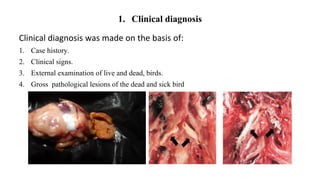
1. Clinical diagnosis
Clinical diagnosis was made on the basis of:
1. Case history.
2. Clinical signs.
3. External examination of live and dead, birds.
4. Gross pathological lesions of the dead and sick bird
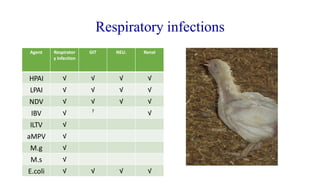
Respiratory infections
Agent Respirator
y infection
GIT NEU. Renal
HPAI √ √ √ √
LPAI √ √ √ √
NDV √ √ √ √
IBV √ ?
√
ILTV √
aMPV √
M.g √
M.s √
E.coli √ √ √ √
Are clinical symptoms enough for confirmative
diagnosis of infection?
Symptoms are not confirmative, for example:
1. HPAI can share Velogenic NDV in high mortality number (90-100%),
nervous and/or digestive signs, Haemorrhages of proventricular glands and
haemorrhages of Peyer's patches.
2. LPAI can share IB in respiratory signs (caseous plugs) and kidney affection
or other respiratory pathogens that affect egg production and quality.
3. Don’t forget presence of mixed (AI with IB or NDV ) and subclinical
infection (IBDV- CAV-AE-REO).
4. So you need quick accurate tool to confirm and differentiate your suspected
diagnosis.
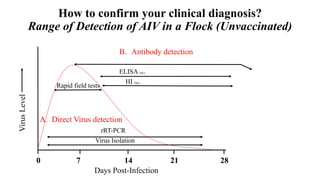
How to confirm your clinical diagnosis?
Range of Detection of AIV in a Flock (Unvaccinated)VirusLevel
Days Post-Infection
0 7 14 21 28
Rapid field tests
B. Antibody detection
rRT-PCR
Virus Isolation
HI (IgG)
ELISA (IgG)
A. Direct Virus detection
1. Limitation of rapid antigen tests
1. Most useful for sick and dead birds (acute)
2. Time of application: at beginning of clinical signs (high titter of the
virus) in case of AI up to 5 days after beginning of clinical signs.
3. AI detection limit: 103.5-104.5 EID50/ML.
4. Sensitivity depend on the titter of virus shedding, so it confirm
positive result not negative result.
5. The tests should only be interpreted on a flock basis and not as an
individual bird test (up to10 test/house).
6. Preliminary tests: so need further tests---------(Molecular diagnosis-
isolation).
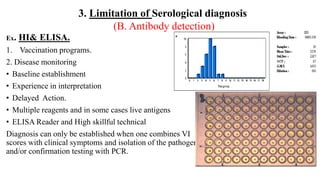
3. Limitation of Serological diagnosis
(B. Antibody detection)
Ex. HI& ELISA.
1. Vaccination programs.
2. Disease monitoring
• Baseline establishment
• Experience in interpretation
• Delayed Action.
• Multiple reagents and in some cases live antigens
• ELISA Reader and High skillful technical
Diagnosis can only be established when one combines VI
scores with clinical symptoms and isolation of the pathogen
and/or confirmation testing with PCR.
4. Molecular Diagnosis
(A. Virus detection)
PCR technologies
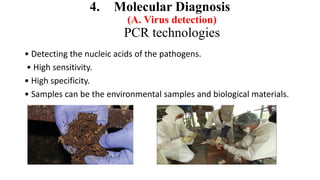
• Detecting the nucleic acids of the pathogens.
• High sensitivity.
• High specificity.
• Samples can be the environmental samples and biological materials.
PCR application
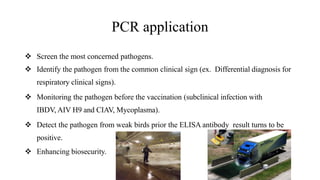
 Screen the most concerned pathogens.
 Identify the pathogen from the common clinical sign (ex. Differential diagnosis for
respiratory clinical signs).
 Monitoring the pathogen before the vaccination (subclinical infection with
IBDV, AIV H9 and CIAV, Mycoplasma).
 Detect the pathogen from weak birds prior the ELISA antibody result turns to be
positive.
 Enhancing biosecurity.
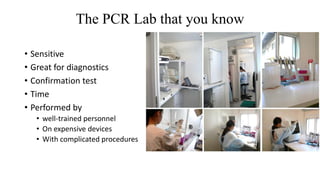
The PCR Lab that you know
• Sensitive
• Great for diagnostics
• Confirmation test
• Time
• Performed by
• well-trained personnel
• On expensive devices
• With complicated procedures
ARTAT with GeneReach Provide a new solution
for complete PCR system (pocket Combo)
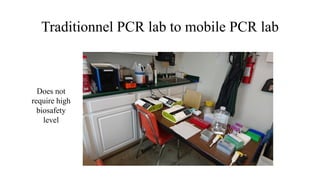
Traditionnel PCR lab to mobile PCR lab
Does not
require high
biosafety
level
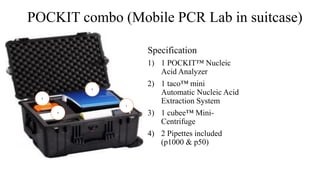
POCKIT combo (Mobile PCR Lab in suitcase)
Specification
1) 1 POCKIT™ Nucleic
Acid Analyzer
2) 1 taco™ mini
Automatic Nucleic Acid
Extraction System
3) 1 cubee™ Mini-
Centrifuge
4) 2 Pipettes included
(p1000 & p50)
4
3
1
2
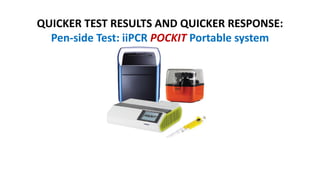
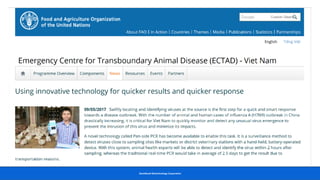
QUICKER TEST RESULTS AND QUICKER RESPONSE:
Pen-side Test: iiPCR POCKIT Portable system
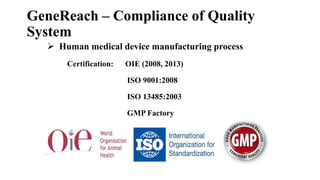
GeneReach – Compliance of Quality
System
 Human medical device manufacturing process
Certification: OIE (2008, 2013)
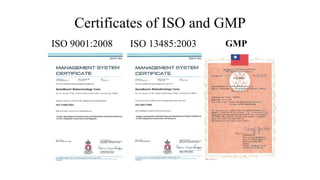
ISO 9001:2008
ISO 13485:2003
GMP Factory
Certificates of ISO and GMP
ISO 9001:2008 ISO 13485:2003 GMP
GeneReach Biotechnology Corporation
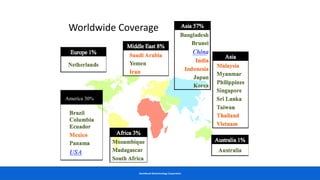
Worldwide Coverage
America 30%
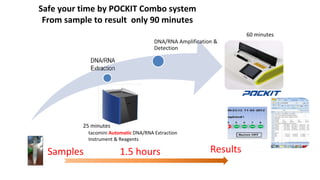
Safe your time by POCKIT Combo system
From sample to result only 90 minutes
DNA/RNA Amplification &
Detection
tacomini Automatic DNA/RNA Extraction
Instrument & Reagents
1.5 hoursSamples Results
25 minutes
60 minutes
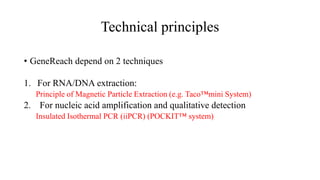
Technical principles
• GeneReach depend on 2 techniques
1. For RNA/DNA extraction:
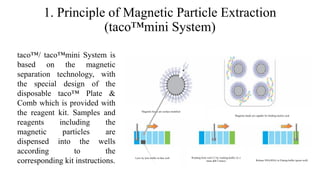
Principle of Magnetic Particle Extraction (e.g. Taco™mini System)
2. For nucleic acid amplification and qualitative detection
Insulated Isothermal PCR (iiPCR) (POCKIT™ system)
1. Principle of Magnetic Particle Extraction
(taco™mini System)
taco™/ taco™mini System is
based on the magnetic
separation technology, with
the special design of the
disposable taco™ Plate &
Comb which is provided with
the reagent kit. Samples and
reagents including the
magnetic particles are
dispensed into the wells
according to the
corresponding kit instructions.
Magnetic beads are surface-modified
Magnetic beads are capable for binding nucleic acid
Lysis by lysis buffer in blue well Washing from well 2-5 by washing buffer (A 2
times &B 2 times) Release DNA/RNA in Eluting buffer (green well)
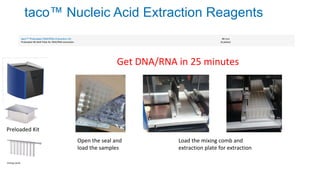
taco™ Nucleic Acid Extraction Reagents
taco™ Preloaded DNA/RNA Extraction Kit
Preloaded 48-Well Plate for DNA/RNA extraction
48 rxns
(6 plates)
Preloaded Kit
Get DNA/RNA in 25 minutes
Open the seal and
load the samples
Load the mixing comb and
extraction plate for extraction
mixing comb
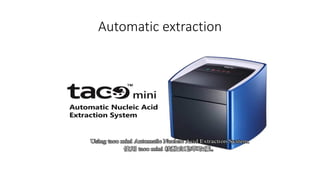
Automatic extraction
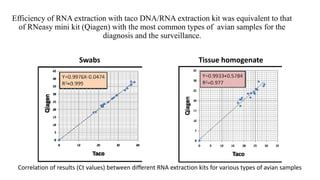
Efficiency of RNA extraction with taco DNA/RNA extraction kit was equivalent to that
of RNeasy mini kit (Qiagen) with the most common types of avian samples for the
diagnosis and the surveillance.
Swabs Tissue homogenate
Correlation of results (Ct values) between different RNA extraction kits for various types of avian samples
GeneReach Biotechnology Corporation
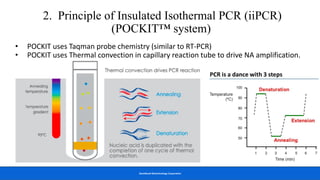
2. Principle of Insulated Isothermal PCR (iiPCR)
(POCKIT™ system)
• POCKIT uses Taqman probe chemistry (similar to RT-PCR)
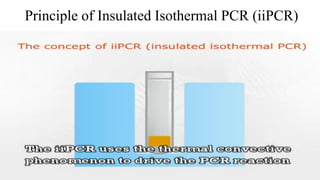
• POCKIT uses Thermal convection in capillary reaction tube to drive NA amplification.
Principle of Insulated Isothermal PCR (iiPCR)
GeneReach Biotechnology Corporation
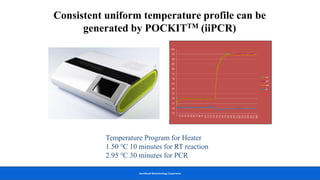
Consistent uniform temperature profile can be
generated by POCKITTM (iiPCR)
Temperature Program for Heater
1.50 ℃ 10 minutes for RT reaction
2.95 ℃ 30 minutes for PCR
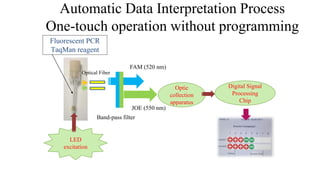
Optic
collection
apparatus
Digital Signal
Processing
Chip
LED
excitation
FAM (520 nm)
JOE (550 nm)
Fluorescent PCR
TaqMan reagent
Automatic Data Interpretation Process
One-touch operation without programming
Band-pass filter
Optical Fiber
GeneReach Biotechnology Corporation
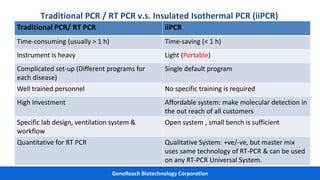
Traditional PCR/ RT PCR iiPCR
Time-consuming (usually > 1 h) Time-saving (< 1 h)
Instrument is heavy Light (Portable)
Complicated set-up (Different programs for
each disease)
Single default program
Well trained personnel No specific training is required
High Investment Affordable system: make molecular detection in
the out reach of all customers
Specific lab design, ventilation system &
workflow
Open system , small bench is sufficient
Quantitative for RT PCR Qualitative System: +ve/-ve, but master mix
uses same technology of RT-PCR & can be used
on any RT-PCR Universal System.
Traditional PCR / RT PCR v.s. Insulated Isothermal PCR (iiPCR)
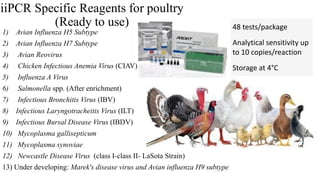
48 tests/package
Analytical sensitivity up
to 10 copies/reaction
Storage at 4°C
iiPCR Specific Reagents for poultry
(Ready to use)
1) Avian Influenza H5 Subtype
2) Avian Influenza H7 Subtype
3) Avian Reovirus
4) Chicken Infectious Anemia Virus (CIAV)
5) Influenza A Virus
6) Salmonella spp. (After enrichment)
7) Infectious Bronchitis Virus (IBV)
8) Infectious Laryngotracheitis Virus (ILT)
9) Infectious Bursal Disease Virus (IBDV)
10) Mycoplasma gallisepticum
11) Mycoplasma synoviae
12) Newcastle Disease Virus (class I-class II- LaSota Strain)
13) Under developing: Marek's disease virus and Avian influenza H9 subtype
iiPCR suggestive Application
1. Diagnosis of acute cases of poultry diseases.
2. Differential diagnosis of multiple respiratory diseases in the same time (eg.
IBV& NDV& AIV A/H5/H9 & ILT and Mycoplasma).
3. Monitoring of subclinical infection eg. IBDV, AIV H9, Reo virus, CIAV, Marek’s,
and Mycoplasma (especially before administration of vaccines- causes of
vaccination failure
4. Pathogens affect Hatchability: (eg. Mycoplasma and Salmonella
5. Baby chicks: Vertical transmitted diseases (eg. Mycoplasma, Salmonella, Reo
virus and AE).).
6. Tracking the source of infection from biological and environmental samples (eg.
Salmonella and AIV).
7. Screening layer/ breeder flocks 3 weeks before transfer to production houses
(Salmonella, mycoplasma, AE, AIV, EDS, Reo)
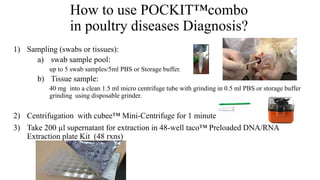
1) Sampling (swabs or tissues):
a) swab sample pool:
up to 5 swab samples/5ml PBS or Storage buffer.
b) Tissue sample:
40 mg into a clean 1.5 ml micro centrifuge tube with grinding in 0.5 ml PBS or storage buffer
grinding using disposable grinder.
2) Centrifugation with cubee™ Mini-Centrifuge for 1 minute
3) Take 200 µl supernatant for extraction in 48-well taco™ Preloaded DNA/RNA
Extraction plate Kit (48 rxns)
How to use POCKIT™combo
in poultry diseases Diagnosis?
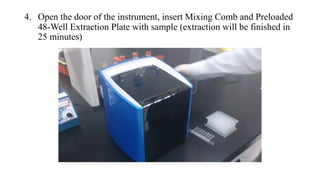
4. Open the door of the instrument, insert Mixing Comb and Preloaded
48-Well Extraction Plate with sample (extraction will be finished in
25 minutes)
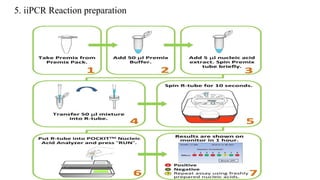
5. iiPCR Reaction preparation
GeneReach Biotechnology Corporation
Pilot study of Pen-side PCR for Avian
influenza surveillance at live bird market in
Northern Vietnam
FAO Vietnam and DAH Vietnam
GeneReach Biotechnology Corporation
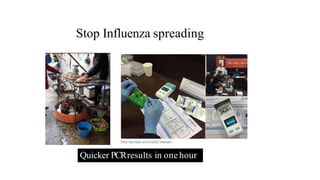
Stop Influenza spreading
Quicker PCRresults in onehour
GeneReach Biotechnology Corporation
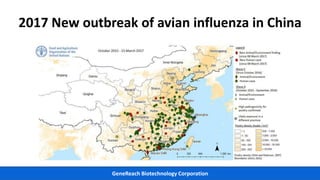
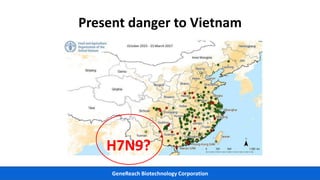
2017 New outbreak of avian influenza in China
GeneReach Biotechnology Corporation
Present danger to Vietnam
H7N9?
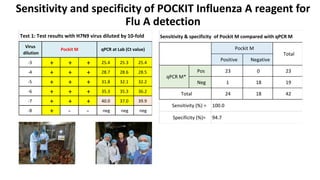
Test
Test 1: Test results with H7N9 virus diluted by 10-fold
Virus
dilution
-3 + + + 25.4 25.3 25.4
-4 + + + 28.7 28.6 28.5
-5 + + + 31.8 32.1 32.2
-6 + + + 35.3 35.3 36.2
-7 + + + 40.0 37.0 39.9
-8 + - - neg neg neg
Pockit M qPCR at Lab (Ct value)
Sensitivity and specificity of POCKIT Influenza A reagent for
Flu A detection
Positive Negative
Pos 23 0 23
Neg 1 18 19
24 18 42
Specificity (%)=
Sensitivity & specificity of Pockit M compared with qPCR M
100.0
94.7
Pockit M
qPCR M*
Total
Total
Sensitivity (%) =
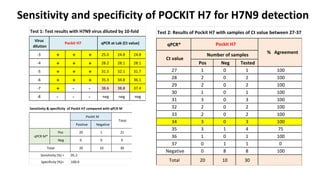
Sensitivity and specificity of POCKIT H7 for H7N9 detection
Test 2: Results of Pockit H7 with samples of Ct value between 27-37
qPCR*
Pos Neg Tested
27 1 0 1 100
28 2 0 2 100
29 2 0 2 100
30 1 0 1 100
31 3 0 3 100
32 2 0 2 100
33 2 0 2 100
34 3 0 3 100
35 3 1 4 75
36 1 0 1 100
37 0 1 1 0
Negative 0 8 8 100
Total 20 10 30
Pockit H7
% AgreementNumber of samples
Ct value
Test
Test 1: Test results with H7N9 virus diluted by 10-fold
Virus
dilution
-3 + + + 25.0 24.8 24.8
-4 + + + 28.2 28.1 28.1
-5 + + + 31.5 32.1 31.7
-6 + + + 35.3 34.8 36.1
-7 + - - 38.6 38.8 37.4
-8 - - - neg neg neg
Pockit H7 qPCR at Lab (Ct value)
Positive Negative
Pos 20 1 21
Neg 0 9 9
20 10 30Total
Sensitivity (%) = 95.2
Specificity (%)= 100.0
Sensitivity & specificity of Pockit H7 compared with qPCR M
Pockit M
Total
qPCR M*
GeneReach Biotechnology Corporation
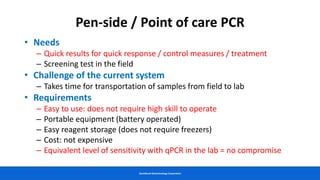
Pen-side / Point of care PCR
• Needs
– Quick results for quick response / control measures / treatment
– Screening test in the field
• Challenge of the current system
– Takes time for transportation of samples from field to lab
• Requirements
– Easy to use: does not require high skill to operate
– Portable equipment (battery operated)
– Easy reagent storage (does not require freezers)
– Cost: not expensive
– Equivalent level of sensitivity with qPCR in the lab = no compromise
GeneReach Biotechnology Corporation
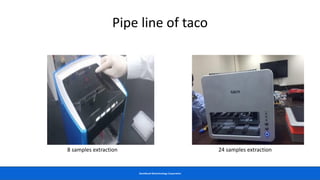
Pipe line of taco
8 samples extraction 24 samples extraction
GeneReach Biotechnology Corporation
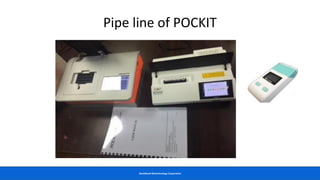
Pipe line of POCKIT
GeneReach Biotechnology Corporation
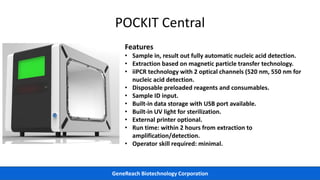
POCKIT Central
Features
• Sample in, result out fully automatic nucleic acid detection.
• Extraction based on magnetic particle transfer technology.
• iiPCR technology with 2 optical channels (520 nm, 550 nm for
nucleic acid detection.
• Disposable preloaded reagents and consumables.
• Sample ID input.
• Built-in data storage with USB port available.
• Built-in UV light for sterilization.
• External printer optional.
• Run time: within 2 hours from extraction to
amplification/detection.
• Operator skill required: minimal.
GeneReach Biotechnology Corporation
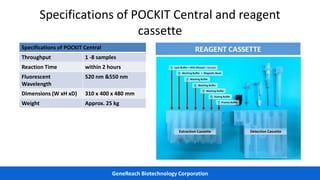
Specifications of POCKIT Central and reagent
cassette
Specifications of POCKIT Central
Throughput 1 -8 samples
Reaction Time within 2 hours
Fluorescent
Wavelength
520 nm &550 nm
Dimensions (W xH xD) 310 x 400 x 480 mm
Weight Approx. 25 kg
THANK YOU
Dr. Moustafa Mohamed Elshazly
Master of poultry diseases
Assistant Manager of Diagnostic & Laboratory Supplies/ Poultry Sector
E-mail: moustafa@artat.com.sa

Poultry disease diagosis

  • 2.
    Practical approaches fordiagnosis of poultry viral diseases 1. Clinical diagnosis 2. Rapid field diagnostic tests 3. Serological diagnosis (HI& ELISA) 4. Molecular diagnosis (PCR technologies) 5. Isolation and characterization (the gold standard methods limited to reference laboratories)
  • 3.
    1. Clinical diagnosis Clinicaldiagnosis was made on the basis of: 1. Case history. 2. Clinical signs. 3. External examination of live and dead, birds. 4. Gross pathological lesions of the dead and sick bird
  • 4.
    Respiratory infections Agent Respirator yinfection GIT NEU. Renal HPAI √ √ √ √ LPAI √ √ √ √ NDV √ √ √ √ IBV √ ? √ ILTV √ aMPV √ M.g √ M.s √ E.coli √ √ √ √
  • 5.
    Are clinical symptomsenough for confirmative diagnosis of infection? Symptoms are not confirmative, for example: 1. HPAI can share Velogenic NDV in high mortality number (90-100%), nervous and/or digestive signs, Haemorrhages of proventricular glands and haemorrhages of Peyer's patches. 2. LPAI can share IB in respiratory signs (caseous plugs) and kidney affection or other respiratory pathogens that affect egg production and quality. 3. Don’t forget presence of mixed (AI with IB or NDV ) and subclinical infection (IBDV- CAV-AE-REO). 4. So you need quick accurate tool to confirm and differentiate your suspected diagnosis.
  • 6.
    How to confirmyour clinical diagnosis? Range of Detection of AIV in a Flock (Unvaccinated)VirusLevel Days Post-Infection 0 7 14 21 28 Rapid field tests B. Antibody detection rRT-PCR Virus Isolation HI (IgG) ELISA (IgG) A. Direct Virus detection
  • 7.
    1. Limitation ofrapid antigen tests 1. Most useful for sick and dead birds (acute) 2. Time of application: at beginning of clinical signs (high titter of the virus) in case of AI up to 5 days after beginning of clinical signs. 3. AI detection limit: 103.5-104.5 EID50/ML. 4. Sensitivity depend on the titter of virus shedding, so it confirm positive result not negative result. 5. The tests should only be interpreted on a flock basis and not as an individual bird test (up to10 test/house). 6. Preliminary tests: so need further tests---------(Molecular diagnosis- isolation).
  • 8.
    3. Limitation ofSerological diagnosis (B. Antibody detection) Ex. HI& ELISA. 1. Vaccination programs. 2. Disease monitoring • Baseline establishment • Experience in interpretation • Delayed Action. • Multiple reagents and in some cases live antigens • ELISA Reader and High skillful technical Diagnosis can only be established when one combines VI scores with clinical symptoms and isolation of the pathogen and/or confirmation testing with PCR.
  • 9.
    4. Molecular Diagnosis (A.Virus detection) PCR technologies • Detecting the nucleic acids of the pathogens. • High sensitivity. • High specificity. • Samples can be the environmental samples and biological materials.
  • 10.
    PCR application  Screenthe most concerned pathogens.  Identify the pathogen from the common clinical sign (ex. Differential diagnosis for respiratory clinical signs).  Monitoring the pathogen before the vaccination (subclinical infection with IBDV, AIV H9 and CIAV, Mycoplasma).  Detect the pathogen from weak birds prior the ELISA antibody result turns to be positive.  Enhancing biosecurity.
  • 11.
    The PCR Labthat you know • Sensitive • Great for diagnostics • Confirmation test • Time • Performed by • well-trained personnel • On expensive devices • With complicated procedures
  • 12.
    ARTAT with GeneReachProvide a new solution for complete PCR system (pocket Combo)
  • 13.
    Traditionnel PCR labto mobile PCR lab Does not require high biosafety level
  • 14.
    POCKIT combo (MobilePCR Lab in suitcase) Specification 1) 1 POCKIT™ Nucleic Acid Analyzer 2) 1 taco™ mini Automatic Nucleic Acid Extraction System 3) 1 cubee™ Mini- Centrifuge 4) 2 Pipettes included (p1000 & p50) 4 3 1 2
  • 15.
    QUICKER TEST RESULTSAND QUICKER RESPONSE: Pen-side Test: iiPCR POCKIT Portable system
  • 16.
    GeneReach – Complianceof Quality System  Human medical device manufacturing process Certification: OIE (2008, 2013) ISO 9001:2008 ISO 13485:2003 GMP Factory
  • 17.
    Certificates of ISOand GMP ISO 9001:2008 ISO 13485:2003 GMP
  • 18.
  • 19.
    Safe your timeby POCKIT Combo system From sample to result only 90 minutes DNA/RNA Amplification & Detection tacomini Automatic DNA/RNA Extraction Instrument & Reagents 1.5 hoursSamples Results 25 minutes 60 minutes
  • 20.
    Technical principles • GeneReachdepend on 2 techniques 1. For RNA/DNA extraction: Principle of Magnetic Particle Extraction (e.g. Taco™mini System) 2. For nucleic acid amplification and qualitative detection Insulated Isothermal PCR (iiPCR) (POCKIT™ system)
  • 21.
    1. Principle ofMagnetic Particle Extraction (taco™mini System) taco™/ taco™mini System is based on the magnetic separation technology, with the special design of the disposable taco™ Plate & Comb which is provided with the reagent kit. Samples and reagents including the magnetic particles are dispensed into the wells according to the corresponding kit instructions. Magnetic beads are surface-modified Magnetic beads are capable for binding nucleic acid Lysis by lysis buffer in blue well Washing from well 2-5 by washing buffer (A 2 times &B 2 times) Release DNA/RNA in Eluting buffer (green well)
  • 22.
    taco™ Nucleic AcidExtraction Reagents taco™ Preloaded DNA/RNA Extraction Kit Preloaded 48-Well Plate for DNA/RNA extraction 48 rxns (6 plates) Preloaded Kit Get DNA/RNA in 25 minutes Open the seal and load the samples Load the mixing comb and extraction plate for extraction mixing comb

  • 23.
  • 24.
    Efficiency of RNAextraction with taco DNA/RNA extraction kit was equivalent to that of RNeasy mini kit (Qiagen) with the most common types of avian samples for the diagnosis and the surveillance. Swabs Tissue homogenate Correlation of results (Ct values) between different RNA extraction kits for various types of avian samples
  • 25.
    GeneReach Biotechnology Corporation 2.Principle of Insulated Isothermal PCR (iiPCR) (POCKIT™ system) • POCKIT uses Taqman probe chemistry (similar to RT-PCR) • POCKIT uses Thermal convection in capillary reaction tube to drive NA amplification.
  • 26.
    Principle of InsulatedIsothermal PCR (iiPCR)
  • 27.
    GeneReach Biotechnology Corporation Consistentuniform temperature profile can be generated by POCKITTM (iiPCR) Temperature Program for Heater 1.50 ℃ 10 minutes for RT reaction 2.95 ℃ 30 minutes for PCR
  • 28.
    Optic collection apparatus Digital Signal Processing Chip LED excitation FAM (520nm) JOE (550 nm) Fluorescent PCR TaqMan reagent Automatic Data Interpretation Process One-touch operation without programming Band-pass filter Optical Fiber
  • 29.
    GeneReach Biotechnology Corporation TraditionalPCR/ RT PCR iiPCR Time-consuming (usually > 1 h) Time-saving (< 1 h) Instrument is heavy Light (Portable) Complicated set-up (Different programs for each disease) Single default program Well trained personnel No specific training is required High Investment Affordable system: make molecular detection in the out reach of all customers Specific lab design, ventilation system & workflow Open system , small bench is sufficient Quantitative for RT PCR Qualitative System: +ve/-ve, but master mix uses same technology of RT-PCR & can be used on any RT-PCR Universal System. Traditional PCR / RT PCR v.s. Insulated Isothermal PCR (iiPCR)
  • 30.
    48 tests/package Analytical sensitivityup to 10 copies/reaction Storage at 4°C iiPCR Specific Reagents for poultry (Ready to use) 1) Avian Influenza H5 Subtype 2) Avian Influenza H7 Subtype 3) Avian Reovirus 4) Chicken Infectious Anemia Virus (CIAV) 5) Influenza A Virus 6) Salmonella spp. (After enrichment) 7) Infectious Bronchitis Virus (IBV) 8) Infectious Laryngotracheitis Virus (ILT) 9) Infectious Bursal Disease Virus (IBDV) 10) Mycoplasma gallisepticum 11) Mycoplasma synoviae 12) Newcastle Disease Virus (class I-class II- LaSota Strain) 13) Under developing: Marek's disease virus and Avian influenza H9 subtype
  • 31.
    iiPCR suggestive Application 1.Diagnosis of acute cases of poultry diseases. 2. Differential diagnosis of multiple respiratory diseases in the same time (eg. IBV& NDV& AIV A/H5/H9 & ILT and Mycoplasma). 3. Monitoring of subclinical infection eg. IBDV, AIV H9, Reo virus, CIAV, Marek’s, and Mycoplasma (especially before administration of vaccines- causes of vaccination failure 4. Pathogens affect Hatchability: (eg. Mycoplasma and Salmonella 5. Baby chicks: Vertical transmitted diseases (eg. Mycoplasma, Salmonella, Reo virus and AE).). 6. Tracking the source of infection from biological and environmental samples (eg. Salmonella and AIV). 7. Screening layer/ breeder flocks 3 weeks before transfer to production houses (Salmonella, mycoplasma, AE, AIV, EDS, Reo)
  • 32.
    1) Sampling (swabsor tissues): a) swab sample pool: up to 5 swab samples/5ml PBS or Storage buffer. b) Tissue sample: 40 mg into a clean 1.5 ml micro centrifuge tube with grinding in 0.5 ml PBS or storage buffer grinding using disposable grinder. 2) Centrifugation with cubee™ Mini-Centrifuge for 1 minute 3) Take 200 µl supernatant for extraction in 48-well taco™ Preloaded DNA/RNA Extraction plate Kit (48 rxns) How to use POCKIT™combo in poultry diseases Diagnosis?
  • 33.
    4. Open thedoor of the instrument, insert Mixing Comb and Preloaded 48-Well Extraction Plate with sample (extraction will be finished in 25 minutes)
  • 34.
    5. iiPCR Reactionpreparation
  • 36.
  • 37.
    GeneReach Biotechnology Corporation Pilotstudy of Pen-side PCR for Avian influenza surveillance at live bird market in Northern Vietnam FAO Vietnam and DAH Vietnam
  • 38.
  • 39.
    Stop Influenza spreading QuickerPCRresults in onehour
  • 40.
    GeneReach Biotechnology Corporation 2017New outbreak of avian influenza in China
  • 41.
  • 42.
    Test Test 1: Testresults with H7N9 virus diluted by 10-fold Virus dilution -3 + + + 25.4 25.3 25.4 -4 + + + 28.7 28.6 28.5 -5 + + + 31.8 32.1 32.2 -6 + + + 35.3 35.3 36.2 -7 + + + 40.0 37.0 39.9 -8 + - - neg neg neg Pockit M qPCR at Lab (Ct value) Sensitivity and specificity of POCKIT Influenza A reagent for Flu A detection Positive Negative Pos 23 0 23 Neg 1 18 19 24 18 42 Specificity (%)= Sensitivity & specificity of Pockit M compared with qPCR M 100.0 94.7 Pockit M qPCR M* Total Total Sensitivity (%) =
  • 43.
    Sensitivity and specificityof POCKIT H7 for H7N9 detection Test 2: Results of Pockit H7 with samples of Ct value between 27-37 qPCR* Pos Neg Tested 27 1 0 1 100 28 2 0 2 100 29 2 0 2 100 30 1 0 1 100 31 3 0 3 100 32 2 0 2 100 33 2 0 2 100 34 3 0 3 100 35 3 1 4 75 36 1 0 1 100 37 0 1 1 0 Negative 0 8 8 100 Total 20 10 30 Pockit H7 % AgreementNumber of samples Ct value Test Test 1: Test results with H7N9 virus diluted by 10-fold Virus dilution -3 + + + 25.0 24.8 24.8 -4 + + + 28.2 28.1 28.1 -5 + + + 31.5 32.1 31.7 -6 + + + 35.3 34.8 36.1 -7 + - - 38.6 38.8 37.4 -8 - - - neg neg neg Pockit H7 qPCR at Lab (Ct value) Positive Negative Pos 20 1 21 Neg 0 9 9 20 10 30Total Sensitivity (%) = 95.2 Specificity (%)= 100.0 Sensitivity & specificity of Pockit H7 compared with qPCR M Pockit M Total qPCR M*
  • 44.
    GeneReach Biotechnology Corporation Pen-side/ Point of care PCR • Needs – Quick results for quick response / control measures / treatment – Screening test in the field • Challenge of the current system – Takes time for transportation of samples from field to lab • Requirements – Easy to use: does not require high skill to operate – Portable equipment (battery operated) – Easy reagent storage (does not require freezers) – Cost: not expensive – Equivalent level of sensitivity with qPCR in the lab = no compromise
  • 45.
    GeneReach Biotechnology Corporation Pipeline of taco 8 samples extraction 24 samples extraction
  • 46.
  • 47.
    GeneReach Biotechnology Corporation POCKITCentral Features • Sample in, result out fully automatic nucleic acid detection. • Extraction based on magnetic particle transfer technology. • iiPCR technology with 2 optical channels (520 nm, 550 nm for nucleic acid detection. • Disposable preloaded reagents and consumables. • Sample ID input. • Built-in data storage with USB port available. • Built-in UV light for sterilization. • External printer optional. • Run time: within 2 hours from extraction to amplification/detection. • Operator skill required: minimal.
  • 48.
    GeneReach Biotechnology Corporation Specificationsof POCKIT Central and reagent cassette Specifications of POCKIT Central Throughput 1 -8 samples Reaction Time within 2 hours Fluorescent Wavelength 520 nm &550 nm Dimensions (W xH xD) 310 x 400 x 480 mm Weight Approx. 25 kg
  • 49.
    THANK YOU Dr. MoustafaMohamed Elshazly Master of poultry diseases Assistant Manager of Diagnostic & Laboratory Supplies/ Poultry Sector E-mail: moustafa@artat.com.sa