
POTENTIAL USE OF NATURAL RED MUD AS
PARTIAL REPLACEMENT IN CEMENT
BY
G.MURALI MOHAN
CONTENTS
Introduction
Materials used and their availability
Preliminary tests
Design of Cement mortar mix
Preparation and testing of mortar cubes
Results
conclusion
INTRODUCTION
During present era use of cement became very high
because of urbanization. So the natural resources
are decreasing rapidly.
As part of development, use of cement in buildings,
many other civil engineering structures is taking
place.
But the sources are getting reduced very fastly
because of heavy usage.
In order to reduce the usage of conventional
materials like cement, some experiments are done
for finding out compressive strength of Cement By
replacing Cement with Red mud
Red mud comprises of oxides of iron, titanium, aluminum
and silica along with some other minor constituents.
Presence of Alumina and Iron oxide in red mud
compensates the deficiency of the same components in
limestone which is the primary raw material for cement
production. Experiments have been conducted under
laboratory condition to assess the strength characteristics
of the aluminum red mud. our project work focuses on the
suitability of red mud obtained for construction. Five test
groups of cubes were casted by replacing the cement
with 0%, 5%, 10%, 15,&20% of red mud. The strength of
these cubes will be compared with the conventional
cubes .
MATERIALS USED AND THEIR AVAILABILITY
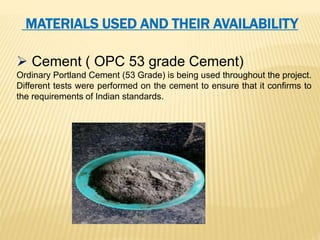
 Cement ( OPC 53 grade Cement)
Ordinary Portland Cement (53 Grade) is being used throughout the project.
Different tests were performed on the cement to ensure that it confirms to
the requirements of Indian standards.
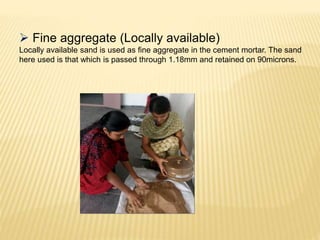
 Fine aggregate (Locally available)
Locally available sand is used as fine aggregate in the cement mortar. The sand
here used is that which is passed through 1.18mm and retained on 90microns.
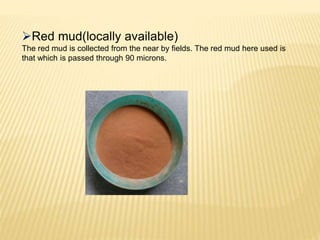
Red mud(locally available)
The red mud is collected from the near by fields. The red mud here used is
that which is passed through 90 microns.
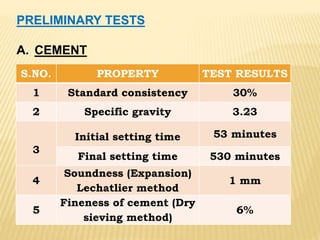
S.NO. PROPERTY TEST RESULTS
1 Standard consistency 30%
2 Specific gravity 3.23
3
Initial setting time 53 minutes
Final setting time 530 minutes
4
Soundness (Expansion)
Lechatlier method
1 mm
5
Fineness of cement (Dry
sieving method)
6%
PRELIMINARY TESTS
A. CEMENT
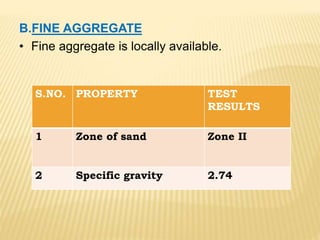
B.FINE AGGREGATE
• Fine aggregate is locally available.
S.NO. PROPERTY TEST
RESULTS
1 Zone of sand Zone II
2 Specific gravity 2.74
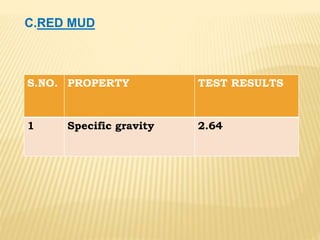
S.NO. PROPERTY TEST RESULTS
1 Specific gravity 2.64
C.RED MUD
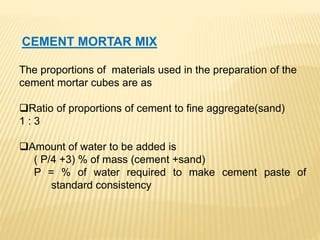
CEMENT MORTAR MIX
The proportions of materials used in the preparation of the
cement mortar cubes are as
Ratio of proportions of cement to fine aggregate(sand)
1 : 3
Amount of water to be added is
( P/4 +3) % of mass (cement +sand)
P = % of water required to make cement paste of
standard consistency
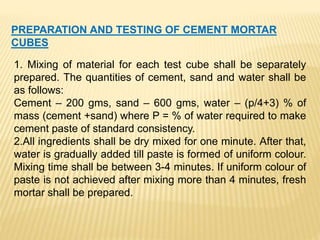
PREPARATION AND TESTING OF CEMENT MORTAR
CUBES
1. Mixing of material for each test cube shall be separately
prepared. The quantities of cement, sand and water shall be
as follows:
Cement – 200 gms, sand – 600 gms, water – (p/4+3) % of
mass (cement +sand) where P = % of water required to make
cement paste of standard consistency.
2.All ingredients shall be dry mixed for one minute. After that,
water is gradually added till paste is formed of uniform colour.
Mixing time shall be between 3-4 minutes. If uniform colour of
paste is not achieved after mixing more than 4 minutes, fresh
mortar shall be prepared.
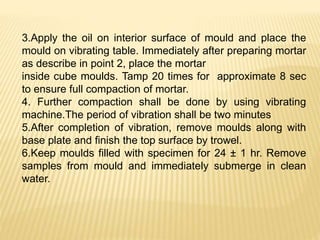
3.Apply the oil on interior surface of mould and place the
mould on vibrating table. Immediately after preparing mortar
as describe in point 2, place the mortar
inside cube moulds. Tamp 20 times for approximate 8 sec
to ensure full compaction of mortar.
4. Further compaction shall be done by using vibrating
machine.The period of vibration shall be two minutes
5.After completion of vibration, remove moulds along with
base plate and finish the top surface by trowel.
6.Keep moulds filled with specimen for 24 ± 1 hr. Remove
samples from mould and immediately submerge in clean
water.
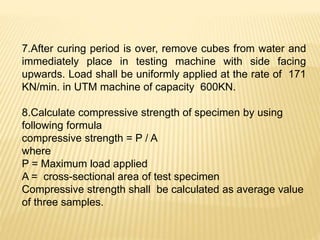
7.After curing period is over, remove cubes from water and
immediately place in testing machine with side facing
upwards. Load shall be uniformly applied at the rate of 171
KN/min. in UTM machine of capacity 600KN.
8.Calculate compressive strength of specimen by using
following formula
compressive strength = P / A
where
P = Maximum load applied
A = cross-sectional area of test specimen
Compressive strength shall be calculated as average value
of three samples.
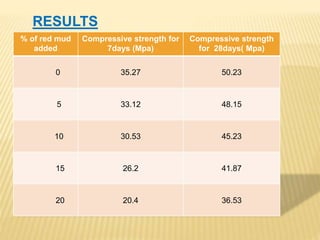
% of red mud
added
Compressive strength for
7days (Mpa)
Compressive strength
for 28days( Mpa)
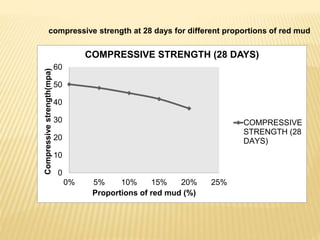
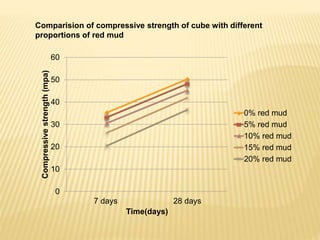
0 35.27 50.23
5 33.12 48.15
10 30.53 45.23
15 26.2 41.87
20 20.4 36.53
RESULTS
0
5
10
15
20
25
30
35
40
0% 10% 20% 30%
compressivestrength(mpa)
Proportions of red mud (%)
COMPRESSIVE STRENGTH (7 DAYS )
COMPRESSIVE
STRENGTH (7
DAYS )
(Mpa)
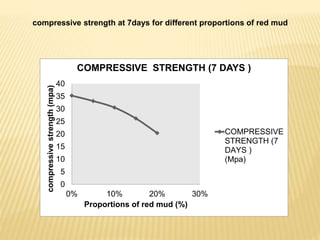
compressive strength at 7days for different proportions of red mud
compressive strength at 28 days for different proportions of red mud
0
10
20
30
40
50
60
0% 5% 10% 15% 20% 25%
Compressivestrength(mpa)
Proportions of red mud (%)
COMPRESSIVE STRENGTH (28 DAYS)
COMPRESSIVE
STRENGTH (28
DAYS)
Comparision of compressive strength of cube with different
proportions of red mud
0
10
20
30
40
50
60
7 days 28 days
Compressivestrength(mpa)
Time(days)
0% red mud
5% red mud
10% red mud
15% red mud
20% red mud
CONCLUSION
Cement mortar cubes with different proportions of red mud
are tested
for their compressive strength and it is found that
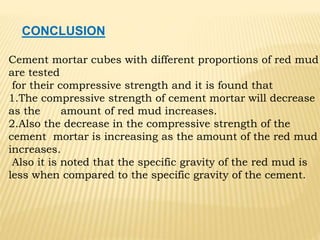
1.The compressive strength of cement mortar will decrease
as the amount of red mud increases.
2.Also the decrease in the compressive strength of the
cement mortar is increasing as the amount of the red mud
increases.
Also it is noted that the specific gravity of the red mud is
less when compared to the specific gravity of the cement.
SCOPE OF FEATURE WORK
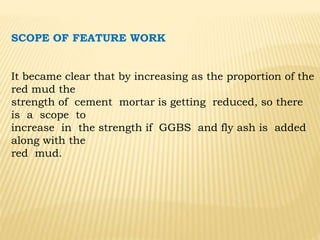
It became clear that by increasing as the proportion of the
red mud the
strength of cement mortar is getting reduced, so there
is a scope to
increase in the strength if GGBS and fly ash is added
along with the
red mud.
potential use of red mud

potential use of red mud

  • 1.
    POTENTIAL USE OFNATURAL RED MUD AS PARTIAL REPLACEMENT IN CEMENT BY G.MURALI MOHAN
  • 2.
    CONTENTS Introduction Materials used andtheir availability Preliminary tests Design of Cement mortar mix Preparation and testing of mortar cubes Results conclusion
  • 3.
    INTRODUCTION During present erause of cement became very high because of urbanization. So the natural resources are decreasing rapidly. As part of development, use of cement in buildings, many other civil engineering structures is taking place. But the sources are getting reduced very fastly because of heavy usage. In order to reduce the usage of conventional materials like cement, some experiments are done for finding out compressive strength of Cement By replacing Cement with Red mud
  • 4.
    Red mud comprisesof oxides of iron, titanium, aluminum and silica along with some other minor constituents. Presence of Alumina and Iron oxide in red mud compensates the deficiency of the same components in limestone which is the primary raw material for cement production. Experiments have been conducted under laboratory condition to assess the strength characteristics of the aluminum red mud. our project work focuses on the suitability of red mud obtained for construction. Five test groups of cubes were casted by replacing the cement with 0%, 5%, 10%, 15,&20% of red mud. The strength of these cubes will be compared with the conventional cubes .
  • 5.
    MATERIALS USED ANDTHEIR AVAILABILITY  Cement ( OPC 53 grade Cement) Ordinary Portland Cement (53 Grade) is being used throughout the project. Different tests were performed on the cement to ensure that it confirms to the requirements of Indian standards.
  • 6.
     Fine aggregate(Locally available) Locally available sand is used as fine aggregate in the cement mortar. The sand here used is that which is passed through 1.18mm and retained on 90microns.
  • 7.
    Red mud(locally available) Thered mud is collected from the near by fields. The red mud here used is that which is passed through 90 microns.
  • 8.
    S.NO. PROPERTY TESTRESULTS 1 Standard consistency 30% 2 Specific gravity 3.23 3 Initial setting time 53 minutes Final setting time 530 minutes 4 Soundness (Expansion) Lechatlier method 1 mm 5 Fineness of cement (Dry sieving method) 6% PRELIMINARY TESTS A. CEMENT
  • 9.
    B.FINE AGGREGATE • Fineaggregate is locally available. S.NO. PROPERTY TEST RESULTS 1 Zone of sand Zone II 2 Specific gravity 2.74
  • 10.
    S.NO. PROPERTY TESTRESULTS 1 Specific gravity 2.64 C.RED MUD
  • 11.
    CEMENT MORTAR MIX Theproportions of materials used in the preparation of the cement mortar cubes are as Ratio of proportions of cement to fine aggregate(sand) 1 : 3 Amount of water to be added is ( P/4 +3) % of mass (cement +sand) P = % of water required to make cement paste of standard consistency
  • 12.
    PREPARATION AND TESTINGOF CEMENT MORTAR CUBES 1. Mixing of material for each test cube shall be separately prepared. The quantities of cement, sand and water shall be as follows: Cement – 200 gms, sand – 600 gms, water – (p/4+3) % of mass (cement +sand) where P = % of water required to make cement paste of standard consistency. 2.All ingredients shall be dry mixed for one minute. After that, water is gradually added till paste is formed of uniform colour. Mixing time shall be between 3-4 minutes. If uniform colour of paste is not achieved after mixing more than 4 minutes, fresh mortar shall be prepared.
  • 13.
    3.Apply the oilon interior surface of mould and place the mould on vibrating table. Immediately after preparing mortar as describe in point 2, place the mortar inside cube moulds. Tamp 20 times for approximate 8 sec to ensure full compaction of mortar. 4. Further compaction shall be done by using vibrating machine.The period of vibration shall be two minutes 5.After completion of vibration, remove moulds along with base plate and finish the top surface by trowel. 6.Keep moulds filled with specimen for 24 ± 1 hr. Remove samples from mould and immediately submerge in clean water.
  • 14.
    7.After curing periodis over, remove cubes from water and immediately place in testing machine with side facing upwards. Load shall be uniformly applied at the rate of 171 KN/min. in UTM machine of capacity 600KN. 8.Calculate compressive strength of specimen by using following formula compressive strength = P / A where P = Maximum load applied A = cross-sectional area of test specimen Compressive strength shall be calculated as average value of three samples.
  • 15.
    % of redmud added Compressive strength for 7days (Mpa) Compressive strength for 28days( Mpa) 0 35.27 50.23 5 33.12 48.15 10 30.53 45.23 15 26.2 41.87 20 20.4 36.53 RESULTS
  • 16.
    0 5 10 15 20 25 30 35 40 0% 10% 20%30% compressivestrength(mpa) Proportions of red mud (%) COMPRESSIVE STRENGTH (7 DAYS ) COMPRESSIVE STRENGTH (7 DAYS ) (Mpa) compressive strength at 7days for different proportions of red mud
  • 17.
    compressive strength at28 days for different proportions of red mud 0 10 20 30 40 50 60 0% 5% 10% 15% 20% 25% Compressivestrength(mpa) Proportions of red mud (%) COMPRESSIVE STRENGTH (28 DAYS) COMPRESSIVE STRENGTH (28 DAYS)
  • 18.
    Comparision of compressivestrength of cube with different proportions of red mud 0 10 20 30 40 50 60 7 days 28 days Compressivestrength(mpa) Time(days) 0% red mud 5% red mud 10% red mud 15% red mud 20% red mud
  • 19.
    CONCLUSION Cement mortar cubeswith different proportions of red mud are tested for their compressive strength and it is found that 1.The compressive strength of cement mortar will decrease as the amount of red mud increases. 2.Also the decrease in the compressive strength of the cement mortar is increasing as the amount of the red mud increases. Also it is noted that the specific gravity of the red mud is less when compared to the specific gravity of the cement.
  • 20.
    SCOPE OF FEATUREWORK It became clear that by increasing as the proportion of the red mud the strength of cement mortar is getting reduced, so there is a scope to increase in the strength if GGBS and fly ash is added along with the red mud.