
SOIL STABILIZATION
USING PLASTIC
BOTTLE STRIPS
BY : : TA N I S H A N AYA K
PROBLEMS IN UNSTABILISED SOIL
Expansive soil is risky due to its high compressibility, low shear strength and high
permeability
Expansive soils like black cotton soil always create problems in foundation. The
problems are swelling, shrinkage and unequal settlement
WHY WE STABILISE THE SOIL
A. Improves the strength of the soil, thus, increasing the soil bearing capacity
B. Prevent soil erosion or formation of dust
C. In dry and arid weather stabilization is also done for soil water-proofing
D. Improves the workability and the durability of the soil.
E. It is more economic both in terms of cost and energy
WHY TO CHOOSE PLASTIC AS SOIL
STABILZER
Transpare
ncy
Soft
When It
Is Hot
Flexibility
Chemical
Resistance
Elastic
Thermal
Resistance
Water
Resistant
Reactivity
With Water
Electrical
Resistance
Flammabili
ty
TEST FOR CHECKING OF SOIL
STABILISION
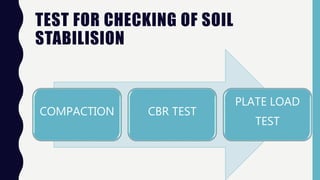
COMPACTION CBR TEST
PLATE LOAD
TEST
MATERIALS
•Materials
–Lateritic Soil
–Plastic Bottles (both cut and uncut)
–Sea Sand
–Synthetic Threads
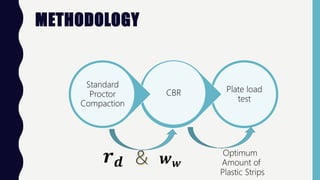
METHODOLOGY
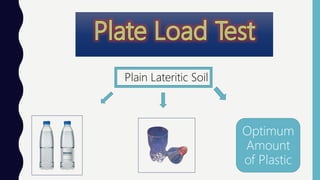
Plate load
test
CBR
Standard
Proctor
Compaction
𝒓 𝒅 𝒘 𝒘
Optimum
Amount of
Plastic Strips
Optimum
Amount
of Plastic
Plain Lateritic Soil
RESULTS AND DISCUSSIONS
•Compaction
𝒓 𝒅 =18.95
𝑘𝑁
𝑚3
𝒘 𝑳=11.2%
% of Plastic
Content
CBR
Value
0 1.9
0.2 1.7
0.4 1.8
0.6 2.5
0.8 1.3
1 1.3
0, 1.9
0.2, 1.7
0.4, 1.8
0.6, 2.5
0.8, 1.3 1, 1.3
0
0.5
1
1.5
2
2.5
3
0 0.2 0.4 0.6 0.8 1 1.2
CBRVALUE
% OF PLASTIC CONTENT
CBR Value
RESULTS FROM PLATE LOAD TEST
Tests done on
Settlement
(mm)
Corresponding
Load (kg)
Percentage variation
of load from plain soil
Plain soil 4 440
Sand filled bottles at
D/B=0.67 4 585 33
Sand filled bottles at D/B=1 4 680 54.5
Bottles cut to halves at
D/B=0.67 4 740 68.1
Bottles cut to halves at
D/B=1 4 900 104.5
Soil mixed with optimum
percentage(0.6%) of Plastic
strips 4 1200 172.7
RESULTS FROM PLATE LOAD TEST
DISCUSSIONS FROM PLATE LOAD
TEST RESULTS
At optimum Settlement is Lesser & Stability is More
ULTIMATE LOAD AND CORRESPONDING SETTLEMENT
Tests done on
Ultimate
load(kg)
Corresponding
settlement(mm)
Plain soil 360 1.60
Sand filled bottles at D/B=0.67 480 1.20
Sand filled bottles at D/B=1 560 1.60
Bottles cut to halves at D/B=0.67 600 1.20
Bottles cut to halves at D/B=1 760 1.60
Soil mixed with optimum
percentage(0.6%) of Plastic
strips 720 0.60
0
100
200
300
400
500
600
700
800
ULTIMATELOAD(Kg)
Variations of ultimate load for various test
arrangements
0.00
0.20
0.40
0.60
0.80
1.00
1.20
1.40
1.60
1.80
SETTLEMENT
Variations of settlement
corresponding to the
ultimate load for various test
arrangements
CONCLUSIONS
• Using plastic bottles as a soil stabiliser is an
economical and gainful utilization since there is
scarcity of good quality soil for embankments and
fills.
• Thus this project is to meets the challenges of society
to reduce the quantities of plastic waste, producing
useful material from non-useful waste materials that
THANK YOU

Soil stabilization using plastic bottle strips

  • 1.
    SOIL STABILIZATION USING PLASTIC BOTTLESTRIPS BY : : TA N I S H A N AYA K
  • 2.
    PROBLEMS IN UNSTABILISEDSOIL Expansive soil is risky due to its high compressibility, low shear strength and high permeability Expansive soils like black cotton soil always create problems in foundation. The problems are swelling, shrinkage and unequal settlement
  • 3.
    WHY WE STABILISETHE SOIL A. Improves the strength of the soil, thus, increasing the soil bearing capacity B. Prevent soil erosion or formation of dust C. In dry and arid weather stabilization is also done for soil water-proofing D. Improves the workability and the durability of the soil. E. It is more economic both in terms of cost and energy
  • 5.
    WHY TO CHOOSEPLASTIC AS SOIL STABILZER Transpare ncy Soft When It Is Hot Flexibility Chemical Resistance Elastic Thermal Resistance Water Resistant Reactivity With Water Electrical Resistance Flammabili ty
  • 6.
    TEST FOR CHECKINGOF SOIL STABILISION COMPACTION CBR TEST PLATE LOAD TEST
  • 7.
    MATERIALS •Materials –Lateritic Soil –Plastic Bottles(both cut and uncut) –Sea Sand –Synthetic Threads
  • 8.
  • 10.
  • 11.
    RESULTS AND DISCUSSIONS •Compaction 𝒓𝒅 =18.95 𝑘𝑁 𝑚3 𝒘 𝑳=11.2%
  • 12.
    % of Plastic Content CBR Value 01.9 0.2 1.7 0.4 1.8 0.6 2.5 0.8 1.3 1 1.3 0, 1.9 0.2, 1.7 0.4, 1.8 0.6, 2.5 0.8, 1.3 1, 1.3 0 0.5 1 1.5 2 2.5 3 0 0.2 0.4 0.6 0.8 1 1.2 CBRVALUE % OF PLASTIC CONTENT CBR Value
  • 13.
    RESULTS FROM PLATELOAD TEST Tests done on Settlement (mm) Corresponding Load (kg) Percentage variation of load from plain soil Plain soil 4 440 Sand filled bottles at D/B=0.67 4 585 33 Sand filled bottles at D/B=1 4 680 54.5 Bottles cut to halves at D/B=0.67 4 740 68.1 Bottles cut to halves at D/B=1 4 900 104.5 Soil mixed with optimum percentage(0.6%) of Plastic strips 4 1200 172.7
  • 14.
  • 15.
    DISCUSSIONS FROM PLATELOAD TEST RESULTS At optimum Settlement is Lesser & Stability is More
  • 16.
    ULTIMATE LOAD ANDCORRESPONDING SETTLEMENT Tests done on Ultimate load(kg) Corresponding settlement(mm) Plain soil 360 1.60 Sand filled bottles at D/B=0.67 480 1.20 Sand filled bottles at D/B=1 560 1.60 Bottles cut to halves at D/B=0.67 600 1.20 Bottles cut to halves at D/B=1 760 1.60 Soil mixed with optimum percentage(0.6%) of Plastic strips 720 0.60
  • 17.
    0 100 200 300 400 500 600 700 800 ULTIMATELOAD(Kg) Variations of ultimateload for various test arrangements 0.00 0.20 0.40 0.60 0.80 1.00 1.20 1.40 1.60 1.80 SETTLEMENT Variations of settlement corresponding to the ultimate load for various test arrangements
  • 18.
    CONCLUSIONS • Using plasticbottles as a soil stabiliser is an economical and gainful utilization since there is scarcity of good quality soil for embankments and fills. • Thus this project is to meets the challenges of society to reduce the quantities of plastic waste, producing useful material from non-useful waste materials that
  • 19.

Editor's Notes

  • #9 Optimum Amount of Plastic Strips obtain by mixing soil with varying percentages (0.0%, 0.2%, 0.4% etc.) of plastic strips in soil and the 4 day soaked CBR Value is obtained.
  • #11 Load-settlement graphs for each plate load test were drawn. For each load-settlement graph, the load corresponding to 4mm settlement was noted. The ultimate load and
  • #12 This is used for finding the bulk density of the soil filled in the tank for plate load test. The California Bearing Ratio test was also carried out by mixing the soil with optimum moisture content.
  • #16 While comparing the percentage variations, it is clear that the maximum percentage decrease in settlement is that for the soil mixed with optimum amount of plastic strips. In the case of soil stabilised