Effective utilization of industrial waste in concrete
introduction
The consumption of natural aggregates of all types has
been increasing in recent years in most countries owing to
rapid industrialization.
Due to increased construction activities in India,
availability of natural fine aggregates are depleting by
each passing day. The continued extraction of natural
aggregates leads to serious environmental problem
including landslides.
Using industrial waste products as either cement additives
or alternate fuels, it is possible to reduce the quantity of
raw materials and fossil fuels used to produce cement.
The use of industrial by-products diverts the material from
the waste stream, reduce the energy used in processing
virgin materials, use of virgin materials and decreases
pollution.
Besides industrial waste offering environmental
advantages, it also improves the performance (HSC and
HPC) and quality of concrete which is the need of hour for
most problems of 21st century including Earthquake
resistance and Durability.
Utilization in concrete – a best alternative since it uses up
Fly ash, Red mud, Silica fume, Rice-husk ash or GGBS for
OPC.
It helps to put off Global Warming but utilizes the waste
materials efficiently thereby reducing the risk of waste
disposal and at same hand, safeguards dwindling natural
resources.
The role of a Civil Engineer is to reduce cement
consumption through the use of supplementary materials.
Hoping this simple initiative will add water to the burning
fire and it will kindle the spirit of young Civil Engineers to
use eco-friendly construction materials in this present
scenario.
Materials used
Most common materials that can be used in concrete are
Fly Ash
Ground Granulated Blast furnace Slag (GGBS)
Red Mud
Microsilica
Metakaolin
Rice Hush Ash (RHA)
Fly ash - non-combusted by-product of coal-fired power
plants. During combustion, the coal's mineral impurities
such as clay, feldspar, quartz and shale fuse in suspension
and are carried away from the combustion chamber by the
exhaust gases. Such fused material cools and solidifies into
spherical glassy particles called fly ash. Fly ash is a finely
divided powder resembling Portland cement consisting
mostly of SiO2.
Red mud - major industrial waste by Bayer process for
the extraction of alumina. Characterized by strong
alkalinity due to presence of excessive amount of
dissolved NaOH. The red color is by the oxidized Fe
present, which can make up to 60% of mass of the red
mud. In addition to Fe, the other dominant particles
include silica, unleached residual Al, and TiO .
Disposal becomes a huge problem due to the presence of
high pH, heavy metals and radioactivity. Hence new
technologies utilizing red mud are gently needed, besides
the use in of GPC.
Kaolinite - clay mineral with the chemical composition
Al2Si2O5(OH)4, which means each particle has one
tetrahedral silica layer and one octahedral alumina layer.
It is a soft mineral produced by the chemical weathering of
aluminum silicate minerals like feldspar. Rocks that
arerich in Kaolinite are also known as china clay, white
clay, or kaolin. Metakaolin is a dehydroxylated form of the
clay mineral Kaolinite in the temperature range of 500-
800°C. It is a highly pozzolanic.
Ground-granulated blast-furnace slag (GGBS) - obtained
by quenching molten iron slag from a blast furnace in
water or steam, to produce a glassy, granular product that
is then dried and ground into a fine powder. The main
components of blast furnace slag are CaO (30-50%), SiO2
(28- 38%), Al2O3 (8-24%) and MgO (1-18%). GGBS has
now effectively replaced sulfate-resisting Portland cement
(SRPC) on the market for sulfate resistance because of its
superior performance and greatly reduced cost compared
to SRPC.
Silica fume - also known as microsilica, is an amorphous
polymorph of silicon dioxide, silica. It is an ultrafine
powder collected as a by-product of the silicon and
ferrosilicon alloy production. It is an ultrafine material
with spherical particles less than 1 µm in diameter, the
average being about 0.15 µm. This makes it approximately
100 times smaller than the average cement particle which
makes it suitable as pozzolanic material for high
performance concrete.
Rice husk Ash (RHA) - Rice husk also called rice hull, is
the hard protecting covering of grains of rice, which is a
by-product generally obtained from milling process of rice.
The RHA is generated after burning the rice husk in the
boiler, which is collected from the particulate collection
equipment. It is highly porous, lightweight and contains
silica in high content (90 – 95%). At present, disposal of
RHA is dumping on waste land, creating land dereliction
problems. Since amount of RHA generated is in plenty, an
effective way of disposal of RHA is needed urgently.
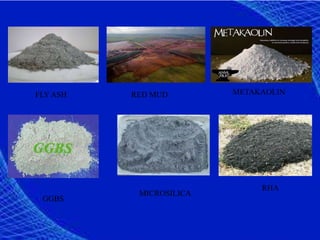
FLY ASH RED MUD METAKAOLIN
GGBS
MICROSILICA
RHA
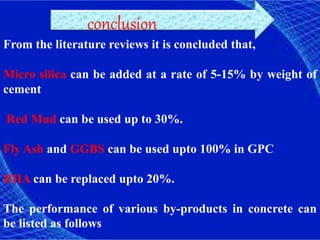
From the literature reviews it is concluded that,
Micro silica can be added at a rate of 5-15% by weight of
cement
Red Mud can be used up to 30%.
Fly Ash and GGBS can be used upto 100% in GPC
RHA can be replaced upto 20%.
The performance of various by-products in concrete can
be listed as follows
conclusion
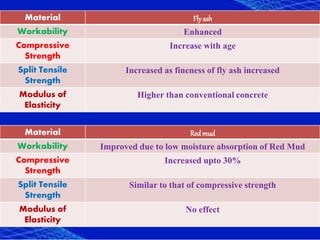
Material Flyash
Workability Enhanced
Compressive
Strength
Increase with age
Split Tensile
Strength
Increased as fineness of fly ash increased
Modulus of
Elasticity
Higher than conventional concrete
Material Redmud
Workability Improved due to low moisture absorption of Red Mud
Compressive
Strength
Increased upto 30%
Split Tensile
Strength
Similar to that of compressive strength
Modulus of
Elasticity
No effect
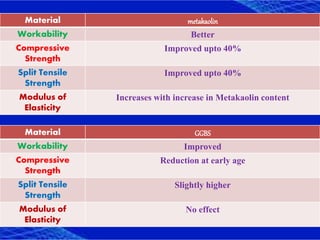
Material metakaolin
Workability Better
Compressive
Strength
Improved upto 40%
Split Tensile
Strength
Improved upto 40%
Modulus of
Elasticity
Increases with increase in Metakaolin content
Material GGBS
Workability Improved
Compressive
Strength
Reduction at early age
Split Tensile
Strength
Slightly higher
Modulus of
Elasticity
No effect
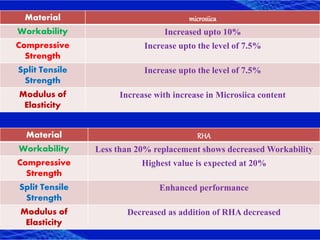
Material microsiica
Workability Increased upto 10%
Compressive
Strength
Increase upto the level of 7.5%
Split Tensile
Strength
Increase upto the level of 7.5%
Modulus of
Elasticity
Increase with increase in Microsiica content
Material RHA
Workability Less than 20% replacement shows decreased Workability
Compressive
Strength
Highest value is expected at 20%
Split Tensile
Strength
Enhanced performance
Modulus of
Elasticity
Decreased as addition of RHA decreased
references
1. Abishek H N and M U Aswanth (2012), Strength studies
of Red Mud based Geopolymer concrete, International
Journal of Emerging Trends in Engineering and
Development, 6(2), pp 10-32.
2. Adam A.A, et al. (2010), Strength, sorptivity and
carbonation of geopolymer concrete, Challenges,
Opportunities and Solutions in Structural Engineering and
Construction, Taylor Francis Group, London, pp 563-568.
3. Ambily P S, Madheswaran C K, Lakhsmanan N,
Dattatreya J K, Jaffer Sathik S A (2012), Experimental
studies on Shear behaviour of reinforced GPC thin webbed
T-beams with and without fibres, International Journal Of
Civil And Structural Engineering, 3(1), pp 128-140.
4. Boskovic Ivana, Vukcevic Mira, Krgovic Milun,
Ivanovic Mileta and Zejak Radomir (2013), The Influence
of Raw Mixture and Activators Characteristics on Red-
Mud based Geopolymers, Research Journal of Chemistry
and Environment, 17 (1), pp 34- 40.
5. Sharda Dhadse, Pramila Kumari and L J Bhagia "Fly
ash characterization, utilization and government initiatives
in India-A review" Journal of Scientific & Industrial
Research vol.67, January 2008, pp.11-18.
6. Alaa M. Rashad "A preliminary study on the effect of
fine aggregate replacement with metakaolin on strength
and abrasion resistance of concrete" Construction and
Building Materials 44 (2013) 487-495.
7. Mohammad Panjehpour, Abang Abdullah Abang Ali1,
Ramazan Demirboga" A review for characterization of
silica fume and its effects on concrete properties"
International Journal of Sustainable Construction
Engineering & Technology (ISSN: 2180-3242) Vol 2, Issue
2, December 2011.
8. M. Ahmaruzzaman "A review on the utilization of fly
ash" Progress in Energy and Combustion Science 36
(2010) pp-327–363.
9. Aiswarya S, Prince Arulraj G, Dilip C "A review on use
of Metakaolin in concrete"IRACST – Engineering Science
and Technology: An International Journal (ESTIJ), ISSN:
2250-3498,Vol.3, No.3, June 2013.
10. Chandana Sukesh1, Bala Kris Chandana Sukesh1,
Bala Krishna Katakam1, P Saha and K. Shyam
Chamberlin "A Study of Sustainable Industrial Waste
Materials as Partial replacement of Cement" IACSIT
Coimbatore Conferences IPCSIT vol. 28 (2012)
Industrial byproducts

Industrial byproducts

  • 1.
    Effective utilization ofindustrial waste in concrete
  • 2.
    introduction The consumption ofnatural aggregates of all types has been increasing in recent years in most countries owing to rapid industrialization. Due to increased construction activities in India, availability of natural fine aggregates are depleting by each passing day. The continued extraction of natural aggregates leads to serious environmental problem including landslides. Using industrial waste products as either cement additives or alternate fuels, it is possible to reduce the quantity of raw materials and fossil fuels used to produce cement.
  • 3.
    The use ofindustrial by-products diverts the material from the waste stream, reduce the energy used in processing virgin materials, use of virgin materials and decreases pollution. Besides industrial waste offering environmental advantages, it also improves the performance (HSC and HPC) and quality of concrete which is the need of hour for most problems of 21st century including Earthquake resistance and Durability.
  • 4.
    Utilization in concrete– a best alternative since it uses up Fly ash, Red mud, Silica fume, Rice-husk ash or GGBS for OPC. It helps to put off Global Warming but utilizes the waste materials efficiently thereby reducing the risk of waste disposal and at same hand, safeguards dwindling natural resources. The role of a Civil Engineer is to reduce cement consumption through the use of supplementary materials. Hoping this simple initiative will add water to the burning fire and it will kindle the spirit of young Civil Engineers to use eco-friendly construction materials in this present scenario.
  • 5.
    Materials used Most commonmaterials that can be used in concrete are Fly Ash Ground Granulated Blast furnace Slag (GGBS) Red Mud Microsilica Metakaolin Rice Hush Ash (RHA)
  • 6.
    Fly ash -non-combusted by-product of coal-fired power plants. During combustion, the coal's mineral impurities such as clay, feldspar, quartz and shale fuse in suspension and are carried away from the combustion chamber by the exhaust gases. Such fused material cools and solidifies into spherical glassy particles called fly ash. Fly ash is a finely divided powder resembling Portland cement consisting mostly of SiO2. Red mud - major industrial waste by Bayer process for the extraction of alumina. Characterized by strong alkalinity due to presence of excessive amount of dissolved NaOH. The red color is by the oxidized Fe present, which can make up to 60% of mass of the red mud. In addition to Fe, the other dominant particles include silica, unleached residual Al, and TiO .
  • 7.
    Disposal becomes ahuge problem due to the presence of high pH, heavy metals and radioactivity. Hence new technologies utilizing red mud are gently needed, besides the use in of GPC. Kaolinite - clay mineral with the chemical composition Al2Si2O5(OH)4, which means each particle has one tetrahedral silica layer and one octahedral alumina layer. It is a soft mineral produced by the chemical weathering of aluminum silicate minerals like feldspar. Rocks that arerich in Kaolinite are also known as china clay, white clay, or kaolin. Metakaolin is a dehydroxylated form of the clay mineral Kaolinite in the temperature range of 500- 800°C. It is a highly pozzolanic.
  • 8.
    Ground-granulated blast-furnace slag(GGBS) - obtained by quenching molten iron slag from a blast furnace in water or steam, to produce a glassy, granular product that is then dried and ground into a fine powder. The main components of blast furnace slag are CaO (30-50%), SiO2 (28- 38%), Al2O3 (8-24%) and MgO (1-18%). GGBS has now effectively replaced sulfate-resisting Portland cement (SRPC) on the market for sulfate resistance because of its superior performance and greatly reduced cost compared to SRPC.
  • 9.
    Silica fume -also known as microsilica, is an amorphous polymorph of silicon dioxide, silica. It is an ultrafine powder collected as a by-product of the silicon and ferrosilicon alloy production. It is an ultrafine material with spherical particles less than 1 µm in diameter, the average being about 0.15 µm. This makes it approximately 100 times smaller than the average cement particle which makes it suitable as pozzolanic material for high performance concrete.
  • 10.
    Rice husk Ash(RHA) - Rice husk also called rice hull, is the hard protecting covering of grains of rice, which is a by-product generally obtained from milling process of rice. The RHA is generated after burning the rice husk in the boiler, which is collected from the particulate collection equipment. It is highly porous, lightweight and contains silica in high content (90 – 95%). At present, disposal of RHA is dumping on waste land, creating land dereliction problems. Since amount of RHA generated is in plenty, an effective way of disposal of RHA is needed urgently.
  • 11.
    FLY ASH REDMUD METAKAOLIN GGBS MICROSILICA RHA
  • 12.
    From the literaturereviews it is concluded that, Micro silica can be added at a rate of 5-15% by weight of cement Red Mud can be used up to 30%. Fly Ash and GGBS can be used upto 100% in GPC RHA can be replaced upto 20%. The performance of various by-products in concrete can be listed as follows conclusion
  • 13.
    Material Flyash Workability Enhanced Compressive Strength Increasewith age Split Tensile Strength Increased as fineness of fly ash increased Modulus of Elasticity Higher than conventional concrete Material Redmud Workability Improved due to low moisture absorption of Red Mud Compressive Strength Increased upto 30% Split Tensile Strength Similar to that of compressive strength Modulus of Elasticity No effect
  • 14.
    Material metakaolin Workability Better Compressive Strength Improvedupto 40% Split Tensile Strength Improved upto 40% Modulus of Elasticity Increases with increase in Metakaolin content Material GGBS Workability Improved Compressive Strength Reduction at early age Split Tensile Strength Slightly higher Modulus of Elasticity No effect
  • 15.
    Material microsiica Workability Increasedupto 10% Compressive Strength Increase upto the level of 7.5% Split Tensile Strength Increase upto the level of 7.5% Modulus of Elasticity Increase with increase in Microsiica content Material RHA Workability Less than 20% replacement shows decreased Workability Compressive Strength Highest value is expected at 20% Split Tensile Strength Enhanced performance Modulus of Elasticity Decreased as addition of RHA decreased
  • 16.
    references 1. Abishek HN and M U Aswanth (2012), Strength studies of Red Mud based Geopolymer concrete, International Journal of Emerging Trends in Engineering and Development, 6(2), pp 10-32. 2. Adam A.A, et al. (2010), Strength, sorptivity and carbonation of geopolymer concrete, Challenges, Opportunities and Solutions in Structural Engineering and Construction, Taylor Francis Group, London, pp 563-568. 3. Ambily P S, Madheswaran C K, Lakhsmanan N, Dattatreya J K, Jaffer Sathik S A (2012), Experimental studies on Shear behaviour of reinforced GPC thin webbed T-beams with and without fibres, International Journal Of Civil And Structural Engineering, 3(1), pp 128-140.
  • 17.
    4. Boskovic Ivana,Vukcevic Mira, Krgovic Milun, Ivanovic Mileta and Zejak Radomir (2013), The Influence of Raw Mixture and Activators Characteristics on Red- Mud based Geopolymers, Research Journal of Chemistry and Environment, 17 (1), pp 34- 40. 5. Sharda Dhadse, Pramila Kumari and L J Bhagia "Fly ash characterization, utilization and government initiatives in India-A review" Journal of Scientific & Industrial Research vol.67, January 2008, pp.11-18. 6. Alaa M. Rashad "A preliminary study on the effect of fine aggregate replacement with metakaolin on strength and abrasion resistance of concrete" Construction and Building Materials 44 (2013) 487-495. 7. Mohammad Panjehpour, Abang Abdullah Abang Ali1, Ramazan Demirboga" A review for characterization of
  • 18.
    silica fume andits effects on concrete properties" International Journal of Sustainable Construction Engineering & Technology (ISSN: 2180-3242) Vol 2, Issue 2, December 2011. 8. M. Ahmaruzzaman "A review on the utilization of fly ash" Progress in Energy and Combustion Science 36 (2010) pp-327–363. 9. Aiswarya S, Prince Arulraj G, Dilip C "A review on use of Metakaolin in concrete"IRACST – Engineering Science and Technology: An International Journal (ESTIJ), ISSN: 2250-3498,Vol.3, No.3, June 2013. 10. Chandana Sukesh1, Bala Kris Chandana Sukesh1, Bala Krishna Katakam1, P Saha and K. Shyam Chamberlin "A Study of Sustainable Industrial Waste Materials as Partial replacement of Cement" IACSIT Coimbatore Conferences IPCSIT vol. 28 (2012)