seminar on
RICE HUSK ASH
PRESENTED BY- GUIDE
MOHAMAD MUJTABA HARSHA.D.SAPKAL
A valuable green resource with great
potential
What is Rice husk ash ( RHA)
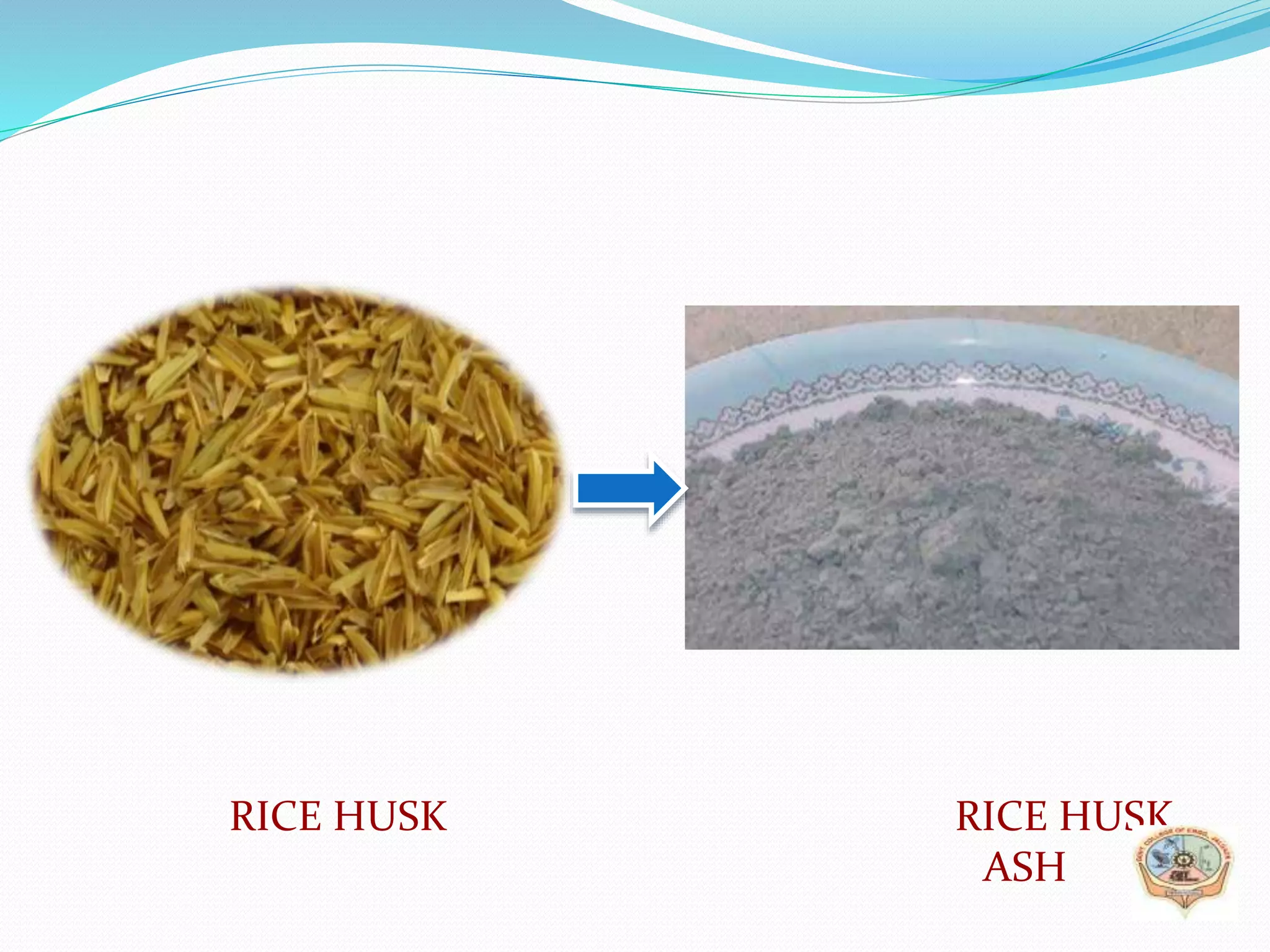
Obtained from burning protecting outer cover of rice husk
It consists of non-crystalline silicon dioxide (SiO2) with
high specific surface area and high pozzolanic
reactivity.
The RHA can be found as natural materials, by-products
or industrial wastes
Chemical propertie so fare closer to micro silica ,silica
fime
RICE HUSK RICE HUSK
ASH
HOW RHA PRODUCE
Chemical compositions of RHA are affected due to
burning process and temperature
RHA produced by burning rice husk between 600 to
700°C temperatures for 2 hours
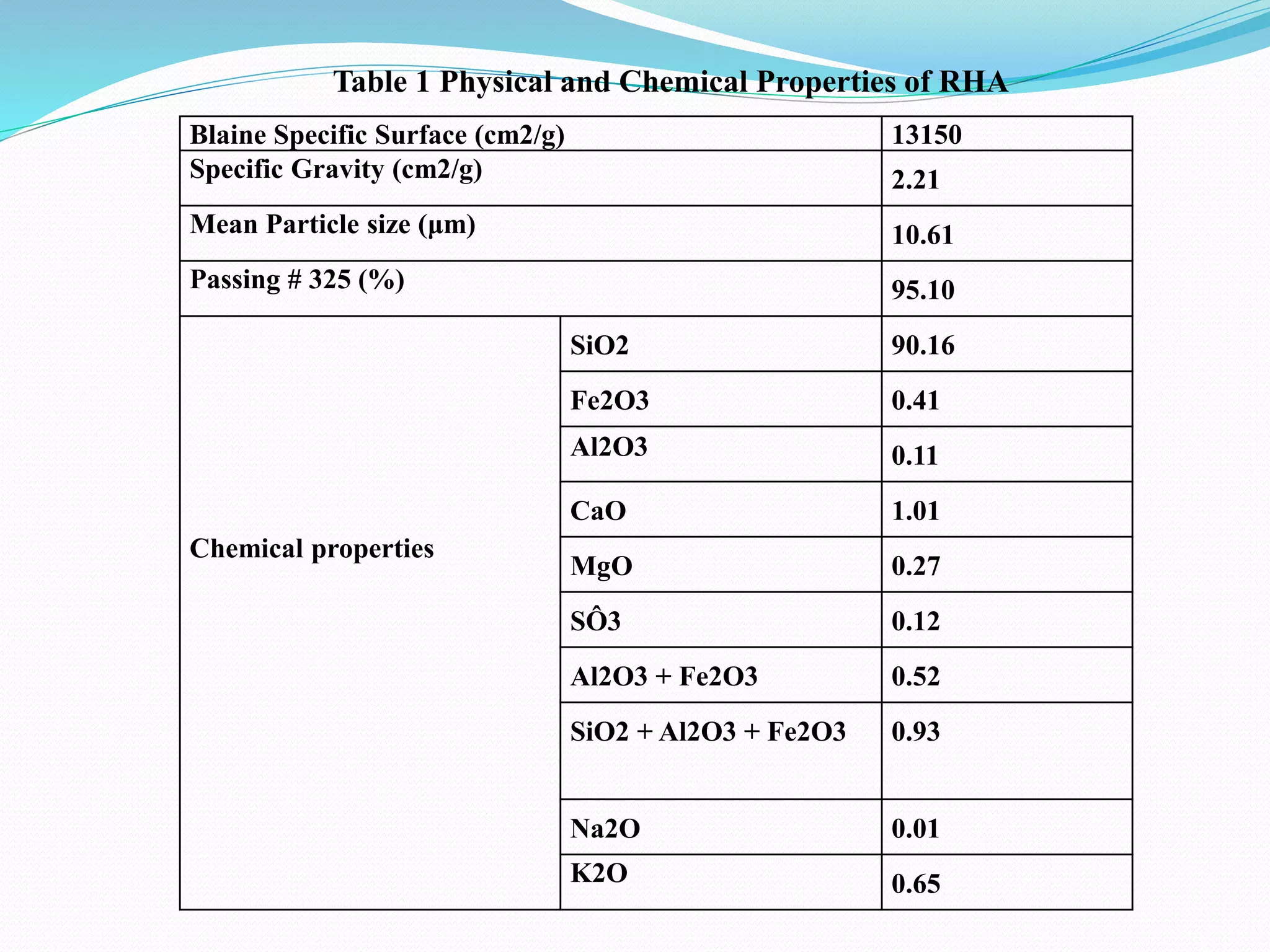
Blaine Specific Surface (cm2/g) 13150
Specific Gravity (cm2/g) 2.21
Mean Particle size (μm) 10.61
Passing # 325 (%) 95.10
Chemical properties
SiO2 90.16
Fe2O3 0.41
Al2O3 0.11
CaO 1.01
MgO 0.27
SÔ3 0.12
Al2O3 + Fe2O3 0.52
SiO2 + Al2O3 + Fe2O3 0.93
Na2O 0.01
K2O 0.65
Table 1 Physical and Chemical Properties of RHA
How RHA improves concrete
 OPC reacts with water to form two products
 Calcium silicate hydrate :it gives strength and
durability to concrete
 Calcium hydroxide
 reacts with CO2 causing effloresce
It creates negative effects on concrete
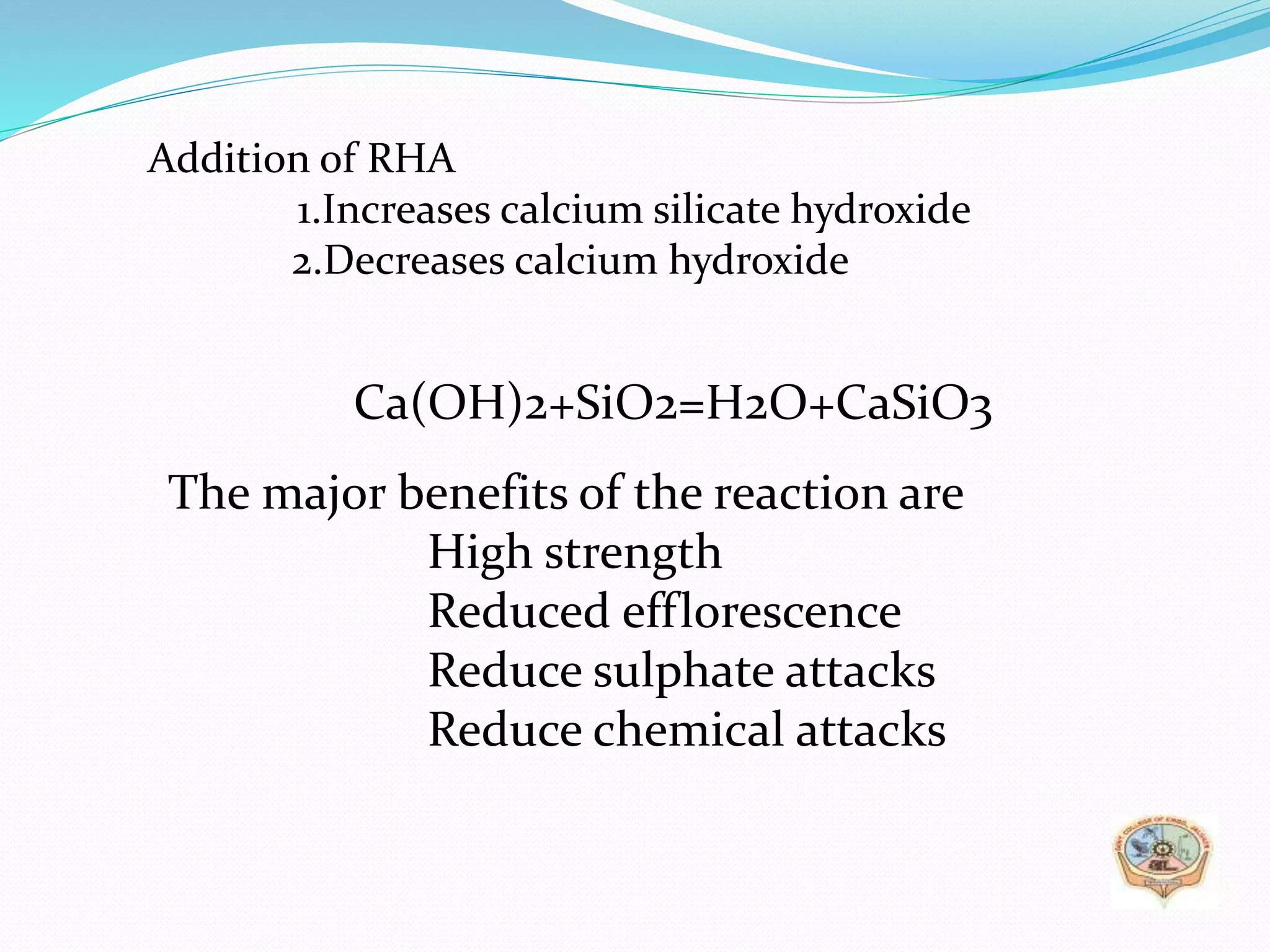
Addition of RHA
1.Increases calcium silicate hydroxide
2.Decreases calcium hydroxide
Ca(OH)2+SiO2=H2O+CaSiO3
The major benefits of the reaction are
High strength
Reduced efflorescence
Reduce sulphate attacks
Reduce chemical attacks
Uses of RHA
 RHA can be used in the 2 distinct ways
1)To create HPC –RHA can be added to cement to
increase high strength concrete
2)To create Green Concrete-RHA can be used as an
substitute to reduce amount of cement with higher
strength
Carbon credits
 The production of 1 Tons of cement contributes to 1
tons of co2 in atmos,
 Worldwide 7% of carbon dioxide emission for
production of OPC
 The utilization of RHA in concrete production is
solution to reduce the cement
ADVANTAGES
 Improves compressive strength, flexural strengths
and split tensile strength.
 RHA mixed concrete shows better bond strength as
compared to OPC concrete.
 Permeability of concrete decreases chloride diffusion
and chloride permeation reduces (30%) replacement.
 RHA makes a role to increased resistance to chemical
.
DISADVANTAGES
 Suitable incinerator/furnace as well as grinding
method is required for burning and grinding rice husk
in order to obtain good quality ash.
 Strength of concrete is reduced for larger (beyond
30%) replacement.
 There is a little transportation problem.
 Unburnt RHA is not suitable for concrete production
CONCLUSION
 To study the effect of RHA as substitute for fine
aggregate in concrete mixture.
 The properties of concrete containing RHA had been
successfully studied.
 The use of RHA in civil construction, besides reducing
the environmental polluters’ factors, may bring several
improvements fotg544r the concrete characteristics.
REFRENCE
 1.M.S.SHETTY CONCRETE TECHNOLOGY
 2.Effect of Rice Husk Ash on Cement Mortar and
Concrete. Sudisht Mishra,
Prof (Dr.) S. V. Deodhar.
 3. Effect of Rice Husk Ash on Lime Stabilization. Dr. J. N.
Jha (Member) K. S. Gill
 4.Effect of Rice Husk Ash on Cement Stabilized Laterite.
MUSA ALHASAN

Rice Husk Ash

  • 1.
    seminar on RICE HUSKASH PRESENTED BY- GUIDE MOHAMAD MUJTABA HARSHA.D.SAPKAL
  • 2.
    A valuable greenresource with great potential
  • 3.
    What is Ricehusk ash ( RHA) Obtained from burning protecting outer cover of rice husk It consists of non-crystalline silicon dioxide (SiO2) with high specific surface area and high pozzolanic reactivity. The RHA can be found as natural materials, by-products or industrial wastes Chemical propertie so fare closer to micro silica ,silica fime
  • 4.
  • 5.
    HOW RHA PRODUCE Chemicalcompositions of RHA are affected due to burning process and temperature RHA produced by burning rice husk between 600 to 700°C temperatures for 2 hours
  • 6.
    Blaine Specific Surface(cm2/g) 13150 Specific Gravity (cm2/g) 2.21 Mean Particle size (μm) 10.61 Passing # 325 (%) 95.10 Chemical properties SiO2 90.16 Fe2O3 0.41 Al2O3 0.11 CaO 1.01 MgO 0.27 SÔ3 0.12 Al2O3 + Fe2O3 0.52 SiO2 + Al2O3 + Fe2O3 0.93 Na2O 0.01 K2O 0.65 Table 1 Physical and Chemical Properties of RHA
  • 7.
    How RHA improvesconcrete  OPC reacts with water to form two products  Calcium silicate hydrate :it gives strength and durability to concrete  Calcium hydroxide  reacts with CO2 causing effloresce It creates negative effects on concrete
  • 8.
    Addition of RHA 1.Increasescalcium silicate hydroxide 2.Decreases calcium hydroxide Ca(OH)2+SiO2=H2O+CaSiO3 The major benefits of the reaction are High strength Reduced efflorescence Reduce sulphate attacks Reduce chemical attacks
  • 9.
    Uses of RHA RHA can be used in the 2 distinct ways 1)To create HPC –RHA can be added to cement to increase high strength concrete 2)To create Green Concrete-RHA can be used as an substitute to reduce amount of cement with higher strength
  • 10.
    Carbon credits  Theproduction of 1 Tons of cement contributes to 1 tons of co2 in atmos,  Worldwide 7% of carbon dioxide emission for production of OPC  The utilization of RHA in concrete production is solution to reduce the cement
  • 11.
    ADVANTAGES  Improves compressivestrength, flexural strengths and split tensile strength.  RHA mixed concrete shows better bond strength as compared to OPC concrete.  Permeability of concrete decreases chloride diffusion and chloride permeation reduces (30%) replacement.  RHA makes a role to increased resistance to chemical .
  • 12.
    DISADVANTAGES  Suitable incinerator/furnaceas well as grinding method is required for burning and grinding rice husk in order to obtain good quality ash.  Strength of concrete is reduced for larger (beyond 30%) replacement.  There is a little transportation problem.  Unburnt RHA is not suitable for concrete production
  • 13.
    CONCLUSION  To studythe effect of RHA as substitute for fine aggregate in concrete mixture.  The properties of concrete containing RHA had been successfully studied.  The use of RHA in civil construction, besides reducing the environmental polluters’ factors, may bring several improvements fotg544r the concrete characteristics.
  • 14.
    REFRENCE  1.M.S.SHETTY CONCRETETECHNOLOGY  2.Effect of Rice Husk Ash on Cement Mortar and Concrete. Sudisht Mishra, Prof (Dr.) S. V. Deodhar.  3. Effect of Rice Husk Ash on Lime Stabilization. Dr. J. N. Jha (Member) K. S. Gill  4.Effect of Rice Husk Ash on Cement Stabilized Laterite. MUSA ALHASAN