Postoperative Fever
Ahikam DJ
Objectives
• Definition
• Causes
• Physiological fever
• 7 W’s
• Take home
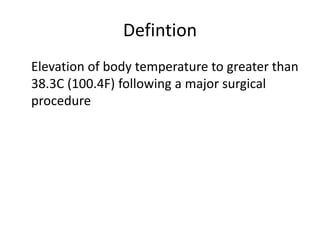
Defintion
Elevation of body temperature to greater than
38.3C (100.4F) following a major surgical
procedure
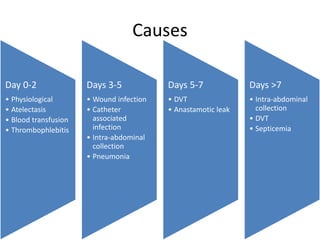
Causes
Day 0-2
• Physiological
• Atelectasis
• Blood transfusion
• Thrombophlebitis
Days 3-5
• Wound infection
• Catheter
associated
infection
• Intra-abdominal
collection
• Pneumonia
Days 5-7
• DVT
• Anastamotic leak
Days >7
• Intra-abdominal
collection
• DVT
• Septicemia
Physiological fever
• Seen in first 48 hrs
• An inflammatory response to the cytokines
released from tissue injury
• Act centrally and raise the thermoregulatory
set point for body temperature.
• Prevalence??
‘Wind’
• Atelectasis (<48hr) and Pneumonia (>48hr)
• Cause: poor inspiratory effort, failure to clear
secretions
• Signs and symptoms: Decreased breath
sounds, crackles, tachypnea, dyspnea, cough,
hypoxemia, dependant infiltrates on chest x-
ray
• Rx: Incentive spirometry, chest physiotherapy,
early mobilization, bronchodilators.
‘Water’
• Symptoms: fever, suprapubic/flank pain, renal
anger tenderness, urinary urgency
• Risk factors: longer duration of
catheterisation, unsterile placement, female
sex, older age, diabetic, history of previous UTI
• Urinalysis and urine culture with sensitivity
• Causative organism: E. Coli, Enterococcus,
‘Wound’
• SSI: Infections that occur at or near the
surgical incision within 30 days of surgery or
with 90 days if prosthetic materials have been
implanted
• Erythema, warmth, tenderness, purulent
drainage from incision
• Superifical, Deep, Organ/space infection
• Organisms: Streptococcus, staph,
enterococcus
‘Walking’
• DVT: Immobilisation
• Risk factors: abdomino-pelvic surgery,
orthopedic surgery, major trauma, spinal cord
injury, cancer, obese.
• Fever, calf tenderness
• Complication: Pulmonary embolism
• Prevention: Early mobilization, TEDS on,
Anticoagulation.
‘Wonder drugs’
• Antimicrobials and heparin : one-third of
drug-related fever.
• Malignant hyperthermia: In genetically
susceptible induviduals to volatile anasthetics
• Discontinue the offending agent
‘Withdrawal’
• Alcohol withdrawal
• Acute treatment is with high-dose
benzodiazepine: Diazepam or lorazepam
‘Wonky glands’
• Addisonian crisis:
– Hypotension, hyponatremia, hyperkalemia,
hypoglycemia, unexplained fever
– Rx: Bolus of dexamethasone 4mg iv or
hydrocortisone 100mg iv
• Thyrotoxicosis
– Tachycardia, altered mental status,
hyper/hypotension, hyperthermia.
– Propranolol 1mg IV bolus, Propylthiouracil 200mg
oral
Reference
• Evaluating postoperative fever Kristopher R. Maday, MS, PA-C; John B.
Hurt, MS, PA-C; Paul Harrelson, MSPAS, PA-C; John Porterfield, MD
Copyright © 2016 American Academy of Physician Assistants

Postoperative fever

  • 1.
  • 2.
    Objectives • Definition • Causes •Physiological fever • 7 W’s • Take home
  • 3.
    Defintion Elevation of bodytemperature to greater than 38.3C (100.4F) following a major surgical procedure
  • 4.
    Causes Day 0-2 • Physiological •Atelectasis • Blood transfusion • Thrombophlebitis Days 3-5 • Wound infection • Catheter associated infection • Intra-abdominal collection • Pneumonia Days 5-7 • DVT • Anastamotic leak Days >7 • Intra-abdominal collection • DVT • Septicemia
  • 5.
    Physiological fever • Seenin first 48 hrs • An inflammatory response to the cytokines released from tissue injury • Act centrally and raise the thermoregulatory set point for body temperature. • Prevalence??
  • 6.
    ‘Wind’ • Atelectasis (<48hr)and Pneumonia (>48hr) • Cause: poor inspiratory effort, failure to clear secretions • Signs and symptoms: Decreased breath sounds, crackles, tachypnea, dyspnea, cough, hypoxemia, dependant infiltrates on chest x- ray • Rx: Incentive spirometry, chest physiotherapy, early mobilization, bronchodilators.
  • 7.
    ‘Water’ • Symptoms: fever,suprapubic/flank pain, renal anger tenderness, urinary urgency • Risk factors: longer duration of catheterisation, unsterile placement, female sex, older age, diabetic, history of previous UTI • Urinalysis and urine culture with sensitivity • Causative organism: E. Coli, Enterococcus,
  • 8.
    ‘Wound’ • SSI: Infectionsthat occur at or near the surgical incision within 30 days of surgery or with 90 days if prosthetic materials have been implanted • Erythema, warmth, tenderness, purulent drainage from incision • Superifical, Deep, Organ/space infection • Organisms: Streptococcus, staph, enterococcus
  • 9.
    ‘Walking’ • DVT: Immobilisation •Risk factors: abdomino-pelvic surgery, orthopedic surgery, major trauma, spinal cord injury, cancer, obese. • Fever, calf tenderness • Complication: Pulmonary embolism • Prevention: Early mobilization, TEDS on, Anticoagulation.
  • 10.
    ‘Wonder drugs’ • Antimicrobialsand heparin : one-third of drug-related fever. • Malignant hyperthermia: In genetically susceptible induviduals to volatile anasthetics • Discontinue the offending agent
  • 11.
    ‘Withdrawal’ • Alcohol withdrawal •Acute treatment is with high-dose benzodiazepine: Diazepam or lorazepam
  • 12.
    ‘Wonky glands’ • Addisoniancrisis: – Hypotension, hyponatremia, hyperkalemia, hypoglycemia, unexplained fever – Rx: Bolus of dexamethasone 4mg iv or hydrocortisone 100mg iv • Thyrotoxicosis – Tachycardia, altered mental status, hyper/hypotension, hyperthermia. – Propranolol 1mg IV bolus, Propylthiouracil 200mg oral
  • 13.
    Reference • Evaluating postoperativefever Kristopher R. Maday, MS, PA-C; John B. Hurt, MS, PA-C; Paul Harrelson, MSPAS, PA-C; John Porterfield, MD Copyright © 2016 American Academy of Physician Assistants