Postmodernism lesson 1
L/O:
In this lesson you will be able to …..
Introduce to the basic ideas about Postmodernism and consider it's origins
Address basic themes and concepts that make something Postmodern
Consider the wider effects of Postmodernism on yourself
Address assessment objectives and exam criteria
Starter
• Post = ?
• Modern = ?
• Ism = ?
Starter
•

Post = after

•

Modern = ?
–

Modern generally denotes something that is "up-to-date", "new", or contemporary. (wiki)

•

1.of or pertaining to present and recent time; not ancient or remote: modern city life.

•

2.characteristic of present and recent time; contemporary; not antiquated or obsolete: modern viewpoints.

•

3.of or pertaining to the historical period following the Middle Ages: modern European history.

•

4.of, pertaining to, or characteristic of contemporary styles of art,literature, music, etc., that reject traditionally acc
epted or sanctioned forms and emphasize individual experimentation and sensibility.

•
•

Ism = ?
a distinctive doctrine, theory, system, or practice:

•
•

a suffix appearing in loanwords from Greek, where it was used to form action nouns from verbs ( baptism );
on this model, used as a.productive suffix in the formation of nouns denoting action or.practice, state or condition
, principles, doctrines, a usage or.characteristic, devotion or adherence, etc. ( criticism; barbarism;Darwinism; desp
otism; plagiarism; realism; witticism; intellectualism
What is pomo?
•

Postmodernism is a term that describes the postmodernist movement in the
arts, its set of cultural tendencies and associated cultural movements.

•

It is in general the era that follows Modernism. It frequently serves as an
ambiguous overarching term
forskeptical interpretationsof culture, literature, art, philosophy, economics, archit
ecture, fiction, and literary criticism.

•

It is often associated with deconstruction and post-structuralism because its usage
as a term gained significant popularity at the same time as twentieth-century poststructural thought

(wiki)

.
Starter
• What do we know about postmodernism?
• Where have you come across is before?
• Is it an easy concept to understand?
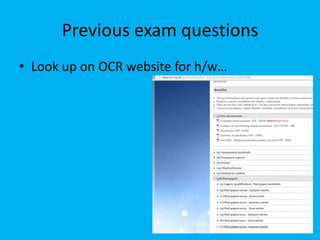
Previous exam questions
• Look up on OCR website for h/w…
POSTMODERNISM!

Ism's: A History
Artistic/Cultural Movements (17th21st Century)
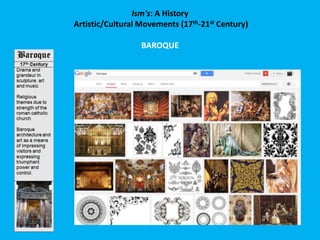
Ism's: A History
Artistic/Cultural Movements (17th-21st Century)
BAROQUE
Ism's: A History
Artistic/Cultural Movements (17th-21st Century)
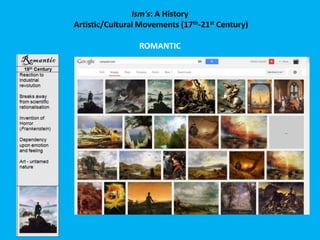
ROMANTIC
Ism's: A History
Artistic/Cultural Movements (17th-21st Century)
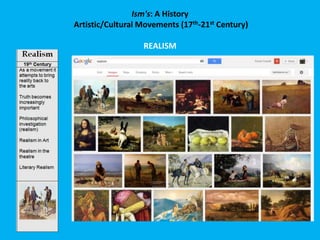
REALISM
Ism's: A History
Artistic/Cultural Movements (17th-21st Century)
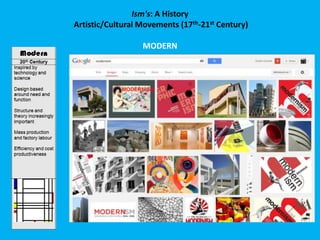
MODERN
Ism's: A History
Artistic/Cultural Movements (17th-21st Century)
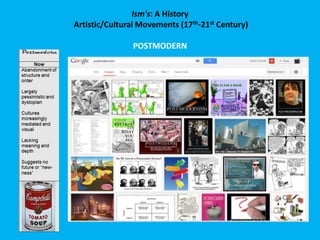
POSTMODERN
Key Concept: Postmodernism
• Postmodernism is a very big and complicated concept to get
your head round, but in its simplest form it attempts to
analyse society and culture now.
• It is the central idea behind new fashion, music and film - put
simply postmodernists believes that artistic creativity and
"newness" can no longer happen as in today's society
everything has been done?
Some Key points
• Inability to create anything new
• Experimentation with existing forms and
conventions
• Loss of the "real"
• General pessimism and lack of purpose
• Technology increasing important in social
interaction
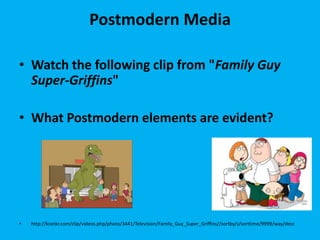
Postmodern Media
• Watch the following clip from "Family Guy
Super-Griffins"
• What Postmodern elements are evident?

•

http://krankr.com/clip/videos.php/photo/3441/Television/Family_Guy_Super_Griffins//sortby/s/sorttime/9999/way/desc
Postmodern elements
•
•
•
•
•
•
•

Generic conventions and hybridity
Popular culture references (Nsync)
Stewie and Brian's ability to talk
Intertextuality
Formal confusion - news report
Reality vs hypereality
Who's Gene Charlott?

• Intertextual references from Family Guy Wiki
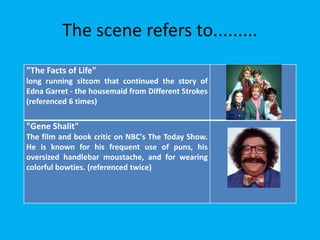
The scene refers to.........
"The Facts of Life"
long running sitcom that continued the story of
Edna Garret - the housemaid from Different Strokes
(referenced 6 times)

"Gene Shalit"
The film and book critic on NBC's The Today Show.
He is known for his frequent use of puns, his
oversized handlebar moustache, and for wearing
colorful bowties. (referenced twice)
What makes something
Postmodern?
activity
• All these texts are post modern….but how?
•
•
•
•
•
•
•

Purpose?
What in common?
Style?
Audience?
Themes?
Content?
Etc.
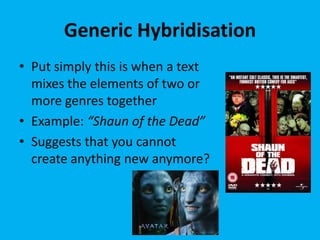
Generic Hybridisation
• Put simply this is when a text
mixes the elements of two or
more genres together
• Example: “Shaun of the Dead”
• Suggests that you cannot
create anything new anymore?
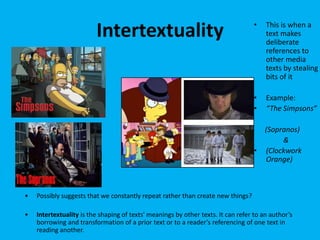
This is when a
text makes
deliberate
references to
other media
texts by stealing
bits of it

•
•

Intertextuality

•

Example:
“The Simpsons”

•

(Sopranos)
&
(Clockwork
Orange)

•

Possibly suggests that we constantly repeat rather than create new things?

•

Intertextuality is the shaping of texts' meanings by other texts. It can refer to an author’s
borrowing and transformation of a prior text or to a reader’s referencing of one text in
reading another.
Intertextuality
Intertextuality is the shaping of texts'
meanings by other texts.
It can refer to an author’s borrowing and
transformation of a prior text or to a
reader’s referencing of one text in
reading another.
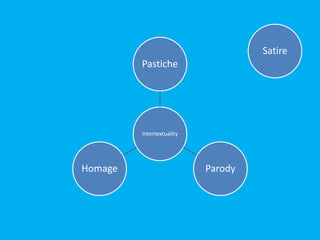
Satire
Pastiche

Intertextuality

Homage

Parody
Pastiche
• A pastiche is a work of art, literature, film, music or
architecture that closely imitates the work of a previous
artist, usually distinguished from parody in the sense that it
celebrates rather than mocks the work it imitates.
• A medley of various ingredients... Denotes a technique
using a generally light hearted, tongue-in-cheek imitation
of another’s style. Although it is jocular (humorous), it is
respectful (unlike parody).
• Alternately, a pastiche may be a hodge-podge of parts
derived from the original work of others.
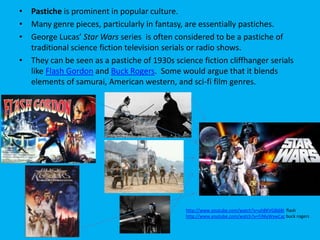
• Pastiche is prominent in popular culture.
• Many genre pieces, particularly in fantasy, are essentially pastiches.
• George Lucas’ Star Wars series is often considered to be a pastiche of
traditional science fiction television serials or radio shows.
• They can be seen as a pastiche of 1930s science fiction cliffhanger serials
like Flash Gordon and Buck Rogers. Some would argue that it blends
elements of samurai, American western, and sci-fi film genres.

http://www.youtube.com/watch?v=uh8KVG8j68I flash
http://www.youtube.com/watch?v=FjNlyWxwCac buck rogers
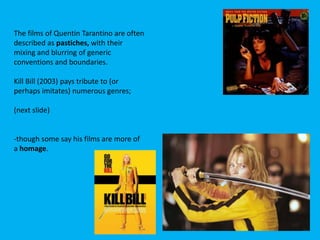
The films of Quentin Tarantino are often
described as pastiches, with their
mixing and blurring of generic
conventions and boundaries.

Kill Bill (2003) pays tribute to (or
perhaps imitates) numerous genres;
(next slide)

-though some say his films are more of
a homage.
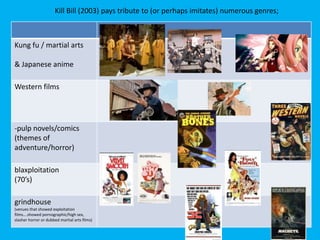
Kill Bill (2003) pays tribute to (or perhaps imitates) numerous genres;

Kung fu / martial arts
& Japanese anime

Western films

-pulp novels/comics
(themes of
adventure/horror)
blaxploitation
(70’s)
grindhouse
(venues that showed exploitation
films….showed pornographic/high sex,
slasher horror or dubbed martial arts films)
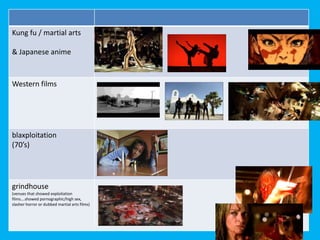
Kung fu / martial arts
& Japanese anime

Western films

blaxploitation
(70’s)

grindhouse
(venues that showed exploitation
films….showed pornographic/high sex,
slasher horror or dubbed martial arts films)
Homage
• Mixing and blurring of generic conventions and
boundaries.
• Film or director pays tribute (some believe
imitates) to previous distinctive styles/genres
• Homage is generally used to mean any public
show of respect to someone to whom you feel
indebted (worthy of dedication). In this sense, a
reference within a creative work to someone who
greatly influenced the artist would be a homage
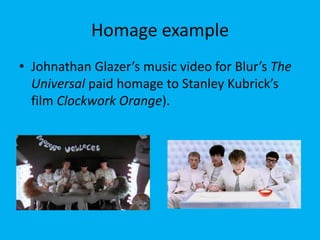
Homage example
• Johnathan Glazer’s music video for Blur’s The
Universal paid homage to Stanley Kubrick’s
film Clockwork Orange).
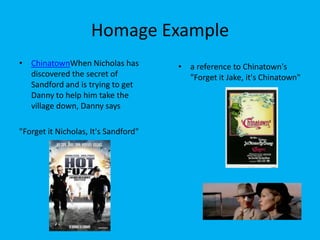
Homage Example
• ChinatownWhen Nicholas has
discovered the secret of
Sandford and is trying to get
Danny to help him take the
village down, Danny says
"Forget it Nicholas, It's Sandford"

• a reference to Chinatown's
"Forget it Jake, it's Chinatown"
Parody
• A parody (also called spoof), is an imitative
work created to mock, comment on or
trivialise an original work, its
subject, author, style, or some other target, by
means of satiric or ironic imitation.
• Most of the humour in recent parodies of film
genres is based on our familiarity with formula
plots, conventions and characters.
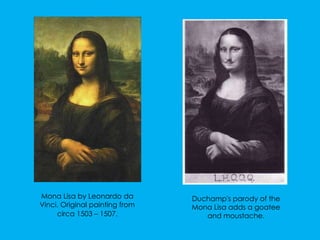
Mona Lisa by Leonardo da
Vinci. Original painting from
circa 1503 – 1507.

Duchamp's parody of the
Mona Lisa adds a goatee
and moustache.
Parody in Duchamp (mona lisa)
• Marcel Duchamp's Dadaist painting LHOOQ parodies DaVinci's Mona Lisa
by marring it with a goatee and moustache. In keeping with his Dadist
practices, which called artistic conventions and aesthetic assumptions into
question, DuChamp’s paired his visual parody with a low pun; in
French, "L.H.O.O.Q." sounds like an idiom describing women who sexually
tease men: "elle a chaud au cul," or "she is hot in the ass."
Parody & genre (western)
• Some genre theorists see parody as a natural
development in the life cycle of any genre.

• Such theorists note that Western movies, for

example, after the classic stage defined the
conventions of the genre, underwent a parody
stage, in which those same conventions were ridiculed
and critiqued.

• Because audiences had seen these classic

Westerns, they had expectations for new
Westerns, and when these expectations were
subverted, the audience laughed.
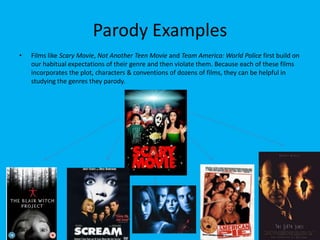
Parody Examples
•

Films like Scary Movie, Not Another Teen Movie and Team America: World Police first build on
our habitual expectations of their genre and then violate them. Because each of these films
incorporates the plot, characters & conventions of dozens of films, they can be helpful in
studying the genres they parody.
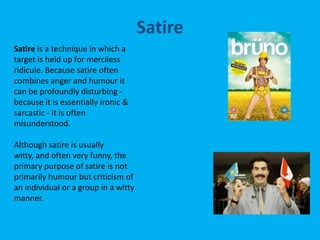
Satire
Satire is a technique in which a
target is held up for merciless
ridicule. Because satire often
combines anger and humour it
can be profoundly disturbing because it is essentially ironic &
sarcastic - it is often
misunderstood.
Although satire is usually
witty, and often very funny, the
primary purpose of satire is not
primarily humour but criticism of
an individual or a group in a witty
manner.
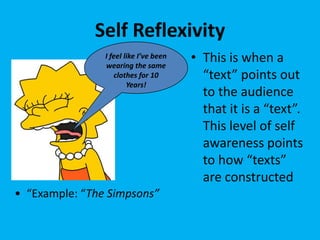
Self Reflexivity
I feel like I’ve been
wearing the same
clothes for 10
Years!

• “Example: “The Simpsons”

• This is when a
“text” points out
to the audience
that it is a “text”.
This level of self
awareness points
to how “texts”
are constructed
Juxtaposition
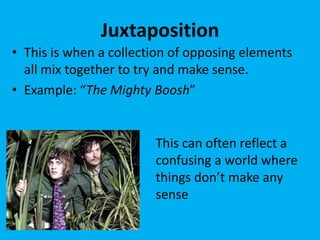
• This is when a collection of opposing elements
all mix together to try and make sense.
• Example: “The Mighty Boosh”

This can often reflect a
confusing a world where
things don’t make any
sense
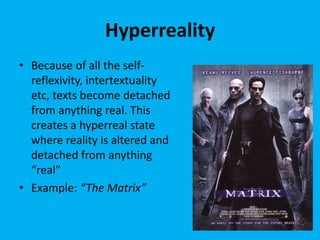
Hyperreality
• Because of all the selfreflexivity, intertextuality
etc, texts become detached
from anything real. This
creates a hyperreal state
where reality is altered and
detached from anything
“real”
• Example: “The Matrix”
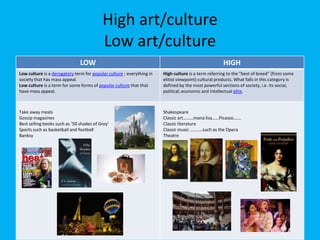
High art/culture
Low art/culture
LOW

HIGH

Low culture is a derogatory term for popular culture ; everything in
society that has mass appeal.
Low culture is a term for some forms of popular culture that that
have mass appeal.

High culture is a term referring to the "best of breed" (from some
elitist viewpoint) cultural products. What falls in this category is
defined by the most powerful sections of society, i.e. its social,
political, economic and intellectual elite.

Take away meals
Gossip magazines
Best selling books such as ‘50 shades of Grey’
Sports such as basketball and football
Banksy

Shakespeare
Classic art………mona lisa……Picasso…….
Classic literature
Classic music ………..such as the Opera
Theatre
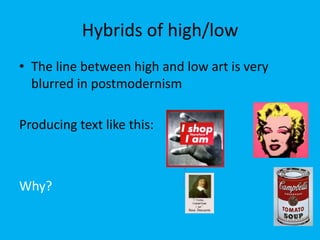
Hybrids of high/low
• The line between high and low art is very
blurred in postmodernism
Producing text like this:

Why?
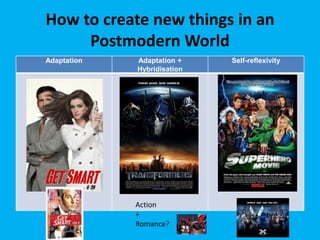
How to create new things in an
Postmodern World
Adaptation

Adaptation +
Hybridisation

Action
+
Romance?

Self-reflexivity
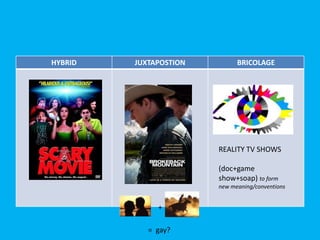
HYBRID

JUXTAPOSTION

BRICOLAGE

REALITY TV SHOWS
(doc+game
show+soap) to form
new meaning/conventions

+
= gay?
• Can you think of two genres that have not
been mixed already?
• What/who decides what works well
together?
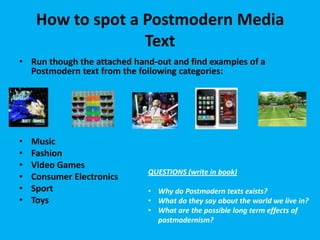
How to spot a Postmodern Media
Text
• Run though the attached hand-out and find examples of a
Postmodern text from the following categories:

•
•
•
•
•
•

Music
Fashion
Video Games
Consumer Electronics
Sport
Toys

QUESTIONS (write in book)
• Why do Postmodern texts exists?
• What do they say about the world we live in?
• What are the possible long term effects of
postmodernism?
Postmodernism WIKI
• http://en.wikipedia.org/wiki/Postmodernism
• If you want to do more reading……
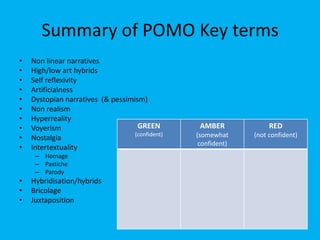
Summary of POMO Key terms
•
•
•
•
•
•
•
•
•
•

Non linear narratives
High/low art hybrids
Self reflexivity
Artificialness
Dystopian narratives (& pessimism)
Non realism
Hyperreality
GREEN
Voyerism
(confident)
Nostalgia
Intertextuality
– Homage
– Pastiche
– Parody

•
•
•

Hybridisation/hybrids
Bricolage
Juxtaposition

AMBER

RED

(somewhat
confident)

(not confident)
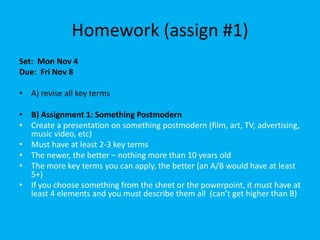
Homework (assign #1)
Set: Mon Nov 4
Due: Fri Nov 8
• A) revise all key terms
• B) Assignment 1: Something Postmodern
• Create a presentation on something postmodern (film, art, TV, advertising,
music video, etc)
• Must have at least 2-3 key terms
• The newer, the better – nothing more than 10 years old
• The more key terms you can apply, the better (an A/B would have at least
5+)
• If you choose something from the sheet or the powerpoint, it must have at
least 4 elements and you must describe them all (can’t get higher than B)

Postmodernism lesson 1

  • 1.
    Postmodernism lesson 1 L/O: Inthis lesson you will be able to ….. Introduce to the basic ideas about Postmodernism and consider it's origins Address basic themes and concepts that make something Postmodern Consider the wider effects of Postmodernism on yourself Address assessment objectives and exam criteria
  • 2.
    Starter • Post =? • Modern = ? • Ism = ?
  • 3.
    Starter • Post = after • Modern= ? – Modern generally denotes something that is "up-to-date", "new", or contemporary. (wiki) • 1.of or pertaining to present and recent time; not ancient or remote: modern city life. • 2.characteristic of present and recent time; contemporary; not antiquated or obsolete: modern viewpoints. • 3.of or pertaining to the historical period following the Middle Ages: modern European history. • 4.of, pertaining to, or characteristic of contemporary styles of art,literature, music, etc., that reject traditionally acc epted or sanctioned forms and emphasize individual experimentation and sensibility. • • Ism = ? a distinctive doctrine, theory, system, or practice: • • a suffix appearing in loanwords from Greek, where it was used to form action nouns from verbs ( baptism ); on this model, used as a.productive suffix in the formation of nouns denoting action or.practice, state or condition , principles, doctrines, a usage or.characteristic, devotion or adherence, etc. ( criticism; barbarism;Darwinism; desp otism; plagiarism; realism; witticism; intellectualism
  • 4.
    What is pomo? • Postmodernismis a term that describes the postmodernist movement in the arts, its set of cultural tendencies and associated cultural movements. • It is in general the era that follows Modernism. It frequently serves as an ambiguous overarching term forskeptical interpretationsof culture, literature, art, philosophy, economics, archit ecture, fiction, and literary criticism. • It is often associated with deconstruction and post-structuralism because its usage as a term gained significant popularity at the same time as twentieth-century poststructural thought (wiki) .
  • 5.
    Starter • What dowe know about postmodernism? • Where have you come across is before? • Is it an easy concept to understand?
  • 6.
    Previous exam questions •Look up on OCR website for h/w…
  • 7.
  • 8.
    Ism's: A History Artistic/CulturalMovements (17th-21st Century) BAROQUE
  • 9.
    Ism's: A History Artistic/CulturalMovements (17th-21st Century) ROMANTIC
  • 10.
    Ism's: A History Artistic/CulturalMovements (17th-21st Century) REALISM
  • 11.
    Ism's: A History Artistic/CulturalMovements (17th-21st Century) MODERN
  • 12.
    Ism's: A History Artistic/CulturalMovements (17th-21st Century) POSTMODERN
  • 13.
    Key Concept: Postmodernism •Postmodernism is a very big and complicated concept to get your head round, but in its simplest form it attempts to analyse society and culture now. • It is the central idea behind new fashion, music and film - put simply postmodernists believes that artistic creativity and "newness" can no longer happen as in today's society everything has been done?
  • 14.
    Some Key points •Inability to create anything new • Experimentation with existing forms and conventions • Loss of the "real" • General pessimism and lack of purpose • Technology increasing important in social interaction
  • 15.
    Postmodern Media • Watchthe following clip from "Family Guy Super-Griffins" • What Postmodern elements are evident? • http://krankr.com/clip/videos.php/photo/3441/Television/Family_Guy_Super_Griffins//sortby/s/sorttime/9999/way/desc
  • 16.
    Postmodern elements • • • • • • • Generic conventionsand hybridity Popular culture references (Nsync) Stewie and Brian's ability to talk Intertextuality Formal confusion - news report Reality vs hypereality Who's Gene Charlott? • Intertextual references from Family Guy Wiki
  • 17.
    The scene refersto......... "The Facts of Life" long running sitcom that continued the story of Edna Garret - the housemaid from Different Strokes (referenced 6 times) "Gene Shalit" The film and book critic on NBC's The Today Show. He is known for his frequent use of puns, his oversized handlebar moustache, and for wearing colorful bowties. (referenced twice)
  • 18.
  • 19.
    activity • All thesetexts are post modern….but how? • • • • • • • Purpose? What in common? Style? Audience? Themes? Content? Etc.
  • 20.
    Generic Hybridisation • Putsimply this is when a text mixes the elements of two or more genres together • Example: “Shaun of the Dead” • Suggests that you cannot create anything new anymore?
  • 21.
    This is whena text makes deliberate references to other media texts by stealing bits of it • • Intertextuality • Example: “The Simpsons” • (Sopranos) & (Clockwork Orange) • Possibly suggests that we constantly repeat rather than create new things? • Intertextuality is the shaping of texts' meanings by other texts. It can refer to an author’s borrowing and transformation of a prior text or to a reader’s referencing of one text in reading another.
  • 22.
    Intertextuality Intertextuality is theshaping of texts' meanings by other texts. It can refer to an author’s borrowing and transformation of a prior text or to a reader’s referencing of one text in reading another.
  • 23.
  • 24.
    Pastiche • A pasticheis a work of art, literature, film, music or architecture that closely imitates the work of a previous artist, usually distinguished from parody in the sense that it celebrates rather than mocks the work it imitates. • A medley of various ingredients... Denotes a technique using a generally light hearted, tongue-in-cheek imitation of another’s style. Although it is jocular (humorous), it is respectful (unlike parody). • Alternately, a pastiche may be a hodge-podge of parts derived from the original work of others.
  • 25.
    • Pastiche isprominent in popular culture. • Many genre pieces, particularly in fantasy, are essentially pastiches. • George Lucas’ Star Wars series is often considered to be a pastiche of traditional science fiction television serials or radio shows. • They can be seen as a pastiche of 1930s science fiction cliffhanger serials like Flash Gordon and Buck Rogers. Some would argue that it blends elements of samurai, American western, and sci-fi film genres. http://www.youtube.com/watch?v=uh8KVG8j68I flash http://www.youtube.com/watch?v=FjNlyWxwCac buck rogers
  • 26.
    The films ofQuentin Tarantino are often described as pastiches, with their mixing and blurring of generic conventions and boundaries. Kill Bill (2003) pays tribute to (or perhaps imitates) numerous genres; (next slide) -though some say his films are more of a homage.
  • 27.
    Kill Bill (2003)pays tribute to (or perhaps imitates) numerous genres; Kung fu / martial arts & Japanese anime Western films -pulp novels/comics (themes of adventure/horror) blaxploitation (70’s) grindhouse (venues that showed exploitation films….showed pornographic/high sex, slasher horror or dubbed martial arts films)
  • 28.
    Kung fu /martial arts & Japanese anime Western films blaxploitation (70’s) grindhouse (venues that showed exploitation films….showed pornographic/high sex, slasher horror or dubbed martial arts films)
  • 29.
    Homage • Mixing andblurring of generic conventions and boundaries. • Film or director pays tribute (some believe imitates) to previous distinctive styles/genres • Homage is generally used to mean any public show of respect to someone to whom you feel indebted (worthy of dedication). In this sense, a reference within a creative work to someone who greatly influenced the artist would be a homage
  • 30.
    Homage example • JohnathanGlazer’s music video for Blur’s The Universal paid homage to Stanley Kubrick’s film Clockwork Orange).
  • 31.
    Homage Example • ChinatownWhenNicholas has discovered the secret of Sandford and is trying to get Danny to help him take the village down, Danny says "Forget it Nicholas, It's Sandford" • a reference to Chinatown's "Forget it Jake, it's Chinatown"
  • 32.
    Parody • A parody(also called spoof), is an imitative work created to mock, comment on or trivialise an original work, its subject, author, style, or some other target, by means of satiric or ironic imitation. • Most of the humour in recent parodies of film genres is based on our familiarity with formula plots, conventions and characters.
  • 33.
    Mona Lisa byLeonardo da Vinci. Original painting from circa 1503 – 1507. Duchamp's parody of the Mona Lisa adds a goatee and moustache.
  • 34.
    Parody in Duchamp(mona lisa) • Marcel Duchamp's Dadaist painting LHOOQ parodies DaVinci's Mona Lisa by marring it with a goatee and moustache. In keeping with his Dadist practices, which called artistic conventions and aesthetic assumptions into question, DuChamp’s paired his visual parody with a low pun; in French, "L.H.O.O.Q." sounds like an idiom describing women who sexually tease men: "elle a chaud au cul," or "she is hot in the ass."
  • 35.
    Parody & genre(western) • Some genre theorists see parody as a natural development in the life cycle of any genre. • Such theorists note that Western movies, for example, after the classic stage defined the conventions of the genre, underwent a parody stage, in which those same conventions were ridiculed and critiqued. • Because audiences had seen these classic Westerns, they had expectations for new Westerns, and when these expectations were subverted, the audience laughed.
  • 36.
    Parody Examples • Films likeScary Movie, Not Another Teen Movie and Team America: World Police first build on our habitual expectations of their genre and then violate them. Because each of these films incorporates the plot, characters & conventions of dozens of films, they can be helpful in studying the genres they parody.
  • 37.
    Satire Satire is atechnique in which a target is held up for merciless ridicule. Because satire often combines anger and humour it can be profoundly disturbing because it is essentially ironic & sarcastic - it is often misunderstood. Although satire is usually witty, and often very funny, the primary purpose of satire is not primarily humour but criticism of an individual or a group in a witty manner.
  • 38.
    Self Reflexivity I feellike I’ve been wearing the same clothes for 10 Years! • “Example: “The Simpsons” • This is when a “text” points out to the audience that it is a “text”. This level of self awareness points to how “texts” are constructed
  • 39.
    Juxtaposition • This iswhen a collection of opposing elements all mix together to try and make sense. • Example: “The Mighty Boosh” This can often reflect a confusing a world where things don’t make any sense
  • 40.
    Hyperreality • Because ofall the selfreflexivity, intertextuality etc, texts become detached from anything real. This creates a hyperreal state where reality is altered and detached from anything “real” • Example: “The Matrix”
  • 41.
    High art/culture Low art/culture LOW HIGH Lowculture is a derogatory term for popular culture ; everything in society that has mass appeal. Low culture is a term for some forms of popular culture that that have mass appeal. High culture is a term referring to the "best of breed" (from some elitist viewpoint) cultural products. What falls in this category is defined by the most powerful sections of society, i.e. its social, political, economic and intellectual elite. Take away meals Gossip magazines Best selling books such as ‘50 shades of Grey’ Sports such as basketball and football Banksy Shakespeare Classic art………mona lisa……Picasso……. Classic literature Classic music ………..such as the Opera Theatre
  • 42.
    Hybrids of high/low •The line between high and low art is very blurred in postmodernism Producing text like this: Why?
  • 43.
    How to createnew things in an Postmodern World Adaptation Adaptation + Hybridisation Action + Romance? Self-reflexivity
  • 44.
  • 45.
    • Can youthink of two genres that have not been mixed already? • What/who decides what works well together?
  • 46.
    How to spota Postmodern Media Text • Run though the attached hand-out and find examples of a Postmodern text from the following categories: • • • • • • Music Fashion Video Games Consumer Electronics Sport Toys QUESTIONS (write in book) • Why do Postmodern texts exists? • What do they say about the world we live in? • What are the possible long term effects of postmodernism?
  • 47.
  • 48.
    Summary of POMOKey terms • • • • • • • • • • Non linear narratives High/low art hybrids Self reflexivity Artificialness Dystopian narratives (& pessimism) Non realism Hyperreality GREEN Voyerism (confident) Nostalgia Intertextuality – Homage – Pastiche – Parody • • • Hybridisation/hybrids Bricolage Juxtaposition AMBER RED (somewhat confident) (not confident)
  • 49.
    Homework (assign #1) Set:Mon Nov 4 Due: Fri Nov 8 • A) revise all key terms • B) Assignment 1: Something Postmodern • Create a presentation on something postmodern (film, art, TV, advertising, music video, etc) • Must have at least 2-3 key terms • The newer, the better – nothing more than 10 years old • The more key terms you can apply, the better (an A/B would have at least 5+) • If you choose something from the sheet or the powerpoint, it must have at least 4 elements and you must describe them all (can’t get higher than B)