UAL MEDIA
Postmodernism& Hyperreality
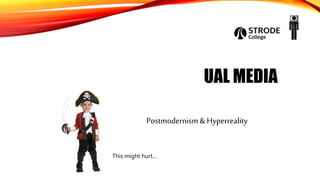
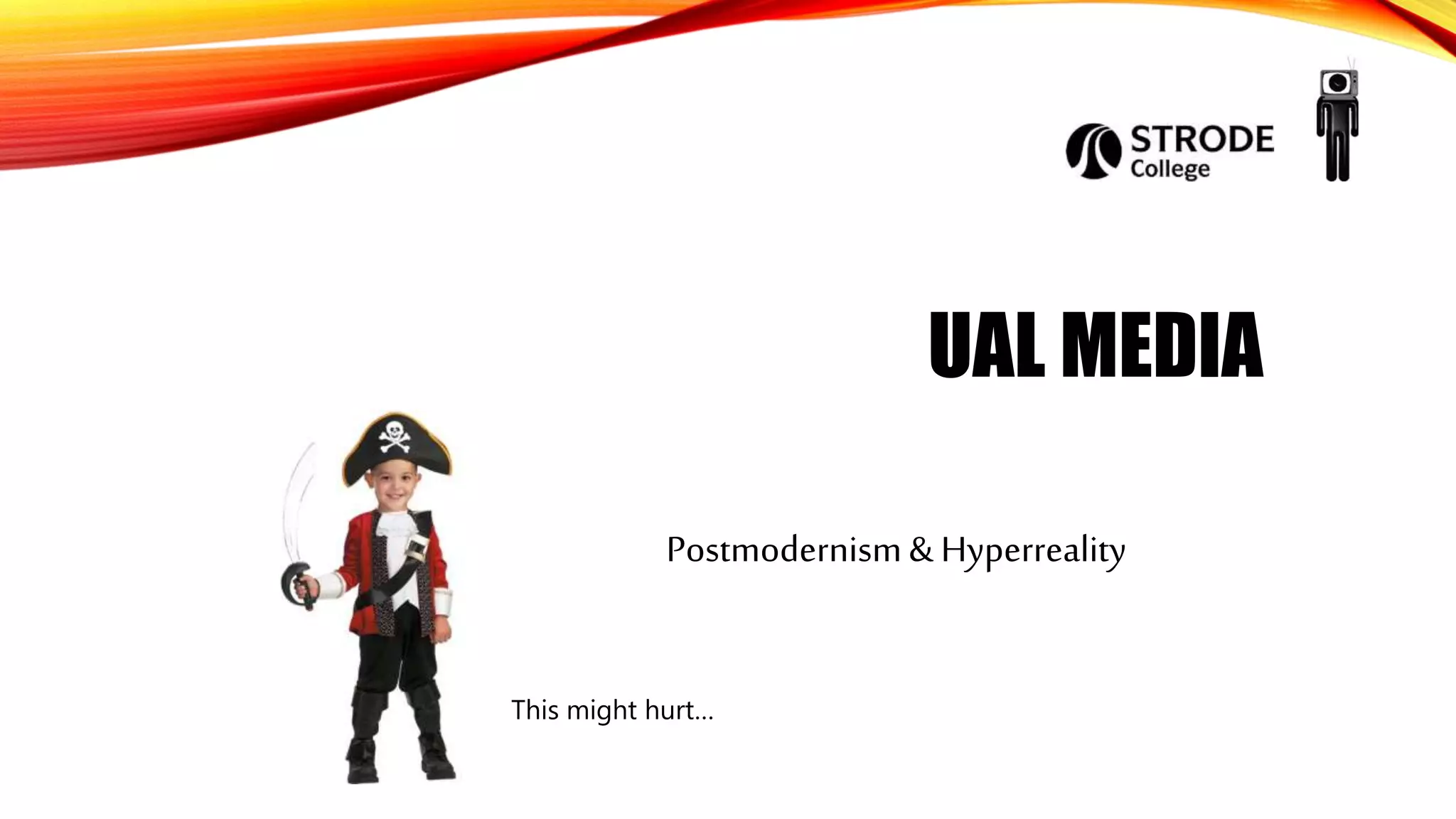
This might hurt…
WHAT IS POST-MODERNISM?
• Notoriously hard to define, can mean different things to different people.
• Consider the words post-modern: What do you think they mean?
POST? MODERN?
POST MODERN
After?
• Post-natal care
• Post production
• Post-traumatic stress
Now?
• Contemporary
• Current
• Up to date
WHAT IS POST-MODERNISM?
If “Modern” is now, how can we be after it?
So what is/was modernism?
Modernism is/was an intellectual school of thought that in art,
literature, architecture and philosophy that had far reaching
impact upon society and culture
Modernism:
The answer to the whole world and everything?
•Modernism is/was a movement a cross culture: art, literature, architecture, philosophy,
etc
•It followed other movements such as renaissance, enlightenment, impressionism,
romanticism, expressionism, realism, etc.
•As with these other movements, its proponents were looking for ‘answers’: new ways to
try and understand the world and life itself
Modernism:
The answer to the whole world and everything?
•Embracing of Major Developments in Technology at the start of the 1900s. Can
you think what they were?
•Rejection of “traditional” values and ideas (e.g. religion), in favour of science
and technology – ‘rationality’
•Photography and Recording = “Crisis of Representation” & “End of Realism”
•Art Movements considered Modernist include Cubism, Surrealism, Dada,
Expressionist.
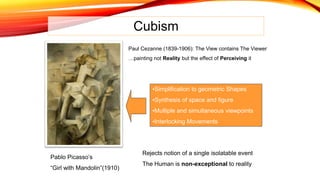
Cubism
Paul Cezanne (1839-1906): The View contains The Viewer
…painting not Reality but the effect of Perceiving it
•Simplification to geometric Shapes
•Synthesis of space and figure
•Multiple and simultaneous viewpoints
•Interlocking Movements
Rejects notion of a single isolatable event
The Human is non-exceptional to reality
Pablo Picasso’s
“Girl with Mandolin”(1910)
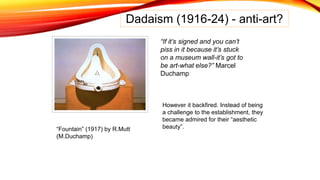
Dadaism (1916-24) - anti-art?
•Horrified by atrocities of outbreak of WW1, Dada was a retaliation to the
bourgeois intellectualist elite whose ideologies were believed to have led to
it.
•Marcel Duchamp’s “Ready-mades” sought to breakdown the rules of art.
•Any non-art object could be displayed as art if disassociated from its
original use context and meaning
•The mass-reproduced object displaced the artistic originality and sacred
uniqueness of the work of art.
Dadaism (1916-24) - anti-art?
“If it’s signed and you can’t
piss in it because it’s stuck
on a museum wall-it’s got to
be art-what else?” Marcel
Duchamp
“Fountain” (1917) by R.Mutt
(M.Duchamp)
However it backfired. Instead of being
a challenge to the establishment, they
became admired for their “aesthetic
beauty”.
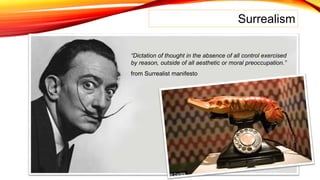
Surrealism
“Dictation of thought in the absence of all control exercised
by reason, outside of all aesthetic or moral preoccupation.”
from Surrealist manifesto
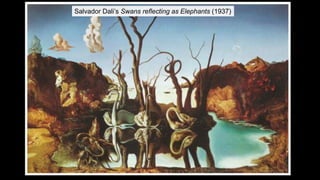
Salvador Dali’s Swans reflecting as Elephants (1937)
Pop Art
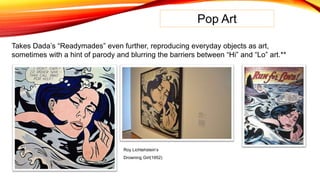
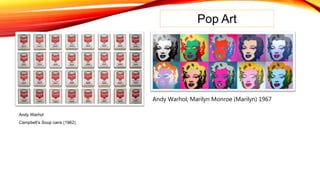
Takes Dada’s “Readymades” even further, reproducing everyday objects as art,
sometimes with a hint of parody and blurring the barriers between “Hi” and “Lo” art.**
Roy Lichtehstein’s
Drowning Girl(1952)
Pop Art
Andy Warhol
Campbell’s Soup cans (1962)
Andy Warhol, Marilyn Monroe (Marilyn) 1967
Modernism/Post Modernism
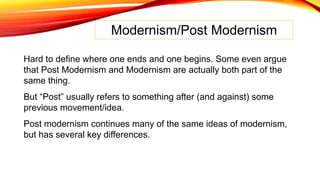
Hard to define where one ends and one begins. Some even argue
that Post Modernism and Modernism are actually both part of the
same thing.
But “Post” usually refers to something after (and against) some
previous movement/idea.
Post modernism continues many of the same ideas of modernism,
but has several key differences.
Summarising Post Modernism
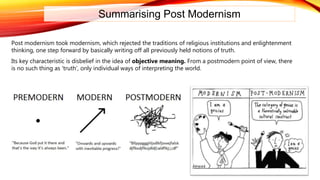
Post modernism took modernism, which rejected the traditions of religious institutions and enlightenment
thinking, one step forward by basically writing off all previously held notions of truth.
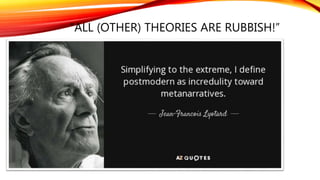
Its key characteristic is disbelief in the idea of objective meaning. From a postmodern point of view, there
is no such thing as ‘truth’, only individual ways of interpreting the world.
“ALL (OTHER) THEORIES ARE RUBBISH!”
Summarising Post Modernism
According to postmodernists any theory that makes claims about universal or
underlying truths is just missing the point. For them, the point is that modern
culture is so fragmented, so diverse, so full of differences that no unified theory
could possibly explain such a melting pot.
Post modernism is therefore about challenging the very notion of ‘truth’ and
challenging “social constructs” – arbitrary cultural rules, boundaries and
structures that have been put in place and accepted as “natural” and/or
necessary, but are in fact not.
In doing so, postmodern products often play with rules, bending and breaking
them, undermining any sense of right and wrong, correct and incorrect.
A common theme in post modern texts is how they bend rules, break boundaries
and question the established order of things.
Post Modernism: Breaking boundaries
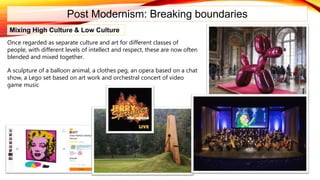
Mixing High Culture & Low Culture
Once regarded as separate culture and art for different classes of
people, with different levels of intellect and respect, these are now often
blended and mixed together.
A sculpture of a balloon animal, a clothes peg, an opera based on a chat
show, a Lego set based on art work and orchestral concert of video
game music
Post Modernism: Breaking boundaries
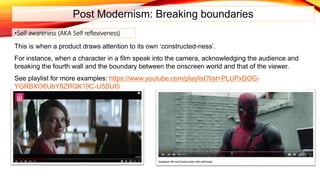
This is when a product draws attention to its own ‘constructed-ness’.
For instance, when a character in a film speak into the camera, acknowledging the audience and
breaking the fourth wall and the boundary between the onscreen world and that of the viewer.
See playlist for more examples: https://www.youtube.com/playlist?list=PLUPxDOG-
YGRBXO6UbY8ZRQK19C-U5SUI5
•Self awareness (AKA Self reflexiveness)
Post Modernism: Breaking boundaries
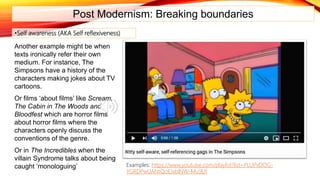
Another example might be when
texts ironically refer their own
medium. For instance, The
Simpsons have a history of the
characters making jokes about TV
cartoons.
Or films ‘about films’ like Scream,
The Cabin in The Woods and
Bloodfest which are horror films
about horror films where the
characters openly discuss the
conventions of the genre.
Or in The Incredibles when the
villain Syndrome talks about being
caught ‘monologuing’
•Self awareness (AKA Self reflexiveness)
Examples: https://www.youtube.com/playlist?list=PLUPxDOG-
YGRDPwUANtQoEJxblNW-Mu9Uf
Post Modernism: Breaking boundaries
Intertextuality
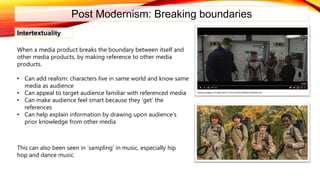
When a media product breaks the boundary between itself and
other media products, by making reference to other media
products.
• Can add realism: characters live in same world and know same
media as audience
• Can appeal to target audience familiar with referenced media
• Can make audience feel smart because they ‘get’ the
references
• Can help explain information by drawing upon audience’s
prior knowledge from other media
This can also been seen in ‘sampling’ in music, especially hip
hop and dance music.
Post Modernism: Breaking boundaries
Genre Bending: Parody and Homage
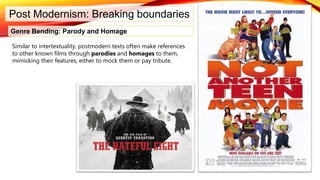
Similar to intertextuality, postmodern texts often make references
to other known films through parodies and homages to them,
mimicking their features, either to mock them or pay tribute.
Post Modernism: Breaking boundaries
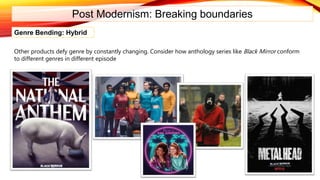
Genre Bending: Hybrid
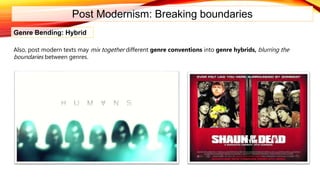
Also, post modern texts may mix together different genre conventions into genre hybrids, blurring the
boundaries between genres.
Post Modernism: Breaking boundaries
Genre Bending: Hybrid
Other products defy genre by constantly changing. Consider how anthology series like Black Mirror conform
to different genres in different episode
Post Modernism: Breaking boundaries
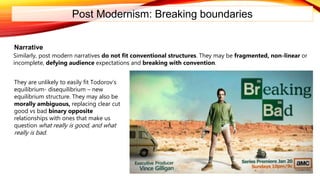
Narrative
Similarly, post modern narratives do not fit conventional structures. They may be fragmented, non-linear or
incomplete, defying audience expectations and breaking with convention.
They are unlikely to easily fit Todorov’s
equilibrium- disequilibrium – new
equilibrium structure. They may also be
morally ambiguous, replacing clear cut
good vs bad binary opposite
relationships with ones that make us
question what really is good, and what
really is bad.
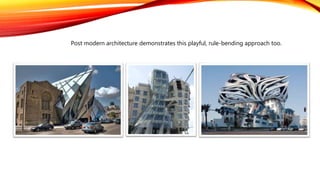
Post modern architecture demonstrates this playful, rule-bending approach too.
STYLE OVER SUBSTANCE
Post modernism’s rejection of rules means critics consider it nihilistic.
It is destructive, but offers no solutions. It constantly undermines society, making us
question everything, without suggesting ways to improve things.
A result of this rejection of truth is that many postmodern texts lack any attempt at
meaningful content themselves – they lack substance.
Post modern artefacts are sometimes called superficial. They are concerned more with
style than substance. They lack any deeper mean. This is known as depthlessness.
STYLE OVER SUBSTANCE
Postmodernism concerns itself primarily with surfaces rather than the ‘hidden
depths’ of structuralism or psychoanalytical theory.
Much of contemporary culture communicates this idea of depthlessness, like a film
set that may appear to be three-dimensional but isn’t.
Often, a cultural product can look as if it is heavily weighted down with meaningful
signifiers, but this is an impression given by the form rather than the content of the
artefact.
STYLE OVER SUBSTANCE
This ‘style over substance’ idea can also be applied to the postmodern identity.
In this view, a person’s surface appearance (their clothing, make-up, hairstyle,
personal possessions and body adornments) neither mask or transmit that person’s
true identity because they are the true identity.
Personal identity becomes a matter of surface appearance and therefore infinitely
variable and changeable.
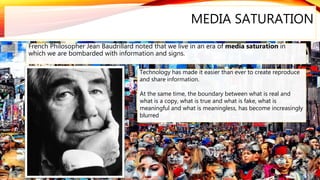
MEDIA SATURATION
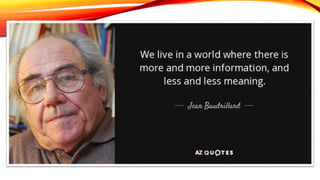
French Philosopher Jean Baudrillard noted that we live in an era of media saturation in
which we are bombarded with information and signs.
Technology has made it easier than ever to create reproduce
and share information.
At the same time, the boundary between what is real and
what is a copy, what is true and what is fake, what is
meaningful and what is meaningless, has become increasingly
blurred
SIMULATION
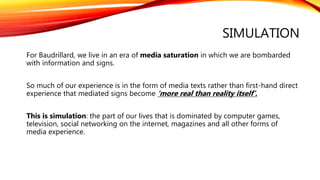
For Baudrillard, we live in an era of media saturation in which we are bombarded
with information and signs.
So much of our experience is in the form of media texts rather than first-hand direct
experience that mediated signs become ‘more real than reality itself’.
This is simulation: the part of our lives that is dominated by computer games,
television, social networking on the internet, magazines and all other forms of
media experience.
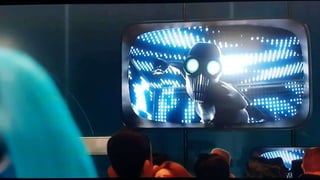
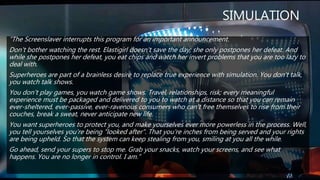
SIMULATION
“The Screenslaver interrupts this program for an important announcement.
Don't bother watching the rest. Elastigirl doesn't save the day; she only postpones her defeat. And
while she postpones her defeat, you eat chips and watch her invert problems that you are too lazy to
deal with.
Superheroes are part of a brainless desire to replace true experience with simulation. You don't talk,
you watch talk shows.
You don't play games, you watch game shows. Travel, relationships, risk; every meaningful
experience must be packaged and delivered to you to watch at a distance so that you can remain
ever-sheltered, ever-passive, ever-ravenous consumers who can't free themselves to rise from their
couches, break a sweat, never anticipate new life.
You want superheroes to protect you, and make yourselves ever more powerless in the process. Well,
you tell yourselves you're being "looked after". That you're inches from being served and your rights
are being upheld. So that the system can keep stealing from you, smiling at you all the while.
Go ahead, send your supers to stop me. Grab your snacks, watch your screens, and see what
happens. You are no longer in control. I am.”
https://www.youtube.com/watch?v=ujgwEldk5Jk&vl=en
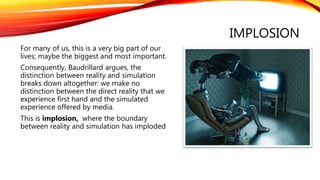
IMPLOSION
For many of us, this is a very big part of our
lives; maybe the biggest and most important.
Consequently, Baudrillard argues, the
distinction between reality and simulation
breaks down altogether: we make no
distinction between the direct reality that we
experience first hand and the simulated
experience offered by media.
This is implosion, where the boundary
between reality and simulation has imploded
HYPERREALITY
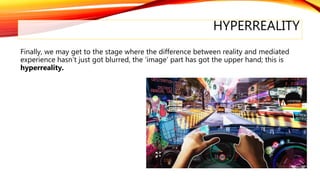
Finally, we may get to the stage where the difference between reality and mediated
experience hasn’t just got blurred, the ‘image’ part has got the upper hand; this is
hyperreality.
HYPERREALITY & SIMULACRUM
Examples of Hyperreality:
• Disneyworld
• Betty Boop (modelled on singer/actress Helen Kane)
• a sports drink of a flavour that doesn’t exist ("wild ice zest berry")
• a plastic Christmas tree that looks better than a real one ever could
• a magazine photo of a model that has been touched up with a computer
• a well manicured garden (nature as hyperreal)
• pornography ("sexier than sex itself")
“Reality becomes redundant and we have reached Hyper-reality in which images breed incestuously
with each other without reference to reality or meaning”(Appiginanesi, p.56)
By Jean Baudrillard
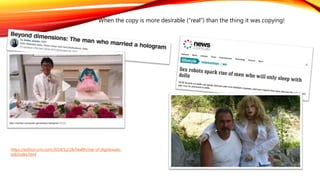
https://edition.cnn.com/2018/12/28/health/rise-of-digisexuals-
intl/index.html
When the copy is more desirable (“real”) than the thing it was copying!
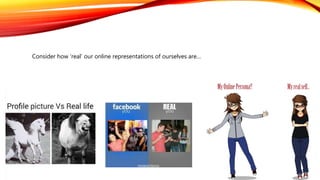
Consider how ‘real’ our online representations of ourselves are…
SIMULACRUM: FASHION
Once, denim was simply a cheap to produce, hard wearing fabric for
manual labour work.
In time, it became a symbol for ‘working class’ and rebellion, then
fashionable as a symbol for cool/rough/edginess.
Now, designer labels sell (expensive) jeans already ripped. Now they
are just fashionable, but detached from their original meaning.
SIMULACRUM: FASHION
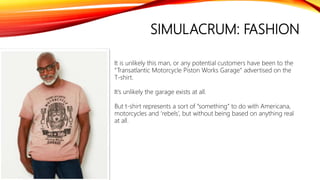
It is unlikely this man, or any potential customers have been to the
“Transatlantic Motorcycle Piston Works Garage” advertised on the
T-shirt.
It’s unlikely the garage exists at all.
But t-shirt represents a sort of “something” to do with Americana,
motorcycles and ‘rebels’, but without being based on anything real
at all.
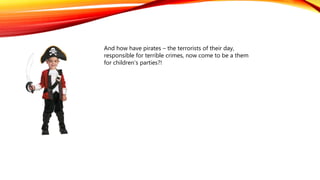
And how have pirates – the terrorists of their day,
responsible for terrible crimes, now come to be a them
for children’s parties?!
POST-TRUTH?
A result of questioning the “truth” of traditional structures has led to questioning the truth of any
structures.
“Relativism” – the idea that there is no objective truth, it just depends upon your point of view,
has lead to a kind of ‘hyper-skepticism’, a disbelief in all ‘facts’.
This is made especially possible with the advent of the Internet which, with less regulation and
the ability of anyone to write anything, has lead to a wide range of conflicting ‘truths’ being
accessible, feeding conspiracy theories and confusion.
This has even reached levels of politics, where high profile politicians are able to make false
claims with relative impunity (without consequence).
“ALTERNATIVE FACTS” AND FAKE NEWS
Following President Trump’s inauguration ceremony, social media and news outlets reported the
low number of crowds who took to the streets to celebrate, which were significantly lower that for
Obama, his predecessor.
In response to this, and in spite of incontrovertible evidence to support this, Trump’s Press
secretary Sean Spicer went on TV to challenge, saying that the crowds had in fact been the
biggest turnout ever.
"Alternative facts" was then a phrase used by U.S. Counselor to the President Kellyanne Conway
during a Meet the Press interview on January 22, 2017, in which she defended White House
Press Secretary Sean Spicer's false statement about the attendance numbers of Donald Trump's
inauguration as President of the United States. When pressed during the interview with Chuck
Todd to explain why Spicer would "utter a provable falsehood", Conway stated that Spicer was
giving "alternative facts". Todd responded, "Look, alternative facts are not facts. They're
falsehoods."
https://www.youtube.com/watch?v=5RwhEHzuulA&list=PLUPxD
OG-YGRAt7bPL7pk2stK47aNSpE80&index=7
POST MODERNISM
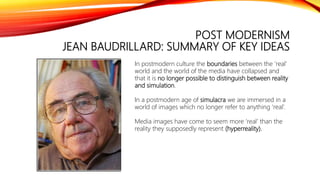
JEAN BAUDRILLARD: SUMMARY OF KEY IDEAS
In postmodern culture the boundaries between the ‘real’
world and the world of the media have collapsed and
that it is no longer possible to distinguish between reality
and simulation.
In a postmodern age of simulacra we are immersed in a
world of images which no longer refer to anything ‘real’.
Media images have come to seem more ‘real’ than the
reality they supposedly represent (hyperreality).
IS IT A POSTMODERN TEXT?
Things to consider when analyzing a media product:
• Intertextuality
• Self reflexiveness/self awareness
• Genre bending
• Non conventional narrative
• Blurring of “high” and “low culture”
• Hyperreality/simulacrum – blurring boundary between reality and representation of reality
• Irony
• Depthlessness
For more videos/explanations and examples visit postmodernism playlist on Youtube
https://www.youtube.com/playlist?list=PLUPxDOG-YGRAt7bPL7pk2stK47aNSpE80

UAL Media Language Theory Postmodernism

  • 1.
  • 2.
    WHAT IS POST-MODERNISM? •Notoriously hard to define, can mean different things to different people. • Consider the words post-modern: What do you think they mean?
  • 3.
  • 4.
    POST MODERN After? • Post-natalcare • Post production • Post-traumatic stress Now? • Contemporary • Current • Up to date
  • 5.
    WHAT IS POST-MODERNISM? If“Modern” is now, how can we be after it? So what is/was modernism? Modernism is/was an intellectual school of thought that in art, literature, architecture and philosophy that had far reaching impact upon society and culture
  • 6.
    Modernism: The answer tothe whole world and everything? •Modernism is/was a movement a cross culture: art, literature, architecture, philosophy, etc •It followed other movements such as renaissance, enlightenment, impressionism, romanticism, expressionism, realism, etc. •As with these other movements, its proponents were looking for ‘answers’: new ways to try and understand the world and life itself
  • 7.
    Modernism: The answer tothe whole world and everything? •Embracing of Major Developments in Technology at the start of the 1900s. Can you think what they were? •Rejection of “traditional” values and ideas (e.g. religion), in favour of science and technology – ‘rationality’ •Photography and Recording = “Crisis of Representation” & “End of Realism” •Art Movements considered Modernist include Cubism, Surrealism, Dada, Expressionist.
  • 8.
    Cubism Paul Cezanne (1839-1906):The View contains The Viewer …painting not Reality but the effect of Perceiving it •Simplification to geometric Shapes •Synthesis of space and figure •Multiple and simultaneous viewpoints •Interlocking Movements Rejects notion of a single isolatable event The Human is non-exceptional to reality Pablo Picasso’s “Girl with Mandolin”(1910)
  • 9.
    Dadaism (1916-24) -anti-art? •Horrified by atrocities of outbreak of WW1, Dada was a retaliation to the bourgeois intellectualist elite whose ideologies were believed to have led to it. •Marcel Duchamp’s “Ready-mades” sought to breakdown the rules of art. •Any non-art object could be displayed as art if disassociated from its original use context and meaning •The mass-reproduced object displaced the artistic originality and sacred uniqueness of the work of art.
  • 10.
    Dadaism (1916-24) -anti-art? “If it’s signed and you can’t piss in it because it’s stuck on a museum wall-it’s got to be art-what else?” Marcel Duchamp “Fountain” (1917) by R.Mutt (M.Duchamp) However it backfired. Instead of being a challenge to the establishment, they became admired for their “aesthetic beauty”.
  • 11.
    Surrealism “Dictation of thoughtin the absence of all control exercised by reason, outside of all aesthetic or moral preoccupation.” from Surrealist manifesto
  • 12.
    Salvador Dali’s Swansreflecting as Elephants (1937)
  • 14.
    Pop Art Takes Dada’s“Readymades” even further, reproducing everyday objects as art, sometimes with a hint of parody and blurring the barriers between “Hi” and “Lo” art.** Roy Lichtehstein’s Drowning Girl(1952)
  • 15.
    Pop Art Andy Warhol Campbell’sSoup cans (1962) Andy Warhol, Marilyn Monroe (Marilyn) 1967
  • 16.
    Modernism/Post Modernism Hard todefine where one ends and one begins. Some even argue that Post Modernism and Modernism are actually both part of the same thing. But “Post” usually refers to something after (and against) some previous movement/idea. Post modernism continues many of the same ideas of modernism, but has several key differences.
  • 17.
    Summarising Post Modernism Postmodernism took modernism, which rejected the traditions of religious institutions and enlightenment thinking, one step forward by basically writing off all previously held notions of truth. Its key characteristic is disbelief in the idea of objective meaning. From a postmodern point of view, there is no such thing as ‘truth’, only individual ways of interpreting the world.
  • 18.
    “ALL (OTHER) THEORIESARE RUBBISH!”
  • 19.
    Summarising Post Modernism Accordingto postmodernists any theory that makes claims about universal or underlying truths is just missing the point. For them, the point is that modern culture is so fragmented, so diverse, so full of differences that no unified theory could possibly explain such a melting pot. Post modernism is therefore about challenging the very notion of ‘truth’ and challenging “social constructs” – arbitrary cultural rules, boundaries and structures that have been put in place and accepted as “natural” and/or necessary, but are in fact not. In doing so, postmodern products often play with rules, bending and breaking them, undermining any sense of right and wrong, correct and incorrect. A common theme in post modern texts is how they bend rules, break boundaries and question the established order of things.
  • 20.
    Post Modernism: Breakingboundaries Mixing High Culture & Low Culture Once regarded as separate culture and art for different classes of people, with different levels of intellect and respect, these are now often blended and mixed together. A sculpture of a balloon animal, a clothes peg, an opera based on a chat show, a Lego set based on art work and orchestral concert of video game music
  • 21.
    Post Modernism: Breakingboundaries This is when a product draws attention to its own ‘constructed-ness’. For instance, when a character in a film speak into the camera, acknowledging the audience and breaking the fourth wall and the boundary between the onscreen world and that of the viewer. See playlist for more examples: https://www.youtube.com/playlist?list=PLUPxDOG- YGRBXO6UbY8ZRQK19C-U5SUI5 •Self awareness (AKA Self reflexiveness)
  • 22.
    Post Modernism: Breakingboundaries Another example might be when texts ironically refer their own medium. For instance, The Simpsons have a history of the characters making jokes about TV cartoons. Or films ‘about films’ like Scream, The Cabin in The Woods and Bloodfest which are horror films about horror films where the characters openly discuss the conventions of the genre. Or in The Incredibles when the villain Syndrome talks about being caught ‘monologuing’ •Self awareness (AKA Self reflexiveness) Examples: https://www.youtube.com/playlist?list=PLUPxDOG- YGRDPwUANtQoEJxblNW-Mu9Uf
  • 23.
    Post Modernism: Breakingboundaries Intertextuality When a media product breaks the boundary between itself and other media products, by making reference to other media products. • Can add realism: characters live in same world and know same media as audience • Can appeal to target audience familiar with referenced media • Can make audience feel smart because they ‘get’ the references • Can help explain information by drawing upon audience’s prior knowledge from other media This can also been seen in ‘sampling’ in music, especially hip hop and dance music.
  • 24.
    Post Modernism: Breakingboundaries Genre Bending: Parody and Homage Similar to intertextuality, postmodern texts often make references to other known films through parodies and homages to them, mimicking their features, either to mock them or pay tribute.
  • 25.
    Post Modernism: Breakingboundaries Genre Bending: Hybrid Also, post modern texts may mix together different genre conventions into genre hybrids, blurring the boundaries between genres.
  • 26.
    Post Modernism: Breakingboundaries Genre Bending: Hybrid Other products defy genre by constantly changing. Consider how anthology series like Black Mirror conform to different genres in different episode
  • 27.
    Post Modernism: Breakingboundaries Narrative Similarly, post modern narratives do not fit conventional structures. They may be fragmented, non-linear or incomplete, defying audience expectations and breaking with convention. They are unlikely to easily fit Todorov’s equilibrium- disequilibrium – new equilibrium structure. They may also be morally ambiguous, replacing clear cut good vs bad binary opposite relationships with ones that make us question what really is good, and what really is bad.
  • 28.
    Post modern architecturedemonstrates this playful, rule-bending approach too.
  • 29.
    STYLE OVER SUBSTANCE Postmodernism’s rejection of rules means critics consider it nihilistic. It is destructive, but offers no solutions. It constantly undermines society, making us question everything, without suggesting ways to improve things. A result of this rejection of truth is that many postmodern texts lack any attempt at meaningful content themselves – they lack substance. Post modern artefacts are sometimes called superficial. They are concerned more with style than substance. They lack any deeper mean. This is known as depthlessness.
  • 30.
    STYLE OVER SUBSTANCE Postmodernismconcerns itself primarily with surfaces rather than the ‘hidden depths’ of structuralism or psychoanalytical theory. Much of contemporary culture communicates this idea of depthlessness, like a film set that may appear to be three-dimensional but isn’t. Often, a cultural product can look as if it is heavily weighted down with meaningful signifiers, but this is an impression given by the form rather than the content of the artefact.
  • 31.
    STYLE OVER SUBSTANCE This‘style over substance’ idea can also be applied to the postmodern identity. In this view, a person’s surface appearance (their clothing, make-up, hairstyle, personal possessions and body adornments) neither mask or transmit that person’s true identity because they are the true identity. Personal identity becomes a matter of surface appearance and therefore infinitely variable and changeable.
  • 32.
    MEDIA SATURATION French PhilosopherJean Baudrillard noted that we live in an era of media saturation in which we are bombarded with information and signs. Technology has made it easier than ever to create reproduce and share information. At the same time, the boundary between what is real and what is a copy, what is true and what is fake, what is meaningful and what is meaningless, has become increasingly blurred
  • 34.
    SIMULATION For Baudrillard, welive in an era of media saturation in which we are bombarded with information and signs. So much of our experience is in the form of media texts rather than first-hand direct experience that mediated signs become ‘more real than reality itself’. This is simulation: the part of our lives that is dominated by computer games, television, social networking on the internet, magazines and all other forms of media experience.
  • 36.
    SIMULATION “The Screenslaver interruptsthis program for an important announcement. Don't bother watching the rest. Elastigirl doesn't save the day; she only postpones her defeat. And while she postpones her defeat, you eat chips and watch her invert problems that you are too lazy to deal with. Superheroes are part of a brainless desire to replace true experience with simulation. You don't talk, you watch talk shows. You don't play games, you watch game shows. Travel, relationships, risk; every meaningful experience must be packaged and delivered to you to watch at a distance so that you can remain ever-sheltered, ever-passive, ever-ravenous consumers who can't free themselves to rise from their couches, break a sweat, never anticipate new life. You want superheroes to protect you, and make yourselves ever more powerless in the process. Well, you tell yourselves you're being "looked after". That you're inches from being served and your rights are being upheld. So that the system can keep stealing from you, smiling at you all the while. Go ahead, send your supers to stop me. Grab your snacks, watch your screens, and see what happens. You are no longer in control. I am.”
  • 37.
  • 38.
    IMPLOSION For many ofus, this is a very big part of our lives; maybe the biggest and most important. Consequently, Baudrillard argues, the distinction between reality and simulation breaks down altogether: we make no distinction between the direct reality that we experience first hand and the simulated experience offered by media. This is implosion, where the boundary between reality and simulation has imploded
  • 39.
    HYPERREALITY Finally, we mayget to the stage where the difference between reality and mediated experience hasn’t just got blurred, the ‘image’ part has got the upper hand; this is hyperreality.
  • 40.
    HYPERREALITY & SIMULACRUM Examplesof Hyperreality: • Disneyworld • Betty Boop (modelled on singer/actress Helen Kane) • a sports drink of a flavour that doesn’t exist ("wild ice zest berry") • a plastic Christmas tree that looks better than a real one ever could • a magazine photo of a model that has been touched up with a computer • a well manicured garden (nature as hyperreal) • pornography ("sexier than sex itself") “Reality becomes redundant and we have reached Hyper-reality in which images breed incestuously with each other without reference to reality or meaning”(Appiginanesi, p.56) By Jean Baudrillard
  • 41.
    https://edition.cnn.com/2018/12/28/health/rise-of-digisexuals- intl/index.html When the copyis more desirable (“real”) than the thing it was copying!
  • 42.
    Consider how ‘real’our online representations of ourselves are…
  • 43.
    SIMULACRUM: FASHION Once, denimwas simply a cheap to produce, hard wearing fabric for manual labour work. In time, it became a symbol for ‘working class’ and rebellion, then fashionable as a symbol for cool/rough/edginess. Now, designer labels sell (expensive) jeans already ripped. Now they are just fashionable, but detached from their original meaning.
  • 44.
    SIMULACRUM: FASHION It isunlikely this man, or any potential customers have been to the “Transatlantic Motorcycle Piston Works Garage” advertised on the T-shirt. It’s unlikely the garage exists at all. But t-shirt represents a sort of “something” to do with Americana, motorcycles and ‘rebels’, but without being based on anything real at all.
  • 45.
    And how havepirates – the terrorists of their day, responsible for terrible crimes, now come to be a them for children’s parties?!
  • 46.
    POST-TRUTH? A result ofquestioning the “truth” of traditional structures has led to questioning the truth of any structures. “Relativism” – the idea that there is no objective truth, it just depends upon your point of view, has lead to a kind of ‘hyper-skepticism’, a disbelief in all ‘facts’. This is made especially possible with the advent of the Internet which, with less regulation and the ability of anyone to write anything, has lead to a wide range of conflicting ‘truths’ being accessible, feeding conspiracy theories and confusion. This has even reached levels of politics, where high profile politicians are able to make false claims with relative impunity (without consequence).
  • 47.
    “ALTERNATIVE FACTS” ANDFAKE NEWS Following President Trump’s inauguration ceremony, social media and news outlets reported the low number of crowds who took to the streets to celebrate, which were significantly lower that for Obama, his predecessor. In response to this, and in spite of incontrovertible evidence to support this, Trump’s Press secretary Sean Spicer went on TV to challenge, saying that the crowds had in fact been the biggest turnout ever. "Alternative facts" was then a phrase used by U.S. Counselor to the President Kellyanne Conway during a Meet the Press interview on January 22, 2017, in which she defended White House Press Secretary Sean Spicer's false statement about the attendance numbers of Donald Trump's inauguration as President of the United States. When pressed during the interview with Chuck Todd to explain why Spicer would "utter a provable falsehood", Conway stated that Spicer was giving "alternative facts". Todd responded, "Look, alternative facts are not facts. They're falsehoods."
  • 48.
  • 49.
    POST MODERNISM JEAN BAUDRILLARD:SUMMARY OF KEY IDEAS In postmodern culture the boundaries between the ‘real’ world and the world of the media have collapsed and that it is no longer possible to distinguish between reality and simulation. In a postmodern age of simulacra we are immersed in a world of images which no longer refer to anything ‘real’. Media images have come to seem more ‘real’ than the reality they supposedly represent (hyperreality).
  • 50.
    IS IT APOSTMODERN TEXT? Things to consider when analyzing a media product: • Intertextuality • Self reflexiveness/self awareness • Genre bending • Non conventional narrative • Blurring of “high” and “low culture” • Hyperreality/simulacrum – blurring boundary between reality and representation of reality • Irony • Depthlessness
  • 51.
    For more videos/explanationsand examples visit postmodernism playlist on Youtube https://www.youtube.com/playlist?list=PLUPxDOG-YGRAt7bPL7pk2stK47aNSpE80