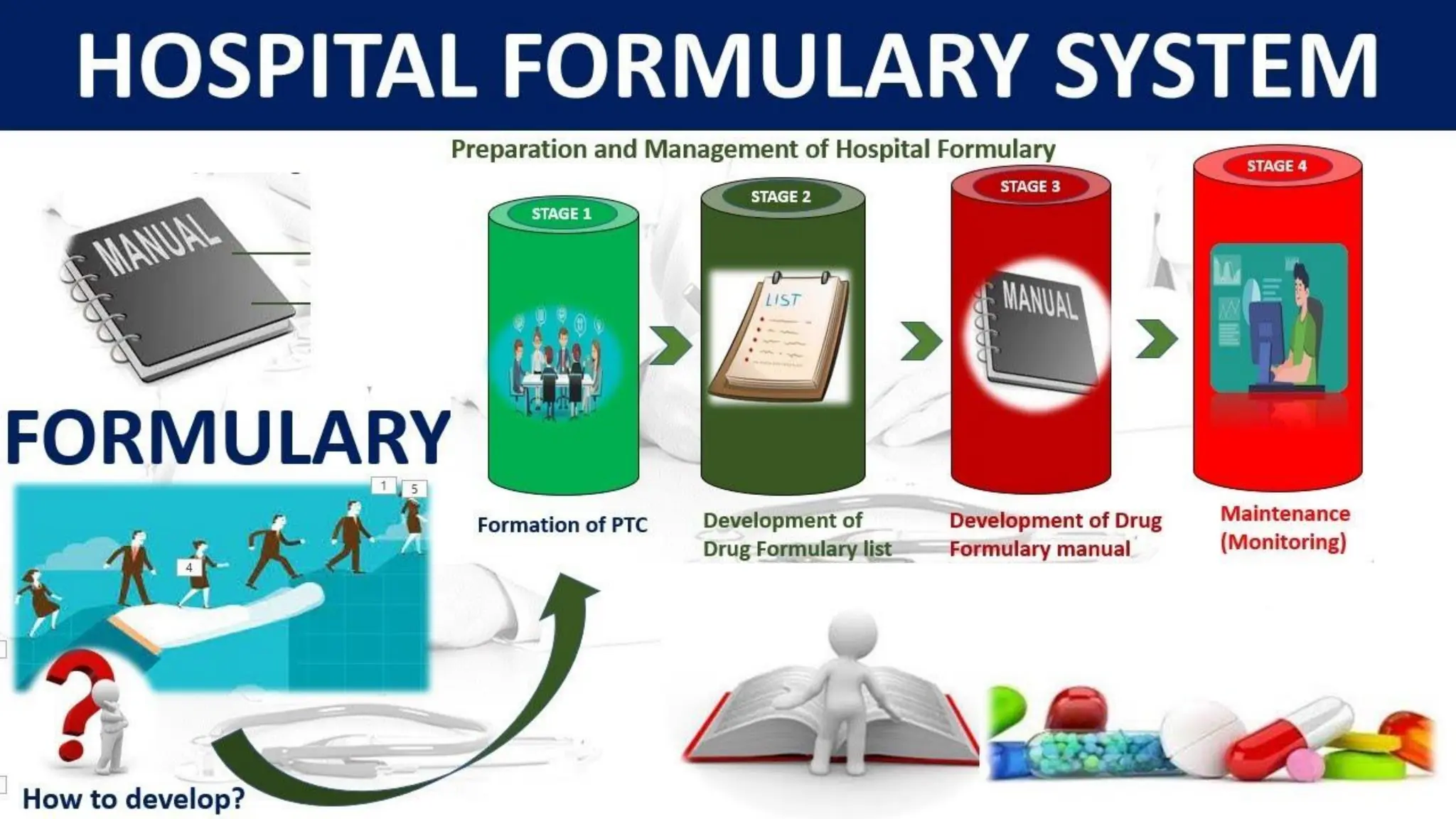
HOSPITAL
FORMULARY
- Miss Vedika Narvekar
DEFINITION
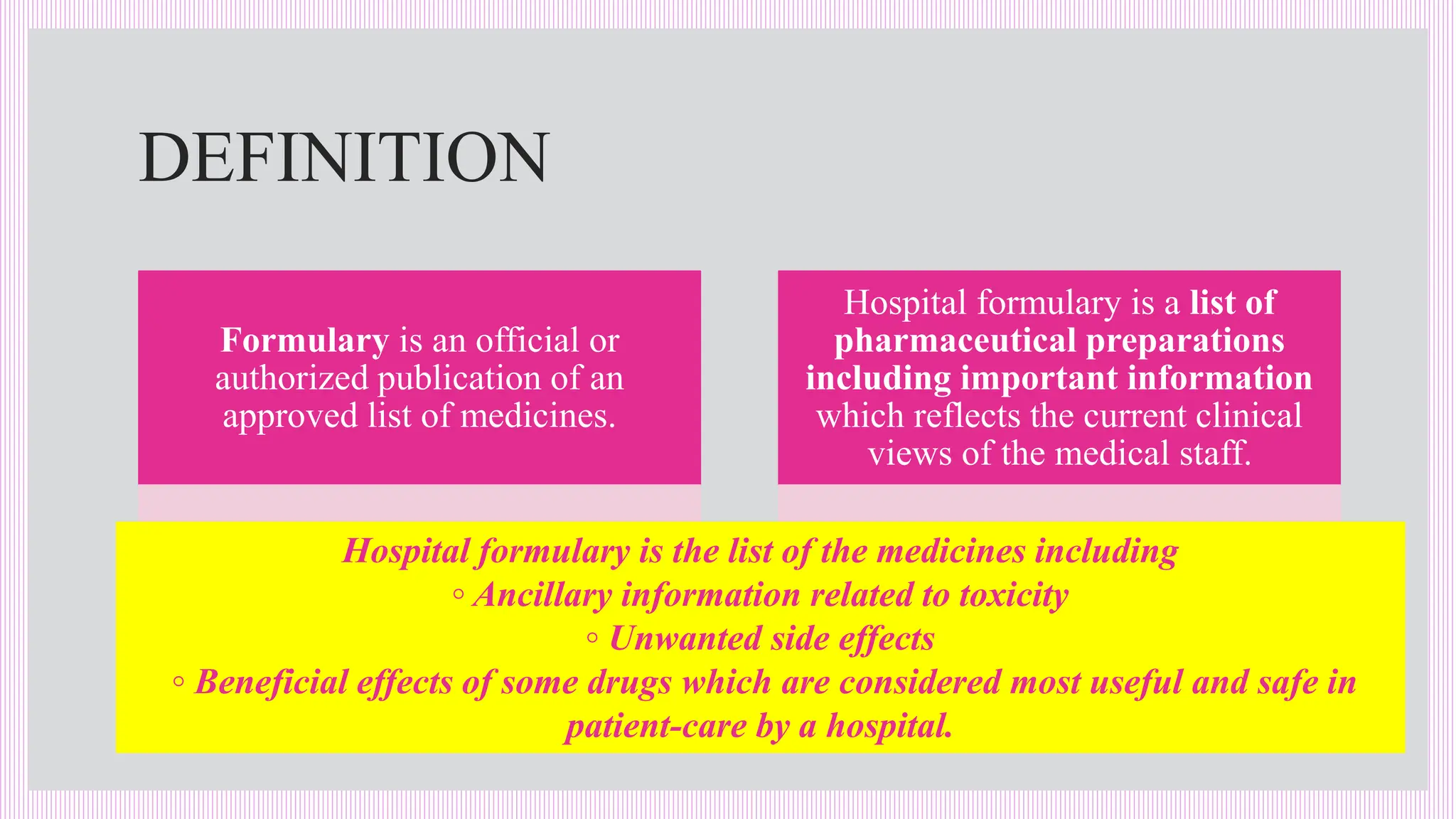
Formulary is an official or
authorized publication of an
approved list of medicines.
Hospital formulary is a list of
pharmaceutical preparations
including important information
which reflects the current clinical
views of the medical staff.
Hospital formulary is the list of the medicines including
◦ Ancillary information related to toxicity
◦ Unwanted side effects
◦ Beneficial effects of some drugs which are considered most useful and safe in
patient-care by a hospital.
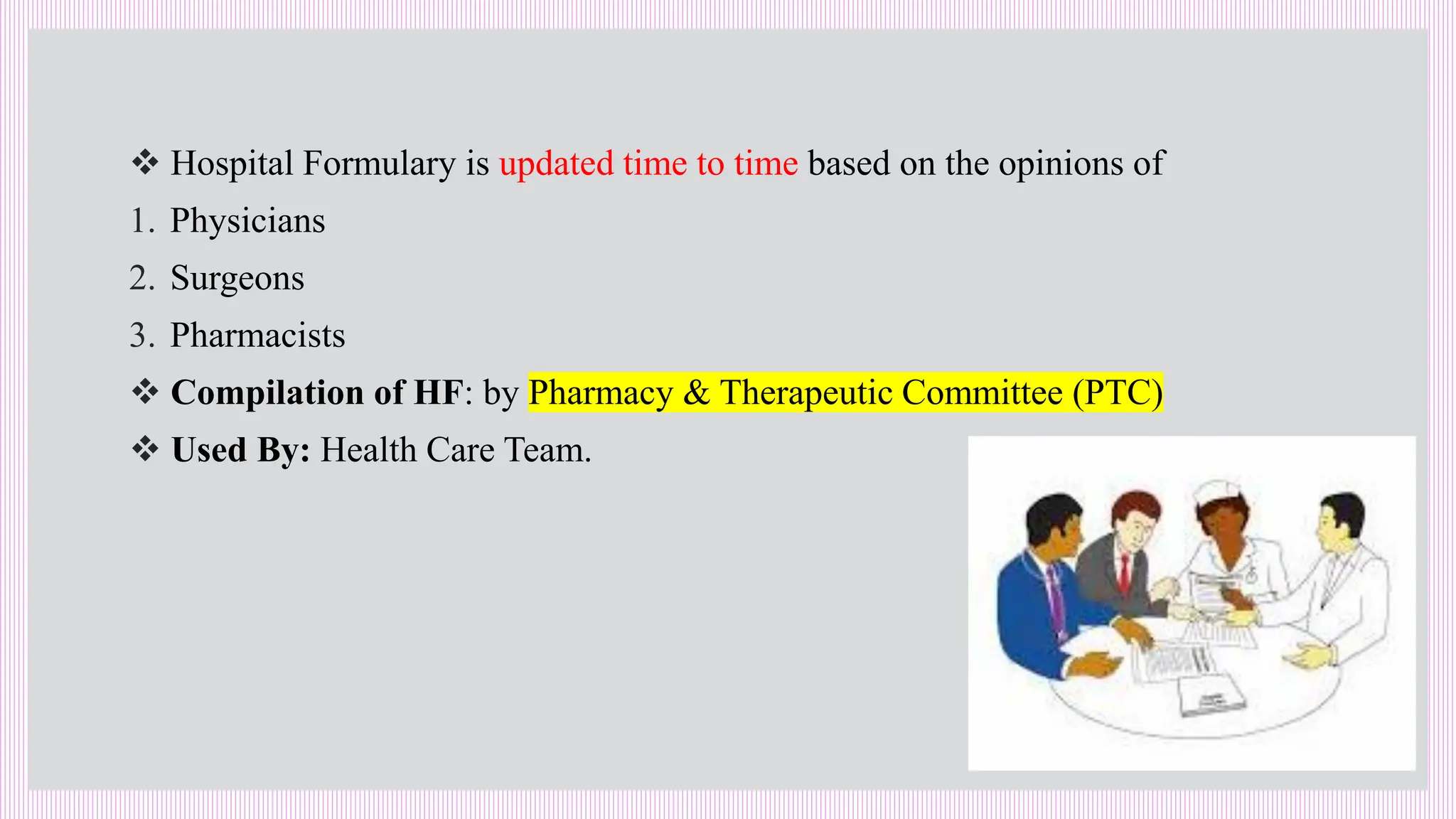
❖ Hospital Formulary is updated time to time based on the opinions of
1. Physicians
2. Surgeons
3. Pharmacists
❖ Compilation of HF: by Pharmacy & Therapeutic Committee (PTC)
❖ Used By: Health Care Team.
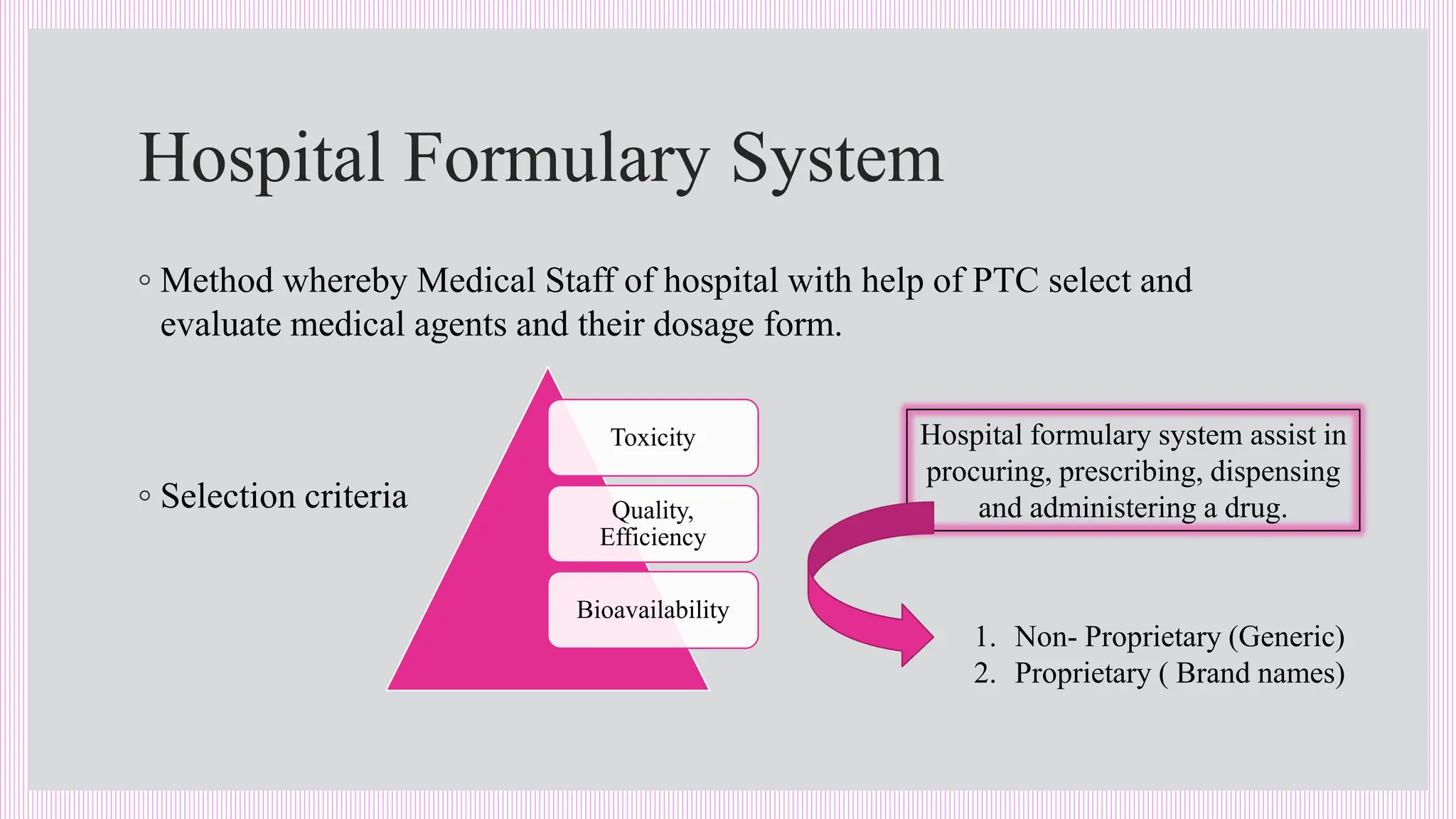
Hospital Formulary System
◦ Method whereby Medical Staff of hospital with help of PTC select and
evaluate medical agents and their dosage form.
◦ Selection criteria
Toxicity
Quality,
Efficiency
Bioavailability
Hospital formulary system assist in
procuring, prescribing, dispensing
and administering a drug.
1. Non- Proprietary (Generic)
2. Proprietary ( Brand names)
NEED (Hospital Formulary)
1. Pharmaceutical companies – Increasing manufacturing /marketing of New
drugs.
2. Increasing influence of advertisement.
3. New sales promotion.
Benefits of Drug Formulary System
—
Therapeutic- Benefit to patient/physician (most efficient
products)
—
Economic – Lower charges to patient
—
Educational – for Staff, Nurses/ Medical students
—
Rational drug use
Advantages of hospital formulary
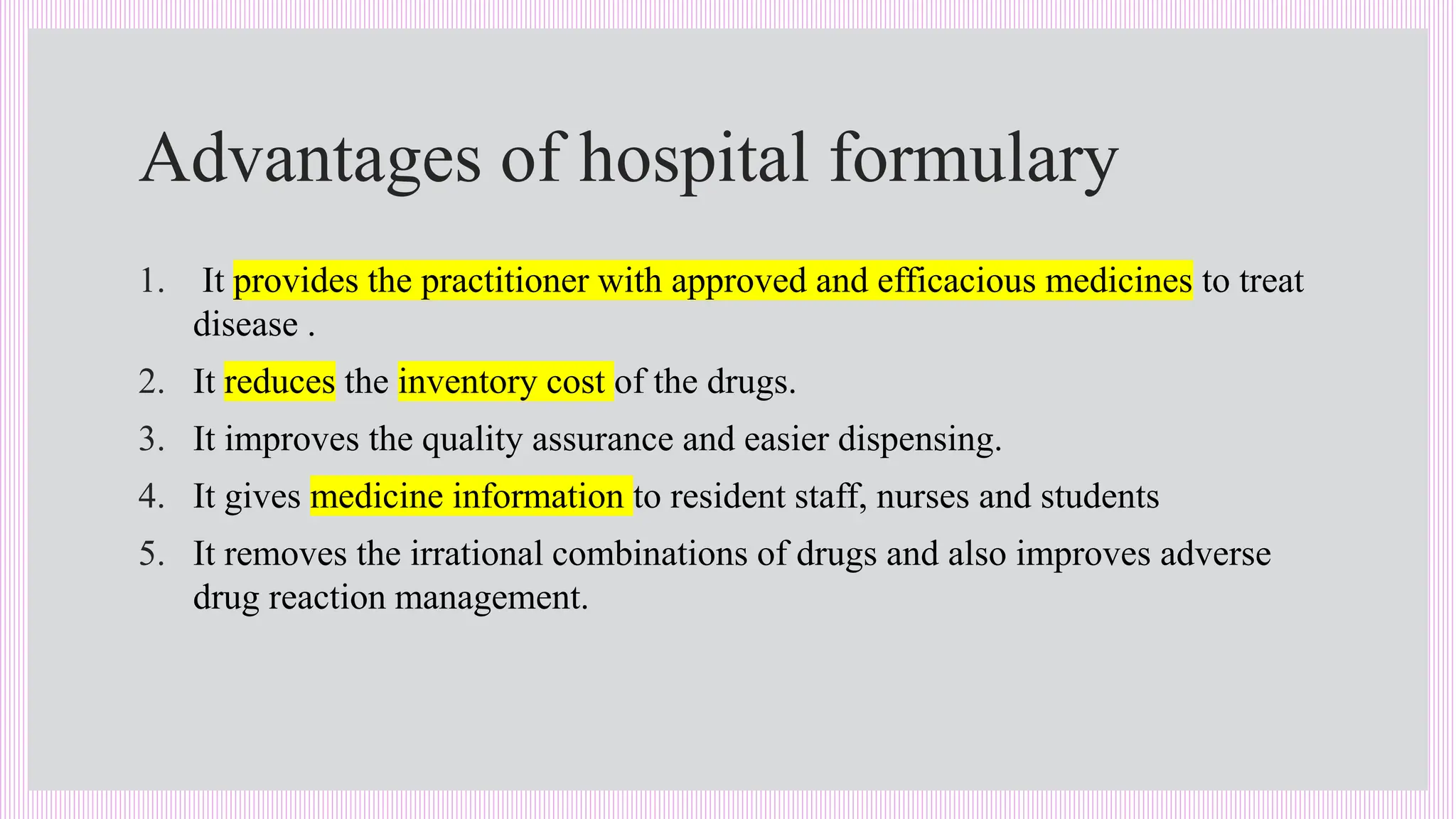
1. It provides the practitioner with approved and efficacious medicines to treat
disease .
2. It reduces the inventory cost of the drugs.
3. It improves the quality assurance and easier dispensing.
4. It gives medicine information to resident staff, nurses and students
5. It removes the irrational combinations of drugs and also improves adverse
drug reaction management.
Disadvantages
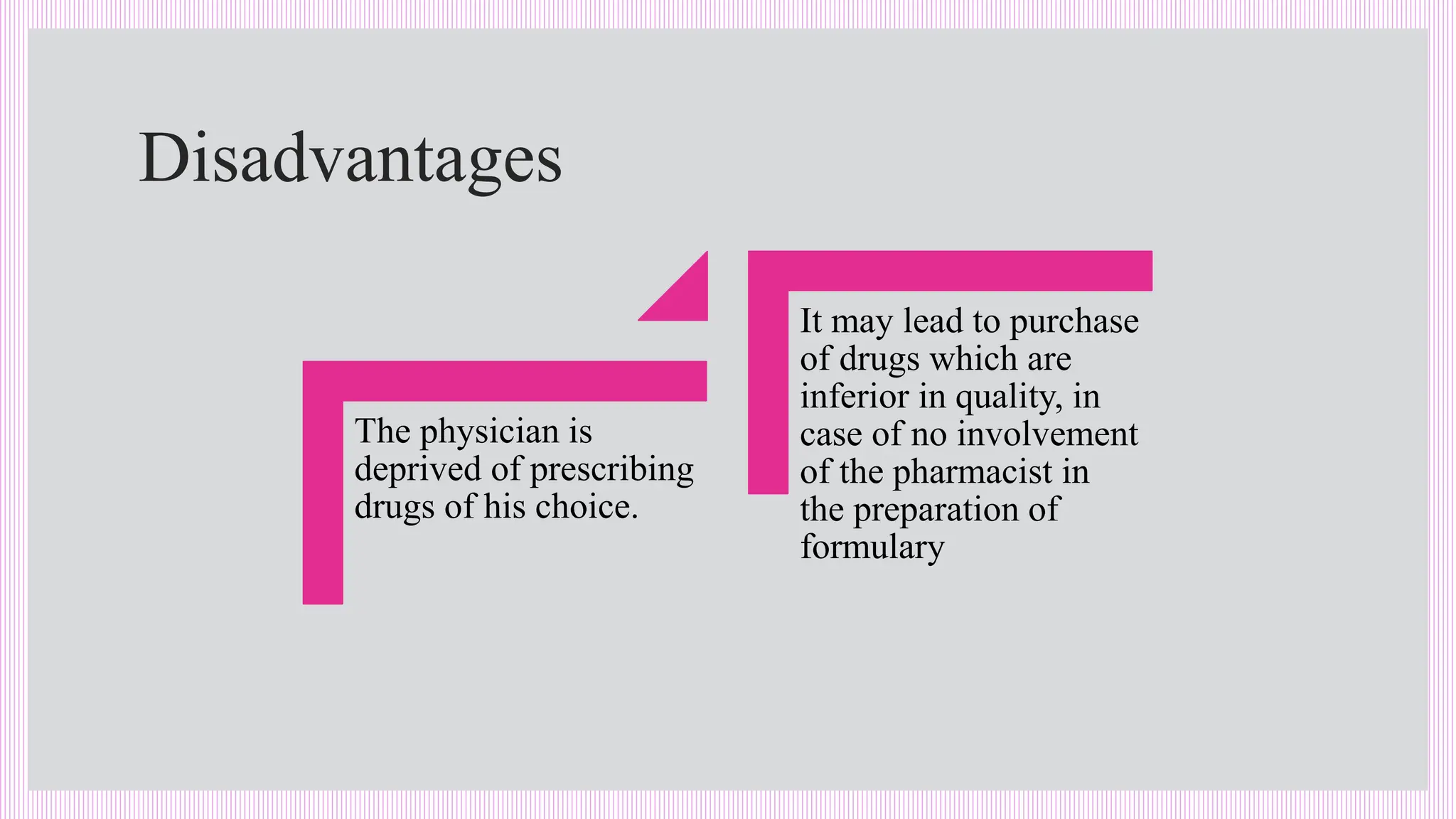
The physician is
deprived of prescribing
drugs of his choice.
It may lead to purchase
of drugs which are
inferior in quality, in
case of no involvement
of the pharmacist in
the preparation of
formulary
GUIDELINE FOR HOSPITAL
FORMULARY
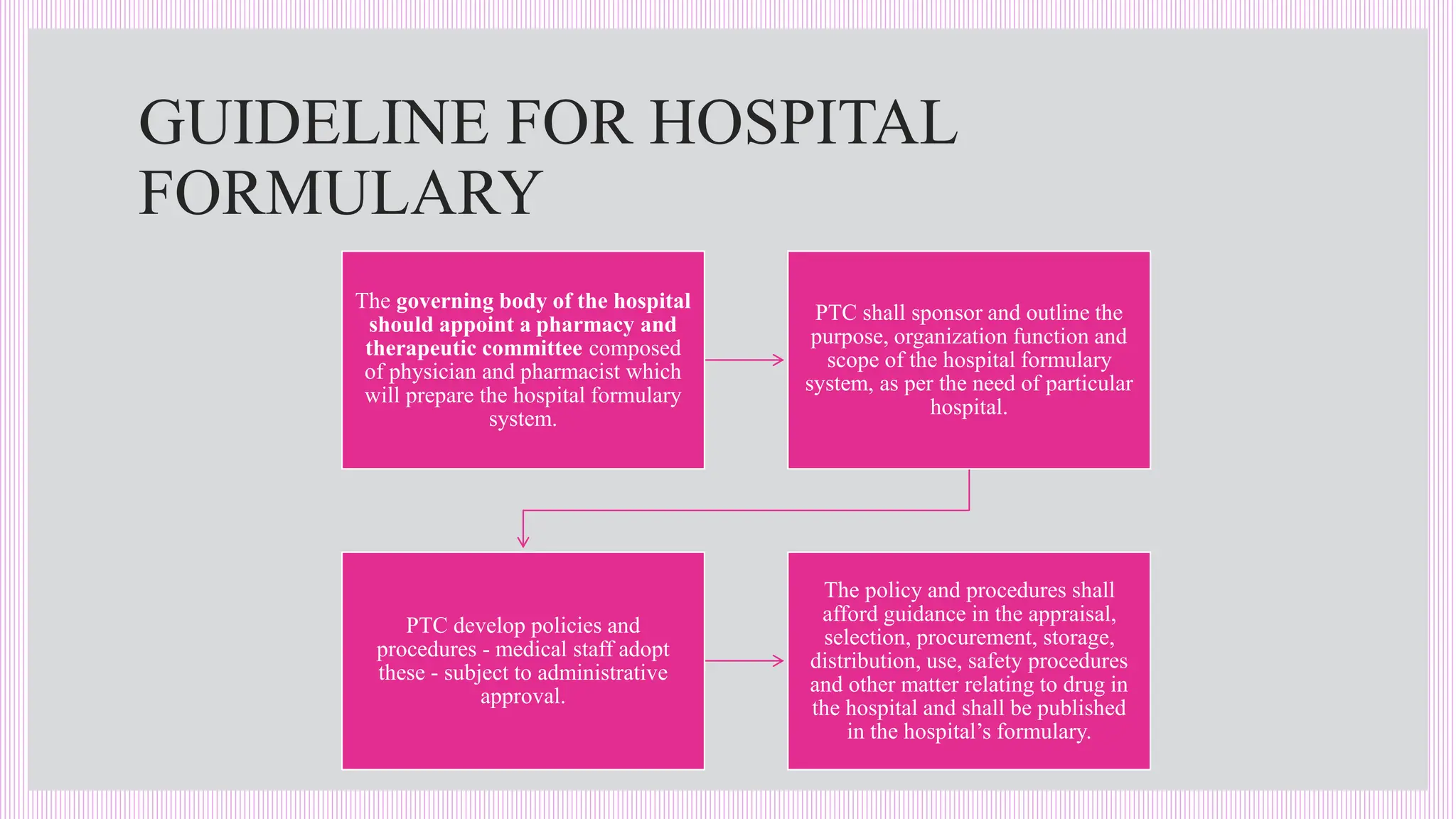
The governing body of the hospital
should appoint a pharmacy and
therapeutic committee composed
of physician and pharmacist which
will prepare the hospital formulary
system.
PTC shall sponsor and outline the
purpose, organization function and
scope of the hospital formulary
system, as per the need of particular
hospital.
PTC develop policies and
procedures - medical staff adopt
these - subject to administrative
approval.
The policy and procedures shall
afford guidance in the appraisal,
selection, procurement, storage,
distribution, use, safety procedures
and other matter relating to drug in
the hospital and shall be published
in the hospital’s formulary.
Contents of HF
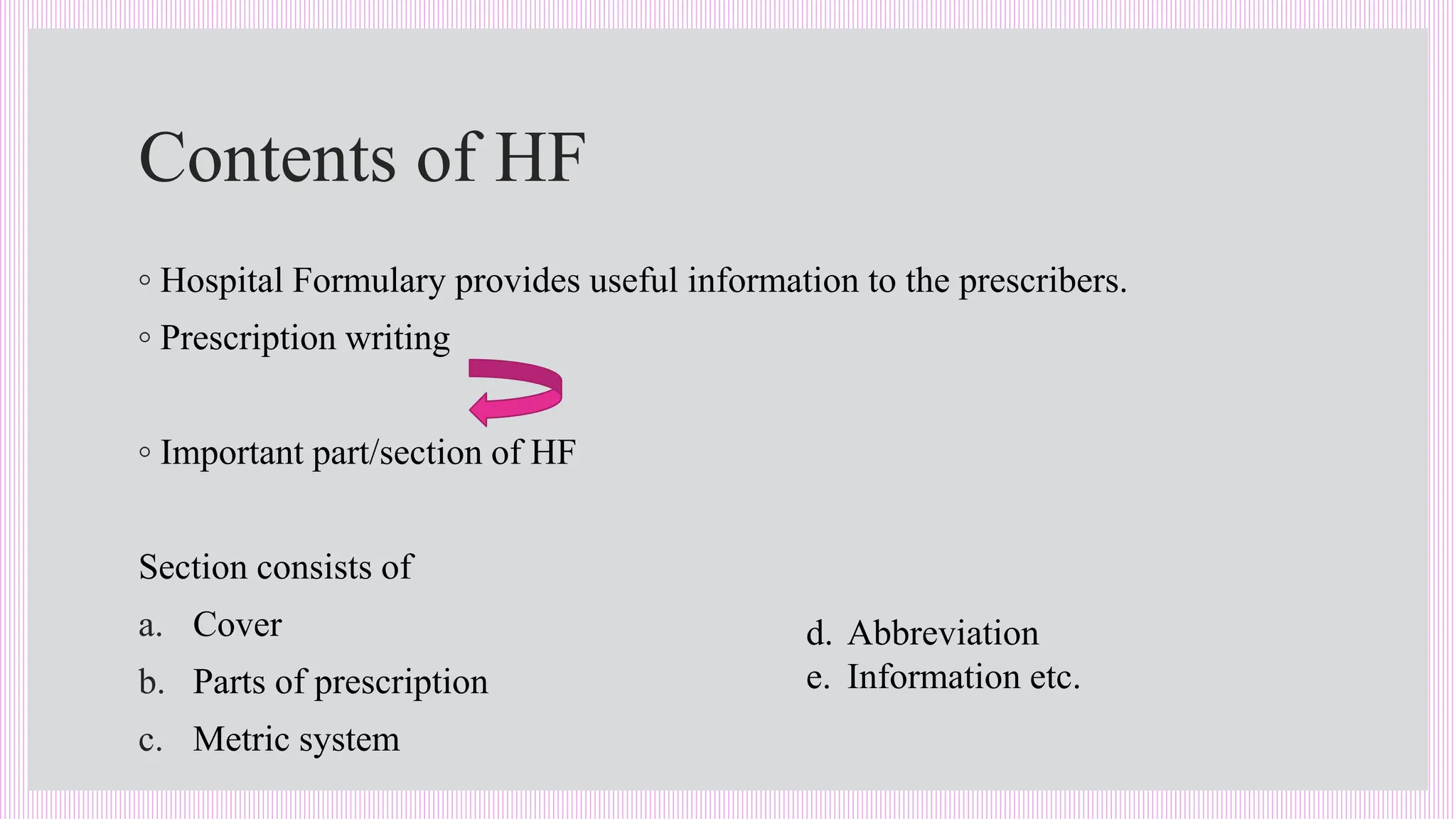
◦ Hospital Formulary provides useful information to the prescribers.
◦ Prescription writing
◦ Important part/section of HF
Section consists of
a. Cover
b. Parts of prescription
c. Metric system
d. Abbreviation
e. Information etc.
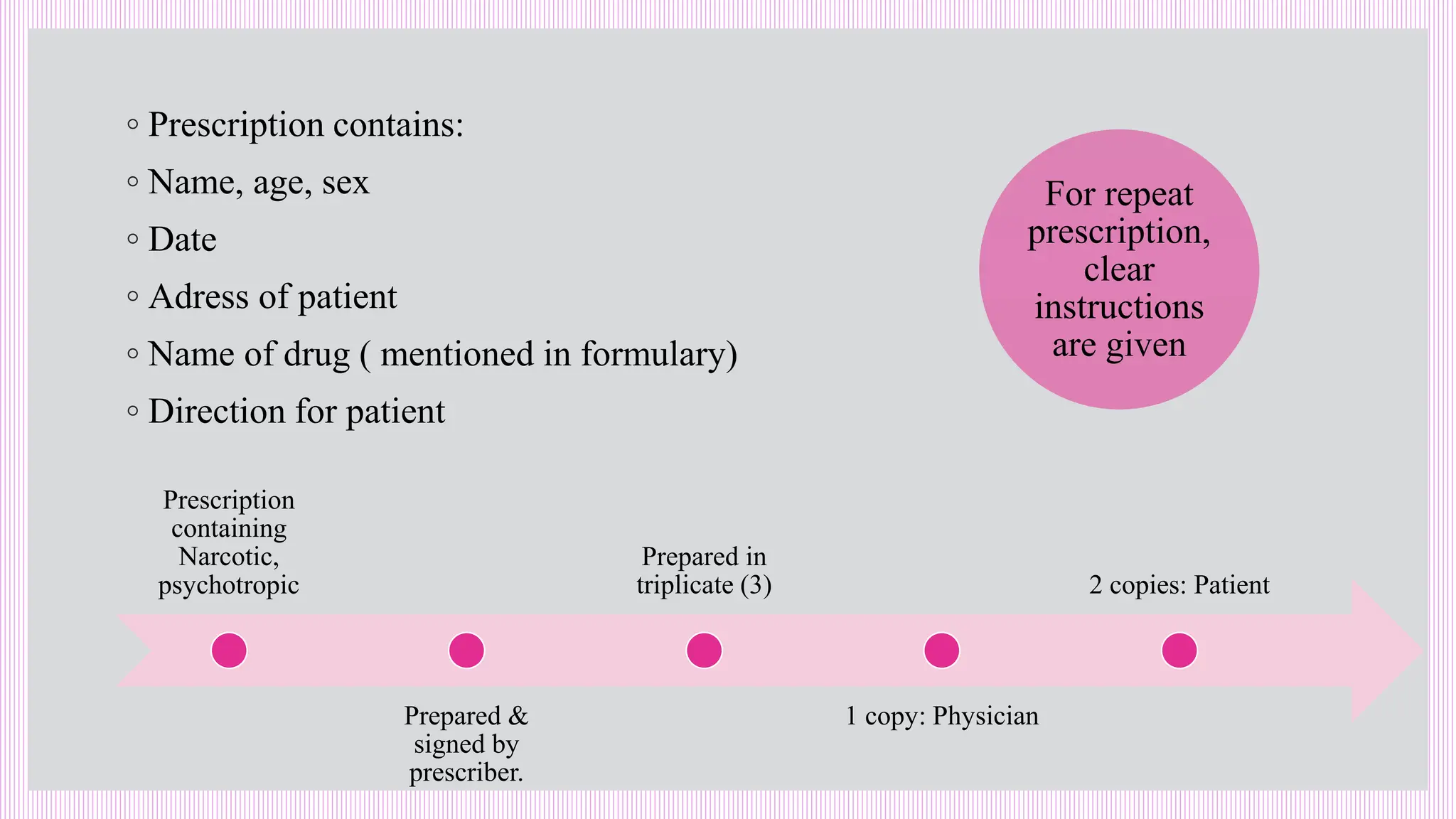
◦ Prescription contains:
◦ Name, age, sex
◦ Date
◦ Adress of patient
◦ Name of drug ( mentioned in formulary)
◦ Direction for patient
For repeat
prescription,
clear
instructions
are given
Prescription
containing
Narcotic,
psychotropic
Prepared &
signed by
prescriber.
Prepared in
triplicate (3)
1 copy: Physician
2 copies: Patient
Primary objectives:
a)Information on drug products approved by PTC
b)Information on hospital policies & procedures --- for use of drugs
c)Special information about drugs. In accordance with these objectives, the
formulary should consist of three main parts:
A. Drug dosage schedule.
B. Hospital approved abbreviations
C. Special information
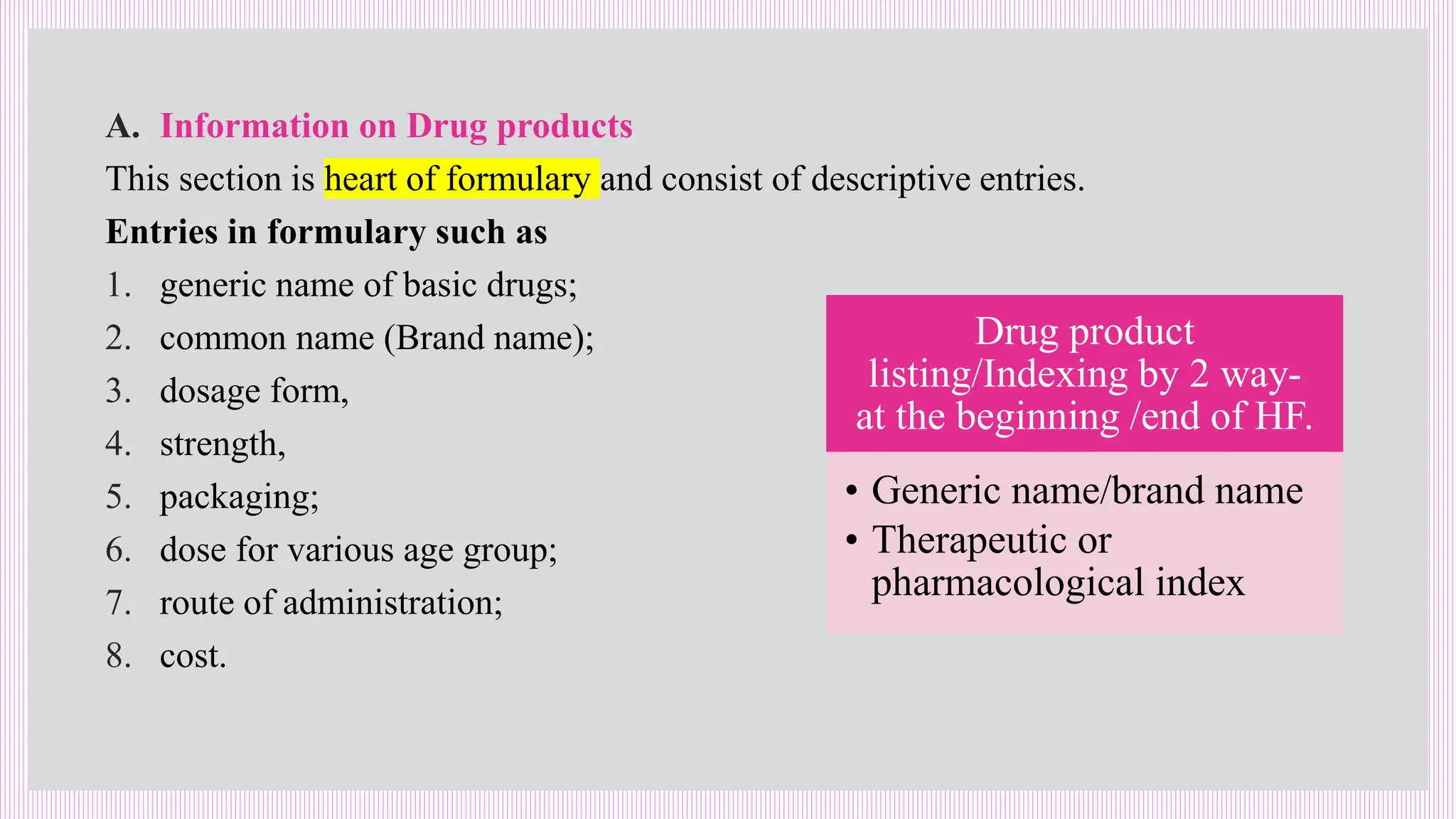
A. Information on Drug products
This section is heart of formulary and consist of descriptive entries.
Entries in formulary such as
1. generic name of basic drugs;
2. common name (Brand name);
3. dosage form,
4. strength,
5. packaging;
6. dose for various age group;
7. route of administration;
8. cost.
Drug product
listing/Indexing by 2 way-
at the beginning /end of HF.
• Generic name/brand name
• Therapeutic or
pharmacological index
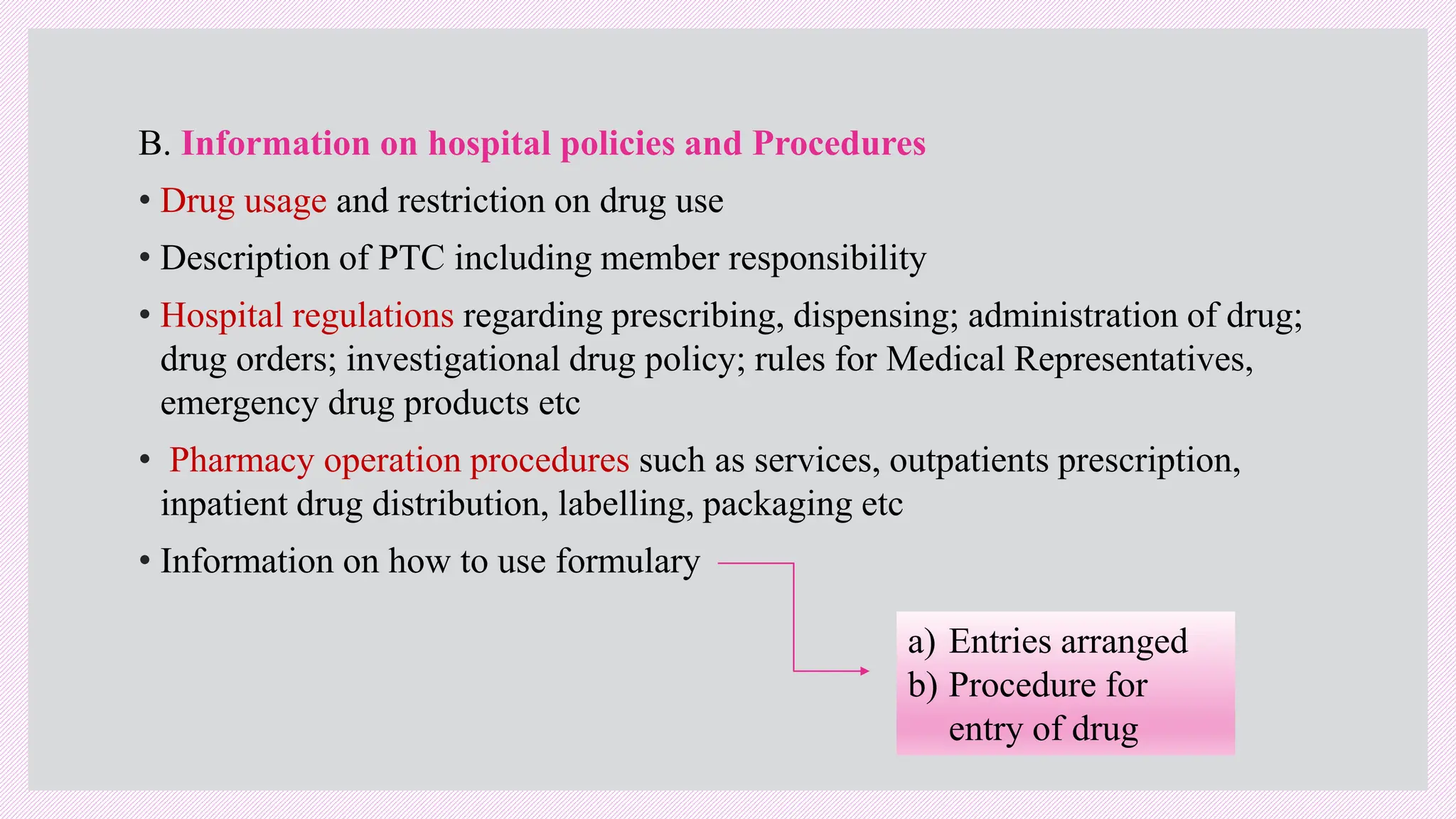
B. Information on hospital policies and Procedures
• Drug usage and restriction on drug use
• Description of PTC including member responsibility
• Hospital regulations regarding prescribing, dispensing; administration of drug;
drug orders; investigational drug policy; rules for Medical Representatives,
emergency drug products etc
• Pharmacy operation procedures such as services, outpatients prescription,
inpatient drug distribution, labelling, packaging etc
• Information on how to use formulary
a) Entries arranged
b) Procedure for
entry of drug
C. Special information
Useful to hospital staff and should be readily available. Varies according to
hospitals.
It includes-
Hospital approved abbreviations
Equivalent dosages of similar drugs
Guidelines for calculating paediatric dosages
List of sugar free drugs
Metric conversion tables
Poison control information
Table of drug interactions
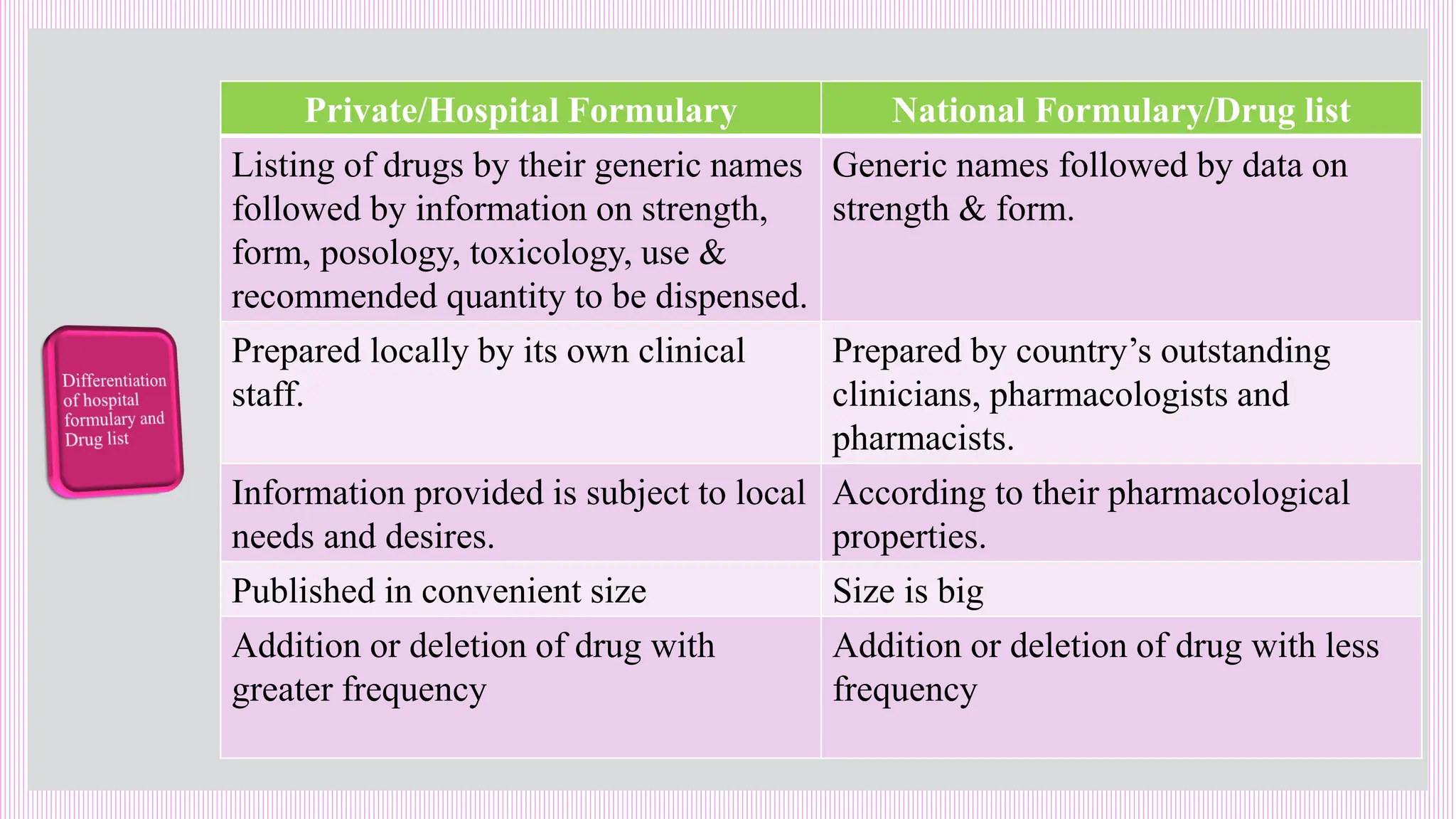
Private/Hospital Formulary National Formulary/Drug list
Listing of drugs by their generic names
followed by information on strength,
form, posology, toxicology, use &
recommended quantity to be dispensed.
Generic names followed by data on
strength & form.
Prepared locally by its own clinical
staff.
Prepared by country’s outstanding
clinicians, pharmacologists and
pharmacists.
Information provided is subject to local
needs and desires.
According to their pharmacological
properties.
Published in convenient size Size is big
Addition or deletion of drug with
greater frequency
Addition or deletion of drug with less
frequency
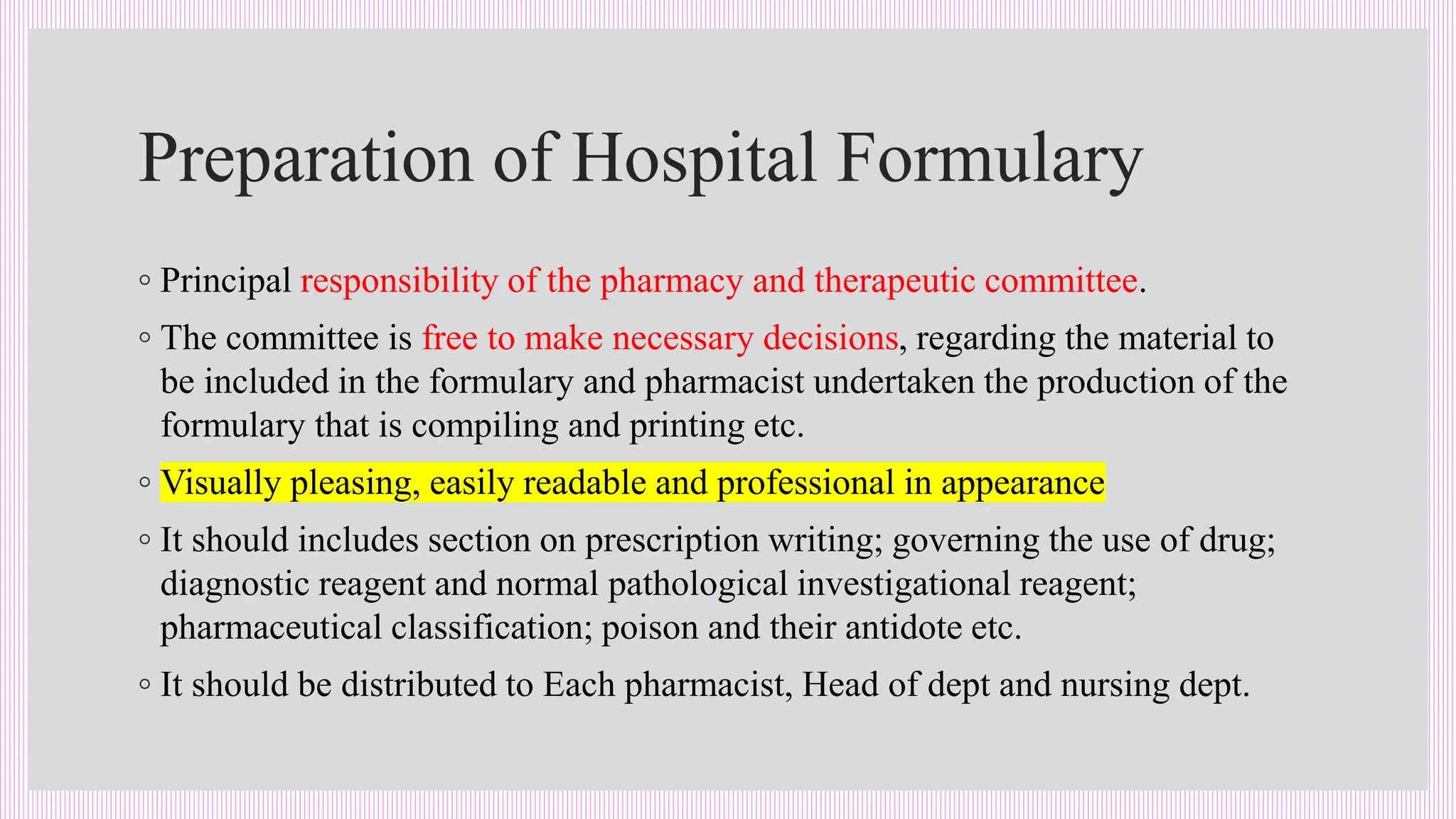
Preparation of Hospital Formulary
◦ Principal responsibility of the pharmacy and therapeutic committee.
◦ The committee is free to make necessary decisions, regarding the material to
be included in the formulary and pharmacist undertaken the production of the
formulary that is compiling and printing etc.
◦ Visually pleasing, easily readable and professional in appearance
◦ It should includes section on prescription writing; governing the use of drug;
diagnostic reagent and normal pathological investigational reagent;
pharmaceutical classification; poison and their antidote etc.
◦ It should be distributed to Each pharmacist, Head of dept and nursing dept.
Composition
1. Title page
2. Names & titles of the members of the PTC
3. Table of contents
4. Information on hospital policies & procedures concerning drugs
5. Products accepted for use at hospital
6. Appendix
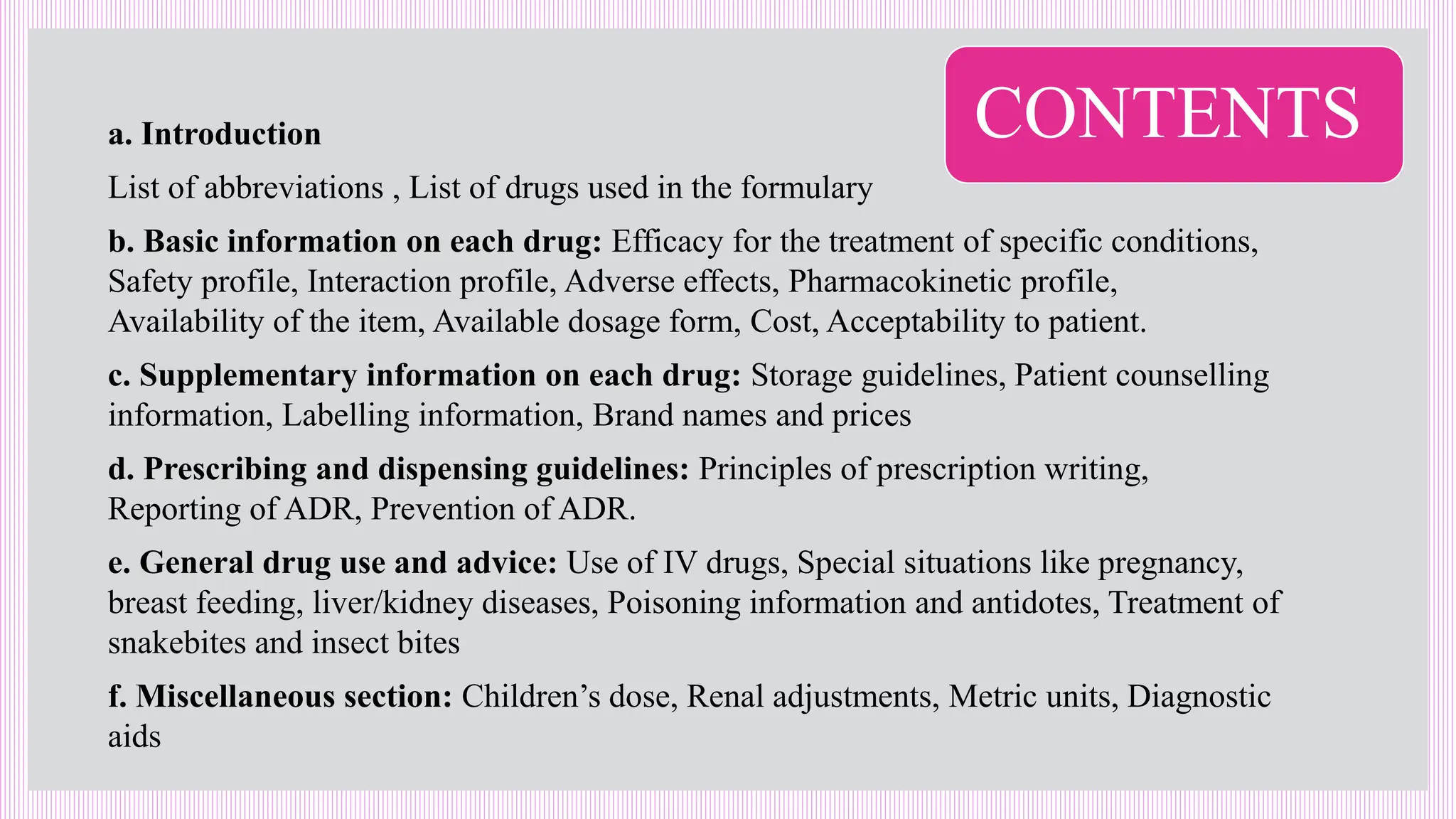
CONTENTS
a. Introduction
List of abbreviations , List of drugs used in the formulary
b. Basic information on each drug: Efficacy for the treatment of specific conditions,
Safety profile, Interaction profile, Adverse effects, Pharmacokinetic profile,
Availability of the item, Available dosage form, Cost, Acceptability to patient.
c. Supplementary information on each drug: Storage guidelines, Patient counselling
information, Labelling information, Brand names and prices
d. Prescribing and dispensing guidelines: Principles of prescription writing,
Reporting of ADR, Prevention of ADR.
e. General drug use and advice: Use of IV drugs, Special situations like pregnancy,
breast feeding, liver/kidney diseases, Poisoning information and antidotes, Treatment of
snakebites and insect bites
f. Miscellaneous section: Children’s dose, Renal adjustments, Metric units, Diagnostic
aids
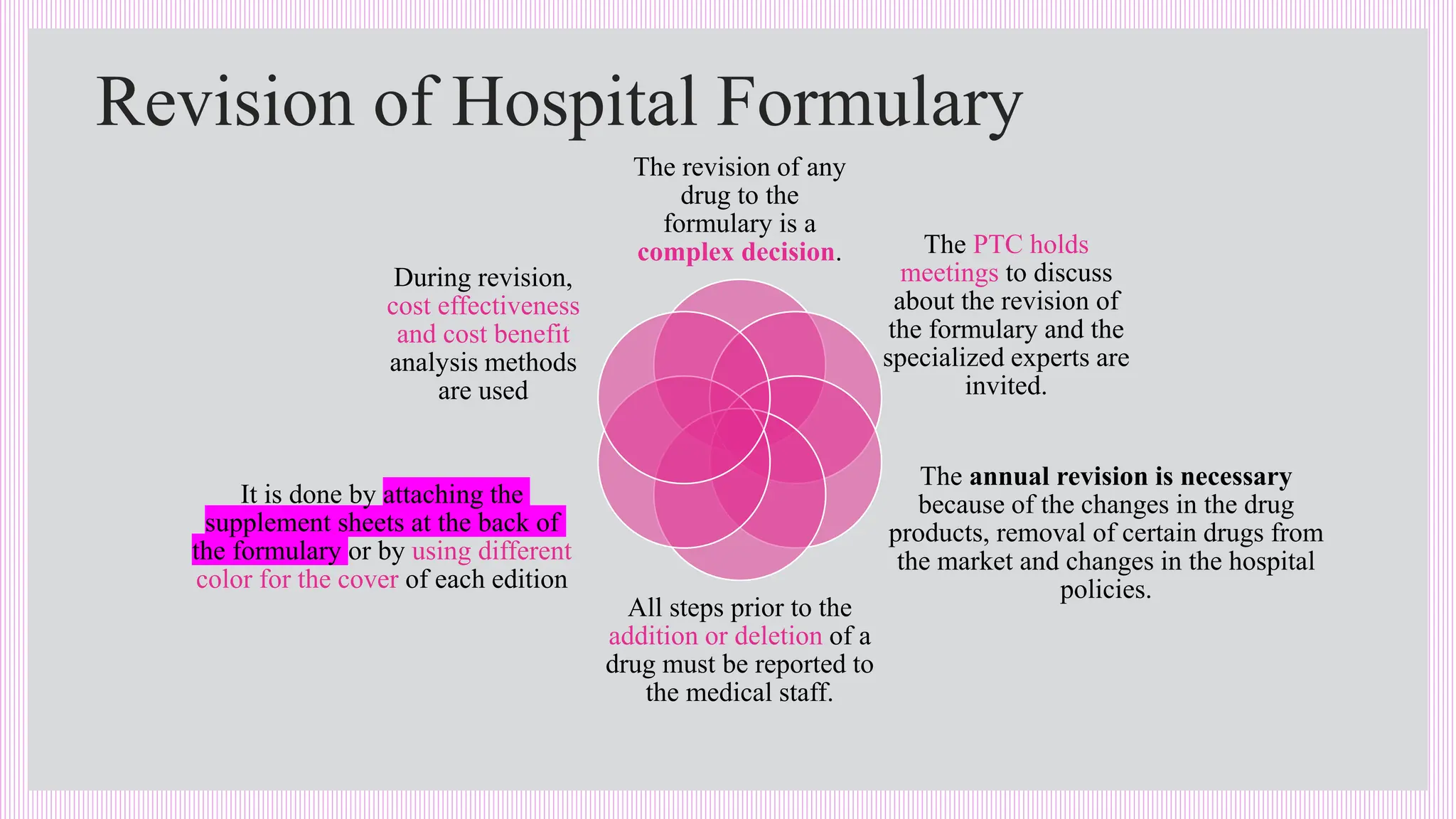
Revision of Hospital Formulary
The revision of any
drug to the
formulary is a
complex decision. The PTC holds
meetings to discuss
about the revision of
the formulary and the
specialized experts are
invited.
The annual revision is necessary
because of the changes in the drug
products, removal of certain drugs from
the market and changes in the hospital
policies.
All steps prior to the
addition or deletion of a
drug must be reported to
the medical staff.
It is done by attaching the
supplement sheets at the back of
the formulary or by using different
color for the cover of each edition
During revision,
cost effectiveness
and cost benefit
analysis methods
are used
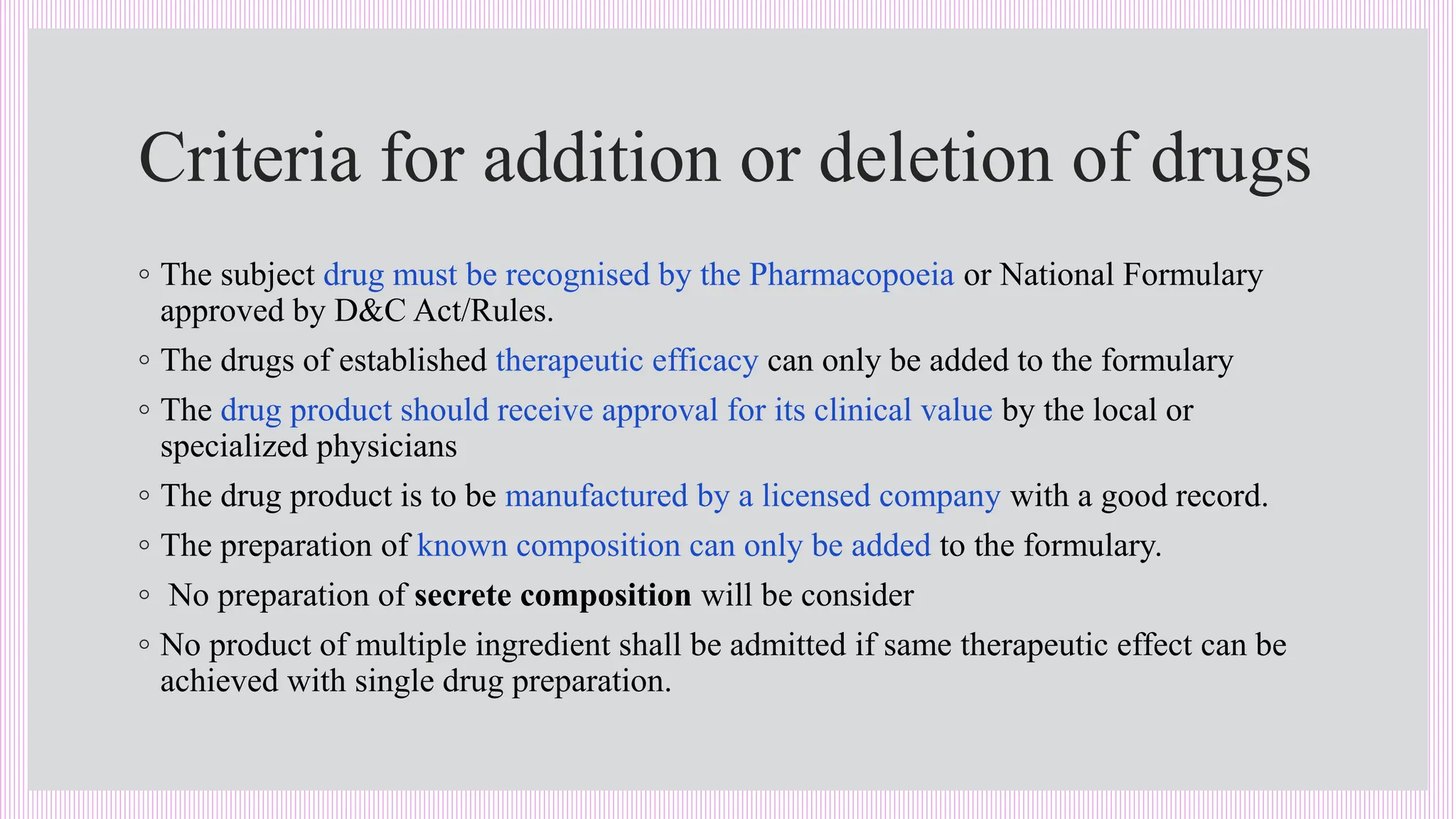
Criteria for addition or deletion of drugs
◦ The subject drug must be recognised by the Pharmacopoeia or National Formulary
approved by D&C Act/Rules.
◦ The drugs of established therapeutic efficacy can only be added to the formulary
◦ The drug product should receive approval for its clinical value by the local or
specialized physicians
◦ The drug product is to be manufactured by a licensed company with a good record.
◦ The preparation of known composition can only be added to the formulary.
◦ No preparation of secrete composition will be consider
◦ No product of multiple ingredient shall be admitted if same therapeutic effect can be
achieved with single drug preparation.

2. Hospital Formulary.pdf unit 2 sem 7 b.pharmacy

  • 1.
  • 2.
    DEFINITION Formulary is anofficial or authorized publication of an approved list of medicines. Hospital formulary is a list of pharmaceutical preparations including important information which reflects the current clinical views of the medical staff. Hospital formulary is the list of the medicines including ◦ Ancillary information related to toxicity ◦ Unwanted side effects ◦ Beneficial effects of some drugs which are considered most useful and safe in patient-care by a hospital.
  • 4.
    ❖ Hospital Formularyis updated time to time based on the opinions of 1. Physicians 2. Surgeons 3. Pharmacists ❖ Compilation of HF: by Pharmacy & Therapeutic Committee (PTC) ❖ Used By: Health Care Team.
  • 5.
    Hospital Formulary System ◦Method whereby Medical Staff of hospital with help of PTC select and evaluate medical agents and their dosage form. ◦ Selection criteria Toxicity Quality, Efficiency Bioavailability Hospital formulary system assist in procuring, prescribing, dispensing and administering a drug. 1. Non- Proprietary (Generic) 2. Proprietary ( Brand names)
  • 6.
    NEED (Hospital Formulary) 1.Pharmaceutical companies – Increasing manufacturing /marketing of New drugs. 2. Increasing influence of advertisement. 3. New sales promotion.
  • 7.
    Benefits of DrugFormulary System — Therapeutic- Benefit to patient/physician (most efficient products) — Economic – Lower charges to patient — Educational – for Staff, Nurses/ Medical students — Rational drug use
  • 8.
    Advantages of hospitalformulary 1. It provides the practitioner with approved and efficacious medicines to treat disease . 2. It reduces the inventory cost of the drugs. 3. It improves the quality assurance and easier dispensing. 4. It gives medicine information to resident staff, nurses and students 5. It removes the irrational combinations of drugs and also improves adverse drug reaction management.
  • 9.
    Disadvantages The physician is deprivedof prescribing drugs of his choice. It may lead to purchase of drugs which are inferior in quality, in case of no involvement of the pharmacist in the preparation of formulary
  • 10.
    GUIDELINE FOR HOSPITAL FORMULARY Thegoverning body of the hospital should appoint a pharmacy and therapeutic committee composed of physician and pharmacist which will prepare the hospital formulary system. PTC shall sponsor and outline the purpose, organization function and scope of the hospital formulary system, as per the need of particular hospital. PTC develop policies and procedures - medical staff adopt these - subject to administrative approval. The policy and procedures shall afford guidance in the appraisal, selection, procurement, storage, distribution, use, safety procedures and other matter relating to drug in the hospital and shall be published in the hospital’s formulary.
  • 11.
    Contents of HF ◦Hospital Formulary provides useful information to the prescribers. ◦ Prescription writing ◦ Important part/section of HF Section consists of a. Cover b. Parts of prescription c. Metric system d. Abbreviation e. Information etc.
  • 12.
    ◦ Prescription contains: ◦Name, age, sex ◦ Date ◦ Adress of patient ◦ Name of drug ( mentioned in formulary) ◦ Direction for patient For repeat prescription, clear instructions are given Prescription containing Narcotic, psychotropic Prepared & signed by prescriber. Prepared in triplicate (3) 1 copy: Physician 2 copies: Patient
  • 13.
    Primary objectives: a)Information ondrug products approved by PTC b)Information on hospital policies & procedures --- for use of drugs c)Special information about drugs. In accordance with these objectives, the formulary should consist of three main parts: A. Drug dosage schedule. B. Hospital approved abbreviations C. Special information
  • 14.
    A. Information onDrug products This section is heart of formulary and consist of descriptive entries. Entries in formulary such as 1. generic name of basic drugs; 2. common name (Brand name); 3. dosage form, 4. strength, 5. packaging; 6. dose for various age group; 7. route of administration; 8. cost. Drug product listing/Indexing by 2 way- at the beginning /end of HF. • Generic name/brand name • Therapeutic or pharmacological index
  • 15.
    B. Information onhospital policies and Procedures • Drug usage and restriction on drug use • Description of PTC including member responsibility • Hospital regulations regarding prescribing, dispensing; administration of drug; drug orders; investigational drug policy; rules for Medical Representatives, emergency drug products etc • Pharmacy operation procedures such as services, outpatients prescription, inpatient drug distribution, labelling, packaging etc • Information on how to use formulary a) Entries arranged b) Procedure for entry of drug
  • 16.
    C. Special information Usefulto hospital staff and should be readily available. Varies according to hospitals. It includes- Hospital approved abbreviations Equivalent dosages of similar drugs Guidelines for calculating paediatric dosages List of sugar free drugs Metric conversion tables Poison control information Table of drug interactions
  • 17.
    Private/Hospital Formulary NationalFormulary/Drug list Listing of drugs by their generic names followed by information on strength, form, posology, toxicology, use & recommended quantity to be dispensed. Generic names followed by data on strength & form. Prepared locally by its own clinical staff. Prepared by country’s outstanding clinicians, pharmacologists and pharmacists. Information provided is subject to local needs and desires. According to their pharmacological properties. Published in convenient size Size is big Addition or deletion of drug with greater frequency Addition or deletion of drug with less frequency
  • 18.
    Preparation of HospitalFormulary ◦ Principal responsibility of the pharmacy and therapeutic committee. ◦ The committee is free to make necessary decisions, regarding the material to be included in the formulary and pharmacist undertaken the production of the formulary that is compiling and printing etc. ◦ Visually pleasing, easily readable and professional in appearance ◦ It should includes section on prescription writing; governing the use of drug; diagnostic reagent and normal pathological investigational reagent; pharmaceutical classification; poison and their antidote etc. ◦ It should be distributed to Each pharmacist, Head of dept and nursing dept.
  • 19.
    Composition 1. Title page 2.Names & titles of the members of the PTC 3. Table of contents 4. Information on hospital policies & procedures concerning drugs 5. Products accepted for use at hospital 6. Appendix
  • 20.
    CONTENTS a. Introduction List ofabbreviations , List of drugs used in the formulary b. Basic information on each drug: Efficacy for the treatment of specific conditions, Safety profile, Interaction profile, Adverse effects, Pharmacokinetic profile, Availability of the item, Available dosage form, Cost, Acceptability to patient. c. Supplementary information on each drug: Storage guidelines, Patient counselling information, Labelling information, Brand names and prices d. Prescribing and dispensing guidelines: Principles of prescription writing, Reporting of ADR, Prevention of ADR. e. General drug use and advice: Use of IV drugs, Special situations like pregnancy, breast feeding, liver/kidney diseases, Poisoning information and antidotes, Treatment of snakebites and insect bites f. Miscellaneous section: Children’s dose, Renal adjustments, Metric units, Diagnostic aids
  • 21.
    Revision of HospitalFormulary The revision of any drug to the formulary is a complex decision. The PTC holds meetings to discuss about the revision of the formulary and the specialized experts are invited. The annual revision is necessary because of the changes in the drug products, removal of certain drugs from the market and changes in the hospital policies. All steps prior to the addition or deletion of a drug must be reported to the medical staff. It is done by attaching the supplement sheets at the back of the formulary or by using different color for the cover of each edition During revision, cost effectiveness and cost benefit analysis methods are used
  • 22.
    Criteria for additionor deletion of drugs ◦ The subject drug must be recognised by the Pharmacopoeia or National Formulary approved by D&C Act/Rules. ◦ The drugs of established therapeutic efficacy can only be added to the formulary ◦ The drug product should receive approval for its clinical value by the local or specialized physicians ◦ The drug product is to be manufactured by a licensed company with a good record. ◦ The preparation of known composition can only be added to the formulary. ◦ No preparation of secrete composition will be consider ◦ No product of multiple ingredient shall be admitted if same therapeutic effect can be achieved with single drug preparation.