












Drugs and the Body


           Nhelia B. Perez, RN, MSN
                 PCU - MJCN
Pharmacokinetics
Phases of Pharmacokinetic
       • Absorption
         - maybe reduced if the villi is
         decreased (disease, drug
         effect, removal of small
         intestines)
         - may be passive (diffusion)
         or active carrier).
Distribution
        -blood flow, drug’s
          affinity to the tissue
          protein binding effect,
          drug volume.
Metabolism

             • Hepatic role
             • Liver diseases
             • Half life
Excretion

• Kidneys
• Kidney diseases
PHARMACODYNAMICS
   • DRUG ACTIONS
   • To replace or act as substitutes for
     missing chemicals.
   • To increase or stimulate certain cellular
     activities.
   • To depress or slow cellular activities.
   • To interfere with the functioning of foreign
     cells, such as invading microorganisms or
     neoplasms.
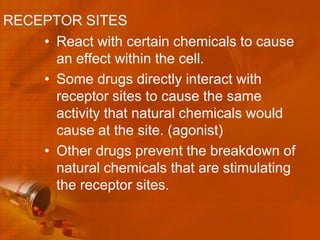
RECEPTOR SITES
    • React with certain chemicals to cause
      an effect within the cell.
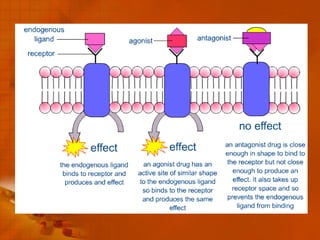
    • Some drugs directly interact with
      receptor sites to cause the same
      activity that natural chemicals would
      cause at the site. (agonist)
    • Other drugs prevent the breakdown of
      natural chemicals that are stimulating
      the receptor sites.
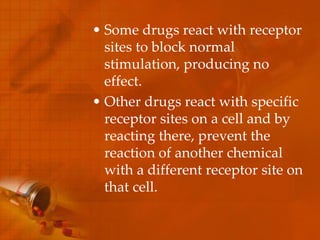
• Some drugs react with receptor
  sites to block normal
  stimulation, producing no
  effect.
• Other drugs react with specific
  receptor sites on a cell and by
  reacting there, prevent the
  reaction of another chemical
  with a different receptor site on
  that cell.
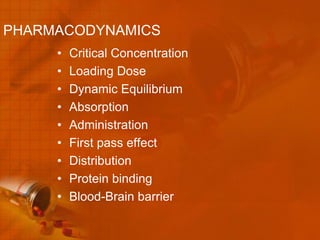
PHARMACODYNAMICS
     •   Critical Concentration
     •   Loading Dose
     •   Dynamic Equilibrium
     •   Absorption
     •   Administration
     •   First pass effect
     •   Distribution
     •   Protein binding
     •   Blood-Brain barrier
•   Placenta and Breast Milk
•   Biotransformation
•   Excretion
•   Half-Life
FACTORS INFLUENCING DRUG EFFECTS

   •   Weight
   •   Age
   •   Gender
   •   Physiological factors
   •   Pathological factors
   •   Genetic factors
   •   Immunological factors
   •   Psychological factors
   •   Environmental factors
• Tolerance
• Cumulation
• Drug-drug or drug-alternative
  therapy interactions
• Drug laboratory test interactions
Adverse
Effects of
 Drugs
TOXIC EFFECTS OF
     DRUGS
SIDE EFFECTS
• Problems that occur when
  treatment goes beyond the
  desired effect. Or problems that
  occur in addition to the desired
  therapeutic effect.
ADVERSE EFFECTS
 • the Drug may have other effects on the body besides
 the therapeutic effect.
 •The patient is sensitive to the drug being given.
 •The drug’s action on the body causes other responses
 that are undesirable or unpleasant.
 •The patient is taking too much or too little of the drug,
 leading to adverse effects
Types of Adverse Effects
            • Primary actions
              – Overdose: extension of the
                 desired effect
            • Secondary actions
              – Undesired effects produced in
                 addition to the pharmacologic
                 effect
            • Hypersensitivity reactions
              – Excessive response to the
                 primary or secondary effect of the
                 drug
Drug Allergy
    • Can occur when the body forms
      antibodies to a particular drug.
    • It may be anaphylactic,
      cytotoxic, serum sickness or
      delayed allergic reaction.
Idiosyncratic Reactions
• also known as type B reactions,
  are drug reactions which occur
  rarely and unpredictably amongst
  the population.
• They frequently occur with exposure
  to new drugs, as they have not been
  fully tested and the full range of
  possible side effects have not been
  discovered; they may also be listed
  as an adverse drug reaction with a
  drug, but be extremely rare.
Teratogenic Effect
• These effects are classed as deterministic,
  which means that the severity as well as
  incidence is related to dose.
• The combined consequences of
  consuming a harmful substance, such as
  alcohol, on a developing fetus; may
  manifest itself as growth deficiency and/or
  mental retardation; fetal alcohol syndrome
  is an example.
LET’S TAKE
     A
 BREAK!!!
Nursing
Management
RIGHTS IN DRUG ADMINISTRATION
         •   Right Patient
         •   Right Route
         •   Right Drug
         •   Right Frequency
         •   Right Dose
•   Right Approach
•   Right Assessment
•   Right to refuse
•   Right Education
•   Right Evaluation
•   Right Documentation
Nursing Management
          • Nursing : An Art and a
            Science
          • The Nursing Process
            1. Assessment
            2. Nursing Diagnosis
            3. Planning
            4. Interventions
            5. Evaluation
ASSESSMENT
• History
  - chronic conditions
  - Drug Use
  - Allergies
  - level of education
  - level of understanding of Disease
  and therapy
- Social Supports
- Financial Supports
- Pattern of Health Care


- Physical Assessment
  1. weight
  2. age
  3. Physical Parameters r/t
  disease or drug effects
NURSING DIAGNOSIS

        • IT MAY BE:
          1. two part
          2. three part
        • Should be based on NANDA
PLANNING

           • Should be SMART
           • Can be short term or long
             term
INTERVENTIONS
    • 7 points to Proper Drug Administration

               1. Drug
               2. Storage
               3. Route
               4. Dosage
               5. Preparation
               6. Timing
               7. recording
Comfort measures
        •   Placebo effect
        •   Managing adverse effects
        •   Lifestyle adjustment
        •   Patient and Family Education
KEY ELEMENTS TO PATIENT
EDUCATION
       • Name, Dose and action of Drug
       • Timing of Administration
       • Special Storage and preparation
         instructions
       • Special comfort or safety measures
       • Safety measures
       • Specific points about drug toxicity
       • Special warnings about drug
         discontinuation
EVALUATION

             • The evaluation is an
               integral part in the
               nursing process.
             • The effectivity of the drug
               therapy is determined
               through evaluation.
Dosage Calculations
Drug Order
• Elements of a Drug Order
• Abbreviations
• Interpreting Drug Orders
DOSAGE CALCULATIONS
     • Measuring Systems
       - Metric System
       - Apothecary System
       - Household system
Converting between Systems
            • Ratio and proportion
Calculating Dosage
•   Oral Drugs
•   Parenteral Drugs
•   Intravenous solutions
•   Pediatric considerations
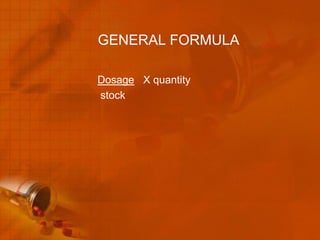
GENERAL FORMULA

Dosage X quantity
stock
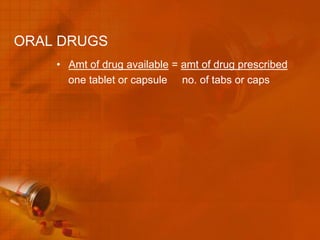
ORAL DRUGS
    • Amt of drug available = amt of drug prescribed
      one tablet or capsule no. of tabs or caps
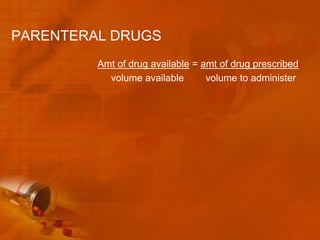
PARENTERAL DRUGS
         Amt of drug available = amt of drug prescribed
           volume available       volume to administer
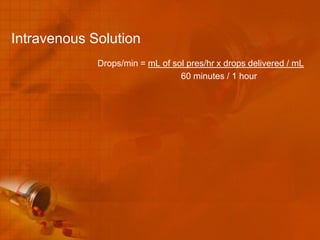
Intravenous Solution
             Drops/min = mL of sol pres/hr x drops delivered / mL
                                 60 minutes / 1 hour
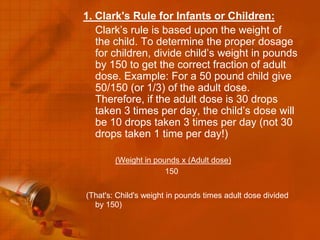
1. Clark's Rule for Infants or Children:
   Clark’s rule is based upon the weight of
   the child. To determine the proper dosage
   for children, divide child’s weight in pounds
   by 150 to get the correct fraction of adult
   dose. Example: For a 50 pound child give
   50/150 (or 1/3) of the adult dose.
   Therefore, if the adult dose is 30 drops
   taken 3 times per day, the child’s dose will
   be 10 drops taken 3 times per day (not 30
   drops taken 1 time per day!)

        (Weight in pounds x (Adult dose)
                      150


(That's: Child's weight in pounds times adult dose divided
  by 150)
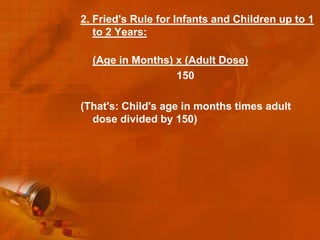
2. Fried's Rule for Infants and Children up to 1
   to 2 Years:

  (Age in Months) x (Adult Dose)
                  150

(That's: Child's age in months times adult
  dose divided by 150)
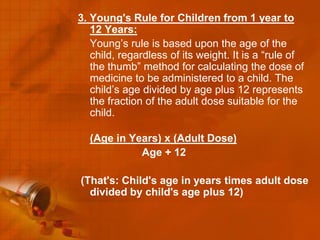
3. Young's Rule for Children from 1 year to
   12 Years:
   Young’s rule is based upon the age of the
   child, regardless of its weight. It is a “rule of
   the thumb” method for calculating the dose of
   medicine to be administered to a child. The
   child’s age divided by age plus 12 represents
   the fraction of the adult dose suitable for the
   child.

  (Age in Years) x (Adult Dose)
            Age + 12

(That's: Child's age in years times adult dose
  divided by child's age plus 12)
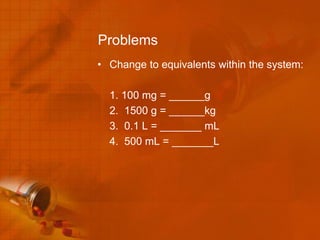
Problems
• Change to equivalents within the system:

  1. 100 mg = ______g
  2. 1500 g = ______kg
  3. 0.1 L = _______ mL
  4. 500 mL = _______L
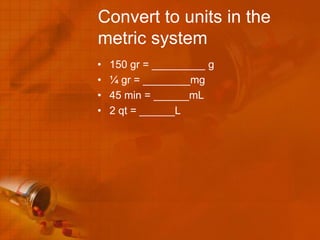
Convert to units in the
metric system
•   150 gr = _________ g
•   ¼ gr = ________mg
•   45 min = ______mL
•   2 qt = ______L
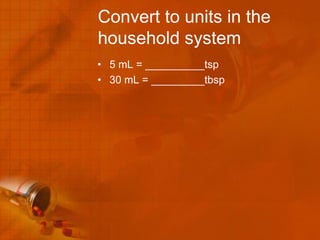
Convert to units in the
household system
• 5 mL = __________tsp
• 30 mL = _________tbsp
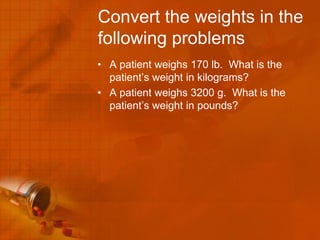
Convert the weights in the
following problems
• A patient weighs 170 lb. What is the
  patient’s weight in kilograms?
• A patient weighs 3200 g. What is the
  patient’s weight in pounds?
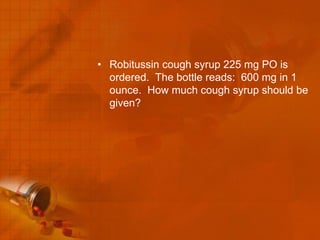
• Robitussin cough syrup 225 mg PO is
  ordered. The bottle reads: 600 mg in 1
  ounce. How much cough syrup should be
  given?
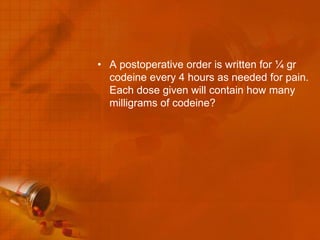
• A postoperative order is written for ¼ gr
  codeine every 4 hours as needed for pain.
  Each dose given will contain how many
  milligrams of codeine?
Thank you for Listening!

Pharma 2014

  • 1.
    Drugs and theBody Nhelia B. Perez, RN, MSN PCU - MJCN
  • 3.
  • 4.
    Phases of Pharmacokinetic • Absorption - maybe reduced if the villi is decreased (disease, drug effect, removal of small intestines) - may be passive (diffusion) or active carrier).
  • 5.
    Distribution -blood flow, drug’s affinity to the tissue protein binding effect, drug volume.
  • 6.
    Metabolism • Hepatic role • Liver diseases • Half life
  • 7.
  • 8.
    PHARMACODYNAMICS • DRUG ACTIONS • To replace or act as substitutes for missing chemicals. • To increase or stimulate certain cellular activities. • To depress or slow cellular activities. • To interfere with the functioning of foreign cells, such as invading microorganisms or neoplasms.
  • 9.
    RECEPTOR SITES • React with certain chemicals to cause an effect within the cell. • Some drugs directly interact with receptor sites to cause the same activity that natural chemicals would cause at the site. (agonist) • Other drugs prevent the breakdown of natural chemicals that are stimulating the receptor sites.
  • 10.
    • Some drugsreact with receptor sites to block normal stimulation, producing no effect. • Other drugs react with specific receptor sites on a cell and by reacting there, prevent the reaction of another chemical with a different receptor site on that cell.
  • 12.
    PHARMACODYNAMICS • Critical Concentration • Loading Dose • Dynamic Equilibrium • Absorption • Administration • First pass effect • Distribution • Protein binding • Blood-Brain barrier
  • 13.
    Placenta and Breast Milk • Biotransformation • Excretion • Half-Life
  • 14.
    FACTORS INFLUENCING DRUGEFFECTS • Weight • Age • Gender • Physiological factors • Pathological factors • Genetic factors • Immunological factors • Psychological factors • Environmental factors
  • 15.
    • Tolerance • Cumulation •Drug-drug or drug-alternative therapy interactions • Drug laboratory test interactions
  • 16.
  • 17.
  • 18.
    SIDE EFFECTS • Problemsthat occur when treatment goes beyond the desired effect. Or problems that occur in addition to the desired therapeutic effect.
  • 19.
    ADVERSE EFFECTS •the Drug may have other effects on the body besides the therapeutic effect. •The patient is sensitive to the drug being given. •The drug’s action on the body causes other responses that are undesirable or unpleasant. •The patient is taking too much or too little of the drug, leading to adverse effects
  • 20.
    Types of AdverseEffects • Primary actions – Overdose: extension of the desired effect • Secondary actions – Undesired effects produced in addition to the pharmacologic effect • Hypersensitivity reactions – Excessive response to the primary or secondary effect of the drug
  • 21.
    Drug Allergy • Can occur when the body forms antibodies to a particular drug. • It may be anaphylactic, cytotoxic, serum sickness or delayed allergic reaction.
  • 22.
    Idiosyncratic Reactions • alsoknown as type B reactions, are drug reactions which occur rarely and unpredictably amongst the population. • They frequently occur with exposure to new drugs, as they have not been fully tested and the full range of possible side effects have not been discovered; they may also be listed as an adverse drug reaction with a drug, but be extremely rare.
  • 23.
    Teratogenic Effect • Theseeffects are classed as deterministic, which means that the severity as well as incidence is related to dose. • The combined consequences of consuming a harmful substance, such as alcohol, on a developing fetus; may manifest itself as growth deficiency and/or mental retardation; fetal alcohol syndrome is an example.
  • 24.
    LET’S TAKE A BREAK!!!
  • 25.
  • 26.
    RIGHTS IN DRUGADMINISTRATION • Right Patient • Right Route • Right Drug • Right Frequency • Right Dose
  • 27.
    Right Approach • Right Assessment • Right to refuse • Right Education • Right Evaluation • Right Documentation
  • 29.
    Nursing Management • Nursing : An Art and a Science • The Nursing Process 1. Assessment 2. Nursing Diagnosis 3. Planning 4. Interventions 5. Evaluation
  • 30.
    ASSESSMENT • History - chronic conditions - Drug Use - Allergies - level of education - level of understanding of Disease and therapy
  • 31.
    - Social Supports -Financial Supports - Pattern of Health Care - Physical Assessment 1. weight 2. age 3. Physical Parameters r/t disease or drug effects
  • 32.
    NURSING DIAGNOSIS • IT MAY BE: 1. two part 2. three part • Should be based on NANDA
  • 33.
    PLANNING • Should be SMART • Can be short term or long term
  • 34.
    INTERVENTIONS • 7 points to Proper Drug Administration 1. Drug 2. Storage 3. Route 4. Dosage 5. Preparation 6. Timing 7. recording
  • 35.
    Comfort measures • Placebo effect • Managing adverse effects • Lifestyle adjustment • Patient and Family Education
  • 36.
    KEY ELEMENTS TOPATIENT EDUCATION • Name, Dose and action of Drug • Timing of Administration • Special Storage and preparation instructions • Special comfort or safety measures • Safety measures • Specific points about drug toxicity • Special warnings about drug discontinuation
  • 37.
    EVALUATION • The evaluation is an integral part in the nursing process. • The effectivity of the drug therapy is determined through evaluation.
  • 38.
  • 39.
    Drug Order • Elementsof a Drug Order • Abbreviations • Interpreting Drug Orders
  • 40.
    DOSAGE CALCULATIONS • Measuring Systems - Metric System - Apothecary System - Household system
  • 41.
    Converting between Systems • Ratio and proportion
  • 42.
    Calculating Dosage • Oral Drugs • Parenteral Drugs • Intravenous solutions • Pediatric considerations
  • 43.
  • 44.
    ORAL DRUGS • Amt of drug available = amt of drug prescribed one tablet or capsule no. of tabs or caps
  • 45.
    PARENTERAL DRUGS Amt of drug available = amt of drug prescribed volume available volume to administer
  • 46.
    Intravenous Solution Drops/min = mL of sol pres/hr x drops delivered / mL 60 minutes / 1 hour
  • 47.
    1. Clark's Rulefor Infants or Children: Clark’s rule is based upon the weight of the child. To determine the proper dosage for children, divide child’s weight in pounds by 150 to get the correct fraction of adult dose. Example: For a 50 pound child give 50/150 (or 1/3) of the adult dose. Therefore, if the adult dose is 30 drops taken 3 times per day, the child’s dose will be 10 drops taken 3 times per day (not 30 drops taken 1 time per day!) (Weight in pounds x (Adult dose) 150 (That's: Child's weight in pounds times adult dose divided by 150)
  • 48.
    2. Fried's Rulefor Infants and Children up to 1 to 2 Years: (Age in Months) x (Adult Dose) 150 (That's: Child's age in months times adult dose divided by 150)
  • 49.
    3. Young's Rulefor Children from 1 year to 12 Years: Young’s rule is based upon the age of the child, regardless of its weight. It is a “rule of the thumb” method for calculating the dose of medicine to be administered to a child. The child’s age divided by age plus 12 represents the fraction of the adult dose suitable for the child. (Age in Years) x (Adult Dose) Age + 12 (That's: Child's age in years times adult dose divided by child's age plus 12)
  • 50.
    Problems • Change toequivalents within the system: 1. 100 mg = ______g 2. 1500 g = ______kg 3. 0.1 L = _______ mL 4. 500 mL = _______L
  • 51.
    Convert to unitsin the metric system • 150 gr = _________ g • ¼ gr = ________mg • 45 min = ______mL • 2 qt = ______L
  • 52.
    Convert to unitsin the household system • 5 mL = __________tsp • 30 mL = _________tbsp
  • 53.
    Convert the weightsin the following problems • A patient weighs 170 lb. What is the patient’s weight in kilograms? • A patient weighs 3200 g. What is the patient’s weight in pounds?
  • 54.
    • Robitussin coughsyrup 225 mg PO is ordered. The bottle reads: 600 mg in 1 ounce. How much cough syrup should be given?
  • 55.
    • A postoperativeorder is written for ¼ gr codeine every 4 hours as needed for pain. Each dose given will contain how many milligrams of codeine?
  • 56.
    Thank you forListening!