IAEA
International Atomic Energy Agency
Set of 103 slides based on the chapter authored by
S.T. Carlsson and J.C. Le Heron
of the IAEA publication (ISBN 978–92–0–143810–2):
Nuclear Medicine Physics:
A Handbook for Teachers and Students
Objective: To familiarize with radiation protection aspects in
nuclear medicine.
Chapter 3: Radiation Protection
Slide set prepared in 2015
by F. Botta (IEO European
Institute of Oncology,
Milano, Italy)
IAEA
Nuclear Medicine Physics: A Handbook for Teachers and Students – Chapter 3 – Slide 2/103
CHAPTER 3 TABLE OF CONTENTS
3.1. Introduction
3.2. Basic principles of radiation protection
3.3. Implementation of radiation protection in a nuclear medicine facility
3.4. Facility design
3.5. Occupational exposure
3.6. Public exposure
3.7. Medical exposure
3.8. Potential exposure
3.9. Quality assurance
IAEA
Nuclear Medicine Physics: A Handbook for Teachers and Students – Chapter 3 – Slide 3/103
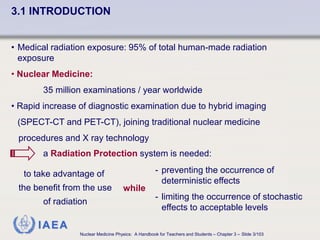
3.1 INTRODUCTION
• Medical radiation exposure: 95% of total human-made radiation
exposure
• Nuclear Medicine:
35 million examinations / year worldwide
• Rapid increase of diagnostic examination due to hybrid imaging
(SPECT-CT and PET-CT), joining traditional nuclear medicine
procedures and X ray technology
a Radiation Protection system is needed:
to take advantage of
the benefit from the use
of radiation
while
- preventing the occurrence of
deterministic effects
- limiting the occurrence of stochastic
effects to acceptable levels
IAEA
Nuclear Medicine Physics: A Handbook for Teachers and Students – Chapter 3 – Slide 4/103
3.1 INTRODUCTION
The Radiation Protection system has evolved over many years until the
formulation of a shared approach:
ICRP System of Radiological Protection
as espoused by the International Commission on Radiological Protection
(ICRP)
A number of ICRP Publications are available on different topics
(www.icrp.org).
IAEA
Nuclear Medicine Physics: A Handbook for Teachers and Students – Chapter 3 – Slide 5/103
3.2 BASIC PRINCIPLES OF RADIATION PROTECTION
3.2.1 The ICRP system of radiological protection
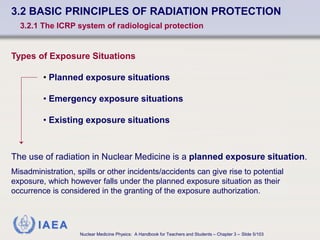
Types of Exposure Situations
• Planned exposure situations
• Emergency exposure situations
• Existing exposure situations
The use of radiation in Nuclear Medicine is a planned exposure situation.
Misadministration, spills or other incidents/accidents can give rise to potential
exposure, which however falls under the planned exposure situation as their
occurrence is considered in the granting of the exposure authorization.
IAEA
Nuclear Medicine Physics: A Handbook for Teachers and Students – Chapter 3 – Slide 6/103
3.2 BASIC PRINCIPLES OF RADIATION PROTECTION
3.2.1 The ICRP system of radiological protection
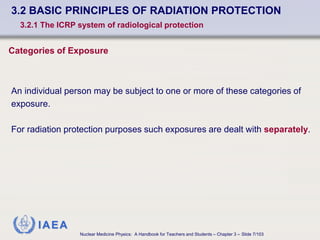
Categories of Exposure
• Medical exposure: patients undergoing exposure for medical diagnosis
or treatment; individuals helping in the support and comfort of patients,
and by volunteers in a programme of biomedical research
• Occupational exposure: workers exposed in the course of their work
• Public exposure: exposure incurred by members of the public from all
exposure situations, but excluding any occupational and medical exposure
In a Nuclear Medicine facility all these exposures occur:
patients, staff occupied in performing nuclear medicine procedures, people
present in the nuclear medicine facility (staff or member of the public), carers
and comforters of patients, volunteers in research projects
IAEA
Nuclear Medicine Physics: A Handbook for Teachers and Students – Chapter 3 – Slide 7/103
3.2 BASIC PRINCIPLES OF RADIATION PROTECTION
3.2.1 The ICRP system of radiological protection
An individual person may be subject to one or more of these categories of
exposure.
For radiation protection purposes such exposures are dealt with separately.
Categories of Exposure
IAEA
Nuclear Medicine Physics: A Handbook for Teachers and Students – Chapter 3 – Slide 8/103
3.2 BASIC PRINCIPLES OF RADIATION PROTECTION
3.2.1 The ICRP system of radiological protection
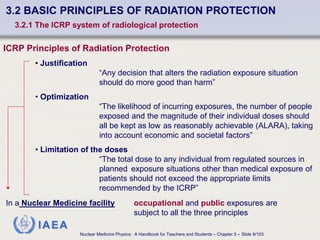
ICRP Principles of Radiation Protection
• Justification
“Any decision that alters the radiation exposure situation
should do more good than harm”
• Optimization
“The likelihood of incurring exposures, the number of people
exposed and the magnitude of their individual doses should
all be kept as low as reasonably achievable (ALARA), taking
into account economic and societal factors”
• Limitation of the doses
“The total dose to any individual from regulated sources in
planned exposure situations other than medical exposure of
patients should not exceed the appropriate limits
recommended by the ICRP”
IAEA
Nuclear Medicine Physics: A Handbook for Teachers and Students – Chapter 3 – Slide 9/103
3.2 BASIC PRINCIPLES OF RADIATION PROTECTION
3.2.1 The ICRP system of radiological protection
In a Nuclear Medicine facility occupational and public exposures are
subject to all the three principles
ICRP Principles of Radiation Protection
• Justification
“Any decision that alters the radiation exposure situation
should do more good than harm”
• Optimization
“The likelihood of incurring exposures, the number of people
exposed and the magnitude of their individual doses should
all be kept as low as reasonably achievable (ALARA), taking
into account economic and societal factors”
• Limitation of the doses
“The total dose to any individual from regulated sources in
planned exposure situations other than medical exposure of
patients should not exceed the appropriate limits
recommended by the ICRP”
IAEA
Nuclear Medicine Physics: A Handbook for Teachers and Students – Chapter 3 – Slide 10/103
3.2 BASIC PRINCIPLES OF RADIATION PROTECTION
3.2.1 The ICRP system of radiological protection
In a Nuclear Medicine facility medical exposure is subject to the first two
principles only
ICRP Principles of Radiation Protection
• Justification
“Any decision that alters the radiation exposure situation
should do more good than harm”
• Optimization
“The likelihood of incurring exposures, the number of people
exposed and the magnitude of their individual doses should
all be kept as low as reasonably achievable (ALARA), taking
into account economic and societal factors”
• Limitation of the doses
“The total dose to any individual from regulated sources in
planned exposure situations other than medical exposure of
patients should not exceed the appropriate limits
recommended by the ICRP”
IAEA
Nuclear Medicine Physics: A Handbook for Teachers and Students – Chapter 3 – Slide 11/103
3.2 BASIC PRINCIPLES OF RADIATION PROTECTION
3.2.1 The ICRP system of radiological protection
ICRP recommended Dose Limits
IAEA
Nuclear Medicine Physics: A Handbook for Teachers and Students – Chapter 3 – Slide 12/103
3.2 BASIC PRINCIPLES OF RADIATION PROTECTION
3.2.2 Safety standards
UNSCEAR (United Nations Scientific Committee on the Effects of Atomic Radiation)
compiles, assesses and disseminates information on the health effects of radiation and
on levels of radiation exposure due to different sources
ICRP
provides recommendations for protection, taking into account the scientific information
provided by UNSCEAR
IAEA
based on ICRP recommendations, defines the Basic Safety Standards = BSS
Not only scientific considerations are taken into account, but also judgement about the
relative importance of different kind of risks and the balancing of risks and benefits
International consensus has been achieved on BSS, with the approval of IAEA member
states and relevant international organizations
IAEA
Nuclear Medicine Physics: A Handbook for Teachers and Students – Chapter 3 – Slide 13/103
3.2 BASIC PRINCIPLES OF RADIATION PROTECTION
3.2.2 Safety standards
International BSS (General Safety Requirements 3):
“Radiation Protection and Safety of Radiation Sources: International Basic
Safety Standards”
issued in 2014
superseding the previous BSS, published as IAEA Safety Series No.115 (1996)
jointly sponsored by the IAEA, European Commission, Food and Agriculture
Organization of the UN, International Labour Organization, OECD Nuclear
Energy Agency, Pan American Health Organization, United Nations
Environmental Program, World Health Organization
AIM:
to establish basic requirements for protection against exposure to ionizing radiation
and for the safety of radiation sources that may deliver such exposure
IAEA
Nuclear Medicine Physics: A Handbook for Teachers and Students – Chapter 3 – Slide 14/103
3.2 BASIC PRINCIPLES OF RADIATION PROTECTION
3.2.3 Radiation protection quantities and units
1. Mean tissue or organ dose, DT
DT =
εT
mT
Total energy imparted by radiation to that tissue or organ
Mass of the tissue or organ T
SI (International System of Units) unit :
[ DT ] =
1 Joule
1 kilogram
= 1 Gray (Gy)
IAEA
Nuclear Medicine Physics: A Handbook for Teachers and Students – Chapter 3 – Slide 15/103
3.2 BASIC PRINCIPLES OF RADIATION PROTECTION
3.2.3 Radiation protection quantities and units
For the same DT to an organ or tissue:
different types
of ionizing radiation
different damage
to the organ or tissue
To account for this fact, the Equivalent dose HT is introduced:
HT = ∑ ⋅
R
R
T
R D
w ,
Weighting factor specific for type R radiation
Mean tissue or organ dose delivered by type R radiation
In case of a mixed radiation field, the sum is performed over the different types
of radiation delivering dose to the tissue or organ
2. Equivalent dose, HT
IAEA
Nuclear Medicine Physics: A Handbook for Teachers and Students – Chapter 3 – Slide 16/103
3.2 BASIC PRINCIPLES OF RADIATION PROTECTION
3.2.3 Radiation protection quantities and units
2. Equivalent dose, HT
Radiation R wR (ICRP Publication N° 103)
photons 1
electrons, muons 1
alpha particles 20
protons 2
neutrons function depending on neutron energy, En:
IAEA
Nuclear Medicine Physics: A Handbook for Teachers and Students – Chapter 3 – Slide 17/103
3.2 BASIC PRINCIPLES OF RADIATION PROTECTION
3.2.3 Radiation protection quantities and units
2. Equivalent dose, HT
SI (International System of Units) unit :
[ HT ] =
1 Joule
1 kilogram
= 1 sievert (Sv)
IAEA
Nuclear Medicine Physics: A Handbook for Teachers and Students – Chapter 3 – Slide 18/103
3.2 BASIC PRINCIPLES OF RADIATION PROTECTION
3.2.3 Radiation protection quantities and units
3. Effective dose, E
For the same HT :
different organ
or tissue
different probability
of stochastic effect
To account for this fact, the Effective dose E is introduced:
E = ∑ ⋅
T
T
T H
w Equivalent dose in organ or tissue T
Tissue weighting factor:
the relative contribution of an organ or tissue T to the
total detriment due to stochastic effects resulting from
a uniform irradiation of the whole body
Sum is performed over all the organ or tissues irradiated and considered to be sensitive
to the induction of stochastic effects.
IAEA
Nuclear Medicine Physics: A Handbook for Teachers and Students – Chapter 3 – Slide 19/103
3.2 BASIC PRINCIPLES OF RADIATION PROTECTION
3.2.3 Radiation protection quantities and units
3. Effective dose, E
Tissue wT (ICRP Publication N° 103)
red marrow, colon, lung,
stomach, breast,
remaining tissues
0.12
Σ wT
0.72
gonads 0.08 0.08
bladder, esophagus,
liver, thyroid
0.04 0.16
bone surface, brain,
salivary glands, skin
0.01 0.04
IAEA
Nuclear Medicine Physics: A Handbook for Teachers and Students – Chapter 3 – Slide 20/103
3.2 BASIC PRINCIPLES OF RADIATION PROTECTION
3.2.3 Radiation protection quantities and units
In case of internal exposure due to radionuclide intake, HT and E depend not
only on the physical properties of the radiation but also on the biological
turnover and retention of the radionuclide = the radionuclide metabolism
inside the body.
The dose is continuosly delivered troughout the period in which the
radionuclide remains in the body.
4. Committed dose quantities
To account for this fact, the Committed dose quantities are introduced,
representing the total dose quantities received over time:
Committed equivalent dose, HT (τ)
Committed effective dose, E (τ)
IAEA
Nuclear Medicine Physics: A Handbook for Teachers and Students – Chapter 3 – Slide 21/103
3.2 BASIC PRINCIPLES OF RADIATION PROTECTION
3.2.3 Radiation protection quantities and units
4. Committed dose quantities
dt
t
H
t
t
∫
+τ
0
0
)
(
T

Time of intake
Integration time = 50 years for workers and adult members of the public
70 years for children (longer life expectancy)
Equivalent dose rate in organ or tissue T
E (τ) = ∑ ⋅
T
H
w )
(
T
T τ
HT (τ) =
IAEA
Nuclear Medicine Physics: A Handbook for Teachers and Students – Chapter 3 – Slide 22/103
3.2 BASIC PRINCIPLES OF RADIATION PROTECTION
3.2.3 Radiation protection quantities and units
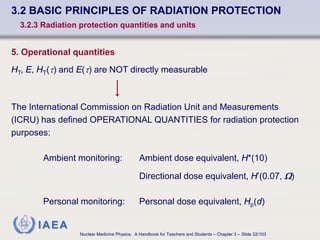
5. Operational quantities
HT, E, HT(τ) and E(τ) are NOT directly measurable
The International Commission on Radiation Unit and Measurements
(ICRU) has defined OPERATIONAL QUANTITIES for radiation protection
purposes:
Ambient monitoring: Ambient dose equivalent, H*(10)
Directional dose equivalent, H’(0.07, Ω)
Personal monitoring: Personal dose equivalent, Hp(d)
IAEA
Nuclear Medicine Physics: A Handbook for Teachers and Students – Chapter 3 – Slide 23/103
3.2 BASIC PRINCIPLES OF RADIATION PROTECTION
3.2.3 Radiation protection quantities and units
5. Operational quantities
Definitions/1
ICRU sphere
30 cm diameter sphere made of tissue equivalent material
(76.2% oxygen, 11.1% carbon, 10.1% hydrogen, 2.6% nitrongen; 1 g/cm3 density)
For the purposes of RADIATION MONITORING, it adequately
approximates the HUMAN BODY in terms of radiation attenuation
and scattering.
For this reason it is used to define the Operational quantities
H*(10), H’(0.07, Ω), Hp(d)
IAEA
Nuclear Medicine Physics: A Handbook for Teachers and Students – Chapter 3 – Slide 24/103
3.2 BASIC PRINCIPLES OF RADIATION PROTECTION
3.2.3 Radiation protection quantities and units
5. Operational quantities
Definitions/2
Expanded radiation field
Hypothetical field which has – at all points of a sufficiently large
volume – the same spectral and angular fluence as the actual field at the
point of interest.
Actual field Expanded field
P
P
.
IAEA
Nuclear Medicine Physics: A Handbook for Teachers and Students – Chapter 3 – Slide 25/103
3.2 BASIC PRINCIPLES OF RADIATION PROTECTION
3.2.3 Radiation protection quantities and units
5. Operational quantities
Definitions/2
Expanded radiation field
The expanded radiation field ensures that the whole ICRU sphere is
exposed to a homogeneous radiation field with the same fluence,
energy distribution and direction distribution as the real radiation field
at the point of interest.
IAEA
Nuclear Medicine Physics: A Handbook for Teachers and Students – Chapter 3 – Slide 26/103
3.2 BASIC PRINCIPLES OF RADIATION PROTECTION
3.2.3 Radiation protection quantities and units
5. Operational quantities
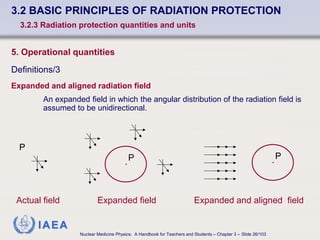
Definitions/3
Expanded and aligned radiation field
An expanded field in which the angular distribution of the radiation field is
assumed to be unidirectional.
Actual field Expanded field
P
P
.
Expanded and aligned field
P
.
IAEA
Nuclear Medicine Physics: A Handbook for Teachers and Students – Chapter 3 – Slide 27/103
3.2 BASIC PRINCIPLES OF RADIATION PROTECTION
3.2.3 Radiation protection quantities and units
5. Operational quantities
Definitions/3
Expanded and aligned radiation field
In the expanded and aligned radiation field, the ICRU sphere is
homogeneously irradiated from one direction, by a fluence obtained as
the integral over all directions of the differential angular fluence of the
real radiation field at the point of interest.
Under these conditions, the dose equivalent at any point in the ICRU
sphere does not depend on the angular distribution of the radiation
direction in the real radiation field.
IAEA
Nuclear Medicine Physics: A Handbook for Teachers and Students – Chapter 3 – Slide 28/103
3.2 BASIC PRINCIPLES OF RADIATION PROTECTION
3.2.3 Radiation protection quantities and units
5. Operational quantities
Area monitoring for penetrating radiation:
H*(10) = ambient dose equivalent at a point in a radiation field
= the dose equivalent that would be produced by the corresponding
expanded and aligned field in the ICRU sphere at a 10 mm depth on the
radius vector opposed to the direction of the radiation field
Area monitoring for low penetrating radiation:
H’(0.07, Ω) = directional dose equivalent at a point in a radiation field
= the dose equivalent that would be produced by the corresponding
expanded field in the ICRU sphere at a 0.07 mm depth along a
specified direction Ω
IAEA
Nuclear Medicine Physics: A Handbook for Teachers and Students – Chapter 3 – Slide 29/103
3.2 BASIC PRINCIPLES OF RADIATION PROTECTION
3.2.3 Radiation protection quantities and units
5. Operational quantities
Personal monitoring:
Hp(d) = personal dose equivalent
= the equivalent dose at a depth d in soft tissue below a specified
point on the body
d = 10 mm for penetrating radiation (photons energy > 15 keV)
d = 3 mm for low penetrating radiation in the lens of the eye
d = 0.07 mm for low penetrating radiation in skin
IAEA
Nuclear Medicine Physics: A Handbook for Teachers and Students – Chapter 3 – Slide 30/103
3.3 RADIATION PROTECTION IN A NUCLEAR MEDICINE FACILITY
3.3.1 General aspects
• Radiation protection must be totally integrated in the clinical practice (delivery of
medical service and patient care)
• Each country addresses radiation protection with a dedicated legislation and
regulatory framework. Specific authorization is typically required to the radiation
protection regulatory body for each facility or person wishing to perform nuclear
medicine procedures
• High standard of radiation protection is typically achieved by encouraging a
safety-based attitude in each individual, through
- education and training
- development of a questioning and learning attitude
- cooperation of national authorities and employer in supporting radiation
protection with adequate resources (personnel and money)
• Every individual must be aware of their own responsibilites. Formal assignment of
duties improves self-consciousness.
IAEA
Nuclear Medicine Physics: A Handbook for Teachers and Students – Chapter 3 – Slide 31/103
3.3 RADIATION PROTECTION IN A NUCLEAR MEDICINE FACILITY
3.3.2 Responsibilities
Licensee and Employers
• Applies the relevant national regulations and meets the licence conditions
• May appoint other people to carry out actions and tasks related to these
responsibilities, but the licensee retains overall responsibility
• Consults the BSS for the details regarding all the radiation protection
requirements
• Ensures that the necessary personnel is appointed (nuclear medicine physicians and
technologists, medical physicists, radiopharmacists and a radiation protection officer, RPO)
• Ensures and supports that all individuals have the necessary education, training
and competence for their respective duties
• Assigns clear responsibilities, establishes a radiation protection programme and
provides the necessary resources to adopt it
• Establishes a comprehensive Quality Assurance programme
• Employers are assigned many responsibilities, in cooperation with the Licensee,
regarding occupational radiation protection
IAEA
Nuclear Medicine Physics: A Handbook for Teachers and Students – Chapter 3 – Slide 32/103
3.3 RADIATION PROTECTION IN A NUCLEAR MEDICINE FACILITY
3.3.2 Responsibilities
Nuclear medicine specialist
Is responsible for the overall radiation protection of the patient (besides his/her
general medical and health care)
Justification of a given nuclear medicine procedure, in conjunction with the
referring medical practitioner
+
Optimization of protection during the examination/treatment
IAEA
Nuclear Medicine Physics: A Handbook for Teachers and Students – Chapter 3 – Slide 33/103
3.3 RADIATION PROTECTION IN A NUCLEAR MEDICINE FACILITY
3.3.2 Responsibilities
Nuclear medicine technologist
Has a key role in the optimization of the patient’s exposure
His skills and care are decisive
IAEA
Nuclear Medicine Physics: A Handbook for Teachers and Students – Chapter 3 – Slide 34/103
3.3 RADIATION PROTECTION IN A NUCLEAR MEDICINE FACILITY
3.3.2 Responsibilities
Radiation protection officer (RPO)
• Oversees and implements radiation protection matters in the hospital
• Unless also a qualified medical physicist in nuclear medicine, has no
responsibilities for radiation protection in medical exposure
• Required skills:
good theoretical and practical knowledge of ionizing radiation properties,
hazards and protection
knowledge of all the legislation and codes of practice related to the uses
of ionizing radiation in the nuclear medicine field
IAEA
Nuclear Medicine Physics: A Handbook for Teachers and Students – Chapter 3 – Slide 35/103
3.3 RADIATION PROTECTION IN A NUCLEAR MEDICINE FACILITY
3.3.2 Responsibilities
Medical physicist
• Has a comprehensive knowledge of the imaging equipment (performance,
physical limitations, calibration, quality control, image quality) and the basis of
internal dosimetry
• Is responsible for the radiation protection during medical exposure, including
all the issues pertaining to imaging, calibration, dosimetry and quality
assurance
• Is responsible for the Quality Assurance and the local continuing education in
radiation protection of the nuclear medicine staff and other health professionals
• Whenever possible, a medical physicist should also serve as a RPO
IAEA
Nuclear Medicine Physics: A Handbook for Teachers and Students – Chapter 3 – Slide 36/103
3.3 RADIATION PROTECTION IN A NUCLEAR MEDICINE FACILITY
3.3.2 Responsibilities
Other personnel
Radiopharmacists or other staff that may have been trained to perform specific
tasks, such as contamination tests or some quality control tests.
IAEA
Nuclear Medicine Physics: A Handbook for Teachers and Students – Chapter 3 – Slide 37/103
3.3 RADIATION PROTECTION IN A NUCLEAR MEDICINE FACILITY
3.3.3 Radiation protection programme
RPP = Radiation Protection Programme
• Developed by the Licensee (and Employer when appropriate) as requested in
the BSS for each nuclear medicine facility
• Represents a protection and safety programme commensurate with the
nature and extent of the risk of the practice, ensuring compliance with radiation
protection standards
• Deals with the protection of the workers, the patient and the general public
• The Licensee provides for its implementation, and facilitates the cooperation
between all the relevant parties
IAEA
Nuclear Medicine Physics: A Handbook for Teachers and Students – Chapter 3 – Slide 38/103
3.3 RADIATION PROTECTION IN A NUCLEAR MEDICINE FACILITY
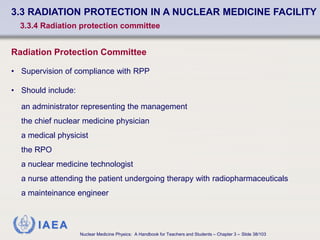
3.3.4 Radiation protection committee
• Supervision of compliance with RPP
• Should include:
an administrator representing the management
the chief nuclear medicine physician
a medical physicist
the RPO
a nuclear medicine technologist
a nurse attending the patient undergoing therapy with radiopharmaceuticals
a mainteinance engineer
Radiation Protection Committee
IAEA
Nuclear Medicine Physics: A Handbook for Teachers and Students – Chapter 3 – Slide 39/103
3.3 RADIATION PROTECTION IN A NUCLEAR MEDICINE FACILITY
3.3.5 Education and training
Personnel to be trained:
- nuclear medicine physicians (or other medical specialists performing
nuclear medicine procedures)
- medical physicists
- nuclear medicine technologists
- radiopharmacists
- RPO
- nurses attending the patient undergoing therapy with radiopharmaceuticals
- mainteinance staff
Aim:
- to understand personal responsibilities
- to perform their duty with appropriate judgement and according to defined
procedures
IAEA
Nuclear Medicine Physics: A Handbook for Teachers and Students – Chapter 3 – Slide 40/103
3.4 FACILITY DESIGN
Milestones
• Safety of sources
• Optimization of protection for staff and the general public
• Prevention of uncontrolled spread of contamination
• Maintenance of low background where most needed
• Fulfilment of national requirements regarding pharmaceutical work
IAEA
Nuclear Medicine Physics: A Handbook for Teachers and Students – Chapter 3 – Slide 41/103
3.4 FACILITY DESIGN
3.4.1 Location and general layout
Location of the nuclear medicine facility:
• Readily accessible, especially for outpatients
• Far away from radiotherapy sources or other strong sources of ionizing radiation
(e.g. cyclotron) which could interfere with the measuring equipment
• Separated from the isolation wards for patients treated with radiopharmaceuticals
Layout of the nuclear medicine facility:
• Separation between work areas and patient areas
• Rooms for radiopharmaceutical preparation far away from measurement rooms
and patient waiting rooms
• Low activity areas close to the entrance, high activity areas to the opposite side
• Transport of unsealed sources within the facility as short as possible
• Uncontrolled spread of contamination reduced to the lowest level achievable
IAEA
Nuclear Medicine Physics: A Handbook for Teachers and Students – Chapter 3 – Slide 42/103
3.4 FACILITY DESIGN
3.4.2 General building requirements
ICRP categorization of hazards
According to the type of work to be performed and the radionuclides (and their
activity) to be used, the ICRP provides criteria to categorize the different rooms of
the facility as LOW, MEDIUM or HIGH hazard areas
According to the hazard level, indications are provided regarding the needs of
ventilation, plumbing, and the materials to be used for walls, floors and work-
benches.
IAEA
Nuclear Medicine Physics: A Handbook for Teachers and Students – Chapter 3 – Slide 43/103
3.4 FACILITY DESIGN
3.4.2 General building requirements
Risk of contamination
Aiming to avoid the spread of contamination and to facilitate the cleaning in case of
contamination:
• The floors and work-benches should be finished with an impermeable
material, washable, resistant to chemical damage and with all joints sealed
• The floor cover should be curved to the wall
• The wall should also be easy to clean
• The chairs and beds in high hazard areas should be easy to decontaminate
(still paying attention to the comfort of the patients)
IAEA
Nuclear Medicine Physics: A Handbook for Teachers and Students – Chapter 3 – Slide 44/103
3.4 FACILITY DESIGN
3.4.2 General building requirements
Unsealed aerosol/gas sources
• To be produced and handled in rooms with an appropriate ventilation system
including:
fume hood
laminar air flow cabinet / glove box
• The ventilation system may also be needed in the examination room, depending on
the radiopharmaceutical used to perform ventilation scintigraphy (see Chapter 9)
IAEA
Nuclear Medicine Physics: A Handbook for Teachers and Students – Chapter 3 – Slide 45/103
3.4 FACILITY DESIGN
3.4.2 General building requirements
Waste release to the sewer – if allowed by the regulatory body
• Aqueous waste: dedicated sink
easy to decontaminate
• Injected patients: separate bathroom, exclusive use for patients
warn patients to sit down, flush the toilet, wash hands
materials easy to decontaminate
• Drain-pipes from the nuclear medicine facility should go as directly as possible to the
main building sewer or, if required by the regulatory body, directed to a delay tank
(especially from isolation wards for patients undergoing radionuclide therapy)
IAEA
Nuclear Medicine Physics: A Handbook for Teachers and Students – Chapter 3 – Slide 46/103
3.4 FACILITY DESIGN
3.4.3 Source security and storage
For a safe handling of the sources:
• Security system to prevent theft, loss, unauthorized use or damage
• Only authorized personnel can order radionuclides
• Routines for delivery, unpacking, safe handling and storage
• It should be possible to trace any source, even if it leaves the facility in a patient
• The regulatory body must be promptly informed in case of stolen or lost source
• If the source is not in use, it must be stored
• Consider the possible consequences of an accidental fire and take steps to minimize
the risk (e.g. not hold highly flammable or reactive materials in the facility, activate a
liaison with the local firefighting authority)
IAEA
Nuclear Medicine Physics: A Handbook for Teachers and Students – Chapter 3 – Slide 47/103
3.4 FACILITY DESIGN
3.4.4 Structural shielding
Calculation of the barriers:
• Fundamental in case of busy facilities where high activities are handled and many
patients are waiting and examined (e.g: PET/CT facility)
• Accurate barrier calculation, including walls, floor, ceiling, made by a qualified
medical physicist or qualified expert when designing the facility (at planning stage)
• Radiation survey routinely performed to ensure the correctness of the calculation
and the shielding efficacy
• Incorrect barriers are dangerous and correcting them later can be very expensive
IAEA
Nuclear Medicine Physics: A Handbook for Teachers and Students – Chapter 3 – Slide 48/103
3.4 FACILITY DESIGN
3.4.5 Classification of workplaces
The BSS requires classification into
controlled areas supervised areas
• delineated, possibly with structural
boundaries designed ad hoc when
planning the facility
• individuals follow protective measures
to control radiation exposures
• an area must be designated as
controlled if it is difficult to predict
doses to individual workers or if
individual doses may be subject to
wide variations
• occupational exposure conditions are
predictable and stable
• kept under review
• additional protective measures and
safety provisions are not normally
needed
IAEA
Nuclear Medicine Physics: A Handbook for Teachers and Students – Chapter 3 – Slide 49/103
3.4 FACILITY DESIGN
3.4.5 Classification of workplaces
In a Nuclear Medicine facility
controlled areas
• rooms for preparation, storage
(including radioactive waste) and
injection of the radiopharmaceuticals
• imaging rooms and waiting areas for
injected patients (due to the potential
risk of contamination)
• areas housing patients undergoing
therapy with radiopharmaceuticals
IAEA
Nuclear Medicine Physics: A Handbook for Teachers and Students – Chapter 3 – Slide 50/103
3.4 FACILITY DESIGN
3.4.6 Workplace monitoring
To check the presence of radiation or radioactive contamination
exposure monitoring contamination monitoring
measuring radiation levels (μSv/h) at
different points with an exposure meter
or survey meter
search for extraneous radioactive
material deposited on surfaces
• The RPO indicates the places where routine monitoring should be performed and
defines the investigation levels
• A member of the staff – well trained in handling the instrument - should be
appointed for this task
• The results must be recorded and investigated in case the investigation levels are
exceeded
IAEA
Nuclear Medicine Physics: A Handbook for Teachers and Students – Chapter 3 – Slide 51/103
3.4 FACILITY DESIGN
3.4.7 Radioactive waste
Features of radioactive waste
• activity: high (e.g. Technetium generator) / low (e.g.biomedical procedures,
research)
• half-life: long / short
• form: solid / liquid / gaseous
The licensee is responsible for a safe management of the radioactive
waste
• making adequate plans since the early stages of any project
involving radioactive materials
• in full compliance with all relevant regulations
• asking for the supervision of the RPO
IAEA
Nuclear Medicine Physics: A Handbook for Teachers and Students – Chapter 3 – Slide 52/103
3.4 FACILITY DESIGN
3.4.7 Radioactive waste
Good practices
• Containers for different types of radioactive waste available in the areas where
the waste is generated
• Label each container indicating the radionuclide, physical form, activity and
external dose rate.
• Pack properly to avoid material leakage during storage.
• Keep record of origin of the waste.
• Biological waste should be refrigerated or put in a freezer
• Availability of a room for ad interim storage of radioactive materials (locked,
properly indicated and, if necessary, ventilated)
IAEA
Nuclear Medicine Physics: A Handbook for Teachers and Students – Chapter 3 – Slide 53/103
3.4 FACILITY DESIGN
3.4.7 Radioactive waste
Final disposal of the radioactive waste
Storage inside the
hospital facility
Return the source
to the vendor
Transfer the source
to a disposal facility
outside the hospital
After decay to acceptable levels
(ruled by the regulatory body)
the source is disposed as
cleared waste in the sewage
(aqueous waste), incinerated or
transferred to a landfill site (solid
waste)
Frequently adopted since the
radionuclides generally have
short half-lives
More frequent in case of long half-
life radionuclides
Attractive option for radionuclide
generators and sealed sources
used for the quality control
programme
This option should be provided for
in the purchase process
IAEA
Nuclear Medicine Physics: A Handbook for Teachers and Students – Chapter 3 – Slide 54/103
3.5 OCCUPATIONAL EXPOSURE
References and guidelines
• Section 3 of the BSS
• IAEA Safety Guides
• IAEA, Applying Radiation Safety Standards in Nuclear Medicine,
Safety Reports Series No. 40, IAEA, Vienna (2005)
IAEA
Nuclear Medicine Physics: A Handbook for Teachers and Students – Chapter 3 – Slide 55/103
Main sources of exposure from an unsealed source
3.5 OCCUPATIONAL EXPOSURE
3.5.1 Sources of Exposure
External irradiation of the body Intake of a radioactive source
The main precautions depend on the
physical properties of the radiation
emitted
→ specific dose rate constant of the
radionuclide + physical half-life
The main precautions depend on
• physical properties of the radiation
emitted
• physical and chemical properties of the
radionuclide
• activity
• patient specific biokinetics (metabolism)
IAEA
Nuclear Medicine Physics: A Handbook for Teachers and Students – Chapter 3 – Slide 56/103
External exposure
3.5 OCCUPATIONAL EXPOSURE
3.5.1 Sources of Exposure
• Every type of work in a Nuclear Medicine facility can contribute to external
exposure:
unpacking radioactive material, activity measurements, storage of sources,
preparation/administration of radiopharmaceuticals, patient handling and
examination, care of radioactive patients, handling of radioactive waste
• With optimized protection, the yearly effective dose for a full-time staff should be
well below 5 mSv
• The highest contribution is given by patient injection and imaging
• High equivalent dose to the fingers can be received during preparation and
administration of radiopharmaceuticals, even with proper shielding
IAEA
Nuclear Medicine Physics: A Handbook for Teachers and Students – Chapter 3 – Slide 57/103
Internal exposure
3.5 OCCUPATIONAL EXPOSURE
3.5.1 Sources of Exposure
• Main risk from radioactive spills, animal experiments, emergency surgery or
autopsy of a therapy patient
• Lower risk from traces of radioactivity found almost everywhere in a Nuclear
Medicine facility (door handles, taps, equipment, patients’ toilet)
• Whole body measurements of workers revealed an equilibrium internal
contamination of up to 10 kBq of 99mTc, which will result in an effective dose of
about 0.05 mSv/year
• Special concern for contamination of the skin, which can lead to high local
equivalent doses
IAEA
Nuclear Medicine Physics: A Handbook for Teachers and Students – Chapter 3 – Slide 58/103
3.5 OCCUPATIONAL EXPOSURE
3.5.2 Justification, Optimization and Dose Limitation
Justification
• The worker has no personal benefit from the professional exposure
• Occupational exposure justification is included in the justification of the
Nuclear Medicine practice itself
Dose limitation
• The risk in radiation work should not be greater than for any other similar
work
• The upper limit of a tolerable risk is reflected by the dose limits (3.2.1)
Optimization
Reduce exposure well below the dose limits
facility and equipment design, source shielding, personal protective
equipment, education and training
IAEA
Nuclear Medicine Physics: A Handbook for Teachers and Students – Chapter 3 – Slide 59/103
3.5 OCCUPATIONAL EXPOSURE
3.5.2 Justification, Optimization and Dose Limitation
Responsibilities
Licensees and Employers
ensure that the exposure is limited and that protecion is optimized
Workers
follow rules and procedures
use the devices for monitoring
use the protective equipment provided
cooperate with the employer to improve the protection standard
IAEA
Nuclear Medicine Physics: A Handbook for Teachers and Students – Chapter 3 – Slide 60/103
3.5 OCCUPATIONAL EXPOSURE
3.5.3 Conditions for pregnant workers and young people
Pregnant workers
• Unborn child is regarded as a member of the general public: 1 mSv dose
limit should be applied once the pregnancy is declared
• Good operational procedures can maintain exposure well below the limits
→ it may not be necessary for a pregnant member of the staff to change
her duties
• However, it is considered prudent to reassign pregnant staff to non-
radiation duties whenever possible
Young people
• No person under 16 is to be subject to occupational exposure
• No person under 18 is to be allowed to work in a controlled area unless
supervised and only for the purpose of training
IAEA
Nuclear Medicine Physics: A Handbook for Teachers and Students – Chapter 3 – Slide 61/103
3.5 OCCUPATIONAL EXPOSURE
3.5.4 Protective clothing
To prevent contamination:
• Gloves
• Laboratory coats
• Safety glasses
• Shoes / Overshoes
• Caps and masks for aseptic work
Lead aprons:
• If worn at all times, it reduces the effective dose by a factor of about 2
• It is a matter of judgement whether such dose reduction justifies the effort
of wearing it
• At some facilities it is used in case of prolonged injection of high activities
IAEA
Nuclear Medicine Physics: A Handbook for Teachers and Students – Chapter 3 – Slide 62/103
3.5 OCCUPATIONAL EXPOSURE
3.5.5 Safe working procedures
Fundamentals for SAFE working conditions:
1. Facility design
planned and
optimized in terms
of safety
2. Protective clothing and equipment
systematically and properly
used by all the operators
3. Working procedures
clearly defined, known and
followed by all the operators
4. Written local rules
especially when dealing
with unsealed sources
IAEA
Nuclear Medicine Physics: A Handbook for Teachers and Students – Chapter 3 – Slide 63/103
3.5 OCCUPATIONAL EXPOSURE
3.5.5 Safe working procedures
To minimize the risk of CONTAMINATION:
• Keep tidy the work areas, free from articles not required for work
• Periodical monitoring and cleaning in order to ensure minimal contamination
• No food, drink, cosmetics, cutlery, crockery, handkerchieves or smoking materials in
areas where unsealed sources are manipulated
• Prepare radiopharmaceuticals over a drip tray covered with absorbing paper
• Immediately cover with absorbent material any spill of radioactive material to prevent
the spread
• If the spill cannot be cleaned promptly, it must be marked to warn other personnel,
and decontamination must be done as soon as possible
• When wearing gloves which may be contaminated, avoid unnecessary contact with
other objects
• When finishing work, the protective clothes should be removed and placed in
appropriate containers. Hands should be washed and monitored
IAEA
Nuclear Medicine Physics: A Handbook for Teachers and Students – Chapter 3 – Slide 64/103
3.5 OCCUPATIONAL EXPOSURE
3.5.5 Safe working procedures
Three RULES to minimize the risk of EXTERNAL EXPOSURE:
Time
The time of exposure should be
kept as short as possible,
without compromising the quality
of work and the use of protective
measures
Shielding
Use shielding devices whenever possible
• properly designed vials, shielded syringes
• work behind properly designed lead glass
shield or similar type of protective barrier
Distance
The distance from any source should be kept as high as possible
• during manipulation: use of forceps or tongs
• transfer radioactive waste in a separate room as soon as possible
• injected patients: maximize the distance and spend as little time as
possible in close proximity
IAEA
Nuclear Medicine Physics: A Handbook for Teachers and Students – Chapter 3 – Slide 65/103
3.5 OCCUPATIONAL EXPOSURE
3.5.6 Personal monitoring
The licensee and the employer have the joint responsibility to ENSURE
that appropriate personal monitoring is provided to the staff
the RPO specifies which workers need to be routinely monitored,
the type of monitoring device and the body position where the
monitor should be worn
some countries may have specific regulatory requirements on
this issue
the regulatory body specifies the monitoring period and the time
frame for reporting monitoring results
IAEA
Nuclear Medicine Physics: A Handbook for Teachers and Students – Chapter 3 – Slide 66/103
3.5 OCCUPATIONAL EXPOSURE
3.5.6 Personal monitoring
Who needs to be monitored?
• All those who work routinely with the radiopharmaceuticals or with the
administered patients
• The staff dealing with excreta from radionuclide therapy
• Those who come into occasional contact with nuclear medicine patients
are not normally included
Who provides the devices for monitoring?
• External personal dosimetry systems are sometimes centrally provided by
the regulatory body
• Third party personal dosimetry providers – approved by the regulatory
body – may be contracted
• Large hospitals may have their own personal dosimetry service
IAEA
Nuclear Medicine Physics: A Handbook for Teachers and Students – Chapter 3 – Slide 67/103
3.5 OCCUPATIONAL EXPOSURE
3.5.6 Personal monitoring
Specific indications for personal monitoring
• Occasionally on staff which regularly prepares and administers
radiopharmaceuticals
• When performing operations with the handling of large quantities of
radionuclides
• Hands monitoring after handling unsealed materials, by a contamination
monitor mounted near the sink. In high background areas it may be
necessary to shield the detector
Fingers
• Rarely necessary on radiation protection grounds
• May be useful to provide reassurance to the staff
• Advisable in case of use of significant quantities of 131I for thyroid
therapy (programme of thyroid uptake measurement)
• Monitor after a serious incident: whole body counter (should be
available at national referral centers). Otherwise, uncollimated
gamma camera
Internal
contamination
IAEA
Nuclear Medicine Physics: A Handbook for Teachers and Students – Chapter 3 – Slide 68/103
3.5 OCCUPATIONAL EXPOSURE
3.5.6 Personal monitoring
Specific indications for personal monitoring
Further
monitoring
• May be indicated if staff dose has increased or it is anticipated that
they may do so in the immediate future
introduction of new examinations/procedures
change in the nuclear medicine facility’s equipment
• The RPO decides who should be monitored and at which monitoring
site
Record of
results
• Regular assessment and record of individual results
• The RPO promptly investigates the causes of unusually high dose
readings
• The RPO indicates corrective actions, when needed
• Countries have different rules regarding the nature of the record and
the time period for which the data must be preserved
IAEA
Nuclear Medicine Physics: A Handbook for Teachers and Students – Chapter 3 – Slide 69/103
3.5 OCCUPATIONAL EXPOSURE
3.5.8 Health surveillance
The licensee makes arrangements for an appropriate health surveillance
following the rules of the national regulatory body
aiming to assess the initial and continuing fitness of each
employee for his/her intended task
basing on the general principles of occupational health
IAEA
Nuclear Medicine Physics: A Handbook for Teachers and Students – Chapter 3 – Slide 70/103
3.5 OCCUPATIONAL EXPOSURE
3.5.8 Health surveillance
Specifically for Nuclear Medicine
• No specific surveillance is necessary for Nuclear Medicine staff
• In case of overexposed workers (> dose limits):
special investigation with biological dosimetry, diagnostic
examinations and – if necessary – medical treatment
• Counseling available to workers who have or may have substantially
exceeded the dose limits, or workers worried about their radiation
exposure
IAEA
Nuclear Medicine Physics: A Handbook for Teachers and Students – Chapter 3 – Slide 71/103
3.5 OCCUPATIONAL EXPOSURE
3.5.9 Local rules
The licensee and the employers, according to BSS and after consulting the
workers representatives
establish written rules and procedures to assure adequate levels of
protection
include in the rules the values of investigation and authorized levels, and the
actions to be adopted when exceeded
make the involved people aware of the rules, the procedures and the safety
provisions
ensure supervision of any occupational exposure, and that the rules are
observed
the rules must be established, maintained and continually reviewed, with an
active participation of the RPO
IAEA
Nuclear Medicine Physics: A Handbook for Teachers and Students – Chapter 3 – Slide 72/103
3.6 PUBLIC EXPOSURE
3.6.1 Justification, optimization and dose limitation
Public exposure
• Defined by BSS as the exposure to radiation sources incurred by members
of the public, excluding any medical or occupational exposure
• The licensee is responsible for controlling public exposure arising from a
nuclear medicine facility.
• Public exposure IN or NEAR the nuclear medicine facility needs to be
considered when designing the shielding and people flow in the facility
• The public sources of exposure are primarily the same as for workers, with a
notable exception: the release out of the facility of patients diagnosed or
treated with radiopharmaceuticals
IAEA
Nuclear Medicine Physics: A Handbook for Teachers and Students – Chapter 3 – Slide 73/103
3.6 PUBLIC EXPOSURE
3.6.1 Justification, optimization and dose limitation
Justification
As for workers, public exposure justification is included in the justification of
the Nuclear Medicine practice itself
Dose limitation
The exposure of the general public is ultimately restricted by the application of
the dose limits
Optimization
The principle of optimization ensures that public doses will be ALARA = As
Low As Reasonaly Achiavable
IAEA
Nuclear Medicine Physics: A Handbook for Teachers and Students – Chapter 3 – Slide 74/103
3.6 PUBLIC EXPOSURE
3.6.2 Design considerations
• Areas for radionuclide storage and preparation well separated from public areas
• Minimize the movement of the radionuclides
e.g: a pass trough connecting the room for pharmaceutical preparation and the
room for administration
• Shielding of areas containing significant amount of activity
• Restricted access so that members of the public are not allowed to enter the
controlled areas
• Radioactive waste stored far away from areas accessible to the public
• Separate waiting rooms and toilets for injected and non-injected patients
The facility layout should be meant for protecting the public:
IAEA
Nuclear Medicine Physics: A Handbook for Teachers and Students – Chapter 3 – Slide 75/103
3.6 PUBLIC EXPOSURE
3.6.3 Exposure from patients
For almost all diagnostic procedures:
• the maximum dose that could be received by another person due to external
exposure from the patient is a fraction of the annual public dose limit
• is not normally necessary to issue any special radiation protection advise to the
patient
• exceptions: ▪ restrictions on breast-feeding a baby (see 3.7.2.4)
▪ intensive use of positron emitters which may require structural
shielding based on the exposure of the public (see 3.4.4)
For patients who have undergone radionuclide therapy:
• advise regarding restrictions on their contact with other people (Chapter 20)
Doses received by individuals who come close to a patient or who
spend some time in neighbouring rooms remain below:
• the dose limit for the public;
• any applicable dose constraint.
IAEA
Nuclear Medicine Physics: A Handbook for Teachers and Students – Chapter 3 – Slide 76/103
3.6 PUBLIC EXPOSURE
3.6.4 Transport of sources
Transport of the sources
INSIDE the facility OUTSIDE the facility
• From the storage areas to the site
where it will be used
• Limited as far as possible by the
facility design
• Local rules to further optimize
radiation protection conditions
• IAEA Regulations for the Safe Transport of
Radioactive materials should be followed
• Mechanically safe package reducing the effect
of potential fire and water damage
• Package labelling indicating the radionuclide
and the activity
Category I (white): D ≤ 0.005 mSv/h
Category II (yellow): 0.005 < D < 0.5 mSv/h
Category III (yellow): 0.5 < D < 2 mSv/h
• Transport Index = 100 ∙ maximum dose rate @
1m from the package surface
IAEA
Nuclear Medicine Physics: A Handbook for Teachers and Students – Chapter 3 – Slide 77/103
3.7 MEDICAL EXPOSURE
3.7.1 Justification of medical exposure
Justification according to the BSS:
• Three levels of justification (according to the ICRP):
;
• In case of biomedical research projects, exposer is considered to be justified
if the project has been approved by an ethics committee
Level 1: General
justification of the
Nuclear Medicine
practice:
accepted for granted,
doing more good
than harm)
Level 2: Generic justification
of new technologies and
techniques:
carried out by the health
authority in conjunction with
appropriate professional
bodies
Level 3: Individual justification of the
procedure for a given individual:
-the final responsibility belongs to the
Nuclear Medicine specialist, who makes a
decision on the appropriateness of the
examination and the techniques to be used;
-relevant national and international
guidelines need to be taken into account
IAEA
Nuclear Medicine Physics: A Handbook for Teachers and Students – Chapter 3 – Slide 78/103
3.7 MEDICAL EXPOSURE
3.7.2 Optimization of protection
Diagnostic procedures Therapeutic procedures
Optimization of procedures which have been justified:
• Minimum patient exposure needed
to achieve the clinical purpose of
the procedure
• Respect of relevant norms
regarding acceptable image quality
established by professional bodies
• Respect of Diagnostic Reference
Levels (DRLs)
The radionuclide and administered
activity are selected so that
• the radiopharmaceutical is
primarily localized in the organ(s)
of interest
• the activity in the rest of the body
is kept as low as reasonably
achievable
IAEA
Nuclear Medicine Physics: A Handbook for Teachers and Students – Chapter 3 – Slide 79/103
3.7 MEDICAL EXPOSURE
3.7.2.1 Administered activity and radiopharmaceuticals
Diagnostic procedures
Nuclear Medicine specialist
Medical physicist
Determine the optimum activity for the
type of examination and the individual
patient, taking DRLs into account
depending on:
• patient body build and weight
• patient’s metabolic characteristics and clinical conditions
• type of equipment used
• type of study (static, dynamic, tomographic, …)
• examination time
IAEA
Nuclear Medicine Physics: A Handbook for Teachers and Students – Chapter 3 – Slide 80/103
3.7 MEDICAL EXPOSURE
3.7.2.1 Administered activity and radiopharmaceuticals
Diagnostic procedures – Administered activity:
Below the threshold, no useful information can be
expected
Poor quality images could lead to serious diagnostic
errors or require exam repetition, with unjustified
irradiation
Once acceptable quality has been reached, a further
increase of the administered activity increases the
absorbed dose without adding any diagnostic
information
Minimum activity threshold
Activity corresponding to
an acceptable quality
Above the threshold:
−activity, ↑ diagnostic quality
Low activity
High activity
IAEA
Nuclear Medicine Physics: A Handbook for Teachers and Students – Chapter 3 – Slide 81/103
3.7 MEDICAL EXPOSURE
3.7.2.1 Administered activity and radiopharmaceuticals
Diagnostic procedures – Choice of the radiopharmaceutical:
If more than one radiopharmaceutical can be used for a procedure, consideration
must be given to:
• physical, chemical, biological properties
• availability of the pharmaceutical
• shelf life
• instrumentation and relative costs
• choice of approved manufacturers and distributors, following national and
international requirements
The final value of the administered activity must be determined and
recorded, to allow the calculation of the organ absorbed doses and the
effective dose
IAEA
Nuclear Medicine Physics: A Handbook for Teachers and Students – Chapter 3 – Slide 82/103
3.7 MEDICAL EXPOSURE
3.7.2.2 Optimization of protection in procedures
Patient undergoing
a diagnostic procedure
to be kept fully informed and motivated
• Before administration: interview about possible pregnancy, small children at home,
breast-feeding or other relevant questions which may have implications on the
procedure
• Check the request to confirm that the right examination, radiopharmaceutical and
activity are going to be dispensed
• It may be necessary to immobilize / sedate children in order to complete
successfully the examination
• Old patients with pain: increasing the administered activity to reduce examination
time may be considered
• Ensure that the equipment work within the conditions established by technical
specifications
IAEA
Nuclear Medicine Physics: A Handbook for Teachers and Students – Chapter 3 – Slide 83/103
3.7 MEDICAL EXPOSURE
3.7.2.3 Pregnant women
Possible pregnancy? • interview the patient before performing the procedure
• posters in the waiting room inviting the patient to notify
the staff a possible or verified status of pregnancy
• in case of doubt, pregnancy test is performed before
starting the procedure
NO YES
the examination or
treatment can be
performed as planned
• as a basic rule, nuclear medicine procedures should be
avoided unless there are strong clinical indications
• carefully consider other methods of diagnosis / to
postpone the examination until after delivery
• if the procedure is unavoidable, the process of
optimization must include the embryo/fetus
IAEA
Nuclear Medicine Physics: A Handbook for Teachers and Students – Chapter 3 – Slide 84/103
3.7 MEDICAL EXPOSURE
3.7.2.3 Pregnant women
Protection of the embryo / fetus
Diagnostic procedures Therapeutic procedures
• reduce the administered activity and
acquire the images for longer time (still
caring the quality of the results)
• after examination, encourage frequent
voiding to minimize the irradiation from the
bladder
• inject the patient with partially filled
bladder rather than empty
• low dose CT protocols in case of PET-CT
or SPECT-CT scans, reducing the
scanning area to a minimum
• not administer therapy, unless life-saving
• after therapy, advise patients to avoid
pregnancy for an appropriate period
• when suspecting high fetal doses (>10mSv)
require careful determination to the medical
physicist and inform the patient about the
possible risk (even in case of inadvertent
exposure of patients who later are found to
have been pregnant at the time of exposure)
• fetal dose < 100 mGy does not justify
pregnancy termination for radiation risk
• at higher doses, individual circumstances
have to be taken into account
IAEA
Nuclear Medicine Physics: A Handbook for Teachers and Students – Chapter 3 – Slide 85/103
3.7 MEDICAL EXPOSURE
3.7.2.4 Lactating women
Nuclear Medicine
procedure to a
lactating woman
possible activity
uptake in the breast
tissue
possibly activity
moving into the
breast milk
Possible RISK
for the baby / 2
possible RISK
for the baby / 1
• the mother is a source of external
exposure and contamination of the
baby during feeding or cuddling
• the dose depends on the time the
baby is held, the distance from
mother’s body and the personal
hygiene
• the dose depends on the
radiopharmaceutical, the amount of
milk, the time between pharmaceutical
administration to the mother and the
feeding of the child
Restrictions on breast-feeding and
advice to the mother are
necessary to minimize the
exposure of the baby under
acceptable levels
(< 0.3 mSv per episode)
IAEA
Nuclear Medicine Physics: A Handbook for Teachers and Students – Chapter 3 – Slide 86/103
3.7 MEDICAL EXPOSURE
3.7.2.4 Lactating women
Nuclear Medicine
procedure to a
lactating woman ?
• in any case, BEFORE the procedure, the possibility to delay the
examination / treatment until the suspension of breat-feeding should
be considered
• it is responsibility of the Nuclear Medicine specialist and the Medical
Physicist to establish local rules on breast-feeding and close contact
between mother and child after examination / treatment
• the rules should be based on recommendations given by national
and international authorities, as well as professional organizations
IAEA
Nuclear Medicine Physics: A Handbook for Teachers and Students – Chapter 3 – Slide 87/103
3.7 MEDICAL EXPOSURE
3.7.2.5 Children
Optimization
during children
examination
= Optimize the administered activity
Method: scaling the adult administered
activity according to the body weight
How?
Simply reducing the
activity in proportion to
the body weight may
result in inadequate
image quality
Reduction in proportion
to the body surface area
should yield the same
count density as for
adults, but the effective
dose is higher
General rule:
activities less than 10%
of the normal adult
activity should not be
administered
IAEA
Nuclear Medicine Physics: A Handbook for Teachers and Students – Chapter 3 – Slide 88/103
3.7 MEDICAL EXPOSURE
3.7.2.5 Children
Optimization
during child
examination with
Hybrid protocols Optimize also the CT protocol
=
How?
• reduce the tube current ∙ time product (mAs) and the tube potential
(kV) without compromising the diagnostic quality of the images
• carefully select the slice width, the pitch and the scanning area
• use individual protocols based on child size (delineated by the
medical physicist and the responsible specialist)
IAEA
Nuclear Medicine Physics: A Handbook for Teachers and Students – Chapter 3 – Slide 89/103
3.7 MEDICAL EXPOSURE
3.7.2.6 Calibration
Dose calibrator or activity meter
available for measurement in syringe or vials
regular quality control of the instrument
Periodic reassessment of the calibration with secondary
standards
IAEA
Nuclear Medicine Physics: A Handbook for Teachers and Students – Chapter 3 – Slide 90/103
3.7 MEDICAL EXPOSURE
3.7.2.7 Clinical patient dosimetry
It is responsibility of the licensee to ensure that
Appropriate clinical dosimetry is performed by a Medical Physicist and documented.
Diagnostic procedures Therapeutic procedures
Evaluation of representative
typical patient doses for
common procedures
Individual evaluation for
each patient, including
absorbed doses to relevant
organs or tissues
IAEA
Nuclear Medicine Physics: A Handbook for Teachers and Students – Chapter 3 – Slide 91/103
3.7 MEDICAL EXPOSURE
3.7.2.8 Diagnostic Reference Levels (DRLs)
DRL = a tool to optimize the protection in medical exposure
Instead,
= the activity to be delivered to a normal sized patient for
a certain type of examination
The hospital procedures should indicate the administration of activities
not higher (unnecessary)
not excessively lower (not adequate to give an useful diagnostic information)
than the DRL (normally set at the national level).
IAEA
Nuclear Medicine Physics: A Handbook for Teachers and Students – Chapter 3 – Slide 92/103
3.7 MEDICAL EXPOSURE
3.7.2.9 Quality assurance for medical exposures
Nuclear Medicine facility’s quality management system
QA for radiation protection
QA for medical exposure
• required by the BSS
• responsibility of the licensee
• composed with the active participation of the medical physicist, nuclear
medicine specialist, nuclear medicine technologist and radiopharmacist
• takes into account the principles established by international
organizations and relevant professional bodies
IAEA
Nuclear Medicine Physics: A Handbook for Teachers and Students – Chapter 3 – Slide 93/103
3.7 MEDICAL EXPOSURE
3.7.2.9 Quality assurance for medical exposures
The QA for medical exposure should include:
+ regular and independent audits of the QA programme
IAEA
Nuclear Medicine Physics: A Handbook for Teachers and Students – Chapter 3 – Slide 94/103
3.7 MEDICAL EXPOSURE
3.7.3 Helping in the care, support or comfort of patients
Who?
• People who knowingly and voluntarily help in the care, support and comfort of
patients undergoing nuclear medicine procedures
OTHER THAN in their employment or occupation
dose < 5 mSv during the period of patient’s examination or treatment
(excluding children and infants)
• Children visiting patients who ingested radiopharmaceuticals
dose < 1 mSv during the period of the visit
IAEA
Nuclear Medicine Physics: A Handbook for Teachers and Students – Chapter 3 – Slide 95/103
3.7 MEDICAL EXPOSURE
3.7.4 Biomedical research
Justification
• only if in accordance with the provisions of the Helsinki Declaration
• only if following the guidelines prepared by the Council for International
Organizations of Medical Sciences
• only if approved by an ethical committee
Dose limitation
An exposure as a part of biomedical research is treated on the same basis as a
medical exposure → it is not subject to dose limitation
Optimization
• a careful evaluation of the radiation dose to the volunteer has to be made
• the associated risk has to be weighed against the benefit for the patient or the
society
• recommendations on this topic are given by ICRP
• the BSS requires the use of dose constraints in the optimization process
IAEA
Nuclear Medicine Physics: A Handbook for Teachers and Students – Chapter 3 – Slide 96/103
3.7 MEDICAL EXPOSURE
3.7.5 Local rules
Written local rules should
cover all the procedures that may affect medical exposure
be known by every member of the staff
They should include:
• Routines for patient identification and information;
• Prescribed radiopharmaceutical and activity for adults and children for
different types of examination, including methods used to adjust the activity
to the single patient and routes of administration;
• Management of patients that are pregnant or might be pregnant;
• Management of breast-feeding patients;
• Routines for safe preparation and administration of radiopharmaceuticals
including activity measurements;
• Procedures in case of misadministration of the radiopharmaceutical;
• Detailed procedure manuals for every type of examination including
handling of equipment.
IAEA
Nuclear Medicine Physics: A Handbook for Teachers and Students – Chapter 3 – Slide 97/103
3.8 POTENTIAL EXPOSURE
3.8.1 Safety assessment and accident prevention
Equipment failure Human error
Possible unintended and accidental exposure
The licensee has the RESPONSIBILITY to take measures in order to
• prevent such events as far as possible
• in case they occur, determine the dose and identify corrective actions to mitigate
the consequences, implement corrective measures, prevent recurrence
How? According to the BSS:
• conduct a safety assessment at all stages of the design of the facility
systematical review of possible events leading to unintended or accidental exposure
list all procedures involving unsealed sources, asking what could go wrong
• presents a report to the regulatory body, if required
IAEA
Nuclear Medicine Physics: A Handbook for Teachers and Students – Chapter 3 – Slide 98/103
3.8 POTENTIAL EXPOSURE
3.8.2 Emergency plans
For the events identified by the safety assessment
Emergency procedures • clear, concise and unambiguous
• posted in visible places
including:
• Predictable incidents and accidents, and measures to deal with them;
• The persons responsible for taking actions, with full contact details;
• The responsibilities of individual personnel in emergency procedures
(nuclear medicine physicians, medical physicists, nuclear medicine
technologists, etc.);
• Equipment and tools necessary to carry out the emergency procedures;
• Training and periodic drills;
• The recording and reporting system;
• Immediate measures to avoid unnecessary radiation doses to patients, staff
• and the public;
• Measures to prevent access of persons to the affected area;
• Measures to prevent spread of contamination.
IAEA
Nuclear Medicine Physics: A Handbook for Teachers and Students – Chapter 3 – Slide 99/103
3.8 POTENTIAL EXPOSURE
3.8.3 Reporting and lesson learned
After an incident/accident
Under the licensee’s responsibility:
comprehensive investigation of the events
production of a report including
• A description of the incident by all persons involved;
• Methods used to estimate the radiation dose received by those involved
in the incident and implications of those methods for possible subsequent
litigation;
• Methods used to analyse the incident and to derive risk estimates from the
data;
• The subsequent medical consequences for those exposed;
• The particulars of any subsequent legal proceedings that may ensue;
• Conclusions drawn from the evaluation of the incident and recommendations
on how to prevent a recurrence of such an accident.
IAEA
Nuclear Medicine Physics: A Handbook for Teachers and Students – Chapter 3 – Slide 100/103
3.9 QUALITY ASSURANCE
3.9.1 General considerations
Quality Assurance = “all planned and systematic actions needed to provide
confidence that a structure, system or component will
perform satisfactorily in service”
up to the licensee (as required by the BSS)
• QA programme
• adequate assurance that the requirements related to protection and
safety are satisfied
• providing quality control mechanisms
• providing procedures for reviewing and assessing the overall
effectiveness of protection and safety measures
• QA for medical exposure (3.7.2.9) is a part of a wider programme
covering all the aspects related to a Nuclear Medicine facility, which in
turn is a part of the hospital QA programme
IAEA
Nuclear Medicine Physics: A Handbook for Teachers and Students – Chapter 3 – Slide 101/103
3.9 QUALITY ASSURANCE
3.9.1 General considerations
Quality Assurance in a Nuclear Medicine facility:
• QA committee: representative from management, nuclear medicine
physician, medical physicist, nuclear medicine technologist, engineer
• cover the entire process from the initial decision to adopt a particular
procedure to the interpretation and recording of the results
• ongoing auditing, both internal and external
• mainteinance of records
• continuous quality improvement based on the learning from the QA
programme itself and from the new techniques developed by the nuclear
medicine community
• collect feedback from experience and learning from accidents or near
misses
IAEA
Nuclear Medicine Physics: A Handbook for Teachers and Students – Chapter 3 – Slide 102/103
3.9 QUALITY ASSURANCE
3.9.1 General considerations`
Quality Assurance in a Nuclear Medicine facility:
covering:
• The prescription of the procedure by the medical practitioner and its
documentation (supervising if there is any error or contraindication);
• Appointments and patient information;
• Clinical dosimetry;
• Optimization of examination protocol;
• Record keeping and report writing;
• Quality control of radiopharmaceuticals and radionuclide generators;
• Acceptance and commissioning;
• Quality control of equipment and software;
• Waste management procedures;
• Training and continuing education of staff;
• Clinical audit;
• General outcome of the nuclear medicine service.
IAEA
Nuclear Medicine Physics: A Handbook for Teachers and Students – Chapter 3 – Slide 103/103
internal
staff from other work areas within the organization
3.9 QUALITY ASSURANCE
3.9.2 Audit
QA programme is reviewed through Audits
external
independent organization
• scheduled on the basis of the status and importance of the activity
• conducted by people technically competent to evaluate the processes,
but not having any direct responsibility on that activity
• following written procedures and checklists
• including medical, technical and procedural checks, aiming to
enhance the effectiveness and efficiency of the QA programme
External audits are generally required for an accredited practice

Chapter_03._Radiation_Protection.pdf

  • 1.
    IAEA International Atomic EnergyAgency Set of 103 slides based on the chapter authored by S.T. Carlsson and J.C. Le Heron of the IAEA publication (ISBN 978–92–0–143810–2): Nuclear Medicine Physics: A Handbook for Teachers and Students Objective: To familiarize with radiation protection aspects in nuclear medicine. Chapter 3: Radiation Protection Slide set prepared in 2015 by F. Botta (IEO European Institute of Oncology, Milano, Italy)
  • 2.
    IAEA Nuclear Medicine Physics:A Handbook for Teachers and Students – Chapter 3 – Slide 2/103 CHAPTER 3 TABLE OF CONTENTS 3.1. Introduction 3.2. Basic principles of radiation protection 3.3. Implementation of radiation protection in a nuclear medicine facility 3.4. Facility design 3.5. Occupational exposure 3.6. Public exposure 3.7. Medical exposure 3.8. Potential exposure 3.9. Quality assurance
  • 3.
    IAEA Nuclear Medicine Physics:A Handbook for Teachers and Students – Chapter 3 – Slide 3/103 3.1 INTRODUCTION • Medical radiation exposure: 95% of total human-made radiation exposure • Nuclear Medicine: 35 million examinations / year worldwide • Rapid increase of diagnostic examination due to hybrid imaging (SPECT-CT and PET-CT), joining traditional nuclear medicine procedures and X ray technology a Radiation Protection system is needed: to take advantage of the benefit from the use of radiation while - preventing the occurrence of deterministic effects - limiting the occurrence of stochastic effects to acceptable levels
  • 4.
    IAEA Nuclear Medicine Physics:A Handbook for Teachers and Students – Chapter 3 – Slide 4/103 3.1 INTRODUCTION The Radiation Protection system has evolved over many years until the formulation of a shared approach: ICRP System of Radiological Protection as espoused by the International Commission on Radiological Protection (ICRP) A number of ICRP Publications are available on different topics (www.icrp.org).
  • 5.
    IAEA Nuclear Medicine Physics:A Handbook for Teachers and Students – Chapter 3 – Slide 5/103 3.2 BASIC PRINCIPLES OF RADIATION PROTECTION 3.2.1 The ICRP system of radiological protection Types of Exposure Situations • Planned exposure situations • Emergency exposure situations • Existing exposure situations The use of radiation in Nuclear Medicine is a planned exposure situation. Misadministration, spills or other incidents/accidents can give rise to potential exposure, which however falls under the planned exposure situation as their occurrence is considered in the granting of the exposure authorization.
  • 6.
    IAEA Nuclear Medicine Physics:A Handbook for Teachers and Students – Chapter 3 – Slide 6/103 3.2 BASIC PRINCIPLES OF RADIATION PROTECTION 3.2.1 The ICRP system of radiological protection Categories of Exposure • Medical exposure: patients undergoing exposure for medical diagnosis or treatment; individuals helping in the support and comfort of patients, and by volunteers in a programme of biomedical research • Occupational exposure: workers exposed in the course of their work • Public exposure: exposure incurred by members of the public from all exposure situations, but excluding any occupational and medical exposure In a Nuclear Medicine facility all these exposures occur: patients, staff occupied in performing nuclear medicine procedures, people present in the nuclear medicine facility (staff or member of the public), carers and comforters of patients, volunteers in research projects
  • 7.
    IAEA Nuclear Medicine Physics:A Handbook for Teachers and Students – Chapter 3 – Slide 7/103 3.2 BASIC PRINCIPLES OF RADIATION PROTECTION 3.2.1 The ICRP system of radiological protection An individual person may be subject to one or more of these categories of exposure. For radiation protection purposes such exposures are dealt with separately. Categories of Exposure
  • 8.
    IAEA Nuclear Medicine Physics:A Handbook for Teachers and Students – Chapter 3 – Slide 8/103 3.2 BASIC PRINCIPLES OF RADIATION PROTECTION 3.2.1 The ICRP system of radiological protection ICRP Principles of Radiation Protection • Justification “Any decision that alters the radiation exposure situation should do more good than harm” • Optimization “The likelihood of incurring exposures, the number of people exposed and the magnitude of their individual doses should all be kept as low as reasonably achievable (ALARA), taking into account economic and societal factors” • Limitation of the doses “The total dose to any individual from regulated sources in planned exposure situations other than medical exposure of patients should not exceed the appropriate limits recommended by the ICRP”
  • 9.
    IAEA Nuclear Medicine Physics:A Handbook for Teachers and Students – Chapter 3 – Slide 9/103 3.2 BASIC PRINCIPLES OF RADIATION PROTECTION 3.2.1 The ICRP system of radiological protection In a Nuclear Medicine facility occupational and public exposures are subject to all the three principles ICRP Principles of Radiation Protection • Justification “Any decision that alters the radiation exposure situation should do more good than harm” • Optimization “The likelihood of incurring exposures, the number of people exposed and the magnitude of their individual doses should all be kept as low as reasonably achievable (ALARA), taking into account economic and societal factors” • Limitation of the doses “The total dose to any individual from regulated sources in planned exposure situations other than medical exposure of patients should not exceed the appropriate limits recommended by the ICRP”
  • 10.
    IAEA Nuclear Medicine Physics:A Handbook for Teachers and Students – Chapter 3 – Slide 10/103 3.2 BASIC PRINCIPLES OF RADIATION PROTECTION 3.2.1 The ICRP system of radiological protection In a Nuclear Medicine facility medical exposure is subject to the first two principles only ICRP Principles of Radiation Protection • Justification “Any decision that alters the radiation exposure situation should do more good than harm” • Optimization “The likelihood of incurring exposures, the number of people exposed and the magnitude of their individual doses should all be kept as low as reasonably achievable (ALARA), taking into account economic and societal factors” • Limitation of the doses “The total dose to any individual from regulated sources in planned exposure situations other than medical exposure of patients should not exceed the appropriate limits recommended by the ICRP”
  • 11.
    IAEA Nuclear Medicine Physics:A Handbook for Teachers and Students – Chapter 3 – Slide 11/103 3.2 BASIC PRINCIPLES OF RADIATION PROTECTION 3.2.1 The ICRP system of radiological protection ICRP recommended Dose Limits
  • 12.
    IAEA Nuclear Medicine Physics:A Handbook for Teachers and Students – Chapter 3 – Slide 12/103 3.2 BASIC PRINCIPLES OF RADIATION PROTECTION 3.2.2 Safety standards UNSCEAR (United Nations Scientific Committee on the Effects of Atomic Radiation) compiles, assesses and disseminates information on the health effects of radiation and on levels of radiation exposure due to different sources ICRP provides recommendations for protection, taking into account the scientific information provided by UNSCEAR IAEA based on ICRP recommendations, defines the Basic Safety Standards = BSS Not only scientific considerations are taken into account, but also judgement about the relative importance of different kind of risks and the balancing of risks and benefits International consensus has been achieved on BSS, with the approval of IAEA member states and relevant international organizations
  • 13.
    IAEA Nuclear Medicine Physics:A Handbook for Teachers and Students – Chapter 3 – Slide 13/103 3.2 BASIC PRINCIPLES OF RADIATION PROTECTION 3.2.2 Safety standards International BSS (General Safety Requirements 3): “Radiation Protection and Safety of Radiation Sources: International Basic Safety Standards” issued in 2014 superseding the previous BSS, published as IAEA Safety Series No.115 (1996) jointly sponsored by the IAEA, European Commission, Food and Agriculture Organization of the UN, International Labour Organization, OECD Nuclear Energy Agency, Pan American Health Organization, United Nations Environmental Program, World Health Organization AIM: to establish basic requirements for protection against exposure to ionizing radiation and for the safety of radiation sources that may deliver such exposure
  • 14.
    IAEA Nuclear Medicine Physics:A Handbook for Teachers and Students – Chapter 3 – Slide 14/103 3.2 BASIC PRINCIPLES OF RADIATION PROTECTION 3.2.3 Radiation protection quantities and units 1. Mean tissue or organ dose, DT DT = εT mT Total energy imparted by radiation to that tissue or organ Mass of the tissue or organ T SI (International System of Units) unit : [ DT ] = 1 Joule 1 kilogram = 1 Gray (Gy)
  • 15.
    IAEA Nuclear Medicine Physics:A Handbook for Teachers and Students – Chapter 3 – Slide 15/103 3.2 BASIC PRINCIPLES OF RADIATION PROTECTION 3.2.3 Radiation protection quantities and units For the same DT to an organ or tissue: different types of ionizing radiation different damage to the organ or tissue To account for this fact, the Equivalent dose HT is introduced: HT = ∑ ⋅ R R T R D w , Weighting factor specific for type R radiation Mean tissue or organ dose delivered by type R radiation In case of a mixed radiation field, the sum is performed over the different types of radiation delivering dose to the tissue or organ 2. Equivalent dose, HT
  • 16.
    IAEA Nuclear Medicine Physics:A Handbook for Teachers and Students – Chapter 3 – Slide 16/103 3.2 BASIC PRINCIPLES OF RADIATION PROTECTION 3.2.3 Radiation protection quantities and units 2. Equivalent dose, HT Radiation R wR (ICRP Publication N° 103) photons 1 electrons, muons 1 alpha particles 20 protons 2 neutrons function depending on neutron energy, En:
  • 17.
    IAEA Nuclear Medicine Physics:A Handbook for Teachers and Students – Chapter 3 – Slide 17/103 3.2 BASIC PRINCIPLES OF RADIATION PROTECTION 3.2.3 Radiation protection quantities and units 2. Equivalent dose, HT SI (International System of Units) unit : [ HT ] = 1 Joule 1 kilogram = 1 sievert (Sv)
  • 18.
    IAEA Nuclear Medicine Physics:A Handbook for Teachers and Students – Chapter 3 – Slide 18/103 3.2 BASIC PRINCIPLES OF RADIATION PROTECTION 3.2.3 Radiation protection quantities and units 3. Effective dose, E For the same HT : different organ or tissue different probability of stochastic effect To account for this fact, the Effective dose E is introduced: E = ∑ ⋅ T T T H w Equivalent dose in organ or tissue T Tissue weighting factor: the relative contribution of an organ or tissue T to the total detriment due to stochastic effects resulting from a uniform irradiation of the whole body Sum is performed over all the organ or tissues irradiated and considered to be sensitive to the induction of stochastic effects.
  • 19.
    IAEA Nuclear Medicine Physics:A Handbook for Teachers and Students – Chapter 3 – Slide 19/103 3.2 BASIC PRINCIPLES OF RADIATION PROTECTION 3.2.3 Radiation protection quantities and units 3. Effective dose, E Tissue wT (ICRP Publication N° 103) red marrow, colon, lung, stomach, breast, remaining tissues 0.12 Σ wT 0.72 gonads 0.08 0.08 bladder, esophagus, liver, thyroid 0.04 0.16 bone surface, brain, salivary glands, skin 0.01 0.04
  • 20.
    IAEA Nuclear Medicine Physics:A Handbook for Teachers and Students – Chapter 3 – Slide 20/103 3.2 BASIC PRINCIPLES OF RADIATION PROTECTION 3.2.3 Radiation protection quantities and units In case of internal exposure due to radionuclide intake, HT and E depend not only on the physical properties of the radiation but also on the biological turnover and retention of the radionuclide = the radionuclide metabolism inside the body. The dose is continuosly delivered troughout the period in which the radionuclide remains in the body. 4. Committed dose quantities To account for this fact, the Committed dose quantities are introduced, representing the total dose quantities received over time: Committed equivalent dose, HT (τ) Committed effective dose, E (τ)
  • 21.
    IAEA Nuclear Medicine Physics:A Handbook for Teachers and Students – Chapter 3 – Slide 21/103 3.2 BASIC PRINCIPLES OF RADIATION PROTECTION 3.2.3 Radiation protection quantities and units 4. Committed dose quantities dt t H t t ∫ +τ 0 0 ) ( T  Time of intake Integration time = 50 years for workers and adult members of the public 70 years for children (longer life expectancy) Equivalent dose rate in organ or tissue T E (τ) = ∑ ⋅ T H w ) ( T T τ HT (τ) =
  • 22.
    IAEA Nuclear Medicine Physics:A Handbook for Teachers and Students – Chapter 3 – Slide 22/103 3.2 BASIC PRINCIPLES OF RADIATION PROTECTION 3.2.3 Radiation protection quantities and units 5. Operational quantities HT, E, HT(τ) and E(τ) are NOT directly measurable The International Commission on Radiation Unit and Measurements (ICRU) has defined OPERATIONAL QUANTITIES for radiation protection purposes: Ambient monitoring: Ambient dose equivalent, H*(10) Directional dose equivalent, H’(0.07, Ω) Personal monitoring: Personal dose equivalent, Hp(d)
  • 23.
    IAEA Nuclear Medicine Physics:A Handbook for Teachers and Students – Chapter 3 – Slide 23/103 3.2 BASIC PRINCIPLES OF RADIATION PROTECTION 3.2.3 Radiation protection quantities and units 5. Operational quantities Definitions/1 ICRU sphere 30 cm diameter sphere made of tissue equivalent material (76.2% oxygen, 11.1% carbon, 10.1% hydrogen, 2.6% nitrongen; 1 g/cm3 density) For the purposes of RADIATION MONITORING, it adequately approximates the HUMAN BODY in terms of radiation attenuation and scattering. For this reason it is used to define the Operational quantities H*(10), H’(0.07, Ω), Hp(d)
  • 24.
    IAEA Nuclear Medicine Physics:A Handbook for Teachers and Students – Chapter 3 – Slide 24/103 3.2 BASIC PRINCIPLES OF RADIATION PROTECTION 3.2.3 Radiation protection quantities and units 5. Operational quantities Definitions/2 Expanded radiation field Hypothetical field which has – at all points of a sufficiently large volume – the same spectral and angular fluence as the actual field at the point of interest. Actual field Expanded field P P .
  • 25.
    IAEA Nuclear Medicine Physics:A Handbook for Teachers and Students – Chapter 3 – Slide 25/103 3.2 BASIC PRINCIPLES OF RADIATION PROTECTION 3.2.3 Radiation protection quantities and units 5. Operational quantities Definitions/2 Expanded radiation field The expanded radiation field ensures that the whole ICRU sphere is exposed to a homogeneous radiation field with the same fluence, energy distribution and direction distribution as the real radiation field at the point of interest.
  • 26.
    IAEA Nuclear Medicine Physics:A Handbook for Teachers and Students – Chapter 3 – Slide 26/103 3.2 BASIC PRINCIPLES OF RADIATION PROTECTION 3.2.3 Radiation protection quantities and units 5. Operational quantities Definitions/3 Expanded and aligned radiation field An expanded field in which the angular distribution of the radiation field is assumed to be unidirectional. Actual field Expanded field P P . Expanded and aligned field P .
  • 27.
    IAEA Nuclear Medicine Physics:A Handbook for Teachers and Students – Chapter 3 – Slide 27/103 3.2 BASIC PRINCIPLES OF RADIATION PROTECTION 3.2.3 Radiation protection quantities and units 5. Operational quantities Definitions/3 Expanded and aligned radiation field In the expanded and aligned radiation field, the ICRU sphere is homogeneously irradiated from one direction, by a fluence obtained as the integral over all directions of the differential angular fluence of the real radiation field at the point of interest. Under these conditions, the dose equivalent at any point in the ICRU sphere does not depend on the angular distribution of the radiation direction in the real radiation field.
  • 28.
    IAEA Nuclear Medicine Physics:A Handbook for Teachers and Students – Chapter 3 – Slide 28/103 3.2 BASIC PRINCIPLES OF RADIATION PROTECTION 3.2.3 Radiation protection quantities and units 5. Operational quantities Area monitoring for penetrating radiation: H*(10) = ambient dose equivalent at a point in a radiation field = the dose equivalent that would be produced by the corresponding expanded and aligned field in the ICRU sphere at a 10 mm depth on the radius vector opposed to the direction of the radiation field Area monitoring for low penetrating radiation: H’(0.07, Ω) = directional dose equivalent at a point in a radiation field = the dose equivalent that would be produced by the corresponding expanded field in the ICRU sphere at a 0.07 mm depth along a specified direction Ω
  • 29.
    IAEA Nuclear Medicine Physics:A Handbook for Teachers and Students – Chapter 3 – Slide 29/103 3.2 BASIC PRINCIPLES OF RADIATION PROTECTION 3.2.3 Radiation protection quantities and units 5. Operational quantities Personal monitoring: Hp(d) = personal dose equivalent = the equivalent dose at a depth d in soft tissue below a specified point on the body d = 10 mm for penetrating radiation (photons energy > 15 keV) d = 3 mm for low penetrating radiation in the lens of the eye d = 0.07 mm for low penetrating radiation in skin
  • 30.
    IAEA Nuclear Medicine Physics:A Handbook for Teachers and Students – Chapter 3 – Slide 30/103 3.3 RADIATION PROTECTION IN A NUCLEAR MEDICINE FACILITY 3.3.1 General aspects • Radiation protection must be totally integrated in the clinical practice (delivery of medical service and patient care) • Each country addresses radiation protection with a dedicated legislation and regulatory framework. Specific authorization is typically required to the radiation protection regulatory body for each facility or person wishing to perform nuclear medicine procedures • High standard of radiation protection is typically achieved by encouraging a safety-based attitude in each individual, through - education and training - development of a questioning and learning attitude - cooperation of national authorities and employer in supporting radiation protection with adequate resources (personnel and money) • Every individual must be aware of their own responsibilites. Formal assignment of duties improves self-consciousness.
  • 31.
    IAEA Nuclear Medicine Physics:A Handbook for Teachers and Students – Chapter 3 – Slide 31/103 3.3 RADIATION PROTECTION IN A NUCLEAR MEDICINE FACILITY 3.3.2 Responsibilities Licensee and Employers • Applies the relevant national regulations and meets the licence conditions • May appoint other people to carry out actions and tasks related to these responsibilities, but the licensee retains overall responsibility • Consults the BSS for the details regarding all the radiation protection requirements • Ensures that the necessary personnel is appointed (nuclear medicine physicians and technologists, medical physicists, radiopharmacists and a radiation protection officer, RPO) • Ensures and supports that all individuals have the necessary education, training and competence for their respective duties • Assigns clear responsibilities, establishes a radiation protection programme and provides the necessary resources to adopt it • Establishes a comprehensive Quality Assurance programme • Employers are assigned many responsibilities, in cooperation with the Licensee, regarding occupational radiation protection
  • 32.
    IAEA Nuclear Medicine Physics:A Handbook for Teachers and Students – Chapter 3 – Slide 32/103 3.3 RADIATION PROTECTION IN A NUCLEAR MEDICINE FACILITY 3.3.2 Responsibilities Nuclear medicine specialist Is responsible for the overall radiation protection of the patient (besides his/her general medical and health care) Justification of a given nuclear medicine procedure, in conjunction with the referring medical practitioner + Optimization of protection during the examination/treatment
  • 33.
    IAEA Nuclear Medicine Physics:A Handbook for Teachers and Students – Chapter 3 – Slide 33/103 3.3 RADIATION PROTECTION IN A NUCLEAR MEDICINE FACILITY 3.3.2 Responsibilities Nuclear medicine technologist Has a key role in the optimization of the patient’s exposure His skills and care are decisive
  • 34.
    IAEA Nuclear Medicine Physics:A Handbook for Teachers and Students – Chapter 3 – Slide 34/103 3.3 RADIATION PROTECTION IN A NUCLEAR MEDICINE FACILITY 3.3.2 Responsibilities Radiation protection officer (RPO) • Oversees and implements radiation protection matters in the hospital • Unless also a qualified medical physicist in nuclear medicine, has no responsibilities for radiation protection in medical exposure • Required skills: good theoretical and practical knowledge of ionizing radiation properties, hazards and protection knowledge of all the legislation and codes of practice related to the uses of ionizing radiation in the nuclear medicine field
  • 35.
    IAEA Nuclear Medicine Physics:A Handbook for Teachers and Students – Chapter 3 – Slide 35/103 3.3 RADIATION PROTECTION IN A NUCLEAR MEDICINE FACILITY 3.3.2 Responsibilities Medical physicist • Has a comprehensive knowledge of the imaging equipment (performance, physical limitations, calibration, quality control, image quality) and the basis of internal dosimetry • Is responsible for the radiation protection during medical exposure, including all the issues pertaining to imaging, calibration, dosimetry and quality assurance • Is responsible for the Quality Assurance and the local continuing education in radiation protection of the nuclear medicine staff and other health professionals • Whenever possible, a medical physicist should also serve as a RPO
  • 36.
    IAEA Nuclear Medicine Physics:A Handbook for Teachers and Students – Chapter 3 – Slide 36/103 3.3 RADIATION PROTECTION IN A NUCLEAR MEDICINE FACILITY 3.3.2 Responsibilities Other personnel Radiopharmacists or other staff that may have been trained to perform specific tasks, such as contamination tests or some quality control tests.
  • 37.
    IAEA Nuclear Medicine Physics:A Handbook for Teachers and Students – Chapter 3 – Slide 37/103 3.3 RADIATION PROTECTION IN A NUCLEAR MEDICINE FACILITY 3.3.3 Radiation protection programme RPP = Radiation Protection Programme • Developed by the Licensee (and Employer when appropriate) as requested in the BSS for each nuclear medicine facility • Represents a protection and safety programme commensurate with the nature and extent of the risk of the practice, ensuring compliance with radiation protection standards • Deals with the protection of the workers, the patient and the general public • The Licensee provides for its implementation, and facilitates the cooperation between all the relevant parties
  • 38.
    IAEA Nuclear Medicine Physics:A Handbook for Teachers and Students – Chapter 3 – Slide 38/103 3.3 RADIATION PROTECTION IN A NUCLEAR MEDICINE FACILITY 3.3.4 Radiation protection committee • Supervision of compliance with RPP • Should include: an administrator representing the management the chief nuclear medicine physician a medical physicist the RPO a nuclear medicine technologist a nurse attending the patient undergoing therapy with radiopharmaceuticals a mainteinance engineer Radiation Protection Committee
  • 39.
    IAEA Nuclear Medicine Physics:A Handbook for Teachers and Students – Chapter 3 – Slide 39/103 3.3 RADIATION PROTECTION IN A NUCLEAR MEDICINE FACILITY 3.3.5 Education and training Personnel to be trained: - nuclear medicine physicians (or other medical specialists performing nuclear medicine procedures) - medical physicists - nuclear medicine technologists - radiopharmacists - RPO - nurses attending the patient undergoing therapy with radiopharmaceuticals - mainteinance staff Aim: - to understand personal responsibilities - to perform their duty with appropriate judgement and according to defined procedures
  • 40.
    IAEA Nuclear Medicine Physics:A Handbook for Teachers and Students – Chapter 3 – Slide 40/103 3.4 FACILITY DESIGN Milestones • Safety of sources • Optimization of protection for staff and the general public • Prevention of uncontrolled spread of contamination • Maintenance of low background where most needed • Fulfilment of national requirements regarding pharmaceutical work
  • 41.
    IAEA Nuclear Medicine Physics:A Handbook for Teachers and Students – Chapter 3 – Slide 41/103 3.4 FACILITY DESIGN 3.4.1 Location and general layout Location of the nuclear medicine facility: • Readily accessible, especially for outpatients • Far away from radiotherapy sources or other strong sources of ionizing radiation (e.g. cyclotron) which could interfere with the measuring equipment • Separated from the isolation wards for patients treated with radiopharmaceuticals Layout of the nuclear medicine facility: • Separation between work areas and patient areas • Rooms for radiopharmaceutical preparation far away from measurement rooms and patient waiting rooms • Low activity areas close to the entrance, high activity areas to the opposite side • Transport of unsealed sources within the facility as short as possible • Uncontrolled spread of contamination reduced to the lowest level achievable
  • 42.
    IAEA Nuclear Medicine Physics:A Handbook for Teachers and Students – Chapter 3 – Slide 42/103 3.4 FACILITY DESIGN 3.4.2 General building requirements ICRP categorization of hazards According to the type of work to be performed and the radionuclides (and their activity) to be used, the ICRP provides criteria to categorize the different rooms of the facility as LOW, MEDIUM or HIGH hazard areas According to the hazard level, indications are provided regarding the needs of ventilation, plumbing, and the materials to be used for walls, floors and work- benches.
  • 43.
    IAEA Nuclear Medicine Physics:A Handbook for Teachers and Students – Chapter 3 – Slide 43/103 3.4 FACILITY DESIGN 3.4.2 General building requirements Risk of contamination Aiming to avoid the spread of contamination and to facilitate the cleaning in case of contamination: • The floors and work-benches should be finished with an impermeable material, washable, resistant to chemical damage and with all joints sealed • The floor cover should be curved to the wall • The wall should also be easy to clean • The chairs and beds in high hazard areas should be easy to decontaminate (still paying attention to the comfort of the patients)
  • 44.
    IAEA Nuclear Medicine Physics:A Handbook for Teachers and Students – Chapter 3 – Slide 44/103 3.4 FACILITY DESIGN 3.4.2 General building requirements Unsealed aerosol/gas sources • To be produced and handled in rooms with an appropriate ventilation system including: fume hood laminar air flow cabinet / glove box • The ventilation system may also be needed in the examination room, depending on the radiopharmaceutical used to perform ventilation scintigraphy (see Chapter 9)
  • 45.
    IAEA Nuclear Medicine Physics:A Handbook for Teachers and Students – Chapter 3 – Slide 45/103 3.4 FACILITY DESIGN 3.4.2 General building requirements Waste release to the sewer – if allowed by the regulatory body • Aqueous waste: dedicated sink easy to decontaminate • Injected patients: separate bathroom, exclusive use for patients warn patients to sit down, flush the toilet, wash hands materials easy to decontaminate • Drain-pipes from the nuclear medicine facility should go as directly as possible to the main building sewer or, if required by the regulatory body, directed to a delay tank (especially from isolation wards for patients undergoing radionuclide therapy)
  • 46.
    IAEA Nuclear Medicine Physics:A Handbook for Teachers and Students – Chapter 3 – Slide 46/103 3.4 FACILITY DESIGN 3.4.3 Source security and storage For a safe handling of the sources: • Security system to prevent theft, loss, unauthorized use or damage • Only authorized personnel can order radionuclides • Routines for delivery, unpacking, safe handling and storage • It should be possible to trace any source, even if it leaves the facility in a patient • The regulatory body must be promptly informed in case of stolen or lost source • If the source is not in use, it must be stored • Consider the possible consequences of an accidental fire and take steps to minimize the risk (e.g. not hold highly flammable or reactive materials in the facility, activate a liaison with the local firefighting authority)
  • 47.
    IAEA Nuclear Medicine Physics:A Handbook for Teachers and Students – Chapter 3 – Slide 47/103 3.4 FACILITY DESIGN 3.4.4 Structural shielding Calculation of the barriers: • Fundamental in case of busy facilities where high activities are handled and many patients are waiting and examined (e.g: PET/CT facility) • Accurate barrier calculation, including walls, floor, ceiling, made by a qualified medical physicist or qualified expert when designing the facility (at planning stage) • Radiation survey routinely performed to ensure the correctness of the calculation and the shielding efficacy • Incorrect barriers are dangerous and correcting them later can be very expensive
  • 48.
    IAEA Nuclear Medicine Physics:A Handbook for Teachers and Students – Chapter 3 – Slide 48/103 3.4 FACILITY DESIGN 3.4.5 Classification of workplaces The BSS requires classification into controlled areas supervised areas • delineated, possibly with structural boundaries designed ad hoc when planning the facility • individuals follow protective measures to control radiation exposures • an area must be designated as controlled if it is difficult to predict doses to individual workers or if individual doses may be subject to wide variations • occupational exposure conditions are predictable and stable • kept under review • additional protective measures and safety provisions are not normally needed
  • 49.
    IAEA Nuclear Medicine Physics:A Handbook for Teachers and Students – Chapter 3 – Slide 49/103 3.4 FACILITY DESIGN 3.4.5 Classification of workplaces In a Nuclear Medicine facility controlled areas • rooms for preparation, storage (including radioactive waste) and injection of the radiopharmaceuticals • imaging rooms and waiting areas for injected patients (due to the potential risk of contamination) • areas housing patients undergoing therapy with radiopharmaceuticals
  • 50.
    IAEA Nuclear Medicine Physics:A Handbook for Teachers and Students – Chapter 3 – Slide 50/103 3.4 FACILITY DESIGN 3.4.6 Workplace monitoring To check the presence of radiation or radioactive contamination exposure monitoring contamination monitoring measuring radiation levels (μSv/h) at different points with an exposure meter or survey meter search for extraneous radioactive material deposited on surfaces • The RPO indicates the places where routine monitoring should be performed and defines the investigation levels • A member of the staff – well trained in handling the instrument - should be appointed for this task • The results must be recorded and investigated in case the investigation levels are exceeded
  • 51.
    IAEA Nuclear Medicine Physics:A Handbook for Teachers and Students – Chapter 3 – Slide 51/103 3.4 FACILITY DESIGN 3.4.7 Radioactive waste Features of radioactive waste • activity: high (e.g. Technetium generator) / low (e.g.biomedical procedures, research) • half-life: long / short • form: solid / liquid / gaseous The licensee is responsible for a safe management of the radioactive waste • making adequate plans since the early stages of any project involving radioactive materials • in full compliance with all relevant regulations • asking for the supervision of the RPO
  • 52.
    IAEA Nuclear Medicine Physics:A Handbook for Teachers and Students – Chapter 3 – Slide 52/103 3.4 FACILITY DESIGN 3.4.7 Radioactive waste Good practices • Containers for different types of radioactive waste available in the areas where the waste is generated • Label each container indicating the radionuclide, physical form, activity and external dose rate. • Pack properly to avoid material leakage during storage. • Keep record of origin of the waste. • Biological waste should be refrigerated or put in a freezer • Availability of a room for ad interim storage of radioactive materials (locked, properly indicated and, if necessary, ventilated)
  • 53.
    IAEA Nuclear Medicine Physics:A Handbook for Teachers and Students – Chapter 3 – Slide 53/103 3.4 FACILITY DESIGN 3.4.7 Radioactive waste Final disposal of the radioactive waste Storage inside the hospital facility Return the source to the vendor Transfer the source to a disposal facility outside the hospital After decay to acceptable levels (ruled by the regulatory body) the source is disposed as cleared waste in the sewage (aqueous waste), incinerated or transferred to a landfill site (solid waste) Frequently adopted since the radionuclides generally have short half-lives More frequent in case of long half- life radionuclides Attractive option for radionuclide generators and sealed sources used for the quality control programme This option should be provided for in the purchase process
  • 54.
    IAEA Nuclear Medicine Physics:A Handbook for Teachers and Students – Chapter 3 – Slide 54/103 3.5 OCCUPATIONAL EXPOSURE References and guidelines • Section 3 of the BSS • IAEA Safety Guides • IAEA, Applying Radiation Safety Standards in Nuclear Medicine, Safety Reports Series No. 40, IAEA, Vienna (2005)
  • 55.
    IAEA Nuclear Medicine Physics:A Handbook for Teachers and Students – Chapter 3 – Slide 55/103 Main sources of exposure from an unsealed source 3.5 OCCUPATIONAL EXPOSURE 3.5.1 Sources of Exposure External irradiation of the body Intake of a radioactive source The main precautions depend on the physical properties of the radiation emitted → specific dose rate constant of the radionuclide + physical half-life The main precautions depend on • physical properties of the radiation emitted • physical and chemical properties of the radionuclide • activity • patient specific biokinetics (metabolism)
  • 56.
    IAEA Nuclear Medicine Physics:A Handbook for Teachers and Students – Chapter 3 – Slide 56/103 External exposure 3.5 OCCUPATIONAL EXPOSURE 3.5.1 Sources of Exposure • Every type of work in a Nuclear Medicine facility can contribute to external exposure: unpacking radioactive material, activity measurements, storage of sources, preparation/administration of radiopharmaceuticals, patient handling and examination, care of radioactive patients, handling of radioactive waste • With optimized protection, the yearly effective dose for a full-time staff should be well below 5 mSv • The highest contribution is given by patient injection and imaging • High equivalent dose to the fingers can be received during preparation and administration of radiopharmaceuticals, even with proper shielding
  • 57.
    IAEA Nuclear Medicine Physics:A Handbook for Teachers and Students – Chapter 3 – Slide 57/103 Internal exposure 3.5 OCCUPATIONAL EXPOSURE 3.5.1 Sources of Exposure • Main risk from radioactive spills, animal experiments, emergency surgery or autopsy of a therapy patient • Lower risk from traces of radioactivity found almost everywhere in a Nuclear Medicine facility (door handles, taps, equipment, patients’ toilet) • Whole body measurements of workers revealed an equilibrium internal contamination of up to 10 kBq of 99mTc, which will result in an effective dose of about 0.05 mSv/year • Special concern for contamination of the skin, which can lead to high local equivalent doses
  • 58.
    IAEA Nuclear Medicine Physics:A Handbook for Teachers and Students – Chapter 3 – Slide 58/103 3.5 OCCUPATIONAL EXPOSURE 3.5.2 Justification, Optimization and Dose Limitation Justification • The worker has no personal benefit from the professional exposure • Occupational exposure justification is included in the justification of the Nuclear Medicine practice itself Dose limitation • The risk in radiation work should not be greater than for any other similar work • The upper limit of a tolerable risk is reflected by the dose limits (3.2.1) Optimization Reduce exposure well below the dose limits facility and equipment design, source shielding, personal protective equipment, education and training
  • 59.
    IAEA Nuclear Medicine Physics:A Handbook for Teachers and Students – Chapter 3 – Slide 59/103 3.5 OCCUPATIONAL EXPOSURE 3.5.2 Justification, Optimization and Dose Limitation Responsibilities Licensees and Employers ensure that the exposure is limited and that protecion is optimized Workers follow rules and procedures use the devices for monitoring use the protective equipment provided cooperate with the employer to improve the protection standard
  • 60.
    IAEA Nuclear Medicine Physics:A Handbook for Teachers and Students – Chapter 3 – Slide 60/103 3.5 OCCUPATIONAL EXPOSURE 3.5.3 Conditions for pregnant workers and young people Pregnant workers • Unborn child is regarded as a member of the general public: 1 mSv dose limit should be applied once the pregnancy is declared • Good operational procedures can maintain exposure well below the limits → it may not be necessary for a pregnant member of the staff to change her duties • However, it is considered prudent to reassign pregnant staff to non- radiation duties whenever possible Young people • No person under 16 is to be subject to occupational exposure • No person under 18 is to be allowed to work in a controlled area unless supervised and only for the purpose of training
  • 61.
    IAEA Nuclear Medicine Physics:A Handbook for Teachers and Students – Chapter 3 – Slide 61/103 3.5 OCCUPATIONAL EXPOSURE 3.5.4 Protective clothing To prevent contamination: • Gloves • Laboratory coats • Safety glasses • Shoes / Overshoes • Caps and masks for aseptic work Lead aprons: • If worn at all times, it reduces the effective dose by a factor of about 2 • It is a matter of judgement whether such dose reduction justifies the effort of wearing it • At some facilities it is used in case of prolonged injection of high activities
  • 62.
    IAEA Nuclear Medicine Physics:A Handbook for Teachers and Students – Chapter 3 – Slide 62/103 3.5 OCCUPATIONAL EXPOSURE 3.5.5 Safe working procedures Fundamentals for SAFE working conditions: 1. Facility design planned and optimized in terms of safety 2. Protective clothing and equipment systematically and properly used by all the operators 3. Working procedures clearly defined, known and followed by all the operators 4. Written local rules especially when dealing with unsealed sources
  • 63.
    IAEA Nuclear Medicine Physics:A Handbook for Teachers and Students – Chapter 3 – Slide 63/103 3.5 OCCUPATIONAL EXPOSURE 3.5.5 Safe working procedures To minimize the risk of CONTAMINATION: • Keep tidy the work areas, free from articles not required for work • Periodical monitoring and cleaning in order to ensure minimal contamination • No food, drink, cosmetics, cutlery, crockery, handkerchieves or smoking materials in areas where unsealed sources are manipulated • Prepare radiopharmaceuticals over a drip tray covered with absorbing paper • Immediately cover with absorbent material any spill of radioactive material to prevent the spread • If the spill cannot be cleaned promptly, it must be marked to warn other personnel, and decontamination must be done as soon as possible • When wearing gloves which may be contaminated, avoid unnecessary contact with other objects • When finishing work, the protective clothes should be removed and placed in appropriate containers. Hands should be washed and monitored
  • 64.
    IAEA Nuclear Medicine Physics:A Handbook for Teachers and Students – Chapter 3 – Slide 64/103 3.5 OCCUPATIONAL EXPOSURE 3.5.5 Safe working procedures Three RULES to minimize the risk of EXTERNAL EXPOSURE: Time The time of exposure should be kept as short as possible, without compromising the quality of work and the use of protective measures Shielding Use shielding devices whenever possible • properly designed vials, shielded syringes • work behind properly designed lead glass shield or similar type of protective barrier Distance The distance from any source should be kept as high as possible • during manipulation: use of forceps or tongs • transfer radioactive waste in a separate room as soon as possible • injected patients: maximize the distance and spend as little time as possible in close proximity
  • 65.
    IAEA Nuclear Medicine Physics:A Handbook for Teachers and Students – Chapter 3 – Slide 65/103 3.5 OCCUPATIONAL EXPOSURE 3.5.6 Personal monitoring The licensee and the employer have the joint responsibility to ENSURE that appropriate personal monitoring is provided to the staff the RPO specifies which workers need to be routinely monitored, the type of monitoring device and the body position where the monitor should be worn some countries may have specific regulatory requirements on this issue the regulatory body specifies the monitoring period and the time frame for reporting monitoring results
  • 66.
    IAEA Nuclear Medicine Physics:A Handbook for Teachers and Students – Chapter 3 – Slide 66/103 3.5 OCCUPATIONAL EXPOSURE 3.5.6 Personal monitoring Who needs to be monitored? • All those who work routinely with the radiopharmaceuticals or with the administered patients • The staff dealing with excreta from radionuclide therapy • Those who come into occasional contact with nuclear medicine patients are not normally included Who provides the devices for monitoring? • External personal dosimetry systems are sometimes centrally provided by the regulatory body • Third party personal dosimetry providers – approved by the regulatory body – may be contracted • Large hospitals may have their own personal dosimetry service
  • 67.
    IAEA Nuclear Medicine Physics:A Handbook for Teachers and Students – Chapter 3 – Slide 67/103 3.5 OCCUPATIONAL EXPOSURE 3.5.6 Personal monitoring Specific indications for personal monitoring • Occasionally on staff which regularly prepares and administers radiopharmaceuticals • When performing operations with the handling of large quantities of radionuclides • Hands monitoring after handling unsealed materials, by a contamination monitor mounted near the sink. In high background areas it may be necessary to shield the detector Fingers • Rarely necessary on radiation protection grounds • May be useful to provide reassurance to the staff • Advisable in case of use of significant quantities of 131I for thyroid therapy (programme of thyroid uptake measurement) • Monitor after a serious incident: whole body counter (should be available at national referral centers). Otherwise, uncollimated gamma camera Internal contamination
  • 68.
    IAEA Nuclear Medicine Physics:A Handbook for Teachers and Students – Chapter 3 – Slide 68/103 3.5 OCCUPATIONAL EXPOSURE 3.5.6 Personal monitoring Specific indications for personal monitoring Further monitoring • May be indicated if staff dose has increased or it is anticipated that they may do so in the immediate future introduction of new examinations/procedures change in the nuclear medicine facility’s equipment • The RPO decides who should be monitored and at which monitoring site Record of results • Regular assessment and record of individual results • The RPO promptly investigates the causes of unusually high dose readings • The RPO indicates corrective actions, when needed • Countries have different rules regarding the nature of the record and the time period for which the data must be preserved
  • 69.
    IAEA Nuclear Medicine Physics:A Handbook for Teachers and Students – Chapter 3 – Slide 69/103 3.5 OCCUPATIONAL EXPOSURE 3.5.8 Health surveillance The licensee makes arrangements for an appropriate health surveillance following the rules of the national regulatory body aiming to assess the initial and continuing fitness of each employee for his/her intended task basing on the general principles of occupational health
  • 70.
    IAEA Nuclear Medicine Physics:A Handbook for Teachers and Students – Chapter 3 – Slide 70/103 3.5 OCCUPATIONAL EXPOSURE 3.5.8 Health surveillance Specifically for Nuclear Medicine • No specific surveillance is necessary for Nuclear Medicine staff • In case of overexposed workers (> dose limits): special investigation with biological dosimetry, diagnostic examinations and – if necessary – medical treatment • Counseling available to workers who have or may have substantially exceeded the dose limits, or workers worried about their radiation exposure
  • 71.
    IAEA Nuclear Medicine Physics:A Handbook for Teachers and Students – Chapter 3 – Slide 71/103 3.5 OCCUPATIONAL EXPOSURE 3.5.9 Local rules The licensee and the employers, according to BSS and after consulting the workers representatives establish written rules and procedures to assure adequate levels of protection include in the rules the values of investigation and authorized levels, and the actions to be adopted when exceeded make the involved people aware of the rules, the procedures and the safety provisions ensure supervision of any occupational exposure, and that the rules are observed the rules must be established, maintained and continually reviewed, with an active participation of the RPO
  • 72.
    IAEA Nuclear Medicine Physics:A Handbook for Teachers and Students – Chapter 3 – Slide 72/103 3.6 PUBLIC EXPOSURE 3.6.1 Justification, optimization and dose limitation Public exposure • Defined by BSS as the exposure to radiation sources incurred by members of the public, excluding any medical or occupational exposure • The licensee is responsible for controlling public exposure arising from a nuclear medicine facility. • Public exposure IN or NEAR the nuclear medicine facility needs to be considered when designing the shielding and people flow in the facility • The public sources of exposure are primarily the same as for workers, with a notable exception: the release out of the facility of patients diagnosed or treated with radiopharmaceuticals
  • 73.
    IAEA Nuclear Medicine Physics:A Handbook for Teachers and Students – Chapter 3 – Slide 73/103 3.6 PUBLIC EXPOSURE 3.6.1 Justification, optimization and dose limitation Justification As for workers, public exposure justification is included in the justification of the Nuclear Medicine practice itself Dose limitation The exposure of the general public is ultimately restricted by the application of the dose limits Optimization The principle of optimization ensures that public doses will be ALARA = As Low As Reasonaly Achiavable
  • 74.
    IAEA Nuclear Medicine Physics:A Handbook for Teachers and Students – Chapter 3 – Slide 74/103 3.6 PUBLIC EXPOSURE 3.6.2 Design considerations • Areas for radionuclide storage and preparation well separated from public areas • Minimize the movement of the radionuclides e.g: a pass trough connecting the room for pharmaceutical preparation and the room for administration • Shielding of areas containing significant amount of activity • Restricted access so that members of the public are not allowed to enter the controlled areas • Radioactive waste stored far away from areas accessible to the public • Separate waiting rooms and toilets for injected and non-injected patients The facility layout should be meant for protecting the public:
  • 75.
    IAEA Nuclear Medicine Physics:A Handbook for Teachers and Students – Chapter 3 – Slide 75/103 3.6 PUBLIC EXPOSURE 3.6.3 Exposure from patients For almost all diagnostic procedures: • the maximum dose that could be received by another person due to external exposure from the patient is a fraction of the annual public dose limit • is not normally necessary to issue any special radiation protection advise to the patient • exceptions: ▪ restrictions on breast-feeding a baby (see 3.7.2.4) ▪ intensive use of positron emitters which may require structural shielding based on the exposure of the public (see 3.4.4) For patients who have undergone radionuclide therapy: • advise regarding restrictions on their contact with other people (Chapter 20) Doses received by individuals who come close to a patient or who spend some time in neighbouring rooms remain below: • the dose limit for the public; • any applicable dose constraint.
  • 76.
    IAEA Nuclear Medicine Physics:A Handbook for Teachers and Students – Chapter 3 – Slide 76/103 3.6 PUBLIC EXPOSURE 3.6.4 Transport of sources Transport of the sources INSIDE the facility OUTSIDE the facility • From the storage areas to the site where it will be used • Limited as far as possible by the facility design • Local rules to further optimize radiation protection conditions • IAEA Regulations for the Safe Transport of Radioactive materials should be followed • Mechanically safe package reducing the effect of potential fire and water damage • Package labelling indicating the radionuclide and the activity Category I (white): D ≤ 0.005 mSv/h Category II (yellow): 0.005 < D < 0.5 mSv/h Category III (yellow): 0.5 < D < 2 mSv/h • Transport Index = 100 ∙ maximum dose rate @ 1m from the package surface
  • 77.
    IAEA Nuclear Medicine Physics:A Handbook for Teachers and Students – Chapter 3 – Slide 77/103 3.7 MEDICAL EXPOSURE 3.7.1 Justification of medical exposure Justification according to the BSS: • Three levels of justification (according to the ICRP): ; • In case of biomedical research projects, exposer is considered to be justified if the project has been approved by an ethics committee Level 1: General justification of the Nuclear Medicine practice: accepted for granted, doing more good than harm) Level 2: Generic justification of new technologies and techniques: carried out by the health authority in conjunction with appropriate professional bodies Level 3: Individual justification of the procedure for a given individual: -the final responsibility belongs to the Nuclear Medicine specialist, who makes a decision on the appropriateness of the examination and the techniques to be used; -relevant national and international guidelines need to be taken into account
  • 78.
    IAEA Nuclear Medicine Physics:A Handbook for Teachers and Students – Chapter 3 – Slide 78/103 3.7 MEDICAL EXPOSURE 3.7.2 Optimization of protection Diagnostic procedures Therapeutic procedures Optimization of procedures which have been justified: • Minimum patient exposure needed to achieve the clinical purpose of the procedure • Respect of relevant norms regarding acceptable image quality established by professional bodies • Respect of Diagnostic Reference Levels (DRLs) The radionuclide and administered activity are selected so that • the radiopharmaceutical is primarily localized in the organ(s) of interest • the activity in the rest of the body is kept as low as reasonably achievable
  • 79.
    IAEA Nuclear Medicine Physics:A Handbook for Teachers and Students – Chapter 3 – Slide 79/103 3.7 MEDICAL EXPOSURE 3.7.2.1 Administered activity and radiopharmaceuticals Diagnostic procedures Nuclear Medicine specialist Medical physicist Determine the optimum activity for the type of examination and the individual patient, taking DRLs into account depending on: • patient body build and weight • patient’s metabolic characteristics and clinical conditions • type of equipment used • type of study (static, dynamic, tomographic, …) • examination time
  • 80.
    IAEA Nuclear Medicine Physics:A Handbook for Teachers and Students – Chapter 3 – Slide 80/103 3.7 MEDICAL EXPOSURE 3.7.2.1 Administered activity and radiopharmaceuticals Diagnostic procedures – Administered activity: Below the threshold, no useful information can be expected Poor quality images could lead to serious diagnostic errors or require exam repetition, with unjustified irradiation Once acceptable quality has been reached, a further increase of the administered activity increases the absorbed dose without adding any diagnostic information Minimum activity threshold Activity corresponding to an acceptable quality Above the threshold: −activity, ↑ diagnostic quality Low activity High activity
  • 81.
    IAEA Nuclear Medicine Physics:A Handbook for Teachers and Students – Chapter 3 – Slide 81/103 3.7 MEDICAL EXPOSURE 3.7.2.1 Administered activity and radiopharmaceuticals Diagnostic procedures – Choice of the radiopharmaceutical: If more than one radiopharmaceutical can be used for a procedure, consideration must be given to: • physical, chemical, biological properties • availability of the pharmaceutical • shelf life • instrumentation and relative costs • choice of approved manufacturers and distributors, following national and international requirements The final value of the administered activity must be determined and recorded, to allow the calculation of the organ absorbed doses and the effective dose
  • 82.
    IAEA Nuclear Medicine Physics:A Handbook for Teachers and Students – Chapter 3 – Slide 82/103 3.7 MEDICAL EXPOSURE 3.7.2.2 Optimization of protection in procedures Patient undergoing a diagnostic procedure to be kept fully informed and motivated • Before administration: interview about possible pregnancy, small children at home, breast-feeding or other relevant questions which may have implications on the procedure • Check the request to confirm that the right examination, radiopharmaceutical and activity are going to be dispensed • It may be necessary to immobilize / sedate children in order to complete successfully the examination • Old patients with pain: increasing the administered activity to reduce examination time may be considered • Ensure that the equipment work within the conditions established by technical specifications
  • 83.
    IAEA Nuclear Medicine Physics:A Handbook for Teachers and Students – Chapter 3 – Slide 83/103 3.7 MEDICAL EXPOSURE 3.7.2.3 Pregnant women Possible pregnancy? • interview the patient before performing the procedure • posters in the waiting room inviting the patient to notify the staff a possible or verified status of pregnancy • in case of doubt, pregnancy test is performed before starting the procedure NO YES the examination or treatment can be performed as planned • as a basic rule, nuclear medicine procedures should be avoided unless there are strong clinical indications • carefully consider other methods of diagnosis / to postpone the examination until after delivery • if the procedure is unavoidable, the process of optimization must include the embryo/fetus
  • 84.
    IAEA Nuclear Medicine Physics:A Handbook for Teachers and Students – Chapter 3 – Slide 84/103 3.7 MEDICAL EXPOSURE 3.7.2.3 Pregnant women Protection of the embryo / fetus Diagnostic procedures Therapeutic procedures • reduce the administered activity and acquire the images for longer time (still caring the quality of the results) • after examination, encourage frequent voiding to minimize the irradiation from the bladder • inject the patient with partially filled bladder rather than empty • low dose CT protocols in case of PET-CT or SPECT-CT scans, reducing the scanning area to a minimum • not administer therapy, unless life-saving • after therapy, advise patients to avoid pregnancy for an appropriate period • when suspecting high fetal doses (>10mSv) require careful determination to the medical physicist and inform the patient about the possible risk (even in case of inadvertent exposure of patients who later are found to have been pregnant at the time of exposure) • fetal dose < 100 mGy does not justify pregnancy termination for radiation risk • at higher doses, individual circumstances have to be taken into account
  • 85.
    IAEA Nuclear Medicine Physics:A Handbook for Teachers and Students – Chapter 3 – Slide 85/103 3.7 MEDICAL EXPOSURE 3.7.2.4 Lactating women Nuclear Medicine procedure to a lactating woman possible activity uptake in the breast tissue possibly activity moving into the breast milk Possible RISK for the baby / 2 possible RISK for the baby / 1 • the mother is a source of external exposure and contamination of the baby during feeding or cuddling • the dose depends on the time the baby is held, the distance from mother’s body and the personal hygiene • the dose depends on the radiopharmaceutical, the amount of milk, the time between pharmaceutical administration to the mother and the feeding of the child Restrictions on breast-feeding and advice to the mother are necessary to minimize the exposure of the baby under acceptable levels (< 0.3 mSv per episode)
  • 86.
    IAEA Nuclear Medicine Physics:A Handbook for Teachers and Students – Chapter 3 – Slide 86/103 3.7 MEDICAL EXPOSURE 3.7.2.4 Lactating women Nuclear Medicine procedure to a lactating woman ? • in any case, BEFORE the procedure, the possibility to delay the examination / treatment until the suspension of breat-feeding should be considered • it is responsibility of the Nuclear Medicine specialist and the Medical Physicist to establish local rules on breast-feeding and close contact between mother and child after examination / treatment • the rules should be based on recommendations given by national and international authorities, as well as professional organizations
  • 87.
    IAEA Nuclear Medicine Physics:A Handbook for Teachers and Students – Chapter 3 – Slide 87/103 3.7 MEDICAL EXPOSURE 3.7.2.5 Children Optimization during children examination = Optimize the administered activity Method: scaling the adult administered activity according to the body weight How? Simply reducing the activity in proportion to the body weight may result in inadequate image quality Reduction in proportion to the body surface area should yield the same count density as for adults, but the effective dose is higher General rule: activities less than 10% of the normal adult activity should not be administered
  • 88.
    IAEA Nuclear Medicine Physics:A Handbook for Teachers and Students – Chapter 3 – Slide 88/103 3.7 MEDICAL EXPOSURE 3.7.2.5 Children Optimization during child examination with Hybrid protocols Optimize also the CT protocol = How? • reduce the tube current ∙ time product (mAs) and the tube potential (kV) without compromising the diagnostic quality of the images • carefully select the slice width, the pitch and the scanning area • use individual protocols based on child size (delineated by the medical physicist and the responsible specialist)
  • 89.
    IAEA Nuclear Medicine Physics:A Handbook for Teachers and Students – Chapter 3 – Slide 89/103 3.7 MEDICAL EXPOSURE 3.7.2.6 Calibration Dose calibrator or activity meter available for measurement in syringe or vials regular quality control of the instrument Periodic reassessment of the calibration with secondary standards
  • 90.
    IAEA Nuclear Medicine Physics:A Handbook for Teachers and Students – Chapter 3 – Slide 90/103 3.7 MEDICAL EXPOSURE 3.7.2.7 Clinical patient dosimetry It is responsibility of the licensee to ensure that Appropriate clinical dosimetry is performed by a Medical Physicist and documented. Diagnostic procedures Therapeutic procedures Evaluation of representative typical patient doses for common procedures Individual evaluation for each patient, including absorbed doses to relevant organs or tissues
  • 91.
    IAEA Nuclear Medicine Physics:A Handbook for Teachers and Students – Chapter 3 – Slide 91/103 3.7 MEDICAL EXPOSURE 3.7.2.8 Diagnostic Reference Levels (DRLs) DRL = a tool to optimize the protection in medical exposure Instead, = the activity to be delivered to a normal sized patient for a certain type of examination The hospital procedures should indicate the administration of activities not higher (unnecessary) not excessively lower (not adequate to give an useful diagnostic information) than the DRL (normally set at the national level).
  • 92.
    IAEA Nuclear Medicine Physics:A Handbook for Teachers and Students – Chapter 3 – Slide 92/103 3.7 MEDICAL EXPOSURE 3.7.2.9 Quality assurance for medical exposures Nuclear Medicine facility’s quality management system QA for radiation protection QA for medical exposure • required by the BSS • responsibility of the licensee • composed with the active participation of the medical physicist, nuclear medicine specialist, nuclear medicine technologist and radiopharmacist • takes into account the principles established by international organizations and relevant professional bodies
  • 93.
    IAEA Nuclear Medicine Physics:A Handbook for Teachers and Students – Chapter 3 – Slide 93/103 3.7 MEDICAL EXPOSURE 3.7.2.9 Quality assurance for medical exposures The QA for medical exposure should include: + regular and independent audits of the QA programme
  • 94.
    IAEA Nuclear Medicine Physics:A Handbook for Teachers and Students – Chapter 3 – Slide 94/103 3.7 MEDICAL EXPOSURE 3.7.3 Helping in the care, support or comfort of patients Who? • People who knowingly and voluntarily help in the care, support and comfort of patients undergoing nuclear medicine procedures OTHER THAN in their employment or occupation dose < 5 mSv during the period of patient’s examination or treatment (excluding children and infants) • Children visiting patients who ingested radiopharmaceuticals dose < 1 mSv during the period of the visit
  • 95.
    IAEA Nuclear Medicine Physics:A Handbook for Teachers and Students – Chapter 3 – Slide 95/103 3.7 MEDICAL EXPOSURE 3.7.4 Biomedical research Justification • only if in accordance with the provisions of the Helsinki Declaration • only if following the guidelines prepared by the Council for International Organizations of Medical Sciences • only if approved by an ethical committee Dose limitation An exposure as a part of biomedical research is treated on the same basis as a medical exposure → it is not subject to dose limitation Optimization • a careful evaluation of the radiation dose to the volunteer has to be made • the associated risk has to be weighed against the benefit for the patient or the society • recommendations on this topic are given by ICRP • the BSS requires the use of dose constraints in the optimization process
  • 96.
    IAEA Nuclear Medicine Physics:A Handbook for Teachers and Students – Chapter 3 – Slide 96/103 3.7 MEDICAL EXPOSURE 3.7.5 Local rules Written local rules should cover all the procedures that may affect medical exposure be known by every member of the staff They should include: • Routines for patient identification and information; • Prescribed radiopharmaceutical and activity for adults and children for different types of examination, including methods used to adjust the activity to the single patient and routes of administration; • Management of patients that are pregnant or might be pregnant; • Management of breast-feeding patients; • Routines for safe preparation and administration of radiopharmaceuticals including activity measurements; • Procedures in case of misadministration of the radiopharmaceutical; • Detailed procedure manuals for every type of examination including handling of equipment.
  • 97.
    IAEA Nuclear Medicine Physics:A Handbook for Teachers and Students – Chapter 3 – Slide 97/103 3.8 POTENTIAL EXPOSURE 3.8.1 Safety assessment and accident prevention Equipment failure Human error Possible unintended and accidental exposure The licensee has the RESPONSIBILITY to take measures in order to • prevent such events as far as possible • in case they occur, determine the dose and identify corrective actions to mitigate the consequences, implement corrective measures, prevent recurrence How? According to the BSS: • conduct a safety assessment at all stages of the design of the facility systematical review of possible events leading to unintended or accidental exposure list all procedures involving unsealed sources, asking what could go wrong • presents a report to the regulatory body, if required
  • 98.
    IAEA Nuclear Medicine Physics:A Handbook for Teachers and Students – Chapter 3 – Slide 98/103 3.8 POTENTIAL EXPOSURE 3.8.2 Emergency plans For the events identified by the safety assessment Emergency procedures • clear, concise and unambiguous • posted in visible places including: • Predictable incidents and accidents, and measures to deal with them; • The persons responsible for taking actions, with full contact details; • The responsibilities of individual personnel in emergency procedures (nuclear medicine physicians, medical physicists, nuclear medicine technologists, etc.); • Equipment and tools necessary to carry out the emergency procedures; • Training and periodic drills; • The recording and reporting system; • Immediate measures to avoid unnecessary radiation doses to patients, staff • and the public; • Measures to prevent access of persons to the affected area; • Measures to prevent spread of contamination.
  • 99.
    IAEA Nuclear Medicine Physics:A Handbook for Teachers and Students – Chapter 3 – Slide 99/103 3.8 POTENTIAL EXPOSURE 3.8.3 Reporting and lesson learned After an incident/accident Under the licensee’s responsibility: comprehensive investigation of the events production of a report including • A description of the incident by all persons involved; • Methods used to estimate the radiation dose received by those involved in the incident and implications of those methods for possible subsequent litigation; • Methods used to analyse the incident and to derive risk estimates from the data; • The subsequent medical consequences for those exposed; • The particulars of any subsequent legal proceedings that may ensue; • Conclusions drawn from the evaluation of the incident and recommendations on how to prevent a recurrence of such an accident.
  • 100.
    IAEA Nuclear Medicine Physics:A Handbook for Teachers and Students – Chapter 3 – Slide 100/103 3.9 QUALITY ASSURANCE 3.9.1 General considerations Quality Assurance = “all planned and systematic actions needed to provide confidence that a structure, system or component will perform satisfactorily in service” up to the licensee (as required by the BSS) • QA programme • adequate assurance that the requirements related to protection and safety are satisfied • providing quality control mechanisms • providing procedures for reviewing and assessing the overall effectiveness of protection and safety measures • QA for medical exposure (3.7.2.9) is a part of a wider programme covering all the aspects related to a Nuclear Medicine facility, which in turn is a part of the hospital QA programme
  • 101.
    IAEA Nuclear Medicine Physics:A Handbook for Teachers and Students – Chapter 3 – Slide 101/103 3.9 QUALITY ASSURANCE 3.9.1 General considerations Quality Assurance in a Nuclear Medicine facility: • QA committee: representative from management, nuclear medicine physician, medical physicist, nuclear medicine technologist, engineer • cover the entire process from the initial decision to adopt a particular procedure to the interpretation and recording of the results • ongoing auditing, both internal and external • mainteinance of records • continuous quality improvement based on the learning from the QA programme itself and from the new techniques developed by the nuclear medicine community • collect feedback from experience and learning from accidents or near misses
  • 102.
    IAEA Nuclear Medicine Physics:A Handbook for Teachers and Students – Chapter 3 – Slide 102/103 3.9 QUALITY ASSURANCE 3.9.1 General considerations` Quality Assurance in a Nuclear Medicine facility: covering: • The prescription of the procedure by the medical practitioner and its documentation (supervising if there is any error or contraindication); • Appointments and patient information; • Clinical dosimetry; • Optimization of examination protocol; • Record keeping and report writing; • Quality control of radiopharmaceuticals and radionuclide generators; • Acceptance and commissioning; • Quality control of equipment and software; • Waste management procedures; • Training and continuing education of staff; • Clinical audit; • General outcome of the nuclear medicine service.
  • 103.
    IAEA Nuclear Medicine Physics:A Handbook for Teachers and Students – Chapter 3 – Slide 103/103 internal staff from other work areas within the organization 3.9 QUALITY ASSURANCE 3.9.2 Audit QA programme is reviewed through Audits external independent organization • scheduled on the basis of the status and importance of the activity • conducted by people technically competent to evaluate the processes, but not having any direct responsibility on that activity • following written procedures and checklists • including medical, technical and procedural checks, aiming to enhance the effectiveness and efficiency of the QA programme External audits are generally required for an accredited practice