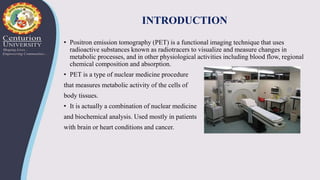
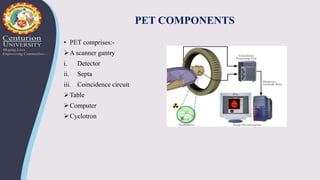
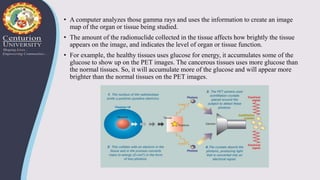
Positron emission tomography (PET) is a nuclear medicine imaging technique that produces 3D images of functional processes in the body. It works by detecting pairs of gamma rays emitted indirectly by a positron-emitting radionuclide (radiotracer) introduced into the body on a biologically active molecule. A PET scan can provide metabolic information about normal and abnormal tissues that can help detect and diagnose disease. Common clinical uses include evaluating cancer, heart disease, brain disorders, and more. Limitations include cost and the need for on-site facilities to produce short-lived radiotracers.







![Pet appilcation[1]](https://cdn.slidesharecdn.com/ss_thumbnails/petappilcation1-191002015502-thumbnail.jpg?width=640&height=640&fit=bounds)


