Gamma Camera Imaging of Radioactive
Sources in Patients
Three major Components:
1. Collimator – localizes γ-ray source in patient
2. NaI(Tl)Crystal (single or multi-crystal) over
width of patient stops the γ-rays.
3. Array of PMT’s – localizes γ-ray interaction in
crystal
Collimator Types
Quality Control (QC)
The observation techniques and activities used to
fulfill requirements for quality.
A minimum level of routine QC is required to
ensure that nuclear medicine equipment is
functioning properly.
These minimum QC tests are intended to detect
problems before they impact on clinical patient
studies.
Further tests may be required to trace the cause
of the problem and to ensure that the equipment
is performing properly after service or adjustment
1 Visual Inspection
2 Background Radiation Levels and Contamination
3 Photopeak And Window Setting
4 Uniformity
5 Resolution
6 Whole Body Scan Resolution
7 Centre Of Rotation
•Intrinsically
• Specific to Crystal and PMT’s
•Extrinsically
•Includes the Collimator
Visual Inspection
• A visual inspection may reveal obvious defects which may
compromise the safety or the imaging efficacy of the
system (e.g. frayed or damaged electrical cables).
• Of particular importance is the visual inspection of
collimators on a regular basis and whenever collimators are
changed.
• Signs of denting or scratching may indicate mechanical
damage to the collimator, and stains may be a sign of
possible contamination.
• Both of these may produce artefacts such as cold or hot
spots on planar images and rings on SPECT images.
Background Radiation
Levels and Contamination
• High levels of background radiation may arise from “hot”
patients in the proximity of the imaging system or other sources
of unshielded radiation.
• If high energy imaging agents are being used, the potential also
exists for penetration through the back of the gamma
camera, where shielding is thinner.
• Other sources of background radiation may include radioactive
contamination on the floor, walls or even the detector itself.
• Background radiation, if it is of sufficient intensity, has the
potential to seriously compromise any type of imaging.
• Even moderately elevated background levels have the potential
to seriously degrade intrinsic uniformity or other intrinsic
measurements.
Photopeak And Window
Setting
• Incorrect photopeak energy window setting(s)
can degrade uniformity, reduce sensitivity or can
increase the scatter contribution to the image.
• Peak settings should be checked and adjusted in a
consistent manner and the settings should be
recorded to detect long term drift in the settings.
• Sudden changes in peak setting indicate a possible
fault in the camera and should be fully
investigated and rectified if necessary before the
camera is again used for clinical studies.
Uniformity
• The uniformity or "flood" QC procedure checks that
the response of the detector to a uniform irradiation is
uniform within defined limits.
• It is one of the most basic QC tests of the gamma
camera.
• Interpretation of clinical images taken with the
gamma camera rely on the assumption that
differences seen are due to differences in tracer
distribution in the patient only and not differences
introduced by the gamma camera.
•
Resolution
• The purpose of resolution checks is to detect
gradual, long term deterioration of
resolution, rather than detecting abrupt
changes.
• Inappropriate adjustments carried out during
service may affect the resolution, without
necessarily being apparent in the uniformity or
other checks.
Whole Body Scan
Resolution
• To avoid loss of resolution in the scanning
direction during whole body scans, the relative
physical position between bed and detector
has to be accurately synchronised with the
electronic offset applied to the image data to
form the whole body image.
• Both mechanical problems and drift or
inappropriate adjustment of image offset or
size can cause a loss of resolution for whole
body scans, particularly in older systems.
Centre Of Rotation
• The rotation axis (or centre of rotation) assumed by
the reconstruction program has to accurately coincide
with the mechanical axis of rotation to avoid loss of
resolution and distortion in the reconstructed slices.
• Centre of rotation (COR) offsets are easily corrected
during the reconstruction process.
• Centre of rotation offset can vary with collimator and
as a function of detector rotation and radius of
rotation.
• It is important to establish which factors affect COR
offset on each particular camera and then make
appropriate allowances for it.
Recommended
Frequency of QC Tests
DAILY
Gamma Camera
• Visual Inspection
• Background/Contamination Check
• Photopeak check and adjustment, if necessary.
Depending on the camera, this may require check
and adjustment of photopeaks for all
radionuclides used with the particular camera.
• Uniformity check on gamma camera
WEEKLY
Gamma Camera
• High Count Flood uniformity check on
computer, particularly for SPECT systems.
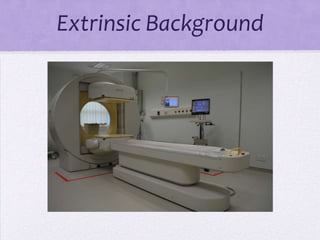
Extrinsic Background
Extrinsic Uniformity
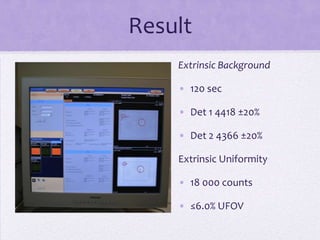
Result
Extrinsic Background
• 120 sec
• Det 1 4418 ±20%
• Det 2 4366 ±20%
Extrinsic Uniformity
• 18 000 counts
• ≤6.0% UFOV
Non-Uniformity from
Cracked/Broken Crystal
Crystal may cracked:
•From mechanical
shock during
collimator
exchange.
•by thermal shock
where the crystal
temperature
changes by more
than 10 deg./hour.
Non-Uniformity from
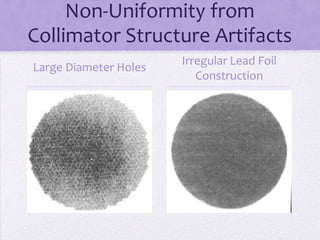
Collimator Structure Artifacts
Large Diameter Holes
Irregular Lead Foil
Construction
Non-Uniformity from
Cracked/Broken Crystal
Crushed Lead Septa Lead Foil Separation
References
• Minimum QC for Nuclear Medicine – ANZSNM
Technical Standards Subcommittee
• http://www.who.int/medicines/areas/quality_s
afety/quality_assurance/en/
THANK YOU

QC Gamma Camera

  • 2.
    Gamma Camera Imagingof Radioactive Sources in Patients Three major Components: 1. Collimator – localizes γ-ray source in patient 2. NaI(Tl)Crystal (single or multi-crystal) over width of patient stops the γ-rays. 3. Array of PMT’s – localizes γ-ray interaction in crystal
  • 3.
  • 4.
    Quality Control (QC) Theobservation techniques and activities used to fulfill requirements for quality. A minimum level of routine QC is required to ensure that nuclear medicine equipment is functioning properly. These minimum QC tests are intended to detect problems before they impact on clinical patient studies. Further tests may be required to trace the cause of the problem and to ensure that the equipment is performing properly after service or adjustment
  • 5.
    1 Visual Inspection 2Background Radiation Levels and Contamination 3 Photopeak And Window Setting 4 Uniformity 5 Resolution 6 Whole Body Scan Resolution 7 Centre Of Rotation
  • 6.
    •Intrinsically • Specific toCrystal and PMT’s •Extrinsically •Includes the Collimator
  • 7.
    Visual Inspection • Avisual inspection may reveal obvious defects which may compromise the safety or the imaging efficacy of the system (e.g. frayed or damaged electrical cables). • Of particular importance is the visual inspection of collimators on a regular basis and whenever collimators are changed. • Signs of denting or scratching may indicate mechanical damage to the collimator, and stains may be a sign of possible contamination. • Both of these may produce artefacts such as cold or hot spots on planar images and rings on SPECT images.
  • 8.
    Background Radiation Levels andContamination • High levels of background radiation may arise from “hot” patients in the proximity of the imaging system or other sources of unshielded radiation. • If high energy imaging agents are being used, the potential also exists for penetration through the back of the gamma camera, where shielding is thinner. • Other sources of background radiation may include radioactive contamination on the floor, walls or even the detector itself. • Background radiation, if it is of sufficient intensity, has the potential to seriously compromise any type of imaging. • Even moderately elevated background levels have the potential to seriously degrade intrinsic uniformity or other intrinsic measurements.
  • 9.
    Photopeak And Window Setting •Incorrect photopeak energy window setting(s) can degrade uniformity, reduce sensitivity or can increase the scatter contribution to the image. • Peak settings should be checked and adjusted in a consistent manner and the settings should be recorded to detect long term drift in the settings. • Sudden changes in peak setting indicate a possible fault in the camera and should be fully investigated and rectified if necessary before the camera is again used for clinical studies.
  • 10.
    Uniformity • The uniformityor "flood" QC procedure checks that the response of the detector to a uniform irradiation is uniform within defined limits. • It is one of the most basic QC tests of the gamma camera. • Interpretation of clinical images taken with the gamma camera rely on the assumption that differences seen are due to differences in tracer distribution in the patient only and not differences introduced by the gamma camera. •
  • 11.
    Resolution • The purposeof resolution checks is to detect gradual, long term deterioration of resolution, rather than detecting abrupt changes. • Inappropriate adjustments carried out during service may affect the resolution, without necessarily being apparent in the uniformity or other checks.
  • 12.
    Whole Body Scan Resolution •To avoid loss of resolution in the scanning direction during whole body scans, the relative physical position between bed and detector has to be accurately synchronised with the electronic offset applied to the image data to form the whole body image. • Both mechanical problems and drift or inappropriate adjustment of image offset or size can cause a loss of resolution for whole body scans, particularly in older systems.
  • 13.
    Centre Of Rotation •The rotation axis (or centre of rotation) assumed by the reconstruction program has to accurately coincide with the mechanical axis of rotation to avoid loss of resolution and distortion in the reconstructed slices. • Centre of rotation (COR) offsets are easily corrected during the reconstruction process. • Centre of rotation offset can vary with collimator and as a function of detector rotation and radius of rotation. • It is important to establish which factors affect COR offset on each particular camera and then make appropriate allowances for it.
  • 14.
    Recommended Frequency of QCTests DAILY Gamma Camera • Visual Inspection • Background/Contamination Check • Photopeak check and adjustment, if necessary. Depending on the camera, this may require check and adjustment of photopeaks for all radionuclides used with the particular camera. • Uniformity check on gamma camera
  • 15.
    WEEKLY Gamma Camera • HighCount Flood uniformity check on computer, particularly for SPECT systems.
  • 16.
  • 17.
  • 18.
    Result Extrinsic Background • 120sec • Det 1 4418 ±20% • Det 2 4366 ±20% Extrinsic Uniformity • 18 000 counts • ≤6.0% UFOV
  • 19.
    Non-Uniformity from Cracked/Broken Crystal Crystalmay cracked: •From mechanical shock during collimator exchange. •by thermal shock where the crystal temperature changes by more than 10 deg./hour.
  • 20.
    Non-Uniformity from Collimator StructureArtifacts Large Diameter Holes Irregular Lead Foil Construction
  • 21.
  • 22.
    References • Minimum QCfor Nuclear Medicine – ANZSNM Technical Standards Subcommittee • http://www.who.int/medicines/areas/quality_s afety/quality_assurance/en/
  • 23.

Editor's Notes

  • #6 Spatial Resolution Collimator - Ability of the collimator to localize the y-ray source in the patient (~6-12 mm)Intrinsic - Ability of the NaI(Tl) crystal and PMT to localize the y-ray interactions in the crystal (~3-4 mm)Extrinsic - Overall system resolution combining collimator and intrinsic factors. Quadratic sum of FWHM of intrinsic and collimator resolution.