Engine Mechanical
Components System
@jnt
Three Main Component
Parts
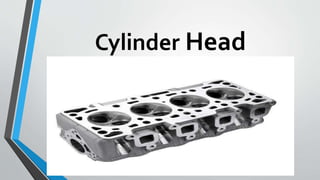
Cylinder Head
•In an internal combustion engine, the
cylinder head sits above the cylinders
on top of the cylinder block. It closes in
the top of the cylinder, forming the
combustion chamber. This joint is
sealed by a head gasket.
Cylinder Head
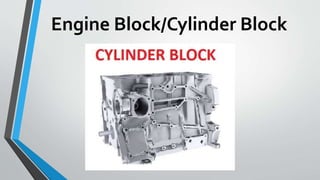
Engine Block/Cylinder Block
•A cylinder block is the structure which
contains the cylinder, plus
any cylinder sleeves and coolant passages. In
the earliest decades of internal
combustion engine development, cylinders w
ere usually cast individually, so cylinder
blocks were usually produced individually for
each cylinder.
Engine Block/Cylinder Block
Oil Pan
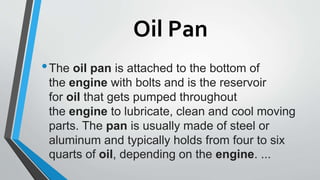
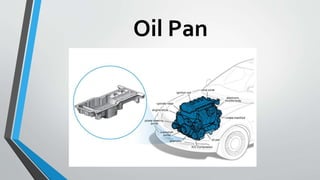
•The oil pan is attached to the bottom of
the engine with bolts and is the reservoir
for oil that gets pumped throughout
the engine to lubricate, clean and cool moving
parts. The pan is usually made of steel or
aluminum and typically holds from four to six
quarts of oil, depending on the engine. ...
Oil Pan
External Parts
Starter Motor
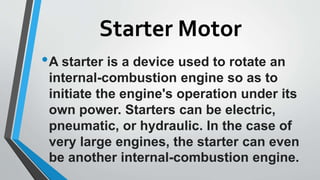
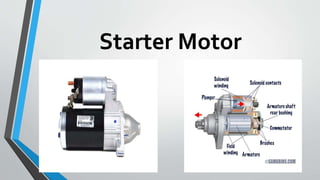
•A starter is a device used to rotate an
internal-combustion engine so as to
initiate the engine's operation under its
own power. Starters can be electric,
pneumatic, or hydraulic. In the case of
very large engines, the starter can even
be another internal-combustion engine.
Starter Motor
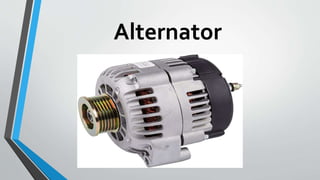
Alternator
•Alternators are used in modern
automobiles to charge the battery and to
power the electrical system when its engine
is running. Until the 1960s, automobiles
used DC dynamo generators with
commutators. With the availability of
affordable silicon diode rectifiers,
alternators were used instead
Alternator
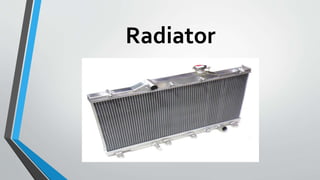
Radiator
•Radiators are heat exchangers used for
cooling internal combustion engines,
mainly in automobiles but also in
piston-engined aircraft, railway
locomotives, motorcycles, stationary
generating plant or any similar use of
such an engine.
Radiator
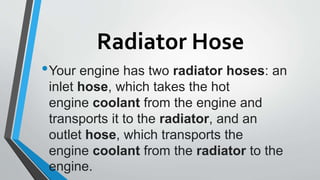
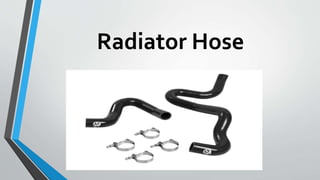
Radiator Hose
•Your engine has two radiator hoses: an
inlet hose, which takes the hot
engine coolant from the engine and
transports it to the radiator, and an
outlet hose, which transports the
engine coolant from the radiator to the
engine.
Radiator Hose
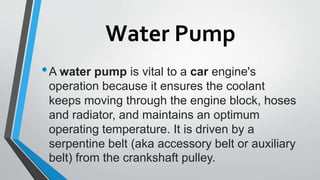
Water Pump
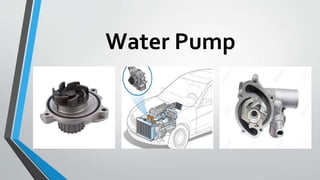
•A water pump is vital to a car engine's
operation because it ensures the coolant
keeps moving through the engine block, hoses
and radiator, and maintains an optimum
operating temperature. It is driven by a
serpentine belt (aka accessory belt or auxiliary
belt) from the crankshaft pulley.
Water Pump
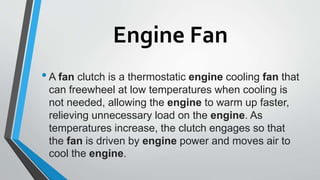
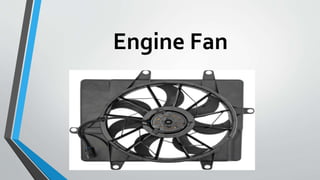
Engine Fan
•A fan clutch is a thermostatic engine cooling fan that
can freewheel at low temperatures when cooling is
not needed, allowing the engine to warm up faster,
relieving unnecessary load on the engine. As
temperatures increase, the clutch engages so that
the fan is driven by engine power and moves air to
cool the engine.
Engine Fan
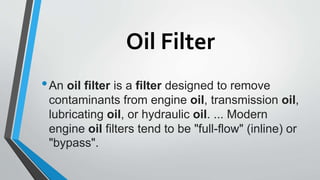
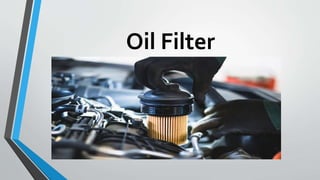
Oil Filter
•An oil filter is a filter designed to remove
contaminants from engine oil, transmission oil,
lubricating oil, or hydraulic oil. ... Modern
engine oil filters tend to be "full-flow" (inline) or
"bypass".
Oil Filter
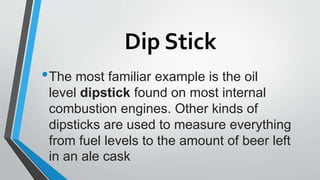
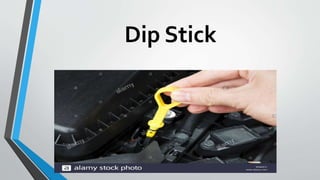
Dip Stick
•The most familiar example is the oil
level dipstick found on most internal
combustion engines. Other kinds of
dipsticks are used to measure everything
from fuel levels to the amount of beer left
in an ale cask
Dip Stick
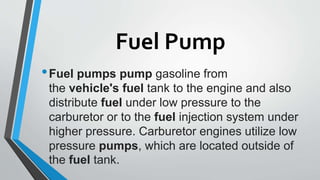
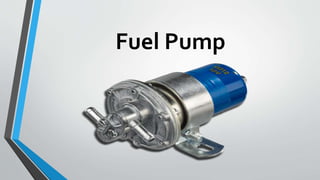
Fuel Pump
•Fuel pumps pump gasoline from
the vehicle's fuel tank to the engine and also
distribute fuel under low pressure to the
carburetor or to the fuel injection system under
higher pressure. Carburetor engines utilize low
pressure pumps, which are located outside of
the fuel tank.
Fuel Pump
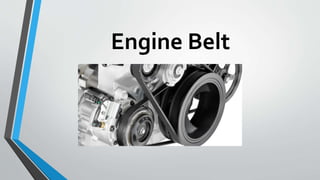
Engine Belt
•A serpentine belt is a single, continuous belt
used to drive multiple peripheral devices in an
automotive engine, such as an alternator,
power steering pump, water pump, air
conditioning compressor, air pump, etc. The
belt may also be guided by an idler pulley
and/or a belt tensioner
Engine Belt
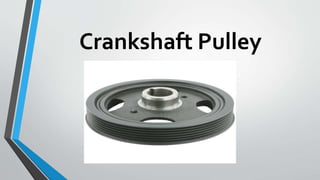
Crankshaft Pulley
•A crankshaft pulley, also called a harmonic
balance wheel or crankshaft sheave, is a
grooved, wheel-shaped device that connects
directly to the vehicle's crankshaft. ...
The crankshaft pulley typically connects to
other car components via accessory belts.
Crankshaft Pulley
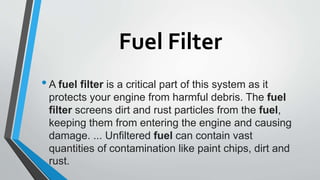
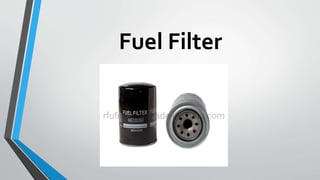
Fuel Filter
•A fuel filter is a critical part of this system as it
protects your engine from harmful debris. The fuel
filter screens dirt and rust particles from the fuel,
keeping them from entering the engine and causing
damage. ... Unfiltered fuel can contain vast
quantities of contamination like paint chips, dirt and
rust.
Fuel Filter
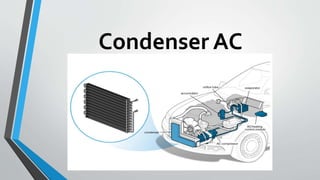
Condenser AC
•The air-conditioning condenser is a radiator
positioned between the car's grille and the
engine-cooling radiator in which the gaseous
refrigerant sheds heat and returns to a liquid
state. The liquid refrigerant flows to the
evaporator inside the dashboard, where it
cools the cabin.
Condenser AC
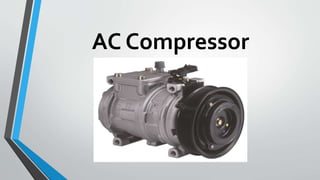
AC Compressor
•The compressor is the power unit of the air-
conditioning system that puts the refrigerant
under high pressure before it pumps it into the
condenser, where it changes from a gas to a
liquid. A fully functioning compressor is
necessary for the air-conditioning system to
provide peak performance.
AC Compressor
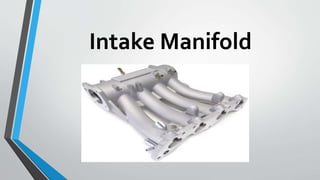
Intake Manifold
•In automotive engineering, an inlet
manifold or intake manifold is the part of
an engine that supplies the fuel/air mixture
to the cylinders. The word manifold comes
from the Old English word manigfeald and
refers to the multiplying of one into many.
Intake Manifold
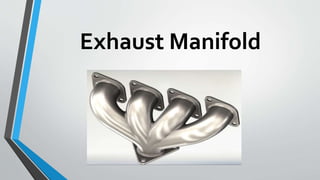
Exhaust Manifold
•In automotive engineering, an exhaust
manifold collects the exhaust gases from
multiple cylinders into one pipe. The word
manifold comes from the Old English word
manigfeald and refers to the folding
together of multiple inputs and outputs.
Exhaust Manifold
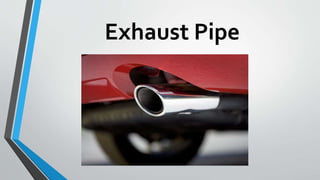
Exhaust Pipe
•An exhaust system is usually piping used to guide
reaction exhaust gases away from a controlled
combustion inside an engine or stove. The entire
system conveys burnt gases from the engine and
includes one or more exhaust pipes. ... Cylinder
head and exhaust manifold. A turbocharger to
increase engine power.
Exhaust Pipe
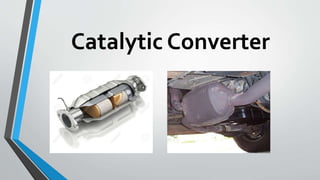
Catalytic Converter
•A catalytic converter is an exhaust
emission control device that reduces toxic
gases and pollutants in exhaust gas from
an internal combustion engine into less-
toxic pollutants by catalyzing a redox
reaction.
Catalytic Converter
Internal Parts
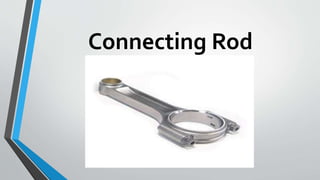
Connecting Rod
•A connecting rod, also called a con rod,
is the part of a piston engine
which connects the piston to the
crankshaft. Together with the crank,
the connecting rod converts the
reciprocating motion of the piston into the
rotation of the crankshaft.
Connecting Rod
Crankshaft
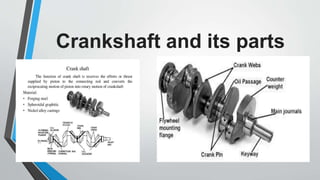
•A crankshaft is a rotating shaft which (in conjunction
with the connecting rods) converts reciprocating
motion of the pistons into rotational
motion. Crankshafts are commonly used in internal
combustion engines and consist of a series of cranks
and crankpins to which the connecting rods are
attached.
Crankshaft and its parts
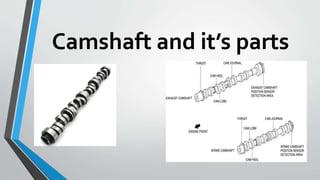
Camshaft
•A camshaft is a rotating object— usually made of
metal— that contains pointed cams, which converts
rotational motion to reciprocal
motion. Camshafts are used in internal combustion
engines (to operate the intake and exhaust valves),
mechanically controlled ignition systems and early
electric motor speed controllers.
Camshaft and it’s parts
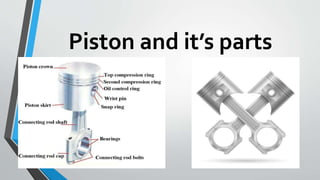
Piston
•A piston is a moving disk enclosed in a
cylinder which is made gas-tight
by piston rings. The disk moves inside the
cylinder as a liquid or gas inside the cylinder
expands and contracts. A piston aids in the
transformation of heat energy into mechanical
work and vice versa.
Piston and it’s parts
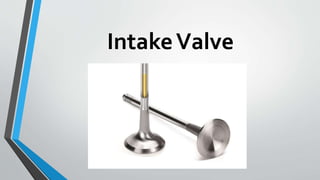
IntakeValve
•a valve that controls the passage of
fluid or air into a pipe, channel, or
duct.
IntakeValve
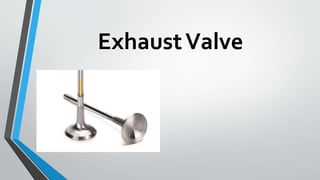
ExhaustValve
•An exhaust valve is a valve that releases burned
gases from a cylinder. ... As pressure increases
during compression and combustion, a small amount
of air-fuel mixture is forced around the edges of
the exhaust valve and between
the valve and valve seat.
ExhaustValve
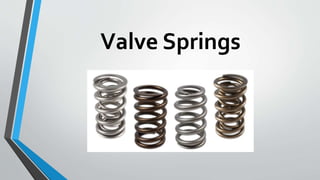
Valve Springs
•Valve springs play an important role in
controlling the breathing in internal combustion
engines. The valves are mechanically opened
by a camshaft, via valve lifters or tappets, and
closed by the valve springs. The valve
springs perform the following functions; Lifting
the weight of the valve.
Valve Springs
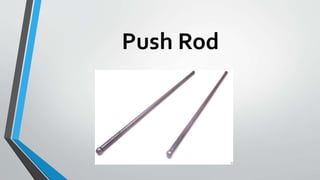
Push Rod
•An overhead valve (OHV) engine, sometimes
called a pushrod engine, is a piston engine
whose valves are located in the cylinder head
above the combustion chamber. This contrasts
with earlier flathead engines, where the valves
were located below the combustion chamber in
the engine block.
Push Rod
Valve Lifter
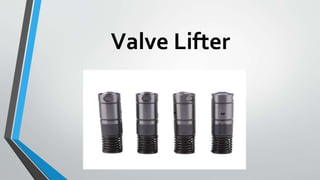
•A hydraulic tappet, also known as a hydraulic
valve lifter or hydraulic lash adjuster, is a device for
maintaining zero valve clearance in an internal
combustion engine. Conventional solid valve
lifters require regular adjusting to maintain a small
clearance between the valve and its rocker or cam
follower.
Valve Lifter
Rocker Arm
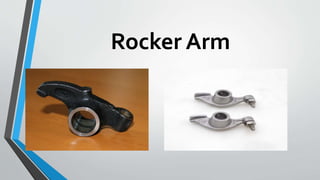
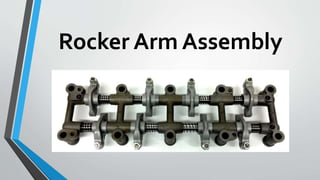
•A rocker arm (in the context of an internal
combustion engine of automotive, marine,
motorcycle and reciprocating aviation types) is
an oscillating lever that conveys radial
movement from the cam lobe into linear
movement at the poppet valve to open it.
Rocker Arm
Rocker Arm Assembly
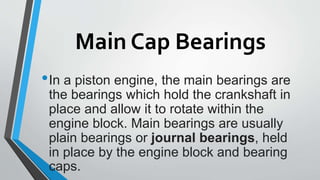
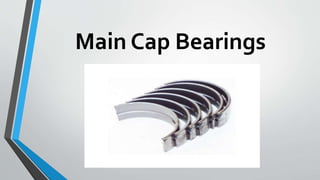
Main Cap Bearings
•In a piston engine, the main bearings are
the bearings which hold the crankshaft in
place and allow it to rotate within the
engine block. Main bearings are usually
plain bearings or journal bearings, held
in place by the engine block and bearing
caps.
Main Cap Bearings
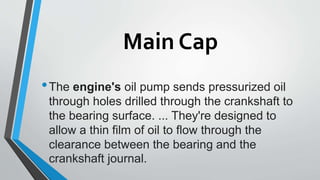
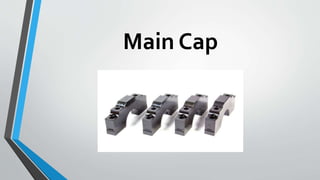
Main Cap
•The engine's oil pump sends pressurized oil
through holes drilled through the crankshaft to
the bearing surface. ... They're designed to
allow a thin film of oil to flow through the
clearance between the bearing and the
crankshaft journal.
Main Cap
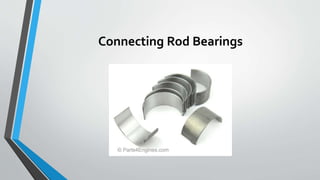
Connecting Rod Bearings
•Connecting rod bearings provide rotating motion of
the crank pin within the connecting rod, which
transmits cycling loads applied to
the piston. Connecting rod bearings are mounted
in the Big end of the connecting rod.
A bearing consists of two parts (commonly
interchangeable).
Connecting Rod Bearings
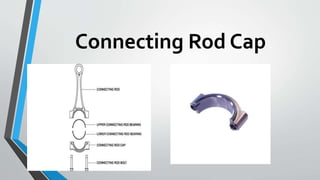
Connecting Rod Cap
•A rod cap is the removable section of a two-
piece connecting rod that provides a bearing
surface for the crankpin journal. The rod cap is
attached to the connecting rod with
two cap screws for installation and removal
from the crankshaft.
Connecting Rod Cap
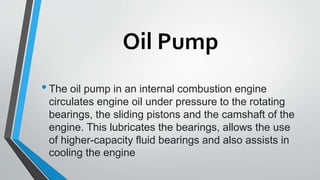
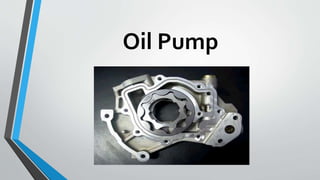
Oil Pump
•The oil pump in an internal combustion engine
circulates engine oil under pressure to the rotating
bearings, the sliding pistons and the camshaft of the
engine. This lubricates the bearings, allows the use
of higher-capacity fluid bearings and also assists in
cooling the engine
Oil Pump
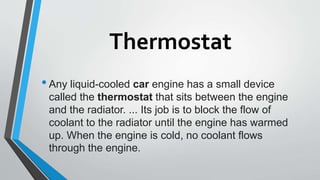
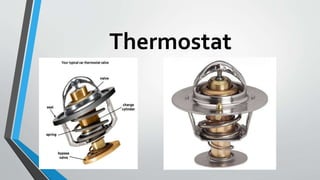
Thermostat
•Any liquid-cooled car engine has a small device
called the thermostat that sits between the engine
and the radiator. ... Its job is to block the flow of
coolant to the radiator until the engine has warmed
up. When the engine is cold, no coolant flows
through the engine.
Thermostat
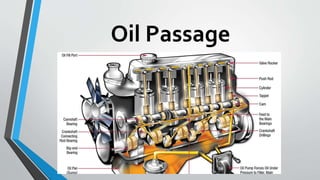
Oil Passage
•When oil is poured into an engine it settles in
the oil pan, also known as the sump, at the bottom
of the engine. ... It then flows through oil
passages (small drilled holes) in the crankshaft to
lubricate the piston connecting Oil pump rod
bearings.
Oil Passage
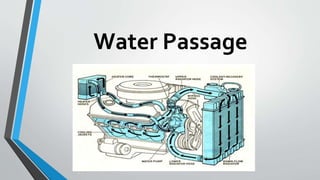
Water Passage
•The flow of water divides in the water outlet
manifolds, goes to the exhaust manifolds, and
through the jacket-water outlet. The majority of
the water is discharged to the jacket-water outlet.
... Water from the exhaust manifolds enters
cored passages in the engine front cover and
returns to the pump.
Water Passage
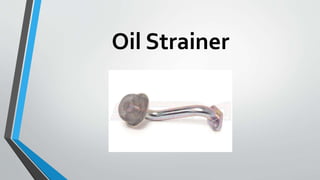
Oil Strainer
•Oil strainers have a very important function
and they must be durable in design...
The engine oil strainer is designed to prevent
debris and contaminants from entering the
vehicle's engine oil.
Oil Strainer
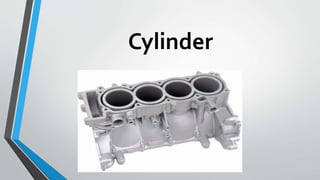
Cylinder
•The cylinder is the space through which the piston
travels, propelled to the energy generated from the
combustion of the air/fuel mixture in the combustion
chamber. In an air-cooled engine, the walls of
the cylinders are exposed to the airflow, to provide
the primary method of cooling to the engine.
Cylinder
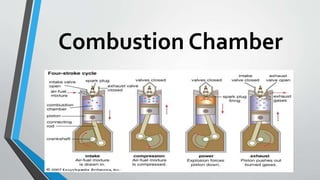
Combustion Chamber
•A Combustion Chamber is the area within the
Cylinder where the fuel/air mix is ignited. As
the Piston compresses the fuel/air mix and
makes contact with the Spark Plug, the mixture
is combusted and pushed out of
the Combustion Chamber in the form of
energy.
Combustion Chamber
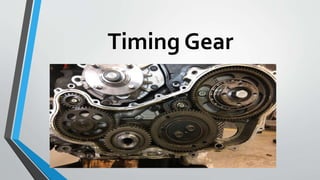
Timing Gear
•The purpose of timing gears is to allow the
camshaft and crankshaft to turn the timing chain.
The crankshaft turns to move pistons up and down
inside the cylinders. The camshaft turns to allow
intake and exhaust valves on the cylinders to open
and close. These components are important for
proper engine timing.
Timing Gear
For Gasoline Engine
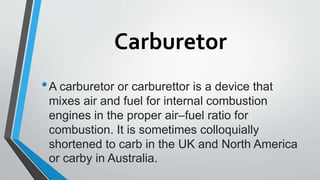
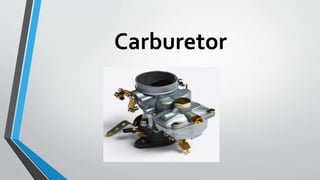
Carburetor
•A carburetor or carburettor is a device that
mixes air and fuel for internal combustion
engines in the proper air–fuel ratio for
combustion. It is sometimes colloquially
shortened to carb in the UK and North America
or carby in Australia.
Carburetor
Distributor
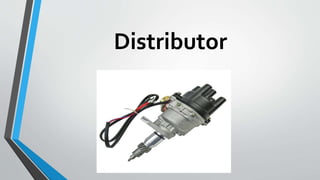
•A distributor is an enclosed rotating shaft used in
spark-ignition internal combustion engines that have
mechanically timed ignition. The distributor's main
function is to route secondary, or high voltage,
current from the ignition coil to the spark plugs in the
correct firing order, and for the correct amount of
time.
Distributor
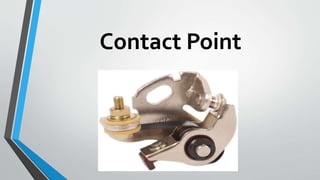
Contact Point
•A contact breaker (or "points") is a type of
electrical switch, and the term typically refers
to the switching device found in the distributor
of the ignition systems of spark-ignition internal
combustion engines.
Contact Point
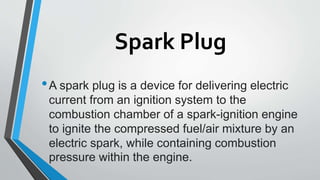
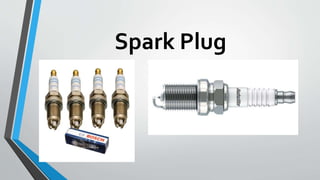
Spark Plug
•A spark plug is a device for delivering electric
current from an ignition system to the
combustion chamber of a spark-ignition engine
to ignite the compressed fuel/air mixture by an
electric spark, while containing combustion
pressure within the engine.
Spark Plug
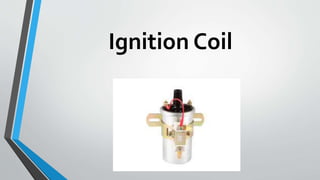
Ignition Coil
•Ignition coils are an electronic engine management
component that are a part of the
vehicle's ignition system. The ignition
coil functions as an induction coil that converts the
vehicle's 12 volts into the several thousand that are
required to jump the spark plug gap and ignite the
engine's air-fuel mixture.
Ignition Coil
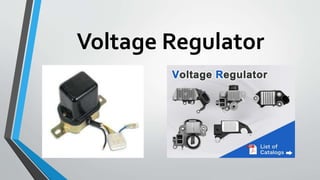
Voltage Regulator
•A VOLTAGE REGULATOR regulates the
charging voltage that the alternator produces,
keeping it between 13.5 and 14.5 volts to protect the
electrical components throughout the vehicle. ... The
most common cause is a broken alternator drive belt.
The alternator is driven by a belt that is powered by
the rotation of the engine.
Voltage Regulator
For Diesel Engine
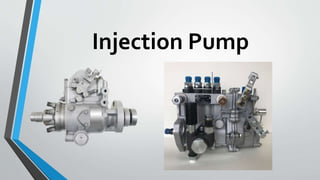
Injection Pump
•An Injection Pump is the device that pumps diesel
into the cylinders of a diesel engine. Traditionally, the
injection pump was driven indirectly from the
crankshaft by gears, chains or a toothed belt that
also drives the camshaft. It rotates at half crankshaft
speed in a conventional four-stroke diesel engine.
Injection Pump
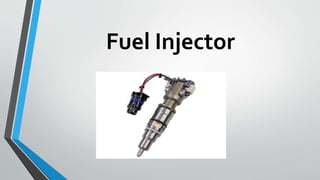
Fuel Injector
•Fuel injectors spray fuel into a car's engine using
electronic controlled valves, capable of opening and
closing many times a second. They have an
atomising nozzle that distributes the petrol or diesel
evenly, for optimum combustion and efficiency. ... A
car generally has one fuel injector per cylinder.
Fuel Injector
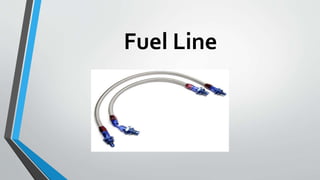
Fuel Line
•A fuel line is a hose used to
bring fuel from one point in a vehicle to
another or from a storage tank to a
vehicle. It is commonly made of reinforced
rubber to prevent splitting and kinking.
Fuel Line
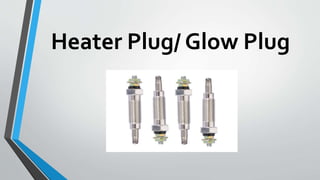
Heater Plug/ Glow Plug
•A glowplug is a heating device used to aid starting
diesel engines. In cold weather, high speed diesel
engines can be difficult to start because the mass of
the cylinder block and cylinder head absorb the heat
of compression, preventing ignition. Pre-chambered
engines use small glowplugs inside the pre-
chambers
Heater Plug/ Glow Plug
Engine mechanical components system

Engine mechanical components system

  • 1.
  • 3.
  • 4.
    Cylinder Head •In aninternal combustion engine, the cylinder head sits above the cylinders on top of the cylinder block. It closes in the top of the cylinder, forming the combustion chamber. This joint is sealed by a head gasket.
  • 5.
  • 6.
    Engine Block/Cylinder Block •Acylinder block is the structure which contains the cylinder, plus any cylinder sleeves and coolant passages. In the earliest decades of internal combustion engine development, cylinders w ere usually cast individually, so cylinder blocks were usually produced individually for each cylinder.
  • 7.
  • 8.
    Oil Pan •The oilpan is attached to the bottom of the engine with bolts and is the reservoir for oil that gets pumped throughout the engine to lubricate, clean and cool moving parts. The pan is usually made of steel or aluminum and typically holds from four to six quarts of oil, depending on the engine. ...
  • 9.
  • 10.
  • 11.
    Starter Motor •A starteris a device used to rotate an internal-combustion engine so as to initiate the engine's operation under its own power. Starters can be electric, pneumatic, or hydraulic. In the case of very large engines, the starter can even be another internal-combustion engine.
  • 12.
  • 13.
    Alternator •Alternators are usedin modern automobiles to charge the battery and to power the electrical system when its engine is running. Until the 1960s, automobiles used DC dynamo generators with commutators. With the availability of affordable silicon diode rectifiers, alternators were used instead
  • 14.
  • 15.
    Radiator •Radiators are heatexchangers used for cooling internal combustion engines, mainly in automobiles but also in piston-engined aircraft, railway locomotives, motorcycles, stationary generating plant or any similar use of such an engine.
  • 16.
  • 17.
    Radiator Hose •Your enginehas two radiator hoses: an inlet hose, which takes the hot engine coolant from the engine and transports it to the radiator, and an outlet hose, which transports the engine coolant from the radiator to the engine.
  • 18.
  • 19.
    Water Pump •A waterpump is vital to a car engine's operation because it ensures the coolant keeps moving through the engine block, hoses and radiator, and maintains an optimum operating temperature. It is driven by a serpentine belt (aka accessory belt or auxiliary belt) from the crankshaft pulley.
  • 20.
  • 21.
    Engine Fan •A fanclutch is a thermostatic engine cooling fan that can freewheel at low temperatures when cooling is not needed, allowing the engine to warm up faster, relieving unnecessary load on the engine. As temperatures increase, the clutch engages so that the fan is driven by engine power and moves air to cool the engine.
  • 22.
  • 23.
    Oil Filter •An oilfilter is a filter designed to remove contaminants from engine oil, transmission oil, lubricating oil, or hydraulic oil. ... Modern engine oil filters tend to be "full-flow" (inline) or "bypass".
  • 24.
  • 25.
    Dip Stick •The mostfamiliar example is the oil level dipstick found on most internal combustion engines. Other kinds of dipsticks are used to measure everything from fuel levels to the amount of beer left in an ale cask
  • 26.
  • 27.
    Fuel Pump •Fuel pumpspump gasoline from the vehicle's fuel tank to the engine and also distribute fuel under low pressure to the carburetor or to the fuel injection system under higher pressure. Carburetor engines utilize low pressure pumps, which are located outside of the fuel tank.
  • 28.
  • 29.
    Engine Belt •A serpentinebelt is a single, continuous belt used to drive multiple peripheral devices in an automotive engine, such as an alternator, power steering pump, water pump, air conditioning compressor, air pump, etc. The belt may also be guided by an idler pulley and/or a belt tensioner
  • 30.
  • 31.
    Crankshaft Pulley •A crankshaftpulley, also called a harmonic balance wheel or crankshaft sheave, is a grooved, wheel-shaped device that connects directly to the vehicle's crankshaft. ... The crankshaft pulley typically connects to other car components via accessory belts.
  • 32.
  • 33.
    Fuel Filter •A fuelfilter is a critical part of this system as it protects your engine from harmful debris. The fuel filter screens dirt and rust particles from the fuel, keeping them from entering the engine and causing damage. ... Unfiltered fuel can contain vast quantities of contamination like paint chips, dirt and rust.
  • 34.
  • 35.
    Condenser AC •The air-conditioningcondenser is a radiator positioned between the car's grille and the engine-cooling radiator in which the gaseous refrigerant sheds heat and returns to a liquid state. The liquid refrigerant flows to the evaporator inside the dashboard, where it cools the cabin.
  • 36.
  • 37.
    AC Compressor •The compressoris the power unit of the air- conditioning system that puts the refrigerant under high pressure before it pumps it into the condenser, where it changes from a gas to a liquid. A fully functioning compressor is necessary for the air-conditioning system to provide peak performance.
  • 38.
  • 39.
    Intake Manifold •In automotiveengineering, an inlet manifold or intake manifold is the part of an engine that supplies the fuel/air mixture to the cylinders. The word manifold comes from the Old English word manigfeald and refers to the multiplying of one into many.
  • 40.
  • 41.
    Exhaust Manifold •In automotiveengineering, an exhaust manifold collects the exhaust gases from multiple cylinders into one pipe. The word manifold comes from the Old English word manigfeald and refers to the folding together of multiple inputs and outputs.
  • 42.
  • 43.
    Exhaust Pipe •An exhaustsystem is usually piping used to guide reaction exhaust gases away from a controlled combustion inside an engine or stove. The entire system conveys burnt gases from the engine and includes one or more exhaust pipes. ... Cylinder head and exhaust manifold. A turbocharger to increase engine power.
  • 44.
  • 45.
    Catalytic Converter •A catalyticconverter is an exhaust emission control device that reduces toxic gases and pollutants in exhaust gas from an internal combustion engine into less- toxic pollutants by catalyzing a redox reaction.
  • 46.
  • 47.
  • 48.
    Connecting Rod •A connectingrod, also called a con rod, is the part of a piston engine which connects the piston to the crankshaft. Together with the crank, the connecting rod converts the reciprocating motion of the piston into the rotation of the crankshaft.
  • 49.
  • 50.
    Crankshaft •A crankshaft isa rotating shaft which (in conjunction with the connecting rods) converts reciprocating motion of the pistons into rotational motion. Crankshafts are commonly used in internal combustion engines and consist of a series of cranks and crankpins to which the connecting rods are attached.
  • 51.
  • 52.
    Camshaft •A camshaft isa rotating object— usually made of metal— that contains pointed cams, which converts rotational motion to reciprocal motion. Camshafts are used in internal combustion engines (to operate the intake and exhaust valves), mechanically controlled ignition systems and early electric motor speed controllers.
  • 53.
  • 54.
    Piston •A piston isa moving disk enclosed in a cylinder which is made gas-tight by piston rings. The disk moves inside the cylinder as a liquid or gas inside the cylinder expands and contracts. A piston aids in the transformation of heat energy into mechanical work and vice versa.
  • 55.
  • 56.
    IntakeValve •a valve thatcontrols the passage of fluid or air into a pipe, channel, or duct.
  • 57.
  • 58.
    ExhaustValve •An exhaust valveis a valve that releases burned gases from a cylinder. ... As pressure increases during compression and combustion, a small amount of air-fuel mixture is forced around the edges of the exhaust valve and between the valve and valve seat.
  • 59.
  • 60.
    Valve Springs •Valve springsplay an important role in controlling the breathing in internal combustion engines. The valves are mechanically opened by a camshaft, via valve lifters or tappets, and closed by the valve springs. The valve springs perform the following functions; Lifting the weight of the valve.
  • 61.
  • 62.
    Push Rod •An overheadvalve (OHV) engine, sometimes called a pushrod engine, is a piston engine whose valves are located in the cylinder head above the combustion chamber. This contrasts with earlier flathead engines, where the valves were located below the combustion chamber in the engine block.
  • 63.
  • 64.
    Valve Lifter •A hydraulictappet, also known as a hydraulic valve lifter or hydraulic lash adjuster, is a device for maintaining zero valve clearance in an internal combustion engine. Conventional solid valve lifters require regular adjusting to maintain a small clearance between the valve and its rocker or cam follower.
  • 65.
  • 66.
    Rocker Arm •A rockerarm (in the context of an internal combustion engine of automotive, marine, motorcycle and reciprocating aviation types) is an oscillating lever that conveys radial movement from the cam lobe into linear movement at the poppet valve to open it.
  • 67.
  • 68.
  • 69.
    Main Cap Bearings •Ina piston engine, the main bearings are the bearings which hold the crankshaft in place and allow it to rotate within the engine block. Main bearings are usually plain bearings or journal bearings, held in place by the engine block and bearing caps.
  • 70.
  • 71.
    Main Cap •The engine'soil pump sends pressurized oil through holes drilled through the crankshaft to the bearing surface. ... They're designed to allow a thin film of oil to flow through the clearance between the bearing and the crankshaft journal.
  • 72.
  • 73.
    Connecting Rod Bearings •Connectingrod bearings provide rotating motion of the crank pin within the connecting rod, which transmits cycling loads applied to the piston. Connecting rod bearings are mounted in the Big end of the connecting rod. A bearing consists of two parts (commonly interchangeable).
  • 74.
  • 75.
    Connecting Rod Cap •Arod cap is the removable section of a two- piece connecting rod that provides a bearing surface for the crankpin journal. The rod cap is attached to the connecting rod with two cap screws for installation and removal from the crankshaft.
  • 76.
  • 77.
    Oil Pump •The oilpump in an internal combustion engine circulates engine oil under pressure to the rotating bearings, the sliding pistons and the camshaft of the engine. This lubricates the bearings, allows the use of higher-capacity fluid bearings and also assists in cooling the engine
  • 78.
  • 79.
    Thermostat •Any liquid-cooled carengine has a small device called the thermostat that sits between the engine and the radiator. ... Its job is to block the flow of coolant to the radiator until the engine has warmed up. When the engine is cold, no coolant flows through the engine.
  • 80.
  • 81.
    Oil Passage •When oilis poured into an engine it settles in the oil pan, also known as the sump, at the bottom of the engine. ... It then flows through oil passages (small drilled holes) in the crankshaft to lubricate the piston connecting Oil pump rod bearings.
  • 82.
  • 83.
    Water Passage •The flowof water divides in the water outlet manifolds, goes to the exhaust manifolds, and through the jacket-water outlet. The majority of the water is discharged to the jacket-water outlet. ... Water from the exhaust manifolds enters cored passages in the engine front cover and returns to the pump.
  • 84.
  • 85.
    Oil Strainer •Oil strainershave a very important function and they must be durable in design... The engine oil strainer is designed to prevent debris and contaminants from entering the vehicle's engine oil.
  • 86.
  • 87.
    Cylinder •The cylinder isthe space through which the piston travels, propelled to the energy generated from the combustion of the air/fuel mixture in the combustion chamber. In an air-cooled engine, the walls of the cylinders are exposed to the airflow, to provide the primary method of cooling to the engine.
  • 88.
  • 89.
    Combustion Chamber •A CombustionChamber is the area within the Cylinder where the fuel/air mix is ignited. As the Piston compresses the fuel/air mix and makes contact with the Spark Plug, the mixture is combusted and pushed out of the Combustion Chamber in the form of energy.
  • 90.
  • 91.
    Timing Gear •The purposeof timing gears is to allow the camshaft and crankshaft to turn the timing chain. The crankshaft turns to move pistons up and down inside the cylinders. The camshaft turns to allow intake and exhaust valves on the cylinders to open and close. These components are important for proper engine timing.
  • 92.
  • 93.
  • 94.
    Carburetor •A carburetor orcarburettor is a device that mixes air and fuel for internal combustion engines in the proper air–fuel ratio for combustion. It is sometimes colloquially shortened to carb in the UK and North America or carby in Australia.
  • 95.
  • 96.
    Distributor •A distributor isan enclosed rotating shaft used in spark-ignition internal combustion engines that have mechanically timed ignition. The distributor's main function is to route secondary, or high voltage, current from the ignition coil to the spark plugs in the correct firing order, and for the correct amount of time.
  • 97.
  • 98.
    Contact Point •A contactbreaker (or "points") is a type of electrical switch, and the term typically refers to the switching device found in the distributor of the ignition systems of spark-ignition internal combustion engines.
  • 99.
  • 100.
    Spark Plug •A sparkplug is a device for delivering electric current from an ignition system to the combustion chamber of a spark-ignition engine to ignite the compressed fuel/air mixture by an electric spark, while containing combustion pressure within the engine.
  • 101.
  • 102.
    Ignition Coil •Ignition coilsare an electronic engine management component that are a part of the vehicle's ignition system. The ignition coil functions as an induction coil that converts the vehicle's 12 volts into the several thousand that are required to jump the spark plug gap and ignite the engine's air-fuel mixture.
  • 103.
  • 104.
    Voltage Regulator •A VOLTAGEREGULATOR regulates the charging voltage that the alternator produces, keeping it between 13.5 and 14.5 volts to protect the electrical components throughout the vehicle. ... The most common cause is a broken alternator drive belt. The alternator is driven by a belt that is powered by the rotation of the engine.
  • 105.
  • 106.
  • 107.
    Injection Pump •An InjectionPump is the device that pumps diesel into the cylinders of a diesel engine. Traditionally, the injection pump was driven indirectly from the crankshaft by gears, chains or a toothed belt that also drives the camshaft. It rotates at half crankshaft speed in a conventional four-stroke diesel engine.
  • 108.
  • 109.
    Fuel Injector •Fuel injectorsspray fuel into a car's engine using electronic controlled valves, capable of opening and closing many times a second. They have an atomising nozzle that distributes the petrol or diesel evenly, for optimum combustion and efficiency. ... A car generally has one fuel injector per cylinder.
  • 110.
  • 111.
    Fuel Line •A fuelline is a hose used to bring fuel from one point in a vehicle to another or from a storage tank to a vehicle. It is commonly made of reinforced rubber to prevent splitting and kinking.
  • 112.
  • 113.
    Heater Plug/ GlowPlug •A glowplug is a heating device used to aid starting diesel engines. In cold weather, high speed diesel engines can be difficult to start because the mass of the cylinder block and cylinder head absorb the heat of compression, preventing ignition. Pre-chambered engines use small glowplugs inside the pre- chambers
  • 114.