
Porters 5 Forces Model
What is it?
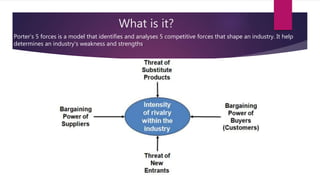
Porter’s 5 forces is a model that identifies and analyses 5 competitive forces that shape an industry. It help
determines an industry's weakness and strengths.
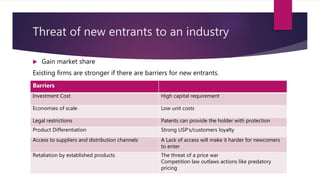
Threat of new entrants to an industry
 Gain market share
Existing firms are stronger if there are barriers for new entrants.
Barriers
Investment Cost High capital requirement
Economies of scale Low unit costs
Legal restrictions Patents can provide the holder with protection
Product Differentiation Strong USP’s/customers loyalty
Access to suppliers and distribution channels A Lack of access will make it harder for newcomers
to enter
Retaliation by established products The threat of a price war
Competition law outlaws actions like predatory
pricing
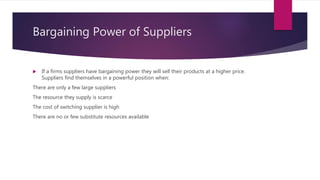
Bargaining Power of Suppliers
 If a firms suppliers have bargaining power they will sell their products at a higher price.
Suppliers find themselves in a powerful position when:
There are only a few large suppliers
The resource they supply is scarce
The cost of switching supplier is high
There are no or few substitute resources available
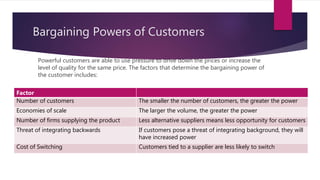
Bargaining Powers of Customers
Powerful customers are able to use pressure to drive down the prices or increase the
level of quality for the same price. The factors that determine the bargaining power of
the customer includes:
Factor
Number of customers The smaller the number of customers, the greater the power
Economies of scale The larger the volume, the greater the power
Number of firms supplying the product Less alternative suppliers means less opportunity for customers
Threat of integrating backwards If customers pose a threat of integrating background, they will
have increased power
Cost of Switching Customers tied to a supplier are less likely to switch
Threat of Substitute Products
This can be a product that meets the same need. For example, the substitutes that
consumers now have to buying newspapers for their news. The extent of the threat
depends on:
- The extent to which the price and performance of the substitute can match the
industry’s product
- The willingness of customers to switch
- Customers loyalty and switching costs
Degree of Competitive rivalry
Intense rivalry in the industry will encourage businesses to engage in price wars, Investment in innovation and new
products and intensive promotion. The main factors that determine the rivalry are:
Factor
Number of competitors in the market Rivalry will be more intense with more competitors
Product differentiation and brand loyalty Grater customer loyalty = less intense competition
Lower product differentiation = greater price competition
Cost structure of the industry If fixed costs are high percentage of costs then profits will be
dependent on volume
Market size and growth prospects Competition Is always most intense in stagnating markets
Exit Barriers It is difficult and expensive to exit an industry
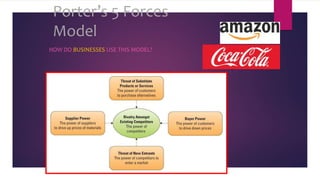
Porter’s 5 Forces
Model
HOW DO BUSINESSES USE THIS MODEL?
How is it useful to firms?
 Based on the concept that there are 5 forces that determine the
competitive intensity and attractiveness of a market.
 Five forces analysis helps organisations to understand the factors
affecting profitability in a specific industry, and can help to inform
decisions relating to: -
 whether to enter a specific industry
 whether to increase capacity in a specific industry
 and developing competitive strategies
HOW DOES IKEA APPLY TO THE
5 FORCE MODEL?
1) Rivalry among existing firms is intense in the
global market of discount furniture and the major
players in the industry include Euromarket Designs
Inc, Galiform plc, Wal-Mart Stores Inc, Argos and
others. However, currently IKEA is the undisputed
market leader in the industry of discounted
furniture in the global scale.
2) The threat of
new entrants into
the industry is
low, and the
chances of
emergence of new
competition for
IKEA is
insubstantial as
the current
market is
saturated
The bargaining power of
IKEA customers is strong,
as the competition is
intense and the
customers have a wide
choice of alternative
options offered by global
furniture retailers
However, the threat of
substitute products
and services is low as
there are no too many
products and services
available that can
substitute the
demand products
offered by IKEA.
IKEA suppliers do not
possess substantial
bargaining power as
there are numerous
factories around the
globe with the
capabilities and
resources to form
partnership with IKEA.
COCA-COLA ENTERPRISES
New Market Entrants
 Economies of scale due to high use of technology and efficient transport and
distribution methods. Eg use of expandable small bottles. This can help the
company by operating at low costs and possibly being price competitive
 Coca-Cola shows incumbents resistance releasing new products like Smart
Water to expand the company and increase profits giving them a larger market
share.
 It is unlikely that there would be more companies entering this market because
huge expenditures on capital are needed which puts off some potential
competitors.
Supplier Power
 The company is a franchise of the Coca-Cola Company.
 It has bargaining power as it is the biggest company that buys its raw materials
from the Coca-Cola Company.
 They have a close relationship with their suppliers as they share their profits.
Buyer Power
 The market is competitive with other companies like Pepsi and Britvic.
 Customers would not incur high costs from switching from one player to another
but customers can easily switch to substitutes.
 Choice of buyers may depend on price and the reputation of the business which
may be the reason why the company is trying to reduce the size of its carbon
footprint.
Product and technology development
 The company keeps on coming up with new innovative products like Smart Water
and Dr Pepper to compete in other markets and be competitive to companies like
Evian.
 There are also investments in technology to increase efficiency, productivity and
reduce costs.
Competitive Rivalry
 Competition from Pepsi and Britvic.
 There is brand loyalty and recognition among customers.
 Competition is relatively high.
 Customers would not incur high costs from switching from one player to another.
 The company has a variety of products including cola, Fanta and water.
 They try to differentiate the taste of their product and they also differentiate
through branding.
Porters 5 forces model

Porters 5 forces model

  • 1.
  • 2.
    What is it? Porter’s5 forces is a model that identifies and analyses 5 competitive forces that shape an industry. It help determines an industry's weakness and strengths.
  • 3.
    Threat of newentrants to an industry  Gain market share Existing firms are stronger if there are barriers for new entrants. Barriers Investment Cost High capital requirement Economies of scale Low unit costs Legal restrictions Patents can provide the holder with protection Product Differentiation Strong USP’s/customers loyalty Access to suppliers and distribution channels A Lack of access will make it harder for newcomers to enter Retaliation by established products The threat of a price war Competition law outlaws actions like predatory pricing
  • 4.
    Bargaining Power ofSuppliers  If a firms suppliers have bargaining power they will sell their products at a higher price. Suppliers find themselves in a powerful position when: There are only a few large suppliers The resource they supply is scarce The cost of switching supplier is high There are no or few substitute resources available
  • 5.
    Bargaining Powers ofCustomers Powerful customers are able to use pressure to drive down the prices or increase the level of quality for the same price. The factors that determine the bargaining power of the customer includes: Factor Number of customers The smaller the number of customers, the greater the power Economies of scale The larger the volume, the greater the power Number of firms supplying the product Less alternative suppliers means less opportunity for customers Threat of integrating backwards If customers pose a threat of integrating background, they will have increased power Cost of Switching Customers tied to a supplier are less likely to switch
  • 6.
    Threat of SubstituteProducts This can be a product that meets the same need. For example, the substitutes that consumers now have to buying newspapers for their news. The extent of the threat depends on: - The extent to which the price and performance of the substitute can match the industry’s product - The willingness of customers to switch - Customers loyalty and switching costs
  • 7.
    Degree of Competitiverivalry Intense rivalry in the industry will encourage businesses to engage in price wars, Investment in innovation and new products and intensive promotion. The main factors that determine the rivalry are: Factor Number of competitors in the market Rivalry will be more intense with more competitors Product differentiation and brand loyalty Grater customer loyalty = less intense competition Lower product differentiation = greater price competition Cost structure of the industry If fixed costs are high percentage of costs then profits will be dependent on volume Market size and growth prospects Competition Is always most intense in stagnating markets Exit Barriers It is difficult and expensive to exit an industry
  • 8.
    Porter’s 5 Forces Model HOWDO BUSINESSES USE THIS MODEL?
  • 9.
    How is ituseful to firms?  Based on the concept that there are 5 forces that determine the competitive intensity and attractiveness of a market.  Five forces analysis helps organisations to understand the factors affecting profitability in a specific industry, and can help to inform decisions relating to: -  whether to enter a specific industry  whether to increase capacity in a specific industry  and developing competitive strategies
  • 10.
    HOW DOES IKEAAPPLY TO THE 5 FORCE MODEL? 1) Rivalry among existing firms is intense in the global market of discount furniture and the major players in the industry include Euromarket Designs Inc, Galiform plc, Wal-Mart Stores Inc, Argos and others. However, currently IKEA is the undisputed market leader in the industry of discounted furniture in the global scale. 2) The threat of new entrants into the industry is low, and the chances of emergence of new competition for IKEA is insubstantial as the current market is saturated
  • 11.
    The bargaining powerof IKEA customers is strong, as the competition is intense and the customers have a wide choice of alternative options offered by global furniture retailers However, the threat of substitute products and services is low as there are no too many products and services available that can substitute the demand products offered by IKEA. IKEA suppliers do not possess substantial bargaining power as there are numerous factories around the globe with the capabilities and resources to form partnership with IKEA.
  • 12.
  • 13.
    New Market Entrants Economies of scale due to high use of technology and efficient transport and distribution methods. Eg use of expandable small bottles. This can help the company by operating at low costs and possibly being price competitive  Coca-Cola shows incumbents resistance releasing new products like Smart Water to expand the company and increase profits giving them a larger market share.  It is unlikely that there would be more companies entering this market because huge expenditures on capital are needed which puts off some potential competitors.
  • 14.
    Supplier Power  Thecompany is a franchise of the Coca-Cola Company.  It has bargaining power as it is the biggest company that buys its raw materials from the Coca-Cola Company.  They have a close relationship with their suppliers as they share their profits.
  • 15.
    Buyer Power  Themarket is competitive with other companies like Pepsi and Britvic.  Customers would not incur high costs from switching from one player to another but customers can easily switch to substitutes.  Choice of buyers may depend on price and the reputation of the business which may be the reason why the company is trying to reduce the size of its carbon footprint.
  • 16.
    Product and technologydevelopment  The company keeps on coming up with new innovative products like Smart Water and Dr Pepper to compete in other markets and be competitive to companies like Evian.  There are also investments in technology to increase efficiency, productivity and reduce costs.
  • 17.
    Competitive Rivalry  Competitionfrom Pepsi and Britvic.  There is brand loyalty and recognition among customers.  Competition is relatively high.  Customers would not incur high costs from switching from one player to another.  The company has a variety of products including cola, Fanta and water.  They try to differentiate the taste of their product and they also differentiate through branding.