Porter’s Five Force
Model
BY - NEETIKA RAO
MICHAEL PORTER “An industry’s
profit potential is largely
determined by the intensity of
competitive rivalry within that
industry”
Introduction
• This model aimed to provide a new way to use effective strategy to identify,
analyse and manage external factors in an organization’s environment.
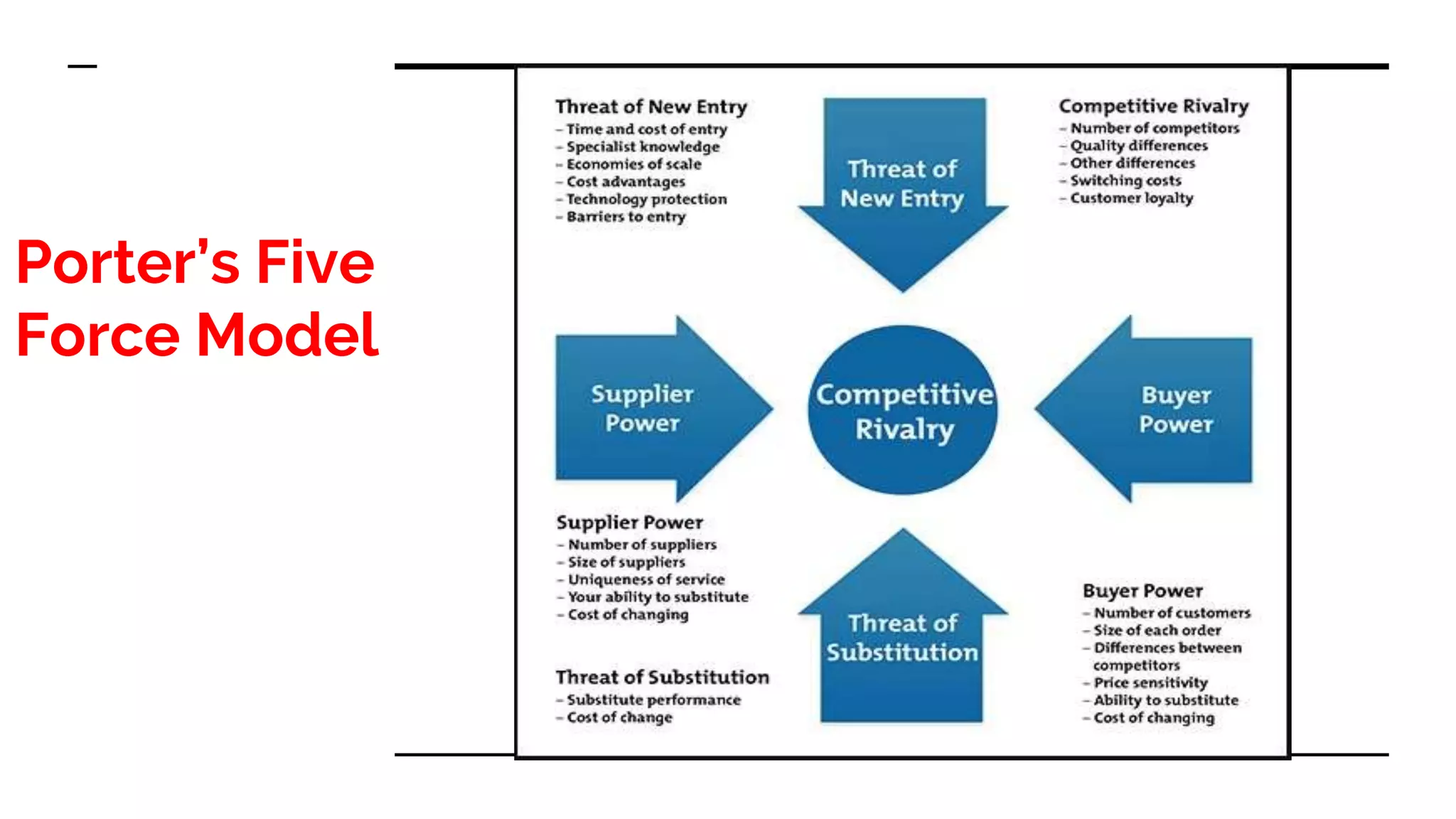
• Porter’s five forces model is an analysis tool that uses five industry forces to
determine the intensity of competition in an industry and its profitability level.
• An attractive market place does not mean that all companies will enjoy similar
success levels. Rather, the unique selling propositions, strategies and processes will
put one company over the other.
• The Five Forces were Porter’s conclusions on the reasons for differing levels of
competition, and hence profitability, in differing industries. They are empirically
derived, i.e. by observation of real companies in real markets, rather than the result
of economic analysis.
Porter’s Five
Force Model
Strengths Limitations
The model is strong tool for competitive
analysis at industry level.
It provides useful input for performing a
SWOT analysis.
● Inside-out strategy is ignored (core
competence)
● It does not cope with synergies and
interdependencies within the portfolio of large
corporations (parenting advantage)
● The environments which are characterized by
rapid, systemic and radical change require more
flexible, dynamic or emergent approaches to
strategy formulation (disruptive innovation)
● Sometimes it may be possible to create
completely new markets instead of selecting
from existing ones.
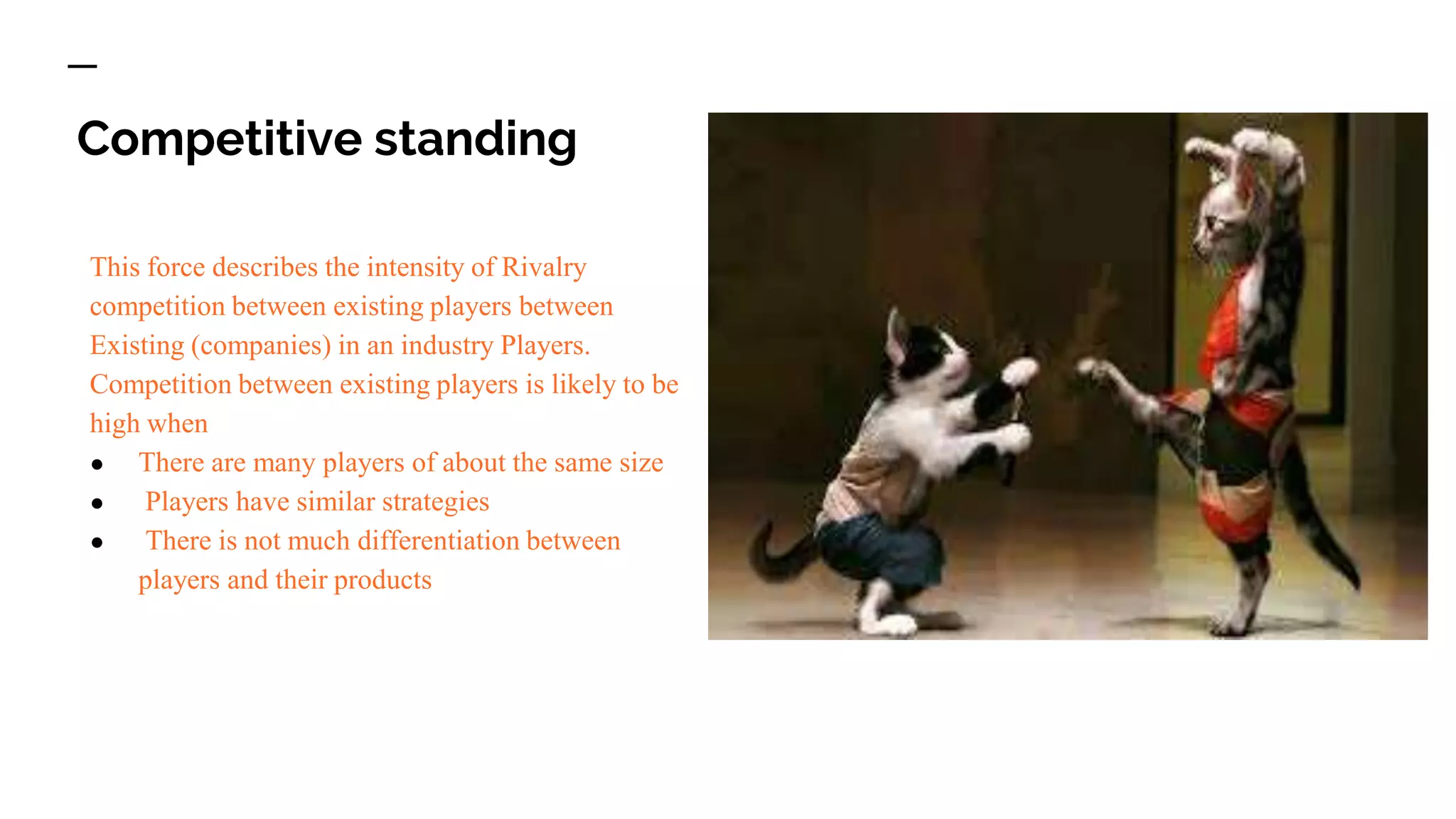
Competitive standing
This force describes the intensity of Rivalry
competition between existing players between
Existing (companies) in an industry Players.
Competition between existing players is likely to be
high when
● There are many players of about the same size
● Players have similar strategies
● There is not much differentiation between
players and their products
Competitive Rivalry
within an Industry-
McDonald
McDonald’s faces tough competition because the fast food
restaurant market is already saturated. This element of the
Five Forces analysis tackles the effect of competing firms in
the industry environment. In McDonald’s case, the strong
force of competitive rivalry is based on the following external
factors:
High number of firms (strong force)
High aggressiveness of firms (strong force)
Low switching costs (strong force)
The fast food restaurant industry has many firms of various
sizes, such as global chains like McDonald’s, KFC and local
fast food restaurants and road side stops (vada pav) . Also,
most medium and large firms aggressively market their
products. In addition, McDonald’s customers experience low
switching costs, which means that they can easily transfer to
other restaurants. Thus, this element of the Five Forces
analysis of McDonald’s shows that competition is among the
most significant external forces on the business.
Suppliers also influence the
competiveness of an industry-
Toyota
The bargaining power of Toyota’s supplier is Weak
Toyota has many suppliers in its automotive manufacturing sector. Resources
like metal, raw materials, leather, plastic, computers, cooling system, electrical
system, breaking system and fuel supply system are all bought from hundreds
of different suppliers and different bargaining prices distributed across the
globe.
One of the competitive advantages of Toyota is its strong relationship with the
suppliers and its efficient manner of monitoring supply chain places low
bargaining power on the suppliers.
In addition most vehicle manufactures own many interchangeable suppliers,
and also have the ability to produce the components by their own in the short
time. Thus, the suppliers do not own the power to change the price.
Bargaining power of Buyer- Coca-Cola
Example of Bargaining power of Buyer Depends on the marketing
channel used for Coca-Cola
• Super Markets
• Convenience Stores
• Soda Shop
• Vending Machine
• Restaurant and Food stores
● The individual buyer no pressure on Coca-Cola
● Large retailers, like Wal-Mart, have bargaining power
because of the large order quantity, but the bargaining
power is lessened because of the end consumer brand
loyalty.
Threat of New
Entrant- Reliance JIO
Example of Threat of New Entrant –
Entry of Reliance JIO Telecommunications
• Jio has grown at a scorching pace:-the network, which
has been adding 1- 1.2 million subscribers a day, will
likely have 25 million 4G customers.
• Jio has set off a fierce mobile tariff war in the country:
• Jio is hurting the balance sheets of other telecom
companies: Airtel saw a 4.9% decline in its Q2 profit
following the operator slashing data tariffs.
• Jio is forcing the other players to join forces:-
Vodafone and Idea Merger
• Jio could impact the online content market in India:-
The Jio suite offers more than 300 live streaming TV
channels and hundreds of music albums and movies.
This forces other incumbents to up their game in the
online video streaming space.
Threat of substitutes : – THE AIRLINE
INDUSTRY
From the point of view of airlines themselves, the flying business is very competitive.
There are hundreds of airlines all trying to get a bigger piece of the pie. Global recessions
have also meant cost cutting exercises for most airlines in the industry and often less
travel in the part of consumers.
Depending on the nature of the airline’s business, the threat of substitutes can range from
lower on the scale to mid-range.
For domestic or regional airlines or routes, there is always the option of taking a car, bus
or train. It may take longer but often this consideration is outweighed by the cost
advantages of substitute methods
There is also no switching cost to deal with.
In the case of international airlines, the threat of substitutes is almost non-existent
On longer routes, a traveller needs to take a flight with no possible alternates
Threat here is from competitors who may offer better rewards, better prices or a better
flying experience
There is also somewhat of a switching cost Example of Threat of substitutes
N E S T L E
Competition is stiff in the food processing market and
Groupe Danone as well as Kraft Foods are the main
rivals of Nestle. This is evident in the commercials that
these companies carry out to attract clients and the
constant innovations in their products. However, Nestle
has always led in the industry because of its top quality
products and constant innovations. Competition has also
ensured that clients have access to the best products in
the world.
COMPETITIVE RIVALRY WITHIN THE
INDUSTRY- HIGH
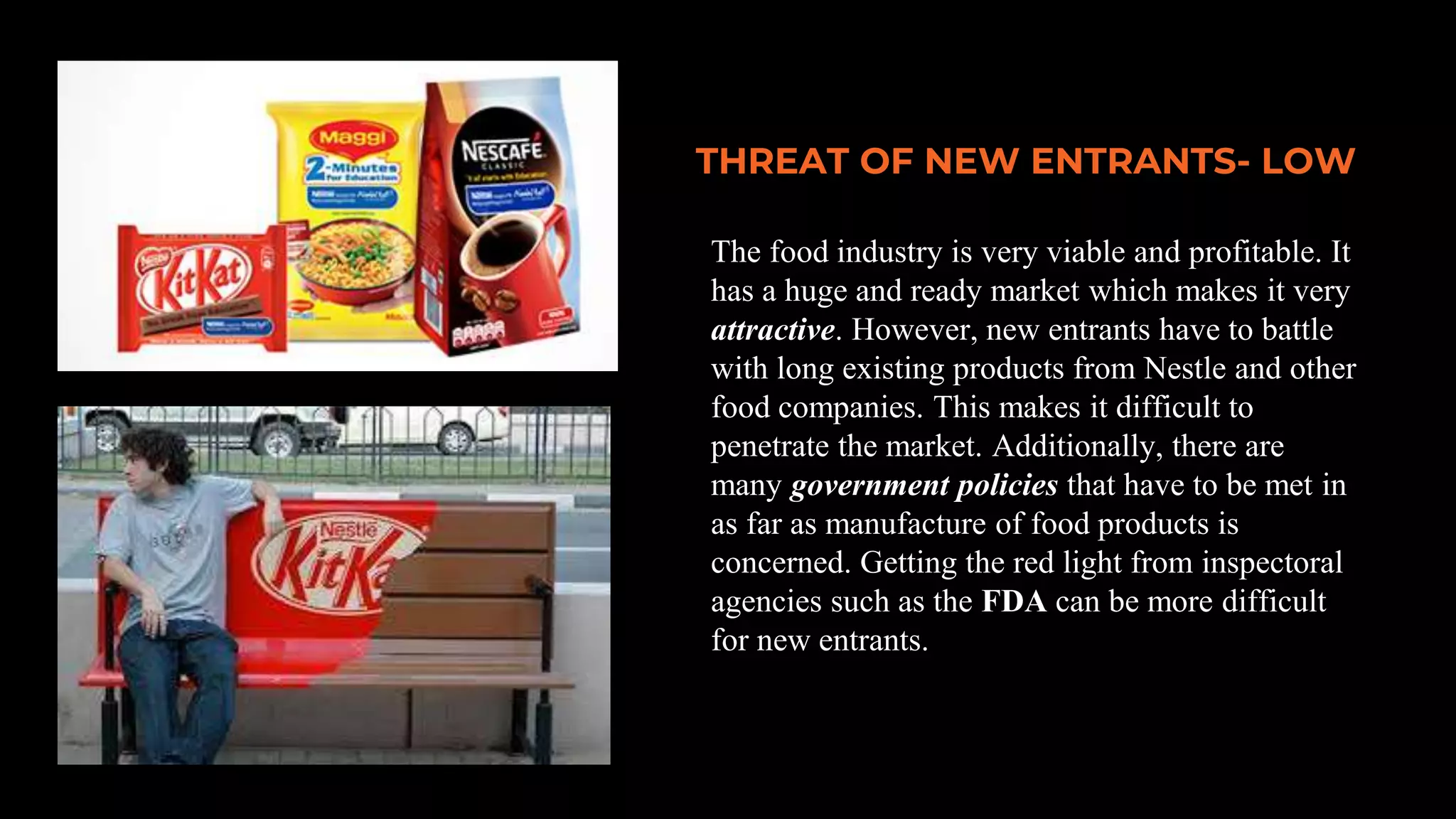
THREAT OF NEW ENTRANTS- LOW
The food industry is very viable and profitable. It
has a huge and ready market which makes it very
attractive. However, new entrants have to battle
with long existing products from Nestle and other
food companies. This makes it difficult to
penetrate the market. Additionally, there are
many government policies that have to be met in
as far as manufacture of food products is
concerned. Getting the red light from inspectoral
agencies such as the FDA can be more difficult
for new entrants.
The customers in the food processing industry
have a lot of bargaining power. This is because of
the easy access to substitute products as well as
other food processing companies besides Nestle.
However, Nestle has countered this bargaining
power by constantly innovating new products that
meet the demands and needs of the clients. The
company has also maintained high quality
production process and incorporated healthy
products into its productions. This has given it
popularity amongst the clients.
BARGAINING POWER OF
BUYERS- HIGH
Bargaining power of suppliers is very important factor to be
considered in any industry as they are the main strength of
the company. Nestle is known for strong relations with the
suppliers around the globe due to its immense buying power
and also because of the fact that in such dairy and
agricultural products quality is always important. Nestle as
always focused over strong and sturdy business relations to
make the ongoing quality stronger. Additionally, Nestlé also
presents helpful guidance to its suppliers on how to work
more proficiently to decrease redundant expenses. And thus
it cares of its suppliers which in return pays them off in the
form of quality products.
BARGAINING POWER OF SUPPLIERS-
LOW
As the product is very common and daily use
product so the threat of substitutes is very high
here. Like if we take the example of bottled water
so the substitute of this is lean pockets that serve
as a competition.There are other food processing
companies such as Groupe Danone and Kraft
foods which produce similar products as Nestle.
So Nestle has to innovate its products
tremendously to stay in the market and to work
efficiently for removing the threat of substitutes.
We can take the example of recent innovation
which is health consciousness and wellness factor
that has been introduced in all products of Nestle.
Such initiatives would make it easier for Nestle to
go beyond the substitutes.
THREAT OF SUBSTITUTE
GOODS- High
STARBUCKS
Starbucks Coffee Company’s success is based on its effectiveness in addressing
the negative impacts of the five forces in its industry environment. These
external factors are outlined in Michael Porter’s Five Forces model. Starbucks
must suitable respond to these five forces to maintain its market position. This
analysis of Starbucks Coffee indicates the intensities of the five forces on the
firm, and the bases of these forces. Starbucks Coffee’s success indicates its
effectiveness in addressing these external factors in its industry environment.
This Five Forces analysis (based on Porter’s model) of external factors in
Starbucks Coffee’s industry environment reveals the most significant issues
facing the company. Success potential is based on how Starbucks positions its
business to address or overcome these five forces.
This part of the Five Forces analysis shows that competition is among the
most important of Starbucks Coffee’s concerns. The company faces a
large number of competitors, which have different sizes, specialties and
strategies. For example, Starbucks faces the competitive force of
McDonald’s and Dunkin Donuts, as well as other specialty coffee
companies. The strong force of competition is also due to the low
switching cost, which means that it is easy for customers to shift from
Starbucks to other brands. Thus, based on this component of the Five
Forces analysis, competition should be among Starbucks Coffee’s top-
priority challenges.
Competitive Rivalry or Competition with
Starbucks Coffee (Strong Force)
Threat of New Entrants or New
Entry (Moderate Force)
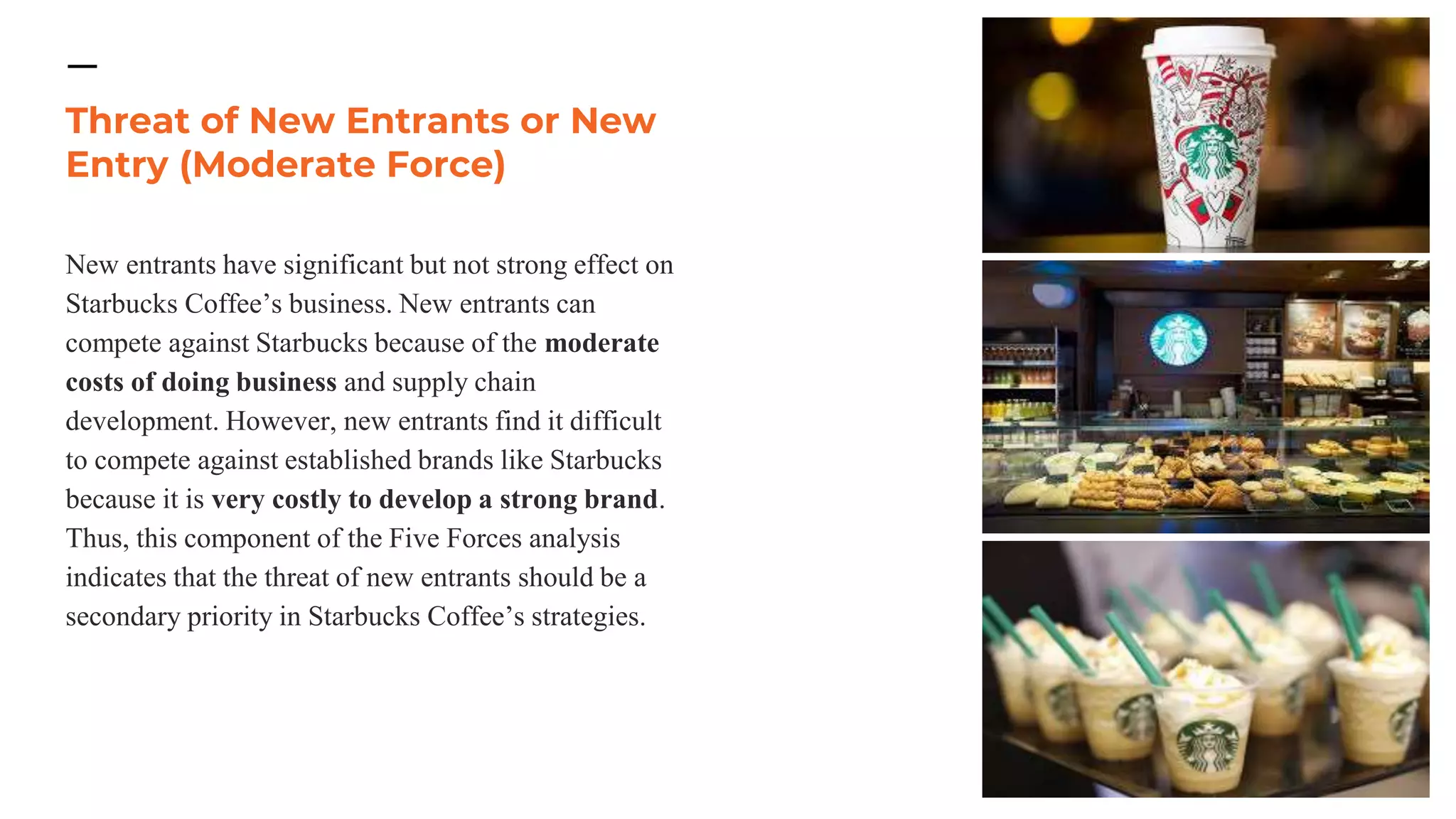
New entrants have significant but not strong effect on
Starbucks Coffee’s business. New entrants can
compete against Starbucks because of the moderate
costs of doing business and supply chain
development. However, new entrants find it difficult
to compete against established brands like Starbucks
because it is very costly to develop a strong brand.
Thus, this component of the Five Forces analysis
indicates that the threat of new entrants should be a
secondary priority in Starbucks Coffee’s strategies.
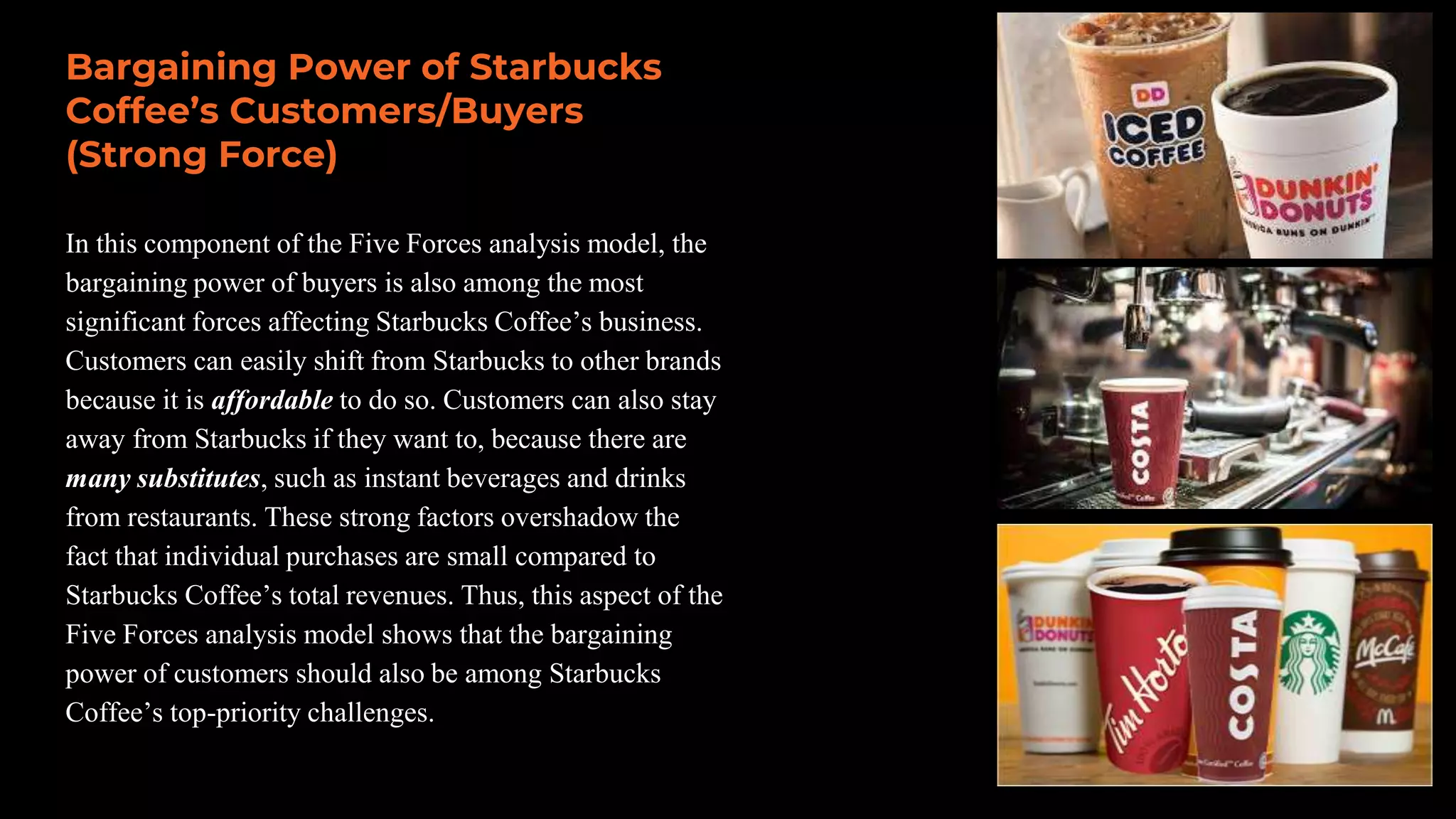
In this component of the Five Forces analysis model, the
bargaining power of buyers is also among the most
significant forces affecting Starbucks Coffee’s business.
Customers can easily shift from Starbucks to other brands
because it is affordable to do so. Customers can also stay
away from Starbucks if they want to, because there are
many substitutes, such as instant beverages and drinks
from restaurants. These strong factors overshadow the
fact that individual purchases are small compared to
Starbucks Coffee’s total revenues. Thus, this aspect of the
Five Forces analysis model shows that the bargaining
power of customers should also be among Starbucks
Coffee’s top-priority challenges.
Bargaining Power of Starbucks
Coffee’s Customers/Buyers
(Strong Force)
Bargaining Power of Starbucks
Coffees’ Suppliers (Weak Force)
This part of the Five Forces analysis model shows
that suppliers do not have much impact on
Starbucks. The large overall supply lessens the
effect of any single supplier on the company. Also,
Starbucks has a policy for diversifying its supply
chain. This policy reduces the influence of
suppliers on the business even though each
supplier has a moderate size compared to the
Starbucks supply chain. Thus, based on this aspect
of the Five Forces analysis model, Starbucks
Coffee does not need to prioritize the concerns or
demands of suppliers.
Threat of Substitution or Substitutes
to Starbucks Products (Strong Force)
Substitutes have strong potential to negatively impact
Starbucks Coffee’s business. Starbucks customers can easily
shift to substitutes because there are many substitutes, such as
beverages from restaurants, and instant and bottled beverages
and other goods from grocery stores. The cost of shifting to
substitutes is low because Starbucks customers do not need to
spend for the shifting process. In addition, many of these
substitutes cost less than Starbucks products. Thus, based on
this part of the Five Forces analysis, Starbucks must consider
the threat of substitutes as among its top-priority concerns.
T H E B O D Y S H O P
COMPETITIVE RIVALRY WITHIN
THE INDUSTRY- HIGH
In the cosmetic market, it is obvious that because of high
market growth rate and profit, more competitors flocked to
this profitable market. For instance Bath & Body Works,
Garden Botanika, H2O+ all copied the strategy of Body Shop
and entered in this market. The sales of Bath & Body Works
increased from 1.12 billion dollars in 1993 to 10 billion
dollars in 1999. The functions of the cosmetic products are
surprisingly similar, so there is likely to be intense
competition over market share which usually results in the
price wars intermittently making the profit of this industry
vulnerable. All of above proved that the threat of competitive
rivalry is strong.
THREAT OF NEW ENTRANTS
Body Shop, firstly, through 28 years hardship, Body Shop established a strong image with good
reputation by the customers, so for the new entrant it is not easy to build up a strong brand loyalty
in short time. Besides, through advocating Fair community trade, Body Shop formed good
relationship with the long-term suppliers of raw materials in the 3rd world countries, which is more
like a friendship than a partner in business environment and can not be imitated by new entrant. In
addition, Body Shop share a developed distribution channel through its own franchise system and
appropriate technology of natural ingredients against animal test, all of above set big barriers for
new entrants. On the contrary, the existing products of Body Shop are becoming more and more
homogeneous. For the reason that the natural ingredients seem to be not the only core
technology of Body Shop, for instance the big competitors Bath & Body works, Garden Botanika
with huge resource had entered the cosmetic market in the middle of 90th with similar natural
cosmetic products. Because of lack of innovation in new product, designing, packing, from 1996 to
1998, around 20 franchises cancelled the contract with Body Shop in USA which resulted in
dramatically declining of market share of Body Shop in USA. So we conclude a mix response to
this force as technology and innovation can open the door to new entrants.
BARGAINING POWER OF BUYERS- HIGH
As for the cosmetic product markets, although the Body Shop doesn’t
concentrate on youths, the majority of consumers are the young
generations who are more inclined to be changeable comparing with the
old generations and concern less on the environment and public issues.
So it becomes harder to attract them to buy the products of Body Shop
mainly because of the differentiation of the social issue. They are more
professional on technology so they could easily know the information
of the price and the new functions of other competitor’s products. At
the same time the buyer have nearly no switching cost to change
another cosmetic products. And nowadays the products of other rivalry
such as Baths and body works, Garden, Botanika have little different
functions of product at relatively cheaper price and the products of
Sainsbury are easier to accessible, so it is more likely for them to
change the products of Body Shop. In conclusion the bargaining power
of buyer is strong.
BARGAINING POWER OF SUPPLIERS
- LOW
According to the Body Shop, the bargaining power of suppliers
is not strong, for the following reasons. Firstly most of
suppliers of Body Shop come from 3rd world countries and
they have limited partner in this industry so that they did not
have monopoly power in supplier industry. Secondly because
the suppliers come from poor community, they have expensive
switching cost because Body Shop is not only the biggest buyer
of them but also contributed to the beneficence of their
community, so it is impossible for them to find other beneficent
buyer to cooperate with. It is two-win cooperation so that the
supplier would not be likely to destroy it. So we can see the
bargaining power of suppliers is not strong.
THREAT OF SUBSTITUTE
GOODS- High
The threat of substitutes comes mainly from
relative price, technology and costs of switching.
As for this point, the substitutes of Body Shop’s
products are the traditional cosmetic products
without focusing on environmental issue and being
made of natural ingredients. Consumers can also
make ​​themselves their products with natural
ingredients easily accessible. Indeed, today's trend
is home-made products and this could affect The
Body Shop. There are also other natural products
on the market as this is increasingly sought after
by customers in the industry of beauty.
THANK YOU

Poter's 5 force model

  • 1.
  • 2.
    MICHAEL PORTER “Anindustry’s profit potential is largely determined by the intensity of competitive rivalry within that industry”
  • 3.
    Introduction • This modelaimed to provide a new way to use effective strategy to identify, analyse and manage external factors in an organization’s environment. • Porter’s five forces model is an analysis tool that uses five industry forces to determine the intensity of competition in an industry and its profitability level. • An attractive market place does not mean that all companies will enjoy similar success levels. Rather, the unique selling propositions, strategies and processes will put one company over the other. • The Five Forces were Porter’s conclusions on the reasons for differing levels of competition, and hence profitability, in differing industries. They are empirically derived, i.e. by observation of real companies in real markets, rather than the result of economic analysis.
  • 4.
  • 5.
    Strengths Limitations The modelis strong tool for competitive analysis at industry level. It provides useful input for performing a SWOT analysis. ● Inside-out strategy is ignored (core competence) ● It does not cope with synergies and interdependencies within the portfolio of large corporations (parenting advantage) ● The environments which are characterized by rapid, systemic and radical change require more flexible, dynamic or emergent approaches to strategy formulation (disruptive innovation) ● Sometimes it may be possible to create completely new markets instead of selecting from existing ones.
  • 6.
    Competitive standing This forcedescribes the intensity of Rivalry competition between existing players between Existing (companies) in an industry Players. Competition between existing players is likely to be high when ● There are many players of about the same size ● Players have similar strategies ● There is not much differentiation between players and their products
  • 7.
    Competitive Rivalry within anIndustry- McDonald McDonald’s faces tough competition because the fast food restaurant market is already saturated. This element of the Five Forces analysis tackles the effect of competing firms in the industry environment. In McDonald’s case, the strong force of competitive rivalry is based on the following external factors: High number of firms (strong force) High aggressiveness of firms (strong force) Low switching costs (strong force) The fast food restaurant industry has many firms of various sizes, such as global chains like McDonald’s, KFC and local fast food restaurants and road side stops (vada pav) . Also, most medium and large firms aggressively market their products. In addition, McDonald’s customers experience low switching costs, which means that they can easily transfer to other restaurants. Thus, this element of the Five Forces analysis of McDonald’s shows that competition is among the most significant external forces on the business.
  • 8.
    Suppliers also influencethe competiveness of an industry- Toyota The bargaining power of Toyota’s supplier is Weak Toyota has many suppliers in its automotive manufacturing sector. Resources like metal, raw materials, leather, plastic, computers, cooling system, electrical system, breaking system and fuel supply system are all bought from hundreds of different suppliers and different bargaining prices distributed across the globe. One of the competitive advantages of Toyota is its strong relationship with the suppliers and its efficient manner of monitoring supply chain places low bargaining power on the suppliers. In addition most vehicle manufactures own many interchangeable suppliers, and also have the ability to produce the components by their own in the short time. Thus, the suppliers do not own the power to change the price.
  • 9.
    Bargaining power ofBuyer- Coca-Cola Example of Bargaining power of Buyer Depends on the marketing channel used for Coca-Cola • Super Markets • Convenience Stores • Soda Shop • Vending Machine • Restaurant and Food stores ● The individual buyer no pressure on Coca-Cola ● Large retailers, like Wal-Mart, have bargaining power because of the large order quantity, but the bargaining power is lessened because of the end consumer brand loyalty.
  • 10.
    Threat of New Entrant-Reliance JIO Example of Threat of New Entrant – Entry of Reliance JIO Telecommunications • Jio has grown at a scorching pace:-the network, which has been adding 1- 1.2 million subscribers a day, will likely have 25 million 4G customers. • Jio has set off a fierce mobile tariff war in the country: • Jio is hurting the balance sheets of other telecom companies: Airtel saw a 4.9% decline in its Q2 profit following the operator slashing data tariffs. • Jio is forcing the other players to join forces:- Vodafone and Idea Merger • Jio could impact the online content market in India:- The Jio suite offers more than 300 live streaming TV channels and hundreds of music albums and movies. This forces other incumbents to up their game in the online video streaming space.
  • 11.
    Threat of substitutes: – THE AIRLINE INDUSTRY From the point of view of airlines themselves, the flying business is very competitive. There are hundreds of airlines all trying to get a bigger piece of the pie. Global recessions have also meant cost cutting exercises for most airlines in the industry and often less travel in the part of consumers. Depending on the nature of the airline’s business, the threat of substitutes can range from lower on the scale to mid-range. For domestic or regional airlines or routes, there is always the option of taking a car, bus or train. It may take longer but often this consideration is outweighed by the cost advantages of substitute methods There is also no switching cost to deal with. In the case of international airlines, the threat of substitutes is almost non-existent On longer routes, a traveller needs to take a flight with no possible alternates Threat here is from competitors who may offer better rewards, better prices or a better flying experience There is also somewhat of a switching cost Example of Threat of substitutes
  • 12.
    N E ST L E
  • 13.
    Competition is stiffin the food processing market and Groupe Danone as well as Kraft Foods are the main rivals of Nestle. This is evident in the commercials that these companies carry out to attract clients and the constant innovations in their products. However, Nestle has always led in the industry because of its top quality products and constant innovations. Competition has also ensured that clients have access to the best products in the world. COMPETITIVE RIVALRY WITHIN THE INDUSTRY- HIGH
  • 14.
    THREAT OF NEWENTRANTS- LOW The food industry is very viable and profitable. It has a huge and ready market which makes it very attractive. However, new entrants have to battle with long existing products from Nestle and other food companies. This makes it difficult to penetrate the market. Additionally, there are many government policies that have to be met in as far as manufacture of food products is concerned. Getting the red light from inspectoral agencies such as the FDA can be more difficult for new entrants.
  • 15.
    The customers inthe food processing industry have a lot of bargaining power. This is because of the easy access to substitute products as well as other food processing companies besides Nestle. However, Nestle has countered this bargaining power by constantly innovating new products that meet the demands and needs of the clients. The company has also maintained high quality production process and incorporated healthy products into its productions. This has given it popularity amongst the clients. BARGAINING POWER OF BUYERS- HIGH
  • 16.
    Bargaining power ofsuppliers is very important factor to be considered in any industry as they are the main strength of the company. Nestle is known for strong relations with the suppliers around the globe due to its immense buying power and also because of the fact that in such dairy and agricultural products quality is always important. Nestle as always focused over strong and sturdy business relations to make the ongoing quality stronger. Additionally, Nestlé also presents helpful guidance to its suppliers on how to work more proficiently to decrease redundant expenses. And thus it cares of its suppliers which in return pays them off in the form of quality products. BARGAINING POWER OF SUPPLIERS- LOW
  • 17.
    As the productis very common and daily use product so the threat of substitutes is very high here. Like if we take the example of bottled water so the substitute of this is lean pockets that serve as a competition.There are other food processing companies such as Groupe Danone and Kraft foods which produce similar products as Nestle. So Nestle has to innovate its products tremendously to stay in the market and to work efficiently for removing the threat of substitutes. We can take the example of recent innovation which is health consciousness and wellness factor that has been introduced in all products of Nestle. Such initiatives would make it easier for Nestle to go beyond the substitutes. THREAT OF SUBSTITUTE GOODS- High
  • 18.
    STARBUCKS Starbucks Coffee Company’ssuccess is based on its effectiveness in addressing the negative impacts of the five forces in its industry environment. These external factors are outlined in Michael Porter’s Five Forces model. Starbucks must suitable respond to these five forces to maintain its market position. This analysis of Starbucks Coffee indicates the intensities of the five forces on the firm, and the bases of these forces. Starbucks Coffee’s success indicates its effectiveness in addressing these external factors in its industry environment. This Five Forces analysis (based on Porter’s model) of external factors in Starbucks Coffee’s industry environment reveals the most significant issues facing the company. Success potential is based on how Starbucks positions its business to address or overcome these five forces.
  • 19.
    This part ofthe Five Forces analysis shows that competition is among the most important of Starbucks Coffee’s concerns. The company faces a large number of competitors, which have different sizes, specialties and strategies. For example, Starbucks faces the competitive force of McDonald’s and Dunkin Donuts, as well as other specialty coffee companies. The strong force of competition is also due to the low switching cost, which means that it is easy for customers to shift from Starbucks to other brands. Thus, based on this component of the Five Forces analysis, competition should be among Starbucks Coffee’s top- priority challenges. Competitive Rivalry or Competition with Starbucks Coffee (Strong Force)
  • 20.
    Threat of NewEntrants or New Entry (Moderate Force) New entrants have significant but not strong effect on Starbucks Coffee’s business. New entrants can compete against Starbucks because of the moderate costs of doing business and supply chain development. However, new entrants find it difficult to compete against established brands like Starbucks because it is very costly to develop a strong brand. Thus, this component of the Five Forces analysis indicates that the threat of new entrants should be a secondary priority in Starbucks Coffee’s strategies.
  • 21.
    In this componentof the Five Forces analysis model, the bargaining power of buyers is also among the most significant forces affecting Starbucks Coffee’s business. Customers can easily shift from Starbucks to other brands because it is affordable to do so. Customers can also stay away from Starbucks if they want to, because there are many substitutes, such as instant beverages and drinks from restaurants. These strong factors overshadow the fact that individual purchases are small compared to Starbucks Coffee’s total revenues. Thus, this aspect of the Five Forces analysis model shows that the bargaining power of customers should also be among Starbucks Coffee’s top-priority challenges. Bargaining Power of Starbucks Coffee’s Customers/Buyers (Strong Force)
  • 22.
    Bargaining Power ofStarbucks Coffees’ Suppliers (Weak Force) This part of the Five Forces analysis model shows that suppliers do not have much impact on Starbucks. The large overall supply lessens the effect of any single supplier on the company. Also, Starbucks has a policy for diversifying its supply chain. This policy reduces the influence of suppliers on the business even though each supplier has a moderate size compared to the Starbucks supply chain. Thus, based on this aspect of the Five Forces analysis model, Starbucks Coffee does not need to prioritize the concerns or demands of suppliers.
  • 23.
    Threat of Substitutionor Substitutes to Starbucks Products (Strong Force) Substitutes have strong potential to negatively impact Starbucks Coffee’s business. Starbucks customers can easily shift to substitutes because there are many substitutes, such as beverages from restaurants, and instant and bottled beverages and other goods from grocery stores. The cost of shifting to substitutes is low because Starbucks customers do not need to spend for the shifting process. In addition, many of these substitutes cost less than Starbucks products. Thus, based on this part of the Five Forces analysis, Starbucks must consider the threat of substitutes as among its top-priority concerns.
  • 24.
    T H EB O D Y S H O P
  • 25.
    COMPETITIVE RIVALRY WITHIN THEINDUSTRY- HIGH In the cosmetic market, it is obvious that because of high market growth rate and profit, more competitors flocked to this profitable market. For instance Bath & Body Works, Garden Botanika, H2O+ all copied the strategy of Body Shop and entered in this market. The sales of Bath & Body Works increased from 1.12 billion dollars in 1993 to 10 billion dollars in 1999. The functions of the cosmetic products are surprisingly similar, so there is likely to be intense competition over market share which usually results in the price wars intermittently making the profit of this industry vulnerable. All of above proved that the threat of competitive rivalry is strong.
  • 26.
    THREAT OF NEWENTRANTS Body Shop, firstly, through 28 years hardship, Body Shop established a strong image with good reputation by the customers, so for the new entrant it is not easy to build up a strong brand loyalty in short time. Besides, through advocating Fair community trade, Body Shop formed good relationship with the long-term suppliers of raw materials in the 3rd world countries, which is more like a friendship than a partner in business environment and can not be imitated by new entrant. In addition, Body Shop share a developed distribution channel through its own franchise system and appropriate technology of natural ingredients against animal test, all of above set big barriers for new entrants. On the contrary, the existing products of Body Shop are becoming more and more homogeneous. For the reason that the natural ingredients seem to be not the only core technology of Body Shop, for instance the big competitors Bath & Body works, Garden Botanika with huge resource had entered the cosmetic market in the middle of 90th with similar natural cosmetic products. Because of lack of innovation in new product, designing, packing, from 1996 to 1998, around 20 franchises cancelled the contract with Body Shop in USA which resulted in dramatically declining of market share of Body Shop in USA. So we conclude a mix response to this force as technology and innovation can open the door to new entrants.
  • 27.
    BARGAINING POWER OFBUYERS- HIGH As for the cosmetic product markets, although the Body Shop doesn’t concentrate on youths, the majority of consumers are the young generations who are more inclined to be changeable comparing with the old generations and concern less on the environment and public issues. So it becomes harder to attract them to buy the products of Body Shop mainly because of the differentiation of the social issue. They are more professional on technology so they could easily know the information of the price and the new functions of other competitor’s products. At the same time the buyer have nearly no switching cost to change another cosmetic products. And nowadays the products of other rivalry such as Baths and body works, Garden, Botanika have little different functions of product at relatively cheaper price and the products of Sainsbury are easier to accessible, so it is more likely for them to change the products of Body Shop. In conclusion the bargaining power of buyer is strong.
  • 28.
    BARGAINING POWER OFSUPPLIERS - LOW According to the Body Shop, the bargaining power of suppliers is not strong, for the following reasons. Firstly most of suppliers of Body Shop come from 3rd world countries and they have limited partner in this industry so that they did not have monopoly power in supplier industry. Secondly because the suppliers come from poor community, they have expensive switching cost because Body Shop is not only the biggest buyer of them but also contributed to the beneficence of their community, so it is impossible for them to find other beneficent buyer to cooperate with. It is two-win cooperation so that the supplier would not be likely to destroy it. So we can see the bargaining power of suppliers is not strong.
  • 29.
    THREAT OF SUBSTITUTE GOODS-High The threat of substitutes comes mainly from relative price, technology and costs of switching. As for this point, the substitutes of Body Shop’s products are the traditional cosmetic products without focusing on environmental issue and being made of natural ingredients. Consumers can also make ​​themselves their products with natural ingredients easily accessible. Indeed, today's trend is home-made products and this could affect The Body Shop. There are also other natural products on the market as this is increasingly sought after by customers in the industry of beauty.
  • 30.