

E-Commerce & Strategic Management


                   Chandra Shekhar Pandey
                   Assistant Professor- SRCM
What is E-Commerce?


• Electronic commerce is the electronic exchange of
  information, goods, services, and payments and
  includes the creation and maintenance of Web-based
  relations
• It uses internet, intranets, extranets, electronic data
  interchange (EDI)
Examples of E-commerce


• transaction processing with electronic payment,
• coordination with business partners such as inventory
  management,
• customer self-service such as tracking order status
  and researching problem resolution
• using a corporate intranet for ubiquitous information
  distribution.
E-Commerce patterns


four major areas of electronic commerce (E.C.). They
  are:
1. Intra-business E.C.,
2. Business-to-Business E.C.,
3. Business-to-Consumer E.C.,
4. Electronic commerce applications within the value
   chain, including the supply chain and the demand
   chain
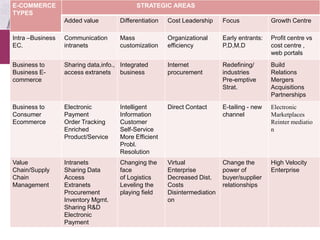
E-COMMERCE                                 STRATEGIC AREAS
TYPES
                  Added value        Differentiation   Cost Leadership     Focus             Growth Centre

Intra –Business   Communication      Mass              Organizational      Early entrants:   Profit centre vs
EC.               intranets          customization     efficiency          P.D,M.D           cost centre ,
                                                                                             web portals
Business to       Sharing data,info., Integrated       Internet            Redefining/       Build
Business E-       access extranets business            procurement         industries        Relations
commerce                                                                   Pre-emptive       Mergers
                                                                           Strat.            Acquisitions
                                                                                             Partnerships
Business to       Electronic         Intelligent       Direct Contact      E-tailing - new   Electronic
Consumer          Payment            Information                           channel           Marketplaces
Ecommerce         Order Tracking     Customer                                                Reinter mediatio
                  Enriched           Self-Service                                            n
                  Product/Service    More Efficient
                                     Probl.
                                     Resolution
Value             Intranets          Changing the      Virtual             Change the        High Velocity
Chain/Supply      Sharing Data       face              Enterprise          power of          Enterprise
Chain             Access             of Logistics      Decreased Dist.     buyer/supplier
Management        Extranets          Leveling the      Costs               relationships
                  Procurement        playing field     Disintermediation
                  Inventory Mgmt.                      on
                  Sharing R&D
                  Electronic
                  Payment
Intra business impact of E-Commerce

1. Added value - Corporate intranet, increased information
   access and improved communications.
2. Differentiation- Businesses are using electronic
   commerce to implement mass customization strategies,
   producing large numbers (mass) of customized items, to
   differentiate their products and services.
For example, one business creates customized compact
  disks. Customers purchase compact disks that are tailored
  according to the their music selections.
  (www.musicmaker.com)
3. Cost Leadership
• Electronic commerce decreases distribution costs
   through a reduction in overhead such as:
   inventory, retail space, and personnel.
• The inefficiencies associated with paper processing
   are decreased or eliminated.
• Lower distribution costs, information flows are
   simplified or redefined that result in further cost
   savings.
• Cost reduction means broader customer base.
4. Focus
Using Ansoff's model9 of Strategies for Increasing
   Scope, electronic commerce affects the ability for a
   business to increase its scope and extend its core
   mission through market penetration, market
   development, product development, or business
   development strategies.
Amazon.com,
Business-to-Business

• Electronic commerce is a natural way for business to
   create value by aligning themselves with their
   customers, suppliers, employees and many others.
• Types of business-to-business electronic commerce
   applications include
electronic data interchange, electronic funds
   transfer, electronic forms, integrated messaging, and
   shared databases.
B2B:Value add

• Business-to-business processes provide sharing of data
  and increased information access through corporate
  extranets.
• Bugle Boy has a strong value-added electronic
  commerce strategy. They provide support to the retailers
  involved in their business-to-business partnerships.
  Through Bugle Boy's extranet they allow retailers to order
  online and see the status of inventory and shipments. It
  supplements their EDI and partner-managed inventory
  efforts
B2B: Differentiation

• Electronic commerce differentiates products and services
   through integrated business strategies. For example,
"Successful high-tech companies will connect their internal
   research and development to their suppliers' R&D labs
for concurrent engineering. Not only will these companies
   electronically share data with the suppliers, but also the
products they develop will be e-commerce-enabled. Products
   will be built to feed data back to the manufacturer on a
variety of parameters, including performance, maintenance
   needs and usage. With this information, the companies will
   have a jump on competitors in the design of the next-
   generation products
B2B:Cost Leadership

sharing information and electronically processing business
   transactions can improve the buyer-supplier relationship by
   allowing the buyer:
• to use automated search tools to identify the exact product
   or products they are seeking.
• to obtain accurate, customer-specific pricing
• to check product availability
• to review total order costs, including tax and shipping
   expenses
• to order with the click of a button
• to choose from a number of payment methods
• to track the status of an order until it is delivered
B2B: Focus


• Engaging in electronic commerce requires rethinking
  the very nature of the buyer/seller relationship. It
  requires the fundamental transformation of business,
  because all or most human interaction and paper-
  based processes within the value chain will need to be
  changed
• A pre-emptive strategy, bypassing of intermediaries
  and changing the entry and exit barriers.
• blurring of industries
Business to customer E-
                commerce


Added Value:
• Another recent example is
  www.WeddingChannel.com. This dot.com business
  provides information and services for the bride-to-be
  and her fiancée. In addition, it assists their guests in
  selecting and purchasing a gift, and travel
  reservations. These added-value features promote
  building a relationship with the consumer.
B2C: Differentiation


• Amazon.com is differentiating their service by using
  "intelligent information". They are tailoring their service
  to each customer by developing a profile of that
  customer and then suggesting books and
  communicating other information of interest to the
  customer.
• Microsoft’s trouble shoot internet application
B2C:Focus


Businesses can target the consumer through "e-tailing".
  Some businesses will use this new marketing channel
  to compliment their existing channels, where
  as, others will sell their products or services only on
  the Internet
Value Chain improvement


• Virtual corporation
• Disintermediation
…thanks………

E commerce and strategic management

  • 1.
    E-Commerce & StrategicManagement Chandra Shekhar Pandey Assistant Professor- SRCM
  • 2.
    What is E-Commerce? •Electronic commerce is the electronic exchange of information, goods, services, and payments and includes the creation and maintenance of Web-based relations • It uses internet, intranets, extranets, electronic data interchange (EDI)
  • 3.
    Examples of E-commerce •transaction processing with electronic payment, • coordination with business partners such as inventory management, • customer self-service such as tracking order status and researching problem resolution • using a corporate intranet for ubiquitous information distribution.
  • 4.
    E-Commerce patterns four majorareas of electronic commerce (E.C.). They are: 1. Intra-business E.C., 2. Business-to-Business E.C., 3. Business-to-Consumer E.C., 4. Electronic commerce applications within the value chain, including the supply chain and the demand chain
  • 5.
    E-COMMERCE STRATEGIC AREAS TYPES Added value Differentiation Cost Leadership Focus Growth Centre Intra –Business Communication Mass Organizational Early entrants: Profit centre vs EC. intranets customization efficiency P.D,M.D cost centre , web portals Business to Sharing data,info., Integrated Internet Redefining/ Build Business E- access extranets business procurement industries Relations commerce Pre-emptive Mergers Strat. Acquisitions Partnerships Business to Electronic Intelligent Direct Contact E-tailing - new Electronic Consumer Payment Information channel Marketplaces Ecommerce Order Tracking Customer Reinter mediatio Enriched Self-Service n Product/Service More Efficient Probl. Resolution Value Intranets Changing the Virtual Change the High Velocity Chain/Supply Sharing Data face Enterprise power of Enterprise Chain Access of Logistics Decreased Dist. buyer/supplier Management Extranets Leveling the Costs relationships Procurement playing field Disintermediation Inventory Mgmt. on Sharing R&D Electronic Payment
  • 6.
    Intra business impactof E-Commerce 1. Added value - Corporate intranet, increased information access and improved communications. 2. Differentiation- Businesses are using electronic commerce to implement mass customization strategies, producing large numbers (mass) of customized items, to differentiate their products and services. For example, one business creates customized compact disks. Customers purchase compact disks that are tailored according to the their music selections. (www.musicmaker.com)
  • 7.
    3. Cost Leadership •Electronic commerce decreases distribution costs through a reduction in overhead such as: inventory, retail space, and personnel. • The inefficiencies associated with paper processing are decreased or eliminated. • Lower distribution costs, information flows are simplified or redefined that result in further cost savings. • Cost reduction means broader customer base.
  • 8.
    4. Focus Using Ansoff'smodel9 of Strategies for Increasing Scope, electronic commerce affects the ability for a business to increase its scope and extend its core mission through market penetration, market development, product development, or business development strategies. Amazon.com,
  • 9.
    Business-to-Business • Electronic commerceis a natural way for business to create value by aligning themselves with their customers, suppliers, employees and many others. • Types of business-to-business electronic commerce applications include electronic data interchange, electronic funds transfer, electronic forms, integrated messaging, and shared databases.
  • 10.
    B2B:Value add • Business-to-businessprocesses provide sharing of data and increased information access through corporate extranets. • Bugle Boy has a strong value-added electronic commerce strategy. They provide support to the retailers involved in their business-to-business partnerships. Through Bugle Boy's extranet they allow retailers to order online and see the status of inventory and shipments. It supplements their EDI and partner-managed inventory efforts
  • 11.
    B2B: Differentiation • Electroniccommerce differentiates products and services through integrated business strategies. For example, "Successful high-tech companies will connect their internal research and development to their suppliers' R&D labs for concurrent engineering. Not only will these companies electronically share data with the suppliers, but also the products they develop will be e-commerce-enabled. Products will be built to feed data back to the manufacturer on a variety of parameters, including performance, maintenance needs and usage. With this information, the companies will have a jump on competitors in the design of the next- generation products
  • 12.
    B2B:Cost Leadership sharing informationand electronically processing business transactions can improve the buyer-supplier relationship by allowing the buyer: • to use automated search tools to identify the exact product or products they are seeking. • to obtain accurate, customer-specific pricing • to check product availability • to review total order costs, including tax and shipping expenses • to order with the click of a button • to choose from a number of payment methods • to track the status of an order until it is delivered
  • 13.
    B2B: Focus • Engagingin electronic commerce requires rethinking the very nature of the buyer/seller relationship. It requires the fundamental transformation of business, because all or most human interaction and paper- based processes within the value chain will need to be changed • A pre-emptive strategy, bypassing of intermediaries and changing the entry and exit barriers. • blurring of industries
  • 14.
    Business to customerE- commerce Added Value: • Another recent example is www.WeddingChannel.com. This dot.com business provides information and services for the bride-to-be and her fiancée. In addition, it assists their guests in selecting and purchasing a gift, and travel reservations. These added-value features promote building a relationship with the consumer.
  • 15.
    B2C: Differentiation • Amazon.comis differentiating their service by using "intelligent information". They are tailoring their service to each customer by developing a profile of that customer and then suggesting books and communicating other information of interest to the customer. • Microsoft’s trouble shoot internet application
  • 16.
    B2C:Focus Businesses can targetthe consumer through "e-tailing". Some businesses will use this new marketing channel to compliment their existing channels, where as, others will sell their products or services only on the Internet
  • 17.
    Value Chain improvement •Virtual corporation • Disintermediation
  • 18.