B2B Marketing & CRM S. S. Ranjan
B2B Marketing & CRM Subject Code : 3.1.8 Total Marks  : 100 External  : 60 Marks Internal  : 40 Marks Inclusion & Considerations Attendance  : Not less than 75% Class Test  : Better 2 out of 3 Presentation : In groups on course subject  Case Study  : Presentation Discipline  : Sincerity & Obedience Participation : Effective
Course Content Introduction to industrial marketing difference between industrial and consumer marketing. Industrial Marketing Environment; Types of Customers; Types of Buying Situations ; Segmentation. Derived Demand Concepts; Industrial Buyer Behaviour; Industrial market Research Industrial Advertising & Promotions; Branding of Industrial, High Technology & Commodities. B2B Product Decisions; New Product Development Industrial Pricing Decision Role of After Sales Services in Industrial Marketing Industrial Distribution B2B Selling and sales management; Key account management; concepts, Negotiated selling, Bidding for contracts; Selling to government customers Concept & Context of CRM : CRM as an integral business strategy. Customer Loyalty Program: A brief discussion from technology point of view Customer Knowledge : The individualized customer preposition The Relationship Policy : Relationship Data Management
Introduction to B2B Marketing It is sometimes also known as Industrial / Business  Organizational  / Producer’s Marketing Industrial goods are in general not the final products. It refers marketing of products and services to the business organizations. It includes, ♦  Manufacturing Companies ♦  Government Undertakings ♦  Private / Public Sector Organization  ♦  Educational Institutions ♦  Hospitals ♦  Commercial Intermediaries
Need of B2B Marketing ►  To produce other goods and services ►  To use of components for other purpose ►  To reduce the production cost ►  To limit the market size  ►  To establish business association ►  To concentrate on client satisfaction ►  To avoid the oligopolistic competition ►  To guard against financial instability and risk ►  To work in cohesion with partners ►  To develop a dependent ancillary
Features of B2B Marketing ►  It is the largest market at all ►  One customer with huge purchasing capabilities ►  It serves from local to international level ►  Customers are generally organizations. ►  It serves for a longer period of time ►  Credit period is comparatively longer ►  Credit is more variable in amount ►  It facilitates the production process ►  Limited players remains in the market  ►  Customer relations are key to success  ►  It also includes technical advice to manufacturer  ►  It is mostly in direct interest of the customers  ►  It fosters joint demand
Functions of B2B Marketing ►  It is the largest market at all ►  To identify and decide the target market ►  To dig out need and wants of the target market ►  To create value for the buying organization ►  To offer customized product or services ►  To develop marketing program involving partner ►  To support customer with technical support  ►  To help in identification of focus group & market ►  To offer other related services to customers ►  To develop mutual faith between the partners
Classification / Areas / Applications of B2B Marketing ►  Materials and Parts  ♦  It includes raw materials, manufactured  materials, OEMs, components and parts  ♦  This is considered under manufacturing cost  ►  Capital Items  ♦  It comprise of installation, heavy equipments,  accessories, light equipments, plant, building  ♦  This is considered under fixed asset and  operating cost  ►  Supplies and Services  ♦  It comprise of items which has cross functional utilities like stationary, courier etc.  ♦  This is considered under operating cost
Characteristics of B2B Marketing ► Geographically concentrated. ► Relatively few customers generally organization ► Distribution channels are short & more supportive  ► Buyer are well informed & aware of their purchase ► Buyers are well organized and offers support  ► Buyers have sophisticated purchase techniques ► Purchasing decisions are based on observations ► Sometimes it becomes difficult to separate and  identify the marketing and the corporate strategy ► It involves large scale of individual purchase  ► It consists of derived and fluctual demand  ► Leasing is most preferred phenomenon at beginning  ► It involves Reciprocal buying (Tyre and A/C for car)  ► Sharing of risk is very common among partners
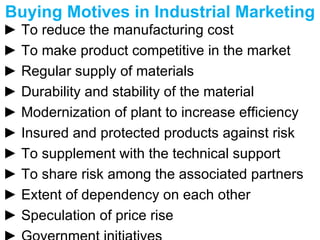
Buying Motives in Industrial Marketing  ►  To reduce the manufacturing cost  ►  To make product competitive in the market  ►  Regular supply of materials ►  Durability and stability of the material ►  Modernization of plant to increase efficiency ►  Insured and protected products against risk ►  To supplement with the technical support ►  To share risk among the associated partners ►  Extent of dependency on each other ►  Speculation of price rise ►  Government initiatives
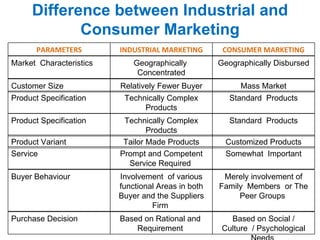
Difference between Industrial and Consumer Marketing PARAMETERS INDUSTRIAL MARKETING CONSUMER MARKETING Market  Characteristics Geographically  Concentrated Geographically Disbursed Customer Size Relatively Fewer Buyer Mass Market Product Specification Technically Complex Products Standard  Products Product Specification Technically Complex Products Standard  Products Product Variant Tailor Made Products Customized Products Service Prompt and Competent Service Required  Somewhat  Important Buyer Behaviour Involvement  of various functional Areas in both Buyer and the Suppliers Firm  Merely involvement of Family  Members  or The Peer Groups  Purchase Decision Based on Rational and  Requirement  Based on Social / Culture  / Psychological Needs
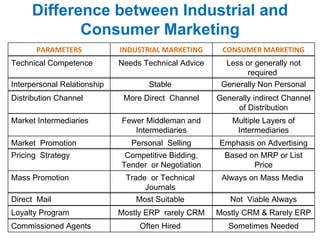
Difference between Industrial and Consumer Marketing PARAMETERS INDUSTRIAL MARKETING CONSUMER MARKETING Technical Competence Needs Technical Advice Less or generally not required  Interpersonal Relationship Stable  Generally Non Personal Distribution Channel More Direct  Channel Generally indirect Channel of Distribution Market Intermediaries Fewer Middleman and Intermediaries Multiple Layers of Intermediaries Market  Promotion Personal  Selling Emphasis on Advertising Pricing  Strategy Competitive Bidding, Tender  or Negotiation Based on MRP or List Price Mass Promotion Trade  or Technical  Journals  Always on Mass Media  Direct  Mail Most Suitable  Not  Viable Always Loyalty Program Mostly ERP  rarely CRM Mostly CRM & Rarely ERP Commissioned Agents Often Hired  Sometimes Needed

1. b2 b marketing & crm [imcost] chapter first

  • 1.
    B2B Marketing &CRM S. S. Ranjan
  • 2.
    B2B Marketing &CRM Subject Code : 3.1.8 Total Marks : 100 External : 60 Marks Internal : 40 Marks Inclusion & Considerations Attendance : Not less than 75% Class Test : Better 2 out of 3 Presentation : In groups on course subject Case Study : Presentation Discipline : Sincerity & Obedience Participation : Effective
  • 3.
    Course Content Introductionto industrial marketing difference between industrial and consumer marketing. Industrial Marketing Environment; Types of Customers; Types of Buying Situations ; Segmentation. Derived Demand Concepts; Industrial Buyer Behaviour; Industrial market Research Industrial Advertising & Promotions; Branding of Industrial, High Technology & Commodities. B2B Product Decisions; New Product Development Industrial Pricing Decision Role of After Sales Services in Industrial Marketing Industrial Distribution B2B Selling and sales management; Key account management; concepts, Negotiated selling, Bidding for contracts; Selling to government customers Concept & Context of CRM : CRM as an integral business strategy. Customer Loyalty Program: A brief discussion from technology point of view Customer Knowledge : The individualized customer preposition The Relationship Policy : Relationship Data Management
  • 4.
    Introduction to B2BMarketing It is sometimes also known as Industrial / Business Organizational / Producer’s Marketing Industrial goods are in general not the final products. It refers marketing of products and services to the business organizations. It includes, ♦ Manufacturing Companies ♦ Government Undertakings ♦ Private / Public Sector Organization ♦ Educational Institutions ♦ Hospitals ♦ Commercial Intermediaries
  • 5.
    Need of B2BMarketing ► To produce other goods and services ► To use of components for other purpose ► To reduce the production cost ► To limit the market size ► To establish business association ► To concentrate on client satisfaction ► To avoid the oligopolistic competition ► To guard against financial instability and risk ► To work in cohesion with partners ► To develop a dependent ancillary
  • 6.
    Features of B2BMarketing ► It is the largest market at all ► One customer with huge purchasing capabilities ► It serves from local to international level ► Customers are generally organizations. ► It serves for a longer period of time ► Credit period is comparatively longer ► Credit is more variable in amount ► It facilitates the production process ► Limited players remains in the market ► Customer relations are key to success ► It also includes technical advice to manufacturer ► It is mostly in direct interest of the customers ► It fosters joint demand
  • 7.
    Functions of B2BMarketing ► It is the largest market at all ► To identify and decide the target market ► To dig out need and wants of the target market ► To create value for the buying organization ► To offer customized product or services ► To develop marketing program involving partner ► To support customer with technical support ► To help in identification of focus group & market ► To offer other related services to customers ► To develop mutual faith between the partners
  • 8.
    Classification / Areas/ Applications of B2B Marketing ► Materials and Parts ♦ It includes raw materials, manufactured materials, OEMs, components and parts ♦ This is considered under manufacturing cost ► Capital Items ♦ It comprise of installation, heavy equipments, accessories, light equipments, plant, building ♦ This is considered under fixed asset and operating cost ► Supplies and Services ♦ It comprise of items which has cross functional utilities like stationary, courier etc. ♦ This is considered under operating cost
  • 9.
    Characteristics of B2BMarketing ► Geographically concentrated. ► Relatively few customers generally organization ► Distribution channels are short & more supportive ► Buyer are well informed & aware of their purchase ► Buyers are well organized and offers support ► Buyers have sophisticated purchase techniques ► Purchasing decisions are based on observations ► Sometimes it becomes difficult to separate and identify the marketing and the corporate strategy ► It involves large scale of individual purchase ► It consists of derived and fluctual demand ► Leasing is most preferred phenomenon at beginning ► It involves Reciprocal buying (Tyre and A/C for car) ► Sharing of risk is very common among partners
  • 10.
    Buying Motives inIndustrial Marketing ► To reduce the manufacturing cost ► To make product competitive in the market ► Regular supply of materials ► Durability and stability of the material ► Modernization of plant to increase efficiency ► Insured and protected products against risk ► To supplement with the technical support ► To share risk among the associated partners ► Extent of dependency on each other ► Speculation of price rise ► Government initiatives
  • 11.
    Difference between Industrialand Consumer Marketing PARAMETERS INDUSTRIAL MARKETING CONSUMER MARKETING Market Characteristics Geographically Concentrated Geographically Disbursed Customer Size Relatively Fewer Buyer Mass Market Product Specification Technically Complex Products Standard Products Product Specification Technically Complex Products Standard Products Product Variant Tailor Made Products Customized Products Service Prompt and Competent Service Required Somewhat Important Buyer Behaviour Involvement of various functional Areas in both Buyer and the Suppliers Firm Merely involvement of Family Members or The Peer Groups Purchase Decision Based on Rational and Requirement Based on Social / Culture / Psychological Needs
  • 12.
    Difference between Industrialand Consumer Marketing PARAMETERS INDUSTRIAL MARKETING CONSUMER MARKETING Technical Competence Needs Technical Advice Less or generally not required Interpersonal Relationship Stable Generally Non Personal Distribution Channel More Direct Channel Generally indirect Channel of Distribution Market Intermediaries Fewer Middleman and Intermediaries Multiple Layers of Intermediaries Market Promotion Personal Selling Emphasis on Advertising Pricing Strategy Competitive Bidding, Tender or Negotiation Based on MRP or List Price Mass Promotion Trade or Technical Journals Always on Mass Media Direct Mail Most Suitable Not Viable Always Loyalty Program Mostly ERP rarely CRM Mostly CRM & Rarely ERP Commissioned Agents Often Hired Sometimes Needed