Supply Chain
Management
Role of Information
  Technology in
   Supply Chain
   Management
INTRODUCTION
• Supply chain management (SCM) is concerned
  with the flow of products and information
  between supply chain members' organizations.
• Recent development in technologies are helpful
  to coordinates the activities to manage the
  supply chain. The cost of information is
  decreased due to the increasing rate of
  technologies.
ELECTRONIC COMMERCE
 Electronic commerce, commonly known as e-
commerce refers to the buying and selling of
products or services over electronic systems
such as the Internet and other computer
networks
 It also includes the entire online process of
developing, marketing, selling, delivering, servi
cing and paying for products and services.
 The amount of trade conducted electronically
has grown extraordinarily with widespread
Internet usage
E-COMMERCE IN SUPPLY CHAIN
•Increases the efficiency in operations

•Better customer service

•Quick process to information.

•Better customer service.

•Reduced paper work.

•Increased productivity

•Cost efficiency.

•Competitive advantage.
Cont:


•   Information Sharing, Convenience, And Control
•   Higher Margins
•   Quick Comparison Shopping
•   Information Sharing, Convenience, And Control
Business Model


The plan implemented by a company to generate
revenue and make a profit from operations. The
model includes the components and functions of
the business, as well as the revenues it generates
and the expenses it incurs.
Business To Business - B To B
• What Does Business To Business - B To B
  Mean?
  Business conducted between companies, rather
  than between a company and individual
  consumers.

• Business To Business - B To B
  An example of a B2B company is a firm that
  makes parts that are sold directly to an
  automobile manufacturer.
Business To Consumer - B To C
• What Does Business To Consumer - B To C
  Mean?
  Business conducted between companies and
  individual consumers, rather than between two
  companies.

• Business To Consumer - B To C
  A retailer like Wal-Mart is an example of a B to C
  company
Customer To Customer - C To C
• What Does Customer To Customer - C To C Mean?
  A type of business model that facilitates interaction between
  customers. Customer to customer businesses provide
  individuals with a place to converse, exchange and interact
  with other people.

• Customer To Customer - C To C
  Many C2C businesses have online operations. Online auctions
  and classifieds such as e-bay are examples of very successful
  customer to customer business models. These sites don't look
  to directly sell goods to their members, instead the customers
  are exchanging with other customers.
Enterprise resource planning (ERP)


    Enterprise Resource Planning (ERP) is a
  system which brings all the decision making
    information from all the departments in a
   company into one single place in order to
 increase efficiency, productivity and profit of
                  the company.
FEATURES
• Integrates internal and external management
  information across an entire organization
• Facilitates the flow of information between all
  business functions inside the boundaries of the
  organization and manage the connections to
  outside
• It involves finance, manufacturing, sales and
  service, customer relationship management, etc
Cont:


 • It is an integrated system that operates in real
   time (or next to real time), without relying on
   periodic updates.
 • A common database, which supports all
   applications.
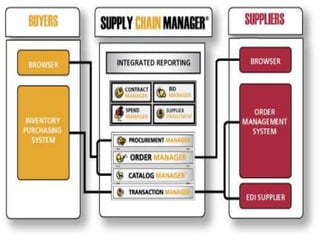
E-Procurement
 E-procurement is the business-to-business
 purchase and sale of supplies and services over
 the Internet.
 This includes management of
 correspondence, bids, questions and
 answers, previous pricing, and multiple emails
 sent to multiple participants.
 E-Procurement helps to reduce the transactional
 costs, achieving faster & automated
 transactions, helps the buyer to focus more on
 strategic part of procurement.
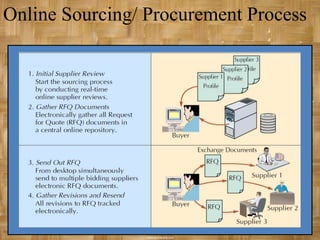
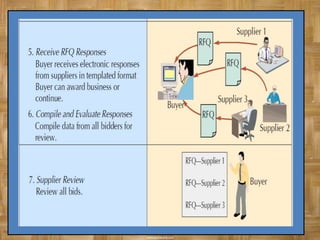
Online Sourcing/ Procurement Process
E-Procurement Tools

                   E-Catalogues
In normal case of business scenario, supplier
 visits end users and buyers and provide their
 product information through Product
 catalogues. These catalogues normally contain
 product specifications, rates, validity of
 rates, discounts, minimum order quantity etc.
E-Marketplaces
This is the single point entry meeting place for buyers
 and suppliers. Here buyers post their requirements
  and suppliers can quote against the requirements
posted by the buyers. Features of a e-marketplace can
   vary from plain transactional trading to enabling
  suppliers and buyers to collaborate in the areas of
      supply chain planning, product designing &
           development, knowledge sharing.
E-Reverse Auctions

                  English Reverse Auctions
  In this type of reverse auction buyer opens the auction
  with the price of the item and seeks lower bid. Bidders
           outbid each other by placing lower bids.
  The auction ends when no body is able to quote lesser
than the lowest quote. It is time bound bidding.

  The buyer may reserve the price above which he is not
willing to pay. In case of winner of the bid is not able to
supply the full quantity the buyer can go for second lowed
bidder to fulfill the quantity. Sometimes buyer may impose
the condition of supplying full quantity in the auction.
Now a days there is new focus on Request for Proposal
(RFP) and Request for information (RFI). So this area now
a days called e-Sourcing or RFx Model.
                     Request for Quotation (RFQ)
is a request for supplier to quote for a particular product
or service. The buyer sets the requirements and
specifications in the document. The supplier has to quote
in the prescribed format specified by the buyer.
              Request for Proposal (RFP)
is a request by a buyer for supplier for submitting the
proposal. RFP asks suppliers to propose how they would
meet the buyer’s product or service need. This approach
is largely used when the supplier is having greater
expertise than buyer.
Request for Information (RFI)
 implies that there is no commitment from either side.
    Buyer asks for the information from supplier and
  evaluate whether they might go for particular service
            or job with a particular supplier.


           Self Service Procurement:
Self service procurement passes on the procurement
jobs to end users. Materials procured under self service
are normally non strategic, under contract and with
fixed pre negotiated prices. Self service procurement
frees the buyer from transaction procurement and
helps him to focus on strategic procurement.
Benefits
Improved Process efficiencies
Manual procurement is labour intensive and time
consuming process. Switching to e-procurement
helps companies to reduce employees’ cost, paper
and redundancy and cycle times

Reduction in errors
Manual processes are always prone to errors. In
manual processes as and when the information is
transferred at many occasions it is re-written or re-
typed at various stages
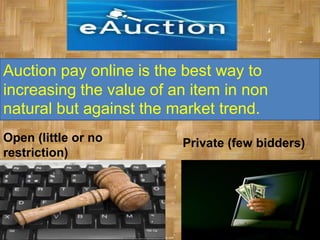
Auction pay online is the best way to
increasing the value of an item in non
natural but against the market trend.
Open (little or no       Private (few bidders)
restriction)
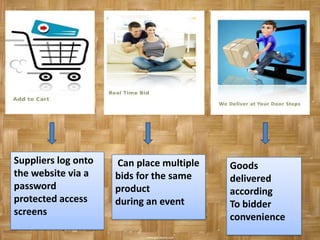
Suppliers log onto   Can place multiple   Goods
the website via a    bids for the same    delivered
password             product              according
protected access     during an event      To bidder
screens                                   convenience
Benefits of E-Auctions
 Opportunities to find unique items and
   collectibles
 Lower prices
 Secure bidding environment
 Bidders can be monitored
Time benefits: reduction in postage,
  paperwork, photocopying
 Convenience
 Identities of bidders are usually hidden
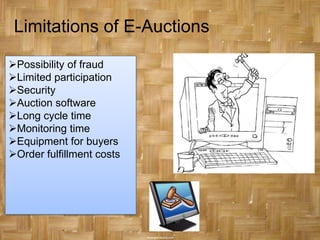
Limitations of E-Auctions

Possibility of fraud
Limited participation
Security
Auction software
Long cycle time
Monitoring time
Equipment for buyers
Order fulfillment costs
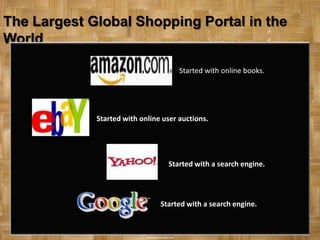
The Largest Global Shopping Portal in the
World

                                      Started with online books.


             Started with online user auctions.


                                  Started with a search engine.


                                Started with a search engine.
ELECTRONIC MARKETS

E-marketplaces are emerging to serve each
point of every industry's supply chain

E-markets are highly collaborative E-Business
models that organize complex business
processes between multiple participants into a
virtual commerce community
E-MARKETPLACES : VALUE CREATION


efficient transactional processes
new business relationships
new business models
new businesses
E-MARKETPLACES: CATEGORIES


Horizontal
Vertical
Private (sell side, buy side)
Public
BENEFITS TO BUSINESSES
Extend the presence and reach of a company
Facilitate doing business with
anyone, anytime, anywhere
Aggregation of content and facilitation of workflow
lead to significant reduction in transaction costs
Cycle times are reduced and deliveries are quicker
Improves relationship with trading partners
Market efficiencies
   Better inventory management
   Better visibility leading to predictability
BENEFITS TO BUYERS

 Aggregation of multiple suppliers

 Direct access to suppliers and through dynamic
  pricing

 Location and tracking of new suppliers

 Provides more negotiating power

 Leads to quick response buyers
BENEFITS TO SUPPLIERS


Provides reach to vast, untapped global markets
True value of products can be realized through
aggregation and participation of buyers
Enables to support JIT practices
Leads to quick response suppliers
E-MARKETS: DESIGN ISSUES

NEGOTIATIONS
  Distributed Negotiations
  Integrative Negotiations
  Auctions
DESIGN OF USER INTERFACES
Business objects in SCM


The Business Objects Supply Chain Management application
provides visibility into performance across the supply chain that
can help you measurably improve the effectiveness of your
supply chain operations and better deliver on corporate
mandates, such as lowering costs and improving return on
working capital. Business Objects will give an
integrated, dynamic view of our sales, supply chain, and
customers.
Business Objects benefits

We can evaluate, monitor, and improve our supply
 chain performance and efficiency.

 Help to gain visibility over constantly changing operations as
  we continuously plan sourcing, manufacturing, delivery, and
  returns.

 It will provide you with hundreds of prebuilt analytics that can
  answer thousands of key business questions and help to gain
  deeper business insight.
 Quickly gain deeper business insight

 Gain industry best practices

 Standardize on terminology and data

 Minimize risk and speed your implementation
Importance of business objects
The Best Choice on the Market Today
The Business Objects suite of enterprise analytic
 applications is the most comprehensive
Product offering on the market today. With insightful
 analytics, an unparalleled framework
Supporting customized development, and an
 integrated data warehouse, Business Objects
Provides your organization with the insight you
 need to extend your competitive advantage
E logistics :
Internet Impact to Logistics
       management
WHAT IS E-LOGISTICS?

E logistics = information liquidity

The ability to acquire and use information when it is
  needed, what is needed, and in an appropriate context.
• Assessable
• Meaningful
• Timely
• Complete
E LOGISTICS PLAYERS
 Players in space-examples

Manugistics, Manhattan Associates, EXE technologies(SSA
  Global), Descartes, SAP etc.

 Strengths

Domain knowledge, proven solution components, customer
  base, critical mass, existing partnership

 Weaknesses

Old tech infrastructure
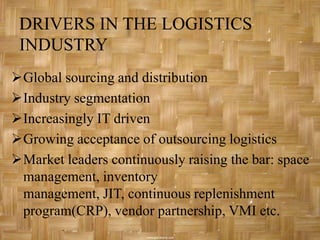
DRIVERS IN THE LOGISTICS
 INDUSTRY
Global sourcing and distribution
Industry segmentation
Increasingly IT driven
Growing acceptance of outsourcing logistics
Market leaders continuously raising the bar: space
 management, inventory
 management, JIT, continuous replenishment
 program(CRP), vendor partnership, VMI etc.
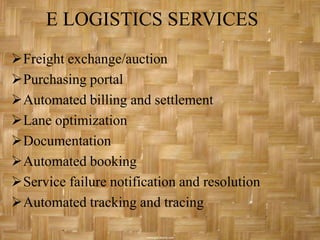
E LOGISTICS SERVICES
Freight exchange/auction
Purchasing portal
Automated billing and settlement
Lane optimization
Documentation
Automated booking
Service failure notification and resolution
Automated tracking and tracing
International trade compliance and landed cost
Product development collaboration
Pricing, revenue and profitability management
E marketing
E fulfillment
Data mining(performance management)
E LOGISTICS-VALUE PROPOSITION


Logistics exchanges will bring price efficiency
 to the most segmented market
Load matching and other optimization tools
 will improve asset utilization
E logistics will greatly improve the industry’s
 information liquidity
Collaborative product development and revenue
 management tools will allow business to improve
 its return on investment
Integrated supply chain execution and collaboration
 tools will dramatically reduce business interaction
 costs and achieve a learner, quicker and more
 reliable supply chain
BENEFITS OF E LOGISTICS
 Business benefits
- On-time delivery and fulfillment, lead time reduction
- Customer service improvements, increased
  collaboration and coordination
- Increased sales
 IT benefits
- Reduces time for data entry, management and
  integration
- Plug and play, easy integration with existing and third-
  party systems
- Transaction processing and monitoring
 Network effect benefits
- Lower transportation cost, improved capacity
  utilization
- Flexible and responsive supply chains(co-
  mingling, merge-in-transit)
- Single point of connection for participants
Any
Questions …???

Presentation1

  • 1.
  • 2.
    Role of Information Technology in Supply Chain Management
  • 3.
    INTRODUCTION • Supply chainmanagement (SCM) is concerned with the flow of products and information between supply chain members' organizations. • Recent development in technologies are helpful to coordinates the activities to manage the supply chain. The cost of information is decreased due to the increasing rate of technologies.
  • 4.
    ELECTRONIC COMMERCE  Electroniccommerce, commonly known as e- commerce refers to the buying and selling of products or services over electronic systems such as the Internet and other computer networks  It also includes the entire online process of developing, marketing, selling, delivering, servi cing and paying for products and services.  The amount of trade conducted electronically has grown extraordinarily with widespread Internet usage
  • 6.
    E-COMMERCE IN SUPPLYCHAIN •Increases the efficiency in operations •Better customer service •Quick process to information. •Better customer service. •Reduced paper work. •Increased productivity •Cost efficiency. •Competitive advantage.
  • 7.
    Cont: • Information Sharing, Convenience, And Control • Higher Margins • Quick Comparison Shopping • Information Sharing, Convenience, And Control
  • 8.
    Business Model The planimplemented by a company to generate revenue and make a profit from operations. The model includes the components and functions of the business, as well as the revenues it generates and the expenses it incurs.
  • 9.
    Business To Business- B To B • What Does Business To Business - B To B Mean? Business conducted between companies, rather than between a company and individual consumers. • Business To Business - B To B An example of a B2B company is a firm that makes parts that are sold directly to an automobile manufacturer.
  • 10.
    Business To Consumer- B To C • What Does Business To Consumer - B To C Mean? Business conducted between companies and individual consumers, rather than between two companies. • Business To Consumer - B To C A retailer like Wal-Mart is an example of a B to C company
  • 11.
    Customer To Customer- C To C • What Does Customer To Customer - C To C Mean? A type of business model that facilitates interaction between customers. Customer to customer businesses provide individuals with a place to converse, exchange and interact with other people. • Customer To Customer - C To C Many C2C businesses have online operations. Online auctions and classifieds such as e-bay are examples of very successful customer to customer business models. These sites don't look to directly sell goods to their members, instead the customers are exchanging with other customers.
  • 12.
    Enterprise resource planning(ERP) Enterprise Resource Planning (ERP) is a system which brings all the decision making information from all the departments in a company into one single place in order to increase efficiency, productivity and profit of the company.
  • 13.
    FEATURES • Integrates internaland external management information across an entire organization • Facilitates the flow of information between all business functions inside the boundaries of the organization and manage the connections to outside • It involves finance, manufacturing, sales and service, customer relationship management, etc
  • 14.
    Cont: • Itis an integrated system that operates in real time (or next to real time), without relying on periodic updates. • A common database, which supports all applications.
  • 15.
    E-Procurement E-procurement isthe business-to-business purchase and sale of supplies and services over the Internet. This includes management of correspondence, bids, questions and answers, previous pricing, and multiple emails sent to multiple participants. E-Procurement helps to reduce the transactional costs, achieving faster & automated transactions, helps the buyer to focus more on strategic part of procurement.
  • 16.
  • 18.
    E-Procurement Tools E-Catalogues In normal case of business scenario, supplier visits end users and buyers and provide their product information through Product catalogues. These catalogues normally contain product specifications, rates, validity of rates, discounts, minimum order quantity etc.
  • 19.
    E-Marketplaces This is thesingle point entry meeting place for buyers and suppliers. Here buyers post their requirements and suppliers can quote against the requirements posted by the buyers. Features of a e-marketplace can vary from plain transactional trading to enabling suppliers and buyers to collaborate in the areas of supply chain planning, product designing & development, knowledge sharing.
  • 20.
    E-Reverse Auctions English Reverse Auctions In this type of reverse auction buyer opens the auction with the price of the item and seeks lower bid. Bidders outbid each other by placing lower bids. The auction ends when no body is able to quote lesser than the lowest quote. It is time bound bidding. The buyer may reserve the price above which he is not willing to pay. In case of winner of the bid is not able to supply the full quantity the buyer can go for second lowed bidder to fulfill the quantity. Sometimes buyer may impose the condition of supplying full quantity in the auction.
  • 21.
    Now a daysthere is new focus on Request for Proposal (RFP) and Request for information (RFI). So this area now a days called e-Sourcing or RFx Model. Request for Quotation (RFQ) is a request for supplier to quote for a particular product or service. The buyer sets the requirements and specifications in the document. The supplier has to quote in the prescribed format specified by the buyer. Request for Proposal (RFP) is a request by a buyer for supplier for submitting the proposal. RFP asks suppliers to propose how they would meet the buyer’s product or service need. This approach is largely used when the supplier is having greater expertise than buyer.
  • 22.
    Request for Information(RFI) implies that there is no commitment from either side. Buyer asks for the information from supplier and evaluate whether they might go for particular service or job with a particular supplier. Self Service Procurement: Self service procurement passes on the procurement jobs to end users. Materials procured under self service are normally non strategic, under contract and with fixed pre negotiated prices. Self service procurement frees the buyer from transaction procurement and helps him to focus on strategic procurement.
  • 23.
    Benefits Improved Process efficiencies Manualprocurement is labour intensive and time consuming process. Switching to e-procurement helps companies to reduce employees’ cost, paper and redundancy and cycle times Reduction in errors Manual processes are always prone to errors. In manual processes as and when the information is transferred at many occasions it is re-written or re- typed at various stages
  • 24.
    Auction pay onlineis the best way to increasing the value of an item in non natural but against the market trend. Open (little or no Private (few bidders) restriction)
  • 25.
    Suppliers log onto Can place multiple Goods the website via a bids for the same delivered password product according protected access during an event To bidder screens convenience
  • 26.
    Benefits of E-Auctions Opportunities to find unique items and collectibles  Lower prices  Secure bidding environment  Bidders can be monitored Time benefits: reduction in postage, paperwork, photocopying  Convenience  Identities of bidders are usually hidden
  • 27.
    Limitations of E-Auctions Possibilityof fraud Limited participation Security Auction software Long cycle time Monitoring time Equipment for buyers Order fulfillment costs
  • 28.
    The Largest GlobalShopping Portal in the World Started with online books. Started with online user auctions. Started with a search engine. Started with a search engine.
  • 29.
    ELECTRONIC MARKETS E-marketplaces areemerging to serve each point of every industry's supply chain E-markets are highly collaborative E-Business models that organize complex business processes between multiple participants into a virtual commerce community
  • 30.
    E-MARKETPLACES : VALUECREATION efficient transactional processes new business relationships new business models new businesses
  • 31.
  • 32.
    BENEFITS TO BUSINESSES Extendthe presence and reach of a company Facilitate doing business with anyone, anytime, anywhere Aggregation of content and facilitation of workflow lead to significant reduction in transaction costs Cycle times are reduced and deliveries are quicker Improves relationship with trading partners Market efficiencies Better inventory management Better visibility leading to predictability
  • 33.
    BENEFITS TO BUYERS Aggregation of multiple suppliers  Direct access to suppliers and through dynamic pricing  Location and tracking of new suppliers  Provides more negotiating power  Leads to quick response buyers
  • 34.
    BENEFITS TO SUPPLIERS Providesreach to vast, untapped global markets True value of products can be realized through aggregation and participation of buyers Enables to support JIT practices Leads to quick response suppliers
  • 35.
    E-MARKETS: DESIGN ISSUES NEGOTIATIONS Distributed Negotiations Integrative Negotiations Auctions DESIGN OF USER INTERFACES
  • 36.
    Business objects inSCM The Business Objects Supply Chain Management application provides visibility into performance across the supply chain that can help you measurably improve the effectiveness of your supply chain operations and better deliver on corporate mandates, such as lowering costs and improving return on working capital. Business Objects will give an integrated, dynamic view of our sales, supply chain, and customers.
  • 37.
    Business Objects benefits Wecan evaluate, monitor, and improve our supply chain performance and efficiency.  Help to gain visibility over constantly changing operations as we continuously plan sourcing, manufacturing, delivery, and returns.  It will provide you with hundreds of prebuilt analytics that can answer thousands of key business questions and help to gain deeper business insight.
  • 38.
     Quickly gaindeeper business insight  Gain industry best practices  Standardize on terminology and data  Minimize risk and speed your implementation
  • 39.
    Importance of businessobjects The Best Choice on the Market Today The Business Objects suite of enterprise analytic applications is the most comprehensive Product offering on the market today. With insightful analytics, an unparalleled framework Supporting customized development, and an integrated data warehouse, Business Objects Provides your organization with the insight you need to extend your competitive advantage
  • 40.
    E logistics : InternetImpact to Logistics management
  • 41.
    WHAT IS E-LOGISTICS? Elogistics = information liquidity The ability to acquire and use information when it is needed, what is needed, and in an appropriate context. • Assessable • Meaningful • Timely • Complete
  • 42.
    E LOGISTICS PLAYERS Players in space-examples Manugistics, Manhattan Associates, EXE technologies(SSA Global), Descartes, SAP etc.  Strengths Domain knowledge, proven solution components, customer base, critical mass, existing partnership  Weaknesses Old tech infrastructure
  • 44.
    DRIVERS IN THELOGISTICS INDUSTRY Global sourcing and distribution Industry segmentation Increasingly IT driven Growing acceptance of outsourcing logistics Market leaders continuously raising the bar: space management, inventory management, JIT, continuous replenishment program(CRP), vendor partnership, VMI etc.
  • 46.
    E LOGISTICS SERVICES Freightexchange/auction Purchasing portal Automated billing and settlement Lane optimization Documentation Automated booking Service failure notification and resolution Automated tracking and tracing
  • 47.
    International trade complianceand landed cost Product development collaboration Pricing, revenue and profitability management E marketing E fulfillment Data mining(performance management)
  • 48.
    E LOGISTICS-VALUE PROPOSITION Logisticsexchanges will bring price efficiency to the most segmented market Load matching and other optimization tools will improve asset utilization E logistics will greatly improve the industry’s information liquidity
  • 49.
    Collaborative product developmentand revenue management tools will allow business to improve its return on investment Integrated supply chain execution and collaboration tools will dramatically reduce business interaction costs and achieve a learner, quicker and more reliable supply chain
  • 50.
    BENEFITS OF ELOGISTICS  Business benefits - On-time delivery and fulfillment, lead time reduction - Customer service improvements, increased collaboration and coordination - Increased sales  IT benefits - Reduces time for data entry, management and integration - Plug and play, easy integration with existing and third- party systems - Transaction processing and monitoring
  • 51.
     Network effectbenefits - Lower transportation cost, improved capacity utilization - Flexible and responsive supply chains(co- mingling, merge-in-transit) - Single point of connection for participants
  • 52.