Porphyria- The Vampire disease
Abhishek Jha
Grp- 18
What is it?
• Group of rare diseases in which metabolic substances
called porphyrins accumulate in body.
• Porphyrins produce heme , which carries oxygen in the
blood; but in the porphyrias, there is a deficiency
(inherited or acquired) of the enzymes that transform
the various porphyrins into others, leading to
abnormally high levels of these substance.
• This manifests with either neurological complications
or skin problems or occasionally both.
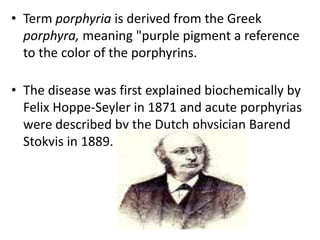
• Term porphyria is derived from the Greek
porphyra, meaning "purple pigment a reference
to the color of the porphyrins.
• The disease was first explained biochemically by
Felix Hoppe-Seyler in 1871 and acute porphyrias
were described by the Dutch physician Barend
Stokvis in 1889.
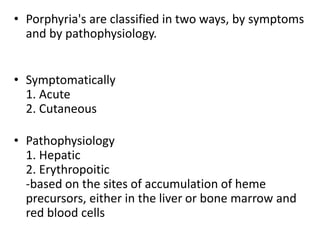
• Porphyria's are classified in two ways, by symptoms
and by pathophysiology.
• Symptomatically
1. Acute
2. Cutaneous
• Pathophysiology
1. Hepatic
2. Erythropoitic
-based on the sites of accumulation of heme
precursors, either in the liver or bone marrow and
red blood cells
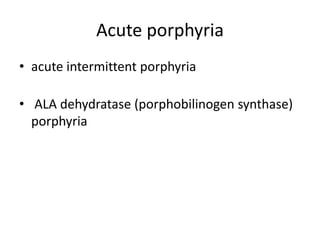
Acute porphyria
• acute intermittent porphyria
• ALA dehydratase (porphobilinogen synthase)
porphyria
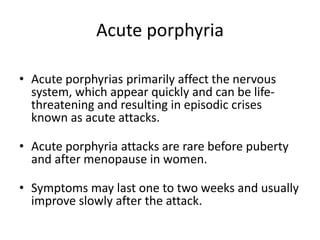
Acute porphyria
• Acute porphyrias primarily affect the nervous
system, which appear quickly and can be life-
threatening and resulting in episodic crises
known as acute attacks.
• Acute porphyria attacks are rare before puberty
and after menopause in women.
• Symptoms may last one to two weeks and usually
improve slowly after the attack.
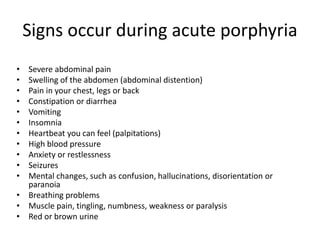
Signs occur during acute porphyria
• Severe abdominal pain
• Swelling of the abdomen (abdominal distention)
• Pain in your chest, legs or back
• Constipation or diarrhea
• Vomiting
• Insomnia
• Heartbeat you can feel (palpitations)
• High blood pressure
• Anxiety or restlessness
• Seizures
• Mental changes, such as confusion, hallucinations, disorientation or
paranoia
• Breathing problems
• Muscle pain, tingling, numbness, weakness or paralysis
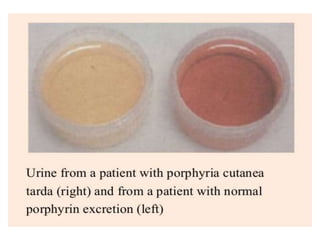
• Red or brown urine
• The relatively low occurrence of porphyria,
the patient may initially be suspected to have
other, unrelated conditions. For instance, the
polyneuropathy of acute porphyria may be
mistaken for Guillain-Barre syndrome, and
porphyria testing is commonly recommended
in those situations
Cutaneous porphyria
• X-linked dominant protoporphyria (XLDPP)
• congenital erythropoietic porphyria (CEP)
• porphyria cutanea tarda (PCT)
• erythropoietic protoporphyria (EPP)
• variegate porphyria
• hereditary coproporphyria
Cutaneous porphyrias
• Cutaneous porphyrias include forms of the
disease that cause skin symptoms as a result
of oversensitivity to sunlight, but these forms
don't usually affect nervous system. Attacks
may last for several days. With some forms,
signs and symptoms may start during infancy
or childhood.
• Sensitivity to the sun and sometimes artificial
light, causing burning pain Sudden painful skin
redness (erythema) and swelling (edema)
Blisters that take weeks to heal Itching Fragile
skin Scars or skin color changes from healing
blisters Increased hair growth Red or brown
urine
Two distinct patterns of skin disease
are seen in porphyria:
• Immediate photosensitivity
This is typical of XLDPP and EPP. Following
a variable period of sun-exposure ,typically
about 30 minutes, patients complain of severe
pain, burning and discomfort in sun-exposed
areas, there may be some redness and
swelling of the skin
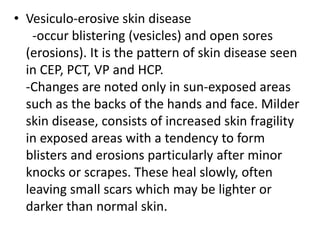
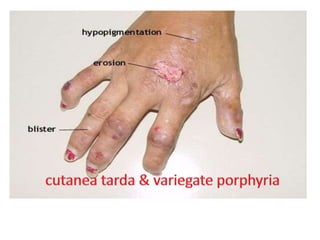
• Vesiculo-erosive skin disease
-occur blistering (vesicles) and open sores
(erosions). It is the pattern of skin disease seen
in CEP, PCT, VP and HCP.
-Changes are noted only in sun-exposed areas
such as the backs of the hands and face. Milder
skin disease, consists of increased skin fragility
in exposed areas with a tendency to form
blisters and erosions particularly after minor
knocks or scrapes. These heal slowly, often
leaving small scars which may be lighter or
darker than normal skin.
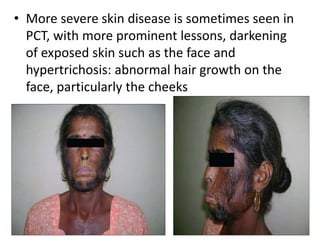
• More severe skin disease is sometimes seen in
PCT, with more prominent lessons, darkening
of exposed skin such as the face and
hypertrichosis: abnormal hair growth on the
face, particularly the cheeks
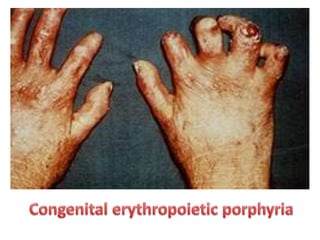
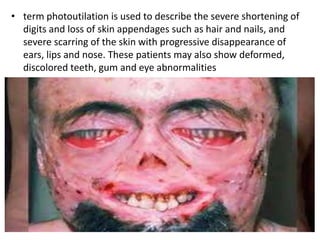
• term photoutilation is used to describe the severe shortening of
digits and loss of skin appendages such as hair and nails, and
severe scarring of the skin with progressive disappearance of
ears, lips and nose. These patients may also show deformed,
discolored teeth, gum and eye abnormalities
Diagnosis
• Blood , urine and stool test may revel kidney
problem and other problem special test
measure prophyrin in blood.
• The test measure the concentration of
porphyrins and their precursors ALA and PBG
which will be very high in patient with an
attack of acute porphyria.
Risk factor
• Certain drugs (barbiturates or sulfonamide antibiotics or,
less often, birth control pills, or some drugs that affect the
mind or behavior, known as psychoactive drugs)
• Chemicals
• Dieting or fasting
• Smoking
• Physical stress, such as infections or other illnesses
• Liver disease
• Emotional stress
• Alcohol use
• Menstrual hormones
• Sun exposure
• Excess iron in your body
Pathogenesis
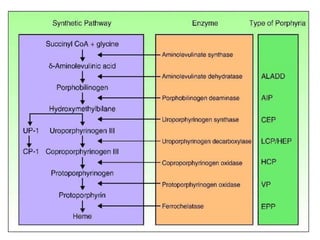
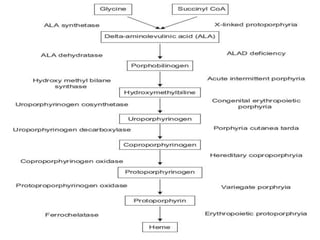
• In humans, porphyrins are the main precursors of heme, an essential
constituent of hemoglobin, myoglobin, catalase, peroxidase, respiratory
and P450 liver cytochromes.
Deficiency in the enzymes of the porphyrin pathway leads to insufficient
production of heme. Heme function plays a central role in cellular
metabolism. This is not the main problem in the porphyrias; most heme
synthesis enzymes—even dysfunctional enzymes—have enough residual
activity to assist in heme biosynthesis. The principal problem in these
deficiencies is the accumulation of porphyrins, the heme precursors,
which are toxic to tissue in high concentrations. The chemical properties
of these intermediates determine the location of accumulation, whether
they induce photosensitivity, and whether the intermediate is excreted (in
the urine or feces).
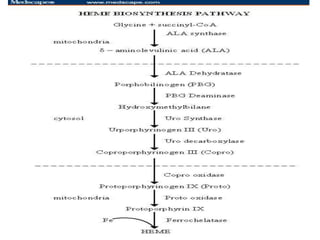
• There are eight enzymes in the heme biosynthetic pathway, four of
which—the first one and the last three—are in the mitochondria, while
the other four are in the cytosol. Defects in any of these can lead to some
form of porphyria.
• The hepatic porphyrias are characterized by acute
neurological attacks (seizures, psychosis, extreme back
and abdominal pain and an acute polyneuropathy),
while the erythropoietic forms present with skin
problems, usually a light-sensitive blistering rash and
increased hair growth.
• Variegate porphyria (also porphyria variegata or mixed
porphyria), which results from a partial deficiency in
PROTO oxidase, manifests itself with skin lesions
similar to those of porphyria cutanea tarda combined
with acute neurologic attacks. All other porphyrias are
either skin- or nerve-predominant.
Epidemiology
• The prevalence of all types of porphyria taken
together has been estimated to be
approximately 1 in 25,000 in the United
States.[31] The worldwide prevalence has been
estimated to be somewhere between 1 in 500
to 1 in 50,000 people.
Culture and History
• Porphyrias have been detected in all races, multiple
ethnic groups on every continent including Africans,
Asians, Australian aborigines, Caucasians, Peruvian,
Mexican, Native Americans, and Sami. There are high
incidence reports of AIP in areas of India and
Scandinavia and over 200 genetic variants of AIP, some
of which are specific to families, although some strains
have proven to be repeated mutations.
• The links between porphyrias and mental illness have
been noted for decades. In the early 1950s patients
with porphyrias (occasionally referred to as "Porphyric
Hemophilia"[33]) and severe symptoms of depression or
catatonia were treated with electroshock.
Vampires and werewolves
• Porphyria has been suggested as an explanation for the origin of
vampire and werewolf legends, based upon certain perceived
similarities between the condition and the folklore.
• In January 1964, L. Illis' 1963 paper, "On Porphyria and the
Aetiology of Werwolves", was published in Proceedings of the Royal
Society of Medicine. Later, Nancy Garden argued for a connection
between porphyria and the vampire belief in her 1973 book,
Vampires. In 1985, biochemist David Dolphin's paper for the
American Association for the Advancement of Science, "Porphyria,
Vampires, and Werewolves: The Aetiology of European
Metamorphosis Legends", gained widespread media coverage, thus
popularizing the idea.
• The theory has been rejected by a few folklorists and researchers as
not accurately describing the characteristics of the original
werewolf and vampire legends or the disease and for potentially
stigmatizing sufferers of porphyria
• The mental illness exhibited by King George III evidenced in the regency crisis of 1788 has inspired
several attempts at retrospective diagnosis. The first, written in 1855, thirty-five years after his
death, concluded he suffered from acute mania. M. Guttmacher, in 1941, suggested manic-
depressive psychosis as a more likely diagnosis. The first suggestion that a physical illness was the
cause of King George's mental derangements came in 1966, in a paper "The Insanity of King George
III: A Classic Case of Porphyria",[37] with a follow-up in 1968, "Porphyria in the Royal Houses of
Stuart, Hanover and Prussia".[38] The papers, by a mother/son psychiatrist team, were written as
though the case for porphyria had been proven, but the response demonstrated that many,
including those more intimately familiar with actual manifestations of porphyria, were
unconvinced. Many psychiatrists disagreed with Hunter's diagnosis, suggesting bipolar disorder as
far more probable. The theory is treated in Purple Secret,[39] which documents the ultimately
unsuccessful search for genetic evidence of porphyria in the remains of royals suspected to suffer
from it.[40] In 2005 it was suggested that arsenic (which is known to be porphyrogenic) given to
George III with antimony may have caused his porphyria.[41] Despite the lack of direct evidence, the
notion that George III (and other members of the royal family) suffered from porphyria has
achieved such popularity that many forget that it is merely a hypothesis. In 2010 an exhaustive
analysis of historical records concluded that the porphyria claim was based on spurious and
selective interpretation of contemporary medical and historical sources
• The mental illness of George III is the basis of the plot in The Madness of King
George, a 1994 British film based upon the 1991 Alan Bennett play The Madness of
George III. The closing credits of the film include the comment that the illness
suffered by King George has been attributed to porphyria and that it is hereditary.
Among other descendants of George III, theorised by the authors of Purple Secret
to have suffered from porphyria (based upon analysis of their extensive and
detailed medical correspondence), were his great-great-granddaughter Princess
Charlotte of Prussia (Emperor William II's eldest sister) and her daughter Princess
Feodora of Saxe-Meiningen. They had more success in being able to uncover
reliable evidence that George III's great-great-great-grandson Prince William of
Gloucester was reliably diagnosed with variegate porphyria.[43]
• It is believed that Mary, Queen of Scots – King George III's great-great-great-great-
great-grandmother – also suffered from acute intermittent porphyria,[44] although
this is subject to much debate. It is assumed she inherited the disorder, if indeed
she had it, from her father, James V of Scotland; both father and daughter endured
well-documented attacks that could fall within the constellation of symptoms of
porphyria.
• Maria I of Portugal, known as "Maria the Pious" or "Maria the Mad" due to both her religious
fervour and her acute mental illness that made her incapable of handling state affairs after 1792, is
also thought to have suffered from porphyria. Francis Willis, the same physician that treated
George III, was even summoned by the Portuguese court, but returned to England after the
Portuguese court set him limits as to what treatments he could see through. Contemporary
sources, such as the Secretary of State for Foreign Affairs Luís Pinto, noted that the Queen suffered
from ever-worsening stomach pains and abdominal spasms — hallmarks of porphyria.[45]
• Vlad III was also said to have suffered from acute porphyria, which may have started the notion that
vampires were allergic to sunlight.[46]
• Other commentators have suggested that Vincent van Gogh may have suffered from acute
intermittent porphyria.[47] It has also been speculated that King Nebuchadnezzar of Babylon
suffered from some form of porphyria (cf. Daniel 4).[48] However, the symptoms of the various
porphyrias are so extensive that a wide constellation of symptoms can be attributed to one or more
of them.[citation needed]
• Physician Archie Cochrane was born with porphyria, which caused health problems throughout his
life.[49]
• Paula Frías Allende, the daughter of the Chilean novelist Isabel Allende, fell into a porphyria-
induced coma in 1991,[50] which inspired Isabel to write the biographical book Paula, dedicated to
her.
Complications
Dehydration Vomiting due to an attack of acute porphyria can lead
to dehydration, which may require that you receive fluids through a vein
(intravenously).
Breathing difficulties Acute porphyrias can cause muscle
weakness and paralysis, which can cause breathing problems.
Low sodium in blood /hyponatremia: linked to problems
with sodium and water handling in your body.
High blood pressure Porphyrin buildup can damage your kidneys
and may result in high blood pressure (hypertension).
Chronic kidney failure
Liver damage
Permanent skin damage When your skin heals after cutaneous
porphyria, it may have an abnormal appearance and coloring. Scars may
remain on your skin as well, and lasting skin problems may cause your
hair to fall out
Preventions
• Although there's no way to prevent porphyria, if you have the disease,
these steps may help prevent symptoms:
• Avoid medications known to trigger acute attacks. Ask your doctor for a
list of safe and unsafe drugs.
• Don't use alcohol or illegal drugs.
• Avoid fasting and dieting that involves severe calorie restriction.
• Don't smoke.
• Minimize sun exposure. When you're outdoors, wear protective clothing
and use a broad-spectrum sunscreen with a high sun protection factor
(SPF).
• Treat infections and other illnesses promptly.
• Take steps to reduce emotional stress.
• Because porphyria is an inherited disorder, your siblings and other family
members may want to consider genetic testing to determine if they have
the disease.
Treatment
• Treatment of acute porphyrias focuses on providing
rapid treatment of symptoms and preventing
complications. This may require hospitalization in
severe cases. Treatment may include::
1. hematin given through a vein(intravenously) , a
medication that is a form of heme, to limit the
body's production of porphyrin.
2. Medication to control pain, nausea and vomiting
3. Intravenous sugar (glucose) or sugar taken by
mouth, if able, to maintain an adequate intake of
carbohydrates.
4. Intravenous fluids to combat dehydration
• Treatment of cutaneous porphyrias focuses on
reducing exposure to sunlight and the amount of
porphyrins in your body to help eliminate your
symptoms. This may include::
1. Drawing blood (phlebotomy)- Drawing a certain
amount of blood from one of veins reduces the iron
in body, which decreases porphyrins
2.Medications: Drugs used to treat malaria —
hydroxychloroquine (Plaquenil) or, less often,
chloroquine (Aralen) — can absorb excess
porphyrins and help body get rid of them more
quickly than usual
3. Beta carotene- increase your skin's tolerance to
sunlight.
4. Vitamin D- Supplements may be recommended to
replace vitamin D deficiency caused by avoidance of
sunlight
Porphyria  the vampire disease

Porphyria the vampire disease

  • 1.
    Porphyria- The Vampiredisease Abhishek Jha Grp- 18
  • 2.
    What is it? •Group of rare diseases in which metabolic substances called porphyrins accumulate in body. • Porphyrins produce heme , which carries oxygen in the blood; but in the porphyrias, there is a deficiency (inherited or acquired) of the enzymes that transform the various porphyrins into others, leading to abnormally high levels of these substance. • This manifests with either neurological complications or skin problems or occasionally both.
  • 4.
    • Term porphyriais derived from the Greek porphyra, meaning "purple pigment a reference to the color of the porphyrins. • The disease was first explained biochemically by Felix Hoppe-Seyler in 1871 and acute porphyrias were described by the Dutch physician Barend Stokvis in 1889.
  • 5.
    • Porphyria's areclassified in two ways, by symptoms and by pathophysiology. • Symptomatically 1. Acute 2. Cutaneous • Pathophysiology 1. Hepatic 2. Erythropoitic -based on the sites of accumulation of heme precursors, either in the liver or bone marrow and red blood cells
  • 6.
    Acute porphyria • acuteintermittent porphyria • ALA dehydratase (porphobilinogen synthase) porphyria
  • 7.
    Acute porphyria • Acuteporphyrias primarily affect the nervous system, which appear quickly and can be life- threatening and resulting in episodic crises known as acute attacks. • Acute porphyria attacks are rare before puberty and after menopause in women. • Symptoms may last one to two weeks and usually improve slowly after the attack.
  • 8.
    Signs occur duringacute porphyria • Severe abdominal pain • Swelling of the abdomen (abdominal distention) • Pain in your chest, legs or back • Constipation or diarrhea • Vomiting • Insomnia • Heartbeat you can feel (palpitations) • High blood pressure • Anxiety or restlessness • Seizures • Mental changes, such as confusion, hallucinations, disorientation or paranoia • Breathing problems • Muscle pain, tingling, numbness, weakness or paralysis • Red or brown urine
  • 10.
    • The relativelylow occurrence of porphyria, the patient may initially be suspected to have other, unrelated conditions. For instance, the polyneuropathy of acute porphyria may be mistaken for Guillain-Barre syndrome, and porphyria testing is commonly recommended in those situations
  • 13.
    Cutaneous porphyria • X-linkeddominant protoporphyria (XLDPP) • congenital erythropoietic porphyria (CEP) • porphyria cutanea tarda (PCT) • erythropoietic protoporphyria (EPP) • variegate porphyria • hereditary coproporphyria
  • 15.
    Cutaneous porphyrias • Cutaneousporphyrias include forms of the disease that cause skin symptoms as a result of oversensitivity to sunlight, but these forms don't usually affect nervous system. Attacks may last for several days. With some forms, signs and symptoms may start during infancy or childhood.
  • 16.
    • Sensitivity tothe sun and sometimes artificial light, causing burning pain Sudden painful skin redness (erythema) and swelling (edema) Blisters that take weeks to heal Itching Fragile skin Scars or skin color changes from healing blisters Increased hair growth Red or brown urine
  • 17.
    Two distinct patternsof skin disease are seen in porphyria: • Immediate photosensitivity This is typical of XLDPP and EPP. Following a variable period of sun-exposure ,typically about 30 minutes, patients complain of severe pain, burning and discomfort in sun-exposed areas, there may be some redness and swelling of the skin
  • 18.
    • Vesiculo-erosive skindisease -occur blistering (vesicles) and open sores (erosions). It is the pattern of skin disease seen in CEP, PCT, VP and HCP. -Changes are noted only in sun-exposed areas such as the backs of the hands and face. Milder skin disease, consists of increased skin fragility in exposed areas with a tendency to form blisters and erosions particularly after minor knocks or scrapes. These heal slowly, often leaving small scars which may be lighter or darker than normal skin.
  • 20.
    • More severeskin disease is sometimes seen in PCT, with more prominent lessons, darkening of exposed skin such as the face and hypertrichosis: abnormal hair growth on the face, particularly the cheeks
  • 21.
    • term photoutilationis used to describe the severe shortening of digits and loss of skin appendages such as hair and nails, and severe scarring of the skin with progressive disappearance of ears, lips and nose. These patients may also show deformed, discolored teeth, gum and eye abnormalities
  • 22.
    Diagnosis • Blood ,urine and stool test may revel kidney problem and other problem special test measure prophyrin in blood. • The test measure the concentration of porphyrins and their precursors ALA and PBG which will be very high in patient with an attack of acute porphyria.
  • 23.
    Risk factor • Certaindrugs (barbiturates or sulfonamide antibiotics or, less often, birth control pills, or some drugs that affect the mind or behavior, known as psychoactive drugs) • Chemicals • Dieting or fasting • Smoking • Physical stress, such as infections or other illnesses • Liver disease • Emotional stress • Alcohol use • Menstrual hormones • Sun exposure • Excess iron in your body
  • 24.
    Pathogenesis • In humans,porphyrins are the main precursors of heme, an essential constituent of hemoglobin, myoglobin, catalase, peroxidase, respiratory and P450 liver cytochromes. Deficiency in the enzymes of the porphyrin pathway leads to insufficient production of heme. Heme function plays a central role in cellular metabolism. This is not the main problem in the porphyrias; most heme synthesis enzymes—even dysfunctional enzymes—have enough residual activity to assist in heme biosynthesis. The principal problem in these deficiencies is the accumulation of porphyrins, the heme precursors, which are toxic to tissue in high concentrations. The chemical properties of these intermediates determine the location of accumulation, whether they induce photosensitivity, and whether the intermediate is excreted (in the urine or feces). • There are eight enzymes in the heme biosynthetic pathway, four of which—the first one and the last three—are in the mitochondria, while the other four are in the cytosol. Defects in any of these can lead to some form of porphyria.
  • 25.
    • The hepaticporphyrias are characterized by acute neurological attacks (seizures, psychosis, extreme back and abdominal pain and an acute polyneuropathy), while the erythropoietic forms present with skin problems, usually a light-sensitive blistering rash and increased hair growth. • Variegate porphyria (also porphyria variegata or mixed porphyria), which results from a partial deficiency in PROTO oxidase, manifests itself with skin lesions similar to those of porphyria cutanea tarda combined with acute neurologic attacks. All other porphyrias are either skin- or nerve-predominant.
  • 26.
    Epidemiology • The prevalenceof all types of porphyria taken together has been estimated to be approximately 1 in 25,000 in the United States.[31] The worldwide prevalence has been estimated to be somewhere between 1 in 500 to 1 in 50,000 people.
  • 27.
    Culture and History •Porphyrias have been detected in all races, multiple ethnic groups on every continent including Africans, Asians, Australian aborigines, Caucasians, Peruvian, Mexican, Native Americans, and Sami. There are high incidence reports of AIP in areas of India and Scandinavia and over 200 genetic variants of AIP, some of which are specific to families, although some strains have proven to be repeated mutations. • The links between porphyrias and mental illness have been noted for decades. In the early 1950s patients with porphyrias (occasionally referred to as "Porphyric Hemophilia"[33]) and severe symptoms of depression or catatonia were treated with electroshock.
  • 28.
    Vampires and werewolves •Porphyria has been suggested as an explanation for the origin of vampire and werewolf legends, based upon certain perceived similarities between the condition and the folklore. • In January 1964, L. Illis' 1963 paper, "On Porphyria and the Aetiology of Werwolves", was published in Proceedings of the Royal Society of Medicine. Later, Nancy Garden argued for a connection between porphyria and the vampire belief in her 1973 book, Vampires. In 1985, biochemist David Dolphin's paper for the American Association for the Advancement of Science, "Porphyria, Vampires, and Werewolves: The Aetiology of European Metamorphosis Legends", gained widespread media coverage, thus popularizing the idea. • The theory has been rejected by a few folklorists and researchers as not accurately describing the characteristics of the original werewolf and vampire legends or the disease and for potentially stigmatizing sufferers of porphyria
  • 29.
    • The mentalillness exhibited by King George III evidenced in the regency crisis of 1788 has inspired several attempts at retrospective diagnosis. The first, written in 1855, thirty-five years after his death, concluded he suffered from acute mania. M. Guttmacher, in 1941, suggested manic- depressive psychosis as a more likely diagnosis. The first suggestion that a physical illness was the cause of King George's mental derangements came in 1966, in a paper "The Insanity of King George III: A Classic Case of Porphyria",[37] with a follow-up in 1968, "Porphyria in the Royal Houses of Stuart, Hanover and Prussia".[38] The papers, by a mother/son psychiatrist team, were written as though the case for porphyria had been proven, but the response demonstrated that many, including those more intimately familiar with actual manifestations of porphyria, were unconvinced. Many psychiatrists disagreed with Hunter's diagnosis, suggesting bipolar disorder as far more probable. The theory is treated in Purple Secret,[39] which documents the ultimately unsuccessful search for genetic evidence of porphyria in the remains of royals suspected to suffer from it.[40] In 2005 it was suggested that arsenic (which is known to be porphyrogenic) given to George III with antimony may have caused his porphyria.[41] Despite the lack of direct evidence, the notion that George III (and other members of the royal family) suffered from porphyria has achieved such popularity that many forget that it is merely a hypothesis. In 2010 an exhaustive analysis of historical records concluded that the porphyria claim was based on spurious and selective interpretation of contemporary medical and historical sources
  • 30.
    • The mentalillness of George III is the basis of the plot in The Madness of King George, a 1994 British film based upon the 1991 Alan Bennett play The Madness of George III. The closing credits of the film include the comment that the illness suffered by King George has been attributed to porphyria and that it is hereditary. Among other descendants of George III, theorised by the authors of Purple Secret to have suffered from porphyria (based upon analysis of their extensive and detailed medical correspondence), were his great-great-granddaughter Princess Charlotte of Prussia (Emperor William II's eldest sister) and her daughter Princess Feodora of Saxe-Meiningen. They had more success in being able to uncover reliable evidence that George III's great-great-great-grandson Prince William of Gloucester was reliably diagnosed with variegate porphyria.[43] • It is believed that Mary, Queen of Scots – King George III's great-great-great-great- great-grandmother – also suffered from acute intermittent porphyria,[44] although this is subject to much debate. It is assumed she inherited the disorder, if indeed she had it, from her father, James V of Scotland; both father and daughter endured well-documented attacks that could fall within the constellation of symptoms of porphyria.
  • 31.
    • Maria Iof Portugal, known as "Maria the Pious" or "Maria the Mad" due to both her religious fervour and her acute mental illness that made her incapable of handling state affairs after 1792, is also thought to have suffered from porphyria. Francis Willis, the same physician that treated George III, was even summoned by the Portuguese court, but returned to England after the Portuguese court set him limits as to what treatments he could see through. Contemporary sources, such as the Secretary of State for Foreign Affairs Luís Pinto, noted that the Queen suffered from ever-worsening stomach pains and abdominal spasms — hallmarks of porphyria.[45] • Vlad III was also said to have suffered from acute porphyria, which may have started the notion that vampires were allergic to sunlight.[46] • Other commentators have suggested that Vincent van Gogh may have suffered from acute intermittent porphyria.[47] It has also been speculated that King Nebuchadnezzar of Babylon suffered from some form of porphyria (cf. Daniel 4).[48] However, the symptoms of the various porphyrias are so extensive that a wide constellation of symptoms can be attributed to one or more of them.[citation needed] • Physician Archie Cochrane was born with porphyria, which caused health problems throughout his life.[49] • Paula Frías Allende, the daughter of the Chilean novelist Isabel Allende, fell into a porphyria- induced coma in 1991,[50] which inspired Isabel to write the biographical book Paula, dedicated to her.
  • 32.
    Complications Dehydration Vomiting dueto an attack of acute porphyria can lead to dehydration, which may require that you receive fluids through a vein (intravenously). Breathing difficulties Acute porphyrias can cause muscle weakness and paralysis, which can cause breathing problems. Low sodium in blood /hyponatremia: linked to problems with sodium and water handling in your body. High blood pressure Porphyrin buildup can damage your kidneys and may result in high blood pressure (hypertension). Chronic kidney failure Liver damage Permanent skin damage When your skin heals after cutaneous porphyria, it may have an abnormal appearance and coloring. Scars may remain on your skin as well, and lasting skin problems may cause your hair to fall out
  • 33.
    Preventions • Although there'sno way to prevent porphyria, if you have the disease, these steps may help prevent symptoms: • Avoid medications known to trigger acute attacks. Ask your doctor for a list of safe and unsafe drugs. • Don't use alcohol or illegal drugs. • Avoid fasting and dieting that involves severe calorie restriction. • Don't smoke. • Minimize sun exposure. When you're outdoors, wear protective clothing and use a broad-spectrum sunscreen with a high sun protection factor (SPF). • Treat infections and other illnesses promptly. • Take steps to reduce emotional stress. • Because porphyria is an inherited disorder, your siblings and other family members may want to consider genetic testing to determine if they have the disease.
  • 34.
    Treatment • Treatment ofacute porphyrias focuses on providing rapid treatment of symptoms and preventing complications. This may require hospitalization in severe cases. Treatment may include:: 1. hematin given through a vein(intravenously) , a medication that is a form of heme, to limit the body's production of porphyrin. 2. Medication to control pain, nausea and vomiting 3. Intravenous sugar (glucose) or sugar taken by mouth, if able, to maintain an adequate intake of carbohydrates. 4. Intravenous fluids to combat dehydration
  • 35.
    • Treatment ofcutaneous porphyrias focuses on reducing exposure to sunlight and the amount of porphyrins in your body to help eliminate your symptoms. This may include:: 1. Drawing blood (phlebotomy)- Drawing a certain amount of blood from one of veins reduces the iron in body, which decreases porphyrins 2.Medications: Drugs used to treat malaria — hydroxychloroquine (Plaquenil) or, less often, chloroquine (Aralen) — can absorb excess porphyrins and help body get rid of them more quickly than usual 3. Beta carotene- increase your skin's tolerance to sunlight. 4. Vitamin D- Supplements may be recommended to replace vitamin D deficiency caused by avoidance of sunlight