Special Needs PlanningThe Basics of Special Needs Planning
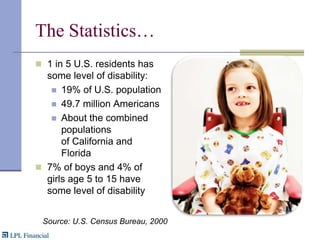
The Statistics…1 in 5 U.S. residents hassome level of disability:19% of U.S. population49.7 million AmericansAbout the combined populations of California and Florida 7% of boys and 4% of girls age 5 to 15 have some level of disabilitySource: U.S. Census Bureau, 2000
The Statistics…1 out of 150 American births results in autismAlzheimer’s develops in someone in America every 70 secondsSource: Centers for Disease Control  and Prevention, February 2007Source:
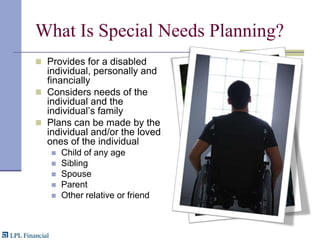
What Is Special Needs Planning?Provides for a disabled individual, personally and financiallyConsiders needs of the  individual and the individual’s familyPlans can be made by the  individual and/or the loved ones of the individual Child of any ageSiblingSpouseParentOther relative or friend
Goals of Special Needs PlanningBalance your present and future needs with your loved one’s present and future needsCreate and implement personal care, financial, and legal plansCommunicate such plans to all relevant personsReview and revise plans as circumstances change Provide peace of mind and family harmony
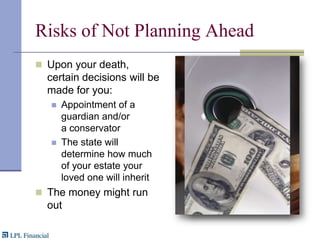
Risks of Not Planning AheadUpon your death, certain decisions will be made for you:Appointment of a  guardian and/or a conservatorThe state will determine how much of your estate your loved one will inherit The money might run out
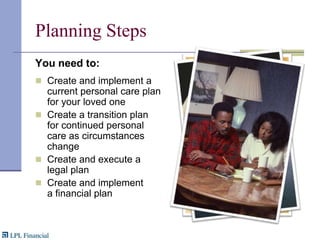
Planning StepsYou need to:Create and implement a current personal care plan for your loved oneCreate a transition plan for continued personal care as circumstances changeCreate and execute a legal planCreate and implement a financial plan
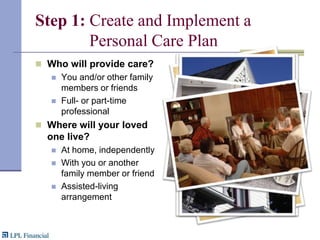
Step 1: Create and Implement a Personal Care PlanWho will provide care?You and/or other family members or friendsFull- or part-time professionalWhere will your loved one live?At home, independentlyWith you or another family member or friendAssisted-living arrangement
Step 1: Create and Implement a Personal Care PlanWhat care is needed?Household chores and other daily tasksWashing and dressingPreparing mealsTransportationMedicalSafety/emergency plan
Step 2: Create a Transition Plan Continuity of care and supervisionChoosing alternate people and services to replace those in original plan if neededAnticipate and prepare for future life eventsAnswer “what if” questionsWhat if you die unexpectedly?What if your loved one becomes unable to make his/her own medical/financial decisions?
Step 3: Create and Execute a Legal Plan Ensure that legal precautions are in place:Medical directivesDurable powers of attorneyYour last will and testamentLetter of intent or instruction (not legally binding)Hire an attorneyAn experienced estate planning or special needs planning attorney will help coordinate your will with other financial plans that have been made or will be made
Step 4: Create and Implement a Financial PlanEstimate the monthly cost to care for your loved oneProject the cost over your loved one’s expected lifespanFactor in inflation
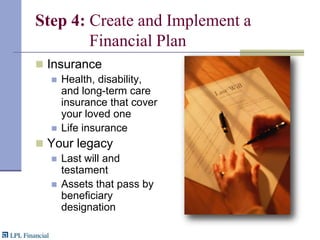
Step 4: Create and Implement a Financial PlanInsuranceHealth, disability, and long-term care insurance that cover your loved oneLife insurance Your legacyLast will and testamentAssets that pass by beneficiary designation
Need to Preserve Government BenefitsSome government benefits are needs basedYou may need to legally protect some assets in order to maintain entitlement to public benefits
Sources of Government Benefits National organizationsCommunity aidState aidFederal aidwww.disability.gov
Federal Benefits: Not Based on Financial NeedMedicareSocial Security Disability Income (SSDI)Other benefitsSpecial education
Federal Benefits: Need-basedMedicaidJoint federal and state program that helps with medical costs for some people with low incomes and limited resourcesSupplemental Social Security Income (SSI)Provides monthly income to people age 65 or older, or who are blind or disabled, and who have limited income and financial resources
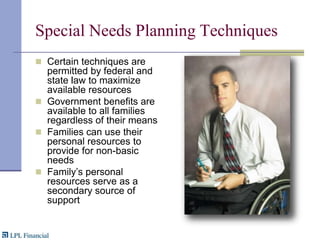
Special Needs Planning TechniquesCertain techniques are permitted by federal and state law to maximize available resourcesGovernment benefits are available to all families regardless of their meansFamilies can use their personal resources to provide for non-basic needsFamily’s personal resources serve as a secondary source of support
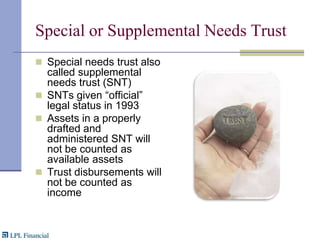
Special or Supplemental Needs TrustSpecial needs trust also called supplemental needs trust (SNT)SNTs given “official” legal status in 1993Assets in a properly drafted and administered SNT will not be counted as available assetsTrust disbursements will not be counted as income
Types of SNTsSelf-settled or first-party SNT Pooled SNTThird-party SNT
Self-Settled or First-Party SNTCreated for sole benefit of disabled individual under age 65Created by parent, grandparent, guardian, or by the courtCannot be created by the disabled individualDisabled individual can fund the trust
Self-Settled or First-Party SNTAvoids Medicaid and SSI “look-back” provisionsAssets in trust will not be countable as resources for eligibility purposesUpon the disabled individual's death, any money or assets remaining in the trust must be used to reimburse the government for Medicaid benefits extended to the individual during his/her lifetime
Pooled SNTManaged by a nonprofit organization Funds are pooled for investment purposesSubaccounts maintained for each disabled beneficiaryCan be created by the disabled individual for himself/herselfPay back to Medicaid or help others in the pool, depending on state law
Third-Party SNTCreated by disabled person’s parent or other third-partyNo payback requirementCreator of trust must not have a duty to support the disabled personDisabled person does not need to be under age 65May or may not trigger Medicaid or SSI penalty period
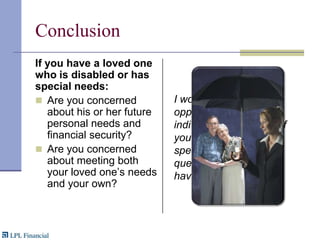
ConclusionIf you have a loved one who is disabled or has special needs:Are you concerned about his or her future personal needs and financial security?Are you concerned about meeting both your loved one’s needs and your own?I would welcome the opportunity to meet individually with each of you to address any specific concerns or questions that you may have.
DisclaimerForefield Inc. does not provide legal, tax, or investment advice. All content provided by Forefield is protected by copyright. Forefield is not responsible for any modifications made to its materials, or for the accuracy of information provided by other sources.

Special Needs Presentation

  • 1.
    Special Needs PlanningTheBasics of Special Needs Planning
  • 2.
    The Statistics…1 in5 U.S. residents hassome level of disability:19% of U.S. population49.7 million AmericansAbout the combined populations of California and Florida 7% of boys and 4% of girls age 5 to 15 have some level of disabilitySource: U.S. Census Bureau, 2000
  • 3.
    The Statistics…1 outof 150 American births results in autismAlzheimer’s develops in someone in America every 70 secondsSource: Centers for Disease Control and Prevention, February 2007Source:
  • 4.
    What Is SpecialNeeds Planning?Provides for a disabled individual, personally and financiallyConsiders needs of the individual and the individual’s familyPlans can be made by the individual and/or the loved ones of the individual Child of any ageSiblingSpouseParentOther relative or friend
  • 5.
    Goals of SpecialNeeds PlanningBalance your present and future needs with your loved one’s present and future needsCreate and implement personal care, financial, and legal plansCommunicate such plans to all relevant personsReview and revise plans as circumstances change Provide peace of mind and family harmony
  • 6.
    Risks of NotPlanning AheadUpon your death, certain decisions will be made for you:Appointment of a guardian and/or a conservatorThe state will determine how much of your estate your loved one will inherit The money might run out
  • 7.
    Planning StepsYou needto:Create and implement a current personal care plan for your loved oneCreate a transition plan for continued personal care as circumstances changeCreate and execute a legal planCreate and implement a financial plan
  • 8.
    Step 1: Createand Implement a Personal Care PlanWho will provide care?You and/or other family members or friendsFull- or part-time professionalWhere will your loved one live?At home, independentlyWith you or another family member or friendAssisted-living arrangement
  • 9.
    Step 1: Createand Implement a Personal Care PlanWhat care is needed?Household chores and other daily tasksWashing and dressingPreparing mealsTransportationMedicalSafety/emergency plan
  • 10.
    Step 2: Createa Transition Plan Continuity of care and supervisionChoosing alternate people and services to replace those in original plan if neededAnticipate and prepare for future life eventsAnswer “what if” questionsWhat if you die unexpectedly?What if your loved one becomes unable to make his/her own medical/financial decisions?
  • 11.
    Step 3: Createand Execute a Legal Plan Ensure that legal precautions are in place:Medical directivesDurable powers of attorneyYour last will and testamentLetter of intent or instruction (not legally binding)Hire an attorneyAn experienced estate planning or special needs planning attorney will help coordinate your will with other financial plans that have been made or will be made
  • 12.
    Step 4: Createand Implement a Financial PlanEstimate the monthly cost to care for your loved oneProject the cost over your loved one’s expected lifespanFactor in inflation
  • 13.
    Step 4: Createand Implement a Financial PlanInsuranceHealth, disability, and long-term care insurance that cover your loved oneLife insurance Your legacyLast will and testamentAssets that pass by beneficiary designation
  • 14.
    Need to PreserveGovernment BenefitsSome government benefits are needs basedYou may need to legally protect some assets in order to maintain entitlement to public benefits
  • 15.
    Sources of GovernmentBenefits National organizationsCommunity aidState aidFederal aidwww.disability.gov
  • 16.
    Federal Benefits: NotBased on Financial NeedMedicareSocial Security Disability Income (SSDI)Other benefitsSpecial education
  • 17.
    Federal Benefits: Need-basedMedicaidJointfederal and state program that helps with medical costs for some people with low incomes and limited resourcesSupplemental Social Security Income (SSI)Provides monthly income to people age 65 or older, or who are blind or disabled, and who have limited income and financial resources
  • 18.
    Special Needs PlanningTechniquesCertain techniques are permitted by federal and state law to maximize available resourcesGovernment benefits are available to all families regardless of their meansFamilies can use their personal resources to provide for non-basic needsFamily’s personal resources serve as a secondary source of support
  • 19.
    Special or SupplementalNeeds TrustSpecial needs trust also called supplemental needs trust (SNT)SNTs given “official” legal status in 1993Assets in a properly drafted and administered SNT will not be counted as available assetsTrust disbursements will not be counted as income
  • 20.
    Types of SNTsSelf-settledor first-party SNT Pooled SNTThird-party SNT
  • 21.
    Self-Settled or First-PartySNTCreated for sole benefit of disabled individual under age 65Created by parent, grandparent, guardian, or by the courtCannot be created by the disabled individualDisabled individual can fund the trust
  • 22.
    Self-Settled or First-PartySNTAvoids Medicaid and SSI “look-back” provisionsAssets in trust will not be countable as resources for eligibility purposesUpon the disabled individual's death, any money or assets remaining in the trust must be used to reimburse the government for Medicaid benefits extended to the individual during his/her lifetime
  • 23.
    Pooled SNTManaged bya nonprofit organization Funds are pooled for investment purposesSubaccounts maintained for each disabled beneficiaryCan be created by the disabled individual for himself/herselfPay back to Medicaid or help others in the pool, depending on state law
  • 24.
    Third-Party SNTCreated bydisabled person’s parent or other third-partyNo payback requirementCreator of trust must not have a duty to support the disabled personDisabled person does not need to be under age 65May or may not trigger Medicaid or SSI penalty period
  • 25.
    ConclusionIf you havea loved one who is disabled or has special needs:Are you concerned about his or her future personal needs and financial security?Are you concerned about meeting both your loved one’s needs and your own?I would welcome the opportunity to meet individually with each of you to address any specific concerns or questions that you may have.
  • 26.
    DisclaimerForefield Inc. doesnot provide legal, tax, or investment advice. All content provided by Forefield is protected by copyright. Forefield is not responsible for any modifications made to its materials, or for the accuracy of information provided by other sources.