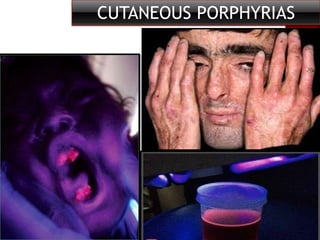
CUTANEOUS PORPHYRIAS
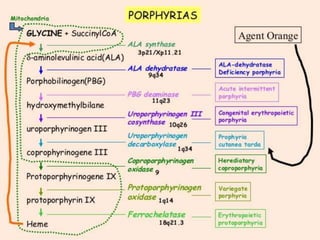
•Porphyrias - group of disorders caused by
defects in the biosynthesis of haem.
•Phototoxic properties of porphyrins, cause
photosensitivity.
The IRON in haem useful for
 electron transfer(respiratory cytochromes),
reversible oxygen binding (haemoglobin and myoglobin)
and
oxidation and reduction reactions (cytochrome P450,
catalase)
• 18 delocalised electrons- exited by long wavelength.
• Soret band – 408 nm – main absorption peak
Cutaneous disease
only
Cutaneous disease
and acute attacks
Acute attacks only
1. Porphyria cutanea
tarda(PCT)
Hereditary
coproporphyria(HC)
Acute intermittent
porphyria(AIP)
2. Congenital
erythropoietic
porphyria(CEP)
Variegate
porphyria(VP)
3. Erythropoietic
protoporphyria(EPP)
CONGENITAL ERYTHROPOIETIC PORPHYRIA
•Gunther disease
•severe ,rare childhood porphyria - lifelong
mutilating photosensitivity and haematological disease.
•AR
•inherited deficiency of uroporphyrinogen
ɪɪɪ cosynthase
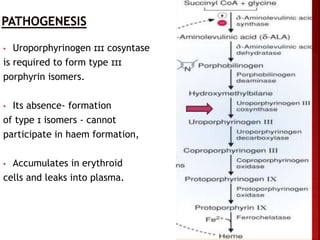
• Uroporphyrinogen ɪɪɪ cosyntase
is required to form type ɪɪɪ
porphyrin isomers.
• Its absence- formation
of type ɪ isomers - cannot
participate in haem formation,
• Accumulates in erythroid
cells and leaks into plasma.
Clinical features
•hydrops fetalis to mild forms
•brown discoloration of amniotic fluid or pink/ brown
porphyrin staining of nappies (fluoresce red‐orange- Wood’s
light).
•Severe photosensitivity in neonatal period → blisters
developing
•Photomutilation- onycholysis, erosions
in terminal phalanges,
destructive changes in pinna and nose
•Repeated inflammation with vesicles and bullae, with
secondary infection → mutilating scarring - face and hands
•A diffuse pseudosclerodermatous thickening of exposed
skin with microstomia and sclerodactyly‐like changes.
•Hypertrichosis - upper arms, temples and malar region
•Eyes . Keratoconjunctivitis, blepharitis, cataracts, corneal
ulcers, scars
•Bones and teeth . When teeth emerge, stained brown(
fluoresce under Wood’s). Decreased bone density, osteopenia
and osteolytic lesions
•Haematology . Haemolytic anaemia, Hypersplenism
Under violet illumination most normoblasts- red
fluorescence localized to their nuclei
• Red cells and urine – large amounts of uro and
coproporphyrin.
• Faeces – coproporphyrin.
• Plasma spectrofluorimetry peak – 615 to 620nm.
TREATMENT
•Hypertransfusion - to maintain polycythaemia→ inhibits
Hb production and ↓ses porphyrin formation
•Allogeneic bone marrow transplantation from an
HLA‐compatible donor treatment of choice
Genetic counselling
• For parents of an affected child, the chance of future
offspring suffering - 25%.
•The diagnosis before birth by measuring the uroporphyrin
I concentration in amniotic fluid, increased as early as 16
weeks in utero
PORPHYRIA CUTANEA TARDA
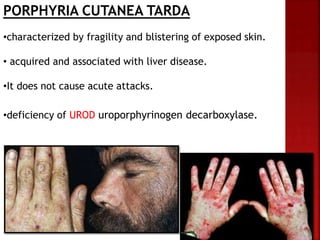
•characterized by fragility and blistering of exposed skin.
• acquired and associated with liver disease.
•It does not cause acute attacks.
•deficiency of UROD uroporphyrinogen decarboxylase.
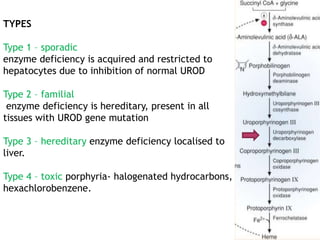
TYPES
Type 1 – sporadic
enzyme deficiency is acquired and restricted to
hepatocytes due to inhibition of normal UROD
Type 2 – familial
enzyme deficiency is hereditary, present in all
tissues with UROD gene mutation
Type 3 – hereditary enzyme deficiency localised to
liver.
Type 4 – toxic porphyria- halogenated hydrocarbons,
hexachlorobenzene.
UROD inactivated by Uroporphomethene, CI
(formed oxidation of uroporphyrinogen )
The inhibitor generated in liver by ROS
accumulated uroporphyrin diffuses into surrounding tissues→
phototoxic reaction in the upper dermis
This leads to lysis of cells in the superficial dermis with
formation of vacuoles which produce blister cavity under the
basal lamina
•Type 1 – adult ; type 2 – childhood
•Fragility and blistering in exposed sites
•Lesions resolve leaving atrophic scars, milia, mottled hyper
or hypo pigmentation
•Scarring alopecia, hypertrichosis,
melasma like hyperpigmentation, onycholysis, solar
elastosis,Morphoea‐like plaques, cicatricial conjunctivitis
HEPATOERYTHROPOIETIC PORPHYRIA(HEP)
•Homozygous form of familial PCT.
•90% reduction in UROD activity.
•Severe disease similar to CEP with phototoxicity during
infancy
RISK FACTORS FOR THE DEVELOPMENT OF PCT
INVESTIGATIONS
•PCT- urine – uroporphyrin
•A plasma spectrofluorimetry peak - 615–620 nm.
•Faeces - Isocoproporphyrin
few patients with VP have the PCT urine pattern (‘dual
porphyria’)
• HEP- additional finding → raised red cell
Zinc‐protoporphyrin, and lower red cell UROD activity
MANAGEMENT
•Photoprotection
sunscreens – titanium
dioxide or zinc oxide,
(with added iron oxide)
filter films for car and
home windows, gloves,
hats and clothes
Specific treatments
•Venesection
Around 500 mL of blood removed every week/2 weeks, ↓
transferrin saturation to 15%, Hb to 11–12 g/dL and plasma
ferritin to ˂ 25 μg/L
•Excision and grafting - ulcerated sclerodermoid lesions
•Desferrioxamine – rapidly chelates hepatic iron
•Low dose chloroquine- complexes with uroporphyrin and
excretes in bile.
•Dose-125mg or 250mg weekly twice
ERYTHROPOIETIC
PROTOPORPHYRIA
•Hereditary
•painful, lifelong photosensitivity
•Without blistering
•Deficient activity of
ferrochelatase enzyme.
•Gain‐of‐function mutations in
ALAS‐2 (the first enzyme in the
pathway)
•Common in 1st year of life
Mutation in ferrochelatase gene
Accumulation of protoporphyrin in RBC
Porphyrin laden cells pass dermal vessels and
are expose to soret wavelength
Acute injury to endothelium by singlet oxygen
and hydroxyl radical.
CLINICAL FEATURES
•Immediate pain on exposure to bright sunlight
•Pts describe discomfort, tingling or itching over dorsae of
hands and face
•partial relief with cold water and wet cloths
•Physical sign – erythema and oedema
•Patients experience a ‘priming phenomenon’ in which sunlight
tolerance is reduced on the day after significant sun
exposure
INVESTIGATIONS
•Plasma fluorimetry – peak at 633nm
•Red cell- free protoporphyrin
•Faeces – protoporphyrin
•Urine – normal
•Biopsy- deposition of PAS positive hyaline material in
walls of blood vessels.
•DIF- IgG deposition.
Management
•Photoprotection
sun protective clothing.
Dihydroxyacetone paint
window films
•Oral β‐carotene -
dose 180 mg daily in adults (90 mg daily in children)
•PUVA and NBUVB- photoprotection by inducing epidermal
thickening and pigmentation.
•Bone marrow transplantation
PORPHYRIAS
THAT
CAUSE
CUTANEOUS
DISEASE AND
ACUTE ATTACKS
HEREDITARY
COPROPORPHYRIA
• rare inherited disease
•characterized by acute attacks
•AD
•Inherited deficiency of
coproporphyrinogen oxidase
•puberty
CLINICAL FEATURES
•Skin - 10–20% - fragility and blistering in sun‐exposed
areas, Prominent hypertrichosis, pigmentation
•Harderoporphyria – jaundice, anemia, hepatosplenomegaly
in neonates
INVESTIGATIONS
•615–620 nm peak - plasma spectrofluorimetry
•increased uro‐ and coproporphyrin – urine
•increased coproporphyrin - faeces
VARIEGATE PORPHYRIA
•rare inherited disease
•AD
•Deficiency of protoporphyrinogen oxidase.
•Accumulation of CPP and PPP inhibits
PBG deaminase.
•Local accumulation – secondary
photoinactivation of UROD
CLINICAL FEATURES
•Begins in adolescence
•Mild skin fragility with painful bullae in exposed areas
•Lesions heal with scarring and pigmentary abnormalities-
pseudoscleromatous changes.
•Intercurrent biliary obstruction exacerbates cutaneous
disease
Acute attacks
•17%
•severity varies from mild abdominal pain, vomiting and
constipation, to very severe attacks with bulbar palsy and
respiratory paralysis.
INVESTIGATIONS
•Plasma spectroflurimetry – peaks around 626nm.
•Urine – coproporphyrin and uroporphyrin similar to PCT.
•Faeces – copro and protoporphyrin
TREATMENT
•Photoprotection
•β carotene
•UVB phototherapy
ACUTE INTERMITTENT PORPHYRIA
•AD
•Deficiency of porphobilinogen
deaminase
•Primary or secondary
•Triggered by drugs- CYP 450
•Gunter triad – abdominal pain,
vomiting , constipation
Pathogenesis
Liver- heme is incorporated into CYP450 proteins
Drug or hormone induces P450
Acutely increases hepatic requirement
Inability of pathway to respond adequately
Secondary accumulation of ALA
CLINICAL FEATURES
•Acute autonomic neuropathy – pain, tachycardia,
hypertension, partial ileus.
•Confusion, agitation, hallucination- abnormal behaviour
•Motor neuropathy - Respiratory muscle paralysis - death
MANAGEMENT
•Urine – PBG excretion
•Treatment – safe drugs
•Analgesia, sedatives, antiemetics and hydration
•IV hematin or haem arginate – suppress hepatic ALA
synthase activity
PSEUDOPORPHYRIA
•non‐porphyric dermatosis
•clinically and histologically indistinguishable from PCT
•Porphyrin concentrations - normal
•clinical presentations of drug‐induced photosensitivity:
Also, non‐drug‐related causes.
Causes
•Photosensitizing drugs
•Hemodialysis
•Sunbeds – UVA tanning beds
Photosensitizing drugs
•NSAIDs- naproxen, ketoprofen, mefanamic acid.
•Nalidixic acid
•Tetracyclines- minocycline
•Furosemide
•Isotretinoin
•Dapsone
Clinical features
•vesicles, bullae, fragility, milia and scarring on
exposed skin - dorsal hands, face, chest
•Diagnosis – Normal porphyrin conc in plasma, urine and
faeces.
•Treatment – stop offending drug, sunbed usage.
CASE #1
45y male alcoholic house painter with c/o blisters on
hands and tight skin.
Urine:
Elevated Uroporphyrin > Coproporphyrins
Feces: elevated Isocopro
RBC: nl
CBC: wbc=8,
Hg=16, Hct=50, Plt=250
LFT: elevated
PORPHYRIA CUTANEA
TARDA
Case #3
Mother comes in with 3yr old child. She says used to cry
after going out in the sun.He would often turn red and
blister afterwards.
you notice sclerodermoid changes of the face along with
excessive hair growth along the temples.
Mother states that both she and the father have
problems with Blistering of their hands with extensive sun
exposure.
Hepatoerythropoietic
Porphyria
Case scenario #4
40y woman from S.Africa. C/o blisters and scarring of
the hands Since age of 20.
Recently admitted to the GI service for N/V/D with
abdominal pain. Urine: Copro > Uro (opposite of PCT)
Variegate
Porphyria
Case #5
3yo female who cries when she Goes outside, and
Then runs inside to stand in front of AC vent.
She now presents to you with elliptical scars on the face
and pebbling of the nose and hands
Erythropoietic protoporphyria
Porphyrias

Porphyrias

  • 1.
  • 2.
    •Porphyrias - groupof disorders caused by defects in the biosynthesis of haem. •Phototoxic properties of porphyrins, cause photosensitivity.
  • 4.
    The IRON inhaem useful for  electron transfer(respiratory cytochromes), reversible oxygen binding (haemoglobin and myoglobin) and oxidation and reduction reactions (cytochrome P450, catalase)
  • 6.
    • 18 delocalisedelectrons- exited by long wavelength. • Soret band – 408 nm – main absorption peak
  • 7.
    Cutaneous disease only Cutaneous disease andacute attacks Acute attacks only 1. Porphyria cutanea tarda(PCT) Hereditary coproporphyria(HC) Acute intermittent porphyria(AIP) 2. Congenital erythropoietic porphyria(CEP) Variegate porphyria(VP) 3. Erythropoietic protoporphyria(EPP)
  • 8.
    CONGENITAL ERYTHROPOIETIC PORPHYRIA •Guntherdisease •severe ,rare childhood porphyria - lifelong mutilating photosensitivity and haematological disease. •AR •inherited deficiency of uroporphyrinogen ɪɪɪ cosynthase
  • 9.
    • Uroporphyrinogen ɪɪɪcosyntase is required to form type ɪɪɪ porphyrin isomers. • Its absence- formation of type ɪ isomers - cannot participate in haem formation, • Accumulates in erythroid cells and leaks into plasma.
  • 10.
    Clinical features •hydrops fetalisto mild forms •brown discoloration of amniotic fluid or pink/ brown porphyrin staining of nappies (fluoresce red‐orange- Wood’s light). •Severe photosensitivity in neonatal period → blisters developing •Photomutilation- onycholysis, erosions in terminal phalanges, destructive changes in pinna and nose
  • 11.
    •Repeated inflammation withvesicles and bullae, with secondary infection → mutilating scarring - face and hands •A diffuse pseudosclerodermatous thickening of exposed skin with microstomia and sclerodactyly‐like changes. •Hypertrichosis - upper arms, temples and malar region
  • 12.
    •Eyes . Keratoconjunctivitis,blepharitis, cataracts, corneal ulcers, scars •Bones and teeth . When teeth emerge, stained brown( fluoresce under Wood’s). Decreased bone density, osteopenia and osteolytic lesions •Haematology . Haemolytic anaemia, Hypersplenism Under violet illumination most normoblasts- red fluorescence localized to their nuclei
  • 13.
    • Red cellsand urine – large amounts of uro and coproporphyrin. • Faeces – coproporphyrin. • Plasma spectrofluorimetry peak – 615 to 620nm.
  • 14.
    TREATMENT •Hypertransfusion - tomaintain polycythaemia→ inhibits Hb production and ↓ses porphyrin formation •Allogeneic bone marrow transplantation from an HLA‐compatible donor treatment of choice
  • 15.
    Genetic counselling • Forparents of an affected child, the chance of future offspring suffering - 25%. •The diagnosis before birth by measuring the uroporphyrin I concentration in amniotic fluid, increased as early as 16 weeks in utero
  • 16.
    PORPHYRIA CUTANEA TARDA •characterizedby fragility and blistering of exposed skin. • acquired and associated with liver disease. •It does not cause acute attacks. •deficiency of UROD uroporphyrinogen decarboxylase.
  • 17.
    TYPES Type 1 –sporadic enzyme deficiency is acquired and restricted to hepatocytes due to inhibition of normal UROD Type 2 – familial enzyme deficiency is hereditary, present in all tissues with UROD gene mutation Type 3 – hereditary enzyme deficiency localised to liver. Type 4 – toxic porphyria- halogenated hydrocarbons, hexachlorobenzene.
  • 18.
    UROD inactivated byUroporphomethene, CI (formed oxidation of uroporphyrinogen ) The inhibitor generated in liver by ROS accumulated uroporphyrin diffuses into surrounding tissues→ phototoxic reaction in the upper dermis This leads to lysis of cells in the superficial dermis with formation of vacuoles which produce blister cavity under the basal lamina
  • 19.
    •Type 1 –adult ; type 2 – childhood •Fragility and blistering in exposed sites •Lesions resolve leaving atrophic scars, milia, mottled hyper or hypo pigmentation •Scarring alopecia, hypertrichosis, melasma like hyperpigmentation, onycholysis, solar elastosis,Morphoea‐like plaques, cicatricial conjunctivitis
  • 20.
    HEPATOERYTHROPOIETIC PORPHYRIA(HEP) •Homozygous formof familial PCT. •90% reduction in UROD activity. •Severe disease similar to CEP with phototoxicity during infancy
  • 21.
    RISK FACTORS FORTHE DEVELOPMENT OF PCT
  • 22.
    INVESTIGATIONS •PCT- urine –uroporphyrin •A plasma spectrofluorimetry peak - 615–620 nm. •Faeces - Isocoproporphyrin few patients with VP have the PCT urine pattern (‘dual porphyria’) • HEP- additional finding → raised red cell Zinc‐protoporphyrin, and lower red cell UROD activity
  • 24.
  • 25.
    •Photoprotection sunscreens – titanium dioxideor zinc oxide, (with added iron oxide) filter films for car and home windows, gloves, hats and clothes
  • 26.
    Specific treatments •Venesection Around 500mL of blood removed every week/2 weeks, ↓ transferrin saturation to 15%, Hb to 11–12 g/dL and plasma ferritin to ˂ 25 μg/L •Excision and grafting - ulcerated sclerodermoid lesions •Desferrioxamine – rapidly chelates hepatic iron •Low dose chloroquine- complexes with uroporphyrin and excretes in bile. •Dose-125mg or 250mg weekly twice
  • 28.
    ERYTHROPOIETIC PROTOPORPHYRIA •Hereditary •painful, lifelong photosensitivity •Withoutblistering •Deficient activity of ferrochelatase enzyme. •Gain‐of‐function mutations in ALAS‐2 (the first enzyme in the pathway) •Common in 1st year of life
  • 29.
    Mutation in ferrochelatasegene Accumulation of protoporphyrin in RBC Porphyrin laden cells pass dermal vessels and are expose to soret wavelength Acute injury to endothelium by singlet oxygen and hydroxyl radical.
  • 30.
    CLINICAL FEATURES •Immediate painon exposure to bright sunlight •Pts describe discomfort, tingling or itching over dorsae of hands and face •partial relief with cold water and wet cloths •Physical sign – erythema and oedema •Patients experience a ‘priming phenomenon’ in which sunlight tolerance is reduced on the day after significant sun exposure
  • 31.
    INVESTIGATIONS •Plasma fluorimetry –peak at 633nm •Red cell- free protoporphyrin •Faeces – protoporphyrin •Urine – normal •Biopsy- deposition of PAS positive hyaline material in walls of blood vessels. •DIF- IgG deposition.
  • 32.
    Management •Photoprotection sun protective clothing. Dihydroxyacetonepaint window films •Oral β‐carotene - dose 180 mg daily in adults (90 mg daily in children) •PUVA and NBUVB- photoprotection by inducing epidermal thickening and pigmentation. •Bone marrow transplantation
  • 33.
  • 34.
    HEREDITARY COPROPORPHYRIA • rare inheriteddisease •characterized by acute attacks •AD •Inherited deficiency of coproporphyrinogen oxidase •puberty
  • 35.
    CLINICAL FEATURES •Skin -10–20% - fragility and blistering in sun‐exposed areas, Prominent hypertrichosis, pigmentation •Harderoporphyria – jaundice, anemia, hepatosplenomegaly in neonates
  • 36.
    INVESTIGATIONS •615–620 nm peak- plasma spectrofluorimetry •increased uro‐ and coproporphyrin – urine •increased coproporphyrin - faeces
  • 37.
    VARIEGATE PORPHYRIA •rare inheriteddisease •AD •Deficiency of protoporphyrinogen oxidase. •Accumulation of CPP and PPP inhibits PBG deaminase. •Local accumulation – secondary photoinactivation of UROD
  • 38.
    CLINICAL FEATURES •Begins inadolescence •Mild skin fragility with painful bullae in exposed areas •Lesions heal with scarring and pigmentary abnormalities- pseudoscleromatous changes. •Intercurrent biliary obstruction exacerbates cutaneous disease
  • 39.
    Acute attacks •17% •severity variesfrom mild abdominal pain, vomiting and constipation, to very severe attacks with bulbar palsy and respiratory paralysis.
  • 40.
    INVESTIGATIONS •Plasma spectroflurimetry –peaks around 626nm. •Urine – coproporphyrin and uroporphyrin similar to PCT. •Faeces – copro and protoporphyrin
  • 41.
  • 42.
    ACUTE INTERMITTENT PORPHYRIA •AD •Deficiencyof porphobilinogen deaminase •Primary or secondary •Triggered by drugs- CYP 450 •Gunter triad – abdominal pain, vomiting , constipation
  • 43.
    Pathogenesis Liver- heme isincorporated into CYP450 proteins Drug or hormone induces P450 Acutely increases hepatic requirement Inability of pathway to respond adequately Secondary accumulation of ALA
  • 44.
    CLINICAL FEATURES •Acute autonomicneuropathy – pain, tachycardia, hypertension, partial ileus. •Confusion, agitation, hallucination- abnormal behaviour •Motor neuropathy - Respiratory muscle paralysis - death
  • 45.
    MANAGEMENT •Urine – PBGexcretion •Treatment – safe drugs •Analgesia, sedatives, antiemetics and hydration •IV hematin or haem arginate – suppress hepatic ALA synthase activity
  • 47.
    PSEUDOPORPHYRIA •non‐porphyric dermatosis •clinically andhistologically indistinguishable from PCT •Porphyrin concentrations - normal •clinical presentations of drug‐induced photosensitivity: Also, non‐drug‐related causes.
  • 48.
  • 49.
    Photosensitizing drugs •NSAIDs- naproxen,ketoprofen, mefanamic acid. •Nalidixic acid •Tetracyclines- minocycline •Furosemide •Isotretinoin •Dapsone
  • 50.
    Clinical features •vesicles, bullae,fragility, milia and scarring on exposed skin - dorsal hands, face, chest •Diagnosis – Normal porphyrin conc in plasma, urine and faeces. •Treatment – stop offending drug, sunbed usage.
  • 53.
    CASE #1 45y malealcoholic house painter with c/o blisters on hands and tight skin.
  • 54.
    Urine: Elevated Uroporphyrin >Coproporphyrins Feces: elevated Isocopro RBC: nl CBC: wbc=8, Hg=16, Hct=50, Plt=250 LFT: elevated PORPHYRIA CUTANEA TARDA
  • 55.
    Case #3 Mother comesin with 3yr old child. She says used to cry after going out in the sun.He would often turn red and blister afterwards. you notice sclerodermoid changes of the face along with excessive hair growth along the temples. Mother states that both she and the father have problems with Blistering of their hands with extensive sun exposure.
  • 56.
  • 57.
    Case scenario #4 40ywoman from S.Africa. C/o blisters and scarring of the hands Since age of 20. Recently admitted to the GI service for N/V/D with abdominal pain. Urine: Copro > Uro (opposite of PCT) Variegate Porphyria
  • 58.
    Case #5 3yo femalewho cries when she Goes outside, and Then runs inside to stand in front of AC vent. She now presents to you with elliptical scars on the face and pebbling of the nose and hands Erythropoietic protoporphyria