CHRONIC MYELOID LEUKEMIA
DR. R. RAJKUMAR D.M.
CONSULTANT MEDICAL
ONCOLOGIST
Introduction
 CML is a clonal myeloproliferative neoplasm
 Dysregulated production and uncontrolled proliferation
of mature and maturing granulocyte with fairly normal
differentiation
 Fusion of 2 genes: BCR (or chromosome 22) and ABL1
(on chromosome 9), resulting in BCR-ABL1 fusion gene
 Final result: Abnormal chromosome 22 called
Philadelphia (Ph) chromosome
 Final product: BCR-ABL1 fusion protein, a dysregulated
tyrosine kinase
 Uncontrolled production of mature and maturing
granulocytes
 Predominantly neutrophils, but also basophils and
eosinophils
 Triphasic or biphasic clinical course
 Chronic phase, accelerated phase, blast crisis
Introduction
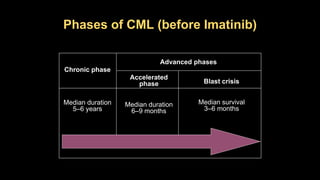
Phases of CML (before Imatinib)
Chronic phase
Median duration
5–6 years
Accelerated
phase
Median duration
6–9 months
Blast crisis
Median survival
3–6 months
Advanced phases
Epidemiology
 Annual incidence: 1 to 2 cases per 100,000
 15% – 20% of all adult leukemias
 Incidence increases significantly with age
– Median age: ~ 55 years
– Prevalence increasing due to current therapy
– Most patients present in CP, 85%
• Majority of CML-related deaths due to progression to AP/BC
– 50% of CML patients are asymptomatic at diagnosis
 Risk factors
– Exposure to ionizing radiation, the only known
Molecular Genetics of CML
 The Philadelphia chromosome was originally detected by
workers in Philadelphia.
 The first genetic abnormality to be associated with a
human cancer.
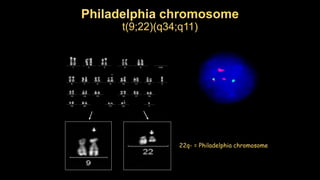
 The result of a balanced translocation between
chromosomes 9 and 22.
 Derivative chromosome 22 is significantly smaller
 Ph chromosome is present in hematopoietic cells from
patients with CML.
 Therefore, the Ph chromosome is acquired and NOT
inherited through the germline.
Molecular Genetics of CML
 The development of chronic phase CML appears to be a
direct result of the BCR-ABL1 activity, which promotes
its development by allowing:
I. Uncontrolled proliferation of transformed cells
II. Discordant maturation
III. Escape from apoptosis
IV. Altered interaction with the cellular Matrix
 The progression of CML from chronic phase to accelerated face or
blast crisis is a complex, multistep process (may be related to GMP).
 Also, it appears to involve the constitutive expression of the BCR-
ABL1 tyrosine kinase.
Molecular Genetics of CML
BCR
ABL
BCR
ABLBCR{q11
Ph
9q+
22
9
{q34 ABL
Philadelphia chromosome
t(9;22)(q34;q11)
22q- = Philadelphia chromosome
bcr-abl Gene and Fusion Protein Tyrosine Kinases
p210Bcr-Abl
p185Bcr-Abl2-11
2-11
Chromosome 9
c-bcr
Chromosome 22
c-abl
Exons
Introns
CML Breakpoints
ALL Breakpoints
1
2-11
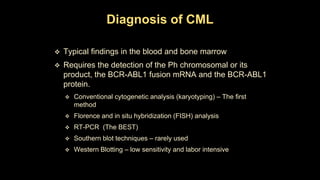
Diagnosis of CML
 Typical findings in the blood and bone marrow
 Requires the detection of the Ph chromosomal or its
product, the BCR-ABL1 fusion mRNA and the BCR-ABL1
protein.
 Conventional cytogenetic analysis (karyotyping) – The first
method
 Florence and in situ hybridization (FISH) analysis
 RT-PCR (The BEST)
 Southern blot techniques – rarely used
 Western Blotting – low sensitivity and labor intensive
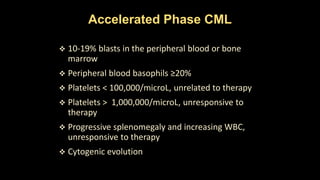
Accelerated Phase CML
 10-19% blasts in the peripheral blood or bone
marrow
 Peripheral blood basophils ≥20%
 Platelets < 100,000/microL, unrelated to therapy
 Platelets > 1,000,000/microL, unresponsive to
therapy
 Progressive splenomegaly and increasing WBC,
unresponsive to therapy
 Cytogenic evolution
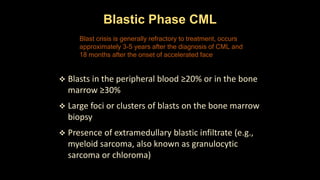
Blastic Phase CML
 Blasts in the peripheral blood ≥20% or in the bone
marrow ≥30%
 Large foci or clusters of blasts on the bone marrow
biopsy
 Presence of extramedullary blastic infiltrate (e.g.,
myeloid sarcoma, also known as granulocytic
sarcoma or chloroma)
Blast crisis is generally refractory to treatment, occurs
approximately 3-5 years after the diagnosis of CML and
18 months after the onset of accelerated face
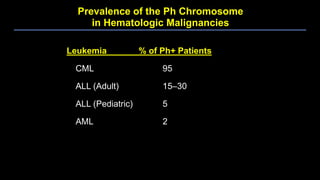
Prevalence of the Ph Chromosome
in Hematologic Malignancies
Leukemia % of Ph+ Patients
CML 95
ALL (Adult) 15–30
ALL (Pediatric) 5
AML 2
Faderl S et al. Oncology. 1999;13:169-180.
Normal Bcr-Abl Signaling*
• The kinase domain
activates a substrate
protein, eg, PI3
kinase, by
phosphorylation
• This activated
substrate initiates a
signaling cascade
culminating in cell
proliferation and
survival
PP P
ADP P
P
PP P
ATP
SIGNALING
Bcr-Abl
Substrate
Effector
ADP = adenosine diphosphate; ATP = adenosine triphosphate;
P = phosphate.
Savage and Antman. N Engl J Med. 2002;346:683
Scheijen and Griffin. Oncogene. 2002;21:3314.
Imatinib Mesylate:
Mechanism of Action*
• Imatinib mesylate
occupies the ATP
binding pocket of
the Abl kinase
domain
• This prevents
substrate
phosphorylation
and signaling
• A lack of signaling
inhibits proliferation
and survival
P
PP P
ATP
SIGNALING
Imatinib
mesylate
Bcr-Abl
Savage and Antman. N Engl J Med. 2002;346:683.
Typical Laboratory Parameters
by Phase of CML
Parameter Chronic Accelerated Blast Crisis
WBC count 20 x 109/L — —
Blasts 1%–09% 10-19% 20%
Basophils  20% —
Platelets  or normal  or  
Bone marrow Myeloid hyperplasia
Cytogenetics Ph+
Bcr-Abl + + +
Phase of CML
WBC = white blood cell; Ph+ = Ph chromosome–positive.
Molecular Methods for Detecting bcr-abl
at the Ph Chromosome
 Fluorescence in situ hybridization (FISH)
Interphase Metaphase
Courtesy of Charles Sawyers, UCLA.
0%
10%
20%
30%
40%
50%
60%
70%
80%
90%
100%
0 1 2 3 4 5
Years After Transplant
S
u
r
v
i
v
a
l
0%
10%
20%
30%
40%
50%
60%
70%
80%
90%
100%
S
u
r
v
i
v
a
l
June 2001, based on transplants 1987 - Feb 2001
Chronic Myelogenous Leukemia
Survival by Disease Stage
First Chronic Phase (n=1903)
Accelerated and 2nd CP (n=744)
Blast Phase (n=159)
P=0.0001
Other Possible Mechanisms of
Resistance to Imatinib Mesylate
Mechanisms of resistance
 Ph+ cell lines
– Bcr-Abl overexpression
– Gene amplification
– Drug reflux mediated by P-glycoprotein
– Other
 In vivo murine model
– Binding in the plasma of alpha 1-acid
glycoprotein to imatinib mesylate
Evolution of Resistance to Imatinib Mesylate in CML
Chronic Phase Blast Crisis Relapse
Ph-positive
Ph-negative
Ph+ blasts
Ph+ imatinib-
resistant blasts
Hematopoietic
differentiation
Bonemarrowtoperipheralblood
Courtesy of Charles L. Sawyers, MD.
“MAJOR ROUTE” ACA
Trisomy8
AdditionalPh-chromosome
Isochromosome (17q)
Trisomy 19
“MINOR ROUTE” ACA
Chromosome 3 aberrations,
loss of the Y-chromosome,
Prevention of BC by more effective treatment in early CP as shown
by the cumulative incidence of blast crisis (German CML Study
Group experience 1983-2011).
7
Survival with BC in the preimatinib and imatinib eras.
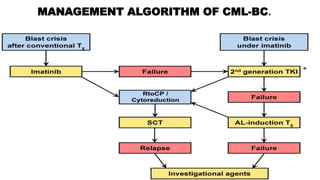
MANAGEMENT ALGORITHM OF CML-BC.

Cml presentation

  • 1.
    CHRONIC MYELOID LEUKEMIA DR.R. RAJKUMAR D.M. CONSULTANT MEDICAL ONCOLOGIST
  • 2.
    Introduction  CML isa clonal myeloproliferative neoplasm  Dysregulated production and uncontrolled proliferation of mature and maturing granulocyte with fairly normal differentiation  Fusion of 2 genes: BCR (or chromosome 22) and ABL1 (on chromosome 9), resulting in BCR-ABL1 fusion gene  Final result: Abnormal chromosome 22 called Philadelphia (Ph) chromosome  Final product: BCR-ABL1 fusion protein, a dysregulated tyrosine kinase
  • 3.
     Uncontrolled productionof mature and maturing granulocytes  Predominantly neutrophils, but also basophils and eosinophils  Triphasic or biphasic clinical course  Chronic phase, accelerated phase, blast crisis Introduction
  • 4.
    Phases of CML(before Imatinib) Chronic phase Median duration 5–6 years Accelerated phase Median duration 6–9 months Blast crisis Median survival 3–6 months Advanced phases
  • 5.
    Epidemiology  Annual incidence:1 to 2 cases per 100,000  15% – 20% of all adult leukemias  Incidence increases significantly with age – Median age: ~ 55 years – Prevalence increasing due to current therapy – Most patients present in CP, 85% • Majority of CML-related deaths due to progression to AP/BC – 50% of CML patients are asymptomatic at diagnosis  Risk factors – Exposure to ionizing radiation, the only known
  • 6.
    Molecular Genetics ofCML  The Philadelphia chromosome was originally detected by workers in Philadelphia.  The first genetic abnormality to be associated with a human cancer.  The result of a balanced translocation between chromosomes 9 and 22.  Derivative chromosome 22 is significantly smaller  Ph chromosome is present in hematopoietic cells from patients with CML.  Therefore, the Ph chromosome is acquired and NOT inherited through the germline.
  • 7.
    Molecular Genetics ofCML  The development of chronic phase CML appears to be a direct result of the BCR-ABL1 activity, which promotes its development by allowing: I. Uncontrolled proliferation of transformed cells II. Discordant maturation III. Escape from apoptosis IV. Altered interaction with the cellular Matrix  The progression of CML from chronic phase to accelerated face or blast crisis is a complex, multistep process (may be related to GMP).  Also, it appears to involve the constitutive expression of the BCR- ABL1 tyrosine kinase.
  • 8.
    Molecular Genetics ofCML BCR ABL BCR ABLBCR{q11 Ph 9q+ 22 9 {q34 ABL
  • 9.
  • 10.
    bcr-abl Gene andFusion Protein Tyrosine Kinases p210Bcr-Abl p185Bcr-Abl2-11 2-11 Chromosome 9 c-bcr Chromosome 22 c-abl Exons Introns CML Breakpoints ALL Breakpoints 1 2-11
  • 11.
    Diagnosis of CML Typical findings in the blood and bone marrow  Requires the detection of the Ph chromosomal or its product, the BCR-ABL1 fusion mRNA and the BCR-ABL1 protein.  Conventional cytogenetic analysis (karyotyping) – The first method  Florence and in situ hybridization (FISH) analysis  RT-PCR (The BEST)  Southern blot techniques – rarely used  Western Blotting – low sensitivity and labor intensive
  • 12.
    Accelerated Phase CML 10-19% blasts in the peripheral blood or bone marrow  Peripheral blood basophils ≥20%  Platelets < 100,000/microL, unrelated to therapy  Platelets > 1,000,000/microL, unresponsive to therapy  Progressive splenomegaly and increasing WBC, unresponsive to therapy  Cytogenic evolution
  • 13.
    Blastic Phase CML Blasts in the peripheral blood ≥20% or in the bone marrow ≥30%  Large foci or clusters of blasts on the bone marrow biopsy  Presence of extramedullary blastic infiltrate (e.g., myeloid sarcoma, also known as granulocytic sarcoma or chloroma) Blast crisis is generally refractory to treatment, occurs approximately 3-5 years after the diagnosis of CML and 18 months after the onset of accelerated face
  • 14.
    Prevalence of thePh Chromosome in Hematologic Malignancies Leukemia % of Ph+ Patients CML 95 ALL (Adult) 15–30 ALL (Pediatric) 5 AML 2 Faderl S et al. Oncology. 1999;13:169-180.
  • 15.
    Normal Bcr-Abl Signaling* •The kinase domain activates a substrate protein, eg, PI3 kinase, by phosphorylation • This activated substrate initiates a signaling cascade culminating in cell proliferation and survival PP P ADP P P PP P ATP SIGNALING Bcr-Abl Substrate Effector ADP = adenosine diphosphate; ATP = adenosine triphosphate; P = phosphate. Savage and Antman. N Engl J Med. 2002;346:683 Scheijen and Griffin. Oncogene. 2002;21:3314.
  • 16.
    Imatinib Mesylate: Mechanism ofAction* • Imatinib mesylate occupies the ATP binding pocket of the Abl kinase domain • This prevents substrate phosphorylation and signaling • A lack of signaling inhibits proliferation and survival P PP P ATP SIGNALING Imatinib mesylate Bcr-Abl Savage and Antman. N Engl J Med. 2002;346:683.
  • 17.
    Typical Laboratory Parameters byPhase of CML Parameter Chronic Accelerated Blast Crisis WBC count 20 x 109/L — — Blasts 1%–09% 10-19% 20% Basophils  20% — Platelets  or normal  or   Bone marrow Myeloid hyperplasia Cytogenetics Ph+ Bcr-Abl + + + Phase of CML WBC = white blood cell; Ph+ = Ph chromosome–positive.
  • 18.
    Molecular Methods forDetecting bcr-abl at the Ph Chromosome  Fluorescence in situ hybridization (FISH) Interphase Metaphase Courtesy of Charles Sawyers, UCLA.
  • 19.
    0% 10% 20% 30% 40% 50% 60% 70% 80% 90% 100% 0 1 23 4 5 Years After Transplant S u r v i v a l 0% 10% 20% 30% 40% 50% 60% 70% 80% 90% 100% S u r v i v a l June 2001, based on transplants 1987 - Feb 2001 Chronic Myelogenous Leukemia Survival by Disease Stage First Chronic Phase (n=1903) Accelerated and 2nd CP (n=744) Blast Phase (n=159) P=0.0001
  • 20.
    Other Possible Mechanismsof Resistance to Imatinib Mesylate Mechanisms of resistance  Ph+ cell lines – Bcr-Abl overexpression – Gene amplification – Drug reflux mediated by P-glycoprotein – Other  In vivo murine model – Binding in the plasma of alpha 1-acid glycoprotein to imatinib mesylate
  • 21.
    Evolution of Resistanceto Imatinib Mesylate in CML Chronic Phase Blast Crisis Relapse Ph-positive Ph-negative Ph+ blasts Ph+ imatinib- resistant blasts Hematopoietic differentiation Bonemarrowtoperipheralblood Courtesy of Charles L. Sawyers, MD.
  • 22.
    “MAJOR ROUTE” ACA Trisomy8 AdditionalPh-chromosome Isochromosome(17q) Trisomy 19 “MINOR ROUTE” ACA Chromosome 3 aberrations, loss of the Y-chromosome,
  • 23.
    Prevention of BCby more effective treatment in early CP as shown by the cumulative incidence of blast crisis (German CML Study Group experience 1983-2011). 7
  • 24.
    Survival with BCin the preimatinib and imatinib eras.
  • 25.