NALANDA ENGLISH MEDIUM HIGHER
SECONDARY SCHOOL
Session :- 2016-2017
Presentation on
Population
Guided By:- Submitted By:-
Ayushi Mam Md.Saad
What Is population?
• A population is all the organisms that both belong to the
same group or species and live in the same geographical
area. In ecology the population of a certain species in a
certain area is estimated using the Lincoln Index. The
area that is used to define a sexual population is such that
inter-breeding is possible between any pair within the
area and more probable than cross-breeding with
individuals from other areas. Normally breeding is
substantially more common within the area than across
the border.
• In sociology, population refers to a collection
of human beings. Demography is a social science which
entails the statistical study of human populations. This
article refers mainly to human population.
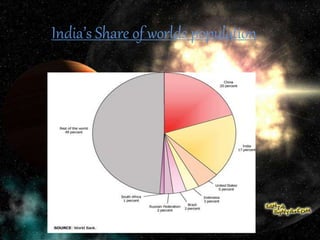
India’s Share of worlds population
Population Distribution by Density
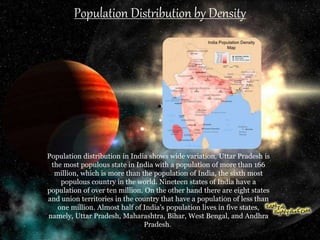
Population distribution in India shows wide variation. Uttar Pradesh is
the most populous state in India with a population of more than 166
million, which is more than the population of India, the sixth most
populous country in the world. Nineteen states of India have a
population of over ten million. On the other hand there are eight states
and union territories in the country that have a population of less than
one million. Almost half of India's population lives in five states,
namely, Uttar Pradesh, Maharashtra, Bihar, West Bengal, and Andhra
Pradesh.
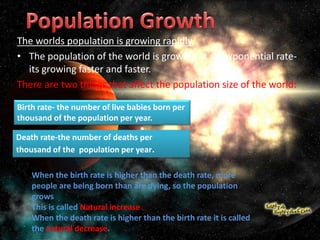
The worlds population is growing rapidly
• The population of the world is growing at an exponential rate-
its growing faster and faster.
There are two things that affect the population size of the world:
Birth rate- the number of live babies born per
thousand of the population per year.
Death rate-the number of deaths per
thousand of the population per year.
When the birth rate is higher than the death rate, more
people are being born than are dying, so the population
grows
This is called Natural increase
When the death rate is higher than the birth rate it is called
the natural decrease.
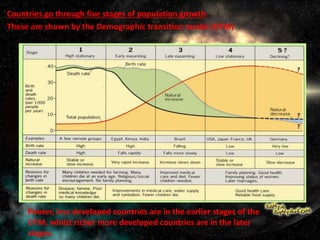
Countries go through five stages of population growth
These are shown by the Demographic transition model (DTM)
Poorer, less developed countries are in the earlier stages of the
DTM, whilst richer more developed countries are in the later
stages.
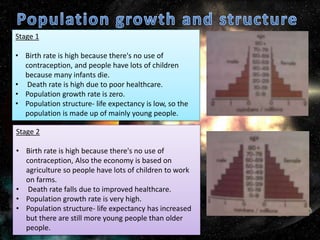
Stage 1
• Birth rate is high because there's no use of
contraception, and people have lots of children
because many infants die.
• Death rate is high due to poor healthcare.
• Population growth rate is zero.
• Population structure- life expectancy is low, so the
population is made up of mainly young people.
Stage 2
• Birth rate is high because there's no use of
contraception, Also the economy is based on
agriculture so people have lots of children to work
on farms.
• Death rate falls due to improved healthcare.
• Population growth rate is very high.
• Population structure- life expectancy has increased
but there are still more young people than older
people.
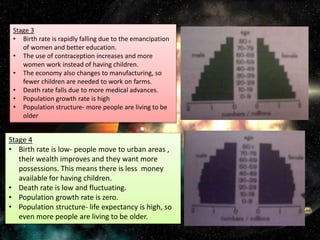
Stage 3
• Birth rate is rapidly falling due to the emancipation
of women and better education.
• The use of contraception increases and more
women work instead of having children.
• The economy also changes to manufacturing, so
fewer children are needed to work on farms.
• Death rate falls due to more medical advances.
• Population growth rate is high
• Population structure- more people are living to be
older
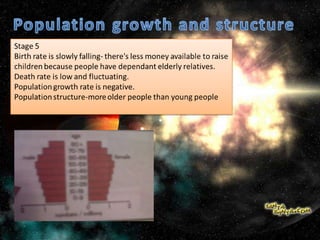
Stage 4
• Birth rate is low- people move to urban areas ,
their wealth improves and they want more
possessions. This means there is less money
available for having children.
• Death rate is low and fluctuating.
• Population growth rate is zero.
• Population structure- life expectancy is high, so
even more people are living to be older.
Rapid population growth has social,
economic and political impacts.
Social
• Services like healthcare and education cant
cope with the rapid increase in population ,
so not everyone has access to them.
• Children have to work to help support their
large families , so they miss out on
education.
• There aren't enough houses for everyone,
so people are forced to live in makeshift
houses in overcrowded settlements. This
leads to health problems because the
houses aren't always connected to sewers
or they don’t have access to clean water.
• There are food shortages if the country
cant grow or import enough food for the
population.
Political
• Most of the population is made
up of young people so the
government focuses on policies
that are important to young
people e.g. education and
provision of things such as
childcare.
• There are fewer older people so
the government doesn’t have to
focus on policies that are
important to older people e.g.
pensions.
• The government has to make
policies to bring population
growth under control so the
social and economic impacts of
rapid population growth don’t
get any worse.
Economic
• There aren't enough jobs for the
number of people in the country so
unemployment increases.
• There is increased poverty because
more people are born into families
that are already poor.
Birth control programmes
Birth control programmes aim to reduce the
birth rate. Some governments do this by
having law about how many children couples
are allowed to have.
Governments also help couples to plan ( and
limit) how many children they have by
offering free contraception and sex
education.
This helps towards sustainable development
because it means the population wont get
much bigger.
Immigration laws
Immigration laws aim to control
immigration (people moving to a
country to live there permanently).
Governments can limit the number of
people that are allowed to immigrate.
They can also be selective about who
they let in e.g. letting in fewer people
of child bearing age means there will be
fewer immigrants having children.
Countries need to control rapid population growth and they also need to develop
in a way that allows people of today to get the things they need without stopping
people in the future getting what they need.
Here are a couple of examples of population policies and how
they help to achieve sustainable development:
• The working population pay taxes,
some of which the government use to
pay the state pensions of older people
and to pay for services like healthcare
and retirement homes.
• Taxes would need to go up because
there are more pensions to pay for and
older people need more healthcare.
The economy would grow more slowly-
less money is being spent on things that
help the economy e.g. education and
business.
• Healthcare services are stretched more
because older people need more
medical care.
• People will need to spend more time
working as unpaid carers for older
family members. This means that the
working population have less leisure
time and are more stressed and
worried.
• People may have fewer children because
they cant afford lots of children when
they have dependant older relatives.
This leads to a drop in birth rate.
• The more old people there are the
lower the pension will be .People will
have to retire later because they cant
afford to get by on a state pension.
• Encouraging larger families e.g. in
Italy women are offered cash
rewards to have more children. This
increases the number of young
people- when they start work there
will a larger working population to
pay taxes and support the ageing
population
• Encouraging the immigration of
young people from other countries.
This increases the working
population.
Theses strategies
don’t help
towards
sustainable
development
because they
increase the
population size.
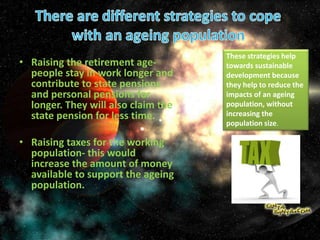
• Raising the retirement age-
people stay in work longer and
contribute to state pensions
and personal pensions for
longer. They will also claim the
state pension for less time.
• Raising taxes for the working
population- this would
increase the amount of money
available to support the ageing
population.
These strategies help
towards sustainable
development because
they help to reduce the
impacts of an ageing
population, without
increasing the
population size.
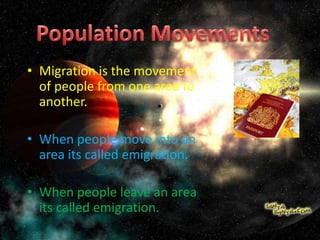
• Migration is the movement
of people from one area to
another.
• When people move into an
area its called emigration.
• When people leave an area
its called emigration.
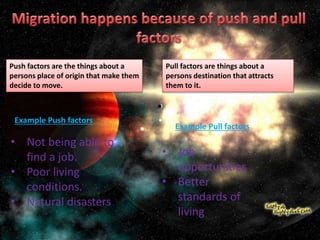
Push factors are the things about a
persons place of origin that make them
decide to move.
Pull factors are things about a
persons destination that attracts
them to it.
Example Pull factors
• Not being able to
find a job.
• Poor living
conditions.
• Natural disasters
• Job
opportunities
• Better
standards of
living
Example Push factors
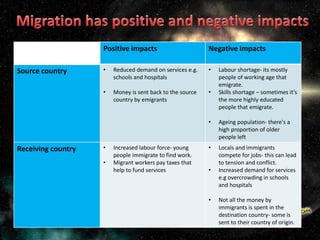
Positive impacts Negative impacts
Source country • Reduced demand on services e.g.
schools and hospitals
• Money is sent back to the source
country by emigrants
• Labour shortage- its mostly
people of working age that
emigrate.
• Skills shortage – sometimes it’s
the more highly educated
people that emigrate.
• Ageing population- there's a
high proportion of older
people left
Receiving country • Increased labour force- young
people immigrate to find work.
• Migrant workers pay taxes that
help to fund services
• Locals and immigrants
compete for jobs- this can lead
to tension and conflict.
• Increased demand for services
e.g overcrowding in schools
and hospitals
• Not all the money by
immigrants is spent in the
destination country- some is
sent to their country of origin.
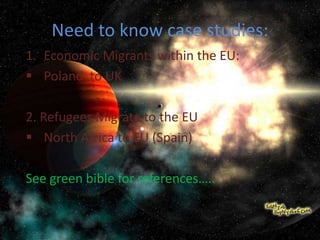
Need to know case studies:
1. Economic Migrants within the EU:
 Poland to UK
2. Refugees Migrate to the EU
 North Africa to EU (Spain)
See green bible for references…..
BIBLIOGRAPHY
Here, I’m Saad of class 9th ‘c’ . I complete this
project with the help of our geography boo
&some little help of internet & my subject
teacher.
Populationppt 110425171556-phpapp02

Populationppt 110425171556-phpapp02

  • 2.
    NALANDA ENGLISH MEDIUMHIGHER SECONDARY SCHOOL Session :- 2016-2017 Presentation on Population Guided By:- Submitted By:- Ayushi Mam Md.Saad
  • 3.
    What Is population? •A population is all the organisms that both belong to the same group or species and live in the same geographical area. In ecology the population of a certain species in a certain area is estimated using the Lincoln Index. The area that is used to define a sexual population is such that inter-breeding is possible between any pair within the area and more probable than cross-breeding with individuals from other areas. Normally breeding is substantially more common within the area than across the border. • In sociology, population refers to a collection of human beings. Demography is a social science which entails the statistical study of human populations. This article refers mainly to human population.
  • 4.
    India’s Share ofworlds population
  • 5.
    Population Distribution byDensity Population distribution in India shows wide variation. Uttar Pradesh is the most populous state in India with a population of more than 166 million, which is more than the population of India, the sixth most populous country in the world. Nineteen states of India have a population of over ten million. On the other hand there are eight states and union territories in the country that have a population of less than one million. Almost half of India's population lives in five states, namely, Uttar Pradesh, Maharashtra, Bihar, West Bengal, and Andhra Pradesh.
  • 6.
    The worlds populationis growing rapidly • The population of the world is growing at an exponential rate- its growing faster and faster. There are two things that affect the population size of the world: Birth rate- the number of live babies born per thousand of the population per year. Death rate-the number of deaths per thousand of the population per year. When the birth rate is higher than the death rate, more people are being born than are dying, so the population grows This is called Natural increase When the death rate is higher than the birth rate it is called the natural decrease.
  • 7.
    Countries go throughfive stages of population growth These are shown by the Demographic transition model (DTM) Poorer, less developed countries are in the earlier stages of the DTM, whilst richer more developed countries are in the later stages.
  • 8.
    Stage 1 • Birthrate is high because there's no use of contraception, and people have lots of children because many infants die. • Death rate is high due to poor healthcare. • Population growth rate is zero. • Population structure- life expectancy is low, so the population is made up of mainly young people. Stage 2 • Birth rate is high because there's no use of contraception, Also the economy is based on agriculture so people have lots of children to work on farms. • Death rate falls due to improved healthcare. • Population growth rate is very high. • Population structure- life expectancy has increased but there are still more young people than older people.
  • 9.
    Stage 3 • Birthrate is rapidly falling due to the emancipation of women and better education. • The use of contraception increases and more women work instead of having children. • The economy also changes to manufacturing, so fewer children are needed to work on farms. • Death rate falls due to more medical advances. • Population growth rate is high • Population structure- more people are living to be older Stage 4 • Birth rate is low- people move to urban areas , their wealth improves and they want more possessions. This means there is less money available for having children. • Death rate is low and fluctuating. • Population growth rate is zero. • Population structure- life expectancy is high, so even more people are living to be older.
  • 11.
    Rapid population growthhas social, economic and political impacts. Social • Services like healthcare and education cant cope with the rapid increase in population , so not everyone has access to them. • Children have to work to help support their large families , so they miss out on education. • There aren't enough houses for everyone, so people are forced to live in makeshift houses in overcrowded settlements. This leads to health problems because the houses aren't always connected to sewers or they don’t have access to clean water. • There are food shortages if the country cant grow or import enough food for the population. Political • Most of the population is made up of young people so the government focuses on policies that are important to young people e.g. education and provision of things such as childcare. • There are fewer older people so the government doesn’t have to focus on policies that are important to older people e.g. pensions. • The government has to make policies to bring population growth under control so the social and economic impacts of rapid population growth don’t get any worse.
  • 12.
    Economic • There aren'tenough jobs for the number of people in the country so unemployment increases. • There is increased poverty because more people are born into families that are already poor.
  • 13.
    Birth control programmes Birthcontrol programmes aim to reduce the birth rate. Some governments do this by having law about how many children couples are allowed to have. Governments also help couples to plan ( and limit) how many children they have by offering free contraception and sex education. This helps towards sustainable development because it means the population wont get much bigger. Immigration laws Immigration laws aim to control immigration (people moving to a country to live there permanently). Governments can limit the number of people that are allowed to immigrate. They can also be selective about who they let in e.g. letting in fewer people of child bearing age means there will be fewer immigrants having children. Countries need to control rapid population growth and they also need to develop in a way that allows people of today to get the things they need without stopping people in the future getting what they need. Here are a couple of examples of population policies and how they help to achieve sustainable development:
  • 14.
    • The workingpopulation pay taxes, some of which the government use to pay the state pensions of older people and to pay for services like healthcare and retirement homes. • Taxes would need to go up because there are more pensions to pay for and older people need more healthcare. The economy would grow more slowly- less money is being spent on things that help the economy e.g. education and business. • Healthcare services are stretched more because older people need more medical care. • People will need to spend more time working as unpaid carers for older family members. This means that the working population have less leisure time and are more stressed and worried. • People may have fewer children because they cant afford lots of children when they have dependant older relatives. This leads to a drop in birth rate. • The more old people there are the lower the pension will be .People will have to retire later because they cant afford to get by on a state pension.
  • 15.
    • Encouraging largerfamilies e.g. in Italy women are offered cash rewards to have more children. This increases the number of young people- when they start work there will a larger working population to pay taxes and support the ageing population • Encouraging the immigration of young people from other countries. This increases the working population. Theses strategies don’t help towards sustainable development because they increase the population size.
  • 16.
    • Raising theretirement age- people stay in work longer and contribute to state pensions and personal pensions for longer. They will also claim the state pension for less time. • Raising taxes for the working population- this would increase the amount of money available to support the ageing population. These strategies help towards sustainable development because they help to reduce the impacts of an ageing population, without increasing the population size.
  • 17.
    • Migration isthe movement of people from one area to another. • When people move into an area its called emigration. • When people leave an area its called emigration.
  • 18.
    Push factors arethe things about a persons place of origin that make them decide to move. Pull factors are things about a persons destination that attracts them to it. Example Pull factors • Not being able to find a job. • Poor living conditions. • Natural disasters • Job opportunities • Better standards of living Example Push factors
  • 19.
    Positive impacts Negativeimpacts Source country • Reduced demand on services e.g. schools and hospitals • Money is sent back to the source country by emigrants • Labour shortage- its mostly people of working age that emigrate. • Skills shortage – sometimes it’s the more highly educated people that emigrate. • Ageing population- there's a high proportion of older people left Receiving country • Increased labour force- young people immigrate to find work. • Migrant workers pay taxes that help to fund services • Locals and immigrants compete for jobs- this can lead to tension and conflict. • Increased demand for services e.g overcrowding in schools and hospitals • Not all the money by immigrants is spent in the destination country- some is sent to their country of origin.
  • 20.
    Need to knowcase studies: 1. Economic Migrants within the EU:  Poland to UK 2. Refugees Migrate to the EU  North Africa to EU (Spain) See green bible for references…..
  • 21.
    BIBLIOGRAPHY Here, I’m Saadof class 9th ‘c’ . I complete this project with the help of our geography boo &some little help of internet & my subject teacher.