Year 10 population test
By Eleanor Heath
An ageing population
 The population structure of an ageing population has
more older people (over 65) than younger people
because fewer people are being born and more people
are surviving until old age.
 Richer Countries are usually the countries with an
ageing population. Most of these countries are at stage
5 of the Demographic Transition model.
 Older people are dependent on the younger working
population and so in an ageing population there is a
higher proportion of people who are dependent.
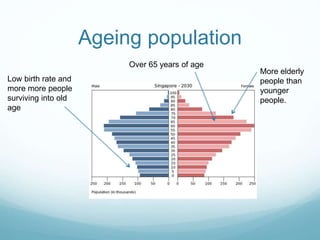
Ageing population
More elderly
people than
younger
people.
Low birth rate and
more more people
surviving into old
age
Over 65 years of age
Problems with an ageing population
Socially
 Healthcare services are stretched more because more elderly
people need care.
 People will need to spent more time working as unpaid careers
for older family members- meaning less leisure time and more
stress and worry.
 People will have fewer children as they cannot afford lots of
children when they have dependent elderly relatives, this
decreases the BR.
 The more elderly people there are the lower the pension will be
provided by the government, people will have to retire later
because they cant afford to get by from a state pension.
Problems with an ageing population
economically
 The working population’s taxes will have to increase
in order to pay for more state pensions, for the health
care which the elderly will need and retirement homes
for the elderly to live in.
 The economy of the country would grow much slower
and less money will be spent to boost the economy-
education and business and more money would be
spent elsewhere which don’t help boost the
economy- retirement homes and healthcare.
Problems with an youthful
population.
 Young children need health care - for example,
immunisations. This is expensive for a country to
provide.
 Young people need to be educated - providing schools
and teachers are expensive. Resources for lessons are
difficult to access, and costly to buy.
 In the future, more children will reach child bearing age,
putting more pressure on the health service.
Benefits of an youthful
population
 Often in LEDCs children do not go to school and
instead do work. LEDCs have a large youthful
population because of their high birth and death rate.
 There are lots of potential workers in the future.
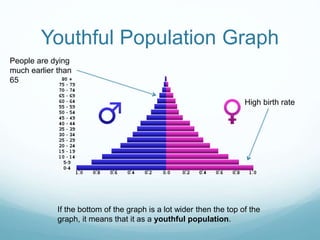
Youthful Population Graph
High birth rate
If the bottom of the graph is a lot wider then the top of the
graph, it means that it as a youthful population.
People are dying
much earlier than
65
Population Pyramids
 Show how many people there are of each group in the
population and how many there are of each gender.
 Population pyramids change as a population becomes
more economically developed.
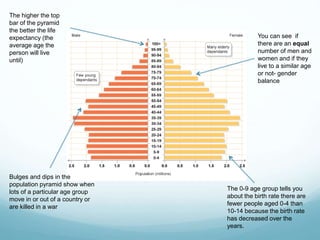
You can see if
there are an equal
number of men and
women and if they
live to a similar age
or not- gender
balance
The 0-9 age group tells you
about the birth rate there are
fewer people aged 0-4 than
10-14 because the birth rate
has decreased over the
years.
Bulges and dips in the
population pyramid show when
lots of a particular age group
move in or out of a country or
are killed in a war
The higher the top
bar of the pyramid
the better the life
expectancy (the
average age the
person will live
until)
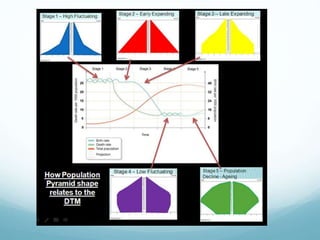
Stage 1
 BR is high because there is no use of contraception
and people have lots of children as infant mortality is
low.
 DR is high due to poor healthcare or a famine
 Population growth rate is zero
 Population structure- life expectancy is low (few people
reach old age) and the population is mostly made up of
younger people.
Stage 2
 BR is high as there is still no use of contraception.
 Economy is based on Agriculture so families have lots
of children to work on the farms.
 Death rate falls due to improved healthcare and diet.
 Population Growth is very high
 Population Structure- life expectancy has increased but
there are still more young people than older people.
Stage 3
 BR is rapidly falling due to contraception which
increases more women to work instead of having
children, women have a more equal place in society
and a better education.
 The economy becomes industrial and so less children
are needed to work on farms
 DR falls to medical advances
 Population growth is high and more people are living
for longer.
Stage 4
 BR is low and peoples wealth improves and they want
more possessions so less money to have children
 DR is low and fluctuating
 Population growth is zero
 Population Structure- life expectancy is high and more
people live for longer.
Stage 5
 BR is slowly falling- less money available to raise
children because of elderly dependents.
 Death rate is low and fluctuating
 Population growth rate is negative
 Population Structure- more elderly people than younger
people.
Main Causes for population
change
 Births - usually measured using the birth rate (number
of live births per 1,000 of the population per year).
 Deaths - usually measured using the death rate
(number of deaths per 1,000 of the population per
year).
 Migration - the movement of people in and out of an
area.
Rate of change
 Births and deaths are natural causes of population change.
The difference between the birth rate and the death rate of a
country or place is called the natural increase. The natural
increase is calculated by subtracting the death rate from the
birth rate.
 natural increase = birth rate - death rate
 The rate of natural increase is given as a percentage,
calculated by dividing the natural increase by 10. For
example, if the birth rate is 14 per 1,000 population, and the
death rate is 8 per 1000 population, then the natural
increase = 14 - 8 = 6. That is 6/1000, which is equal to 0.6 per
cent.
Factors affecting BR
 Availability of family planning services
 Social and religious beliefs - especially in relation to contraception and abortion
 Female employment
 Economic prosperity (although in theory when the economy is doing well families can
afford to have more children in practice the higher the economic prosperity the lower the
birth rate).
 Poverty levels – children can be seen as an economic resource in developing countries
as they can earn money
 Infant Mortality Rate – a family may have more children if a country's IMR is high as it is
likely some of those children will die.
 Conflicts- a war
 Typical age of marriage
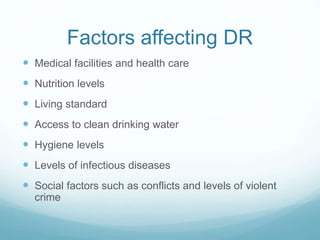
Factors affecting DR
 Medical facilities and health care
 Nutrition levels
 Living standard
 Access to clean drinking water
 Hygiene levels
 Levels of infectious diseases
 Social factors such as conflicts and levels of violent
crime
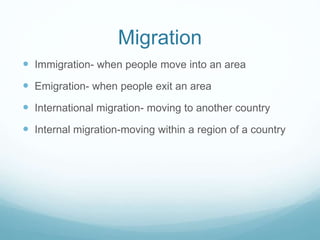
Migration
 Immigration- when people move into an area
 Emigration- when people exit an area
 International migration- moving to another country
 Internal migration-moving within a region of a country
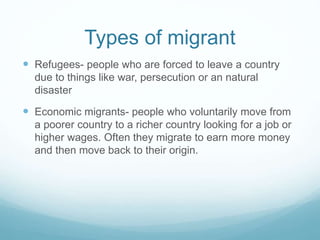
Types of migrant
 Refugees- people who are forced to leave a country
due to things like war, persecution or an natural
disaster
 Economic migrants- people who voluntarily move from
a poorer country to a richer country looking for a job or
higher wages. Often they migrate to earn more money
and then move back to their origin.
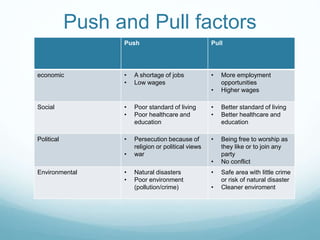
Push and Pull factors
Push Pull
economic • A shortage of jobs
• Low wages
• More employment
opportunities
• Higher wages
Social • Poor standard of living
• Poor healthcare and
education
• Better standard of living
• Better healthcare and
education
Political • Persecution because of
religion or political views
• war
• Being free to worship as
they like or to join any
party
• No conflict
Environmental • Natural disasters
• Poor environment
(pollution/crime)
• Safe area with little crime
or risk of natural disaster
• Cleaner enviroment

Geography test population

  • 1.
    Year 10 populationtest By Eleanor Heath
  • 2.
    An ageing population The population structure of an ageing population has more older people (over 65) than younger people because fewer people are being born and more people are surviving until old age.  Richer Countries are usually the countries with an ageing population. Most of these countries are at stage 5 of the Demographic Transition model.  Older people are dependent on the younger working population and so in an ageing population there is a higher proportion of people who are dependent.
  • 3.
    Ageing population More elderly peoplethan younger people. Low birth rate and more more people surviving into old age Over 65 years of age
  • 4.
    Problems with anageing population Socially  Healthcare services are stretched more because more elderly people need care.  People will need to spent more time working as unpaid careers for older family members- meaning less leisure time and more stress and worry.  People will have fewer children as they cannot afford lots of children when they have dependent elderly relatives, this decreases the BR.  The more elderly people there are the lower the pension will be provided by the government, people will have to retire later because they cant afford to get by from a state pension.
  • 5.
    Problems with anageing population economically  The working population’s taxes will have to increase in order to pay for more state pensions, for the health care which the elderly will need and retirement homes for the elderly to live in.  The economy of the country would grow much slower and less money will be spent to boost the economy- education and business and more money would be spent elsewhere which don’t help boost the economy- retirement homes and healthcare.
  • 6.
    Problems with anyouthful population.  Young children need health care - for example, immunisations. This is expensive for a country to provide.  Young people need to be educated - providing schools and teachers are expensive. Resources for lessons are difficult to access, and costly to buy.  In the future, more children will reach child bearing age, putting more pressure on the health service.
  • 7.
    Benefits of anyouthful population  Often in LEDCs children do not go to school and instead do work. LEDCs have a large youthful population because of their high birth and death rate.  There are lots of potential workers in the future.
  • 8.
    Youthful Population Graph Highbirth rate If the bottom of the graph is a lot wider then the top of the graph, it means that it as a youthful population. People are dying much earlier than 65
  • 9.
    Population Pyramids  Showhow many people there are of each group in the population and how many there are of each gender.  Population pyramids change as a population becomes more economically developed.
  • 10.
    You can seeif there are an equal number of men and women and if they live to a similar age or not- gender balance The 0-9 age group tells you about the birth rate there are fewer people aged 0-4 than 10-14 because the birth rate has decreased over the years. Bulges and dips in the population pyramid show when lots of a particular age group move in or out of a country or are killed in a war The higher the top bar of the pyramid the better the life expectancy (the average age the person will live until)
  • 12.
    Stage 1  BRis high because there is no use of contraception and people have lots of children as infant mortality is low.  DR is high due to poor healthcare or a famine  Population growth rate is zero  Population structure- life expectancy is low (few people reach old age) and the population is mostly made up of younger people.
  • 13.
    Stage 2  BRis high as there is still no use of contraception.  Economy is based on Agriculture so families have lots of children to work on the farms.  Death rate falls due to improved healthcare and diet.  Population Growth is very high  Population Structure- life expectancy has increased but there are still more young people than older people.
  • 14.
    Stage 3  BRis rapidly falling due to contraception which increases more women to work instead of having children, women have a more equal place in society and a better education.  The economy becomes industrial and so less children are needed to work on farms  DR falls to medical advances  Population growth is high and more people are living for longer.
  • 15.
    Stage 4  BRis low and peoples wealth improves and they want more possessions so less money to have children  DR is low and fluctuating  Population growth is zero  Population Structure- life expectancy is high and more people live for longer.
  • 16.
    Stage 5  BRis slowly falling- less money available to raise children because of elderly dependents.  Death rate is low and fluctuating  Population growth rate is negative  Population Structure- more elderly people than younger people.
  • 17.
    Main Causes forpopulation change  Births - usually measured using the birth rate (number of live births per 1,000 of the population per year).  Deaths - usually measured using the death rate (number of deaths per 1,000 of the population per year).  Migration - the movement of people in and out of an area.
  • 18.
    Rate of change Births and deaths are natural causes of population change. The difference between the birth rate and the death rate of a country or place is called the natural increase. The natural increase is calculated by subtracting the death rate from the birth rate.  natural increase = birth rate - death rate  The rate of natural increase is given as a percentage, calculated by dividing the natural increase by 10. For example, if the birth rate is 14 per 1,000 population, and the death rate is 8 per 1000 population, then the natural increase = 14 - 8 = 6. That is 6/1000, which is equal to 0.6 per cent.
  • 19.
    Factors affecting BR Availability of family planning services  Social and religious beliefs - especially in relation to contraception and abortion  Female employment  Economic prosperity (although in theory when the economy is doing well families can afford to have more children in practice the higher the economic prosperity the lower the birth rate).  Poverty levels – children can be seen as an economic resource in developing countries as they can earn money  Infant Mortality Rate – a family may have more children if a country's IMR is high as it is likely some of those children will die.  Conflicts- a war  Typical age of marriage
  • 20.
    Factors affecting DR Medical facilities and health care  Nutrition levels  Living standard  Access to clean drinking water  Hygiene levels  Levels of infectious diseases  Social factors such as conflicts and levels of violent crime
  • 21.
    Migration  Immigration- whenpeople move into an area  Emigration- when people exit an area  International migration- moving to another country  Internal migration-moving within a region of a country
  • 22.
    Types of migrant Refugees- people who are forced to leave a country due to things like war, persecution or an natural disaster  Economic migrants- people who voluntarily move from a poorer country to a richer country looking for a job or higher wages. Often they migrate to earn more money and then move back to their origin.
  • 23.
    Push and Pullfactors Push Pull economic • A shortage of jobs • Low wages • More employment opportunities • Higher wages Social • Poor standard of living • Poor healthcare and education • Better standard of living • Better healthcare and education Political • Persecution because of religion or political views • war • Being free to worship as they like or to join any party • No conflict Environmental • Natural disasters • Poor environment (pollution/crime) • Safe area with little crime or risk of natural disaster • Cleaner enviroment