Createdby:
PRAVIN
XI-B
WHAT IS POPULATION?
In sociology, population refers to a
collection of humans.
A population is all the organisms that
both belong to the same group or
species and live in the same
geographical area.
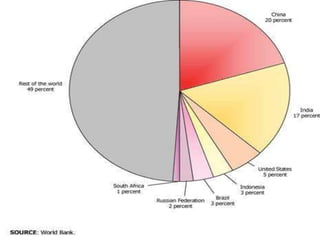
Country Percent(%) of
World
Population
China 19.4
India 17.5
USA 4.5
Indonesia 3.4
Brazil 2.8
Pakistan 2.7
Bangladesh 2.4
Nigeria 2.3
Russia Federal 2.0
Japan 1.9
Others 41.2
Top Ten Population Countries
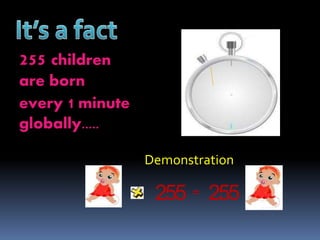
255 children
are born
every 1 minute
globally.....
255 = 255
Demonstration
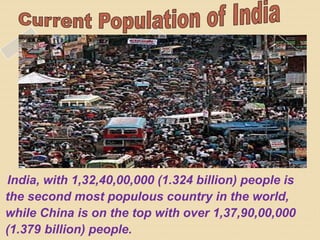
India, with 1,32,40,00,000 (1.324 billion) people is
the second most populous country in the world,
while China is on the top with over 1,37,90,00,000
(1.379 billion) people.
Kolkata, India
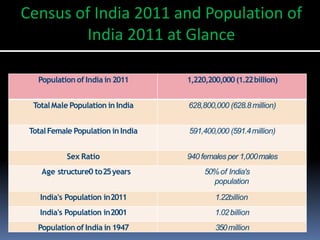
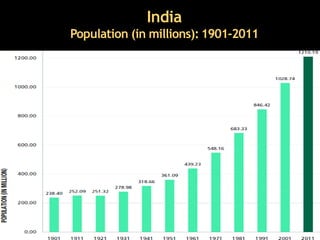
Population of India in 2011 1,220,200,000(1.22billion)
TotalMale Population in India 628,800,000 (628.8million)
TotalFemale Population in India 591,400,000 (591.4million)
Sex Ratio 940 females per 1,000males
Age structure0 to25years 50%of India's
population
India's Population in2011 1.22billion
India's Population in2001 1.02billion
Population of India in 1947 350million
Census of India 2011 and Population of
India 2011 at Glance
Sr. No. State Name Population
Percent(%) of
India
Density
1 Uttar Pradesh 19,95,81,477 16.49 828
2 Maharashtra 11,23,72,972 9.29 365
3 Bihar 10,38,04,637 8.58 1,102
4 West Bengal 9,13,47,736 7.55 1,029
5 Andhra Pradesh 8,46,65,533 7.00 308
6
Madhya
Pradesh
7,25,97,565 6.00 236
7 Tamil Nadu 7,21,38,958 5.96 555
8 Rajasthan 6,86,21,012 5.67 201
9 Karnataka 6,11,30,704 5.05 319
10 Gujarat 6,03,83,628 4.99 308
Top Ten States of highest Population in India
as per India Census 2011
India
Population (in millions):1901-2011
Map showing the population density ofeach
district in India
Processes of Population
Change/Growth
 Therearethree main
processesof changeof
population :
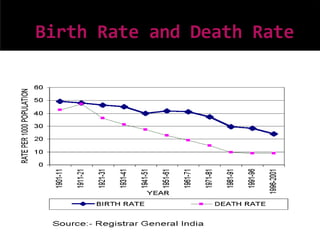
Birth rate
Deathrate
Migration
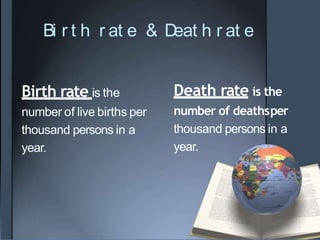
Birth rate is the
number of live births per
thousand persons in a
year.
Death rate is the
number of deathsper
thousand persons in a
year.
Bi r t h r at e & Deat h r at e
Birth Rate and Death Rate
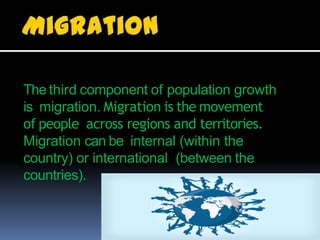
The third component of population growth
is migration. Migration is the movement
of people across regions and territories.
Migration can be internal (within the
country) or international (between the
countries).
The population of a
nation is generally
grouped into three
broad categories:
Children (generally
below 15 years)
Working Age (15-59
years)
Aged (Above 59 years)
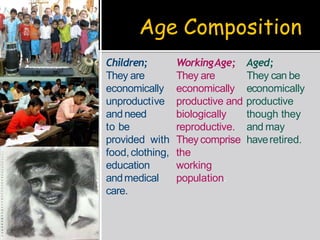
Age Composition
Children;
They are
economically
unproductive
andneed
to be
provided with
food,clothing,
education
andmedical
care.
WorkingAge;
They are
economically
biologically
reproductive.
Aged;
They can be
economically
productive and productive
though they
and may
Theycomprise haveretired.
the
working
population.
• Sex ratio is defined as the no. of females per
1000 males in the population
• The sex ratio in the country has always
remained unfavorable to females
• This information is an important social
indicator to measure the extent of equality
between males and femalesin a society at a
giventime.
Census Year Sex Ratio
(Females per 1000 males )
1951 946
1961 941
1971 930
1981 934
1991 929
2001 933
India : Sex ratio1951-2001
National Population Policy
 Government of India initiated the comprehensive
Family Planning Programme.
 This programme has sought to promote
responsible &planned parenthood on a voluntary
basis.
 The NPP 2000 provides a policy framework for:
1.Imparting free & compulsoryschool
education up to 14 yrs ofage.
2.Reducing infant mortality rate to below 30 per1000
live births.
3.Achieving universal immunisation of childrenagainst
various diseases.
4. Promoting delayed marriage forgirls.
Population Growth refers to the change in
the number of inhabitants of a country or
territory during a specific period of time, say
during the last ten years.
There is a debate regarding the
population growth of India. Some
regard it as a boon while others
consider it as a bane. I have tried to put
forward the views of both the sides in a
simple way.
Advantages of Overpopulation
i)Efficient utilization of resources
A major portion of our country's resources are lying idle or are underutilized. We need
more manpower to utilize them effectively so that there is no wastage.
ii) Expansion of Market
An increase in the total population will raise the demand for various essential as well as
luxury goods. It will act as an incentive for the producers to set up more industries which
will bring economic development.
iii)Better Labor Force
The growing population will help in increasing the national output of the country and we
can have the benefits of new talented minds of the younger generations.
iv)Greater Investments and Capital Formation
The population will create a wider market. Hence it will attract the investors to invest on
these items. This will lead to a net addition in the capital stock of the country.
Disadvantages of Overpopulation
i) Shortage of Food Grains
With the increase in the population it becomes difficult to feed all the mouths properly as
the agricultural sector of our country is still not mechanized. Also the increase in the
population will put a greater stress on the land leading to its fragmentation.
ii) Environmental Problems
We are all aware about the various environmental problems that our country faces. Global
Warming is one of them that result from heavy pollution from the industries.
iii) Problem of Unemployment
There will be a huge problem of unemployment and underemployment with the increase in
the population as additional jobs created could not keep pace with the growth rate.
iv) Poverty and Low Standard of Living
Low level of per capita income reduces the purchasing power of the people making them
poor. They cannot arrange for the proper education of the children resulting in the lower
standard of living.
India is projected to overtake
China as the world's most
populous nation by 2030.
India's population growth has
raised concerns that it would
lead to widespread
unemployment and political
instability.
Year Population
2020: 1,326,093,000
2030: 1,460,743,000
2040: 1,571,715,000
2050: 1,656,554,000
SOME FACTS ON
INDIA’S
POPULATION
.
1. The red patch on this map has around the same population as
the regions in blue.
The red patch covers Uttar Pradesh, Bengal, Bihar, Jharkhand, as
well as Bangladesh.
2. India and Pakistan have a similar number of Muslim residents,
but India's Muslim population accounts for only 14% of the nation,
compared to Pakistan's 97%.
3. This year around 150 million first-time voters were eligible to
cast their vote – a number more than the total population of
Russia, the world’s largest country.
4. The Indian Railways carry 30 million passengers everyday,
which is more than the total inhabitants in Sri Lanka and is also
just 2% of the total population of our country.
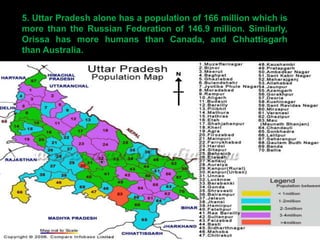
5. Uttar Pradesh alone has a population of 166 million which is
more than the Russian Federation of 146.9 million. Similarly,
Orissa has more humans than Canada, and Chhattisgarh
than Australia.
Best Population  PPT

Best Population PPT

  • 1.
  • 2.
    WHAT IS POPULATION? Insociology, population refers to a collection of humans. A population is all the organisms that both belong to the same group or species and live in the same geographical area.
  • 3.
    Country Percent(%) of World Population China19.4 India 17.5 USA 4.5 Indonesia 3.4 Brazil 2.8 Pakistan 2.7 Bangladesh 2.4 Nigeria 2.3 Russia Federal 2.0 Japan 1.9 Others 41.2 Top Ten Population Countries
  • 5.
    255 children are born every1 minute globally..... 255 = 255 Demonstration
  • 6.
    India, with 1,32,40,00,000(1.324 billion) people is the second most populous country in the world, while China is on the top with over 1,37,90,00,000 (1.379 billion) people.
  • 7.
  • 8.
    Population of Indiain 2011 1,220,200,000(1.22billion) TotalMale Population in India 628,800,000 (628.8million) TotalFemale Population in India 591,400,000 (591.4million) Sex Ratio 940 females per 1,000males Age structure0 to25years 50%of India's population India's Population in2011 1.22billion India's Population in2001 1.02billion Population of India in 1947 350million Census of India 2011 and Population of India 2011 at Glance
  • 9.
    Sr. No. StateName Population Percent(%) of India Density 1 Uttar Pradesh 19,95,81,477 16.49 828 2 Maharashtra 11,23,72,972 9.29 365 3 Bihar 10,38,04,637 8.58 1,102 4 West Bengal 9,13,47,736 7.55 1,029 5 Andhra Pradesh 8,46,65,533 7.00 308 6 Madhya Pradesh 7,25,97,565 6.00 236 7 Tamil Nadu 7,21,38,958 5.96 555 8 Rajasthan 6,86,21,012 5.67 201 9 Karnataka 6,11,30,704 5.05 319 10 Gujarat 6,03,83,628 4.99 308 Top Ten States of highest Population in India as per India Census 2011
  • 10.
  • 11.
    Map showing thepopulation density ofeach district in India
  • 12.
    Processes of Population Change/Growth Therearethree main processesof changeof population : Birth rate Deathrate Migration
  • 13.
    Birth rate isthe number of live births per thousand persons in a year. Death rate is the number of deathsper thousand persons in a year. Bi r t h r at e & Deat h r at e
  • 14.
    Birth Rate andDeath Rate
  • 15.
    The third componentof population growth is migration. Migration is the movement of people across regions and territories. Migration can be internal (within the country) or international (between the countries).
  • 16.
    The population ofa nation is generally grouped into three broad categories: Children (generally below 15 years) Working Age (15-59 years) Aged (Above 59 years)
  • 17.
    Age Composition Children; They are economically unproductive andneed tobe provided with food,clothing, education andmedical care. WorkingAge; They are economically biologically reproductive. Aged; They can be economically productive and productive though they and may Theycomprise haveretired. the working population.
  • 18.
    • Sex ratiois defined as the no. of females per 1000 males in the population • The sex ratio in the country has always remained unfavorable to females • This information is an important social indicator to measure the extent of equality between males and femalesin a society at a giventime.
  • 19.
    Census Year SexRatio (Females per 1000 males ) 1951 946 1961 941 1971 930 1981 934 1991 929 2001 933 India : Sex ratio1951-2001
  • 20.
    National Population Policy Government of India initiated the comprehensive Family Planning Programme.  This programme has sought to promote responsible &planned parenthood on a voluntary basis.  The NPP 2000 provides a policy framework for:
  • 21.
    1.Imparting free &compulsoryschool education up to 14 yrs ofage. 2.Reducing infant mortality rate to below 30 per1000 live births. 3.Achieving universal immunisation of childrenagainst various diseases. 4. Promoting delayed marriage forgirls.
  • 22.
    Population Growth refersto the change in the number of inhabitants of a country or territory during a specific period of time, say during the last ten years. There is a debate regarding the population growth of India. Some regard it as a boon while others consider it as a bane. I have tried to put forward the views of both the sides in a simple way.
  • 23.
    Advantages of Overpopulation i)Efficientutilization of resources A major portion of our country's resources are lying idle or are underutilized. We need more manpower to utilize them effectively so that there is no wastage. ii) Expansion of Market An increase in the total population will raise the demand for various essential as well as luxury goods. It will act as an incentive for the producers to set up more industries which will bring economic development. iii)Better Labor Force The growing population will help in increasing the national output of the country and we can have the benefits of new talented minds of the younger generations. iv)Greater Investments and Capital Formation The population will create a wider market. Hence it will attract the investors to invest on these items. This will lead to a net addition in the capital stock of the country.
  • 24.
    Disadvantages of Overpopulation i)Shortage of Food Grains With the increase in the population it becomes difficult to feed all the mouths properly as the agricultural sector of our country is still not mechanized. Also the increase in the population will put a greater stress on the land leading to its fragmentation. ii) Environmental Problems We are all aware about the various environmental problems that our country faces. Global Warming is one of them that result from heavy pollution from the industries. iii) Problem of Unemployment There will be a huge problem of unemployment and underemployment with the increase in the population as additional jobs created could not keep pace with the growth rate. iv) Poverty and Low Standard of Living Low level of per capita income reduces the purchasing power of the people making them poor. They cannot arrange for the proper education of the children resulting in the lower standard of living.
  • 25.
    India is projectedto overtake China as the world's most populous nation by 2030. India's population growth has raised concerns that it would lead to widespread unemployment and political instability. Year Population 2020: 1,326,093,000 2030: 1,460,743,000 2040: 1,571,715,000 2050: 1,656,554,000
  • 26.
  • 27.
    . 1. The redpatch on this map has around the same population as the regions in blue. The red patch covers Uttar Pradesh, Bengal, Bihar, Jharkhand, as well as Bangladesh.
  • 28.
    2. India andPakistan have a similar number of Muslim residents, but India's Muslim population accounts for only 14% of the nation, compared to Pakistan's 97%.
  • 29.
    3. This yeararound 150 million first-time voters were eligible to cast their vote – a number more than the total population of Russia, the world’s largest country.
  • 30.
    4. The IndianRailways carry 30 million passengers everyday, which is more than the total inhabitants in Sri Lanka and is also just 2% of the total population of our country.
  • 31.
    5. Uttar Pradeshalone has a population of 166 million which is more than the Russian Federation of 146.9 million. Similarly, Orissa has more humans than Canada, and Chhattisgarh than Australia.