POPULATION AND ITS CONTROL
Md Yusuf Ali
Senior tutor
K. J. Somaiya college of nursing
INTRODUCTION
 Population explosion a boon or a curse? For the
European developed countries like Spain and
Italy, where the population is decreasing, this
might be considered as a boon. However, for the
developing countries like India, population
explosion is a curse and is damaging to the
development of the country and it’s society.
MEANING
 The literal meaning of population is “the whole
number of people or inhabitants in a country or
region”.
 The literal meaning of population explosion is “a
sudden, large increase in the size and number of
population”.
 In simple words, it could be defined as increase in
birth rates and decrease in death rates.
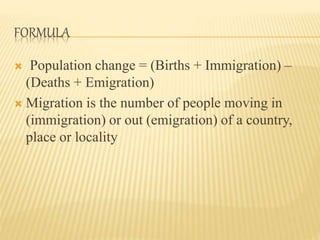
FORMULA
 Population change = (Births + Immigration) –
(Deaths + Emigration)
 Migration is the number of people moving in
(immigration) or out (emigration) of a country,
place or locality
POPULATION GROWTH IN INDIA
 According to 2001 census India's total population
has crossed 1,028,737,436 out of which
532,223,090 are males and females are
496,514,346.
 Of this number, 157,863,145 are children up to
the age of six years out of which 81,911,041 are
males and 75,952,104 are females.
 According to the 15th Indian Census in 2011
spread across 29 states and 7 union territories that
covered 640 districts,5,767 tehsils,7,933 towns
and more than 600,000 villages.
population Total
Male
Female
1,210,193,422
623,724,248
586,469,174
Literacy Total
Male
female
74%
82.10%
65.10%
POPULATION TRENDS FOR MAJOR RELIGIOUS GROUPS IN
INDIA(2001-2011)
Religion 2001 population % 2011 population %
Hindu 80.46 79.80
Muslim 13.46 14.23
Christianity 2.34 2.30
Sikhism 1.87 1.72
Buddhism 0.77 0.70
Jainism 0.41 0.37
Other religions/No religion 0.72 0.9
REASONS FOR THE POPULATION
 The increase in birth rates due to medical
improvements and illiteracy.
 The decrease in death rates due to better medical
facilities and advancements in the field of
medicine.
 Immigration to better developed countries due to
several reasons like better job opportunities, war,
and natural causes like hurricanes, earthquakes,
and so on.
REASONS FOR INCREASE IN POPULATION IN INDIA
 Birth rate
 Poverty
 Illiteracy, traditions and cultural Norms. Death rates
 Advanced medical treatments.
 Migration plays an important role in the population
increase.
 However, in countries like India, migration plays a
big role in the population change.
SOME OTHER FACTORS
 Place of women in society
 Value of children in society
 Widow marriage
 Custom and belief
 Industrialization
 Urbanization
 Better health facilities
 Good housing condition
EFFECTS OF POPULATION EXPLOSION:
 Already India is containing 17.5%of the world’s
population. The current rate of population growth
in India is 1.2% and the total fertility rate is 2.1%.
 Air Pollution
 Water Pollution
 Increase in Demand For Food Resources
 Deforestation
 Unemployment and Illiteracy
CONSEQUENCES OF OVERPOPULATION.
 Land or Space
 Housing problems
 Food supply
 Water supply
 Sewage disposal
 Sanitation
 Health care and education
 Unemployment and poverty
 Crimes
 Traffic problem
 Fuel and energy problems
POPULATION CONTROL
 There are two ways of controlling human
population
 1 planned
 2. catastrophic
 Planned control of population:- the only
practicable method to control world population
is to reduced the birth rate. It can be achieved
by
* Education * increasing marriageable age
* family planning
EDUCATION
 Young people of reproductive age group should
be educated about the benefits of small family.
Mass media ( radio ,television , newspaper,
magazines, poster) and educational institutions
can play an important role in this campaigning.
MARRIAGEABLE AGE
 Present marriageable age is 18 years for female
and 21 years for males . Population experts
explain that raising marriageable from 18 to 20 or
22 would bring down the birth rate by 20-30% An
ICMR report has shown that about 49% women
in India are married before the legal age of 18
years.
FAMILY PLANNING
 Adopting government sponsored family planning
programme since 1951, birth rate in India has
came down only slightly (from 41.7 to 28.3 per
1000 per year in about 50 years)
 In 1975 , India Govt made a tentative programme
of compulsory sterilization that required one
parents to undergo sterilization after two children
. But due to public resistance , it was again
changed to voluntary approach.
Population explosion and its control

Population explosion and its control

  • 1.
    POPULATION AND ITSCONTROL Md Yusuf Ali Senior tutor K. J. Somaiya college of nursing
  • 2.
    INTRODUCTION  Population explosiona boon or a curse? For the European developed countries like Spain and Italy, where the population is decreasing, this might be considered as a boon. However, for the developing countries like India, population explosion is a curse and is damaging to the development of the country and it’s society.
  • 3.
    MEANING  The literalmeaning of population is “the whole number of people or inhabitants in a country or region”.  The literal meaning of population explosion is “a sudden, large increase in the size and number of population”.  In simple words, it could be defined as increase in birth rates and decrease in death rates.
  • 4.
    FORMULA  Population change= (Births + Immigration) – (Deaths + Emigration)  Migration is the number of people moving in (immigration) or out (emigration) of a country, place or locality
  • 5.
    POPULATION GROWTH ININDIA  According to 2001 census India's total population has crossed 1,028,737,436 out of which 532,223,090 are males and females are 496,514,346.  Of this number, 157,863,145 are children up to the age of six years out of which 81,911,041 are males and 75,952,104 are females.
  • 6.
     According tothe 15th Indian Census in 2011 spread across 29 states and 7 union territories that covered 640 districts,5,767 tehsils,7,933 towns and more than 600,000 villages. population Total Male Female 1,210,193,422 623,724,248 586,469,174 Literacy Total Male female 74% 82.10% 65.10%
  • 7.
    POPULATION TRENDS FORMAJOR RELIGIOUS GROUPS IN INDIA(2001-2011) Religion 2001 population % 2011 population % Hindu 80.46 79.80 Muslim 13.46 14.23 Christianity 2.34 2.30 Sikhism 1.87 1.72 Buddhism 0.77 0.70 Jainism 0.41 0.37 Other religions/No religion 0.72 0.9
  • 8.
    REASONS FOR THEPOPULATION  The increase in birth rates due to medical improvements and illiteracy.  The decrease in death rates due to better medical facilities and advancements in the field of medicine.  Immigration to better developed countries due to several reasons like better job opportunities, war, and natural causes like hurricanes, earthquakes, and so on.
  • 9.
    REASONS FOR INCREASEIN POPULATION IN INDIA  Birth rate  Poverty  Illiteracy, traditions and cultural Norms. Death rates  Advanced medical treatments.  Migration plays an important role in the population increase.  However, in countries like India, migration plays a big role in the population change.
  • 10.
    SOME OTHER FACTORS Place of women in society  Value of children in society  Widow marriage  Custom and belief  Industrialization  Urbanization  Better health facilities  Better health facilities  Good housing condition
  • 11.
    EFFECTS OF POPULATIONEXPLOSION:  Already India is containing 17.5%of the world’s population. The current rate of population growth in India is 1.2% and the total fertility rate is 2.1%.  Air Pollution  Water Pollution  Increase in Demand For Food Resources  Deforestation  Unemployment and Illiteracy
  • 12.
    CONSEQUENCES OF OVERPOPULATION. Land or Space  Housing problems  Food supply  Water supply  Sewage disposal  Sanitation  Health care and education  Unemployment and poverty  Crimes  Traffic problem  Fuel and energy problems
  • 13.
    POPULATION CONTROL  Thereare two ways of controlling human population  1 planned  2. catastrophic  Planned control of population:- the only practicable method to control world population is to reduced the birth rate. It can be achieved by * Education * increasing marriageable age * family planning
  • 14.
    EDUCATION  Young peopleof reproductive age group should be educated about the benefits of small family. Mass media ( radio ,television , newspaper, magazines, poster) and educational institutions can play an important role in this campaigning.
  • 15.
    MARRIAGEABLE AGE  Presentmarriageable age is 18 years for female and 21 years for males . Population experts explain that raising marriageable from 18 to 20 or 22 would bring down the birth rate by 20-30% An ICMR report has shown that about 49% women in India are married before the legal age of 18 years.
  • 16.
    FAMILY PLANNING  Adoptinggovernment sponsored family planning programme since 1951, birth rate in India has came down only slightly (from 41.7 to 28.3 per 1000 per year in about 50 years)  In 1975 , India Govt made a tentative programme of compulsory sterilization that required one parents to undergo sterilization after two children . But due to public resistance , it was again changed to voluntary approach.