POPULATION DYNAMICS,
CARRYING CAPACITY, AND
CONSERVATION BIOLOGY
The Walker School
Environmental Science
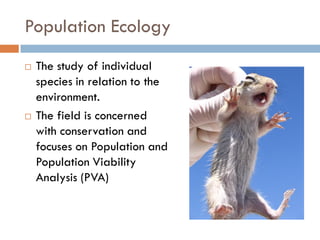
Population Ecology
 The study of individual
species in relation to the
environment.
 The field is concerned
with conservation and
focuses on Population and
Population Viability
Analysis (PVA)
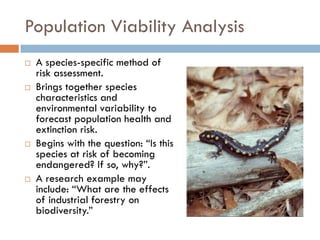
Population Viability Analysis
 A species-specific method of
risk assessment.
 Brings together species
characteristics and
environmental variability to
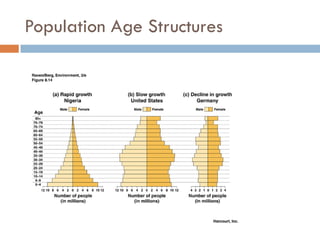
forecast population health and
extinction risk.
 Begins with the question: “Is this
species at risk of becoming
endangered? If so, why?”.
 A research example may
include: “What are the effects
of industrial forestry on
biodiversity.”
WHAT ARE THE MAJOR
CHARACTERISTICS OF A
POPULATION?
Populations
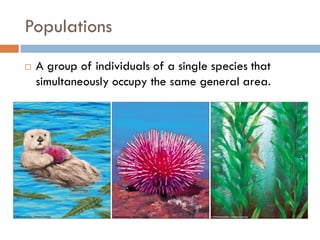
 A group of individuals of a single species that
simultaneously occupy the same general area.
Populations Under Study
 Diseases (prions, viruses, bacteria)
 Vegetation (crops, orchards, forests)
 Terrestrial Animals (cattle, sheep, pigs, chickens)
 Aquatic Organisms (fish, shrimp)
 Humans
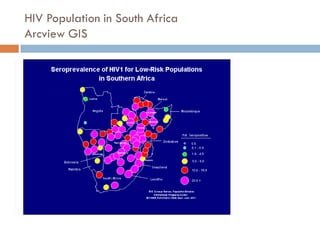
HIV Population in South Africa
Arcview GIS
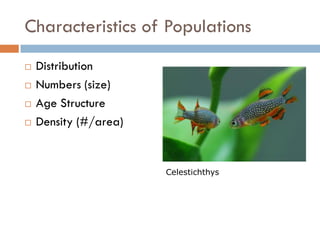
Characteristics of Populations
 Distribution
 Numbers (size)
 Age Structure
 Density (#/area)
Celestichthys
WHAT IS BIOGEOGRAPHY?
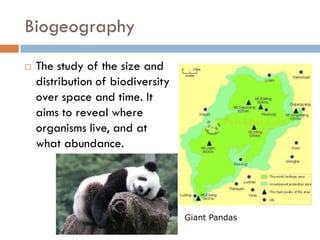
Biogeography
 The study of the size and
distribution of biodiversity
over space and time. It
aims to reveal where
organisms live, and at
what abundance.
Giant Pandas
Factors Explaining Species Distributions
 Speciation
 Extinction
 Continental drift
 Glaciations
(associated variations
in sea level, river
routes)
 River capture
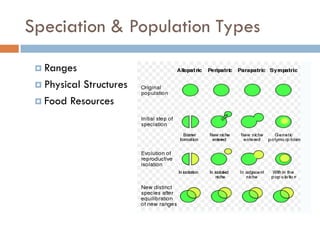
Speciation & Population Types
 Ranges
 Physical Structures
 Food Resources
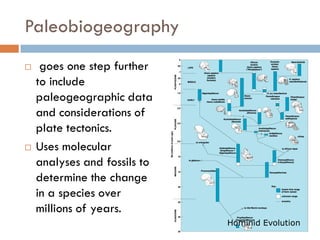
Paleobiogeography
 goes one step further
to include
paleogeographic data
and considerations of
plate tectonics.
 Uses molecular
analyses and fossils to
determine the change
in a species over
millions of years.
Hominid Evolution
HOW ARE POPULATIONS
TRACKED?
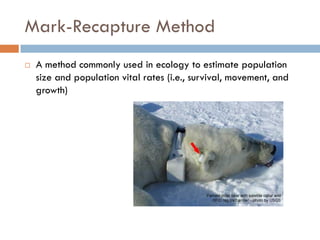
Mark-Recapture Method
 A method commonly used in ecology to estimate population
size and population vital rates (i.e., survival, movement, and
growth)
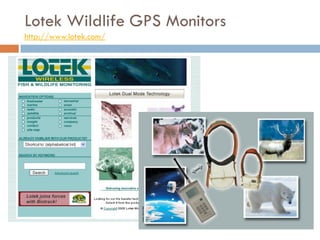
Lotek Wildlife GPS Monitors
http://www.lotek.com/
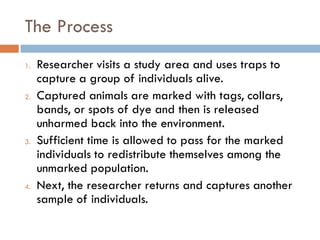
The Process
1. Researcher visits a study area and uses traps to
capture a group of individuals alive.
2. Captured animals are marked with tags, collars,
bands, or spots of dye and then is released
unharmed back into the environment.
3. Sufficient time is allowed to pass for the marked
individuals to redistribute themselves among the
unmarked population.
4. Next, the researcher returns and captures another
sample of individuals.
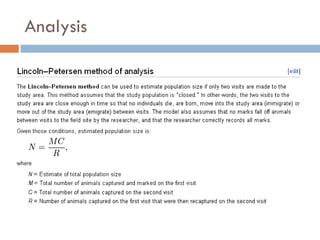
Analysis
WHAT FACTORS GOVERN
CHANGES IN POPULATION
SIZE?
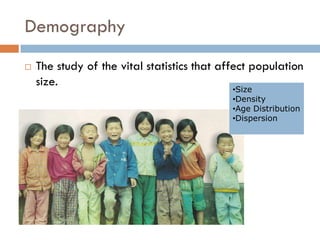
Demography
 The study of the vital statistics that affect population
size.
•Size
•Density
•Age Distribution
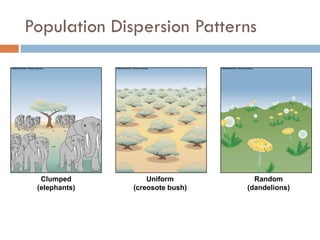
•Dispersion
Clumped
(elephants)
Uniform
(creosote bush)
Random
(dandelions)
Population Dispersion Patterns
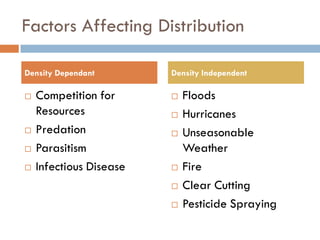
Factors Affecting Distribution
 Competition for
Resources
 Predation
 Parasitism
 Infectious Disease
 Floods
 Hurricanes
 Unseasonable
Weather
 Fire
 Clear Cutting
 Pesticide Spraying
Density Dependant Density Independent
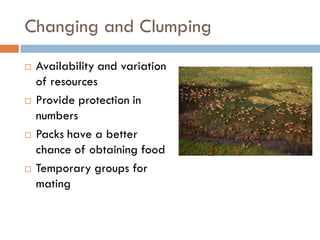
Changing and Clumping
 Availability and variation
of resources
 Provide protection in
numbers
 Packs have a better
chance of obtaining food
 Temporary groups for
mating
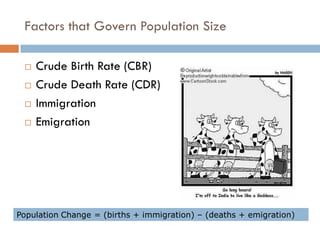
Factors that Govern Population Size
 Crude Birth Rate (CBR)
 Crude Death Rate (CDR)
 Immigration
 Emigration
Population Change = (births + immigration) – (deaths + emigration)
Population Age Structures
WHAT LIMITS POPULATION
GROWTH?
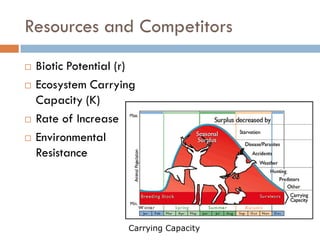
Resources and Competitors
 Biotic Potential (r)
 Ecosystem Carrying
Capacity (K)
 Rate of Increase
 Environmental
Resistance
Carrying Capacity
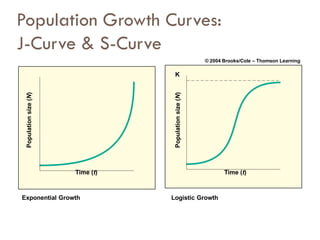
© 2004 Brooks/Cole – Thomson Learning
Time (t) Time (t)
Populationsize(N)
Populationsize(N)
K
Exponential Growth Logistic Growth
Population Growth Curves:
J-Curve & S-Curve
2.0
1.5
1.0
.5
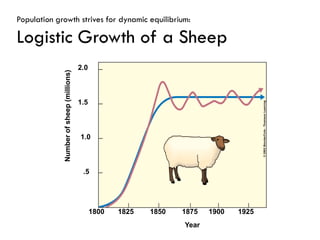
Numberofsheep(millions)
1800 1825 1850 1875 1900 1925
Year
Population growth strives for dynamic equilibrium:
Logistic Growth of a Sheep
2,000
1,500
Numberofreindeer
1910 1920 1930 1940 1950
Year
1,000
500
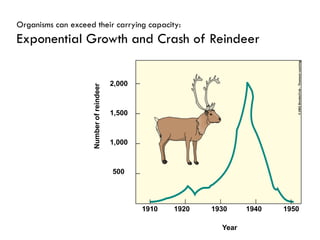
Organisms can exceed their carrying capacity:
Exponential Growth and Crash of Reindeer
Reasons for Diebacks
 Catastrophic Loss of Resources
 Introduction of New Predator
 Disease
WHAT KINDS OF POPULATION
CHANGE CURVES DO WE FIND
IN NATURE?
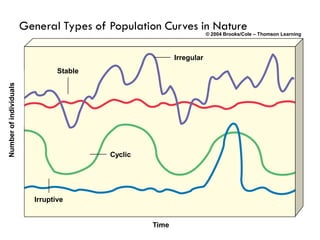
© 2004 Brooks/Cole – Thomson Learning
Numberofindividuals
Time
Irruptive
Stable
Cyclic
Irregular
General Types of Population Curves in Nature
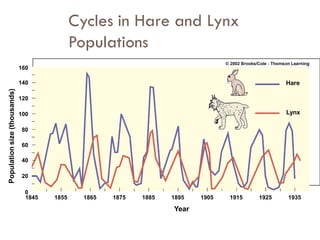
Populationsize(thousands)
160
140
120
100
80
60
40
20
0
1845 1855 1865 1875 1885 1895 1905 1915 1925 1935
Year
Hare
Lynx
Cycles in Hare and Lynx
Populations
Community Organization –
Trophic Cascade Model
 Postulates that it is mainly predation that controls
community organization
 Predators control herbivores
Community Organization –
Bottom-Up Model
 Mineral nutrients control community organization
 Nutrients control plant types and numbers
 Plants control predators
 Changes in this community are done by adding or
removing minerals
Activity: Radio Expeditions
Species Extinctions
 Audio Evidence of Ivory-Billed Woodpecker
 http://www.npr.org/templates/story/story.php?storyId=4814860
 Audubon Bird Count, Lost Woodpecker Rediscovered
 http://www.npr.org/templates/story/story.php?storyId=5067655
 Slate's Explainer: Determining Species Extinction
 http://www.npr.org/templates/story/story.php?storyId=5015201
Activity: Radio Expeditions
Species Extinctions Questions
 Populations are classified by size, density, age distribution, and dispersion
type. Briefly explain each of these concepts and describe one
environmental factor that would limit the population growth of a bird
species.
 Discuss the difference between an endangered and a threatened species.
 Design a population count experiment to determine if a bird population is
threatened or endangered. Make sure to discuss how the study area was
selected and what method will be used to estimate population.
 Discuss one biological intervention, economic incentive and one legislative
policy to restore an endangered bird population.
 Discuss what technology could be used to periodically monitor the program.
WHAT TYPE OF
REPRODUCTIVE PATTERNS DO
SPECIES HAVE?
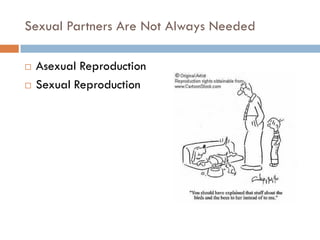
Sexual Partners Are Not Always Needed
 Asexual Reproduction
 Sexual Reproduction
Sexual Reproduction Methods
 Semelparity
 Onetime reproductive event
 Iteroparity
 Repeated reproduction
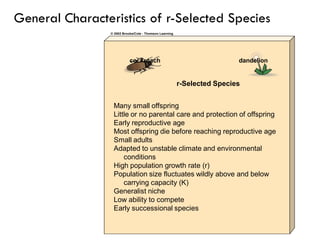
Many small offspring
Little or no parental care and protection of offspring
Early reproductive age
Most offspring die before reaching reproductive age
Small adults
Adapted to unstable climate and environmental
conditions
High population growth rate (r)
Population size fluctuates wildly above and below
carrying capacity (K)
Generalist niche
Low ability to compete
Early successional species
r-Selected Species
cockroach dandelion
General Characteristics of r-Selected Species
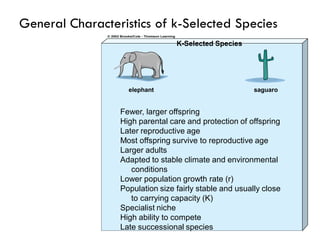
Fewer, larger offspring
High parental care and protection of offspring
Later reproductive age
Most offspring survive to reproductive age
Larger adults
Adapted to stable climate and environmental
conditions
Lower population growth rate (r)
Population size fairly stable and usually close
to carrying capacity (K)
Specialist niche
High ability to compete
Late successional species
elephant saguaro
K-Selected Species
General Characteristics of k-Selected Species
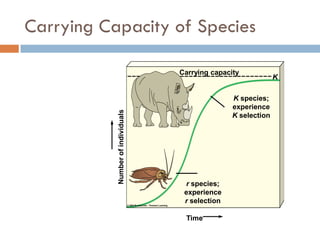
Carrying Capacity of Species
Numberofindividuals
Time
Carrying capacity
K species;
experience
K selection
r species;
experience
r selection
K
WHAT ROLE DOES GENETICS
PLAY IN THE SIZE OF
POPULATIONS?
Vulnerability of Populations
 Founders Effect
 Results from the migration of a population to a geographically
isolated area.
 Demographic Bottleneck
 Results from a natural catastrophe such as fire or a hurricane.
 Genetic Drift
 Results from random changes in the gene frequencies in a population.
 Interbreeding
 Results when individuals from a small population breed with each
other.
HOW DO ECOLOGISTS USE
LIFE TABLES AND
SURVIVORSHIP CURVES TO
MONITOR POPULATIONS?
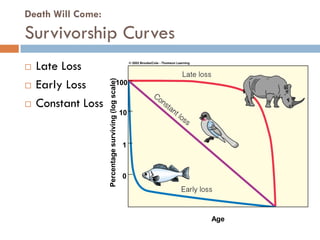
Death Will Come:
Survivorship Curves
 Late Loss
 Early Loss
 Constant Loss
Percentagesurviving(logscale)
100
10
1
0
Age
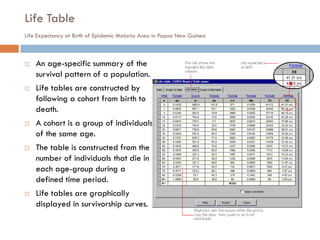
Life Table
Life Expectancy at Birth of Epidemic Malaria Area in Papua New Guinea
 An age-specific summary of the
survival pattern of a population.
 Life tables are constructed by
following a cohort from birth to
death.
 A cohort is a group of individuals
of the same age.
 The table is constructed from the
number of individuals that die in
each age-group during a
defined time period.
 Life tables are graphically
displayed in survivorship curves.
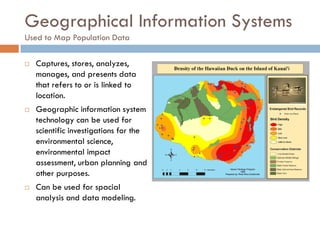
Geographical Information Systems
Used to Map Population Data
 Captures, stores, analyzes,
manages, and presents data
that refers to or is linked to
location.
 Geographic information system
technology can be used for
scientific investigations for the
environmental science,
environmental impact
assessment, urban planning and
other purposes.
 Can be used for spacial
analysis and data modeling.

Deocareza populationecology

  • 1.
    POPULATION DYNAMICS, CARRYING CAPACITY,AND CONSERVATION BIOLOGY The Walker School Environmental Science
  • 2.
    Population Ecology  Thestudy of individual species in relation to the environment.  The field is concerned with conservation and focuses on Population and Population Viability Analysis (PVA)
  • 3.
    Population Viability Analysis A species-specific method of risk assessment.  Brings together species characteristics and environmental variability to forecast population health and extinction risk.  Begins with the question: “Is this species at risk of becoming endangered? If so, why?”.  A research example may include: “What are the effects of industrial forestry on biodiversity.”
  • 4.
    WHAT ARE THEMAJOR CHARACTERISTICS OF A POPULATION?
  • 5.
    Populations  A groupof individuals of a single species that simultaneously occupy the same general area.
  • 6.
    Populations Under Study Diseases (prions, viruses, bacteria)  Vegetation (crops, orchards, forests)  Terrestrial Animals (cattle, sheep, pigs, chickens)  Aquatic Organisms (fish, shrimp)  Humans
  • 7.
    HIV Population inSouth Africa Arcview GIS
  • 8.
    Characteristics of Populations Distribution  Numbers (size)  Age Structure  Density (#/area) Celestichthys
  • 9.
  • 10.
    Biogeography  The studyof the size and distribution of biodiversity over space and time. It aims to reveal where organisms live, and at what abundance. Giant Pandas
  • 11.
    Factors Explaining SpeciesDistributions  Speciation  Extinction  Continental drift  Glaciations (associated variations in sea level, river routes)  River capture
  • 12.
    Speciation & PopulationTypes  Ranges  Physical Structures  Food Resources
  • 13.
    Paleobiogeography  goes onestep further to include paleogeographic data and considerations of plate tectonics.  Uses molecular analyses and fossils to determine the change in a species over millions of years. Hominid Evolution
  • 14.
  • 15.
    Mark-Recapture Method  Amethod commonly used in ecology to estimate population size and population vital rates (i.e., survival, movement, and growth)
  • 16.
    Lotek Wildlife GPSMonitors http://www.lotek.com/
  • 17.
    The Process 1. Researchervisits a study area and uses traps to capture a group of individuals alive. 2. Captured animals are marked with tags, collars, bands, or spots of dye and then is released unharmed back into the environment. 3. Sufficient time is allowed to pass for the marked individuals to redistribute themselves among the unmarked population. 4. Next, the researcher returns and captures another sample of individuals.
  • 18.
  • 19.
    WHAT FACTORS GOVERN CHANGESIN POPULATION SIZE?
  • 20.
    Demography  The studyof the vital statistics that affect population size. •Size •Density •Age Distribution •Dispersion
  • 21.
  • 22.
    Factors Affecting Distribution Competition for Resources  Predation  Parasitism  Infectious Disease  Floods  Hurricanes  Unseasonable Weather  Fire  Clear Cutting  Pesticide Spraying Density Dependant Density Independent
  • 23.
    Changing and Clumping Availability and variation of resources  Provide protection in numbers  Packs have a better chance of obtaining food  Temporary groups for mating
  • 24.
    Factors that GovernPopulation Size  Crude Birth Rate (CBR)  Crude Death Rate (CDR)  Immigration  Emigration Population Change = (births + immigration) – (deaths + emigration)
  • 25.
  • 26.
  • 27.
    Resources and Competitors Biotic Potential (r)  Ecosystem Carrying Capacity (K)  Rate of Increase  Environmental Resistance Carrying Capacity
  • 28.
    © 2004 Brooks/Cole– Thomson Learning Time (t) Time (t) Populationsize(N) Populationsize(N) K Exponential Growth Logistic Growth Population Growth Curves: J-Curve & S-Curve
  • 29.
    2.0 1.5 1.0 .5 Numberofsheep(millions) 1800 1825 18501875 1900 1925 Year Population growth strives for dynamic equilibrium: Logistic Growth of a Sheep
  • 30.
    2,000 1,500 Numberofreindeer 1910 1920 19301940 1950 Year 1,000 500 Organisms can exceed their carrying capacity: Exponential Growth and Crash of Reindeer
  • 31.
    Reasons for Diebacks Catastrophic Loss of Resources  Introduction of New Predator  Disease
  • 32.
    WHAT KINDS OFPOPULATION CHANGE CURVES DO WE FIND IN NATURE?
  • 33.
    © 2004 Brooks/Cole– Thomson Learning Numberofindividuals Time Irruptive Stable Cyclic Irregular General Types of Population Curves in Nature
  • 34.
    Populationsize(thousands) 160 140 120 100 80 60 40 20 0 1845 1855 18651875 1885 1895 1905 1915 1925 1935 Year Hare Lynx Cycles in Hare and Lynx Populations
  • 35.
    Community Organization – TrophicCascade Model  Postulates that it is mainly predation that controls community organization  Predators control herbivores
  • 36.
    Community Organization – Bottom-UpModel  Mineral nutrients control community organization  Nutrients control plant types and numbers  Plants control predators  Changes in this community are done by adding or removing minerals
  • 37.
    Activity: Radio Expeditions SpeciesExtinctions  Audio Evidence of Ivory-Billed Woodpecker  http://www.npr.org/templates/story/story.php?storyId=4814860  Audubon Bird Count, Lost Woodpecker Rediscovered  http://www.npr.org/templates/story/story.php?storyId=5067655  Slate's Explainer: Determining Species Extinction  http://www.npr.org/templates/story/story.php?storyId=5015201
  • 38.
    Activity: Radio Expeditions SpeciesExtinctions Questions  Populations are classified by size, density, age distribution, and dispersion type. Briefly explain each of these concepts and describe one environmental factor that would limit the population growth of a bird species.  Discuss the difference between an endangered and a threatened species.  Design a population count experiment to determine if a bird population is threatened or endangered. Make sure to discuss how the study area was selected and what method will be used to estimate population.  Discuss one biological intervention, economic incentive and one legislative policy to restore an endangered bird population.  Discuss what technology could be used to periodically monitor the program.
  • 39.
    WHAT TYPE OF REPRODUCTIVEPATTERNS DO SPECIES HAVE?
  • 40.
    Sexual Partners AreNot Always Needed  Asexual Reproduction  Sexual Reproduction
  • 41.
    Sexual Reproduction Methods Semelparity  Onetime reproductive event  Iteroparity  Repeated reproduction
  • 42.
    Many small offspring Littleor no parental care and protection of offspring Early reproductive age Most offspring die before reaching reproductive age Small adults Adapted to unstable climate and environmental conditions High population growth rate (r) Population size fluctuates wildly above and below carrying capacity (K) Generalist niche Low ability to compete Early successional species r-Selected Species cockroach dandelion General Characteristics of r-Selected Species
  • 43.
    Fewer, larger offspring Highparental care and protection of offspring Later reproductive age Most offspring survive to reproductive age Larger adults Adapted to stable climate and environmental conditions Lower population growth rate (r) Population size fairly stable and usually close to carrying capacity (K) Specialist niche High ability to compete Late successional species elephant saguaro K-Selected Species General Characteristics of k-Selected Species
  • 44.
    Carrying Capacity ofSpecies Numberofindividuals Time Carrying capacity K species; experience K selection r species; experience r selection K
  • 45.
    WHAT ROLE DOESGENETICS PLAY IN THE SIZE OF POPULATIONS?
  • 46.
    Vulnerability of Populations Founders Effect  Results from the migration of a population to a geographically isolated area.  Demographic Bottleneck  Results from a natural catastrophe such as fire or a hurricane.  Genetic Drift  Results from random changes in the gene frequencies in a population.  Interbreeding  Results when individuals from a small population breed with each other.
  • 47.
    HOW DO ECOLOGISTSUSE LIFE TABLES AND SURVIVORSHIP CURVES TO MONITOR POPULATIONS?
  • 48.
    Death Will Come: SurvivorshipCurves  Late Loss  Early Loss  Constant Loss Percentagesurviving(logscale) 100 10 1 0 Age
  • 49.
    Life Table Life Expectancyat Birth of Epidemic Malaria Area in Papua New Guinea  An age-specific summary of the survival pattern of a population.  Life tables are constructed by following a cohort from birth to death.  A cohort is a group of individuals of the same age.  The table is constructed from the number of individuals that die in each age-group during a defined time period.  Life tables are graphically displayed in survivorship curves.
  • 50.
    Geographical Information Systems Usedto Map Population Data  Captures, stores, analyzes, manages, and presents data that refers to or is linked to location.  Geographic information system technology can be used for scientific investigations for the environmental science, environmental impact assessment, urban planning and other purposes.  Can be used for spacial analysis and data modeling.