HUMAN RESOURCES
CLASS –8
GEOGRAPHY
HUMAN RESOURCES
People are a nation’s
greatest resource.
Nature’s bounty
becomes significant only
when people find it
useful.
It is people with their
demands and abilities
that turn them into
‘resources’.
Hence, human resource
is the ultimate resource.
Healthy, educated and
motivated people
develop resources as
per their requirements.
Human resources like
other resources are not
equally distributed over
the world.
They differ in their
educational levels, age
and sex. Their numbers
and characteristics also
keep changing.
DO YOU KNOW?
The Government of
India has a Ministry
of Human Resource
Development.
The Ministry was
created in 1985 with
an aim to improve
people’s skills.
This just shows how
important people are
as a resource for the
country.
This Photo by Unknown author is licensed under CC BY-SA.
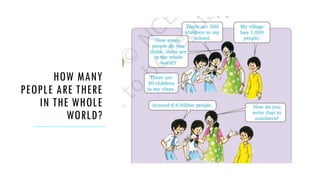
HOW MANY
PEOPLE ARE THERE
IN THE WHOLE
WORLD?
DO YOU KNOW?
Pradhan Mantri Kaushal
Vikas Yojna (PKVY) was
started in 2015 aiming to
train one crore Indian
youth from 2016 to 2020.
The objective of this
scheme is to encourage
aptitude towards
employable skills by giving
quality training to
probable and existing
wage earners.
This Photo by Unknown author is licensed under CC BY.
DISTRIBUTION OF POPULATION
The way in which people are spread across the earth
surface is known as the pattern of population distribution.
More than 90 per cent of the world’s population lives in
about 30 per cent of the land surface.
The distribution of population in the world is extremely
uneven.
DISTRIBUTION OF POPULATION
Some areas are very
crowded and some are
sparely populated.
The crowded areas are
south and south east Asia,
Europe and north eastern
North America.
Very few people live in high
latitude areas, tropical
deserts, high mountains and
areas of equatorial forests.
Many more people live
north of the Equator than
south of the Equator. Almost
three-quarters of the
world’s people live in two
continents Asia and Africa.
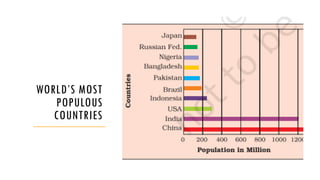
Sixty per cent of the world’s
people stay in just 10
countries.
All of them have more than
a 100 million people.
DENSITY OF
POPULATION
Population density is the number of
people living in a unit area of the
earth’s surface.
It is normally expressed as per square
km.
The average density of population in
the whole world is 51 persons per
square km.
South Central Asia has the highest
density of population followed by East
and South East Asia
WORLD’S MOST
POPULOUS
COUNTRIES
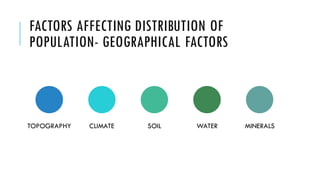
FACTORS AFFECTING DISTRIBUTION OF
POPULATION- GEOGRAPHICAL FACTORS
TOPOGRAPHY CLIMATE SOIL WATER MINERALS
OTHER FACTORS ARE-
Social
Cultural
Economic
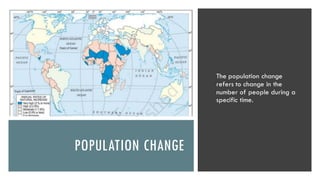
POPULATION CHANGE
The population change
refers to change in the
number of people during a
specific time.
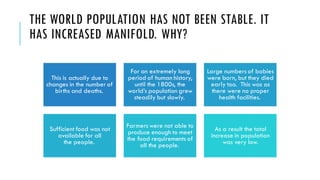
THE WORLD POPULATION HAS NOT BEEN STABLE. IT
HAS INCREASED MANIFOLD. WHY?
This is actually due to
changes in the number of
births and deaths.
For an extremely long
period of human history,
until the 1800s, the
world’s population grew
steadily but slowly.
Large numbers of babies
were born, but they died
early too. This was as
there were no proper
health facilities.
Sufficient food was not
available for all
the people.
Farmers were not able to
produce enough to meet
the food requirements of
all the people.
As a result the total
increase in population
was very low.
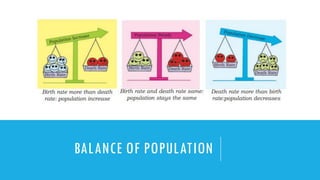
BALANCE OF POPULATION
BIRTHS AND DEATHS RATE
Births are usually measured using the birth rate i.e. the number of
live births per 1,000 people.
Deaths are usually measured using the death rate i.e. the number of
deaths per 1,000 people.
Migrations is the movement of people in and out of an area.
Births and deaths are the natural causes of population change.
The difference between the birth rate and the death rate of a
country is called the natural growth rate.
MIGRATION
Migration is another way by which population size
changes.
People may move within a country or between
countries.
Emigrants are people who leave a country;
Immigrants are those who arrive in a country.
Countries like the United States of America and
Australia have gained in-numbers by in-migration
or immigration.
Sudan is an example of a country that has
experienced a loss in population numbers due to
out-migration or emigration.
IMMIGRATION AND
EMIGRATION
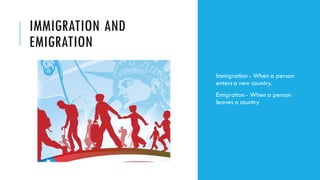
Immigration - When a person
enters a new country.
Emigration - When a person
leaves a country
GENERAL TREND OF INTERNATIONAL
MIGRATIONS
The general trend of international
migrations is from the less developed
nations to the more developed nations-
in search of better employment
opportunities.
WITHIN COUNTRIES LARGE NUMBER OF PEOPLE
MAY MOVE FROM THE RURAL TO URBAN
AREAS-
in search of employment
education
health facilities
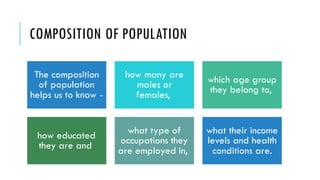
COMPOSITION OF POPULATION
The composition
of population
helps us to know -
how many are
males or
females,
which age group
they belong to,
how educated
they are and
what type of
occupations they
are employed in,
what their income
levels and health
conditions are.
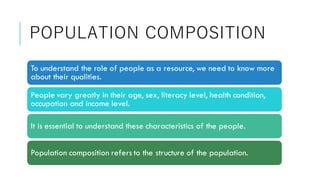
POPULATION COMPOSITION
To understand the role of people as a resource, we need to know more
about their qualities.
People vary greatly in their age, sex, literacy level, health condition,
occupation and income level.
It is essential to understand these characteristics of the people.
Population composition refers to the structure of the population.
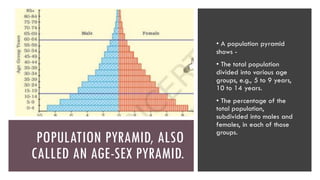
POPULATION PYRAMID, ALSO
CALLED AN AGE-SEX PYRAMID.
• A population pyramid
shows -
• The total population
divided into various age
groups, e.g., 5 to 9 years,
10 to 14 years.
• The percentage of the
total population,
subdivided into males and
females, in each of those
groups.
POPULATION PYRAMID
The shape of the population pyramid tells the story of the
people living in that particular country.
The numbers of children (below 15 years) are shown at the
bottom and reflect the level of births.
The size of the top shows the numbers of aged people (above
65 years) and reflects the number of deaths
FUTURE OF ANY NATION
DEPENDS ON -
- Skilled, spirited and hopeful young people
endowed with a positive outlook.
- We in India are fortunate to have such a
resource.
- They must be educated and provided skills
and opportunities to become able and
productive.
THANK YOU

Chapter 6 Human Resources Geography class 8th ncert

  • 1.
  • 2.
    HUMAN RESOURCES People area nation’s greatest resource. Nature’s bounty becomes significant only when people find it useful. It is people with their demands and abilities that turn them into ‘resources’. Hence, human resource is the ultimate resource. Healthy, educated and motivated people develop resources as per their requirements. Human resources like other resources are not equally distributed over the world. They differ in their educational levels, age and sex. Their numbers and characteristics also keep changing.
  • 3.
    DO YOU KNOW? TheGovernment of India has a Ministry of Human Resource Development. The Ministry was created in 1985 with an aim to improve people’s skills. This just shows how important people are as a resource for the country. This Photo by Unknown author is licensed under CC BY-SA.
  • 4.
    HOW MANY PEOPLE ARETHERE IN THE WHOLE WORLD?
  • 5.
    DO YOU KNOW? PradhanMantri Kaushal Vikas Yojna (PKVY) was started in 2015 aiming to train one crore Indian youth from 2016 to 2020. The objective of this scheme is to encourage aptitude towards employable skills by giving quality training to probable and existing wage earners. This Photo by Unknown author is licensed under CC BY.
  • 6.
    DISTRIBUTION OF POPULATION Theway in which people are spread across the earth surface is known as the pattern of population distribution. More than 90 per cent of the world’s population lives in about 30 per cent of the land surface. The distribution of population in the world is extremely uneven.
  • 7.
    DISTRIBUTION OF POPULATION Someareas are very crowded and some are sparely populated. The crowded areas are south and south east Asia, Europe and north eastern North America. Very few people live in high latitude areas, tropical deserts, high mountains and areas of equatorial forests. Many more people live north of the Equator than south of the Equator. Almost three-quarters of the world’s people live in two continents Asia and Africa. Sixty per cent of the world’s people stay in just 10 countries. All of them have more than a 100 million people.
  • 8.
    DENSITY OF POPULATION Population densityis the number of people living in a unit area of the earth’s surface. It is normally expressed as per square km. The average density of population in the whole world is 51 persons per square km. South Central Asia has the highest density of population followed by East and South East Asia
  • 9.
  • 10.
    FACTORS AFFECTING DISTRIBUTIONOF POPULATION- GEOGRAPHICAL FACTORS TOPOGRAPHY CLIMATE SOIL WATER MINERALS
  • 11.
  • 12.
    POPULATION CHANGE The populationchange refers to change in the number of people during a specific time.
  • 13.
    THE WORLD POPULATIONHAS NOT BEEN STABLE. IT HAS INCREASED MANIFOLD. WHY? This is actually due to changes in the number of births and deaths. For an extremely long period of human history, until the 1800s, the world’s population grew steadily but slowly. Large numbers of babies were born, but they died early too. This was as there were no proper health facilities. Sufficient food was not available for all the people. Farmers were not able to produce enough to meet the food requirements of all the people. As a result the total increase in population was very low.
  • 14.
  • 15.
    BIRTHS AND DEATHSRATE Births are usually measured using the birth rate i.e. the number of live births per 1,000 people. Deaths are usually measured using the death rate i.e. the number of deaths per 1,000 people. Migrations is the movement of people in and out of an area. Births and deaths are the natural causes of population change. The difference between the birth rate and the death rate of a country is called the natural growth rate.
  • 16.
    MIGRATION Migration is anotherway by which population size changes. People may move within a country or between countries. Emigrants are people who leave a country; Immigrants are those who arrive in a country. Countries like the United States of America and Australia have gained in-numbers by in-migration or immigration. Sudan is an example of a country that has experienced a loss in population numbers due to out-migration or emigration.
  • 17.
    IMMIGRATION AND EMIGRATION Immigration -When a person enters a new country. Emigration - When a person leaves a country
  • 18.
    GENERAL TREND OFINTERNATIONAL MIGRATIONS The general trend of international migrations is from the less developed nations to the more developed nations- in search of better employment opportunities.
  • 19.
    WITHIN COUNTRIES LARGENUMBER OF PEOPLE MAY MOVE FROM THE RURAL TO URBAN AREAS- in search of employment education health facilities
  • 20.
    COMPOSITION OF POPULATION Thecomposition of population helps us to know - how many are males or females, which age group they belong to, how educated they are and what type of occupations they are employed in, what their income levels and health conditions are.
  • 21.
    POPULATION COMPOSITION To understandthe role of people as a resource, we need to know more about their qualities. People vary greatly in their age, sex, literacy level, health condition, occupation and income level. It is essential to understand these characteristics of the people. Population composition refers to the structure of the population.
  • 22.
    POPULATION PYRAMID, ALSO CALLEDAN AGE-SEX PYRAMID. • A population pyramid shows - • The total population divided into various age groups, e.g., 5 to 9 years, 10 to 14 years. • The percentage of the total population, subdivided into males and females, in each of those groups.
  • 23.
    POPULATION PYRAMID The shapeof the population pyramid tells the story of the people living in that particular country. The numbers of children (below 15 years) are shown at the bottom and reflect the level of births. The size of the top shows the numbers of aged people (above 65 years) and reflects the number of deaths
  • 24.
    FUTURE OF ANYNATION DEPENDS ON - - Skilled, spirited and hopeful young people endowed with a positive outlook. - We in India are fortunate to have such a resource. - They must be educated and provided skills and opportunities to become able and productive.
  • 25.