Dr. Meenakshi Prasad
Assistant Professor
P.G. Deptt. of Geography
M.U, Bodh Gaya
Source : google images
Population
The number of human beings that live in a
particular geographical area at a particular
time .
An important aspect of human population is
its distribution & density
Source : google images
Distribution & Density
Population Distribution describes how the
individuals are distributed or spread
throughout a given area. It is the spatial
pattern of dispersal of population.
Population Density represents the average
number of individuals per unit of geographical
area. In simple terms it is the ratio between
the population and area.
• The concept of population density was first used
by Henry Drury Harness in 1837 in a series of
maps prepared by him considering the railways of
Ireland.
• The density is used to make areal comparison
• It is a useful means of assessing over population
& under population
• It is a measure of the incidence of population
concentration in terms of persons per square
kilometer or per square mile
Contd ……
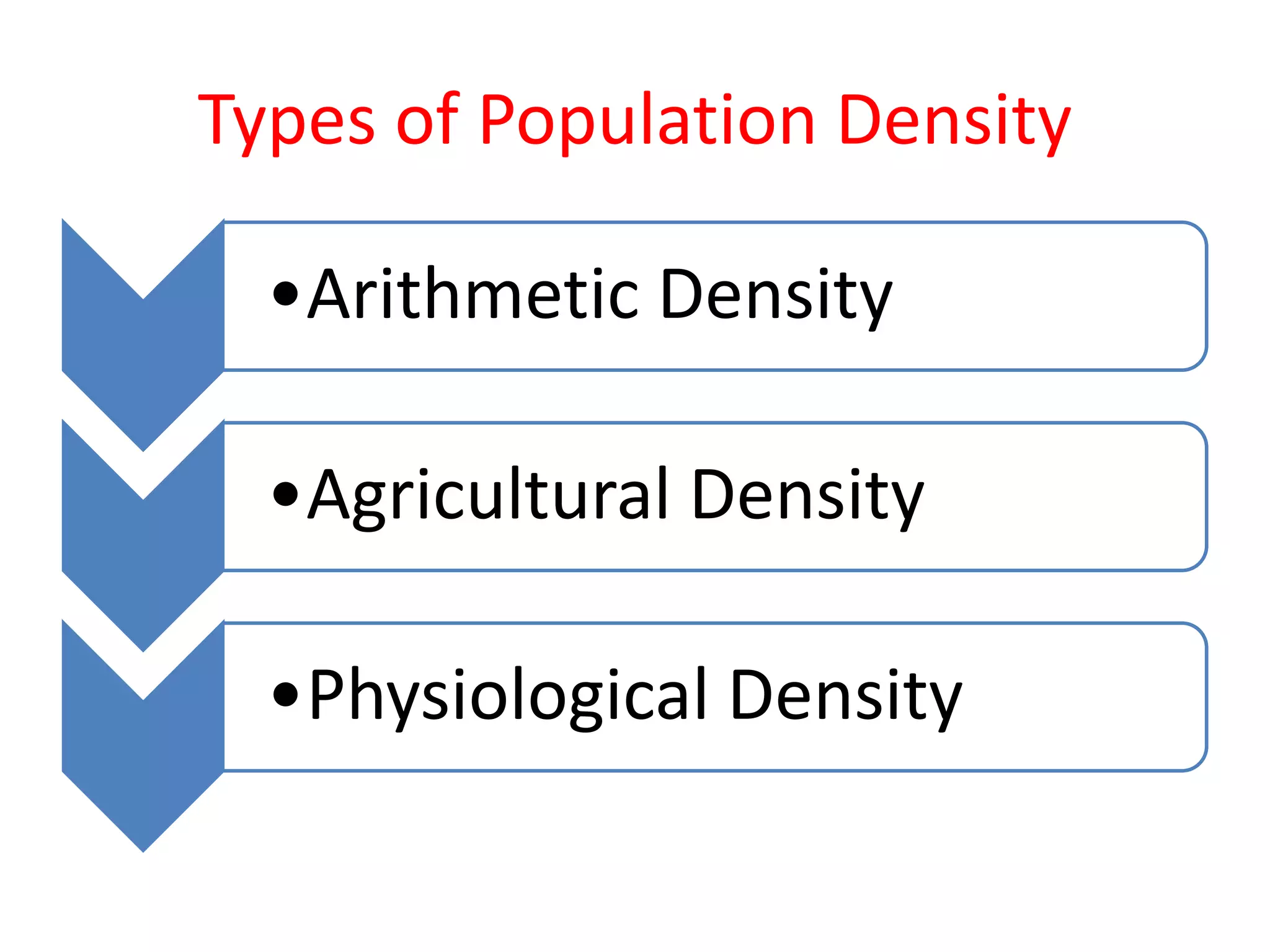
Types of Population Density
•Arithmetic Density
•Agricultural Density
•Physiological Density
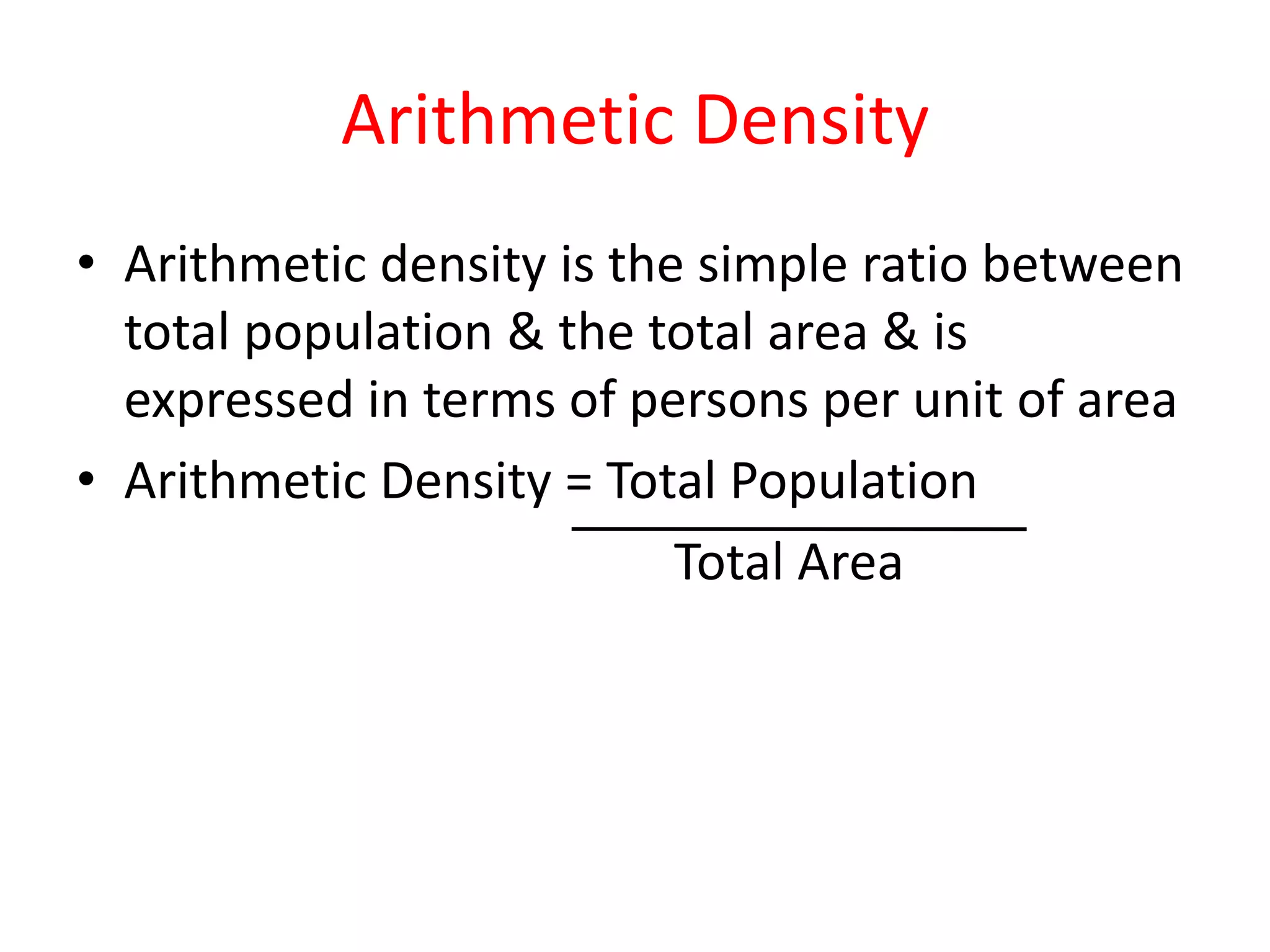
Arithmetic Density
• Arithmetic density is the simple ratio between
total population & the total area & is
expressed in terms of persons per unit of area
• Arithmetic Density = Total Population
Total Area
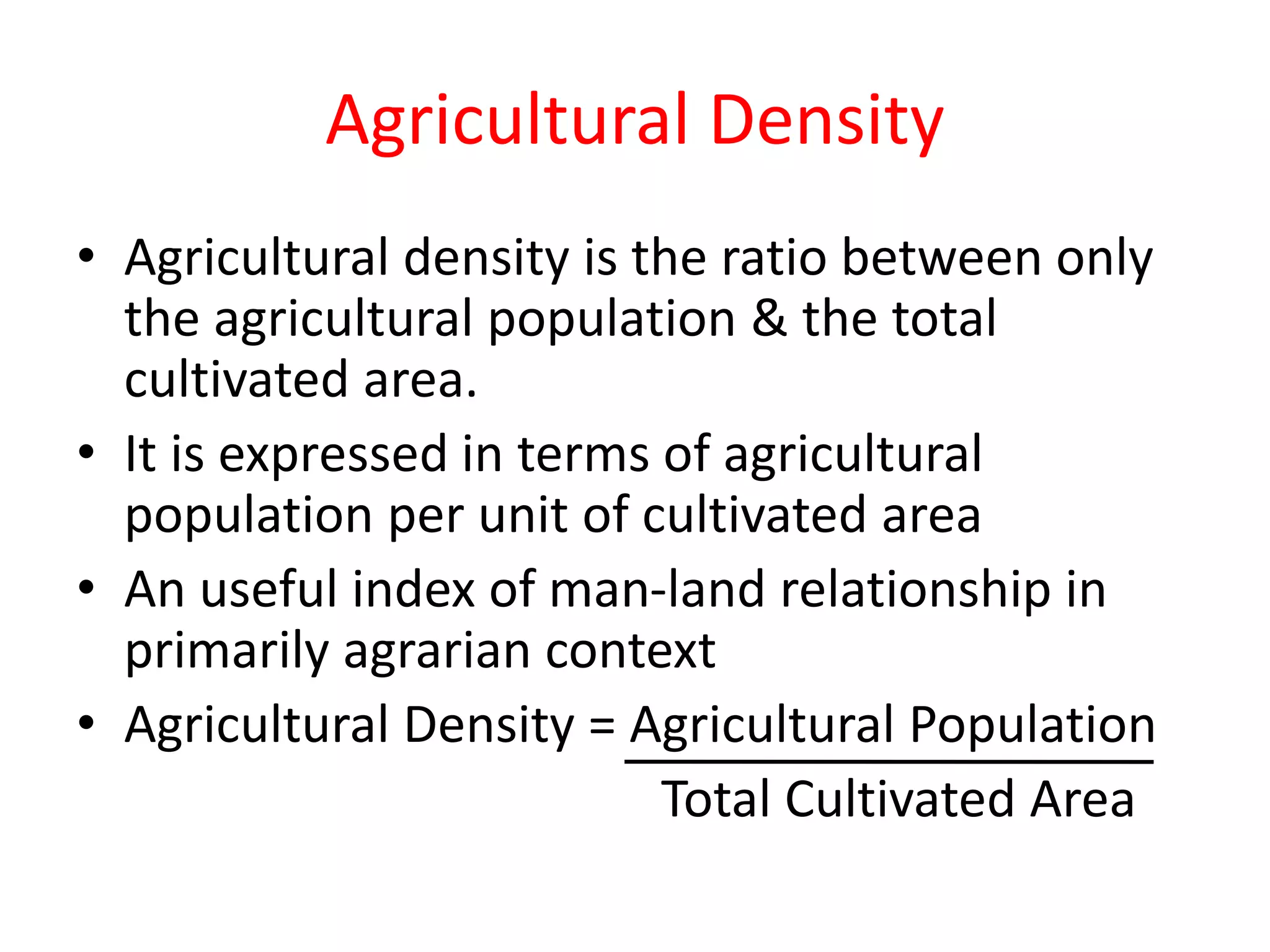
Agricultural Density
• Agricultural density is the ratio between only
the agricultural population & the total
cultivated area.
• It is expressed in terms of agricultural
population per unit of cultivated area
• An useful index of man-land relationship in
primarily agrarian context
• Agricultural Density = Agricultural Population
Total Cultivated Area
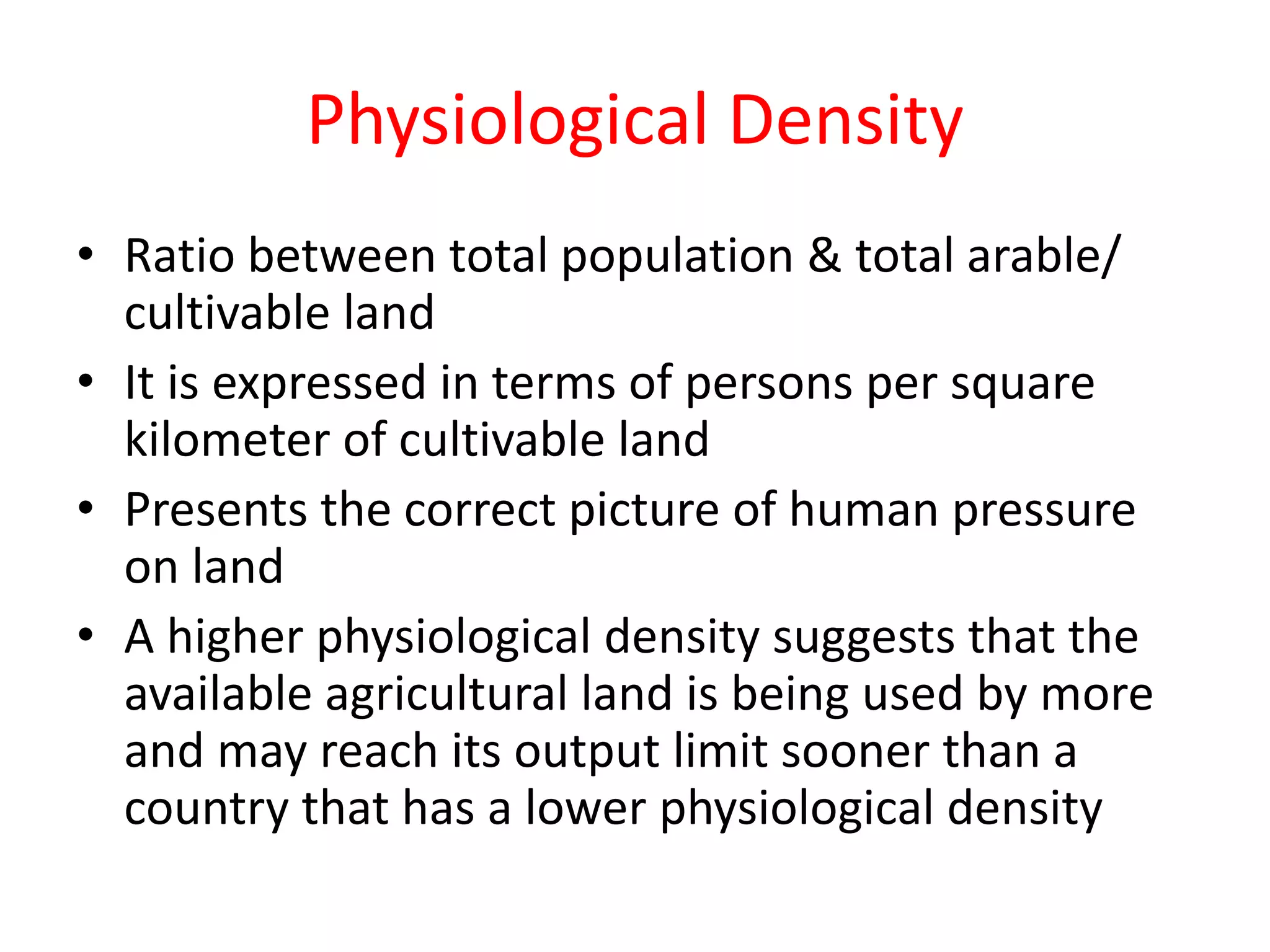
Physiological Density
• Ratio between total population & total arable/
cultivable land
• It is expressed in terms of persons per square
kilometer of cultivable land
• Presents the correct picture of human pressure
on land
• A higher physiological density suggests that the
available agricultural land is being used by more
and may reach its output limit sooner than a
country that has a lower physiological density
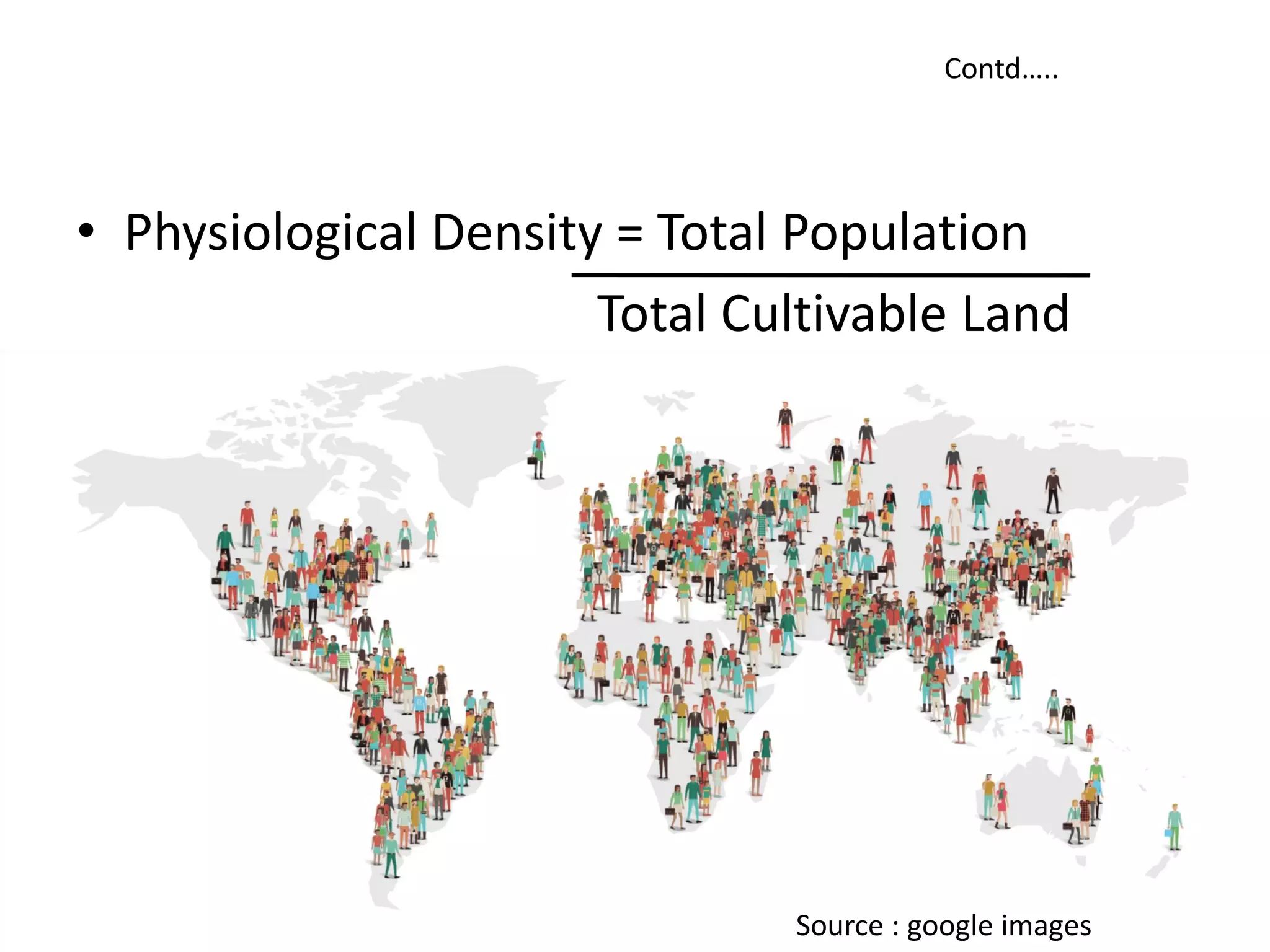
• Physiological Density = Total Population
Total Cultivable Land
Contd…..
Source : google images
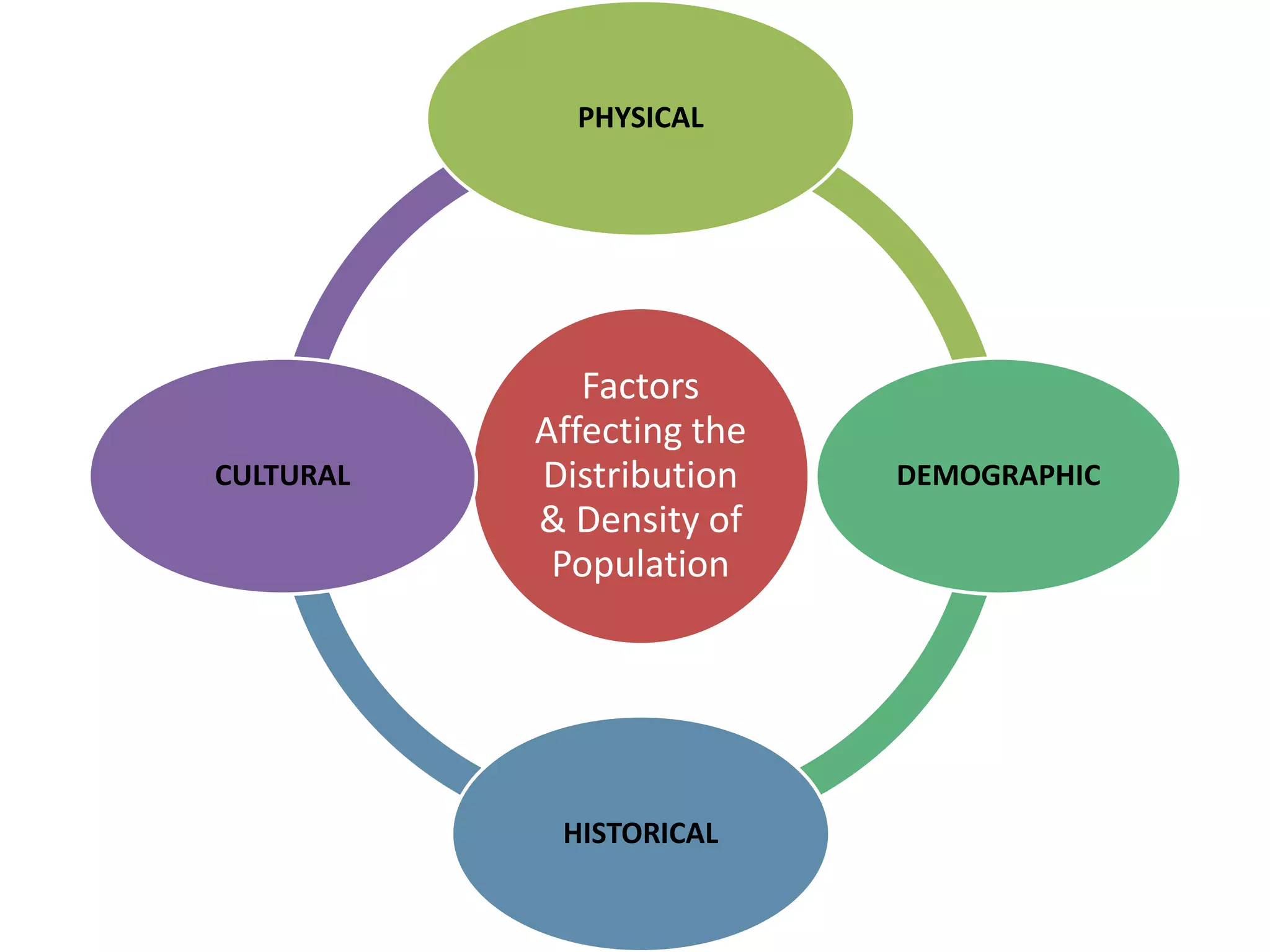
Factors
Affecting the
Distribution
& Density of
Population
PHYSICAL
DEMOGRAPHIC
HISTORICAL
CULTURAL
Physical Factors
• Relief or terrain – Plain areas encourage a higher
concentration & density of population as
compared to mountainous regions as the steep
slope of the mountains restrict the availability of
land for agriculture, development of transport,
industries & other economic activities, while the
plain areas with gentle slope are ideal for the
development of these activities
• Staszewski in his exhaustive analysis of the
vertical distribution of population has shown that
both the
number & densities decline with increasing
altitude
• According to him a little more than 56% of the
world’s population lives within 200 m from the
sea level & over 80% within 500 m.
• The Himalayan region which occupies about 13%
of India supports only 1-2% of its population
while the Great Central plains which occupies less
than 1/4th of the country supports more than half
of the country’s population
Contd…….
• Climate – Temperature & rainfall play an
important role in determining the population
of an area. Climatic extremes discourage the
concentration of population. Such climates
include the extremely cold climate like we
have in the Himalayas or Extremely dry & hot
climate like we have in the Thar desert.
• A moderate climate is favourable for
population
• The population map of India follows its rainfall
map to a large extent.
• Fertility of Soil – Fertile soil supports a higher
population concentration & density while infertile
soil decreases both.
• Alluvial soil of Great Central plains & coastal
plains & black soil of Deccan plateau of India
support a higher population density
• Availability of Water – Water is the basic
necessity for irrigation, industries, transport &
domestic purposes. So its availability encourages
concentration & density of population. This is the
reason why river valleys of India are densely
populated
• Availability of Mineral
Resources – Areas rich in
mineral resources tend to have
a large concentration & density
of population as such areas
have great possibilities of
economic development &
employment opportunities
• The higher density of
population in Chhota Nagpur
plateau is one such example
Source : google images
Cultural Factors:
• Industrialisation – Population has a magnetic
attraction towards industrial centres & regions as
they provide massive employment opportunities.
Thus, such areas have a high density of
population.
• Industries are capable of supporting more people
as compared to agricultural lands
• Phenomenal growth of industries is one of the
major causes for relatively high population
density West Bengal, Maharashtra & Gujarat
• Development of Transport Network – Areas with
good transport network are more accessible and
hence have more population & higher density &
vice-versa
• The northern plains of India have a dense
transport network and is densely populated. The
peninsular plateau has moderate network of
transport & hence is moderately populated. The
Himalayan region lacks in transport facilities and
is therefore scarcely populated with a low density
of population.
• Urbanisation – Urban centres act like magnets
for migrant population as the offer a wide
variety of employment opportunities, better
educational & health facilities, security &
promise a better standard of living. Thus, they
have a high concentration of population & a
high to very high population density
• Urban centres in India like Greater Mumbai,
Delhi, Kolkata, etc. have population densities
of over 6000 persons /square km.
• Safety & Security – Areas that offer a better
sense of security & safety to the people have a
higher concentration of people & a higher
density & vice-versa.
• The urban centres are densely populated
while the frontier areas of any countries are
sparsely populated
• War torn areas & areas of political unrest of
militant or naxal activities tend to discourage
population concentration
• Government Policy – The government policies
may encourage or discourage the growth as
well as settlement of population in a region
there by affecting the population
concentration & its density
• The article 370 in J & K which was in force till
July 2019 was a major reason for low
population density in J & K
Historical Factors :
• Duration of human settlement is an important
determinant of the magnitude of population
concentration in any area
• Most of the densely populated areas have a
very long history of human habitation, such as
the river valleys
• However, there may be exceptions to this as in
the case of Mesopotamia
Demographic Factors :
• Among the demographic factors fertility rate,
mortality rate & migration are considered
• The difference between fertility rate & mortality
rate decides the natural increase in population. If
this difference is high population grows rapidly in
an area making it densely populated as is the
case with states like Bihar.
• In-migration increases the concentration &
density of population while out-migartion leads
to the opposite, for eg. Urban centres are
exploding with population due to in-migration
Conclusion
• In fact the distribution & density of population
is affected by the combination of all the
previously mentioned factors.
• What can be noted is that in most of the areas
of the world both are increasing.
References
• Chandana, R.C: Population Geography, Kalyani Publisers, New Delhi,
2017
• Ojha, S.K : Jansankhya evam nagrikaran, Bauddhik Prakashan, 2017
• Khullar, D.R : India – A Comprehensive Geography, Kalyani
Publishers, New Delhi, 2010
• http://epgp.inflibnet.ac.in/epgpdata/uploads/epgp_content/S0004
53PO/P001844/M029745/ET/1525155870PS_MU_23Factors_affect
ing_Distribution_ofPopulationModule23Paper10Ed.pdf
• http://www.yourarticlelibrary.com/population-geography/factors-
that-affects-population-distribution/43092
• https://www.jkgeography.com/physical-and-human-factors-
affecting-global-population-distribution.html

Factors Affecting the Distribution & Density of Population

  • 1.
    Dr. Meenakshi Prasad AssistantProfessor P.G. Deptt. of Geography M.U, Bodh Gaya Source : google images
  • 2.
    Population The number ofhuman beings that live in a particular geographical area at a particular time . An important aspect of human population is its distribution & density Source : google images
  • 3.
    Distribution & Density PopulationDistribution describes how the individuals are distributed or spread throughout a given area. It is the spatial pattern of dispersal of population. Population Density represents the average number of individuals per unit of geographical area. In simple terms it is the ratio between the population and area.
  • 4.
    • The conceptof population density was first used by Henry Drury Harness in 1837 in a series of maps prepared by him considering the railways of Ireland. • The density is used to make areal comparison • It is a useful means of assessing over population & under population • It is a measure of the incidence of population concentration in terms of persons per square kilometer or per square mile Contd ……
  • 5.
    Types of PopulationDensity •Arithmetic Density •Agricultural Density •Physiological Density
  • 6.
    Arithmetic Density • Arithmeticdensity is the simple ratio between total population & the total area & is expressed in terms of persons per unit of area • Arithmetic Density = Total Population Total Area
  • 7.
    Agricultural Density • Agriculturaldensity is the ratio between only the agricultural population & the total cultivated area. • It is expressed in terms of agricultural population per unit of cultivated area • An useful index of man-land relationship in primarily agrarian context • Agricultural Density = Agricultural Population Total Cultivated Area
  • 8.
    Physiological Density • Ratiobetween total population & total arable/ cultivable land • It is expressed in terms of persons per square kilometer of cultivable land • Presents the correct picture of human pressure on land • A higher physiological density suggests that the available agricultural land is being used by more and may reach its output limit sooner than a country that has a lower physiological density
  • 9.
    • Physiological Density= Total Population Total Cultivable Land Contd….. Source : google images
  • 10.
    Factors Affecting the Distribution & Densityof Population PHYSICAL DEMOGRAPHIC HISTORICAL CULTURAL
  • 11.
    Physical Factors • Reliefor terrain – Plain areas encourage a higher concentration & density of population as compared to mountainous regions as the steep slope of the mountains restrict the availability of land for agriculture, development of transport, industries & other economic activities, while the plain areas with gentle slope are ideal for the development of these activities • Staszewski in his exhaustive analysis of the vertical distribution of population has shown that both the
  • 12.
    number & densitiesdecline with increasing altitude • According to him a little more than 56% of the world’s population lives within 200 m from the sea level & over 80% within 500 m. • The Himalayan region which occupies about 13% of India supports only 1-2% of its population while the Great Central plains which occupies less than 1/4th of the country supports more than half of the country’s population Contd…….
  • 13.
    • Climate –Temperature & rainfall play an important role in determining the population of an area. Climatic extremes discourage the concentration of population. Such climates include the extremely cold climate like we have in the Himalayas or Extremely dry & hot climate like we have in the Thar desert. • A moderate climate is favourable for population • The population map of India follows its rainfall map to a large extent.
  • 14.
    • Fertility ofSoil – Fertile soil supports a higher population concentration & density while infertile soil decreases both. • Alluvial soil of Great Central plains & coastal plains & black soil of Deccan plateau of India support a higher population density • Availability of Water – Water is the basic necessity for irrigation, industries, transport & domestic purposes. So its availability encourages concentration & density of population. This is the reason why river valleys of India are densely populated
  • 15.
    • Availability ofMineral Resources – Areas rich in mineral resources tend to have a large concentration & density of population as such areas have great possibilities of economic development & employment opportunities • The higher density of population in Chhota Nagpur plateau is one such example Source : google images
  • 16.
    Cultural Factors: • Industrialisation– Population has a magnetic attraction towards industrial centres & regions as they provide massive employment opportunities. Thus, such areas have a high density of population. • Industries are capable of supporting more people as compared to agricultural lands • Phenomenal growth of industries is one of the major causes for relatively high population density West Bengal, Maharashtra & Gujarat
  • 17.
    • Development ofTransport Network – Areas with good transport network are more accessible and hence have more population & higher density & vice-versa • The northern plains of India have a dense transport network and is densely populated. The peninsular plateau has moderate network of transport & hence is moderately populated. The Himalayan region lacks in transport facilities and is therefore scarcely populated with a low density of population.
  • 18.
    • Urbanisation –Urban centres act like magnets for migrant population as the offer a wide variety of employment opportunities, better educational & health facilities, security & promise a better standard of living. Thus, they have a high concentration of population & a high to very high population density • Urban centres in India like Greater Mumbai, Delhi, Kolkata, etc. have population densities of over 6000 persons /square km.
  • 19.
    • Safety &Security – Areas that offer a better sense of security & safety to the people have a higher concentration of people & a higher density & vice-versa. • The urban centres are densely populated while the frontier areas of any countries are sparsely populated • War torn areas & areas of political unrest of militant or naxal activities tend to discourage population concentration
  • 20.
    • Government Policy– The government policies may encourage or discourage the growth as well as settlement of population in a region there by affecting the population concentration & its density • The article 370 in J & K which was in force till July 2019 was a major reason for low population density in J & K
  • 21.
    Historical Factors : •Duration of human settlement is an important determinant of the magnitude of population concentration in any area • Most of the densely populated areas have a very long history of human habitation, such as the river valleys • However, there may be exceptions to this as in the case of Mesopotamia
  • 22.
    Demographic Factors : •Among the demographic factors fertility rate, mortality rate & migration are considered • The difference between fertility rate & mortality rate decides the natural increase in population. If this difference is high population grows rapidly in an area making it densely populated as is the case with states like Bihar. • In-migration increases the concentration & density of population while out-migartion leads to the opposite, for eg. Urban centres are exploding with population due to in-migration
  • 23.
    Conclusion • In factthe distribution & density of population is affected by the combination of all the previously mentioned factors. • What can be noted is that in most of the areas of the world both are increasing.
  • 24.
    References • Chandana, R.C:Population Geography, Kalyani Publisers, New Delhi, 2017 • Ojha, S.K : Jansankhya evam nagrikaran, Bauddhik Prakashan, 2017 • Khullar, D.R : India – A Comprehensive Geography, Kalyani Publishers, New Delhi, 2010 • http://epgp.inflibnet.ac.in/epgpdata/uploads/epgp_content/S0004 53PO/P001844/M029745/ET/1525155870PS_MU_23Factors_affect ing_Distribution_ofPopulationModule23Paper10Ed.pdf • http://www.yourarticlelibrary.com/population-geography/factors- that-affects-population-distribution/43092 • https://www.jkgeography.com/physical-and-human-factors- affecting-global-population-distribution.html