CENSUS OF INDIA
2011
Dr Harjot Kaur
AIMSR, Bathinda.
DEFINITION
HISTORY OF CENSUS
07/30/15census
4
WHY CENSUS NECESSARY?
 Revising country’s progress in the past decade
 Monitoring ongoing scheme
 Plan for future
 Reservation of seats in constituencies –
parliament/assembly/panchayat and other local
bodies
 To make decisions regarding public welfare
 Census data is also used by international
agencies,scholars,business people,industrialist
s etc.
07/30/15census
7
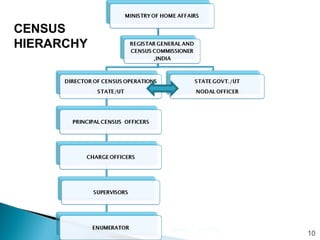
Who conducts census?
07/30/15census
9
07/30/15census
10
CENSUS
HIERARCHY
• Population
• Density
• Population (0-6)
• Scheduled Castes Population
• Scheduled Tribes Population
• Number of Literates
• Number of Workers (Total, Main, Marginal)
• Category of Economic Activity (Cultivators,
Agricultural Labourers, Household Industry
Workers, Other Workers)
• Non Workers
 Slogan of census 2011 – ‘our Census our future’.
 It is the 15th
Census since 1872
 7th
Census since independence
 Largest census in the human history ever conducted
by any Government till now.
 No. of census functionaries – 2.7 million
 Covering
640 districts
5924 sub-districts
5767 Tehsils
7742 towns
> 6 lakhs villages
 No. of languages (Schedules) - 16
 No. of languages (Training Manuals) - 18
 Paper utilised – More than11 million tones
 Total cost – 2209 crores
 In house listing – New questions on assets
added
 In population enumeration – New
questions added
 1st
time - NPR of usual residents were created
(Biometrics)
Issue of Smart Card with 12 digit UID No. to all
usual residents.
 Census in school – New initiative.
 It is a register of usual residents of the country.
 Comes under citizenship act 1955 and citizenship rules
(Registration of Citizens and issue of National Identity Cards)2003.
 Objectives
   The objective of the NPR is to create a comprehensive identity
database of every usual resident in the country. The database
would contain demographic as well as biometric particulars.
07/30/15census
23
NPR
 The National Population Register household
schedule contained 9 questions
 The Houselisting schedule contained 35 questions
 The Population enumeration schedule contained 30
questions
DATA HIGHLIGHTS
Population of India
Census 2011
• Final Total Population of the country is
1,210,726,932(or 1.21 billion)
As on 0.00 Hrs. of 1st March, 2011
Decadal Change in Population
India : 2001-2011
• There has been an increase of 181.96 million
persons in absolute number of population in
India during 2001-11
• Increase among males: 90.97 million
• Increase among females: 90.99 million
• Growth Rate of females (18.3%) is higher
than males (17.1%)
Decadal Change in Population
India : 2001-2011
• Population of India grew by 17.7% during
2001-11, against 21.5% in the previous decade
• Among the major States, highest decadal
growth in population has been recorded in
Bihar (25.4%)
• 14 States/UTs have recorded population
growth above 20%.
• 833.5 million persons live in Rural areas as per Census
2011 - more than two-third of the total population
• 377.1 million persons live in urban areas.
Population – Rural Urban Distribution
India : 1961-2011
 .High TFR
 .Low Literacy and Women Status
 .Less effective Governance
 .More Traditional Values and Customs
 8 States ( 43% to 46% Popn )
 .Rajasthan . Jharkhand
 . Uttarakhand . Uttarpradesh
 . Bihar . Madhya Pradesh
 . Chattisgarh . Orissa
Proportion of Urban Population
India : 1951-2011
• Urban proportion has gone up from 17.3% in 1951 to 31.2% in 2011.
• EAG states have lower urban proportion (21.1%) in comparison to non EAG
states (39.7% )
• Highest proportion of urban population is in NCT Delhi (97.5%)
• Top 5 States: Goa (62.2%), Mizoram (52.1%), Tamil Nadu (48.4%), Kerala
(47.7%) & Maharashtra (45.2%)
Density of Population
India : 2011
•Delhi (11,320) turns out to be the most densely inhabited followed by
Chandigarh (9,258), among all States/UTs, both in 2001 and 2011 Census.
•Among the major States, Bihar occupies the first position with a density of
1106, surpassing West Bengal which occupied the first position during 2001.
•The minimum population density works out in Arunachal Pradesh (17) for
both 2001 and 2011 Census.
Density of Population , India
2001 2011
325 382
(Persons per sq. km.)
Child Population (0-6 years)
India : 2001, 2011
  2001 2011
Variation
(in %)
Persons 163.8 164.5 +0.4 %
Males 85.0 85.7 +0.8 %
Females 78.8 78.7 -0.1 %
• The Child Population (0-6) is almost
stationary - grown by only 0.4% in the last
decade.
• In 17 States/UTs the Child Population has
declined in 2011 compared to 2001.
(in million)
Sex Composition of Child Population
(0-6) – India 2011
• The total number of children in India is 164.5 millions, about
660 thousand more than the number recorded in 2001
• Male Child (0-6) population has increased whereas Female
Child population has decreased marginally during 2001-11
• 8 States, viz. Jammu & Kashmir, Rajasthan, Uttar Pradesh,
Bihar, Jharkhand, Arunachal Pradesh, Mizoram, Meghalaya
have proportion of child population more than 15 percent.
Sex Ratio of Population
India : 2001, 2011
Sex ratio is defined as the number of females per 1000
males in a population.
Residence 2001 2011 Change
Total 933 943 +10
Rural 946 949 +3
Urban 900 929 +29
States Ranked by Sex Ratio –
2011
(Major States – Population 10 million and above)
Top 5 States Bottom 5 States
States Sex Ratio States Sex Ratio
Kerala 1,084 Haryana 879
Tamil Nadu 996 Jammu & Kashmir 889
Andhra Pradesh 993 Punjab 895
Chhattisgarh 991 Uttar Pradesh 912
Odisha 979 Bihar 918
* Sex Ratio is defined as the number of females per 1000 males
Child Sex Ratio (0-6)
India : 2001, 2011
• The sex ratio in the age group 0-6 attempts to bring
out the recent changes in our society in its attitude
and outlook towards the girl child.
• Also an indicator of the likely future trends of sex
ratio in the population.
Residence 2001 2011 Change
Total 927 919 -8
Rural 934 923 -11
Urban 906 905 -1
States Ranked by Child Sex Ratio (0-6)
2011 (Major States – Population 10 million and above)
Top 5 States Bottom 5 States
States
Sex Ratio
(0-6 yrs)
States
Sex Ratio
(0-6 yrs)
Chhattisgarh 969 Haryana 834
Kerala 964 Punjab 846
Assam 962 Jammu & Kashmir 862
West Bengal 956 Rajasthan 888
Jharkhand and
Karnataka
948 Gujarat 890
* Child Sex Ratio (0-6) is defined as the number of females
per 1000 males in the age group 0-6 years.
Overall sex ratio has increased by 7 points
( 933 to 940)
Except in 3 states . Jammu and Kashmir
. Bihar
. Gujarat
State Statistics—Overall Sex Ratio
Scheduled CasteScheduled Caste
(SC)(SC)
&&
Scheduled TribeScheduled Tribe
(ST)(ST)
SCs/STs in India - 2011SCs/STs in India - 2011
• Scheduled Castes are notified in 31 States/UTs of India
and Scheduled Tribes in 30 States
• There are altogether 1,241 individual ethnic groups,
etc. notified as Scheduled Castes in different
States/UTs
• Number of individual ethnic groups, etc. notified as
Scheduled Tribes is 705
• There has been some changes in the List of SCs/STs
in States/ UTs during the last decade
Population of SCs
India : 2011
  2001 2011
Variation
(%)
Persons 166.6 201.4 +20.8 %
Males 86.1 103.5 +20.3 %
Females 80.5 97.9 +21.5 %
(in million)
Population of STs
India : 2011
Sex  2001 2011
Variation
(%)
Persons 84.3 104.3 +23.7 %
Males 42.6 52.4 +22.9 %
Females 41.7 51.9 +24.4 %
(in million)
Proportion of SC/ST Population
India – 2001, 2011
 
Proportion of
SCs
Proportion of
STs
2001 2011 2001 2011
Total 16.2 16.6 8.2 8.6
Rural 17.9 18.5 10.4 11.3
Urban 11.8 12.6 2.4 2.8
(In %)
(In %)
(In %)
States/UTs Ranked by Proportion
of SCs - 2011
Top 5 States/UTs Bottom 5 States/UTs
Punjab 31.9% Mizoram 0.1%
Himachal Pradesh 25.2% Meghalaya 0.6%
West Bengal 23.5% Goa 1.7%
Uttar Pradesh 20.7% Dadra & Nagar Haveli 1.8%
Haryana 20.2% Daman & Diu 2.5%
Top 5 States/UTs Bottom 5 States/UTs
Lakshadweep 94.8% Uttar Pradesh 0.6%
Mizoram 94.4% Tamil Nadu 1.1%
Nagaland 86.5% Bihar 1.3%
Meghalaya 86.1% Kerala 1.5%
Arunachal Pradesh 68.8% Uttarakhand 2.9%
States/UTs Ranked by Proportion
of STs - 2011
LiteratesLiterates
&&
Literacy RatesLiteracy Rates
Number of Literates
India : 2001, 2011
• A person (aged 7 and above) is considered literate, if
he or she can read and write, with understanding, in
any language.
Sex 2001 2011 Change
Persons 560.7 763.5 +202.8
Males 336.5 434.7 +98.2
Females 224.2 328.8 +104.6
(in millions)
Literacy Rate
India : 2001, 2011
  2001 2011
Difference
(2011 – 2001)
Persons 64.8 73.0 +8.2
Males 75.3 80.9 +5.6
Females 53.7 64.6 +10.9
(in %)
• Largest increase: Dadra & Nagar Haveli by 18.6 points (from 57.6% to
76.2%), Bihar by 14.8 points (from 47.0% to 61.8%), Tripura by 14.0
points (from 73.2% to 87.2%)
• Improvement in Female literacy is higher than males in all States/UTs,
except Mizoram (where it is same in both Males and Females) during the
decade 2001-11.
Literacy Rate – Rural Urban Differential
India - 2001, 2011
• Gap between Literacy Rate in Urban and Rural areas is
steadily declining in every census. In Census 2011, the
gap stands at 16.3 points
Gender Gap in Literacy Rate
India - 2001, 2011
• Gender gap in Literacy Rate is steadily declining in every
census. In Census 2011, the gap stands at 16.3 points
States/UTs Ranked by Literacy
Rate 2011
Top 5 States/UTs Bottom 5 States/UTs
States/UTs
Literacy
Rate
States/UTs
Literacy
Rate
Kerala 94.0 Bihar 61.8
Lakshadweep 91.8 Arunachal Pradesh 65.4
Mizoram 91.3 Rajasthan 66.1
Goa 88.7 Jharkhand 66.4
Tripura 87.2 Andhra Pradesh 67.0
(In %)
Workers,Workers,
Work ParticipationWork Participation
Rate (WPR)Rate (WPR)
&&
Categories ofCategories of
Economic ActivityEconomic Activity
Definition of Work
(Economic Activity)- 2011
Worker: A person who has participated in any economically
productive activity with or without compensation or
profit
Reference period: one year preceding the date of enumeration
Number of Workers by Residence
India : 2011
 Residence
Number of
Workers
Non-Workers
Work
Participation
Rate*
Total 481.7 728.8 39.8%
Rural 348.6 484.9 41.8%
Urban 133.1 243.9 35.3%
* Work Participation Rate is defined as the number of workers per
100 population
(in million)
Work Participation Rate
India : 2001, 2011
Residenc
e
Sex 2001 2011 Change
Total Persons 39.1 39.8 +0.7
Males 51.7 53.3 +1.6
Females 25.6 25.5 -0.1
(In %)
States/UTs Ranked by WPR-
2011
Top 5 States/UTs Bottom 5 States/UTs
States/UTs WPR States/UTs WPR
Himachal Pradesh 51.9 Lakshadweep 29.1
Sikkim 50.5 Uttar Pradesh 32.9
Daman & Diu 49.9 NCT of Delhi 33.3
Nagaland 49.2 Bihar 33.4
Chhattisgarh 47.7 Jammu & Kashmir 34.5
(In %)
States/UTs Ranked by WPR
Females : 2011
Top 5 States/UTs Bottom 5 States/UTs
States/UTs WPR(F) States/UTs WPR(F)
Himachal Pradesh 44.8 NCT of Delhi 10.6
Nagaland 44.7 Lakshadweep 11.0
Chhattisgarh 39.7 Punjab 13.9
Sikkim 39.6 Daman & Diu 14.9
Manipur 38.6 Chandigarh 16.0
(In %)
Type of Workers- 2011
• Main Worker: Persons who ‘worked’ for 6 months or more
during the reference year
• Marginal Worker: Persons who ‘worked’ for less than 6
months.
• For the first time in Census 2011, the marginal workers
have been sub-divided in two categories, namely, those
worked for less than 3 months and those who worked for 3
to 6 months
• Non-Worker: Persons who did not ‘work’ at all during the
reference period. Includes students, persons engaged in
household duties, dependents, pensioners, beggars, etc.
Type of Workers
India : 2001, 2011
Residence Sex 2001 2011 Change
Main Workers Persons 77.8 75.2 -2.6
Males 87.3 82.3 -5.0
Female
s
57.3 59.6 2.3
Marginal
Workers
Persons 22.2 24.8 2.6
Males 12.7 17.7 5.0
Female
s
42.7 40.4 -2.3
(in %)
Persons
Males
Females
ENCOURAGING
ISSUES
DISTRESSING
ISSUES
% Decadal growth is 17.7
less than previous(21.5)
General popn is increasing
Child popn is less(164.5 –
168.3)
Child sex ratio is decreased
( 927-914)
Overall sex ratio is
improved (933—940 )
Density of popn is more
( 325—382 )
Overall,male & female
literacy rate is
better( 560.7–763.5)
% improvement in
Literacy rate is more in
BEST PERFORMER
KERALA
WORST PERFORMER
BIHAR
LOWEST PERCENTAGE DECADAL
GROWTH IN POPULATION IN INDIA
(4.86%)
HIGHEST PERCENTAGE DECADAL
GROWTH(25.07%)
HIGHEST LITERACY RATE IN INDIA
(93.91%)
LOWEST LITERACY RATE(63.82%)
HIGHEST MALE AND FEMALE
LITERACY RATE IN INDIA (96% &
91.98%)
LOWEST MALE AND FEMALE
LITERCY RATE (73.39% &53.33%)
HIGHEST SEX RATIO (1038
FEMALES /1000 MALES)
5TH
LOWEST SEX RATIO (916/1000
MALES)
07/30/15census
66
Census 2011

Census 2011

  • 1.
    CENSUS OF INDIA 2011 DrHarjot Kaur AIMSR, Bathinda.
  • 2.
  • 3.
  • 4.
  • 5.
  • 7.
     Revising country’sprogress in the past decade  Monitoring ongoing scheme  Plan for future  Reservation of seats in constituencies – parliament/assembly/panchayat and other local bodies  To make decisions regarding public welfare  Census data is also used by international agencies,scholars,business people,industrialist s etc. 07/30/15census 7
  • 9.
  • 10.
  • 11.
    • Population • Density •Population (0-6) • Scheduled Castes Population • Scheduled Tribes Population • Number of Literates • Number of Workers (Total, Main, Marginal) • Category of Economic Activity (Cultivators, Agricultural Labourers, Household Industry Workers, Other Workers) • Non Workers
  • 17.
     Slogan ofcensus 2011 – ‘our Census our future’.  It is the 15th Census since 1872  7th Census since independence  Largest census in the human history ever conducted by any Government till now.  No. of census functionaries – 2.7 million  Covering 640 districts 5924 sub-districts 5767 Tehsils 7742 towns > 6 lakhs villages
  • 18.
     No. oflanguages (Schedules) - 16  No. of languages (Training Manuals) - 18  Paper utilised – More than11 million tones  Total cost – 2209 crores  In house listing – New questions on assets added  In population enumeration – New questions added
  • 21.
     1st time -NPR of usual residents were created (Biometrics) Issue of Smart Card with 12 digit UID No. to all usual residents.  Census in school – New initiative.
  • 23.
     It isa register of usual residents of the country.  Comes under citizenship act 1955 and citizenship rules (Registration of Citizens and issue of National Identity Cards)2003.  Objectives    The objective of the NPR is to create a comprehensive identity database of every usual resident in the country. The database would contain demographic as well as biometric particulars. 07/30/15census 23 NPR
  • 24.
     The NationalPopulation Register household schedule contained 9 questions
  • 25.
     The Houselistingschedule contained 35 questions
  • 26.
     The Populationenumeration schedule contained 30 questions
  • 27.
  • 28.
    Population of India Census2011 • Final Total Population of the country is 1,210,726,932(or 1.21 billion) As on 0.00 Hrs. of 1st March, 2011
  • 29.
    Decadal Change inPopulation India : 2001-2011 • There has been an increase of 181.96 million persons in absolute number of population in India during 2001-11 • Increase among males: 90.97 million • Increase among females: 90.99 million • Growth Rate of females (18.3%) is higher than males (17.1%)
  • 30.
    Decadal Change inPopulation India : 2001-2011 • Population of India grew by 17.7% during 2001-11, against 21.5% in the previous decade • Among the major States, highest decadal growth in population has been recorded in Bihar (25.4%) • 14 States/UTs have recorded population growth above 20%.
  • 31.
    • 833.5 millionpersons live in Rural areas as per Census 2011 - more than two-third of the total population • 377.1 million persons live in urban areas. Population – Rural Urban Distribution India : 1961-2011
  • 32.
     .High TFR .Low Literacy and Women Status  .Less effective Governance  .More Traditional Values and Customs  8 States ( 43% to 46% Popn )  .Rajasthan . Jharkhand  . Uttarakhand . Uttarpradesh  . Bihar . Madhya Pradesh  . Chattisgarh . Orissa
  • 33.
    Proportion of UrbanPopulation India : 1951-2011 • Urban proportion has gone up from 17.3% in 1951 to 31.2% in 2011. • EAG states have lower urban proportion (21.1%) in comparison to non EAG states (39.7% ) • Highest proportion of urban population is in NCT Delhi (97.5%) • Top 5 States: Goa (62.2%), Mizoram (52.1%), Tamil Nadu (48.4%), Kerala (47.7%) & Maharashtra (45.2%)
  • 34.
    Density of Population India: 2011 •Delhi (11,320) turns out to be the most densely inhabited followed by Chandigarh (9,258), among all States/UTs, both in 2001 and 2011 Census. •Among the major States, Bihar occupies the first position with a density of 1106, surpassing West Bengal which occupied the first position during 2001. •The minimum population density works out in Arunachal Pradesh (17) for both 2001 and 2011 Census. Density of Population , India 2001 2011 325 382 (Persons per sq. km.)
  • 35.
    Child Population (0-6years) India : 2001, 2011   2001 2011 Variation (in %) Persons 163.8 164.5 +0.4 % Males 85.0 85.7 +0.8 % Females 78.8 78.7 -0.1 % • The Child Population (0-6) is almost stationary - grown by only 0.4% in the last decade. • In 17 States/UTs the Child Population has declined in 2011 compared to 2001. (in million)
  • 36.
    Sex Composition ofChild Population (0-6) – India 2011 • The total number of children in India is 164.5 millions, about 660 thousand more than the number recorded in 2001 • Male Child (0-6) population has increased whereas Female Child population has decreased marginally during 2001-11 • 8 States, viz. Jammu & Kashmir, Rajasthan, Uttar Pradesh, Bihar, Jharkhand, Arunachal Pradesh, Mizoram, Meghalaya have proportion of child population more than 15 percent.
  • 37.
    Sex Ratio ofPopulation India : 2001, 2011 Sex ratio is defined as the number of females per 1000 males in a population. Residence 2001 2011 Change Total 933 943 +10 Rural 946 949 +3 Urban 900 929 +29
  • 38.
    States Ranked bySex Ratio – 2011 (Major States – Population 10 million and above) Top 5 States Bottom 5 States States Sex Ratio States Sex Ratio Kerala 1,084 Haryana 879 Tamil Nadu 996 Jammu & Kashmir 889 Andhra Pradesh 993 Punjab 895 Chhattisgarh 991 Uttar Pradesh 912 Odisha 979 Bihar 918 * Sex Ratio is defined as the number of females per 1000 males
  • 39.
    Child Sex Ratio(0-6) India : 2001, 2011 • The sex ratio in the age group 0-6 attempts to bring out the recent changes in our society in its attitude and outlook towards the girl child. • Also an indicator of the likely future trends of sex ratio in the population. Residence 2001 2011 Change Total 927 919 -8 Rural 934 923 -11 Urban 906 905 -1
  • 40.
    States Ranked byChild Sex Ratio (0-6) 2011 (Major States – Population 10 million and above) Top 5 States Bottom 5 States States Sex Ratio (0-6 yrs) States Sex Ratio (0-6 yrs) Chhattisgarh 969 Haryana 834 Kerala 964 Punjab 846 Assam 962 Jammu & Kashmir 862 West Bengal 956 Rajasthan 888 Jharkhand and Karnataka 948 Gujarat 890 * Child Sex Ratio (0-6) is defined as the number of females per 1000 males in the age group 0-6 years.
  • 41.
    Overall sex ratiohas increased by 7 points ( 933 to 940) Except in 3 states . Jammu and Kashmir . Bihar . Gujarat State Statistics—Overall Sex Ratio
  • 42.
  • 43.
    SCs/STs in India- 2011SCs/STs in India - 2011 • Scheduled Castes are notified in 31 States/UTs of India and Scheduled Tribes in 30 States • There are altogether 1,241 individual ethnic groups, etc. notified as Scheduled Castes in different States/UTs • Number of individual ethnic groups, etc. notified as Scheduled Tribes is 705 • There has been some changes in the List of SCs/STs in States/ UTs during the last decade
  • 44.
    Population of SCs India: 2011   2001 2011 Variation (%) Persons 166.6 201.4 +20.8 % Males 86.1 103.5 +20.3 % Females 80.5 97.9 +21.5 % (in million)
  • 45.
    Population of STs India: 2011 Sex  2001 2011 Variation (%) Persons 84.3 104.3 +23.7 % Males 42.6 52.4 +22.9 % Females 41.7 51.9 +24.4 % (in million)
  • 46.
    Proportion of SC/STPopulation India – 2001, 2011   Proportion of SCs Proportion of STs 2001 2011 2001 2011 Total 16.2 16.6 8.2 8.6 Rural 17.9 18.5 10.4 11.3 Urban 11.8 12.6 2.4 2.8 (In %)
  • 47.
  • 48.
  • 49.
    States/UTs Ranked byProportion of SCs - 2011 Top 5 States/UTs Bottom 5 States/UTs Punjab 31.9% Mizoram 0.1% Himachal Pradesh 25.2% Meghalaya 0.6% West Bengal 23.5% Goa 1.7% Uttar Pradesh 20.7% Dadra & Nagar Haveli 1.8% Haryana 20.2% Daman & Diu 2.5%
  • 50.
    Top 5 States/UTsBottom 5 States/UTs Lakshadweep 94.8% Uttar Pradesh 0.6% Mizoram 94.4% Tamil Nadu 1.1% Nagaland 86.5% Bihar 1.3% Meghalaya 86.1% Kerala 1.5% Arunachal Pradesh 68.8% Uttarakhand 2.9% States/UTs Ranked by Proportion of STs - 2011
  • 51.
  • 52.
    Number of Literates India: 2001, 2011 • A person (aged 7 and above) is considered literate, if he or she can read and write, with understanding, in any language. Sex 2001 2011 Change Persons 560.7 763.5 +202.8 Males 336.5 434.7 +98.2 Females 224.2 328.8 +104.6 (in millions)
  • 53.
    Literacy Rate India :2001, 2011   2001 2011 Difference (2011 – 2001) Persons 64.8 73.0 +8.2 Males 75.3 80.9 +5.6 Females 53.7 64.6 +10.9 (in %) • Largest increase: Dadra & Nagar Haveli by 18.6 points (from 57.6% to 76.2%), Bihar by 14.8 points (from 47.0% to 61.8%), Tripura by 14.0 points (from 73.2% to 87.2%) • Improvement in Female literacy is higher than males in all States/UTs, except Mizoram (where it is same in both Males and Females) during the decade 2001-11.
  • 54.
    Literacy Rate –Rural Urban Differential India - 2001, 2011 • Gap between Literacy Rate in Urban and Rural areas is steadily declining in every census. In Census 2011, the gap stands at 16.3 points
  • 55.
    Gender Gap inLiteracy Rate India - 2001, 2011 • Gender gap in Literacy Rate is steadily declining in every census. In Census 2011, the gap stands at 16.3 points
  • 56.
    States/UTs Ranked byLiteracy Rate 2011 Top 5 States/UTs Bottom 5 States/UTs States/UTs Literacy Rate States/UTs Literacy Rate Kerala 94.0 Bihar 61.8 Lakshadweep 91.8 Arunachal Pradesh 65.4 Mizoram 91.3 Rajasthan 66.1 Goa 88.7 Jharkhand 66.4 Tripura 87.2 Andhra Pradesh 67.0 (In %)
  • 57.
    Workers,Workers, Work ParticipationWork Participation Rate(WPR)Rate (WPR) && Categories ofCategories of Economic ActivityEconomic Activity
  • 58.
    Definition of Work (EconomicActivity)- 2011 Worker: A person who has participated in any economically productive activity with or without compensation or profit Reference period: one year preceding the date of enumeration
  • 59.
    Number of Workersby Residence India : 2011  Residence Number of Workers Non-Workers Work Participation Rate* Total 481.7 728.8 39.8% Rural 348.6 484.9 41.8% Urban 133.1 243.9 35.3% * Work Participation Rate is defined as the number of workers per 100 population (in million)
  • 60.
    Work Participation Rate India: 2001, 2011 Residenc e Sex 2001 2011 Change Total Persons 39.1 39.8 +0.7 Males 51.7 53.3 +1.6 Females 25.6 25.5 -0.1 (In %)
  • 61.
    States/UTs Ranked byWPR- 2011 Top 5 States/UTs Bottom 5 States/UTs States/UTs WPR States/UTs WPR Himachal Pradesh 51.9 Lakshadweep 29.1 Sikkim 50.5 Uttar Pradesh 32.9 Daman & Diu 49.9 NCT of Delhi 33.3 Nagaland 49.2 Bihar 33.4 Chhattisgarh 47.7 Jammu & Kashmir 34.5 (In %)
  • 62.
    States/UTs Ranked byWPR Females : 2011 Top 5 States/UTs Bottom 5 States/UTs States/UTs WPR(F) States/UTs WPR(F) Himachal Pradesh 44.8 NCT of Delhi 10.6 Nagaland 44.7 Lakshadweep 11.0 Chhattisgarh 39.7 Punjab 13.9 Sikkim 39.6 Daman & Diu 14.9 Manipur 38.6 Chandigarh 16.0 (In %)
  • 63.
    Type of Workers-2011 • Main Worker: Persons who ‘worked’ for 6 months or more during the reference year • Marginal Worker: Persons who ‘worked’ for less than 6 months. • For the first time in Census 2011, the marginal workers have been sub-divided in two categories, namely, those worked for less than 3 months and those who worked for 3 to 6 months • Non-Worker: Persons who did not ‘work’ at all during the reference period. Includes students, persons engaged in household duties, dependents, pensioners, beggars, etc.
  • 64.
    Type of Workers India: 2001, 2011 Residence Sex 2001 2011 Change Main Workers Persons 77.8 75.2 -2.6 Males 87.3 82.3 -5.0 Female s 57.3 59.6 2.3 Marginal Workers Persons 22.2 24.8 2.6 Males 12.7 17.7 5.0 Female s 42.7 40.4 -2.3 (in %) Persons Males Females
  • 65.
    ENCOURAGING ISSUES DISTRESSING ISSUES % Decadal growthis 17.7 less than previous(21.5) General popn is increasing Child popn is less(164.5 – 168.3) Child sex ratio is decreased ( 927-914) Overall sex ratio is improved (933—940 ) Density of popn is more ( 325—382 ) Overall,male & female literacy rate is better( 560.7–763.5) % improvement in Literacy rate is more in
  • 66.
    BEST PERFORMER KERALA WORST PERFORMER BIHAR LOWESTPERCENTAGE DECADAL GROWTH IN POPULATION IN INDIA (4.86%) HIGHEST PERCENTAGE DECADAL GROWTH(25.07%) HIGHEST LITERACY RATE IN INDIA (93.91%) LOWEST LITERACY RATE(63.82%) HIGHEST MALE AND FEMALE LITERACY RATE IN INDIA (96% & 91.98%) LOWEST MALE AND FEMALE LITERCY RATE (73.39% &53.33%) HIGHEST SEX RATIO (1038 FEMALES /1000 MALES) 5TH LOWEST SEX RATIO (916/1000 MALES) 07/30/15census 66

Editor's Notes

  • #4 Earliest literature rig-veda reveals that some kind of population count was maintained in during 800-600 bc . The celebrated “arthshastar” by kautilya written in the 3rd century bc prescribed the collection of population stats as a measure for state policy for taxation.
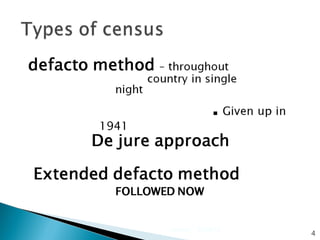
  • #5 defacto- enumerating people as of where they are found on census day De jure- enumeration of people as of where they ususally reside regardless of where they are on day of census
  • #18 28 states and 7 Uts punjab
  • #20 E-learning modules introduced for training the enumerators(animation characters representing enumerators and respondents deliver dialougues
  • #24 The National Population Register (NPR) is a Register of usual residents of the country. It is being prepared at the local (Village/sub-Town), sub-District, District, State and National level under provisions of the Citizenship Act 1955 and the Citizenship (Registration of Citizens and issue of National Identity Cards) Rules, 2003. It is mandatory for every usual resident of India to register in the NPR. A usual resident is defined for the purposes of NPR as a person who has resided in a local area for the past 6 months or more or a person who intends to reside in that area for the next 6 months or more.  
  • #67 The National Family Health Survey (NFHS) is a large-scale, multi-round survey conducted in a representative sample of households throughout India. Three rounds of the survey have been conducted since the first survey in 1992-93. The survey provides state and national information for India on fertility, infant and child mortality, the practice of family planning, maternal and child health, reproductive health, nutrition, anaemia, utilization and quality of health and family planning services. Each successive round of the NFHS has had two specific goals: a) to provide essential data on health and family welfare needed by the Ministry of Health and Family Welfare and other agencies for policy and programme purposes, and b) to provide information on important emerging health and family welfare issues. The Ministry of Health and Family Welfare (MOHFW), Government of India, designated the International Institute for Population Sciences(IIPS)
  • #68  the level of registration of births and deaths under the Act has continued to be far from satisfactory in several states/UTs. With a view to generate reliable and continuous data on these indicators, the Office of the Registrar General, India, initiated the scheme of sample registration of births and deaths in India popularly known as Sample Registration System (SRS) in 1964 65 on a pilot basis and on full scale from 1969 70. The SRS since then has been providing data on regular basis. The SRS in India is based on a dual record system. The field investigation under Sample Registration System consists of continuous enumeration of births and deaths in a sample of villages/urban blocks by a resident part time enumerator, and an independent six monthly retrospective survey by a full time supervisor. The data obtained through these two sources are matched. The unmatched and partially matched events are re-verified in the field to get an unduplicated count of correct events