" Our Census - Our Future".Census Of India
2011
EXECUTION &FIELD WORK
Census of India 2011
Phases of Census field work
Phase 1: House listing and Housing Census and
canvassing of Household Schedule of
National Population Register (NPR):(45days)
between April and September, 2010
Phase 2: Population Enumeration: 9th
February to
28th
February, 2011
Revisional round : 1st
to 5th
March, 2011
Phase II: is a time bound process
HOUSE LISTING &HOUSING CENSUS
Census of india2011
• Conducted 7 to 8 months in advance of census taking
• Helps to prepare the frame for collection of
information during next phase of enumeration
• Lists each and every building, house and other
structures in the Enumeration Area and collects
information on their use
• Identifies residential houses for population
enumeration
• Collects household level information on amenities and
assets available.
House listing &Housing Census Operations:
• House listing and Housing Census was carried out in
different periods ranging over April to September 2010
in different states.
• Along with House listing canvassing of Household
Schedules for the preparation of National Population
Register (NPR) as per citizens act of 1955 was also
carried out this time
• Usually 30 days are taken for House listing. Due to
NPR 45 days were taken for fieldwork this time.
• In Kerala the phase Conducted in April-May(12 th April
to May 27th
)
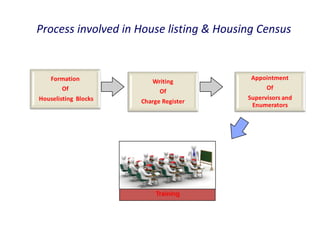
Process involved in House listing & Housing Census
Charge officers duties during HLO
Houselisting Block
(HLBS)
•Specific area allotted to
a specific Enumerator
for carrying out of Census
Operations relating to
House Numbering and
Houselisting.
•.
CHARGE REGISTER- VILLAGE/TOWN/ TALUK LEVEL
• A register recording exhaustive details of each
and every House listing/ enumeration block,
details of address of the block, enumerators
and supervisors details etc.
• Charge registers prepared separately for
House listing and population Enumeration.
Appointment of Enumerators &Supervisors
• Enumerators and supervisors are appointed
by the charge officers and the officials are
taken from state govt staff such as teachers,
Clerical Staff etc. as enumerators and a higher
grade officers are appointed as supervisors.
• One Supervisor was to supervise maximum of
6 Enumeration blocks .
Training of the supervisors &Enumerators
• Charge officers were responsible for training
of enumerators and supervisors in his charge.
• Master trainers imparted training to them.
• No. of training sessions depends upon number
of blocks in respective charges.
• 10% officials were appointed in ‘reserves’ to
meet exigencies.
House to house listing
The enumerator appointed for an HLB has to list
out all buildings in it without omission
/duplication.
•Census houses were assigned numbers by the
enumerators – continuously inside his HLB.
•Notional Map of the HLB has to be prepared
• Visit all census houses and some details of
household residing also procured.
Houselisting and Housing Census
Schedule
Houselist-Questions
• Predominant material of floor,
wall and roof of the Census
House
• Use & Condition of Census
House
• Name of Head of HH
• Ownership status
• Number of dwelling rooms
• Number of married couples
• Amenities available:
• Main source and availability
of drinking water
• Main source of lighting
• Latrine within the premises
• Type of latrine facility
• Waste water outlet
connected to
• Amenities available (contd):
• Bathing facility within the
premises
• Availability of kitchen
• Fuel used for cooking
• Assets possessed by the
household
• Radio/Transistor
• Television
• Computer/Laptop
• Telephone/Mobile phone
• Bicycle
• Scooter/Motor Cycle/Moped
• Car/Jeep/Van
• Availing banking services
35
columns
House listing tables are treasure chest of a wide variety of data on housing conditions,
assets &amenities available in the country
HL
schedule
&
POPULATION ENUMERATION
Census of india2011
Time line: Population Enumeration
Population Enumeration: 9th
February to 28th
February, 2011
• Census Moment and Reference moment for Census
2011 will be 00:00 hours of 1st
Mach 2011
• Revisional round : 1st
to 5th
March, 2011
1. Re-visit
2. Births, Deaths and Arrivals of Visitors updating.
Births, Deaths and Arrivals of Visitors after 00:00 hours
of 1st
March, 2011 will not be taken
• In snow bound areas
• Population Enumeration 11th
to 30th
Sep 2010
• Revisional Round 1st
to 5th
Oct 2010
• In all other areas
• Population Enumeration 9th
to 28th
Feb 2011
• Revisional Round 1st
to 5th
Mar 2011
Population Enumeration Calendar
Enumeration Block(EBS): Specific area allotted
to a specific Enumerator for carrying out of
Census Operations relating Population
enumeration.
•Ebs are Demarcated with specified boundaries to avoid duplication and
omission
•Assigned to an enumerator for conducting field work
•Population size inside the area is expected to be less than 800.
•House listing blocks with huge size were bifurcated in to sub block, but kept in
tact in census2011.
Concepts and Definitions
Preparing EB from HLB
• One AHL booklet is
prepared for each
EB
Population Enumeration (29 Questions)
Demographic
• Name of the person
• Relationship to head
• Sex – Male, Female and Other
• Date of Birth and Age
Marital Status
• Current marital status
• Age at marriage
Cultural
• Religion
• Scheduled Caste/Scheduled Tribe
• Disability
• Mother Tongue
• Other languages known
Population Enumeration (29 Questions)
Literacy
• Literacy status
• Status of attendance
• Highest educational level attained
Economic
• Work status – Main, marginal and non-worker
• Category of economic activity – Cultivator,
Agricultural labourer, Worker in household
Industries & Other workers
• Occupation, Nature of Industry, Trade or Service
Economic
• Class of worker – Employer, Employee, Single
worker, Family worker
• Non economic activity – Student, Household duties,
Dependant, Pensioner, Rentier, Beggar, Others
• Seeking or available for work
Population Enumeration (29 Questions)
Travel to
Place of Work
• Travel to place of work
• Mode of transport - On foot, Bicycle, Moped/Scooter/
Motor Cycle/ Car/Jeep/Van, Tempo/Auto-rickshaw,
Taxi, Bus, Train, Water Transport, Any other,
Non-travel
Migration
• Birth Place / Place of last migration
• Reason for migration
• Duration of stay since migration
Fertility
• Children surviving
• Children ever born
• Number of children born alive during last one year
Household Schedule
Household Schedule
27
last day of training:
Collect Census
materials including
Identity card
Check location
particulars
appointment letter vs.
AHL
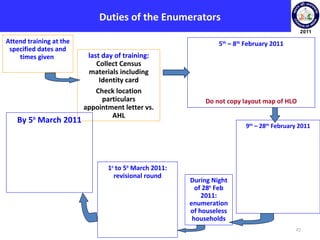
Duties of the Enumerators
Attend training at the
specified dates and
times given
1st
to 5th
March 2011:
revisional round
Update Household
Schedule
Strike page totals
Prepare working sheet
and enumerator’s
abstract
5th
– 8th
February 2011
Identify EB boundary and prepare layout
map
Ensure same Building/ Census house No.
on AHL and updated layout map
Make separate Layout Map & other
material for each allotted EB
Do not copy layout map of HLO
By 5th
March 2011
Handover all records to
Supervisor with certificate
of complete coverage and
inventory of used / unused
materials
Submit one folder for each
allotted EB
9th
– 28th
February 2011
Update AHL and fill-up
Household Schedule
together
Ensure Same Building/
Census house number on
AHL and updated layout
map
Maintain Separate set of
records for each allotted EB
During Night
of 28th
Feb
2011:
enumeration
of houseless
households
PE- Process
House to house
canvassing in
Enumeration Block
(20 days) from
9th
to 28th
February 2011
Revisional Round
(5 days) from
1st
to 5th
March 2011
Census NPR Vital Statistics
What is New
in 2011 Census ?
Census NPR Vital Statistics
Household Schedule
• State of the Art designing used for
designing the Schedules
• New features on the HH Schedule:
• Bar Code, Form Number, Continued
Sheet
• Linking to House list Household
Census NPR Vital Statistics
Household Schedule (Contd)
• New/Revised Questions:
• Name of the Institutional Household to be
recorded
• Sex: New category ‘Other’ introduced
• Date of Birth question introduced
• Current marital Status: Separate codes
assigned for Separated and Divorced
• New filter Question on SC/ST introduced –
‘Is this person SC/ST?’
Census NPR Vital Statistics
Household Schedule (Contd)
• New/Revised Questions (Contd):
• Work :
• Among Marginal Workers – Introduced new
category for those who worked for less than 3
months
• Rentiers – A separate code-5 has been included
under non-economic activity
• Prostitutes to be categorized under ‘Others’ in
place of ‘Beggar’ in 2001.
Census House
• A building or part of a building used or recognized as a
separate unit having a separate main entrance from the
road or common courtyard or staircase etc.
• May be occupied or vacant.
• May be used for a residential or non- residential purpose
or both.
• Example: Building with number of Flats or Blocks/ Wings,
which are independent of one another having separate
entrances - to be considered as separate census houses.
Concepts and Definitions
Household
•Group of persons who normally live together and take their meals
from a common kitchen. The persons may be related or
unrelated or mix of both
•Unrelated persons living together and not taking meals from a
common kitchen, each such person is treated as a separate
household
•Household may have one or more members
•There are three types of households:
o Normal households
o Institutional households
o Houseless households
•Houselisting: only normal and institutional Households are to
be covered.
Concepts and Definitions
Normal Household
• Group of persons who normally live together and take their
meals from a common kitchen. The persons may be
related or unrelated or mix of both
• Unrelated persons living together and not taking meals
from a common kitchen, each such person is treated as a
separate household.
• Household may have one or more members
• May be difficult to apply the definition strictly in some cases
– Exceptions exist!.
Concepts and Definitions
Institutional Household
•A group of unrelated persons who live in an institution and
take their meals from a common kitchen
o boarding houses, messes, hostels, hotels, rescue
homes, observation homes, beggars' homes, jails,
ashrams, old age homes, children homes,
orphanages, etc.
o Note: The families of wardens and peons living in
separate census houses and cooking separately would
be treated as a separate normal household
Concepts and Definitions
Houseless Household
• Households which do not live in buildings or Census
houses
• Lives in the open or roadside, pavements, in hume pipes,
under fly-overs and staircases, or in the open in places of
worship, mandaps, railway platforms, etc.,
• Houseless households are not to be covered in
Houselisting Phase
Concepts and Definitions
2001 2011
States/UTs 35 35
Districts 593 640
Tehsils 5463 5767
Towns 5161 7742
Villages 593732 608786
Households 194 Million 240 Million
EBs 19.82 lakhs 23.56 lakhs
Population 1.03 Bn 1.20 Bn
How Big is the Exercise
Special efforts to ensure coverage of all settlements/
population growths at the Census of India 2011
The ultimate objective of the Census of India 2011 is the
universal coverage of population without duplication or
omission.
To successfully achieve this objective, most important
instruction is to ensure coverage of all administrative areas.
It is necessary to give attention particularly to settlements and
habitats in difficult areas (such as forests etc.) which should be
located/ traced out in charges with the help of district officials.
 It must be ensured that all such areas are listed out separately
and are covered during Population Enumeration.
Special Charges
• The Defence and strictly Military/ Para- Military areas where the access of the civilian
Enumerators is not permissible due to security reasons are termed as ‘Special Charges’ for
the purpose of Census.
• The responsibility of conducting the Census operations of Military and Para- Military
personnel and their families will rest with the Officer in Command of the stations/ units.
• The Enumeration in these areas would be done by Military/ Para- Military Officials.
• The Commanding Officer or some suitable Senior Officer is to be appointed as the Special
Charge Officer by the Chief Principal Census Officer (Director of Census Operations, Kerala).
• As per Census hierarchy the Special Charge Officers will come under the Principal Census
Officers of the concerned District in which the Special Charge area is located.
The enumeration of Houseless Population is one of the important
aspects of population enumeration in our country.
 Households which do not live in buildings or Census houses but
live in the open or roadside, pavements etc. are to be treated as
Houseless Households.
Co- operation of NGOs working with this population may be
ensured for better rapport with them during their Enumeration
Charge Officers may request for Police protection during their
Enumeration if need be but sparingly.
It is important to ensure that Houseless Population are
enumerated on the night of 28th
February, 2011 but before 00:00
st
Enumeration of Houseless Population
Night
count
 As part of Census taking the crew and passengers of any ship or other
vessel which will be at any Ports as at 00:00 hours of 1st
March 2011 will
have to be enumerated at that Port provided they have not been
enumerated elsewhere.
For timely enumeration each Charge Officer will engage the required
number of trained enumerator(s) depending on the number of persons to
be enumerated, for enumerating the crew and passengers of the
ship/vessel.
Persons who live permanently or for a number of months in boats and
have no residence on land are to be enumerated as boat Population.
Besides this, persons having residence on land will also be found living in
boats during the entire period of enumeration. They will also be treated
as boat Population.
Enumeration of Sea &Boat Population
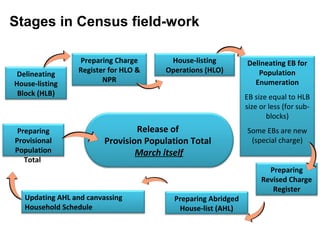
Stages in Census field-work
Delineating
House-listing
Block (HLB)
Preparing Charge
Register for HLO &
NPR
House-listing
Operations (HLO)
Delineating EB for
Population
Enumeration
EB size equal to HLB
size or less (for sub-
blocks)
Some EBs are new
(special charge)
Preparing
Revised Charge
Register
Preparing Abridged
House-list (AHL)
Updating AHL and canvassing
Household Schedule
Preparing
Provisional
Population
Total
Release of
Provision Population Total
March itself
DATA PROCESSING
Census of India 2011
• Indian Census - Always been in the forefront of using
latest technology
• 1961 Census – Unit Record machines used
• 1971 Census – Key-punching (electrical cum
mechanical) machines used – An IBM 1401 computer
with IBM card Reader used
• 1981 Census – Data Entry made using Key to Disk
machines. Processing by HP 1000 CD-Cyber 730 &
NEC - 1000 Computer System at NIC
Capturing Information and Processing
huge volume of Census Data
• 1991 Census - Medha 930 Main Frame
Computer System used for Data
processing. Unix based dumb terminals
used for data entry
• 2001 Census – First large country to use
image based Automatic Form Processing
Technology, High Speed Duplex Scanners
used for image capturing
• 2011 Census – Using more developed
ICR Technology with advanced features.
Capturing Information and Processing
huge volume of Census Data
Census 1961 1971 1981 1991 2001 2011
Population
(million)
439 548 683 846 1028 1221
Collection
(%)
100 100 100 100 100 100
Capture
(%)
5 15 25 45 100 100
Mode Hand
Punch
Key
Punch
Data
Entry
Data
Entry
Scanning
/ICR
Improved
Scanning
/ICR
Time
taken
(years)
8 to 9 8 to 9 8 to 9 7 to 8 4 to 5 1 to 2
Mode for Data Capture & Processing
since 1961
Image based
Recognition (ICR)
Manual completion of
unrecognized characters
Census 2011 Process
Scanning
Database/
Tabulation
Data
Dissemination
Image validation
PUBLICATION OF RESULTS -DATA
DISSEMINATION
Census of India 2011
• Provisional results
Quick tabulation from Enumerators abstract
Preparing Provisional Population Totals
The Provisional Population Totals are computed for each
EB using enumerator’s abstract
The totals are summarised and district level figures are
sent to ORGI by each DCO
ORGI validates district level figures and releases the
Provisional Population Totals at State and District level
(rural /urban) by March 2011
• Followed by data processing and preparation
of different types of tables, validation and
evaluation of the reports also carried out in
directorates/ORGI.
• Comparison with earlier census reports, trend
analysis, evaluation with other sources of data
also an essential feature of census data.
Data Dissemination
• Final Population totals
Data Dissemination
List of Publications
A – Series Tables: General Population Tables-PCA
B – Series Tables: Economic Tables
C – Series: Social and Cultural Tables
D – Series: Migration Tables
F – Series: Fertility Tables
HH – Series: Household Tables
H – Series: Tables on Houses, Household Amenities and Assets
SCST - Series: Tables on Individual Scheduled Castes (SC) and Sc
)
Miscellaneous other tables, cross tables
CensusInfo Dashboard
on the Web
CensusInfo
State
Comparisons
Area
Profile
CARTOGRAPHY AND GEOGRAPHICAL
INFORMATION SYSTEM
 Census is an authentic source of political and administrative
geography.
 The Cartographic Division of the Census Organisation has
evolved over the years and is now the largest producer of
thematic maps in the country.
 It has come a long way from the traditional manual cartographic
methods used until 1981 and now utilizes the latest GIS software
to produce digital maps.
 ORGI and Directorates have fully equipped Map Divisions with
latest GIS (Geographical Information System) software.
 A new effort in Census 2011 was the preparation of digital map of
cities, up to the level of streets and buildings, using satellite
imagery.
 This digital map was used to carve out the enumeration blocks in
the cities.
 Various administrative &thematic maps available
Administrative &thematic
maps
For more data& info : Please visit
• http://www.censusindia.gov.in
POST ENUMERATION SURVEY
Census Of India2011
The primary objective of the PES is to estimate
the magnitude of omissions (under-count) and
duplications (over-count), or in other words, to
determine the coverage error & assess Errors in
response, or content error in the recorded
individual characteristics, with regard to certain
items canvassed in the census like age, literacy,
type of disability, types of occupation and
fertility etc.
• The PES is, thus, intended to provide possible
answers to the questions:
• (i) How accurately the persons have been
enumerated (coverage error) in the census?
• (ii) How precisely have certain characteristics
of the individual been recorded (content
error) in the census?
• These are called Type I and Type II errors
respectively.
Post Enumeration survey(PES)
• The Post Enumeration Survey (PES) of the population
enumeration of Census 2011 was conducted in all the 35
States and Union territories of the country shortly after the
population enumeration during April through July 2011.
• It was conducted in 4000 Enumeration Blocks of the country.
The primary objective of the PES was to estimate the
magnitude of omissions (under-count) and duplication (over-
count) of individuals in the Census 2011 in terms of omission
rate.
Post Enumeration survey(PES)
• At the national level, the PES has shown a net omission of 23 persons
for every 1000 persons enumerated.
• This is from an estimated undercount of 23.08 persons for every 1000
persons, offset by 0.10 person for every 1000 persons being counted
more than once.
Post Enumeration survey(PES)
Census NPR Vital Statistics
Country Year Omission Rate
(%)
• India 1981 1.8
• India 1991 1.7
• India 2001 2.3
• India 2011 2.3
• China 2000 1.8
• U.K. 2001 2.2
• New Zealand 2001 2.2
• Cambodia 1998 1.8
• Bangladesh 1991 4.6
Omission rates – Selected countries
DATA HIGHLIGHTS- CENSUS2011
Census of India2011
• 53.2% of census houses in India is in good condition
• 77.1% of census houses are used for residing
• 86.6 households occupies own house
• 67.2%of households use electricity as the major source of
lighting
• 46.9% households have latrines within their premise
• 28.5% households have gas as major fuel used for cooking
• 47.2% households have television
• 58.7% households avail banking services………..
Data Highlights
House listing & Housing Census
India
•Population of India has reached to 121 crores.
•It comprises 62.31 crores males and 58.74 crores
females.
•Total absolute increase in population during the
decade is 18.19 crores.
•Population growth during the decade remained 17.7
percent.
•Density of population per sq. km. has been 382
persons.
•Sex ratio for females per 1000 males is 943 females.
•Child sex ratio for females is 919 per 1000 males.
•Literacy rate of India has gone up to 73.0 percent
from previous figure of 64.83 percent.
India
Population Enumeration
Population of India
Census 2011
• Final Total Population of the country is
121,08,54,977* (or 1.21 billion)
• Provisional Population Total
1,210,193,422*
• Difference: + 661,555 persons (0.04%)
* Includes the estimated population of Mao Maram, Paomata and Purul sub-divisions of Senapati
district of Manipur.
In the remaining slides, the figures exclude the estimated population of Mao Maram, Paomata
and Purul sub-divisions of Senapati district of Manipur.
As on 0.00 Hrs. of 1st March, 2011
Decadal Change in Population
India : 2001-2011
• There has been an increase of 181.96 million persons in
absolute number of population in India during 2001-11
• Increase among males: 90.97 million
• Increase among females: 90.99 million
• Growth Rate of females (18.3%) is higher than males
(17.1%)
Decadal Change in Population
India : 2001-2011
• Population of India grew by 17.7% during 2001-11, against
21.5% in the previous decade
• Among the major States, highest decadal growth in
population has been recorded in Bihar (25.4%)
• 14 States/UTs have recorded population growth above
20%.
DECADAL
CHANGE IN
POPULATION
(IN %)
• 833.5 million persons live in Rural areas as per Census 2011 - more
than two-third of the total population
• 377.1 million persons live in urban areas.
Population – Rural Urban Distribution India :
1961-2011
Density of Population
India : 2011
•Delhi (11,320) turns out to be the most densely inhabited followed by Chandigarh
(9,258), among all States/UTs, both in 2001 and 2011 Census.
•Among the major States, Bihar occupies the first position with a density of 1106,
surpassing West Bengal which occupied the first position during 2001.
•The minimum population density works out in Arunachal Pradesh (17) for both
2001 and 2011 Census.
Density of Population , India
2001 2011
325 382
(Persons per sq. km.)
DENSITY OF
POPULAITON
Child Population (0-6 years)
India : 2001, 2011
2001 2011
Variation
(in %)
Persons 163.8 164.5 +0.4 %
Males 85.0 85.7 +0.8 %
Females 78.8 78.7 -0.1 %
• The Child Population (0-6) is almost stationary
- grown by only 0.4% in the last decade.
• In 17 States/UTs the Child Population has
declined in 2011 compared to 2001.
(in million)
Sex Composition of Child Population
(0-6) – India 2011
• The total number of children in India is 164.5 millions, about 660
thousand more than the number recorded in 2001
• Male Child (0-6) population has increased whereas Female Child
population has decreased marginally during 2001-11
• 8 States, viz. Jammu & Kashmir, Rajasthan, Uttar Pradesh, Bihar,
Jharkhand, Arunachal Pradesh, Mizoram, Meghalaya have
proportion of child population more than 15 percent.
Sex Ratio of Population
India : 2001, 2011
Sex ratio is defined as the number of females per 1000
males in a population.
Residence 2001 2011 Change
Total 933 943 +10
Rural 946 949 +3
Urban 900 929 +29
States Ranked by Sex Ratio – 2011
(Major States – Population 10 million and above)
Top 5 States Bottom 5 States
States Sex Ratio States Sex Ratio
Kerala 1,084 Haryana 879
Tamil Nadu 996 Jammu & Kashmir 889
Andhra Pradesh 993 Punjab 895
Chhattisgarh 991 Uttar Pradesh 912
Odisha 979 Bihar 918
* Sex Ratio is defined as the number of females per 1000 males
Child Sex Ratio (0-6)
India : 2001, 2011
• The sex ratio in the age group 0-6 attempts to bring out the recent
changes in our society in its attitude and outlook towards the girl
child.
• Also an indicator of the likely future trends of sex ratio in the
population.
Residence 2001 2011 Change
Total 927 919 -8
Rural 934 923 -11
Urban 906 905 -1
States Ranked by Child Sex Ratio (0-6) 2011 (Major
States – Population 10 million and above)
Top 5 States Bottom 5 States
States
Sex Ratio
(0-6 yrs)
States
Sex Ratio
(0-6 yrs)
Chhattisgarh 969 Haryana 834
Kerala 964 Punjab 846
Assam 962 Jammu & Kashmir 862
West Bengal 956 Rajasthan 888
Jharkhand and
Karnataka
948 Gujarat 890
* Child Sex Ratio (0-6) is defined as the number of females
per 1000 males in the age group 0-6 years.
Number of Literates
India : 2001, 2011
• A person (aged 7 and above) is considered literate, if he or she can
read and write, with understanding, in any language.
Sex 2001 2011 Change
Persons 560.7 763.5 +202.8
Males 336.5 434.7 +98.2
Females 224.2 328.8 +104.6
(in millions)
Literacy Rate
India : 2001, 2011
2001 2011
Difference
(2011 – 2001)
Persons 64.8 73.0 +8.2
Males 75.3 80.9 +5.6
Females 53.7 64.6 +10.9
(in %)
• Largest increase: Dadra & Nagar Haveli by 18.6 points (from 57.6% to 76.2%), Bihar by 14.8
points (from 47.0% to 61.8%), Tripura by 14.0 points (from 73.2% to 87.2%)
• Improvement in Female literacy is higher than males in all States/UTs, except Mizoram
(where it is same in both Males and Females) during the decade 2001-11.
Literacy Rate – Rural Urban Differential
India - 2001, 2011
• Gap between Literacy Rate in Urban and Rural areas is steadily declining
in every census. In Census 2011, the gap stands at 16.3 points
LITERACY RATE
AMONG
FEMALES
States/UTs Ranked by Literacy Rate 2011
Top 5 States/UTs Bottom 5 States/UTs
States/UTs
Literacy
Rate
States/UTs
Literacy
Rate
Kerala 94.0 Bihar 61.8
Lakshadweep 91.8 Arunachal Pradesh 65.4
Mizoram 91.3 Rajasthan 66.1
Goa 88.7 Jharkhand 66.4
Tripura 87.2 Andhra Pradesh 67.0
(In %)
Number of Workers by Residence
India : 2011
Residence
Number of
Workers
Non-Workers
Work
Participation
Rate*
Total 481.7 728.8 39.8%
Rural 348.6 484.9 41.8%
Urban 133.1 243.9 35.3%
* Work Participation Rate is defined as the number of workers per
100 population
(in million)
Work Participation Rate
India : 2001, 2011
Residence Sex 2001 2011 Change
Total Persons 39.1 39.8 +0.7
Males 51.7 53.3 +1.6
Females 25.6 25.5 -0.1
(In %)
Median Age –States
2011
Thank You
“ Of creations, I am the beginning, the
middle and the end; Of knowledge I am
knowledge of the Supreme Self; Among
speakers, I am words that are unbiased
and in pursuit of truth …”- The Gita,
With Thanks and Regards

Census 2011 part2

  • 1.
    " Our Census- Our Future".Census Of India 2011
  • 2.
  • 3.
    Phases of Censusfield work Phase 1: House listing and Housing Census and canvassing of Household Schedule of National Population Register (NPR):(45days) between April and September, 2010 Phase 2: Population Enumeration: 9th February to 28th February, 2011 Revisional round : 1st to 5th March, 2011 Phase II: is a time bound process
  • 4.
    HOUSE LISTING &HOUSINGCENSUS Census of india2011
  • 5.
    • Conducted 7to 8 months in advance of census taking • Helps to prepare the frame for collection of information during next phase of enumeration • Lists each and every building, house and other structures in the Enumeration Area and collects information on their use • Identifies residential houses for population enumeration • Collects household level information on amenities and assets available. House listing &Housing Census Operations:
  • 6.
    House listing &HousingCensus Operations: • House listing and Housing Census was carried out in different periods ranging over April to September 2010 in different states. • Along with House listing canvassing of Household Schedules for the preparation of National Population Register (NPR) as per citizens act of 1955 was also carried out this time • Usually 30 days are taken for House listing. Due to NPR 45 days were taken for fieldwork this time. • In Kerala the phase Conducted in April-May(12 th April to May 27th )
  • 7.
    Process involved inHouse listing & Housing Census Charge officers duties during HLO
  • 9.
    Houselisting Block (HLBS) •Specific areaallotted to a specific Enumerator for carrying out of Census Operations relating to House Numbering and Houselisting. •.
  • 10.
    CHARGE REGISTER- VILLAGE/TOWN/TALUK LEVEL • A register recording exhaustive details of each and every House listing/ enumeration block, details of address of the block, enumerators and supervisors details etc. • Charge registers prepared separately for House listing and population Enumeration.
  • 11.
    Appointment of Enumerators&Supervisors • Enumerators and supervisors are appointed by the charge officers and the officials are taken from state govt staff such as teachers, Clerical Staff etc. as enumerators and a higher grade officers are appointed as supervisors. • One Supervisor was to supervise maximum of 6 Enumeration blocks .
  • 12.
    Training of thesupervisors &Enumerators • Charge officers were responsible for training of enumerators and supervisors in his charge. • Master trainers imparted training to them. • No. of training sessions depends upon number of blocks in respective charges. • 10% officials were appointed in ‘reserves’ to meet exigencies.
  • 13.
    House to houselisting The enumerator appointed for an HLB has to list out all buildings in it without omission /duplication. •Census houses were assigned numbers by the enumerators – continuously inside his HLB. •Notional Map of the HLB has to be prepared • Visit all census houses and some details of household residing also procured.
  • 14.
    Houselisting and HousingCensus Schedule
  • 15.
    Houselist-Questions • Predominant materialof floor, wall and roof of the Census House • Use & Condition of Census House • Name of Head of HH • Ownership status • Number of dwelling rooms • Number of married couples • Amenities available: • Main source and availability of drinking water • Main source of lighting • Latrine within the premises • Type of latrine facility • Waste water outlet connected to • Amenities available (contd): • Bathing facility within the premises • Availability of kitchen • Fuel used for cooking • Assets possessed by the household • Radio/Transistor • Television • Computer/Laptop • Telephone/Mobile phone • Bicycle • Scooter/Motor Cycle/Moped • Car/Jeep/Van • Availing banking services 35 columns House listing tables are treasure chest of a wide variety of data on housing conditions, assets &amenities available in the country
  • 16.
  • 17.
  • 18.
    Time line: PopulationEnumeration Population Enumeration: 9th February to 28th February, 2011 • Census Moment and Reference moment for Census 2011 will be 00:00 hours of 1st Mach 2011 • Revisional round : 1st to 5th March, 2011 1. Re-visit 2. Births, Deaths and Arrivals of Visitors updating. Births, Deaths and Arrivals of Visitors after 00:00 hours of 1st March, 2011 will not be taken
  • 19.
    • In snowbound areas • Population Enumeration 11th to 30th Sep 2010 • Revisional Round 1st to 5th Oct 2010 • In all other areas • Population Enumeration 9th to 28th Feb 2011 • Revisional Round 1st to 5th Mar 2011 Population Enumeration Calendar
  • 20.
    Enumeration Block(EBS): Specificarea allotted to a specific Enumerator for carrying out of Census Operations relating Population enumeration. •Ebs are Demarcated with specified boundaries to avoid duplication and omission •Assigned to an enumerator for conducting field work •Population size inside the area is expected to be less than 800. •House listing blocks with huge size were bifurcated in to sub block, but kept in tact in census2011. Concepts and Definitions
  • 21.
    Preparing EB fromHLB • One AHL booklet is prepared for each EB
  • 22.
    Population Enumeration (29Questions) Demographic • Name of the person • Relationship to head • Sex – Male, Female and Other • Date of Birth and Age Marital Status • Current marital status • Age at marriage Cultural • Religion • Scheduled Caste/Scheduled Tribe • Disability • Mother Tongue • Other languages known
  • 23.
    Population Enumeration (29Questions) Literacy • Literacy status • Status of attendance • Highest educational level attained Economic • Work status – Main, marginal and non-worker • Category of economic activity – Cultivator, Agricultural labourer, Worker in household Industries & Other workers • Occupation, Nature of Industry, Trade or Service Economic • Class of worker – Employer, Employee, Single worker, Family worker • Non economic activity – Student, Household duties, Dependant, Pensioner, Rentier, Beggar, Others • Seeking or available for work
  • 24.
    Population Enumeration (29Questions) Travel to Place of Work • Travel to place of work • Mode of transport - On foot, Bicycle, Moped/Scooter/ Motor Cycle/ Car/Jeep/Van, Tempo/Auto-rickshaw, Taxi, Bus, Train, Water Transport, Any other, Non-travel Migration • Birth Place / Place of last migration • Reason for migration • Duration of stay since migration Fertility • Children surviving • Children ever born • Number of children born alive during last one year
  • 25.
  • 26.
  • 27.
    27 last day oftraining: Collect Census materials including Identity card Check location particulars appointment letter vs. AHL Duties of the Enumerators Attend training at the specified dates and times given 1st to 5th March 2011: revisional round Update Household Schedule Strike page totals Prepare working sheet and enumerator’s abstract 5th – 8th February 2011 Identify EB boundary and prepare layout map Ensure same Building/ Census house No. on AHL and updated layout map Make separate Layout Map & other material for each allotted EB Do not copy layout map of HLO By 5th March 2011 Handover all records to Supervisor with certificate of complete coverage and inventory of used / unused materials Submit one folder for each allotted EB 9th – 28th February 2011 Update AHL and fill-up Household Schedule together Ensure Same Building/ Census house number on AHL and updated layout map Maintain Separate set of records for each allotted EB During Night of 28th Feb 2011: enumeration of houseless households
  • 28.
    PE- Process House tohouse canvassing in Enumeration Block (20 days) from 9th to 28th February 2011 Revisional Round (5 days) from 1st to 5th March 2011
  • 29.
    Census NPR VitalStatistics What is New in 2011 Census ?
  • 30.
    Census NPR VitalStatistics Household Schedule • State of the Art designing used for designing the Schedules • New features on the HH Schedule: • Bar Code, Form Number, Continued Sheet • Linking to House list Household
  • 31.
    Census NPR VitalStatistics Household Schedule (Contd) • New/Revised Questions: • Name of the Institutional Household to be recorded • Sex: New category ‘Other’ introduced • Date of Birth question introduced • Current marital Status: Separate codes assigned for Separated and Divorced • New filter Question on SC/ST introduced – ‘Is this person SC/ST?’
  • 32.
    Census NPR VitalStatistics Household Schedule (Contd) • New/Revised Questions (Contd): • Work : • Among Marginal Workers – Introduced new category for those who worked for less than 3 months • Rentiers – A separate code-5 has been included under non-economic activity • Prostitutes to be categorized under ‘Others’ in place of ‘Beggar’ in 2001.
  • 33.
    Census House • Abuilding or part of a building used or recognized as a separate unit having a separate main entrance from the road or common courtyard or staircase etc. • May be occupied or vacant. • May be used for a residential or non- residential purpose or both. • Example: Building with number of Flats or Blocks/ Wings, which are independent of one another having separate entrances - to be considered as separate census houses. Concepts and Definitions
  • 34.
    Household •Group of personswho normally live together and take their meals from a common kitchen. The persons may be related or unrelated or mix of both •Unrelated persons living together and not taking meals from a common kitchen, each such person is treated as a separate household •Household may have one or more members •There are three types of households: o Normal households o Institutional households o Houseless households •Houselisting: only normal and institutional Households are to be covered. Concepts and Definitions
  • 35.
    Normal Household • Groupof persons who normally live together and take their meals from a common kitchen. The persons may be related or unrelated or mix of both • Unrelated persons living together and not taking meals from a common kitchen, each such person is treated as a separate household. • Household may have one or more members • May be difficult to apply the definition strictly in some cases – Exceptions exist!. Concepts and Definitions
  • 36.
    Institutional Household •A groupof unrelated persons who live in an institution and take their meals from a common kitchen o boarding houses, messes, hostels, hotels, rescue homes, observation homes, beggars' homes, jails, ashrams, old age homes, children homes, orphanages, etc. o Note: The families of wardens and peons living in separate census houses and cooking separately would be treated as a separate normal household Concepts and Definitions
  • 37.
    Houseless Household • Householdswhich do not live in buildings or Census houses • Lives in the open or roadside, pavements, in hume pipes, under fly-overs and staircases, or in the open in places of worship, mandaps, railway platforms, etc., • Houseless households are not to be covered in Houselisting Phase Concepts and Definitions
  • 38.
    2001 2011 States/UTs 3535 Districts 593 640 Tehsils 5463 5767 Towns 5161 7742 Villages 593732 608786 Households 194 Million 240 Million EBs 19.82 lakhs 23.56 lakhs Population 1.03 Bn 1.20 Bn How Big is the Exercise
  • 39.
    Special efforts toensure coverage of all settlements/ population growths at the Census of India 2011 The ultimate objective of the Census of India 2011 is the universal coverage of population without duplication or omission. To successfully achieve this objective, most important instruction is to ensure coverage of all administrative areas. It is necessary to give attention particularly to settlements and habitats in difficult areas (such as forests etc.) which should be located/ traced out in charges with the help of district officials.  It must be ensured that all such areas are listed out separately and are covered during Population Enumeration.
  • 40.
    Special Charges • TheDefence and strictly Military/ Para- Military areas where the access of the civilian Enumerators is not permissible due to security reasons are termed as ‘Special Charges’ for the purpose of Census. • The responsibility of conducting the Census operations of Military and Para- Military personnel and their families will rest with the Officer in Command of the stations/ units. • The Enumeration in these areas would be done by Military/ Para- Military Officials. • The Commanding Officer or some suitable Senior Officer is to be appointed as the Special Charge Officer by the Chief Principal Census Officer (Director of Census Operations, Kerala). • As per Census hierarchy the Special Charge Officers will come under the Principal Census Officers of the concerned District in which the Special Charge area is located.
  • 41.
    The enumeration ofHouseless Population is one of the important aspects of population enumeration in our country.  Households which do not live in buildings or Census houses but live in the open or roadside, pavements etc. are to be treated as Houseless Households. Co- operation of NGOs working with this population may be ensured for better rapport with them during their Enumeration Charge Officers may request for Police protection during their Enumeration if need be but sparingly. It is important to ensure that Houseless Population are enumerated on the night of 28th February, 2011 but before 00:00 st Enumeration of Houseless Population Night count
  • 42.
     As partof Census taking the crew and passengers of any ship or other vessel which will be at any Ports as at 00:00 hours of 1st March 2011 will have to be enumerated at that Port provided they have not been enumerated elsewhere. For timely enumeration each Charge Officer will engage the required number of trained enumerator(s) depending on the number of persons to be enumerated, for enumerating the crew and passengers of the ship/vessel. Persons who live permanently or for a number of months in boats and have no residence on land are to be enumerated as boat Population. Besides this, persons having residence on land will also be found living in boats during the entire period of enumeration. They will also be treated as boat Population. Enumeration of Sea &Boat Population
  • 43.
    Stages in Censusfield-work Delineating House-listing Block (HLB) Preparing Charge Register for HLO & NPR House-listing Operations (HLO) Delineating EB for Population Enumeration EB size equal to HLB size or less (for sub- blocks) Some EBs are new (special charge) Preparing Revised Charge Register Preparing Abridged House-list (AHL) Updating AHL and canvassing Household Schedule Preparing Provisional Population Total Release of Provision Population Total March itself
  • 44.
  • 45.
    • Indian Census- Always been in the forefront of using latest technology • 1961 Census – Unit Record machines used • 1971 Census – Key-punching (electrical cum mechanical) machines used – An IBM 1401 computer with IBM card Reader used • 1981 Census – Data Entry made using Key to Disk machines. Processing by HP 1000 CD-Cyber 730 & NEC - 1000 Computer System at NIC Capturing Information and Processing huge volume of Census Data
  • 46.
    • 1991 Census- Medha 930 Main Frame Computer System used for Data processing. Unix based dumb terminals used for data entry • 2001 Census – First large country to use image based Automatic Form Processing Technology, High Speed Duplex Scanners used for image capturing • 2011 Census – Using more developed ICR Technology with advanced features. Capturing Information and Processing huge volume of Census Data
  • 47.
    Census 1961 19711981 1991 2001 2011 Population (million) 439 548 683 846 1028 1221 Collection (%) 100 100 100 100 100 100 Capture (%) 5 15 25 45 100 100 Mode Hand Punch Key Punch Data Entry Data Entry Scanning /ICR Improved Scanning /ICR Time taken (years) 8 to 9 8 to 9 8 to 9 7 to 8 4 to 5 1 to 2 Mode for Data Capture & Processing since 1961
  • 48.
    Image based Recognition (ICR) Manualcompletion of unrecognized characters Census 2011 Process Scanning Database/ Tabulation Data Dissemination Image validation
  • 49.
    PUBLICATION OF RESULTS-DATA DISSEMINATION Census of India 2011
  • 50.
    • Provisional results Quicktabulation from Enumerators abstract Preparing Provisional Population Totals The Provisional Population Totals are computed for each EB using enumerator’s abstract The totals are summarised and district level figures are sent to ORGI by each DCO ORGI validates district level figures and releases the Provisional Population Totals at State and District level (rural /urban) by March 2011
  • 51.
    • Followed bydata processing and preparation of different types of tables, validation and evaluation of the reports also carried out in directorates/ORGI. • Comparison with earlier census reports, trend analysis, evaluation with other sources of data also an essential feature of census data. Data Dissemination
  • 52.
    • Final Populationtotals Data Dissemination List of Publications A – Series Tables: General Population Tables-PCA B – Series Tables: Economic Tables C – Series: Social and Cultural Tables D – Series: Migration Tables F – Series: Fertility Tables HH – Series: Household Tables H – Series: Tables on Houses, Household Amenities and Assets SCST - Series: Tables on Individual Scheduled Castes (SC) and Sc ) Miscellaneous other tables, cross tables
  • 53.
  • 54.
  • 55.
  • 56.
    CARTOGRAPHY AND GEOGRAPHICAL INFORMATIONSYSTEM  Census is an authentic source of political and administrative geography.  The Cartographic Division of the Census Organisation has evolved over the years and is now the largest producer of thematic maps in the country.  It has come a long way from the traditional manual cartographic methods used until 1981 and now utilizes the latest GIS software to produce digital maps.  ORGI and Directorates have fully equipped Map Divisions with latest GIS (Geographical Information System) software.  A new effort in Census 2011 was the preparation of digital map of cities, up to the level of streets and buildings, using satellite imagery.  This digital map was used to carve out the enumeration blocks in the cities.  Various administrative &thematic maps available Administrative &thematic maps
  • 57.
    For more data&info : Please visit • http://www.censusindia.gov.in
  • 58.
  • 59.
    The primary objectiveof the PES is to estimate the magnitude of omissions (under-count) and duplications (over-count), or in other words, to determine the coverage error & assess Errors in response, or content error in the recorded individual characteristics, with regard to certain items canvassed in the census like age, literacy, type of disability, types of occupation and fertility etc.
  • 60.
    • The PESis, thus, intended to provide possible answers to the questions: • (i) How accurately the persons have been enumerated (coverage error) in the census? • (ii) How precisely have certain characteristics of the individual been recorded (content error) in the census? • These are called Type I and Type II errors respectively. Post Enumeration survey(PES)
  • 61.
    • The PostEnumeration Survey (PES) of the population enumeration of Census 2011 was conducted in all the 35 States and Union territories of the country shortly after the population enumeration during April through July 2011. • It was conducted in 4000 Enumeration Blocks of the country. The primary objective of the PES was to estimate the magnitude of omissions (under-count) and duplication (over- count) of individuals in the Census 2011 in terms of omission rate. Post Enumeration survey(PES)
  • 62.
    • At thenational level, the PES has shown a net omission of 23 persons for every 1000 persons enumerated. • This is from an estimated undercount of 23.08 persons for every 1000 persons, offset by 0.10 person for every 1000 persons being counted more than once. Post Enumeration survey(PES)
  • 63.
    Census NPR VitalStatistics Country Year Omission Rate (%) • India 1981 1.8 • India 1991 1.7 • India 2001 2.3 • India 2011 2.3 • China 2000 1.8 • U.K. 2001 2.2 • New Zealand 2001 2.2 • Cambodia 1998 1.8 • Bangladesh 1991 4.6 Omission rates – Selected countries
  • 64.
  • 65.
    • 53.2% ofcensus houses in India is in good condition • 77.1% of census houses are used for residing • 86.6 households occupies own house • 67.2%of households use electricity as the major source of lighting • 46.9% households have latrines within their premise • 28.5% households have gas as major fuel used for cooking • 47.2% households have television • 58.7% households avail banking services……….. Data Highlights House listing & Housing Census India
  • 66.
    •Population of Indiahas reached to 121 crores. •It comprises 62.31 crores males and 58.74 crores females. •Total absolute increase in population during the decade is 18.19 crores. •Population growth during the decade remained 17.7 percent. •Density of population per sq. km. has been 382 persons. •Sex ratio for females per 1000 males is 943 females. •Child sex ratio for females is 919 per 1000 males. •Literacy rate of India has gone up to 73.0 percent from previous figure of 64.83 percent. India Population Enumeration
  • 67.
    Population of India Census2011 • Final Total Population of the country is 121,08,54,977* (or 1.21 billion) • Provisional Population Total 1,210,193,422* • Difference: + 661,555 persons (0.04%) * Includes the estimated population of Mao Maram, Paomata and Purul sub-divisions of Senapati district of Manipur. In the remaining slides, the figures exclude the estimated population of Mao Maram, Paomata and Purul sub-divisions of Senapati district of Manipur. As on 0.00 Hrs. of 1st March, 2011
  • 68.
    Decadal Change inPopulation India : 2001-2011 • There has been an increase of 181.96 million persons in absolute number of population in India during 2001-11 • Increase among males: 90.97 million • Increase among females: 90.99 million • Growth Rate of females (18.3%) is higher than males (17.1%)
  • 69.
    Decadal Change inPopulation India : 2001-2011 • Population of India grew by 17.7% during 2001-11, against 21.5% in the previous decade • Among the major States, highest decadal growth in population has been recorded in Bihar (25.4%) • 14 States/UTs have recorded population growth above 20%.
  • 70.
  • 71.
    • 833.5 millionpersons live in Rural areas as per Census 2011 - more than two-third of the total population • 377.1 million persons live in urban areas. Population – Rural Urban Distribution India : 1961-2011
  • 72.
    Density of Population India: 2011 •Delhi (11,320) turns out to be the most densely inhabited followed by Chandigarh (9,258), among all States/UTs, both in 2001 and 2011 Census. •Among the major States, Bihar occupies the first position with a density of 1106, surpassing West Bengal which occupied the first position during 2001. •The minimum population density works out in Arunachal Pradesh (17) for both 2001 and 2011 Census. Density of Population , India 2001 2011 325 382 (Persons per sq. km.)
  • 73.
  • 74.
    Child Population (0-6years) India : 2001, 2011 2001 2011 Variation (in %) Persons 163.8 164.5 +0.4 % Males 85.0 85.7 +0.8 % Females 78.8 78.7 -0.1 % • The Child Population (0-6) is almost stationary - grown by only 0.4% in the last decade. • In 17 States/UTs the Child Population has declined in 2011 compared to 2001. (in million)
  • 75.
    Sex Composition ofChild Population (0-6) – India 2011 • The total number of children in India is 164.5 millions, about 660 thousand more than the number recorded in 2001 • Male Child (0-6) population has increased whereas Female Child population has decreased marginally during 2001-11 • 8 States, viz. Jammu & Kashmir, Rajasthan, Uttar Pradesh, Bihar, Jharkhand, Arunachal Pradesh, Mizoram, Meghalaya have proportion of child population more than 15 percent.
  • 76.
    Sex Ratio ofPopulation India : 2001, 2011 Sex ratio is defined as the number of females per 1000 males in a population. Residence 2001 2011 Change Total 933 943 +10 Rural 946 949 +3 Urban 900 929 +29
  • 77.
    States Ranked bySex Ratio – 2011 (Major States – Population 10 million and above) Top 5 States Bottom 5 States States Sex Ratio States Sex Ratio Kerala 1,084 Haryana 879 Tamil Nadu 996 Jammu & Kashmir 889 Andhra Pradesh 993 Punjab 895 Chhattisgarh 991 Uttar Pradesh 912 Odisha 979 Bihar 918 * Sex Ratio is defined as the number of females per 1000 males
  • 78.
    Child Sex Ratio(0-6) India : 2001, 2011 • The sex ratio in the age group 0-6 attempts to bring out the recent changes in our society in its attitude and outlook towards the girl child. • Also an indicator of the likely future trends of sex ratio in the population. Residence 2001 2011 Change Total 927 919 -8 Rural 934 923 -11 Urban 906 905 -1
  • 79.
    States Ranked byChild Sex Ratio (0-6) 2011 (Major States – Population 10 million and above) Top 5 States Bottom 5 States States Sex Ratio (0-6 yrs) States Sex Ratio (0-6 yrs) Chhattisgarh 969 Haryana 834 Kerala 964 Punjab 846 Assam 962 Jammu & Kashmir 862 West Bengal 956 Rajasthan 888 Jharkhand and Karnataka 948 Gujarat 890 * Child Sex Ratio (0-6) is defined as the number of females per 1000 males in the age group 0-6 years.
  • 80.
    Number of Literates India: 2001, 2011 • A person (aged 7 and above) is considered literate, if he or she can read and write, with understanding, in any language. Sex 2001 2011 Change Persons 560.7 763.5 +202.8 Males 336.5 434.7 +98.2 Females 224.2 328.8 +104.6 (in millions)
  • 81.
    Literacy Rate India :2001, 2011 2001 2011 Difference (2011 – 2001) Persons 64.8 73.0 +8.2 Males 75.3 80.9 +5.6 Females 53.7 64.6 +10.9 (in %) • Largest increase: Dadra & Nagar Haveli by 18.6 points (from 57.6% to 76.2%), Bihar by 14.8 points (from 47.0% to 61.8%), Tripura by 14.0 points (from 73.2% to 87.2%) • Improvement in Female literacy is higher than males in all States/UTs, except Mizoram (where it is same in both Males and Females) during the decade 2001-11.
  • 82.
    Literacy Rate –Rural Urban Differential India - 2001, 2011 • Gap between Literacy Rate in Urban and Rural areas is steadily declining in every census. In Census 2011, the gap stands at 16.3 points
  • 83.
  • 84.
    States/UTs Ranked byLiteracy Rate 2011 Top 5 States/UTs Bottom 5 States/UTs States/UTs Literacy Rate States/UTs Literacy Rate Kerala 94.0 Bihar 61.8 Lakshadweep 91.8 Arunachal Pradesh 65.4 Mizoram 91.3 Rajasthan 66.1 Goa 88.7 Jharkhand 66.4 Tripura 87.2 Andhra Pradesh 67.0 (In %)
  • 85.
    Number of Workersby Residence India : 2011 Residence Number of Workers Non-Workers Work Participation Rate* Total 481.7 728.8 39.8% Rural 348.6 484.9 41.8% Urban 133.1 243.9 35.3% * Work Participation Rate is defined as the number of workers per 100 population (in million)
  • 86.
    Work Participation Rate India: 2001, 2011 Residence Sex 2001 2011 Change Total Persons 39.1 39.8 +0.7 Males 51.7 53.3 +1.6 Females 25.6 25.5 -0.1 (In %)
  • 87.
  • 88.
    Thank You “ Ofcreations, I am the beginning, the middle and the end; Of knowledge I am knowledge of the Supreme Self; Among speakers, I am words that are unbiased and in pursuit of truth …”- The Gita, With Thanks and Regards