" Our Census - Our Future".
Directorate of Census
Operations
Kerala
Info on Largest administrative exercise in the country.
The Gospel of Luke places the birth of Jesus under the 
reign of Herod ("In the days of King Herod of 
Judea..."– Luke 1:5) and links it to the census of Quirinius
In those days a decree went out from Emperor Augustus that all the world
should be registered. This was the first registration and was taken while
Quirinius was governor of Syria. All went to their own towns to be
registered. Joseph also went from the town of Nazareth in Galilee to Judea,
to the city of David called Bethlehem, because he was descended from the
house and family of David. He went to be registered with Mary, to whom he
was engaged and who was expecting a child. (Luke 2:1–5)
Salient features of
Census 2011-India
• Census taking is an ancient institution with a hoary tradition. 
• Babylonians who instituted a system of revenue returns around 4000 BC is 
credited with its origin. 
• The word ‘census’ is derived from the Latin word ‘censere’ meaning ‘to 
assess’ or ‘to rate’.
•  It dates back to the 1st or 2nd century BC. 
• Census taking became a worldwide institution with the expansion of the 
Roman Empire. 
• Growth of feudalism and disintegration of the Roman Empire put an end 
to the first phase of periodical censuses. 
• One of the earliest completed censuses involving people of all ages was 
taken in the German City of Nuremberg. 
• The earliest of the modern census was taken in Iceland in 1703. But the 
results were delayed. Hence the Swedish census of 1750 is regarded as 
the first modern census which published the population data. 
INTRODUCTION
Census of India2011
 Definition of Census
A population census is the total
process of collecting, compiling,
evaluating, analyzing and
publishing or otherwise
disseminating demographic,
economic and social data
pertaining, at a specified time, to all
persons in a country or in a well-
delimited part
of a country.
Why CENSUS?
• “….Population is basic to the production and distribution of material
wealth. In order to plan for, and implement, economic and social
development, administrative activity or scientific research, it is
necessary to have reliable and detailed data on the size, distribution
and composition of population. The population census is a primary
source of these basic benchmark statistics, covering not only the
settled population but also homeless persons and nomadic groups.
Data from population censuses should allow presentation and
analysis in terms of statistics on persons and households and for a
wide variety of geographical units, ranging from the country as a
whole to individual small localities or city blocks.’…
1.5 Principles and Recommendations for Population and
Housing Censuses, Revision 2 UN
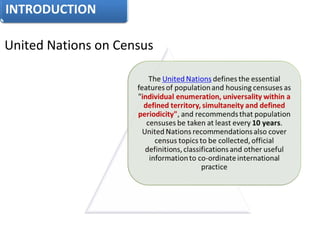
United Nations on Census
OVERVIEW OF CENSUS 2011 
• Census is a reflection of truth and facts as they exist in 
a country about its people, their diversity of 
habitation, religion, culture, language, education, 
health and socio-economic status. 
• In the present context ‘population census’ in India is 
primarily an official enumeration through a direct visit 
to all the people who are physically present and 
residing regularly or temporarily in the country at a 
given point of time.
• Population census provides  valuable information about the land and its 
people at a given point of time. It provides trends and its various 
characteristics which are essential for Planning. Very supportive in all 
types of plans.
• Needs for business persons, industrialists, scholars, academicians,
planners
• Determining  & demarcating parliamentary and assembly constituency
• Very decisive even in presidential elections. Voting Value of members of 
electoral college  depends on the population
• Formation of Towns/panchayats, wards size of such institutions depends
on population size
• Fund transfers- from centre to state, a criteria followed is population
size
• Reservations to Scheduled castes/Tribes
Usage of Census Data
HISTORY
Census of India2011
Historical Background
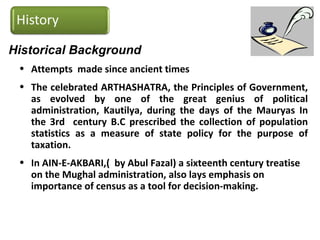
• Attempts made since ancient times
• The celebrated ARTHASHATRA, the Principles of Government,
as evolved by one of the great genius of political
administration, Kautilya, during the days of the Mauryas In
the 3rd century B.C prescribed the collection of population
statistics as a measure of state policy for the purpose of
taxation.
• In AIN-E-AKBARI,( by Abul Fazal) a sixteenth century treatise
on the Mughal administration, also lays emphasis on
importance of census as a tool for decision-making.
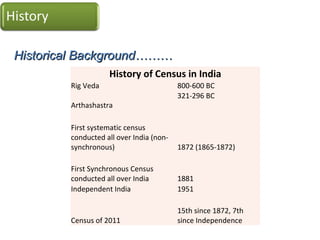
History of Census in India
Rig Veda 800-600 BC
Arthashastra
321-296 BC
First systematic census 
conducted all over India (non-
synchronous) 1872 (1865-1872)
First Synchronous Census 
conducted all over India 1881
Independent India 1951
Census of 2011
15th since 1872, 7th 
since Independence
Historical Background………Historical Background………
METHODOLOGY
Census of India2011
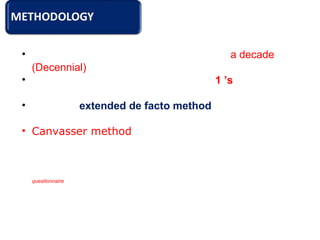
• The Census of India is conducted once in a decade
(Decennial).
• From 1881 onward in the year ending 1 ’s
• It follows extended de facto method.
• Canvasser method adopted to collect information
from each household.
Under this approach, data is collected from every individual by visiting the household and canvassing the
questionnaire all over the country, over a period of three weeks.
Phases of Census
Phase 1:  House listing and 
Housing Census
Phase 2:  Population Enumeration: 
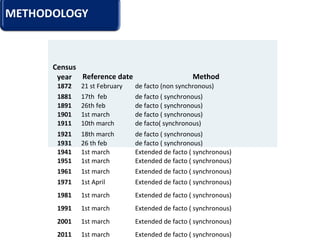
Census
year Reference date Method
1872 21 st February de facto (non synchronous)
1881 17th  feb de facto ( synchronous)
1891 26th feb de facto ( synchronous)
1901 1st march de facto ( synchronous)
1911 10th march de facto( synchronous)
1921 18th march de facto ( synchronous)
1931 26 th feb de facto ( synchronous)
1941 1st march Extended de facto ( synchronous)
1951 1st march Extended de facto ( synchronous)
1961 1st march Extended de facto ( synchronous)
1971 1st April Extended de facto ( synchronous)
1981 1st march Extended de facto ( synchronous)
1991 1st march Extended de facto ( synchronous)
2001 1st march Extended de facto ( synchronous)
2011 1st march Extended de facto ( synchronous)
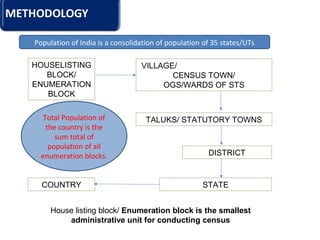
HOUSELISTING
BLOCK/
ENUMERATION
BLOCK
VILLAGE/
CENSUS TOWN/
OGS/WARDS OF STS
TALUKS/ STATUTORY TOWNS
DISTRICT
STATECOUNTRY
House listing block/ Enumeration block is the smallest
administrative unit for conducting census
Population of India is a consolidation of population of 35 states/UTs
Total Population of 
the country is the 
sum total of 
population of all 
enumeration blocks. 
ORGANISING THE CENSUS
Census of India2011
Census NPR Vital Statistics
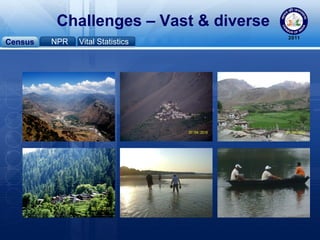
Challenges – Vast & diverse
Challenges…
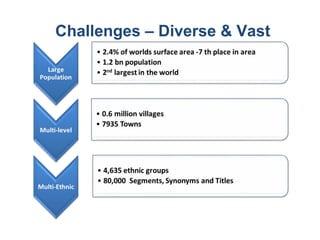
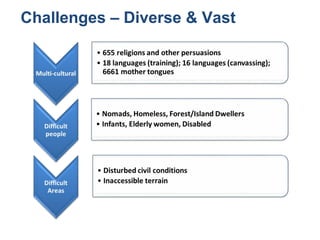
Challenges – Diverse & Vast
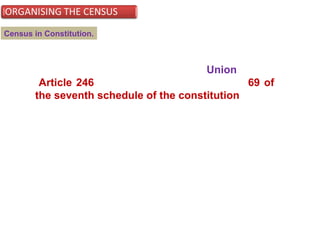
In India, the population census is a Union subject
(Article 246) and is listed at serial number 69 of
the seventh schedule of the constitution.
Although the Census Act is an instrument of Central legislation, in the
scheme of its execution, state hierarchy is setup at all levels by State
Governments for the purpose of carrying out census.
Census in Constitution.
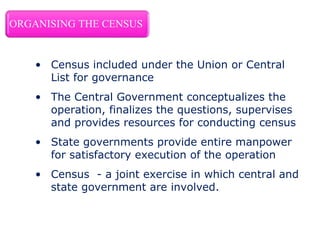
• Census included under the Union or Central
List for governance
• The Central Government conceptualizes the
operation, finalizes the questions, supervises
and provides resources for conducting census
• State governments provide entire manpower
for satisfactory execution of the operation
• Census - a joint exercise in which central and
state government are involved.
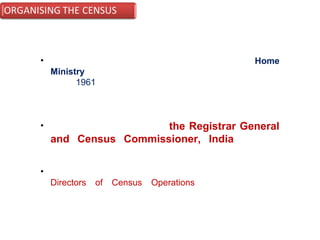
• The Census Organisation under the Union Home
Ministry has been functioning on permanent footing ever
since 1961 and provides a vital continuity to conceive,
plan and implement the programme of census taking in
country.
• The Organisation headed by the Registrar General
and Census Commissioner, India has field
offices in thirty three States and Union territories.
• These are permanent Directorates headed by the
Directors of Census Operations, who are mainly
responsible for the conduct of census in their respective
jurisdiction.
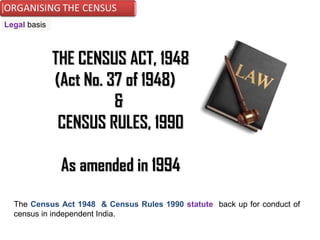
THE CENSUS ACT, 1948THE CENSUS ACT, 1948
(Act No. 37 of 1948)(Act No. 37 of 1948)
&&
CENSUS RULES, 1990CENSUS RULES, 1990
As amended in 1994As amended in 1994
The Census Act 1948 & Census Rules 1990 statute back up for conduct of
census in independent India.
Legal basis
CENSUS OF INDIA 2011
Legal Provisions: Census Act 1948
All Census officers are appointed u/s 4 of the Act :
Obligation of the Census Officers/Staff
• Cannot refuse duty
• Cannot obstruct anyone from performing duty
• Cannot put offensive, improper or
unauthorized question(s)
• Cannot knowingly make a false return
• Cannot disclose any Census information
Punishment :- Imprisonment up to 3 years and/or fine up to
Rs. 1000/- (Sec. 11 of the Act)
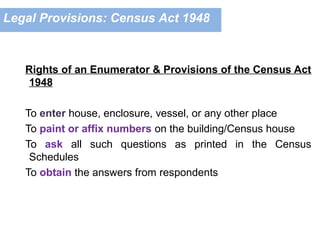
Rights of an Enumerator & Provisions of the Census Act
1948
To enter house, enclosure, vessel, or any other place
To paint or affix numbers on the building/Census house
To ask all such questions as printed in the Census
Schedules
To obtain the answers from respondents
Legal Provisions: Census Act 1948
Legal Provisions: Census Act 1948 (Contd.)
Other Provisions
Section 15A of the Act:
Service interests of the members of the Census Staff are given
due protection
Census Duty is considered as “On Duty”
Section 15B of the Act:
Any act undertaken in good faith by the Census Staff under
the Census Act and Rules is protected
Legal Provisions: Census Act 1948 (Contd.)
Obligation of the Public (Sec. 8/9 of the Act)
• To allow entry to the Census staff in
her/his house
• To allow painting of number on her/his house
• To give correct information to the best of
her/his knowledge & belief
Punishment for violation:-
Fine upto Rs. 1000/- (Sec 11 of the Act)
Legal Provisions: Census Act 1948 (Contd.)
Confidentiality of Census Records
(Sec.15 of the Act)
CENSUS RECORDS
not open to inspection nor admissible as evidence
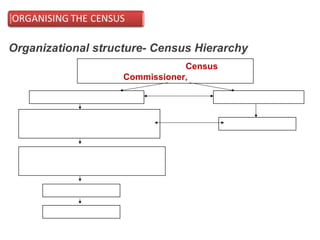
Organizational structure- Census Hierarchy
Registrar General & Census
Commissioner, India
Director of Census Operations
Principal Census Officers
(Deputy Commissioners/ Collectors/
Commissioners of Corporation
Supervisors
Enumerators
Charge Officers (Tehsildar/ Chief Officer) or
City/ Town Census Officer (Municipal
Officer)
State Govt./ UT Admin.
Nodal Officer
State Co-ordinator will co-ordinate between
Centre and State
PLANNING FOR CENSUS 2011
Census of India2011
• Updating of frame for census:
• The first step towards taking of Census 2011 was preparation of a
complete and non-duplicated list of all geographical entities in the
country, which includes states, Districts, Tahsils, Towns and
Villages.
• Boundaries of all administrative units in the State were frozen as
on 31st December 2009. This exercise also involved
obtaining the latest maps of districts, tahsils and towns.
• Notifications and gazattes issued in connection with changes at
various levels of administrative set up-village, towns,taluk, district,
state are procured and updations are made in the frame used for
earlier census.
• Changes in jurisdiction will include changes in name of villages,
creation of new villages/ towns/ tahsil/ district/states etc.
• Preparation of a code directory(Meta data standards
code):
One of the important inputs of census takings is assigning
of the location codes to various administrative units. With
the help of the directory it is easy to identify
administrative units easily.
• The directory of with unique identification code for each
administrative unit helped to ensure that every administrative unit is
covered without omission or duplication.
• In Census 2011 is that each and every Villages, Statutory Towns,
Census Towns and Forest Villages were assigned with separate
series of codes.
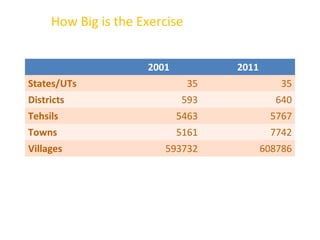
2001 2011
States/UTs 35 35
Districts 593 640
Tehsils 5463 5767
Towns 5161 7742
Villages 593732 608786
How Big is the Exercise
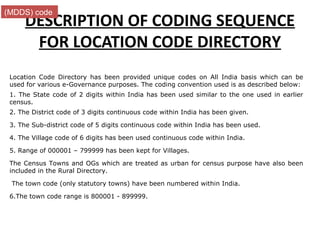
DESCRIPTION OF CODING SEQUENCE
FOR LOCATION CODE DIRECTORY
(MDDS) code
Location Code Directory has been provided unique codes on All India basis which can be
used for various e-Governance purposes. The coding convention used is as described below:
1. The State code of 2 digits within India has been used similar to the one used in earlier
census.
2. The District code of 3 digits continuous code within India has been given.
3. The Sub-district code of 5 digits continuous code within India has been used.
4. The Village code of 6 digits has been used continuous code within India.
5. Range of 000001 – 799999 has been kept for Villages.
The Census Towns and OGs which are treated as urban for census purpose have also been
included in the Rural Directory.
The town code (only statutory towns) have been numbered within India.
6.The town code range is 800001 - 899999.
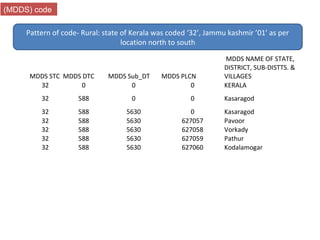
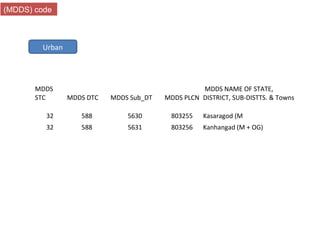
MDDS STC MDDS DTC MDDS Sub_DT MDDS PLCN
MDDS NAME OF STATE,
DISTRICT, SUB-DISTTS. &
VILLAGES
32 0 0 0 KERALA
32 588 0 0 Kasaragod
32 588 5630 0 Kasaragod
32 588 5630 627057 Pavoor
32 588 5630 627058 Vorkady
32 588 5630 627059 Pathur
32 588 5630 627060 Kodalamogar
(MDDS) code
Pattern of code- Rural: state of Kerala was coded ‘32’, Jammu kashmir ’01’ as per
location north to south
MDDS
STC MDDS DTC MDDS Sub_DT MDDS PLCN
MDDS NAME OF STATE,
DISTRICT, SUB-DISTTS. & Towns
32 588 5630 803255 Kasaragod (M
32 588 5631 803256 Kanhangad (M + OG)
Urban
(MDDS) code
Rural -Urban classification of areas
•Next important step as part of pre-census activities
was finalisation of the Rural-Urban frame.
•This exercise helped to prepare a complete up to
date list of Statutory and Census Towns and villages
as urban and rural areas respectively.
• The demarcation of Out-Growths of Towns and
Urban Agglomerations was also taken up as a part of
this exercise.
CLASSIFICATION OF AREA
URBAN
RURAL
Areas are classified into rural
and urban in census
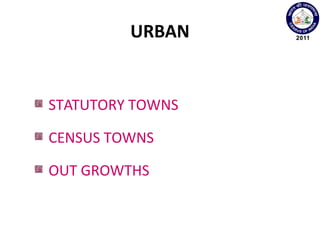
URBAN
STATUTORY TOWNS
CENSUS TOWNS
OUT GROWTHS
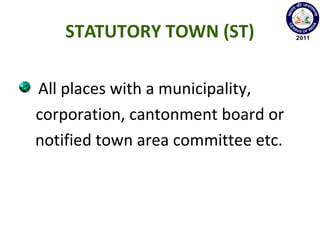
STATUTORY TOWN (ST)
All places with a municipality,
corporation, cantonment board or
notified town area committee etc.
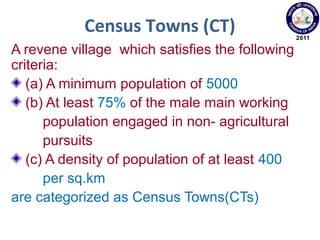
Census Towns (CT)
A revene village which satisfies the following
criteria:
(a) A minimum population of 5000
(b) At least 75% of the male main working
population engaged in non- agricultural
pursuits
(c) A density of population of at least 400
per sq.km
are categorized as Census Towns(CTs)
OUTGROWTHS(OG)
A village or part of a village contiguous to a
statutory town and possess the urban features in
terms of infrastructure and amenities such as
pucca roads, electricity, taps, drainage system for
disposal of waste water etc., educational
institutions, post offices, medical facilities, banks
etc. are considered as urban and are termed as
Outgrowth.
URBAN AGGLOMERATION(UA)
An Urban Agglomeration is a continuous
urban spread consisting of a Town and its
adjoining Urban Out-growths or two or more
physically contiguous Towns together and
any adjoining Urban OGs of such Towns.
The core town or at least one of the
constituent towns of a UA should necessarily
be a statutory town and the total population of
a UA should not be less than 20,000 as per
the 2001 Census.
• Designing and finalization of Questionnaire
and other forms for data collection
In order to finalise questionnaire for data
collection A TECHNICAL ADVISORY COMMITTEE
formed to advice the Organisation
The committee consists of data users such as Experts,
Academicians, heads of various depts., organisations &
NGOs…….
• Conducting of Pre-test
The Census Questionnaire was piloted and
pretested.
The results and experiences were discussed in
the Conference of Directors and technical
committee and updations made accordingly.
Pre Surveys (Pre test)
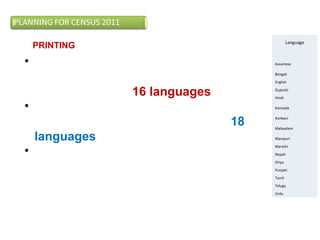
• A feature that makes the Indian Census
particularly complex is that the schedules
are canvassed in 16 languages and
• The Instruction Manuals for training the
field functionaries are developed in 18
languages.
• 5.4 million instruction manuals and 340
million census Schedules.
PRINTING Language
Assamese
Bengali
English
Gujarati
Hindi
Kannada
Konkani
Malayalam
Manipuri
Marathi
Nepali
Oriya
Punjabi
Tamil
Telugu
Urdu
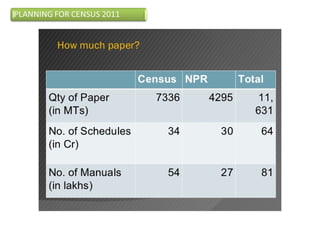
Features of the Census 2011 Questionnaires
•Forms designed by National Institute of Design, Ahmadabad
•Printed in select high-end Presses having capacity for digital printing
•Special colours used to enable complete drop-out after scanning
•Schedules are printed on special graded paper in consultation with
technical experts
•Specification for Paper evolved in consultation with experts
•Census Schedules are comparable with the best in class
internationally
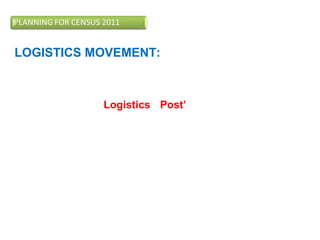
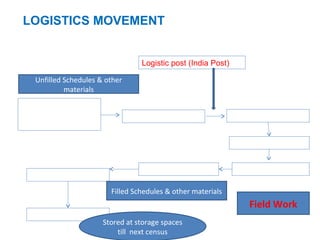
LOGISTICS MOVEMENT:
The handling and transportation of logistics required for
field work was transported to the respective charges
through a special tie up made with India post. The
arrangement of Logistics Post’ was a pioneering
initiative undertaken for 2011 Census. The return
collection of filled in schedules also was made through
this arrangement.
ORGI/
DCO/
Printing Press
Districts
Enumerator
Charges
Scanning centers
Supervisor
LOGISTICS MOVEMENT
Despatch &return of materials
Supervisor
Charges
Logistic post (India Post)
Field Work
Unfilled Schedules & other
materials
Filled Schedules & other materials
Stored at storage spaces
till next census
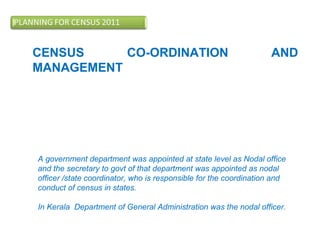
CENSUS CO-ORDINATION AND
MANAGEMENT
Successful census operations require timely and
effective co-ordination at state, district, village and ward
levels. For this purpose various committees and census
working groups were constituted.
A government department was appointed at state level as Nodal office
and the secretary to govt of that department was appointed as nodal
officer /state coordinator, who is responsible for the coordination and
conduct of census in states.
In Kerala Department of General Administration was the nodal officer.
STATE LEVEL
Liaising with various departments of the State Government was
made possible with the help of a committee under the
chairmanship of Chief Secretary, constituted with Principal
Secretaries and Secretaries of different departments of the State
Government as members.
DISTRICT LEVEL
District Census group was constituted under the chairmanship of
Collector for proper management of census operations at the
district level. Heads of different departments of district
administration including were members
.
CAPACITY BUILDING OF CENSUS
FUNCTIONARIES
Census of India2011
• Notifications relating to the intention for
conducting House listing &PE has to be
published in India gazettes and reproduced in
respective states gazettes.
• Appointment of census functionaries need to
be notified
• Notification of questions to be asked during
both phases of census need to be published
• Various other related notifications, letters etc.
need to be made.
CAPACITY BUILDING OF CENSUS
FUNCTIONARIES
Important notifications issued for conduct of Census 2011
 Notification regarding the intention of the Government of India to conduct a
Census of the population of India in 2011 was published in the Gazette of
India . And the same republished in state gazettes
 In the same Notification, the Reference Date was also notified as 00.00 hours
of the first day of March 2011 (except for the snow-bound areas of Jammu &
Kashmir, Himachal Pradesh and Uttarakhand). In the snow bound areas of
Jammu & Kashmir, Himachal Pradesh and Uttarakhand the Reference Date
was notified as 00.00 hours of the first day of October 2010.
 Notification regarding the conduct of House listing and Housing Census from
1st April 2010 to 30th September 2010 in different States and Union
Territories was published in the Gazette of India on 25th February 2010.
 Simultaneously, the Notification regarding the conduct of House
listing and Housing Census from was published in the Gazette of
India
 The Notification regarding the questions to be canvassed in the
Population Enumeration was published in the Gazette of India on
31st August 2010.
 Notification on appointment of census functionaries was issued.
 Notification on freezing of boundaries of various administrative
levels by 31/12/2009 issued
PLANNING FOR CENSUS 2011
Important notifications issued for conduct of Census 2011
For the successful conducting of Census and getting qualitative
data from census proper training required to be imparted for the
census functionaries at all levels. Trainings are an important
feature of census.
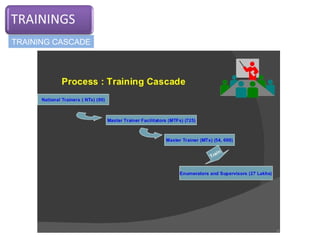
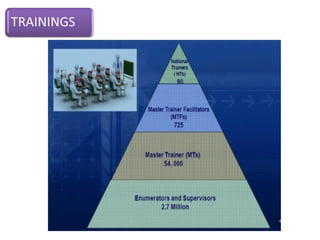
•A three tier cascade of training was devised for this purpose in
2011.
•At the top of the pyramid was a group of 90 National Trainers
(NTs) at national level. 5 days training given for them.
•725 Master Trainer Faciliters (MTFs) at state level.
•54000 Master trainers at District level.
– NGOs were evolved in training of Census 2011.
– Volunteers from NGOs working in the field of disability and gender
were alsoassociated with training
TRAINING CASCADE
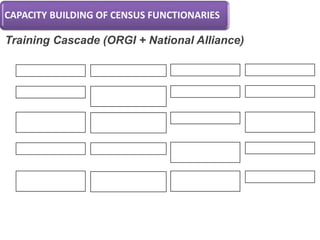
Training Cascade (ORGI + National Alliance)
National Trainers
Master Trainers
Facilitators
Master Trainers
Supervisors and
Enumerators
90 (45 Alliance+45
ORGI)
725 (375
Alliance+350 ORGI)
54000 (ORGI)
2700000 (School
Teachers)
4 Days residential
4 Days Residential
4 days Non-
Residential
3 (2+1) Days Non
Residential
Level Number Nature
Mumbai & Delhi
States/ Cluster of
States
District
City/ Town/ Taluka
Venue
• Special efforts were made to improve the Instruction Manual by
including more illustrations and examples.
• Training Guides were prepared to help the trainers impart quality
training. Trainers at each level – nation, state and district levels
were given intensive in-house training and provided training aids,
such as power point presentations, e-learning modules, scripts of
role plays and practice sheets.
• Special training modules were developed for explaining the issues
related to disability and gender.
• Another special training effort was made in development of training
modules for gender sensitive districts.
• In addition, NGOs working in the field of disability and gender were
associated with Census 2011 for training the trainers at all the
levels.
TRAININGs
• STATE LEVEL TRAINING
• State level training was conducted at every state
headquarter
• DISTRICT LEVEL TRAINING
• District level trainings were held at district
headquarters
• CHARGE LEVEL TRAINING
• Charge level trainings for enumerators and
supervisors were organised
CAPACITY BUILDING OF CENSUSFUNCTIONARIES
SPECIAL ATTENTIONS-GENDER
SENSITIZATION &DISABILITY
Census of India2011
• Gender disaggregated data is the basis for gender sensitive policy
formulation and programme planning.
• The need for gender statistics in formulating policies and
programmes can hardly be over-emphasized. Conceptually,
information collected in Census is gender neutral and compiled
and tabulated for both men and women separately.
• The Questionnaire and Instruction Manual for collection of
information in the field have been carefully designed to avoid any
bias on the basis of gender.
• The training of Census functionaries also focuses on this aspect
of neutrality.
• Gender sensitivities like age at marriage, marital status, literacy
and economic activities in unorganized and unpaid work are
important characteristics for coverage during census.
• In all the 20 Gender critical states of, specially trained gender
MTFs (GMTFs) trained the MTs and census field staff.
• States/Districts returned abnormal gender
parametres were treated as gender critical
• Sex ratio below 900, female literacy below
30%, Female work participation rate below
20% of 2001 census were the parametres.
• Special training modules derived..
In Kerala 9
districts
PUBLICITY AND MEDIA PLAN
Census of India2011
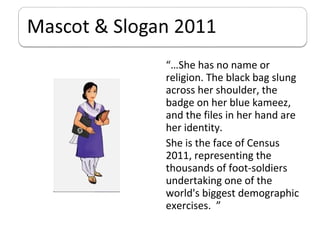
“…She has no name or
religion. The black bag slung
across her shoulder, the
badge on her blue kameez,
and the files in her hand are
her identity.
She is the face of Census
2011, representing the
thousands of foot-soldiers
undertaking one of the
world's biggest demographic
exercises. ”Slogan "Our Census, Our Future",
• NATIONAL LEVEL
• All modes of Publicity - Mass media, Public relations,
Outreach activities and Digital media were used to spread
awareness and ensure the cooperation of all stakeholders.
• A scientific media plan was designed by a professional agency
that also created the media content in both the phases of the
Census.
• While the general theme was that of including everybody
without omission, special emphasis was laid on vulnerable
groups like women, elderly, disabled, infants, homeless and
primitive tribes in forest and remote areas.
• Celebrity endorsements were also broadcast.
Census NPR Vital Statistics
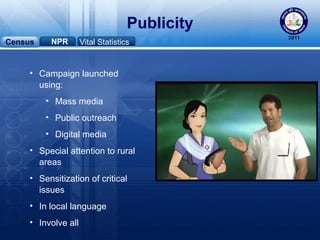
• Campaign launched
using:
• Mass media
• Public outreach
• Digital media
• Special attention to rural
areas
• Sensitization of critical
issues
• In local language
• Involve all
Publicity
CENSUS IN SCHOOLS
•A new initiative of ‘Census in Schools’ was
launched across the country. Purpose of this
programme was to make the children aware
about the census enumeration of their families
and neighbourhoods and also to expose them to
the significance of census data in the
development of the country
COMMUNICATION
Census of India2011
• Help desk and help lines had been introduced
in 2001 and same style continued in 2011 also.
• At all levels of hierarchy help desk were
functioning
• FAQs were available
• Website was operational
Census Helplines
• Video Conferences conducted
• National conferences of officers upto Principal Census Officer
level conducted
• Conferences of chief secretaries and Director General of
Police
• Conferences of chief Ministers and Lt Governers
• State conferences and Video Conferences were held
• Press conferences etc…………..
Conferences/ Meetings
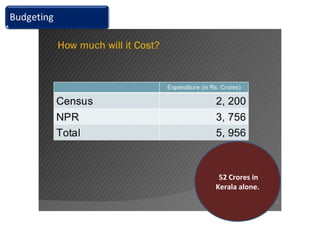
BUDGETTING
Census of India2011
52 Crores in
Kerala alone.
Part -2 begins

Census 2011 1part

  • 1.
    " Our Census- Our Future". Directorate of Census Operations Kerala Info on Largest administrative exercise in the country. The Gospel of Luke places the birth of Jesus under the  reign of Herod ("In the days of King Herod of  Judea..."– Luke 1:5) and links it to the census of Quirinius In those days a decree went out from Emperor Augustus that all the world should be registered. This was the first registration and was taken while Quirinius was governor of Syria. All went to their own towns to be registered. Joseph also went from the town of Nazareth in Galilee to Judea, to the city of David called Bethlehem, because he was descended from the house and family of David. He went to be registered with Mary, to whom he was engaged and who was expecting a child. (Luke 2:1–5) Salient features of Census 2011-India
  • 2.
    • Census taking is an ancient institution with a hoary tradition.  • Babylonians who instituted a system of revenue returns around 4000 BC is  credited with its origin.  •The word ‘census’ is derived from the Latin word ‘censere’ meaning ‘to  assess’ or ‘to rate’. •  It dates back to the 1st or 2nd century BC.  • Census taking became a worldwide institution with the expansion of the  Roman Empire.  • Growth of feudalism and disintegration of the Roman Empire put an end  to the first phase of periodical censuses.  • One of the earliest completed censuses involving people of all ages was  taken in the German City of Nuremberg.  • The earliest of the modern census was taken in Iceland in 1703. But the  results were delayed. Hence the Swedish census of 1750 is regarded as  the first modern census which published the population data. 
  • 3.
  • 4.
     Definition ofCensus A population census is the total process of collecting, compiling, evaluating, analyzing and publishing or otherwise disseminating demographic, economic and social data pertaining, at a specified time, to all persons in a country or in a well- delimited part of a country.
  • 5.
    Why CENSUS? • “….Populationis basic to the production and distribution of material wealth. In order to plan for, and implement, economic and social development, administrative activity or scientific research, it is necessary to have reliable and detailed data on the size, distribution and composition of population. The population census is a primary source of these basic benchmark statistics, covering not only the settled population but also homeless persons and nomadic groups. Data from population censuses should allow presentation and analysis in terms of statistics on persons and households and for a wide variety of geographical units, ranging from the country as a whole to individual small localities or city blocks.’… 1.5 Principles and Recommendations for Population and Housing Censuses, Revision 2 UN
  • 6.
  • 8.
  • 9.
    • Population census provides  valuable information about the land and its  people at a given point of time. It provides trends and its various  characteristics which are essential for Planning. Very supportive in all  types of plans. •Needs for business persons, industrialists, scholars, academicians, planners • Determining  & demarcating parliamentary and assembly constituency • Very decisive even in presidential elections. Voting Value of members of  electoral college  depends on the population • Formation of Towns/panchayats, wards size of such institutions depends on population size • Fund transfers- from centre to state, a criteria followed is population size • Reservations to Scheduled castes/Tribes Usage of Census Data
  • 10.
  • 11.
    Historical Background • Attemptsmade since ancient times • The celebrated ARTHASHATRA, the Principles of Government, as evolved by one of the great genius of political administration, Kautilya, during the days of the Mauryas In the 3rd century B.C prescribed the collection of population statistics as a measure of state policy for the purpose of taxation. • In AIN-E-AKBARI,( by Abul Fazal) a sixteenth century treatise on the Mughal administration, also lays emphasis on importance of census as a tool for decision-making.
  • 12.
    History of Censusin India Rig Veda 800-600 BC Arthashastra 321-296 BC First systematic census  conducted all over India (non- synchronous) 1872 (1865-1872) First Synchronous Census  conducted all over India 1881 Independent India 1951 Census of 2011 15th since 1872, 7th  since Independence Historical Background………Historical Background………
  • 13.
  • 14.
    • The Censusof India is conducted once in a decade (Decennial). • From 1881 onward in the year ending 1 ’s • It follows extended de facto method. • Canvasser method adopted to collect information from each household. Under this approach, data is collected from every individual by visiting the household and canvassing the questionnaire all over the country, over a period of three weeks.
  • 15.
    Phases of Census Phase1:  House listing and  Housing Census Phase 2:  Population Enumeration: 
  • 16.
    Census year Reference dateMethod 1872 21 st February de facto (non synchronous) 1881 17th  feb de facto ( synchronous) 1891 26th feb de facto ( synchronous) 1901 1st march de facto ( synchronous) 1911 10th march de facto( synchronous) 1921 18th march de facto ( synchronous) 1931 26 th feb de facto ( synchronous) 1941 1st march Extended de facto ( synchronous) 1951 1st march Extended de facto ( synchronous) 1961 1st march Extended de facto ( synchronous) 1971 1st April Extended de facto ( synchronous) 1981 1st march Extended de facto ( synchronous) 1991 1st march Extended de facto ( synchronous) 2001 1st march Extended de facto ( synchronous) 2011 1st march Extended de facto ( synchronous)
  • 17.
    HOUSELISTING BLOCK/ ENUMERATION BLOCK VILLAGE/ CENSUS TOWN/ OGS/WARDS OFSTS TALUKS/ STATUTORY TOWNS DISTRICT STATECOUNTRY House listing block/ Enumeration block is the smallest administrative unit for conducting census Population of India is a consolidation of population of 35 states/UTs Total Population of  the country is the  sum total of  population of all  enumeration blocks. 
  • 18.
  • 19.
    Census NPR VitalStatistics Challenges – Vast & diverse
  • 20.
  • 21.
  • 22.
    In India, thepopulation census is a Union subject (Article 246) and is listed at serial number 69 of the seventh schedule of the constitution. Although the Census Act is an instrument of Central legislation, in the scheme of its execution, state hierarchy is setup at all levels by State Governments for the purpose of carrying out census. Census in Constitution.
  • 23.
    • Census includedunder the Union or Central List for governance • The Central Government conceptualizes the operation, finalizes the questions, supervises and provides resources for conducting census • State governments provide entire manpower for satisfactory execution of the operation • Census - a joint exercise in which central and state government are involved.
  • 24.
    • The CensusOrganisation under the Union Home Ministry has been functioning on permanent footing ever since 1961 and provides a vital continuity to conceive, plan and implement the programme of census taking in country. • The Organisation headed by the Registrar General and Census Commissioner, India has field offices in thirty three States and Union territories. • These are permanent Directorates headed by the Directors of Census Operations, who are mainly responsible for the conduct of census in their respective jurisdiction.
  • 25.
    THE CENSUS ACT,1948THE CENSUS ACT, 1948 (Act No. 37 of 1948)(Act No. 37 of 1948) && CENSUS RULES, 1990CENSUS RULES, 1990 As amended in 1994As amended in 1994 The Census Act 1948 & Census Rules 1990 statute back up for conduct of census in independent India. Legal basis
  • 26.
    CENSUS OF INDIA2011 Legal Provisions: Census Act 1948 All Census officers are appointed u/s 4 of the Act : Obligation of the Census Officers/Staff • Cannot refuse duty • Cannot obstruct anyone from performing duty • Cannot put offensive, improper or unauthorized question(s) • Cannot knowingly make a false return • Cannot disclose any Census information Punishment :- Imprisonment up to 3 years and/or fine up to Rs. 1000/- (Sec. 11 of the Act)
  • 27.
    Rights of anEnumerator & Provisions of the Census Act 1948 To enter house, enclosure, vessel, or any other place To paint or affix numbers on the building/Census house To ask all such questions as printed in the Census Schedules To obtain the answers from respondents Legal Provisions: Census Act 1948
  • 28.
    Legal Provisions: CensusAct 1948 (Contd.) Other Provisions Section 15A of the Act: Service interests of the members of the Census Staff are given due protection Census Duty is considered as “On Duty” Section 15B of the Act: Any act undertaken in good faith by the Census Staff under the Census Act and Rules is protected
  • 29.
    Legal Provisions: CensusAct 1948 (Contd.) Obligation of the Public (Sec. 8/9 of the Act) • To allow entry to the Census staff in her/his house • To allow painting of number on her/his house • To give correct information to the best of her/his knowledge & belief Punishment for violation:- Fine upto Rs. 1000/- (Sec 11 of the Act)
  • 30.
    Legal Provisions: CensusAct 1948 (Contd.) Confidentiality of Census Records (Sec.15 of the Act) CENSUS RECORDS not open to inspection nor admissible as evidence
  • 31.
    Organizational structure- CensusHierarchy Registrar General & Census Commissioner, India Director of Census Operations Principal Census Officers (Deputy Commissioners/ Collectors/ Commissioners of Corporation Supervisors Enumerators Charge Officers (Tehsildar/ Chief Officer) or City/ Town Census Officer (Municipal Officer) State Govt./ UT Admin. Nodal Officer State Co-ordinator will co-ordinate between Centre and State
  • 32.
    PLANNING FOR CENSUS2011 Census of India2011
  • 33.
    • Updating offrame for census: • The first step towards taking of Census 2011 was preparation of a complete and non-duplicated list of all geographical entities in the country, which includes states, Districts, Tahsils, Towns and Villages. • Boundaries of all administrative units in the State were frozen as on 31st December 2009. This exercise also involved obtaining the latest maps of districts, tahsils and towns. • Notifications and gazattes issued in connection with changes at various levels of administrative set up-village, towns,taluk, district, state are procured and updations are made in the frame used for earlier census. • Changes in jurisdiction will include changes in name of villages, creation of new villages/ towns/ tahsil/ district/states etc.
  • 34.
    • Preparation ofa code directory(Meta data standards code): One of the important inputs of census takings is assigning of the location codes to various administrative units. With the help of the directory it is easy to identify administrative units easily. • The directory of with unique identification code for each administrative unit helped to ensure that every administrative unit is covered without omission or duplication. • In Census 2011 is that each and every Villages, Statutory Towns, Census Towns and Forest Villages were assigned with separate series of codes.
  • 35.
    2001 2011 States/UTs 3535 Districts 593 640 Tehsils 5463 5767 Towns 5161 7742 Villages 593732 608786 How Big is the Exercise
  • 36.
    DESCRIPTION OF CODINGSEQUENCE FOR LOCATION CODE DIRECTORY (MDDS) code Location Code Directory has been provided unique codes on All India basis which can be used for various e-Governance purposes. The coding convention used is as described below: 1. The State code of 2 digits within India has been used similar to the one used in earlier census. 2. The District code of 3 digits continuous code within India has been given. 3. The Sub-district code of 5 digits continuous code within India has been used. 4. The Village code of 6 digits has been used continuous code within India. 5. Range of 000001 – 799999 has been kept for Villages. The Census Towns and OGs which are treated as urban for census purpose have also been included in the Rural Directory. The town code (only statutory towns) have been numbered within India. 6.The town code range is 800001 - 899999.
  • 37.
    MDDS STC MDDSDTC MDDS Sub_DT MDDS PLCN MDDS NAME OF STATE, DISTRICT, SUB-DISTTS. & VILLAGES 32 0 0 0 KERALA 32 588 0 0 Kasaragod 32 588 5630 0 Kasaragod 32 588 5630 627057 Pavoor 32 588 5630 627058 Vorkady 32 588 5630 627059 Pathur 32 588 5630 627060 Kodalamogar (MDDS) code Pattern of code- Rural: state of Kerala was coded ‘32’, Jammu kashmir ’01’ as per location north to south
  • 38.
    MDDS STC MDDS DTCMDDS Sub_DT MDDS PLCN MDDS NAME OF STATE, DISTRICT, SUB-DISTTS. & Towns 32 588 5630 803255 Kasaragod (M 32 588 5631 803256 Kanhangad (M + OG) Urban (MDDS) code
  • 39.
    Rural -Urban classificationof areas •Next important step as part of pre-census activities was finalisation of the Rural-Urban frame. •This exercise helped to prepare a complete up to date list of Statutory and Census Towns and villages as urban and rural areas respectively. • The demarcation of Out-Growths of Towns and Urban Agglomerations was also taken up as a part of this exercise.
  • 40.
    CLASSIFICATION OF AREA URBAN RURAL Areasare classified into rural and urban in census
  • 41.
  • 42.
    STATUTORY TOWN (ST) Allplaces with a municipality, corporation, cantonment board or notified town area committee etc.
  • 43.
    Census Towns (CT) Arevene village which satisfies the following criteria: (a) A minimum population of 5000 (b) At least 75% of the male main working population engaged in non- agricultural pursuits (c) A density of population of at least 400 per sq.km are categorized as Census Towns(CTs)
  • 44.
    OUTGROWTHS(OG) A village orpart of a village contiguous to a statutory town and possess the urban features in terms of infrastructure and amenities such as pucca roads, electricity, taps, drainage system for disposal of waste water etc., educational institutions, post offices, medical facilities, banks etc. are considered as urban and are termed as Outgrowth.
  • 45.
    URBAN AGGLOMERATION(UA) An UrbanAgglomeration is a continuous urban spread consisting of a Town and its adjoining Urban Out-growths or two or more physically contiguous Towns together and any adjoining Urban OGs of such Towns. The core town or at least one of the constituent towns of a UA should necessarily be a statutory town and the total population of a UA should not be less than 20,000 as per the 2001 Census.
  • 46.
    • Designing andfinalization of Questionnaire and other forms for data collection In order to finalise questionnaire for data collection A TECHNICAL ADVISORY COMMITTEE formed to advice the Organisation The committee consists of data users such as Experts, Academicians, heads of various depts., organisations & NGOs…….
  • 47.
    • Conducting ofPre-test The Census Questionnaire was piloted and pretested. The results and experiences were discussed in the Conference of Directors and technical committee and updations made accordingly. Pre Surveys (Pre test)
  • 48.
    • A featurethat makes the Indian Census particularly complex is that the schedules are canvassed in 16 languages and • The Instruction Manuals for training the field functionaries are developed in 18 languages. • 5.4 million instruction manuals and 340 million census Schedules. PRINTING Language Assamese Bengali English Gujarati Hindi Kannada Konkani Malayalam Manipuri Marathi Nepali Oriya Punjabi Tamil Telugu Urdu
  • 49.
    Features of theCensus 2011 Questionnaires •Forms designed by National Institute of Design, Ahmadabad •Printed in select high-end Presses having capacity for digital printing •Special colours used to enable complete drop-out after scanning •Schedules are printed on special graded paper in consultation with technical experts •Specification for Paper evolved in consultation with experts •Census Schedules are comparable with the best in class internationally
  • 51.
    LOGISTICS MOVEMENT: The handlingand transportation of logistics required for field work was transported to the respective charges through a special tie up made with India post. The arrangement of Logistics Post’ was a pioneering initiative undertaken for 2011 Census. The return collection of filled in schedules also was made through this arrangement.
  • 52.
    ORGI/ DCO/ Printing Press Districts Enumerator Charges Scanning centers Supervisor LOGISTICSMOVEMENT Despatch &return of materials Supervisor Charges Logistic post (India Post) Field Work Unfilled Schedules & other materials Filled Schedules & other materials Stored at storage spaces till next census
  • 53.
    CENSUS CO-ORDINATION AND MANAGEMENT Successfulcensus operations require timely and effective co-ordination at state, district, village and ward levels. For this purpose various committees and census working groups were constituted. A government department was appointed at state level as Nodal office and the secretary to govt of that department was appointed as nodal officer /state coordinator, who is responsible for the coordination and conduct of census in states. In Kerala Department of General Administration was the nodal officer.
  • 54.
    STATE LEVEL Liaising withvarious departments of the State Government was made possible with the help of a committee under the chairmanship of Chief Secretary, constituted with Principal Secretaries and Secretaries of different departments of the State Government as members. DISTRICT LEVEL District Census group was constituted under the chairmanship of Collector for proper management of census operations at the district level. Heads of different departments of district administration including were members .
  • 55.
    CAPACITY BUILDING OFCENSUS FUNCTIONARIES Census of India2011
  • 56.
    • Notifications relatingto the intention for conducting House listing &PE has to be published in India gazettes and reproduced in respective states gazettes. • Appointment of census functionaries need to be notified • Notification of questions to be asked during both phases of census need to be published • Various other related notifications, letters etc. need to be made. CAPACITY BUILDING OF CENSUS FUNCTIONARIES
  • 57.
    Important notifications issuedfor conduct of Census 2011  Notification regarding the intention of the Government of India to conduct a Census of the population of India in 2011 was published in the Gazette of India . And the same republished in state gazettes  In the same Notification, the Reference Date was also notified as 00.00 hours of the first day of March 2011 (except for the snow-bound areas of Jammu & Kashmir, Himachal Pradesh and Uttarakhand). In the snow bound areas of Jammu & Kashmir, Himachal Pradesh and Uttarakhand the Reference Date was notified as 00.00 hours of the first day of October 2010.  Notification regarding the conduct of House listing and Housing Census from 1st April 2010 to 30th September 2010 in different States and Union Territories was published in the Gazette of India on 25th February 2010.
  • 58.
     Simultaneously, theNotification regarding the conduct of House listing and Housing Census from was published in the Gazette of India  The Notification regarding the questions to be canvassed in the Population Enumeration was published in the Gazette of India on 31st August 2010.  Notification on appointment of census functionaries was issued.  Notification on freezing of boundaries of various administrative levels by 31/12/2009 issued PLANNING FOR CENSUS 2011 Important notifications issued for conduct of Census 2011
  • 59.
    For the successfulconducting of Census and getting qualitative data from census proper training required to be imparted for the census functionaries at all levels. Trainings are an important feature of census. •A three tier cascade of training was devised for this purpose in 2011. •At the top of the pyramid was a group of 90 National Trainers (NTs) at national level. 5 days training given for them. •725 Master Trainer Faciliters (MTFs) at state level. •54000 Master trainers at District level. – NGOs were evolved in training of Census 2011. – Volunteers from NGOs working in the field of disability and gender were alsoassociated with training
  • 60.
  • 62.
    Training Cascade (ORGI+ National Alliance) National Trainers Master Trainers Facilitators Master Trainers Supervisors and Enumerators 90 (45 Alliance+45 ORGI) 725 (375 Alliance+350 ORGI) 54000 (ORGI) 2700000 (School Teachers) 4 Days residential 4 Days Residential 4 days Non- Residential 3 (2+1) Days Non Residential Level Number Nature Mumbai & Delhi States/ Cluster of States District City/ Town/ Taluka Venue
  • 63.
    • Special effortswere made to improve the Instruction Manual by including more illustrations and examples. • Training Guides were prepared to help the trainers impart quality training. Trainers at each level – nation, state and district levels were given intensive in-house training and provided training aids, such as power point presentations, e-learning modules, scripts of role plays and practice sheets. • Special training modules were developed for explaining the issues related to disability and gender. • Another special training effort was made in development of training modules for gender sensitive districts. • In addition, NGOs working in the field of disability and gender were associated with Census 2011 for training the trainers at all the levels.
  • 64.
    TRAININGs • STATE LEVELTRAINING • State level training was conducted at every state headquarter • DISTRICT LEVEL TRAINING • District level trainings were held at district headquarters • CHARGE LEVEL TRAINING • Charge level trainings for enumerators and supervisors were organised CAPACITY BUILDING OF CENSUSFUNCTIONARIES
  • 65.
  • 66.
    • Gender disaggregateddata is the basis for gender sensitive policy formulation and programme planning. • The need for gender statistics in formulating policies and programmes can hardly be over-emphasized. Conceptually, information collected in Census is gender neutral and compiled and tabulated for both men and women separately. • The Questionnaire and Instruction Manual for collection of information in the field have been carefully designed to avoid any bias on the basis of gender. • The training of Census functionaries also focuses on this aspect of neutrality. • Gender sensitivities like age at marriage, marital status, literacy and economic activities in unorganized and unpaid work are important characteristics for coverage during census. • In all the 20 Gender critical states of, specially trained gender MTFs (GMTFs) trained the MTs and census field staff.
  • 67.
    • States/Districts returnedabnormal gender parametres were treated as gender critical • Sex ratio below 900, female literacy below 30%, Female work participation rate below 20% of 2001 census were the parametres. • Special training modules derived.. In Kerala 9 districts
  • 68.
    PUBLICITY AND MEDIAPLAN Census of India2011
  • 70.
    “…She has noname or religion. The black bag slung across her shoulder, the badge on her blue kameez, and the files in her hand are her identity. She is the face of Census 2011, representing the thousands of foot-soldiers undertaking one of the world's biggest demographic exercises. ”Slogan "Our Census, Our Future",
  • 71.
    • NATIONAL LEVEL •All modes of Publicity - Mass media, Public relations, Outreach activities and Digital media were used to spread awareness and ensure the cooperation of all stakeholders. • A scientific media plan was designed by a professional agency that also created the media content in both the phases of the Census. • While the general theme was that of including everybody without omission, special emphasis was laid on vulnerable groups like women, elderly, disabled, infants, homeless and primitive tribes in forest and remote areas. • Celebrity endorsements were also broadcast.
  • 72.
    Census NPR VitalStatistics • Campaign launched using: • Mass media • Public outreach • Digital media • Special attention to rural areas • Sensitization of critical issues • In local language • Involve all Publicity
  • 73.
    CENSUS IN SCHOOLS •Anew initiative of ‘Census in Schools’ was launched across the country. Purpose of this programme was to make the children aware about the census enumeration of their families and neighbourhoods and also to expose them to the significance of census data in the development of the country

  • 74.
  • 75.
    • Help deskand help lines had been introduced in 2001 and same style continued in 2011 also. • At all levels of hierarchy help desk were functioning • FAQs were available • Website was operational Census Helplines
  • 76.
    • Video Conferencesconducted • National conferences of officers upto Principal Census Officer level conducted • Conferences of chief secretaries and Director General of Police • Conferences of chief Ministers and Lt Governers • State conferences and Video Conferences were held • Press conferences etc………….. Conferences/ Meetings
  • 77.
  • 78.
  • 79.