Leadership
Styles
PRESENTED BY
MUHAMMED FARSIN ELARAM
Leadership Styles
 The action of leading a group of people or an organisation is
known as Leadership.
 Leadership styles are the patterns of behaviour which a leader
adopt in influencing the behaviour of his followers.
 It refers to a leader’s methods, characteristics and behaviors
when directing, motivating, and managing their teams.
Various styles of leadership are adopted by different
leaders. They are categorized as,
1.Autocratic style
2.Free rein style
3.Participative style
4.Paternalistic style
5.Charismatic Leadership
1.Autocratic style
 It is also known as authoritarian, directive or monothetic style.
 In autocratic leadership style a manager centralize decision making power and authority in
himself and exercises complete and full fledged control over his subordinates.
 He gives orders and the subordinates are expected to obey him.
 He determines policies for the group without consulting them.
 There are mainly three types of autocratic leaders,
a) Strict autocrat
b) Benevolent autocrat
c) Manipulative autocrat
a) Strict autocrat :- He follows autocratic style in a very strict sense. He
influence subordinates through negative motivation That is by
criticizing subordinates, imposing penalty etc.
b) Benevolent autocrat :- Under this method, the leader influence his
subordinate through positive motivation. He uses reward and
incentives in directing his subordinates towards the organizational goal.
goal. By using praise and pats on the back he secure the loyalty of
subordinates who accept his decisions.
c) Manipulative autocrat :- The autocratic leader tries to make the
subordinate to feel that they are actually participating in decision
making even though he had already taken decision.
Advantages and Disadvantages of
Autocratic style
Advantages:-
 It permit quick decision making. Because
only one person decides for the whole
group.
 It provides strong motivation and reward
to a manager adopting this style.
 There are many subordinates who like to
work under centralized authority structure
and strict discipline. They get satisfaction
from this style.
Disadvantages:-
 It create dissatisfaction when it is
strict and motivation style is
negative.
 Low morale and conflict develop
easily in autocratic situation.
There is more dependence less
individuality in the organisation.
2. Free rein or Laissez Faire
Leadership
 Free rein or laissez faire leadership means giving complete freedom to
subordinates.
That means the leader passes the responsibility for decision making to his
subordinates and takes a minimum initiative in administration.
He gives no direction and allows the group to establish its own goal and
workout its own problems.
This style of leadership can produce quick and good results if the
subordinates are highly qualified and intelligent and who have a sincere
desire to go ahead and perform their responsibilities.
Once an investment decision is made, He trusts his managers to know how to achieve the
performance he expects
3.Participative Leadership
This style is also called democratic, consultative or ideographic style.
Decentralization of authority is vested with this type of leadership.
Subordinates are consulted and their participation in formulation of
policies is ensured.
Advantages and Disadvantages of
Participative Leadership
Advantages:-
1. It rises the morale of employees.
2. It leads to better understanding and co-operation between
management and employee.
3. It to leads to reduction in complaints and grievance
4. It reduce labour turnover and absenteeism
Disadvantages:-
1. Quick decision cannot be taken.
2. Participation maybe interpreted as inefficiency of the leader in
taking decisions.
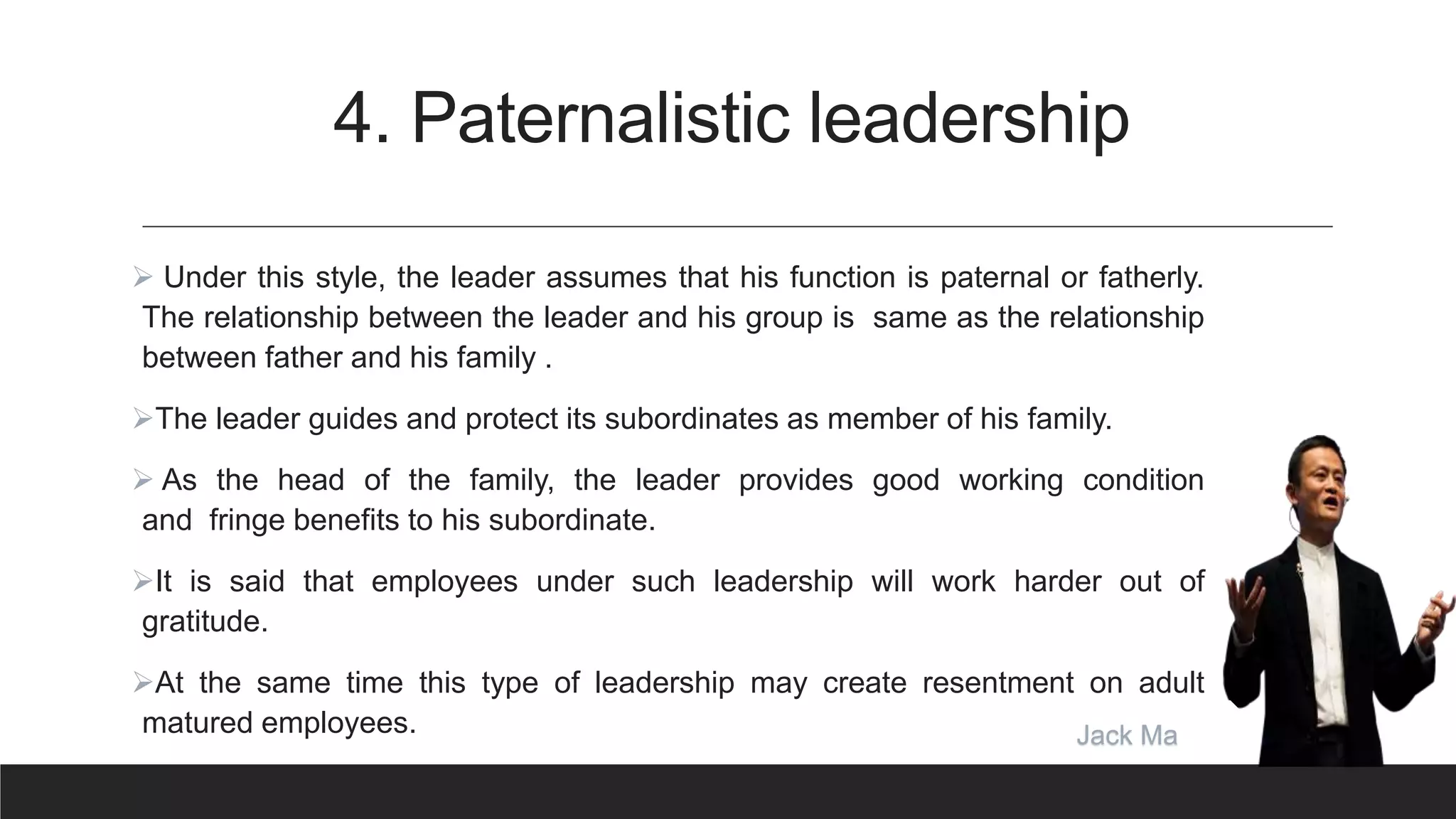
4. Paternalistic leadership
 Under this style, the leader assumes that his function is paternal or fatherly.
The relationship between the leader and his group is same as the relationship
between father and his family .
The leader guides and protect its subordinates as member of his family.
 As the head of the family, the leader provides good working condition
and fringe benefits to his subordinate.
It is said that employees under such leadership will work harder out of
gratitude.
At the same time this type of leadership may create resentment on adult
matured employees. Jack Ma
5. Charismatic leadership
A charismatic leader attracts more people. "Charisma possessed by a person attracts
a number of people towards him". He is known as charismatic leader.
There is something like magic with him. The charismatic leader gathers followers
through his of personality and charm, rather than any form of external power or
authority.
Charismatic leaders pay a great attention in scanning and reading their environment,
and are good at picking up the moods and concerns of both individuals and largest
audience.
Charismatic leaders, who are building a group, whether it is a political party, a cult or a
business team, will often focus strongly on making the group very clear and distinct
separating it from other.
Barack Obama is an example of a
charismatic leader
THANK YOU

Leadership Styles With Real Life Examples

  • 1.
  • 2.
    Leadership Styles  Theaction of leading a group of people or an organisation is known as Leadership.  Leadership styles are the patterns of behaviour which a leader adopt in influencing the behaviour of his followers.  It refers to a leader’s methods, characteristics and behaviors when directing, motivating, and managing their teams.
  • 3.
    Various styles ofleadership are adopted by different leaders. They are categorized as, 1.Autocratic style 2.Free rein style 3.Participative style 4.Paternalistic style 5.Charismatic Leadership
  • 4.
    1.Autocratic style  Itis also known as authoritarian, directive or monothetic style.  In autocratic leadership style a manager centralize decision making power and authority in himself and exercises complete and full fledged control over his subordinates.  He gives orders and the subordinates are expected to obey him.  He determines policies for the group without consulting them.  There are mainly three types of autocratic leaders, a) Strict autocrat b) Benevolent autocrat c) Manipulative autocrat
  • 5.
    a) Strict autocrat:- He follows autocratic style in a very strict sense. He influence subordinates through negative motivation That is by criticizing subordinates, imposing penalty etc. b) Benevolent autocrat :- Under this method, the leader influence his subordinate through positive motivation. He uses reward and incentives in directing his subordinates towards the organizational goal. goal. By using praise and pats on the back he secure the loyalty of subordinates who accept his decisions. c) Manipulative autocrat :- The autocratic leader tries to make the subordinate to feel that they are actually participating in decision making even though he had already taken decision.
  • 6.
    Advantages and Disadvantagesof Autocratic style Advantages:-  It permit quick decision making. Because only one person decides for the whole group.  It provides strong motivation and reward to a manager adopting this style.  There are many subordinates who like to work under centralized authority structure and strict discipline. They get satisfaction from this style. Disadvantages:-  It create dissatisfaction when it is strict and motivation style is negative.  Low morale and conflict develop easily in autocratic situation. There is more dependence less individuality in the organisation.
  • 7.
    2. Free reinor Laissez Faire Leadership  Free rein or laissez faire leadership means giving complete freedom to subordinates. That means the leader passes the responsibility for decision making to his subordinates and takes a minimum initiative in administration. He gives no direction and allows the group to establish its own goal and workout its own problems. This style of leadership can produce quick and good results if the subordinates are highly qualified and intelligent and who have a sincere desire to go ahead and perform their responsibilities. Once an investment decision is made, He trusts his managers to know how to achieve the performance he expects
  • 8.
    3.Participative Leadership This styleis also called democratic, consultative or ideographic style. Decentralization of authority is vested with this type of leadership. Subordinates are consulted and their participation in formulation of policies is ensured.
  • 9.
    Advantages and Disadvantagesof Participative Leadership Advantages:- 1. It rises the morale of employees. 2. It leads to better understanding and co-operation between management and employee. 3. It to leads to reduction in complaints and grievance 4. It reduce labour turnover and absenteeism Disadvantages:- 1. Quick decision cannot be taken. 2. Participation maybe interpreted as inefficiency of the leader in taking decisions.
  • 10.
    4. Paternalistic leadership Under this style, the leader assumes that his function is paternal or fatherly. The relationship between the leader and his group is same as the relationship between father and his family . The leader guides and protect its subordinates as member of his family.  As the head of the family, the leader provides good working condition and fringe benefits to his subordinate. It is said that employees under such leadership will work harder out of gratitude. At the same time this type of leadership may create resentment on adult matured employees. Jack Ma
  • 11.
    5. Charismatic leadership Acharismatic leader attracts more people. "Charisma possessed by a person attracts a number of people towards him". He is known as charismatic leader. There is something like magic with him. The charismatic leader gathers followers through his of personality and charm, rather than any form of external power or authority. Charismatic leaders pay a great attention in scanning and reading their environment, and are good at picking up the moods and concerns of both individuals and largest audience. Charismatic leaders, who are building a group, whether it is a political party, a cult or a business team, will often focus strongly on making the group very clear and distinct separating it from other. Barack Obama is an example of a charismatic leader
  • 12.