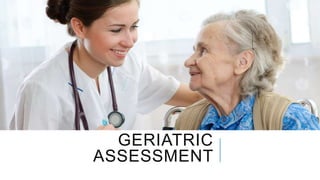
GERIATRIC
ASSESSMENT
DEFINITION
Geriatrics-
Geriatrics is the branch of medicine dealing with the problem of
the ageing and the diseases of the elderly and management of the
diseases of older adults.
The branch of medicine dealing with the health and care of old
people
Geriatric Nursing-
It is the field of nursing that specializes in the care of the
elderly.
Gerontological nursing is the specialty of nursing
pertaining to older adults.
ASSESSMENT OF ELDERLY
The geriatric assessment is a multidimensional,
multidisciplinary diagnostic instrument designed to
collect data on the medical, psychosocial and
functional capabilities and limitations of elderly
patients.
COMPONENTS OF GERIATRIC
ASSESSMENT
1.History
2.The Physical Examination
3.Neuropsychiatric Examination
4.Functional Examination
1- HISTORY
The geriatric assessment incorporates all
aspects of a conventional medical history
including demographic data, chief complaint,
present illness, past and current medical
problems, family and social history.
A) DEMOGRAPHIC DATA
It includes the following
•Full name
•Age, sex and birth date
•Marital status
•Source of history and reliability of
historian
B) CHIEF COMPLAINT AND
PRESENT ILLNESS
Elderly patients are famous for presenting with
any combination of non-specific, apparently
unrelated and seemingly trivial complaints.
Sometimes they have no complaint at all.
Chief complains includes -
•Primary reason for visit, ideally in patient's own
words
•Duration of presenting symptoms
C) PAST MEDICAL HISTORY
This includes the assessment of the following
things
Previous medical history.
General state of health
Childhood diseases
Immunizations (Tetanus-diphtheria,
pertussis, measles, mumps, rubella, hepatitis
A&B, influenza, varicella, h. flu., polio)
Chronological list of adult medical
diseases, injuries
Hospitalizations
Allergies
Medications, including dosage, duration
and indication
Diet
D) NUTRITIONAL
ASSESSMENT
Nutritional assessment involves the evaluation of :
• Current weight in comparison to ideal body
weight, with determination of BMI to evaluate for
underweight or obesity.
• Recent changes in body weight.
• Current medications and their potential to affect
the patient's nutritional status.
• Functional status to determine if the patient
can purchase and prepare food for Himself,
plus mental status with regard to their interest
in food.
• Food intake by food groups for a quick
estimation of adequacy of diet.
• Vitamin/mineral supplementation.
E) SOCIAL HISTORY
It address familial,
occupational, and
recreational aspects of
the patient's personal
life. The components
of social history are
Substances (Alcohol,
Tobacco, illicit drugs)
occupation
sexual preference
Travel &
exercise
Living arrangements,
financial security,
access to medical
services
Recreational Activity,
Sleep
F) SOCIAL NETWORKS
The assessment of social networks involves
collecting information on
(1) marital status,
(2) number of children and the frequency of
their visits,
(3) existence and involvement of other close
relatives or close friends, and
(4) frequency of attendance at religious and
secular meetings or events.
2- PHYSICAL EXAMINATION
The physical examination includes physical assessment of patient
from head to toe and the systemic evaluation. It is a major tool for
the diagnosis of elderly problems.
It includes
1- General Appearance
Apparent age, state of health, nutritional status, alertness, and
evidence of discomfort.
2- Vital Signs
Temperature, blood pressure, pulse rate and rhythm (regular or
irregular), and
respiratory rate and pattern.
3- Skin
4- Lymph nodes
Size, consistency, mobility and tenderness in occipital,
cervical, post-auricular, submandibular, supra-clavicular,
axillary and inguinal regions.
5- Head
Size, symmetry, evidence of trauma, tenderness (including
sinuses), masses, and condition of scalp.
6- Eyes
Eyebrows, lids, conjunctival inflammation and scleral icterus;
corneal opacities and abrasions; pupillary size, equality and
reaction to light and accommodation; extraocular movements
and exophthalmos; fundi for discs, vessels, macula, exudates
and hemorrhages; gross visual acuity and fields.
7- Ears
8- Nose
Deformities and septal deviation; obstruction, mucous
membrane inflammation, polyps, bleeding and discharge.
9- Mouth
Lip color, lesions and pigmentations; condition of teeth;
gingival color, inflammation, and bleeding; tongue color,
moisture, tremor and coating; buccal mucosa inflammation
and eruptions; soft palate; odor of breath. If patient wears
dentures, remove them.
10- Throat
Mucosal color, exudates and lesions; tonsil size, symmetry
and exudates; post-nasal discharge.
11- Neck
Range of motion; pain and tenderness; tracheal position,
thyroid size, symmetry and consistency; carotid impulse
12- Back
Range of motion; pain and tenderness over spine, muscles
and costovertebral angle; symmetry.
13- Thorax
Shape and symmetry in excursion; intercostal retractions; rib
tenderness and chest wall masses.
14- Lungs
Percussion, auscultation, bronchophony, egophony,
pectoriloquy and fremitus.
15- Breasts
Size, shape, symmetry, tenderness and masses.
16- Heart
Precordial movement, apical impulse, rate and rhythm; heart
sounds, murmurs, rubs and gallops.
17- Abdomen
Shape, tenderness, bowel sounds and bruits; size of liver,
spleen, and kidneys; masses
18- Extremities
Deformities, tenderness, localized swelling, peripheral
pulses and edema, cyanosis, clubbing, temperature,
varicose veins, and hair loss.
19- Musculoskeletal
Joint mobility, tenderness, effusion, erythema and
deformity.
20- Neurologic
Screening exam in non-neurologic cases, otherwise full
exam. Mental status; cranial nerves; peripheral strength,
tone and sensation; deep tendon reflexes; Rhomberg and
21- Female Pelvic and Rectal
External genitalia; speculum exam for vaginal
mucosa and cervix, bimanual exam for uterus,
masses and tenderness; digital rectal.
22- Male Pelvic and Rectal
Inguinal hernias; scrotal and testicular masses
and tenderness; digital rectal, with prostate
exam.
3- NEUROPSYCHIATRIC
EXAMINATION
Neurological and psychiatric examinations
comprise a significant portion of the Geriatric
Assessment.
This is because illnesses such as dementia and
delirium are common among elderly patients.
It includes (Mini-Mental State Examination)
1. Cognitive Assessment
2. Mood Assessment
3. Substance Abuse
4. Competency
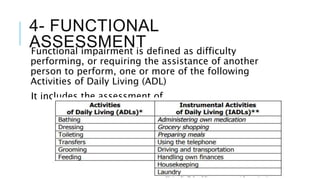
4- FUNCTIONAL
ASSESSMENTFunctional impairment is defined as difficulty
performing, or requiring the assistance of another
person to perform, one or more of the following
Activities of Daily Living (ADL)
It includes the assessment of

Geriatric Assessment , Assessment of Elderly

  • 1.
  • 2.
    DEFINITION Geriatrics- Geriatrics is thebranch of medicine dealing with the problem of the ageing and the diseases of the elderly and management of the diseases of older adults. The branch of medicine dealing with the health and care of old people
  • 3.
    Geriatric Nursing- It isthe field of nursing that specializes in the care of the elderly. Gerontological nursing is the specialty of nursing pertaining to older adults.
  • 4.
    ASSESSMENT OF ELDERLY Thegeriatric assessment is a multidimensional, multidisciplinary diagnostic instrument designed to collect data on the medical, psychosocial and functional capabilities and limitations of elderly patients.
  • 5.
    COMPONENTS OF GERIATRIC ASSESSMENT 1.History 2.ThePhysical Examination 3.Neuropsychiatric Examination 4.Functional Examination
  • 6.
    1- HISTORY The geriatricassessment incorporates all aspects of a conventional medical history including demographic data, chief complaint, present illness, past and current medical problems, family and social history.
  • 7.
    A) DEMOGRAPHIC DATA Itincludes the following •Full name •Age, sex and birth date •Marital status •Source of history and reliability of historian
  • 8.
    B) CHIEF COMPLAINTAND PRESENT ILLNESS Elderly patients are famous for presenting with any combination of non-specific, apparently unrelated and seemingly trivial complaints. Sometimes they have no complaint at all. Chief complains includes - •Primary reason for visit, ideally in patient's own words •Duration of presenting symptoms
  • 9.
    C) PAST MEDICALHISTORY This includes the assessment of the following things Previous medical history. General state of health Childhood diseases Immunizations (Tetanus-diphtheria, pertussis, measles, mumps, rubella, hepatitis A&B, influenza, varicella, h. flu., polio)
  • 10.
    Chronological list ofadult medical diseases, injuries Hospitalizations Allergies Medications, including dosage, duration and indication Diet
  • 11.
    D) NUTRITIONAL ASSESSMENT Nutritional assessmentinvolves the evaluation of : • Current weight in comparison to ideal body weight, with determination of BMI to evaluate for underweight or obesity. • Recent changes in body weight. • Current medications and their potential to affect the patient's nutritional status.
  • 12.
    • Functional statusto determine if the patient can purchase and prepare food for Himself, plus mental status with regard to their interest in food. • Food intake by food groups for a quick estimation of adequacy of diet. • Vitamin/mineral supplementation.
  • 13.
    E) SOCIAL HISTORY Itaddress familial, occupational, and recreational aspects of the patient's personal life. The components of social history are Substances (Alcohol, Tobacco, illicit drugs) occupation sexual preference Travel & exercise Living arrangements, financial security, access to medical services Recreational Activity, Sleep
  • 14.
    F) SOCIAL NETWORKS Theassessment of social networks involves collecting information on (1) marital status, (2) number of children and the frequency of their visits, (3) existence and involvement of other close relatives or close friends, and (4) frequency of attendance at religious and secular meetings or events.
  • 15.
    2- PHYSICAL EXAMINATION Thephysical examination includes physical assessment of patient from head to toe and the systemic evaluation. It is a major tool for the diagnosis of elderly problems. It includes 1- General Appearance Apparent age, state of health, nutritional status, alertness, and evidence of discomfort. 2- Vital Signs Temperature, blood pressure, pulse rate and rhythm (regular or irregular), and respiratory rate and pattern. 3- Skin
  • 16.
    4- Lymph nodes Size,consistency, mobility and tenderness in occipital, cervical, post-auricular, submandibular, supra-clavicular, axillary and inguinal regions. 5- Head Size, symmetry, evidence of trauma, tenderness (including sinuses), masses, and condition of scalp. 6- Eyes Eyebrows, lids, conjunctival inflammation and scleral icterus; corneal opacities and abrasions; pupillary size, equality and reaction to light and accommodation; extraocular movements and exophthalmos; fundi for discs, vessels, macula, exudates and hemorrhages; gross visual acuity and fields. 7- Ears
  • 17.
    8- Nose Deformities andseptal deviation; obstruction, mucous membrane inflammation, polyps, bleeding and discharge. 9- Mouth Lip color, lesions and pigmentations; condition of teeth; gingival color, inflammation, and bleeding; tongue color, moisture, tremor and coating; buccal mucosa inflammation and eruptions; soft palate; odor of breath. If patient wears dentures, remove them. 10- Throat Mucosal color, exudates and lesions; tonsil size, symmetry and exudates; post-nasal discharge. 11- Neck Range of motion; pain and tenderness; tracheal position, thyroid size, symmetry and consistency; carotid impulse
  • 18.
    12- Back Range ofmotion; pain and tenderness over spine, muscles and costovertebral angle; symmetry. 13- Thorax Shape and symmetry in excursion; intercostal retractions; rib tenderness and chest wall masses. 14- Lungs Percussion, auscultation, bronchophony, egophony, pectoriloquy and fremitus. 15- Breasts Size, shape, symmetry, tenderness and masses. 16- Heart Precordial movement, apical impulse, rate and rhythm; heart sounds, murmurs, rubs and gallops.
  • 19.
    17- Abdomen Shape, tenderness,bowel sounds and bruits; size of liver, spleen, and kidneys; masses 18- Extremities Deformities, tenderness, localized swelling, peripheral pulses and edema, cyanosis, clubbing, temperature, varicose veins, and hair loss. 19- Musculoskeletal Joint mobility, tenderness, effusion, erythema and deformity. 20- Neurologic Screening exam in non-neurologic cases, otherwise full exam. Mental status; cranial nerves; peripheral strength, tone and sensation; deep tendon reflexes; Rhomberg and
  • 20.
    21- Female Pelvicand Rectal External genitalia; speculum exam for vaginal mucosa and cervix, bimanual exam for uterus, masses and tenderness; digital rectal. 22- Male Pelvic and Rectal Inguinal hernias; scrotal and testicular masses and tenderness; digital rectal, with prostate exam.
  • 21.
    3- NEUROPSYCHIATRIC EXAMINATION Neurological andpsychiatric examinations comprise a significant portion of the Geriatric Assessment. This is because illnesses such as dementia and delirium are common among elderly patients. It includes (Mini-Mental State Examination) 1. Cognitive Assessment 2. Mood Assessment 3. Substance Abuse 4. Competency
  • 22.
    4- FUNCTIONAL ASSESSMENTFunctional impairmentis defined as difficulty performing, or requiring the assistance of another person to perform, one or more of the following Activities of Daily Living (ADL) It includes the assessment of