Additives:
There are two additives used in polyester industry.
 TDO (Titanium Dioxide)
 Catalyst (Antimony Triacetate)
TDO:
It is de-lusting and dulling agent (i.e., to eliminate brightness)used for making white color of PET
instead of transparent. TDO is white powder imported from Germany in 1000kgs. TDO is mixed
with EG and added with respect to weight of PET produced. It is added in Polymer process at
Esterification stage-2 (ES-2).
Catalyst:
Antimony triacetate is used as catalyst for promotion of polycondensation of PET. It is white
crystalline powder imported from China in buckets each of weight 15 kg. The catalyst active part is
Antimony metal ion Sb+++. Catalyst is mixed with filtered EG in low concentration (3% solution)
batch wise in the catalyst preparation vessel.After filtration, prepared solution is continuously fed
in a defined amount (180 ppm of PET) to the paste preparation tank. It produces no adverse effect
on quality of the product.
HTM Section:
Both reactions Esterification/Polycondensation are endothermic, so large amount of heat is required to bring
the reactors to the reaction temperature (>2500C). For this purpose,two phases heat transfermedium are used
in HTM system:
 Primary HTM
 Secondary HTM
Primary HTM System:
The primary HTL systemprovides total heat requirement of the Polycondensation and Spinning plant. The
necessary thermal energy for all related plant sections is supplied and distributed by liquid heat transfer media
(HTM).
In order to achieve this, the liquid HTM systemis heated in the HTM heaters to constant feed temperature
3250C. The required heat generated by combustion of fuel oil or fuel gas.The Primary HTM pumps are used
to circulate HTM via the primary heating circuit.
No. of HTM Furnaces = 3 (2 operation, 1 stand by)
No. of primary HTM Pumps = 4 (3 used mostly)
Secondary HTM System:
HTM circulation in Polymer Building through HTM Pumps (8.0 & 16.0 Meter) is called secondary HTM
system. All reactors heating through coils (ES-1, ES-2 & PP) and jacket of DRR and Product transfer line
heating is done through secondary HTM Pumps.
HTM:
Two HTM used in coils or jackets or lines for heating purpose.
 Sanotherm (Therminol-66) ---Liquid form
 Dowtherm (Diphenyl) ----Vapor form
Santotherm:
It is used for primary heating. The heating of HTM is carried in heaters/furnaces by burning HFO
or Natural gas. For this purposed there are dual fuel burners are installed on heater’s top vertically.
As its boiling point is almost 3400C so we heat it at high temperature within liquid state.We mostly
heat it at 3200C. Every coil line has different inlet and exit points.
Dowtherm:
For the secondary heating, HTM having boiling point 254~258 0C is also used in vapor form. It is
heated by primary HTM coming from furnaces. It is moved into the jackets of reactors to have
uniform heat around the reactor. It is also used in spinning section where the melt to heat melt
polymer.
Why Santotherm instead of Steam?
 Heat is transferred more in liquid phase instead of vapor phase.
 At high temperature, steam becomes superheated steam, which decreases coefficient of heat
transfer. Hence, we used Sanothermfor temperature like 250~320 0C.
Polymer Process:
Polymer Process completes in following stages:
1. Paste Preparation
2. Esterification stage 1 (ES-1)
3. Esterification stage 2 (ES-2)
4. Pre-Polycondensation (PP)
5. Polycondensation in Disc Ring Reactor (DRR)
Paste Preparation:
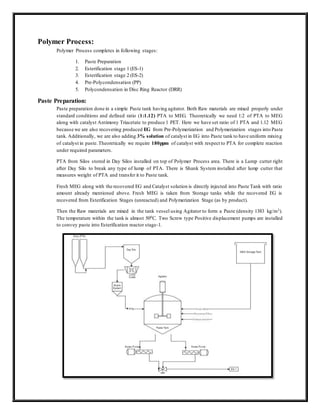
Paste preparation done in a simple Paste tank having agitator. Both Raw materials are mixed properly under
standard conditions and defined ratio (1:1.12) PTA to MEG. Theoretically we need 1:2 of PTA to MEG
along with catalyst Antimony Triacetate to produce 1 PET. Here we have set ratio of 1 PTA and 1.12 MEG
because we are also recovering produced EG from Pre-Polymerization and Polymerization stages into Paste
tank. Additionally, we are also adding 3% solution of catalyst in EG into Paste tank to have uniform mixing
of catalyst in paste.Theoretically we require 180ppm of catalyst with respect to PTA for complete reaction
under required parameters.
PTA from Silos stored in Day Silos installed on top of Polymer Process area. There is a Lump cutter right
after Day Silo to break any type of lump of PTA. There is Shank System installed after lump cutter that
measures weight of PTA and transfer it to Paste tank.
Fresh MEG along with the recovered EG and Catalyst solution is directly injected into Paste Tank with ratio
amount already mentioned above. Fresh MEG is taken from Storage tanks while the recovered EG is
recovered from Esterification Stages (unreacted) and Polymerization Stage (as by product).
Then the Raw materials are mixed in the tank vessel using Agitator to form a Paste (density 1383 kg/m3).
The temperature within the tank is almost 500C. Two Screw type Positive displacement pumps are installed
to convey paste into Esterification reactor stage-1.
Esterification:
It Consists of two reactors (ES-1 & ES-2) in series and divided in two stages.
1. Esterification Stage-1
2. Esterification Stage-2
Esterification Stage-1:
Paste from Paste tank is transferred into reactor ES-1. ES-1 reactor in CSTR type of reactor, here two kinds
of HTM are used like Santotherm and Dowtherm. Sanotherm is present within coils in the reactor, while
Dowtherm is installed in the jacket of reactor. In ES-1 the temperature is maintained to 2500Cwith 400mbar
gauge pressure. In ES-1 esterification is completed upto 91-93%.
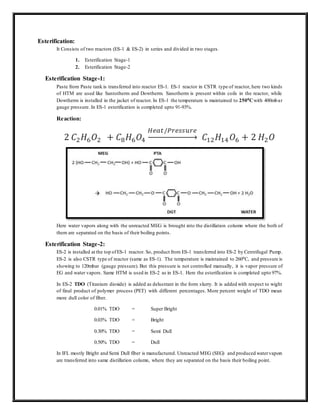
Reaction:
2 𝐶2𝐻6𝑂2 + 𝐶8𝐻6𝑂4
𝐻𝑒𝑎𝑡/𝑃𝑟𝑒𝑠𝑠𝑢𝑟𝑒
→ 𝐶12𝐻14𝑂6 + 2 𝐻2𝑂
Here water vapors along with the unreacted MEG is brought into the distillation column where the both of
them are separated on the basis of their boiling points.
Esterification Stage-2:
ES-2 is installed at the top ofES-1 reactor. So, product from ES-1 transferred into ES-2 by Centrifugal Pump.
ES-2 is also CSTR type of reactor (same as ES-1). The temperature is maintained to 2600C, and pressure is
showing to 120mbar (gauge pressure). But this pressure is not controlled manually, it is vapor pressure of
EG and water vapors. Same HTM is used in ES-2 as in ES-1. Here the esterification is completed upto 97%.
In ES-2 TDO (Titanium dioxide) is added as delustrant in the form slurry. It is added with respect to wight
of final product of polymer process (PET) with different percentages. More percent weight of TDO mean
more dull color of fiber.
0.01% TDO = Super Bright
0.03% TDO = Bright
0.30% TDO = Semi Dull
0.50% TDO = Dull
In IFL mostly Bright and Semi Dull fiber is manufactured. Unreacted MEG (SEG) and produced watervapors
are transferred into same distillation column, where they are separated on the basis their boiling point.
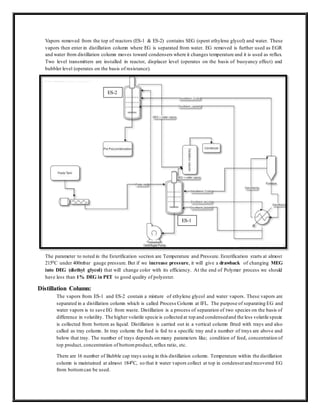
Vapors removed from the top of reactors (ES-1 & ES-2) contains SEG (spent ethylene glycol) and water. These
vapors then enter in distillation column where EG is separated from water. EG removed is further used as EGR
and water from distillation column moves toward condensers where it changes temperature and it is used as reflux.
Two level transmitters are installed in reactor, displacer level (operates on the basis of buoyancy effect) and
bubbler level (operates on the basis of resistance).
The parameter to noted in the Esterification section are Temperature and Pressure. Esterification starts at almost
2150C under 400mbar gauge pressure. But if we increase pressure, it will give a drawback of changing MEG
into DEG (diethyl glycol) that will change color with its efficiency. At the end of Polymer process we should
have less than 1% DEG in PET to good quality of polyester.
Distillation Column:
The vapors from ES-1 and ES-2 contain a mixture of ethylene glycol and water vapors. These vapors are
separated in a distillation column which is called Process Column at IFL. The purpose of separating EG and
water vapors is to save EG from waste. Distillation is a process of separation of two species on the basis of
difference in volatility. The higher volatile specie is collected at top and condensedand the less volatile specie
is collected from bottom as liquid. Distillation is carried out in a vertical column fitted with trays and also
called as tray column. In tray column the feed is fed to a specific tray and a number of trays are above and
below that tray. The number of trays depends on many parameters like; condition of feed, concentration of
top product, concentration of bottomproduct, reflux ratio, etc.
There are 16 number of Bubble cap trays using in this distillation column. Temperature within the distillation
column is maintained at almost 1840C, so that it water vapors collect at top in condenserand recovered EG
from bottomcan be used.
ES-2
ES-1

Polymer process

  • 1.
    Additives: There are twoadditives used in polyester industry.  TDO (Titanium Dioxide)  Catalyst (Antimony Triacetate) TDO: It is de-lusting and dulling agent (i.e., to eliminate brightness)used for making white color of PET instead of transparent. TDO is white powder imported from Germany in 1000kgs. TDO is mixed with EG and added with respect to weight of PET produced. It is added in Polymer process at Esterification stage-2 (ES-2). Catalyst: Antimony triacetate is used as catalyst for promotion of polycondensation of PET. It is white crystalline powder imported from China in buckets each of weight 15 kg. The catalyst active part is Antimony metal ion Sb+++. Catalyst is mixed with filtered EG in low concentration (3% solution) batch wise in the catalyst preparation vessel.After filtration, prepared solution is continuously fed in a defined amount (180 ppm of PET) to the paste preparation tank. It produces no adverse effect on quality of the product. HTM Section: Both reactions Esterification/Polycondensation are endothermic, so large amount of heat is required to bring the reactors to the reaction temperature (>2500C). For this purpose,two phases heat transfermedium are used in HTM system:  Primary HTM  Secondary HTM Primary HTM System: The primary HTL systemprovides total heat requirement of the Polycondensation and Spinning plant. The necessary thermal energy for all related plant sections is supplied and distributed by liquid heat transfer media (HTM). In order to achieve this, the liquid HTM systemis heated in the HTM heaters to constant feed temperature 3250C. The required heat generated by combustion of fuel oil or fuel gas.The Primary HTM pumps are used to circulate HTM via the primary heating circuit. No. of HTM Furnaces = 3 (2 operation, 1 stand by) No. of primary HTM Pumps = 4 (3 used mostly) Secondary HTM System: HTM circulation in Polymer Building through HTM Pumps (8.0 & 16.0 Meter) is called secondary HTM system. All reactors heating through coils (ES-1, ES-2 & PP) and jacket of DRR and Product transfer line heating is done through secondary HTM Pumps. HTM: Two HTM used in coils or jackets or lines for heating purpose.  Sanotherm (Therminol-66) ---Liquid form  Dowtherm (Diphenyl) ----Vapor form
  • 2.
    Santotherm: It is usedfor primary heating. The heating of HTM is carried in heaters/furnaces by burning HFO or Natural gas. For this purposed there are dual fuel burners are installed on heater’s top vertically. As its boiling point is almost 3400C so we heat it at high temperature within liquid state.We mostly heat it at 3200C. Every coil line has different inlet and exit points. Dowtherm: For the secondary heating, HTM having boiling point 254~258 0C is also used in vapor form. It is heated by primary HTM coming from furnaces. It is moved into the jackets of reactors to have uniform heat around the reactor. It is also used in spinning section where the melt to heat melt polymer. Why Santotherm instead of Steam?  Heat is transferred more in liquid phase instead of vapor phase.  At high temperature, steam becomes superheated steam, which decreases coefficient of heat transfer. Hence, we used Sanothermfor temperature like 250~320 0C.
  • 3.
    Polymer Process: Polymer Processcompletes in following stages: 1. Paste Preparation 2. Esterification stage 1 (ES-1) 3. Esterification stage 2 (ES-2) 4. Pre-Polycondensation (PP) 5. Polycondensation in Disc Ring Reactor (DRR) Paste Preparation: Paste preparation done in a simple Paste tank having agitator. Both Raw materials are mixed properly under standard conditions and defined ratio (1:1.12) PTA to MEG. Theoretically we need 1:2 of PTA to MEG along with catalyst Antimony Triacetate to produce 1 PET. Here we have set ratio of 1 PTA and 1.12 MEG because we are also recovering produced EG from Pre-Polymerization and Polymerization stages into Paste tank. Additionally, we are also adding 3% solution of catalyst in EG into Paste tank to have uniform mixing of catalyst in paste.Theoretically we require 180ppm of catalyst with respect to PTA for complete reaction under required parameters. PTA from Silos stored in Day Silos installed on top of Polymer Process area. There is a Lump cutter right after Day Silo to break any type of lump of PTA. There is Shank System installed after lump cutter that measures weight of PTA and transfer it to Paste tank. Fresh MEG along with the recovered EG and Catalyst solution is directly injected into Paste Tank with ratio amount already mentioned above. Fresh MEG is taken from Storage tanks while the recovered EG is recovered from Esterification Stages (unreacted) and Polymerization Stage (as by product). Then the Raw materials are mixed in the tank vessel using Agitator to form a Paste (density 1383 kg/m3). The temperature within the tank is almost 500C. Two Screw type Positive displacement pumps are installed to convey paste into Esterification reactor stage-1.
  • 4.
    Esterification: It Consists oftwo reactors (ES-1 & ES-2) in series and divided in two stages. 1. Esterification Stage-1 2. Esterification Stage-2 Esterification Stage-1: Paste from Paste tank is transferred into reactor ES-1. ES-1 reactor in CSTR type of reactor, here two kinds of HTM are used like Santotherm and Dowtherm. Sanotherm is present within coils in the reactor, while Dowtherm is installed in the jacket of reactor. In ES-1 the temperature is maintained to 2500Cwith 400mbar gauge pressure. In ES-1 esterification is completed upto 91-93%. Reaction: 2 𝐶2𝐻6𝑂2 + 𝐶8𝐻6𝑂4 𝐻𝑒𝑎𝑡/𝑃𝑟𝑒𝑠𝑠𝑢𝑟𝑒 → 𝐶12𝐻14𝑂6 + 2 𝐻2𝑂 Here water vapors along with the unreacted MEG is brought into the distillation column where the both of them are separated on the basis of their boiling points. Esterification Stage-2: ES-2 is installed at the top ofES-1 reactor. So, product from ES-1 transferred into ES-2 by Centrifugal Pump. ES-2 is also CSTR type of reactor (same as ES-1). The temperature is maintained to 2600C, and pressure is showing to 120mbar (gauge pressure). But this pressure is not controlled manually, it is vapor pressure of EG and water vapors. Same HTM is used in ES-2 as in ES-1. Here the esterification is completed upto 97%. In ES-2 TDO (Titanium dioxide) is added as delustrant in the form slurry. It is added with respect to wight of final product of polymer process (PET) with different percentages. More percent weight of TDO mean more dull color of fiber. 0.01% TDO = Super Bright 0.03% TDO = Bright 0.30% TDO = Semi Dull 0.50% TDO = Dull In IFL mostly Bright and Semi Dull fiber is manufactured. Unreacted MEG (SEG) and produced watervapors are transferred into same distillation column, where they are separated on the basis their boiling point.
  • 5.
    Vapors removed fromthe top of reactors (ES-1 & ES-2) contains SEG (spent ethylene glycol) and water. These vapors then enter in distillation column where EG is separated from water. EG removed is further used as EGR and water from distillation column moves toward condensers where it changes temperature and it is used as reflux. Two level transmitters are installed in reactor, displacer level (operates on the basis of buoyancy effect) and bubbler level (operates on the basis of resistance). The parameter to noted in the Esterification section are Temperature and Pressure. Esterification starts at almost 2150C under 400mbar gauge pressure. But if we increase pressure, it will give a drawback of changing MEG into DEG (diethyl glycol) that will change color with its efficiency. At the end of Polymer process we should have less than 1% DEG in PET to good quality of polyester. Distillation Column: The vapors from ES-1 and ES-2 contain a mixture of ethylene glycol and water vapors. These vapors are separated in a distillation column which is called Process Column at IFL. The purpose of separating EG and water vapors is to save EG from waste. Distillation is a process of separation of two species on the basis of difference in volatility. The higher volatile specie is collected at top and condensedand the less volatile specie is collected from bottom as liquid. Distillation is carried out in a vertical column fitted with trays and also called as tray column. In tray column the feed is fed to a specific tray and a number of trays are above and below that tray. The number of trays depends on many parameters like; condition of feed, concentration of top product, concentration of bottomproduct, reflux ratio, etc. There are 16 number of Bubble cap trays using in this distillation column. Temperature within the distillation column is maintained at almost 1840C, so that it water vapors collect at top in condenserand recovered EG from bottomcan be used. ES-2 ES-1