International Journal of Engineering and Technical Research (IJETR)
ISSN: 2321-0869, Volume-1, Issue-10, December 2013
93 www.erpublication.org

Abstract— Purified Terephthalic Acid (PTA for short) and
Mono Ethylene Glycol (MEG) are the basic raw materials used
for polyester manufacture. In the manufacture of textile grade
polyester, these raw materials are converted to molten polymer
(Polyethylene terephthalate) in continuous polymerisation (CP)
units. CP-4 is one such continuous polymerisation unit, feeding
polymer to manufacture Polyester staple fiber (PSF). in Maral
Oversease limited, nimrani. The rated capacity of CP-4 is 180
tons per day of polymer, at present running 224TPD. Design of
CP-4 unit is based on DU PONT technology.
The paper comprises the study on CP-4 PSF
esterification section heat exchanger, it discuss heat balance of
the system.
Index Terms—CP, PSF, PTA, MEG.
I. INTRODUCTION
A heat exchanger consists of heat transfer elements
such as a core or matrix containing the heat transfer surface,
and fluid distribution elements such as headers, manifolds,
tanks, inlet and outlet nozzles or pipes, or seals. Usually, there
are no moving parts in a heat exchanger; however, there are
exceptions, such as a rotary regenerative exchanger or surface
heat exchanger.
The heat transfer surface is a surface of the
exchanger core that is in direct contact with fluids and through
which heat is transferred by conduction. That portion of the
surface that is in direct contact with both the hot and cold
fluids and transfers heat between them is referred to as the
primary or direct surface. To increase the heat transfer area,
appendages may be intimately connected to the primary
surface to provide an extended, secondary, or indirect surface.
These extended surface elements are referred to as fins. Thus,
heat is conducted through the fin and convected and radiated
from the fin (through the surface area) to the surrounding
fluid, or vice versa, depending on whether the fin is being
cooled or heated. As a result, the addition of fins to the
primary surface reduces the thermal resistance on that side
and thereby increases the total heat transfer from the surface
for the same temperature difference. Fins may form flow
passages for the individual fluids but do not separate the two
(or more) fluids of the exchanger. These secondary surfaces
or fins may also be introduced primarily for structural
Manuscript received December 20, 2013.
Vikas Barfa, Student of Master of Engineering, RGPV Bhopal, M.P.
Specialisation in Thermal Engineering. Contact No. 09584686262.
Mr. A. Paul, Associate Professor Mechanical Engineering SSSIST
sehore M.P.
Dr. G.R.Selokar, Principal,SSSIST Sehore M.P.
Not only heat exchangers often used in the process,
power, petroleum, transportation, air-conditioning,
refrigeration, cryogenic, heat recovery, alternative fuel, and
manufacturing industries, they also serve as key components
of many industrial products available in the market place.
These exchangers can be classified in many different ways.
II. THE CRITERIA THAT A PROCESS HEAT EXCHANGER MUST
SATISFY ARE,
1. The heat exchanger must meet the process
requirements. That is, it must effect the desired change in the
thermal condition of the process stream within the allowable
pressure drops, and it must continue to do this until the next
scheduled shutdown of the plant for maintenance.
2. The exchanger must withstand the service conditions
of the plant environment. This includes the mechanical
stresses of installation, startup, shutdown, normal operation,
emergencies, and maintenance, and the thermal stresses
induced by the temperature differences. It must also resist
corrosion by the process and service streams (as well as by
the environment); this is usually mainly a matter of choice of
materials of construction, but mechanical design does have
some effect. Desirably, the exchanger should also resist
fouling, but there is not much the designer may do with
confidence in this regard except keep the velocities as high as
pressure drop and vibration limits permit.
3. The exchanger must be maintainable, which usually
implies choosing a configuration that permits cleaning tube
side and/or shell-side, as may be indicated and replacement
of tubes and any other components that may be especially
vulnerable to corrosion, erosion, or vibration. This
requirement may also place limitations on positioning the
exchanger and in providing clear space around it.
4. The exchanger should cost as little as is consistent
with the above requirements; in the present context, this
refers to first cost or installed cost, since operating cost and
the cost of lost production due to exchanger unavailability
have already been considered by implication in the earlier
and more important criteria.
5. Finally, there may be limitations on exchanger
diameter, length, weight and/or tube specifications due to site
requirements, lifting and servicing capabilities, or inventory
considerations.
It is a desirable feature that the exchanger design be
specified with an eye to possible alternative uses in other
applications. However, this has disturbing implications.
Most heat exchangers are intended for projects having an
expected life of five to twenty years equal to or greater than
the probable life of the exchanger. To suggest that a heat
exchanger might become available sooner implies either that
Heat Balance Analysis for Esterification Heat
Exchanger for Increased Capacity
Vikas Barfa, A. Paul, Dr. G.R.Selokar
Heat Balance Analysis for Esterification Heat Exchanger for Increased Capacity
94 www.erpublication.org
the exchanger or the process will prove unsatisfactory in its
role. It is far better to labor under the positive compulsion
that the only hope for success is by designing each item
uniquely for the best performance in the task at hand.
III. PROCESS DESCRIPTION
Purified Terephthalic Acid (PTA for short) and
Mono Ethylene Glycol (MEG) are the basic raw materials
used for polyester manufacture. In the manufacture of textile
grade polyester, these raw materials are converted to molten
polymer (Polyethylene terephthalate) in continuous
polymerisation (CP) units. CP-4 is one such continuous
polymerisation unit, feeding polymer to manufacture
Polyester staple fiber (PSF). The rated capacity of CP-4 is
180 tons per day of polymer, at present running 224TPD.
Design of CP-4 unit is based on DU PONT technology.
While esterification reaction does not require any
catalyst, the raw materials, i.e., PTA and MEG undergo
esterification at atmospheric pressure and elevated
temperature (280-300 0
C). Polycondensation on the other
hand, requires antimony trioxide as catalyst. Also, the
polycondensation reaction occurs at high temperature and
vacuum.
Process of conversion of raw material to polymer is
taking place in three reactors. The first reactor is called
esterification reactor, where esterification of PTA and MEG
takes place. Some amount of polycondensation also does
occur in this reactor, leading to formation of oligomer having
an average degree of polymerization (DP) of 6-10 instead of
pure DHET. Oligomer thus formed undergoes further
stepwise polymerization in two vessels operating under high
temperature and vacuum, viz., Upflow, Prepolymeriser
(UPPP) and Finisher. Different temperature and pressure are
maintained in the three vessels for polycondensation reaction
to take place.
IV. HEAT BALANCE
The formation of DHET with the elimination of two moles
of water is starting reaction of manufacturing of PET .The
subsequent reaction where in two/more such DHET
molecules join together to build a chain of polymer involves
elimination of one molecule of MEG. This is condensation
polymerization.
A both reactions are reversible and removal of byproduct
namely water and MEG has to be done to drive reaction in
forward direction to produce PET polymer.
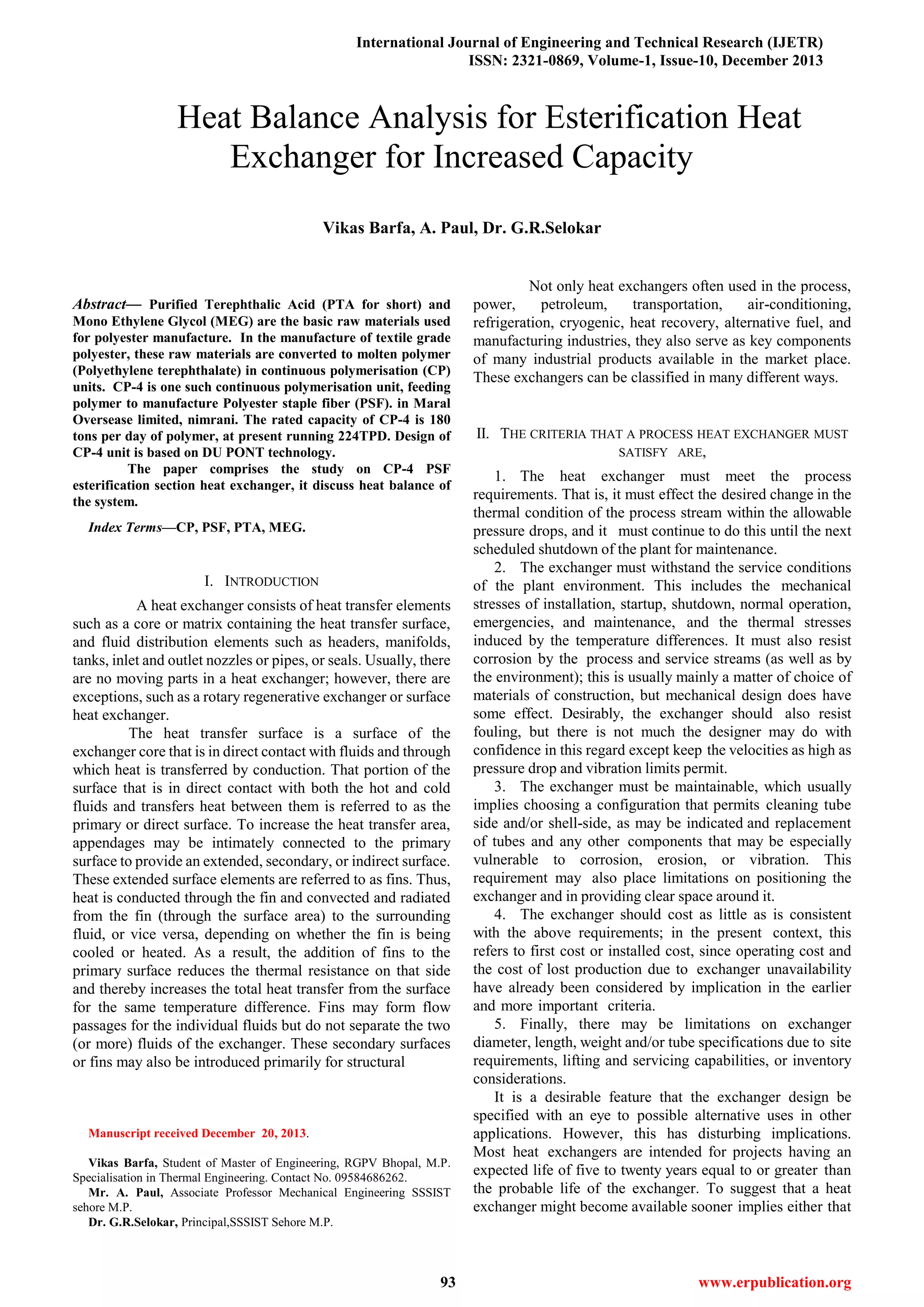
The heat of reaction can be calculated using following
reaction at 25 C.
The heat of reaction of PTA and MEG = Sum of heat of
formation of products - Sum of heat of reaction of reactants
Reactants of
Formation
Heat of
Formation
Products A. Heat of
Formation
1mole of
PTAkcal/mol -195.02
kcal/mol
1 mole of
DHET
-261.80
2 mole of
MEGkcal/mol
-92.07
kcal/mol
2 mole
WATER
-57.79
Hence standard heat of reaction at 25 C is 3.57 kcal/mol. As
the value is small and +ve, the reaction is slightly
endothermic.
As the plant data shows high heavy heat load duty at the
reactor stage wherein the initial reaction forming DHET takes
place. The high heat duty can be requirement for higher
production to increase the rate of reaction or to keep process
fluid in molten form.
Polymerization reaction involving the chain building of
monomers with elimination of MEG Is exothermic reaction.
The heat of reaction given in literature is –20 kcal/mol of
MEG given out. When the above values are very small, so
heat of reaction is considered negligible in heat balance
calculation.
V. DESIGN CALCULATIONS
ASS Assumption- For higher throughput reactor temperature to be
increased to 290 C from existing 285 C and reactor level to
be increased to 44(38) percent for required conversion.
Polymer Through
PUT
Flow11640 kg/hr
(Data)
Specific heat of PTA 1.312 kJ/kg.C
Avg. specific
heat of EG
2.42 kJ/kg.C
Heat of dissolution
of PTA
472 kJ/kg.C
Specific heat of water 4.184 kJ/kg.C
Heat of vaporization
of EG at (290C)
550 kJ/kg.C
Heat of vaporization
of water at(290C)
1434 kJ/kg.C
Specific heat
of oilgomer
2.09 kJ/kg.C
PET Actual 11434.32 kg/hr
PTA feed 9846.09 kg/hr
Recycle EG feed
(with 5%moisture)
7742.01 kg/hr
Actual EG 7354.91 kg/hr
Water 387.10 kg/hr
Water vapor overhead 2355.74 kg/hr
EG vapor overhead 3413.12 kg/hr
Slurry temp. 80 C
Reactor temp 290 C
International Journal of Engineering and Technical Research (IJETR)
ISSN: 2321-0869, Volume-1, Issue-10, December 2013
95 www.erpublication.org
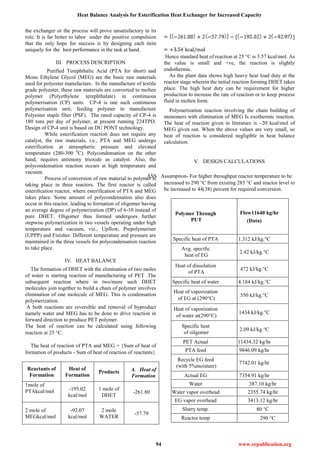
VI. HEAT CALCULATIONS
Q Description
For PUT 11640
kg/hr
Q1 Heat taken by PTA
Q2
Heat taken for PTA
dissolution
Q3
Heat taken by
feed EG
Q4
Heat taken
by water
Q5
Heat taken for EG
vaporization
Q6
Heat taken by water
vaporization
Q7
Heat taken to
heat oligomer
Q
TOTAL HEAT
LOAD
HEAT GIVEN BY
DOWTHERM
VII. ANALYSIS
The detailed energy balance calculations for CP4
heat indicate that the operation of the heat exchanger under
steady state condition is in order and the results are within the
limits of measurement and calculation errors.
The calculations does not account for unsteady state
situations like plant upsets. For e.g. plant shutdown and start
up, power or steam failure situations are not included in the
calculations.
Apart from the heat duty, there are some operating
constraints associated with the Heat Exchanger and vapor
separator unit. With the throughput of 280 TPD, the reactor
conditions are such that the carryover is very low. Presently,
fortnightly cleaning of pot filters is done which maintains the
solid content in the system. With increased throughput to 280
TPD, the vapor load and process conditions will lead to
increased carryover rate. Though the rate of carryover cannot
be exactly predicted, it can be seen that increasing the
cleaning frequency to once a week or even more will take care
of the system.
VIII. CONCLUSION AND RECOMMENDATIONS
CP4 esterification system works under steady state
operating condition. The heat exchange calculations have
been considered with high level and temperature operation.
The additional heat duty due to increased slurry flow rate and
higher temperature differential is being fulfilled by the same
heat exchanger.
It is recommended that with the increase in throughput, the
reactor carryover needs to be carefully watched and pot filter
cleaning frequency should be optimized to prevent process
upset due to choking. Feasibility of other equipments for
higher throughput 280 TPD (water condenser, seperation
column, UFPP Finisher) etc.can be studied.
REFERENCES
[1] Dupont’s Basic Data Manual.
[2] “PROCESS HEAT TRANSFER” BY D.Q KERN FIFTH Edition,
MCGraw Hill International Publication, (1988).
[3] Chemical Engineers portable hand book by Richard.G.Griskey,
McGraw Hill international publication, (2000)
[4] “Unit operations of Chemical Engineering” By Waren.l.McCabe,
Julian Smith and Peter Harriot.Sixth Edition, McGraw Hill
International Publication.(2001).
[5] “shell and Tube Heat Exchanger Design Software for Educational
Applications” by K.C. Leong and K.C.Toh, Int. J.Enging Ed. Vol. 14,
No.3, p.217-224,TEMPUS Publication,1998.
[6] “Effective Design Shell and Tube Heat Exchangers” by Rajiv
Mukherjee, Engineers India Ltd.
[7] “Applying Learnable Evolution Model to Heat Exchanger Design” by
Kenneth A. Kaufman and Ryszard S. Michalski Machine Learning and
Inference Laboratory .
Vikas Barfa, Student of Master of Engineering, RGPV Bhopal, M.P.
Specialisation in Thermal Engineering. Contact No. 09584686262.
Mr. A. Paul, Associate Professor Mechanical Engineering SSSIST
sehore M.P.
Dr. G.R.Selokar, Principal,SSSIST Sehore M.P

Ijetr012053

  • 1.
    International Journal ofEngineering and Technical Research (IJETR) ISSN: 2321-0869, Volume-1, Issue-10, December 2013 93 www.erpublication.org  Abstract— Purified Terephthalic Acid (PTA for short) and Mono Ethylene Glycol (MEG) are the basic raw materials used for polyester manufacture. In the manufacture of textile grade polyester, these raw materials are converted to molten polymer (Polyethylene terephthalate) in continuous polymerisation (CP) units. CP-4 is one such continuous polymerisation unit, feeding polymer to manufacture Polyester staple fiber (PSF). in Maral Oversease limited, nimrani. The rated capacity of CP-4 is 180 tons per day of polymer, at present running 224TPD. Design of CP-4 unit is based on DU PONT technology. The paper comprises the study on CP-4 PSF esterification section heat exchanger, it discuss heat balance of the system. Index Terms—CP, PSF, PTA, MEG. I. INTRODUCTION A heat exchanger consists of heat transfer elements such as a core or matrix containing the heat transfer surface, and fluid distribution elements such as headers, manifolds, tanks, inlet and outlet nozzles or pipes, or seals. Usually, there are no moving parts in a heat exchanger; however, there are exceptions, such as a rotary regenerative exchanger or surface heat exchanger. The heat transfer surface is a surface of the exchanger core that is in direct contact with fluids and through which heat is transferred by conduction. That portion of the surface that is in direct contact with both the hot and cold fluids and transfers heat between them is referred to as the primary or direct surface. To increase the heat transfer area, appendages may be intimately connected to the primary surface to provide an extended, secondary, or indirect surface. These extended surface elements are referred to as fins. Thus, heat is conducted through the fin and convected and radiated from the fin (through the surface area) to the surrounding fluid, or vice versa, depending on whether the fin is being cooled or heated. As a result, the addition of fins to the primary surface reduces the thermal resistance on that side and thereby increases the total heat transfer from the surface for the same temperature difference. Fins may form flow passages for the individual fluids but do not separate the two (or more) fluids of the exchanger. These secondary surfaces or fins may also be introduced primarily for structural Manuscript received December 20, 2013. Vikas Barfa, Student of Master of Engineering, RGPV Bhopal, M.P. Specialisation in Thermal Engineering. Contact No. 09584686262. Mr. A. Paul, Associate Professor Mechanical Engineering SSSIST sehore M.P. Dr. G.R.Selokar, Principal,SSSIST Sehore M.P. Not only heat exchangers often used in the process, power, petroleum, transportation, air-conditioning, refrigeration, cryogenic, heat recovery, alternative fuel, and manufacturing industries, they also serve as key components of many industrial products available in the market place. These exchangers can be classified in many different ways. II. THE CRITERIA THAT A PROCESS HEAT EXCHANGER MUST SATISFY ARE, 1. The heat exchanger must meet the process requirements. That is, it must effect the desired change in the thermal condition of the process stream within the allowable pressure drops, and it must continue to do this until the next scheduled shutdown of the plant for maintenance. 2. The exchanger must withstand the service conditions of the plant environment. This includes the mechanical stresses of installation, startup, shutdown, normal operation, emergencies, and maintenance, and the thermal stresses induced by the temperature differences. It must also resist corrosion by the process and service streams (as well as by the environment); this is usually mainly a matter of choice of materials of construction, but mechanical design does have some effect. Desirably, the exchanger should also resist fouling, but there is not much the designer may do with confidence in this regard except keep the velocities as high as pressure drop and vibration limits permit. 3. The exchanger must be maintainable, which usually implies choosing a configuration that permits cleaning tube side and/or shell-side, as may be indicated and replacement of tubes and any other components that may be especially vulnerable to corrosion, erosion, or vibration. This requirement may also place limitations on positioning the exchanger and in providing clear space around it. 4. The exchanger should cost as little as is consistent with the above requirements; in the present context, this refers to first cost or installed cost, since operating cost and the cost of lost production due to exchanger unavailability have already been considered by implication in the earlier and more important criteria. 5. Finally, there may be limitations on exchanger diameter, length, weight and/or tube specifications due to site requirements, lifting and servicing capabilities, or inventory considerations. It is a desirable feature that the exchanger design be specified with an eye to possible alternative uses in other applications. However, this has disturbing implications. Most heat exchangers are intended for projects having an expected life of five to twenty years equal to or greater than the probable life of the exchanger. To suggest that a heat exchanger might become available sooner implies either that Heat Balance Analysis for Esterification Heat Exchanger for Increased Capacity Vikas Barfa, A. Paul, Dr. G.R.Selokar
  • 2.
    Heat Balance Analysisfor Esterification Heat Exchanger for Increased Capacity 94 www.erpublication.org the exchanger or the process will prove unsatisfactory in its role. It is far better to labor under the positive compulsion that the only hope for success is by designing each item uniquely for the best performance in the task at hand. III. PROCESS DESCRIPTION Purified Terephthalic Acid (PTA for short) and Mono Ethylene Glycol (MEG) are the basic raw materials used for polyester manufacture. In the manufacture of textile grade polyester, these raw materials are converted to molten polymer (Polyethylene terephthalate) in continuous polymerisation (CP) units. CP-4 is one such continuous polymerisation unit, feeding polymer to manufacture Polyester staple fiber (PSF). The rated capacity of CP-4 is 180 tons per day of polymer, at present running 224TPD. Design of CP-4 unit is based on DU PONT technology. While esterification reaction does not require any catalyst, the raw materials, i.e., PTA and MEG undergo esterification at atmospheric pressure and elevated temperature (280-300 0 C). Polycondensation on the other hand, requires antimony trioxide as catalyst. Also, the polycondensation reaction occurs at high temperature and vacuum. Process of conversion of raw material to polymer is taking place in three reactors. The first reactor is called esterification reactor, where esterification of PTA and MEG takes place. Some amount of polycondensation also does occur in this reactor, leading to formation of oligomer having an average degree of polymerization (DP) of 6-10 instead of pure DHET. Oligomer thus formed undergoes further stepwise polymerization in two vessels operating under high temperature and vacuum, viz., Upflow, Prepolymeriser (UPPP) and Finisher. Different temperature and pressure are maintained in the three vessels for polycondensation reaction to take place. IV. HEAT BALANCE The formation of DHET with the elimination of two moles of water is starting reaction of manufacturing of PET .The subsequent reaction where in two/more such DHET molecules join together to build a chain of polymer involves elimination of one molecule of MEG. This is condensation polymerization. A both reactions are reversible and removal of byproduct namely water and MEG has to be done to drive reaction in forward direction to produce PET polymer. The heat of reaction can be calculated using following reaction at 25 C. The heat of reaction of PTA and MEG = Sum of heat of formation of products - Sum of heat of reaction of reactants Reactants of Formation Heat of Formation Products A. Heat of Formation 1mole of PTAkcal/mol -195.02 kcal/mol 1 mole of DHET -261.80 2 mole of MEGkcal/mol -92.07 kcal/mol 2 mole WATER -57.79 Hence standard heat of reaction at 25 C is 3.57 kcal/mol. As the value is small and +ve, the reaction is slightly endothermic. As the plant data shows high heavy heat load duty at the reactor stage wherein the initial reaction forming DHET takes place. The high heat duty can be requirement for higher production to increase the rate of reaction or to keep process fluid in molten form. Polymerization reaction involving the chain building of monomers with elimination of MEG Is exothermic reaction. The heat of reaction given in literature is –20 kcal/mol of MEG given out. When the above values are very small, so heat of reaction is considered negligible in heat balance calculation. V. DESIGN CALCULATIONS ASS Assumption- For higher throughput reactor temperature to be increased to 290 C from existing 285 C and reactor level to be increased to 44(38) percent for required conversion. Polymer Through PUT Flow11640 kg/hr (Data) Specific heat of PTA 1.312 kJ/kg.C Avg. specific heat of EG 2.42 kJ/kg.C Heat of dissolution of PTA 472 kJ/kg.C Specific heat of water 4.184 kJ/kg.C Heat of vaporization of EG at (290C) 550 kJ/kg.C Heat of vaporization of water at(290C) 1434 kJ/kg.C Specific heat of oilgomer 2.09 kJ/kg.C PET Actual 11434.32 kg/hr PTA feed 9846.09 kg/hr Recycle EG feed (with 5%moisture) 7742.01 kg/hr Actual EG 7354.91 kg/hr Water 387.10 kg/hr Water vapor overhead 2355.74 kg/hr EG vapor overhead 3413.12 kg/hr Slurry temp. 80 C Reactor temp 290 C
  • 3.
    International Journal ofEngineering and Technical Research (IJETR) ISSN: 2321-0869, Volume-1, Issue-10, December 2013 95 www.erpublication.org VI. HEAT CALCULATIONS Q Description For PUT 11640 kg/hr Q1 Heat taken by PTA Q2 Heat taken for PTA dissolution Q3 Heat taken by feed EG Q4 Heat taken by water Q5 Heat taken for EG vaporization Q6 Heat taken by water vaporization Q7 Heat taken to heat oligomer Q TOTAL HEAT LOAD HEAT GIVEN BY DOWTHERM VII. ANALYSIS The detailed energy balance calculations for CP4 heat indicate that the operation of the heat exchanger under steady state condition is in order and the results are within the limits of measurement and calculation errors. The calculations does not account for unsteady state situations like plant upsets. For e.g. plant shutdown and start up, power or steam failure situations are not included in the calculations. Apart from the heat duty, there are some operating constraints associated with the Heat Exchanger and vapor separator unit. With the throughput of 280 TPD, the reactor conditions are such that the carryover is very low. Presently, fortnightly cleaning of pot filters is done which maintains the solid content in the system. With increased throughput to 280 TPD, the vapor load and process conditions will lead to increased carryover rate. Though the rate of carryover cannot be exactly predicted, it can be seen that increasing the cleaning frequency to once a week or even more will take care of the system. VIII. CONCLUSION AND RECOMMENDATIONS CP4 esterification system works under steady state operating condition. The heat exchange calculations have been considered with high level and temperature operation. The additional heat duty due to increased slurry flow rate and higher temperature differential is being fulfilled by the same heat exchanger. It is recommended that with the increase in throughput, the reactor carryover needs to be carefully watched and pot filter cleaning frequency should be optimized to prevent process upset due to choking. Feasibility of other equipments for higher throughput 280 TPD (water condenser, seperation column, UFPP Finisher) etc.can be studied. REFERENCES [1] Dupont’s Basic Data Manual. [2] “PROCESS HEAT TRANSFER” BY D.Q KERN FIFTH Edition, MCGraw Hill International Publication, (1988). [3] Chemical Engineers portable hand book by Richard.G.Griskey, McGraw Hill international publication, (2000) [4] “Unit operations of Chemical Engineering” By Waren.l.McCabe, Julian Smith and Peter Harriot.Sixth Edition, McGraw Hill International Publication.(2001). [5] “shell and Tube Heat Exchanger Design Software for Educational Applications” by K.C. Leong and K.C.Toh, Int. J.Enging Ed. Vol. 14, No.3, p.217-224,TEMPUS Publication,1998. [6] “Effective Design Shell and Tube Heat Exchangers” by Rajiv Mukherjee, Engineers India Ltd. [7] “Applying Learnable Evolution Model to Heat Exchanger Design” by Kenneth A. Kaufman and Ryszard S. Michalski Machine Learning and Inference Laboratory . Vikas Barfa, Student of Master of Engineering, RGPV Bhopal, M.P. Specialisation in Thermal Engineering. Contact No. 09584686262. Mr. A. Paul, Associate Professor Mechanical Engineering SSSIST sehore M.P. Dr. G.R.Selokar, Principal,SSSIST Sehore M.P