Construction of Polygon
Presented By: Mahrukh
Shehzadi
WHAT IS POLYGON;
A frequency polygon is a graphical form of
representation of data.
Frequency polygons are a graphical device for
understanding the shapes of distributions.
They serve the same purpose as histograms, but are
especially helpful for comparing sets of data.
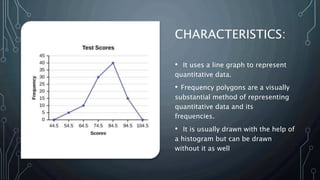
CHARACTERISTICS:
• It uses a line graph to represent
quantitative data.
• Frequency polygons are a visually
substantial method of representing
quantitative data and its
frequencies.
• It is usually drawn with the help of
a histogram but can be drawn
without it as well
HOW TO CONSTRUCT IT.
CONSTRUCT WITH THE HELP OF
HISTOGRAM:
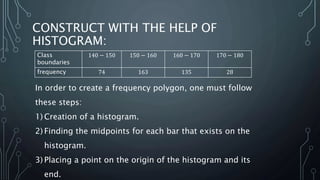
Class
boundaries
140 − 150 150 − 160 160 − 170 170 − 180
frequency 74 163 135 28
In order to create a frequency polygon, one must follow
these steps:
1) Creation of a histogram.
2) Finding the midpoints for each bar that exists on the
histogram.
3) Placing a point on the origin of the histogram and its
end.
CONSTRUCT WITH
THE HELP OF
HISTOGRAM:
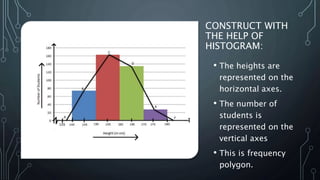
• The heights are
represented on the
horizontal axes.
• The number of
students is
represented on the
vertical axes
• This is frequency
polygon.
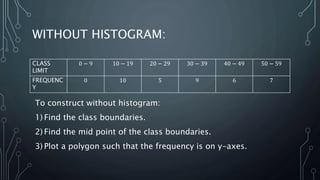
WITHOUT HISTOGRAM:
CLASS
LIMIT
0 − 9 10 − 19 20 − 29 30 − 39 40 − 49 50 − 59
FREQUENC
Y
0 10 5 9 6 7
To construct without histogram:
1) Find the class boundaries.
2) Find the mid point of the class boundaries.
3) Plot a polygon such that the frequency is on y-axes.
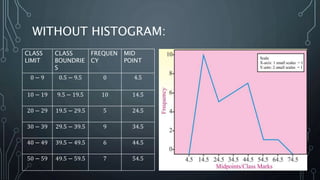
WITHOUT HISTOGRAM:
CLASS
LIMIT
CLASS
BOUNDRIE
S
FREQUEN
CY
MID
POINT
0 − 9 0.5 − 9.5 0 4.5
10 − 19 9.5 − 19.5 10 14.5
20 − 29 19.5 − 29.5 5 24.5
30 − 39 29.5 − 39.5 9 34.5
40 − 49 39.5 − 49.5 6 44.5
50 − 59 49.5 − 59.5 7 54.5
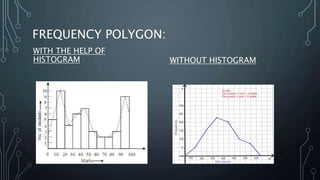
FREQUENCY POLYGON:
WITH THE HELP OF
HISTOGRAM WITHOUT HISTOGRAM
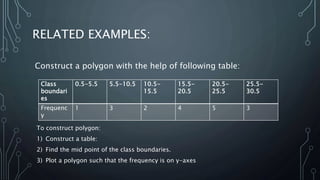
RELATED EXAMPLES:
Construct a polygon with the help of following table:
Class
boundari
es
0.5-5.5 5.5-10.5 10.5-
15.5
15.5-
20.5
20.5-
25.5
25.5-
30.5
Frequenc
y
1 3 2 4 5 3
To construct polygon:
1) Construct a table:
2) Find the mid point of the class boundaries.
3) Plot a polygon such that the frequency is on y-axes
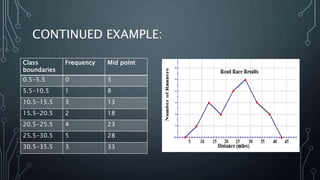
CONTINUED EXAMPLE:
Class
boundaries
Frequency Mid point
0.5-5.5 0 3
5.5-10.5 1 8
10.5-15.5 3 13
15.5-20.5 2 18
20.5-25.5 4 23
25.5-30.5 5 28
30.5-35.5 3 33
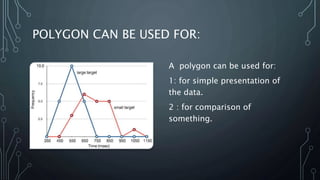
POLYGON CAN BE USED FOR:
A polygon can be used for:
1: for simple presentation of
the data.
2 : for comparison of
something.
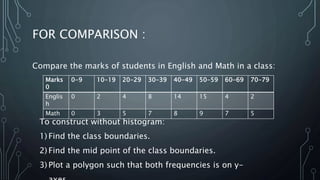
FOR COMPARISON :
Compare the marks of students in English and Math in a class:
Marks
0
0-9 10-19 20-29 30-39 40-49 50-59 60-69 70-79
Englis
h
0 2 4 8 14 15 4 2
Math 0 3 5 7 8 9 7 5
To construct without histogram:
1) Find the class boundaries.
2) Find the mid point of the class boundaries.
3) Plot a polygon such that both frequencies is on y-
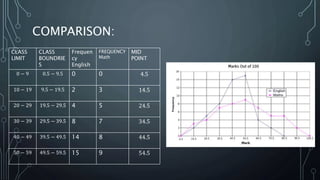
COMPARISON:
CLASS
LIMIT
CLASS
BOUNDRIE
S
Frequen
cy
English
FREQUENCY
Math
MID
POINT
0 − 9 0.5 − 9.5 0 0 4.5
10 − 19 9.5 − 19.5 2 3 14.5
20 − 29 19.5 − 29.5 4 5 24.5
30 − 39 29.5 − 39.5 8 7 34.5
40 − 49 39.5 − 49.5 14 8 44.5
50 − 59 49.5 − 59.5 15 9 54.5
Polygon

Polygon

  • 1.
  • 2.
    WHAT IS POLYGON; Afrequency polygon is a graphical form of representation of data. Frequency polygons are a graphical device for understanding the shapes of distributions. They serve the same purpose as histograms, but are especially helpful for comparing sets of data.
  • 3.
    CHARACTERISTICS: • It usesa line graph to represent quantitative data. • Frequency polygons are a visually substantial method of representing quantitative data and its frequencies. • It is usually drawn with the help of a histogram but can be drawn without it as well
  • 4.
  • 5.
    CONSTRUCT WITH THEHELP OF HISTOGRAM: Class boundaries 140 − 150 150 − 160 160 − 170 170 − 180 frequency 74 163 135 28 In order to create a frequency polygon, one must follow these steps: 1) Creation of a histogram. 2) Finding the midpoints for each bar that exists on the histogram. 3) Placing a point on the origin of the histogram and its end.
  • 6.
    CONSTRUCT WITH THE HELPOF HISTOGRAM: • The heights are represented on the horizontal axes. • The number of students is represented on the vertical axes • This is frequency polygon.
  • 7.
    WITHOUT HISTOGRAM: CLASS LIMIT 0 −9 10 − 19 20 − 29 30 − 39 40 − 49 50 − 59 FREQUENC Y 0 10 5 9 6 7 To construct without histogram: 1) Find the class boundaries. 2) Find the mid point of the class boundaries. 3) Plot a polygon such that the frequency is on y-axes.
  • 8.
    WITHOUT HISTOGRAM: CLASS LIMIT CLASS BOUNDRIE S FREQUEN CY MID POINT 0 −9 0.5 − 9.5 0 4.5 10 − 19 9.5 − 19.5 10 14.5 20 − 29 19.5 − 29.5 5 24.5 30 − 39 29.5 − 39.5 9 34.5 40 − 49 39.5 − 49.5 6 44.5 50 − 59 49.5 − 59.5 7 54.5
  • 9.
    FREQUENCY POLYGON: WITH THEHELP OF HISTOGRAM WITHOUT HISTOGRAM
  • 10.
    RELATED EXAMPLES: Construct apolygon with the help of following table: Class boundari es 0.5-5.5 5.5-10.5 10.5- 15.5 15.5- 20.5 20.5- 25.5 25.5- 30.5 Frequenc y 1 3 2 4 5 3 To construct polygon: 1) Construct a table: 2) Find the mid point of the class boundaries. 3) Plot a polygon such that the frequency is on y-axes
  • 11.
    CONTINUED EXAMPLE: Class boundaries Frequency Midpoint 0.5-5.5 0 3 5.5-10.5 1 8 10.5-15.5 3 13 15.5-20.5 2 18 20.5-25.5 4 23 25.5-30.5 5 28 30.5-35.5 3 33
  • 12.
    POLYGON CAN BEUSED FOR: A polygon can be used for: 1: for simple presentation of the data. 2 : for comparison of something.
  • 13.
    FOR COMPARISON : Comparethe marks of students in English and Math in a class: Marks 0 0-9 10-19 20-29 30-39 40-49 50-59 60-69 70-79 Englis h 0 2 4 8 14 15 4 2 Math 0 3 5 7 8 9 7 5 To construct without histogram: 1) Find the class boundaries. 2) Find the mid point of the class boundaries. 3) Plot a polygon such that both frequencies is on y-
  • 14.
    COMPARISON: CLASS LIMIT CLASS BOUNDRIE S Frequen cy English FREQUENCY Math MID POINT 0 − 90.5 − 9.5 0 0 4.5 10 − 19 9.5 − 19.5 2 3 14.5 20 − 29 19.5 − 29.5 4 5 24.5 30 − 39 29.5 − 39.5 8 7 34.5 40 − 49 39.5 − 49.5 14 8 44.5 50 − 59 49.5 − 59.5 15 9 54.5