We are learning to: Draw and interpret frequency polygons.
Friday 7 February 2025 We are learning about: Frequency polygons
Key terms: Data, frequency, grouped, interval, line, polygon, straight
KEY TERMS
KEY TERMS
• Developing learners will be able to complete a grouped frequency table for a set of data.
• Secure learners will be draw a frequency polygon from a grouped frequency table.
• Excelling learners will be able to solve unfamiliar problems involving frequency polygons.
A frequency polygon is a type of graph that lets us identify the
‘shape’ of data and its trends.
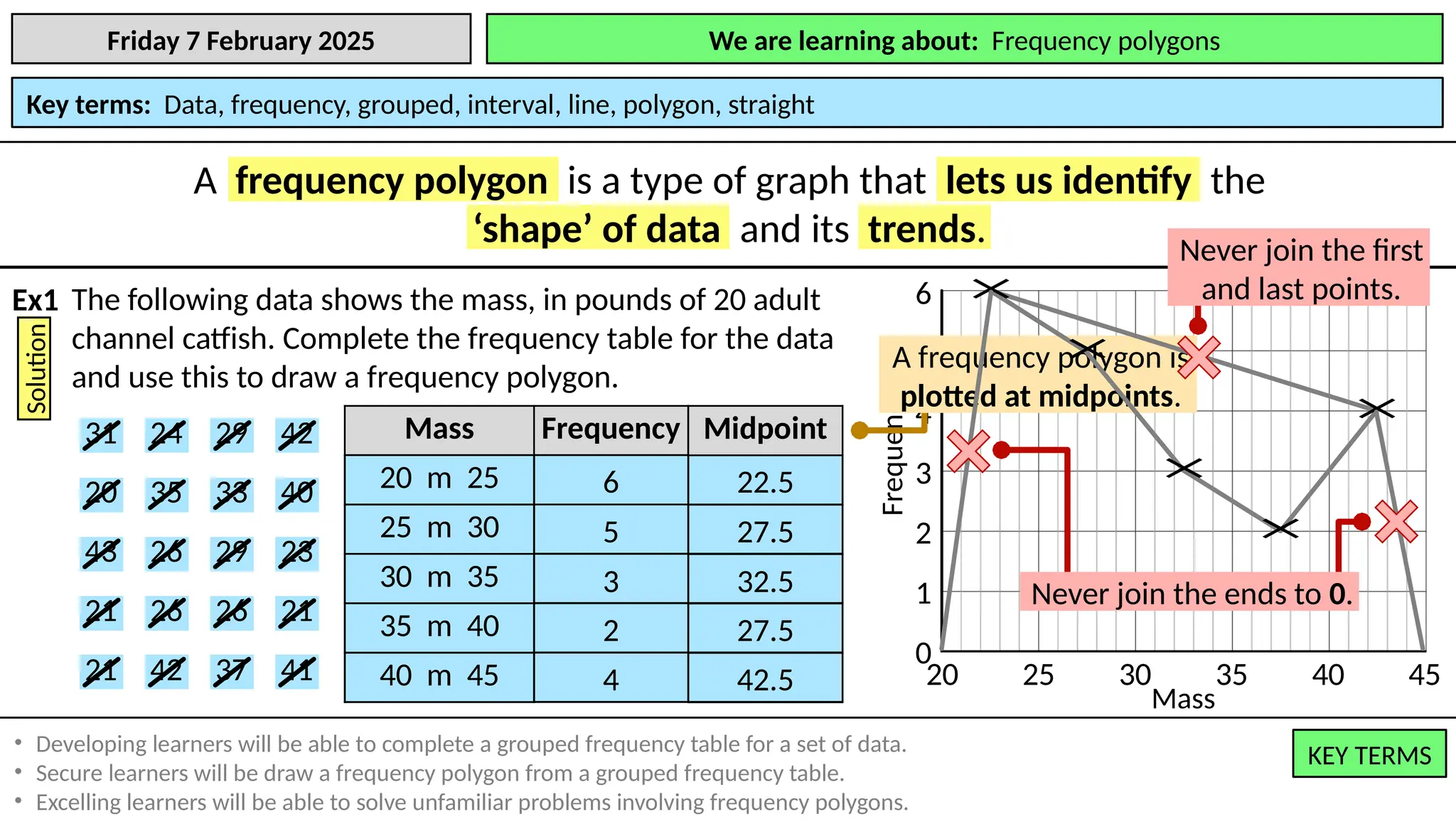
Ex1 The following data shows the mass, in pounds of 20 adult
channel catfish. Complete the frequency table for the data
and use this to draw a frequency polygon.
Solution
Mass Frequency
20 m 25
25 m 30
30 m 35
35 m 40
40 m 45
Midpoint
31 24 29 42
20 35 33 40
43 26 29 23
21 26 26 21
21 42 37 41
6
5
3
2
4
Mass
Frequency
0
1
2
3
4
5
6
20 25 30 35 40 45
A frequency polygon is
plotted at midpoints.
22.5
27.5
32.5
27.5
42.5
×
×
×
Never join the first
and last points.
×
×
Never join the ends to 0.
We are learning to: Draw and interpret frequency polygons.
Friday 7 February 2025 We are learning about: Frequency polygons
Key terms: Data, frequency, grouped, interval, line, polygon, straight
KEY TERMS
KEY TERMS
• Developing learners will be able to complete a grouped frequency table for a set of data.
• Secure learners will be draw a frequency polygon from a grouped frequency table.
• Excelling learners will be able to solve unfamiliar problems involving frequency polygons.
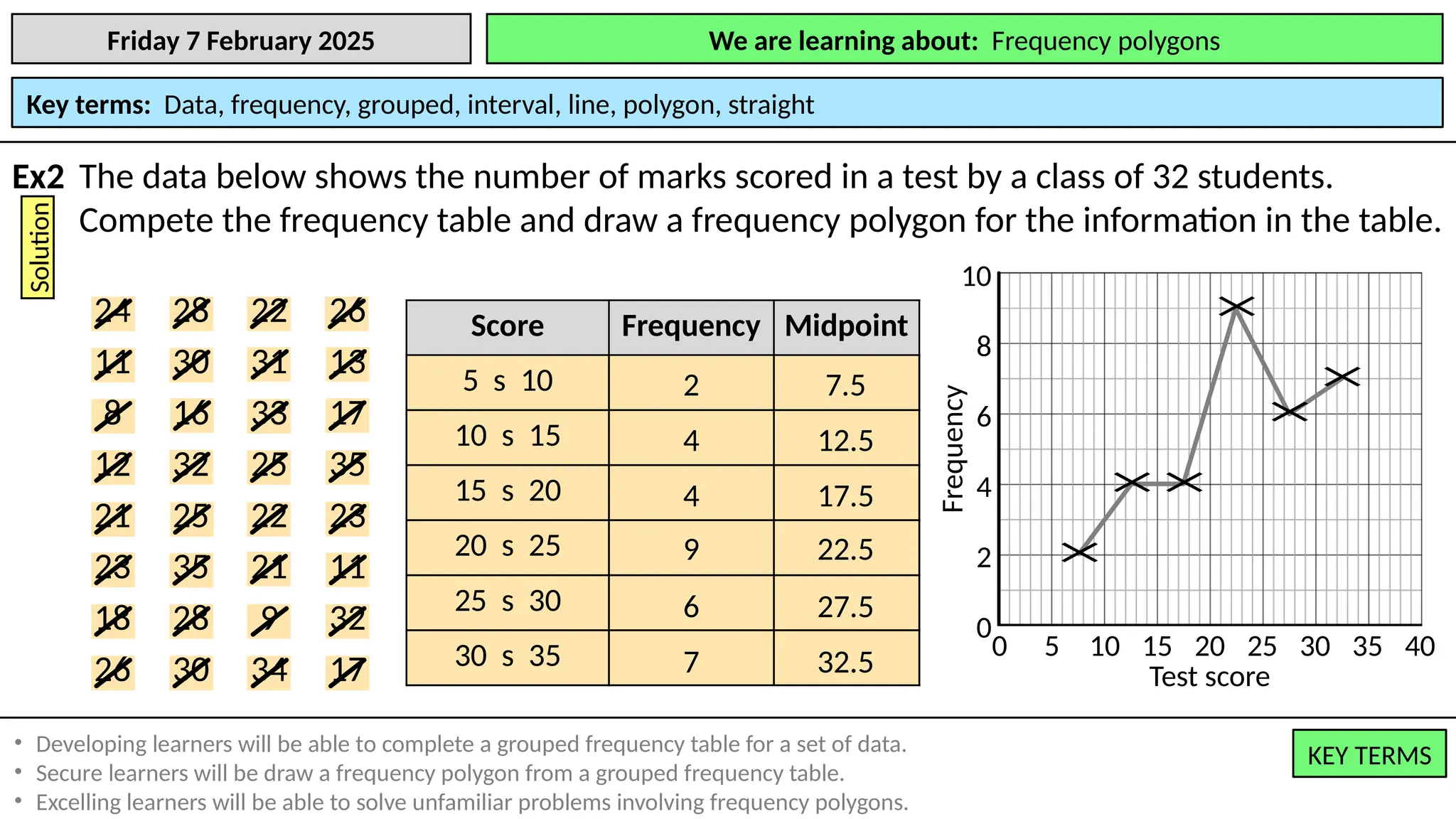
Ex2 The data below shows the number of marks scored in a test by a class of 32 students.
Compete the frequency table and draw a frequency polygon for the information in the table.
Solution
24 28 22 26
11 30 31 13
8 16 33 17
12 32 25 35
21 25 22 23
23 35 21 11
18 28 9 32
26 30 34 17
Score Frequency
5 s 10
10 s 15
15 s 20
20 s 25
25 s 30
30 s 35
2
4
4
9
6
7
Midpoint
7.5
12.5
17.5
22.5
27.5
32.5
0 5 10 15 20 25 30 35 40
Test score
0
2
4
6
8
10
Frequency
××
×
×
×
×
We are learning to: Draw and interpret frequency polygons.
Friday 7 February 2025 We are learning about: Frequency polygons
Key terms: Data, frequency, grouped, interval, line, polygon, straight
KEY TERMS
KEY TERMS
• Developing learners will be able to complete a grouped frequency table for a set of data.
• Secure learners will be draw a frequency polygon from a grouped frequency table.
• Excelling learners will be able to solve unfamiliar problems involving frequency polygons.
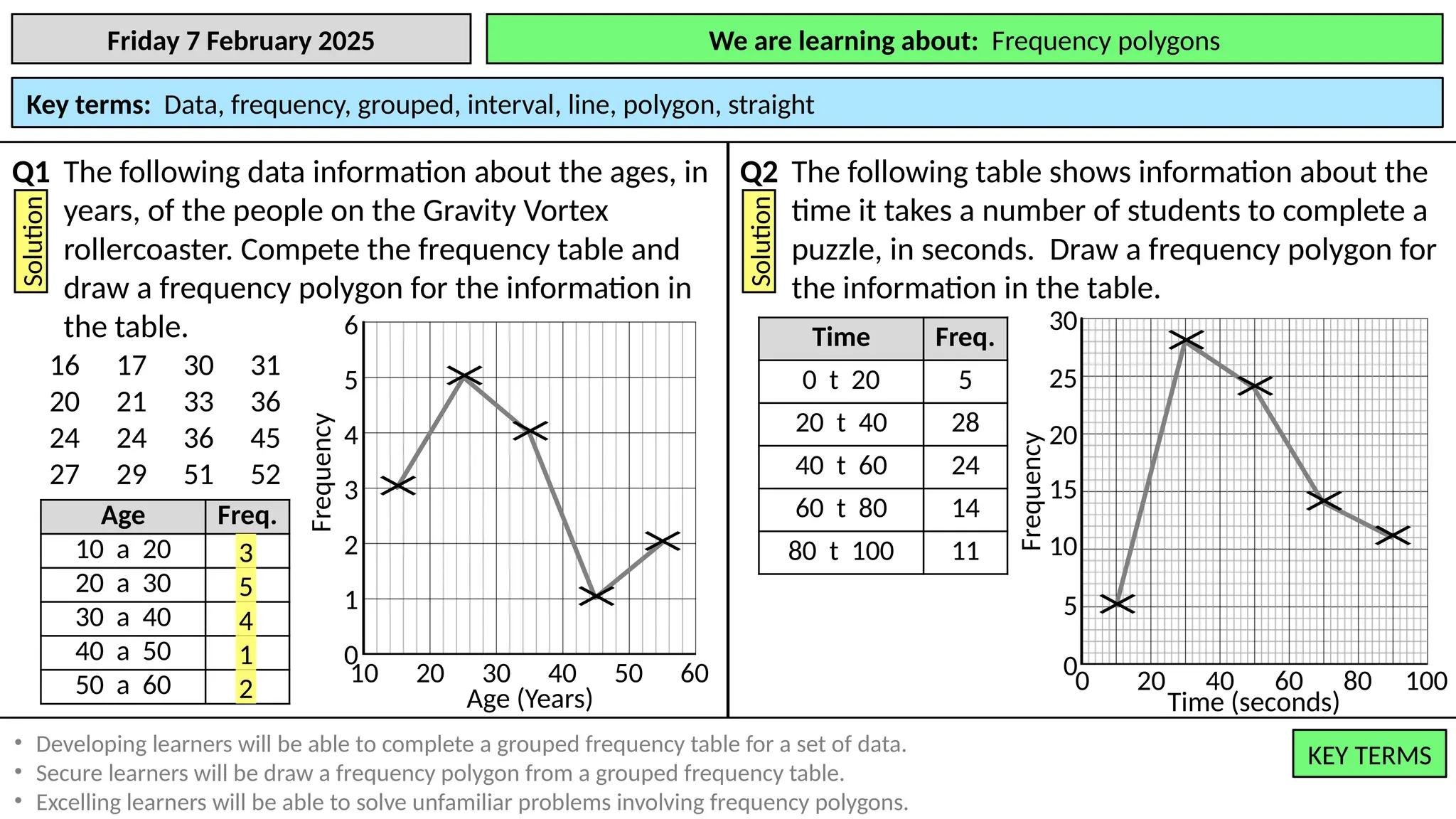
Q1 The following data information about the ages, in
years, of the people on the Gravity Vortex
rollercoaster. Compete the frequency table and
draw a frequency polygon for the information in
the table.
Solution
16 17 30 31
20 21 33 36
24 24 36 45
27 29 51 52
Age Freq.
10 a 20
20 a 30
30 a 40
40 a 50
50 a 60
3
Frequency
2
1
0
4
5
6
60
50
40
30
20
10
Age (Years)
3
5
4
1
2
×
×
×
×
×
Q2 The following table shows information about the
time it takes a number of students to complete a
puzzle, in seconds. Draw a frequency polygon for
the information in the table.
Solution
Time Freq.
0 t 20 5
20 t 40 28
40 t 60 24
60 t 80 14
80 t 100 11
0 20 40 60 80 100
Time (seconds)
0
Frequency
5
10
15
20
25
30
×
×
×
×
×
We are learning to: Draw and interpret frequency polygons.
Friday 7 February 2025 We are learning about: Frequency polygons
Key terms: Data, frequency, grouped, interval, line, polygon, straight
KEY TERMS
KEY TERMS
• Developing learners will be able to complete a grouped frequency table for a set of data.
• Secure learners will be draw a frequency polygon from a grouped frequency table.
• Excelling learners will be able to solve unfamiliar problems involving frequency polygons.
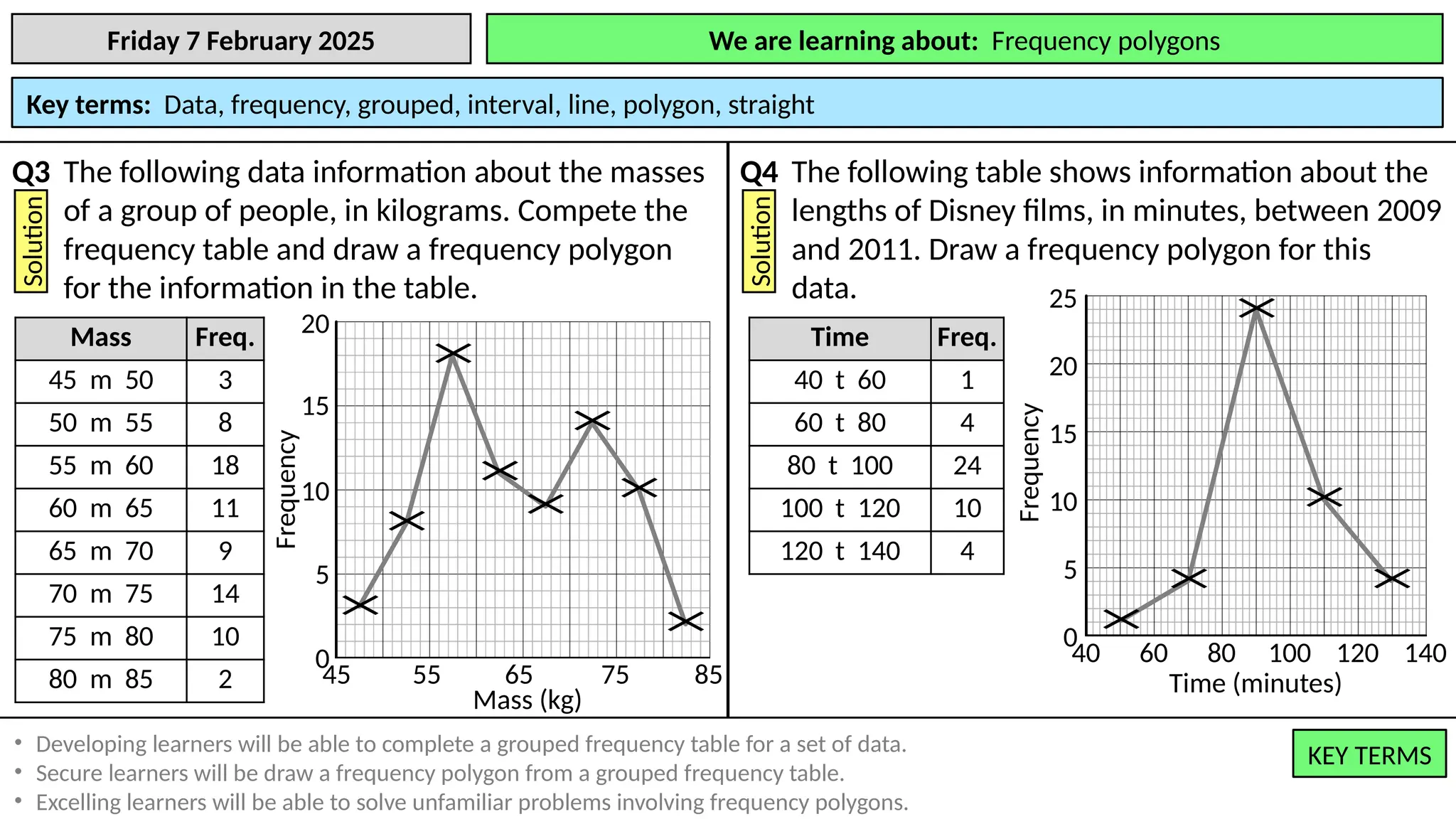
Q3 The following data information about the masses
of a group of people, in kilograms. Compete the
frequency table and draw a frequency polygon
for the information in the table.
Solution
Q4 The following table shows information about the
lengths of Disney films, in minutes, between 2009
and 2011. Draw a frequency polygon for this
data.
Solution
Time Freq.
40 t 60 1
60 t 80 4
80 t 100 24
100 t 120 10
120 t 140 4
Mass Freq.
45 m 50 3
50 m 55 8
55 m 60 18
60 m 65 11
65 m 70 9
70 m 75 14
75 m 80 10
80 m 85 2
10
Frequency
5
0
15
20
Mass (kg)
55
45 65 75 85
×
×
×
×
×
×
×
×
Time (minutes)
140
120
100
80
60
40
0
Frequency
5
10
15
20
25
×
×
×
×
×
We are learning to: Draw and interpret frequency polygons.
Friday 7 February 2025 We are learning about: Frequency polygons
Key terms: Data, frequency, grouped, interval, line, polygon, straight
KEY TERMS
KEY TERMS
• Developing learners will be able to complete a grouped frequency table for a set of data.
• Secure learners will be draw a frequency polygon from a grouped frequency table.
• Excelling learners will be able to solve unfamiliar problems involving frequency polygons.
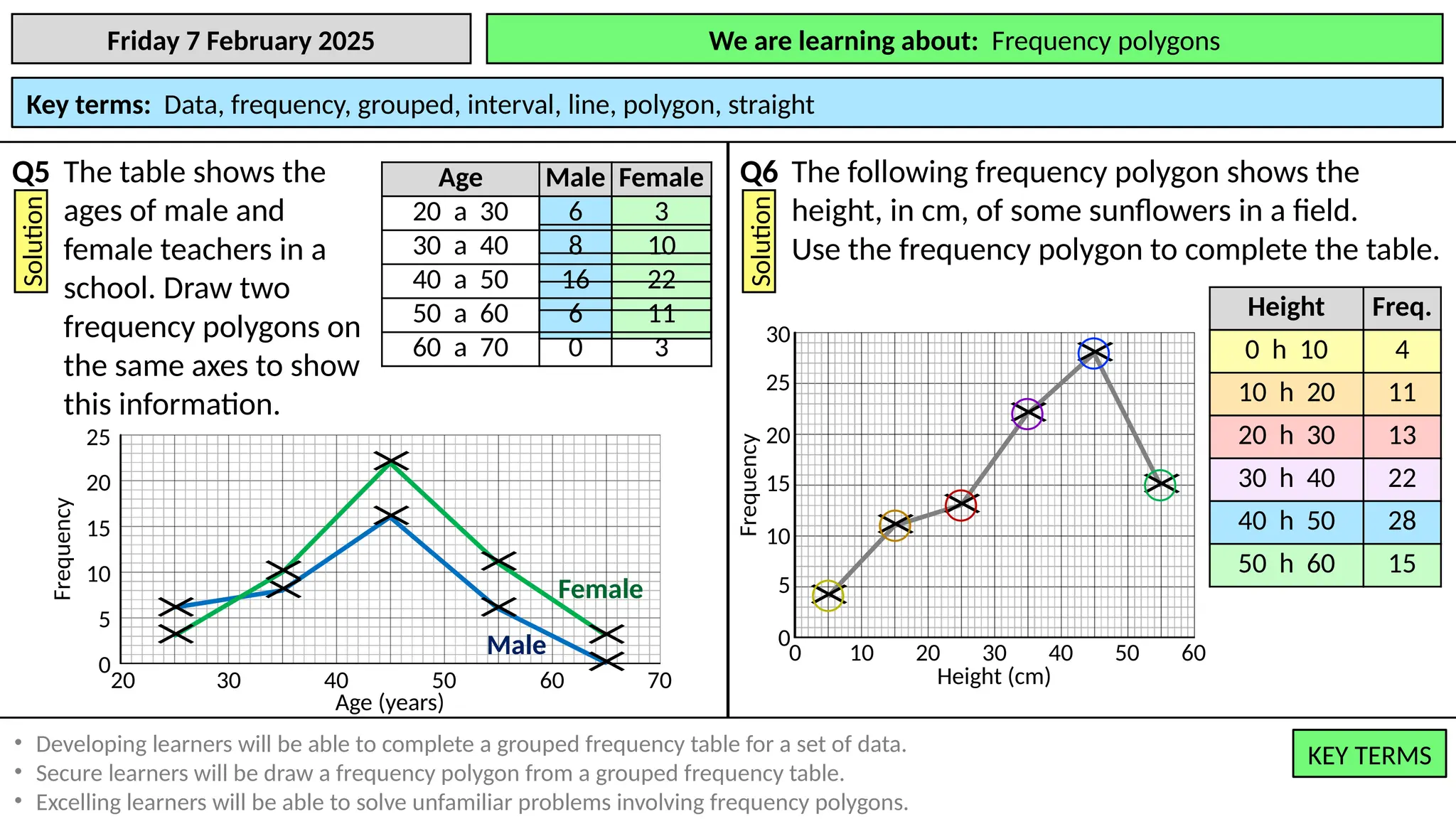
Q5 The table shows the
ages of male and
female teachers in a
school. Draw two
frequency polygons on
the same axes to show
this information.
Solution
Q6 The following frequency polygon shows the
height, in cm, of some sunflowers in a field.
Use the frequency polygon to complete the table.
Solution
Age Male Female
20 a 30 6 3
30 a 40 8 10
40 a 50 16 22
50 a 60 6 11
60 a 70 0 3
Frequency
0
5
10
15
20
25
Age (years)
20 30 40 50 60 70
× ×
×
×
×
Male
×
×
×
×
×
Female
Height Freq.
Height (cm)
60
50
40
30
20
10
0
0
5
10
15
20
25
30
Frequency
×
××
×
×
×
0 h 10 4
10 h 20 11
20 h 30 13
30 h 40 22
40 h 50 28
50 h 60 15
We are learning to: Draw and interpret frequency polygons.
Friday 7 February 2025 We are learning about: Frequency polygons
Key terms: Data, frequency, grouped, interval, line, polygon, straight
KEY TERMS
KEY TERMS
• Developing learners will be able to complete a grouped frequency table for a set of data.
• Secure learners will be draw a frequency polygon from a grouped frequency table.
• Excelling learners will be able to solve unfamiliar problems involving frequency polygons.
Time (mins)
0 10 20 30 40 50 60 70 80
0
10
5
15
20
Frequency
×
×
×
×
×
× ×
×
Ex3 The frequency polygon shows the information
about amount of time spent by people in the
supermarket.
Solution
[a] What is the modal class interval?
[b] Explain why we can’t say how many people
spent exactly 44 minutes in the supermarket.
10 t 20
We only have groups of times. Not
the individual times for each person.
Ex4 The frequency polygon shows information on
how long people spend in a gym. Calculate an
estimate of the mean time spent in the gym.
Solution
Time (mins)
120
100
80
60
40
20
0
0
5
10
15
20
25
30
Frequency
×
×
×
×
×
×
Total minutes
10 1
30 18
50 29
70 20
90 16
110 6
5500
Total people
1 18 29 20 16 6
90
Mean 5500 90
Mean 61.1 minutes(1dp)
We are learning to: Draw and interpret frequency polygons.
Friday 7 February 2025 We are learning about: Frequency polygons
Key terms: Data, frequency, grouped, interval, line, polygon, straight
KEY TERMS
KEY TERMS
• Developing learners will be able to complete a grouped frequency table for a set of data.
• Secure learners will be draw a frequency polygon from a grouped frequency table.
• Excelling learners will be able to solve unfamiliar problems involving frequency polygons.
Q1 Simon has drawn a frequency polygon showing
information about amount of time a random
sample of people spend in the swimming pool.
Solution
[a] How many people were in the sample?
[b] What is the modal class interval?
Time (mins)
0 10 20 30 40 50
0
10
5
15
20
Frequency
25
×
×
×
×
×
Q2 The frequency polygon shows the lengths, in cm,
of a random sample of saltwater crocodiles.
Solution
[a] How many crocodiles were sampled?
[b] What is the modal class?
[c] Calculate an estimate for the mean length of
a saltwater crocodile.
Length (cm)
440 450 460 490 500 520
0
10
5
15
Frequency
20
470 480 510
× ×
×
×
× ×
×
×
20 t 30
62
93
470 t 480
484.7cm
We are learning to: Draw and interpret frequency polygons.
Friday 7 February 2025 We are learning about: Frequency polygons
Key terms: Data, frequency, grouped, interval, line, polygon, straight
KEY TERMS
KEY TERMS
• Developing learners will be able to complete a grouped frequency table for a set of data.
• Secure learners will be draw a frequency polygon from a grouped frequency table.
• Excelling learners will be able to solve unfamiliar problems involving frequency polygons.
Q3 The frequency polygon shows the masses, in
grams, of a random sample of bananas.
Solution
Q4 The frequency polygon shows difference in scores
between the winning and losing teams in a
random sample of rugby games.
Solution
[a] How many games were sampled?
[b] What is the modal class interval?
[c] Calculate an estimate for the mean
difference in score.
[a] How many people were in the sample?
[b] What is the modal class interval?
[c] Calculate an estimate for the mean mass of a
banana.
×
Mass (grams)
80 110 120
0
3
1
5
Frequency
6
90 100 130
2
4
×
×
×
×
Score difference
0 10 30 50
0
10
5
15
Frequency
20 40
×
×
×
×
×
110 t 110
18
108.3g
10 t 20
30
16.3
We are learning to: Draw and interpret frequency polygons.
Friday 7 February 2025 We are learning about: Frequency polygons
Key terms: Data, frequency, grouped, interval, line, polygon, straight
KEY TERMS
KEY TERMS
• Developing learners will be able to complete a grouped frequency table for a set of data.
• Secure learners will be draw a frequency polygon from a grouped frequency table.
• Excelling learners will be able to solve unfamiliar problems involving frequency polygons.
Q5 The frequency polygon shows ages of a random
sample of women having multiple-delivery births.
Solution
[a] How many women between the ages of 25
and 40 had multiple-delivery births?
[b] Calculate an estimate for the mean age of a
woman having a multiple-delivery birth.
Q6 The frequency polygon shows the resting heart
rates in a sample of men and women. Which
gender has the highest mean heart rate?
Solution
Age (years)
15 20 25 30 40 45
0
10
5
15
20
Frequency
25
35
30
×
×
×
×
×
×
67
Heart rate (bpm)
55 60 65 80 85
0
10
5
15
Frequency
20
70 75 90
25
50 95
×
×
× ×
×
×
×
×
×××
×
×
×
Men Women
33
Men’s mean HR 72.8 bpm
Women’s mean HR 73.7 bpm
Women have the
highest mean HR.

7f-Frequency-polygons.pptxpptpptpptpptppt

  • 1.
    We are learningto: Draw and interpret frequency polygons. Friday 7 February 2025 We are learning about: Frequency polygons Key terms: Data, frequency, grouped, interval, line, polygon, straight KEY TERMS KEY TERMS • Developing learners will be able to complete a grouped frequency table for a set of data. • Secure learners will be draw a frequency polygon from a grouped frequency table. • Excelling learners will be able to solve unfamiliar problems involving frequency polygons. A frequency polygon is a type of graph that lets us identify the ‘shape’ of data and its trends. Ex1 The following data shows the mass, in pounds of 20 adult channel catfish. Complete the frequency table for the data and use this to draw a frequency polygon. Solution Mass Frequency 20 m 25 25 m 30 30 m 35 35 m 40 40 m 45 Midpoint 31 24 29 42 20 35 33 40 43 26 29 23 21 26 26 21 21 42 37 41 6 5 3 2 4 Mass Frequency 0 1 2 3 4 5 6 20 25 30 35 40 45 A frequency polygon is plotted at midpoints. 22.5 27.5 32.5 27.5 42.5 × × × Never join the first and last points. × × Never join the ends to 0.
  • 2.
    We are learningto: Draw and interpret frequency polygons. Friday 7 February 2025 We are learning about: Frequency polygons Key terms: Data, frequency, grouped, interval, line, polygon, straight KEY TERMS KEY TERMS • Developing learners will be able to complete a grouped frequency table for a set of data. • Secure learners will be draw a frequency polygon from a grouped frequency table. • Excelling learners will be able to solve unfamiliar problems involving frequency polygons. Ex2 The data below shows the number of marks scored in a test by a class of 32 students. Compete the frequency table and draw a frequency polygon for the information in the table. Solution 24 28 22 26 11 30 31 13 8 16 33 17 12 32 25 35 21 25 22 23 23 35 21 11 18 28 9 32 26 30 34 17 Score Frequency 5 s 10 10 s 15 15 s 20 20 s 25 25 s 30 30 s 35 2 4 4 9 6 7 Midpoint 7.5 12.5 17.5 22.5 27.5 32.5 0 5 10 15 20 25 30 35 40 Test score 0 2 4 6 8 10 Frequency ×× × × × ×
  • 3.
    We are learningto: Draw and interpret frequency polygons. Friday 7 February 2025 We are learning about: Frequency polygons Key terms: Data, frequency, grouped, interval, line, polygon, straight KEY TERMS KEY TERMS • Developing learners will be able to complete a grouped frequency table for a set of data. • Secure learners will be draw a frequency polygon from a grouped frequency table. • Excelling learners will be able to solve unfamiliar problems involving frequency polygons. Q1 The following data information about the ages, in years, of the people on the Gravity Vortex rollercoaster. Compete the frequency table and draw a frequency polygon for the information in the table. Solution 16 17 30 31 20 21 33 36 24 24 36 45 27 29 51 52 Age Freq. 10 a 20 20 a 30 30 a 40 40 a 50 50 a 60 3 Frequency 2 1 0 4 5 6 60 50 40 30 20 10 Age (Years) 3 5 4 1 2 × × × × × Q2 The following table shows information about the time it takes a number of students to complete a puzzle, in seconds. Draw a frequency polygon for the information in the table. Solution Time Freq. 0 t 20 5 20 t 40 28 40 t 60 24 60 t 80 14 80 t 100 11 0 20 40 60 80 100 Time (seconds) 0 Frequency 5 10 15 20 25 30 × × × × ×
  • 4.
    We are learningto: Draw and interpret frequency polygons. Friday 7 February 2025 We are learning about: Frequency polygons Key terms: Data, frequency, grouped, interval, line, polygon, straight KEY TERMS KEY TERMS • Developing learners will be able to complete a grouped frequency table for a set of data. • Secure learners will be draw a frequency polygon from a grouped frequency table. • Excelling learners will be able to solve unfamiliar problems involving frequency polygons. Q3 The following data information about the masses of a group of people, in kilograms. Compete the frequency table and draw a frequency polygon for the information in the table. Solution Q4 The following table shows information about the lengths of Disney films, in minutes, between 2009 and 2011. Draw a frequency polygon for this data. Solution Time Freq. 40 t 60 1 60 t 80 4 80 t 100 24 100 t 120 10 120 t 140 4 Mass Freq. 45 m 50 3 50 m 55 8 55 m 60 18 60 m 65 11 65 m 70 9 70 m 75 14 75 m 80 10 80 m 85 2 10 Frequency 5 0 15 20 Mass (kg) 55 45 65 75 85 × × × × × × × × Time (minutes) 140 120 100 80 60 40 0 Frequency 5 10 15 20 25 × × × × ×
  • 5.
    We are learningto: Draw and interpret frequency polygons. Friday 7 February 2025 We are learning about: Frequency polygons Key terms: Data, frequency, grouped, interval, line, polygon, straight KEY TERMS KEY TERMS • Developing learners will be able to complete a grouped frequency table for a set of data. • Secure learners will be draw a frequency polygon from a grouped frequency table. • Excelling learners will be able to solve unfamiliar problems involving frequency polygons. Q5 The table shows the ages of male and female teachers in a school. Draw two frequency polygons on the same axes to show this information. Solution Q6 The following frequency polygon shows the height, in cm, of some sunflowers in a field. Use the frequency polygon to complete the table. Solution Age Male Female 20 a 30 6 3 30 a 40 8 10 40 a 50 16 22 50 a 60 6 11 60 a 70 0 3 Frequency 0 5 10 15 20 25 Age (years) 20 30 40 50 60 70 × × × × × Male × × × × × Female Height Freq. Height (cm) 60 50 40 30 20 10 0 0 5 10 15 20 25 30 Frequency × ×× × × × 0 h 10 4 10 h 20 11 20 h 30 13 30 h 40 22 40 h 50 28 50 h 60 15
  • 6.
    We are learningto: Draw and interpret frequency polygons. Friday 7 February 2025 We are learning about: Frequency polygons Key terms: Data, frequency, grouped, interval, line, polygon, straight KEY TERMS KEY TERMS • Developing learners will be able to complete a grouped frequency table for a set of data. • Secure learners will be draw a frequency polygon from a grouped frequency table. • Excelling learners will be able to solve unfamiliar problems involving frequency polygons. Time (mins) 0 10 20 30 40 50 60 70 80 0 10 5 15 20 Frequency × × × × × × × × Ex3 The frequency polygon shows the information about amount of time spent by people in the supermarket. Solution [a] What is the modal class interval? [b] Explain why we can’t say how many people spent exactly 44 minutes in the supermarket. 10 t 20 We only have groups of times. Not the individual times for each person. Ex4 The frequency polygon shows information on how long people spend in a gym. Calculate an estimate of the mean time spent in the gym. Solution Time (mins) 120 100 80 60 40 20 0 0 5 10 15 20 25 30 Frequency × × × × × × Total minutes 10 1 30 18 50 29 70 20 90 16 110 6 5500 Total people 1 18 29 20 16 6 90 Mean 5500 90 Mean 61.1 minutes(1dp)
  • 7.
    We are learningto: Draw and interpret frequency polygons. Friday 7 February 2025 We are learning about: Frequency polygons Key terms: Data, frequency, grouped, interval, line, polygon, straight KEY TERMS KEY TERMS • Developing learners will be able to complete a grouped frequency table for a set of data. • Secure learners will be draw a frequency polygon from a grouped frequency table. • Excelling learners will be able to solve unfamiliar problems involving frequency polygons. Q1 Simon has drawn a frequency polygon showing information about amount of time a random sample of people spend in the swimming pool. Solution [a] How many people were in the sample? [b] What is the modal class interval? Time (mins) 0 10 20 30 40 50 0 10 5 15 20 Frequency 25 × × × × × Q2 The frequency polygon shows the lengths, in cm, of a random sample of saltwater crocodiles. Solution [a] How many crocodiles were sampled? [b] What is the modal class? [c] Calculate an estimate for the mean length of a saltwater crocodile. Length (cm) 440 450 460 490 500 520 0 10 5 15 Frequency 20 470 480 510 × × × × × × × × 20 t 30 62 93 470 t 480 484.7cm
  • 8.
    We are learningto: Draw and interpret frequency polygons. Friday 7 February 2025 We are learning about: Frequency polygons Key terms: Data, frequency, grouped, interval, line, polygon, straight KEY TERMS KEY TERMS • Developing learners will be able to complete a grouped frequency table for a set of data. • Secure learners will be draw a frequency polygon from a grouped frequency table. • Excelling learners will be able to solve unfamiliar problems involving frequency polygons. Q3 The frequency polygon shows the masses, in grams, of a random sample of bananas. Solution Q4 The frequency polygon shows difference in scores between the winning and losing teams in a random sample of rugby games. Solution [a] How many games were sampled? [b] What is the modal class interval? [c] Calculate an estimate for the mean difference in score. [a] How many people were in the sample? [b] What is the modal class interval? [c] Calculate an estimate for the mean mass of a banana. × Mass (grams) 80 110 120 0 3 1 5 Frequency 6 90 100 130 2 4 × × × × Score difference 0 10 30 50 0 10 5 15 Frequency 20 40 × × × × × 110 t 110 18 108.3g 10 t 20 30 16.3
  • 9.
    We are learningto: Draw and interpret frequency polygons. Friday 7 February 2025 We are learning about: Frequency polygons Key terms: Data, frequency, grouped, interval, line, polygon, straight KEY TERMS KEY TERMS • Developing learners will be able to complete a grouped frequency table for a set of data. • Secure learners will be draw a frequency polygon from a grouped frequency table. • Excelling learners will be able to solve unfamiliar problems involving frequency polygons. Q5 The frequency polygon shows ages of a random sample of women having multiple-delivery births. Solution [a] How many women between the ages of 25 and 40 had multiple-delivery births? [b] Calculate an estimate for the mean age of a woman having a multiple-delivery birth. Q6 The frequency polygon shows the resting heart rates in a sample of men and women. Which gender has the highest mean heart rate? Solution Age (years) 15 20 25 30 40 45 0 10 5 15 20 Frequency 25 35 30 × × × × × × 67 Heart rate (bpm) 55 60 65 80 85 0 10 5 15 Frequency 20 70 75 90 25 50 95 × × × × × × × × ××× × × × Men Women 33 Men’s mean HR 72.8 bpm Women’s mean HR 73.7 bpm Women have the highest mean HR.

Editor's Notes

  • #6 Data for Q4 from http://doctordisney.com/disney-movies-list-of-years-running-time-ratings/
  • #11 Data for Q6 from https://www.statcrunch.com/app/index.php?dataid=2188688