

Submitted by

Ashish Dua
INTRODUCTION

 Biomedical textiles are textile products and
  constructions for medical and biological
  applications.
 These are used in contact with tissue, blood, cells
  and other living substances.

Main attributes
 Bio stability
(It is the ability of a material to perform with an appropriate host,
    responsible for a specific application)
   Biocompatibility
(It is ability of the device to perform its intended function, with the desired
    degree of incorporation in the host)
MEDICAL TEXTILES AND BIOMEDICAL TEXTILES


   Medical textiles
    These are textile products and constructions for medical applications
    Applications are:
   Protective and healthcare textiles
   Dressings, bandages
   Hygiene products


   Biomedical textiles
    These are fibrous structures used in specific biological environments, their
    performance depends on biocompatibility with cells and biological tissue or
    fluids.
    Applications are:
   Implantable materials and devices
   Tissue engineering
   Neural repairs
The design of a biomedical textile is driven by its end function.
The main factors included are:
       Function:
   The textile needs to fulfil the purpose for which it was designed.

    Biocompatibility:
   This refers to the reaction of the textile with blood and tissue in the body.

    Cost:
   This depends on the raw materials, manufacturing process and product
   end-use.

    Product approval:
   Each country has its own regulations and standards for medical textiles.
BIOCOMPATIBLE POLYMERS


    Protein fibres of biological origin obtained from bovine skin
   Properties : Excellent biocompatibility
                  Low immunogenicity
   Uses:          Artificial tissues
                  Wound dressing
                  Sutures
                  Soft contact lens


    Protein fibres of biological origin and derived from small
    intestine of sheep or oxen
   Properties: Hard to handle
   Uses:         Sutures
   Polylactic acid (PLA)
    Cornstarch sugar is fermented into lactic acid, which is then polymerised
   Properties: Slow degrading polymer
                  Good tensile strength
   Uses:         Orthopaedic applications


   Polyglycolic acid (PGA)
   Properties: High tensile modulus
                 Greater hydrolytic susceptibility
                 Excellent mechanical properties
   Uses:        Resorbable sutures


                                    Salts of alginic acid occurring in seaweed.
   Properties: Generates a moist healing environment
   Uses:       Wound healing
Natural biopolymer, contains amino sugars obtained from shells of crabs,
    wings of insects, fungi. Alkali treatment of chitin yields chitosan and result
    can then be spun into filament having strength similar to viscose structure of
    chitin and chitosan.
   Properties: Biocompatible
                     Bacteriostatic
                     Fungistatic
   Uses:           Artificial skin


    High performance fibres, obtained by pyrolysing PAN
   Properties: Low strength
                     High elongation
   Uses:            Medical and surgerical applications
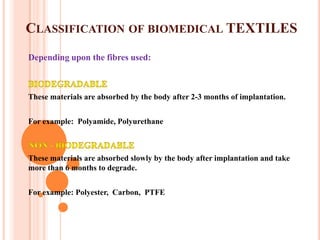
CLASSIFICATION OF BIOMEDICAL TEXTILES
Depending upon the fibres used:


These materials are absorbed by the body after 2-3 months of implantation.


For example: Polyamide, Polyurethane


These materials are absorbed slowly by the body after implantation and take
more than 6 months to degrade.


For example: Polyester, Carbon, PTFE
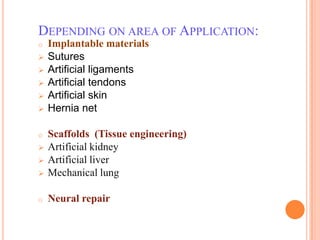
DEPENDING ON AREA OF APPLICATION:
o   Implantable materials
   Sutures
   Artificial ligaments
   Artificial tendons
   Artificial skin
   Hernia net

o   Scaffolds (Tissue engineering)
   Artificial kidney
   Artificial liver
   Mechanical lung

o   Neural repair
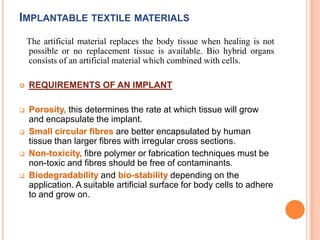
IMPLANTABLE TEXTILE MATERIALS
    The artificial material replaces the body tissue when healing is not
    possible or no replacement tissue is available. Bio hybrid organs
    consists of an artificial material which combined with cells.

   REQUIREMENTS OF AN IMPLANT

   Porosity, this determines the rate at which tissue will grow
    and encapsulate the implant.
   Small circular fibres are better encapsulated by human
    tissue than larger fibres with irregular cross sections.
   Non-toxicity, fibre polymer or fabrication techniques must be
    non-toxic and fibres should be free of contaminants.
   Biodegradability and bio-stability depending on the
    application. A suitable artificial surface for body cells to adhere
    to and grow on.
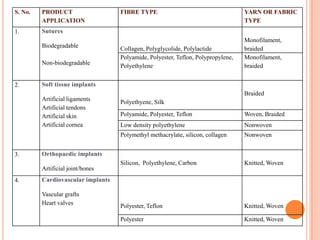
S. No.   PRODUCT                   FIBRE TYPE                                     YARN OR FABRIC
         APPLICATION                                                              TYPE
1.       Sutures
                                                                                  Monofilament,
         Biodegradable             Collagen, Polyglycolide, Polylactide           braided
                                   Polyamide, Polyester, Teflon, Polypropylene,   Monofilament,
         Non-biodegradable         Polyethylene                                   braided


2.       Soft tissue implants
                                                                                  Braided
         Artificial ligaments      Polyethyene, Silk
         Artificial tendons
         Artificial skin           Polyamide, Polyester, Teflon                   Woven, Braided
         Artificial cornea         Low density polyethylene                       Nonwoven
                                   Polymethyl methacrylate, silicon, collagen     Nonwoven


3.       Orthopaedic implants
                                   Silicon, Polyethylene, Carbon                  Knitted, Woven
         Artificial joint/bones
4.       Cardiovascular implants

         Vascular grafts
         Heart valves              Polyester, Teflon                              Knitted, Woven

                                   Polyester                                      Knitted, Woven
SUTURES
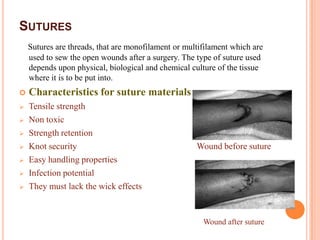
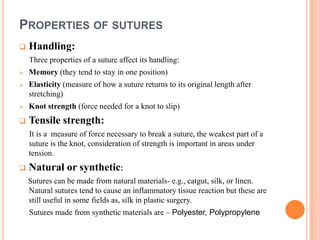
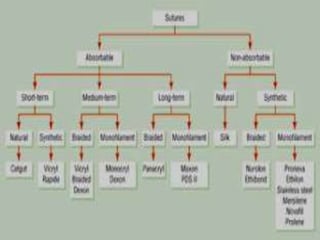
    Sutures are threads, that are monofilament or multifilament which are
    used to sew the open wounds after a surgery. The type of suture used
    depends upon physical, biological and chemical culture of the tissue
    where it is to be put into.
   Characteristics for suture materials
   Tensile strength
   Non toxic
   Strength retention
   Knot security                                    Wound before suture
   Easy handling properties
   Infection potential
   They must lack the wick effects


                                                       Wound after suture
PROPERTIES OF SUTURES
   Handling:
    Three properties of a suture affect its handling:
   Memory (they tend to stay in one position)
   Elasticity (measure of how a suture returns to its original length after
    stretching)
   Knot strength (force needed for a knot to slip)
   Tensile strength:
    It is a measure of force necessary to break a suture, the weakest part of a
    suture is the knot, consideration of strength is important in areas under
    tension.
   Natural or synthetic:
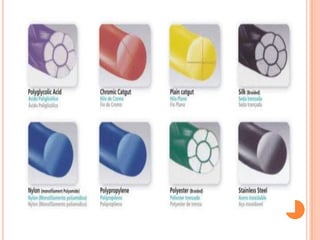
    Sutures can be made from natural materials- e.g., catgut, silk, or linen.
    Natural sutures tend to cause an inflammatory tissue reaction but these are
    still useful in some fields as, silk in plastic surgery.
    Sutures made from synthetic materials are – Polyester, Polypropylene
   Monofilament or multifilament –
    Monofilament sutures are single stranded; multifilament sutures are
    several strands braided together.
    Braided sutures have better handling property but cause tissue drag and the
    spaces between filaments can harbour bacteria.
    Monofilaments do not have these problems but tend to have significant
    memory and can be difficult to handle.


   Absorbable or non-absorbable--
    Absorbable sutures are constructed from the materials which are broken
    down in tissue after a given period of time usually from ten days to four
    weeks. They are therefore applied in many inner tissues of the body.


    Non Absorbable sutures are made from materials which are not
    metabolized by the body, and used either on skin wound closure, where the
    sutures can be removed after a few weeks, or in some inner tissues in which
    absorbable sutures are in adequate.
o   Tissue –
    Ultimately, the type of suture depends on where it is to be used. In the skin,
    non- absorbable sutures can be used, provided they are removed. Ideally, the
    suture should be a monofilament. In the face, sutures should be removed as
    quickly as possible to minimise scarring.


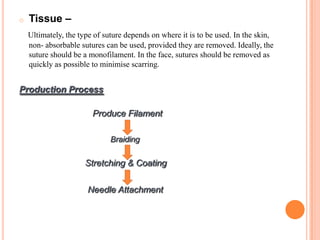
Production Process

                        Produce Filament

                              Braiding


                      Stretching & Coating

                      Needle Attachment
   Classification of implantable materials:
   Soft Tissue Implants
   Hard Tissue Implants


   Soft Tissue Implants
    Strength and flexibility of textile material make it particularly suitable for
    biomedical implants.
    Soft tissue compatible biological polymers are collagen, silk protein,
    cellulose, chitin and chitosan.
    Soft tissue artificial materials include silicone rubber, polyurethane, hydro
    gels and carbon fibre.


These includes:
   Artificial tendon and artificial ligament
   Artificial skin
   Hernia net
   Artificial cornea
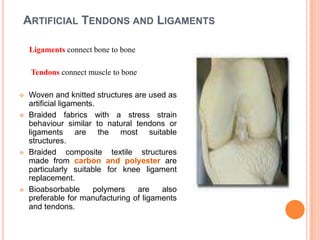
ARTIFICIAL TENDONS AND LIGAMENTS

    Ligaments connect bone to bone

    Tendons connect muscle to bone

   Woven and knitted structures are used as
    artificial ligaments.
   Braided fabrics with a stress strain
    behaviour similar to natural tendons or
    ligaments are the most suitable
    structures.
   Braided composite textile structures
    made from carbon and polyester are
    particularly suitable for knee ligament
    replacement.
   Bioabsorbable       polymers  are    also
    preferable for manufacturing of ligaments
    and tendons.
   Major requirements of artificial tendons and
    ligaments
   Biological
       Bio compatibility
       Long term stability
       Supporting tissue proliferation


   Bio mechanical
       Physiological progressive stress strain behaviour
       Low creeping
       High shear strength


   Porosity

   Flexibility
 Skin      Dressing

   In order to conform to irregular surface, elastic
    and flexible materials are used for skin dressing,
    which are able to promote skin regeneration.


   For flexibility and absorbability of the body
    fluid, skin dressing is obtained from woven and
    non woven fabrics as well as also from micro
    porous layer.


   Collagen and chitin are the most commonly
    using skin dressing materials, besides which
    there is no material which can meet the
    requirements of a skin substitute exactly.
Two essential requirements for skin dressing:
i)  It should prevent the dehydration of the wound and also able to resist the
    bacterial entry.
ii) It should be permeable enough to allow the passage of discharge
    through pores and cuts.


The necessary properties for a skin substitute are as follows:
 Tissue compatibility
 Inner surface structure that permit growth of fibro vascular
  tissue
 Prevention of wound contraction
 Flexibility
 Pliability to permit conformation to irregular wound surface
 Elasticity to permit motion of underlying body tissues
 Resistance to linear and shear stresses
 Low cost and indefinite self life.
   Hernia net
    Meshes are used in hernia repair and abdominal wall replacement, where
    mechanical strength and fixation are important.
    The composite meshes made up of polyester, polypropylene and carbon fibres.


    Required properties of the mesh are:
   Strength
   Flexibility
   Appropriate pore size and pore size
    distribution
   Good dimensional stability
   Easy to mould
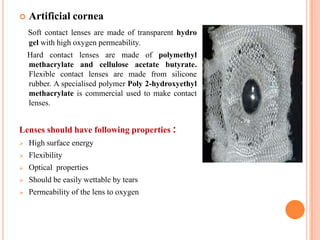
   Artificial cornea
    Soft contact lenses are made of transparent hydro
    gel with high oxygen permeability.
    Hard contact lenses are made of polymethyl
    methacrylate and cellulose acetate butyrate.
    Flexible contact lenses are made from silicone
    rubber. A specialised polymer Poly 2-hydroxyethyl
    methacrylate is commercial used to make contact
    lenses.


Lenses should have following properties :
   High surface energy
   Flexibility
   Optical properties
   Should be easily wettable by tears
   Permeability of the lens to oxygen
HARD TISSUE IMPLANTS
 Hard tissue compatible materials must possess excellent mechanical
  properties.
Properties of the polymer for hard tissue implants are
   Good processability
   Chemical stability
   Bio compatibility


   These includes:
   Orthopaedic implants
   Cardiovasclar implants
ORTHOPAEDIC IMPLANTS
   The applications include artificial bone, bone cement and artificial
    joints. Orthopaedic implants are used to replace bones and joints,
    and fixation plates are used to stabilize fractured bones. Textile
    structural composites like carbon composites have replaced by metal
    implants. A non woven man made from graphite and Teflon is used
    around the implants to promote tissue growth.
CARDIOVASCLAR IMPLANTS
 Categories
        Vascular grafts
        Heart valves
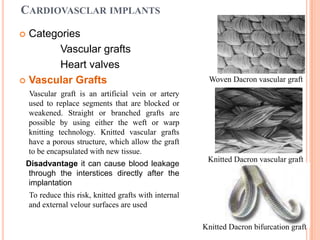
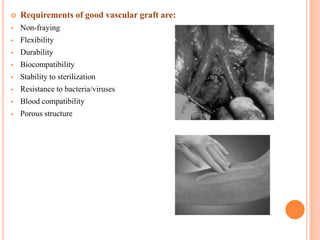
 Vascular Grafts                                        Woven Dacron vascular graft
    Vascular graft is an artificial vein or artery
    used to replace segments that are blocked or
    weakened. Straight or branched grafts are
    possible by using either the weft or warp
    knitting technology. Knitted vascular grafts
    have a porous structure, which allow the graft
    to be encapsulated with new tissue.
                                                         Knitted Dacron vascular graft
    Disadvantage it can cause blood leakage
    through the interstices directly after the
    implantation
    To reduce this risk, knitted grafts with internal
    and external velour surfaces are used

                                                        Knitted Dacron bifurcation graft
   Requirements of good vascular graft are:
   Non-fraying
   Flexibility
   Durability
   Biocompatibility
   Stability to sterilization
   Resistance to bacteria/viruses
   Blood compatibility
   Porous structure
 Heart valves
  The heart valves assist cardiothoracic
  surgeon in treating valvular diseases.
 The heart valves are of two types:
•   Mechanical valve
•   Tissue valve
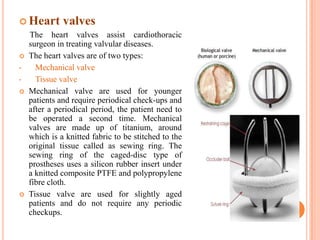
 Mechanical valve are used for younger
  patients and require periodical check-ups and
  after a periodical period, the patient need to
  be operated a second time. Mechanical
  valves are made up of titanium, around
  which is a knitted fabric to be stitched to the
  original tissue called as sewing ring. The
  sewing ring of the caged-disc type of
  prostheses uses a silicon rubber insert under
  a knitted composite PTFE and polypropylene
  fibre cloth.
 Tissue valve are used for slightly aged
  patients and do not require any periodic
  checkups.
   Scaffolds
    Tissue engineering support structures or „scaffolds‟ which are artificial
    devices, designed to act as templates for attached cells and newly formed
    tissues. The scaffolds' three-dimensional, porous structures encourage cell
    attachment, proliferation and migration through an interconnected
    network of pores. New tissue forms gradually and can be implanted into
    the body.
   Design factors:
   Allow cell attachment and migration
   Deliver and retain cells and biochemical factors
   Enable diffusion of vital cell nutrients and expressed products
   Exert certain mechanical and biological influences to modify the
    behaviour of the cell phase
   Scaffolds used in tissue engineering must also fulfill the following
    requirements:
   Be biocompatible
   Resist biodegradation
   High porosity
   Adequate pore size to facilitate cell seeding and diffusion
   Rate of biodegradation should coincide with rate of tissue formation
EXTRACORPOREAL DEVICES

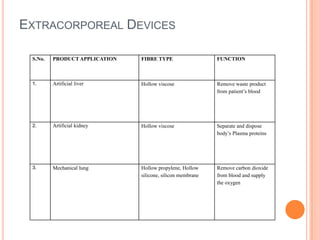
 S.No.   PRODUCT APPLICATION   FIBRE TYPE                   FUNCTION


 1.      Artificial liver      Hollow viscose               Remove waste product
                                                            from patient‟s blood


 2.      Artificial kidney     Hollow viscose               Separate and dispose
                                                            body‟s Plasma proteins


 3.      Mechanical lung       Hollow propylene, Hollow     Remove carbon dioxide
                               silicone, silicon membrane   from blood and supply
                                                            the oxygen
   Artificial liver
    The liver has multiple functions essential to maintain life including
    carbohydrate metabolism, synthesis of proteins, amino acid
    metabolism, urea synthesis, lipid metabolism, drug biotransformation
    and waste removal. The artificial liver utilizes the functions of separating,
    disposing & supply of fresh plasma in hollow viscose fibres or membranes
    similar to those used for artificial kidney to perform their function. In the
    case of extracorporeal devices, cells are grown to confluence in devices
    resembling dialysis cartridges, and then inserted into a „circuit‟ outside the
    patient‟s body, where blood from the patient flows through the cartridge,
    contacting the cells, and then back into the patient.
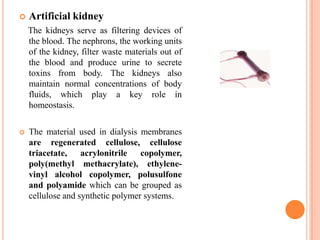
   Artificial kidney
    The kidneys serve as filtering devices of
    the blood. The nephrons, the working units
    of the kidney, filter waste materials out of
    the blood and produce urine to secrete
    toxins from body. The kidneys also
    maintain normal concentrations of body
    fluids, which play a key role in
    homeostasis.

   The material used in dialysis membranes
    are regenerated cellulose, cellulose
    triacetate, acrylonitrile copolymer,
    poly(methyl methacrylate), ethylene-
    vinyl alcohol copolymer, polusulfone
    and polyamide which can be grouped as
    cellulose and synthetic polymer systems.
   The function of the artificial kidney is achieved by circulating
    the blood through a membrane, which may be either a flat
    sheet or a bundle of hollow regenerated cellulose fibres in the
    form of cellophane. In an external artificial kidney, a
    haemodialyser, is used which can perform many of the
    functions of a kidney. Since the dialyser is a foreign substance
    to the human body, when the blood is circulated through the
    dialyser, the leucocyte count in the blood decreases over the
    first 20 minutes of dialysis, but recovers to its original value
    after 1 hour. It is made up from a bundle of hollow fibres
    through which the blood circulates. The objective is to
    improve the surface of hollow fibres so that the leucocyte
    decrease does not occur. Hemodialysis includes removal of
    metabolic substances, adjustment of electrolytes and pH and
    removal of excess water by ultrafiltration and dialysis, which
    is usually a membrane separation process.
   Mechanical lung

    Oxygenate body‟s blood and remove cellular by products most of which
    consisted of CO2.The microporous membranes of the mechanical lung
    possess high permeability to gases but low permeability to liquids and
    functions in the same manner as the natural lung allowing oxygen to
    come into contact with the patient‟s blood.
     Silicone or polypropylene fibres are used for fabricating mechanical lung so
    as to allow the permeation of gases. The mechanical lung should ideally function
    for at least 1 to 3 weeks. But the present mechanical lung can function only for a
    week. This is because, ability to remove carbon dioxide falls off. The lung is a
    form of gas exchanger to supply oxygen to the blood and remove carbon dioxide.
    Microporous membranes that provide high permeability for gas flow and low
    permeability for liquid flow which is similar to the natural lung where oxygen
    and blood come into contact. In these devices, oxygen flows around hollow fibres
    at extremely low pressure. Blood flows inside of the fibres. The oxygen
    permeates the micropores of the fibres and comes in contact with the blood. The
    pressure gradient between the blood and oxygen is kept near zero to prevent
    mixing of oxygen and blood. Red blood cells capture oxygen by diffusion
    process.
   PP hollow fibre exhibits good compatibility with blood and excellent gas
    permeability. Its use allows a design of a compact artificial lung that is easy and
    safe to operate. However, its long term use causes a leak of blood plasma
    components.
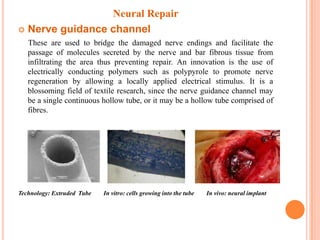
Neural Repair
 Nerve guidance channel
   These are used to bridge the damaged nerve endings and facilitate the
   passage of molecules secreted by the nerve and bar fibrous tissue from
   infiltrating the area thus preventing repair. An innovation is the use of
   electrically conducting polymers such as polypyrole to promote nerve
   regeneration by allowing a locally applied electrical stimulus. It is a
   blossoming field of textile research, since the nerve guidance channel may
   be a single continuous hollow tube, or it may be a hollow tube comprised of
   fibres.


Technology: Extruded Tube   In vitro: cells growing into the tube   In vivo: neural implant
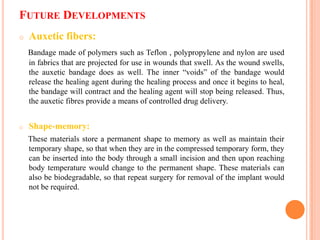
FUTURE DEVELOPMENTS
o   Auxetic fibers:
    Bandage made of polymers such as Teflon , polypropylene and nylon are used
    in fabrics that are projected for use in wounds that swell. As the wound swells,
    the auxetic bandage does as well. The inner “voids” of the bandage would
    release the healing agent during the healing process and once it begins to heal,
    the bandage will contract and the healing agent will stop being released. Thus,
    the auxetic fibres provide a means of controlled drug delivery.


o   Shape-memory:
    These materials store a permanent shape to memory as well as maintain their
    temporary shape, so that when they are in the compressed temporary form, they
    can be inserted into the body through a small incision and then upon reaching
    body temperature would change to the permanent shape. These materials can
    also be biodegradable, so that repeat surgery for removal of the implant would
    not be required.
   Electronics :
    The use of electronic devices in textile implants is envisaged, for example,
    as monitors in artificial arteries, stents and heart valves constructed from
    textiles. When the implant begins to not function properly, they would act as
    warning devices and trigger electrical pulses or the release of drugs to
    overcome the problem, at least temporarily.


   Controlled drug delivery :
    Drugs present as additives in resorbable fabrics would gradually be released
    on breakdown of the fabrics. Another intriguing innovation is the
    development of soluble glass fibres for the controlled release of drugs in a
    wide range of concentrations and delivery periods.
     REFERENCES

1.     Supriya Pal, Asian Textile journal, June 2009, Pg 47
2.     O.L. Shanmugasundaram, Asian Dyer, April 2008, Pg 54
3.     J. Hayavadana & Anil Kumar, Asian Textile Journal, September 2006, Pg 81
4.     Indra Doraiswamy & K P Chellamani, Asian Textile Journal, December 2008, Pg 49
5.     S. Viju, The Indian Textile Journal, June 2008, Pg 75
6.     M K Panthaki, The Indian Textile Journal, Feburary 2008, Pg 63
7.     S. Viju, Asian Textile journal, May 2008, Pg 37
8.     Dr S K Basu, The Indian Textile Journal, December 2008, Pg 91
9.     O.L. Shanmugasundaram, Asian Dyer, October 2007, Pg 56
10.    M L Gulrajani, ATT, Jan- March 2008, Pg 29
11.    Dr J Srinivasan & S Kathirvelu, The Indian Textile Journal, October 2006, Pg 45
12.    O.L. Shanmugasundaram, The Indian Textile Journal, September 2008, Pg 99
13.    A. K. Moghe & B. S. Gupta, TJTI, Vol. 99 No. 5, Pg 467
14.    Henen Jedda, Saber Ben Abdessalem TJTI, Vol. 99 No. 3, Pg273
15.    www.expresstextile.com
16.    http://www.csiro.au/science/TissueEngineering.html#
17.    US Patent 6146651
18.    Biomedical Textiles, Maria Cieslewski, November 13, 2006, ELE 382
Presentation2

Presentation2

  • 1.
  • 2.
    INTRODUCTION  Biomedical textilesare textile products and constructions for medical and biological applications.  These are used in contact with tissue, blood, cells and other living substances. Main attributes  Bio stability (It is the ability of a material to perform with an appropriate host, responsible for a specific application)  Biocompatibility (It is ability of the device to perform its intended function, with the desired degree of incorporation in the host)
  • 3.
    MEDICAL TEXTILES ANDBIOMEDICAL TEXTILES  Medical textiles These are textile products and constructions for medical applications Applications are:  Protective and healthcare textiles  Dressings, bandages  Hygiene products  Biomedical textiles These are fibrous structures used in specific biological environments, their performance depends on biocompatibility with cells and biological tissue or fluids. Applications are:  Implantable materials and devices  Tissue engineering  Neural repairs
  • 4.
    The design ofa biomedical textile is driven by its end function. The main factors included are:  Function: The textile needs to fulfil the purpose for which it was designed.  Biocompatibility: This refers to the reaction of the textile with blood and tissue in the body.  Cost: This depends on the raw materials, manufacturing process and product end-use.  Product approval: Each country has its own regulations and standards for medical textiles.
  • 5.
    BIOCOMPATIBLE POLYMERS Protein fibres of biological origin obtained from bovine skin  Properties : Excellent biocompatibility Low immunogenicity  Uses: Artificial tissues Wound dressing Sutures Soft contact lens Protein fibres of biological origin and derived from small intestine of sheep or oxen  Properties: Hard to handle  Uses: Sutures
  • 6.
    Polylactic acid (PLA) Cornstarch sugar is fermented into lactic acid, which is then polymerised  Properties: Slow degrading polymer Good tensile strength  Uses: Orthopaedic applications  Polyglycolic acid (PGA)  Properties: High tensile modulus Greater hydrolytic susceptibility Excellent mechanical properties  Uses: Resorbable sutures Salts of alginic acid occurring in seaweed.  Properties: Generates a moist healing environment  Uses: Wound healing
  • 7.
    Natural biopolymer, containsamino sugars obtained from shells of crabs, wings of insects, fungi. Alkali treatment of chitin yields chitosan and result can then be spun into filament having strength similar to viscose structure of chitin and chitosan.  Properties: Biocompatible Bacteriostatic Fungistatic  Uses: Artificial skin High performance fibres, obtained by pyrolysing PAN  Properties: Low strength High elongation  Uses: Medical and surgerical applications
  • 8.
    CLASSIFICATION OF BIOMEDICALTEXTILES Depending upon the fibres used: These materials are absorbed by the body after 2-3 months of implantation. For example: Polyamide, Polyurethane These materials are absorbed slowly by the body after implantation and take more than 6 months to degrade. For example: Polyester, Carbon, PTFE
  • 9.
    DEPENDING ON AREAOF APPLICATION: o Implantable materials  Sutures  Artificial ligaments  Artificial tendons  Artificial skin  Hernia net o Scaffolds (Tissue engineering)  Artificial kidney  Artificial liver  Mechanical lung o Neural repair
  • 10.
    IMPLANTABLE TEXTILE MATERIALS The artificial material replaces the body tissue when healing is not possible or no replacement tissue is available. Bio hybrid organs consists of an artificial material which combined with cells.  REQUIREMENTS OF AN IMPLANT  Porosity, this determines the rate at which tissue will grow and encapsulate the implant.  Small circular fibres are better encapsulated by human tissue than larger fibres with irregular cross sections.  Non-toxicity, fibre polymer or fabrication techniques must be non-toxic and fibres should be free of contaminants.  Biodegradability and bio-stability depending on the application. A suitable artificial surface for body cells to adhere to and grow on.
  • 11.
    S. No. PRODUCT FIBRE TYPE YARN OR FABRIC APPLICATION TYPE 1. Sutures Monofilament, Biodegradable Collagen, Polyglycolide, Polylactide braided Polyamide, Polyester, Teflon, Polypropylene, Monofilament, Non-biodegradable Polyethylene braided 2. Soft tissue implants Braided Artificial ligaments Polyethyene, Silk Artificial tendons Artificial skin Polyamide, Polyester, Teflon Woven, Braided Artificial cornea Low density polyethylene Nonwoven Polymethyl methacrylate, silicon, collagen Nonwoven 3. Orthopaedic implants Silicon, Polyethylene, Carbon Knitted, Woven Artificial joint/bones 4. Cardiovascular implants Vascular grafts Heart valves Polyester, Teflon Knitted, Woven Polyester Knitted, Woven
  • 12.
    SUTURES Sutures are threads, that are monofilament or multifilament which are used to sew the open wounds after a surgery. The type of suture used depends upon physical, biological and chemical culture of the tissue where it is to be put into.  Characteristics for suture materials  Tensile strength  Non toxic  Strength retention  Knot security Wound before suture  Easy handling properties  Infection potential  They must lack the wick effects Wound after suture
  • 13.
    PROPERTIES OF SUTURES  Handling: Three properties of a suture affect its handling:  Memory (they tend to stay in one position)  Elasticity (measure of how a suture returns to its original length after stretching)  Knot strength (force needed for a knot to slip)  Tensile strength: It is a measure of force necessary to break a suture, the weakest part of a suture is the knot, consideration of strength is important in areas under tension.  Natural or synthetic: Sutures can be made from natural materials- e.g., catgut, silk, or linen. Natural sutures tend to cause an inflammatory tissue reaction but these are still useful in some fields as, silk in plastic surgery. Sutures made from synthetic materials are – Polyester, Polypropylene
  • 15.
    Monofilament or multifilament – Monofilament sutures are single stranded; multifilament sutures are several strands braided together. Braided sutures have better handling property but cause tissue drag and the spaces between filaments can harbour bacteria. Monofilaments do not have these problems but tend to have significant memory and can be difficult to handle.  Absorbable or non-absorbable-- Absorbable sutures are constructed from the materials which are broken down in tissue after a given period of time usually from ten days to four weeks. They are therefore applied in many inner tissues of the body. Non Absorbable sutures are made from materials which are not metabolized by the body, and used either on skin wound closure, where the sutures can be removed after a few weeks, or in some inner tissues in which absorbable sutures are in adequate.
  • 17.
    o Tissue – Ultimately, the type of suture depends on where it is to be used. In the skin, non- absorbable sutures can be used, provided they are removed. Ideally, the suture should be a monofilament. In the face, sutures should be removed as quickly as possible to minimise scarring. Production Process Produce Filament Braiding Stretching & Coating Needle Attachment
  • 18.
    Classification of implantable materials:  Soft Tissue Implants  Hard Tissue Implants  Soft Tissue Implants Strength and flexibility of textile material make it particularly suitable for biomedical implants. Soft tissue compatible biological polymers are collagen, silk protein, cellulose, chitin and chitosan. Soft tissue artificial materials include silicone rubber, polyurethane, hydro gels and carbon fibre. These includes:  Artificial tendon and artificial ligament  Artificial skin  Hernia net  Artificial cornea
  • 19.
    ARTIFICIAL TENDONS ANDLIGAMENTS Ligaments connect bone to bone Tendons connect muscle to bone  Woven and knitted structures are used as artificial ligaments.  Braided fabrics with a stress strain behaviour similar to natural tendons or ligaments are the most suitable structures.  Braided composite textile structures made from carbon and polyester are particularly suitable for knee ligament replacement.  Bioabsorbable polymers are also preferable for manufacturing of ligaments and tendons.
  • 20.
    Major requirements of artificial tendons and ligaments  Biological  Bio compatibility  Long term stability  Supporting tissue proliferation  Bio mechanical  Physiological progressive stress strain behaviour  Low creeping  High shear strength  Porosity  Flexibility
  • 21.
     Skin Dressing  In order to conform to irregular surface, elastic and flexible materials are used for skin dressing, which are able to promote skin regeneration.  For flexibility and absorbability of the body fluid, skin dressing is obtained from woven and non woven fabrics as well as also from micro porous layer.  Collagen and chitin are the most commonly using skin dressing materials, besides which there is no material which can meet the requirements of a skin substitute exactly.
  • 22.
    Two essential requirementsfor skin dressing: i) It should prevent the dehydration of the wound and also able to resist the bacterial entry. ii) It should be permeable enough to allow the passage of discharge through pores and cuts. The necessary properties for a skin substitute are as follows:  Tissue compatibility  Inner surface structure that permit growth of fibro vascular tissue  Prevention of wound contraction  Flexibility  Pliability to permit conformation to irregular wound surface  Elasticity to permit motion of underlying body tissues  Resistance to linear and shear stresses  Low cost and indefinite self life.
  • 23.
    Hernia net Meshes are used in hernia repair and abdominal wall replacement, where mechanical strength and fixation are important. The composite meshes made up of polyester, polypropylene and carbon fibres. Required properties of the mesh are:  Strength  Flexibility  Appropriate pore size and pore size distribution  Good dimensional stability  Easy to mould
  • 24.
    Artificial cornea Soft contact lenses are made of transparent hydro gel with high oxygen permeability. Hard contact lenses are made of polymethyl methacrylate and cellulose acetate butyrate. Flexible contact lenses are made from silicone rubber. A specialised polymer Poly 2-hydroxyethyl methacrylate is commercial used to make contact lenses. Lenses should have following properties :  High surface energy  Flexibility  Optical properties  Should be easily wettable by tears  Permeability of the lens to oxygen
  • 25.
    HARD TISSUE IMPLANTS Hard tissue compatible materials must possess excellent mechanical properties. Properties of the polymer for hard tissue implants are  Good processability  Chemical stability  Bio compatibility  These includes:  Orthopaedic implants  Cardiovasclar implants
  • 26.
    ORTHOPAEDIC IMPLANTS  The applications include artificial bone, bone cement and artificial joints. Orthopaedic implants are used to replace bones and joints, and fixation plates are used to stabilize fractured bones. Textile structural composites like carbon composites have replaced by metal implants. A non woven man made from graphite and Teflon is used around the implants to promote tissue growth.
  • 27.
    CARDIOVASCLAR IMPLANTS  Categories Vascular grafts Heart valves  Vascular Grafts Woven Dacron vascular graft Vascular graft is an artificial vein or artery used to replace segments that are blocked or weakened. Straight or branched grafts are possible by using either the weft or warp knitting technology. Knitted vascular grafts have a porous structure, which allow the graft to be encapsulated with new tissue. Knitted Dacron vascular graft Disadvantage it can cause blood leakage through the interstices directly after the implantation To reduce this risk, knitted grafts with internal and external velour surfaces are used Knitted Dacron bifurcation graft
  • 28.
    Requirements of good vascular graft are:  Non-fraying  Flexibility  Durability  Biocompatibility  Stability to sterilization  Resistance to bacteria/viruses  Blood compatibility  Porous structure
  • 29.
     Heart valves The heart valves assist cardiothoracic surgeon in treating valvular diseases.  The heart valves are of two types: • Mechanical valve • Tissue valve  Mechanical valve are used for younger patients and require periodical check-ups and after a periodical period, the patient need to be operated a second time. Mechanical valves are made up of titanium, around which is a knitted fabric to be stitched to the original tissue called as sewing ring. The sewing ring of the caged-disc type of prostheses uses a silicon rubber insert under a knitted composite PTFE and polypropylene fibre cloth.  Tissue valve are used for slightly aged patients and do not require any periodic checkups.
  • 30.
    Scaffolds Tissue engineering support structures or „scaffolds‟ which are artificial devices, designed to act as templates for attached cells and newly formed tissues. The scaffolds' three-dimensional, porous structures encourage cell attachment, proliferation and migration through an interconnected network of pores. New tissue forms gradually and can be implanted into the body.  Design factors:  Allow cell attachment and migration  Deliver and retain cells and biochemical factors  Enable diffusion of vital cell nutrients and expressed products  Exert certain mechanical and biological influences to modify the behaviour of the cell phase  Scaffolds used in tissue engineering must also fulfill the following requirements:  Be biocompatible  Resist biodegradation  High porosity  Adequate pore size to facilitate cell seeding and diffusion  Rate of biodegradation should coincide with rate of tissue formation
  • 31.
    EXTRACORPOREAL DEVICES S.No. PRODUCT APPLICATION FIBRE TYPE FUNCTION 1. Artificial liver Hollow viscose Remove waste product from patient‟s blood 2. Artificial kidney Hollow viscose Separate and dispose body‟s Plasma proteins 3. Mechanical lung Hollow propylene, Hollow Remove carbon dioxide silicone, silicon membrane from blood and supply the oxygen
  • 32.
    Artificial liver The liver has multiple functions essential to maintain life including carbohydrate metabolism, synthesis of proteins, amino acid metabolism, urea synthesis, lipid metabolism, drug biotransformation and waste removal. The artificial liver utilizes the functions of separating, disposing & supply of fresh plasma in hollow viscose fibres or membranes similar to those used for artificial kidney to perform their function. In the case of extracorporeal devices, cells are grown to confluence in devices resembling dialysis cartridges, and then inserted into a „circuit‟ outside the patient‟s body, where blood from the patient flows through the cartridge, contacting the cells, and then back into the patient.
  • 34.
    Artificial kidney The kidneys serve as filtering devices of the blood. The nephrons, the working units of the kidney, filter waste materials out of the blood and produce urine to secrete toxins from body. The kidneys also maintain normal concentrations of body fluids, which play a key role in homeostasis.  The material used in dialysis membranes are regenerated cellulose, cellulose triacetate, acrylonitrile copolymer, poly(methyl methacrylate), ethylene- vinyl alcohol copolymer, polusulfone and polyamide which can be grouped as cellulose and synthetic polymer systems.
  • 35.
    The function of the artificial kidney is achieved by circulating the blood through a membrane, which may be either a flat sheet or a bundle of hollow regenerated cellulose fibres in the form of cellophane. In an external artificial kidney, a haemodialyser, is used which can perform many of the functions of a kidney. Since the dialyser is a foreign substance to the human body, when the blood is circulated through the dialyser, the leucocyte count in the blood decreases over the first 20 minutes of dialysis, but recovers to its original value after 1 hour. It is made up from a bundle of hollow fibres through which the blood circulates. The objective is to improve the surface of hollow fibres so that the leucocyte decrease does not occur. Hemodialysis includes removal of metabolic substances, adjustment of electrolytes and pH and removal of excess water by ultrafiltration and dialysis, which is usually a membrane separation process.
  • 36.
    Mechanical lung Oxygenate body‟s blood and remove cellular by products most of which consisted of CO2.The microporous membranes of the mechanical lung possess high permeability to gases but low permeability to liquids and functions in the same manner as the natural lung allowing oxygen to come into contact with the patient‟s blood. Silicone or polypropylene fibres are used for fabricating mechanical lung so as to allow the permeation of gases. The mechanical lung should ideally function for at least 1 to 3 weeks. But the present mechanical lung can function only for a week. This is because, ability to remove carbon dioxide falls off. The lung is a form of gas exchanger to supply oxygen to the blood and remove carbon dioxide. Microporous membranes that provide high permeability for gas flow and low permeability for liquid flow which is similar to the natural lung where oxygen and blood come into contact. In these devices, oxygen flows around hollow fibres at extremely low pressure. Blood flows inside of the fibres. The oxygen permeates the micropores of the fibres and comes in contact with the blood. The pressure gradient between the blood and oxygen is kept near zero to prevent mixing of oxygen and blood. Red blood cells capture oxygen by diffusion process.  PP hollow fibre exhibits good compatibility with blood and excellent gas permeability. Its use allows a design of a compact artificial lung that is easy and safe to operate. However, its long term use causes a leak of blood plasma components.
  • 37.
    Neural Repair  Nerveguidance channel These are used to bridge the damaged nerve endings and facilitate the passage of molecules secreted by the nerve and bar fibrous tissue from infiltrating the area thus preventing repair. An innovation is the use of electrically conducting polymers such as polypyrole to promote nerve regeneration by allowing a locally applied electrical stimulus. It is a blossoming field of textile research, since the nerve guidance channel may be a single continuous hollow tube, or it may be a hollow tube comprised of fibres. Technology: Extruded Tube In vitro: cells growing into the tube In vivo: neural implant
  • 38.
    FUTURE DEVELOPMENTS o Auxetic fibers: Bandage made of polymers such as Teflon , polypropylene and nylon are used in fabrics that are projected for use in wounds that swell. As the wound swells, the auxetic bandage does as well. The inner “voids” of the bandage would release the healing agent during the healing process and once it begins to heal, the bandage will contract and the healing agent will stop being released. Thus, the auxetic fibres provide a means of controlled drug delivery. o Shape-memory: These materials store a permanent shape to memory as well as maintain their temporary shape, so that when they are in the compressed temporary form, they can be inserted into the body through a small incision and then upon reaching body temperature would change to the permanent shape. These materials can also be biodegradable, so that repeat surgery for removal of the implant would not be required.
  • 39.
    Electronics : The use of electronic devices in textile implants is envisaged, for example, as monitors in artificial arteries, stents and heart valves constructed from textiles. When the implant begins to not function properly, they would act as warning devices and trigger electrical pulses or the release of drugs to overcome the problem, at least temporarily.  Controlled drug delivery : Drugs present as additives in resorbable fabrics would gradually be released on breakdown of the fabrics. Another intriguing innovation is the development of soluble glass fibres for the controlled release of drugs in a wide range of concentrations and delivery periods.
  • 40.
    REFERENCES 1. Supriya Pal, Asian Textile journal, June 2009, Pg 47 2. O.L. Shanmugasundaram, Asian Dyer, April 2008, Pg 54 3. J. Hayavadana & Anil Kumar, Asian Textile Journal, September 2006, Pg 81 4. Indra Doraiswamy & K P Chellamani, Asian Textile Journal, December 2008, Pg 49 5. S. Viju, The Indian Textile Journal, June 2008, Pg 75 6. M K Panthaki, The Indian Textile Journal, Feburary 2008, Pg 63 7. S. Viju, Asian Textile journal, May 2008, Pg 37 8. Dr S K Basu, The Indian Textile Journal, December 2008, Pg 91 9. O.L. Shanmugasundaram, Asian Dyer, October 2007, Pg 56 10. M L Gulrajani, ATT, Jan- March 2008, Pg 29 11. Dr J Srinivasan & S Kathirvelu, The Indian Textile Journal, October 2006, Pg 45 12. O.L. Shanmugasundaram, The Indian Textile Journal, September 2008, Pg 99 13. A. K. Moghe & B. S. Gupta, TJTI, Vol. 99 No. 5, Pg 467 14. Henen Jedda, Saber Ben Abdessalem TJTI, Vol. 99 No. 3, Pg273 15. www.expresstextile.com 16. http://www.csiro.au/science/TissueEngineering.html# 17. US Patent 6146651 18. Biomedical Textiles, Maria Cieslewski, November 13, 2006, ELE 382