1
Polymer and Advanced Industrial Chemistry
(CH-813)
Lecture No 8
Biodegradable plastics
Polylactic acid, Polyglycolic acid, Polycaprolactone,
Polyhydroxyalkanoate(Properties, Synthesis and Structure)
19th April 2022
Quiz 1
2
Bioplastic
• Bioplastic is a biodegradable material that come from renewable sources
and can be used to reduce the problem of plastic waste that is
suffocating the planet and polluting the environment.
• Advantages of bioplastics:
• They reduce carbon footprint(total amount of greenhouse gases)
• They providing energy savings in production
• They do not involve the consumption of non-renewable raw materials
• Their production reduces non-biodegradable waste that contaminates the environment
• They do not contain additives that are harmful to health
• They do not change the flavor or scent of the food contained
3
4
Bioplastic
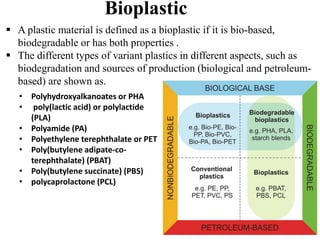
 A plastic material is defined as a bioplastic if it is bio-based,
biodegradable or has both properties .
 The different types of variant plastics in different aspects, such as
biodegradation and sources of production (biological and petroleum-
based) are shown as.
• Polyhydroxyalkanoates or PHA
• poly(lactic acid) or polylactide
(PLA)
• Polyamide (PA)
• Polyethylene terephthalate or PET
• Poly(butylene adipate-co-
terephthalate) (PBAT)
• Poly(butylene succinate) (PBS)
• polycaprolactone (PCL)
Sources of bioplastics:
• Bio base
• Petroleum base
A bioplastic can be defined as a polymer that is manufactured
into a commercial product from a natural source or renewable
resource. A bioplastic can be biodegradable, but a biodegradable
plastic does not mean the material was derived fully or in part
from a biological source. For example, polymers such as
polycaprolactone (PCL) and poly(butylene succinate) (PBS) are
biodegradable but petroleum based.
5
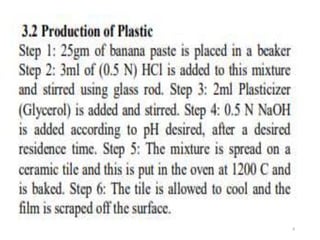
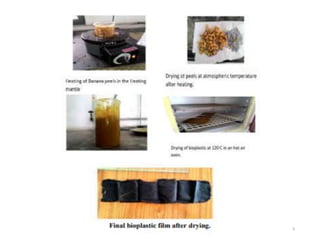
Bioplastic from Banana Peel
6
https://www.youtube.com/watch?v=f7LdLNGMKJs
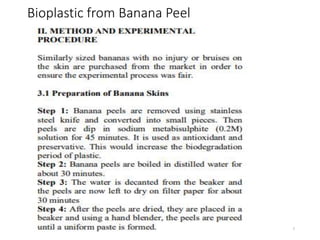
Bioplastic from Banana Peel
7
8
9
10
Polylactic acid and Polyglycolic Acid
• Environmental problems, such as global warming and plastic pollution
have forced researchers to investigate alternatives for conventional
plastics.
• The polymer materials of polylactic acid (PLA), polyglycolic acid
(PGA), and poly(lactic-co-glycolic) acid (PLGA) are strong
contributors as biodegradable plastic.
• It is also advantageous to utilize co-polymer and polymer blends of
monomers of PLA and PGA. PLGA to form copolymers with
biodegradability, hydrophilicity, mechanical properties, physical
properties, and surface topography
Poly(lactic acid) (PLA), one of the well-known eco-friendly
biodegradables and biobased polyesters, has been studied
extensively and is considered to be a promising substitute to
petroleum-based polymers
PLA
• PLA is biodegradable, biocompatible, and renewable
thermoplastic polyester which is mainly derived from corn
starch. The monomer lactic acid (LA) of PLA is derived from
natural sources. LA is produced using bacterial fermentation of
corn, sugarcane, potatoes, and other biomass. PLA is a very
useful material to be used as a replacement for petroleum-
based polymers because of its good mechanical properties and
good processability. PLA, however, is a hydrophobic polymer
and has poor toughness, slow degradation rate, less reactive
side chain groups, and low thermal stability
11
Poly (lactic acid) (PLA)
• Bio-plastics have gained tremendous attention, due to the
increasing environmental pressure on global warming and
plastic pollution. Among them, poly (lactic acid) (PLA) is both
bio-based and bio-degradable, which has been widely used in
many disposable packaging applications.
• Compared to traditional petroleum-based plastics, PLA is more
expensive and usually has less mechanical and physical
properties.
• The modification of PLA with PGA can be achieved via co-
polymerization, physical blending and multilayer lamination.
12
PLA
There are three main areas
of use for PLA, PGA, and
PLGA plastics:
(1) Use a drug carrier in
drug delivery applications
(2) The promotion of cell
growth and organ healing
in cell scaffolds and other
tissue engineered materials
(3) The implementation of
plastics in packaging
materials.
13
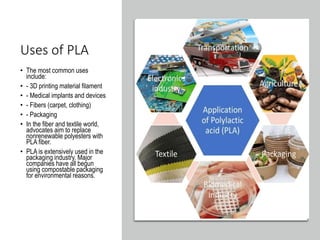
Uses of PLA
• The most common uses
include:
• - 3D printing material filament
• - Medical implants and devices
• - Fibers (carpet, clothing)
• - Packaging
• In the fiber and textile world,
advocates aim to replace
nonrenewable polyesters with
PLA fiber.
• PLA is extensively used in the
packaging industry. Major
companies have all begun
using compostable packaging
for environmental reasons.
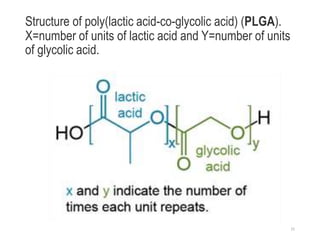
Structure of poly(lactic acid-co-glycolic acid) (PLGA).
X=number of units of lactic acid and Y=number of units
of glycolic acid.
15
16
Polylactic Acid An Environmently Friendly Plastic
• In our global polymers’ total production has reached about 9 billion
tons . From these plastics, only 9–10% is recycled and reused,
another small amount (12%) is incinerated, while the biggest
percentage (78–79%) is accumulated in environment (oceans, lakes,
rivers and landfills).
• Poly(lactic acid) (PLA), one of the well-known eco-friendly
biodegradables and biobased polyesters, has been studied extensively
and is considered to be a promising substitute to petroleum-based
polymers.
• PLA is one of the most promising polymers used in these applications
and is properly called “polymer of the 21st century “. It is the only
one, synthesized on a greater scale.
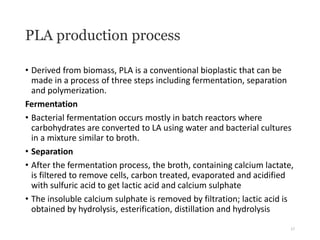
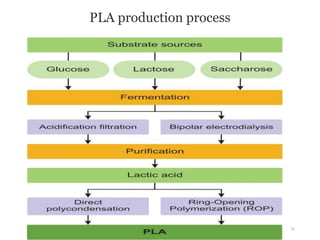
PLA production process
• Derived from biomass, PLA is a conventional bioplastic that can be
made in a process of three steps including fermentation, separation
and polymerization.
Fermentation
• Bacterial fermentation occurs mostly in batch reactors where
carbohydrates are converted to LA using water and bacterial cultures
in a mixture similar to broth.
• Separation
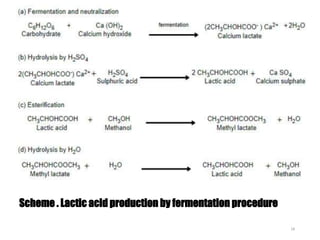
• After the fermentation process, the broth, containing calcium lactate,
is filtered to remove cells, carbon treated, evaporated and acidified
with sulfuric acid to get lactic acid and calcium sulphate
• The insoluble calcium sulphate is removed by filtration; lactic acid is
obtained by hydrolysis, esterification, distillation and hydrolysis
17
18
Scheme . Lactic acid production by fermentation procedure
Polylactic Acid production process
19
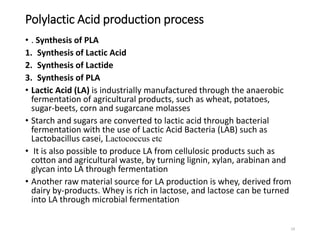
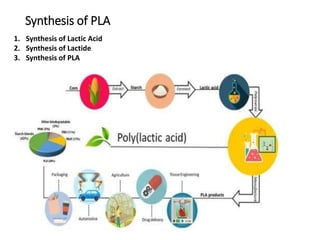
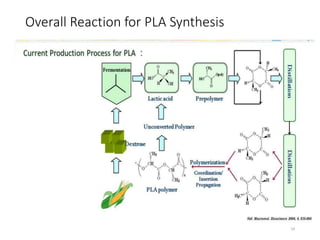
• . Synthesis of PLA
1. Synthesis of Lactic Acid
2. Synthesis of Lactide
3. Synthesis of PLA
• Lactic Acid (LA) is industrially manufactured through the anaerobic
fermentation of agricultural products, such as wheat, potatoes,
sugar-beets, corn and sugarcane molasses
• Starch and sugars are converted to lactic acid through bacterial
fermentation with the use of Lactic Acid Bacteria (LAB) such as
Lactobacillus casei, Lactococcus etc
• It is also possible to produce LA from cellulosic products such as
cotton and agricultural waste, by turning lignin, xylan, arabinan and
glycan into LA through fermentation
• Another raw material source for LA production is whey, derived from
dairy by-products. Whey is rich in lactose, and lactose can be turned
into LA through microbial fermentation
Synthesis of Lactide
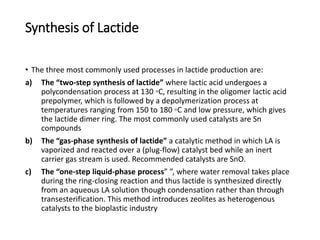
• The three most commonly used processes in lactide production are:
a) The “two-step synthesis of lactide” where lactic acid undergoes a
polycondensation process at 130 ◦C, resulting in the oligomer lactic acid
prepolymer, which is followed by a depolymerization process at
temperatures ranging from 150 to 180 ◦C and low pressure, which gives
the lactide dimer ring. The most commonly used catalysts are Sn
compounds
b) The “gas-phase synthesis of lactide” a catalytic method in which LA is
vaporized and reacted over a (plug-flow) catalyst bed while an inert
carrier gas stream is used. Recommended catalysts are SnO.
c) The “one-step liquid-phase process” ”, where water removal takes place
during the ring-closing reaction and thus lactide is synthesized directly
from an aqueous LA solution though condensation rather than through
transesterification. This method introduces zeolites as heterogenous
catalysts to the bioplastic industry
Synthesis of
PLA
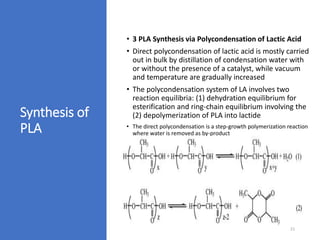
• 3 PLA Synthesis via Polycondensation of Lactic Acid
• Direct polycondensation of lactic acid is mostly carried
out in bulk by distillation of condensation water with
or without the presence of a catalyst, while vacuum
and temperature are gradually increased
• The polycondensation system of LA involves two
reaction equilibria: (1) dehydration equilibrium for
esterification and ring-chain equilibrium involving the
(2) depolymerization of PLA into lactide
• The direct polycondensation is a step-growth polymerization reaction
where water is removed as by-product
21
PLA production process
22
Synthesis of PLA
23
1. Synthesis of Lactic Acid
2. Synthesis of Lactide
3. Synthesis of PLA
Overall Reaction for PLA Synthesis
24
25
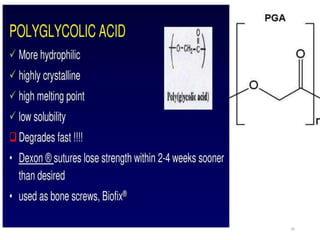
Poly glycolic acid is
a biodegradable, thermoplastic polymer and the simplest
linear, aliphatic polyester. It can be prepared starting
from glycolic acid by means of polycondensation or ring-opening
polymerization.
Poly glycolic acid
26
27
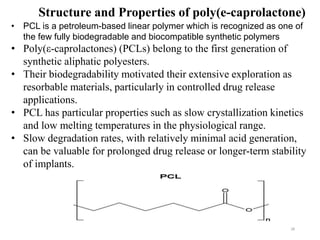
Structure and Properties of poly(e-caprolactone)
28
• PCL is a petroleum-based linear polymer which is recognized as one of
the few fully biodegradable and biocompatible synthetic polymers
• Poly(ε-caprolactones) (PCLs) belong to the first generation of
synthetic aliphatic polyesters.
• Their biodegradability motivated their extensive exploration as
resorbable materials, particularly in controlled drug release
applications.
• PCL has particular properties such as slow crystallization kinetics
and low melting temperatures in the physiological range.
• Slow degradation rates, with relatively minimal acid generation,
can be valuable for prolonged drug release or longer-term stability
of implants.
29
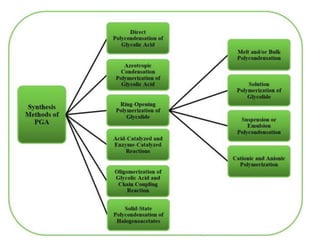
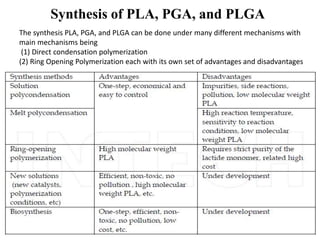
Synthesis of PLA, PGA, and PLGA
The synthesis PLA, PGA, and PLGA can be done under many different mechanisms with
main mechanisms being
(1) Direct condensation polymerization
(2) Ring Opening Polymerization each with its own set of advantages and disadvantages
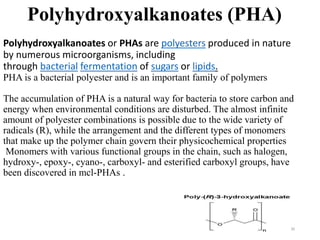
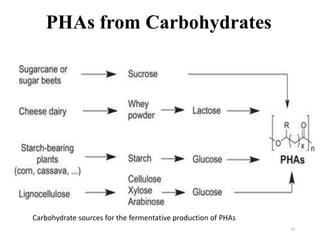
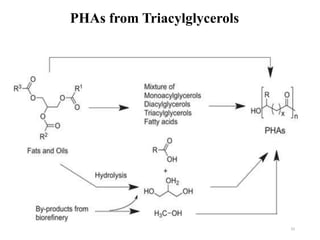
Polyhydroxyalkanoates or PHAs are polyesters produced in nature
by numerous microorganisms, including
through bacterial fermentation of sugars or lipids.
PHA is a bacterial polyester and is an important family of polymers
The accumulation of PHA is a natural way for bacteria to store carbon and
energy when environmental conditions are disturbed. The almost infinite
amount of polyester combinations is possible due to the wide variety of
radicals (R), while the arrangement and the different types of monomers
that make up the polymer chain govern their physicochemical properties
Monomers with various functional groups in the chain, such as halogen,
hydroxy-, epoxy-, cyano-, carboxyl- and esterified carboxyl groups, have
been discovered in mcl-PHAs .
30
Polyhydroxyalkanoates (PHA)
31
32
PHAs from Carbohydrates
Carbohydrate sources for the fermentative production of PHAs
33
PHAs from Triacylglycerols
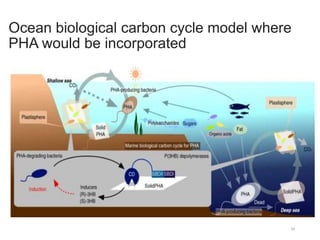
Ocean biological carbon cycle model where
PHA would be incorporated
34
Important Conclusion
35
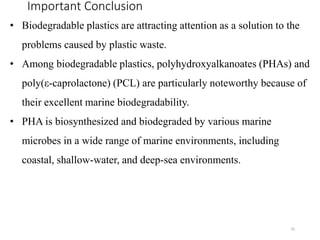
• Biodegradable plastics are attracting attention as a solution to the
problems caused by plastic waste.
• Among biodegradable plastics, polyhydroxyalkanoates (PHAs) and
poly(ε-caprolactone) (PCL) are particularly noteworthy because of
their excellent marine biodegradability.
• PHA is biosynthesized and biodegraded by various marine
microbes in a wide range of marine environments, including
coastal, shallow-water, and deep-sea environments.
36
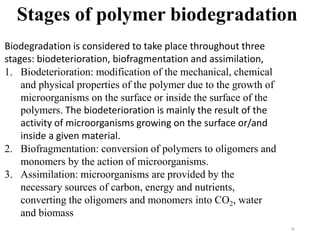
Stages of polymer biodegradation
Biodegradation is considered to take place throughout three
stages: biodeterioration, biofragmentation and assimilation,
1. Biodeterioration: modification of the mechanical, chemical
and physical properties of the polymer due to the growth of
microorganisms on the surface or inside the surface of the
polymers. The biodeterioration is mainly the result of the
activity of microorganisms growing on the surface or/and
inside a given material.
2. Biofragmentation: conversion of polymers to oligomers and
monomers by the action of microorganisms.
3. Assimilation: microorganisms are provided by the
necessary sources of carbon, energy and nutrients,
converting the oligomers and monomers into CO2, water
and biomass
37
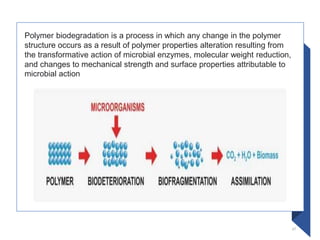
Polymer biodegradation is a process in which any change in the polymer
structure occurs as a result of polymer properties alteration resulting from
the transformative action of microbial enzymes, molecular weight reduction,
and changes to mechanical strength and surface properties attributable to
microbial action
Biodegradability Testing of Bioplastic Bages
38
https://www.youtube.com/watch?v=dwYU17lwIHc

Bio Plastic

  • 1.
    1 Polymer and AdvancedIndustrial Chemistry (CH-813) Lecture No 8 Biodegradable plastics Polylactic acid, Polyglycolic acid, Polycaprolactone, Polyhydroxyalkanoate(Properties, Synthesis and Structure) 19th April 2022
  • 2.
  • 3.
    Bioplastic • Bioplastic isa biodegradable material that come from renewable sources and can be used to reduce the problem of plastic waste that is suffocating the planet and polluting the environment. • Advantages of bioplastics: • They reduce carbon footprint(total amount of greenhouse gases) • They providing energy savings in production • They do not involve the consumption of non-renewable raw materials • Their production reduces non-biodegradable waste that contaminates the environment • They do not contain additives that are harmful to health • They do not change the flavor or scent of the food contained 3
  • 4.
    4 Bioplastic  A plasticmaterial is defined as a bioplastic if it is bio-based, biodegradable or has both properties .  The different types of variant plastics in different aspects, such as biodegradation and sources of production (biological and petroleum- based) are shown as. • Polyhydroxyalkanoates or PHA • poly(lactic acid) or polylactide (PLA) • Polyamide (PA) • Polyethylene terephthalate or PET • Poly(butylene adipate-co- terephthalate) (PBAT) • Poly(butylene succinate) (PBS) • polycaprolactone (PCL)
  • 5.
    Sources of bioplastics: •Bio base • Petroleum base A bioplastic can be defined as a polymer that is manufactured into a commercial product from a natural source or renewable resource. A bioplastic can be biodegradable, but a biodegradable plastic does not mean the material was derived fully or in part from a biological source. For example, polymers such as polycaprolactone (PCL) and poly(butylene succinate) (PBS) are biodegradable but petroleum based. 5
  • 6.
    Bioplastic from BananaPeel 6 https://www.youtube.com/watch?v=f7LdLNGMKJs
  • 7.
  • 8.
  • 9.
  • 10.
    10 Polylactic acid andPolyglycolic Acid • Environmental problems, such as global warming and plastic pollution have forced researchers to investigate alternatives for conventional plastics. • The polymer materials of polylactic acid (PLA), polyglycolic acid (PGA), and poly(lactic-co-glycolic) acid (PLGA) are strong contributors as biodegradable plastic. • It is also advantageous to utilize co-polymer and polymer blends of monomers of PLA and PGA. PLGA to form copolymers with biodegradability, hydrophilicity, mechanical properties, physical properties, and surface topography Poly(lactic acid) (PLA), one of the well-known eco-friendly biodegradables and biobased polyesters, has been studied extensively and is considered to be a promising substitute to petroleum-based polymers
  • 11.
    PLA • PLA isbiodegradable, biocompatible, and renewable thermoplastic polyester which is mainly derived from corn starch. The monomer lactic acid (LA) of PLA is derived from natural sources. LA is produced using bacterial fermentation of corn, sugarcane, potatoes, and other biomass. PLA is a very useful material to be used as a replacement for petroleum- based polymers because of its good mechanical properties and good processability. PLA, however, is a hydrophobic polymer and has poor toughness, slow degradation rate, less reactive side chain groups, and low thermal stability 11
  • 12.
    Poly (lactic acid)(PLA) • Bio-plastics have gained tremendous attention, due to the increasing environmental pressure on global warming and plastic pollution. Among them, poly (lactic acid) (PLA) is both bio-based and bio-degradable, which has been widely used in many disposable packaging applications. • Compared to traditional petroleum-based plastics, PLA is more expensive and usually has less mechanical and physical properties. • The modification of PLA with PGA can be achieved via co- polymerization, physical blending and multilayer lamination. 12
  • 13.
    PLA There are threemain areas of use for PLA, PGA, and PLGA plastics: (1) Use a drug carrier in drug delivery applications (2) The promotion of cell growth and organ healing in cell scaffolds and other tissue engineered materials (3) The implementation of plastics in packaging materials. 13
  • 14.
    Uses of PLA •The most common uses include: • - 3D printing material filament • - Medical implants and devices • - Fibers (carpet, clothing) • - Packaging • In the fiber and textile world, advocates aim to replace nonrenewable polyesters with PLA fiber. • PLA is extensively used in the packaging industry. Major companies have all begun using compostable packaging for environmental reasons.
  • 15.
    Structure of poly(lacticacid-co-glycolic acid) (PLGA). X=number of units of lactic acid and Y=number of units of glycolic acid. 15
  • 16.
    16 Polylactic Acid AnEnvironmently Friendly Plastic • In our global polymers’ total production has reached about 9 billion tons . From these plastics, only 9–10% is recycled and reused, another small amount (12%) is incinerated, while the biggest percentage (78–79%) is accumulated in environment (oceans, lakes, rivers and landfills). • Poly(lactic acid) (PLA), one of the well-known eco-friendly biodegradables and biobased polyesters, has been studied extensively and is considered to be a promising substitute to petroleum-based polymers. • PLA is one of the most promising polymers used in these applications and is properly called “polymer of the 21st century “. It is the only one, synthesized on a greater scale.
  • 17.
    PLA production process •Derived from biomass, PLA is a conventional bioplastic that can be made in a process of three steps including fermentation, separation and polymerization. Fermentation • Bacterial fermentation occurs mostly in batch reactors where carbohydrates are converted to LA using water and bacterial cultures in a mixture similar to broth. • Separation • After the fermentation process, the broth, containing calcium lactate, is filtered to remove cells, carbon treated, evaporated and acidified with sulfuric acid to get lactic acid and calcium sulphate • The insoluble calcium sulphate is removed by filtration; lactic acid is obtained by hydrolysis, esterification, distillation and hydrolysis 17
  • 18.
    18 Scheme . Lacticacid production by fermentation procedure
  • 19.
    Polylactic Acid productionprocess 19 • . Synthesis of PLA 1. Synthesis of Lactic Acid 2. Synthesis of Lactide 3. Synthesis of PLA • Lactic Acid (LA) is industrially manufactured through the anaerobic fermentation of agricultural products, such as wheat, potatoes, sugar-beets, corn and sugarcane molasses • Starch and sugars are converted to lactic acid through bacterial fermentation with the use of Lactic Acid Bacteria (LAB) such as Lactobacillus casei, Lactococcus etc • It is also possible to produce LA from cellulosic products such as cotton and agricultural waste, by turning lignin, xylan, arabinan and glycan into LA through fermentation • Another raw material source for LA production is whey, derived from dairy by-products. Whey is rich in lactose, and lactose can be turned into LA through microbial fermentation
  • 20.
    Synthesis of Lactide •The three most commonly used processes in lactide production are: a) The “two-step synthesis of lactide” where lactic acid undergoes a polycondensation process at 130 ◦C, resulting in the oligomer lactic acid prepolymer, which is followed by a depolymerization process at temperatures ranging from 150 to 180 ◦C and low pressure, which gives the lactide dimer ring. The most commonly used catalysts are Sn compounds b) The “gas-phase synthesis of lactide” a catalytic method in which LA is vaporized and reacted over a (plug-flow) catalyst bed while an inert carrier gas stream is used. Recommended catalysts are SnO. c) The “one-step liquid-phase process” ”, where water removal takes place during the ring-closing reaction and thus lactide is synthesized directly from an aqueous LA solution though condensation rather than through transesterification. This method introduces zeolites as heterogenous catalysts to the bioplastic industry
  • 21.
    Synthesis of PLA • 3PLA Synthesis via Polycondensation of Lactic Acid • Direct polycondensation of lactic acid is mostly carried out in bulk by distillation of condensation water with or without the presence of a catalyst, while vacuum and temperature are gradually increased • The polycondensation system of LA involves two reaction equilibria: (1) dehydration equilibrium for esterification and ring-chain equilibrium involving the (2) depolymerization of PLA into lactide • The direct polycondensation is a step-growth polymerization reaction where water is removed as by-product 21
  • 22.
  • 23.
    Synthesis of PLA 23 1.Synthesis of Lactic Acid 2. Synthesis of Lactide 3. Synthesis of PLA
  • 24.
    Overall Reaction forPLA Synthesis 24
  • 25.
    25 Poly glycolic acidis a biodegradable, thermoplastic polymer and the simplest linear, aliphatic polyester. It can be prepared starting from glycolic acid by means of polycondensation or ring-opening polymerization. Poly glycolic acid
  • 26.
  • 27.
  • 28.
    Structure and Propertiesof poly(e-caprolactone) 28 • PCL is a petroleum-based linear polymer which is recognized as one of the few fully biodegradable and biocompatible synthetic polymers • Poly(ε-caprolactones) (PCLs) belong to the first generation of synthetic aliphatic polyesters. • Their biodegradability motivated their extensive exploration as resorbable materials, particularly in controlled drug release applications. • PCL has particular properties such as slow crystallization kinetics and low melting temperatures in the physiological range. • Slow degradation rates, with relatively minimal acid generation, can be valuable for prolonged drug release or longer-term stability of implants.
  • 29.
    29 Synthesis of PLA,PGA, and PLGA The synthesis PLA, PGA, and PLGA can be done under many different mechanisms with main mechanisms being (1) Direct condensation polymerization (2) Ring Opening Polymerization each with its own set of advantages and disadvantages
  • 30.
    Polyhydroxyalkanoates or PHAsare polyesters produced in nature by numerous microorganisms, including through bacterial fermentation of sugars or lipids. PHA is a bacterial polyester and is an important family of polymers The accumulation of PHA is a natural way for bacteria to store carbon and energy when environmental conditions are disturbed. The almost infinite amount of polyester combinations is possible due to the wide variety of radicals (R), while the arrangement and the different types of monomers that make up the polymer chain govern their physicochemical properties Monomers with various functional groups in the chain, such as halogen, hydroxy-, epoxy-, cyano-, carboxyl- and esterified carboxyl groups, have been discovered in mcl-PHAs . 30 Polyhydroxyalkanoates (PHA)
  • 31.
  • 32.
    32 PHAs from Carbohydrates Carbohydratesources for the fermentative production of PHAs
  • 33.
  • 34.
    Ocean biological carboncycle model where PHA would be incorporated 34
  • 35.
    Important Conclusion 35 • Biodegradableplastics are attracting attention as a solution to the problems caused by plastic waste. • Among biodegradable plastics, polyhydroxyalkanoates (PHAs) and poly(ε-caprolactone) (PCL) are particularly noteworthy because of their excellent marine biodegradability. • PHA is biosynthesized and biodegraded by various marine microbes in a wide range of marine environments, including coastal, shallow-water, and deep-sea environments.
  • 36.
    36 Stages of polymerbiodegradation Biodegradation is considered to take place throughout three stages: biodeterioration, biofragmentation and assimilation, 1. Biodeterioration: modification of the mechanical, chemical and physical properties of the polymer due to the growth of microorganisms on the surface or inside the surface of the polymers. The biodeterioration is mainly the result of the activity of microorganisms growing on the surface or/and inside a given material. 2. Biofragmentation: conversion of polymers to oligomers and monomers by the action of microorganisms. 3. Assimilation: microorganisms are provided by the necessary sources of carbon, energy and nutrients, converting the oligomers and monomers into CO2, water and biomass
  • 37.
    37 Polymer biodegradation isa process in which any change in the polymer structure occurs as a result of polymer properties alteration resulting from the transformative action of microbial enzymes, molecular weight reduction, and changes to mechanical strength and surface properties attributable to microbial action
  • 38.
    Biodegradability Testing ofBioplastic Bages 38 https://www.youtube.com/watch?v=dwYU17lwIHc