Acrylamide
Thermally induced harmful
        chemical
      Advanced Food Chemistry
   Food Engineering Master Program
      İstanbul Aydın Üniversitesi
Background
- 1950 industrial chemical used for water treatment, paper
industry, glues, flocculants, synthetis of dyes
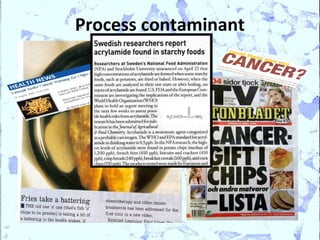
- 2002 discovered in Sweden in starchy foods (production
Temperature dependent) so not found in boiled or not
heated food
- 2009 Health Canada assesses whether acrylamide is a
hazard to human health and whether any regulatory action
needs to be taken.
- 2010 EChA added acrylamide to the list of substances of
very high concern
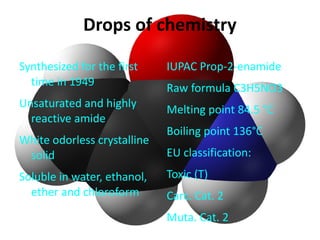
Drops of chemistry

Synthesized for the first    IUPAC Prop-2-enamide
  time in 1949
                             Raw formula C3H5NO3
Unsaturated and highly
                             Melting point 84.5 °C
  reactive amide
                             Boiling point 136°C
White odorless crystalline
 solid                       EU classification:
Soluble in water, ethanol,   Toxic (T)
  ether and chloroform       Carc. Cat. 2
                             Muta. Cat. 2
ROUTES OF EXPOSURE: The substance can be absorbed into
           EXPOSURE
  the body by inhalation, through the skin and by ingestion.
INHALATION RISK: Evaporation at 20°C is negligible; a harmful
            RISK
  concentration of airborne particles can, however, be
  reached quickly.
EFFECTS OF SHORT-TERM EXPOSURE: irritating the eyes, the
                          EXPOSURE
  skin and the respiratory tract. The substance may cause
  effects on the central nervous system.
EFFECTS OF LONG-TERM OR REPEATED EXPOSURE: effects on
                                       EXPOSURE
  the nervous system, resulting in peripheral nerve damage.
  This substance is probably carcinogenic to humans. May
  cause heritable genetic damage in humans.
Formation in food
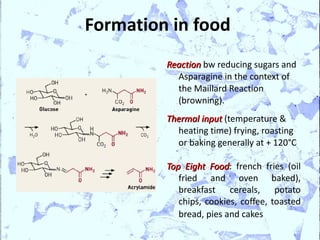
         Reaction bw reducing sugars and
           Asparagine in the context of
           the Maillard Reaction
           (browning).
         Thermal input (temperature &
           heating time) frying, roasting
           or baking generally at + 120°C

         Top Eight Food: french fries (oil
                    Food
            fried and oven baked),
            breakfast cereals, potato
            chips, cookies, coffee, toasted
            bread, pies and cakes
Acrylamide is a result of the Maillard reaction
A reaction occurs between the carbohydrates
  (sugar) and proteins and is responsible for
  changes in color, flavor and nutritive in food.
It has been confirmed that asparagine is the
  main amino acid responsible for its formation.
Available evidence suggests that sugars and
  other carbonyl compounds play a specific role
  in the decarboxylation process of asparagine
Why being worried?
Neurotoxicity in humans is well known from occupational
                and accidental exposures
Experimental studies in animals have shown reproductive,
        genotoxic and carcinogenic properties
  IARC classified chemical as “probably carcinogenic to
                   humans (Group 2A)”
 Relative levels of acrylamide in the diet are higher than
             many other known carcinogens
   Regarded as a genotoxic carcinogen - a safe level of
           exposure cannot be established
Process contaminant
Acrylamide in food?

Its presence in food was unknown prior to the Swedish
                      report in 2002.


 Found “by chance” when blood samples of exposed
   workers (miners) and an unexposed control group
  were compared and high levels of acrylamide were
                found in both groups.
Effects of Acrylamide on people

Acrylamide is considered to be a mutagen and possibly a
 carcinogen in humans.

Case studies provided by National Cancer Institute some of
  the cancers that are believed to be related to acrylamide
  are: oral cavity, pharynx, esophagus, larynx, kidney,
  breast, ovary.
Neurological damage has been associated to exposure of
  high levels of acrylamide in water treatment plants. There
  have been cases of human poisoning due to
  contaminated water in proximity to ground injection sites
  where acrylamide is disposed of.
What has been done?
Risks to consumers have been discussed by many
  international bodies (e.g. EFSA, FAO, WHO), EU
  committees and national authorities

 Initiatives to reduce/prevent acrylamide formation
                     CIAA Toolbox*
     EU Acrylamide Workshops & Stakeholder meetings


                    EU Initiatives
             EU Monitoring Recommendation
                 EU Indicative Values
                     EU Checklist
Eu monitoring programme
Monitoring of food groups known to be major contributors
Principal aim is to investigate if mitigation strategies
 (i.e. Toolbox*) are used and/or effective
       Toolbox*
Produce taken from same source over period of 3 years
    (last one was 2007 – 2009)
Data from Member States analysed by EFSA
Results did not show clear trends
Programme extended (open-ended)
Accompanied by a checklist to collect further information
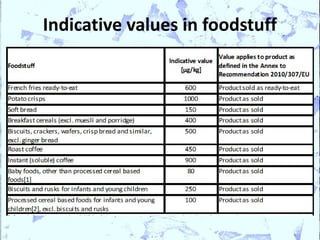
Information used to establish indicative values
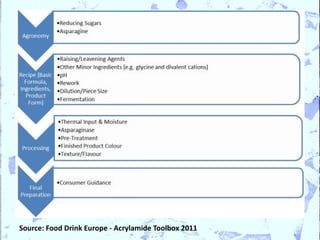
Source: Food Drink Europe - Acrylamide Toolbox 2011
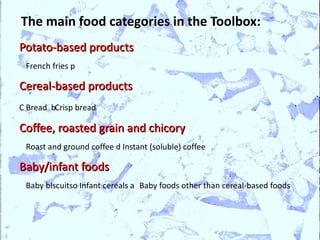
The main food categories in the Toolbox:
Potato-based products
 French fries p

Cereal-based products
C Bread bCrisp bread

Coffee, roasted grain and chicory
 Roast and ground coffee d Instant (soluble) coffee

Baby/infant foods
 Baby biscuitso Infant cereals a Baby foods other than cereal-based foods
From Farm to fork :
Potato Based Products
     Case study
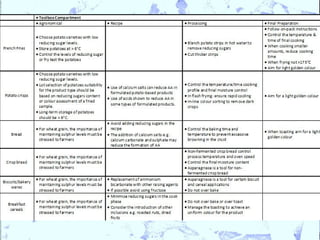
Farming


F Selection of potato varieties with low reducing sugars
  that are suitable for the product type.
t Minimising the risk of high reducing sugars by
  growing those low sugar varieties
g Ensuring tubers are mature at time of harvesting
  (immature tubers tend to have higher reducing sugar
  levels).
Storage

S Controlling storage conditions from farm to factory
  (e.g. temp. >6°C identified as good practice for long
  term storage
t Storing crops within the recommended window for
  the specific variety
Manufacturing
MCalcium salts (e.g. Ca-lactate), when used at <0.3% in
the dough, can be an effective reduction tool. The
percentage decrease is highly dependent on the AA
starting level of the product this tool is applied to.
s In potato-based pellet snacks ~1% addition of calcium
chloride has given a ~20-80% reduction dependent on
the product design. Too high levels of calcium salts can,
however, generate off-flavours.
h Treatment of potato flakes with calcium salts during
their production have demonstrated 30-40% reduction
dependent on the product design and formulation. Too
high levels can, however, generate undesirable product
attributes.
Processing

P Asparaginase may reduce AA in reconstituted
  doughbased products but off flavours can be created in
  some recipes
s Thermal input controls Acrylamide formation in the
  finished product
f Controlling moisture helps to manage cooking control
C Blanching is a very effective tool to impact AA levels in
  French fries
Cont'd
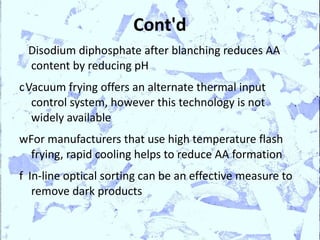
 Disodium diphosphate after blanching reduces AA
 content by reducing pH
cVacuum frying offers an alternate thermal input
  control system, however this technology is not
  widely available
wFor manufacturers that use high temperature flash
  frying, rapid cooling helps to reduce AA formation
f In-line optical sorting can be an effective measure to
   remove dark products
Final Preparation:
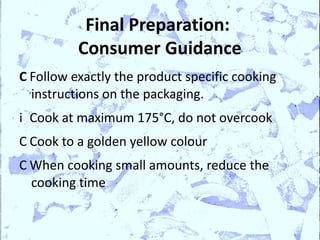
          Consumer Guidance
C Follow exactly the product specific cooking
  instructions on the packaging.
i Cook at maximum 175°C, do not overcook
C Cook to a golden yellow colour
C When cooking small amounts, reduce the
  cooking time
Indicative values in foodstuff
Future issues
Breeding new potato varieties with lower reducing sugar content and/or
   less cold sweetening effect.

Further optimise agricultural practices to minimise reducing sugars and
   Asn. The nitrogen fertiliser regime appears to influence the reducing
   sugar concentration of the potato tuber, i.e. increased reducing
   sugars (60–100%) upon lowering the field N-fertilisation.

At the likely levels of acrylamide intake from the diet, the key effects of
   concern are genotoxicity and possible carcinogenic effects

Appropriate efforts to reduce acrylamide concentrations in food should
  continue

Keep identifying how to optimise processing, preparation and cooking
  regimes to reduce levels of acrylamide in food
References
CONFEDERATION OF THE FOOD AND DRINK INDUSTRIES OF THE EU. Food drink europe acrylamide
   toolbox 2011 (2011).

EUROPEAN FOOD SAFETY AUTHORITY, Results on acrylamide levels in food from monitoring years
   2007-2009 and exposure assessment. efsa (2011).

EC (European Commission), Recommendation of 11 January 2011 on investigations into the levels of
    acrylamide in food (2011).

FAO/WHO (Food and Agricultural Organisation/World Health Organization). Summary and conclusions
   report of the seventy-second meeting of the JECFA (2010)

World Health Organization, Principles and methods for the risk assessment of chemicals in food.
   Environmental Health (2010)

FAO/WHO. International Programme on Chemical Safety (IPCS). (2011).

SPIVEY, A. A matter of degrees: advancing our understanding of acrylamide. Environmental Health
    Perspectives (2010).
Thank you for your time!

Acrylamide

  • 1.
    Acrylamide Thermally induced harmful chemical Advanced Food Chemistry Food Engineering Master Program İstanbul Aydın Üniversitesi
  • 2.
    Background - 1950 industrialchemical used for water treatment, paper industry, glues, flocculants, synthetis of dyes - 2002 discovered in Sweden in starchy foods (production Temperature dependent) so not found in boiled or not heated food - 2009 Health Canada assesses whether acrylamide is a hazard to human health and whether any regulatory action needs to be taken. - 2010 EChA added acrylamide to the list of substances of very high concern
  • 3.
    Drops of chemistry Synthesizedfor the first IUPAC Prop-2-enamide time in 1949 Raw formula C3H5NO3 Unsaturated and highly Melting point 84.5 °C reactive amide Boiling point 136°C White odorless crystalline solid EU classification: Soluble in water, ethanol, Toxic (T) ether and chloroform Carc. Cat. 2 Muta. Cat. 2
  • 4.
    ROUTES OF EXPOSURE:The substance can be absorbed into EXPOSURE the body by inhalation, through the skin and by ingestion. INHALATION RISK: Evaporation at 20°C is negligible; a harmful RISK concentration of airborne particles can, however, be reached quickly. EFFECTS OF SHORT-TERM EXPOSURE: irritating the eyes, the EXPOSURE skin and the respiratory tract. The substance may cause effects on the central nervous system. EFFECTS OF LONG-TERM OR REPEATED EXPOSURE: effects on EXPOSURE the nervous system, resulting in peripheral nerve damage. This substance is probably carcinogenic to humans. May cause heritable genetic damage in humans.
  • 5.
    Formation in food Reaction bw reducing sugars and Asparagine in the context of the Maillard Reaction (browning). Thermal input (temperature & heating time) frying, roasting or baking generally at + 120°C Top Eight Food: french fries (oil Food fried and oven baked), breakfast cereals, potato chips, cookies, coffee, toasted bread, pies and cakes
  • 6.
    Acrylamide is aresult of the Maillard reaction A reaction occurs between the carbohydrates (sugar) and proteins and is responsible for changes in color, flavor and nutritive in food. It has been confirmed that asparagine is the main amino acid responsible for its formation. Available evidence suggests that sugars and other carbonyl compounds play a specific role in the decarboxylation process of asparagine
  • 7.
    Why being worried? Neurotoxicityin humans is well known from occupational and accidental exposures Experimental studies in animals have shown reproductive, genotoxic and carcinogenic properties IARC classified chemical as “probably carcinogenic to humans (Group 2A)” Relative levels of acrylamide in the diet are higher than many other known carcinogens Regarded as a genotoxic carcinogen - a safe level of exposure cannot be established
  • 8.
  • 9.
    Acrylamide in food? Itspresence in food was unknown prior to the Swedish report in 2002. Found “by chance” when blood samples of exposed workers (miners) and an unexposed control group were compared and high levels of acrylamide were found in both groups.
  • 10.
    Effects of Acrylamideon people Acrylamide is considered to be a mutagen and possibly a carcinogen in humans. Case studies provided by National Cancer Institute some of the cancers that are believed to be related to acrylamide are: oral cavity, pharynx, esophagus, larynx, kidney, breast, ovary. Neurological damage has been associated to exposure of high levels of acrylamide in water treatment plants. There have been cases of human poisoning due to contaminated water in proximity to ground injection sites where acrylamide is disposed of.
  • 11.
    What has beendone? Risks to consumers have been discussed by many international bodies (e.g. EFSA, FAO, WHO), EU committees and national authorities Initiatives to reduce/prevent acrylamide formation CIAA Toolbox* EU Acrylamide Workshops & Stakeholder meetings EU Initiatives EU Monitoring Recommendation EU Indicative Values EU Checklist
  • 12.
    Eu monitoring programme Monitoringof food groups known to be major contributors Principal aim is to investigate if mitigation strategies (i.e. Toolbox*) are used and/or effective Toolbox* Produce taken from same source over period of 3 years (last one was 2007 – 2009) Data from Member States analysed by EFSA Results did not show clear trends Programme extended (open-ended) Accompanied by a checklist to collect further information Information used to establish indicative values
  • 13.
    Source: Food DrinkEurope - Acrylamide Toolbox 2011
  • 14.
    The main foodcategories in the Toolbox: Potato-based products French fries p Cereal-based products C Bread bCrisp bread Coffee, roasted grain and chicory Roast and ground coffee d Instant (soluble) coffee Baby/infant foods Baby biscuitso Infant cereals a Baby foods other than cereal-based foods
  • 15.
    From Farm tofork : Potato Based Products Case study
  • 16.
    Farming F Selection ofpotato varieties with low reducing sugars that are suitable for the product type. t Minimising the risk of high reducing sugars by growing those low sugar varieties g Ensuring tubers are mature at time of harvesting (immature tubers tend to have higher reducing sugar levels).
  • 17.
    Storage S Controlling storageconditions from farm to factory (e.g. temp. >6°C identified as good practice for long term storage t Storing crops within the recommended window for the specific variety
  • 18.
    Manufacturing MCalcium salts (e.g.Ca-lactate), when used at <0.3% in the dough, can be an effective reduction tool. The percentage decrease is highly dependent on the AA starting level of the product this tool is applied to. s In potato-based pellet snacks ~1% addition of calcium chloride has given a ~20-80% reduction dependent on the product design. Too high levels of calcium salts can, however, generate off-flavours. h Treatment of potato flakes with calcium salts during their production have demonstrated 30-40% reduction dependent on the product design and formulation. Too high levels can, however, generate undesirable product attributes.
  • 19.
    Processing P Asparaginase mayreduce AA in reconstituted doughbased products but off flavours can be created in some recipes s Thermal input controls Acrylamide formation in the finished product f Controlling moisture helps to manage cooking control C Blanching is a very effective tool to impact AA levels in French fries
  • 20.
    Cont'd Disodium diphosphateafter blanching reduces AA content by reducing pH cVacuum frying offers an alternate thermal input control system, however this technology is not widely available wFor manufacturers that use high temperature flash frying, rapid cooling helps to reduce AA formation f In-line optical sorting can be an effective measure to remove dark products
  • 21.
    Final Preparation: Consumer Guidance C Follow exactly the product specific cooking instructions on the packaging. i Cook at maximum 175°C, do not overcook C Cook to a golden yellow colour C When cooking small amounts, reduce the cooking time
  • 23.
  • 24.
    Future issues Breeding newpotato varieties with lower reducing sugar content and/or less cold sweetening effect. Further optimise agricultural practices to minimise reducing sugars and Asn. The nitrogen fertiliser regime appears to influence the reducing sugar concentration of the potato tuber, i.e. increased reducing sugars (60–100%) upon lowering the field N-fertilisation. At the likely levels of acrylamide intake from the diet, the key effects of concern are genotoxicity and possible carcinogenic effects Appropriate efforts to reduce acrylamide concentrations in food should continue Keep identifying how to optimise processing, preparation and cooking regimes to reduce levels of acrylamide in food
  • 25.
    References CONFEDERATION OF THEFOOD AND DRINK INDUSTRIES OF THE EU. Food drink europe acrylamide toolbox 2011 (2011). EUROPEAN FOOD SAFETY AUTHORITY, Results on acrylamide levels in food from monitoring years 2007-2009 and exposure assessment. efsa (2011). EC (European Commission), Recommendation of 11 January 2011 on investigations into the levels of acrylamide in food (2011). FAO/WHO (Food and Agricultural Organisation/World Health Organization). Summary and conclusions report of the seventy-second meeting of the JECFA (2010) World Health Organization, Principles and methods for the risk assessment of chemicals in food. Environmental Health (2010) FAO/WHO. International Programme on Chemical Safety (IPCS). (2011). SPIVEY, A. A matter of degrees: advancing our understanding of acrylamide. Environmental Health Perspectives (2010).
  • 26.
    Thank you foryour time!