PRACTICE II, DIDACTICS OF ELT
LESSON PLAN Nº 6
Teachers: Prof. Estela N. Braun, Prof. Vanesa Cabral, Prof. Luján Ramos, and ETA
Fulbright John Brakke
Trainees: Mara Barbieri and Mariel Matta
School: School N°6 “Dr. Ricardo Gutierrez”
Courses: 5th grade C & D
Textbook: “Howdy Friends” Level 1, Santillana
Date: August, 22nd 2017 from 13:15 to 14:50
Topics: Bugs, numbers and there is/are
Classes: N° 11 & 12
LEARNING OBJECTIVES
 Revise vocabularyaboutbugsandtheirbodyparts.
 Incorporate vocabularyaboutactionverbsbyacting themout(jump,run,climb,eat,
fly,walk,sleep,see).
 Solve areadingcomprehensionactivity.
 Provide descriptionsof bugsusing have/hasgot,haven’t/hasn’tgot.
ROUTINE
Singinggreetingsong“Yellow,red,green andblue.Helloteacher,how are you?”.Giving
studentsbudgeswiththeirnames.Writingthe date onthe board.
WARM UP
The teacherwill presentactionverbswiththe helpof flashcards.Then,she willplay“Simon
says” withthe class,usingthe verbslearned.Studentswill have tomime the verbswhen
required.
TYPE OF INTERACTION:teacher– students
MACRO-SKILLS:listening
TIMING: 10 minutes
MATERIALS: blackboard,flashcardsof actionverbs
DEVELOPMENT:
First Activity:
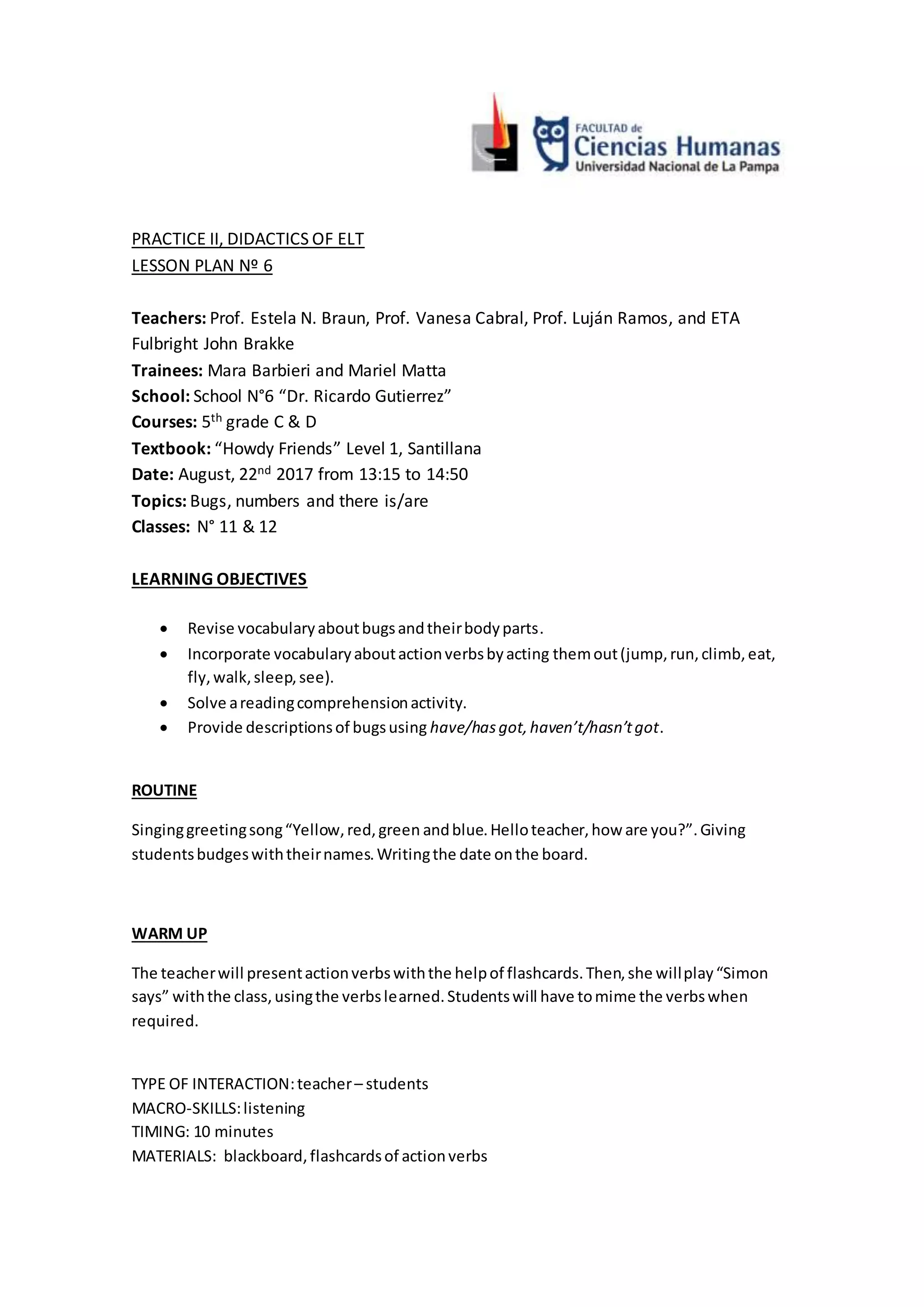
The teacherwill askstudents toshare whichwordstheyfoundinthe word searchthat was
assignedashomework.Thenshe will copythe wordsonthe board,classifyingthemaccording
to the task, sothat all studentscan check.
TYPE OF INTERACTION:teacher– students
MACRO-SKILLS:reading
TIMING: 5 minutes
MATERIALS: blackboard – extrahandoutswithwordsearchactivityincase someone lostitor
was absent
SecondActivity:
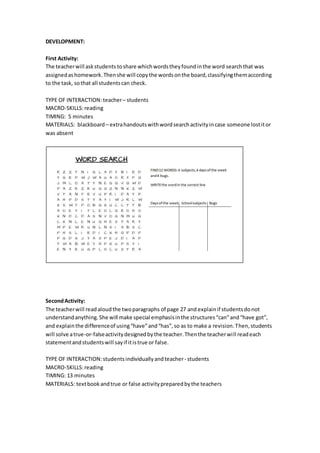
The teacherwill readaloudthe twoparagraphs of page 27 and explainif studentsdonot
understand anything.She will make special emphasisinthe structures“can”and“have got”,
and explainthe differenceof using“have”and“has”,so as to make a revision.Then,students
will solve atrue-or-falseactivitydesignedbythe teacher.Thenthe teacherwill readeach
statementandstudentswill sayif itistrue or false.
TYPE OF INTERACTION:students individuallyandteacher- students
MACRO-SKILLS:reading
TIMING: 13 minutes
MATERIALS: textbook andtrue or false activitypreparedbythe teachers
Third activity
The teacherwill askstudentstoworkin pairsto complete activity16from page 29. She will
firstexplainthe activity,andafter5 minutesshe will correctorallyandwritingthe answerson
the board.
TYPE OF INTERACTION:students inpairs
MACRO-SKILLS:reading
TIMING: 5 minutes
MATERIALS: activitybook,blackboard
Write TRUE or FALSE
Snailscan runveryfast.
Snailshave gota shell.
Snailscan climb.
Snailsdon’teatplants.
Wasps are dangerous.
Wasps haven’tgota poisonoussting.
Wasps don’tlike nectar.
Fourth activity
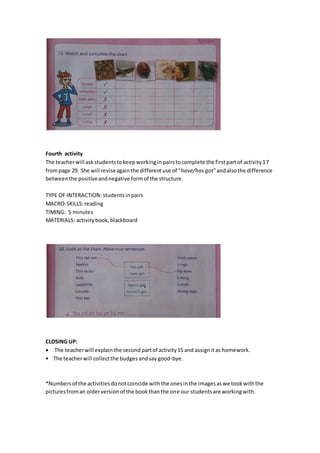
The teacherwill askstudentstokeepworkinginpairstocomplete the firstpartof activity17
frompage 29. She will reviseagainthe differentuse of “have/hasgot”andalsothe difference
betweenthe positiveandnegative formof the structure.
TYPE OF INTERACTION:students inpairs
MACRO-SKILLS:reading
TIMING: 5 minutes
MATERIALS: activitybook,blackboard
CLOSING UP:
 The teacherwill explainthe second partof activity15 and assignitas homework.
• The teacherwill collectthe budges andsaygood-bye.
*Numbersof the activitiesdonotcoincide withthe onesinthe imagesaswe tookwiththe
picturesfroman olderversionof the bookthanthe one our studentsare workingwith.
 While studentsare workingonsecond,thirdand fourthactivities,bothteacherswill go
aroundthe students’deskcheckingthattheyhave completedthe handoutsand
homeworkworkedwithsofar.She will keepthe informationinachart, and askthose
students whohave notcompletedsomethingtodoso before the test.
 At some pointof the lesson,the teacherwill tell studentsthatthe followingTuesday
theywill have atest,so theycan have a whole weektostudy,andalso that nextclass
(Thursday) theywill make anactivityinclassthatwill countas part of the test as well.

Lesson plan n° 6 Barbieri - Matta

  • 1.
    PRACTICE II, DIDACTICSOF ELT LESSON PLAN Nº 6 Teachers: Prof. Estela N. Braun, Prof. Vanesa Cabral, Prof. Luján Ramos, and ETA Fulbright John Brakke Trainees: Mara Barbieri and Mariel Matta School: School N°6 “Dr. Ricardo Gutierrez” Courses: 5th grade C & D Textbook: “Howdy Friends” Level 1, Santillana Date: August, 22nd 2017 from 13:15 to 14:50 Topics: Bugs, numbers and there is/are Classes: N° 11 & 12 LEARNING OBJECTIVES  Revise vocabularyaboutbugsandtheirbodyparts.  Incorporate vocabularyaboutactionverbsbyacting themout(jump,run,climb,eat, fly,walk,sleep,see).  Solve areadingcomprehensionactivity.  Provide descriptionsof bugsusing have/hasgot,haven’t/hasn’tgot. ROUTINE Singinggreetingsong“Yellow,red,green andblue.Helloteacher,how are you?”.Giving studentsbudgeswiththeirnames.Writingthe date onthe board. WARM UP The teacherwill presentactionverbswiththe helpof flashcards.Then,she willplay“Simon says” withthe class,usingthe verbslearned.Studentswill have tomime the verbswhen required. TYPE OF INTERACTION:teacher– students MACRO-SKILLS:listening TIMING: 10 minutes MATERIALS: blackboard,flashcardsof actionverbs
  • 2.
    DEVELOPMENT: First Activity: The teacherwillaskstudents toshare whichwordstheyfoundinthe word searchthat was assignedashomework.Thenshe will copythe wordsonthe board,classifyingthemaccording to the task, sothat all studentscan check. TYPE OF INTERACTION:teacher– students MACRO-SKILLS:reading TIMING: 5 minutes MATERIALS: blackboard – extrahandoutswithwordsearchactivityincase someone lostitor was absent SecondActivity: The teacherwill readaloudthe twoparagraphs of page 27 and explainif studentsdonot understand anything.She will make special emphasisinthe structures“can”and“have got”, and explainthe differenceof using“have”and“has”,so as to make a revision.Then,students will solve atrue-or-falseactivitydesignedbythe teacher.Thenthe teacherwill readeach statementandstudentswill sayif itistrue or false. TYPE OF INTERACTION:students individuallyandteacher- students MACRO-SKILLS:reading TIMING: 13 minutes MATERIALS: textbook andtrue or false activitypreparedbythe teachers
  • 3.
    Third activity The teacherwillaskstudentstoworkin pairsto complete activity16from page 29. She will firstexplainthe activity,andafter5 minutesshe will correctorallyandwritingthe answerson the board. TYPE OF INTERACTION:students inpairs MACRO-SKILLS:reading TIMING: 5 minutes MATERIALS: activitybook,blackboard Write TRUE or FALSE Snailscan runveryfast. Snailshave gota shell. Snailscan climb. Snailsdon’teatplants. Wasps are dangerous. Wasps haven’tgota poisonoussting. Wasps don’tlike nectar.
  • 4.
    Fourth activity The teacherwillaskstudentstokeepworkinginpairstocomplete the firstpartof activity17 frompage 29. She will reviseagainthe differentuse of “have/hasgot”andalsothe difference betweenthe positiveandnegative formof the structure. TYPE OF INTERACTION:students inpairs MACRO-SKILLS:reading TIMING: 5 minutes MATERIALS: activitybook,blackboard CLOSING UP:  The teacherwill explainthe second partof activity15 and assignitas homework. • The teacherwill collectthe budges andsaygood-bye. *Numbersof the activitiesdonotcoincide withthe onesinthe imagesaswe tookwiththe picturesfroman olderversionof the bookthanthe one our studentsare workingwith.
  • 5.
     While studentsareworkingonsecond,thirdand fourthactivities,bothteacherswill go aroundthe students’deskcheckingthattheyhave completedthe handoutsand homeworkworkedwithsofar.She will keepthe informationinachart, and askthose students whohave notcompletedsomethingtodoso before the test.  At some pointof the lesson,the teacherwill tell studentsthatthe followingTuesday theywill have atest,so theycan have a whole weektostudy,andalso that nextclass (Thursday) theywill make anactivityinclassthatwill countas part of the test as well.