This document provides an overview of calcareous microfossils, specifically focusing on foraminifera. It defines foraminifera as single-celled organisms with shells composed of calcite or aragonite. Their shells are made of one or multiple chambers. Foraminifera morphology and mineralogy form the basis for identification and classification. They first appeared in the Cambrian period and have been important for paleoclimate reconstruction, paleoceanography studies, archaeology, biostratigraphy, and oil exploration.
What is Microfossils?
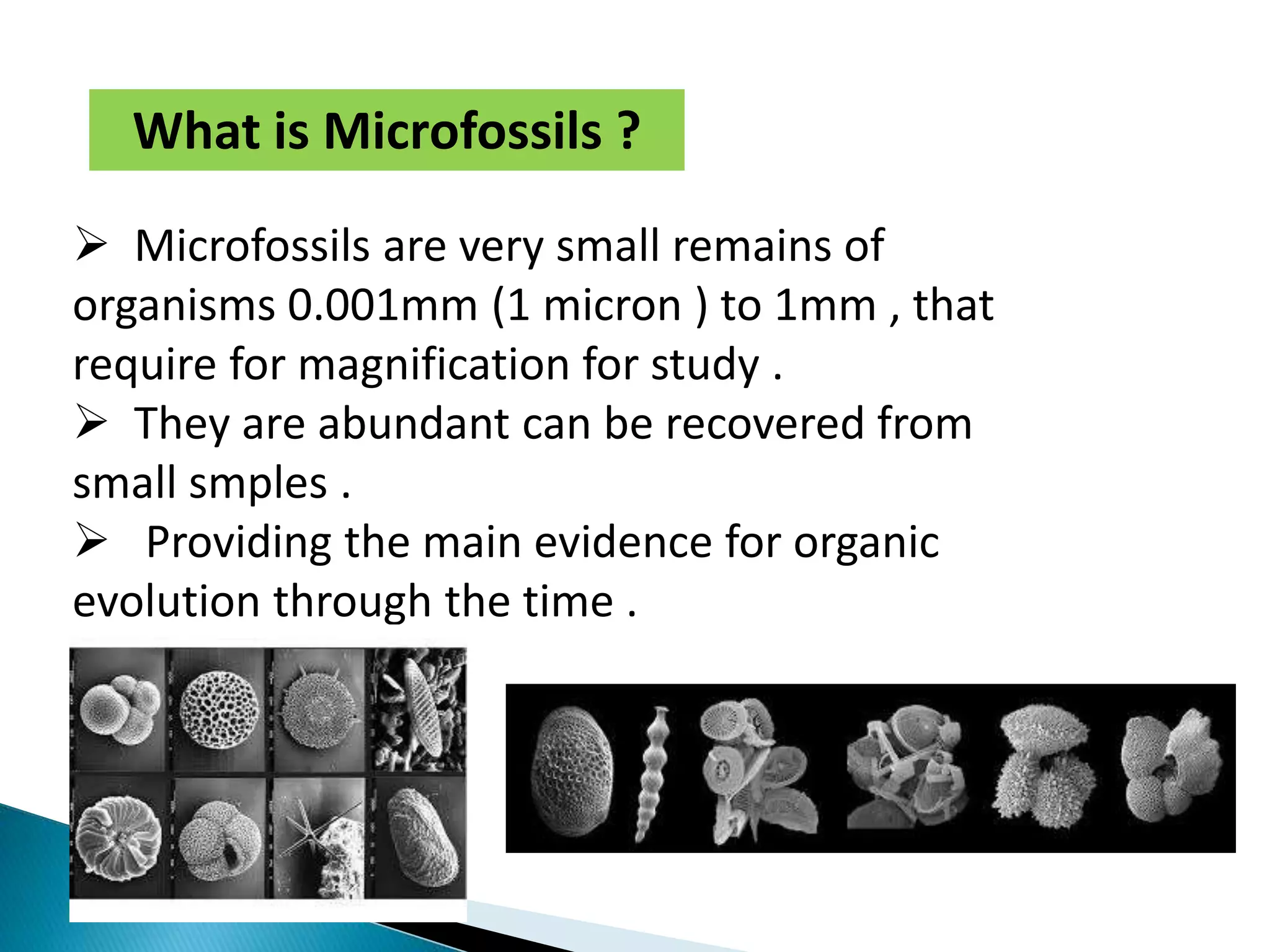
Microfossils are very small remains of
organisms 0.001mm (1 micron ) to 1mm , that
require for magnification for study .
They are abundant can be recovered from
small smples .
Providing the main evidence for organic
evolution through the time .
4.
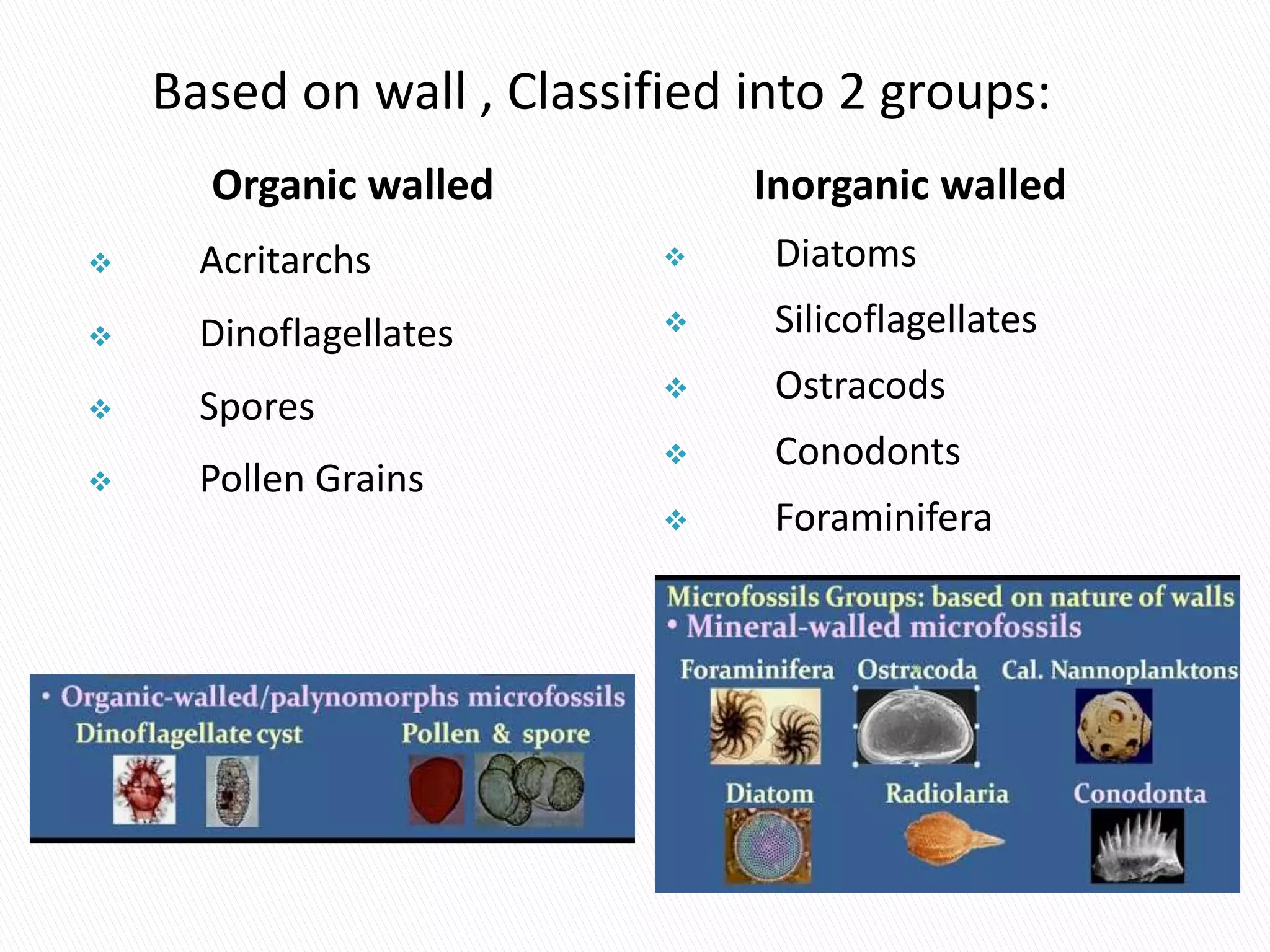
Based on wall, Classified into 2 groups:
Organic walled
Acritarchs
Dinoflagellates
Spores
Pollen Grains
Inorganic walled
Diatoms
Silicoflagellates
Ostracods
Conodonts
Foraminifera
5.
Based on thecontent of species we divided
some types they are,
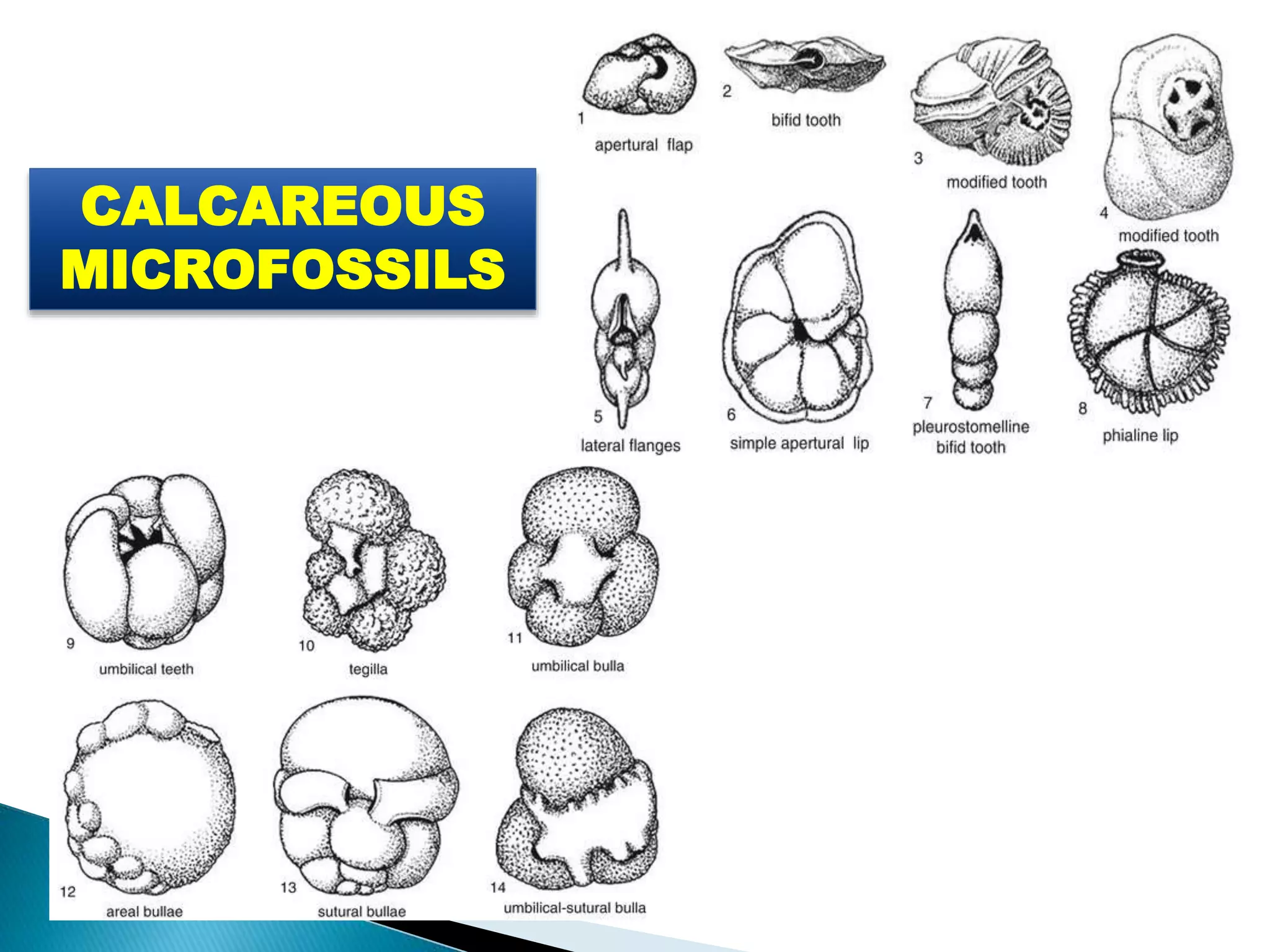
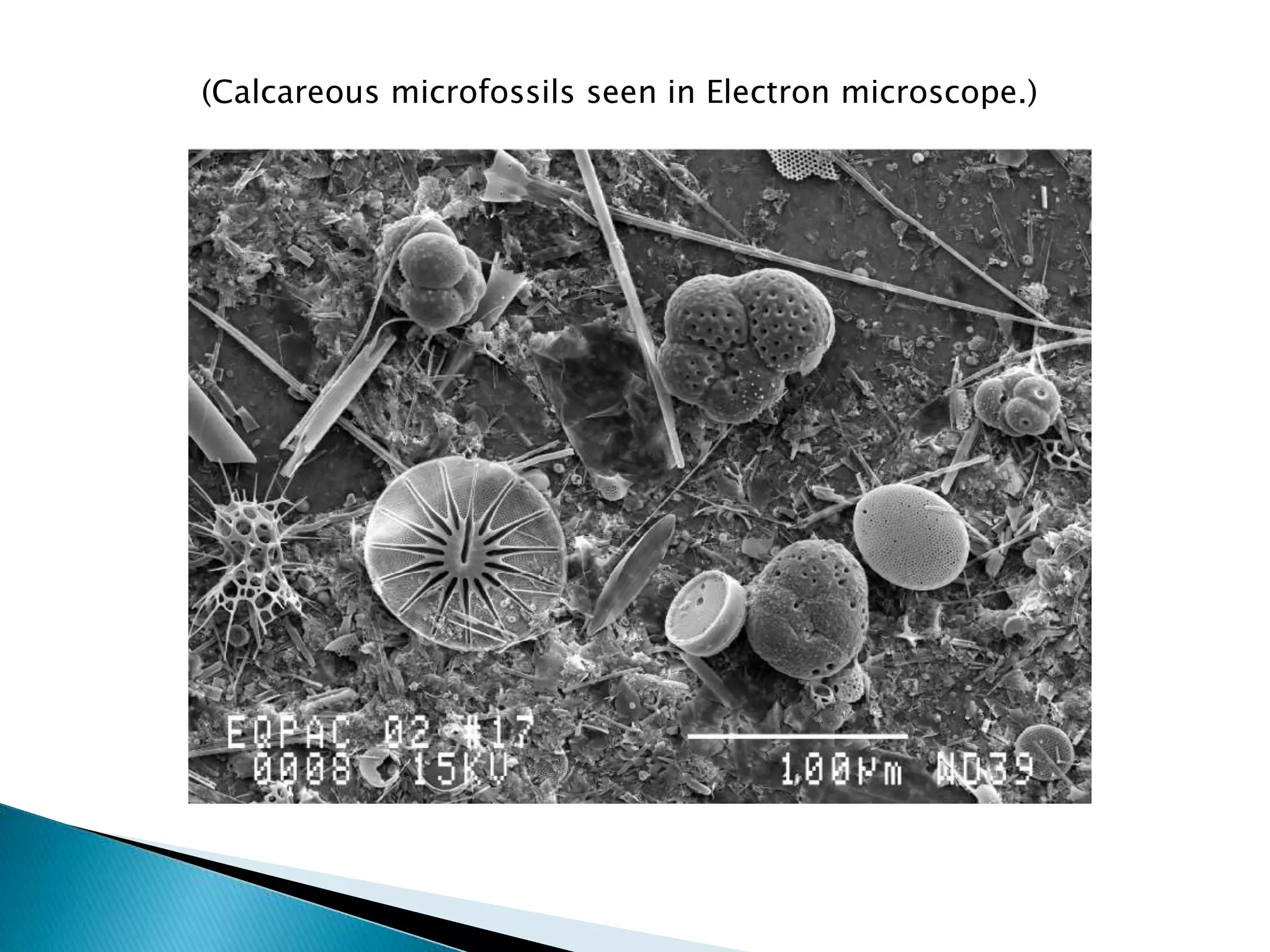
Calcareous Microfossils
include coccoliths, foraminifera, calcareous
dinoflagellate cysts, and ostracods (seed shrimp)
Phosphatic Microfossils
include conodonts (tiny oral structures of an extinct
chordate group), some scolecodonts.
Types Of Microfossils:
6.
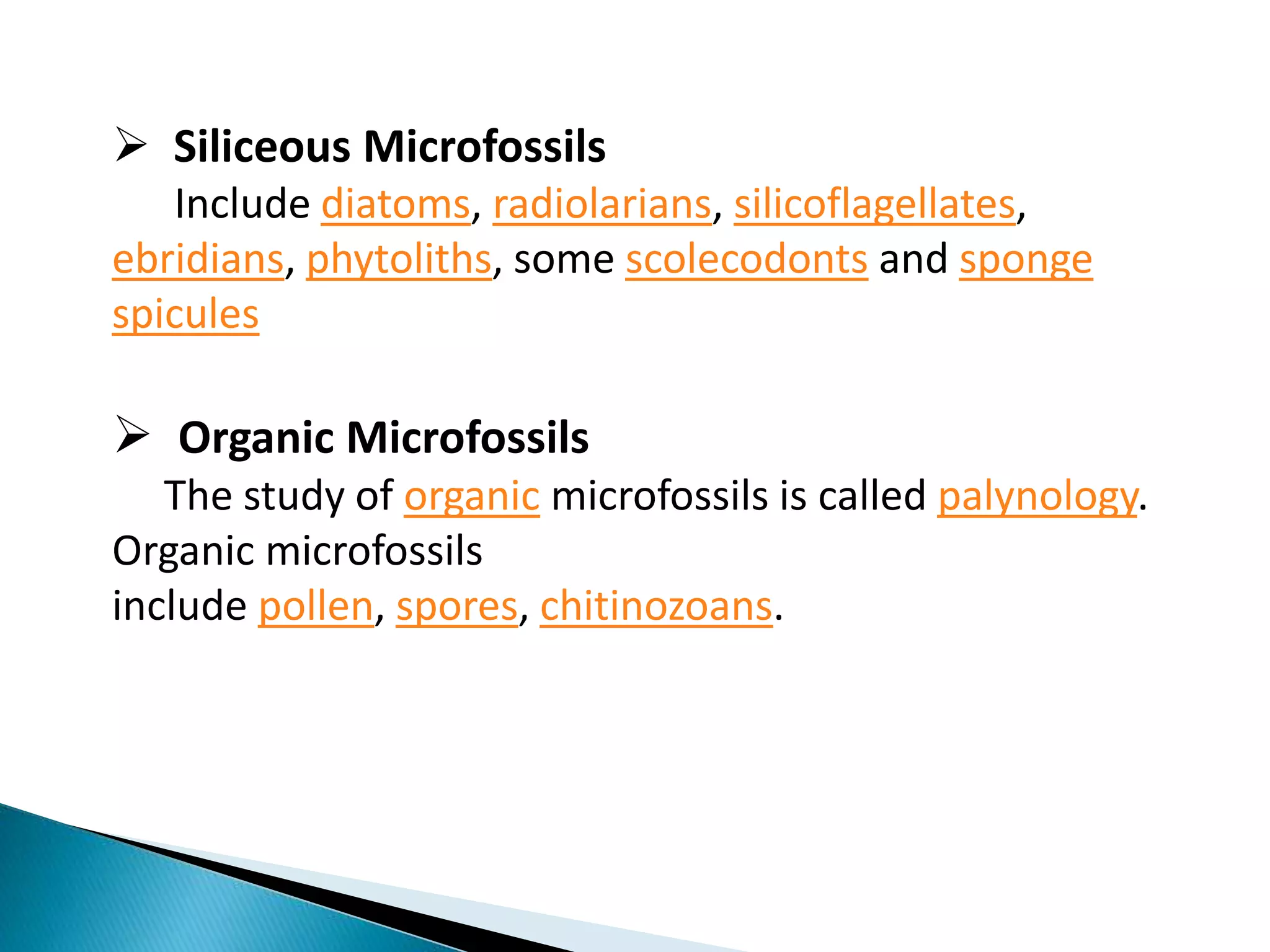
Siliceous Microfossils
Includediatoms, radiolarians, silicoflagellates,
ebridians, phytoliths, some scolecodonts and sponge
spicules
Organic Microfossils
The study of organic microfossils is called palynology.
Organic microfossils
include pollen, spores, chitinozoans.
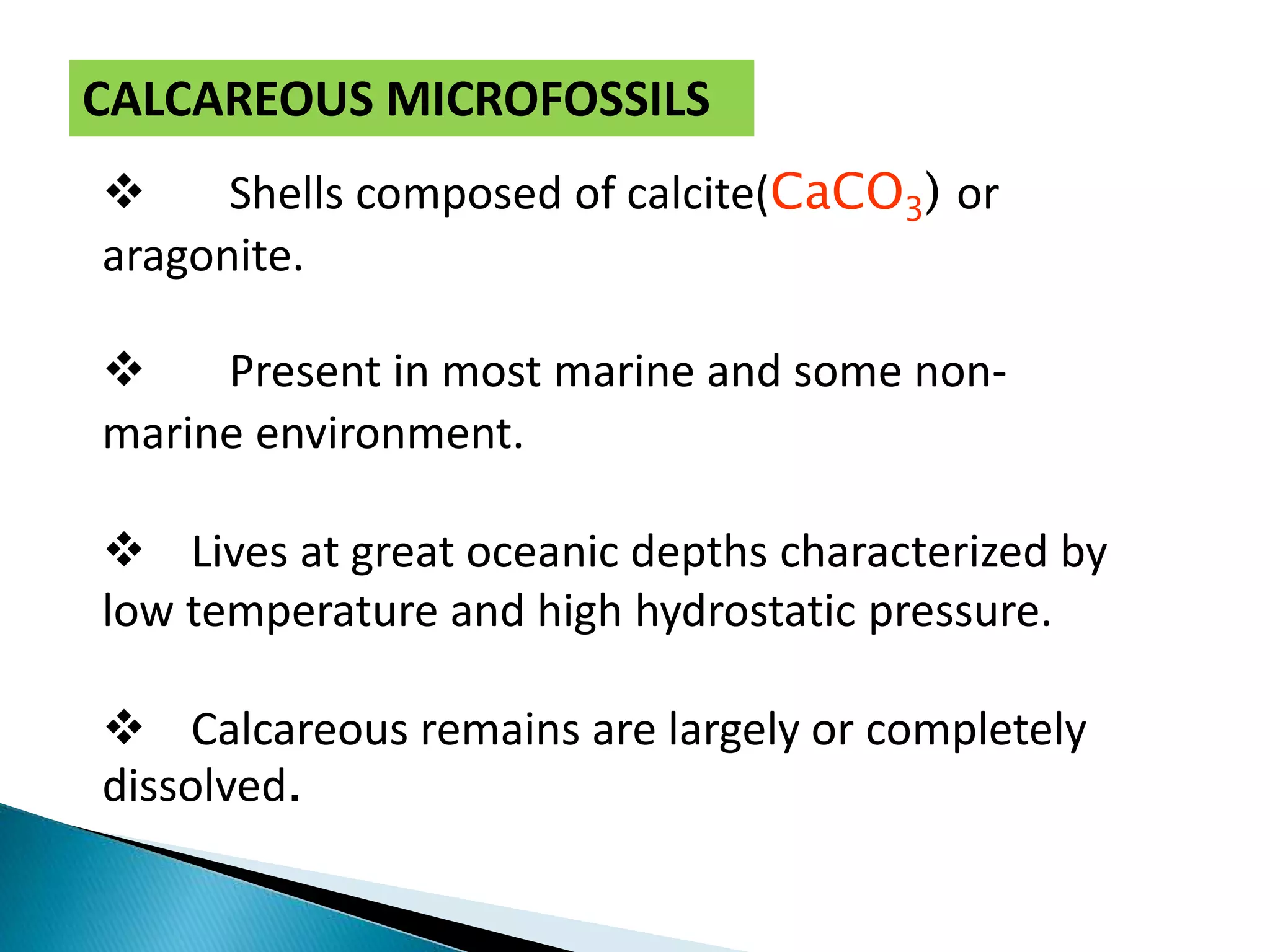
Shells composedof calcite(CaCO3) or
aragonite.
Present in most marine and some non-
marine environment.
Lives at great oceanic depths characterized by
low temperature and high hydrostatic pressure.
Calcareous remains are largely or completely
dissolved.
CALCAREOUS MICROFOSSILS
10.
There arethree principal types of Calcareous
Microfossils:
i). Calcareous foraminifera
ii). Ostracods, and
iii). Calcareous nannofossils
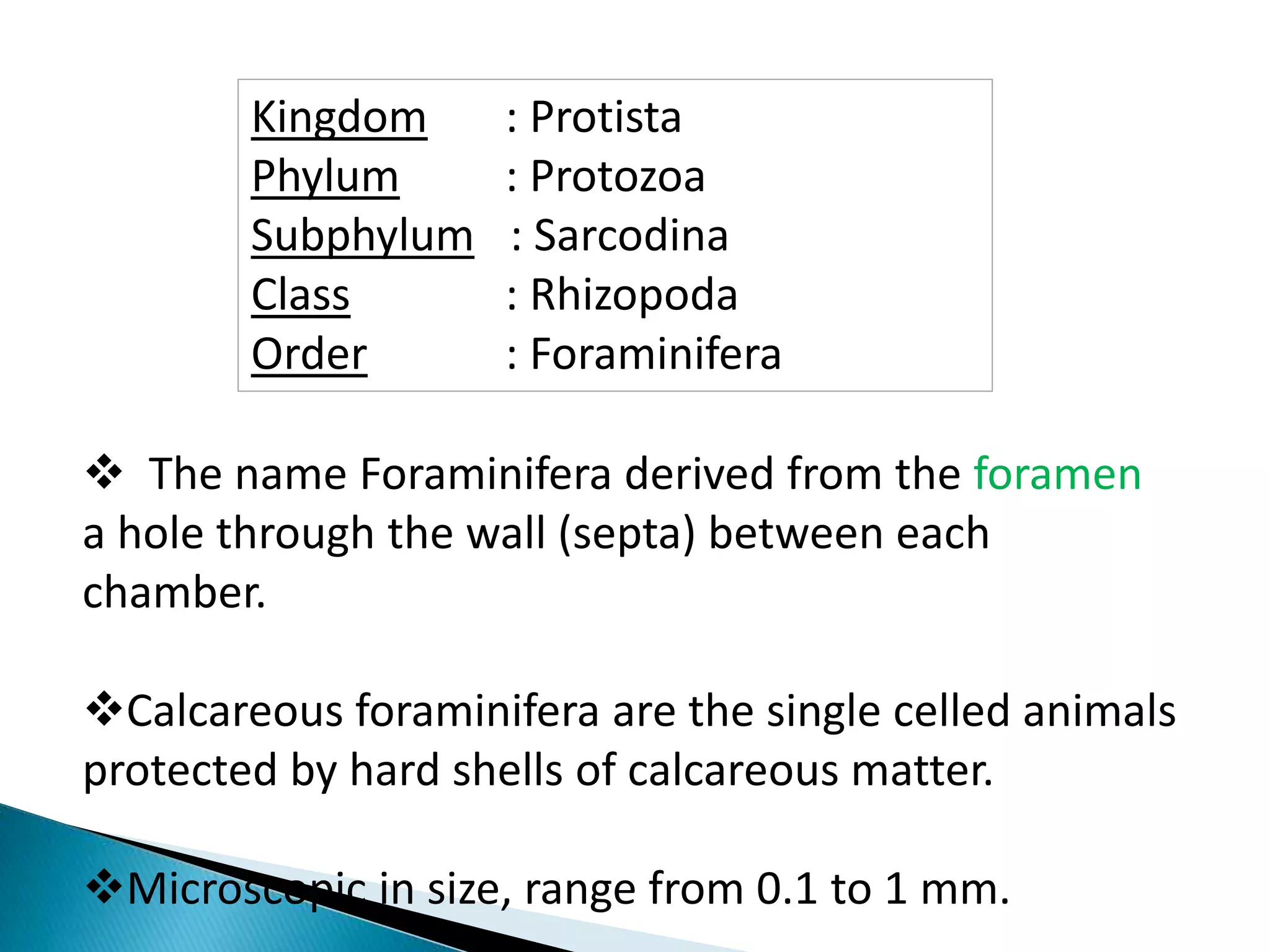
Kingdom : Protista
Phylum: Protozoa
Subphylum : Sarcodina
Class : Rhizopoda
Order : Foraminifera
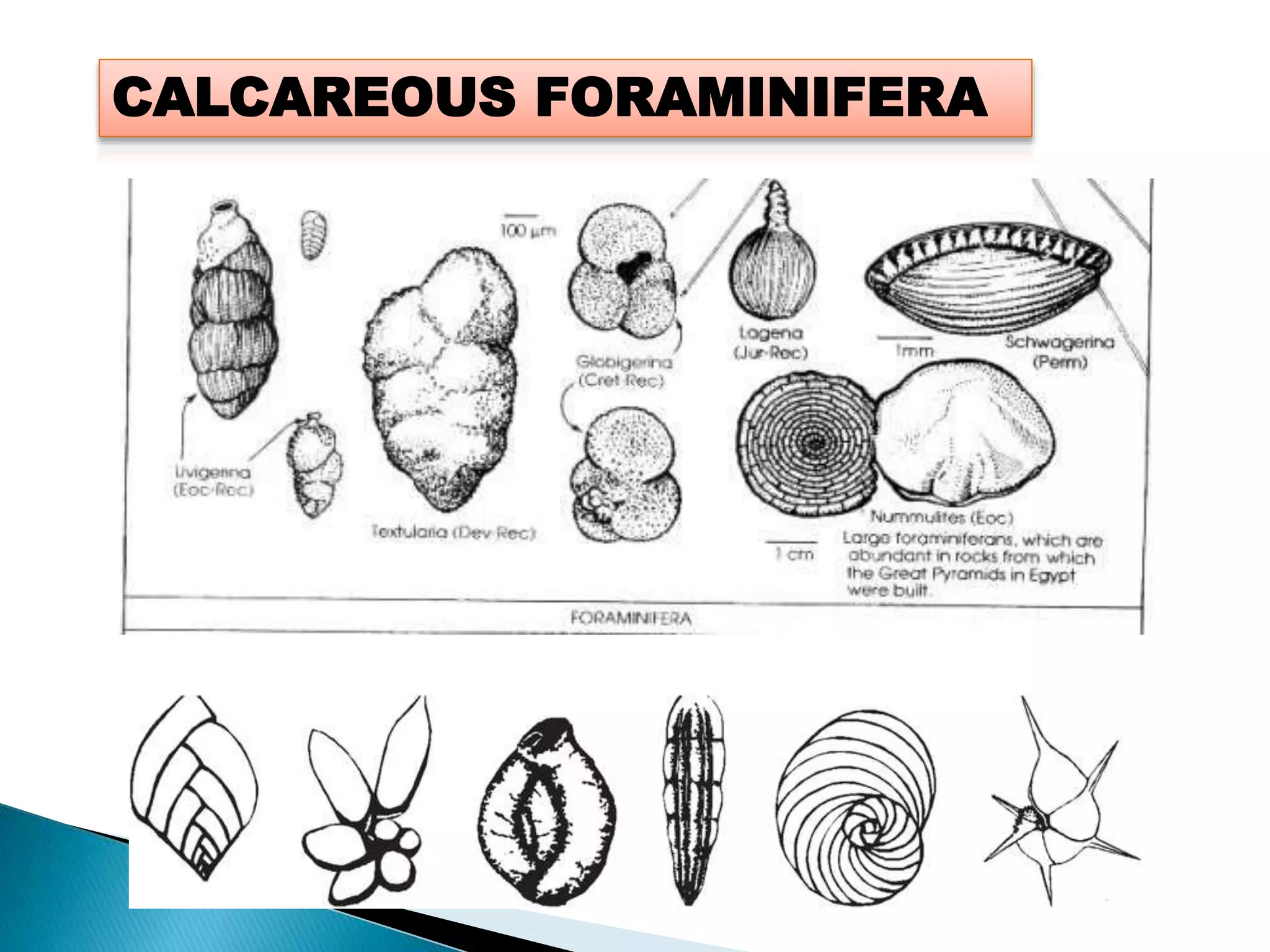
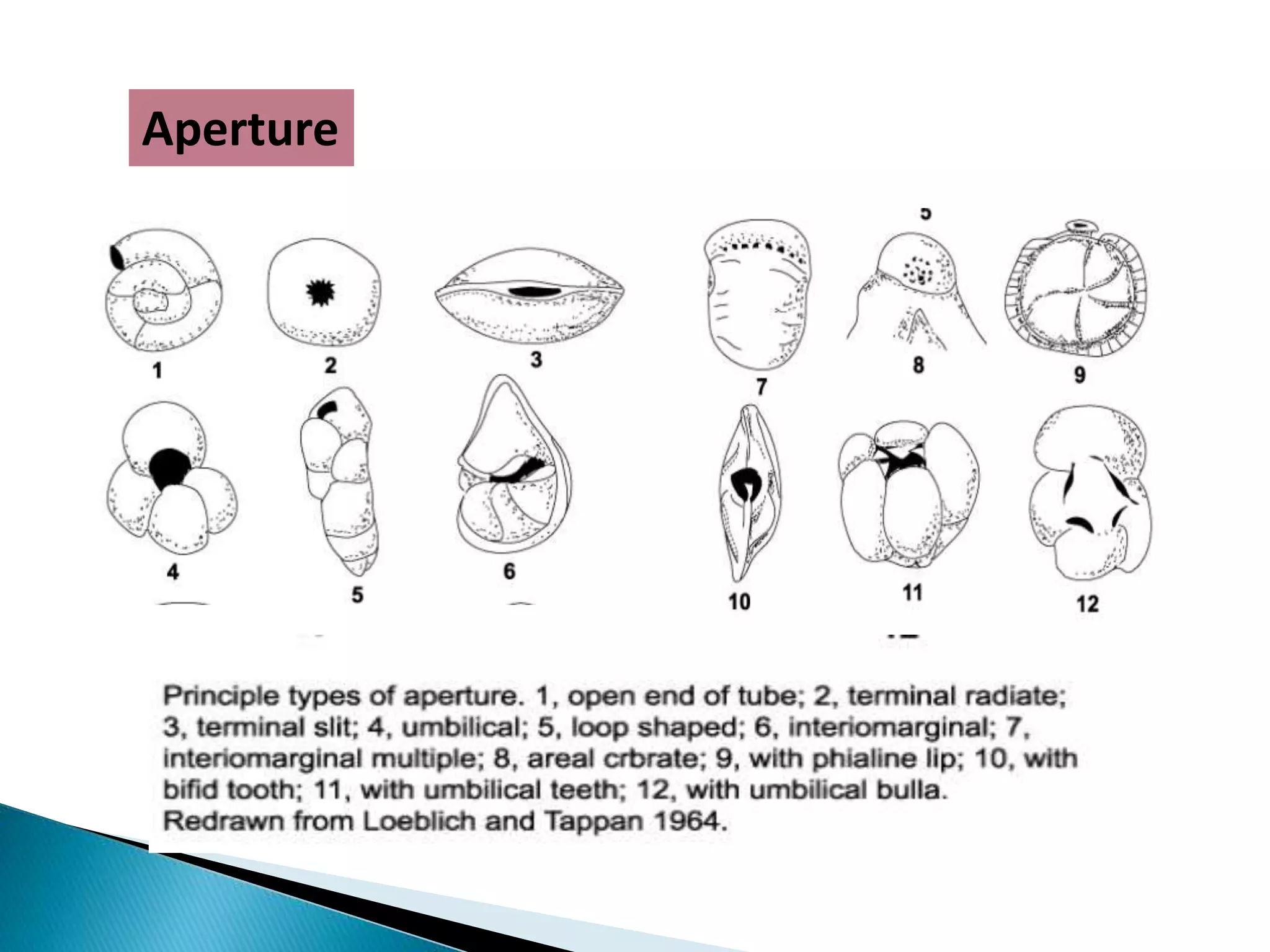
The name Foraminifera derived from the foramen
a hole through the wall (septa) between each
chamber.
Calcareous foraminifera are the single celled animals
protected by hard shells of calcareous matter.
Microscopic in size, range from 0.1 to 1 mm.
13.
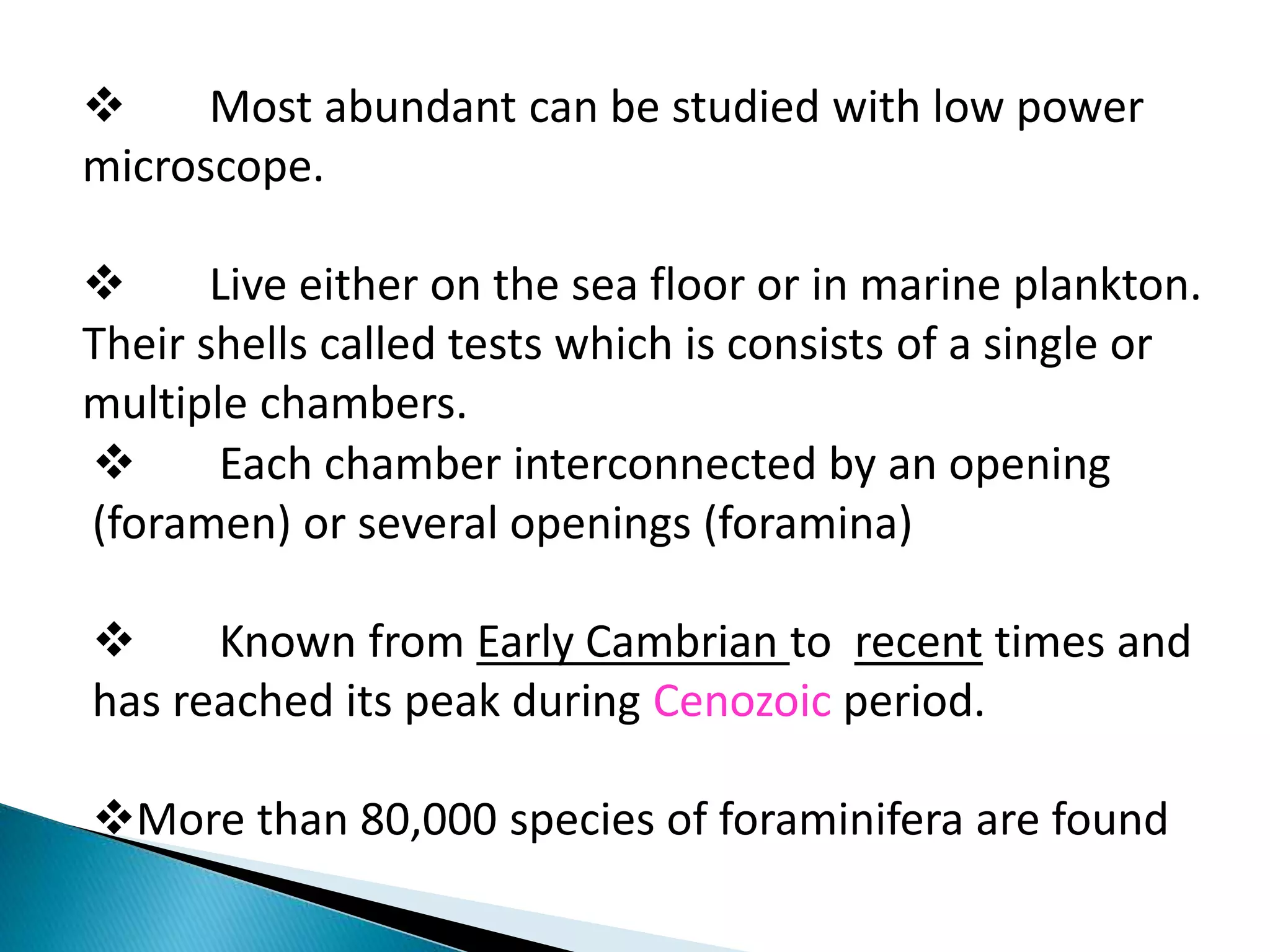
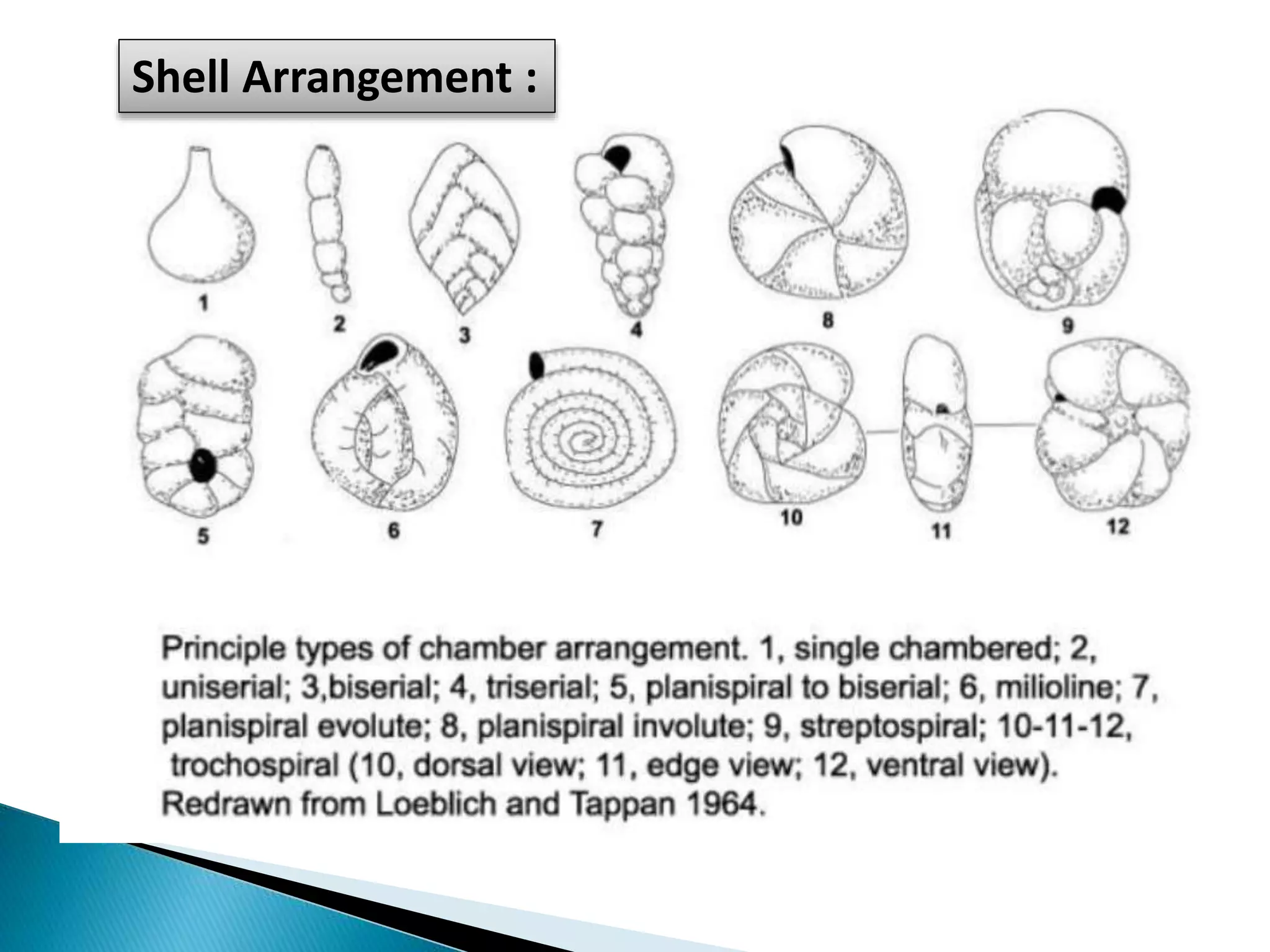
Each chamberinterconnected by an opening
(foramen) or several openings (foramina)
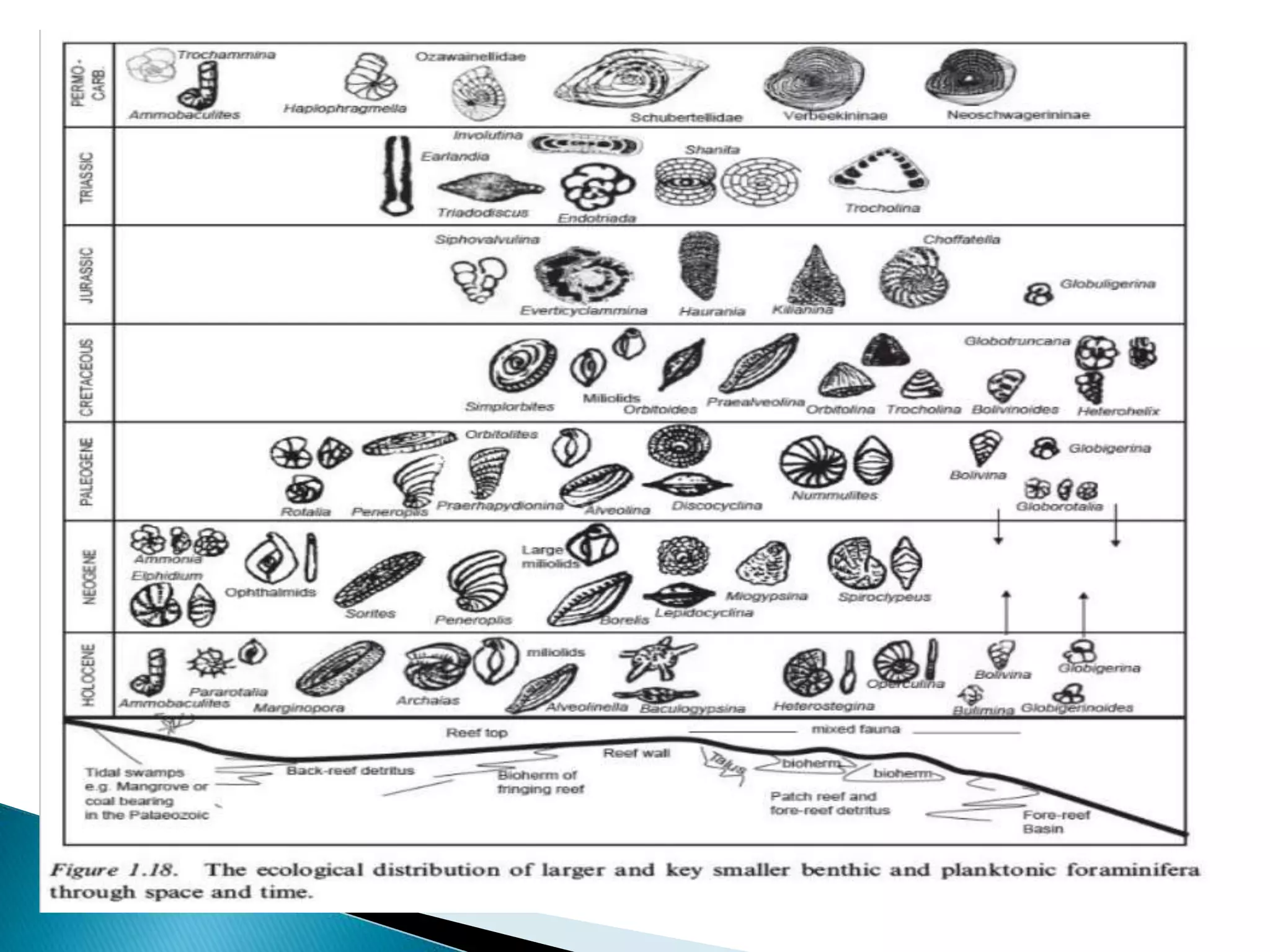
Known from Early Cambrian to recent times and
has reached its peak during Cenozoic period.
More than 80,000 species of foraminifera are found
Most abundant can be studied with low power
microscope.
Live either on the sea floor or in marine plankton.
Their shells called tests which is consists of a single or
multiple chambers.
14.
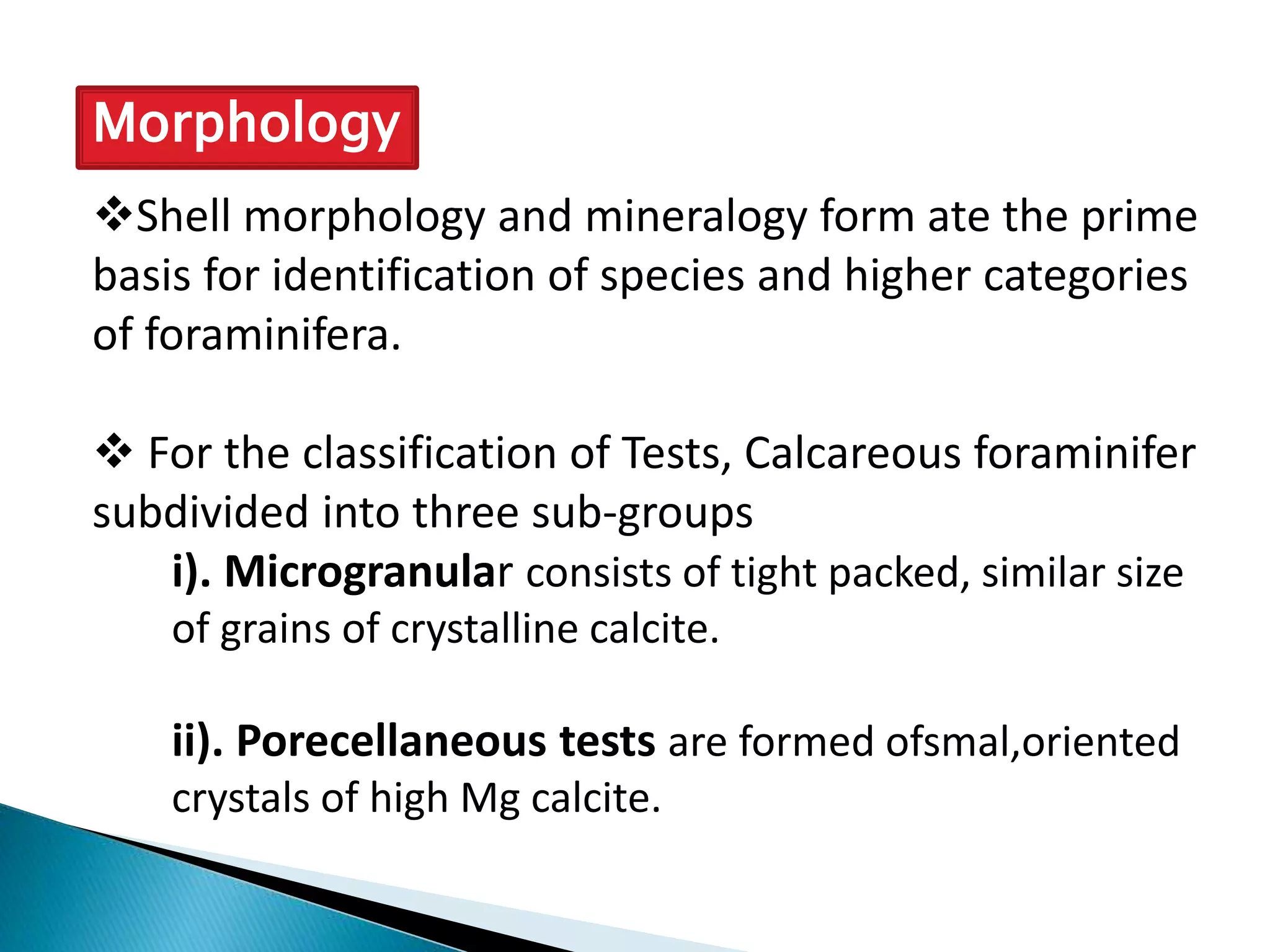
Morphology
Shell morphology andmineralogy form ate the prime
basis for identification of species and higher categories
of foraminifera.
For the classification of Tests, Calcareous foraminifer
subdivided into three sub-groups
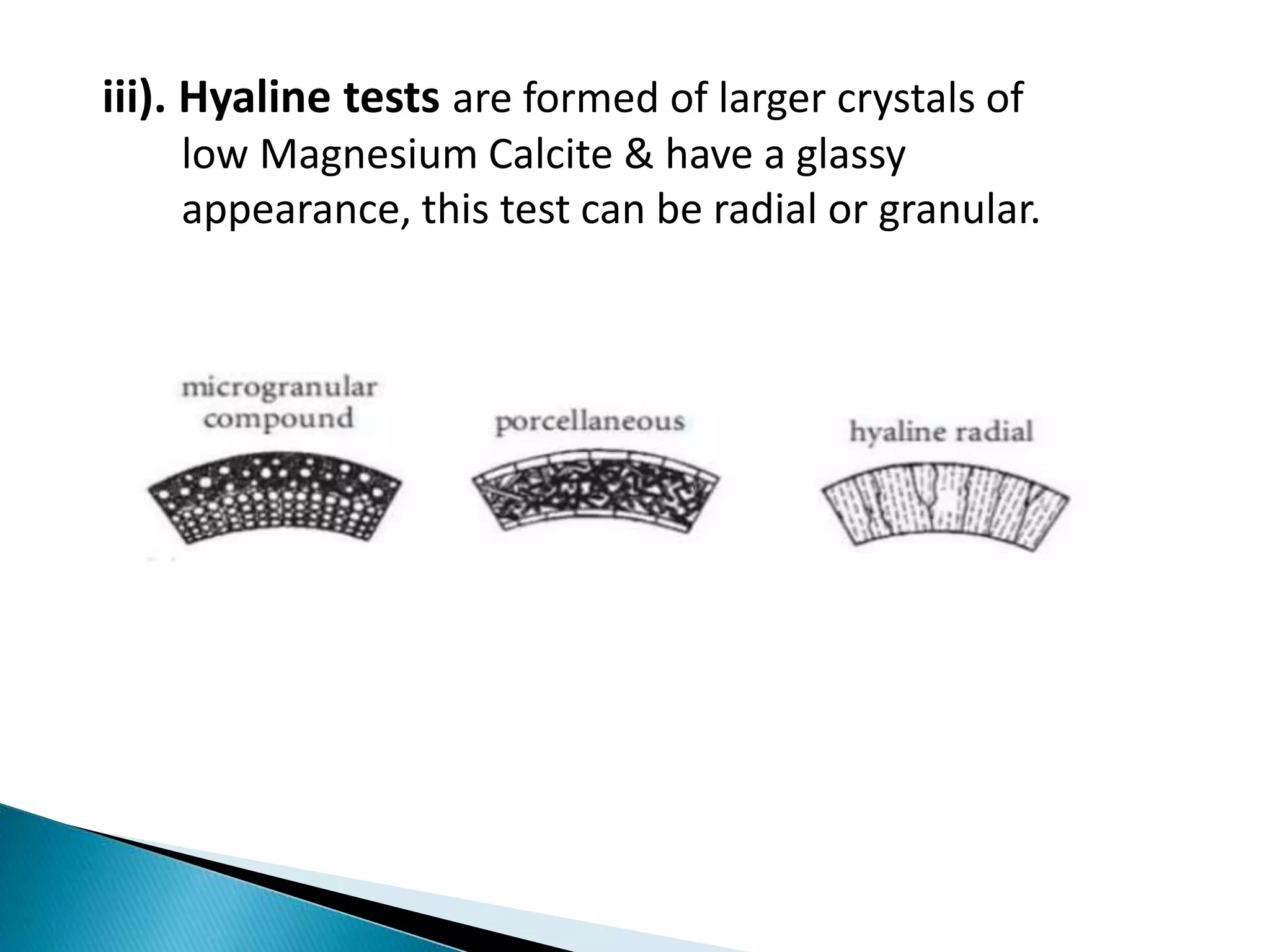
i). Microgranular consists of tight packed, similar size
of grains of crystalline calcite.
ii). Porecellaneous tests are formed ofsmal,oriented
crystals of high Mg calcite.
15.
iii). Hyaline testsare formed of larger crystals of
low Magnesium Calcite & have a glassy
appearance, this test can be radial or granular.
Geological distribution
Foraminiferaare thought to have been present in
present in the Pre-Cambrian seas, but as yet no undepted
fossils of this order have been described from rocks older
than the Cambrian.
They made their first appearance in Cambrian and
comparatively rare till carboniferous, but they became
prominent and of great geological importance during
upper carboniferous and Permian.
So, therefore Foramainifera ranging from Cambrian
To Recent.
20.
Applications :
Calcareous fossilforaminifer are formed from
elements found in the ancient seas they lived in. Thus
they are very useful in Palaeoclimatology and
Palaeoceanography.
They can be used to reconstruct past climate by
examining stable isotope ratios of oxygen , and the
history of the carbon cycle and oceanic productivity by
examining the stable isotope ratios of carbon.
21.
Foraminifera canalso used be utilised in
archaeology in the provenacing of some stone raw
material types. Some stone types such as limestone,
are commonly found to contain fossilised
foraminifera.
Because of their diversity, abundance, and
complex morphology, fossil foraminiferal
assemblages are useful for biostratigraphy, and can
accurately give relative dates to rocks. The oil
industry relies heavily on microfossils such as forams
to find potential oil deposits.