
METAMORPHISM OF
1.ULTRAMAFIC AND MAFIC
2. PELITIC AND CALCAREOUS
ROCKS
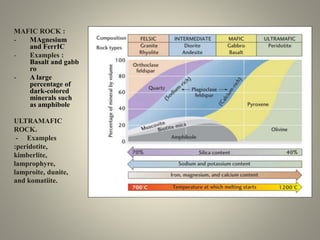
MAFIC ROCK :
- MAgnesium
and FerrIC
- Examples :
Basalt and gabb
ro
- A large
percentage of
dark-colored
minerals such
as amphibole
ULTRAMAFIC
ROCK.
- Examples
:peridotite,
kimberlite,
lamprophyre,
lamproite, dunite,
and komatiite.
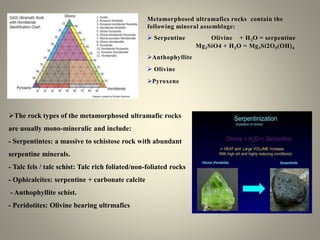
Metamorphosed ultramafics rocks contain the
following mineral assemblage:
 Serpentine Olivine + H2O = serpentine
Mg2SiO4 + H2O = Mg3Si2O5(OH)4
Anthophyllite
 Olivine
Pyroxene
The rock types of the metamorphosed ultramafic rocks
are usually mono-mineralic and include:
- Serpentintes: a massive to schistose rock with abundant
serpentine minerals.
- Talc fels / talc schist: Talc rich foliated/non-foliated rocks
- Ophicalcites: serpentine + carbonate calcite
- Anthophyllite schist.
- Peridotites: Olivine bearing ultrmafics
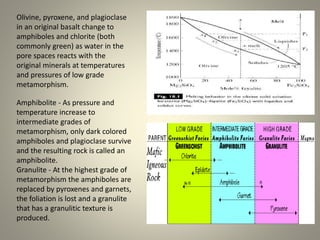
Olivine, pyroxene, and plagioclase
in an original basalt change to
amphiboles and chlorite (both
commonly green) as water in the
pore spaces reacts with the
original minerals at temperatures
and pressures of low grade
metamorphism.
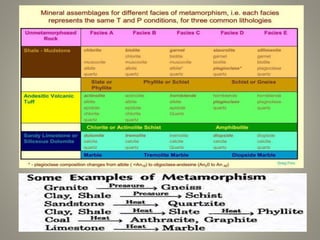
Amphibolite - As pressure and
temperature increase to
intermediate grades of
metamorphism, only dark colored
amphiboles and plagioclase survive
and the resulting rock is called an
amphibolite.
Granulite - At the highest grade of
metamorphism the amphiboles are
replaced by pyroxenes and garnets,
the foliation is lost and a granulite
that has a granulitic texture is
produced.
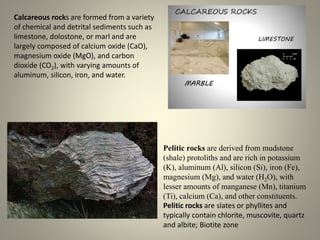
Calcareous rocks are formed from a variety
of chemical and detrital sediments such as
limestone, dolostone, or marl and are
largely composed of calcium oxide (CaO),
magnesium oxide (MgO), and carbon
dioxide (CO2), with varying amounts of
aluminum, silicon, iron, and water.
Pelitic rocks are derived from mudstone
(shale) protoliths and are rich in potassium
(K), aluminum (Al), silicon (Si), iron (Fe),
magnesium (Mg), and water (H2O), with
lesser amounts of manganese (Mn), titanium
(Ti), calcium (Ca), and other constituents.
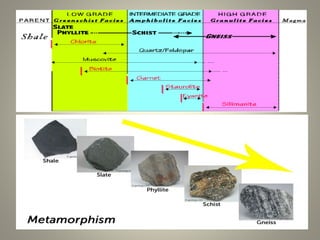
Pelitic rocks are slates or phyllites and
typically contain chlorite, muscovite, quartz
and albite; Biotite zone
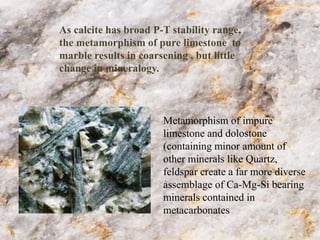
As calcite has broad P-T stability range,
the metamorphism of pure limestone to
marble results in coarsening , but little
change in mineralogy.
Metamorphism of impure
limestone and dolostone
(containing minor amount of
other minerals like Quartz,
feldspar create a far more diverse
assemblage of Ca-Mg-Si bearing
minerals contained in
metacarbonates
THANK YOU

Metamorphism of different Rocks

  • 1.
    METAMORPHISM OF 1.ULTRAMAFIC ANDMAFIC 2. PELITIC AND CALCAREOUS ROCKS
  • 2.
    MAFIC ROCK : -MAgnesium and FerrIC - Examples : Basalt and gabb ro - A large percentage of dark-colored minerals such as amphibole ULTRAMAFIC ROCK. - Examples :peridotite, kimberlite, lamprophyre, lamproite, dunite, and komatiite.
  • 3.
    Metamorphosed ultramafics rockscontain the following mineral assemblage:  Serpentine Olivine + H2O = serpentine Mg2SiO4 + H2O = Mg3Si2O5(OH)4 Anthophyllite  Olivine Pyroxene The rock types of the metamorphosed ultramafic rocks are usually mono-mineralic and include: - Serpentintes: a massive to schistose rock with abundant serpentine minerals. - Talc fels / talc schist: Talc rich foliated/non-foliated rocks - Ophicalcites: serpentine + carbonate calcite - Anthophyllite schist. - Peridotites: Olivine bearing ultrmafics
  • 4.
    Olivine, pyroxene, andplagioclase in an original basalt change to amphiboles and chlorite (both commonly green) as water in the pore spaces reacts with the original minerals at temperatures and pressures of low grade metamorphism. Amphibolite - As pressure and temperature increase to intermediate grades of metamorphism, only dark colored amphiboles and plagioclase survive and the resulting rock is called an amphibolite. Granulite - At the highest grade of metamorphism the amphiboles are replaced by pyroxenes and garnets, the foliation is lost and a granulite that has a granulitic texture is produced.
  • 5.
    Calcareous rocks areformed from a variety of chemical and detrital sediments such as limestone, dolostone, or marl and are largely composed of calcium oxide (CaO), magnesium oxide (MgO), and carbon dioxide (CO2), with varying amounts of aluminum, silicon, iron, and water. Pelitic rocks are derived from mudstone (shale) protoliths and are rich in potassium (K), aluminum (Al), silicon (Si), iron (Fe), magnesium (Mg), and water (H2O), with lesser amounts of manganese (Mn), titanium (Ti), calcium (Ca), and other constituents. Pelitic rocks are slates or phyllites and typically contain chlorite, muscovite, quartz and albite; Biotite zone
  • 6.
    As calcite hasbroad P-T stability range, the metamorphism of pure limestone to marble results in coarsening , but little change in mineralogy. Metamorphism of impure limestone and dolostone (containing minor amount of other minerals like Quartz, feldspar create a far more diverse assemblage of Ca-Mg-Si bearing minerals contained in metacarbonates
  • 9.